




Abstract
Background:
Multiple sclerosis is a chronic immune-mediated disease of the central nervous system affecting nearly 3 million people worldwide. Although much progress has been made in the understanding and treatment of MS, cures remain elusive.
Objectives:
To accelerate the development of cures for MS by updating the Pathways to Cures Research Roadmap based on a contemporary understanding of disease. The refined Roadmap will help to promote research in scientific areas with great potential to reveal insights leading to cures and inspire greater coordination of global resources.
Methods:
Refinements to the Roadmap were achieved during a Global Summit that included close to 200 academic and industry scientists, health care providers, policy makers, funders, and people with MS from 15 countries.
Results:
The refined Roadmap describes three pathways that target opportunities for generating scientific insights leading to cures. Recommendations for accelerating research progress include, lowering barriers for global data sharing, enhancing collaboration and coordination among research supporters, committing to sustained funding, considering implications for implementation, engaging PwMS and committing to diversity, equity, and inclusion in the global MS movement.
Conclusion:
The refined roadmap provides a strategic framework for tackling the complexities of MS and advancing prevention strategies, effective treatments, and cures.
Introduction
Multiple sclerosis (MS) is a chronic immune-mediated disease of the central nervous system (CNS) affecting nearly 3 million people worldwide that can cause significant disability. 1 Although much progress has been made in understanding the pathogenesis of MS and there are many effective treatments for relapsing disease, strategies that prevent incident cases do not yet exist, there is a paucity of therapies that slow disability progression or restore function, and cures for MS remain elusive. The Pathways to Cures Research Roadmap (Roadmap) was established several years ago with input from scientific experts, health care providers, and people with MS (PwMS) and has been endorsed by 31 leading global MS advocacy and professional organizations. 2 The goals of the Roadmap are to (1) promote research in scientific areas with great potential to reveal insights leading to cures, and (2) inspire greater coordination of global resources that accelerate scientific progress.
There are three distinct but overlapping Pathways described in the Roadmap: (1) The Stop pathway is focused on achieving a state of no new disease activity or CNS injury, (2) the Restore pathway aims to reverse symptoms and recover neurological function, and (3) the End pathway strives to prevent incident cases of MS. The opportunities for achieving cures in the context of the current understanding of the natural history and biological basis of MS are illustrated in Figure 1.
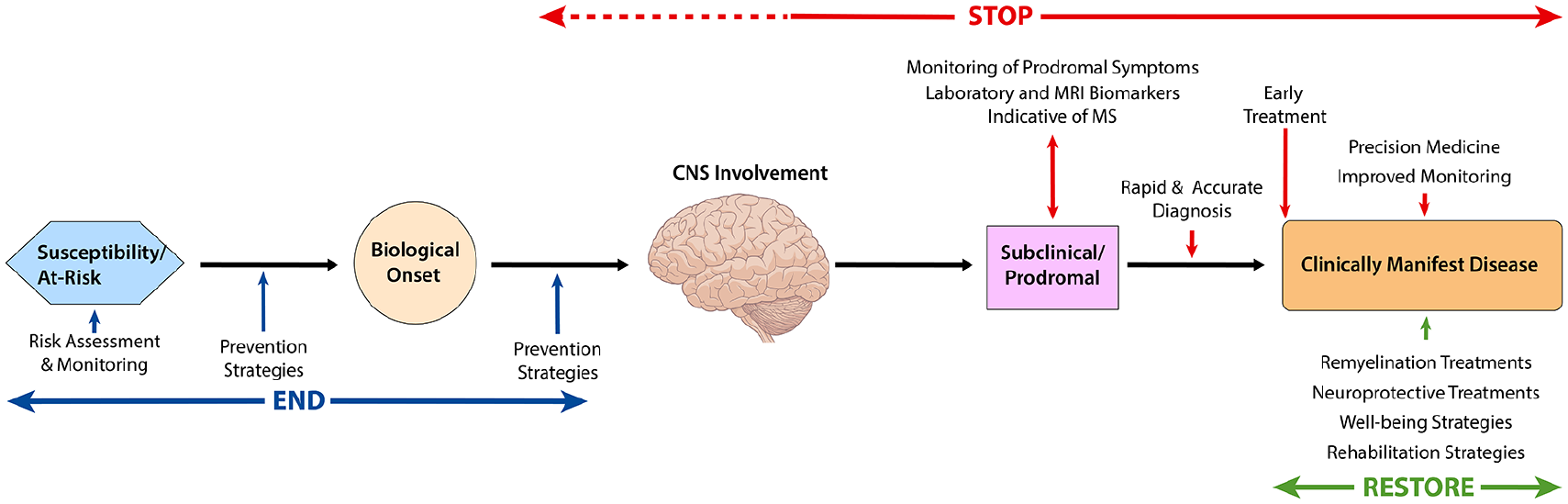
Opportunities for Pathways to Cures Interventions.
The Roadmap is a living document and significant advances in the understanding and treatment of MS have been achieved since it was first established. These new insights and refinements were discussed during a recent Global Summit that included nearly 200 academic and industry scientists, health care providers, policy makers, funders, and PwMS from 15 countries. This report contains an updated Roadmap that considers recent scientific advances and provides recommendations which could accelerate progress toward cures through enhanced global collaboration.
Stop pathway
Objective 1
The first objective of the Stop pathway is early detection and treatment. Progress toward this objective includes ongoing refinements to the MS diagnostic criteria that allow for earlier and more accurate diagnosis.3,4 New insights are revealing early features of MS that could identify people at the very beginning of disease. 5 For example, radiologically isolated syndrome (RIS) is a condition wherein lesions characteristic of MS are detected by magnetic resonance imaging (MRI) that often precede the onset of clinical disease by several years. 6 Two recent studies have reported that treatment with disease-modifying therapies (DMTs) can delay and, in some cases, prevent the onset of clinical MS in people with RIS.7,8 Prodromal features of MS have also been recognized, representing another opportunity to identify individuals who are starting to develop MS. 9 These and other research advances have created optimism that MS can be detected and treated at its very earliest stages with greatly improved outcomes.
Research priorities
Refine the MS diagnostic criteria to facilitate ever earlier and more accurate diagnosis and treatment.
Improve the RIS criteria to enhance its predictive value.
Establish clinical, imaging, fluid, genetic, and immune biomarkers that allow for the sensitive and specific detection of the pre-clinical and prodromal stages of disease in diverse populations.
Objective 2
Tailoring DMTs to the dominant pathological feature in an individual is the second objective of the Stop pathway. Progress has been made in defining the biological basis for the different clinical presentations of MS, and these insights are contributing to a refined classification of disease subtypes. An international work group has begun updating the MS classification based on the underlying pathophysiology that is well supported by the MS community.10–15
Blood biomarkers that identify different MS trajectories have been reported, possibly enabling a match between a PwMS and their optimal treatment.16–18 Machine learning algorithms have been applied to brain MRI scans that identified specific disease subtypes. 19 In addition, genetic studies have identified a locus associated with more rapid clinical progression, which may reveal targets leading to the development of DMTs for progressive subtypes of MS. 20 These and other recent advancements, are moving us toward a more personalized approach to treatment of MS.
Research priorities
Combine insights from genetic signatures of disease subtypes with multimodal immune phenotyping to decipher the underlying pathophysiology of MS disease subtypes.
Explore MRI-based subtyping using machine learning to better understand underlying disease mechanisms and to help predict prognosis and treatment response.
Develop effective DMTs for progressive MS.
Restore pathway
Objective 1
The first objective of the Restore pathway is to develop strategies to repair myelin, restore axonal function, preserve neurons, and reestablish neural circuits. Currently, the most achievable regenerative process is the restoration of myelin. 21 In pre-clinical models, remyelination has been shown to reestablish saltatory conduction, promote functional recovery, and protect axons from degeneration. 21
A leading approach for enhancing remyelination in MS is to promote the expansion, recruitment to lesions, and differentiation of resident oligodendrocyte precursor cells (OPCs) into myelin producing cells. Several agents that regulate receptors, cell metabolism, as well as signaling pathways that promote OPC differentiation have shown promise in pre-clinical models and some are being tested in MS.22–25 Modest improvements in outcomes such as visual evoked potential latency, low contrast visual acuity, and MRI measures such as magnetization transfer ratio, myelin water fraction, and diffusion tensor imaging have been reported. 22 Increasing the pool of OPCs through transplantation of progenitor cells into the CNS is another strategy being tested to promote remyelination, and a recent report of human fetal neural precursor cell transplantation in PwMS supports this approach. 26
For myelin repair strategies to be effective, it is imperative that the tissue microenvironment be permissive. Damaging inflammatory factors must be subdued and inhibitors of repair neutralized for optimal remyelination. Inhibitors including LINGO-1, myelin debris, and several extracellular matrix molecules have been identified, and in some cases pharmacological agents that mitigate these factors have been developed.27–29 In addition, drugs that promote phagocytic activity within lesions and expedite debris removal have been proposed to promote a “repair friendly” environment. 30
Research priorities
Engineer better animal models of remyelination with higher translational value that takes into account the inflammatory nature of MS lesions.
Combine remyelinating approaches with different and complementary mechanisms of action.
Achieve a better understanding of regional remyelination given that gray matter lesions remyelinate better than white matter lesions. 31
Develop fluid biomarkers that inform on remyelination, along with continued improvement in quantifiable imaging measures for CNS remyelination.
Objective 2
The second objective of the Restore Pathway is to develop prehabilitation and rehabilitation strategies that leverage the plasticity of the CNS to achieve preventive, restorative, and compensatory approaches for maintaining or improving function. Physical activity and exercise are cornerstone interventions in MS with documented benefits for a wide array of symptoms. 32 Emerging evidence suggests that increased levels of physical activity and/or structured exercise may have a disease-modifying potential in MS and may even lower the risk of disease.33,34 Recently, interventions deployed early in the disease course (prehabilitation), aiming to prevent loss of function rather than restoring lost abilities, have been explored. 35
Cognitive rehabilitation is another promising area with documented improvement in several cognitive domains. 36 Cognitive rehabilitation can also improve quality of life, suggesting that memory rehabilitation is beneficial and meaningful to PwMS. 37 Whereas physical activity and exercise have the potential to build a physical reserve, it is still debated whether this is also possible with cognitive rehabilitation. The ability of cognitive and exercise interventions in combination to ameliorate cognitive dysfunction in progressive MS have been recently explored—albeit with mixed results. 38 Dietary interventions, balance training, and sleep interventions have also shown promise and are currently being investigated.35,39–43
Research priorities
Enhance the methodological quality of MS rehabilitation studies.
Prioritize testing of strategies deployed early in the disease course that prevent function loss.
Test complex interventions combining several approaches and/or alongside pharmacological treatment.
Develop a better understanding of the “active ingredient” of non-pharmacological interventions and develop a deeper understanding of the underlying mechanisms leading to functional recovery.
Achieve a better understanding of dose-response relationships and how different subgroups of patients may respond to treatment.
End pathway
Objective 1
The first objective of this pathway is to develop strategies for prevention of incident cases of MS in the general population by limiting or preventing exposure to modifiable risk factors. There has been considerable progress made in identifying risk factors associated with the onset of MS. Both genetic and epidemiological studies of large-scale cohorts or national health care systems data have returned robust and well validated associations. 44 These observations have prioritized different mechanisms potentially related to the onset of MS, including metabolic factors such as obesity in adolescence, environmental exposures that influence vitamin D levels, pollutants such as those found in cigarette smoke, and exposure to Epstein Barr Virus (EBV).45–49 While causation has yet to be determined for any of these risk factors, strategies that minimize or eliminate exposures to modifiable risks factors (e.g. neutralizing EBV vaccination) represent promising areas of research to explore.
Genetic studies have provided additional insights from the more than 234 MS susceptibility variants identified. 44 Most of these variants appear to influence the expression of genes in peripheral immune cells and up to half of them also influence susceptibility to other autoimmune diseases, suggesting that the earliest molecular events leading to MS involve peripheral immune dysregulation and a propensity for autoimmunity. 50 It is currently unknown how these features of immune dysfunction, driven by MS risk variants, may relate to the environmental exposures and life experiences associated with MS risk.
Research priorities
Understand better the modifiable risk factors, genetic determinants, and the interactions contributing to MS etiology in European and non-European populations.
Increase knowledge of early life exposures (including prenatal and perinatal) that contribute to the development of pediatric MS.
Promote collaboration with public health and other patient advocacy organizations with a common interest in preventing MS in the design and implementation of prevention trials.
Objective 2
The second objective of the End pathway is to prevent MS in people with an elevated risk for developing disease. Studies of first-degree relatives of individuals with rheumatoid arthritis and type 1 diabetes have shown that biomarkers and genetic factors can predict disease risk and they are being used to enable prevention trials.51,52 While the ability to predict the risk for MS has not yet been validated, these studies offer examples for the design of MS prevention approaches.
Designing MS prevention studies in high-risk individuals inspires a key semantic question of “what is MS?” While formal diagnostic criteria for MS exist, they are not helpful for prevention studies because the CNS is already damaged by the time MS is diagnosed. Since RIS and clinically isolated syndrome (CIS) also respond to MS DMTs, we can conceptualize MS starting once the CNS is involved. Therefore, for high-risk prevention studies, individuals in this pre-clinical stage of disease (prior to engagement of the CNS and any radiological evidence of MS and/or prodromal symptoms) will need to be identified. Candidate biomarkers which can identify people at high risk for MS have been reported, but their relevance for identifying people in the pre-clinical stage of disease is still unclear.53–56
Key factors needed to develop therapeutic strategies for prevention of MS in the high risk population are coming into focus, including (1) guidance from other diseases on how to approach prevention studies, (2) genetic tools to identify family members at higher risk of MS, (3) biomarkers of immune dysfunction and CNS damage that may indicate pre-clinical stages of disease, and (4) molecular mechanisms that are influenced by susceptibility variants that could provide therapeutic targets.
Research priorities
Optimize approaches to communicate the magnitude of an individual’s risk of MS in a manner that protects privacy and minimizes adverse outcomes.
Map the pre-clinical stages of the disease so that informative biomarkers and timely targeting of interventions can be realized.
Encourage studies with agents that target a specific immune perturbation along with deep longitudinal characterization of participants.
Recommendations for accelerating progress
Lower barriers to data sharing
The direction of travel for each Pathway is clear, but continued progress toward the development of MS cures will require statistical power enabled by large data sets and multi-center/multi-national collaboration. Collaborative efforts are often delayed or halted due to overly complicated and cumbersome policies and regulations governing data sharing such as (1) regulatory limits on data sharing based on concerns for participant confidentiality and privacy, (2) lack of infrastructure and/or resources to support data sharing, (3) technical considerations (e.g. data security/interoperability/governance and database architecture), (4) regulatory constraints on sharing data that do not align with the wishes of most PwMS, and (5) psychological, social, and motivational challenges.57,58 Advocating for changes in policy that overcome these obstacles would undoubtedly accelerate progress.
Challenges to international collaboration also impede research progress. Guidelines for data sharing differ at the national and international levels and there are no consistently applied international templates for data transfer, storage, and consent that help to overcome these diverse legal and regulatory rules. Regional and national imperatives for local data analysis that prevent a more centralized approach, also impedes progress. Likewise, different countries use different definitions for anonymized, coded, and identifiable patient information, which leads to different requirements for formal consent. Fortunately, efforts such as the FAIR Guiding Principles for data sharing and Global MS Data Alliance, point the way to lowering some of these barriers.59–61
Promote collaboration
A strategic and global collaborative approach for supporting research that reduces duplication and leads to major new insights and cures for MS is urgently needed (Figure 2). These global collaborative efforts will require effective leadership, a clear focus, a consensus on priorities, and agreement on equitable rules of engagement. Funders should support collaborative projects when it adds value and when it cannot be done by a single research group. Keys to a successful global collaboration framework include (1) a clear governance structure, (2) a plan for prioritizing joint initiatives, and (3) a way to balance funding of longer-term initiatives while allowing for innovation and investigator-initiated ideas. Defined milestones and clear metrics to measure progress will also be essential for success. Efforts such as the International Progressive MS Alliance point the way to achieving this goal.62–65
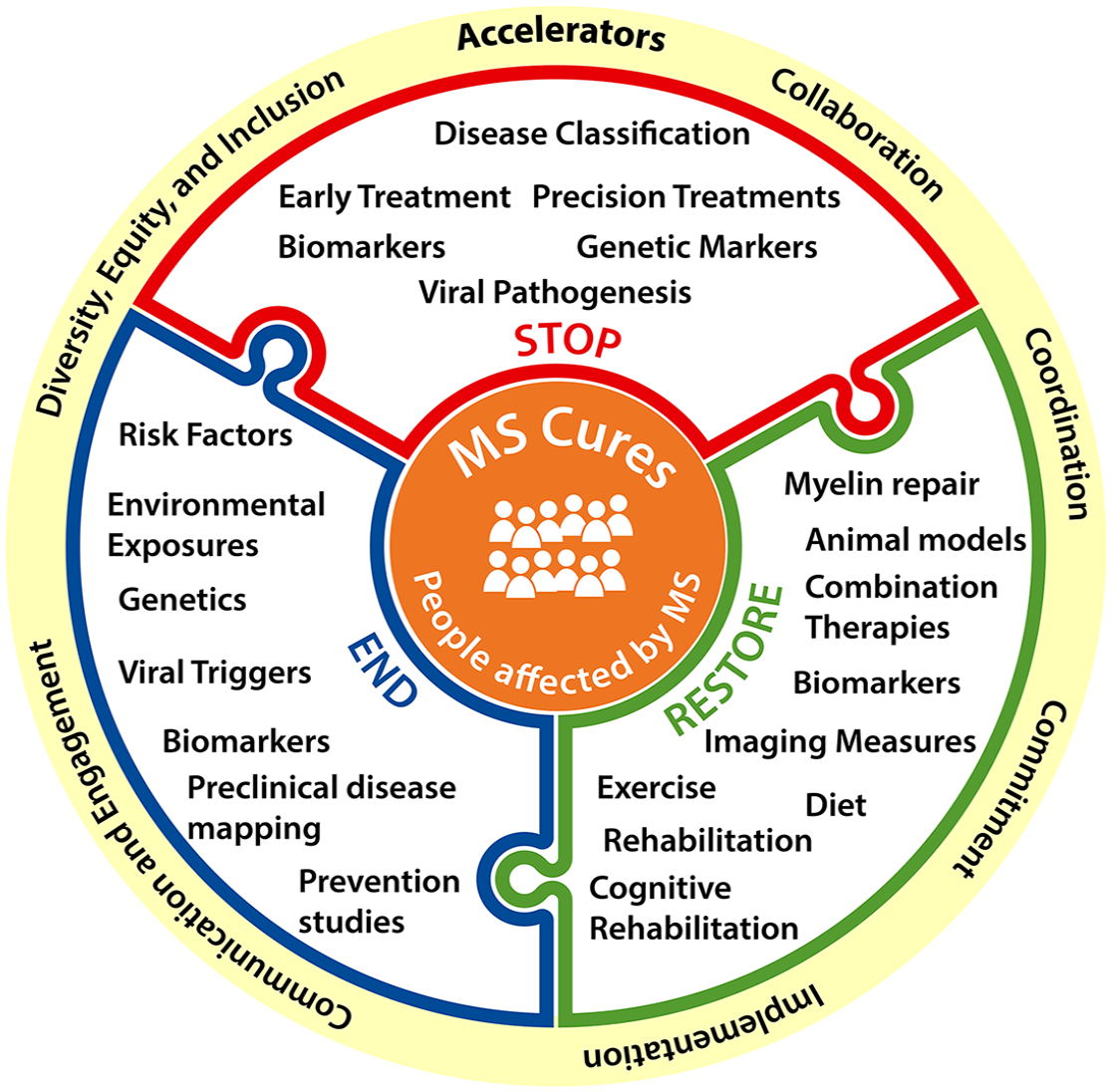
Recommendations for accelerating Pathways to Cures.
Enhance coordination
Resources available globally to fund MS research are finite, thus better coordination of research programs by funders has the potential to enhance their collective impact by applying investments strategically. Establishment of global research priorities and coordination among MS research funders will help ensure that resources are focused on opportunities with the greatest potential to generate insights leading to new prevention approaches, treatments, and cures. Coordination can help reduce redundancies and can also leverage grant making infrastructure to reduce the administrative expense. Enhanced coordination of research resources like biobanks (e.g. tissue, fluid, DNA) is an example of an opportunity that would have a major impact. Global collaborative efforts like the International Progressive MS Alliance and the Patient Reported Outcome for Multiple Sclerosis (PROMS) have proven that global MS funders can work together to coordinate research investments and accelerate progress.65–67 These efforts have set the stage for broader global coordination of research investments.
Provide sustained funding
The global MS community must be committed to sustained research funding. The uncertainty caused by sporadic funding disincentivizes researchers from pursuing science advancing Pathways to Cures. Furthermore, a lack of long-term funding commitments can result in projects terminating before they yield results, which wastes resources and delays progress. One possible solution would be for global funders to pool resources creating a shared fund that would make awards only when sufficient resources were available for the life of the project.
Consider implementation
As funding of more sophisticated and expensive science advances, it will be important to consider how the results will be disseminated and the outcomes implemented. It would be unfortunate if commercialized therapies, diagnostic tools, and advanced imaging modalities, are for financial, technical, or logistical reasons, inaccessible to PwMS. Engagement of policy makers and payers at very early stages of development will be necessary to assure access to PwMS in a timely manner. Funders should consider deploying resources to understand and overcome access challenges during the early stages of the projects they support.
Engage people affected by MS
At the center of any powerful collaboration is the individual who stands to benefit most from research progress—PwMS. The global MS movement must engage PwMS at every level of research. Meaningful engagement has the potential to enhance the quality, relevance, and impact of sponsored research. For example, involvement of PwMS in the design of clinical trials enables the development of therapies that are acceptable and feasible, potentially enhancing uptake and adherence once approved. Opportunities exist for engaging PwMS more deeply in research and design and potentially as advocates for overcoming some of the barriers to research progress like data sharing.68,69 In addition, communicating the outcomes and impacts of research investments to the public is critical for acquiring and retaining the support of the global MS movement. Funders should anticipate the communication needs of their supporters and develop plans to address these needs at the very earliest stages of major funding initiatives.
The generalizability of research breakthroughs is threatened by a lack of diversity in MS research and clinical care.70,71 The MS movement must do a better job of diversifying the MS research and clinical workforce, perhaps through the development of fellowships and/or early career awards targeting underrepresented scholars. In addition, researchers and funders should engage people from underrepresented groups in the design, implementation, and participation in both fundamental and clinical research studies. Better engagement will enhance the quality of the results, reveal important effectiveness and safety information, and potentially help discover population-specific differences in the natural history of disease and response to therapy, thereby assuring that better treatments and cures are developed for everyone living with MS.
Conclusion
Scientific breakthroughs leading to MS cures will require strategic investments in research priorities and enhanced global collaboration among all stakeholders in the MS movement. The refined Roadmap provides a foundation for a dialogue among MS research funders to enhance collaboration and coordination of investments focused on accelerating progress toward cures. A recent declaration by the major global MS advocacy organizations to focus resources on research areas with high potential to accelerate progress has created excitement and optimism that MS cures are within our reach.
Footnotes
Acknowledgements
Thanks to Anne Helme, Paola Zaratin, Jorge Correale, and Kathy Smith for their service on the Pathways to Cures Global Summit Organizing Committee. Thanks to Shawna Golden and Kate Daniels for their assistance with the Global Summit. Thanks also to Cathy Carlson and Susan Atlas for writing support.
Data availability statement
Data sharing not applicable to this article as no datasets were generated or analyzed during the current study.
Declaration of Conflicting Interests
The author(s) declared the following potential conflicts of interest with respect to the research, authorship, and/or publication of this article: BFB has as no relevant conflicts. BLB serves as a consultant to Novartis, UCB, Roche, and Sanofi for work unrelated to the present manuscript. BLB receives funding for research grants from the NIH and National MS Society. CCW has no relevant conflicts. TC has received travel support from Sanofi. UD has no relevant conflicts. PLD has received research support from Biogen and Merck Serono. AKP has no relevant conflicts. VWY is funded by research grants from MS Canada, the Canadian Institutes of Health Research, USA Department of Defense Multiple Sclerosis Research Program, Genentech and Novartis. He has received speaker honoraria from Biogen, EMD Serono, Novartis, Roche, Sanofi-Genzyme and Teva Canada. He is the recipient of unrestricted educational grants from Biogen, EMD Serono, Novartis, Roche, Sanofi-Genzyme and Teva Canada to support educational activities of the Alberta MS Network, which he directs. ENB has no relevant conflicts. AJT is Co-Chair, UCL-Eisai Steering Committee drug discovery collaboration (paid to institution), Member, National MS Society (USA) Scientific Advisory Committee (receive support for travel), Clinical Trials Committee, Progressive MS Alliance (receive support for travel), Board member, European Charcot Foundation (receive support for travel), Editor in Chief, Multiple Sclerosis Journal (receiving honorarium from SAGE Publishers), Editorial Board Member, The Lancet Neurology (receiving free subscription).
Funding
The author(s) disclosed receipt of the following financial support for the research, authorship, and/or publication of this article: Activities supporting the development of the Roadmap were funded by the National Multiple Sclerosis Society (USA).
