



Abstract
In Spain, the Basic Document DB HR Protection against Noise outlines acoustic regulations for buildings. Acoustic testing is not mandatory nationwide, but several regions and local governments require testing the sound insulation of walls, floors, and facades, as well as the sound pressure levels of building services, to obtain the first occupation license. This license is integrated into the final stage of the construction process in Spain, confirming the building’s completion and that it is safe and habitable. This paper aims to analyze the regional decrees in Spain that require mandatory acoustic testing before occupancy. Specifically, information on test sampling and other procedures will be presented. The regulations concerning different types of acoustic testing and the required sampling rates have been analyzed across several autonomous communities and major cities in Spain, alongside an examination of the Spanish acoustic classification scheme. A comparison was made to evaluate the minimum number of mandatory tests required for various acoustical characteristics. Additionally, a practical example is provided, illustrating the sampling rates and comparing the resulting number of measurements required. Although some local regulations share criteria on sampling, such as testing 10% of dwellings or using the square root of the number of dwellings, this study found it challenging to interpret the ordinances and apply them to a specific case, as many issues are left to the technician’s discretion. It would be ideal for criteria and sampling procedures to be harmonized and implemented uniformly at the national level.
Keywords
Introduction
Achieving an adequate acoustic quality indoors is essential for the comfort and well-being of occupants in dwellings. Good layout, a good selection of separating walls, floors, and façade elements, 1 proper detailing of junctions and a careful workmanship will prevent flanking transmission 2 and lead to good sound insulation in buildings. 3
Same principles apply for the noise control of building services: good planning, sizing, correct selection of acoustical materials and vibration isolators, 4 together with site inspections, will limit the noise transmitted from service and equipment to the occupied spaces. 3
Acoustical advice is essential throughout every phase of a building’s construction, from the preliminary design stage to the construction. Conducting pre-occupancy acoustic testing is crucial in guaranteeing the building’s acoustic quality. By performing a sample of these measurements, several benefits can be achieved. First, it helps verify compliance with building regulations. It also enables the early detection of any defects during construction, allowing for corrective measures to be taken before the building is occupied. Additionally, it reduces the risk of future complaints and enhances the marketability of the property.
As opposed to single family houses, multifamily buildings have separating walls and floors, common areas, plant rooms, collective equipment, etc. which may cause annoyance to occupants due to noise and vibration. In Spain, 66.90% of the dwellings, approximately 12.58M, are multifamily dwellings, 5 which means most of the population lives in flats or apartments, where acoustics is key to ensure comfort, privacy and health.
In Spain, the 2021 Living Conditions Survey 6 highlights that noise from neighbors or the street is one of the most frequently reported environmental issues, with more households affected by this problem than by other concerns such as pollution, lack of light, or crime. As shown in Figure 1(a), noise is a leading concern for population, while Figure 1(b) illustrates that the prevalence of reported noise problems varies with the urbanization level, being highest in cities than in towns and suburbs and rural areas.
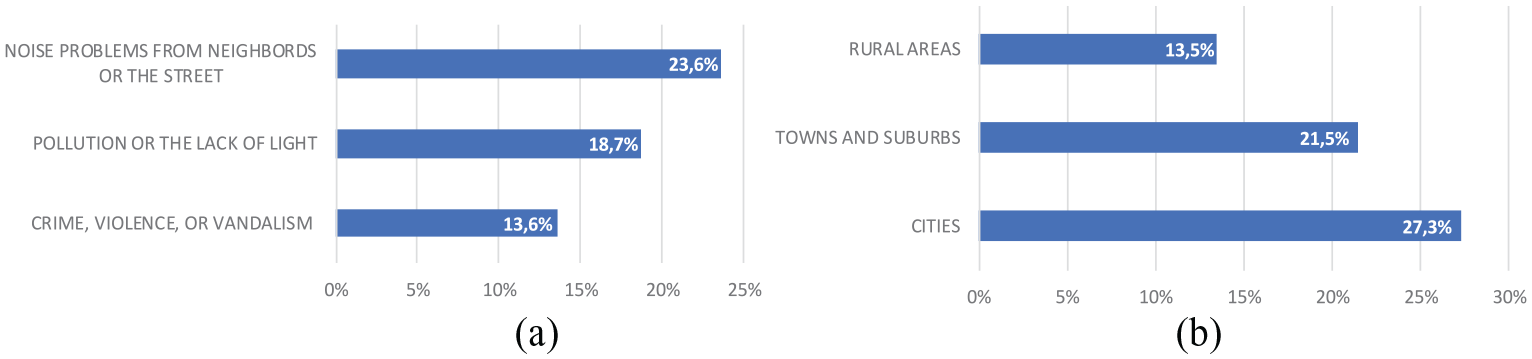
(a) Degree of population concern for environmental issues versus safety in cities and (b) reported noise problems according to the urbanization levels.
Basic document DB HR Protection against noise, 7 establishes acoustic requirements in buildings in Spain. This regulation, which came into force in 2009, has remained stable with hardly any changes to date. The only update was minor; it was made in 2019, when the references to testing standards, such as Refs.,8–10 were updated.
Beyond these mandatory minimum requirements, an acoustic classification scheme, UNE 74201, 11 was developed to regulate levels of quality and acoustic performance above the requirements by defining a system of six classes, A to F, with criteria for the different acoustic characteristics. A more detailed sampling procedure for measurements is also defined. The application of this standard is currently voluntary and no minimum class is required in Basic Document DB HR.
Pre-occupancy acoustic testing is not mandatory at the national level, since the powers of building control are devolved to autonomous communities. That is the reason why several autonomous communities and local governments require testing the sound insulation and limit noise levels for service and equipment before the completion of buildings. Furthermore, to ensure control over these measurements, the autonomous communities specify requirements regarding acoustic tests, such as that these measurements be carried out by an accredited or collaborating company. This accreditation evaluates the activity of laboratories to ensure their impartiality and competence. Likewise, the quality departments of the different autonomous communities maintain a registry of competent entities for the performance of acoustic tests.
Other countries such as England and Wales, 12 Scotland, 13 and Northern Ireland 14 introduced mandatory testing to verify the compliance of sound insulation requirements in dwellings and developed the Robust Details Scheme. 15 In the case of Italy final compliance control is required for public buildings, based on field measurements performed by a competent acoustic technician. 16 As for private buildings, final measurements are required in some regions like Tuscany. 17
This paper compiles and analyzes the regional decrees in Spain which require mandatory acoustic testing, and it also compares the acoustic sampling plan of the acoustic classification scheme in Spain. 11 The local decrees studied in this paper correspond to the main capitals. Spain has 8131 towns 18 and the authors have only considered the local ordinances of main capitals that are known to require pre-occupancy testing.
In addition, the final compliance control thorough field measurements has been contextualized within the quality control process in the building and the construction process in Spain, considering the role of acoustics in the phases of this process. Some local legislations have been studied in detail, highlighting stricter requirements and the control they impose over the operation of activities to verify that they are acoustically acceptable. Finally, an example of application of the different sampling procedures studied is presented. An acoustic insulation calculation software (SONarchitect 19 ) was used to model one case study, the software uses the ISO 12354 parts 1, 2, and 3.20 –22 The intention was to obtain a histogram with the distribution of the different predicted sound insulation values in the entire building to show the range of values of sound insulation that can be found in an ordinary multistorey building due to its design. It shows that when applying a sampling procedure for the field measurements, the most unfavorable cases should be selected.
This paper is an updated and extended version of the paper presented at the Forum Acusticum Conference held in Torino in September 2023. 23
Acoustic requirements in Spanish buildings
Airborne, impact and façade sound insulation requirements for new build dwellings established in Spanish building regulations 7 are summarized in Table 1. As for service and equipment noise limit values for building services are contained in RD 1367/2007 24 and limit values are shown in Table 2.
Requirements for sound insulation for protected spaces, such as living rooms and bedrooms in new build dwellings in Spain.
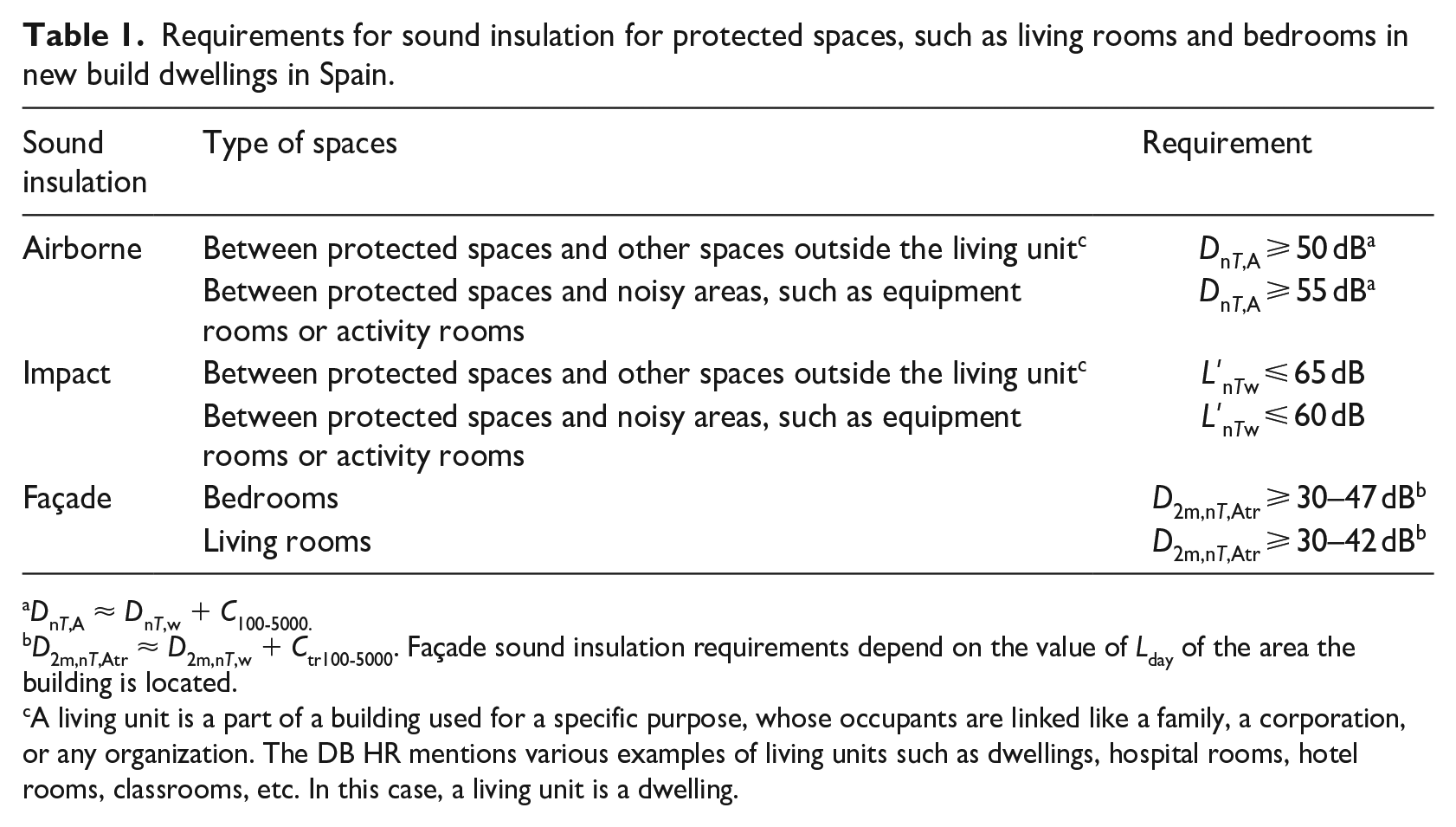
DnT,A ≈ DnT,w + C100-5000.
D2m,nT,Atr ≈ D2m,nT,w + Ctr100-5000. Façade sound insulation requirements depend on the value of Lday of the area the building is located.
A living unit is a part of a building used for a specific purpose, whose occupants are linked like a family, a corporation, or any organization. The DB HR mentions various examples of living units such as dwellings, hospital rooms, hotel rooms, classrooms, etc. In this case, a living unit is a dwelling.
Limit values for service and equipment noise in dwellings.
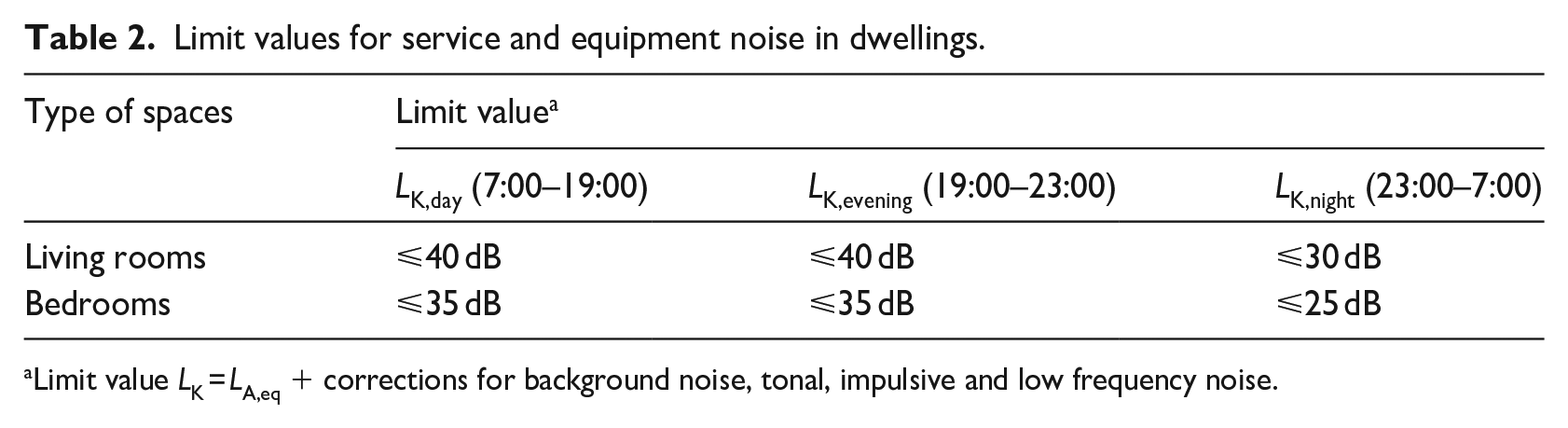
Limit value LK = LA,eq + corrections for background noise, tonal, impulsive and low frequency noise.
A deviation or tolerance of 3 dB is allowed between the requirements and results from in situ measurements for sound insulation, due to measurement uncertainties.
Spanish Building Code also establishes requirements for reverberation time in certain spaces, whose limit values are shown in Table 3. For in situ measurements of reverberation time, the deviation accepted is of 0.1 s. In case of common areas in public residential buildings, educational and hospital buildings the requirements are stablished in terms of acoustic absorption in order to limit reverberant noise that could affect to adjacent protected areas.
Limit values for reverberation time and sound absorption in Spanish regulations.
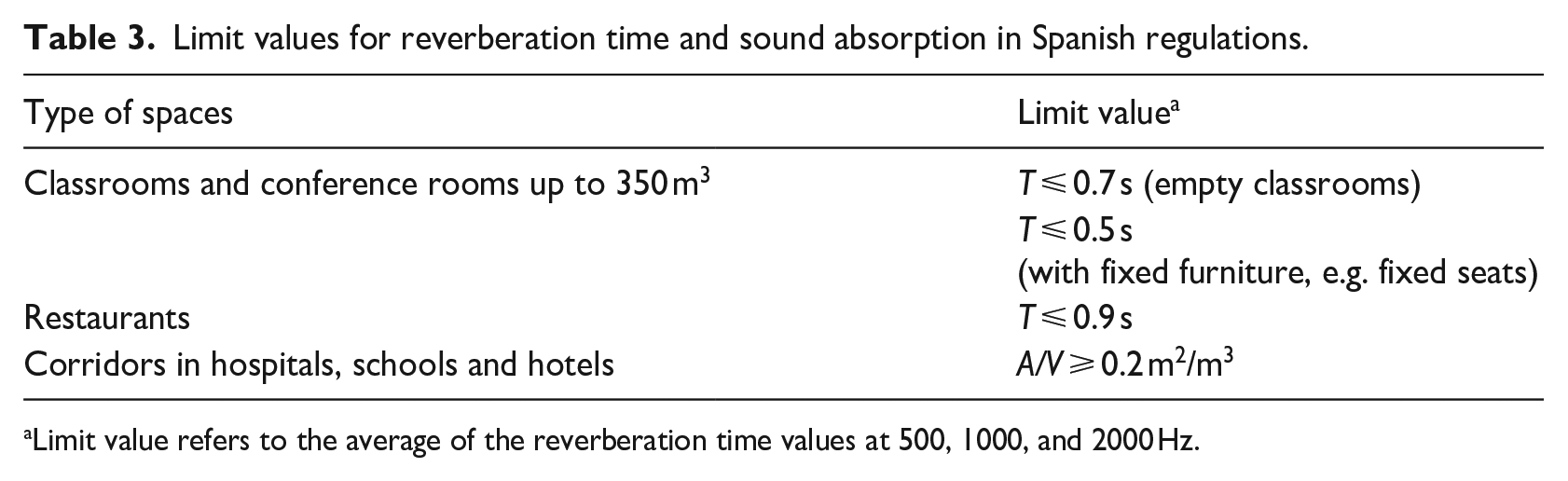
Limit value refers to the average of the reverberation time values at 500, 1000, and 2000 Hz.
The acoustic classification scheme in Spain. UNE 74201
It is well established that building acoustic regulations generally specify minimum requirements to guarantee a baseline level of acoustic quality for buildings. However, they do not always ensure satisfactory conditions for all occupants. As a result, some countries have introduced acoustic classification schemes 25 aimed at defining additional and graduated levels of acoustic conditions through a system of classes.
In Spain, the acoustic classification scheme is developed in the Spanish standard UNE 74201 11 which was approved in September 2021, just 12 years after the Basic Document DB HR Protection against noise 7 came into force. The use of this classification standard is voluntary in Spain and it is complementary to the current regulations.
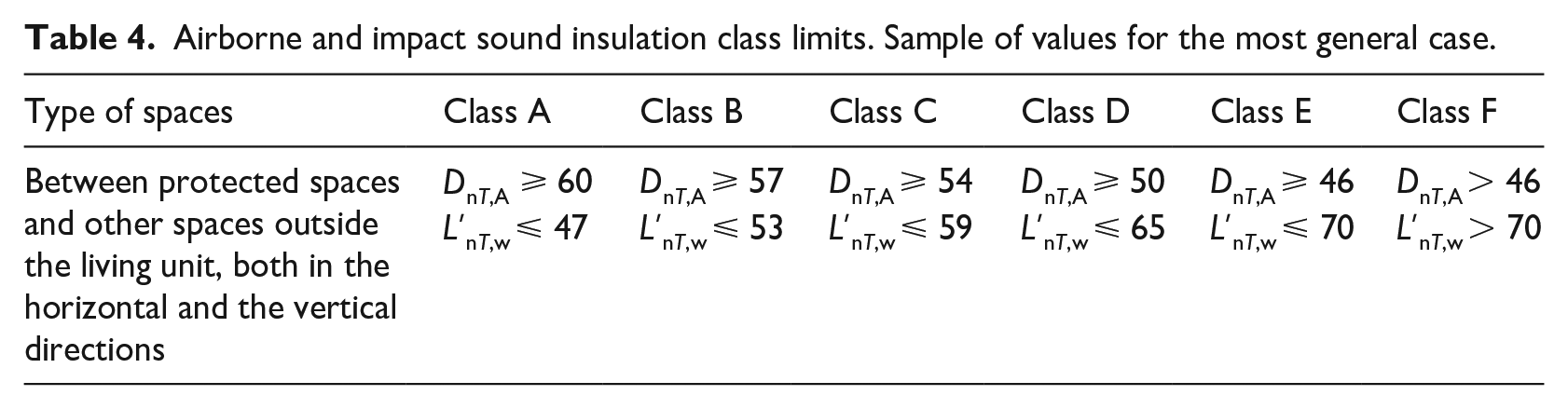
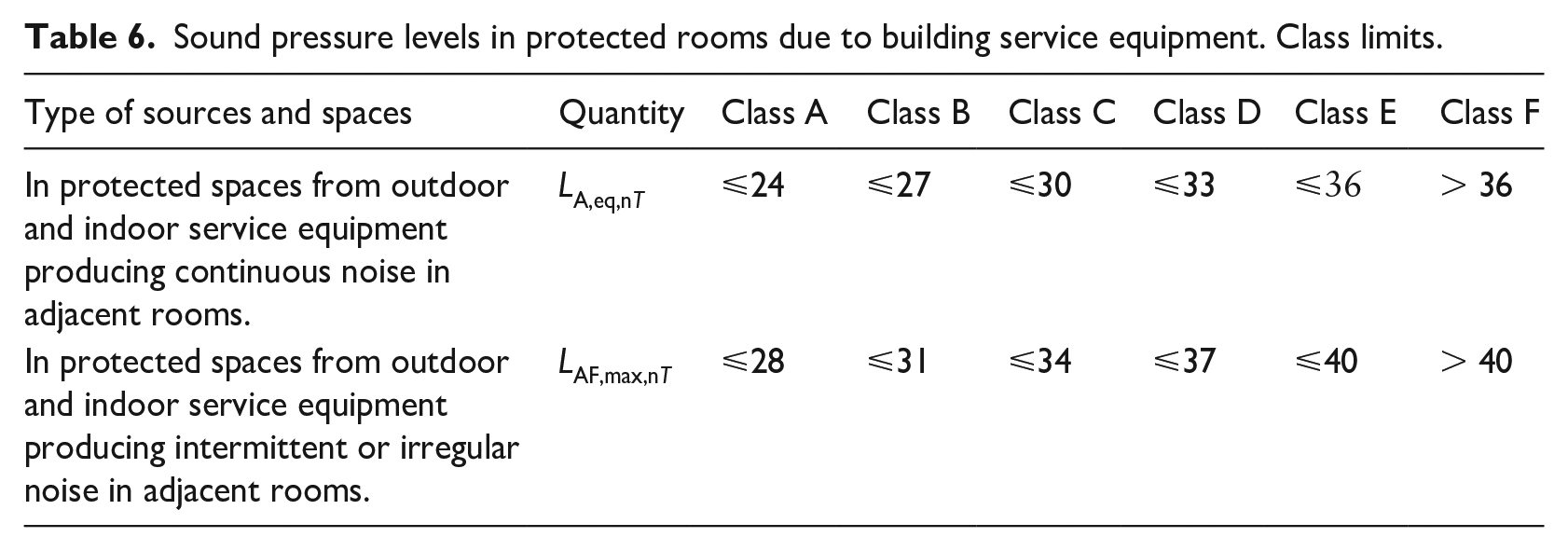
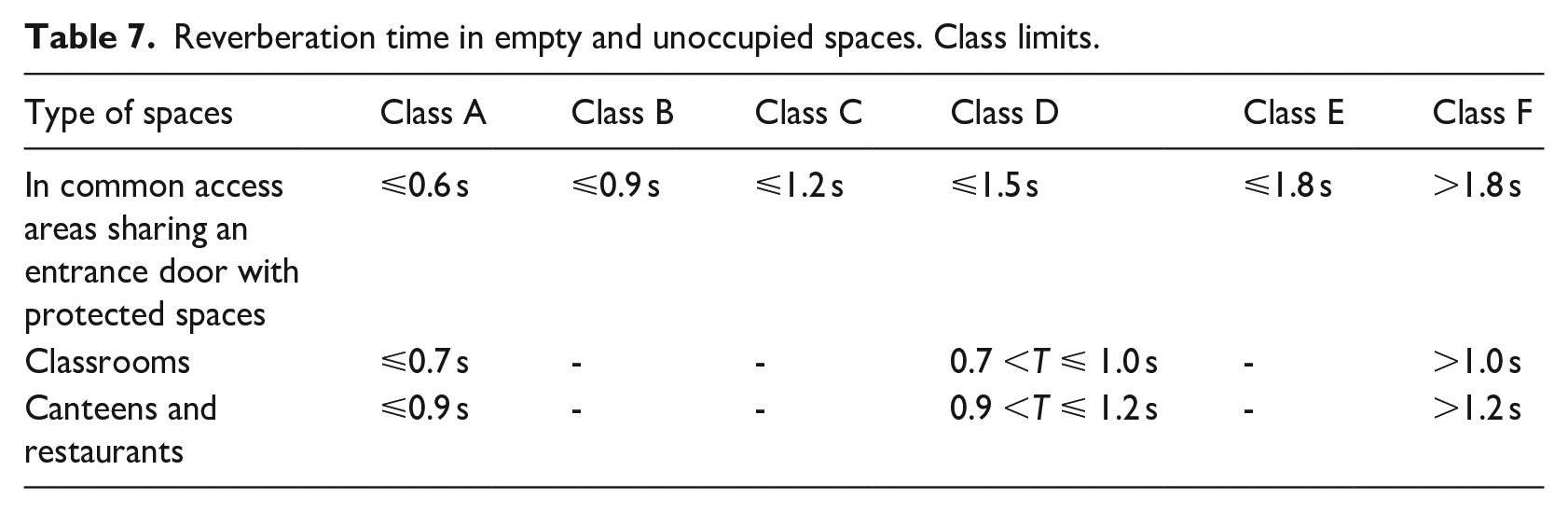
Tables 4 to 7 show the principal cases that are included in the classification scheme and the values assigned to the different classes. Buildings complying with the mandatory values of the building code are class D and buildings with acoustic performance below a certain value correspond with class F, which is intended to classify existing buildings.
Airborne and impact sound insulation class limits. Sample of values for the most general case.
Sound insulation against exterior noise. Class limits.
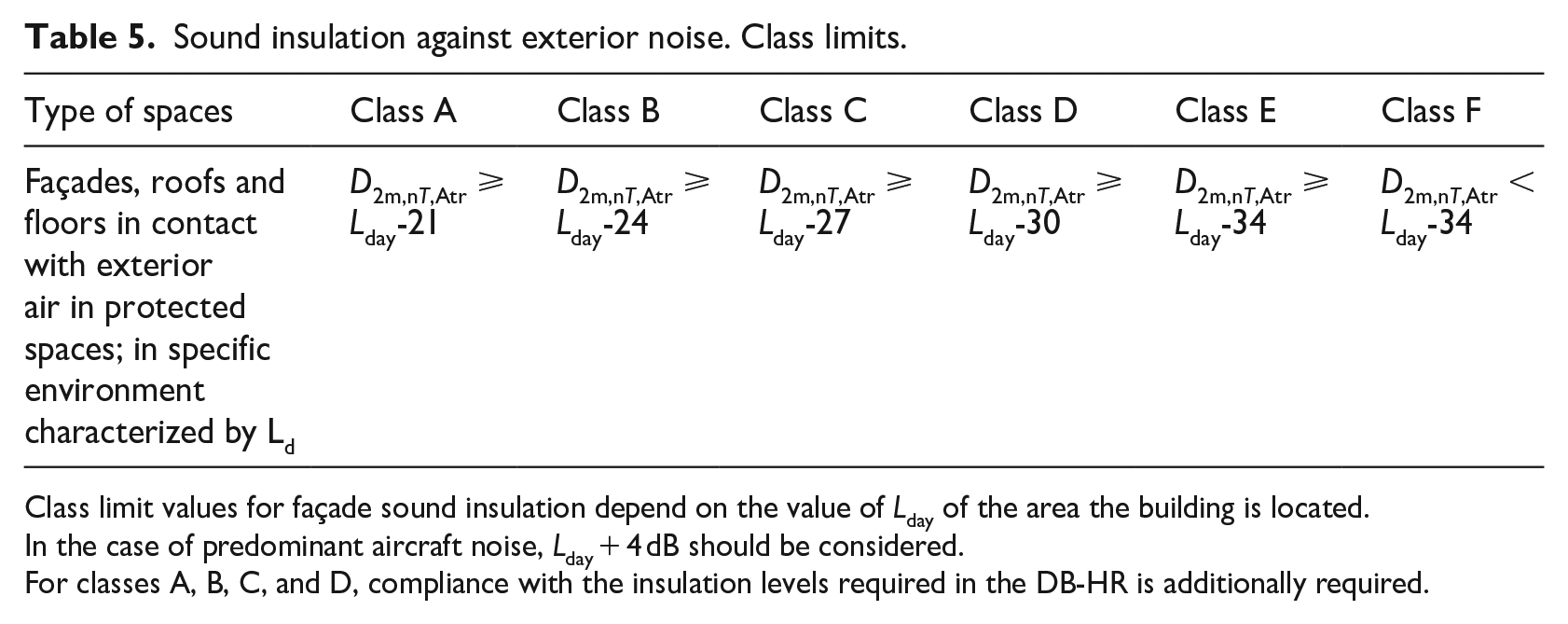
Class limit values for façade sound insulation depend on the value of Lday of the area the building is located.
In the case of predominant aircraft noise, Lday + 4 dB should be considered.
For classes A, B, C, and D, compliance with the insulation levels required in the DB-HR is additionally required.
Sound pressure levels in protected rooms due to building service equipment. Class limits.
Reverberation time in empty and unoccupied spaces. Class limits.
In relation to noise from service equipment, Table 6 shows maximum values for A-weighted time-averaged or the maximum sound pressure levels due to service equipment, for each of the classes. But it must be considered that the classification scheme refers the ISO 16032 26 for measuring the sound pressure levels of technical equipment, which differs from the method established in RD 1367/2007, 24 which is mandatory in Spain for testing noise from service and equipment. Therefore, care must be taken because obtaining a certain acoustic class does not directly imply fulfilling RD 1367/2007, as measurement methods are different and descriptors are not comparable.
The scope of regional and local regulations
In addition to national requirements set in Basic Document DB HR, 7 and the classification scheme UNE 74201, 11 there are complementary regional and local regulations related to building acoustics. Spain is divided into 17 autonomous communities, and has 8131 towns, 5 and the local administrations are most directly involved with the noise problems of their citizens, and ultimately, they are forced to address noise problems. The information in this section refers to the regional and local regulations described in 6.2.
The autonomous communities have some functions devolved from the State and have authority over several matters such as architectural heritage and quality control of buildings and housing. Therefore, they have the power to legislate, adapt and develop complementary regulations within their jurisdiction; these are regional regulations that apply only to their territorial scope. In this way, all the autonomous communities have regulated some aspects related to buildings, such as building permit procedures which are described in Section 5. Furthermore, some of them have also approved regulations aimed at controlling aspects related to the quality of buildings, 27 particularly, to their acoustic quality and control, such as the post construction acoustic testing to verify compliance with requirements set in Basic Document DB HR Protection against noise 7 and RD 1367/2007. 24
Most regional and local regulations align closely with both regulations.7,24 However, some include complementary and often more restrictive guidelines. These guidelines specify terms and conditions for conducting quality controls in buildings and establish the regulation and supervision of public and private testing laboratories (see Section 6).
Acoustic emitters are also regulated, considering as such the activities, infrastructure, equipment, machinery, or public or private behaviors, that generate noise pollution within a territory. Buildings are also considered in their role as acoustic receptors. Military activities and labor activities are excluded from these regulations as they are governed by their specific legislation.
Local regulations, typically address the activities and public establishments, to limit the transmission, and immission of noise to protected spaces adjacent to these activities. In these cases, local legislations usually classify the activities within buildings and, depending on their type, establish specific acoustic insulation requirements.
In this case, many of these regulations agree on requiring a minimum global insulation level (DnT,A ≈ DnT,w + Ctr) and also a minimum sound insulation value at 125 Hz (DnT,125), that is obtained by measuring sound insulation corrected for background noise, corresponding to the three 1/3 octave bands that compose the 125 Hz octave band.
The required DnT,125 values depend on the level of acoustic annoyance that may be caused by the activity, which it is normally a recreational activity or a public venue. DnT,A values range from 55 to 80 dBA (compared to 55 dBA in the national regulation).
The required values of DnT,125 range from 35 to 65 dB.
In relation to impact noise, for those activities in which impact phenomena occur repeatedly (e.g. gyms, academies of dance, etc.), unlike the national requirement of L′nT,w ⩽ 60 dB, it is ensured that the levels transmitted to adjacent protected spaces do not exceed values of 40 dB for activities operating during the day and 35 dB during the night, also expressed as L′nT,w and with spatial averaged measurements in different positions in the receiving room, based on LAeq measurements over 10 s intervals.28,29
These types of recreational activities are usually located on the ground floor and residential spaces are located in upper spaces above them; Therefore, the measurement carried out is not the same as that in the DB HR, since an ascending measurement is made with the source room on the ground floor and the receiving room in the upper space, and placing the tapping machine in the lower room.
Finally, some of them also regulate acoustic audits, that is, the verification every 5 years that the activity maintains the necessary acoustic conditions and it is allowed to continue operating in adequate conditions. 30 Other municipal ordinances also regulate vibration measurements, most of them in relation to underground means of transport such as trains or subways. 28
The role of acoustics and the stages in the construction process
Figure 2 shows the stages of the building process in relation to the role of acoustics in the building design and construction. It also includes the control permits issued by local authorities in Spain. Stages from the preliminary works,31,32 such as feasibility studies, to the post construction phase and closeout, are described. In general, each stage lays the foundations for the development of the subsequent stages, where further refinement and detailed design are required. 33
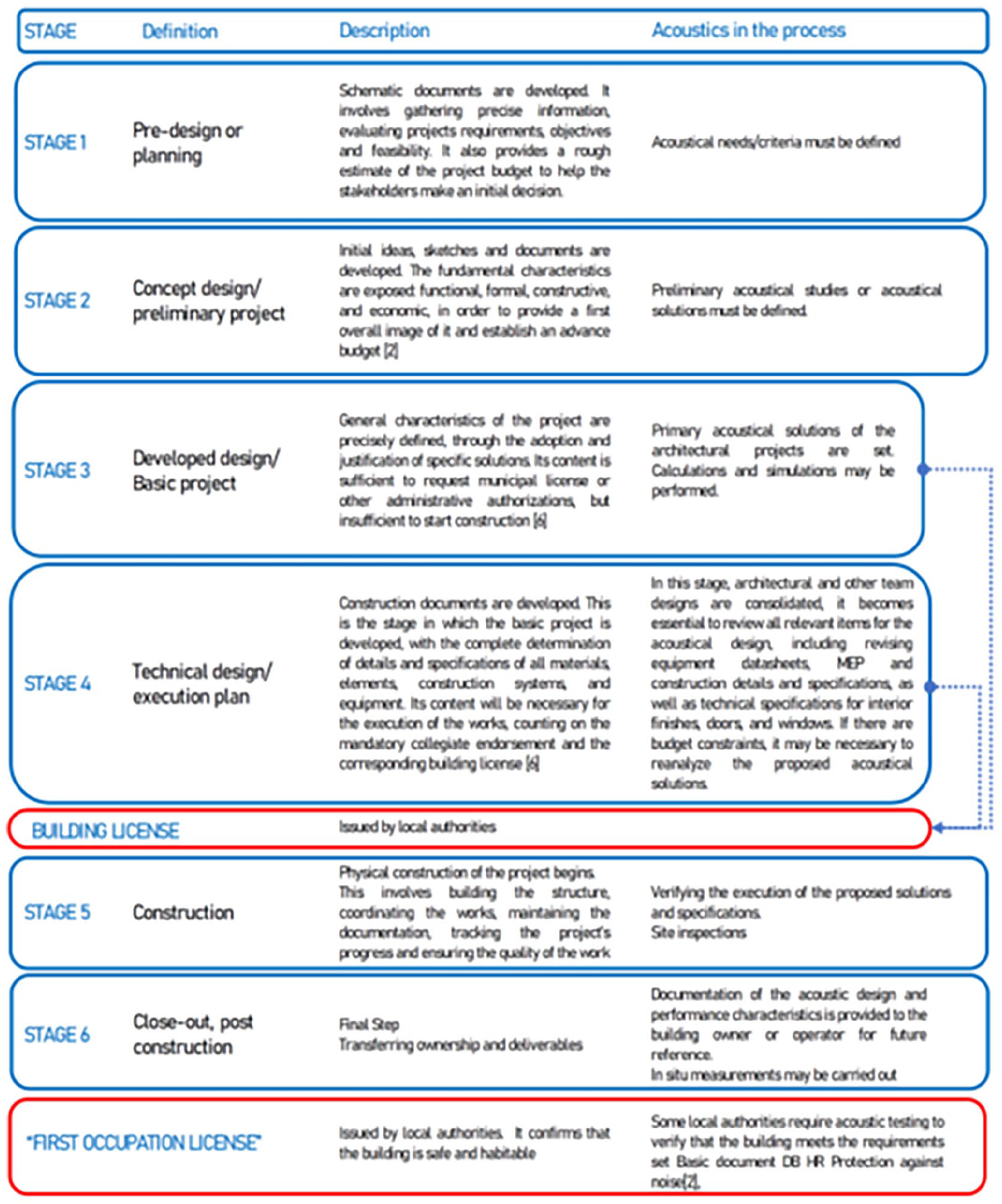
Schematic view of the building process in Spain.
The role of acoustics comprehends setting the requirements and criteria in the preliminary stages of the process. Developing acoustical solutions of the architectural project based on simulations and calculations are required in the developed design stage or Basic Project34,35 and Execution Plan. 36 During the Execution Plan development, architectural and other team designs are consolidated, and this is the stage when it becomes essential to review all relevant items for the acoustical design, including revising equipment datasheets, MEP (Mechanical, Electrical and Plumbing engineering) and construction details and specifications, as well as technical specifications for interior finishes, doors, and windows. It may be necessary to reanalyze solutions based in the development of the Execution Plan and the budget. The documentation for the Basic project and the Execution plan must include compliance with the acoustic requirements set in Basic document DB HR Protection against noise. 7
Integrating acoustical considerations from the outset is essential because the initial schematic plans can significantly impact acoustic quality. A well-designed acoustical layout is crucial for achieving good sound insulation. 37 The later acoustics are included in the building process, the more costly the construction may become.
During the construction phase, site inspections are necessary to ensure the quality of the project. As mentioned in the introduction, pre-occupancy acoustic testing is also beneficial and offers numerous advantages. These include verifying compliance with regulations, the early detection of defects, and reducing the risk of complaints.
Figure 2 also includes the role of local authorities in the building process in Spain. Regarding the mandatory local permits, there are two important landmarks:
The building license, which authorizes the construction to start. This license could be issued with the Basic Project or with the Execution Plan depending on the local authorities. 38 At this stage, compliance with the building regulations, including part DB HR Protection against noise 7 must be demonstrated in the project, using one of the procedures described in the regulations, which consists of calculations and tabulated values and guidelines. 3
The “first occupancy license” confirms that the building is safe and habitable and has been constructed in accordance with the specifications submitted to the local authorities before construction began. 38 This document is compulsory for occupation, and without it, the building cannot be inhabited, and services cannot be contracted. Some local governments and autonomous communities require acoustic pre-occupancy testing before issuing the “first occupancy license.” See Section 6.
Building acoustics quality control in Spanish buildings
Accreditation and quality assurance of acoustic control entities and laboratories in Spain
In Spain, the Building Code regulates the technical requirements of the buildings at a national level. Part I of the Spanish Building Code 34 is a framework that also sets general conditions for the construction and maintenance of buildings and their facilities.
The implementation of the Building Code is facilitated by competent bodies and entities that endorse the provision of services such as acoustic insulation testing. In Spain, a general registry of testing laboratories for quality control in construction exists, which includes control entities and testing laboratories for construction quality control, as referenced in Article 4.4.d of Part I of the Spanish Building Code (CTE). 39
This general registry includes both accredited control entities and laboratories for construction quality control, as well as those that submit a responsible declaration to carry out their activities.
Authorizations are granted by the Competent Public Administrations of the Autonomous Communities or Cities that endorse the provision of services by such laboratories in accordance with Royal Decree 410/2020, 40 which establishes the necessary requirements for construction quality control testing laboratories to carry out their activities.
The entities and laboratories must submit a responsible declaration to the competent authority prior to commencing their activities, including justification of the required criteria for such laboratories. This ensures a quality management system compliant with ISO/IEC 17025 41 standard and meeting minimum requirements of impartiality, confidentiality, personnel, or document control, among others. Additionally, the laboratory must be equipped with all necessary sampling, measurement, and testing equipment for the proper execution of tests. This measurement equipment must be verified and, if necessary, calibrated before being put into service and subsequently according to the laboratory’s maintenance, verification, and calibration program.
One of the activities indicated by UNE-EN ISO/IEC 17025 41 standard to verify the quality assurance of test results is the participation of laboratories in Round Robin Tests (RRT). For this reason, in Spain a Round Robin Testing Plan (EILA) has been organized at the national level with the collaboration of the Autonomous Communities for a few years and is held annually. Moreover, some autonomous communities organize their own Round Robin Tests as a control mechanism for their own laboratories.
In addition to the general registry of laboratories, entities can obtain accreditation for the acoustic tests they perform through the “Entidad Nacional de Acreditación,” ENAC, that is the national accreditation body designated by the Government under Regulation (EC) No 765/2008 of the European Parliament and of the Council of 9 July 2008 setting out the requirements for accreditation and market surveillance relating to the marketing of products. 42 The national accreditation body regulates accreditation operations in Europe based on five fundamental principles: non-profit, independence, non-competitiveness, international evaluation, and mutual recognition.
ENAC represents Spain in international organizations that shape the global accreditation infrastructure, with its accreditations recognized in over 100 countries. It is a full member of EA (European Accreditation), ILAC (International Laboratory Accreditation Cooperation) and IAF (International Accreditation Forum). This organization evaluates laboratories offering conformity assessment services, such as acoustic laboratories, demonstrating that they operate following internationally accepted standards and possess the technical competence and capacity to conduct acoustic tests within their accredited scope.
Currently, more than 82 companies in the field of acoustics are accredited by ENAC, including on-site testing laboratories, with a presence in all 17 autonomous communities. Additionally, most of these laboratories are authorized as Collaborating Companies of the Administration, registered in the public and user-accessible registry for acoustic pollution control services mentioned above.
Pre-occupancy acoustic testing required
Several communities and local governments require pre-occupancy acoustic testing to verify compliance with acoustic requirements as part of the “first occupation license.” Acoustic testing comprises airborne sound insulation of separating walls, floors and facades according to ISO 16283,8–10 reverberation time according to ISO 3382 43 and the sound pressure level of building services according to specific procedures in regional decrees and ordinances.
The regions and cities where pre-occupancy acoustic tests are mandatory are listed below, with references to specific regional and local regulations. See Figure 3 for location details:
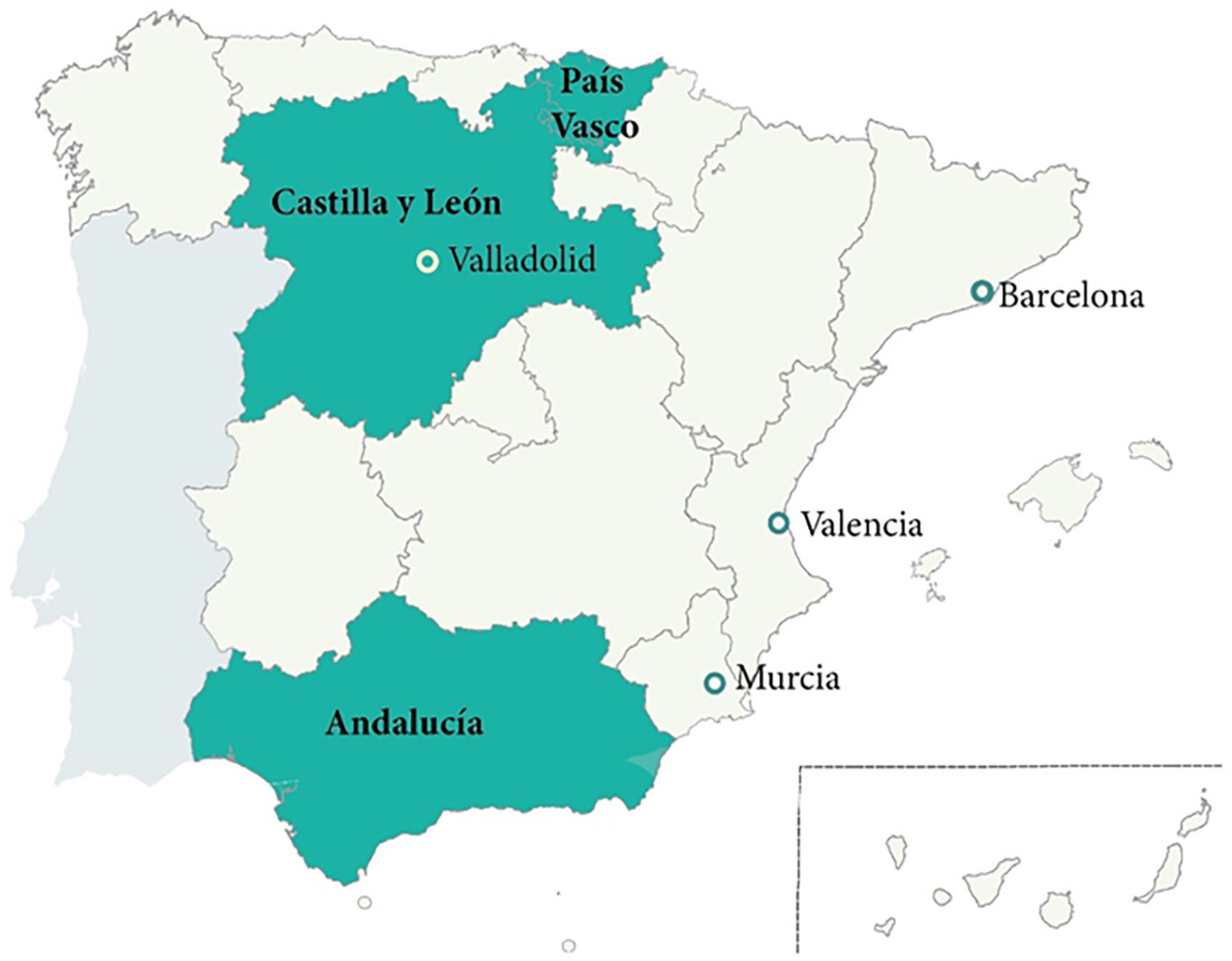
Areas where acoustic testing is mandatory in Spain and a sampling procedure is defined in regulations.
These areas have defined sampling procedures in their local regulations. Regions like Galicia 52 or Comunidad Valenciana 30 require pre-occupancy testing, but do not define the sampling procedures for acoustic testing, thus they are not included in this comparative study.
The sampling applied in Galicia 52 for the pre-occupancy testing is applied on a discretionary basis, that is, as there are no fixed rules, the sampling is decided by officials. In some city councils only one measurement is required, and those who are a little more demanding require a measurement depending on the type of building construction.
In the case of Comunidad Valenciana different municipalities have transposed the regional decree 30 to their local regulations establishing the same criteria that the city of Valencia applies (see Table 8).
Minimum number of sound insulation tests that are mandatory in different cities and autonomous communities in Spain.
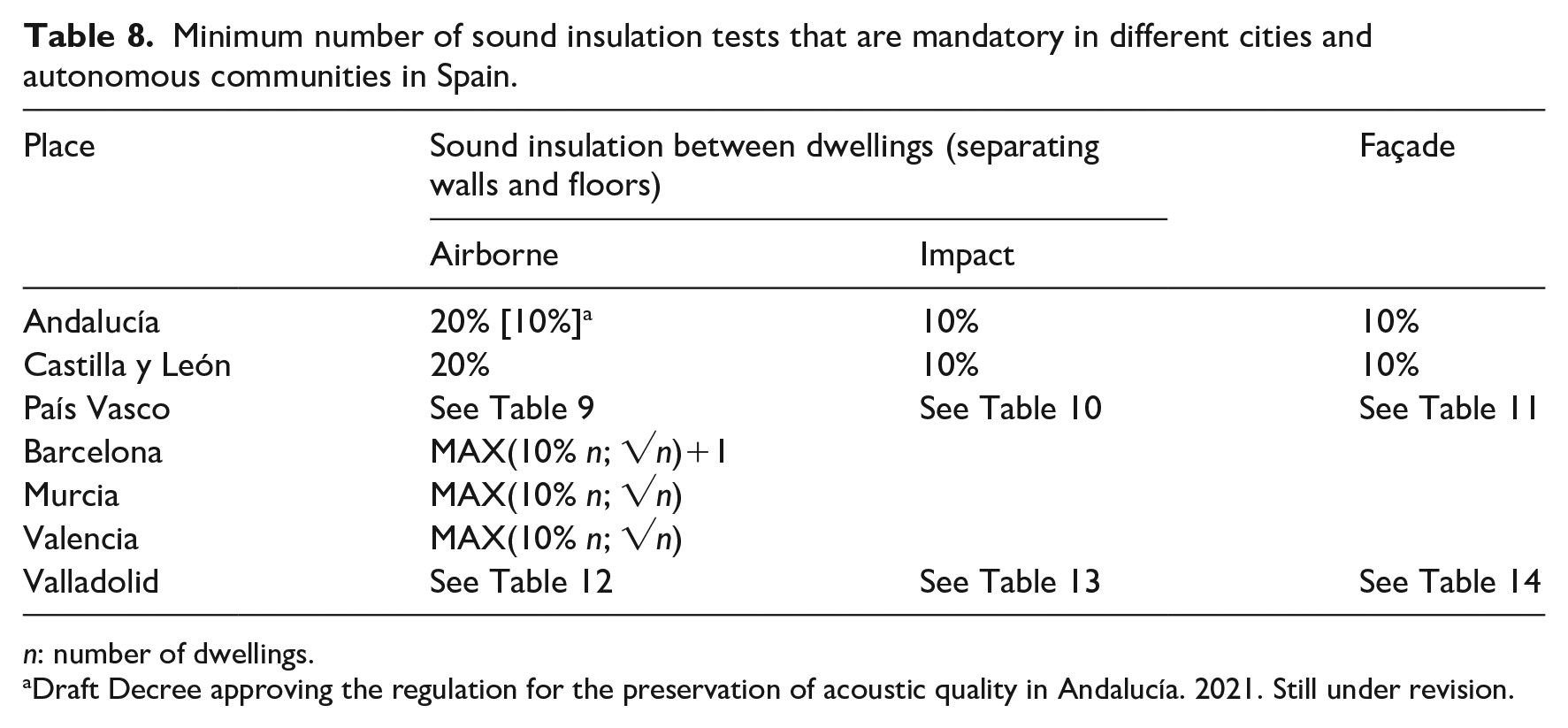
n: number of dwellings.
Draft Decree approving the regulation for the preservation of acoustic quality in Andalucía. 2021. Still under revision.
For the autonomous community of Castilla y León, Ley 5/2009 del Ruido de Castilla y León 45 mandates that all municipal ordinances align with the regional law. However, some municipal ordinances increase the sampling requirements for acoustic testing as indicated in their corresponding regional laws. This is the case, for example, with the Ordenanza sobre ruidos y vibraciones del Ayuntamiento de Valladolid, 51 which increases the number of tests required for the first occupancy license concerning the mandatory compliance according to the law in this autonomous community.
In most cases, acoustic tests are mandatory for new build homes, and for building renovations, according to the scope of Basic Document DB HR Protection against Noise. 7 In Andalucía, tests are also required for retrofitting when significant alterations to the composition of facades, volume or major structural modifications are planned, as well as when there is a substantial change in the building intended use.
In the rest of the regions of Spain, pre-completion sound testing is not mandatory, nevertheless, acoustics is often of great concern for builders and developers, who in some cases hire consultants to conduct acoustic performance tests to make sure regulations are met.
Acoustic sampling for field acoustic measurements
Sound insulation
The following tables contain the minimum number of sound insulation tests to be carried out for each different building element: separating walls, floors or facades in different places mentioned in section 3. Such percentage applies to categories of general building elements, such as separating walls, floors, or façades. To illustrate, a distinct building element is defined as one with a different composition. Therefore, if two façades are composed of different materials, the minimum number of tests would need to be conducted separately on each façade. These standards are overly general and lack specificity, with variations depending on the region. As a result, it would be beneficial to have a more detailed sampling guideline outlined in national regulations to clarify these requirements.
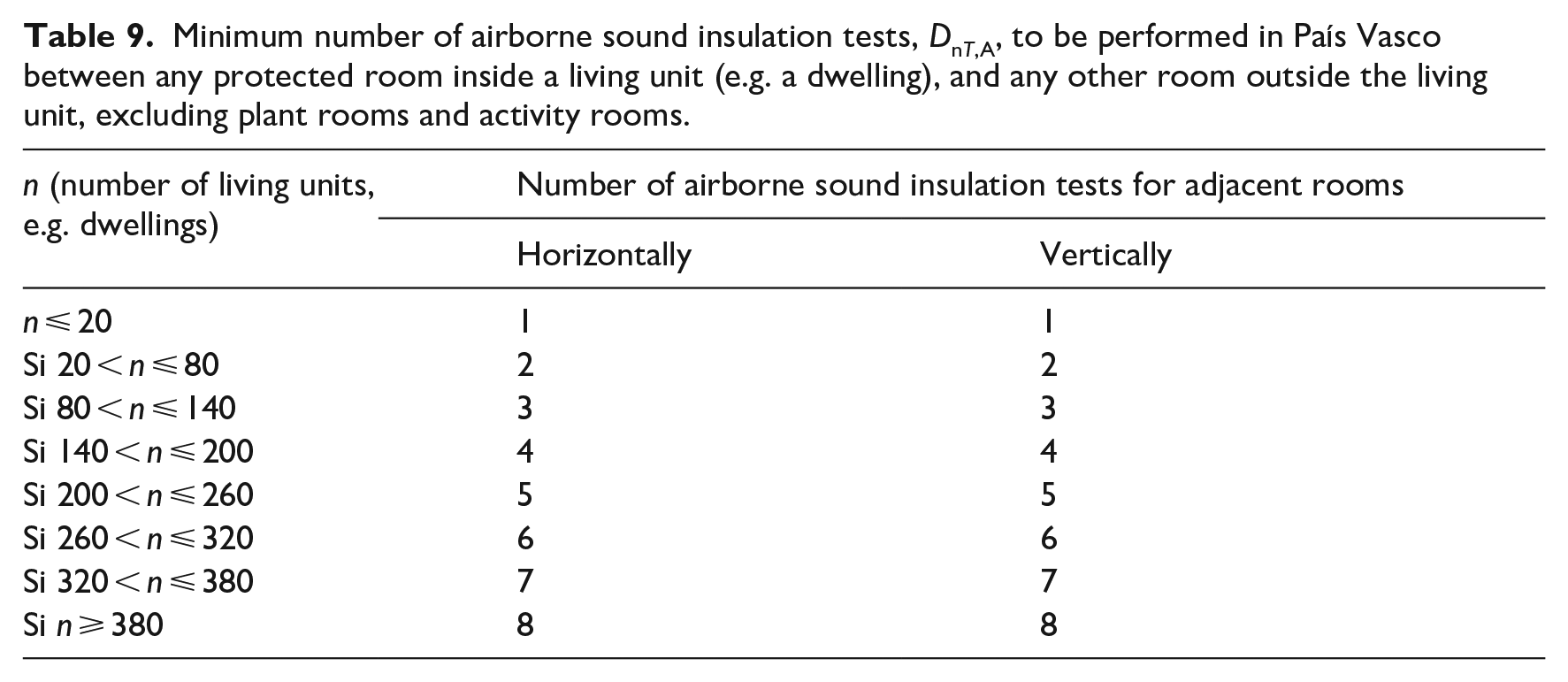
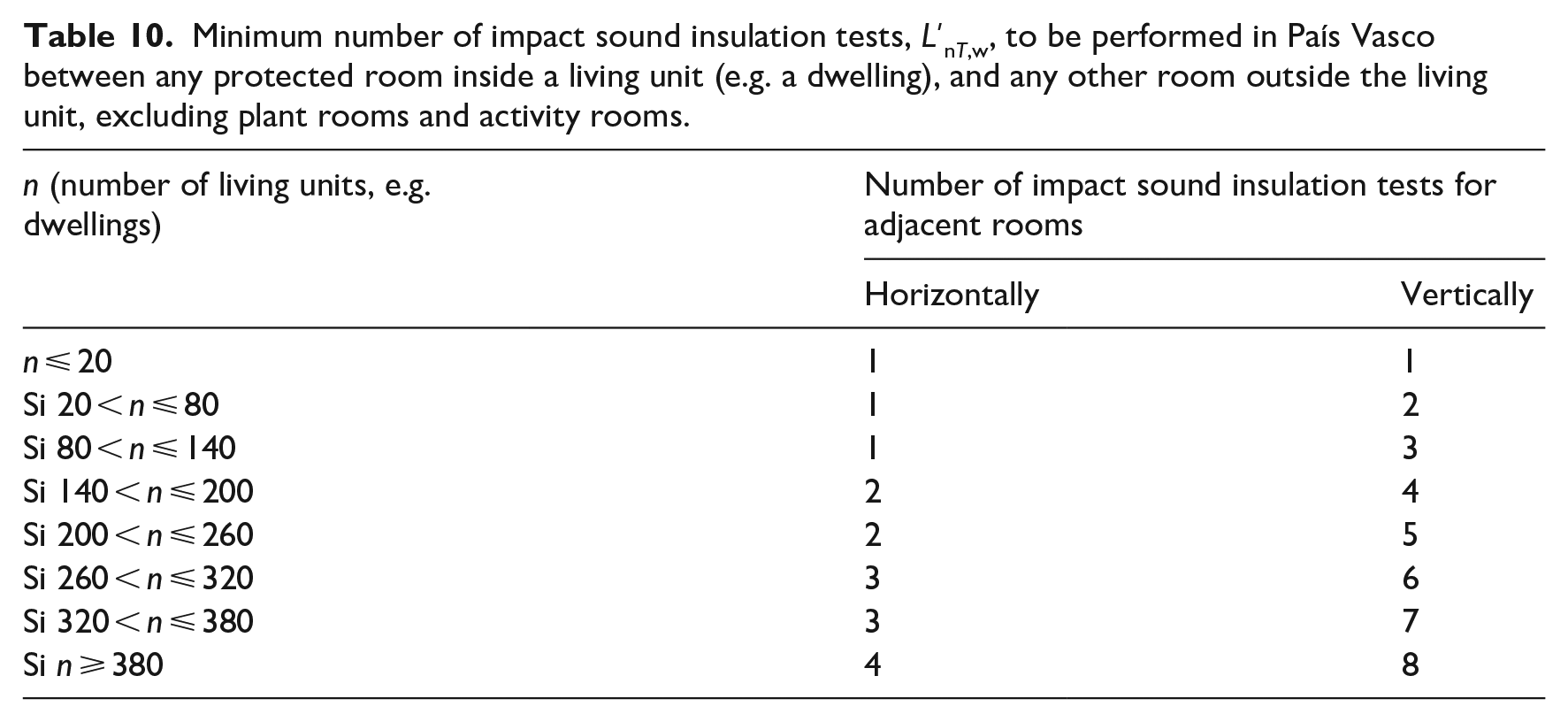
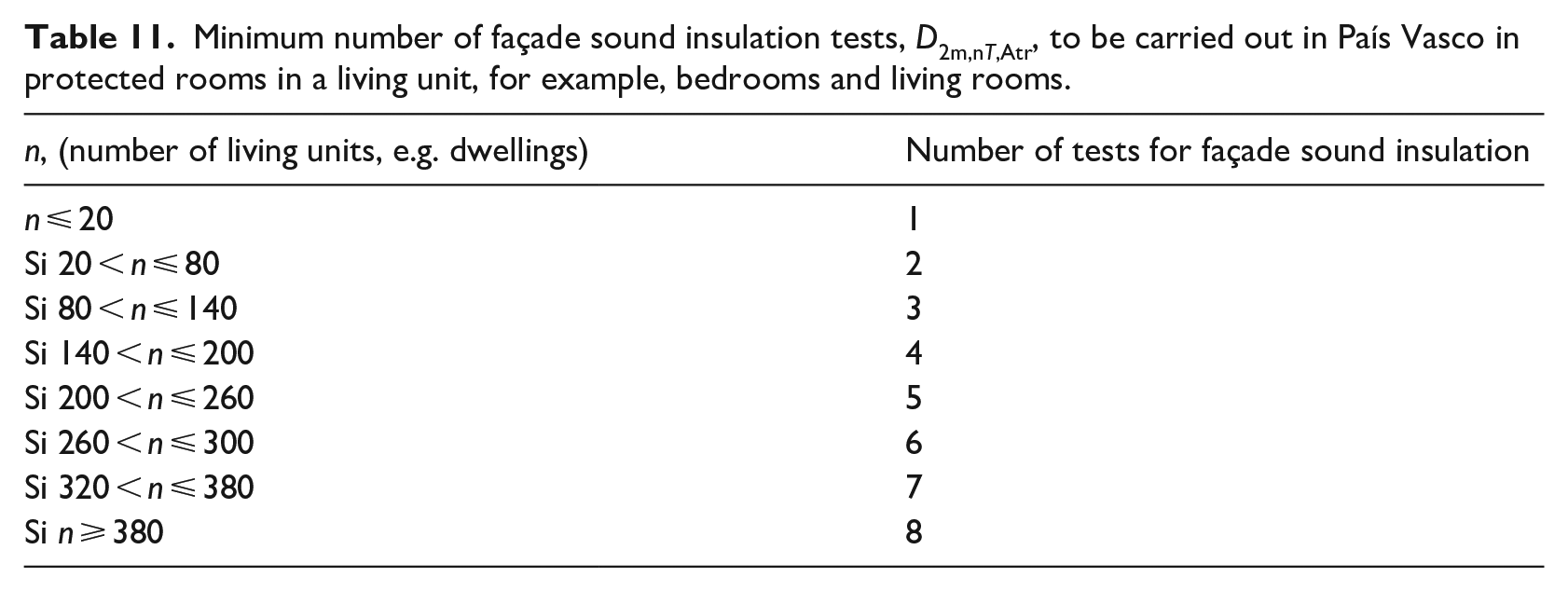
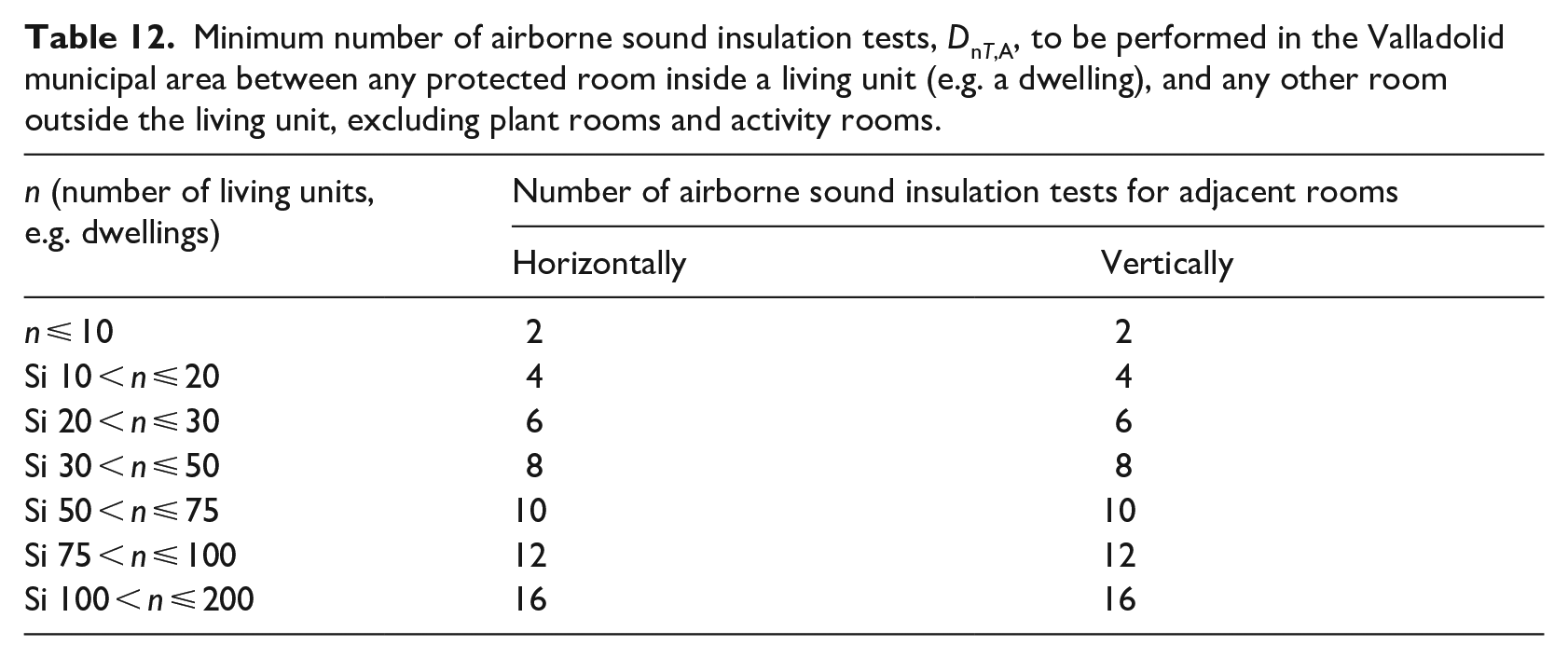
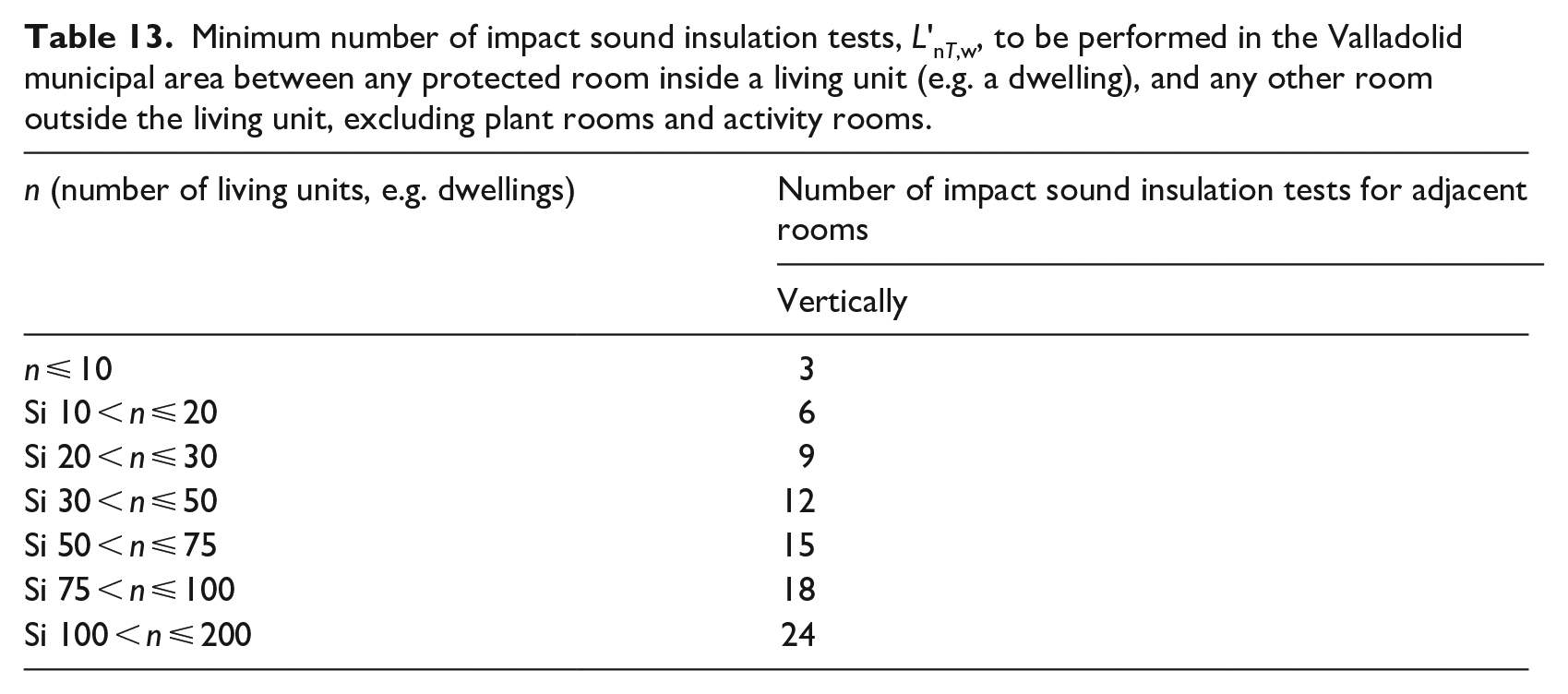
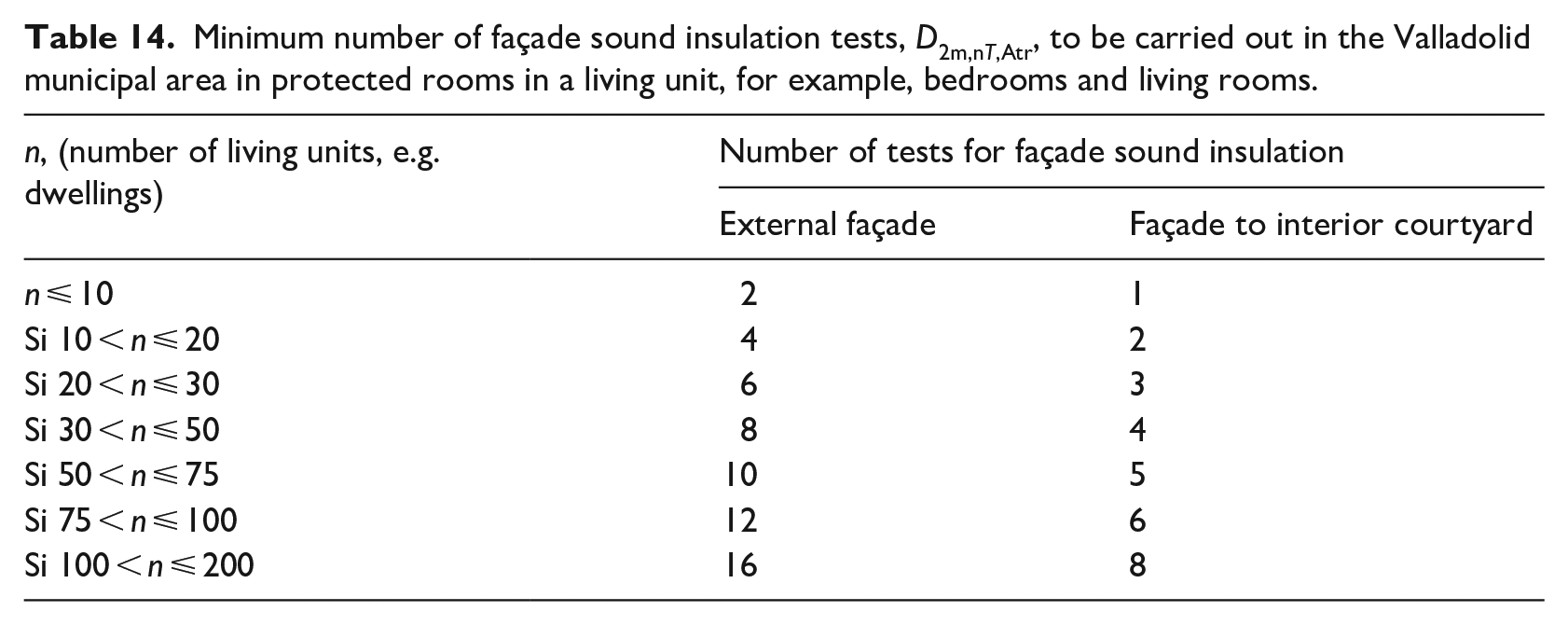
In general, the most repeated criterion is to test at least 10% of the dwellings per each construction element: separating walls floors and facades, for airborne and impact sound insulation. However, there are differences, as some regions indicate to test the airborne sound insulation of at least 20% of the dwellings and in País Vasco, the procedure for pre-completion testing is described in more detail. 47 Tables 9 to 11 describe the minimum mandatory tests to be carried out depending on the number of dwellings in País Vasco. A similar situation is found in the municipality of Valladolid, 51 where the number of mandatory tests is increased compared to the regional law 45 ; Tables 12 to 14 describe these tests according to the number of living units.
Minimum number of airborne sound insulation tests, DnT,A, to be performed in País Vasco between any protected room inside a living unit (e.g. a dwelling), and any other room outside the living unit, excluding plant rooms and activity rooms.
Minimum number of impact sound insulation tests, L′nT,w, to be performed in País Vasco between any protected room inside a living unit (e.g. a dwelling), and any other room outside the living unit, excluding plant rooms and activity rooms.
Minimum number of façade sound insulation tests, D2m,nT,Atr, to be carried out in País Vasco in protected rooms in a living unit, for example, bedrooms and living rooms.
Minimum number of airborne sound insulation tests, DnT,A, to be performed in the Valladolid municipal area between any protected room inside a living unit (e.g. a dwelling), and any other room outside the living unit, excluding plant rooms and activity rooms.
Minimum number of impact sound insulation tests, L’nT,w, to be performed in the Valladolid municipal area between any protected room inside a living unit (e.g. a dwelling), and any other room outside the living unit, excluding plant rooms and activity rooms.
Minimum number of façade sound insulation tests, D2m,nT,Atr, to be carried out in the Valladolid municipal area in protected rooms in a living unit, for example, bedrooms and living rooms.
In addition to the insulation requirements described above, all of the regulatory documents studied, with the exception of the Barcelona municipal ordinance, 48 require sound insulation tests of all construction elements which separate a dwelling and plant rooms or activity rooms.
The information of the decrees and ordinances analyzed is not homogeneous. In most cases, regulations provide a brief explanation of the construction elements to be tested and the percentage of sound insulation tests to be carried out, but in País Vasco there are criteria for prioritizing test cases (see Section 7.5).
Regarding plant rooms or activity rooms (Activity rooms are premises with an A-weighted sound pressure level up to a 70 dBA. Leisure activity premises such bars, pubs, discos, workshops, etc. where the sound pressure level usually exceeds 70 dBA are considered “noisy premises,” and the DB HR does not apply to them. In that case, it is the local authority that sets the noise insulation requirements and this is related to the type of activity license) several regulations specify that all cases of plant rooms or activity adjacent to protected rooms, for example, bedrooms and living rooms must be tested, either for airborne or impact sound insulation.
Sound pressure levels produced by service and equipment
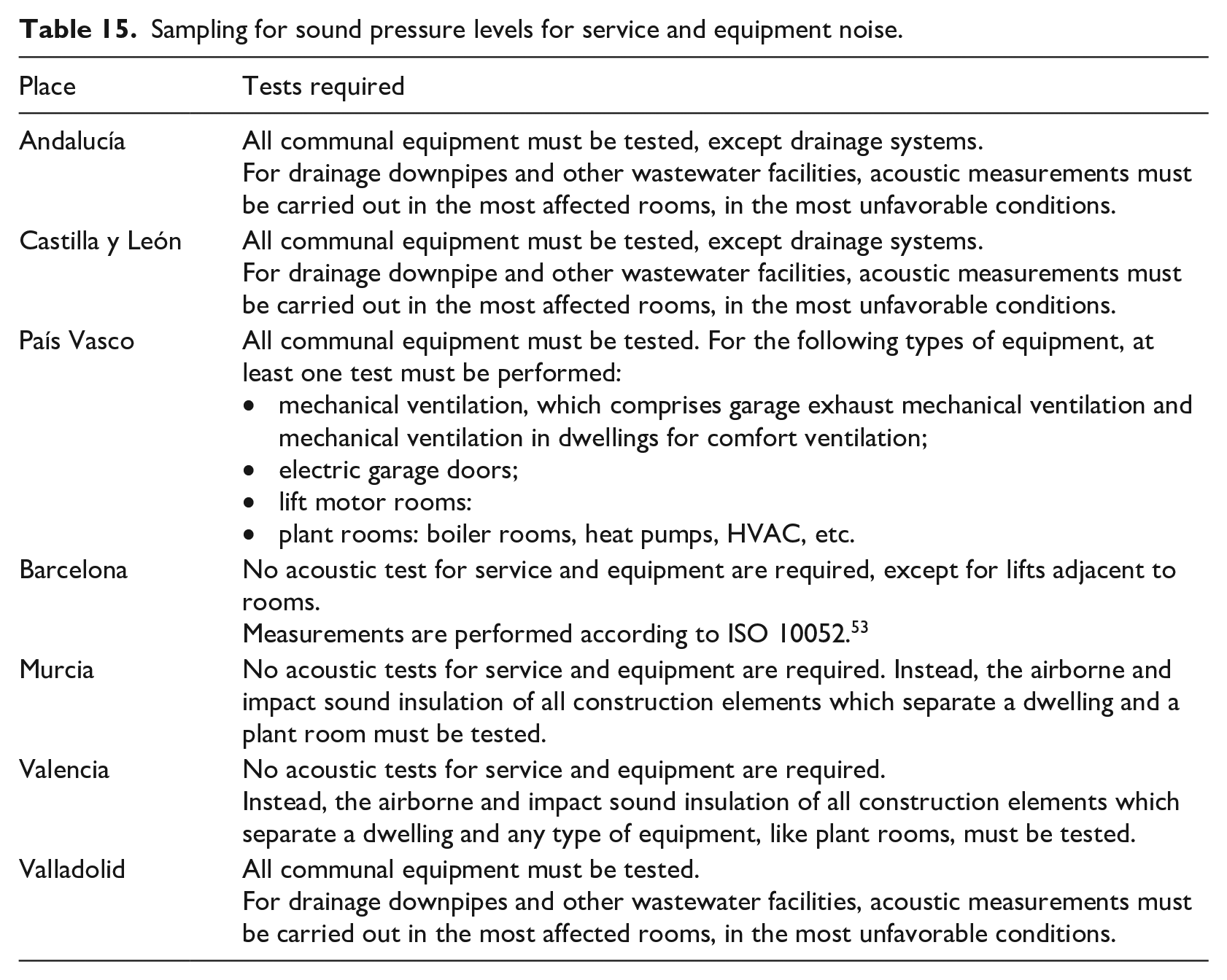
Table 15 summarizes the approach to the sampling of sound pressure levels due to service and equipment in each autonomous community and city. Whenever the sound pressure levels from building services are required to be measured, the focus is on communal systems, except for plumbing noise. Individual building services such as individual HVAC, noise from bathrooms or individual mechanical ventilation with heat recovery are not required to be tested.
Sampling for sound pressure levels for service and equipment noise.
Reverberation time in classrooms and restaurants
Despite being a requirement in the Spanish Building Code, 7 only Castilla y León requires reverberation time measurements in classrooms and conference rooms, restaurants, and canteens.
The sampling procedure in the Spanish classification scheme
UNE 74201 11 establishes the sampling procedures for the acoustic characteristics and gives guidelines for the selection of rooms to be tested focusing on the most unfavorable situations. It contains two verification procedures based on field measurements.
It is based on ISO TS 19488 54 and defines in great detail the verification and the following two sampling-plan procedures, intended to facilitate the implementation of this classification scheme:
- procedure A is based on verification by calculations, visual inspections and in situ tests, thus it implies the advice of an acoustician in the design, construction, and inspection of a building;
- procedure B is based exclusively on in situ tests.
In relation to sound insulation, in general, the sampling rate defined is 5% or 3% for procedure A and 10% or 6% for procedure B (3% and 6% applies in some cases to vertical adjoining rooms to avoid a large number of resulting rooms to be tested). For those cases involving activities or service equipment rooms, it is required to test, at least, one case.
Unlike the decrees explained above these percentages apply to cases and subcases, not to the number of dwellings. In Spanish UNE 74201, 11 cases are defined by these three factors:
- the acoustic characteristic: airborne sound insulation, impact sound insulation, façade sound insulation, noise from building services and reverberation time.
- the type of room: protected rooms, noisy rooms or common access rooms.
- the relative position of adjoining rooms: rooms adjoining horizontally or vertically.
Examples of cases include “airborne sound insulation between protected rooms that are horizontally adjacent” or “impact sound insulation between rooms that are vertically adjacent.”
In total, 14 cases are listed in UNE 74201, 11 serving as guidance for technicians to prioritize rooms for acoustic testing.
Subcases are related to different construction systems in each identified case, for example, different separating walls between protected rooms that adjoin horizontally.
Sampling is also defined for:
- reverberation time: the sampling rate defined is 5% for procedure A and 10% for procedure B, of all detected subcases and at least one measurement per subcase must be done;
- service equipment: all installations must be measured at least once; and in case of there is more than one communal equipment of the same type (e.g. lifts), at least one measurement must be carried out for each of them.
- waste water installations: 1% of the detected cases (those with a change of direction in the pipe adjoining the protected room), with a minimum of one test;
- bathroom fittings (shower, lavatory, bidet, washbasin) and kitchen sinks: 1% of the vertically, 1% of the horizontally, 1% of the diagonally adjoining rooms, with a minimum of one test per each type of element.
In all situations defined in the sampling procedure the number of tests obtained after applying the corresponding percentages must be rounded to the higher integer.
Criteria to select specific spaces for measurements
Decrees and ordinances usually provide a brief explanation of the construction elements to be tested and the percentage of sound insulation tests (and other type of measurements) to be carried out, as it has been shown; and they do not go further into criteria for prioritizing test cases.
Multi-storey housing are usually composed of repetitive living units or dwellings with a homogeneous structure both in relation to the distribution of spaces and in the constructive solutions for the different elements: separating walls and floors or facades. However, there may be situations in which the spatial configuration is quite heterogeneous, and have a wide and varied set of living units. Then it becomes necessary to analyze each housing development or building individually in order to establish proper acoustic control measures once the construction is completed.
General criteria for prioritizing and selecting the most unfavorable cases are given, for instance, in situations with equal building elements, cases that should be selected are those that due to their position in the building, or due to more incompatible uses, are more likely to cause inconvenience. In all cases it will be necessary to choose the separating walls and floors that adjoin the most sensitive and protected areas, so that we always select the most unfavorable cases. In the case noise from a service equipment or an activity the measurements will be carried out in the most unfavorable conditions. Whenever possible, protected spaces should act as the receiving rooms in measurements
A general criterion that the authors consider quite sensible is to select those cases whose acoustic insulations have been previously calculated and whose calculated values are closer to the limit values.
The fact that the regional regulations do not provide concrete and detailed sampling criteria beyond the required number of measurements has led the regional governments of the País Vasco, 47 Andalucía, 55 and Cataluña 56 to develop application guides that clarify and specify more detailed criteria for the selection of test rooms. These guides, along with the Spanish acoustic classification scheme, 11 agree in defining the most unfavorable situations by first applying criteria based on the type and use of the rooms, and then considering geometric characteristics and other parameters. The idea is to select as the most sensitive areas of the living unit or dwelling, adjacent to noisy rooms of other dwellings, such as bathrooms, kitchens, and living room or adjacent to common or access areas. There is a pre-established order to select the spaces to be tested sequentially; for example, a bedroom will always be tested before a living room and a kitchen will always be considered as an emitting room before another living room or bedroom of the neighboring dwelling. As many combinations as necessary will be selected to complete the number of tests obtained in the sampling procedure.
These criteria can be extrapolated to other uses, such as educational and hospital buildings, for example, by replacing “bedroom” with “classroom” or with “hospital room.”
Other general and geometric criteria defined are selecting the receiving rooms among those with the lowest ratio of V/Ss, where V is volume and Ss is the surface of the separating element or avoiding testing rooms separated by expansion joints or in the case of floors with no coverings.
In the case of façades, criteria for prioritizing sound insulation are selecting rooms on the most exposed to outdoor noise façade, biggest openings and with the lowest ratio of V/SF, where V is volume and SF is the surface of the façade.
When selecting spaces for reverberation time measurements, those with the highest volume will be selected first.
To determine the noise levels generated by building service equipment, the closest protected room and/or most affected by the equipment or installation under analysis is selected.
When acoustic control of a building is carried out through sampling, it is important to highlight that compliance in the sampled cases does not exempt compliance in the non-sampled cases.
Example of application of sampling procedures
In this section, an example of the application of the sampling procedures detailed in section 7 is shown. The building used in the example is the same as the one in UNE 74201, 11 which is a common residential building with 6 floors, 3 entrance halls, and 9 apartments per floor, in total there are 45 dwellings. The ground floor is occupied by activity rooms. The floors plan layout of the building are shown in Figures 4 and 5.
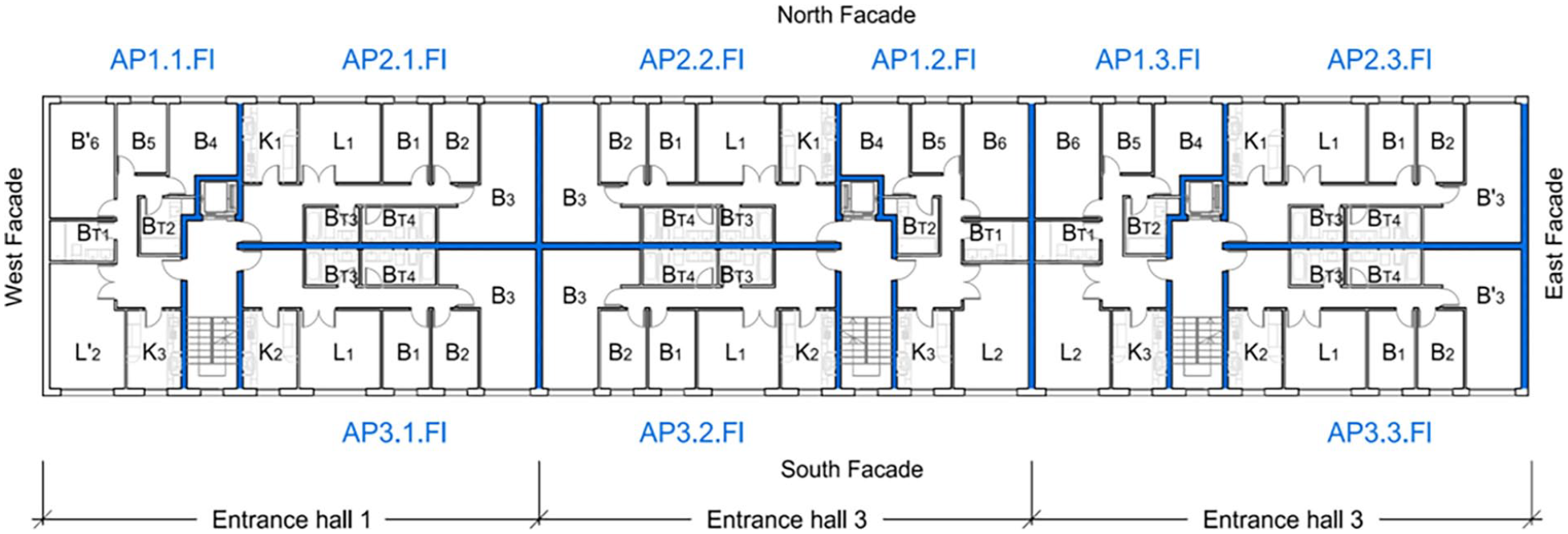
Plan layout of the building. Typical floor plant: first–fifth floors. B: bedroom; L: living room; BT: bathroom; K: kitchen; AP1: apartment 1; AP2: apartment 2; AP3: apartment 3; FL: floor number. Example: AP2.1.4 is AP2 (apartment 2) in entrance hall 1 in the fourth floor.
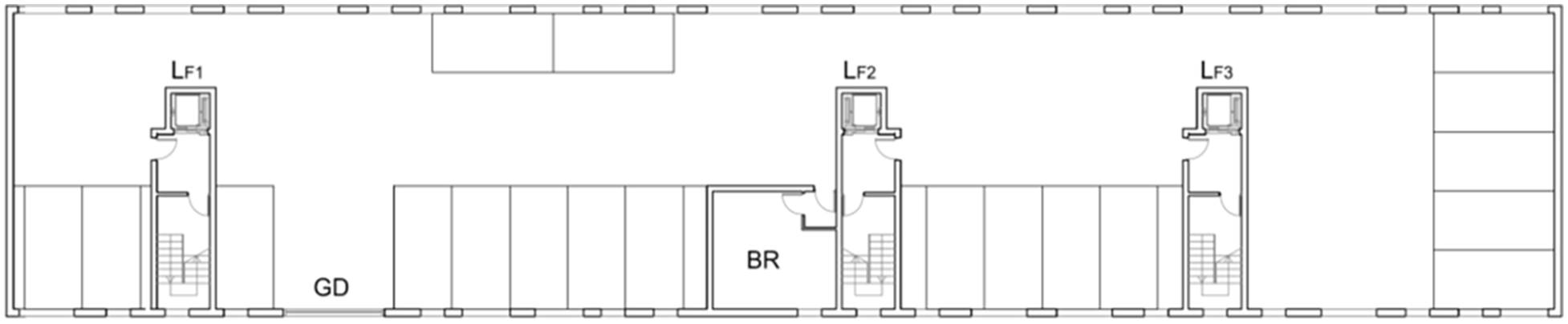
Plan layout of the building. Ground floor: Garage and service equipment. LF1: lift in entrance hall 1; GD: garage door; LF2: lift in entrance hall 2; BR: boiler room; LF3: lift in entrance hall 3.
First, the range of sound insulation values that can be obtained in such a building because of its design were estimated in Section 8.1 using calculation according to ISO 12354.20 –22 Secondly, in Section 8.2, the different sampling procedures were applied to the example and the number of tests required in each regional and local regulation were compared.
In the comparison, the acoustic classification scheme, UNE 74201 11 is also included, it is procedure B of this standard, based only on sound insulation tests (as explained in Section 7.4), that was considered in the study.
Range of the calculated sound insulation values found in the example
A model has been created that represents the building in example of UNE 74201 11 to make the acoustic insulation calculations. There are walls and floors separating bedrooms, living rooms, kitchens, stairways, corridors, bathrooms etc. Calculations of the sound insulation values of all the rooms in the building have been made using the software SONarchitect 19 that models the entire building. The results show the diversity of sound insulation values that can be found in a common multistorey building. Assuming that the standard deviation of the calculation model is 1,5 to 2,5 dB for airborne sound insulation, 20 2 dB for vertical impact sound insulation 21 and 3 dB for façade sound insulation 22 according to ISO 12354, Figures 6 to 8, show the histogram of the different sound insulation values that can be found in an ordinary housing block with 45 dwellings. The figures only represent the sound insulation values of living rooms and bedrooms, small rooms such as bathrooms, corridors, or kitchens are not represented. The different values found in the calculations performed are due to the architectural design: room with different areas, different sizes of separating walls, the junctions with walls and facades, etc. It is important to note that once these elements are installed in the building, differences between calculated values and measured values will be found, due to many factors such as inaccurate building element input data, uncertainty related to the field measurement methods, poor workmanship, and the fact that certain constructions are more sensitive to the building process than others. 57
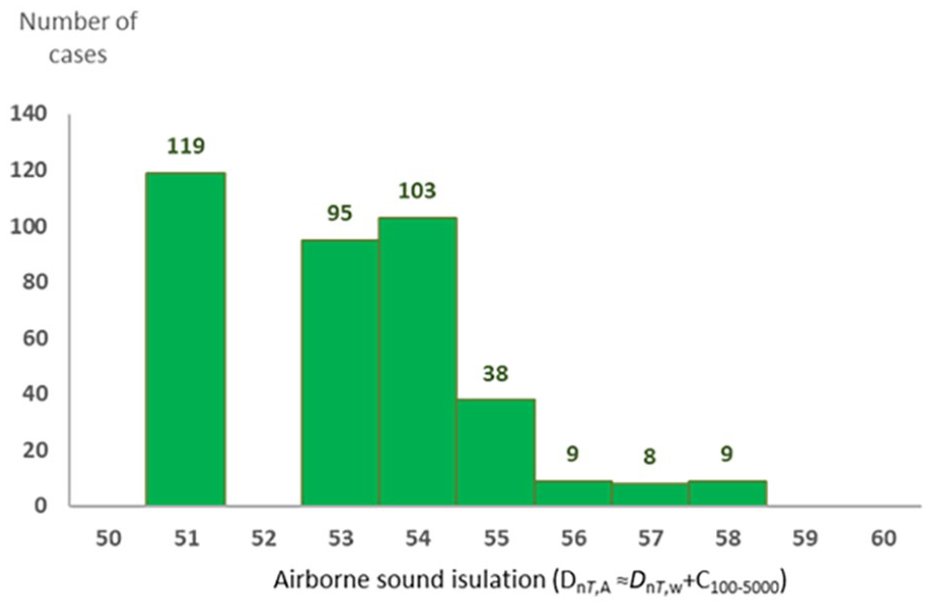
Histogram showing the airborne sound insulation values for separating walls and floors between different dwellings calculated for the example. The number of cases with a certain airborne sound insulation is indicated on the vertical axis. The calculated values of airborne sound insulation are shown on the horizontal axis. The value of 51 dB corresponds to the separating walls between protected rooms of different dwellings. The rest of the cases with higher airborne sound insulation correspond to separating floors.
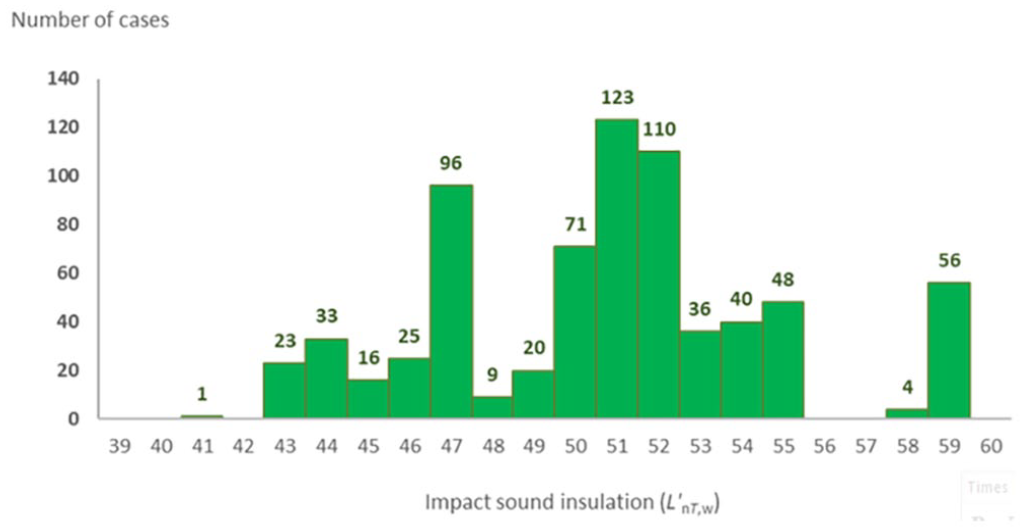
Histogram showing the impact sound insulation values for separating floors between different dwellings calculated for the example. This histogram shows a high amount of cases (711 in total), because it compiles the vertical, horizontal and diagonal impact sound insulation. The lowest values shown to the left are for the horizontal and diagonal transmission between rooms.
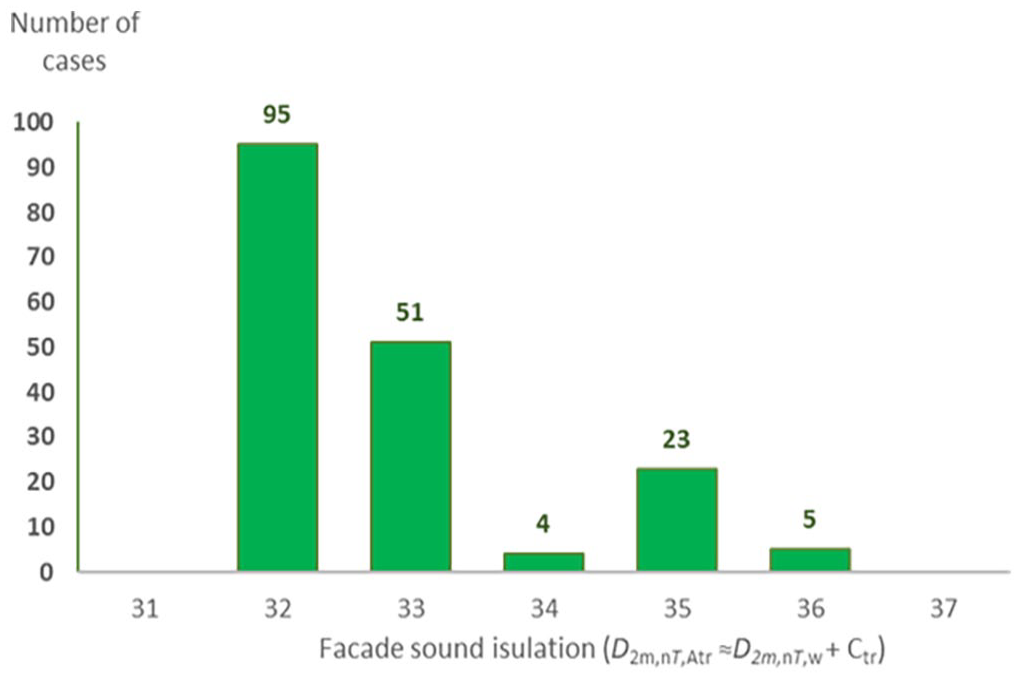
Histogram showing the facade sound insulation values for the living rooms and bedrooms. The differences are due to the sizes of the windows and the proportion of the external wall and windows.
Figure 6 expresses the airborne sound insulation, DnT,A, for separating walls and floors, Figure 7 expresses the impact sound insulation values, L′nT,w, found in the vertical direction, horizontal and diagonal directions, and Figure 8 represents the façade sound insulation D2m,nT,Atr.
The building elements used in the calculation complied with the building regulations in Spain, they consisted of:
- the separating wall between rooms is composed of a double hollow brick walls, 70 mm wide, with elastic interlayers in the perimeter, cavity 50 mm wide filled with mineral wool.
- the separating wall between rooms and staircases is composed of 115 mm perforated brick wall, a 40 mm cavity filled with mineral wool and a 50 mm brick wall with elastic interlayers in its perimeter.
- a beam and block floor with ceramic blocks 30 cm wide, with a floating screed of 70 mm of mortar on top of a resilient layer composed of 5 mm of expanded polyethylene.
- the internal walls are composed of 70 mm light hollow bricks with elastic interlayers on top and bottom
- the façade is a heavyweight construction made of 115 mm ceramic perforated brick with internal and external linings with thermal sound insulation.
- industrialized casement windows, with two leaves, glass units are 4.20.4. The outdoor noise level, Lday, was set in 60 dB.
Sampling procedures applied to the example
The data shown in Figure 9 correspond to the total sound insulation tests that must be carried out mandatorily by applying each of the normative documents studied. The total number of tests has been considered since the selection criteria differ in the regional regulations and in the UNE 74201 standard. 11 In the acoustic classification standard, they are calculated based on the number of existing protected spaces, while in the rest of the legislation, they are based on the number of dwellings. Additionally, in this comparison, all the required airborne sound insulation tests have been combined into a single value, including both horizontal and vertical tests. For façade tests, the graph combines all required measurements, considering both exterior façades and those facing enclosed courtyards when specified in the regulations. This graph also indicates the required acoustic tests when there are equipment rooms or activity rooms such as garages, boiler rooms, etc.
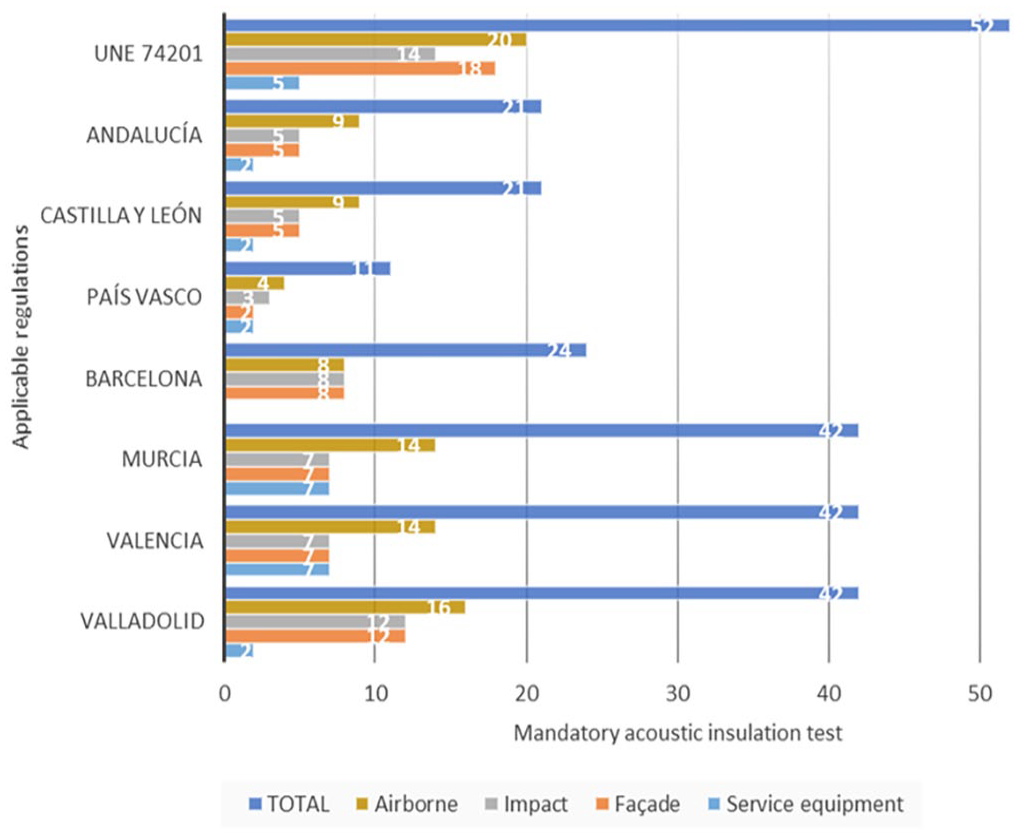
Comparison of sampling for sound insulation.
The analyzed municipal ordinances show similar values with higher requirements than those required by regional laws. Furthermore, there is a significant difference in the number of tests required in the sampling proposed by the UNE 74201 compared to the rest of the normative documents.
On the other hand, Figure 10 shows the list of required sound pressure level tests in the different sampling procedures. It is worth noting that some of the criteria indicated in the different documents are unclear, lending themselves to interpretation by the competent technician. For example, in the selection of service equipment tests, some regulations indicate the need to test in most affected rooms, in the most unfavorable conditions, but do not indicate the necessary number of tests to do, leaving this decision to the technician conducting the sampling. In this publication, when the number of tests is not indicated, the minimum mandatory number has been taken: one test of the most affected room.
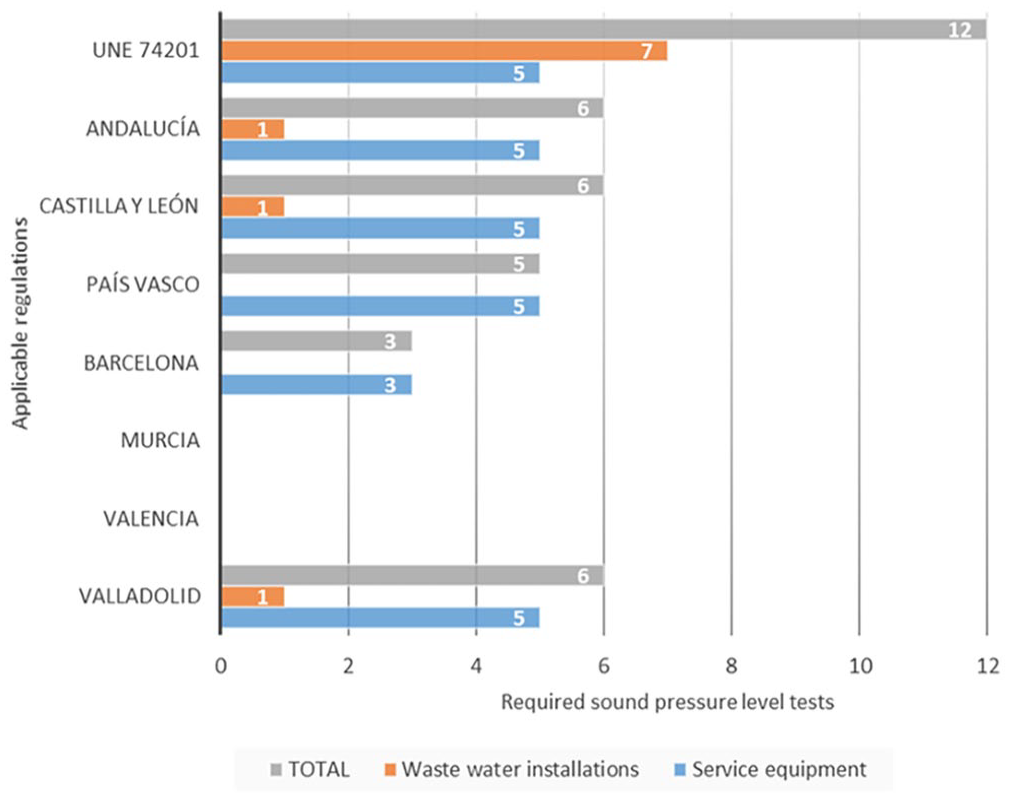
Comparison of sampling for sound pressure levels for service and equipment noise.
This comparison shows that only four of the eight regulatory documents studied consider the noise levels tests for waste water installations. At the same time, all, except for two cities, have noise levels test requirements for building service equipment.
Limitations of the research
This study has certain limitations related to the access and availability of regional and municipal regulations in Spain. First, although an extensive review was attempted, not all existing regulations in the country were studied. The analysis focused primarily on regulations that were known by the authors to include specific requirements for acoustic testing, which may limit the representativeness of the findings regarding regulations in other autonomous communities or municipalities where sufficient or clear information is not available. The information presented in this paper has been extracted from regulations and laws which were in force in November 2024.
Additionally, although international comparisons could provide valuable insights, this study does not include an extensive comparison, as the focus is on the Spanish regulatory framework. While some references to other countries are included for context, gathering detailed and up-to-date information on mandatory acoustic testing in a broader set of international jurisdictions was beyond the scope of this work. Future research could expand on this aspect if additional sources and resources become available.
Furthermore, it is important to note that not all regional or national regulations are fully transposed at the local level, leading to disparities in municipal ordinances and, in some cases, challenges in ensuring consistency in testing procedures across different jurisdictions.
Finally, the reviewed regulations show a certain degree of ambiguity, as they are written in relatively open terms. This allows for varied interpretations by technicians and laboratories, which could affect the consistency of results and the comparability of tests across different regions, as well as our own approach to applying these regulations in a real building example.
Conclusions
In Spain, acoustic requirements in buildings are established in Basic document DB HR Protection against noise that came into force in 2009. It was revolutionary at that time and represented an important advance. This was due both to the increase in sound insulation requirements and to the fact that in situ sound insulation descriptors began to be used. This allowed a final performance of the building to be verified. This regulation is similar to the regulations in other European countries and ultimately, fostered an improvement in the acoustic quality of buildings. To guarantee this acoustic quality is achieved, acoustic issues must be addressed throughout the different phases of the construction process.
Pre-occupancy acoustic testing plays an essential role in the acoustic quality of buildings, as it ensures the verification of requirements in the first place. Acoustic testing as well as site inspections during the construction phase enable the early detection of defects during construction, such as increased flanking transmission due to the substitution of materials or workmanship errors. This will allow for corrective measures to be taken before the building is occupied. Additionally, pre-occupancy acoustic testing reduces the risk of future complaints and enhances the marketability of the property.
In Spain, pre-occupancy acoustic testing is not mandatory at the national level, but several autonomous communities and local governments require testing the sound insulation before the completion of buildings to obtain the “first occupancy license,” which is a completion certificate issued by the authorities that confirms that the building is safe and habitable. These tests are performed when the building is entirely finished: all finishes are completed, all enclosures, windows and doors are installed, and the building systems are fully in place.
This paper is a comparative study on the different sampling procedures and of regional decrees and ordinances in Spain which include mandatory testing. require mandatory acoustic testing . It also includes the sampling procedure in the Spanish acoustic classification scheme, which could be a reference for those places that do not have mandatory acoustic testing and do not define any sampling method.
For this purpose, a review of the regional and municipal regulations has been conducted to examine in detail how compliance with acoustic requirements is verified through field measurements. In this analysis of local regulations, the requirements that complete and complement the national regulations have also been studied. Among the regulated aspects are the sampling rate that must be applied to know how many tests must be carried out, some criteria for selecting the rooms to be tested, or the requirements that the laboratories must meet to ensure their impartiality and competence. For example, laboratories must be registered in the general registry of testing laboratories for quality control in construction, ensure a quality management system according to the UNE EN ISO/IEC 17025 standard and meet minimum requirements of impartiality, confidentiality, personnel, or document control, among others. In addition, entities can obtain accreditation for the acoustic tests they perform through the national accreditation organization.
In all the communities and municipalities analyzed, sound insulation measurements are required in residential buildings for several key situations. These include airborne and impact sound insulation between dwellings, sound insulation of façades, and both airborne and impact sound insulation between dwellings and plant rooms or activity rooms.
Each autonomous community specifies the criteria on sampling. The most repeated criterion is to test at least 10% of the dwellings per each construction element: separating walls floors and facades, for airborne and impact sound insulation, but there are differences, as some regions indicate to test the airborne sound insulation of at least 20% of the dwellings and in País Vasco and Valladolid, the procedure for pre-completion testing are described in more detail.
Regarding the noise levels produced by building services, there are different approaches. In some places, Barcelona, Murcia and Valencia, it is not required to test the sound pressure levels from building services. In the rest of the autonomous communities, all communal building services affecting adjacent dwellings must be tested. Individual systems, such as HVAC heat pumps, water installations or mechanical ventilation are not required to be tested, except for País Vasco, where mechanical ventilation of dwellings must be tested.
The multistorey building example developed in the UNE 74201 has been taken to apply the sampling procedures of the different regulations. And calculations of the sound insulation values of all the rooms in the building have been made using the software SONarchitect to study the diversity of sound insulation values through histograms. The histograms presented in this paper illustrate the wide range of sound insulation values found in a typical multistory building due to its design. They indicate the importance of selecting the most unfavorable rooms when making field measurements. If the most favorable rooms are selected, for example, the biggest rooms, there is the potential risk of non-compliance in smaller rooms.
One of the main findings of this study is the lack of standardization regarding acoustic testing procedures, as Tthe information contained in regional decrees and ordinances is not homogeneous. The application of the different sampling procedures to an example has confirmed the difficulty it entails since many aspects are not clearly defined and are left to the interpretation of the technicians. Some local governments have developed guidelines and documents to help acousticians to apply regulations. It is the case of País Vasco, Andalucía and Barcelona. Nevertheless, it would be convenient for acousticians and professionals if criteria and sampling procedures were harmonized in all regions of Spain.
In particular, this study highlights key aspects that should be addressed in any future standardization effort, including:
- establishing clear and consistent sampling plans based on objective criteria.
- defining tolerance values to account for measurement uncertainty.
- standardizing procedures for determining compliance with regulatory requirements.
Recognizing these challenges, the authors of this paper are actively involved in future research aimed at improving consistency in acoustic assessments and harmonizing criteria and sampling procedures across regional regulations. This work is structured around two main lines of research.
First, the Spanish Decree RD 1367/2007 is currently undergoing revision. As part of this process, a working group on the harmonization of municipal ordinances has been proposed. The aim is to draft a “model ordinance” that could serve as a reference for various municipalities to align their local regulations.
Second, there is ongoing research into potential improvements to the Basic Document DB HR Protection against Noise. One area under study is the possibility of establishing mandatory acoustic testing at the national level. This consideration requires addressing several topics, such as defining a minimum sampling plan, setting limit values to apply tolerance and account for measurement uncertainty, and establishing criteria for declaring compliance with regulatory requirements.
These efforts would undoubtedly contribute to the harmonization of acoustic regulations throughout Spain.
Footnotes
Acknowledgements
The authors are grateful to Simone Secchi for responding to questions about national acoustic regulations in Italy. However, the authors assume full responsibility for any errors in the paper. Feedback, corrections, and updated information are welcomed and appreciated.
Declaration of conflicting interests
The author(s) declared no potential conflicts of interest with respect to the research, authorship, and/or publication of this article.
Funding
The author(s) received no financial support for the research, authorship, and/or publication of this article.
Ethical approval and informed consent
Not applicable.

Data availability
All data presented in the tables and graphs in this paper have been extracted from regulations and laws in force as of May 2024. Links to the regulations can be found in the reference section. Warning: The details included in this paper should not be applied directly as legislation; instead, the original documents or their updates should be consulted.