




Abstract
This paper constitutes the third part of a series of works on lower-dimensional models in lubrication. In Part A, it was shown that implicit constitutive theory must be used in the modelling of incompressible fluids with pressure-dependent viscosity and that it is not possible to obtain a lower-dimensional model for the pressure just by letting the film thickness go to zero, as in the proof of the classical Reynolds equation. In Part B, a new method for deriving lower-dimensional models of thin-film flow of fluids with pressure-dependent viscosity was presented. Here, in Part C, we also incorporate the energy equation so as to include fluids with both temperature and pressure dependent viscosity. By asymptotic analysis of this system, as the film thickness goes to zero, we derive a simplified model of the flow. We also carry out an asymptotic analysis of the boundary condition, in the case where the normal stress is specified on one part of the boundary and the velocity on the remaining part.
Keywords
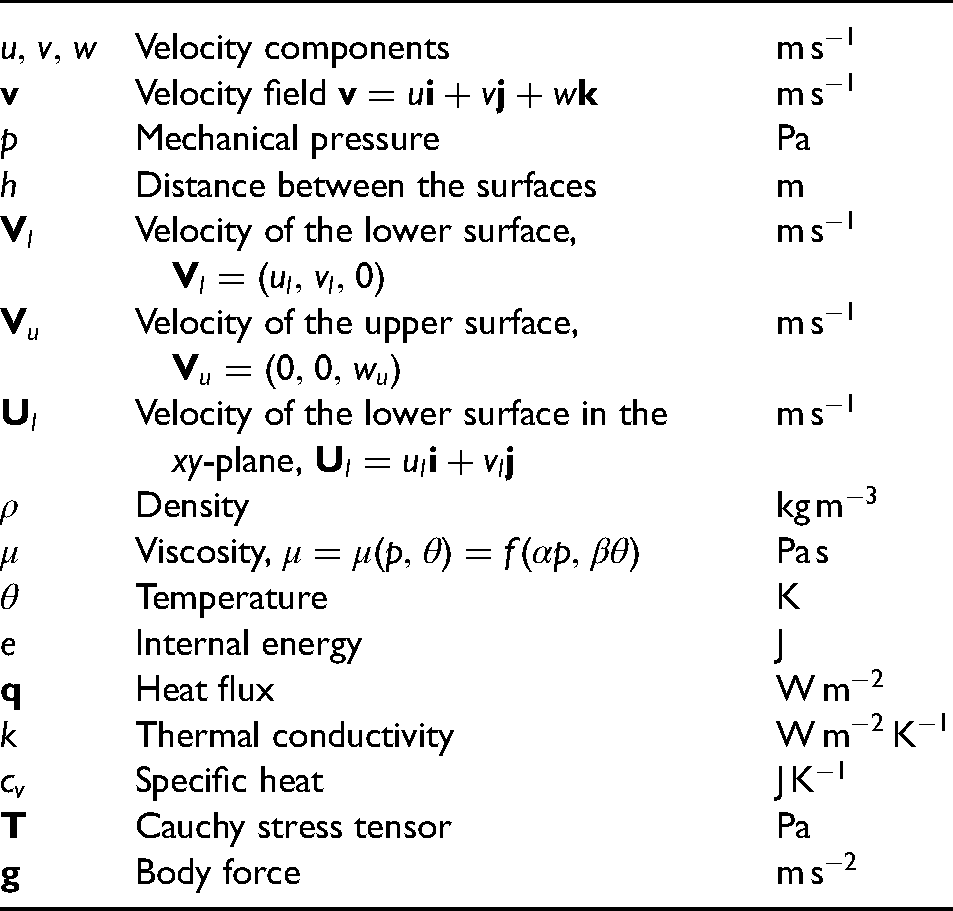
Nomenclature
Introduction
The celebrated lower-dimensional model, referred to as the Reynolds equation, that is appropriate to study of problems in lubrication was derived (in 1886) by Osborne Reynolds, 1 under the assumption that the fluid film is thin, in the case of the incompressible Navier–Stokes fluid whose viscosity is constant. However, when the viscosity depends on the pressure, just the assumption that the film thickness is small is insufficient to obtain a lower-dimensional model similar to that of the Reynolds equation. In Part A, 2 of the two-part paper,2,3 Almqvist et al. have recently shown that by following the standard procedure used to reduce the dimension of the Navier–Stokes equation, one finds that there are additional terms that are related to the body forces and inertia that do not reduce in dimension appropriately. In Part B, 3 Almqvist et al. discussed an alternative procedure to obtain a lower-dimensional equation that is appropriate for lubrication problems by appealing to asymptotic analysis.
As an increase in pressure increases the viscosity and an increase in temperature decreases the viscosity, the competing effects between pressure and temperature help moderate changes in the viscosity. In this study, which should be recognised as Part C to the aforementioned two-part paper,2,3 we address the competing effect between pressure and temperature as we develop a lower-dimensional model by applying asymptotic analysis when the viscosity depends on both the pressure and temperature. The flow can of course be modelled by the general system of equations which is obtained via balance of mass, balance of linear and angular momentum, and balance of energy, together with a set of constitutive relations. However, in realistic applications, it is difficult to solve this system of equations even with present day computers and software. Therefore, it is important to find simplified models which are accurate enough and can be efficiently handled from a numerical point of view. When the viscosity only depends on the pressure this has been done with success by using the fact that the fluid domain is very thin, i.e. that the gap between the surfaces is very small compared to the size of the surfaces. More precisely, one has by asymptotic analysis, as the film thickness goes to zero, derived lower-dimensional models (2-D models) for the pressure which are significantly easier to solve than the original system of equations, see Part A and B.2,3
Seminal work in deriving simplified models of thin film flow by asymptotic analysis, as the film thickness goes to zero, was carried out by Osborne Reynolds.
1
By rewriting the incompressible Navier–Stokes equation in a special dimensionless form and neglecting terms, which are small under the assumption that the lubricant film is very thin, he derived the following simplified model of lubricant flow:

Mathematical models of lubrication are often very complex, but they are almost always built on (1) and (2). Unfortunately, the arguments which lead to these complex models are often conceptually wrong and there are numerous scientific works where the arguments leading to the model should be improved, corrected, or better justified. Let us give an example: In elastohydrodynamic lubrication (EHL) the pressure is extremely high which implies that the viscosity changes by several orders of magnitude in the fluid domain. In addition, the viscosity also depends on the temperature and the surfaces are elastically deformed due to the high pressure. All these effects are commonly taken into account by just replacing the constant viscosity in (2) by a viscosity-pressure-temperature relation
In the two previous parts of this paper,2,3 we pointed out common misinterpretations and incorrect usage of the Reynolds equation when the viscosity depends on the pressure. In particular, it was highlighted that to obtain a system of equations, which is suitable for asymptotic analysis one must start by applying the theory for implicit constitutive relations developed by Rajagopal,7,8 which leads to a generalized Navier–Stokes equation. The reason is that it is conceptually wrong to say that the viscosity in the Navier–Stokes (Newtonian) constitutive model for an incompressible fluid depends on the pressure (see the studies by Almqvist et al.2,3 and Rajagopal7,8), as such a dependence makes the constitutive relation for the stress and the symmetric part of the velocity gradient to be implicit. That is, one no more has the stress defined explicitly in terms of the symmetric part of the velocity gradient.
It is well-known that in many realistic applications it is important to consider the fact that the viscosity depends on the temperature. The purpose of this paper is to generalize the results in Part A and B, by deriving a simplified system of equations governing incompressible thin film flow where the viscosity not only depends on the pressure, but also the temperature. In addition, we show that it is not trivial to determine the appropriate boundary conditions that should be used in the simplified model.
There are numerous works considering the derivation of simplified models of thin film flow. We do not give a complete review of all these results, but we only mention those which we judge to be most relevant for the present work. In the mathematically oriented paper 9 a generalized Reynolds equation and an associated energy equation is derived. However, the asymptotic analysis starts from the Stokes equation (i.e. inertial terms are neglected a priori), the viscosity only depends on the temperature and the gap between the surfaces does not change with time. The results in Ciuperca et al. 9 are consistent with the more general results presented in this paper. In the well-cited paper by Dowson 10 a generalized Reynolds equation was also derived. It permits the variation of the viscosity across, as well as along, the lubricant film. The generalized form of the Reynolds equation which was derived by Dowson 10 is the same as (54), except for that the derivation presented by Dowson does not admit the viscosity to depend on the pressure. The reasons for this are clearly explained in the previous two parts of this paper.2,3 In Dowson 10 an approximate energy equation is also discussed. In particular, it is pointed out that the term in the energy equation which describes the viscous dissipation can be significantly reduced with little error. This is consistent with the energy equation (40) which is derived in this paper. The analysis in Dowson 10 is not restricted to incompressible fluids. However, one should be aware of that the analysis starts by inserting the Stokes assumption into the Navier–Stokes equation and nowadays it is known that Stokes assumption is inapt, see Rajagopal. 11 The derivation of a generalized Reynolds equation for fluids with pressure dependent viscosity has also been considered in previous works,12–16 with other techniques and assumptions.
The paper is organized in the following way: In Section “The 3-D mathematical model”, we present a mathematical model of isochoric flow for fluids with temperature and pressure dependent viscosity. In particular we show that, implicit constitutive theory must be used since the viscosity in an incompressible Newtonian fluid cannot depend on the pressure. In Section “Derivation of a simplified model of thin film flow”, we derive a simplified model of the flow by asymptotic analysis of the full model as the fluid film thickness goes to zero. From this simplified model we derive, in Section “A system of Reynolds type for fluids with pressure and temperature dependent viscosity”, a system of equations for the pressure and temperature. The system consists of a generalized form of the Reynolds equation and a simplified version of the energy equation. The boundary condition to be used for the pressure in the generalized form of the Reynolds equation depends on the type of boundary condition one has on the lateral surface in the full model. The relation between the boundary condition in the full model and the boundary condition that should be used in the generalized form of the Reynolds equation is presented, for some typical examples, in Section “Asymptotic analysis of the boundary conditions”. Finally, we present the main conclusions and some concluding remarks in Section “Conclusions and concluding remarks”.
The 3-D mathematical model
In this section we describe the full
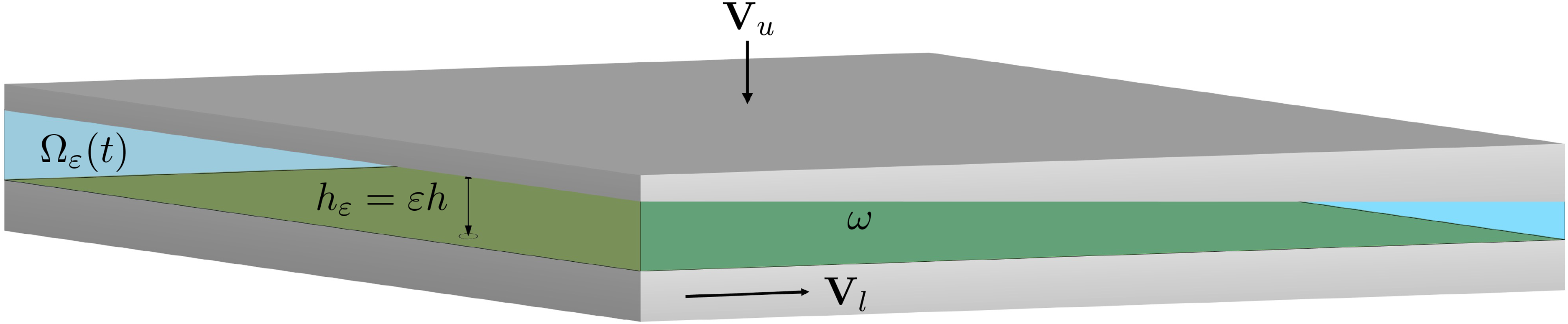
Description of the “thin” flow domain
We consider flows where the fluid is confined between two surfaces. More precisely, the lower surface is a flat surface in the An illustration of a typical fluid domain 

The fluid model
The Navier–Stokes constitutive relation for an incompressible homogeneous fluid is based on the assumption that the Cauchy stress tensor 
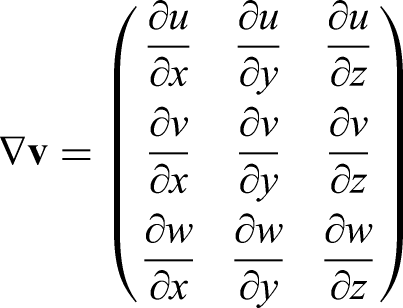


The way to justify constitutive relations for incompressible fluids where the material moduli may depend on the pressure, is to go beyond the class of the Navier–Stokes fluid model or even the more general Stokesian fluid model and consider the fluid as a sub-class of fluids described the implicit constitutive relations. The idea of using implicit constitutive relations was recently introduced by Rajagopal.7,8 The main idea is to, instead of starting from (4), start with the following implicit constitutive assumption: 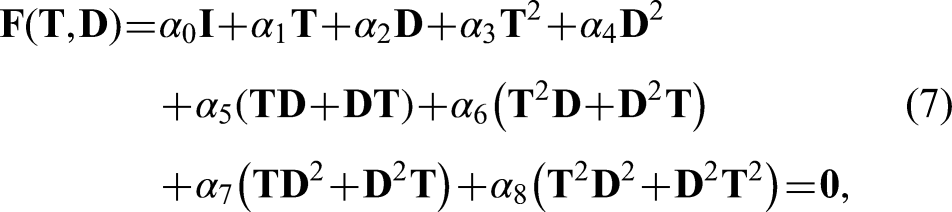


The viscosity-pressure-temperature relationship in (8) is determined empirically or by molecular modeling. In general, the viscosity increases with the pressure and decreases with the temperature. In our analysis we consider viscosity-pressure-temperature relations of the form
In this paper we consider incompressible homogeneous fluids described by implicit constitutive relations which are modeled by the constitutive relation (8). A generalization would be to consider fluids described by implicit constitutive relations which undergo isochoric motion in isothermal flows, but which could change its volume due to changes in temperature. The pioneering works considering this possibility, for classical linear viscous fluids, were done independently by Oberbeck 17 and Boussinesq. 18 Many attempts have been made to rigorously justify the Oberbeck–Boussinesq approximate equations. An overview can be found in Rajagopal, 19 and the case with pressure dependent viscosity is considered in Rajagopal. 20
Balance equations
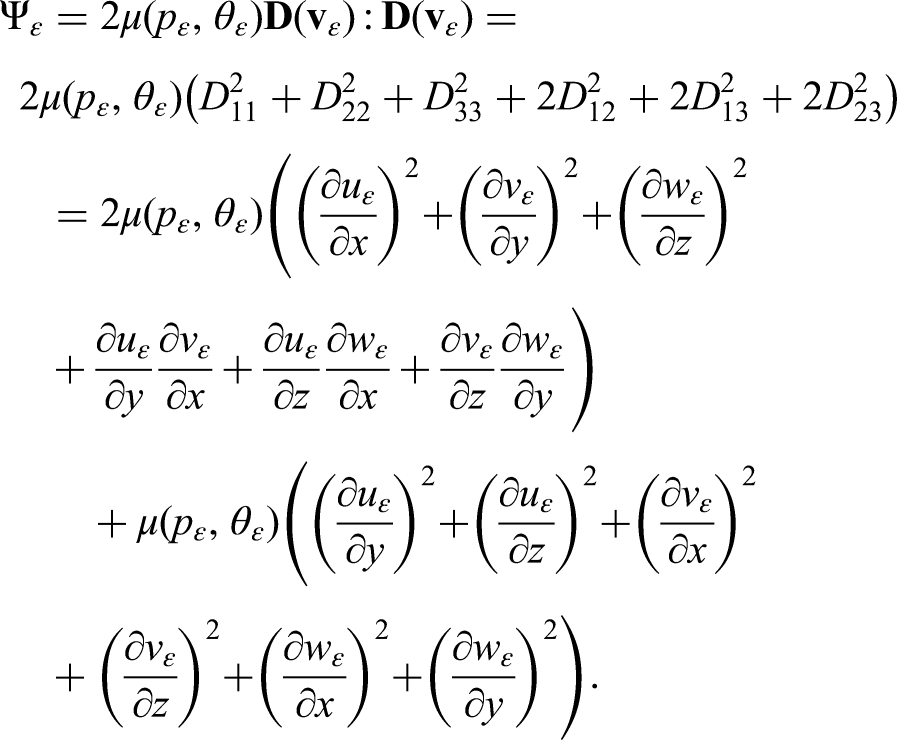
In the present work we consider homogeneous fluids which may be considered as incompressible, i.e. the density Balance of mass for an incompressible fluid, leads to the velocity field being divergence free, i.e. Balance of linear momentum implies that Balance of energy yields the equation
The system of equations (10), (12) and (15) is closed (it has five equations and five unknowns) and governs the flow.






Boundary and initial conditions
The fluid domain 


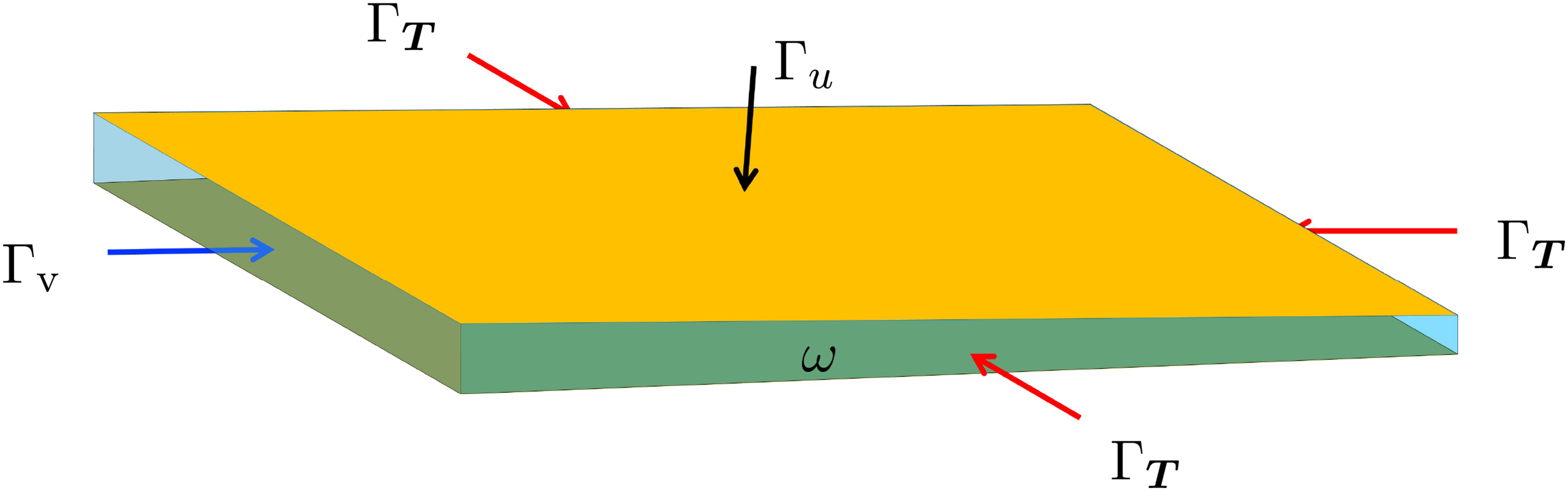
An illustration of a fluid domain (transparent blue), with fluid boundary
To have a mathematical well-posed problem, we must also impose some type of boundary condition on the wall of the bearing domain. There are several choices for this. However, from a physical point of view it is often not obvious which boundary condition one should choose to best describe the situation under study. In this work we consider the situation where the velocity 


If the measure of
Derivation of a simplified model of thin film flow
To compute the solution of the system of balance equations (10), (12) and (15) with associated boundary- and initial conditions is very difficult. It becomes extra difficult when the domain is very thin, i.e.
The main idea
The main idea for deriving is similar to the one that was used in Almqvist et al.
3
Indeed, assume that we want to compute the velocity, pressure and temperature for a given We want to compute the solution Construct an auxiliary sequence Show that Use the fact that for small values of Since
Construction of the auxiliary sequence (scaling of
)
A crucial question is how to construct the auxiliary sequence 




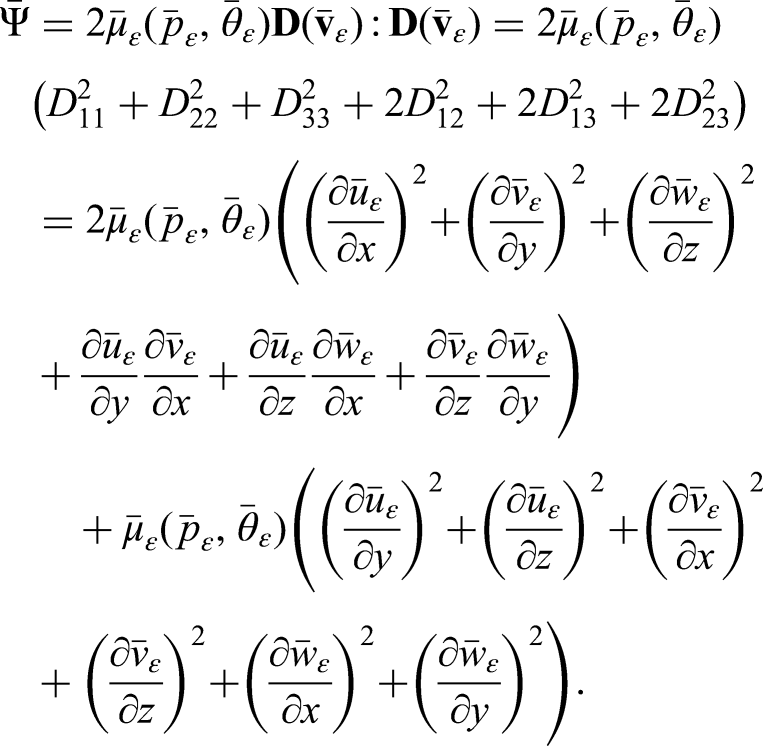
We deliberately do not discuss the appropriate boundary conditions for the auxiliary system (17)–(19) here. This discussion is postponed to Section “Asymptotic analysis of the boundary conditions”.
Transformation of the
-dependent domain
into a fixed domain
The fluid domain 
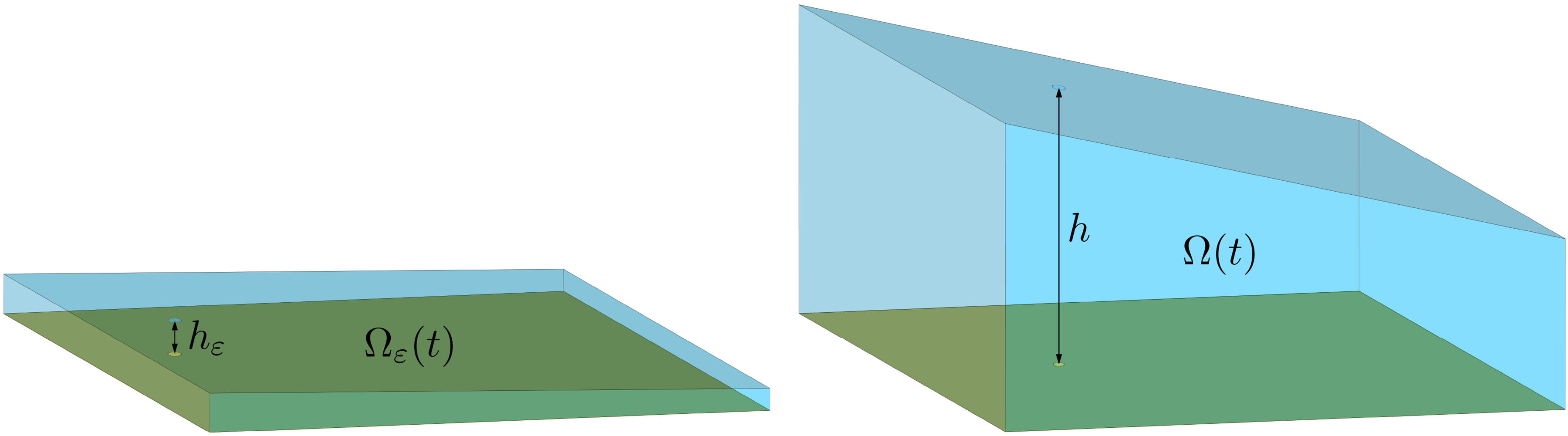
An illustration of the
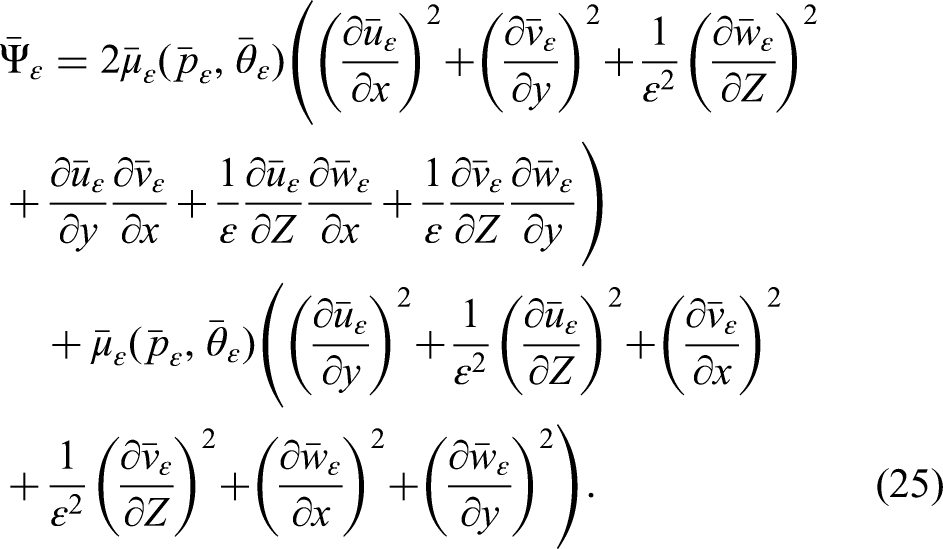
In the new variables, i) the equation (10) describing conservation of mass becomes
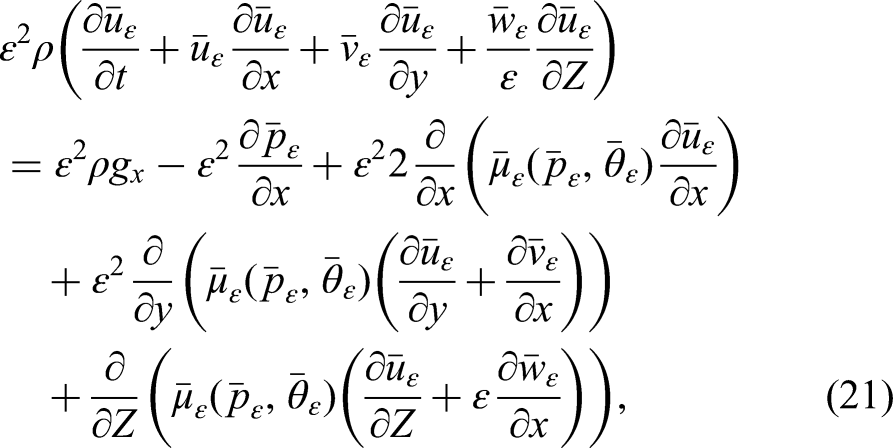
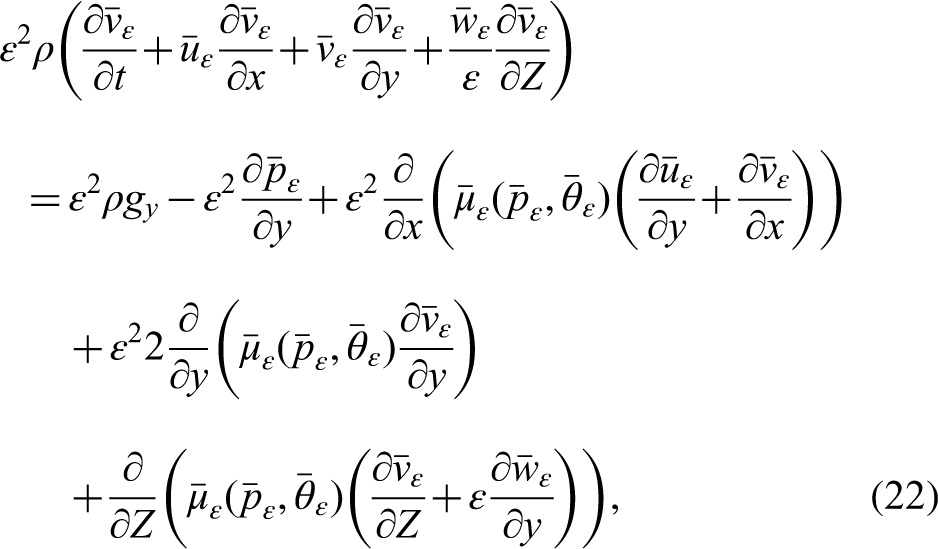
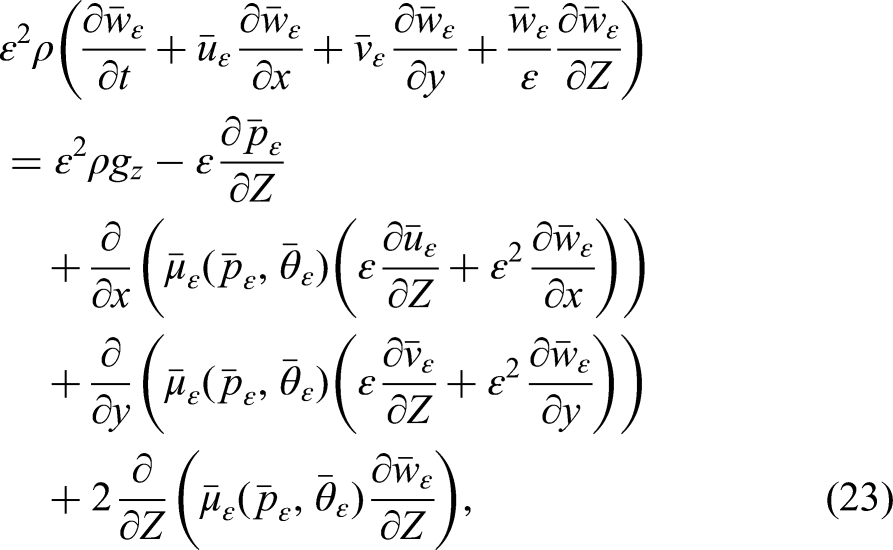
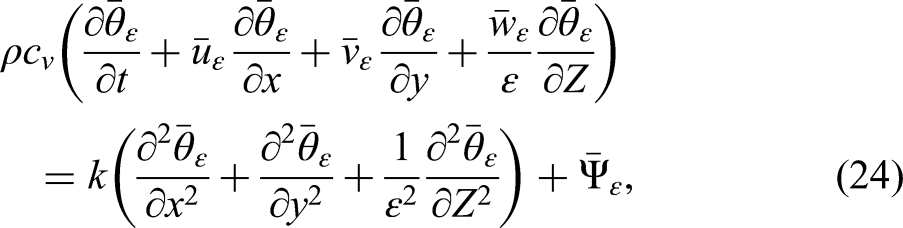
Asymptotic expansion of the velocity field, pressure and temperature
Let us assume that 




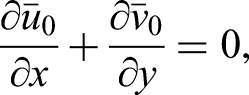
The no-slip boundary condition at the upper and lower surfaces motivates the assumption that 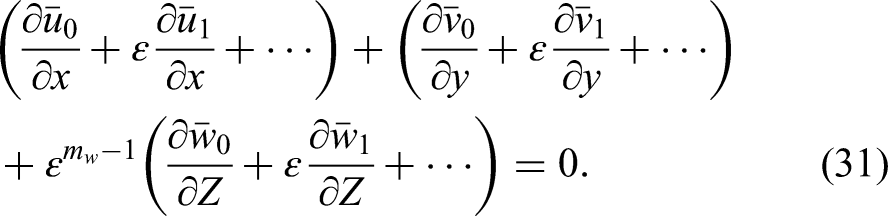










A system of Reynolds type for fluids with pressure and temperature dependent viscosity
In this section, we will derive a closed system of equations for the pressure and temperature developing in thin-film flows of incompressible fluids. The system consists of a generalized form of the Reynolds equation and a type of energy equation.
A generalized Reynolds equation
From (39) it follows that 




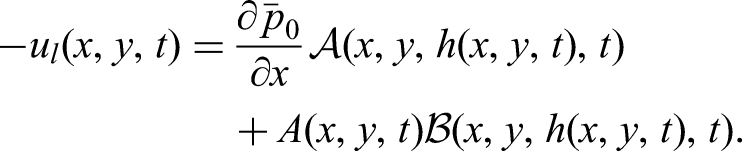

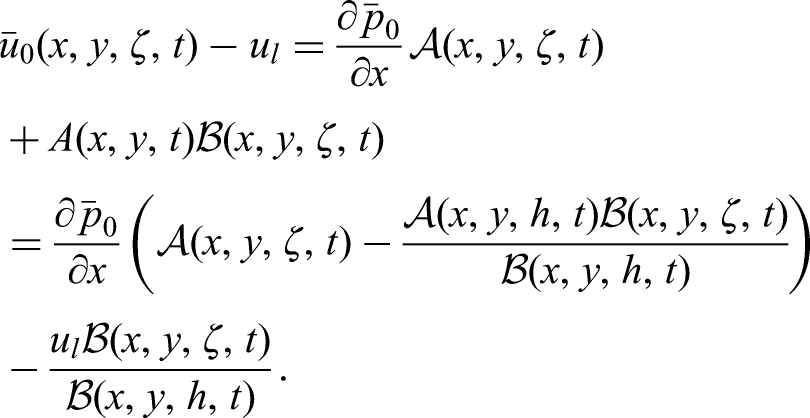
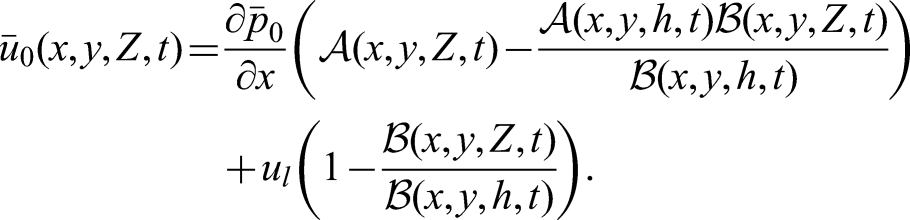
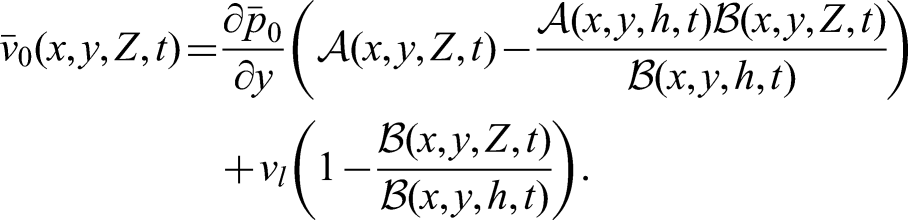
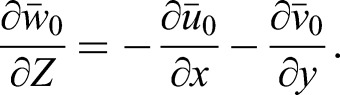

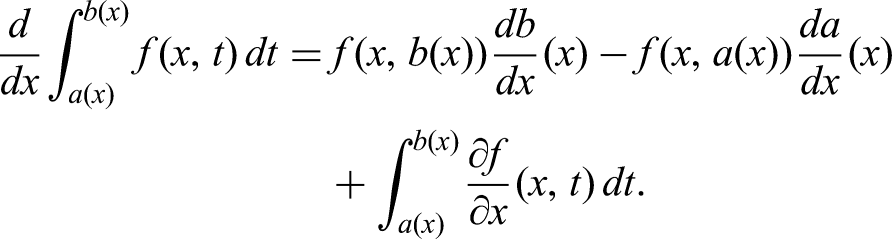

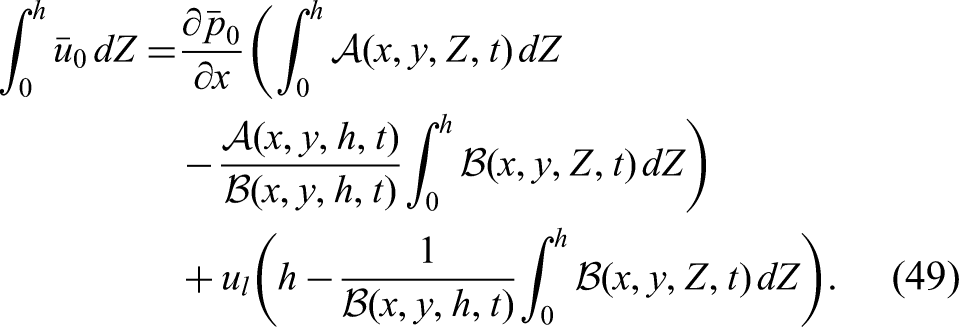
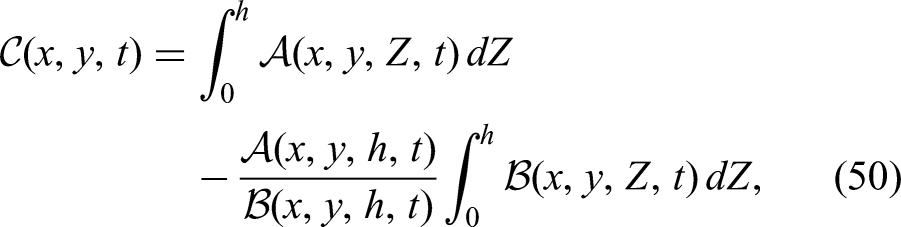



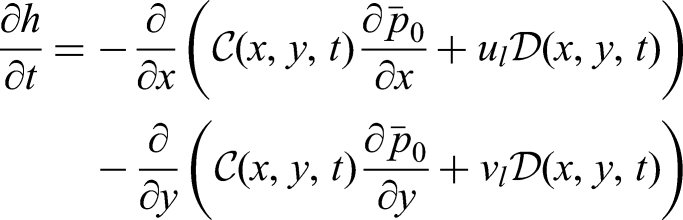

We note that in the stationary case, i.e. when
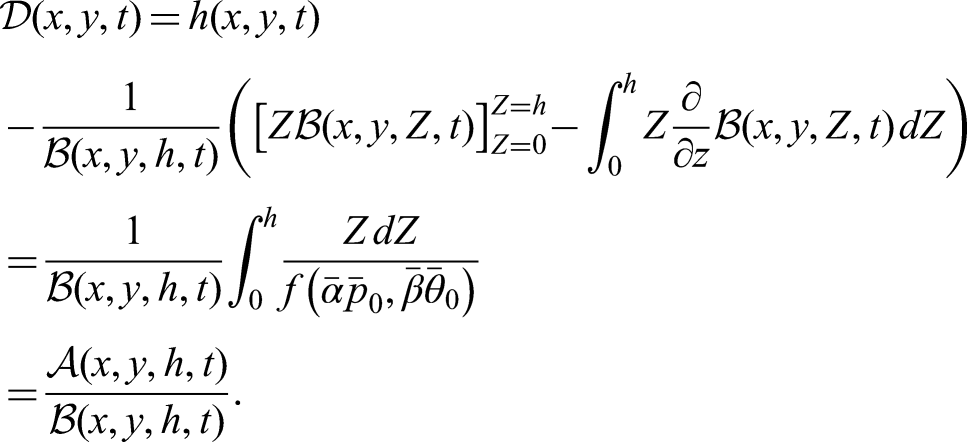
To help the reader to compare the present result with the result in Dowson,
10
we just point out that by integration by parts we have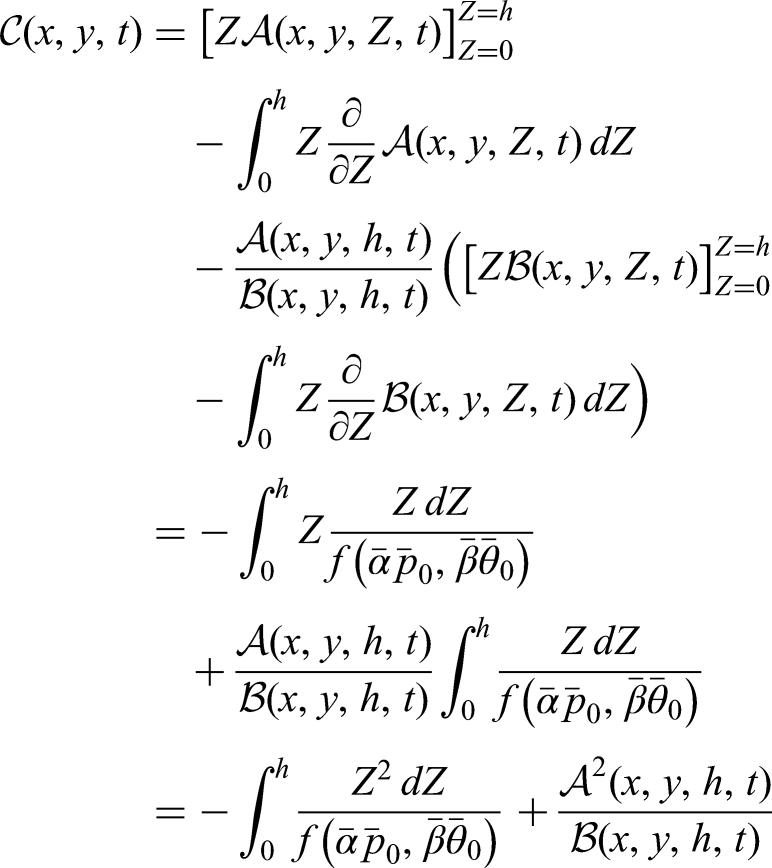
The energy equation associated with the generalized Reynolds equation
Equation (40) may be written as



The main result
Let us just sum up the main results in this section. Indeed, in Subsection “A generalized Reynolds equation” we derived the generalized equation (54) and in Subsection “The energy equation associated with the generalized Reynolds equation” we derived the equation (58) which is a special form of the energy equation. These two equation forms a system of Reynolds type. More precisely, we have derived the following model of incompressible thin film flow for fluids with pressure and temperature dependent viscosity:

Particular cases
Let us consider two examples:
If 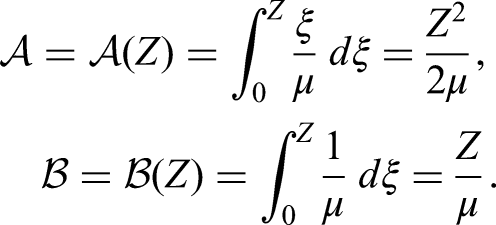
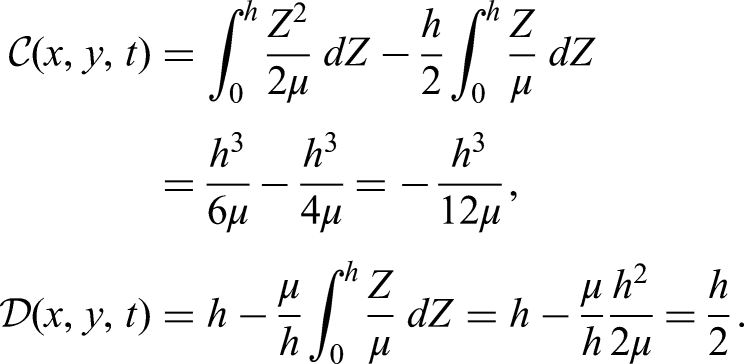
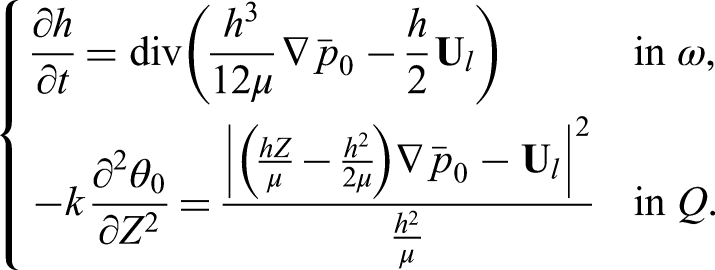
(The generalized equation derived in Almqvist et al.2,3)
If 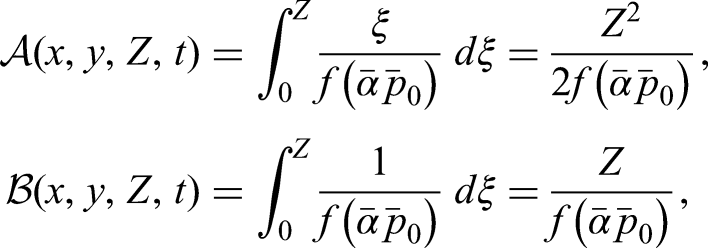
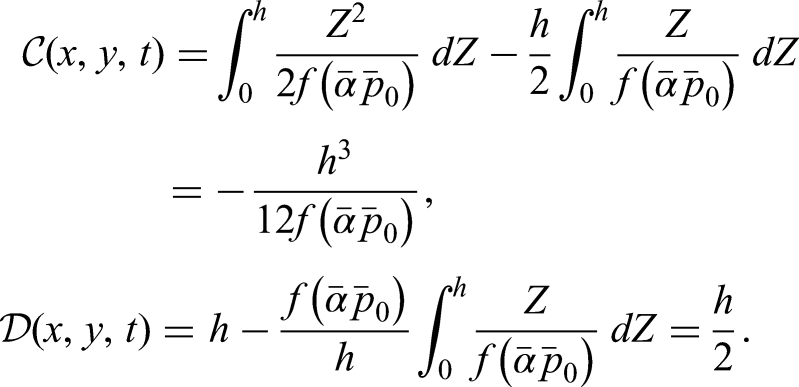
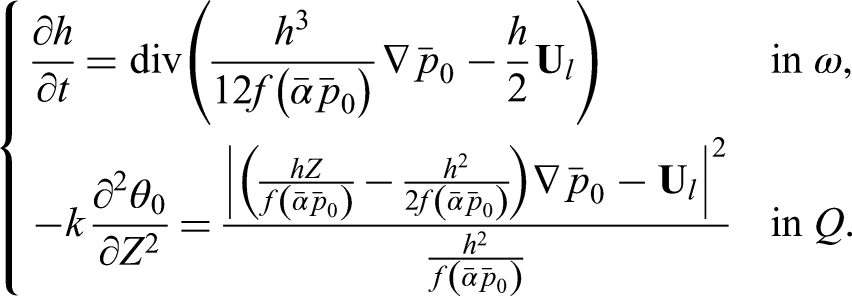
Remark: In the above examples the viscosity does not depend on the temperature and it possible to further simplify the system (59)–(60) by using that the pressure does not depend on Z. If the viscosity depends on the temperature, then it is not possible to do further simplifications since the temperature depends on
Asymptotic analysis of the boundary conditions
In this subsection we discuss the boundary conditions that should be imposed in the auxiliary system (17)–(19) and study the asymptotic behavior of these boundary conditions.
Let us start by considering the boundary condition at 
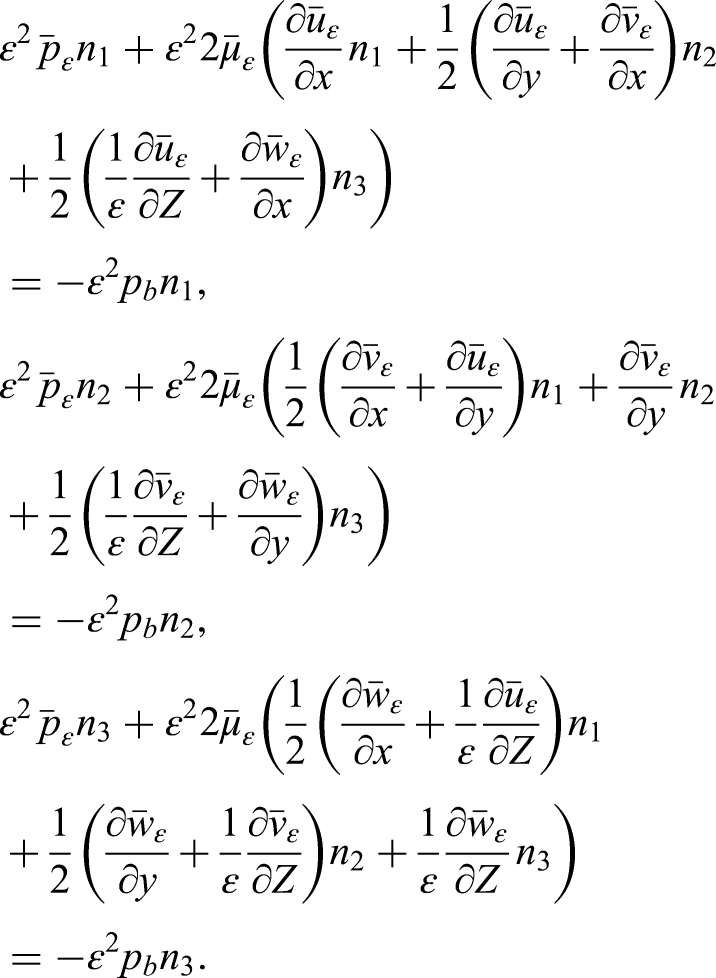

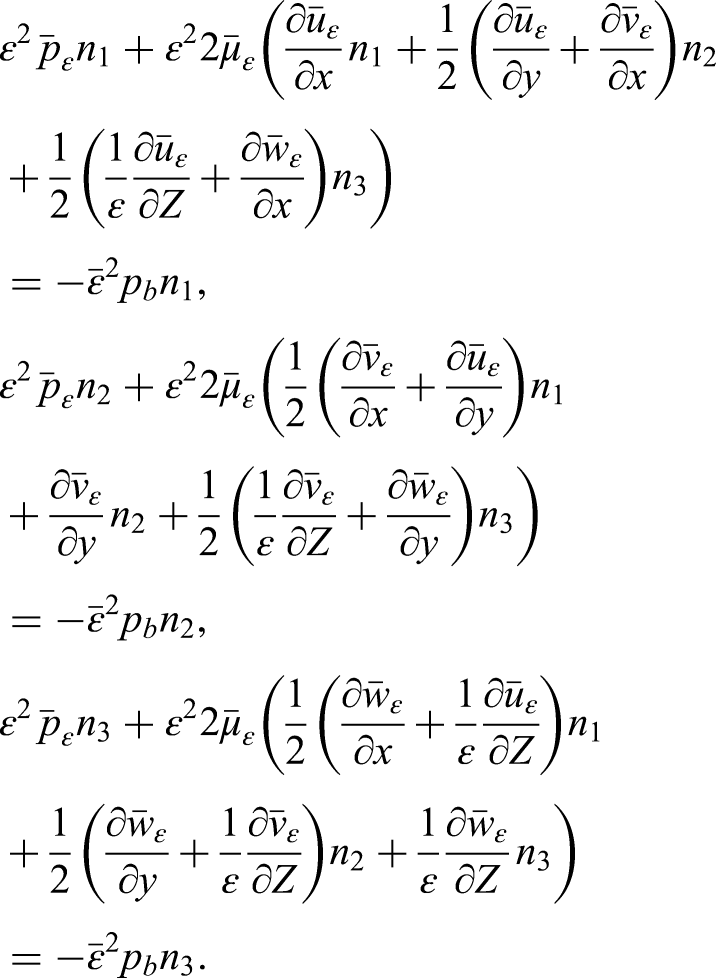

Let us consider the boundary condition on 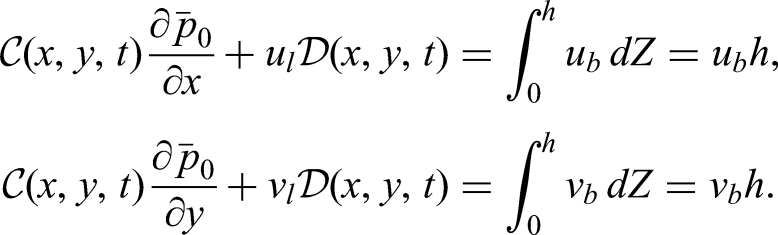

If 
If 
Conclusions and concluding remarks
In this paper we have derived a model of incompressible thin film flow, where the viscosity of the fluid depends on pressure and temperature. It, thereby, constitutes an addition, i.e. Part C, to the previously published two-part paper.2,3 We have also pointed out shortcomings in the derivations of some of the models that are widely used to model such flows. The main conclusions and results are:
The Navier–Stokes model of an incompressible fluid can not be used since it does not allow the viscosity to depend on the pressure. Hence, to derive equations governing the motion of incompressible fluids with pressure and temperature dependent viscosity one must start by deriving a constitutive relation where the material moduli may depend on the pressure and the temperature. This is done by applying the implicit constitutive theory. After inserting the derived constitutive relation into the equations representing balance of linear momentum and balance of energy we observe that we must scale the viscosity-pressure coefficient From the simplified system, we derived a system of equations for the pressure and the temperature. The system consists of a generalized form of the Reynolds equation (59) and an energy equation (60). The generalized form of the Reynolds equation is a lower-dimensional model, i.e. the domain is two-dimensional. The domain associated with the equation which is related to the energy is three-dimensional. This is because the temperature varies across the film. A Dirichlet boundary condition for the velocity in the generalized Navier–Stokes equation yields a Neumann boundary condition for the pressure in the lower-dimensional equation (59). Moreover, a normal stress condition in the generalized Navier–Stokes equation yields a Dirichlet condition for the pressure in the lower-dimensional equation (59).
This work presents, by no means, the final solution to thin-film flow modeling. There are various points of improvement that could be addressed in future work, drawing from the results presented herein. The list can be made nearly infinitely long but, we can only mention a few. For instance, it is necessary to rethink and work on adapting suitable boundary conditions (when applying the present modeling approach) to a particular application. Relaxing the assumption of fluid incompressibility (in a physically sound way) is another one. Rigorously including a rheology which is more complex than the constitutive relationship given by (8) is a third. It is also essential that future research is devoted to possibly including the fluid’s phase change from liquid to solid and the associated plastic flow of the solid within the contact region. Another important aspect is to develop numerical methods for solving the lower-dimensional problems, associated with various application. However, it is well-known that even in the simple isothermal situation, it is a very challenging task to get the numerical scheme to converge.
Footnotes
Declaration of Conflicting Interests
The author(s) declared no potential conflicts of interest with respect to the research, authorship, and/or publication of this article.
Funding
The author(s) disclosed receipt of the following financial support for the research, authorship, and/or publication of this article: The authors acknowledge support from VR (The Swedish Research Council): DNR 2019-04293.

Correction (December 2022):
This article has been updated with minor corrections since its original publication.