Most of the problems in lubrication are studied within the context of Reynolds’ equation, which can be derived by writing the incompressible Navier-Stokes equation in a dimensionless form and neglecting terms which are small under the assumption that the lubricant film is very thin. Unfortunately, the Reynolds equation is often used even though the basic assumptions under which it is derived are not satisfied. One example is in the mathematical modelling of elastohydrodynamic lubrication (EHL). In the EHL regime, the pressure is so high that the viscosity changes by several orders of magnitude. This is taken into account by just replacing the constant viscosity in either the incompressible Navier-Stokes equation or the Reynolds equation by a viscosity-pressure relation. However, there are no available rigorous arguments which justify such an assumption. The main purpose of this two-part work is to investigate if such arguments exist or not. In Part A, we formulate a generalised form of the Navier-Stokes equation for piezo-viscous incompressible fluids. By dimensional analysis of this equation we, thereafter, show that it is not possible to obtain the Reynolds equation, where the constant viscosity is replaced with a viscosity-pressure relation, by just neglecting terms which are small under the assumption that the lubricant film is very thin. The reason is that the lone assumption that the fluid film is very thin is not enough to neglect the terms, in the generalised Navier-Stokes equation, which are related to the body forces and the inertia. However, we analysed the coefficients in front of these (remaining) terms and provided arguments for when they may be neglected. In Part B, we present an alternative method to derive a lower-dimensional model, which is based on asymptotic analysis of the generalised Navier-Stokes equation as the film thickness goes to zero.
It is well-known that the consequences of lubrication in e.g. bearings and gears, in terms of energy loss, materials wastage, premature failures and environmental impact are substantial, see e.g. literature.1 To optimise the lubrication, it is necessary to have accurate and applicable mathematical models of the lubricant flow between the surfaces. We are interested in the class of lubrication problems wherein the lubricant can be considered as incompressible and piezo-viscous. This means that the Navier-Stokes consititutive relation,a presented here in (4), is not applicable. We will, therefore, apply the theory for implicit consititutive relations developed in literature,2,3 and combine the implicit relation given in (10) for the lubricant rheology with conservation of mass, balance of linear and angular momentum, to model the flow. This type of system is very complex, but the fact that the fluid domain in lubrication is very thin can, as will be shown here, in many cases be used to derive lower-dimensional equations of the flow, which are significantly easier to apply and solve numerically. One of the main objectives with this work is, actually, to highlight the necessity of using an implicit consitutive relation to obtain an equation that can be used to model the flow of an incompressible and piezo-viscous fluid.
The lower-dimensional equation for the pressure that Reynolds derived,4 is often presented as
where p is the mechanical pressure in the fluid, ρ is the density of the fluid, μ is viscosity of the fluid and V is the sum of the velocities (in the xy-plane) of the lower- and the upper surface and the domain is depicted in Figure 1. The mechanical pressure is the negative mean value of the normal stress and from now onwards when we say pressure we mean mechanical pressure.b
Schematics of the flow domain.
The Reynolds equation (1) was derived under quite restrictive assumptions. In particular, Reynolds assumed that the surfaces were rigid, the fluid was an oil and he could, therefore, treat it as if it had constant viscosity and density. Remark that, in Section Derivation of Reynolds’ equation (constant viscosity and density), we show that under these conditions one can obtain the classical Reynolds equation by just assuming that the fluid film is sufficiently thin, i.e. it is not necessary to, a priori, omit the inertial- and body-force terms. In lubrication theory it is, however, common to assume, often in a quite heuristic way, that (1) also is valid in much more general situations. Let us give three examples of this. The first is mathematical modelling of elastohydrodynamic lubrication (EHL), where the pressure may be so high that the viscosity changes several orders of magnitude, within the lubricated conjunction. In addition, the pressure leads to deformation of the elastic surfaces. Despite that the conditions under which the Reynolds equation (1) was derived are then not fulfilled in the EHL regime, one still uses (1), and it is simply assumed that the film thickness and the viscosity depend on the presssure, i.e. and , see e.g. literature.6–10 The second example we want to mention considers surface roughness, which is commonly modeled using techniques developed within homogenization of partial differential equations. However, the asymptotic analysis of the Navier-Stokes equation is a delicate problem and the result will depend on the ratio between the wavelength of the surface roughness and the film thickness. In literature,11–13 it is shown under what conditions it can be justified to just apply homogenization to the Reynolds equation, i.e. by first letting the film thickness go to zero and thereafter letting the wavelength of the roughness go to zero. For reviews on multi-scale texturing in lubrication the reader is referred to e.g. literature.14,15 The third example stems from the fact that a fluid subjected to too large tensile stresses will rupture and air bubbles are formed. This phenomenon is known as hydrodynamic cavitation and it is commonly modeled by a modified form of the classical Reynolds equation in which the density depends on the pressure, see e.g. literature.16–18 However, there exists no proof of that the same result would be obtained by considering cavitation already in the Navier-Stokes equation and, thereafter, deriving a lower-dimensional model which takes cavitation into account.
Numerical solutions, obtained using models based on the Reynolds equation, have proven to agree well with experimental results, see e.g. literature19–22 for some recent results concerning EHL. However, the mathematical motivation for their derivation is not always clear. There are several questions that should be answered to have a satisfactory theory. The purpose of this work is to investigate if it is possible to derive a lower-dimensional model for incompressible piezo-viscous fluid flow. The main aim is to to answer the question: are there any rigorous arguments which justify that one can just substitute the constant viscosity in the classical Reynolds equation (1) with a viscosity-pressure relation and which are the assumptions that must be made? In other words, is it possible to derive the equation
Is it for example necessary to use heuristic arguments like “Experience shows that we can neglect the inertial term in the Navier-Stokes equation” and hence in principle start the analysis from the Stokes equation. The approach of just replacing the constant viscosity in the Reynolds equation by a viscosity-pressure relation has also been considered in literature,23–27 with other techniques and assumptions. In literature28 lower-dimensional models applicable to the case with pressure dependent density was presented. The idea of deriving lower-dimensional models from the full partial differential equations have also been used with success in the linearised theory of elasticity to model plates, shells and rods, see e.g. the books.29,30
Our work is divided into two parts; Part A and Part B, and it is presented in two papers. They are written in such a way that they can be read separately, but to get the full picture one should read both. In our presentation, we will (without out loss of generality) always assume that the fluid domain and the surface velocities are as depicted in Figure 1. In particular, the lower surface is smooth and moves in the xy-plane, the upper surface is normally not parallel to the lower and moves only in the z-direction. In Part A, we use dimensional analysis to answer the main question and we must, therefore, have a -model of the flow to start with. We show that it is only possible to formulate a generalisation of the Navier-Stokes equation for incompressible piezo-viscous fluids, by using implicit constitutive relations.2,3 Then we show that it is not possible to obtain (2) by just allowing the lubricant film thickness be sufficiently thin (contrary to the proof of the Reynolds equation we are presenting here). The reason is that the assumption that the fluid film is very thin alone is not enough to neglect the terms, which are related to the body force and the inertia. However, we show that they may be neglected by making additional assumptions, which leads to that we can derive (2). In Part B, we present a new method for answering the question if there are any rigorous arguments which justify that one can just substitute the constant viscosity in the Reynolds equation (1) with a viscosity-pressure relation, i.e. that (2) may be used.
On an inconsistency in modelling of incompressible fluids with pressure dependent viscosity
In this section, we want to point out a frequently occurring inconsistency in the mathematical modelling of lubrication. More precisely, that many authors just replace the constant viscosity in the Reynolds equation by a given viscosity-pressure relation. This is conceptually wrong since the Reynolds equation is derived without considering that the density and viscosity may depend on the pressure, i.e. for incompressible Navier-Stokes fluids. Thus, just replacing the constant viscosity in the Reynolds equation by a given viscosity-pressure relation contradicts the basic tenets under which the Navier-Stokes constitutive relation is based. However, since the viscosity of most liquids, which can be approximated as incompressible fluids, depends upon the mechanical pressure, it is critical to take this dependence into account in several applications, an example being EHL. Below, we will briefly explain the origin of the inconsistency and then we will show that, the assumption of the dependence of viscosity on the mechanical pressure can be justified, if the fluid is considered as a sub-class of implicit algebraic constitutive equations.
The Navier-Stokes constitutive relation is based on the assumption that the Cauchy stress tensor depends on the density ρ, temperature T and the gradient of the velocity;
i.e.
On requiring that the Cauchy stress be linear in and that it meets frame-indifference and isotropy one obtains the classical compressible Navier-Stokes fluid model, that allows the material moduli to depend arbitrarily on the density and temperature, namely
where p is the thermodynamic pressure, and λ and μ are the two viscosities that appear in Poisson’s development of the model and is the symmetric part of the velocity gradient. The thermodynamic pressure is a constitutive specification. In the case of the incompressible Navier-Stokes fluid, the Cauchy stress takes the form
where p is the indeterminate part of the stress due to the constraint of incompressibility (cannot be constitutively specified) and is the “negative mean value of the normal stress” and is referred to as the mechanical pressure. Notice that in an incompressible Navier-Stokes fluid
since the constraint of incompressibility requires that
The starting point that is used for the development of the Navier-Stokes fluid model, namely equation (3) will not allow one to obtain a model wherein the material moduli can depend on the mechanical pressure in the case of an incompressible fluid, as dependence on the mechanical pressure implies that the material moduli have to be functions of the stress. To make matters abundantly clear, the assumption in the case of an incompressible fluid that
implies that
and such a constitutive relation cannot be obtained within the purview of the class of models (3). Thus, the use of formulae like (30), for the dependence of the viscosity on the mechanical pressure (the negative mean value of the normal stress), cannot be justified within the context of the incompressible Navier-Stokes fluid model (5). Unfortunately, in much of the engineering- and physics literature one is cavalier and assumes that the classical incompressible Navier-Stokes fluid allows under its ambit a model in which the shear viscosity depends on the mechanical pressure. The way that the assumption of the dependence of viscosity on the mechanical pressure can be justified, is to go beyond the class of the Navier-Stokes fluid model or even the more general Stokesian fluid model and consider the fluid as a sub-class of implicit algebraic constitutive equations introduced by Rajagopal.2 If instead of (3), one where to start with the following implicit constitutive assumption:
then one would have implicit constitutive expressions wherein the material moduli can depend on the density, temperature and the mutually independent invariants of the stress , the symmetric part of the velocity gradient , and the mixed invariants of and , see Rajagopal2,3 for a detailed discussion of such representations. A simple sub-class belonging to (9) is the model
where p is given by (6) as a consequence of the assumption (7), and this type of relationship allows the material moduli to depend on the principal invariants of the stress, the principal invariants of the symmetric part of the velocity gradient, mixed invariants depending on the stress and the symmetric part of the velocity gradient and the density. It is only within the context of the starting point (9) that one can rationally obtain a model, such as (10), wherein the viscosity depends on the mechanical pressure in an incompressible fluid, thereby giving a proper basis for assumptions of the kind made by Barus31 and his successors.
Scaling of the Navier-Stokes equation
Let us consider isothermal flow of an incompressible fluid, which can be modeled by the constitutive relation (10). By inserting the constitutive relation (10) into the Cauchy equation (balance of linear momentum)
we obtain the generalised Navier-Stokes equation
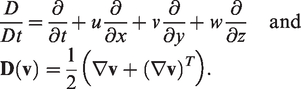
where the density ρ is constant, accounts for body forces present, μ is the dynamic viscosity,
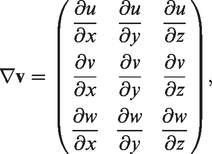
We remark that, one has to start with an implicit constitutive model of the form (9) to obtain the generalised Navier-Stokes equation (11) with pressure dependent viscosity. Thus this is not possible, by modelling the fluid as a Navier-Stokes fluid. Since there are four unknowns in (11) it needs to be considered together with the conservation of mass, which for an incompressible fluid is reduced to
i.e. the flow is isochoric. Note that if the fluid is incompressible, which means that it has constant density, then the flow is isochoric, but the converse is not true. In component form, the generalised Navier-Stokes equation (11) reads
As with all mathematical modelling, we will only start to understand the mathematical implications if we write the model in dimensionless variables. In our case, we will do this with the aim to better understand the flow when the fluid domain is very thin. We will, without loss of generality, restrict the discussion to the case where g is constant. Let us start by defining new independent and dependent dimensionless variables
where the bar denotes that it is the new dimensionless variable and the subscript denotes that it is a typical dimensional scale. We will also introduce the scaling
for the constants in our model. Let us now discuss the typical dimensional scales:
In order to reduce the number of characteristic parameters (without loss of generality), we choose both and as L, where L is the smaller of Lx and Ly.
Since ρ and g are constant it is natural to choose , , and .
It seems natural to let and be the speed of the lower surface, i.e.
We choose , i.e. roughly the time it takes for a fluid particle to travel from the inlet to the outlet.
We are interested in thin film flow, i.e. flow is confined in domains where the ratio . Hence the characteristic length scales are not independent. Indeed, let us use the ratio to define the small parameter ε, i.e. .
It remains to determine and !
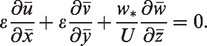
In dimensionless form, the equation for conservation of mass (12) becomes
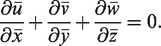
To avoid unnecessary restrictions on the flow we choose and the dimensionless equation for conservation of mass is simply
For an in-depth discussion on this matter the reader is referred to.32 Now it only remains to determine and .
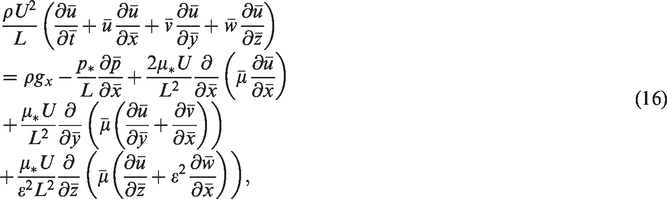
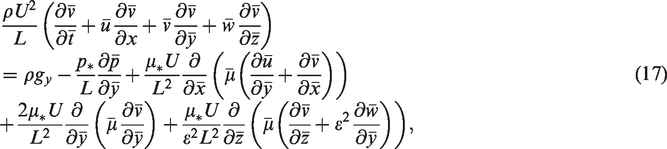
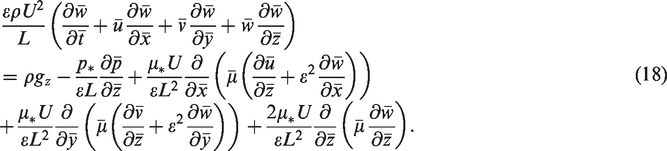
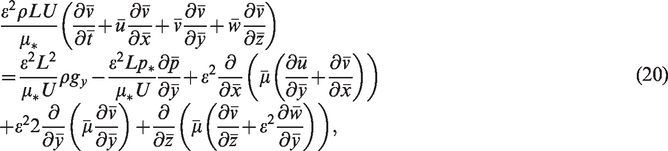
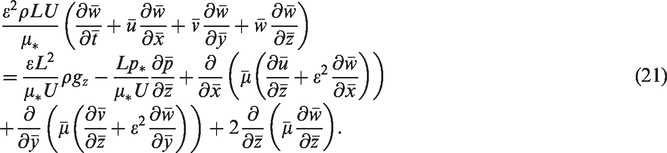
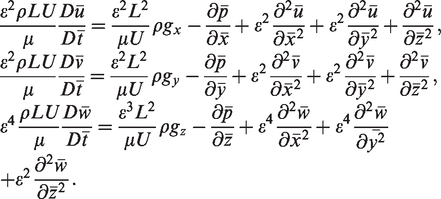
The incompressible Navier-Stokes system of equations (13)–(15) expressed in the dimensionless variables becomes
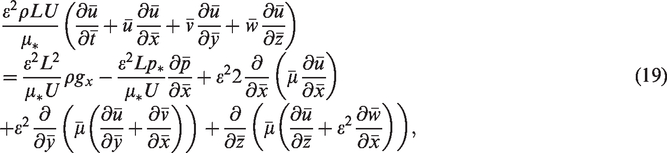
Multiplying (16) and (17) by and (18) by yields
To be able to proceed, one has to take into account the viscosity-pressure relation. In the next section, we will consider the case where the viscosity can be assumed to be constant and show that this leads to the same lower-dimensional model for the flow, that Reynolds presented in literature.4 In Section Lower-dimensional models for piezo-viscous fluids, we will, thereafter, consider the flow of an incompressible and piezo-viscous fluid and the complications that this introduces to the derivation of a lower-dimensional model of the Reynolds type.
Derivation of Reynolds’ equation (constant viscosity and density)
In this section we derive the Reynolds equation (1). We do this to enable a proper discussion as to whether there are or there are not, theoretical arguments to justify whether it is possible to replace the constant viscosity in the Reynolds equation with a given viscosity-pressure relation. The derivation we present is based on a carefully adapted scaling of the classical incompressible Navier-Stokes equation and that terms of order and higher are so small that they can be neglected.
As the viscosity μ is constant we can choose , which implies that . This together with the dimensionless form of the equation for conservation of mass imply that the dimensionless form of the incompressible Navier-Stokes equation in component form reduces to
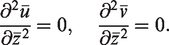
Since it only remains to determine . This means that if , then we must find the value of k. If and we neglect terms including ε, then (22) and (23) reduce to
This implies that the flow can only be of the Couette type, which we know is not true. If and we neglect terms including ε, then (22) and (23) reduce to
which is unrealistic in most applications and, hence, it must be that k = 2. If we choose the characteristic pressure as
then the system (22)-(24) becomes
By neglecting terms of order and higher (i.e. on only considering the dominating terms) we obtain
which in dimensional form become
Note that the influence of the inertial- and the body-force terms dissapear by only assuming that the film is sufficiently thin. Reynolds did not present a proof of this in,4 he merely argued that they may be omitted, see p. 186.
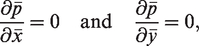
Here we observe that , which must be true for any lower-dimensional model of the pressure. Since , u and v can be found by integrating the first two equations in (25) with respect to z and applying the no slip boundary conditions stating that , at the lower surface, and , at the upper surface. Indeed, in this way we obtain that
Inserting this into the equation for conservation of mass (12) and integrating with respect to z from 0 to h, yields
where V is the two-dimensional vector and, thus, we have derived the Reynolds equation. Notice that it is derived for incompressible Navier-Stokes fluids with constant viscosity. In addition it is assumed that the surfaces are rigid, the flow is isothermal, the fluid sticks to the surfaces and no cavitation occurs.
Lower-dimensional models for piezo-viscous fluids
In this section, we will use dimensional analysis to investigate if it can be justified that one replaces the constant viscosity in the Reynolds equation with a viscosity-pressure relation when the fluid is incompressible and piezo-viscous. The analysis starts from the generalised Navier-Stokes equation (11), obtained based on the implicit constitutive assumption (9), since this is the only way which one can rigorously obtain a model for an incompressible fluid, wherein the viscosity depends on the mechanical pressure.
Piezo-viscous fluids obeying Barus’ law and a change of variables
In the field of lubrication,
is a widely used constitutive relationship between the pressure and the viscosity, which is often referred to as Barus’ Law,c see e.g. the authorative articles7–9,33 and books.6,34–36
In the mathematical modelling of lubrication there are thousands of papers, where the piezo-viscous effect is taken into account by just replacing the constant viscosity in the Reynolds equation (29) with a viscosity-pressure relation such as Barus’ law, i.e. just assuming that
is valid and that (26) and (27) also hold when μ depends on the pressure. Arguments that support this are, however, almost non-existent. Below we will point out some important gaps in the theory.
The nonlinear equation (31) can be transformed into a linear equation by a simple change of variables, similar to the one employed in.33,37–39 Indeed, let
and the nonlinear equation (31) is transformed to the linear equation
Scaling and lower-dimensional model for the pressure
The aim is now to see if we can derive (31), or equivalently (33), by using arguments similar to those that we used in the derivation of the Reynolds equation (29). It is beneficial to first use the change of variables (32) to rewrite (19)-(21) and then proving (33). Indeed, let us start by defining the dimensionless variable corresponding to q as (note that ), then
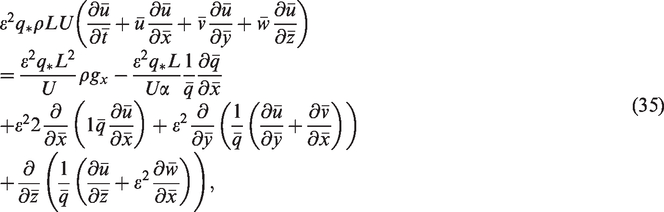
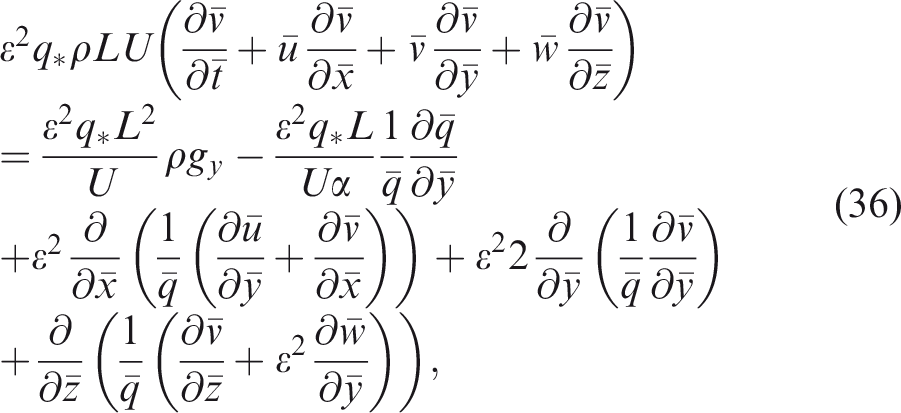
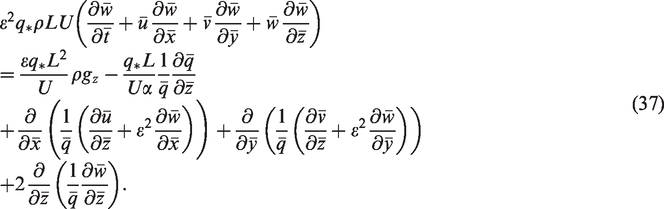
By inserting (34) into the system (19)–(21) we obtain
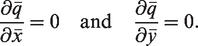
Let us now try to find a lower-dimensional model for the pressure by only taking the dominant terms into account (exactly as we did in the derivation of the Reynolds equation (29) when the viscosity is constant). To find out which are the dominating terms we must determine , and in order do this we take cognisance of the following
By definition, a lower-dimensional model for the pressure must satisfy , which implies that . This means that if we believe that it is possible to derive a lower dimensional model for the pressure then must be such that this holds.
Any realistic lower-dimensional model for the pressure should include the forces which are related to the first term in the right hand side of the Navier-Stokes constitutive relation (10), i.e. the terms related to in the system (35)-(37).
In typical lubrication applications the viscous effects plays a crucial role. Thus any lower-dimensional model must take this into account.
We will, therefore, assume that and we must determine k such that the requirements above are satisfied. Indeed, if , then (35) and (36) are reduced to
if we only take the dominant terms into account, i.e. the first condition above is not met. If and we only take the dominant terms into account, then (35) and (36) become
This is unrealistic and in addition the last requirement of a lower-dimensional model is not met. We can now only hope that k = 2 will give us something useful. Let us choose
Inserting (38) into the system (35)-(37) and neglecting all but the dominant terms, i.e. terms of order and higher, yields
This system fulfills the requirements above and we have obtained a lower-dimensional model of the flow. When the system (39)-(41) is solved then the pressure may be found by back substitution. We observe that, contrary to the case with constant viscosity (see Section Derivation of Reynolds’ equation (constant viscosity and density)), the terms related to the body force and the inertial terms do not disappear. This implies that it is NOT possible to integrate this system as we were able to in the proof of Reynolds equation, and we can, therefore, not obtain a single equation for the pressure. Hence, we have obtained a lower-dimensional model which is not so useful after all. In fact, it is easier to solve the Navier-Stokes equation numerically than the system (39)-(41). By this we mean that there are a lot of commercial software for solving the Navier-Stokes equation, but not for the system (39)-(41).
An equation of Reynolds’ type for piezo-viscous fluids
We have just seen that if the fluid has a viscosity-pressure relationship of the type (30), then it is not possible to obtain a single lower-dimensional equation for the pressure by just letting ε be sufficiently small, i.e. the situation is completely different from the one where the viscosity is constant (Reynolds equation). The reason for this is that, no matter how small ε is, we will still have the inertial- and the body-force terms in (39) and (41), but when the viscosity is constant then these terms may be neglected if ε is sufficiently small.
The reason for the problem we just have encountered would not have appeared, if we, as many authors do, from the beginning just had claimed that one can neglect the inertial- and body-force terms without presenting any theoretical arguments. Because then, the system (39)-(41) would be reduced to
By writing (42) to (44) in dimensional form, i.e.
we obtain (33), or equivalently (31), in the same way as in the derivation of the Reynolds equation (29).
A careful analysis of the size of coefficients in the system (39)-(41) would make it possible to find out when it is reasonable to neglect the inertial- and body-force terms. It is, however, of cardinal importance to notice and acknowledge that they cannot be neglected as a consequence of the lone motivation that the fluid film is sufficiently thin, i.e. that ε is small enough. In Part B we will, nevertheless, present an alternative approach where it is sufficient to just let ε be sufficiently small to obtain (31).
Example. Let us now investigate if there are any conditions under which the influence of the inertial- and body-force terms becomes negligible. To this end, we will consider an application operating within , . Then, if lubricated by a liquid specified with and , we have that and . This shows that the influence of the inertial- and the body-force terms is small, which motivates that they can be neglected.
Conclusions
In this paper, we have highlighted that within the context of the mathematical modelling of lubrication the Reynolds lower-dimensional theory is used to describe lubricant flow, even though the basic assumptions are not fulfilled. One apparent example is the modelling of elastohydrodynamic lubrication. We have also highlighted that the derivation of the classical Reynolds equation only requires the film to be sufficiently thin, i.e., that it is not necessary to a priori omit the inertial- and body-force terms. We have studied how to theoretically justify a lower-dimensional equation for the pressure when the fluid is piezo-viscous (recall that in the whole paper we have considered incompressible fluids and isothermal flows). The main conclusions are:
We used dimensional analysis of the incompressible Navier-Stokes equation to show that Reynolds equation follows by just assuming that the lubricant film is sufficiently thin, i.e. it is not necessary to, a priori, omit the inertial- and body-force terms.
We have shown that one must start from implicit constitutive theory to obtain a generalised Navier-Stokes equation, that allow the viscosity to depend on the pressure, in order to derive a lower-dimensional model that allow the viscosity to depend on the pressure.
We applied dimensional analysis to our generalised Navier-Stokes equation and derived a lower-dimensional model for the pressure. In particular, the analysis showed that the inertial- and body-force terms cannot be neglected by sole assumption that the film thickness is thin and that is not possible to obtain a Reynolds type equation, without making further assumptions.
We analysed the coefficients in front of the inertial- and body-force terms in our lower-dimensional model, and provided arguments for when they may be neglected and a Reynolds type of equation can be derived.
We have pointed out that there are many interesting theoretical questions which must be answered in order to have a satisfactory theory in connection with the use of the Reynolds equation. For example there are issues related to cavitation, surface roughness, thermal effects, elastic deformation of the surfaces, curvature of the thin fluid domain etc. There are also many important gaps of a more mathematical nature which should be filled in, e.g. regarding existence and uniqueness of solutions, convergence rate as the film thickness goes to zero, possible classes of constitutive relations and so on.
Supplemental Material
sj-zip-1-pij-10.1177_1350650120973792 - Supplemental material for On lower-dimensional models in lubrication, Part A: Common misinterpretations and incorrect usage of the Reynolds equation
Supplemental material, sj-zip-1-pij-10.1177_1350650120973792 for On lower-dimensional models in lubrication, Part A: Common misinterpretations and incorrect usage of the Reynolds equation by Andreas Almqvist, Evgeniya Burtseva, Kumbakonam Rajagopal and Peter Wall in Proceedings of the Institution of Mechanical Engineers, Part J: Journal of Engineering Tribology
Footnotes
Declaration of Conflicting Interests
The author(s) declared no potential conflicts of interest with respect to the research, authorship, and/or publication of this article.
Funding
The author(s) disclosed receipt of the following financial support for the research, authorship, and/or publication of this article: The authors acknowledge support from VR (The Swedish Research Council): DNR 2019-04293.
ORCID iD
Andreas Almqvist
Notes
References
1.
HolmbergKAnderssonPErdemirA.Global energy consumption due to friction in passenger cars. Tribol Int2012;
47: 221–234.
ReynoldsO.On the theory of lubrication and its application to Mr. Beauchamps Tower’s experiments, including an experimental determination of the viscosity of olive oil. Proc R Soc Lond1886;
40: 191–203.
5.
NavierCLMH.Sur les lois du mouvement des fluids, en ayant egard a l’adhesion des molecules. Annalen Der Chemie1821;
19: 244–260.
6.
VennerCHLubrechtAA.Multilevel methods in lubrication. Tribology Series
37, Amsterdam: Elsevier Science BV, 2000.
7.
SpikesHA.Sixty years of EHL. Lubrication Science2006;
18: 265–291.
8.
LugtPMMorales-EspejelGE.A review of elasto-hydrodynamic lubrication theory. Tribol Trans2011;
54: 470–496.
9.
LarssonR. EHL governing equations. In: Wang QJ and Chung Y-W (eds) Encyclopedia of tribology. Springer US, Boston, MA, 2013, pp.827–832.
10.
VakisAIYastrebovVAScheibertJ, et al.
Modeling and simulation in tribology across scales: an overview. Tribol Int2018;
125
11.
BayadaGChambatM.Homogenization of the Stokes system in a thin film flow with rapidly varying thickness. Esaim: M2AN1989;
23: 205–234.
12.
BenhabouchaNChambatMCiupercaI.Asymptotic behaviour of pressure and stresses in a thin film flow with a rough boundary. Quart Appl Math2005;
63: 369–400.
13.
FabriciusJTsandzanaAPerez-RafolsF, et al.
A comparison of the roughness regimes in hydrodynamic lubrication. J Tribol2017;
139: 1–10. 051702.
14.
GropperDWangLHarveyTJ.Hydrodynamic lubrication of textured surfaces: a review of modeling techniques and key findings. Tribol Int2016;
94: 509–529.
15.
GrützmacherPGProfitoFJRosenkranzA.Multi-scale surface texturing in tribology – current knowledge and future perspectives. Lubricants2019;
7: 95.
16.
ElrodHGAdamsML.A computer program for cavitation and starvation problems. In: Cavitation and Related Phenomena in Lubrication, Proceedings of the 1st Leeds-Lyon Symposium on Tribology, Ed. by Dowson D, Godet M and Taylor CM, 1975, pp. 37--43.
17.
GiacopiniMFowellMTDiniD, et al.
A mass-conserving complementarity formulation to study lubricant films in the presence of cavitation. J Tribol2010;
132: 041702.
18.
AlmqvistAFabriciusJLarssonR, et al.
A new approach for studying cavitation in lubrication. J Tribol2014;
136: 011706.
19.
HabchiWVergnePBairS, et al.
Influence of pressure and temperature dependence of thermal properties of a lubricant on the behaviour of circular tehd contacts. Tribol Int2010;
43: 1842–1850.
20.
ŠperkaPKřupkaIHartlM.Experimental study of roughness effect in a rolling-sliding EHL contact. part I: roughness deformation. Trib Trans2016;
59: 267–276.
21.
ŠperkaPKřupkaIHartlM.Experimental study of roughness effect in a rolling-sliding EHL contact. part II: complementary effects. Trib Trans2016;
59: 277–285.
22.
HultqvistTVrčekAMarklundP, et al.
On waviness and two-sided surface features in thermal elastohydrodynamically lubricated line contacts. Lubricants2020;
8: 64.
23.
GustafssonTRajagopalKRStenbergR, et al.
Nonlinear Reynolds equation for hydrodynamic lubrication. Appl Math Model2015;
39: 5299–5309.
24.
Marušić-PalokaEMarušićS.Analysis of the Reynolds equation for lubrication in case of pressure-dependent viscosity. Math Probl Eng, Pages Art ID2013;
2013: 1–10.
25.
Marušić-PalokaEPažaninI.Asymptotic modeling of the thin film flow with a pressure-dependent viscosity. J Appl Math2014;
2014: 1–8. 8,
26.
RajagopalKRSzeriAZ.On an inconsistency in the derivation of the equations of elastohydrodynamic lubrication. R Soc Lond Proc Ser A Math Phys Eng Sci2003;
459: 2771–2786.
27.
SzeriAZ. The thin film approximation in hydrodynamic, including elastohydrodynamic, lubrication. In: Nikas GK (ed.) Recent developments in wear prevention, friction and lubrication, chapter 1. Kerala: Research Signpost, 2010, pp.1–43.
28.
AlmqvistABurtsevaEPérez-RàfolsF, et al.
New insights on lubrication theory for compressible fluids. Internat J Engrg Sci2019;
145: 103170.
29.
CiarletPG. Mathematical elasticity. Vol. II, volume 27 of Studies in mathematics and its applications. Amsterdam: North-Holland Publishing Co., 1997.
30.
Ciarlet PG. Mathematical elasticity. Vol. III, volume 29 of Studies in mathematics and its applications. Amsterdam: North-Holland Publishing Co., 2000.
31.
BarusC.Isotherms, isopiestics and isometrics relative to viscosity. Am Jour Sci1893;
s3-45: 87–96.
32.
DowsonD.A generalized reynolds equation for fluid-film lubrication. Int J Mech Sci1962;
4: 159–170.
HamrockBJSchmidSRJacobsonBO.Fundamentals of fluid film lubrication. 2nd ed.New York:
Marcel Dekker Inc., 2004.
36.
BhushanB.Principles and applications of tribology.
Chichester, West Sussex, UK:
Wiley, 2013.
37.
MuskatMEvingerHH.Studies in lubrication IX. the effect of the pressure variation of viscosity on the lubrication of plane sliders. J Appl Phys1940;
11: 739–748.
38.
ErtelAM. Hydrodynamic calculation of lubrication of curved surfaces (gears, rolling bearings, highly loaded journalbearings etc.) Akad. Nauk, Moscow, 1945, p. 64.
39.
Morales-EspejelGEWemekampAW.Ertel–Grubin methods in elastohydrodynamic lubrication – a review. Proc IMechE, Part J: J Engineering Tribology2008;
222: 15–34.
40.
PoissonSD.Mémoire sur les e’quations ge’ne’rales de l’équilibre et du mouvement des corps solides élastiques et des fuides. Journal de L’Ecole Polytechnique1831;
13: 1--172
41.
StokesGG.On the theories of the internal friction of fluids in motion, and of the equilibrium and motion of elastic solids. Trans Camb Phil Soc1845;
8: 287–305.
42.
DugasR.A history of mechanics.
New York:
Dover Publications, 1988.
43.
TruesdellC.A program toward rediscovering the rational mechanics of the age of reason. Arch History Exact Sci1960;
1: 1–36.
44.
StokesGG.On the effect of internal friction of fluids on the motion pendulums. Trans Cambridge Philos Soc1851;
9: 8–106.
45.
RajagopalKR.A new development and interpretation of the Navier–Stokes fluid which reveals why the “Stokes assumption” is inapt. Int J Non-Linear Mech2013;
50: 141–151.
46.
BurestiG.A note on stokes’ hypothesis. Acta Mech2015;
226: 3555–3559.
47.
RajagopalKR.Remarks on the notion of “pressure. Int J Non-Linear Mech2015;
71: 165–172.
48.
HydeJH.On the viscosities and compressibilities of liquids at high pressures. Proc R Soc Lond Ser A, Containing Papers Math Phys Char1920;
97: 240–259.
49.
BridgmanPW.The effect of pressure on the viscosity of forty-three pure liquids. Proc Am Acad Arts Sci1926;
61: 57–99.
50.
HerseyMD.A short account of the theory of lubrication. I. Introduction; viscosity and friction. J Franklin Inst1935;
219: 677–702.
51.
RajagopalKR.On the cavalier attitude towards referencing. Int J Eng Sci2012;
51: 338–343.
Supplementary Material
Please find the following supplemental material available below.
For Open Access articles published under a Creative Commons License, all supplemental material carries the same license as the article it is associated with.
For non-Open Access articles published, all supplemental material carries a non-exclusive license, and permission requests for re-use of supplemental material or any part of supplemental material shall be sent directly to the copyright owner as specified in the copyright notice associated with the article.