



Abstract
In this essay, we take the burgeoning scholarship on multimodal approaches to the study of organization and management as our point of departure to explore substantial limitations hindering a genuinely multimodal understanding within our discipline. We problematize how existing academic conventions: (a) limit our research agenda and the choice of relevant phenomena, topics, research questions, and empirical designs; (b) restrict the conceptual and empirical toolbox within the research process, restricting researchers’ ability to explore and exploit opportunities afforded by multimodality; and (c) narrow down the channels for scholarly communication, including the distribution of findings and knowledge transfer. Subsequently, we outline three promising “shifts”—toward research as a creative endeavor, toward research as an encounter, and toward research as a material practice—that we believe may successfully pave the way to fully harness the potential of multimodality in our field.
Keywords
Introduction
On a spring day in Italy, I drove to the famous furniture-making district in Perignano to conduct interviews with a high-end design company that had produced some contemporary pieces nowadays exhibited in international art museums such as the MOMA in New York. Sufficiently ambitious, but at the same time conscious of my limited understanding and repertoire given the focal research setting, I arrived at the company site to discuss the creative design process and the success behind their iconic objects. As I was meeting with the designers, I started to feel a certain ‘imperfection’, struggling to convert my in-situ experience into conventional academic thinking and terminology. Only gradually, however, did I realize that I was confronted with multiple issues. I could not wriggle out from the inability to develop representations of the gamut of experiences and interactions and translate them into scholarly concepts and schemata. As conversations unfolded, I could not assign a specific theoretical ‘label’ to the themes that popped up. Was that designer now talking about sense-making processes, or about knowledge sharing within the design team, or about identity issues? In addition, I had the feeling that any attempt at classifying the vivid lived experiences in conceptual terms was already circumscribing my observations. In other words, I felt restricted in my ability to conceptually frame what was going on in a way adequate to the subject matter. As my site visit continued, I realized that another challenge was that I could not fully comprehend and grasp the designer’s embodied knowledge and his aesthetic experiences; it seemed that my scientific language was insufficient to fully understand and appreciate his creative sensibility. During my write-up later that day, it soon became clear that the central methodological and epistemological problem was translating the rich process of artistic inspiration and idea generation I observed into a meaningful academic text. How could I research and theorize something so genuinely ephemeral and embodied with the verbal vocabulary available in our field of scholarly inquiry? And it was at this point that I also realized that I was confronted with an even more frustrating issue: how to communicate what I had seen and learned to my co-authors (and eventually our readers)? As they asked me about the setting, I realized that I was not able to explain what had emerged from my conversations on the ground. Certainly, my research notes were not doing justice to the complexity of my visual impressions as well as the multiple layers of material and spatial perceptions during the experience. My researcher identity had been vacillating under a series of inabilities – the inabilities to see, to grasp, and to communicate all relevant issues and insights.
Our introductory vignette vividly illustrates substantial limitations hampering the recently burgeoning multimodal scholarship in organization and management research (for overviews, see Bell et al., 2014; Boxenbaum et al., 2018; Höllerer et al., 2019; Meyer et al., 2013), particularly in how we envision, conduct, and disseminate our research. In our experience, these are common struggles affecting all aspects of research; alas, they are rarely discussed openly, since institutionalized conventions normalize scholarship as writing. The unfortunate outcome is that multimodality remains a (niche) sub-field of organization research when it should be, we argue, at the core of all engagement with organization(s).
We therefore wish to take this opportunity to speak out about underexplored opportunities of the “multimodal turn” in our domain of scholarly inquiry, sketching the analytical and political opportunities that emerge when we broaden the way we envision, conduct, and disseminate our research. We start by outlining the self-inflicted challenges that are cemented by unreflectively reproducing limiting conventions; we then propose a programmatic shift toward conceiving of organization research as genuinely multimodal.
Problematizing conventions in Scholarly Inquiry
Multimodality is commonly understood as “the phenomenon that all communication integrates a range of meaning-making resources, that is images, words, sound, etc.” (Höllerer et al., 2019; 24) because “communicative situations (considered very broadly) [. . .] rely upon combinations of different ‘forms’ of communication to be effective” (Bateman et al., 2017: 7). Beyond such basic definition, precise understandings of multimodality vary (e.g. Hiippala, 2015; Ravelli et al., 2023). For our purposes, these finer distinctions are secondary because we (a) see value in all approaches, depending on the specific research aims at hand; and (b) focus on the basic argument that any organizational phenomenon is inherently multimodal, independent of the theoretical approach.
Existing research (e.g. Cartel et al., 2018; Höllerer et al., 2018a; Islam et al., 2016; Wasserman and Frenkel, 2011) strongly supports this basic premise. However, while we observe a proliferation of conceptual and methodological approaches to multimodality (Boxenbaum et al., 2018; Höllerer et al., 2019), the multimodal turn seems to remain focused on phenomena and data, with few but notable calls for harnessing multimodality more broadly (e.g. Dane and Rockmann, 2021; Langley and Ravasi, 2019; LeBaron, 2017; Lehtonen and Putkonen, 2023; Pollock, 2022; Swedberg, 2016).
We see one reason for this skewed engagement with multimodality in current academic conventions that are partly unsuitable for—or even detrimental to—multimodal work. Note that we do not claim that conventions are per se problematic. They are important in diversified research fields such as management, since they provide clearly articulated practices and standards that offer a foundation for integration and legitimation (Kelemen and Bansal, 2002). However, they also create limitations (Alvesson and Gabriel, 2013; Daft and Lewin, 1990) and, when adhered to in unreflective and inflexible ways, risk narrowing our thinking about phenomena, as well as constraining analytical strategies to accommodate the specific needs of particular research settings. In the following, we discuss three areas governed by limiting conventions. For each, we first suggest the value of multimodality and then outline the specific restrictions.
Conventions governing our research agendas
Benefits of envisioning organization research multimodally
The opening vignette expresses our discomfort with the inability to adequately “see” the full relevance of multimodality in organizations. When we fail to grasp multimodal cues that are crucial for field actors, or when we disregard non-verbal traces of meaning in textual data, are we really studying our phenomena holistically, or are we artificially stunting our research to make it fit established ways of thinking?
Previous work has shown that engaging with multimodality extends the very questions we ask as well as the conceptual constructs we use (e.g. Barry and Meisiek, 2010; Christiansen, 2018; Comi and Whyte, 2018; Davison and Giovannoni, 2023; Gümüsay et al., 2018; Höllerer et al., 2018b; Quattrone et al., 2021). As a twist of the proverb: If you are deeply but exclusively interested in nails (i.e. issues that manifest verbally), you will develop intricate theories of hammers—but you will overlook issues that require completely different tools. Without acknowledging the full spectrum of modes—and their interactions—we miss opportunities for capturing elusive knowledge (Toraldo et al., 2018), acknowledging previously underexplored phenomena, and drawing from such resources for theory building. Against such backdrop: Can organization research that is unable to grasp the intricacies of multimodal reality offer adequate theories of organization(s)?
We suggest that calls for phenomenon-based research (e.g. von Krogh et al., 2012) cannot be properly heeded without a genuinely multimodal perspective. Additionally, “multimodal scholarship has the potential to offer transformational political possibilities” (Literat et al., 2018: 8), that is, support more “emancipatory” styles of theory-building (Cornelissen et al., 2021) that criticize theoretical categories and underlying assumptions, emphasize a different stance and involvement of researchers, and argue for viable alternatives. This further opens opportunities to be more inclusive of academic contributions that experiment with novel and explorative approaches, thereby changing scholarly conversations (Healey et al., 2023).
Barriers to envisioning research multimodally
The significant increase in publications (e.g. Hammersley, 2011) combined with tendencies to achieve commensurability with existing knowledge creates obstacles for innovative perspectives that do not immediately resonate with established disciplinary agendas. Institutionalized conventions incentivize scholars to perceive phenomena through the “lenses” that they were socialized into. This leads to a trend of confirming what has already been discussed in previous studies: the so called “footnote-on-footnote” effect (Daft and Lewin, 1990). Pressures to compete on the academic job market further disincentivize risk-taking. Legitimacy requirements create isomorphic tendencies (e.g. DiMaggio and Powell, 1983) in the choice of topics and perspectives across the collective research agenda.
Since it is easier to validate and expand generally agreed knowledge rather than “change the conversation” (Healey et al., 2023), scholars tend to “translate” their multimodal impressions into verbal form to integrate them into theories based on understandings of organizations and management derived from verbal theorizing. This reduces multimodality to an “add-on” or a “steppingstone” for verbal theorizing, rather than a starting point for radically different conceptual and analytical insights. The verbal remains the “baseline,” and other modes are valuable only insofar as they can eventually be verbalized. Since organizational realities are inherently multimodal, this reduces opportunities for theory that is closer to the phenomena experienced by actors in the field and more relevant to organizational practice.
Conventions limiting the research process
Benefits of conducting organization research multimodally
The opening vignette also argues that we need multimodal approaches to better grasp, analyze, and theorize our observations, that is, complement research on multimodality with research through multimodality. We have always felt that multimodality should be about more than just data—a way of thinking, of engaging with the social world. As long as we keep translating or “resemiotizing” (Iedema, 2003) multimodal realities when moving from empirical observation to analysis and theory development, we impoverish our insights by oversimplifying the richness that multimodal perspectives naturally offer. Why do we acknowledge that actors in the field experience and manage the world multimodally, but still unduly restrict our own research designs?
Recent calls to learn from the realm of arts (e.g. Bagnoli, 2009; Linstead, 2018) emphasize how multimodality provides unexpected revelations on the research setting, particularly on affect and esthetics. This enables us to identify additional features of organizations and organizing. But more conventional questions can also benefit from multimodal perspectives. Multimodality can further deepen theoretical accounts of the role of material objects (see also Shortt and Izak, 2021) and technology (see also Leonardi and Barley, 2008). For instance, Barker and Jewitt (2022) stress the importance of tactile cues and develop an analytical strategy for grasping experiences of touch across the production process. Even the analysis of mostly verbal data can benefit from visualizations to support interpretations of empirical findings (e.g. Langley and Ravasi, 2019).
Barriers to conducting research multimodally
Conventions of data collection and analysis promote validated techniques, templates, and heuristic devices. They encourage structure and routines (Kelemen and Bansal, 2002), which become integrative to the research process. Most research relies on the ability to store data for repeated access, which excludes ephemeral phenomena such as smell and touch that elude common storage techniques (but see Riach and Warren, 2015). The reliance on (digitally) storable data shapes what is considered analyzable and worthy of the academic “gaze” – which unavoidably flattens our insights. Additionally, the increasing regulation of ethical approvals has created more rigid procedures which are often experienced as a hurdle (Truman, 2003); they are not (yet) geared toward the collection of ephemeral traces of organizational life which are often unforeseeable.
These conventions exist in opposition to multimodal research. While different forms of ethnography (e.g. LeBaron et al., 2018; Pink, 2007) have become very adept at capturing multimodality, they usually require eventual verbalization—which means that the particularities of non-verbal modes are lost at some point (but see Bezemer and Mavers, 2011). Additionally, “ways of knowing” that cannot be verbalized are not yet legitimate enough to be featured in methodology sections, excluding rich traditions of non-verbal knowledge (e.g. Mills and Dooley, 2019). Despite common usage of sketches, drawings, and physical arrangements to support interpretation (e.g. Höllerer et al., 2019; Ravasi, 2017), existing conventions are woefully insufficient for the generation of non-verbal theory. Even visual models are mostly reduced to boxes and arrows and need to be extensively discussed in written form. This may limit what Suddaby (2010) refers to as “construct clarity,” thereby reducing our capacity to develop and contribute to good theory.
Conventions limiting the communication of research
Benefits of disseminating organization research multimodally
A third frustration expressed in the opening vignette concerns our inability to appropriately express multimodal insights to others. Even if we succeed in making our research agendas and processes more multimodal, what good will that do if we cannot communicate the multimodal aspects of our emerging knowledge to audiences?
Goldberg (2010: 379), who developed multimodal strategies to express his findings on Hurricane Katrina, contents that “what is said and how [. . .] began very quickly to dictate a different way of thinking about the subject matter, about the possibilities of representation, implication, intimation and conclusion.” Multimodal genres are not only different ways of providing the same content; they enable alternative forms of argument characterized by a different logic, innovative forms of mobilizing and articulating evidence, and, more generally, ways of integrating structure, style, and content in designs that may be more appropriate for multimodal insights (Jancsary and Lehtonen, in press). In other words, they are a substantial resource for “writing differently” (e.g. Gilmore et al., 2019; Grey and Sinclair, 2006).
In discussing Goldberg’s work, Jakubowicz and van Leeuwen (2010) highlight how multimodality provides opportunities to (a) engage audiences more interactively; (b) mix emotion and creativity with the standards of academic texts; (c) allow for combinations of scientific argument and activist vision; and (d) support abstract arguments with more extensive and detailed documentary evidence. This may also enhance ways of learning from our work, as multimodal resources have repeatedly been shown to improve knowledge transfer in the classroom (e.g. O’Doherty, 2020; Shams and Seitz, 2008).
Barriers to disseminating research multimodally
Conventions have implications for “the ways in which the research is set up, carried out and written up” (Kelemen and Bansal, 2002: 99); they are palpable in writing standards that provide clues for thinking and elaborating research. Material restrictions of publishing (e.g. article formats, word limits, forms of integrating non-verbal content) have repercussions for the types of knowledge and the forms of analysis that can be included. This tends to perpetuate established positions and favors conformity. It is easy to forget that the scientific article is itself a social construction (Cornelissen et al., 2021) that emerged under specific historical circumstances and was—during its infancy—far from being unanimously celebrated (Csiszar, 2018).
Multimodal formats beyond the combination of written text and abstract figures are not currently considered to be “proper” academic knowledge dissemination and are often denied the accolades that come with top-tier journal publications (but see Dane and Rockmann, 2021; Pollock, 2022). There are as yet no established criteria for reviewing the quality of multimodal publications, and the application of standard criteria reduces the degree of novelty, especially in terms of dissemination. Accordingly, we cannot fully avoid “trying to write like everyone else,” which “restrict[s] the range of our inquiries and speculations” (Van Maanen, 1995: 139). Practical challenges include copyright restrictions on reproducing multimodal materials for which restrictive licensing agreements or permissions may be required. Additionally, established citation rules for verbal text can be unsuitable for referencing dynamic or interactive content. How, for instance, can we adequately “cite” video displayed in previous academic publications—or an interactive module that allows readers to access and browse research findings through different paths?
Shifting Organization research toward multimodality
Up to this point, our essay followed the very conventions we criticized. One drawback is that we had to illustrate a genuinely multimodal set of concerns (envisioning, conducting, and disseminating research) with a monomodal (i.e. written) vignette. What if we complemented our presentation of these concerns in a different way?
For eliciting a multimodal complement to the initial verbal vignette, we collaborated with a visual artist who had also participated in other “multimodal research projects” with the first author. Our intention was to preserve the vividness and richness of the field experience, and to give the artist an opportunity to add her own impressions and interpretations while reflecting on the written account of the researcher. The multimodal vignette is not intended to replace the written one but to enrich it with an alternative perspective and “language.” After considerable discussion, the artist came up with Figure 1. While this reflection clearly lacks the precision and narrative consistency of a verbal vignette (see also Meyer et al., 2018), it reveals a messier, differently accurate, reconstruction of the experience. The figure is not meant to suggest a clear reading path but invites readers to engage with it freely. The guiding metaphor of the “egg” evokes the imaginative and mysterious potential of the creative process, which stands in contrast to the linear, structured logic of research symbolized by the QWERTY keyboard. The egg represents the “fundamental core” of the artistic process, that elusive “quid” which is essential yet not guaranteed in any artistic creation. The figure thus captures the near impossibility of turning multimodal creative moments into “book knowledge.”
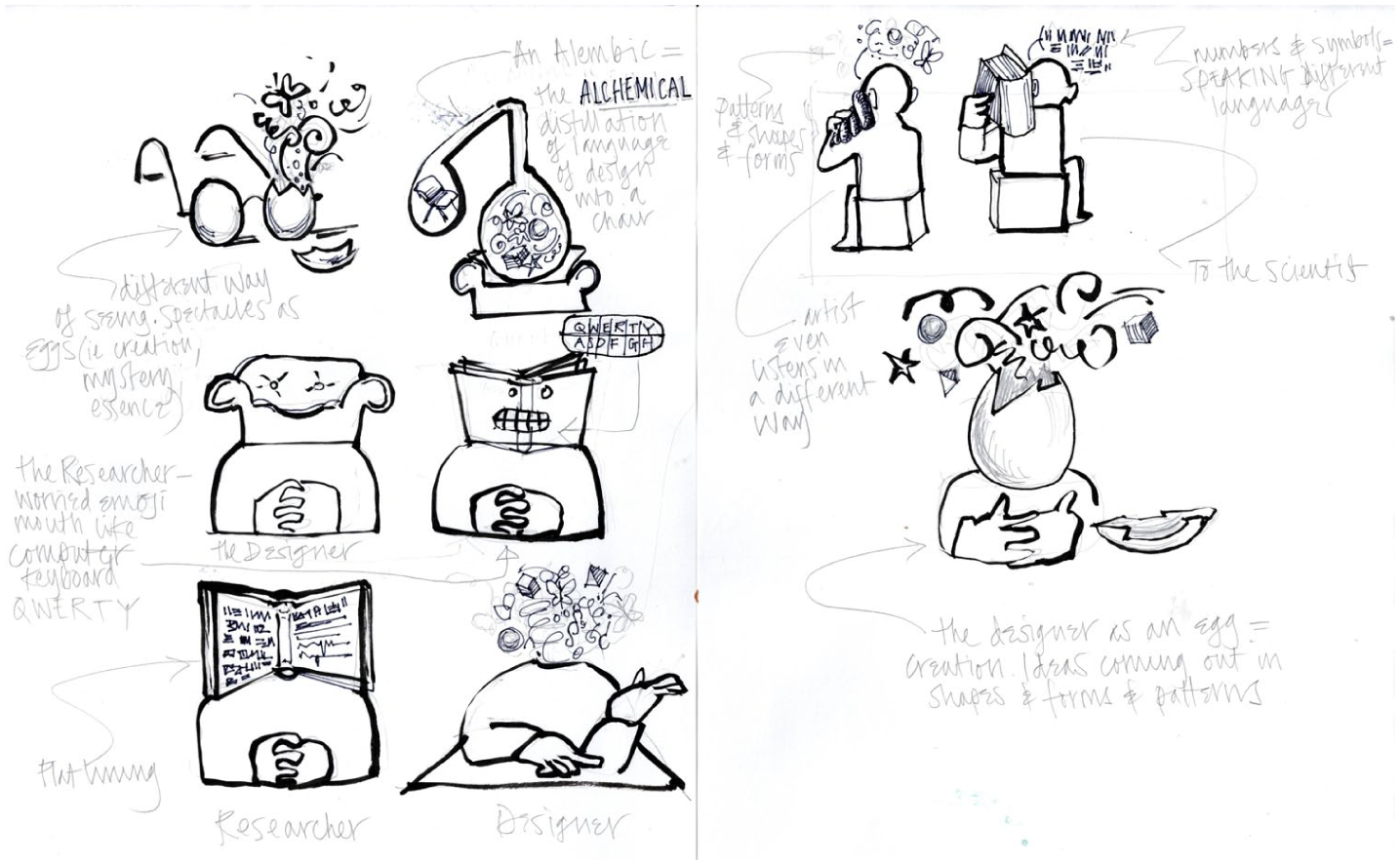
A multimodal version of the introductory vignette.
This exercise of adding multimodality to the vignette inspired us to suggest a series of “shifts” in conceiving of organization research that can pave the way for multimodality as a constitutive principle rather than a stream of research, with the potential to offer new angles and initiate new conversational directions (Healey et al., 2023). These shifts also support increased multimodal literacy (e.g. Van Leeuwen, 2017) and an appreciation of “strong multimodality” (Zilber, 2018), that is, understanding modes as equally important and inherently entangled in most aspects of organizational realities.
Shift #1: Organization research as creative endeavor
A first shift involves understanding organization research as an inherently creative endeavor aimed at developing “new ways of showing and knowing” (LeBaron, 2017: 1), prompting scholars to re-examine their self-understandings, voice, and role in processes of knowledge production. It resembles what Bell and Willmott (2020) describe as “research-as-craft,” a way of knowledge production based on embodied and imaginative knowing with openings toward politics and ethics. Such focus on expanding—rather than refining or confirming—knowledge can harness the complexities of phenomena in ways that position the multimodality of the social world front and center (e.g. Jakubowicz and van Leeuwen, 2010). It also emphasizes multimodal creativity in forms and content of theorizing (e.g. Langley and Ravasi, 2019; Swedberg, 2016), paving the way for more inclusive and emancipatory theories (e.g. Cornelissen et al., 2021).
Figure 1 has illustrated the need for the proposed shift to creative engagement. The distance between “traditional” research and creative engagement manifests, for instance, in different modes of “listening” and “hearing”: the designer listening into a shell and the researcher into a book. This underscores the separation between cognitive processes and material experiences as a basic shortcoming in our training. Research as creative endeavor requires approaches that accommodate local improvisation and reflection-in-action, connecting to discussions around professional knowledge and the creative disposition (e.g. Schön, 1983) that is particularly essential for engaging with professional practices. Researchers should not disregard their intuitive and creative potential when approaching the field or label such qualities as disturbances to their professional expertise.
Accordingly, research as creative endeavor challenges limitations in envisioning research multimodally, as it moves the focus from established schemata to unexpected knowledge potentials inherent in multimodal research settings. By training our gaze on the “unspeakable,” we acknowledge aspects of organizational reality outside of established expertise. It further legitimates overcoming limitations in conducting research multimodally by demanding innovative methodologies suitable for studying hitherto unacknowledged traces of organizational life and motivating the use of multimodal assemblages (e.g. mind maps, sketches, drawings, recordings of research meetings) for theory crafting. Finally, it pushes against limitations in disseminating research multimodally, since idea(l)s of creativity and craft are antithetical to an understanding of organization research as “a science of verbal reports” (Daft and Lewin, 1990: 3).
Research as creative endeavor encourages scholars to engage with multimodality in ways that dissolve barriers between creativity and rigor and therefore stimulate dialog, inspire activism, and foster future-oriented interventions. For instance, engaging with the narrative style of TV series enables scholars to draw on powerful visual storytelling and future-oriented imaginaries to explore fundamental questions related to climate change (Acosta et al., 2025) and minority stereotypes in the workplace (Prasad, 2023). By foregrounding affect, narrative, and esthetics, this marks a shift toward artistic expression to better understand and interpret phenomena.
Shift #2: Organization research as encounters
The second shift entails bringing researchers closer to others’ multimodal expertise. Our own collaborative research (Marcolin et al., 2024) has shown that the production of artistic work during the research process may allow informants to “act back” on the artist’s drawings, exploring whether their lived experiences are authentically represented. Thinking of research as encounters also foregrounds questions of voice and agency. Collaborative designs (e.g. Lehtonen, 2020; Lingard et al., 2015; Skjælaaen et al., 2020; Van der Vaart et al., 2018) bring the multimodal expertise of informants at eye level with academic accounts. This promises to expand the multimodal toolbox for evoking, eliciting, and engaging meanings, especially regarding more ephemeral modes such as touch (e.g. Barker and Jewitt, 2022) and smell (e.g. Gümüsay et al., 2018; Riach and Warren, 2015).
Figure 1 is a product of an encounter between researchers and artist that included both serendipity and mutual appreciation. Such interpretative layering between artist and researcher—but also potentially including field actors—deepens reflections on struggles encountered in the field and can prompt more multivocal ways of engaging with the research context. This helps overcome limitations in envisioning research multimodally by allowing us to shift our gaze and interrogate our expertise in relation to alternative ones. It also mitigates limitations in conducting research multimodally by foregrounding alternative epistemologies and methodologies. Our analytical toolbox may benefit substantially from deeper and more diversified understandings of how the multimodal world is experienced and made sense of. Research-as-encounter further lifts limitations in disseminating research multimodally. While our expertise is in writing, artists, craftspeople, and other collaborators can inspire us to communicate our insights in multimodal forms that are more adequate for expressing different knowledges, and for reaching more diverse audiences.
Emphasizing encounters also facilitates appreciative multimodal engagement with perspectives from the Global South (Barros, 2018; Barros et al., 2025). It enables context-sensitive inquiry, particularly within complex and underexplored settings, the inclusion of multiple perspectives (Barros et al., 2025), spaces for multilingual and multimodal expression (Dutta et al., 2022), and an acknowledgment of multimodal affordances in local contexts (de Medeiros Oliveira et al., 2017). For instance, in their study on policing in a major Latin American city, Alcadipani and Cunliffe (2024) show how the multimodality of integrating videos, photographs, audio recordings, and text messages into ethnographic fieldwork led to shifts in encounters and field relations—challenging conventional asymmetrical relationships and fostering a plurality of voices in producing and interpreting data.
Shift #3: Organization research as material practice
The final shift suggests a stronger acknowledgment of research as embodied practice that encounters, manipulates, and creates artifacts of various materialities (from physical objects to virtual interfaces). Some traditions stress the prevalence of artifacts as pillars of the social world (e.g. Miller, 2005; Nicolini et al., 2012; Orlikowski and Scott, 2008; Rafaeli and Pratt, 2013) and suggest multimodality as an inherent aspect of organization research. This highlights the professional gaze (Styhre, 2011) as both material and cultural technique, and understands scholarly publications as artifacts, which legitimates new multimodal genres such as film (e.g. Miko-Schefzig et al., 2022; Wood et al., 2018) or graphical formats (e.g. Lehtonen and Putkonen, 2023; Schiemer et al., 2021). Such shift aligns with existing agendas to free academic knowledge production from mainstream writing conventions (Gilmore et al., 2019; Mandalaki, 2023).
Figure 1 is itself an artifact, but it also references other artifacts (such as sofas, books, and eggs). Its multimodal language emphasizes the materiality and embodied character of both research and design—designers and researchers have bodies that listen, create, interact, and in these processes “become.” This illustrates a push against limitations in envisioning research multimodally by foregrounding practices of conceiving of and materializing research in multimodal form. Further, a focus on material practices challenges limitations in conducting research multimodally. If the creation and manipulation of artifacts is at the core of methodologies, we need to better account for the multimodal affordances of the tools we use for sorting, coding, and interpreting data, including our own sensory apparatuses. Finally, such shift expands the set of genres for disseminating research multimodally, putting the spotlight on ways of presenting research in an evocative (and not just informative) way and of facilitating audiences’ empathetic engagement (Nair et al., 2018).
Harnessing multimodality for understanding and communicating research as material practice could play a powerful role in re-shaping research conventions, particularly those that make researchers, contexts, and types of data invisible (Hansen et al., 2025). Foregrounding the researchers’ sensory, esthetic, and affective presence facilitates dissolving dichotomous understandings of the subjective and objective (Jancsary and Lehtonen, in press) and the achievement of intersubjectivity (Duncan and Elias, 2021). This has indeed the potential to generate new multimodal conventions for the organization of research projects and for writing research differently.
Concluding remarks
The world of organizations is inherently multimodal; alas, most of our scholarly engagement with it is not. The past two decades have seen a gradual rise of multimodality in our domain of inquiry. This is commendable and an important step forward. However, the multimodal turn—so we fear—is at risk of halting halfway through. Multimodality must not remain something we study; instead, it needs to inform researching and publishing as well. In other words, the ways in which we envision, conduct, and disseminate our research need to become inherently multimodal; and the study of multimodality in organizations needs to become a multimodal study of organizations.
So while there is some progress in this direction, we worry that efforts remain isolated, focusing on individual practices, and losing the bigger picture. This leads to “band aid” and “patchwork” solutions that treat the symptoms more than the overarching malaise. To be clear, such endeavor requires a political as well as a scholarly program. On the scholarly side, we need to further develop our multimodal literacy as individuals and as a discipline to fully account for and utilize multimodal resources and affordances at our disposal. This includes recognizing that modal hierarchies are deeply embedded within specific research traditions. The verbal mode is often the primary vehicle for knowledge production and interpretation in Western traditions. Acknowledging that hierarchies vary across cultural contexts opens opportunities for valuable conversations with research beyond the Global North, where non-verbal modes may carry equal or even greater significance. Multimodality facilitates multivocality and fosters more symmetrical relations in engaging with research from these contexts at eye-level, enabling more inclusive, collaborative, and context-sensitive forms of knowledge production and exchange.
On the political side, we need to re-think our taken-for-granted conventions, rules, and infrastructures in ways that support, rather than limit, opportunities for harnessing the potential of multimodality. This includes technical, administrative, and legal infrastructures, specifically tools for storing and analyzing nonverbal material, ways of citing nonverbal data, and ethical guidelines that protect research subjects but account for the instability, uncertainty, and elusiveness that characterize multimodal research. One area that deserves particular attention is the development of quality criteria for multimodal research within academic publishing. Our field would greatly benefit from peer-review standards tailored to multimodal research. These guidelines should recognize multimodal elements as integral components of scholarly work—not as a supplementary addition.
Such an endeavor also necessitates substantial shifts in how we conceive of organization and management research. Our suggestions are hardly exhaustive, and additional efforts are necessary. The good news is that all suggestions seem rooted in lively ongoing conversations. If joined together and brought into a constructive dialog with established conventions, they may transform our discipline in yet unimagined ways.
Footnotes
Declaration of conflicting interests
The authors declared no potential conflicts of interest with respect to the research, authorship, and/or publication of this article.
Funding
The authors received no financial support for the research, authorship, and/or publication of this article.
Ethical approval and informed consent statements
This article does not contain any studies with human or animal participants.
