




Abstract
What will entrepreneurship look like in 2030? We conducted a Delphi panel study asking this question of editors and Editorial Review Board members of the two leading entrepreneurship journals, Journal of Business Venturing and Entrepreneurship Theory and Practice in an attempt to lift the eyes of the field to the horizon, outside academe, if only briefly. Using thematic coding analysis, we identified close to 1000 first-order codes from the 175 scholars surveyed, which we categorized into 24 distinct themes. From this input in the first round, we generated 93 predictions, which were assessed by the panel in terms of likelihood in a second round. It is our hope that these themes and predictions might serve to inspire our present research, teaching, and entrepreneurial endeavors, and spur debate and discussions among (future) entrepreneurship scholars of future-relevant phenomena that can potentially be studied under the rubric of entrepreneurship.
Keywords
Conducting and publishing relevant entrepreneurship research is difficult. It requires scholars to integrate the needs of two domains—theory and practice—which at times can be diametrically opposed. Contributions to practice require that scholars look forward, keeping their eyes on the horizon in order to identify new phenomena in need of explanation owing to their likely effect on entrepreneurs and entrepreneurship. Contributions to theory require that scholars look backward to prior studies to determine what is known about entrepreneurship and what has yet to be learned. Ideally, entrepreneurship scholars reconcile the two by simultaneously considering how practice may extend theory and how theory might inform practice. But practically, scholars, not practitioners, determine what gets published. The result is a risk for business scholarship to become insulated from the rapidly changing world of practice as the demands of reviewers trump the preferences of practitioners, and for researchers to become increasingly conditioned to look backward and inward to the literature as opposed to looking forward and outward to practice. However, scholarship that is not grounded in practice runs the risk of irrelevancy (Wiklund et al., 2019). As scholars, we must occasionally cast our gaze to the horizon, ask what is happening, and reflect upon its implications for our research to remain relevant. As Wiklund et al. (2019) state, relevant research begins with and pursues a research question with impact, and impactful entrepreneurship research usually surfaces questions with long-term horizons.
In order to find useful middle ground that allowed us to simultaneously look outward and forward, while ensuring we remained within the realm of what scholars deem important, we conducted a Delphi panel study of editors and editorial review board members of the two leading entrepreneurship journals Entrepreneurship Theory and Practice (ETP) and Journal of Business Venturing (JBV), asking, “What will entrepreneurship look like in 2030?” In particular, the results of this study can serve three distinct purposes.
First, when asked the question “What will entrepreneurship look like in 2030?” a thematic coding analysis of the responses of the 175 scholars that we surveyed generated 990 first-order codes, which we categorized into 24 distinct themes. This represents a holistic, collective understanding of the themes JBV and ETP board members consider to be relevant when considering entrepreneurship as a practice by 2030. The themes and their interconnections can serve as inspiration for (future) entrepreneurship scholars as they provide a consolidated overview of phenomena considered relevant in the future. While several papers identify one or a few of those themes, our study contains a unique amalgamation of them. As such, it is more akin to an atlas to the future rather than a guidebook. It can hopefully inspire thematic choices of scholars and could be instrumental in answering the “so what” or “who cares” question.
It can also potentially serve to identify gaps in our present research. For example, several respondents believe that, in 2030, themes or combinations of themes will be relevant that are currently receiving only scant scholarly attention. As such, the findings of this paper can potentially serve as a basis for collective action, such as generating ideas for special issues of journals and calls for new research programs. The wide overview presented in this paper may also be inspiring because it is produced by a sample representing the field of entrepreneurship research as a whole. While individual scholars or sets of scholars discuss the future of various aspects of entrepreneurship or entrepreneurship research (e.g., Chalmers et al. (2020) relating entrepreneurship and artificial intelligence [AI]), this paper reports on a comprehensive systematic study and analysis of what a wide range of scholars believe future entrepreneurship will look like, each bringing their own perspective. Such collective assessments of the future are rare (previously nonexistent?) within our field.
Second, from the input of the individual respondents in the first round, we derived 93 predictions pertaining to the 24 themes, which were assessed by the entire panel in terms of likelihood in a second round. The results indicate the extent to which the panel believes a prediction will actually materialize (M) as well as the level of (dis-)agreement (SD) within the panel. Establishing our collective beliefs and agreements will hopefully inspire debate, discussions, and research. Predictions do not have to be accurate to be influential; they can shape the future of the field by influencing our evaluations of others’ work as well as our deliberations of projects that we ourselves may choose to initiate. Therefore, how (in)hospitable the field is to a research topic is partly a function of shared beliefs about what the future holds. This suggests that it is useful to explore what influential stewards and gatekeepers within our field think about the future.
Third, as entrepreneurship scholars, we influence the future of entrepreneurship, even if modestly. Our research may directly or indirectly shape conversations among entrepreneurs, investors, policy makers, and all others involved in the entrepreneurship ecosystem. As teachers of entrepreneurship students, we have opportunities to influence the entrepreneurs of tomorrow. And many of us are involved in entrepreneurial endeavors ourselves, in whatever form or shape, commercial or otherwise. This paper may inspire our actions in all three respects. Focusing on the future allows us to engage with questions proactively (because we expect them to be relevant in the future) rather than reactively. For example, a flood of studies is now emerging relating entrepreneurship to COVID-19, but epidemiologists have known for some time that a pandemic of this kind would be quite possible (cf., Osterholm & Olshaker, 2017). Some of the predictions in our study are pessimistic, others are optimistic—our actions can help to avert the pessimistic scenarios and to promote the optimistic ones. Being outward focused and proactively engaged with the future allows us to seek and pursue opportunities for novel ways of value creation, making us more entrepreneurial as scholars. In sum, our beliefs about the future affect our actions today, which influence the future that actually will occur. A prospective study of what entrepreneurship in 2030 will look like should have no illusion of accurately identifying what will happen. However, we believe there is value to engage in a collective anticipatory exercise making us more aware of what can happen.
The remainder of the paper proceeds as follows. After explaining the methodology of our Delphi study, we present the 24 future themes and 93 predictions that emerged from the qualitative first round, and the ratings of likelihood given to these predictions, gathered in the quantitative second round. We conclude by discussing the implications of our findings for the future development of the field of entrepreneurship.
Method
The Delphi Methodology
As suggested by its name, the Delphi method is typically used to forecast the future, particularly in relation to complex questions that do not lend themselves to traditional quantitative forecasting on the basis of historical data (Rowe & Wright, 1999). The objective is to obtain a group opinion from individually contributing experts (Landeta & Barrutia, 2011). It enables input from a large and geographically dispersed group (Rowe & Wright, 1999). Four key features signify Delphi studies: anonymity, iteration, controlled feedback, and the statistical aggregation of group response (Rowe & Wright, 1999). Each will now be discussed.
Anonymity of participants allows them to submit and assess ideas on the basis of merit alone, reducing the threat of potentially invalid criteria, such as the status of an idea’s proponent (Rowe & Wright, 1999). It also enables groups to leverage the expertise of individuals who do not coincide in time or space. By processing all information anonymously, all expert opinions are weighted equally. In our study, participants knew the population (JBV and ETP board members), but not who actually participated or on whose input a particular prediction was based.
Delphi studies always have multiple rounds. When including an idea generation round, as our study did, the first round is unstructured, allowing the individual experts free scope to identify and elaborate on those issues they see as important (Rowe & Wright, 1999). In our second round, the input gathered in the first round from each individual participant was put in front of the entire panel, who then provided their assessment of agreement in closed formats.
The research leader employs controlled feedback, such that the exchange of information between the experts is not free or direct. This preserves anonymity by offering the raw data provided in the first round in a reduced and structured form in the second round (Landeta, 2006). In our case, the first round elicited the thoughts of the experts on how entrepreneurship would look like in 2030, which were subsequently formulated as predictive statements that could be processed quantitatively and statistically (Landeta, 2006) to promote the fourth characteristic of a Delphi study: Group statistical response.
Delphi studies are sometimes designed to seek consensus between participants, but that was not the aim of our study. Instead, we sought to reveal the thinking of the ETP and JBV boards in all their facets and diversity by using the Delphi study as a heuristic device to uncover different beliefs about the future and whether any were shared. Therefore, it was not necessary that the panel agree; in fact, both consensus and disagreement were considered valuable information.
Study Design and Timing
In addition to the generic features of a Delphi study outlined above, the study design reflects some specific decisions. Firstly, we focused on the future of entrepreneurship in the midterm. We chose the year 2030 because a 10-year time frame allows for an assessment of qualitative differences between now and the future, without becoming overly speculative (a risk of a longer time frame) or merely reflecting a continuation of current trends (a risk of a shorter time frame).
Our study entailed two rounds. Between January 7th and 28th 2020, participants completed the first round, which consisted of open-ended questions about the future of entrepreneurship. Between April 29th and May 21st 2020, participants completed the second round, which was comprised of 93 predictions to be scored in terms of likelihood of becoming true by 2030. The COVID-19 crisis began between rounds, peaking in Europe in the second half of March and in the United States in the first half of April. This left us with two executive decisions. The first one concerned whether to incorporate COVID-19 and its effects explicitly in the study as open or closed questions. We opted against both, choosing not to incorporate COVID-19 because of the many uncertainties regarding the nature, extent, and effects of the pandemic at that time. With our understanding being updated rapidly every day, we feared that any input specific to COVID-19 could be outmoded by the time this article would appear. Second, we decided to hold off sending out the second-round survey for a number of weeks until respondents were likely to have settled into new patterns of living (such as working from home, social distancing). Thinking about the future requires the ability to detach oneself (at least somewhat) from the present. By late April, we believed this to be the case. Still, responses may be affected by the pandemic in at least two ways. It may influence the likelihood ratings of certain questions (for example, more necessity, crisis or digital entrepreneurship). Further it could increase a sense of uncertainty more generally, pushing ratings toward the 50/50 score.
Sample
The editors and editorial board members of ETP and JBV were invited to participate. In total, 330 invitations were sent out with 217 useable responses for a 66% response rate (see Appendix 1 for names of the participants). One hundred and forty-one participants took part in both rounds, 34 participants contributed only to the first round (totaling 175 usable responses), and 42 participants contributed only to the second round (totaling 183 usable responses). For the second round, t-tests revealed a statistically significant difference in response between the groups of 42 (only taking part in Round 2) and of 141 (taking part in both rounds) for two out of 93 predictions. This may be expected based on chance alone, because one in 20 differences are likely to be statistically significant at the 5% level even if there is no difference in the underlying population.
The sample consisted of 67% men and 33% women. In terms of age, 9% aged above 65, 24% between 55 and 64, 28% between 45 and 54, 37% between 35 and 44, and 3% was 34 or younger. Ninety-six percent of the sample were employed in Western countries (United States 51%; Canada 9%; Europe including UK 34%; Australia 2%), with six participants working in Asia, one in Russia, and one in Ghana. In terms of country of origin, 18 participants (8%) were of non-Western origin. Thus, in terms of country of origin and residence, the sample reflects a Western perspective.
Measures and Analysis
Round 1
The first round contained four open questions to elicit input about what entrepreneurship might look like in 2030. The opening question, after an introduction, is “What will the future look like in terms of the entrepreneur of 2030? Which developments do you believe will most impact the state of entrepreneurship in 2030, and how will entrepreneurship be affected?” (Q1). The closing question was formulated as “please write down any thoughts you may have about how entrepreneurship in 2030 may be different from today” (Q4). The first round also asked for feedback on an initial version of Figure 1 (Q3) and combinations between types and forms of entrepreneurship shown its columns (Q2), which we planned to use as an overarching structure to group the themes generated by the open question. Our questions invited participants to submit thoughts on what they think will happen in the future, as opposed to what they would like to see happen, or what they think should happen. For the optimists, these categories converge; for the pessimists, they diverge.
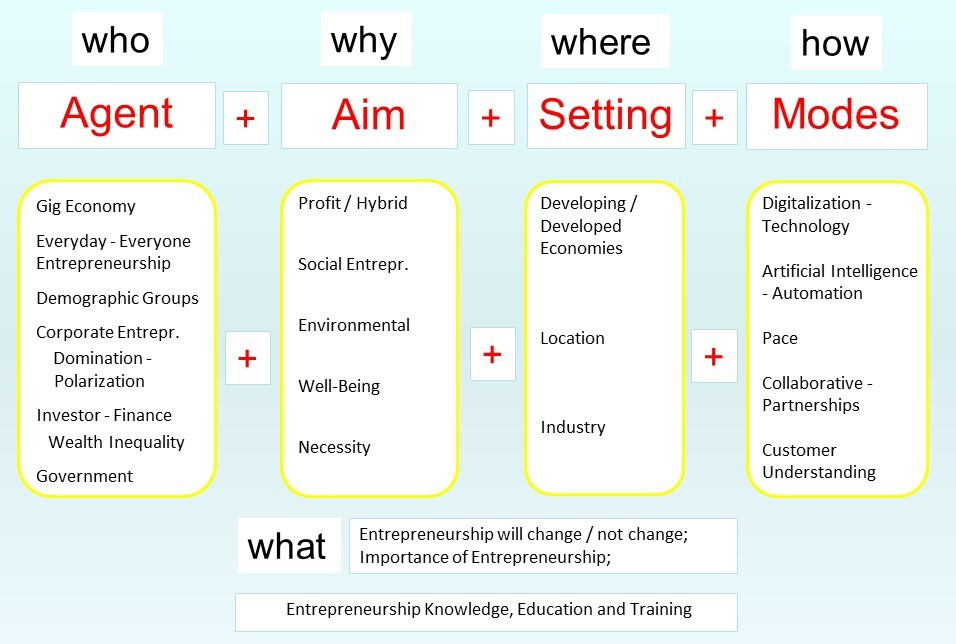
Delphi study themes and their possible combinations.
We used thematic analyses (Braun & Clarke, 2006; Guest et al., 2012) to code the responses. All information was processed anonymously, ensuring that all participants’ input was weighted equally. In thematic analysis, responses are initially coded into shorthand descriptions (first-order codes), which correspond quite literally to the text. The first open question (Q1) received the largest amount of input, resulting in 688 first-order codes. Additionally, 200 first-order codes were generated by Q4, and 102 by Q2. In total, the input of the 175 participants resulted in 990 first-order codes. In addition to one of the authors, a research assistant coded the responses, yielding 91% agreement between them on the first 100 codes. After discussing the diverging 9% and arriving at a shared approach, agreement of first-order codes grew to 96%. Respondents varied considerably in length of response, such that respondents who add more ideas are featured more strongly in the study because they generated more first-order codes. Also, because responses regularly connected two or more ideas, a single argument can have multiple first-order codes.
In subsequent rounds of thematic analysis, codes that reflected a similar theme were grouped together under the heading of a higher-order code. This resulted to a reduction of the initial 990 first-order codes to 94 second-order codes, then down to 42 third-order codes, and finally to 24 themes in the fourth and last round of aggregation (in thematic analysis, the final higher order codes are called themes [Guest et al., 2012]). The themes were finally mapped onto a superordinate structure of what, who, why, where, and how (Figure 1).
Note that the number of first-order codes is not a reflection of whether a majority of scholars think that a particular entrepreneurship topic will be important in 2030. In the first round, 175 scholars individually gave their view on how entrepreneurship may look in 2030. By means of thematic analyses, these views were aggregated into 24 themes or topics. With each of the participants focused on one or a few themes, none of the 24 themes were brought up by a majority of the panel members.
Round 2
The second round of the Delphi study placed predictive statements in front of the full panel. These predictions were directly based on the input of individual participants in the first round (thus, they represent the input of the board members). For each of the 24 themes, small summaries were written based on the first-order codes associated with each theme (no participant was identified in the process). From these summaries, predictions were derived. Thus, each prediction was derived from the input of a subset of panel members (as none of the individual participants’ input in Round 1 covered all 24 themes), whereas the responses generated in Round 2 represent a collective assessment in terms of assigned likelihood. As an end result, the 24 themes are represented by a total of 93 predictions (Table 1). The number of first-order codes per theme is listed on the first line of each subsection of Table 1.
Themes (Round 1) andCollective Assessment of Predictions (Round 2).

In developing these 93 predictions, we followed a few principles. First, when selecting and formulating the predictions, we focused on those we expected to be non-obvious. We saw little point in asking, for example, for the likelihood that e-commerce will increase in importance by 2030. Given the vast number of possible predictions that could be derived from the first stage of the study, we feared that including such statements would lead to unnecessary response fatigue and sample shrinkage. Second, given our focus on extensive as opposed to marginal changes, we formulated the items to represent a significant change or shift. For example, we asked participants to score the likelihood of whether, by 2030 many more youngsters (below 18 years old) engage in entrepreneurship compared to today. However, this means that that some panel members could have attached a low likelihood to a prediction, despite believing that change will occur. As one panel member stated: “2030 is around the corner. Some of these things may occur, but less likely in the timeframe offered.” Third, as shown by the example above, the items continually reminded respondents to consider 2030 in comparison to today, to ensure the focus was firmly on 2030.
Fourth, we deliberately phrased questions in an abstract manner rather than offering precise reference points. Thus, we formulated “By 2030, entrepreneurs and large corporations in western countries will be increasingly vilified because of their wealth,” rather than “By 2030, the number of media reports in Western countries questioning the wealth of entrepreneurs and large corporations will have increased by 500% compared to 2020.” Similarly, we chose not to accompany each prediction with a set of definitions, even though this may have led to heterogeneity in the understanding of the raters. Furthermore, we chose not to specify a setting or context, even though answers may vary by setting or context (such as country or culture). To focus the assessment on the likelihood of the broader idea, we employed greater abstraction over specific formulation. Specific formulation would be preferred in a prediction tournament focused on the short term, but our aim was to reveal broader issues that panelists believed may affect the future of entrepreneurship and the degree to which these beliefs were shared across the panel. Also, when predictions are formulated precisely, it is unclear whether low likelihood represents disagreement with the sentiment or with the precise formulation.
The predictions were presented in five blocks of around 18–19 questions, with predictions grouped by theme and the themes randomized over the blocks. The instruction given in the survey was repeated above each block of predictions and reads: “We ask you to indicate, as a percentage between 0 and 100, the likelihood of each prediction. A score of 0% means totally unlikely, 100% totally likely, and 50% would mean equally likely to happen or not. If you are unable to provide an estimate, then leave the answer box blank.” As in the first round, predictions were pre-tested on samples of graduate and undergraduate students. There was considerable attrition in completion of the second-round survey, with 180 participants filling out the first question, and 151 filling out the last one, likely from response fatigue.
Findings
Table 1 presents an overview of the themes derived from the qualitative analysis of the responses to Round 1, and Figure 1 shows these themes mapped onto the superordinate categories of what, who, why, where, and how. Many individual respondents commented that the phenomenon of entrepreneurship (“what”) will remain the same, confirmed by the panel as a whole in Round 2 ( Table 1, #1). While the “what” may remain similar (although increasing in importance), the panel proposed many ways in which agents, aims, settings, and modes (who, why, where, how) may increase in prevalence, importance, and/or quality. Agents, aims, settings, and modes can be combined within and between columns, and as such the themes generated by the study can be combined at will.
Perhaps the most striking feature of Table 1 is the wide range of topics broached by the respondents. For example, in terms of “who” will act entrepreneurially, Round 1 generated no less than 347 first-order codes, which we sorted into eight overarching themes: (1) gig economy, (2) everyday-everyone entrepreneurship, (3) demographics, (4a) corporate entrepreneurship, (4b) domination-polarization, (5a) investors-finance, (5b) wealth inequality, and (6) government. Some themes appear to be influenced by current economic and social trends (e.g., gig economy and wealth inequality) while others may be classic (e.g., the role of government). Across the dimensions of what, who, why, where, and how, we arrived at 24 themes capable of inspiring research under the rubric of entrepreneurship.
Table 1 also reports on the assessment by the panel of the likelihood of 93 predictions, derived from the qualitative input of individual panel members in Round 1. Apart from means and standard deviations, we report quartile frequencies. We present 50% as a separate “50/50” category (respondents were asked to leave answer boxes blank if they felt unable to provide an estimate).
The high and relatively consistent standard deviations reported across the 93 predictions deserve mention. The lowest standard deviation is 0.18 and the highest 0.29. This suggests that we succeeded in our intention to only put predictions in front of the panel of which we considered the likelihood nonobvious. Moreover, as noted in the “Methods” section, in this Delphi study we did not strive for consensus, as some Delphi studies do. The high standard deviation and the fact that for each prediction, we find respondents within all four quartiles as well as the 50/50 category suggests that there is substantial disagreement regarding whether any prediction will actually materialize or not.
The mean values range from 33% to 73% likelihood. Thus, while the panel is split across virtually all predictions, mean tendencies are quite clear, with the mean of means being above 50%. This suggests that, on balance, more things are predicted to happen than not.
We now analyze the emerging themes in greater detail. In doing so, when we refer to “one respondent,” “a few respondents,” or “some respondents,” we refer to the input provided by individual respondents in Round 1. When we refer to “the panel,” we refer to the collective assessment of predictions in Round 2.
What
What Will Not Change and What Will Change
Many respondents posited that entrepreneurship as a phenomenon would not change. This theme generated the highest number of first-order codes (79). Entrepreneurship may change in terms of its agents, aims, settings and modes, but in its fundamentals, entrepreneurship would not change. Respondents made various statements to similar effect. Examples include: (a) Entrepreneurship will continue to consist of recognizing, evaluating, and exploiting opportunities to produce new solutions to solve extant problems. (b) In 2030 it will be about solving pains/problems by introducing a new set of activities that are sustainable over time. (c) The fundamentals of identifying a promising idea, satisfying a unique set of needs, and developing the resources to put the idea into action will remain. (d) Entrepreneurs will continue to make bets amidst change and uncertainty. When put in front of the entire panel ( Table 1, item #1), a statement expressing that entrepreneurship itself will remain similar had, of all statements, the highest likelihood rating (M = 73%).
The Importance of Entrepreneurship
Whereas the essence of entrepreneurship was seen as stable, its nature seemed to become increasingly multifaceted. This is reflected in the themes and their associated predictions, such as (a) the importance of the gig economy; (b) the rise of “everyday-everyone” entrepreneurship (i.e., predicting that seeing and exploiting opportunities will become general life principles [#2]); (c) wider and more varied participation of various demographic groups; (d) incumbent corporate organizations becoming more entrepreneurial; and (e) an increase in manifestations of entrepreneurship in developing economies. The “what,” entrepreneurship, becomes more relevant and important as a consequence of such developments.
Entrepreneurship Knowledge, Education and Training
While the essence of entrepreneurship may remain the same (#1), participants expected its agents, aims, settings, and modes to evolve, and entrepreneurship education to change with it. Some respondents expected an increased interest in entrepreneurship knowledge, education and training. There was some support among the panel that by 2030 there will be more expert knowledge and insights pertaining to entrepreneurship. There will be a better sense of the entrepreneurial actions at which one can improve (#6). People’s easy access to online resources and online degrees (in entrepreneurship and other fields) will make it easier to acquire knowledge and training (see #14, #92). However, there is no majority support for a prediction that this will culminate in entrepreneurship as a profession in 2030 being like management in the 20th century: professionalized, systematized, and structured (#5). Also, it was predicted that entrepreneurship education will be delivered differently to multiple populations, and there will be better educational programming for disadvantaged groups (#8). Furthermore, entrepreneurship education is expected to start at a younger age—that is, high school and elementary school (#7).
Who
Gig Economy
The term “gig economy” refers to a workforce environment in which short-term and part-time engagements are commonplace, whether as employees, as freelancers, or as independent ventures. Out of 990 first-order codes, 70 referred to the gig economy, making it the second largest category. Though not up to the point that it will become the dominant way to earn a living ( Table 1, #9), it was expected that many will use the gig economy for a “side hustle” (#10). One respondent suggested that as a consequence, by 2030, research will no longer meaningfully measure firm size in terms of the number of employees.
The gig economy was also considered likely to proliferate as more individuals test ideas in the form of ventures, running one or more side businesses alongside a job. They will do so for fun, for profit, or both. The increase in freelancers will be enabled by digital technologies and social media. One respondent signaled the emergence of the “side hustle” generation—that is, running one or more small ventures alongside a stable source of income. This would be particularly the case in areas where stable income was provided by some form of universal basic income (UBI), which a quarter of the board members saw as a likely development (#11). Moreover, it was suggested that creating a business is not a one-time, forever career decision, such that many ventures may solve a cause and then be dissolved once that issue is solved.
Some respondents argued that employees becoming self-employed contractors did not represent entrepreneurship because these contractors do not see or create the opportunities on which they act; instead, they are merely forced to contract as freelancers rather than as employees. As discussed further in the “necessity” section, it was noted that the gig economy will also consist of individuals who have no other options. The panel was divided as to whether by 2030 the ratio of “fun” to necessity will have increased or decreased (#12).
Everyday-Everyone Entrepreneurship
Respondents argued that, by 2030 seeing and exploiting opportunities will have become a general life principle (#2). As such, it will be integrated in all we do, not only in work, but also in domains such as parenting or leisure time. Thus, not only the line between employee and entrepreneur will become blurred, but also between work and nonwork. The panel as a whole, however, was divided on the likelihood of this development (#13). It was thought that the manifestation of entrepreneurship will become much more diverse in terms of who, why, where, and how (see particularly the demographics theme coming up next). Individual respondents expected that so-called “everyday-everyone” entrepreneurship will be supported by a variety of technologies (social media, internet platforms including crowdfunding, no-code software, SAAS, blockchain), providing tools and connectivity. It will also be facilitated by readily available knowledge about entrepreneurship. As such, democratization of technology and knowledge will empower individuals to see/create and act on opportunities, to solve problems, and to innovate. Empowered individuals may even tackle wicked problems and grand challenges. However, the panel as a whole was divided in its ratings (#14). It was proposed that, by 2030 everyday-everyone entrepreneurship will attract more media and research attention than high-growth entrepreneurship; but again, the panel as a whole was not convinced (#15).
Demographics
Various respondents proposed that, by 2030, a more diverse set of demographic groups will engage in entrepreneurship, and the panel somewhat supported this view (demographics section,Table 1b Table 1). The aging of the population is a future development that can be predicted with a high degree of certainty. A majority of panel members found it likely that there will be many more older entrepreneurs and angel investors by 2030 (#19, #20), as these elders have the knowledge and resources, desire to stay active and involved, understand the needs of the aging population, and may have a need or desire for supplemental income. Furthermore, respondents expected more migrants and refugees because of climate change and wars fought over resources. Potentially these migrants, including refugees, will be engaged in entrepreneurship, because their host nations may not be willing or able to provide them with social welfare support. However, the panel was divided as to whether societies by 2030 will have vastly improved in finding ways to facilitate the entrepreneurial engagement of refugees and migrants (#22). Women entrepreneurship was also expected to have become more common (#17), with a majority thinking it likely that the gender gap (GEM, 2017) will narrow in many countries (#16). One suggested reason for this development is access to finance through crowdfunding being more favorable to women than regular channels, an idea on which the panel as a whole was divided (#23). Respondents also expected that people aged 18 or younger will be more engaged in entrepreneurship, finding some support by the panel (#18), as many expect entrepreneurship education and training to be integrated into primary and secondary education (#7).
Corporate Entrepreneurship
Respondents believed that incumbent organizations will be more entrepreneurial by 2030 than they are today. Several trends were proposed as contributing to this development. For starters, increased competition, and technological uncertainty and change will force corporations to be more entrepreneurial. Additionally, the panel expects employees to become more entrepreneurial (#26), possibly as a means of retaining their jobs. Corporate entrepreneurship will increase in prevalence and importance because environmental and societal challenges will require the organizational power of big firms (#90). Finally, it will be more common in 2030 than it is now, for corporations to seek to remain innovative by acquiring startups (#27) because such acquisition is believed to reduce risks, resources, and competition. As a consequence, it was predicted that entrepreneurs who intend to start high-growth firms will become less ambitious, seeking instead to start specialized ventures that can quickly be sold to large corporations (#89). One respondent suggested that IPOs may become so rare that venture capital markets will need to change.
Domination – Polarization
Associated with big corporations was the theme of “domination and polarization.” Several respondents foresaw a future characterized by an increasing division and polarization between a relatively small number of entrepreneurial ventures that are extremely powerful and profitable and a relatively large number of entrepreneurial actors that have limited individual power and limited profits (#28). In particular, large platforms are expected to dominate the innovation landscape, with platforms such as Amazon outperforming traditional retailers. Indeed, a majority of the panel believed that the major tech firms will vastly increase their power compared to today (#29).
With the power of global mega-corporations increasing, individual respondents proposed that this may increasingly threaten country sovereignty and individual privacy. The majority of the panel, however, did not believe this will emerge (#30). Respondents suggested that questions of whether and how high-growth forms of entrepreneurship can create a more inclusive society in the long term will become increasingly important, such that it will become unclear whether entrepreneurship is about “becoming the elite” or about improving overall well-being.
Respondents focusing on the other side of the divide suggested that entrepreneurship will become more necessity focused, directed at frugal innovation, low-tech services, as well as social ventures addressing social and environmental challenges in a local manner. These respondents suggested that there will be many startups, but these startups will find growth more difficult given that much of “the pie” is already flowing to a few large dominant firms. This prediction was not supported by the panel as a whole (#31).
Investors – Finance
Several respondents proposed that options for obtaining finance will continue to expand. Connectivity technologies including crowdfunding platforms will connect entrepreneurs to investors. Baby boomers will pass on their wealth to the next generation by means of gifts or as angel investors. Cryptocurrencies and initial coin offerings will fund new ventures. However, obtaining finance is not believed to become much easier (#32), and there was mixed support for the idea that, by 2030, consumer-focused crowdfunding platforms will dominate early-stage capital markets (#77).
A somewhat opposing view also emerged in Round 1. It was proposed that, by 2030, most capital will flow to high-tech ventures amenable to scale and winner-take-all markets. AI will help optimize that money flows to the best projects. Respondents argued that too much money will be chasing too few investment opportunities worldwide, leading to even more domination of successful mega corporations as they easily attract funding (cf. #28). Investors, in particular the super-rich, will use their pocketbook to influence their favorite social and technological developments. A strong increase of impact investing, with both small and hyper-rich angel investors investing with a purpose, was also predicted. The panel as a whole somewhat leaned toward these predictions (#34, #35).
Wealth Inequality
The panel foresaw income and wealth inequality as increasing further (#36). Nevertheless, the majority of the panelists did not believe this will be because of entrepreneurship (#37), even though that would be the case if a select group of entrepreneurs and investors continue to vastly expand their wealth. Respondents also suggested that entrepreneurship acts as a leveling force, with more individuals likely to be engaged in entrepreneurship in the gig economy, or even in daily life more generally (see earlier sections on gig economy, everyday-everyone entrepreneurship, and demographics). The panel was divided as to whether entrepreneurs will be increasingly vilified because of their wealth (#40), or whether negative individual and societal consequences of entrepreneurship will receive much more attention than they do today (#38). In terms of remedies, a majority of the panelists did not believe that several countries will (re)introduce (forms of) socialism (#41), or UBI that might allow individuals to engage in entrepreneurial ventures while being assured of a small but stable income (#11). One step short of these more radical developments was that governments will find more effective ways to tax super-wealthy entrepreneurs and global enterprises, who agree to being taxed based on the assumption that income re-distribution will not only ensure social stability but also further consumer demand. However, the panel was divided as to whether governments will be better at reducing tax evasion by entrepreneurs and corporations by 2030 (#39).
Government
Some respondents expected an increase in government-promoted entrepreneurship serving political, military, and/or ideological aims, serving narrow interests in some cases, but the panel as a whole was divided on the likelihood of this prediction (#43). Government-promoted entrepreneurship was also expected to be focused on major innovative solutions for broadly supported societal and environmental issues (#89). While increased governmental interference could be perceived as a negative force on entrepreneurship, respondents suggested that Chinese state-driven and sponsored innovation will continue to expand and be successful. However, the panel was divided as to whether, by 2030 Chinese state-driven and sponsored innovation will dominate many industries worldwide (#42). This prediction is less likely to come true if, as a panel majority believes, by 2030 protectionism and nationalism has expanded even further (#44). The panel was split on the prediction that governments will have greater influence in 2030 than today over how entrepreneurs operate (#45).
Why
Profit – Hybrid
Respondents held different views about whether entrepreneurial firms will increasingly emphasize nonfinancial goals alongside profit. Some respondents suggested that this will happen for only a subset of businesses, accompanied by a growing divide between pure profit-focused firms and entrepreneurs aimed at solving societal and environmental challenges, but the panel as a whole did not support this position (#46). Neither did the panel believe that having hybrid aims (i.e., doing well alongside doing good) will become the new normal, despite an expected increase in popularity of social entrepreneurship (#49) and focus on solving environmental issues (#55). A majority of the panel believed that, by 2030, large corporations will be primarily focused on profit, at least as much as they are today (#48). There was limited support for the idea of entrepreneurs delivering social goods for profit (#73). The panel was divided about whether, in response to pressure from consumers and governments, entrepreneurs will experience increased requirements to measure and report performance socially and environmentally as well as financially (#47).
Social Entrepreneurship
In Round 1, individual respondents proposed that in 2030, the new generation of entrepreneurs will have the digital skills and willingness to engage in social production. The panel agreed that, having inherited a world with a range of environmental and social problems, an increased number of new entrepreneurs will devote themselves to solving these issues (#48), whether local or global in scope. However, the panel as a whole did not believe that social entrepreneurship will become so large that the social returns from entrepreneurship will dwarf the private returns (#51), nor was there a majority view that it will scale beyond prior NGO and nonprofit models (#52). The panel was divided as to whether social entrepreneurship will substitute for state provision of social goods in countries with weak institutions. A sizable minority of respondents, however, foresaw some loss of popularity of social entrepreneurship owing to increased market understanding of their failure, weaknesses, and/or shortcomings (#53).
Environmental
Individual respondents expected that by 2030 numerous entrepreneurs will be focused on combating climate change and environmental degradation. A large majority of the panelists supported the idea that a strong further increase in environmental problems will make focus on sustainability mainstream (#55). Further, a majority believed that startups, corporations, and governments will form partnerships in their attempts to address environmental concerns (#54, #90). There was no majority support, however, for the prediction that, by 2030, entrepreneurs will have succeeded in solving several climate change and sustainability concerns. Although a pandemic was not referred to in the first round of this Delphi study, several respondents predicted that, by 2030, acute environmental disasters will lead to the emergence of a new industry of entrepreneurs specialized in immediate survival and disaster response. A majority of the panel felt this was likely (#57, #70), and was split on the prediction that, by 2030 entrepreneurship will be significantly more focused on the survival of the human species (#58).
Well-Being
Some respondents expected the goal of personal well-being of the entrepreneur to increase in prominence when engaging in entrepreneurship. They posited that entrepreneurship can be a way to achieve self-actualization, work–life balance, and a high quality of life. The panel was split as to whether, by 2030, a vast majority of entrepreneurs will be unwilling to trade off physical and mental well-being for demands related to their venture (#59).
Necessity
Several respondents expected that, by 2030, there will be an increase in the amount of necessity entrepreneurship, possibly as a consequence of increasing wealth and income inequality (#36), with working poor and refugees in particular being forced into necessity entrepreneurship. The panel overall was split on these latter positions (#4, #59, #60), and there was also no majority belief that job loss from AI and automation will force many individuals to scrape together an income to sustain themselves (#85).
Where
Developing - Developed Economies
A number of individual respondents expected that entrepreneurship will shift from developed to developing economies because more gains and growth can be achieved there due to population size and potential for economic and social growth. One respondent went so far as to say that for entrepreneurship research conducted in 2030, pure U.S. samples may be seen as convenience samples. However, the panel was split on the idea that, by 2030, more breakthrough innovation (#62), or applications of sharing economy models (#76), will occur in developing economies than in developed economies. Only a minority believed that developing countries will not only become known for necessity entrepreneurship but also for sustainable growth models (#63).
China received special mention. Although some respondents expected the Chinese economy to falter, others expected that Chinese tech entrepreneurs will challenge the dominance of U.S. companies, partly because of state sponsorship helping them to do so. The panel was split as to whether Chinese tech entrepreneurs will have overtaken U.S. companies in dominance by 2030 (#64, see also #42). Entrepreneurship under autocratic regimes was also mentioned. Respondents wondered whether those regimes will be able to support innovative entrepreneurship, and even if they do, whether they will they fall in a middle-income trap. In some of these countries, such as Russia, entrepreneurship may exist in isolation and under conditions of unfair competition. The panel as a whole was split on whether, by 2030, autocratic regimes will have found effective ways to make entrepreneurship work in their economies (#65).
Location
The importance of geography and location may decrease by 2030. The panel tended toward the position that, because of the global reach provided by technological capabilities, products and services will look increasingly similar across the globe (#69). At the same time, trends invoke countertrends, such that a vast majority believed in increased local, personalized, and community-based entrepreneurship, providing human connection and authenticity (#66). Thus, entrepreneurship may simultaneously become increasingly diverse and similar across settings, contexts, and locations. Entrepreneurship may also occur in locations that normally do not receive much attention, such as remote communities (#67), possibly because of climate change. Moving even more remotely beyond earth, the panel was split about whether many more entrepreneurial ventures in 2030 will be engaged with space exploration (#68).
Industries
Several industries of the future were identified, mostly based on technologies (for example, augmented reality, bio-engineering, bio-informatics, cybersecurity, electric vehicles, genetic engineering, Internet-of-Things, life science technologies, medical and health technologies, precision fermentation in food production, robotics, and surveillance technologies). Their prominence in the future was sometimes considered to rest on their combination with demographic developments, such as healthcare for an aging population. Respondents expected industries to become increasingly interconnected, with higher sector fluidity—that is, information, knowledge, and resources flowing freely across industry boundaries. Regional developments in tech clusters were expected to remain important, as regions compete for leading positions in the industries of the future. As these predictions seem relatively noncontroversial, they were not placed in front of the panel.
In addition, several socioeconomic trends were proposed as sources of entrepreneurial innovation. Two examples, respectively serving low- and high-end market segments, were e-commerce entrepreneurs selling and repurposing second-hand goods, and an increase in services for the affluent and wealthy, particularly for the super-rich (top 1%). The latter prediction received limited support (#72), despite a collective belief that income and wealth inequality will continue to spike (#37). Also, cultural trends were noted (increased interest in authenticity, well-being, community, living a “slow life,” solutions to living in overcrowded cities, solving personal or household daily problems) (#66). One respondent expected a vast increase in silly diversions such as games, a belief not shared by a panel majority (#71). The lowest support for any prediction (average likelihood of 33%) was for the idea that entrepreneurship and market approaches might replace state welfare efforts (#73). As reported in the section on addressing environmental concerns, many respondents envisioned new forms of entrepreneurship emerging as a response to environmental disasters (global warming, environmental degradation), providing impetus not only for entrepreneurs to provide solutions to environmental problems but also for the emergence of entrepreneurship that is specialized in disaster recovery and crisis management (#57, #70).
How
Digitalization – Technology
In their Round 1 responses, several respondents expected an enhanced role of technology, particularly related to digitalization in entrepreneurship. Digitalization, it was argued, will provide entrepreneurs with increased access, connectivity, and real-time intelligence. It will become easy to share prototypes instantly to get feedback from others. Platforms will exist that explore everything from household products to infrastructure in B2C, B2B, C2B, and B2G markets. With platforms expected to dominate the innovation landscape because of the data lakes they construct, one respondent raised the question of whether platforms such as that provided by Apple facilitate entrepreneurship, actively shape it, or compete against it? The panel as a whole did not expect the Apple platform to eliminate entrepreneurship, but they did not feel that it strongly enhances it either (#74, #75). The panel was also split on the idea that consumer focused crowdfunding platforms will dominate early-stage capital markets (#77), and the proposition that developing countries will be the main setting where sharing economy models are implemented (#76).
AI – Automation
Out of 990 first-order codes, 63 referred to AI, making this the third largest category. Kaplan and Haenlein (2019, p. 17) define AI as “a system’s ability to correctly interpret external data, to learn from such data, and to use those learnings to achieve specific goals and tasks through flexible adaptation.” Several respondents also expected AI to over many functions previously performed by entrepreneurs, or at least to help entrepreneurs perform these tasks better. This applies particularly to information processing and decision making regarding problems and opportunities. Some expected AI to also augment the creative abilities of entrepreneurs, whereas others expected a specialization of labor with entrepreneurs focusing on the creative, coordinating, and social tasks involved in value creation. The panel was split on the likelihood of these predictions (#78, #79), but again, the predictions are formulated in a relatively extreme form. It is noteworthy that half of the sample found them more likely than not, and those who attached low likelihood to the extreme predictions may still support a more moderate position. Similarly, the panel was split on whether AI and machine learning (ML) software will behave entrepreneurially (#80), but mostly the panel was skeptical that this may lead to AI algorithms being recognized as members of startup teams (#81).
Another issue raised in the first round concerned the benefits of AI and to whom they would mostly accrue. Will AI become mainstream for all ventures, thus promoting a surge of entrepreneurship at a local level around the world, or will these benefits accrue to the AI powered platforms themselves making “the pie” smaller for small ventures? The panel as a whole showed more support for the first position than the second (#82, #83). Some respondents expected that even if AI is widely used, AI and automation would allow startups to grow without creating many jobs. They believed that AI and automation will reduce the job creation function of entrepreneurship, even up to the point of entrepreneurs being replaced by the innovations they create. Thus, these respondents expected AI to promote entrepreneurship by pushing individuals into necessity entrepreneurship and the gig economy. Only a minority of the panelists felt these positions were likely or somewhat likely (#84, #85).
Pace
Several respondents as well as the full panel (#86) expected an acceleration of current trends, particularly with regard to technological innovation. This acceleration, participants argued, will entail collapsing time windows caused by faster and increased information access, increased global competitiveness, and mounting consumer impatience. Virtual reality, AI, and other digital technologies will allow for rapid and cheap experimentation, making product design and customer feedback cycles faster and more effective. One respondent went so far as to predict that, by 2030, companies such as Zara and H&M may have new collections every week. Consequently, adaptability, speed, and agility will become key to entrepreneurial success (#87). Businesses will focus more on core competencies, thus pushing them to outsource more, giving further impetus to the gig economy. Respondents proposed that many organizations will have difficulty adapting to the increase in technological pace. This also includes business schools, as the speed and nature of change will outstrip the grasp of existing theory, leading to a frustration with theory, according to one respondent. Already, the speed of updating government legislation lags behind the speed of technological innovation, causing delays in commercial experimentation and exploitation. Some expected this lag to increase even more, but this prediction found no overall support from the panel (#88). Increasing pace not only applies to the churning of firms but also to successful exits, with successful startups being sold quickly and serial entrepreneurs moving on to their next venture (#89).
Collaborative – Partnerships
A majority of the panelists expected that, by 2030, there will be more alliances of diverse stakeholder groups in entrepreneurship (#90). Respondents suggested that isolated actors cannot solve the global challenges the world faces by 2030. One of entrepreneurship’s roles will be to organize cooperation among different entities and types of actors. There will be more collective idea development and exploitation. Respondents noted that collaboration will increase not only because there is an increased need, but also because the millennials are a collaborative generation.
Respondents remarked that particularly startups providing specialized digital products or services need to make sure their product or service aligns with existing innovation ecosystems. With innovation taking place in ecosystems, there will be a further increase in collaborative modes between startups and corporations. Furthermore, if the aims of a venture become more mixed, then collaborative modes are set to increase. Overall, the panel showed slight support for the idea that, compared to today, entrepreneurship will be more collective and less individual by 2030 (#91).
Customer Understanding
Above, we discussed how AI may change how entrepreneurship will be conducted. Connected to this theme, some respondents in Round 1 emphasized the importance of empathy and emotional intelligence (EQ). They proposed that entrepreneurs and their organizations high in empathy and EQ will be more successful in AI applications. More generally, the panel as a whole agreed with the predictions that with finance, information, and technological tools being widely available to even the smallest ventures (#92), competitive advantage for entrepreneurs will increasingly be a function of user centeredness and customer understanding (#93). With entrepreneurial success being a function of consumer demand, more than access to finance, information, or technology, startups will be increasingly driven by user-centeredness and entrepreneurs to take the perspective of users. Thus, design thinking will be widely applied owing to its acknowledgment of the importance of fostering emotional connection to products.
Additional Analyses
To explore whether response patterns fell into interesting categories, we conducted a series of cluster analyses. The most useful result was a two-group solution generated by K-means clustering. Essentially one group consisted of respondents who assigned lower probabilities to all predicted changes versus one group that assigned higher probabilities to these same changes. Perhaps we can label these as a “cautious” versus a “bold” group. The two items on which the two groups differed the most were both related to AI (#77, #78; t > 8, p < .001). Cluster membership correlated significantly (r = .25; p < .01) with gender, with female participants being more likely to be bold, expecting 2030 to look more different than male participants did. Age correlated neither with cluster membership nor with gender. We also analyzed whether response diverged by country of residence and country of origin. When comparing the responses of those working in the United States and those working in continental Europe, two items showed the highest difference (t > 4, p < .001), with those in Europe scoring higher. These are #46 (By 2030, all entrepreneurs, including the self-employed, will experience increased requirements to measure and report performance socially and environmentally as well as financially) and #90 (By 2030, we will see more collaborative forms of entrepreneurship involving startups, corporations, investors, and the government aiming to address grand challenges/wicked problems).
Discussion
In this prospective Delphi study, we elicited the views on entrepreneurship in 2030 from a panel of expert entrepreneurship scholars serving on the ETP and JBV editorial boards, translated this input into predictions, and had the likelihood of these predictions assessed by the panel as a whole. The most striking outcome of this exercise is the richness of themes and predictions provided by the panel. It is apparent that, when asked the broad question of what the future of entrepreneurship will hold, entrepreneurship scholars do not think along the same lines. The Delphi methodology allows for the creation of an instant “community of inquiry” (Shepherd, 2015) and by engaging 175 scholars in an exploratory open-ended first round, we generated a large plurality of perspectives.
Predicting what will happen in 2030 is speculative, and we make no pretense that our study will accurately predict what entrepreneurship will look like in 2030. The non-linearity of complex systems makes accuracy of long-term predictions an elusive goal. As both Ludwig Lachmann (1971) and Nassim Nicholas Taleb (2007) have eloquently argued, accurately predicting the future in the long term requires the incorporation of elements of the future itself. Moreover, there are an infinite number of unexpected events that have a very small chance of occurring but very high impact if they do—and at least a number of them will occur (the COVID-19 pandemic is an example of such a “wildcard” event). Tetlock and Gardner (2016), while describing the habits of so-called superforecasters, states that the accuracy of expert predictions declines toward chance 5 years out.
Nevertheless, the inability to predict the future accurately does not imply that we should only focus on the here and now, or only on those aspects that can be accurately predicted. As stated by Winkler and Moser (2016, p. 64):
Delphi is highly valuable in situations of severe uncertainty stemming from rapidly unfolding, non-calculable dynamics, or uncertainty originating from large multidisciplinary problems in highly complex environments. In these situations, precise analytical data processing techniques are not applicable and trend extrapolation is mostly inadequate. Instead, information collection and knowledge must be built on informed opinion and subjective expert judgments as well as experience-based interpretations.
The themes and predictions generated by the Delphi panel can serve as inspiration for (future) entrepreneurship scholars as they signal the issues and debates considered relevant in shaping the future. In terms of themes, the number of first-order codes is a proxy for how often a theme was raised by the panel, and a high prevalence is therefore a proxy of salience (for example, AI, gig economy). However, if a theme is mentioned less often, that does not mean it is less interesting. Scholarship can be seen as entrepreneurship in that scholars are entrepreneurs and their papers are their products. Reviewers are investors and the field is the market. Consequently, knowing what is on the field’s radar is helpful in determining whether a research topic has a warm or cool market. Knowing that others are interested in a topic suggests less pushback in studying it, and likely rapid progress in understanding that topic. However, what is popular is not necessarily what is most important. As Shepherd (2015) argues, entrepreneurial research with the highest impact is achieved by thinking entrepreneurially—reflected in an open mind toward new topics, methods, and ways of doing things.
The fact that multiple mutually exclusive scenarios were deemed equally likely by our panel opens opportunities for scholars to be influential. There are many ways in which researchers can help promote the realization of scenarios deemed more desirable. For example, they can facilitate understanding of the diverging possibilities and their determinants, help predict which scenario will eventually arise, or more generally draw attention to particular scenarios and highlight their pros and cons. Many of the themes and predictions make reference to a political context. With the future of entrepreneurship being contingent on political decisions, entrepreneurship scholars can play a role in terms of informing, facilitating, and influencing political debates.
Our study is deliberately aimed at identifying what entrepreneurship as a practice will look like in 2030, as opposed to what entrepreneurship research will entail. The predictions generated by the participants are not to be equated to research questions. Nevertheless, research questions and their subsequent answers can inform the debates reflected in the predictions and their collective assessment by the panel, which held opposed views on any prediction. In terms of themes, none of them received no coverage at all in JBV or ETP (which is logical as all panel members publish in these journals), but certain themes have received less consideration than others. Among them are the gig economy, entrepreneurial behavior in non-venture settings (everyday-everyone entrepreneurship), entrepreneurship in developing economies, and the ever accelerating pace of entrepreneurship. Also, many themes and predictions relate to the political context of entrepreneurship, which is underexplored, such as the debate whether big business (increasingly) dominates small business, whether entrepreneurship promotes equality or inequality, and the personal entrepreneurial agendas of billionaire investors. Further inspiration for future research topics and questions can be found by looking at the combination of themes (in line with their high prevalence, many respondents connected AI to the gig economy and to a variety of other themes) within and across the superordinate categories of agents, aims, settings, and modes. Obviously, any venture involves any of the superordinate categories. The next section offers a range of more detailed future research suggestions.
Future Research
Table 1 offers predictions for developments that may inspire research questions as we approach 2030. We identify a few theoretical tensions to which such developments would likely contribute. In Table 2, we highlight a range of future research questions and possible theoretical frames.
Research Questions and Possible Theoretical Frames Inspired by Our Findings.
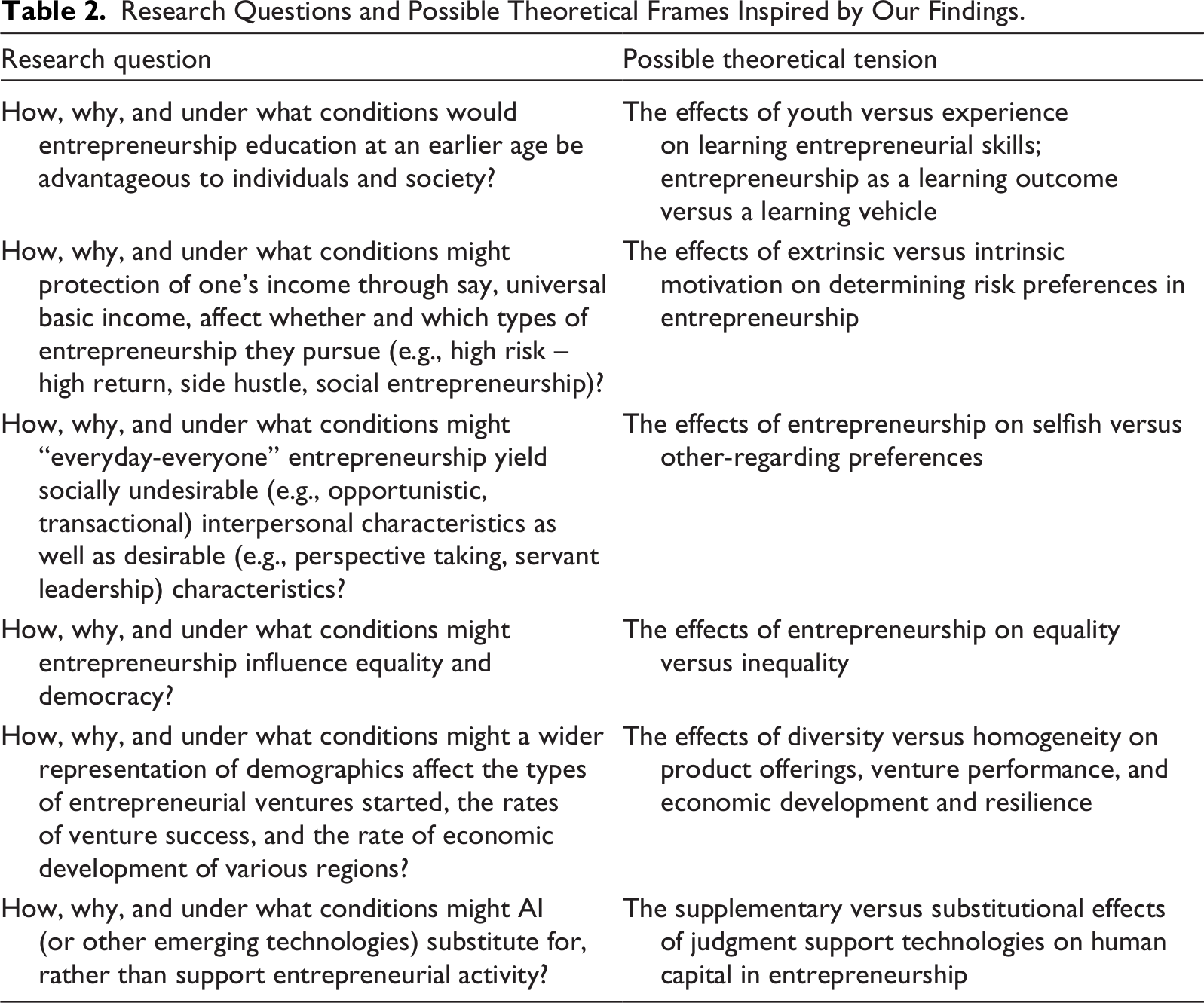
For example, the shift to teaching entrepreneurship at an earlier and earlier age begs the question of how, why, and under what conditions development of entrepreneurial skills as at earlier age would be advantageous to individuals and society? Some scholars suggest that children learn many things faster than adults because they have more free time to learn, fewer demands on their attention, few inhibitions, and a prefrontal cortex that is still developing (Ericsson, 2014). Others suggest that adults are as good, if not better, at learning and absorbing new information because the experience, mental models, and preexisting knowledge they already have ensures better and faster comprehension as well as long-term retention (Meulman et al., 2015). Moreover, the ability and freedom adults have to direct their own learning allows for greater control over motivation and results, allowing adults to utilize techniques in learning that make them more efficient and effective at it. If there is an ideal “age of acquisition” for learning a second language (e.g., DeKeyser, 2013), then might something similar exist for learning the art and science of entrepreneurship? Alternatively, rather than knowledge of entrepreneurship being the desired learning outcome, entrepreneurship can be the process through which children acquire knowledge about other important matters. Being self-directed, driven by personal initiative, and requiring a range of skills and abilities, entrepreneurship has the potential to serve as a vehicle for broad learning throughout the ages (cf. Sigmundsson et al., 2017).
Similarly, a review of our findings suggests research questions that highlight the effects of UBI on entrepreneurship. Would UBI liberate entrepreneurial attempts by removing much of the fear of failure? Or might it remove the motivation to try (McGregor & Cutcher-Gershenfeld, 1960)? Or could it simply alter the types of entrepreneurship one might consider pursuing? For instance, if UBI raises a person’s “affordable loss” (Sarasvathy, 2001), he or she may only consider ventures that promise windfalls or significant intrinsic rewards (Gagné & Deci, 2005), but then again, they might choose only to entertain ventures that provide no threat to their UBI—for example, a small cash-based side hustle conducive to tax evasion?
Our panel points to numerous other possible research questions concerning entrepreneurship’s role in eliciting (un)desired interpersonal characteristics among members of a society. In her Bourgeois Virtues, for example, McCloskey (2010) suggests that entrepreneurial capitalism facilitates perspective taking, volunteerism, and servant leadership (e.g., McMullen, 2010; van Dierendonck, 2011) as a spillover of attending to others’ wants and needs for one’s livelihood, while Williamson (1975) in his Markets and Hierarchies suggests that uncertainty like that which characterizes entrepreneurial capitalism would likely encourage opportunism. Obviously, both cannot be right without considering some moderators in the social (un)desirability of entrepreneurship’s effect on a people’s character. Under which conditions, then, is the entrepreneur likely to approach the social negotiation of new value creation with the golden rule of a giver (Haidt, 2006), the tit-for-tat strategy of a matcher, or the opportunism of a taker (Grant, 2013)?
In a similar spirit, the panel also exhibits concern over the possibly shifting dynamics of entrepreneurship’s relation with power. For the last few decades, scholars have focused on entrepreneurship as a force for deconcentrating economic power from incumbents who may no longer be providing consumer welfare at optimal levels (Shane & Venkataraman, 2000; Thurik & Wennekers, 2004). However, researchers have long known that entrepreneurship can also be used to concentrate power among a small number of actors (Rumelt, 2005), and the rise of social media and other platforms appears to be facilitating monopoly power (Culpepper & Thelen, 2020). For example, Marinoni and Voorheis (2019) observe that high-quality entrepreneurship is associated with greater rather than less inequality in the United States. On the other hand, Audretsch and Moog (2020) observe a close relationship between entrepreneurship and democracy throughout history, with autocratic regimes striking down on entrepreneurship, most recently using COVID-19 as a vehicle to curb entrepreneurship. These disparate outcomes point to the need to consider moderators when contemplating whether entrepreneurship dilutes or concentrates economic power.
Our panel of experts expect the number of new ventures being created to matter to both the character of a people and the concentration of economic power, but they also think that who creates these ventures will matter. In general, they see increasing diversity as a desirable quality within a nation. For example, increasing multiculturalism as well as racial and ethnic diversity in the United States and Europe suggests a continuing rise in the types of ventures and product offerings. By enhancing diversification, increased heterogeneity might serve as a hedge against vulnerabilities from over-specialization that could arise from homogeneity in social identity. Further, more diverse inputs into the economy may provide enhanced social stability, as well as economic development and resilience at higher social orders. However, greater diversity in the United States and Europe implies coordination costs simply not borne by less heterogeneous regions or nations (such as China). This raises the question of whether cultural diversity or homogeneity is the superior source of competitive advantage across nations and whether these consequences depend on short-term or long-term effects.
Lastly, research potential exists concerning the effects of developments such as AI on the type of entrepreneurial ventures that might be expected to emerge and how well they perform. Will AI extend the entrepreneur’s reach or simply replace him or her? As noted by journalists such as Friedman (2018), the answer is likely to depend on a number of contingencies that researchers have only just begun to examine. For example, individuals who have a natural proclivity for analysis and rational thinking will be more likely to be attracted to and do well in vocations that require such skills. But such individuals would also be more prone to be displaced by AI. Conversely, people who have a proclivity for unconventional thinking, improvisation, and behavior that is outside the norm will be attracted to vocations that embrace such characteristics and would also be difficult to replace with AI. Arguably, the dilemma is similar enough to the opportunities and threats associated with outsourcing or automation to make some inferences about the implications of AI on various types of entrepreneurship and particular entrepreneurial activities. Simply put, when do AI or similar judgment support technologies supplement the human capital of the entrepreneur making it even more valuable, and when do they substitute for it, diminishing its value?
Adding to the urgency of investigating these questions is that the results in Round 2 reveal divergence of agreement on all predictions, implying that multiple scenarios are possible. Researchers can help develop these scenarios. Research can facilitate understanding of the diverging possibilities and their determinants, help predict which scenario will eventually arise, or help promote the realization of one scenario over others, if not equally desirable. As such, we believe this study has the potential to fill an agenda-setting function.
To conclude, this study represents the collective anticipatory thinking of entrepreneurship experts in terms of what they currently believe are the most important future themes. We hope this study helps to inform and to inspire.
Footnotes
Appendix: List of Participants

| Gordon Adomdza Thomas Allison Allen Amason Alejandro Amezcua Brian Anderson Jean-Luc Arregle Jonathan Arthurs David Audretsch Erkko Autio V.Baconi-Gerasymenko Rene Bakker Robert Baron Bat Batjargal Massimo Baù Matthias Baum Judith Behrens Heiko Bergmann Joern Block Steven Bradley Jim Brau Keith Brigham Keith Brouthers Candida Brush Peter Bryant Amanda Bullough Henri Burgers Katrin Burmeister-Lamp Lowell Busenitz Per Bylund Gabriella Cacciotti Albert Cannella Melissa Cardon Jon Carr Sara Carter Gary Castrogiovanni Richard Chan Elsa Chan Gaylen Chandler Todd Chiles Francesco Chirico Young Rok Choi Jim Chrisman Alex Coad Joseph Coombs Andrew Corbett Nicole Coviello Jeff Covin Christopher Crawford J.Darroch Blakley Davis Alfredo De Massis David Deeds Frédéric Delmar Dawn DeTienne |
Nicholas Dew Dimo Dimov Jonathan Eckhardt Kimberly Eddleston Linda Edelman Amanda Elam Prescott Ensign Saul Estrin Hanqing Fang Emmanuelle Fauchart Stephanie Fernhaber Riccardo Fini Eileen Fischer Greg Fisher Maw Der Foo Robert Garrett William Gartner Joel Gehman Michael Gielnik Brett Anitra Gilbert Denis Gregoire Arent Greve Dietmar Grichnik Matthew Grimes Marc Gruber Vishal Gupta Jeremy Hall Isabella Hatak Helen Haugh Benson Honig M.Hughes A.E. Ingram R.D. Ireland Sarah Jack Peter Jaskiewicz Anna Jenkins Amol Joshi Rachida Justo A.Kaleka Nadine Kammerlander Tomas Karlsson Shoko Kato Teemu Kautonen J.Kay Keels Susanna Khavul Theodore Khoury Ewald Kibler Roland Kidwell Phillip Kim Kim Klyver Mirjam Knockaert Patrick Kreiser Donald F. Kuratko Claire Leitch |
Moren Levesque Dan Li Benyamin LichtensteinDominic Lim Andy Lockett Cari Lomberg Sophie Manigart Tatiana Manolova Lou Marino Laura Marler Susan Marlow Bruce Martins Andrew Maxwell Brian McCann Alexander McKelvie Aaron McKenny Steve Michael Tomasz Mickiewicz Hana Milanov Danny Miller J.Robert Mitchell Erik Monsen Todd Moss Charles Murnieks Lucia Naldi Satish Nambisan Meyyappan Narayanan Donald Neubaum Scott Newbert Charlene Nicholls-Nixon Boris Nikolaev AnnaleenaParhankangas Haemin Dennis Park Simon Parker Pankaj Patel Saurav Pathak dean Patton Holger Patzelt John Pearce Ana Maria Peredo Larry Plummer Jeff Pollack Andreas Rauch Stuart Read Maija Renko Becky Reuber Vera Rocha Mikko Rönkkö Matthew Rutherford Arvin Sahaym Carlo Salvato E.Santarelli Harry Sapienza Leon Schjoedt |
William Schulze Mariarosa Scarlata Susan Schwarz Denis Schweizer Christian Schwens Salvatore Sciascia Lois Shelton Galina Shirokova D.Siegel Philipp Sieger Mark Simon J.Singh Brock Smith Pek-Hooi Soh Jeffrey Sohl Paul Steffens Ute Stephan Christopher Stevens Shuhua Sun Christopher Sutter Evangelos Syrigos J.Tag Siri Terjesen Stewart Thornhill Patricia Thornton Roy Thurik Varkey Titus Erno Tornikoski David Townsend Paul Tracey Andranik Tumasjan Roxana Turturea Lorraine Uhlaner Marilyn Uy Ingrid Verheul Silvio Vismara Wim Voordeckers William Wales Jennifer Walske Justin Webb Friederike Welter Karl Wennberg Page West David Williams Trenton Williams Joakim Wincent Marcus Wolfe Matthew Wood Helena Yli-Renko Toru Yoshikawa Thomas Zellweger Anica Zeyen Wubiao Zhou Charlene Zietsma |
Acknowledgements
We like to acknowledge the 217 editors and editorial board members participating in the Delphi panel (see  ); Etienne Schraven, Danja Overgaag, Paul Jansen, and Roy Thurik for comments and input; and the 2019, 2020 and 2021 cohorts of the honours course “The Future Entrepreneur” at VU University Amsterdam.
Declaration of Conflicting Interests
The author(s) declared no potential conflicts of interest with respect to the research, authorship, and/or publication of this article.
Funding
The author(s) received no financial support for the research, authorship, and/or publication of this article.