




Abstract
This paper draws on semi-structured interviews with 57 women electronic music artists to establish the concept of ‘ameliorative work’ as unrecognised and/or undervalued effort expended in order to make their working life better. We contribute to critical research into gender inequalities in the creative industries, and in particular consider the under-researched issue of women’s responses to incidents of gender-based discrimination that arise from simultaneously being visible as a woman, while remaining invisible as a creative professional. Ameliorative work is both the potential for betterment and change as well as an effortful burden. We present the complexity of ameliorative work’s impact on women in creative occupations using paranoid and reparative readings, in order to recognise and empower women’s agency in managing the discrimination and marginalisation they encounter in their working lives.
Keywords
Introduction
This paper advances understanding of gendered conditions and the lived experience of work in the creative industries. Specifically, we surface the unrecognised efforts that women make to navigate gendered in/visibility (Lewis and Simpson, 2010) in masculine working environments, theorising those efforts as a distinct form of work. Our empirical focus is the electronic dance music sector, which remains stubbornly male dominated, particularly in its public facing form. From 2012 to the time of writing, only 21% of acts appearing at electronic dance music festivals globally have been women (Female:pressure, 2024) and 78% of the primary artists on the most successful UK dance music tracks during 2020–2022 were men (The Jaguar Foundation, 2022). Likewise, reports on inclusion in music recording studios confirm even lower participation with only around 5% of technical producers being women (Smith et al., 2024), and 95% of the technical credits of 757 top streamed songs in 2022 being attributed to men (Lazar et al., 2023). Creative industries research shows that overall, the sector is marked by gendered inequalities (e.g. Anheier and Markovic, 2025; Bennett, 2018; Brook and Webb, 2022; Cannizzo and Strong, 2020; Conor et al., 2015; Eikhof et al., 2019; Finkel et al., 2017; Wolfe, 2020). For example, in the UK, while women’s participation in the cultural industries hovers just under 50% of the workforce, occupational segregation and the prevalence of women in lower paid and/or status roles means the UK cultural industries have a gender pay gap of 20% (Anheier and Markovic, 2025: 179, 183).
Yet, the perpetuation of gender inequalities is not always easy to expose, as discrimination and exclusion is often performed through micro-level, everyday interactions and behaviours (Kim and Meister, 2023). Following Lewis and Simpson (2010) we contend these arise from an in/visibility dynamic where heightened visibility as women renders women invisible as credible professionals – something which is particularly pronounced in tech-heavy creative occupations such as electronic music. Navigating this dynamic involves responding to continued acts of discrimination and exclusion with significant consequences for women. Our overarching research question for this paper then, is: How do women electronic music artists respond to gender-based discrimination and exclusion as experienced through everyday incidents? The answers to this question represent our first contribution to existing literature on work in the creative industries: that while it is well documented that women in the creative sector face obstacles, how they respond to gender-based discrimination and exclusion remains less well explored. Our use of the term ‘responses’ in this paper encompasses internal deliberations and emotions as well as outwardly observable behaviours. Previous research indicates that women’s internal emotional responses to harassment may include normalisation, annoyance, discomfort, anger, fear and embarrassment while behaviours encompass for example verbal appeasement, avoidance, and verbal or physical resistance (Lewis and McBride, 2024). While such research has often focused on behaviours Lewis and McBride argue that including emotional states is important for understanding a fuller range of responses.
Our second, conceptual contribution to broader debates on gendered inequalities in organisations, is introducing the novel concept of ameliorative work. Having outlined the women’s responses, we show how dealing with discrimination and professional diminishment is a pervasive, effortful and continuous forms of work in and of itself, informed by previous experiences and sector-specific conditions. In other words, we argue that ameliorative work is required to navigate gendered in/visibility (Lewis and Simpson, 2010). Furthermore, ameliorative work is hidden and/or unrecognised and undervalued. Making unrecognised effort visible is a central aim of our conceptual endeavour, since the prospect of addressing gender inequalities depends on ‘which aspects of gender inequality that knowledge makes visible’ (Eikhof et al., 2019: 841). Our second research question for the paper is therefore: How can we conceptualise women’s responses to gender-based discrimination and exclusion as a form of work?
The proposed concept carries within it the potential for betterment and change, as well as signalling a burden to be endured. Whilst it is ‘a slog and a push’ it is also ‘a labour of love’ as our title suggests. Thus, we do not view women’s conditions as inevitably bleak, casting them as powerless victims. However, neither do we wish to ignore the very present realities of harm, disadvantage and oppression that ameliorative work captures, or succumb to an ‘uncritical celebration of [creative] work as wholly creative, rewarding and fun’ (Banks, 2010: 256). To help us hold this tension, we subject our findings to a paranoid and a reparative reading following the work of Sedgwick (2003). Sedgwick suggests that experiencing systemic oppression ‘does not intrinsically or necessarily enjoin that person to any specific train of epistemological or narrative consequences’ (Sedgwick (2003): 124). In other words, there is not a predetermined outcome or position that experiences of discrimination produce, and it is possible to simultaneously recognise an oppressive reality and the potential for change.
The paper begins with a consideration of the characteristics of creative work and their impact on women, followed by a more detailed discussion of gendered in/visibility in electronic music. We then outline the qualitative methodology and sample for the study, and explain our analytical approach. This is followed by our findings where we present our participants’ responses to encountered everyday incidents of gender-based discrimination and exclusion. We then conceptualise these responses as ameliorative work, developing the concept and crafting our contribution to advancing organisational understanding of the dynamics of gendered in/visibility in creative industries. We conclude the paper by considering the utility of ameliorative work to organisation studies as a concept that articulates the hidden and/or undervalued work of being minoritised.
Characteristics of creative work and the impact on women
The creative industries have traditionally been heralded as providing work opportunities for ‘the widest spectrum of people’ (Banks, 2017: 90). The sector has been viewed as an exemplar of ‘a fair and diverse industry’ (Brook et al., 2018: 1), with an ‘egalitarian image’ (Gill, 2002: 86). However, Banks (2017) notes that although the growth of the sector in the mid-20th century opened up more opportunities, they were unequally distributed. Studies of the contemporary creative industries show that they continue to be ‘young, white, male and middle-class’ (Eikhof, 2017: 290; see also Anheier and Markovic, 2025). Furthermore, creative work often exhibits a tension between detrimental precarious working conditions, and a strong affective attachment felt by workers (e.g. Banks, 2007; Gill, 2002; Rowlands and Handy, 2012). Positive notions of autonomy, an immersive quality to the work and an affirming self-identity are often referred to (Alacovska et al., 2021; Hoedemaekers, 2018; Siciliano, 2016). Reflective of the strong commitment and attachment that creative workers often show, performing creative work has been conceptualised as acquiring an aesthetic subjectivity (Siciliano, 2016), which indicates all-encompassing engagement, meaning considerable emotional and social investment goes into ‘being’ a creative worker. Therefore, given how enmeshed creative work is with identity, responding to incidents of discrimination and exclusion that arise from gendered in/visibility is likely to have profound and far-reaching effects on women’s professional sense of self.
Creative sector working conditions are characterised by precariousness, flexibility, informal paid labour practices, a reputational/contact culture and informal recruitment processes, unsocial working hours, ‘bulimic’ working patterns and protean careers (Alacovska, 2018; Banks and Milestone, 2011; Bennett and Hennekam, 2018; Cannizzo and Strong, 2020; Conor et al., 2015; Hennekam and Bennett, 2017; Morris et al., 2024; Pitts, 2022; Eikhof and Warhurst, 2013). The ideal creative worker is ‘flexible, networked, adaptable and entrepreneurial’ (Conor et al., 2015: 11), echoing the neoliberal ideal worker who is resilient and resourceful in the face of insecure labour conditions. There are high levels of self-employment and freelance-type work (Bennett and Bridgstock, 2015; Eikhof et al., 2019), meaning contacts and good reputation are important career-furthering assets (Morris et al., 2024; Eikhof and Warhurst, 2013). Creative workers therefore need to continually ‘put themselves out there’ for work opportunities (Cannizzo and Strong, 2020), including working for free, or well below a standard rate, with the anticipation that later reward will be reaped in the form of future paid work. Mackenzie and McKinlay (2021: 1842) name this hope labour, pointing to the ‘exploitative realities of unpaid or under-compensated cultural work’. Under such conditions those with a secure financial foundation have greater means to work for no or little pay (Shade and Jacobson, 2015; Siebert and Wilson, 2013). Hence, possessing both social and economic capital is crucial to succeeding in the creative industries.
These conditions are compounded for women as men often occupy the most influential positions and maintain a reputational old boys’ network (Grugulis and Stoyanova, 2012). Building up social capital through networks is particularly crucial for women, yet women tend to have fewer means to develop this all-important resource (Abtan, 2016; Eikhof, 2017). The emphasis on networks and contacts is somewhat at odds with the egalitarian and meritocratic rhetoric surrounding the creative industries. In a merit-based system individual success supposedly stems from an objectively measured quality of ideas and products – in our case ‘talent’ and ‘good music’. However, what has been shown to matter for evaluations of talent is the somatic norm, meaning looking the part (Brook et al., 2020; see Puwar, 2004, 2021). This bias was first unmasked some 20 years ago, through blind auditions for orchestral musicians that resulted in considerably more women performers being chosen than when selectors could see who was playing (Goldin and Rouse, 2000).
The outcome of these working conditions is that, as Lewis and Simpson (2010: 2, added emphasis) assert, women ‘have to work hard to manage both gender and occupational identity’. This work is added to the creative labour they already do, and in the next section we examine how this gendered in/visibility plays out for women working in electronic music.
Gendered in/visibility and electronic music
Understanding the dynamics and experiences of visibility and invisibility in organisations has been used as a productive theoretical framing for analysing inequality and exclusion (Lewis and Simpson, 2010; see also Buchanan and Settles, 2019). The dynamic is complex; while visibility ‘might include being noticed for one’s skills and abilities’ (Buchanan and Settles, 2019: 2), it might also denote being visible on account of deviating from the norm. Similarly, invisibility might denote experiences of disadvantage and exclusion, but also the privilege of fitting the norm and hence being ‘unmarked’ in for example gendered terms (Lewis and Simpson, 2010). In/visibility is thus shaped by context, with individuals navigating shifting positions. In unpacking the in/visibility dynamic Lewis and Simpson (2010) distinguish between different levels. ‘Surface’ level manifestations of visibility are when women are highly visible due to their fewer numbers, as we can see in relation to electronic music in the introduction to this paper. As women’s participation in the industry is low, it is still quite unusual to see a woman in the role of DJ, and rarer still to meet a female producer of electronic music. As a significant part of DJing involves night-time work, and being a crowd entertainer (Biehl, 2019) in hedonistic spaces characterised by alcohol and drug use (Forsyth et al., 2016), this hypervisibility brings increased risks for women that are not faced by men (Musicians Union, 2019; Shukla, 2023).
At a ‘deep’ level, Lewis and Simpson (2010) explain how gendered norms, practices and values inform the in/visibility dynamic: those who correspond to the norm are granted invisibility because they seemingly and unproblematically belong as credible professionals. Meanwhile, those outside the norm are seen as out of place. This is associated with embodiment – what Puwar (2021) refers to as the somatic norm. Ashcraft (2013) conceptualises the somatic norm as a ‘glass slipper’ effect whereby one’s gender, among other identities, fits certain occupations as if by magic. Women, therefore, have to materially and emotionally invest in managing their visibility as gendered Other, while simultaneously also having to manage their invisibility as credible professionals – the hard work that Lewis and Simpson (2010: 2) refer to. The anthropological concept of social navigation is useful here to further flesh out this dynamic. It refers to the social and micro-political dimensions of ‘how people move in uncertain circumstances. . . the way agents act in difficult situations, move under the influence of multiple forces or seek to escape confining structures’ (Vigh, 2009: 420). Duignan-Pearson (2019) uses social navigation to investigate the working lives of women DJs, drawing attention to the constant alertness, vigilance, scrutiny and hyper-attentiveness they enact. We find this construction useful in acknowledging context-specific structural conditions while also considering the agentic possibilities of those working hard to navigate the tensions presented by gendered in/visibility.
Of particular interest to the present paper is how gendered in/visibility manifests in relation to creativity. As creativity is more readily attributed to men, they are deemed more suitable for prominent (and well paid) creative roles with decision-making power (Hesmondhalgh and Baker, 2015). This is particularly so in the electronic music industry with only one in eight contacts for signing new music (A&R), and an estimated 15% of record label owners being women (Kladzyke, 2018). Even when women are visible in creative roles, their contributions are not necessarily credited (Brook et al., 2020). For example, female vocalists often receive no, or very few royalty rights, even if they wrote the top line melody they are singing (Bress, 2022; De Knock, 2022). The staging of women as peripheral acts in clubs and festivals also reinforces assumptions that ‘serious’ DJing is the preserve of men (Brewster and Broughton, 2022; Farrugia and Olszanowski, 2017; McCarthy, 2020; Rodgers, 2012; Wolfe, 2020).
Women are also seen as gendered Others, rather than as competent creative and technical professionals in electronic music because of the fundamental role of technology in DJing and music production, which remain strongly associated with men (Armstrong, 2016; Brereton et al., 2020; Lazar et al., 2023; Marie, 2022; Wolfe, 2020). Digital music players have superseded vinyl turntables in most places where DJs perform – these are complex units for mixing, manipulating and controlling sound on up to four channels at a time, all of which the DJ must enact seamlessly during their performance, while building energy among the dancers in the crowd (Foroughi et al., 2024). Likewise, modern electronic music production is software-driven with a lot carried out in the producer’s home studio (Wolfe, 2020). It requires a high degree of audio engineering knowledge and familiarity with computers in order to produce music well. This usually involves understanding of synthesis, and perhaps the operation of synthesisers as well as more traditional instruments (Parsley, 2022).
In sum, women are constantly doubted for their skills and technical prowess because their gender transgresses the norm. Coupled with ‘not fitting in’ are gender stereotyping, and sexist, ageist and lookist attitudes and practices that make the creative sector challenging for women (Eikhof et al., 2019; Larsen, 2017). Of importance, then, is to explore how women respond to these challenges.
Methodology
The data we draw on in this paper were generated from semi-structured biographical interviews with 57 women conducted by Author A who is herself a woman with experience of DJing and producing music. The interviews were carried out between November 2018 and October 2022 as part of a larger funded research project. Author B acted as a critical friend throughout the data collection process as part of a project advisory group and this paper is borne of conversations that began between both authors during the fieldwork phase.
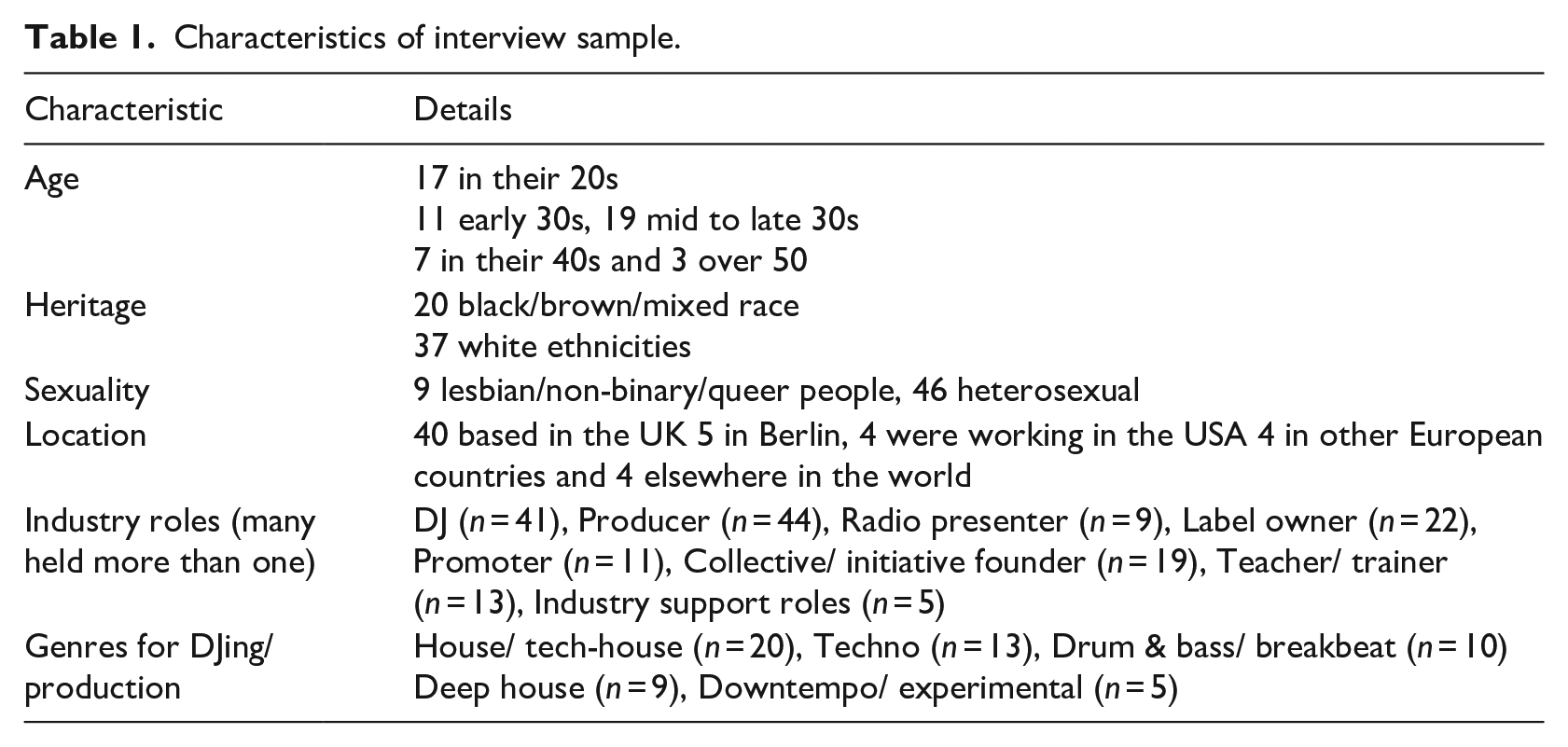
Participants were recruited purposively from Author A’s personal and professional contacts in the music industry, with additional snowball sampling as commonly used to access specific groups through existing networks, especially when those groups are hidden (Browne, 2005), and as used in other studies of creative workers (Alacovska et al., 2021; Hoedemaekers, 2018). The music industry experience of the participants varied by duration of career and role in the industry. Most DJed and produced music, but some also ran record labels, music tech companies and collectives aimed at platforming women in electronic music. There were 18 women of colour, and participants’ ages ranged from early 20s to late 60s, with the majority being late 20s to late 30s. Participants were either based in the UK, or undertook a considerable amount of their work there (see Table 1).
Characteristics of interview sample.
The purpose of the interviews was linked to our broader aim to make gender inequalities ‘visible and actionable’ (Eikhof et al., 2019: 841), and discussion was conducted in a conversational style in line with Brinkmann and Kvale’s (2014) idea of ‘InterViews’ – a co-creation of data that resists the tendency to see research participants as subjects to extract data from. Furthermore, the interviews were ‘com-passionate’ (Parsley, 2022) in the sense that Author A and the research participants were coming together to discuss something that they were both excited about: electronic music, DJing and music production. The emotional contagion of this process led to heightened rapport – something that was important since almost all the interviews were carried out via video calls. This was partly due to time constraints of busy freelance music artists, and partly due to the constraints of the Covid-19 pandemic. The increased use of video communication for research purposes during the pandemic has established video interviewing as no longer being seen as the ‘poor relation’ to face to face encounters (de Villiers et al., 2022).
The starting point of the interviews was open; Author A did not assume that the participants felt discriminated against or viewed the industry in gendered terms. The interviews were broadly biographical, covering childhood and career histories with music, before discussing creative processes, career strategies and occupational issues such as getting booked for DJ gigs, or signing music to record labels. They ranged from 40 to 120 minutes, with an average length of 90 minutes. We use pseudonyms for all participants, taking care not to reveal their identity, not least because the sensitive nature of some of the stories might have reputational repercussions for an artist’s career.
Data analysis
Author A’s closeness to the data and her shared knowledge with the participants was complemented by Author B’s lack of prior knowledge of the industry and not being involved in conducting the interviews. Author B was therefore well placed to question aspects of the data that Author A may have taken for granted, or placed too much emphasis on. Through this reflexive interrogation between us (see Gilmore and Kenny, 2015), we mitigated the potential impact of interviewer bias as we jointly analysed the data.
The interviews were recorded and transcribed verbatim and analysis followed an abductive approach; ‘alternat[ing] between (previous) theory and empirical facts (or clues) whereby both are successively reinterpreted in the light of each other’ (Alvesson and Sköldberg, 2018: 5). In practice, this meant organising data using NVivo where the first-stage coding consisted of creating broad, generic categories to reflect ‘preliminary ideas or concepts’ (Coffey and Atkinson, 1996: 35). This initial, ‘open’ phase resulted in 11 codes, generated in response to our curiosity around how gender became salient to participants. Analysis of these data highlighted that it was generally through challenges, adversity, and others’ treatment that gender became salient to the participants.
This prompted us to consult gender-focused literature on the creative industries, where little has been written about women’s responses to gender-based challenges. Thus, we returned to our interview data again to identify (a) specific gender-based incidents reported by the participants (e.g. discrimination, micro-aggression, harassment) and (b) what the participants felt or did in response to the incident. We noted the underlying character of these responses as being effortful and requiring a range of resources. This, in turn, led to our proposition that the responses constituted a form of work, undertaken through internal deliberation or external individual or collective action. To substantiate this, we constructed themes that captured patterns of shared meaning related to gender-based incidents of discrimination and exclusion, which are the headings under which we present our findings (see also Table 2). In working with the data in this way, it became apparent that what drove the responses of the women was a desire to make working life better, or at least more bearable, which led us to our concept of ameliorative work.
Analytical process: from initial coding to final reading.
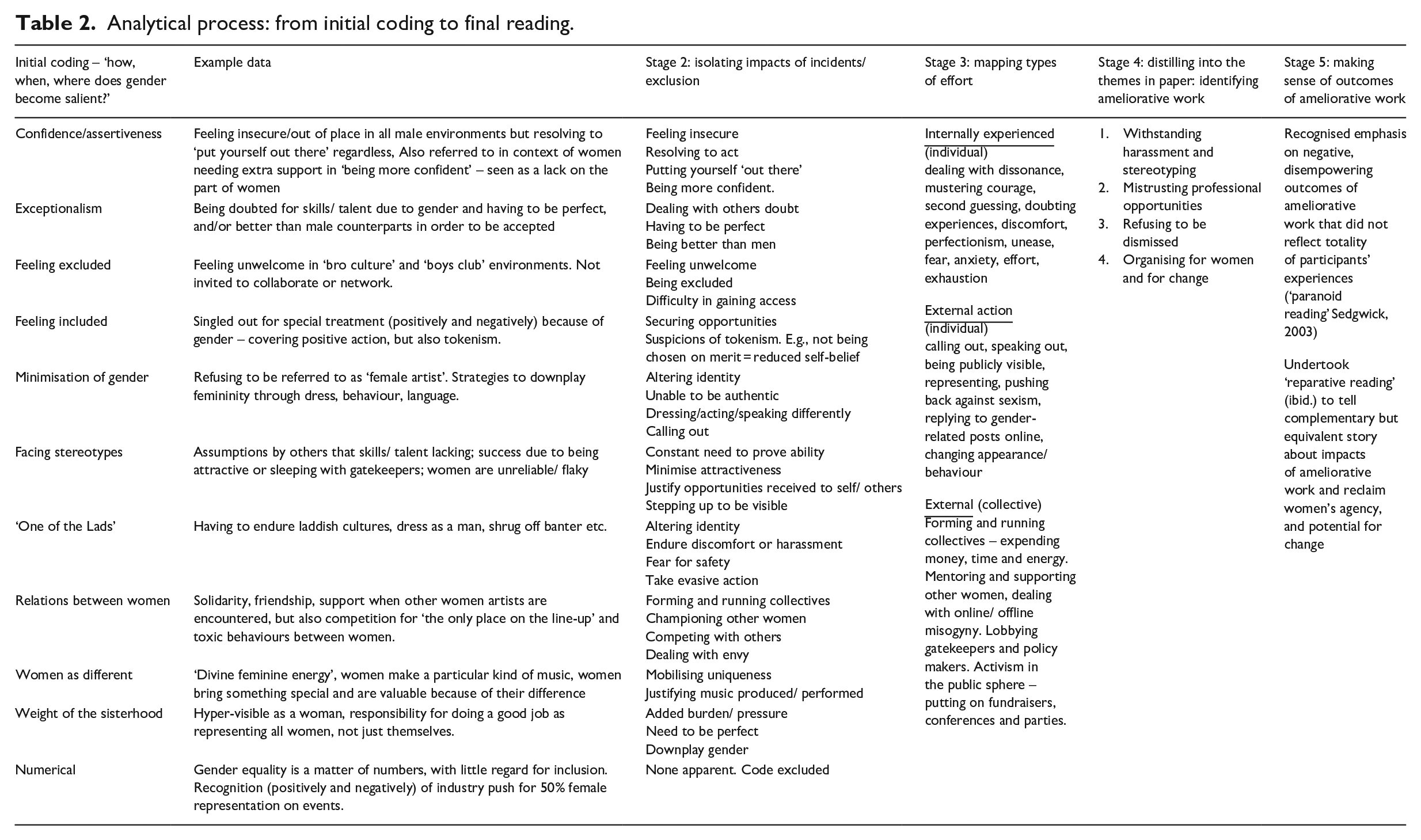
In doing this, we uncovered an immanent tension between the significant personal and professional burden and/or cost of responding to gender-based discrimination and exclusion, and a more hope-laden potential for emancipation also present in the themes. To make sense of this tension we continued our analysis by adopting Sedgwick’s (2003) paranoid and reparative reading strategies (see Table 2). First, a paranoid reading may reveal ‘structural explanations for oppression, subjugation and dominance’ (Christensen, 2021: 157), and is always striving to see behind the veil of ‘mere presentation’. It chimes with critical analyses of work and organisation, and it certainly has much to offer in analysing inequalities and issues of power. However, paranoid reading recognises only ‘all the bad things that have happened in order to be ready for all the bad things that are still to come’ (Love, 2010: 237), which too often excludes alternative forms of meaning and knowledge that may also – and at the same time – be true.
Second, a reparative reading enables giving weight to ‘the many ways selves and communities succeed in extracting sustenance from the objects of a culture . . . whose avowed desire has often been not to sustain them’ (Sedgwick, 2003: 150–151). This is, we argue, inspiring and gives hope for the future. In concert with a paranoid reading, a reparative reading offers possibilities for change, allowing us as researchers to ‘be truthful to a participant’s idiosyncratic accounts whilst also acknowledging the structural conditions and effects that go beyond them’ (Moreno-Gabriel and Johnson, 2020: 110). Wiegman (2014: 11) describes reparation as a way of ‘learning how to build small worlds of sustenance that cultivate a different present and future for the losses one has suffered’ and suggests that it can be done through ‘compassionate redescription’ (Wiegman, 2014: 7).
Through subjecting our findings to the two reading strategies we sought to capture the tensions and complexities of the participants’ narratives, as we show in the next section. It enabled us to both capture grimness and to appreciate sustenance and drive, and to discover how different factors coalesce into ongoing effort, in other words, into work. As we present our participants’ responses to gender-based discrimination and exclusion in the next section, we show that while there are damaging and negative impacts, those experiences do not have to lead only to resignation but may also produce paths forward.
Responses to gender-based discrimination and exclusion
In the sections that follow we show the various ways in which the participants responded to gender-based discrimination, stereotyping and exclusion. As previously mentioned, we include internal deliberations and emotions as well as behaviour to show the range of responses reflected in the data. In many cases incidents were of an ‘everyday sexism’ type, although there were also examples of explicit harassment. The ‘everydayness’ of sexism does not mean that it has little effect; on the contrary, these types of experiences have been shown to have significant effects on for example self-esteem and the ability to trust others (Berg, 2006), which indicates that there might be an emotional toll even though there might be no outwardly sign of responsive behaviour. It is therefore important to be attentive to such seemingly mundane incidents.
Withstanding harassment and stereotyping
A central part of DJ work is being on display as an entertainer, which means potentially being the target of harassment. There were examples of this in the data, including the following: My hands are on [the] decks, my ears are covered, and my vision is on the decks. . . I’m focused, I’m working, [and] guys have come and grabbed me, and then I’m like [thinking] fuck off, I am trying to work. . . [But] I just smile and be like [makes a dismissive face] and they go off, cos I don’t want to be “Oh, fuck off!” because that will just create a situation that was not needed, they are just drunk and it’s not [always] that offensive. (Alice)
Alice’s conciliatory response aims to defuse the situation and she rationalises the incident as ‘they are just drunk’ and not intending to be offencive. As alcohol and drugs are common features of the workplaces of DJs, this type of behaviour is seen as par for the course. In another example, Naomi told of being stopped by a doorman at a club where she was hired to play because he did not believe she was the DJ. She said of the incident that ‘I try and just let it go past and not let it get to me’. These responses normalise harassment and stereotyping, in order to not ‘create a situation that [is] not needed’ as Alice explained. Letting the incident pass is easier and safer than addressing it and risking being seen as troublesome.
The sense that incidents of this kind are common occurrences, including those not involving physical harassment, is reflected in how participants indicate a continuous process of managing them, indicated by the underlined passages in the following quotes: [In my press shots] my male teacher said that I looked like a little girl running down the stairs on Christmas Eve to play on my dad’s new mixing deck, and I stood there and I was like “What did you say?” . . . I’m [DJing] there on a stage, a festival, it’s taken by a professional photographer . . . and he’s just like “You look like a little girl” . . . Maybe if I’m going to ‘provoke’ then [As a producer] you’re just not taken seriously, you’re just not taken seriously at all. . . I feel like
Being dismissively referred to as ‘a little girl’ and not being taken seriously are common ways of undermining the professional contributions of women. Both Emily and Loretta view incidents like these as recurring and say that they must push on, indicating continuous effort. Loretta’s quote also points to how women are ‘seen’ as women, and therefore visibly out of place, yet not taken seriously, and therefore not ‘seen’ as professionals: ‘I have to get them to see me’.
Read through a paranoid lens, these are telling examples of being visible as women but invisible as creatives (Gill, 2002), and of the participants normalising uncomfortable and/or unwanted situations. A paranoid reading concludes that this does little to challenge the status quo, and it positions women as complicit in reproducing gender inequalities. However, the taken-for-grantedness of these experiences and the fact that they are seen as part and parcel of being a woman in this sector also opens the door for reparative reading. It is an example of social navigation where ‘agents act in difficult situations, [and] move under the influence of multiple forces’ (Vigh, 2009: 420). The examples show astute reflexive awareness of the potential consequences of acting in a particular manner (‘creating a situation i.e. not needed’) and of the gendered social forces that demand continuous effort from the women (‘having to learn to deal with it’ and ‘it is not going to stop’). While the incidents are indicative of gender-based harassment, stereotyping and discrimination they also show that the participants are not naïve victims.
Mistrusting professional opportunities
Another important part of working as a DJ is finding opportunities for expanding one’s network and establishing collaborative relationships. In several cases, however, decisions about taking up offers were accompanied by an underlying current of discomfort: My first thought is “Do you want to sleep with me?”, not because I feel highly about myself but . . . just because why would you reach out to me? Is it because you want a female touch on your track or . . . is it maybe cos you want a female touch? But [on the] other hand it’s really a shame cos I bet most of them probably just thought it was interesting, “Oh, a girl, finally!”, and then reach[ed] out, but because I had a bad experience I’m like hiding [from them]. (Emily) You might be called into a session at a really weird time of night, which doesn’t make me feel comfortable . . . and [I think] “If I was a guy, would you do the same?” I hate that second guessing of what’s [their] motivation. (Olga)
Even if there are no indications of male collaborators having any other than professional motives, it is clear in the data that suspicions of sexual motives often arise, and shape decisions on what projects to engage in. The constant vigilance is taxing, and, as Emily’s quote indicates, can extend into second guessing the validity of one’s own suspicions. These internal deliberations form an integral part of making decisions about work opportunities. They are important to acknowledge even though these examples do not include outwardly action, as they are still time and energy-consuming, and form an integral part of the participants’ professional life.
Examples of this kind readily lend themselves to a paranoid interpretation in the context of an industry which routinely sexualises and tokenises women who are ‘on display’ in a double sense: as women in a male-dominated industry, and as crowd entertainers. As reputation is crucial, rejecting job offers hampers the building of all-important economic and social capital. Their decisions may be couched in the language of choice – as is often the case when women’s careers are discussed (Simpson et al., 2010) – but it is a ‘choice’ forced by industry-specific gendered characteristics.
However, a reparative reading repositions these women as having agency to manage their careers (Bennett and Hennekam, 2018). We do not propose ignoring the realities and effects of structural inequalities in favour of uncritically celebrating women’s resilience and ‘heroism’ (Adamson and Kelan, 2019), but rather than positioning them as passive victims of the threat of male power, re-reading the findings reparatively affords these women agentic subject positions. In some cases there were explicit expressions of resistance, as the next section shows.
Refusing to be dismissed
Instances of speaking up were often fuelled by feelings of anger or a strong sense of injustice. Nelly experienced a microaggression at a festival where she was playing: I was in [the artist shuttle] and then there was two other DJs, and this one [DJ] guy sitting next to me asked the [other DJ] guy in front of him “So where are you from, what’s your DJ name?”, and then he turns and looks at me and is like “So, you work here?” He just assumed . . . but I’m like playing here, I’m in the artist shuttle! He just looked at me because I’m a brown woman [and] assumed I worked there, it was absurd! After that, I was so pissed off, I told everybody.
Being a woman of colour means that Nelly is out of place in terms of both gender and race, searingly illustrated by the assumption made by a male, white peer that she is not a DJ. Meanwhile, Lia recounted an incident where she rightly demanded what she was owed after she was told she would not be paid for a gig: [I said] “Listen, you owe me money!” I’ve come to play, your club was empty, [but I] want my money. . .. And they just were horrible and they said. . . I was a diva. . .they called me a diva because I was just asking for money that I was owed.
In these instances Nelly and Lia spoke up against the experienced mistreatments, refusing to ‘let them pass’. In the case of Nelly her professional status is disregarded and as such can be seen as yet another instance of negating the accomplishments of minorities. Lia meanwhile is placed in a situation where she might not receive financial compensation, which would lead to loss of income in a precarious sector which is rife with exploitative practices. A paranoid reading posits that, first, women inevitably face sexist and racist stereotypes in this line of work and in society, and that, second, they are punished for speaking up. Lia is being labelled a diva, an epithet often attributed to women who are seen to be unreasonable and self-important. Openly challenging a situation in this way is punished by denigrating or dismissing feelings and reactions, so-called gaslighting, which is why, as we saw in previous examples, women may choose to withdraw or smooth over the situation, knowing that ‘unacceptable’ behaviour may harm future work opportunities. Taking a reparative stance, however, means that voicing experiences of dismissal is an instance of speaking the unspeakable (Gill, 2014); of refusing to stay silent to instead call out discrimination and exploitation, and defend one’s personal and professional integrity even though it may provoke derision. In addition to the individual examples seen above, there were also examples of organised, collective responses.
Organising for women and for change
So far we have seen examples of the participants’ individual responses to instances of harassment, stereotyping and dismissal. Individual experiences are however indicative of structural patterns, which was acknowledged by the participants as some of them led or participated in collective initiatives aimed at making all women artists’ working lives better.
Liz, who organises courses and mentoring for young women learning to DJ, explained the approach she takes: I [have] realised that what’s lacking for women to learn tech is not the information but like the learning environment is not designed for women to feel comfortable learning. So if I can just make their first experience of learning tech a very comfortable and confident one then they can go into whatever environment after this. . . Which is why this tech training programme I kept it all female and with all female mentors.
The participants were well aware of stereotypes regarding women’s lack of technological nous. Liz thus makes it clear that it is the masculine environment rather than an innate lack that makes it challenging for women to feel comfortable with technology, and her aim is to enable them to thrive in any environment by first developing their skills in a women-only space.
When Kat was asked why she founded an initiative for Black women music producers despite the potential detriment to the time she could devote to making music, she replied: Yeah, it’s like a full-time job sometimes! It’s a labour of love, it’s so so needed but no-one’s going to do this stuff if it’s not us.
Kat recognises the workload that running an initiative brings with it as she compares it to a full-time job, but it was clear from her interview that it was work she was compelled to do. She raises the point that those who are on the receiving end of discrimination and exclusion must take action to redress those conditions. This however places an extra burden on those who occupy a marginalised position, adding to the ‘hard work’ needed to manage their gendered occupational identities.
While initiatives of the type exemplified by Liz and Kat are targeted at women in order to support their careers, the data also included examples of collective action aimed at reshaping the whole industry, with a mission to bring about change. Abi, the founder of a collective for women DJs, said: The overall mission and aim [of the collective] is to diversify the music industry, as broad and as wide as that is. If we can even slightly contribute to getting more girls on the line-up, or getting out there and in the industry [. . .] that’s the overall aim, and we do that through everything we do.
Initiatives like these are still aimed at improving women’s professional opportunities, but they acknowledge that industry-wide support, including the support of men, is needed to achieve change. The initiatives demand a large amount of work and dedication, with sometimes disappointing results. Kerri and Freya explained how difficult it was to secure sponsorship for their gender equality initiatives. Both struggled to generate crowd-funding despite widespread publicity, and both suggested, independently of one another, that mainstream industry players were not interested in publicly committing to gender diversity because, Kerri said: [They’re] too afraid of the ‘the backlash’, or cancel culture. Why? Because they’re shit scared, or they’ve got skeletons in their closets. When I was doing [name of project] and it was about men, [donors and sponsors] were queueing up. I couldn’t take their money fast enough. But when it’s about helping women? [mimes silence]
Backlash was a term used to articulate the outrage voiced particularly by white male artists and fans, and some women, against positive action. The risk of a backlash was often cited as a reason to avoid any kind of public commitment to supporting diversity. While these responses add to feelings of making a difference and working towards occupational justice for those involved, taking action requires effort, time and material resources over and above doing creative work. As Tess put it, when talking about responding to sexist comments online, and echoing Loretta’s sentiment about it being a slog: ‘Oh god, it’s all just so exhausting’.
A paranoid reading would conclude that these collective responses aimed at redressing gender inequalities either have little chance of bringing about change in light of the resistance they face, or that they ultimately focus on adapting women’s behaviour to existing social structures that produce women as needing to learn to be more confident (Orgad and Gill, 2022), and being responsible for fighting their own marginalisation. Calling out the behaviour of individuals and organisations requires courage since they are making themselves hypervisible in an industry where they are already visible as women. While a paranoid reading surfaces the entrenched, systemic inequalities of the industry it paints a situation with little hope for change.
Read reparatively, however, these initiatives do hold potential for bringing about change because they draw attention to injustices by calling out inequality, being vocal about the difficulties women artists face, and working towards solutions. They refuse to accept the status quo and through their work for an alternative future they ‘challenge the invisibility of male privilege’ (Lewis and Simpson, 2010: 7). In this vein a reparative reading reassures that ‘the future may be different from the present . . . [and that] the past, in turn, could have happened differently from the way it actually did’ (Sedgwick, 2003: 146). As such, the initiatives work for change through remodelling the present for it to become a past that ‘happened differently’. While the findings show the deleterious effects of gendered in/visibility on the women’s careers and professional sense of self in their responses to discrimination and exclusion, our reparative re-reading opens up a broader register of possible outcomes in response to the dynamics of gendered in/visibility.
The findings show how the participants negotiate everyday incidents of gender-based discrimination and exclusion within a gendered in/visibility dynamic. What became clear to us in conducting the analysis was the extent to which the responses – whether emotional or behavioural – were continuous and exhausting, and performed in order to make these women’s professional lives bearable or better. We therefore conceptualise this as a form of work, which we name ameliorative work as we discuss more fully below.
Conceptualising responses to gender-based discrimination and exclusion in the creative industries as ameliorative work
The first research question we set out to examine in this paper was: How do women electronic music artists respond to gender-based discrimination and exclusion as experienced through everyday incidents? Our analysis shows an array of responses that answer this question – from individually managing the situation at hand to collectively organising for improvement and change. The gendered nature of the creative industries came through clearly in the data – the participants were aware of and/or had experience of stereotyping, harassment and exclusion, echoing existing research (Alacovska et al., 2021; Bennett, 2018; Brook and Webb, 2022; Cannizzo and Strong, 2020; Conor et al., 2015; Eikhof et al., 2019; Finkel et al., 2017). Our research extends this critical body of literature by showing and conceptually articulating the responses by women to gender-based discrimination and exclusion as ameliorative work, and by enriching knowledge about the situated dynamics of gendered in/visibility and its effects on women’s occupational experiences.
A distinction between the responses is that some were individual and private insofar as they were not discussed with others, while others were collective and vocal. Yet, the two are interlinked since responses that appear to be individual emotional reactions are informed by context-specific temporal and social dimensions. For example, the sexist character of the industry means that women learn to be wary of men’s motives, leading to for example turning down potentially lucrative opportunities. ‘Putting yourself out there’ to build social capital is vital for establishing networks and a professional reputation (Morris et al., 2024; Eikhof, 2017), yet it is not straightforward for women. If women do decide to take up opportunities, they run the risk of building a sexualised ‘reputation’. Using sex for career advancement is a well-established trope that negates women’s professional accomplishments. Women are subject to a disciplinary gaze (Lewis and Simpson, 2010: 2), which can be internalised. Decisions taken regarding professional opportunities are informed by previous knowledge and experiences of the industry. As such, both individual responses such as Emily’s decision to decline a job opportunity and Alice’s strategy of smiling to defuse harassment, and collective responses such as Liz’s initiative to provide women-only training are grounded in the gendered processes in their professional context. Hence, we found that responses are not simply piecemeal reactions to incidents as they happen, but that they are contextually informed, often proactive, strategies navigated with sharp awareness of the conditions of the sector, and the obstacles these women face (Gill, 2002; Rowlands and Handy, 2012).
Navigating gendered in/visibility in the creative industries
The theoretical construct of organisational in/visibility allows us to view responses to incidents as underpinned by a masculine norm and male-domination that arises in the context of precarious working conditions known to disadvantage women (Brook et al., 2020). Navigating the in/visibility dynamic typically entails adapting to the norm or doing the job ‘differently’ (Simpson et al., 2010). Adapting means approaching the norm so as to become ‘invisible’, while doing the job differently means emphasising that it can be done as the Other – in this case, repositioning the profession of being a DJ to include women. Public initiatives that challenge the male-domination of the sector are of the latter kind, with varying degrees of success, as our findings show. Women-only initiatives such as Liz’s recognise that ‘the environment’ is hostile to women and so the aim is to help women adapt through skills development. While the creative industries have been attributed with an egalitarian image, there is ample research to show that they are not (Anheier and Markovic, 2025; Eikhof, 2017). The gendered in/visibility dynamic at play is complex. Here we can return to the examples of the photos of Emily playing at a festival, and Nelly riding in the artist shuttle. On a surface level they have ‘made it’ – becoming artists in a famously male-dominated sector, and the merit-based argument can be made that they are proof that talented women will find opportunities. Yet despite evidencing this merit by having been hired to DJ, in everyday interactions professional recognition is not granted to them. The rhetoric of merit functions to conceal such gender disadvantage and is thus implied in the in/visibility dynamic (Lewis and Simpson, 2010).
Part of the ‘hard work’ women perform, therefore, is in navigating the gendered in/visibility dynamic through responding to gender-based discrimination and exclusion. Their responses are in part individual and internal, carried out to make their professional lives as liveable as possible. However, even in the face of detrimental working conditions there are also signs of affective attachment (Siciliano, 2016), expressed as a ‘labour of love’, which is felt as important and rewarding. This work is most clearly visible in collective action taken to make the industry more welcoming to women. Both types of hard work the women perform are responses to gender-based discrimination and exclusion within a context of gendered in/visibility. We conceptualise these responses as ameliorative work.
Introducing the concept of ameliorative work
Following our argument that women’s actions reflect an in/visibility dynamic shaped by context (Lewis and Simpson, 2010), we adhere to Rowlands and Handy’s (2012: 674) examination of the creative industries and resultant call for an ‘understanding [of] the adaptive meaning of actions people take within specific contexts’. Specifically regarding the creative sector, Bennett and Hennekam (2018: 11) found that women who encounter challenges find ways of exercising ‘increased agency and resilience’. This reflexive manoeuvring requires that we do not assume a de-facto defeatist attitude, which brings us to propose ameliorative work as a concept to encapsulate the range of responses and their effects as shown in our findings.
Amelioration denotes the intention to ‘improve, alleviate, or mitigate something’ (Oxford English Dictionary, n.d.). In psychology, amelioration is the intended aim of interventions designed to help individuals cope with stress, trauma and harassment (Kyle and Angelique, 2002; Nelson and Prilleltensky, 2010). Such interventions help with coping, but they do not aim to transform social structures. While we find the coping aspect partially appropriate for articulating some types of the responses to felt discriminatory behaviour, it does not span the full range we have seen. Therefore, we develop a broader understanding of amelioration as shaped by social relations, in this case taking place in the context of gender inequalities that characterise the creative sector and creative work.
Our proposed ameliorative work concept addresses the second research question that motivated this paper: How can we conceptualise women’s responses to gender-based discrimination and exclusion as a form of work? We do this by adopting an inclusive idea of work as not only constituting paid employment (Pettinger, 2019). With this in mind, what our analysis demonstrated were responses to gendered in/visibility that were effortful, ongoing, often cumulative, and required a range of resources leads us to view them as work. In particular, it is because of the in/visibility dynamics that this work is performed in the first place. The underlying premise of Lewis and Simpson’s (2010) ideas is that certain characteristics become salient, or recede on account of the fact individuals are in a minority, also suggested by Buchanan and Settles (2019) and it is this that we argue provokes incidents of discrimination and exclusion that necessitate work undertaken to ameliorate the women’s professional lives.
Part of this work, as we have shown, is of an individual character and expressed as internal deliberations, often with an emotional component (cf. Lewis and McBride, 2024). These include anger over sexual harassment, being prepared for the ‘slog’ of repeated stereotyping or exclusion, and spending time on second-guessing others’ motives and one’s own evaluations. While not always translated into immediate observable behaviours, these responses are nevertheless an exhausting part of the women’s professional conditions. Other individual responses are expressed as behaviours such as speaking up against stereotyping and mistreatment. All these responses carry a quality that may be described as ameliorative in that they are undertaken to improve, alleviate or mitigate circumstances, to enable the women to get on with their careers. Articulating ameliorative work is an important endeavour. Naming a collection of related experiences affords them discursive power (Branch and Rocchi, 2015). The concept of ameliorative work draws seemingly disparate activities together, shifts the phenomenon out of the shadows, with the potential to open up dialogue, and provides validation to the women whose occupational lives are characterised by these struggles. However, while the concept brings to light the extra burden on women as work, it is work they perform to make things better. The outcome of ameliorative work is not necessarily hopeless or deterministic because ameliorative work also harbours the potential for change, as our paranoid and reparative readings of the findings following Sedgwick (2003) show.
Paranoid and reparative reading: toil and the potential for change
A paranoid reading shows how the industry is stacked against women, and how navigating the in/visibility dynamics – manifested as responding to gender-based discrimination – is exhausting. When women’s behaviours contravene the norm in instances where they assert themselves and speak up individually or collectively, they risk punishment. It is also, at times, ameliorative to normalise discrimination and harassment, which in turn positions women complicit in upholding gender inequalities. In the case of collective endeavours, some tend to take a ‘fix the women’ approach (Orgad and Rosalind, 2022) where women are taught to adapt to the prevailing conditions, thereby reinforcing the status quo, rather than aiming to change them. A paranoid reading suggests that ultimately, ameliorative work will do little or nothing to shift entrenched, unequal occupational opportunities and distributions.
There is nothing inherently wrong with taking this paranoid stance. Indeed, great strides have been made in understanding oppression, marginalisation and structural domination as a result of such theorising and all of the above analyses of our findings are true. However, when paranoid reading comes to stand ‘as a mandatory injunction rather than a possibility among other possibilities’ (Sedgwick, 2003: 125), then we become closed to other, more compassionate forms of understanding that might reinvest the subject(s) of our research with agency, respect and empowerment (Frischherz, 2018). In other words, a singular focus on paranoid readings fails to ‘recognis[e] human invention and agency despite the disciplinary force of systems of power’ (ibid: 554, emphasis added).
As we have seen, there were also collective responses aimed at improving the circumstances for all women in the industry, and in some cases intentions to transform the industry itself. The initiatives emerge in response to the gendered in/visibility dynamic of the sector, and they take a longer-term perspective than primarily mitigating a distinct discriminatory incident, as was the case with individual responses. Collective initiatives are readily distinguishable as work due to their coordinated effort and use of material resources. Thinking reparatively, we can see how some of these forms of ameliorative work have the power to redress the in/visibility dynamic. The high-profile forms of ameliorative work, such as running collectives and activist organisations, draw attention to the in/visibility dynamic and its effects. Likewise, women who face disadvantage and difficulty yet show up anyway, improve representation, normalise women as competent professionals in the industry while being visible as women at the same time. While a reparative reading does not provide an immediate solution to, or the disappearance of, experienced injustices, we argue it is valuable for understanding marginalised populations in the workplace in ways that reclaim agency, and the potential for change (Christensen, 2021). In contrast, a reparative reading acknowledges the joy and passion that creative work engenders. Kat who spoke about a ‘labour of love’ exemplifies the affective pleasure of creative work, framed as having meaning beyond pecuniary compensation (Siciliano, 2016). Read reparatively, women navigating gendered in/visibility through ameliorative work do so in order to continue doing work they love and which they are attached to.
The contribution of ameliorative work to creative work and organisation studies
To demonstrate the contribution of the concept of ameliorative work to creative industries research and to management and organisation studies more broadly, we position it in relation to two other concepts which describe hidden and/or undervalued efforts in a work context: hope labour (Mackenzie and McKinlay, 2021) and emotional labour (e.g. Grandey et al., 2013; Hochschild, 1983).
First, we see parallels between hope labour (Mackenzie and McKinlay, 2021) and ameliorative work in relation to the exploitative conditions of the creative industries and prevalence of unpaid or underpaid work. As free or underpaid work is not accounted for, it is a hidden yet pervasive aspect of creative work that creative workers put up with it, at least to some extent, in the hope of future, better paid work. Ameliorative work is also carried out in the hope of a better future, or indeed a more comfortable present, but the reward here is a fundamental right to respect, safety and fair treatment. The hiddenness of hope labour stems from the fact that as it is unpaid it does not figure in official industry reports; meanwhile, the unrecognised and/or undervalued nature of ameliorative work has gendered roots. In other words, hope labour is grounded in exploitation, ameliorative work in discrimination. Conceptualising ameliorative work brings some hitherto neglected aspects of creative work out of the shadows, as we argue above. It contributes to critical research that reveals the gendered inequalities of the creative industries (Anheier and Markovic, 2025; Brook and Webb, 2022) by viewing them through an in/visibility dynamic, and it and adds explanatory power to phenomena such as more women ‘choosing’ to leave the industry compared to men (Brook et al., 2020).
Second, we consider the well-known concept of emotional labour which refers to employer-required emotion displays and regulation (Hochschild, 1983), predominantly in service work. As the findings show, some responses are laden with emotion, meaning some ameliorative work includes regulating emotions. Emotional labour undoubtedly has a gendered component in that women tend to dominate service work, and desirable emotion displays are of a feminine character such as pleasantness and cheerfulness (Hackman, 2024). However, emotional labour operates in the context of an employment relationship where it is required as part of the expectations of a contract. Ameliorative work, in contrast, is not required from a contractual relationship, and although it encompasses emotional displays similar to those of emotional labour at times, it is performed for different reasons. Further, ameliorative work extends beyond emotion to encompass a broader register of social conduct, as our findings show.
We thus view ameliorative work as a valuable complement to existing concepts which aim to articulate the hidden aspects of labour.
Conclusion
Through an empirical case study of 57 women electronic music artists’ responses to everyday incidents of gender-based discrimination and exclusion, we have shown how dynamics of gendered in/visibility are navigated in the creative industries. We enrich Lewis and Simpson’s (2010) discussion of gendered in/visibilities at work by showing how individuals respond to incidents that arise because of it within the unique constellation of characteristics that make up the creative industries. This responds to calls for greater attention to women’s lived experiences in this sector (Eikhof et al., 2019).
We introduce the concept of ameliorative work to denote the effortful, ongoing and resource-intensive work that is needed in order to navigate gendered in/visibility. The naming of it as ameliorative work is grounded in the notion that it is effort undertaken to better the experiences and conditions of women working in the creative sector, and that although often taxing, this work is not entirely without possibilities for change. Employing Sedgwick’s (2003) strategy of paranoid and reparative reading enables us to consider both its struggle and promise.
The crucial and valuable aspect of ameliorative work is that it shows how women creative electronic artists’ careers are not simply punctuated by discrete incidents of gender-based discrimination and exclusion, but that they are of a continued, persistent character. While responding to them is an ongoing form of work, it is nevertheless invisible and made hard to articulate because of the characteristics of the creative industries. By conceptualising the participants’ responses as ameliorative work we first of all bring to light the unacknowledged efforts of women creative workers, and second provide a starting point for instigating change. In particular we suggest that it is precisely the unrecognised and/or undervalued, taken-for-granted and everyday character of ameliorative work that makes it so powerful. We contend that ameliorative work might apply to any situation where minority individuals are subject to the in/visibility dynamics described in this paper, and as such the concept of ameliorative work has theoretical utility in a range of occupational settings where structural inequality persists on the grounds of differences such as race, sexuality, age and disability. We call for further research to examine the utility of the ameliorative work concept in other contexts.
Ameliorative work is a useful concept for researchers and practitioners alike for articulating the exhausting, often risky yet hope-filled and empowering work undertaken by minority individuals – rendering it visible as work. In turn, this establishes the possibility of recognising and compensating this work, and designing interventions to lessen its burden. It provides a language with which to highlight the myriad injustices, experiences, compensatory behaviours and effort that women and other minorities are required to expend to survive and thrive at work.
Footnotes
Funding
The author(s) disclosed receipt of the following financial support for the research, authorship, and/or publication of this article: This research was generously funded by a Research Fellowship for Samantha Parsley from The Leverhulme Trust under grant number: 2019-598-7.
