




Abstract
Using Acker’s concept of ‘inequality regimes’, this article examines the practices and processes of gender inequality in the Birmingham Jewellery Quarter, highlighting the complex and subtle nature of discrimination sometimes at play and the strategies used by those who progress within this context. The project involved in-depth interviews during which participants recounted their career stories. Our research study examines the ways in which men and women in the Birmingham Jewellery Quarter account for their careers in order to examine the underlying gender regimes that influence the everyday practices of workers in this context. Our findings suggest that contrary to contemporary images of the creative industries, jewellery making remains deeply traditional with structures and processes that both overtly and covertly disadvantage women workers. Empirically, this article enhances our understanding of the way that this creative cluster operates and examines how that disadvantages particular groups of workers. Theoretically, this article contributes to our knowledge of the use of the concept of gender regimes at a cluster level.
Introduction
This article examines the gendered nature of careers in the jewellery industry. Utilising the gender regime framework (Acker, 2006, 2009; Connell, 2006; Walby, 2004), this article investigates the ongoing creation of gender inequality in one major jewellery cluster (the Birmingham Jewellery Quarter (BJQ)) and its impact upon careers. Careers in creative industries are often considered an exemplar of current trends in career theory concerning portfolio and protean careers (Taylor, 2011). The assumption seems to be that individuals work as free spirits with the autonomy to follow their passion. However, recent research suggests that while this may be the case for a limited minority, the extent to which this applies across the creative sector is questionable (Currid-Halkett, 2015; Ekman, 2014; Gill and Pratt, 2008; Oakley, 2004). In response to calls for a more nuanced understanding of the creative industries and utilising in-depth studies of the different industries involved (Eikhof and Warhurst, 2013; Jones et al., 2015), this article focuses on the jewellery industry. Traditionally, jewellery was seen as a male-dominated sector (Economic Times, 2012) and one in which women are present mainly in ‘soft skill’ roles and significantly absent in senior management positions (Dunn, 2014). A hybrid industry featuring creative, manufacturing and retail work, women have only relatively recently entered the boardroom, and only in a few selective organisations (Bishop, 2013). With limited statistics available, industry reporting suggests women are mostly at the bottom of organisational hierarchies, and there are few women owners or directors. Although the number of women designers is increasing (Bishop, 2013), diamond cutting, gem trading and watchmaking remain particular male bastions (Griffiths, 2015).
The fact that women are disadvantaged in male-dominated industries has been well rehearsed. Many studies highlight how women workers are seen as less competent than their male counterparts and thus kept away from core knowledge clusters (Greed, 2000; Sang et al., 2014; Watts, 2010). In addition to direct work-related exclusion, studies also indicate that women in male-dominated occupations face barriers to social networks as a result of what Kanter calls ‘homo-social behaviour’ (Fisher and Kinsey, 2014; Gregory, 2009; Grugulis and Stoyanova, 2012; Kanter, 1977. Since the jewellery trade relies heavily on social networks, such exclusion suggests great disadvantage.
By examining the various experiences of employed and self-employed jewellery workers, we highlight the complex and subtle nature of discrimination sometimes at play and the strategies used by those who progress within this context. The project involved in-depth interviews with 26 participants working within the BJQ during which participants recounted their career stories. In the spirit of a discursive approach (see, for example, Alvesson and Karreman, 2000), we took our participants’ narratives as the point of departure for knowledge. While our participants freely talked about their experiences of work and their career in the jewellery profession, we specifically asked them about the requirements to enter and progress in their organisations, the opportunities and the constraints they encountered in developing their careers, home–work dynamics that they had to manage, what they did to achieve their career goals and their future career aspirations. Our findings suggest that contrary to contemporary images of the creative industries, jewellery making remains deeply traditional with structures and processes that both overtly and covertly disadvantage women workers. This article begins by giving some context to the industry, and in particular to the regional cluster of the BJQ where the interviews were undertaken. We then introduce the concept of gender regimes and explore how these can help to illuminate the processes that create inequality. Following a discussion of our methodology and findings, we discuss the key contributions of this study. The first is an empirical contribution in terms of enhancing understanding of the way that this creative cluster operates and an examination of how that disadvantages particular groups of workers. The second is more theoretical and relates to the development of Acker’s concept of gender regimes for use at a cluster level.
The context
Employment in the United Kingdom’s creative economy, which includes jewellery as a major employer, has been growing three times faster than the workforce as a whole (4.3%) (Bakhshi et al., 2015). While the value of the creative economy to the wider UK economy and workforce is recognised (Bakhshi et al., 2014; Chapain et al., 2010; Creative Skillset, 2015; Department for Culture, Media & Sport (DCMS), 2015), it is still difficult to gain an accurate picture of the employment patterns for some parts of this sector, jewellery being one example. The 2014 DCMS report into the creative sector highlighted the problem of gaining accurate data regarding the composition of the workforce in this area. While the Business Register and Employment Survey (BRES) 1 indicates the levels of employment in the jewellery industry, these data may not give a true reflection due to the broad industry categorisations used (i.e. clocks, jewellery) and because they do not capture some of the roles (e.g. management, or even designer-makers). More importantly, for this research, the proportion of employees by gender is unavailable. Despite these gaps, the available data indicate trends in employment in the jewellery sector. In 2013, approximately 47,000 people worked in the UK jewellery industry, a 5% decline since 2009 (Office for National Statistics (ONS), 2015). Birmingham ranks first in the United Kingdom for the number of people employed in the manufacture of jewellery-related articles and third in the manufacture of imitation jewellery. The BJQ and wider UK jewellery industry is geographically concentrated, dominated by small firms employing less than 10 people, characterised by local inter-firm networking and heavily reliant upon out-workers for specialist tasks (Blackswan, 2013; De Propris and Wei, 2007; Pollard, 2004). The BJQ is also the site of the Birmingham School of Jewellery, the largest in Europe and hosts the principal assay office in the United Kingdom. This is a tightly knit industry; individuals within it are well known to each other as family tradition, and physical proximity perpetuates close social networks (De Propris and Wei, 2007). However, the BJQ has also been criticised for its insularity, passivity and conservatism (Pollard, 2004).
Jewellers undertake cutting, polishing or setting gemstones, or making, repairing or selling jewellery. However, the jewellery industry in Birmingham developed in parallel to other engineering trades, applying its skills to other industrial production working with precious metals (Smith and Whiles, 1987). This boundary-spanning work led to certain demarcations within the trade – so silver platers might work for jewellery and other metal-based trades, while gold jewellery is made by specialists who do nothing else. Traditionally, designer craftsmen work alone, can be less well-connected within the industry and typically have higher qualifications, rather than, or in addition to industry training. Concentration of the trade in the BJQ is reinforced by the industry structure and the networks of relationships and links between the larger firms, skilled craft workers and small manufacturing designers.
Manufacturing jewellery can appear to be a trade with relatively low entry barriers. If an individual owns tools, little space is required and workshops with benches can be rented, albeit in often dilapidated premises (Blackswan, 2013). People can make and sell their own jewellery independently to bridge contract gaps with others, but there are (often expensive) material costs involved. Thus, there is a distinction between the out-worker and the true independent designer jewellery maker (Smith and Whiles, 1987); some will spend much of the working week in an employer’s premises, while still in reality being an independent out-worker. Individuals frequently move organisation within the BJQ, and part-time work is common, making it difficult to define the difference between employees and the self-employed. Working conditions for the self-employed jeweller can also mirror those found elsewhere in the creative industries, whereby benign notions of creative work are underpinned by sometimes precarious and exploitive work processes (Banks and Hesmondhalgh, 2009; Morgan et al., 2013; Shade and Jacobson, 2015). This context provides an original and fascinating backdrop to explore the impact of gender regimes on individuals’ working lives.
Careers and gender regimes in jewellery
The development of the creative industries in the United Kingdom has been proposed as a driver of economic growth, offering the possibility of higher levels of employment and regional regeneration (Florida, 2012, 2014; Ross, 2009). Within this discourse, creative industry labour is often presented as an essentially progressive form of work (Banks and Hesmondhalgh, 2009). Florida (2012), in particular, stresses the potential benefits to individuals as well as economies, arguing that these industries are meritocratic, offering new avenues for advancement dependent only upon creative talent with ‘full opportunity and unfettered social mobility for all’ (p. 321). Debates concerning advancement in the creative sector chime with contemporary career theorising on protean, boundaryless and portfolio careers (Arthur and Rousseau, 1996; Baruch and Vardi, 2016; Hall, 2004). These models suggest that individuals have become free agents with an enhanced responsibility for their own career development (Baruch, 2004, 2006; Dany, 2003). Although criticised for their under-socialised perspective (see, for example, Baruch and Vardi, 2016; Peel and Inkson, 2004; Pringle and Mallon, 2003), these models remain influential (for a discussion, see Tams and Arthur, 2010).
In contrast to much of the contemporary under-socialised career theorising, in this article, we argue that context matters. Welter (2011) argues that an understanding of human behaviour requires consideration of the context(s) that influence that behaviour, including business, social, spatial, institutional and societal contexts, in order to fully comprehend the constraints and enablers operating in particular situations. By examining individuals’ experiences in one creative cluster, we argue that it is possible to see patterns of inequality and consider the ways in which different organisations or industries structure opportunity in such a way as to (dis)advantage certain groups.
Although creativity is often assumed to be a feminine trait (Henry, 2009), gender inequality and disadvantage for women in the creative industries have been identified by a number of scholars (see, for example, Gill, 2002; Grugulis and Stoyanova, 2012; Hesmondhalgh, 2007; McRobbie, 1998; Morgan and Nelligan, 2015; Wreyford, 2013). Eikhof and Warhurst (2013) discussed how the underlying assumption of meritocracy in the creative industries is flawed, and that inequality is inevitable as a result of the precarious nature of the work, wage instability, low or unwaged entry level jobs, the reliance on social networks and working patterns. Jones and Pringle (2015) suggest that one of the most concerning aspects of this inequality is that it is ‘unspeakable’ (Gill, 2011) – that there is no discourse of inequality. Similarly, Wreyford (2015) uses Bourdieu’s notion of ‘symbolic violence’ to argue that discourses of meritocracy are so dominant in the creative industries that they are not questioned – even by those who suffer disadvantage as a result. In order to examine how gender inequality is produced and sustained in the jewellery industry, we utilise the concept of gender/inequality regimes.
A variety of writers discuss gender regimes, focussing on different disciplines (e.g. sociology, law, political science) and different societal levels (see, for example, Walby, 2004; Tomlinson, 2007). At the more micro-organisational or industry level, gender or inequality regimes provide ‘an analytic approach to understanding the ongoing creation of inequalities in work organizations, and can identify inequality-producing practices and their locations in particular organizing processes’ (Acker, 2009: 201). A gender regime involves all of the dimensions of gender relations. Here, inequality is defined as the systematic differences between individuals in terms of the following: their levels of power and control over goals, resources and outcomes; their involvement in decision-making; in the allocation of work and opportunities for promotion; in levels of employment security; in the distribution of pay and other monetary rewards; and finally in the levels of respect that they are afforded in worker relations (Acker, 2009). Authors utilising the gender regime framework recognise that organisations are bearers of gender (Acker, 1990) in that they ‘create and reproduce gender divisions of labour, cultural definitions of masculinity and femininity, and ways of articulating men’s and women’s interests’, (Connell, 2006: 838). Researchers argue that all organisations have inequality regimes that result in and maintain gender (and race, class and sexual orientation) inequalities (Acker, 2006, 2009; Connell, 1987), and importantly, that these gender arrangements are active and not passive (Connell, 2006). Thus, as women enter into masculine domains, complex adjustments are triggered in which symbolic gender dichotomy may be preserved while other changes are conceded (Gherardi and Poggio (2001) cited in Connell, 2006: 838).
There are a number of different frameworks for understanding gender or inequality regimes. Connell (2002), for example, highlights four dimensions of gender regimes: the gender division of labour, gender relations of power, emotion and human relations, and gender culture and symbolism. We will use the framework put forward by Joan Acker (2009) for considering inequality regimes. She also identifies four dimensions. The first two provide a picture or map of existing levels of inequality through a consideration of, first, the bases of inequality, and, second, the shape and degree of inequality which includes consideration of features such as the degree and pattern of segregation, the size of wage differences, and the extent of power differences. The third dimension concerns the organising processes that produce inequality such as job hierarchies, recruitment and promotion processes and wage setting and supervisory practices. Finally, the fourth dimension relates to impediments to change such as the invisibility of systematic inequalities and the perceived legitimacy of these inequalities (Acker, 2009: 204–210).
In this article, following on from the work of Jones and Pringle (2015), we extend Acker’s framework beyond the organisational level to examine the workings of a particular cluster within the jewellery industry, as we argue that there are a number of shared practices and processes across the industry in general and particularly across this cluster of jewellery designer/manufacturer/retailers, which means that gender disadvantage is institutionalised at that meso (local)-level. Our research study examines the ways in which men and women in the BJQ account for their careers in order to examine the underlying gender regimes that influence the everyday practices of workers in this context.
Methodology
The starting point of our research is that the organisational world is socially constructed, and that individuals are ‘knowledgeable agents’ in that they can ‘know what they are trying to do and can explain their thoughts, intentions and actions’ (Gioia et al., 2013: 17). The qualitative data were generated through in-depth individual interviews (Kvale, 1996; Rubin, 2011), with 26 individuals working within the jewellery industry, based in one UK jewellery cluster – BJQ – and are listed under pseudonyms in Table 1 below. The sample includes 12 women and 14 men. In all, 5 interviewees were individual designer-makers, 3 were involved in trade organisations or associations and the remaining 18 worked in primarily small or medium-sized organisations, 2 reflecting the business structure of the industry (Blackswan, 2013; Pollard, 2004). Their industry experience ranges from 5 years to almost 40 years.
Profile of participants.
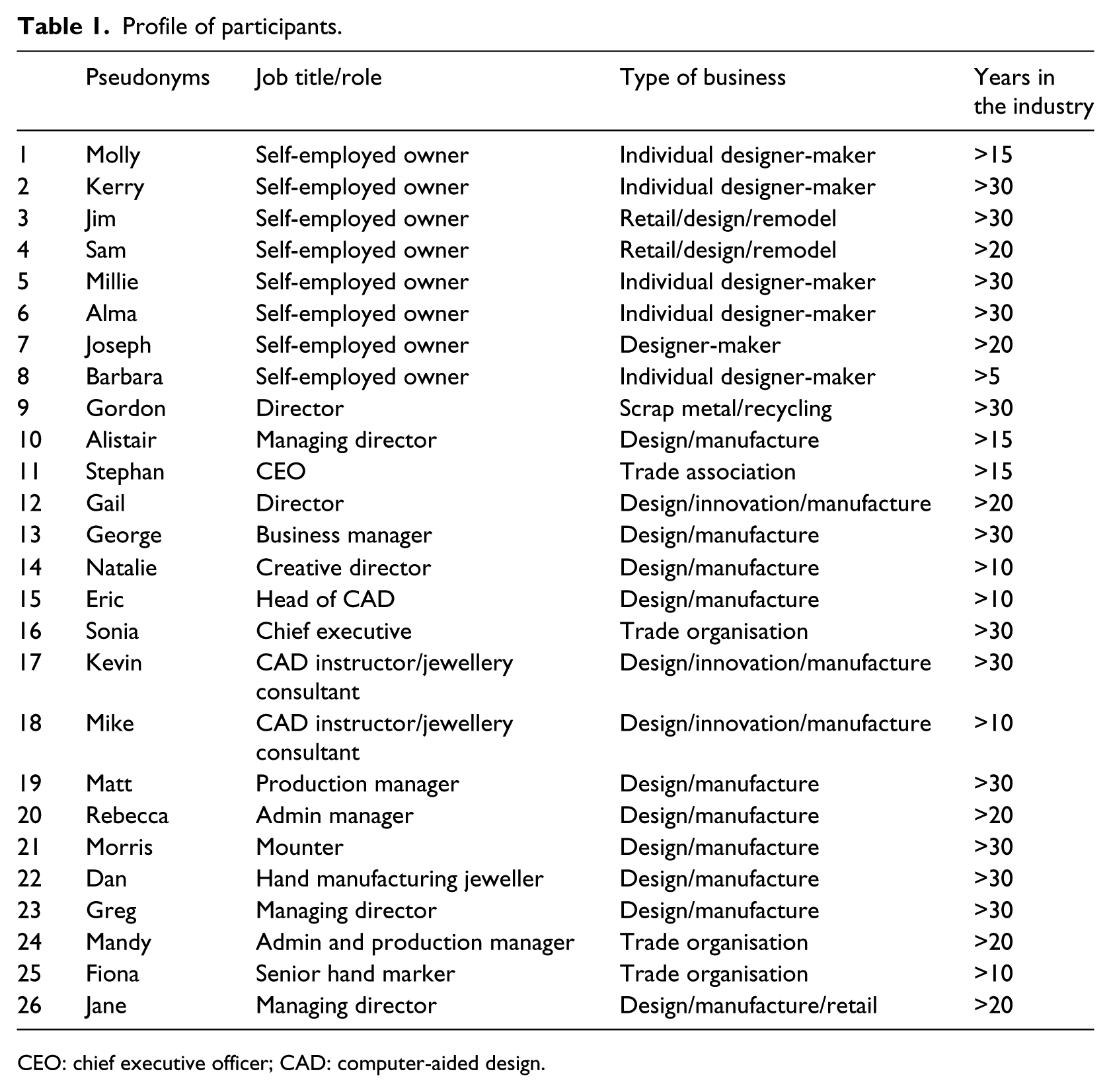
CEO: chief executive officer; CAD: computer-aided design.
The jewellery sector is both highly guarded and security conscious, and the topic is a sensitive one for informants to discuss because of the close interpersonal networks in the cluster and industry. For researchers, this presents significant access difficulties as unsolicited approaches are likely to be rejected. To overcome these difficulties, one of the authors gained familiarity with the operational aspects of the jewellery industry and identified key informants to act as advisors for the research. This included a series of private industry meetings and discussions, and attendance at global trade events between 2011 and 2014. We then drew on a range of contacts to secure access to the individuals who took part in our study, an approach that has proven successful in previous research of small businesses (Tsai et al., 2007; Woldesenbet et al., 2012). As a cluster, the BJQ is a contextual microcosm of the wider industry; therefore, our sample permits an informed snapshot of the trade.
Interviews with respondents typically lasted around an hour. Participants explored their reasons for embarking on careers in the jewellery industry and background experiences (including family, education and training) that led to those decisions, and how their careers had evolved over time. Discussion also focused on enabling factors and constraints in their own careers and more generally in the industry. These interviews formed biographical narrative accounts, seen as valuable sociological resources to uncover deeper forces and processes governing experiences (Morgan and Nelligan, 2015). They provide an opportunity to ‘problematize the common sense accounts and uncover the larger influences of social structure and culture that may not be superficially apparent’ (Morgan and Nelligan, 2015: 69).
Interviews were transcribed and initially analysed using an inductive grounded theory approach (Glaser, 2001), in which descriptive open-coding techniques were used to fully examine the data, and then moved on to axial coding to develop second-order themes reflecting issues arising from our analysis of the literature (Gioia et al., 2013; Silverman, 2000; Van Maanen, 1979). It was at this point that we identified the importance of the concept of gender regime and went back to the data to examine the extent to which this helped us to elucidate structures and processes of disadvantage. Thus, although we did not initially set out to test Acker’s concept of gender regime, it became evident during the analysis of our data and the development of conceptual codes shown in Table 2 below that our findings supported the framework she has provided.
Coding template and examples of participants’ quotes.
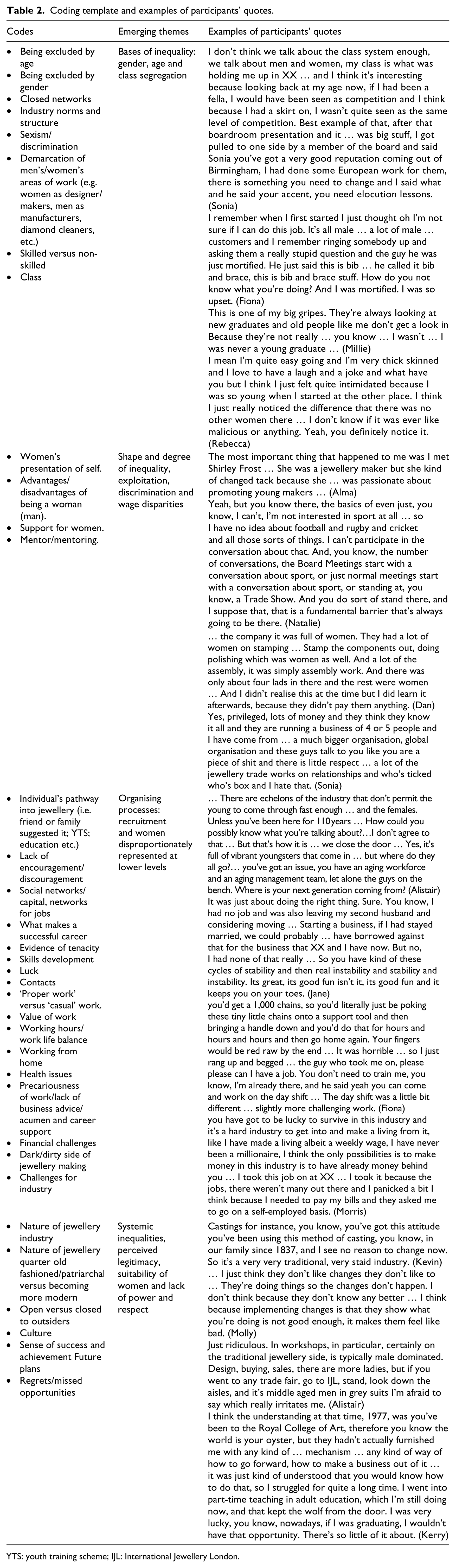
YTS: youth training scheme; IJL: International Jewellery London.
Findings
Table 2 provides an overview of our coding process complete with illustrative quotes. These findings are then discussed in more detail in the text that follows.
Gender segregation, wage and power differences
The first two aspects of Acker’s framework provide a picture of existing levels of inequality through a consideration of, first, the bases of inequality, and second, the shape and the degree of inequality which includes consideration of features, such as the degree and the pattern of segregation, the size of wage differences and the extent of power differences. There is very limited accurate data that fully encompass employment in the jewellery industry. However, it appears that the jewellery industry is a very conservative one where men still dominate (Foulkes, 2015). A designer-maker, trading for 30 years explained: The jewellery quarter is, I think, essentially a very conservative place. It’s a place that resists change really, it doesn’t like it, doesn’t want to start being all modern and … it’s quite insular … quite blinkered. (Kerry)
While industry commentators suggest that women have gained in power across the industry (e.g. the ‘Hot 100’ annual list of successful jewellers features 53 women and 49 men), our participants still believed (and the data suggest) that within BJQ, jewellery making remains a masculine industry where women are disproportionately represented at lower levels of organisational hierarchies or self-employed as designer manufacturers in micro-businesses (Hughes, 2012).
Research participants identified both vertical and horizontal segregation across the BJQ. With regard to horizontal segregation, areas such as watchmaking, casting and diamond polishing were particularly identified as male dominated. Various reasons were put forward for this. Matt, a very experienced production manager, for example, commented on the physically demanding nature of the work that led him to have ‘never thought about manually taking on a female mounter or setter’.
Others such as Gail commented on the ‘dirty’ nature of many jobs: ‘polishing tends to be men because it’s a filthy dirty job and nobody wants to do it’, implicitly suggesting that women would be reluctant to ‘do’ dirty work (Simpson et al., 2014), or expect only to engage with less arduous aspects of jewellery making: … if you are making jewellery, it’s dirty work you know it’s not all sitting there painting pretty pictures, you have got to get down to polishing and setting. (Mike)
Reflecting other studies (Henry, 2009; Hughes, 2012), participants agreed that women were more suited to the designer-maker role, suggesting that this was partially due to the fact they had more flair for design: There’s probably more female designer makers around than there are male designer makers, but I don’t think that’s particularly a sexist thing, it’s just that they are better designers and they come up with better designs. (George)
McRobbie (1998) proposes that contemporary creative work is attractive to women because they expect it to deliver a different or unconventional organisation of working, including greater workplace inclusivity. She argues that, in fact, women are more likely to be excluded by situations where informal employment dominates. Lazar (2006) proposes that women will be attracted to the creative industries more by the desire for self-aestheticisation, while Taylor (2014) suggests that creative work carries both associations. Women were indeed attracted to jewellery careers for their creativity; for example, Millie, a longstanding independent designer-maker, was clear on her identity ‘I see myself as an artist … making jewellery’. But the freedom of being self-employed was also vaunted as a means of achieving work–life balance by some designer-makers. Alma, another designer-maker, talked about how she had stopped working to have two children but continued to draw until she felt able to work from home and develop her business: Anyway, I started to make things in the bedroom … Because we had a lodger in the attic … I had a table … I had a blow lamp. I had … a vice … I carried on with the silver and I made lots and lots of earrings with beads and melting the silver and blobs and stuff … And I began to sell them to my friends.
However, the majority of designer-makers also needed other means of support – either from husbands/partners, parents or part-time jobs to support themselves. Below, Kerry (designer-maker) discusses a colleague who was trying to set up as a designer-maker in the quarter: She needed, as most designer makers have part-time jobs anyway, you know, they’re not solely dependent on their work … to make money … so they all have part-time jobs, and she was commuting for a while …
In addition, some designer-makers also recognised their lack of influence within the industry and the BJQ, as Gail with 20 years jewellery experience highlights below: So by choosing to keep the business small and if you like a home industry which is what some people would perceive it to be, you know, right or wrong, not saying either way, that they are not taken as seriously. (Gail)
Interestingly, designers working within the larger organisations also felt a lack of power and respect. For example, Natalie, the Creative Director of a company employing approximately 200 people, commented how her managing director considers design work to be ‘fluffy … you just draw pictures’. This disregard for the contribution of women can be further seen in discussions of wage levels where both men and women agreed that women tend to earn markedly less than their male counterparts, whatever their level within the firm.
On the factory floor, for example, Dan, a manual jewellery maker commented on the exploitative practices of one particular jewellery manufacturer: … It was absolutely disgusting. It’s low paid piece work … They didn’t pay us much but the women was even on less. Yes (we were getting paid more than the women), and at the time I thought that was wrong.
At more senior levels, women also commented on wage disparities, illustrated by Natalie’s account of wage discussions with her managing director: … he said, ‘why do you keep mentioning the fact that you’re a woman? You know, why, have you got an issue with that?’ And I said, ‘well, because I know that I’m the lowest paid Director and the only reason, because my role doesn’t dictate that I should get any lower paid than the rest of the people, so the only reason I can think of, if you’re judging it by skills it’s because I’m a female, so that’s my key issue really’. So it is a conversation I have repeatedly … and I do hand on heart believe that is purely down to me being a female, I don’t think it’s down to anything else.
Natalie was a highly qualified individual who had spent many years building a portfolio of formal and informal jewellery skills and experience that most people did not have. Thus, both employed and self-employed women tend to operate in the more precarious or less valued roles in the industry, and even those in senior positions will struggle for legitimacy. In the next section, we move on to discuss the organising practices that contribute to this situation.
Organising practices
Acker (2009) also points to a variety of organising processes that potentially create and sustain inequality within organisations, including how work is organised, recruitment, hiring and promotion practices, wage setting and supervisory practices and informal interactions while doing the work. We have already discussed how the work was organised, but a further important point is the extent of movement between firms and between employment and self-employment within BJQ. Social capital seems fundamentally important to this, and our male participants in particular tell stories of how they moved between employment contracts and self-employment as a result of industry changes and personal circumstances. Historically, the dynamism in the labour market has been helped by high levels of informality and trust within the industry, and the close-knit nature of clusters like the BJQ, as Jim, co-owner of a small jewellery design and manufacturing firm, comments: Obviously we’re a close knit community. You can’t help it because you’ve worked with people who then branch out and go and do their own thing and then literally everybody … not saying everybody knows everybody, but you could walk up the road, and get … it might take you an hour just to get there and back.
Similarly Barbara, a designer-maker, comments on the strong bonds of trust built up between suppliers: Yes, the jewellery quarter runs on trust … you’re taking away a diamond on approval, and just promising that I’m going to show my customer this, and then they don’t like it, I’ll bring it back, or I’ll pay for it, and it baffled me at first, that you would be given that kind of sum of money with a signature on a bit of paper when you could be anyone, so it really does run on kind of having your face known and, yes, on trust …
However, this trust has to be earned, and acts as a barrier to progress if you do not already have established relationships to draw upon; only through recommendation can you access credit accounts, further exacerbating the social and financial impediments to entering the sector.
This informality is evident in hiring processes, and most male participants talked about how they gained employment in BJQ through friends and family. This was common for entry to jewellery manufacturing experienced by Matt, now a production manager, and George a business manager, but informal networks were important for all levels and also worked for men on the design side such as Eric, a computer-aided design (CAD) designer: … through this lad Rob who was courting my sister – he knew that a company called Lefleuve were looking for a trainee diamond setter. So I got dragged down to them, said sit there and started learning how to set diamonds eventually in rings and that. (Matt) Then out of the blue I had an uncle who said we have a job at the factory that I work in the diamond cutting department. And I said I have no idea what that is … And so I just went for the interview, because it was something like twice the amount of money. (George) Basically a chap called Steve who I went to Uni with did my course he got a job here working for Drex as a CAD designer. (Eric)
Women were much less likely to mention these informal networks as entry routes. The majority of women, whether they were employed or self-employed, heavily relied on education or training courses to gain access into jewellery making (perhaps explaining the very high proportion of women students at the Birmingham Jewellery School). Some, like designer-makers Millie and Alma, went to night classes while being employed or looking after children at home and used this as a springboard into self-employment as a designer-maker. Others like Molly, a designer-maker, took up courses for full-time degree or post-graduate qualifications: I got into jewellery mainly really because I kind of followed the art route through school, did a foundation and then the kind of work I did there they kind of pointed me in that direction … And then I worked for a little bit for a manufacturer and then I came to Birmingham to do the MA course which is how I ended up staying here …
This was not necessarily an easy transition though. For example, Fiona, a hand marker, explained how business start-up costs meant that she couldn’t pursue jewellery making, even though she was a Jewellery School graduate and had buyers interested in her designs: When I first finished uni I was actually working here in the day and then I was sneaking back into the Jewellery School to make things to do shows … but in the end I just got myself into a bit of an absolutely knackered state … I was just working too much and then decided to just … knock making the jewellery on the head … that wasn’t paying my bills … Yeah. I’ve got quite a lot of equipment … but it’s just precious metals you’d have to buy as well …
Acker (2009) also points to the importance of supervisory practices as an element of the gender regime. Five of the women (Alma, Jane, Sonia, Rebecca and Mandy) highlighted the important role that informal mentors or sponsors had played in giving them confidence and pushing them forward in what was seen as a male-dominated environment, sometimes through practical skills training, or more informal support in terms of access to networks: … then Sonia came in and Sonia obviously saw something in me somewhere and decided that she would try and do some mentoring with me, which I can’t believe it, whoopee, it’s absolutely fantastic yes … (Mandy)
Mentors emerged as important figures, helping overcome some of the disadvantages and lack of informal networks that women face in the industry. Alma talked of the role her mentor played in helping her to turn her work into a profitable business by pricing realistically and suggesting ways to overcome her lack of connections within buying networks: She said, first of all she said, I think I want to show your work, but it’s totally under-priced … She said what I needed to do … to go along and do a bit on the stand and talk to customers. It was brilliant because I got some orders. It was very very daunting … But having done it, I felt you know … I felt yeah!! …I’d got orders … Yes, she was a mentor … and I wouldn’t have got anywhere without her.
These quotes highlight the ways in which women with influence can impact positively on others (Grosser, 2009). In the cases above, mentors supported the women to take risks and build their career capital. Older male mentors also took an interest in Mandy, Sonia and Rebecca, helping and developing their careers.
Turning to informal interactions at work, in many ways the culture in jewellery manufacture appeared to have more parallels with traditional engineering than with common perceptions of the creative industries. Perhaps this is unsurprising given the much higher proportion of manufacturing activity in jewellery than other creative industries (Chapain and Comunian, 2011). Several women talked about the sexist culture of jewellery. One extreme example came from Sonia, now a Chief Executive Officer, talking about her early days in charge of production at a relatively large jewellery manufacturer: So I had dead rats left on the stairs for me when I left the office … I walked round the factory floor one day and a bloke was standing starker’s to see what reaction he will get. He said I’m changing my overalls and I said put it away because it’s not doing you any favours and I just carried on …
Although less overt, discrimination was also noted by women in other areas. For example, Gail, a technical design director, gave the example below of how she and her colleagues combated stereotypes: I’ve used the disadvantages to my advantage. For example … we would go to technical trade fairs and all the blokes on the stands … they would talk straight to James and ignore me totally … they would say so James what do you think about this new laser might you be buying one and he said I don’t know I’ll have to ask the boss … and then he just turns to me and goes what do you think boss? That’s classic watching people’s reaction. They only have to do it once they won’t do it again … it’s very important how to manage that because you don’t want to upset anybody you just want to remind them gently that … you know there are other ways of thinking about things. (Gail)
While the designer-makers may not face such attitudes in their daily work, they did voice feelings of powerlessness and experiences of being excluded from important social and business networks which led them to set up their own network of women jewellers to promote and sell their work. This has occurred in other UK clusters – for example, the Manchester Jewellers Network is a collective of mainly women designer-makers.
Impediments to change
The final aspect of Acker’s (2009) framework concerns potential impediments to change, in particular, the invisibility or perceived legitimacy of existing structures and processes of disadvantage. A key challenge to change across the entire jewellery industry is the difficulty of gaining data to substantiate any claim for inequalities. The industry is notoriously secretive and there is very little information about the position of women. Indeed, the available information tends to favour celebratory stories. For example, the Hot 100 (Professional Jeweller, 2015) list of key players in the jewellery industry suggests that women are playing an equal role to men, particularly in the more innovative areas.
In our interviews, there was much discussion of the BJQ’s conservative and traditional nature. Although expressing frustration at the inequality that existed in the cluster, both men and women seemed to suggest that it was just ‘one of those things’ that had to be dealt with and preferred a more subtle approach to dealing with it rather than direct confrontation. Some women argued that they were using their disadvantage to their own advantage; for example, Fiona, below, argues that people expect her to fail and she can challenge their perceptions and similarly Gail, above, discussed how she challenged stereotypes: Yeah, and I think with older men I think it’s easier because they kind of take one look at me and think oh God what does she know and then they don’t expect a lot and then I do something quite good or listen to … them and we talk about something and so they’re kind of like ah alright then.
Wage differentials were discussed earlier and there was widespread recognition among participants that women earned a good deal less than men. Some expressed frustration but often felt powerless to do anything about this. Others, such as Rebecca, a manager for over 20 years in the same firm even suggested that this may be legitimate: And I see that some men do earn more than some women, but it doesn’t mean that they’re not worthy of it, they might have more experience, they might do more work, I don’t know … That’s not my decision.
It was suggested that part of the reason for women’s position in BJQ was an underlying assumption from employers that a woman’s income was a second income, as highlighted by Natalie: And they think well that’s okay she’s got a husband behind the scenes and it must be, you know, okay at home so why does she need the money for? Its fine its pocket money isn’t it?
Similarly, for some of the designer-makers, particularly those with children, there seemed to be an acceptance that their business was secondary to other responsibilities. For example, Millie outlines her situation at the early stages of her career before she achieved considerable success with her work: Well, my husband said … he didn’t mind me doing it as long as it didn’t cost him anything … Well he wasn’t terribly supportive time-wise, so I mean … I wouldn’t have thought of not having a meal on the table.
Workplace assumptions about women’s roles as partners and mothers thus conspire with home expectations of their roles, to further disadvantage women who already have to overcome the challenges of the financial costs and casual devaluing of jewellery making as a serious career (Hughes, 2012). While annoyed at how their roles were characterised by others, it was apparent that many women were resigned to these distorted categorisations of their value as workers. Yet, even working within these constraints, the women used ingenuity and creativity to progress their careers. Alma explained how she managed to manage to scrape together enough for her materials: … I never had enough money … I mean, obviously when you’ve got children, you clothe them and shoes were always wearing out … I made everything from scratch … cooked as cheaply as possible … There was a child allowance which was a God send if you wanted to buy a piece of lino, I mean, that’s an awful thing to say … Once … I kind of got a bit of money, then I could buy a bit more … It was very very small … I never borrowed anything … that was really my children’s money … But I always paid it back … and that’s the way I just crept forward, a little bit at a time, saving up.
Hence, it appears that a variety of strategies are being used by women in order to negotiate challenges and manage their careers, whether within organisations or as individual designer-makers. As we discuss below, however, many of these strategies are essentially conservative, a way of coping with the status quo, rather than necessarily challenging or disrupting existing ways of operating.
Figure 1 below summarises the findings and maps the gender regime of BJQ. It also outlines the strategies that women adopt to try to overcome the subtle (and not so subtle) forms of disadvantage created through that regime. This is discussed further and the implications considered in the following section.
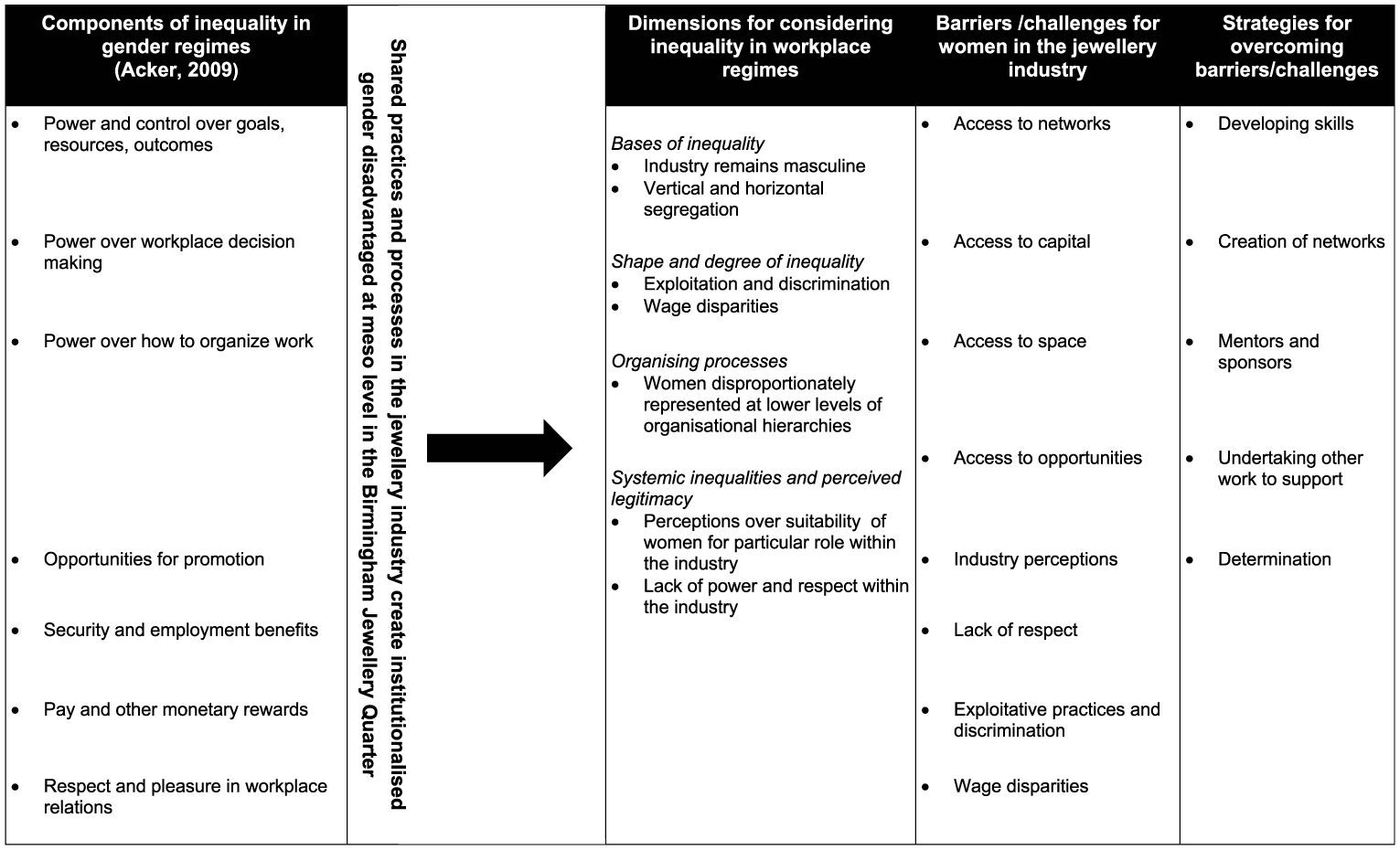
Mapping inequality in gender regimes: the case of Birmingham Jewellery Quarter (BJQ).
Discussion and conclusion
Using Acker’s (2009) concept of gender regimes, this article has examined the practices and processes of gender inequality in the BJQ. Our research offers two key contributions. The first is an empirical contribution in terms of enhancing understanding of the way that this creative cluster operates and an examination of how this disadvantages particular groups of workers. The second is more theoretical and relates to the use of the concept of gender regimes at a cluster level.
Our empirical contribution relates to the way in which gender regimes operate in the jewellery industry in general and in the BJQ in particular. The jewellery industry is complex and fragmented and made up of a range of separate, but interdependent organisations and businesses. Due to this multiplicity, it is to some extent different from other creative industries where there is more convergence around the design or creation of a particular product (Chapain and Comunian, 2011). This means that the issues experienced by the workforce in some cases exhibit the hybrid features of both manufacturing and design industries. The interviews revealed that the BJQ remains a predominantly masculine environment, not only in terms of the distribution of power and responsibility within organisations, but in wages, attitudes towards ways of working and perceived capabilities in the jewellery industry. There appears to be a clear segregation between those considered as artists and those considered as skilled craftspeople (Banks, 2010; Hughes, 2012). The latter is the domain of those who undertake work thought to be more technical, traditional, dirty and ‘hands on’, and therefore perceived by some as male work (Simpson et al., 2014). The former is linked to greater formal education, creativity and imagination, and primarily the domain of women (Henry, 2009). In reality, there is considerable interdependency across the roles, but the cluster norms that perpetuate these barriers create processes of disadvantage for women. Some participants were able to challenge these attitudes and reconfigure the landscape of career boundaries, but others have met resistance.
Thus, we can see a dual labour market with groups having completely different career paths, including different entry qualifications, career trajectories and rewards. For the men in our sample, careers within BJQ were fluid, dynamic and informal. Whereas for women, entry to the industry was generally more difficult. They appeared to lack access to the right networks and their social capital was low. They attempted to make up for this through the acquisition of cultural capital, thus explaining the very high proportion of women students at the Jewellery School. Once they graduated, many found that entry into the industry was hampered by a lack of economic and social capital. They developed micro-businesses within the BJQ, but due to power structures within the cluster, they lacked voice and influence. Self-employment is often presented from a ‘liberation perspective’ (Rehman and Frisby, 2000) as an ideal work option, offering levels of autonomy, freedom and control that have been largely unattainable in more traditional employment. This accords with much of the career literature on boundaryless and protean styles of working (Arthur and Rousseau, 1996; Hall, 2004; Inkson et al., 2012; Lee et al., 2014; Rodrigues and Guest, 2010). In contrast, however, the ‘marginalisation perspective’ portrays self-employment as an unstable, low paying form of work involving long hours and performed without the advantages of pensions, benefits or job security (Baruch and Vardi, 2016; Greenhalgh and Rosenblatt, 2010; Young and Richards, 1992). This chimes with more recent literature on precarious work in the creative industries (Gill and Pratt, 2008; Kalleberg, 2009) and the dangers of flexploitation (Morgan et al., 2013). From these interviews, it seems clear that women face both normative and structural constraints that curtail the options and rewards available to them in the labour market (Hughes, 2012; McRae, 2003).
As shown in Figure 1, the main barriers that were identified in BJQ were around industry perceptions of the role and competence levels of women and access to networks, capital, space and opportunity. It is clear, as the diagram shows that women proactively tried to manoeuvre around these constraints. Our data are replete with examples of women creatively adapting to situations, whether that meant using child allowance to fund the business, challenging stereotypes of managers and suppliers, developing networks of their own or mentoring others. One powerful example of women working together was in the development of a designer-maker network through their own freelance work, often advertised through a website, or through the creation of their own networks to establish links with other people in the industry, but also to collaborate on setting up exhibitions and retail spaces. Two examples include Centrepiece in Birmingham and the Manchester Jewellers network in Manchester, both of which are dominated by the activities of women jewellers.
These strategies effectively enabled (some) women to survive in the industry but participants also gave an overpowering sense that little had fundamentally changed in BJQ, with gender disparities prevailing. Stories were still told of how women were more suited to certain areas of business and power remains in the hands of men, suggesting that these micro-strategies are essentially conservative, preserving or working around the status quo, rather than fundamentally challenging it. It would seem that within this field (Bourdieu and Wacquant, 1992), the key source of capital for entry and progression is social and women’s lack of access to this fundamentally constrains them. While they are attempting to develop their own social capital through the development of networks and mobilising other forms of capital – for example symbolic capital – women remain at the margins. This relates to Bourdieu’s notion of doxa, the naturalisation of power relations such that they are beyond challenge (Fernando and Cohen, 2015), and highlights the fundamental difficulties of bringing about change.
Our second contribution relates to the use of Acker’s model of inequality regimes at the meso-level (cluster level), rather than at an organisational level. Although career theory has been critiqued for its undersocialisation and lack of concern with context, some scholars have challenged this (see, for example, Duberley et al., 2006; Gunz and Mayrhofer, 2011; Inkson et al., 2012; McMahon et al., 2014). Cohen and Duberley (2015) recently highlighted the importance of three interrelated aspects of context upon career making: context as ideology matters to issues of identity, affiliation, legitimacy. In other words, it influences what is seen as possible/impossible, legitimate/illegitimate, or desirable/undesirable, and is reflected in this study as people discussed the meaning and purpose of their working lives. Context as enduring structural features highlights the existing institutions and structures of opportunity which define and prescribe what is available, possible and impossible. Finally, proximal events provide unexpected challenges that impact upon both structures of opportunity and ideas about the meaning and purpose of work and identity.
We would argue that the BJQ provides an ideal level of analysis for examining the contextual embeddedness of gender regimes and showing how this impacts upon individuals. The nature of the BJQ, its historical development and the individual and organisational relationships embedded in this cluster provide a particular way of working that has a significant impact on how careers are enacted. While it would be possible to identify some of these processes at an organisational level, looking across the cluster highlights the interrelationships between business practices across various organisational forms and offers a more embedded view of enablement and constraint. The contextual impacts found in local clusters have already been recognised within the corporate social responsibility literature (Pedersen and Gwozdz, 2014; Spence, 2007) suggesting ‘large firm’ theory is potentially less transferable (Carrigan et al., 2011). Consequently, researchers must reflect on the distinctive aspects of a cluster perspective including approaches that reflect the empirical reality of the small business context. Gender regimes across the jewellery industry are cloaked by structures of secrecy and security. These become further concentrated within clusters such as the BJQ, intensified by local traditions, family and small business practices, social capital and networks of influence. Consequentially, processes of disadvantage are rendered intrinsic within cluster operational and cultural norms; thus, we suggest that an understanding of gender regimes requires a multilevel analysis involving micro-, meso- and macro-levels. Finally, while our focus in this article has been upon gender, we suggest that future research should examine inequality regimes more generally. This would fit Acker’s (2009) later work where she extended her framework to consider ethnicity and class as well as gender. It would also enable an intersectional approach which recognises the simultaneous and dynamic interactions between different axes of individual identity (Corlett and Mavin, 2014) and challenges the homogeneous representation of gender by considering how gender intersects with other social identities in women’s articulations of their experiences of work.
Footnotes
Funding
The author(s) disclosed receipt of the following financial support for the research, authorship, and/or publication of this article: The authors would like to thank Coventry University for the Pump Prime Fund grant that supported this research.