




Abstract
This article scrutinizes the role of rhythms in perpetuating and transforming business as usual in the Anthropocene. The focus is on understanding how some rhythms become authoritative and repeat business as usual while others prompt radically different temporal imaginaries in and beyond organizations. Empirically, we examine how diverse organizational and natural rhythms come together in the context of the alpine winter tourism industry. By analyzing the constitution of rhythms in materialities, practices, and voices through multimodal vignettes, we trace the development of dominant rhythms with eurhythmic harmony and arrhythmic disturbance emerging as key configurations. This study contributes to a temporal understanding of how business remains locked in its repetition, pointing to eurhythmia as a chronopathic organizational experience when crises in the Anthropocene demand immediate action. Further, we highlight the potential of understanding arrhythmia as an invitation to transform business-as-usual by attuning to neglected, more-than-human temporalities. Overall, this paper draws attention to the power of rhythms in shaping predominant yet unseen configurations of authority in organizational temporality in the Anthropocene.
Introduction
“The central quest then becomes to explore the present and find traces and places where it reveals more than its own repetition.” (Berg Johansen and De Cock, 2018: 189)
Referring to the new age of the Anthropocene, scholars emphasize the need to change organizations and business models to mitigate existing global inequality and geopolitical crises tied to human-made climate change, biodiversity loss, and ocean acidification, among others (De Cock et al., 2021; Ergene et al., 2018, 2021; Wright et al., 2018). The Anthropocene is a geological epoch defined by accelerated growth-oriented industrial rhythms where reckless use of resources has been detrimental to endeavors for progress. In this volatile era (Lederer and Kreuter, 2018; Wright et al., 2018), organizations and the planet face drastic rhythmic changes in weather patterns, heat waves, droughts, melting ice caps, and floods. In such critical times (Nyberg and De Cock, 2022), organizations are driven by an urgency to act and not to waste any more time to master the threat of a bleak future (Bensaude-Vincent, 2022; Gibson and Warren, 2020). To do so, however, organizations and organizational scholarship “need to imagine a future that goes beyond the comfortable assumptions of business as usual” (Wright and Nyberg, 2017: 1657)—yet we remain stuck in its repetition.
From a temporal perspective, business-as-usual rhythms perpetuate “the ecological crisis in the modern regime of temporality” (Bensaude-Vincent, 2022: 213) and repeat “histories of capital, patriarchy, racism or colonization” (Fagan, 2019: 59). To challenge and change the usual ways of doing business (Berg Johansen and De Cock, 2018), different temporal imaginaries (Roux-Rosier et al., 2018) that can function outside the endless perpetuation of scalable, uni-directional, and homogenous business-as-usual rhythms in the Anthropocene are needed (De Cock et al., 2021; Ergene et al., 2021; Plotnikof and Mumby, 2024). Organizational scholarship calls for theoretical and methodological approaches that account for such imaginaries, their materialities, practices, and voices, and their constitution through interaction, exchanges, and conflicts (Arruda Fontenelle, 2023; Bensaude-Vincent, 2022; Ergene et al., 2021; Fagan, 2019; Roux-Rosier et al., 2018). As the unseen rhythms wield their insidious power in and over organizations, this study attempts to identify how some rhythms become authoritative (Bourgoin et al., 2020; Kuhn, 2008; Vásquez et al., 2018) in temporal configurations to shed light on how “the constitutive powers of time constructs reproduce taken-for-granted assumptions” (Plotnikof and Mumby, 2024: 664) of business as usual and unfold how the emergence of radically different temporalities becomes possible.
This article combines critical research on organizational temporality (e.g. Plotnikof and Mumby, 2024) with rhythmanalytical approaches (Lefebvre, 2004; Nash, 2020; Rongna and Sun, 2022). We specifically focus on the performativity of rhythms as patterns of time in space constituted by an interplay of materialities, practices, and voices in and beyond organizations. Rhythms are a collective performance of elements in time and space (Lyon, 2018). They integrate space, time, and energy into a singular syntax, providing a framework for comprehending their “inescapable imbrication” (Oppermann et al., 2020: 276). When viewed as temporal categories or structures, rhythms are both experienced as preexisting and stable and performatively unfolding in organizational practices (Roux-Rosier et al., 2018). Rhythms are part of every organizational activity (Massey, 2019) and are constantly “enacted and reinterpreted in practice” (Wenzel et al., 2020: 1443), such as schedules, work routines, or regular business activities. Yet, rhythms expand far beyond the human realm and capitalistic modes of organizing. They ring through the cycles of natural recuperation and transformation in the Anthropocene (Oppermann et al., 2020; Roux-Rosier et al., 2018). The Anthropocene is characterized by drastic rhythmic changes in weather patterns, such as heat waves, droughts, and floods, in terms of their pace and amplitude. These large-scale rhythmic changes transcend organizational temporalities but are simultaneously fueled by their destructive influences of unbridled production and consumption (De Cock et al., 2021; Oppermann et al., 2020). The concept of rhythms provides a promising theoretical base for exploring the entanglements, tensions, and conflicts between business-as-usual temporality with ecological, glacial, and cyclical rhythms and their consequences for organizing in the Anthropocene (Wright et al., 2018).
Through ethnographic fieldwork, this study investigates how diverse organizational and natural rhythms come together in the context of the Alpine winter tourism industry. Following the concept of rhythmanalysis (Lefebvre, 2004; Nash, 2020), we delve into the intricate interplay of diverse and often discordant rhythms and their orchestration, which collectively shape and are shaped by organizational temporalities. The tourism industry provides a rich empirical setting for understanding the process of intertwined rhythms as different economic rhythms (such as seasonality, public holidays, work schedules, and industrial rhythms) and transformational shifts in natural rhythms (global warming and extreme weather events) shape and affect winter tourism organizations. Building on multimodal vignettes, we discuss (1) how rhythms are constituted in organizational practices, voices, and materiality, (2) their interplay in multiple eurhythmic or arrhythmic configurations, (3) the authority of some rhythms and their workings in the Anthropocene.
Theoretical background
Rhythms as temporal patterns of practices, materialities, and voices
Organizational and social life is determined by various rhythms: managerial rhythms, such as work schedules and the ups and downs of the financial market; social rhythms, like holidays or family schedules; bodily rhythms, such as sleep and hunger; or natural rhythms, like day and night, seasonality or weather phenomena. A rhythm “defines the order and tempo of practice” (Katila et al., 2020: 1311) through specific measures such as speed, frequency, and consistency (Lefebvre, 2004). As such, rhythms organize space and time through their different qualities. Some rhythms are steady and recurring and create stability; others are unstable and introduce more disruptive modes of ordering. Such rhythms may oscillate between acceleration and deceleration (Thorpe, 2015). In a dynamic flux of energy of physical spaces and movements, rhythms temporalize space and localize time, weaving the social fabric of the everyday (Cresswell, 2023; Lefebvre, 2004). While each rhythm is highly specific and situated in a particular space at a particular time (Lyon, 2018; Nash, 2020), their overarching characteristics can be categorized into two types: linear and cyclical rhythms (Lefebvre, 2004).
Linear rhythms unfold primarily in social and organizational realms. Examples of linear rhythms are deadlines and schedules (Katila et al., 2020; Mohammed, 2019) or the rhythms of the working day (Nash, 2020). More broadly, linear rhythms are linked to a “globally synced network of timekeeping” (Mohammed, 2019: 203) and are “imposed by technology, industry, and consumption” (Lyon, 2018: 25). In the Anthropocene, organizational temporality is primarily ordered by the linear rhythms of the movement of capital (Lefebvre, 2004), perpetuating a linear logic of production, progress, and accumulation (Beacham, 2018; Johnsen et al., 2019; Wozniak, 2017). Urgency, rapidity, and efficiency characterize much of the fast-paced tempo of high-performing organizations with often monotonous and repetitive work practices (Agar and Manolchev, 2020; Mazutis et al., 2021). Such practices reproduce linear rhythms of capitalism that run with the clock time (Jensen et al., 2022; Plotnikof and Mumby, 2024), ambitious over-work ethic (Blagoev and Schreyögg, 2019) and strategic visions unified in “industrialized labor that demand greater synchronization and established time as a ‘competitive advantage’” (van Tienoven, 2019: 978). Through this reciprocity, work practices and organizations muddle along the increasing pace of linear rhythms of capitalistic progress and exploitation (Beacham, 2018) while fueling the very same through hyper-efficient, fast-paced, unified work practices oriented toward unforgiving organizational clock-time (Mazutis et al., 2021).
In contrast to linear rhythms, cyclical rhythms relate to natural or cosmic activities (Lefebvre, 2004) such as the weather (Rantala et al., 2011), agricultural seasons (Beacham, 2018; Rongna and Sun, 2022), heat (Oppermann et al., 2020), or bodily rhythms such as sleep (Endrissat and Islam, 2022; Rantala and Valtonen, 2014), hunger or rest (Agar and Manolchev, 2020; Katila et al., 2020). Cyclical rhythms let us have a kairological experience of time characterized by non-accumulative and fluctuating attunements rather than a linear rhythm of progress with a defined start and end. Cyclical rhythms are open and dynamic reiterations and reincarnations rather than rigid, one-dimensional repetitions and successions (Wozniak, 2017). Although cyclical rhythms follow their own pace and are not tied to the clock time of modernity, they are nevertheless part of organizational life. For example, Davies and Riach (2019) describe how the work practices of biosecurity inspection in bee hives are linked to both linear rhythms (such as expected inspections per hour or inspection schedules) and the cyclical rhythms of the hive as in the “continual buzz and hum of bees” (Davies and Riach, 2019: 249). Although cyclical rhythms constitute daily organizational life, they are rarely given the same attention as linear, clock-time rhythms in management and organizational research. Rhythms have been “largely conceived through human thought and action, not as also made through matter and energy per se” (Oppermann et al., 2020: 276). Business leaders and organizational research often conceive the cyclical rhythms of nature as “a controllable entity that can only be managed according to a logic of the marketplace” (Kuhn and Deetz, 2008: 180). We point to the necessity of exploring the authority of cyclical rhythms and its dimension in organizing that go beyond the linear, speedy, capitalistic progress and unfold the cyclical rhythms such as climate and weather as “active” temporalities (Rantala et al., 2011; Roux-Rosier et al., 2018) for attuning to and performing different organizational realities in the Anthropocene.
To sum up this performative aspect of rhythms in musical terms, linear and cyclical rhythms can be described as the “song of time” in the Anthropocene, with their “instruments (materiality), trained playing techniques (body) and voices (discourse)” (Wenzel et al., 2020: 1450). We will now discuss how these materialities, bodily practices, and voices synchronize or go out of tune in the configurations of multiple rhythms.
Authority in polyrhythmic configurations: eurhythmic harmony and arrhythmic disturbance
Linear and cyclical rhythms overlap, interfere, or clash, and we only know how they matter “in relation to other rhythms” (Lefebvre, 2004: 10) in their configurations. Following Lefebvre’s (2004) terminology, Nash (2020: 307) differentiates polyrhythmic configurations into two types: “[E]urhythmia is where the rhythmic state is characterized by regular repetition, working together in harmony, [. . .] and arrhythmia is the state of disordered rhythms, characterized by anxiety and pathology.”
In eurhythmia, multiple rhythms synchronize in a particular place at a particular time to make organizational harmonies or realities. For this synchronization, one rhythm acts as a dominant “zeitgeber” (Geiger et al., 2021), and all other rhythms need to match this dominant rhythm to create harmony (Blagoev and Schreyögg, 2019). In neoliberal organizations and Western societies, these “zeitgebers” are the state’s and the capital’s linear rhythms (Lefebvre, 2004), which normalize and naturalize particular states of harmony into a synchronized state of eurhythmia. Failing to harmonize with such dominant linear rhythms then operates as “a threat to organizations’ survival” (Blagoev and Schreyögg, 2019: 1820). Eurhythmic states of harmony and synchronization simultaneously perform systems of power in perpetuating the order and tempo of their authoritative rhythms, such as capitalism, modernity, racism, and colonialization, while limiting other rhythms to sing their “songs of time” (Plotnikof and Mumby, 2024; Thorpe et al., 2023; Wenzel et al., 2020).
In arrhythmia, rhythms are “out of step” (Lyon, 2018: 25). Rhythms are mismatched and are at odds with each other. While Lefebvre (2004) defines arrhythmia as a pathological situation (see Lyon, 2018; Nash, 2020), arrhythmic disruption can potentially exceed this negative connotation. Thorpe’s (2015) work on the temporal and spatial leisure practices in the ruins of Christchurch (New Zealand) after the earthquake in 2011 discusses new kinds of arrhythmia and their potential for creating alternative temporalities and questioning previously dominant linear organizational rhythms. Agar and Manolchev (2020) show how migrant labor practices of slowing down and decoupling from speedy work practices of everyday capitalist eurhythmia create moments of rest and reflection for workers. Mohammed (2019: 209) illustrates the disruptive capacity of the “rhythm of waltz” that “crests in to replace the learned habit of dividing and commodifying time” and produces “something new” in a shopping center. As arrhythmia draws attention to previously unquestioned, dominant rhythms (Thorpe et al., 2023), they can now be more noticed, felt, and contested through the disruptions they are causing. Arrhythmia, thus, can become “curative, inventive, and perhaps, even revolutionary” (Wozniak, 2017: 500). Through disturbances, arrhythmia can unleash moments of sensitive temporal attunement and bring out the damaging aspects of business-as-usual temporality in the Anthropocene.
While various linear and cyclical rhythms act in concert in eurhythmia or bring dissonance through arrhythmia, they do not appear in equal measures in these configurations. Some rhythms matter more than others. They become authoritative (Kuhn, 2008; Vásquez et al., 2018) through and for the tempo, frequency, and repetition performed in socio-material entanglements. Following Bourgoin et al. (2020: 1158), we consider authoritative rhythms not as “a static ‘thing,’ or the intrinsic property of any specific ‘source,’ but an outcome of the weaving of relations in a specific situation.” In rhythmic configurations, materialities, practices, bodies, sounds, and voices become powerful and performative (Plotnikof and Mumby, 2024). The constitution of rhythmic configurations in business-as-usual temporalities is thus a constant struggle for authority, and which rhythms “dominate” and which get “marginalized and devalued” (Plotnikof and Mumby, 2024: 676) is determined by the loudest voice, tempo, and playing methods. Authoritative rhythms become dominant readings of organizational temporality (Vásquez et al., 2018) through their repetition and citation and can materialize the powerful vectors of capitalism and other normative forces. At the same time the, dynamic enactment of rhythms with their various materialities, practices and voices can also challenge and disrupt the previously dominant temporalities of the Anthropocene. In this paper, we explore how authoritative rhythms form eurhythmic or arrhythmic configurations and “direct attention and discipline actors” (Kuhn, 2008: 1236) through synchronizing, normalizing, disturbing, and shifting organizational temporalities in the Anthropocene.
With an empirical study on the rhythms of winter in the tourism industry, we aim to uncover which rhythms and their configurations become authoritative (Bourgoin et al., 2020; Kuhn, 2008; Vásquez et al., 2018), how they constitute and are constituted through materialities, practices, and voices, and what consequences these polyrhythmic configurations bear for organizing in the Anthropocene.
Methodological approach
Research context
Empirically, we investigate ski area organizations operating in the winter tourism industry in the Austrian Alps. Several rhythms shape the winter tourism industry. On a macro level, winter tourism is a seasonal business lasting from late December until mid-April, with most overnight stays concentrated within a few weeks of public holidays between December and February. This seasonality foregrounds the intricate time-space connections of winter tourism rhythms. For example, snow must fall at the right time (before Christmas) and in the right place (in the ski area). These ever-repeating rhythms of the winter season are a key revenue driver of the local economy and a vital employment source. On a micro-level, ski areas’ materialities, with their machinery and lifts, create strict spatiotemporal flows for guests (e.g. slow queuing vs fast downhill skiing) and workers (e.g. seasonal employment and blue-collar work aligned to the servicescape and machinery of the ski area).
The climate crisis exerts mounting pressure upon these rhythms and the intertwined business models. Enmeshed with a debt-driven economy reliant on capitalistic modes of value production (Wozniak, 2017), the value creation for the winter tourism industry is squeezed into an ever-shorter winter season (Gross and Winiwarter, 2015) and finds itself forced to mitigate seasonal dependency via investments in new technologies such as snowmaking to better adapt to changing seasons (Falk and Lin, 2018). Thus, ski areas must work around shifting natural rhythms characterized by rising temperatures and increased precipitation to maintain business-as-usual rhythms. The intricate connection between natural rhythms and the linear business rhythms and the growing precarity and vulnerability arising from these dependencies in the tourism industry creates an ideal setting for studying authority in polyrhythmic configurations and their consequences for rethinking the future of winter tourism and organizing writ large in the Anthropocene.
Data collection
We approached the data collection from an ethnographic perspective to encounter the materialities, practices, and voices constituting these rhythms. The fieldwork followed the methodological principles of shadowing (Vásquez, 2019) following snow during two winter seasons in two ski areas in the Austrian Alps (see Nadegger, 2023). The first ski area is located close to the regional capital of Tyrol, Innsbruck. This small-scale ski area is well-known for its snow park facilities—a kind of skate park on snow visited mainly by local kids and students. The second ski area is larger, located in a remote alpine valley, and famous for its exclusivity, high altitude, and snow security. Due to its remote location, it mainly attracts foreign overnight tourists. Spending 80 hours in the two ski resorts, we followed daily activities such as “shaping” the snow park (i.e. preparing jumps and obstacles), grooming slopes, driving in snowcats, maintaining cable car infrastructure, and artificial snow production. We conducted informal conversations with the staff to understand the abundance of materialities, activities, and relations in the rhythms. Our primary data set contains 47 pages of transcribed voice memos, 27 pages of field notes, 306 photos, and 43 videos.
We combined these ethnographic primary data with archival data sources to account for rhythms extending beyond the scope of immediate organizational practices (as suggested by Oppermann et al., 2020). To integrate longitudinal developments more comprehensively (such as the preparation, start, or end of the season over multiple years), we collected supplementary information on the rhythms of ski areas. We collected online data (approx. 5000 Facebook posts between 2014 and 2023 and 2300 Instagram posts between 2015 and 2023) and weather data from 1943 to 2009 for the first ski area and 1954–2020 for the second ski area (GeoSphere Austria Data Hub, 2023). In addition, we have consulted climate and weather research reports (e.g. Future Snow Cover Evolution in Austria, 2022) better to understand the weather rhythms in the above areas.
Data analysis
Immersing in the ethnographic data, we have noticed the importance of diverse rhythms in organizing daily work practices and other persistent materialities, such as the humming motor of the snowcats or the howling of the wind. We became interested in how the natural and industrialized rhythms come together or clash in these ski resorts in intriguing ways. To capture the temporal configurations, we approached our data set with Lefebvre's (2004; see also Nash, 2020) rhythmanalytical framework. Our aim was to re-engage with the field through our “bodies, attentive ears, eyes, a head, a memory, and a heart” (Lefebvre, 2004: 36) and listen to organizational rhythms “like the audience to a symphony” (Wozniak, 2017: 503). These embodied, multi-sensory engagements with the collected data allowed us to evoke the “felt” temporalities in the field of us as (researcher-)rhythmanalysts among and with other (worker-)rhythmanalysts. What rhythms did we feel? What rhythms guided organizational practices? What rhythms were created, intertwined, or fell apart?
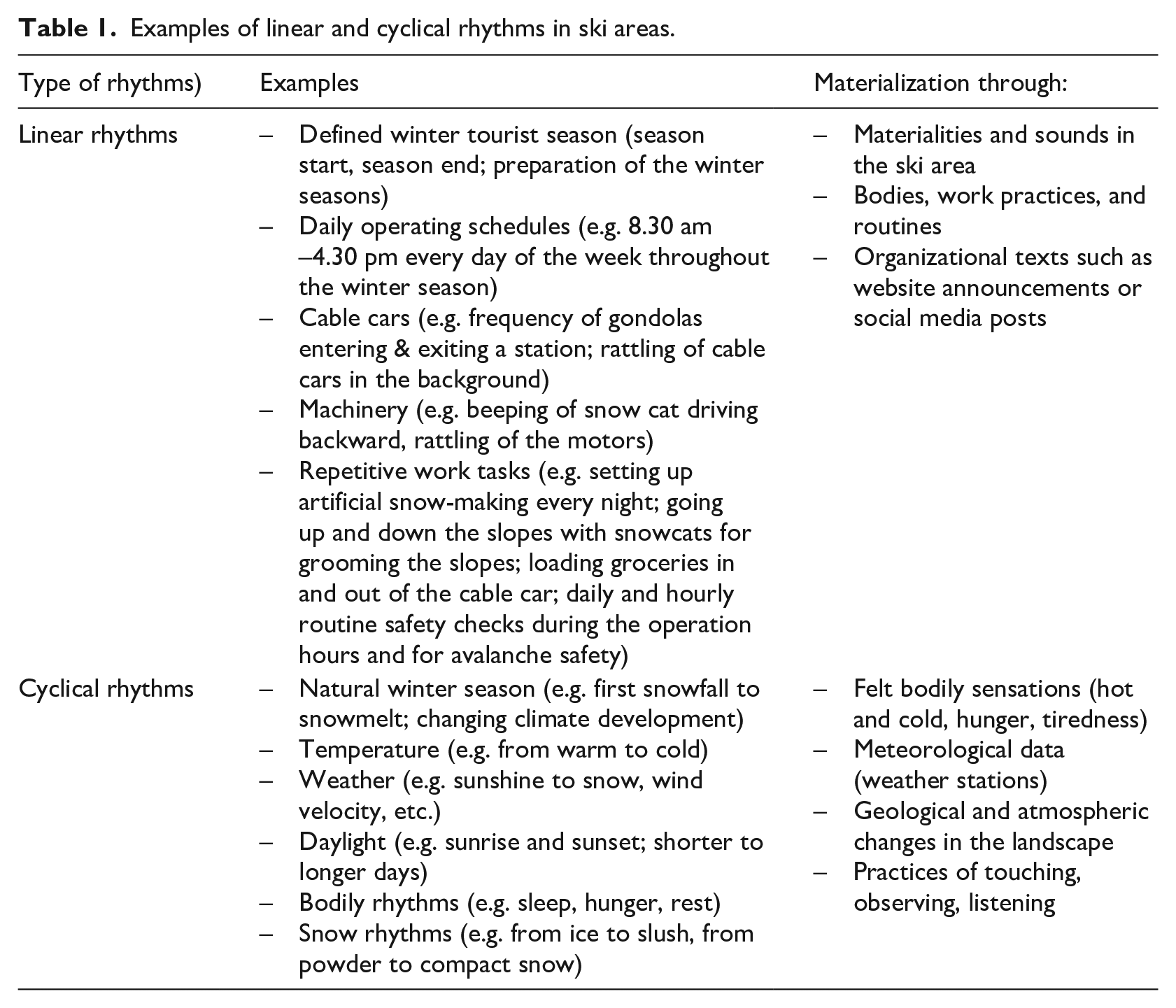
We approached our ethnographic data set inspired by other rhythm analysts (e.g. Borch et al., 2015; Nash, 2020; Oppermann et al., 2020; Thorpe et al., 2023) and multimodal, embodied sensibilities to research in and of organizations (Dille and Plotnikof, 2020; Satama and Huopalainen, 2024). First, we mapped the rhythms with predefined first-order codes for linear and cyclical rhythms (see Table 1). Then, we interrogated moments and practices where these rhythms intertwine in configurations and create polyrhythmia, eurhythmia, and arrhythmia and investigated how and when particular rhythms in these configurations became “authoritative” (Vásquez et al., 2018) and dominated the tempo of organizational life. For example, we listened to soundscapes in the video recordings (see, e.g. Figure 1 or Figure 2), how they structure certain moments in time (such as the engine purring at the start of the slope preparation), and became omnipresent throughout the data. Rhythmic instances also occurred through the tourism worker’s reflections, for example, when they referred to delays and rhythmic changes (“This season was more difficult, as there was less snow”), spatiotemporal indicators (such as tracks in the snow revealing information on visitor numbers and movement) or temporal problems (“The late shaping of the snowpark now causes problems - everything is frozen already”). We integrated this multitude of experiences and the particular instances of rhythmic configurations through poetic accounts, playfully mimicking the soundscapes to evoke the rhythmic dimension of our field in “subtle, micro-level embodied sensations” (Satama and Huopalainen, 2024: 541).
Examples of linear and cyclical rhythms in ski areas.
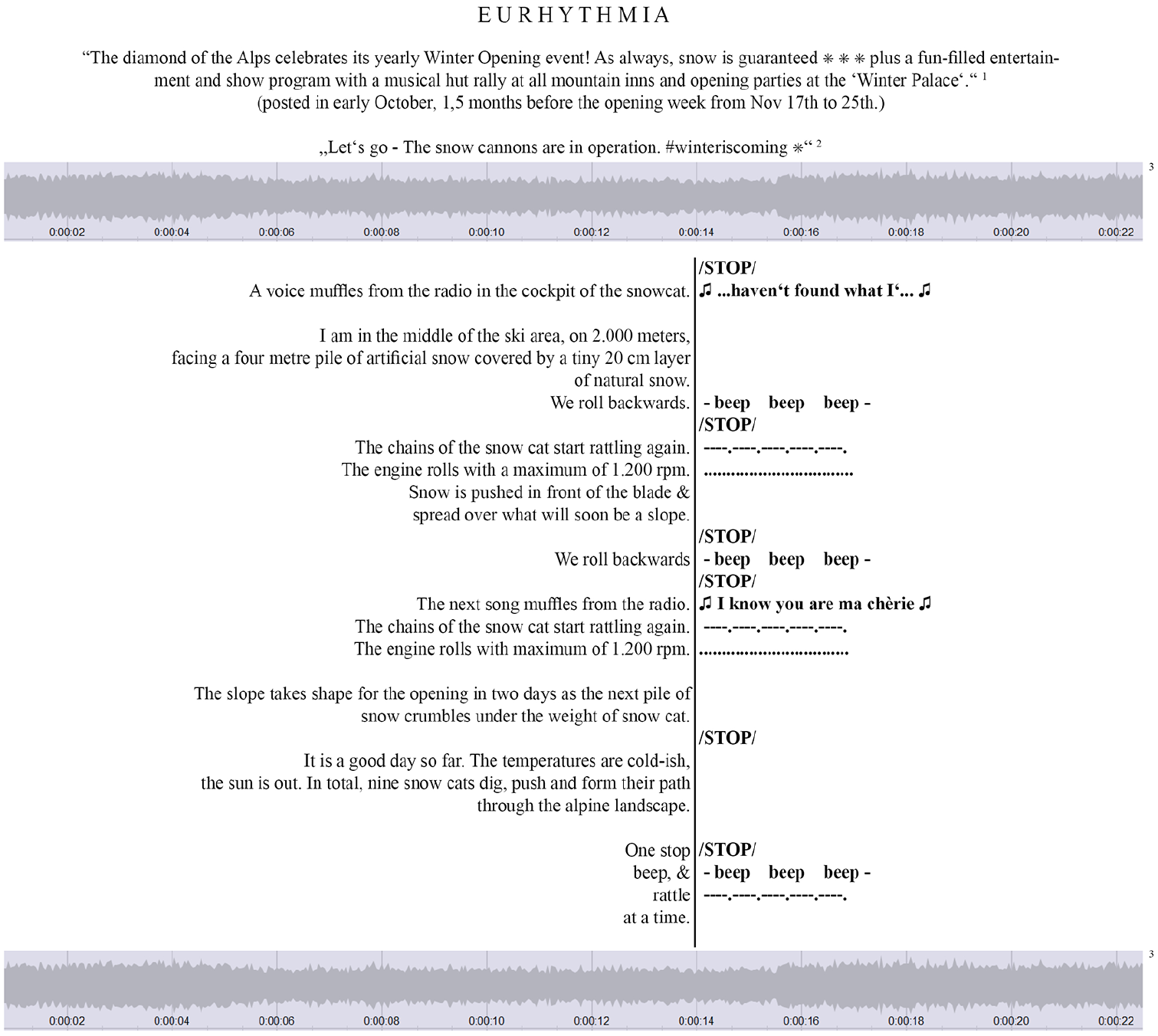
Eurhytmic harmony at the start of another winter season; 1: Facebook post by ski area 2; 2: Instagram post by ski area 2; 3: Soundwave of a “Pistenbully 600” engine.
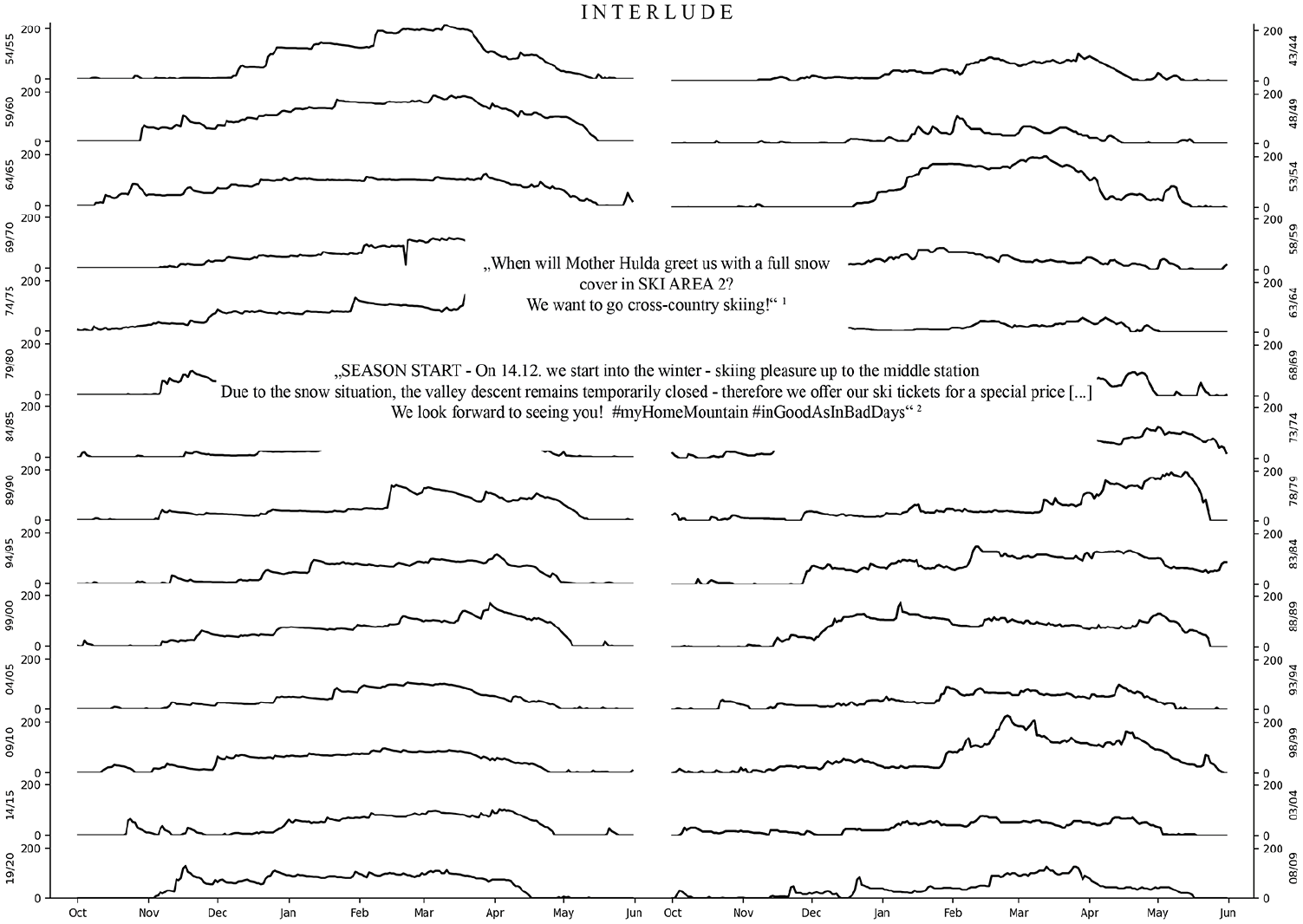
Unplanned interludes. 1: Facebook post by ski area 2; 2: Instagram post by ski area 1; Left: snowheight (cm) in the winter seasons from 1954/55 to 2019/20 in a 5-year-intervall in ski area 2; Right: snowheight (cm) in the winter seasons from 1943/44 to 2008/9 in a 5-year-intervall in the ski area 1; Weather data: GeoSphere Austria Data Hub.
We then combined these poetic accounts with the secondary data to incorporate different, long-term rhythms at play. First, we used direct quotes from the official social media channels to illustrate the discursive dimension of rhythms and how they disrupt or facilitate the seasonal schedules (“6 days to go - last chance to go skiing for this season”) or tourism routines (“And we have some rare birds living around the snowpark. They need their quiet time in the night so please show respect, keep the noise down after 6 pm, and leave the animals their space”). In addition, we plotted weather data (with indicators such as temperature or snow depth) to illustrate long-term snow and weather rhythms that go beyond the immediate daily work routines. We then combined the poetic accounts with the illustrative examples from the secondary data into vignettes. The multimodal vignettes (Dille and Plotnikof, 2020; Jenkins et al., 2021) show dense instances where and how these rhythmic configurations materialize, intertwine in different imbrications, and become authoritative. With these vignettes, we discuss the authority of particular rhythms, how they were made or made themselves present, and the implications this bears for organizing (winter tourism) in the Anthropocene.
Findings
Open your ears, listen, and immerse yourself in the rattling gears of cable cars and muffling howls of snowstorms.
Stop, beep, and rattle: Eurhythmia in preparing another perfect winter season
The first vignette gives a glimpse of the temporality of ski areas just before the season starts (see Figure 1). The upcoming winter season is slowly approaching, and anticipations are apparent in the first posts about the planned start of the season (see quotes 1 and 2 in Figure 1). The sound waves of the snowcat engine purr as it crawls through the landscape of unfinished slopes (see the sound wave of the “Pistenbully 600” in Figure 1). Gondolas carrying food, water, and equipment to the top stations in the areas and the humming of the snow cannons point to the scheduled opening date. At this point, the preparations are going well. The activities are laborious and stressful, but things “line up.” Linear rhythms like work schedules, the cable cars, and the back-and-forth slope grooming are unfolding toward the opening date, unbothered by cyclical rhythms such as weather, temperature, the still looming COVID-19 pandemic, or the workers’ bodily rhythms like sleep or exhaustion. After rough years of pandemic disruption, we are at the promising beginning of another new winter season. Everything is running smoothly.
In this state of eurhythmia (Lefebvre, 2004; Nash, 2020), the linear rhythms of the organizational practices, materialities, and voices hum along the melody of the tourism seasonality. The linear rhythm is intertwined with a predefined managerial seasonality (in contrast to the natural, cyclical, weather-related winter season). It acts as an authoritative rhythm that dictates the song of time. This linear rhythm of the official winter season rang through the announcements and posts about a defined season start long before any estimation about the weather and snowfall was possible. We hear the machinery like snow canons and snow cats beeping, rattling, and humming relentlessly to get everything ready, despite what the weather might hold in store. Practices and bodies align to the requirements and conventions of the predefined season, and work stretches to night shifts. As long as these rhythms are “on schedule” and keep running, rattling, and beeping, organizing another winter season in the ski area is performed in a rhythmic state of harmony—eurhythmia—with the market-based rhythms of profit. Through technological adaption, the cyclical and glacial rhythms of natural processes (such as changing weather patterns or late snowfall) become less of a concern, as quote nr. 2 in the vignette emphasizes: “Let’s go, the snow cannons are in operation. #winteriscoming.” The energy and water resources required for keeping these rhythms in harmony are seen as a necessity, a temporal competitive advantage for opening just a little earlier than the neighboring ski areas or providing snow security for tourists in an ever-repeating winter season.
In this eurhythmia, the song of time follows a “future perfect” approach (Pitsis et al., 2003) in preparing for another “perfect” tourism winter season. The predefined season start and end is an integral element of the business-as-usual model of the ski areas and becomes the dominant rhythm that all other rhythms aspire to match. To secure these kinds of eurhythmic harmony with one particular linear rhythm, the materialities, practices, and voices have to achieve a temporal uncoupling (Blagoev and Schreyögg, 2019; Slawinski and Bansal, 2012) from other rhythms (such as snow-scarce winters due to global warming) and create an entirely new rhythmic configuration to achieve short-term organizational harmony. In such harmony, the linear dominant rhythms either maintain a temporal distance from cyclical rhythms or try to master them rather than wanting to be in tune with them (Blagoev and Schreyögg, 2019). Maintaining this distance requires muting and mastering some rhythms while amplifying others. The tiniest cackles and ticks of gear wheels in the cable car, the continuous purr of the snowcat engine, and the humming of snow cannons tirelessly materialize the authority of these rhythms. The work practices are all aligned to perform a successful start of the managerial seasonality, and the voices in the discourse reinforce the temporal sense of control, repetitiveness, security, and predictability (Jensen et al., 2022; Slawinski and Bansal, 2012; Thorpe, 2015). The authority of this business-as-usual temporality becomes imbricated and validated by the season schedules, the rattling of the cable car, and the repeating practices of the workers: it gains authority (Kuhn, 2008; Vásquez et al., 2018). The materialities, practices, and voices in the ski areas stabilize the authority of particular rhythms through performing their repetitive, co-oriented, synchronized, and monorhythmic experiences. These authoritative eurhythmia become part of the winter tourism businesses as usual. That’s how things have always been and will be.
Although multiple rhythms in the ski areas synchronize and align in harmony with the authoritative rhythms of tourism seasonality, this eurhythmic state is what Rongna and Sun (2022) define as a monorhythmic livelihood. This eurhythmic configuration supports one distinct path (i.e. the economic value production in line with tourism seasonality) and affords harmony within this state (i.e. stabilizing the repetition of business as usual). While this monorhythmic livelihood is central to organizational life in the ski areas, its impact echoes far beyond its mountain ridges. For example, with the authority of this linear seasonal rhythm, cyclical rhythms like vegetation periods for plants become shorter due to the extensive artificial snow cover, while the consumption of resources, land use, and CO2 emissions accelerate global warming and prolong cycles of natural recuperation (Gross and Winiwarter, 2015; Oppermann et al., 2020; Roux-Rosier et al., 2018). As such, the materialities, practices, and voices perform a rhythmic monoculture and act as a site for control of the tempos of capitalistic modes of production and progress (Beacham, 2018). Although such a monorhythmic harmony appears to be a viable option for reaffirming the survival of the ski area organization in the short term, it also creates a lock-in effect through this seemingly inevitable enactment of monorhythmic survival (Blagoev and Schreyögg, 2019; Gibson and Warren, 2020; Johnsen et al., 2019) and alienation from other possible temporalities (Plotnikof and Mumby, 2024; Thorpe, 2015). The authority in these rhythmic configurations makes it difficult, or almost impossible, to unlock or even imagine a different temporality as it swings the wheels of the business-as-usual machine through everyday materialities, practices, and voices. These linear rhythms foreclose alternative paths prone to more volatile natural cyclical rhythms (such as agricultural seasons, vegetation rest periods, late snowfall, and shifting seasons) and temporalities governed by resting, pausing, or stopping, such as those related to different needs of workers, such as rest or sleep in bodily rhythms. Eurhythmia then becomes a chronopathic experience (Johnsen et al., 2019).
Interlude: A stumble in the winter orchestra
This authoritative, monorhythmic livelihood is sometimes disturbed when the natural rhythms make themselves heard (see Figure 2). The natural ebb and flow of the yearly snowfall constitute the beating heart of the winter season, as seen in the history of weather plots of both areas in Figure 2. However, the shifting magnitude, delays, and skips in this heartbeat with snow-scarce winters and warming temperatures immediately affect ticket prices and tourism seasonality (see quotes 1 and 2 in Figure 2). Late arrival of a predicted snowfall or an unexpected weather change invites interruption. It holds the potential to change the tempo of the authoritative business rhythms and the locked-in repetition of tourism seasonality. With the increasing temporal tensions of a warming planet and changing seasons seeping into this monorhythmic state from “beyond” the organization, the ski area organizations increasingly “struggle and aspire” (Johnsen et al., 2019: 10) to orchestrate this eurhythmic state of harmony over and over again. They are striving to hold on to the business-as-usual eurhythmic lock-in by trying to fix disruptive forces with the help of technologies and excessive use of resources. These efforts to maintain the status quo are repeating and accelerating the climate crises in the Anthropocene, thus becoming counterproductive for these organizations’ long-term future and life on Earth in general (Slawinski and Bansal, 2012).
Time to enjoy, not to work: Arrhythmia disturbing another im/perfect winter season
The second vignette describes the daily routine of snow park shapers and how an unexpected snowfall interrupts the authority of the eurhythmic harmony. Usually, the daily workflow of preparing or shaping the jumps and obstacles in the snowpark of ski area 1 starts with the closing of the ski area for customers. Shaping involves physically demanding manual labor following a linear rhythm imposed by the opening hours of the ski area. While even these strict daily routines, such as manual shoveling and raking, were described as “repetitive movements” with almost a captivating quality, this vignette highlights how unexpected snowfall interrupts the skiing area’s rhythmic flow of daily business as usual (see Figure 3). The vignette illustrates how a cyclical rhythm (i.e. the changing weather patterns of an unexpected snowfall) affects the workers’ bodies and the linear practices of their repetitive shaping. Through this pull of excitement (Endrissat and Islam, 2022) of the fresh, powdery snow, the workers disregarded their usual schedules and routines. After arriving at the cable car’s top station, the first author joined the snow park team on their way to start shaping in the park. We felt the fluffy powder snow under our snowboards and skis. The riding to the snowpark entrance became more playful, jumping over barrier tapes and fences at the park entry. After a quick check and swiping the thick snow layer from the first obstacle, the head shaper turns around and announces: “Now is the time to go for a few powder runs.” We rode down to the middle station, engaging in a shared yet not synchronized pattern of connecting, attuning, and singing along with the cyclical rhythms of the snowfall (Davies and Riach, 2019; Sage et al., 2016). For now, we did not hear the purring snowcat engines but just the whistling of the wind over the sharp mountain ridges, our breathing rhythms in the cold winter air, and the crunch of steps through the fresh powdery snow (see the sound wave in Figure 3). Later on, the head shaper shares his observation of fewer and fewer joyful moments on powder days due to, as he supposes, the impacts of the climate crisis. The unexpected snowfall triggered an arrhythmic period in which the beat of nature broke up the monorhythmic state of the ski area, impacting its business profits and thus paving the way for more volatile, open-ended temporalities of fun, excitement, and exploration.
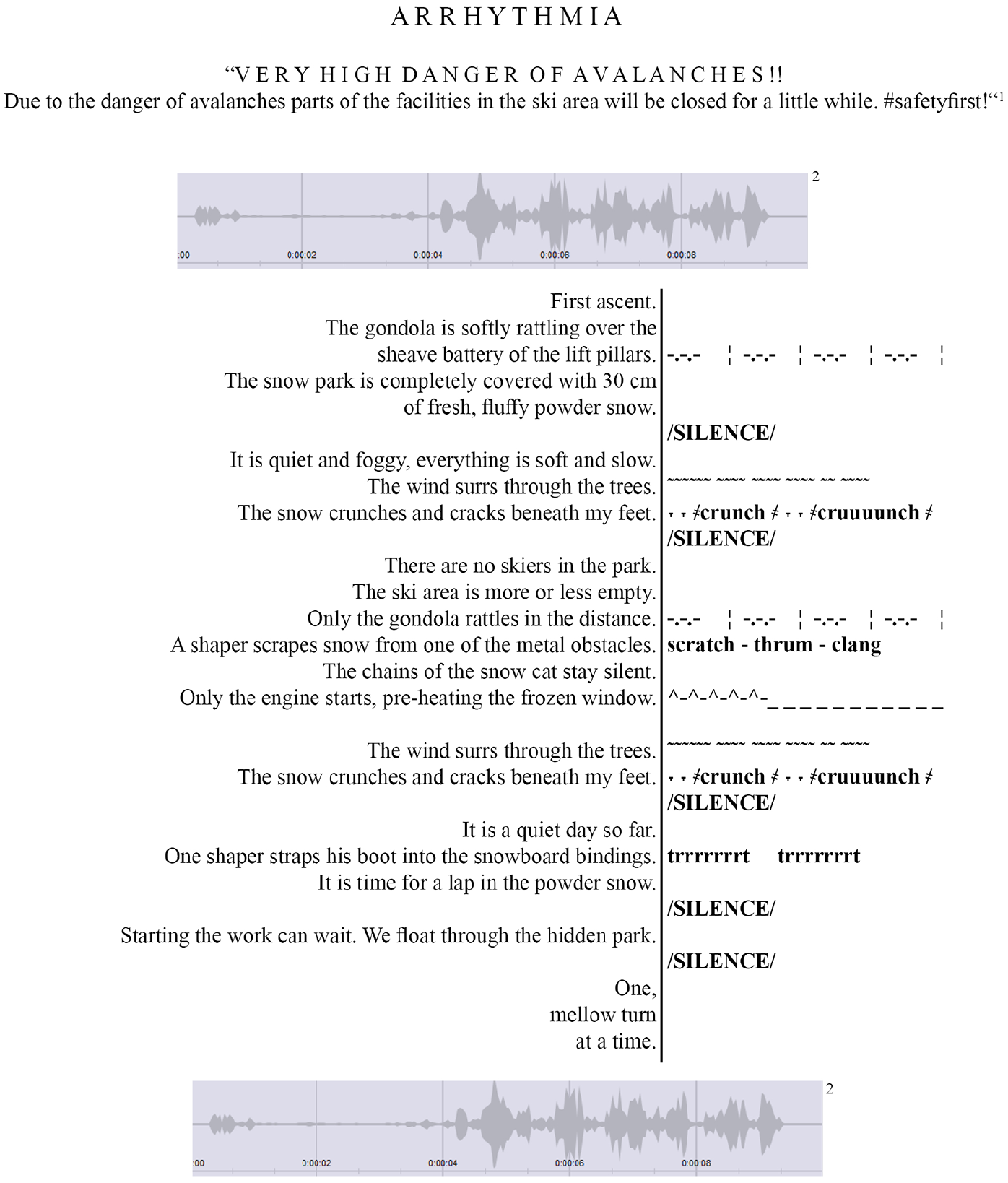
Vignette on moments of arrhythmia in the winter tourism industry. 1: Facebook post by ski area 2; 2: Soundwave of the wind surring and the crunching of steps.
Despite the continuous authority of eurythmic harmony of the linear rhythms in the ski areas, these spontaneous disruptions highlight their fragility. The vignette serves as an example of how organizing in ski areas is strongly affected by the temporalities of the natural environment (see also quote 1 in Figure 3). Snowfall and danger of avalanches can delay the ski areas’ opening during the day or even stop the cable cars for multiple days. In contrast to the eurhythmic configuration described in the first vignette (Figure 1), cyclical natural rhythms like snowfall or weather patterns are not rooted in linear, market-based rhythms of capitalism. Although organizational rhythms of production, commodification, and consumption partially overpower cyclical rhythms such as the weather, snowfall, and climate through, for example, technological solutions, they are still “wild” in the sense that “they object their domestication” (Sage et al., 2016: 435) and trouble the authority of monorhythmic business-as-usual configurations. The unexpected snowfall was such a wild moment of arrhythmia. The weather forecast did neither predict the pace nor the extent of the snowfall. The volatile frequency of the snowfall evaded the dense network of weather sensors, prediction models, and organizational routines—surfacing their limits. In such instances, moments of arrhythmia exert “significant power in directing and redirecting” (Rantala et al., 2011: 285) organizational temporalities and allow for, but also force a transformation of the authoritative eurhythmic configuration of business as usual. For example, the arrhythmic configuration described in the vignette opens up time for rhythms of rest, fun, and connecting with the materiality of the ski area in a more adaptive, open, and vertical time (Helin, 2023), losing track of time while cruising through an unfinished snowpark. However, other arrhythmic disruptions can be more destructive or violent, as shown in the vignette. Moments of disaster, such as a deadly avalanche accident of a staff member earlier in the season, still ring through the stories of the workers, make time stand still, and create moments of mourning, grief, and loss while the lifts keep running.
Through disruption, arrhythmia reveals the fractured mosaic (Thorpe et al., 2023) of materialities, practices, and voices that perform and perpetuate the rhythms of business as usual, as illustrated in the quote about the price reduction due to the delayed snowfall in the interlude (see Figure 2). As the rattling of the cable car halts, the humming of snow cannons ceases. The beat of steady, forward marching progress stops. Arrhythmic interventions create holes in business-as-usual temporality that undo the reduction of work, organizations, and landscapes to economic profit and the accumulation of economic wealth in the Anthropocene (Sage et al., 2016; Tsing, 2015; Wozniak, 2017). As such, arrhythmia becomes a harbor for slowing down and waiting and grants authority to dwell or flow with different, new, or unacknowledged cyclical and more-than-human rhythms (Davies and Riach, 2019; Sage et al., 2016; Thorpe et al., 2023). At the same time, violent disruptions like the avalanche incident blur the image of prevailing harmony, orchestration, and control over natural rhythms while highlighting the temporal tensions between moments of grief, rest, and silence and the urgency to get back to business as usual and opening the slopes in the ski areas. Through disturbance (Sage et al., 2016), arrhythmia creates a sensibility for locked-in business-as-usual rhythms and allows the re-negotiation of authority within these rhythmic configurations.
If you closely listen to the vignette in Figure 3 again, you will still hear the rattling of the cable car, even if it is distant and muffled. More often than not, moments of arrhythmic disturbance were only brief glitches in the business-as-usual temporality (Thorpe et al., 2023). After the mellow turns in the powdery snow, the cable car carries the first tourists up the mountain, and the rhythmic configurations fall into their monorhythmic business-as-usual patterns. Even the deadly avalanche incident did not delay the ski area’s opening for more than a few hours. However, what stays from these moments of disturbance is the ability to notice other rhythms outside business-as-usual temporalities (Roux-Rosier et al., 2018; van Tienoven, 2019) and learning to attune to rather than dominate alternative temporalities: developing sensibilities and “reading” the cyclical rhythms (Rantala et al., 2011; Sage et al., 2016) or pushing against the urge to open the ski area a little earlier in the upcoming season. These small shifts carry the potential for hopeful new starts and small, local promises for alternative temporalities in the Anthropocene.
Discussion
Taking off our ski boots and coming back to our office desks, we now return to the puzzle at the beginning of this paper: how can organizations transcend their business-as-usual repetition in the Anthropocene? The vignettes of eurhythmia in another “perfect” winter season, the stumble in this winter orchestration, and the arrhythmic intervention reveal how business-as-usual temporalities remain locked in, deeply entrenched linear monorhythmic harmony and how they can get disrupted through arrhythmic moments and create the settings for alternative temporalities. We have shown how some rhythms gain authority in polyrhythmic configurations and how they not only direct, discipline, and normalize but also disrupt existing, taken-for-granted temporalities. From a temporal perspective, this is how business as usual is done and can be undone in the Anthropocene. The present study allowed us to zoom into the configuration of rhythms through their materialities, practices, and voices and “scrutinize how certain temporal qualities perform and make time function powerfully in the organizing processes” (Plotnikof and Mumby, 2024: 664). We will now first discuss the potential of a rhythmanalytical perspective for understanding how locked-in repetition gains authority and perpetuates business-as-usual temporalities in the Anthropocene, and second, provide an arrhythmic perspective for re-imagining alternative temporalities in moments of disturbance. We conclude with an outlook on the potential inherent in investigating and critiquing the politics of time in the Anthropocene for organizational research.
Locked-in repetition of business as usual in the Anthropocene
First, this study outlines how organizations get stuck in the repetition of their business-as-usual rhythms by lending them authority. The first vignette about eurhythmic harmony illustrates how ski area organizations habitually repeat a “perfect” winter season (Pitsis et al., 2003). The authority of linear rhythms of production and capital accumulation is manifested and legitimized through the functioning of mundane organizational temporality—materialized in the ever-repeating cable car rattles, repetitive work practices, and voiced through the season schedules in the ski areas’ announcements. This study thus answers the calls to investigate the relational constitution of authority “where the sociomateriality of things can help to understand the prefigurative meanings of forging authority” (Pascucci et al., 2021: 323). Since the organization constantly attempts to perform and stabilize the linear harmony in mundane business-as-usual rhythms, it remains locked-in in its monorhythmic state (Blagoev and Schreyögg, 2019; Rongna and Sun, 2022) and the associated limited conception of organizational temporality as capitalistic progress (De Cock et al., 2021).
The present study indicates that to achieve a state of harmony with the “zeitgeber” (Geiger et al., 2021) of business-as-usual practices, organizations need to decouple their business practices from and simultaneously gain authority over changing and potentially disruptive cyclical rhythms such as seasonal shifts or weather patterns. While this decoupling may enhance short-term organizational survival based on marketplace logic (De Cock et al., 2021; Kuhn and Deetz, 2008; Oppermann et al., 2020), temporal tensions between business-as-usual rhythms and the rhythms of natural recuperation increase, threatening the resilience of organizations in the long-term (Berg Johansen and De Cock, 2018; Slawinski and Bansal, 2012).
Building upon the work by Roux-Rosier et al. (2018: 554), we unravel the repetitive and exploitative rhythms of business as usual in the Anthropocene as an organizational problem that similarly reaches beyond the confines of the organization itself. The locked-in repetition of monorhythmic business-as-usual configurations accelerates the environmental crises in the Anthropocene. As we show, locking in is only possible through extensive resource use (of water, snow, and energy) and by disregarding their long-term impact of produced emissions or on the biodiversity in alpine landscapes. As such, the set ways of linear organizational rhythms amplify cyclical rhythms’ disruptive potentials. The amplified cyclical rhythms (e.g. weather events such as floods or heat waves with increased amplitude) then constitute a major force capable of destabilizing the eurhythmic harmony of business practices—life on Earth more broadly—in the long term.
This empirically grounded analysis of rhythms in ski area organizations adds the dimension of power and authority to the current discussions on the double nature of temporal synchronization and decoupling and its impacts on the short-term and long-term survival of organizations (Blagoev and Schreyögg, 2019; Slawinski and Bansal, 2012). We highlight the consequences of locked-in repetition in business-as-usual harmony and how it perpetuates, rather than questions, the tempo of capitalist modes of production and their devastating consequences for the planet. Through the intricate entanglement of materialities, practices, and voices that form the rhythm of the “perfect” winter season, we show how eurhythmic harmony as a chronopatic experience becomes “consequential in making some times more worthy than others” (Plotnikof and Mumby, 2024: 672). The authority of eurhythmic harmony stabilizes business-as-usual temporalities and leads to an inertia of organizations to act in or mitigate an increasingly volatile Anthropocene. They remain stuck in and ensure its repetition (Berg Johansen and De Cock, 2018).
Fleeting moments of arrhythmic disturbance and their transformative potential
Second, this study opens up a new perspective on the potential for arrhythmia to develop a sensibility for locked-in repetition and, second, unfold possibilities of attuning to alternative organizational temporalities. With the rhythmanalytical approach adopted in this study, we show how unusual materialities, voices, and practices gain authority in such moments of disturbance. The vignette in the interlude and on arrhythmia show moments of disturbance through “wild” rhythms (Sage et al., 2016), like unexpected weather changes. By resisting domestication, such cyclical rhythms gain authority in the arrhythmic configuration of organizational temporality. While their disturbance to daily business practices may be seen as negative or even pathological within the logics of production and consumption (Lefebvre, 2004; Lyon, 2018), our findings offer a more nuanced understanding of arrhythmia. Moments of arrhythmia reveal conflicting business-as-usual temporalities, configurations of power, and how they are performed (Thorpe et al., 2023) while creating an openness to attuning to “multiple temporalities” (Tsing, 2015: 21). In attuning to snowfall, a changing landscape, and to inconsistent weather patterns, the vignette on arrhythmia illustrates “experiments in time-keeping with other beings” (Gibson and Warren, 2020: 327). Collaborative worlding with “wild” materialities like snow, landscapes, atmospheres, and weather become center stage in the temporal unfolding of organizational life (Cresswell, 2023; Sage et al., 2016). Resting, playing, dwelling, and attuning represent a set of practices that provide an alternative to the rhythms of business as usual (Agar and Manolchev, 2020; Mohammed, 2019) and voices that question the way things are and have always been, find a “hole in time” (Wozniak, 2017: 505) to become heard.
In arrhythmic configurations, authority in organizational temporalities gets reshuffled playfully (e.g. through experimentation and playfulness in deep powdery snow) or more violently (e.g. through avalanche incidents). Both examples of arrhythmia illustrate a more-than-human, “wild” temporality (Helin, 2023; Rantala et al., 2011; Sage et al., 2016) that challenges and often exceeds linear and anthropocentric rhythms. These fleeting moments of arrhythmia can also be interpreted in the light of Lefebvres’ theory of moments’. Lefebvre conceived moments as critical junctures when established norms and business practices can be challenged and questioned. In this sense, moments are crises that offer opportunities for significant transformation or disruption (Lefebvre, 2014). Moments of arrhythmia represent small ruptures of the monorhythmic, locked-in states of harmony because of the messy, volatile, and unpredictable circumstances they bring. They offer a glimpse into the Anthropocene futures without the promise of stability (Nyberg and De Cock, 2022; Tsing, 2015) while pointing to a polychronic view of organizational temporality and its untapped potential (Plotnikof and Mumby, 2024; Wright et al., 2013). Shifting away from the locked-in repetition of business as usual, moments of arrhythmia introduce a set of alternative materialities, practices, and voices that can become authoritative and thus break away from the locked-in repetition of business as usual in the Anthropocene (Berg Johansen and De Cock, 2018; Fagan, 2019; Wozniak, 2017). By turning to joy and fun and allowing for spaces to grief, it is precisely this rupture that offers “radical possibilities” where “rhythm is self-directed rather than part of someone else’s rhythmic project” (Cresswell, 2023: 673).
Conclusion
In this article, we highlight the potential of understanding arrhythmia as an invitation for change in business-as-usual rhythms. Such a change can foster attuning rhythms to intensified organizational temporality and synchronizing with other beings in different ways. Although these moments were fleeting, they nevertheless hum and sometimes shout the songs of “radical alterity” that force us to develop a “new perception of time” (Arruda Fontenelle, 2023: 10) with and for more-than-human, natural, cyclical rhythms. Such moments of arrhythmic disturbance then become political, emancipatory projects of different tempos, paces, and rhythmic configurations (Cresswell, 2023; Reid-Musson, 2018), even if only for an instance. While embracing such disturbance may seem intimidating at best and impossible at worst for organizations in a locked-in state of eurhythmic harmony, we highlight the potential of opportune moments of autonomy, especially in times of uncertainty (Geiger et al., 2021). This transient autonomy from business-as-usual rhythms allows imagining more resilient, open-ended organizational temporalities (De Cock et al., 2021; Ergene et al., 2021; Plotnikof and Mumby, 2024), for example, by fostering serendipity outside of repetitive schedules (Hilbolling et al., 2022) or slow rhythms of leisure, resting, community and connection beyond labor and market exchange (Agar and Malnochev, 2020). In volatile, anthropocentric times of crisis that impose an urgency to change, such holes in time may offer untapped potential for resilience, creativity, and rest in and beyond organizations.
We have explored the rhythmic configurations within the winter tourism industry’s empirical “outdoor” context. Still, similar configurations or disruptive influences might also be present in more implicit politics of time (see Plotnikof and Mumby, 2024). We see how sensitivity to rhythms in future research can uncover, critique and reimagine short-term, profit-oriented business temporalities and critically reflect on the politics of time of multiple organizational phenomena, such as the ever-accelerating overworking culture (Blagoev and Schreyögg, 2019), the energy of upbeat rhythms between affect and the entrepreneurial orders (Katila et al., 2020) or the extractive, fossil fuel industries and their geological rhythms (Valtonen and Pullen, 2021) nested in profit and promises (voices), oil and sand (materialities), and polluting and extracting (practices).
This research offers a rhythm perspective and demonstrates its potential for unraveling and performing moments of disturbance as an answer to calls for alternative ways of organizing in the Anthropocene (Ergene et al., 2018, 2021; Wright et al., 2018). Tuning into particular rhythms allowed us to imagine moments for stopping and disrupting rigid and repetitive modes of organizing business-as-usual temporality. Concludingly, we highlight the need to critically examine the scope and consequences of the politics of time in organizing business as usual in the Anthropocene (Plotnikof and Mumby, 2024; Wright et al., 2018): Which song should we hum? Whom should we listen to? Is it eurhythmic harmony in syncing with the monorhythmic, economic zeitgebers in business-as-usual? Or is the arrhythmic disruption through cyclical rhythms that allows shifting from business-as-usual rhythms to alternative practices, opening new tempos and rhythms for stopping, pausing, and reflecting? We invite organizational research to develop such multidimensional sensitivities further to better understand and interrupt temporal, embodied, and affective forces of business as usual and imagine alternative possibilities. Such endeavors can prompt our understanding of who or what can become a matter of concern or even authority (Vásquez et al., 2018) in perpetuating or re-imagining business-as-usual futures so that we might become more than our own repetition.
Footnotes
Acknowledgements
We thank Associate Editor Steffen Böhm and the three anonymous reviewers for their constructive comments and support of this paper’s style and ambition. We also thank all participants of the EGOS 2023 Sub-Theme “Performing the Future Communicatively: How What Does Not Yet Exist Already Makes a Difference” and Mie Plotnikof for their inspiring and motivating feedback on earlier versions of this manuscript. Lastly, we extend our gratitude to all tourism workers who let us be part of their daily lives.
Funding
The author(s) disclosed receipt of the following financial support for the research, authorship, and/or publication of this article: This field work was supported by the research project “Geschäftsmodell Wintersport” funded by the Tourismusforschungszentrum Tirol (Tyrolean Regional Government, Austria).
