



Abstract
In this ethnographic study of firefighters we explore how routines are coordinated under high levels of temporal uncertainty—when the timing of critical events cannot be known in advance and temporal misalignment creates substantial risks. Such conditions render time-consuming incremental and situated forms of temporal structuring—the focus of previous research on temporal coordination—unfeasible. Our findings show that firefighters focused their efforts on enacting temporal autonomy or, as they called it, “getting ahead of time.” They gained temporal autonomy—the capacity to temporally uncouple from the unfolding situation to preserve the ability to adapt to autonomously selected events—by relying on rhythms they developed during training in performing individual routines and by opening up to the evolving situation only when transitioning between routines. Our study contributes to literature on temporal structuring by introducing temporal autonomy as a novel strategy for dealing with temporal contingencies. We also contribute to research on routine dynamics by introducing the performance of temporal boundaries as a previously unrecognized form of coordination within and among routines. Finally, we contribute to process research a method that allows analyzing complex temporal patterns and thus provides a novel way of visualizing processes.
Time has from very early on been a central issue in research on organizational coordination (Taylor, 1911). For most of the twentieth century, research in this area was grounded either in the concept of clock time—with time perceived as “abstract, absolute, unitary, invariant, linear, mechanical, and quantitative” (Orlikowski and Yates, 2002: 685)—or in the seemingly opposing concept of event time, in which actors “use the event as a reference point for things that happen before and after” (Ancona, Okhuysen, and Perlow, 2001: 515). This has changed in the past two decades. One of the most influential insights in contemporary research on time and temporality pertains to the need to consider both clock and event time to better understand temporal structuring, that is, “how people construct and reconstruct the temporal conditions that shape their lives” (Orlikowski and Yates, 2002: 686). Much research on temporal structuring in organizations focuses on issues of temporal coordination—the temporally integrated accomplishment of interdependent tasks (Okhuysen and Bechky, 2009). Empirical and conceptual studies have already demonstrated how bridging clock and event time can lead to important new insights in this regard (Orlikowski and Yates, 2002; Crossan et al., 2005; Patriotta and Gruber, 2015). This line of research has helped us understand how temporal coordination is accomplished through a situated and incremental process of temporal structuring.
However, temporal uncertainty—a fundamental “uncertainty about when crucial events or actions are going to occur” (McGrath and Kelly, 1986: 407)—renders situated and incremental forms of temporal structuring problematic. Incremental forms of temporal structuring are problematic because a sudden turn of events might require instantaneous collective responses that are right the first time. In addition, temporal uncertainty will—by definition—make it challenging to properly and collectively establish whether an event is critical or not. As a consequence, actors might not have enough time to collectively (re)negotiate what to do when. This is a relevant problem for organization and management scholars because particularly emergency and fast-response organizations have to operate under such conditions. Firefighters (Klein, 2017), SWAT teams (Bechky and Okhuysen, 2011), and trauma response teams (Faraj and Xiao, 2006), for example, have to accomplish temporal coordination in a context that is unknown and constantly changing, providing little room for coordination failures (Hällgren, Rouleau, and de Rond, 2018). Thus far, we have a very limited understanding of the kind of temporal structuring that actors can turn to in situations characterized by high levels of temporal uncertainty. Building on a case study of firefighters in Hamburg, Germany, we apply a routine dynamics perspective to answer the research question of how actors temporally coordinate the performances of multiple, interdependent routines under temporal uncertainty.
The Challenge of Temporal Coordination under Temporal Uncertainty
In the last two decades, scholars have started to conceive of temporal coordination processes in organizations as instances of temporal structuring (Orlikowski and Yates, 2002). Taking a practice perspective, this stream of research is based on a conception of time as both an enacted and therefore always malleable social structure and, simultaneously, a quasi-objective limiting condition of organizational work (Evans, Kunda, and Barley, 2004; Kaplan and Orlikowski, 2013; Reinecke and Ansari, 2015; Granqvist and Gustafsson, 2016). The analytical focus is on the question of how temporal coordination emerges in organizations as actors “implicitly or explicitly draw on . . . repertoires of temporal structures” (Reinecke and Ansari, 2015: 622), which “they enact in their recurrent social practices” (Orlikowski and Yates, 2002: 686).
Until now, research in this area has been mostly concerned with forms of temporal structuring that are situated and incremental. Research on entrainment, “the capturing and modifying of an endogenous rhythmic process, by some external or internal signal or cycle” (McGrath and Kelly, 1992: 409), plays a pivotal role in this regard: “Entrainment occurs when endogenous routines within teams become synchronized with external pacers. Pacers are outside the team, and internal routines align with external cycles” (Zellmer-Bruhn, Waller, and Ancona, 2015: 137; emphasis in the original). According to social entrainment theory, actors usually orient their actions toward a powerful external pacer, such as reporting periods or seasonal harvests, the so-called “zeitgeber” in establishing temporal fit (Mosakowski and Earley, 2000; Pérez-Nordtvedt et al., 2008; Rowell, Gustafsson, and Clemente, 2016; Kunisch et al., 2017). This is possible because “time is elastic in relation to activities and [therefore] work patterns can be entrained to time limits” (McGrath and Kelly, 1992: 409).
A guiding assumption of this line of work is that temporal fit between organizational routines and the external environment leads to higher performance (e.g., McGrath and Rotchford, 1983; Bluedorn, 2002). A prolonged state of temporal misfit, in contrast, “implies substandard performance and an increased risk of organizational failure” (Pérez-Nordtvedt et al., 2008: 791). In line with this, empirical research has illustrated that significant shifts in an organization’s temporal environment are often associated with performance losses, at least temporarily (Davis, Eisenhardt, and Bingham, 2009). Consequently, organizations actively try to reorient organizational routines toward the new pacer in order to reestablish temporal fit (Eisenhardt and Tabrizi, 1995; Brown and Eisenhardt, 1997).
Importantly, entrainment theory assumes an incremental fitting-in process that takes time to effectively establish temporal coordination. In other words, temporal fit between internal routines and the external environment does not happen instantaneously; it requires multiple iterations, gradually fitting the rhythm of a routine to the rhythm of the zeitgeber (the external pacer). By implication, entrainment processes rely on the rhythm of the zeitgeber to remain recognizable and stable during multiple performances of routines that ought to be entrained (see also Zerubavel, 1981; McGrath and Kelly, 1986; Ancona and Chong, 1996; Shi and Prescott, 2012).
More recently, scholars have shifted attention away from entrainment to more active forms of temporal structuring in which actors generate new cycles rather than adapting to a preexisting zeitgeber. For example, Granqvist and Gustafsson (2016: 1010) identified constructing urgency and enacting momentum as “bottom-up, issue-driven and generative forms.” While this kind of temporal structuring is clearly different from entrainment, which is characterized as “top-down, routinized, [and] reproductive” (Granqvist and Gustafsson, 2016: 1029), it is still a situated and incremental form of temporal structuring. It is situated because “people use their circumstances to achieve intelligent action” (Suchman, 2009: 70). Consequently, researchers have focused on how actors deal with breakdowns—emergent inconsistencies between the situation at hand and established temporal structures (Kaplan and Orlikowski, 2013). Actors react to such breakdowns by creating new temporal structures through temporal work, defined as “negotiating and resolving tensions among different understandings of what has happened in the past, what is at stake in the present, and what might emerge in the future” (Kaplan and Orlikowski, 2013: 965). Just like entrainment, temporal work does not happen in an instant. It can require time-intensive negotiation and sense-making processes before actors converge on new temporal structures that better fit the changed situation (Faraj and Xiao, 2006; Kaplan and Orlikowski, 2013; Granqvist and Gustafsson, 2016).
Notwithstanding their relevance and validity for many settings, results from previous research on temporal structuring are less helpful when we want to understand how actors accomplish temporal coordination under temporal uncertainty—an important challenge for many organizations that operate in a “fast-response setting” (Patriotta and Gruber, 2015: 1575). Patriotta and Gruber (2015) reported on such conditions for a news organization that regularly had to adapt its live program to emergent breaking news stories. Bechky and Okhuysen (2011) described how SWAT teams are regularly confronted with unexpected external events during their deployments. More generally, we can assume that crisis-management organizations in particular, like ER teams, firefighters, and other emergency response organizations, regularly have to accomplish temporal coordination under conditions of temporal uncertainty (see also Klein et al., 2006; Wolbers, Boersma, and Groenewegen, 2018). In many emergency situations, actors are confronted with the absence of a clearly recognizable zeitgeber combined with the always-present risk of a sudden turn of events that leaves them with little time to collectively renegotiate the meaning of events for the timing of their actions (Cevolini, 2012). In what follows, we outline how a routine dynamics perspective can enrich our understanding of how actors engage in temporal structuring when confronted with the challenges posed by temporal uncertainty.
A Routine Dynamics Perspective on Temporal Coordination Processes
An organizational routine can be defined as a “repetitive, recognizable pattern of interdependent actions, involving multiple actors” (Feldman and Pentland, 2003: 96). The pattern of a routine is oriented toward the accomplishment of a “day-to-day operational task” (Rerup and Feldman, 2011: 584) and emerges as its constituent actions become reflective of each other (Kremser, Pentland, and Brunswicker, 2019). A routine dynamics perspective focuses the researcher on the processual nature of routines as emergent and generative action patterns (Feldman, 2000; Feldman and Pentland, 2003; Pentland et al., 2012; Feldman et al., 2016). Specific attention is paid to processes of patterning (Danner-Schröder and Geiger, 2016; Feldman, 2016; Goh and Pentland, 2019), whereby actors perform situated actions so that they “fit together to form joint action” (Dionysiou and Tsoukas, 2013: 186), accomplishing coordination within and among routines (Jarzabkowski, Le, and Feldman, 2012; Turner and Rindova, 2012; Kremser and Schreyögg, 2016; Kremser and Blagoev, 2020). In our efforts to better understand the accomplishment of temporal coordination under conditions of temporal uncertainty, a routine dynamics perspective can help us in describing important temporal features of organizational work and analyzing how they can be accomplished in practice.
Understanding organizational routines as recognizable patterns of actions helps us describe important temporal features of organizational work. Routines, defined as sequential patterns in the accomplishment of an operational task (Pentland and Feldman, 2007; Goh and Pentland, 2019), are inherently temporal; the pace and rhythm of a routine are fundamentally important. Drawing on research in social psychology (McGrath and Kelly, 1986), we define the pace of a routine as the average rate of action during a complete routine performance. While important in its own right, such as for analyzing time pressure and variability of routine performances (Turner and Fern, 2012), the notion of pace is often insufficient to describe comprehensively the analytically relevant temporal features of a routine. Especially under conditions of temporal uncertainty, different actions of the same performance might not have the same duration. Also, there might be shorter or longer intermissions or interruptions between actions. The notion of rhythm helps us capture these more complex features of the temporal pattern of routines. We define the rhythm of a routine as the characteristic succession of different paces during a routine performance (see also Zerubavel, 1981; Warner, 1988).
Importantly, both pace and rhythm can become recognizable only at the intersection of event and clock time. Put differently, we can describe the pace or rhythm of a routine only if we—implicitly or explicitly—think of event and clock time as a duality (Orlikowski and Yates, 2002). Because event time is constituted by the difference between before and after (Turner, 2014), it only helps in describing the sequential structure of routine performances. Event time does not suffice to fully account for differences in the pace—and, by implication, rhythm—of routine performances. Pace is the average rate of action (e.g., per minute), and to calculate any rate, we need a clock time reference. Pace therefore implies considering event and clock time as a duality. The same holds true for rhythm, as the rhythm of a routine is the characteristic succession of different paces.
Having established the language to describe the temporal pattern of a routine (pace and rhythm), we turn to the analytical question of how this pattern might be accomplished in practice. Studies on temporal patterning processes within routines already highlight that actors draw on both clock and event time in accomplishing a temporally patterned routine performance (see Turner, 2014, and Howard-Grenville and Rerup, 2017, for recent reviews). Studies of issues such as time pressure (Turner and Fern, 2012), schedules (Turner and Rindova, 2012, 2018), and calendars (Akoumianakis and Ktistakis, 2017) focus on how actors make use of clock time in the (temporal) patterning of routines. These studies analyze how the “routine performance connects to a common metric of time, and the broader organizational or life contexts in which the routine is embedded” (Turner and Rindova, 2018: 1257). More specifically, and aligned with more general research on social entrainment, they describe an iterative process in which routine participants recognize timing patterns both in their environment and in their routine performances. The resulting clock time–based expectations are then also frequently inscribed in formal schedules, which in turn tends to stabilize the emergent temporal pattern of a routine and make routine performances more effective (Turner and Rindova, 2012, 2018). In addition, routine dynamics scholars have illustrated the importance of event time for temporal coordination within routines; Turner and Rindova (2018: 1256) defined the “sequence-based patterning” mechanism as one in which “the occurrence of preceding actions within routines serves to stimulate subsequent actions” (Turner, 2014: 127; see also Cohen and Bacdayan, 1994). Sequence-based patterning extends the entrainment argument by allowing for the accomplishment of temporal coordination without having to rely on an external pacer, instead enacting an internally established rhythm (see also Warner, 1988; Cunha, 2009).
While providing important insights on the process of temporal patterning of single routines, Turner and Rindova (2018: 1275) pointed out that future research needs to explicitly illuminate “how routine participants coordinate actions not only within, but also across routines.” This is specifically relevant in the context of crisis management. Emergency response teams (Wolbers, Boersma, and Groenewegen, 2018), such as SWAT teams (Bechky and Okhuysen, 2011), usually do not rely on a single routine but enact a whole “routine cluster” (Kremser and Schreyögg, 2016) to successfully complete their deployments. The fact that many of these deployments occur under conditions of temporal uncertainty, so that the timing of important events cannot be known ex-ante and might be different each time (McGrath and Kelly, 1986), is a core challenge in the process of temporal patterning within and among routines. Under these conditions, we can assume that the effectiveness of sequence- and timing-based mechanisms identified in previous research on routine dynamics will be limited. Sequence-based patterning might play an important role in coordinating the timing of actions within routines, even under conditions of temporal uncertainty, as it does not rely on the existence of a rather stable external pacer. But it might not suffice to accomplish temporal coordination among routines. When emergency response teams must split up and perform routines in parallel, sequence-based patterning approaches its natural limits. At the same time, the temporal uncertainty that characterizes many emergency situations will limit the effectiveness of timing-based patterning. When you cannot know how long it takes to complete one routine performance in a given situation (e.g., to extinguish a fire), it is impossible to properly schedule and prepare for performances of subsequent or parallel routines (e.g., searching for survivors). Recent research in the field of routine dynamics has thus highlighted the importance of boundaries in addressing dynamically evolving coordination challenges within and among routines (Quick and Feldman, 2014; Bucher and Langley, 2016; Salvato and Rerup, 2018; Kremser, Pentland, and Brunswicker, 2019).
Performing Temporal Boundaries in Coordinating Routines
Organizational research on boundaries and boundary work focuses on the “purposeful individual and collective effort to influence the social, symbolic, material, or temporal boundaries; demarcations; and distinctions affecting groups, occupations, and organizations” (Langley et al., 2019: 704). Most studies focus on the social, material, and temporal boundaries that separate groups of actors from each other, sometimes in order to connect them again (e.g., Quick and Feldman, 2014). A routine dynamics perspective, however, generally focuses on actions, not actors (Feldman, 2016). Hence routine boundaries refer to differences between action patterns rather than between actors (Kremser, Pentland, and Brunswicker, 2019).
In performing routine boundaries, actors create a shared focus of attention (Kremser, Pentland, and Brunswicker, 2019: 87). Bucher and Langley (2016) analyzed how hospital workers perform boundaries by establishing physical distance between different sets of activities. Using the example of a passenger service routine on a transatlantic flight, Kremser, Pentland, and Brunswicker (2019) discussed how performing boundaries enables the coordination of actions within and among routines. They highlighted how boundaries were performed through signaling behaviors that established certain contextual cues as important, thus establishing a “difference between situational relevance and irrelevance” (Kremser, Pentland, and Brunswicker, 2019: 89). This helped the performing actors to accomplish interdependencies within and among routines.
Combining these insights from prior work allows us to develop an initial understanding of how actors perform temporal boundaries between routines and how doing so might help them coordinate under temporal uncertainty. To accomplish this, actors enact differences in the temporal patterns of routines—their pace and rhythm. Relying on endogenous signaling behaviors rather than on exogenous cycles or time-consuming negotiations allows for almost instantaneously reorienting actions toward another temporal pattern. This suggests that performing temporal routine boundaries could play an important role in accomplishing temporal coordination in fast-response settings. But to date there is very limited understanding of and empirical research on how such coordination is achieved under conditions of temporal uncertainty. While a routine dynamics perspective gives us a fruitful theoretical toolkit to understand temporal coordination within routines, we lack insights into how multiple routines are coordinated against a background of temporal uncertainty. Under these circumstances temporal coordination strategies explored by previous research are of little help because no clearly recognizable zeitgeber exists, and time-intensive negotiations to converge routine performances into new temporal structures that better fit the situation are not an option. To investigate how multiple routines are coordinated against a background of temporal uncertainty, we studied the operations of firefighters in Hamburg.
Methods
Research Setting: Firefighting Operations
We address our research question with a qualitative single case study (Yin, 1994). Inductive qualitative research is particularly appropriate when the research question focuses on developing theory (Strauss and Corbin, 1990; Eisenhardt and Graebner, 2007), especially with regard to processes (Creswell, 1998; Langley, 1999). We purposefully sampled an organization that relies heavily on routines in its execution of tasks and for which time obviously plays a critical role. The fire brigade, as a high-reliability, fast-response organization, builds on routines in order to operate reliably in adverse contexts (Weick and Sutcliffe, 2007), and time is critical in its operations. Moreover, firefighters operate under conditions of high temporal uncertainty as defined above: each deployment is different, and unexpected events are likely to occur (Bechky and Okhuysen, 2011). Firefighters cannot predict events or the times at which they may occur during a deployment; each deployment may significantly differ from the next, and as a consequence, an incremental fitting-in with external pacers is not an option. Responding urgently is essential to minimize potentially disastrous consequences and prevent loss of life, but acting in a rushed manner poses the risk of failure. Thus improvisation and haste should be controlled in order to prevent failures (Bigley and Roberts, 2001).
The biggest concern for the leader of a firefighting unit is getting overwhelmed by the situation, putting them in a position they refer to as “running behind time.” This concern involves losing their capacity to act and react to unexpected events in a coordinated fashion. Their main goal is to “get ahead of time”—to stay in control of the situation by anticipating what may happen next. To achieve it, firefighters adapt a well-trained set of routines to specific circumstances, which enables them to act effectively, safely, and quickly. Because each incident differs from the next, coordinating and assembling multiple routines is a novel challenge in each operation. Executing routines in a timely fashion without compromising health and safety is therefore a central concern in any professional firefighting operation (Danner-Schröder and Geiger, 2016).
Access and Data Collection
Consistent with a practice perspective (Gherardi, 2012; Nicolini, 2013), non-participant observation was of utmost importance to grasp how routines were actually performed (Feldman and Orlikowski, 2011). As we were interested in how multiple routines are coordinated in action under temporal uncertainty, we had to observe the enactment of those routines (Feldman and Orlikowski, 2011). We first contacted the training academy of the Hamburg firefighters, as we thought it would be more feasible to observe firefighters in trainings than in actual deployments. But as our engagement with the organization deepened and we gained instructors’ and firefighters’ trust, they allowed us to accompany them as observers on deployments. Hence our primary source of data builds on nonparticipant observations of real firefighting operations. This was supplemented by observation of training sessions, in which firefighters learned how to deal with unexpected, complex, and time-critical scenarios.
The Hamburg fire brigade is a public organization that employs nearly 3,000 professional firefighters who are called into service for approximately 250,000 operations each year—from fire-related incidents to medical emergencies, car and truck accidents, and technical assistance. The first two authors observed 12 complete 24-hour shifts of firefighters in two fire stations (Hamburg Central and Hamburg West) in parallel, with each author being present at one station. Together, the authors accompanied the firefighters on 37 deployments that covered the whole range of firefighting duties, such as fires in apartment buildings, false alarms, car accidents, and animal rescues. Our informants confirmed that we observed an average mixture of deployments occurring over the course of a year.
In total, the first two authors spent 288 hours at fire stations. In addition to accompanying firefighters on deployments, we “lived” with them at the fire station; firefighters spend most of their time cooking meals, playing sports, maintaining equipment, and performing training sessions. We were thus immersed deeply in the context of our study. In addition, we participated in 10 training days at the firefighting academy, a professional school to train firefighters. As part of the training to become qualified as a team leader, we observed 44 different and complex scenarios prepared by the instructors, either on the training ground of the academy or on the premises of real firms in the Hamburg region that utilized hazardous materials.
Each training session lasted for six hours and included between two and six scenarios; observing them was important as they familiarized us with firefighting work and helped us understand how firefighters learn not to get overwhelmed and how to remain calm in chaotic environments. The initial observations of training sessions were difficult to untangle; we were overwhelmed by their complexity. The more we learned about firefighting work, the better we understood what was going on, and thus the better we could focus our observations and keep track of routine performances. In general, training sessions involved more severe and complex scenarios than what would normally occur in real life.
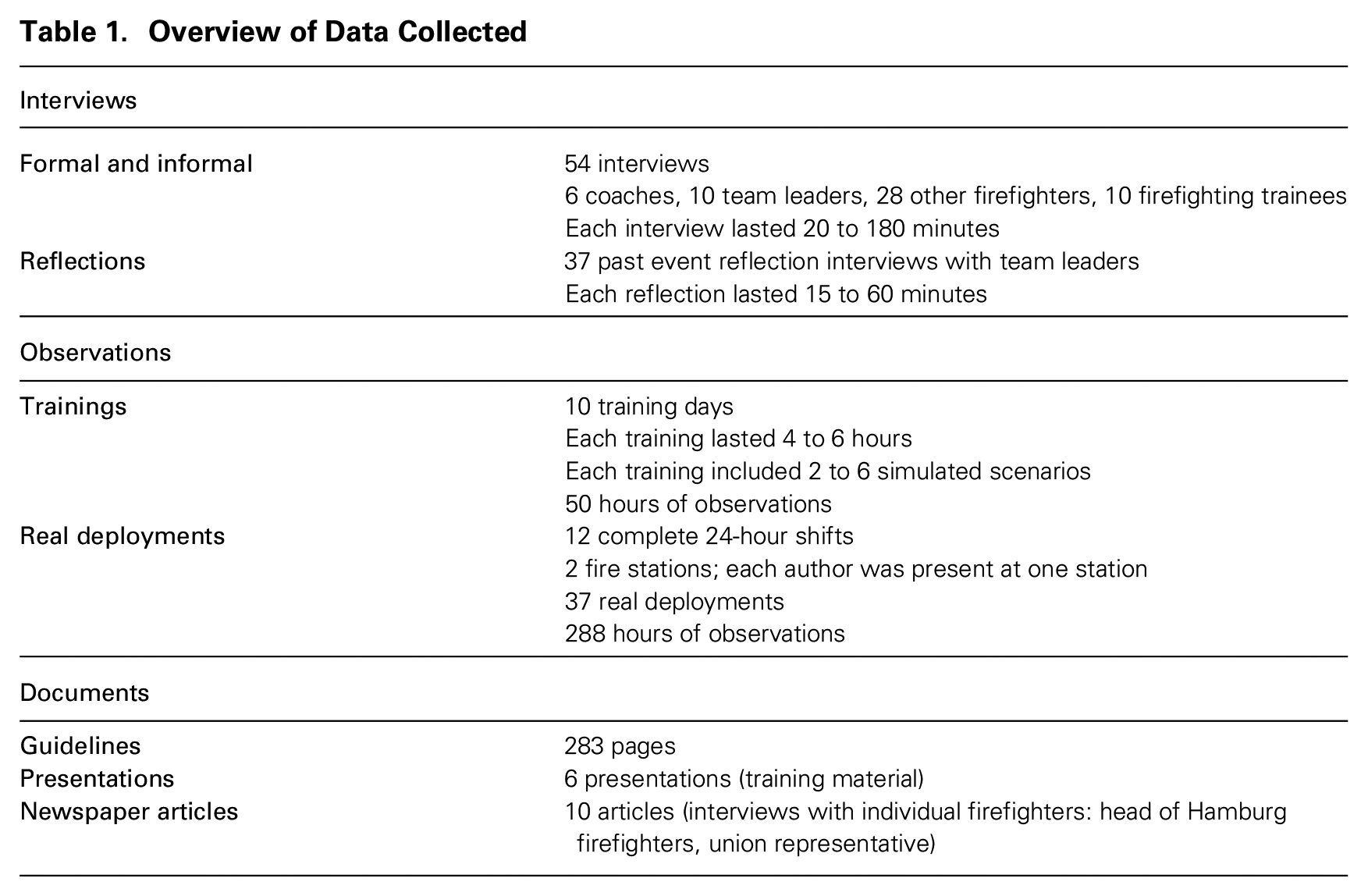
In all, our written observations resulted in 433 pages of field notes. In addition, we conducted 54 formal and informal interviews with instructors and firefighters from all levels and degrees of experience, during which they described how they prepared for and acted in complex firefighting operations. Furthermore, after each deployment we observed, we held post-event reflections with the team leaders in which their actions and decisions were recapitulated. These 37 post-event reflections, lasting between 15 and 60 minutes each, were not recorded due to reasons of confidentiality, but we kept detailed notes of the conversations. We completed our data set with additional documents, such as guidelines, presentations, and newspaper articles. Table 1 provides an overview of the data collected.
Overview of Data Collected
Analytical Process
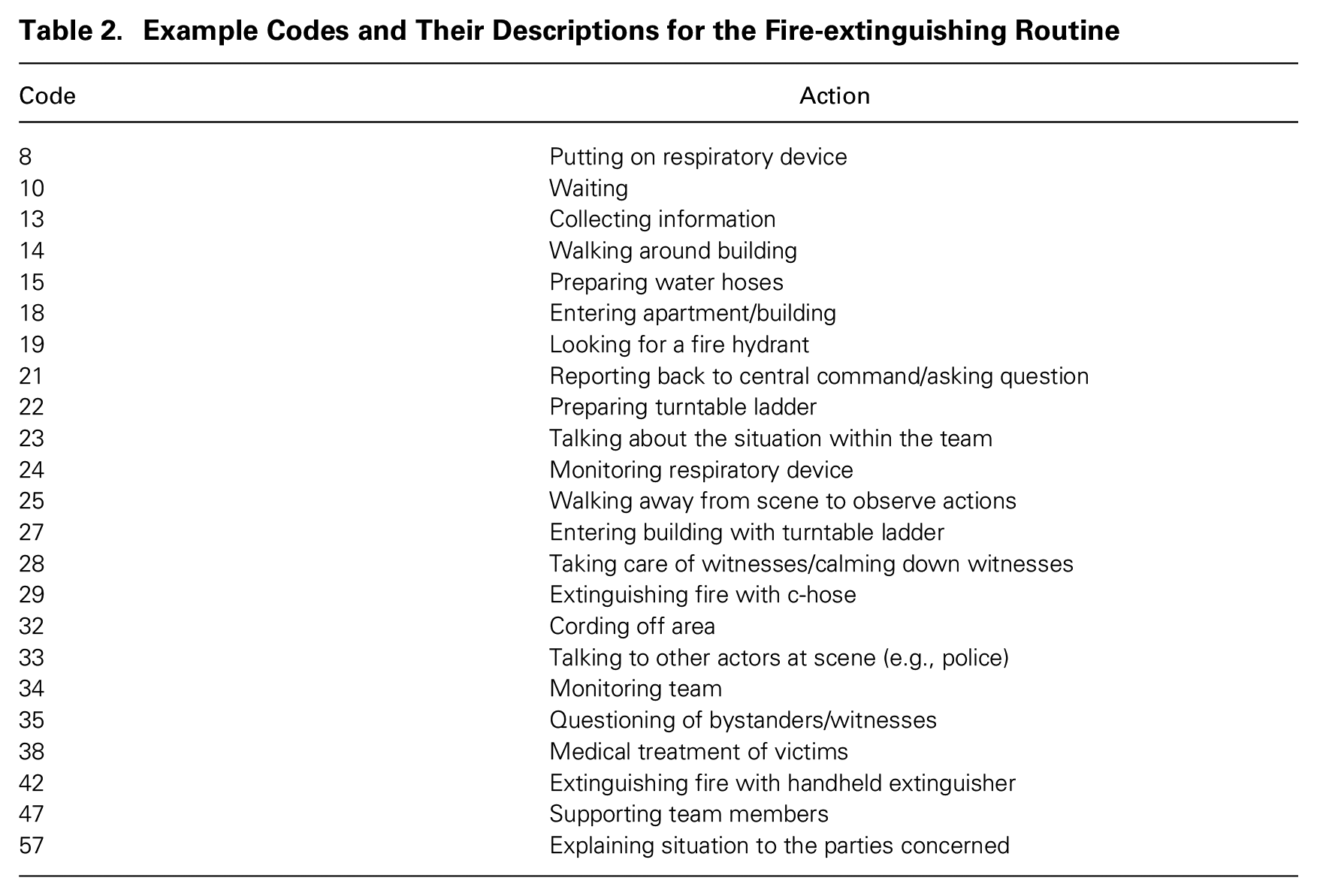
Our analytical process unfolded in four steps. Applying a routine dynamics perspective, we started by qualifying the actions in our field notes, placing specific emphasis on describing who (actor) did what (action) at which point in time (clock time; when). To obtain an accurate account of time and timing (when), we carried a stopwatch during observations and carefully noted what happened each minute. Later, we collated the notes with protocols from the firefighters, which also included a time stamp (in clock time) that was registered for each instance the team leader used the radio to provide information to the central command. To account for actors (who), we clustered a firefighting unit according to their way of working. A firefighting unit that is deployed to an incident commonly consists of ten men in three trucks who jointly enact firefighting routines. Each unit is led by a team leader and his assistant. Moreover, there are two attack teams (consisting of two men each), one support team (two men), and another team of two that operates the turntable ladder and functions as a secondary support team if the turntable ladder is not used. Because the challenges of temporal coordination arose mostly between, rather than within, these teams of two (attack, support, ladder), we decided to treat every team of two as one singular actor. Hence we coded the actions for a total of six actors: team leader, assistant, attack 1, attack 2, support, and ladder. However, not all members of the unit leave the station for every response; it depends on the type of emergency. For example, when the firefighters rescue a cat from a roof, only one team is operating. We thus decided to code only the actions of those actors who left the station to respond to the emergency. We assigned numerical codes to each specific action we had observed. Building on Pentland’s (2003a) idea of mapping sequential variety, and consistent with a sequential analysis of workplace data (Salvato, 2009; Pentland, Haerem, and Hillison, 2011), we coded—for each of the 37 cases—the actions (what) a particular actor (who) performed at which point in time (when—in clock time). In coding the different actions, we aimed to be as detailed as possible while also being mindful of creating a meaningful lexicon of different actions that would not become too exhaustive. To arrive at a lexicon of actions, the first two authors coded the observation data individually at first, after which we discussed the codes to determine a conclusive list. The third author acted as devil’s advocate, questioning the coding scheme as an outsider. This process resulted in 66 different action codes across all the cases studied; see Table 2 for examples and Figure A1 in the Online Appendix (http://journals.sagepub.com/doi/suppl/10.1177/0001839220941010) for a complete list of the codes.
Example Codes and Their Descriptions for the Fire-extinguishing Routine
In the second step, we aimed at identifying routines within our coding scheme. Following the definition of routines by Feldman and Pentland (2003: 96) as “repetitive, recognizable patterns of interdependent actions carried out by multiple actors,” we clustered actions that were carried out by multiple actors into distinct action patterns. To identify routines and (analytically) separate them from each other, we used the concept put forward in Kremser and Schreyögg (2016) and further developed by Kremser, Pentland, and Brunswicker (2019: 90); two actions were perceived to be part of the same routine if they created an immediately relevant and situation-specific context for each other. For example, the action of “looking for a fire hydrant” created an immediately relevant, situation-specific context for the action of “preparing water hoses”; the preparation of water hoses is accomplished only with situation-specific information about the exact position of the fire hydrant in mind. Hence those “actions are (made) reflective of each other” (Kremser and Schreyögg, 2016: 701) and belong to the same pattern. Conversely, two actions were considered to be part of different routines if the successful accomplishment of one action did not rely on situation-specific information about the other. For example, the action “preparing water hoses” could be accomplished without any situation-specific information about the action “driving to the incident,” e.g., the specific route taken by the driver. This gave us a complete list of all the routines we could identify in the data, along with all the potential action steps (codes) that were part of each routine. Of course, not every action step was enacted in each observable repetition of the respective routine. And some actions belong to more than one routine, which is consistent with findings on routine dynamics (Feldman, 2016). We presented our clustering of routines to our informants for validation, which also helped us name the routines according to firefighters’ descriptions. Table A1 in the Online Appendix provides an overview of all routines and respective actions that are part of each routine identified.
In a third step, inspired by Pentland’s (2003b) framework for the analysis of sequential variety, we analyzed our action codes to account for clock and event time. We followed Turner and Rindova’s (2018: 1256) operationalization of event time as “the progression of time reflected in the occurrence of particular events in an unfolding process.” To arrive at a measure of event time, we first counted the number of different actions performed by the different actors (teams) at a given clock time interval (inter-team). Table 3 shows an example of this analysis: In minute 8 of the operation, the team leader was monitoring the team (code #34), the assistant and team support 1 were looking for a fire hydrant (code #19), team attack 1 was preparing water hoses (code #15), team attack 2 was putting on a respiratory device (code #8), and team ladder was preparing the turntable ladder (code #22). This counted for five different actions enacted during one minute (dotted circle in Table 3). In addition we wanted our event time measure to be sensitive to switches between different actions, i.e., how often an actor switches from one action to the next as an indication of how fast or slow time is passing by from the perspective of the performing actors. This is a central concern for our conception of rhythm and consistent with the concept of event time developed by Ancona, Okhuysen, and Perlow (2001: 518), who stated that time runs faster the busier people are. Our interviews confirmed that this was also our informants’ perception. Therefore, we counted the number of actions that differed from one clock time interval to the next, irrespective of who enacted these action steps. Referring to our example, from minute 8 to minute 9, the following change occurred: In minute 9, the team leader reported back to the central command (code #21), whereas all other teams continued with the same actions they were enacting in minute 8; this was counted as one change from minute 8 to 9 (dashed circle in Table 3).
Example for Counting Different Actions Per Time Interval and Across Time Intervals
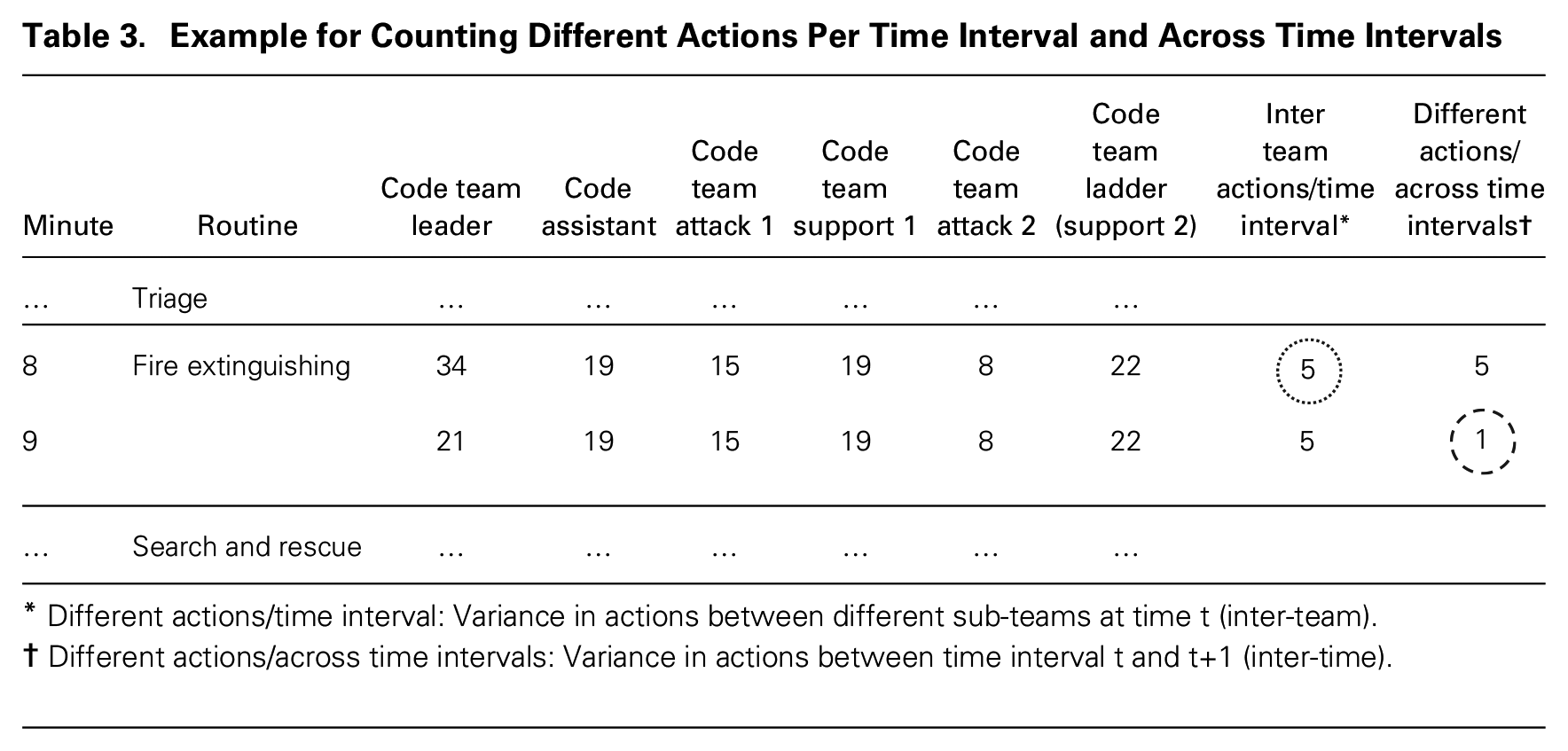
Different actions/time interval: Variance in actions between different sub-teams at time t (inter-team).
Different actions/across time intervals: Variance in actions between time interval t and t+1 (inter-time).
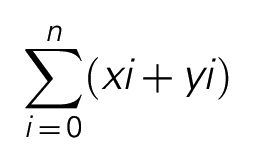
Next in our effort to operationalize event time, we summed up both numbers: how many actions were performed during one minute (inter-team) and how many different actions were carried out during two consecutive minutes (inter-time). In taking this step, we were mindful of both effects—inter-team and inter-time differences—influencing the perception of event time. Inter-team differences account for the different actions performed by different actors, i.e., how many different actions were performed per time interval. Inter-time differences reflect how busy each team is—how often actors do something different. We thus operationalized event time as how many things were happening within one observation interval between teams and how often actions switched across observation intervals. In the formula, x is the number of actions between actors (step 1), and y is the number of different actions across time (step 2).
We combined our event time measure with clock time by setting a standard length of one minute as our observation interval. The combination of clock and event time enabled us to properly depict the pace as well as the rhythm of each routine performance. Next, we plotted this analysis into a coordination system where the x-axis represents clock time in minutes and the y-axis represents event time as operationalized above. The resulting diagram plots a deployment of the firefighters from the initiating alarm until the teams were back at the fire station. As each deployment differed in its clock time duration, the x-axis varies in the time periods displayed. These event-clock-time diagrams provided us with the necessary means to contrast and compare the temporal structuring of all routine performances during each deployment observed.
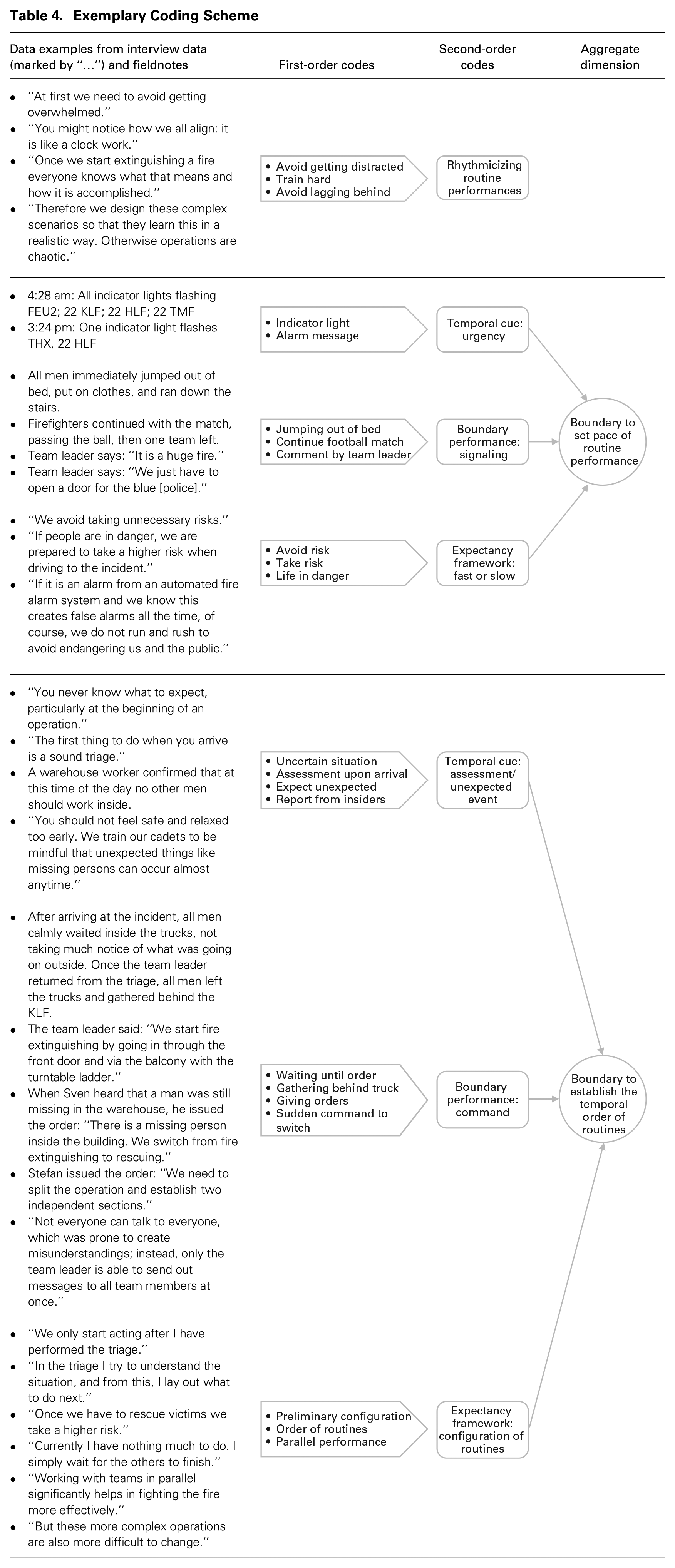
Fourth, we wrote a case narrative for each deployment and training scenario observed, including the initial alarm, the drive to the incident, the triage before the actual operation, the operation itself, and the return to the fire station. To improve accuracy, we documented many details to obtain a rich description of events to complement our numerical coding. These narrative descriptions became especially useful as a means to zoom into our data and better understand the temporal structuring of the deployment. Plotting clock and event time for each deployment revealed that significant changes in the temporal patterns occurred at the intersection of routines. This discovery led us to return to our case narratives and conduct a more formal coding of these “turning points” (Abbott, 1997). We focused on each transition using open coding at first (breaking down the data to understand the underlying dynamics), followed by performing second-order coding, or coding across concepts to reveal the thematic relationships and contrasts (Strauss and Corbin, 1990; Gioia, Corley, and Hamilton, 2012). Our coding focused our analysis on the temporal boundaries that were enacted at the turning points from steep to flat (or reverse). The first two authors discussed the coding, and the third author provided alternative explanations of the data to improve the quality of theorizing (Gioia et al., 1994). These second-order themes were then clustered into aggregate dimensions following our emerging ideas on coordinating multiple routines under conditions of temporal uncertainty. Table 4 provides examples of our interpretative process.
Exemplary Coding Scheme
Findings: Getting Ahead of Time
The Hamburg firefighters were confronted with a variety of incidents, ranging from fires to car accidents to providing technical assistance to the police. For each deployment, firefighters had to temporally coordinate multiple routines in situ. As a result, each deployment proceeded differently, even if they were of a similar type. Figure 1 provides examples of the event-clock-time graphs of three fire-extinguishing deployments all emanating from a similar initial alarm, which was fire. As the graphs show, each operation unfolded differently. In Case A (fire in an apartment building), after teams arrived at the scene (minute 5), the graph is very steep, which indicates fast-paced performances. After the fire-extinguishing routine (minutes 9–14), a dismantling routine followed (minutes 15–20), which entailed firefighters loading their material back on to the trucks and preparing to leave the scene. But this was interrupted by another triage routine (minutes 21–27) with expectations of a new fire getting sparked. Only after the assessment revealed that everything was in order did the firefighters jointly drive back to the station. Case B, of smoke visible on the fire protection wall between two houses, shows a graph with a more varied temporal pattern. After the firefighters arrived, the triage routine was performed (minutes 6–8). The graph gets significantly steeper during the performance of the fire-extinguishing routine (minutes 10–16). Here, the team leader identified an electrical switch as the cause for the smoke; removing the fuse was sufficient to stop the ignition and put the fire out. Firefighters then left the scene without the need to dismantle and drove back to the station. Case C (fire at a construction site) depicts a very flat graph, indicating slow-paced performances throughout the operation. After the triage routine (minutes 6–9), firefighters immediately drove back to the station, as no potential fire was detected.
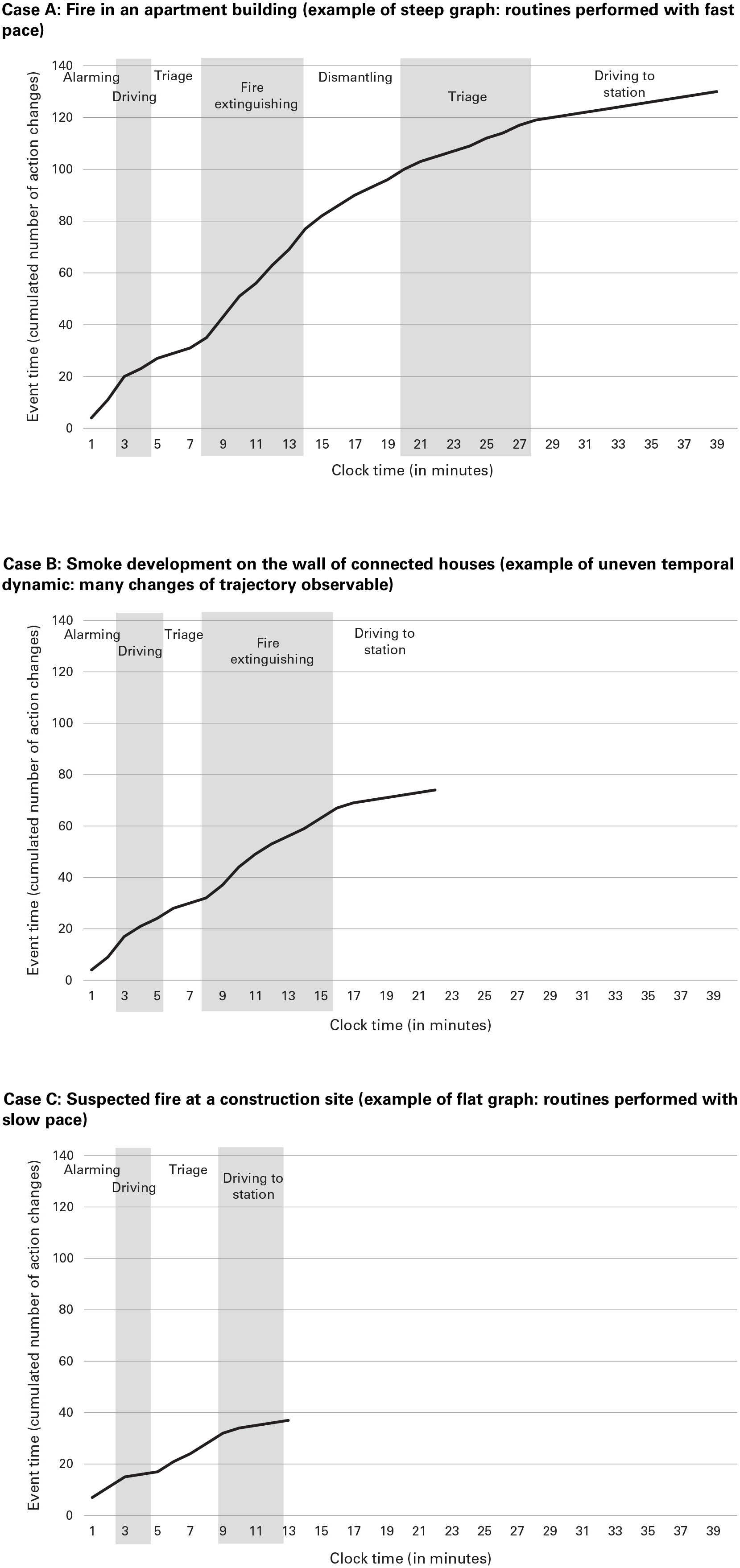
Comparison of Three Different Deployments All Triggered by a Fire Alarm
The idiosyncratic nature of the event-clock-time graphs indicates that these deployments were not incrementally entrained to any external, stable zeitgeber. We would expect deployments of a similar type to have a typical temporal pattern, with operations being oriented toward a schedule developed over the course of multiple such deployments (see Turner and Rindova, 2018). Instead, firefighters repeatedly expressed during our interviews, as summarized by a team leader, that “each operation is very different from the preceding one. You can never know what to expect.” Their main challenge—expressed regularly during conversations—was “to get ahead of time.” As a firefighter at the Hamburg Central station said, “We need to be in a position to know what might happen in the next 20 minutes and act accordingly.” Getting ahead of time means that firefighters wanted to avoid being forced to react to an evolving situation hastily and without proper preparation. Instead, they wanted to control the situation such that they were always well prepared to adapt to uncertain and changing elements. As another firefighter at Hamburg Central told us: The worst is if you run behind, then you lose grip of the situation and focus. . . . All our efforts are geared towards getting ahead of time—we need to be in control and know what happens next.
In our effort to uncover how firefighters got and stayed ahead of time, the significant changes revealed in the event-clock-time graphs became central to our analysis; as seen in Figure 1, these changes occurred at the transition points between routines. This led us to focus on different types of temporal patterning within versus among routines. Our findings for performing routines under temporal uncertainty show that firefighters were focused on getting the timing of actions right to accomplish temporal coordination between the actions within a routine and getting the timing of outcomes right to accomplish temporal coordination among routines.
Temporal Patterning within Routines: Getting the Timing of Actions Right
In performing a specific routine, firefighters’ main concern with regard to temporal coordination was to get the timing of actions right. To achieve this, they had to confront a dual challenge. First, each firefighter needed to time his actions so that they were in sync with the actions of others in order to collectively accomplish an operative task with high reliability. The situation did not allow for misunderstandings or lengthy negotiations between firefighters. As a team leader explained, “When we are operating, there is no time to figure out and discuss how to do it. Everyone needs to know what needs to be done, and I have to rely on my staff here.” Second, firefighters usually operated in chaotic, loud, and even overwhelming situations. Remaining focused was paramount to avoid danger and collaborate effectively. As a leadership coach expressed, “At first, we need to avoid getting overwhelmed by what is happening. Imagine everyone running around like headless chickens—this would make things even worse.”
Firefighters tackled this dual challenge by what we call rhythmicizing their routine performances: they performed routines with a characteristic rhythm. By comparing the performance of the same routines (e.g., fire extinguishing) across multiple operations, we found that they were often performed with a typical rhythm, i.e., the form of the event-clock-time graphs was very similar. For example, the fire-extinguishing routine usually started at a fast pace and then gradually became slower throughout the course of the routine. Other routines revealed a different typical rhythm. Alarming and driving were usually characterized by a continuous rhythm, as they were enacted at a pace that remained rather stable throughout the entire performance; see Figure 2, which shows straight lines in the event-clock-time graphs for these routines. The typical rhythm for a routine was not always accomplished consistently, i.e., the graphs sometimes differ. But firefighters said in interviews that they had a clear intention of sticking to a particular rhythm once a routine performance started. One team leader told us: You might notice how we all align: It is like a clockwork. . . . No one decides to take a break or take it easy while we are firefighting or while someone else is rushing like mad. It all works hand in hand, and we do not change this during performance. If you see someone running or shouting, it is usually a bad sign because it means people are out of sync. . . .
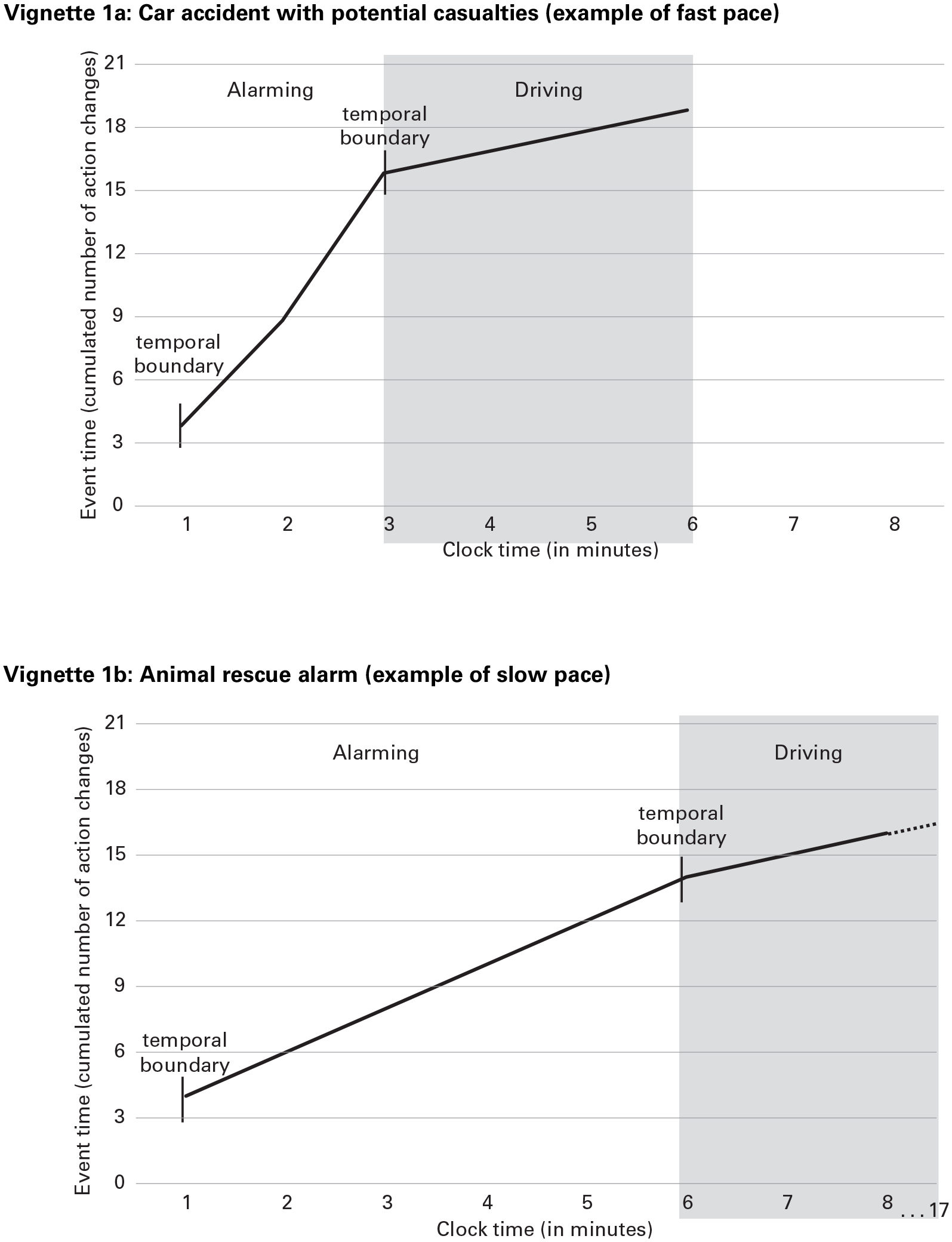
Performance of Temporal Boundary to Set the Pace of Routine Performance
The fact that the rhythm of these routine performances was accomplished not in a factory hall but in the often highly turbulent environment of a firefighting deployment is important. This clearly indicates that the temporal structure of these routine performances was the result of effort, yet this accomplishment cannot be properly understood as entrainment to an external zeitgeber. Instead, we found that rhythms of firefighting routines were established during trainings; learning to stick to a particular rhythm was an important element we observed in the training of cadets. During training sessions, firefighter instructors tried to ensure that cadets trained to perform routines in different circumstances. As a leadership instructor said: Once we start extinguishing a fire, everyone knows what that means and how it is accomplished; that is how they are all trained. . . . And once we have started this, everyone involved knows what the other one does, how and when—this is well trained. It feels like a well-oiled machine. . . . We cannot start debating how fast we should act and how this is done in the face of the event. . . .
Particularly, the danger that someone could get distracted and out of sync with the others was a central issue we saw addressed in all the trainings. As a fire-extinguishing instructor explained: The most difficult thing is not to get distracted by all the things happening around you while you work. And you often observe in the trainings, one can get lost in all the chaos around. That must be avoided at all costs; therefore, we design these complex scenarios so that they learn this in a realistic way. Otherwise we will get out of sync and the entire operation would collapse.
Sticking to a well-trained, pre-established rhythm in the performance of each individual routine enables firefighters to get the timing of actions right. During the performance of a routine, firefighters usually had an inward focus because all their efforts were geared toward remaining in sync with the others while avoiding getting distracted by their surroundings. A team member told us: When I am for example extinguishing a fire it all feels like in a tunnel. You hardly notice what is going on around you . . . sometimes, after really stressful deployments you later look back and do not really remember what you have done. . . . I guess it is a sort of autopilot thing.
Temporal Patterning among Routines: Getting the Timing of Outcomes Right
While getting the timing of actions right required an inward focus to avoid getting distracted by the unfolding situation, the operation as a whole could not be detached from that situation. Therefore it was also critical that the timing of the outcomes of routine performances, such as having arrived at a deployment site or having rescued a person, fit the timing of other routine outcomes as well as the temporal characteristics of the situation. A team member said: Of course, we have to adapt to the situation and act accordingly. We need to be at an incident before people are in serious danger or before the fire has burnt down the entire structure and caused significant damage.
Getting the timing of outcomes right required a different approach from getting the timing of actions right. The main challenge was that the temporal character of the deployment as a whole was unclear ex-ante and could change midway, i.e., there was high temporal uncertainty. As a leadership instructor explained, “So, of course we have to decide on site what to do. You cannot sit in the office and plan that in advance—that’s what makes it so challenging, but also exciting.” Our analysis reveals that firefighters got the timing of outcomes right mainly through performing temporal boundaries during transitions between routines. In what follows, we demonstrate how the performance of temporal boundaries involved signaling behaviors that were oriented by the experience-based interpretation of temporal cues. These signaling behaviors established shared “expectancy frameworks” (Patriotta and Gruber, 2015) regarding the pace and the temporal order of routines.
Performing temporal boundaries to set the pace of routine performances
One important purpose of performing temporal boundaries was to adjust the pace of routine performances to the unfolding situation. Deciding on the pace was key because acting faster—enacting routines with higher average pace but in the same well-trained rhythm—means that firefighters take more risk to accomplish a certain outcome faster. We found that shared expectations about the appropriate pace of a specific routine performance were often established by a preceding boundary performance. Vignette 1a provides an example of the performance of a temporal boundary resulting in a very fast-paced performance of the alarming routine. 1
Vignette 1a (see Figure 2): Alarm message: THX-Y, Ferbacher Straße 34: Car accident, 22-KLF, 22-HLF, 22-TMF At 06.25 p.m., the team of ten firefighters had just sat down in their common room for dinner. Performing the boundary: Suddenly the alarm went off. All trucks were alarmed simultaneously. Once this alarm went off, all ten men immediately dropped their cutlery and jumped off their seats, leaving their dinner untouched. Performing the alarming routine: Firefighters ran down the stairs to the garage where the trucks are parked. In the garage, they all quickly wore their protective gear, which was hanging next to the fire trucks, and mounted their vehicles. On his way down, the team leader passed the computer terminal in the stairway and took the alarm message from the printer; it listed the cause of the alarm and where the incident was located. He quickly read over it while he put on his gear and jumped into the lead fire truck.
In this example, performing the alarming routine took the team two minutes from the time they recognized the alarm until they left the station; their pace or average rate of action was 6.0. Vignette 1b provides a contrasting example in which the alarming routine was performed at a considerably slower pace; in this instance, it took the firefighters five minutes to perform, so their pace was 2.0.
Vignette 1b (see Figure 2): Alarm message: TIER, Ifflmanstraße 35, cat on rooftop, 22-TMF At 03.24 p.m., while the firefighters were playing soccer together, the alarm went off. Performing the boundary: The indicator lights signaled that only one truck and its crew were actioned. All men briefly looked at the indicator lights in the soccer room, and those who were not actioned simply continued the match. The crew that did get alerted still continued passing the ball to their team mates, after which they left the soccer room without haste. Performing the alarming routine: While the team members were walking into the garage, the team leader passed the computer terminal and took the alarm message from the printer. The men then started to undress, taking their sweaty sports shirts off and putting fresh shirts on. They then put on their protective gear while continuing to talk about the match and having fun with each other.
Comparing these two vignettes shows that the alarming routine was performed at quite different paces. We found that different temporal cues triggered different signaling behaviors during the observed boundary performances. In Vignette 1a, the headquarters alerted all trucks at once and the firefighters immediately dropped everything, whereas in Vignette 1b, only one truck was called in and the firefighters took more time to respond. As we learned during interviews, differences in the alarming signals gave firefighters cues that influenced the immediacy of their collective reaction and the pace of the subsequent alarming routine. As one team leader told us: From the indicator lights you already get an idea of how urgent the case might be. If all trucks are alerted, it is a more serious issue than if only one truck is alerted—which is usually the case in situations of technical assistance.
We also learned that firefighters did not always drive as fast as possible to the incident but varied the pace of the driving routine to fit the perceived urgency of the situation. The signaling behavior most relevant during the respective boundary performances involved the team leader reading the alarm message to his team members. The alarm message (i.e., the cue) contained a large amount of new information in a highly compressed form. It included a code indicating the nature of the emergency (fire, technical assistance, chemicals, biological, nuclear, etc.) and whether persons were endangered, the location of the incident, a numerical code for the fire station (e.g., 22), and a code for the truck, (e.g., HLF). This information was used to select an expectancy framework with regard to the pace of the routine performance. As a team leader clarified: Once I have seen the alarm message, I have a good sense of how urgent it actually is. We all have some sort of checklist in our minds like: Are there potential casualties? Is the entire unit alerted? Is it an automatic fire alarm system in a building from which we know often triggers false alarms? And so on. . . . And this, of course, influences how fast we act and how much risk we take in driving to the incident. In non-urgent cases, we avoid endangering the public and ourselves.
As with the alarming and driving routines, the pace of most routine performances was set during boundary performances that relied on cues to select preexisting temporal expectancy frameworks. Table B6 in Online Appendix B provides additional examples of pace and the respective temporal cues identified during the analysis.
Performing temporal boundaries for temporally ordering routines under high temporal uncertainty
Performing temporal boundaries was also important to establish collective expectations about the temporal ordering of routines, i.e., which routines to enact when. As with the above examples, this involved signaling behaviors that were oriented toward environmental cues and energized pre-established temporal expectancy frameworks. Our analysis revealed that expectations regarding the temporal ordering of routines were related to the degree of perceived temporal uncertainty. High levels of perceived temporal uncertainty usually resulted in the performance of one routine at a time, whereas low uncertainty apparently allowed for parallel routine performance at the same time. We start with reporting the results of our analysis for situations characterized by high levels of temporal uncertainty, i.e., a high risk of an unexpected event that could affect the necessary temporal ordering of routines.
Specific temporal cues were associated with perceptions of high temporal uncertainty. First, the team leader would usually perceive the temporal uncertainty to be high after arriving at the incident. As a leadership instructor from the firefighting academy explained: From the alarm message, you only get a rough idea of what is going on; you need to assess the situation yourself. This takes time but is a good investment. After the triage, you can start with a structured approach and deal with your forces [the men] in an efficient way. If you start just doing something and then realize that you have to rebuild your operation, you would lose out on far more time.
A team leader confirmed this in an interview: First, I need to assess the situation to know what’s going on; only then I can give informed orders. I do not really know what’s going on before I have seen it myself.
A second cue related to perceptions of high temporal uncertainty was when any civilian got embroiled in a potentially life-threatening situation. As one firefighter said: The worst case for us is to search for victims and have them rescued. We are under severe time pressure, and we are actually running behind. . . . It is a feeling of having lost control of events. Only once we have rescued them are we back in the driver’s seat.
Even the chance that someone could be in danger was enough for firefighters to perceive a situation as highly uncertain. A leadership instructor asserted: You should not feel safe and relaxed too early. We train our cadets to be mindful that unexpected events, like missing persons, can occur almost anytime and require their immediate attention.
As a consequence, most deployments were perceived as highly uncertain, especially during the beginning of an operation and during critical actions like extinguishing a fire or rescuing the victim of a car accident.
In situations perceived as highly temporally uncertain, we usually observed temporal boundary performances that signaled the expectation that routines ought to be performed one after the other. Vignette 2 provides an example.
Vignette 2 (see Figure 3): Alarm message: FEU1, Wandsbeker Straße 42, 2.floor, smoke visible on window, 22-KLF, 22-HLF, 22-TMF Afternoon in the fire station Hamburg Central: Firefighters had just come back from their after-lunch nap and were exercising in the gym or watching TV. At 04.13 p.m. the alarm went off . . . Performing the boundary: . . . with all indicator lights flashing; the alarm message stated a so-called Fire 1 incident, which indicates small fires in apartment buildings with no suspicion of potential human casualties. Performing the alarming routine: Firefighters were quickly running down the stairs; they put on their gear and boarded the trucks. Performing the boundary: Upon boarding the trucks, the team leader summarized the alarm message to his team members: “It is a Fire 1 alarm with visible smoke, so we might get something to do actually.” With signaling lights and sirens switched on . . . Performing the driving routine: . . . the ten firefighters drove to the incident. In the truck in which we were sitting, two members of the attack team started putting on their respiratory devices; all others were quiet. Upon arrival one could see thick smoke coming out of a window in the second floor of an apartment building. The drivers parked the trucks. Performing the triage routine: Next, only the team leader left the truck, while all other nine men remained in the trucks actually doing nothing. Firefighters remained on their seats, not talking, most of them not even looking at the scene, just waiting for the team leader to return. After about 4 minutes, the team leader returned to the trucks. The team leader instructed the men to exit. All men then gathered behind the HLF truck . . . Performing the boundary: . . . and the team leader—in a calm voice—started to instruct them. He first gave them a small briefing on the situation (looming fire in an apartment on the second floor, no missing persons) and then gave his orders. “Team attack 1: look for the fire hydrant, extinguish fire with c-hose. Team support: you lay out the hoses. Team attack 2: you also mount your respiratory devices and provide support in fire extinguishing with the c-hose. Team ladder: you help in preparing the hoses and function as a safety team, and monitor the oxygen supply.” Performing the fire-extinguishing routine: Only after having heard these orders did the men actually start performing the fire-extinguishing routine in the way it had been prescribed by the team leader.
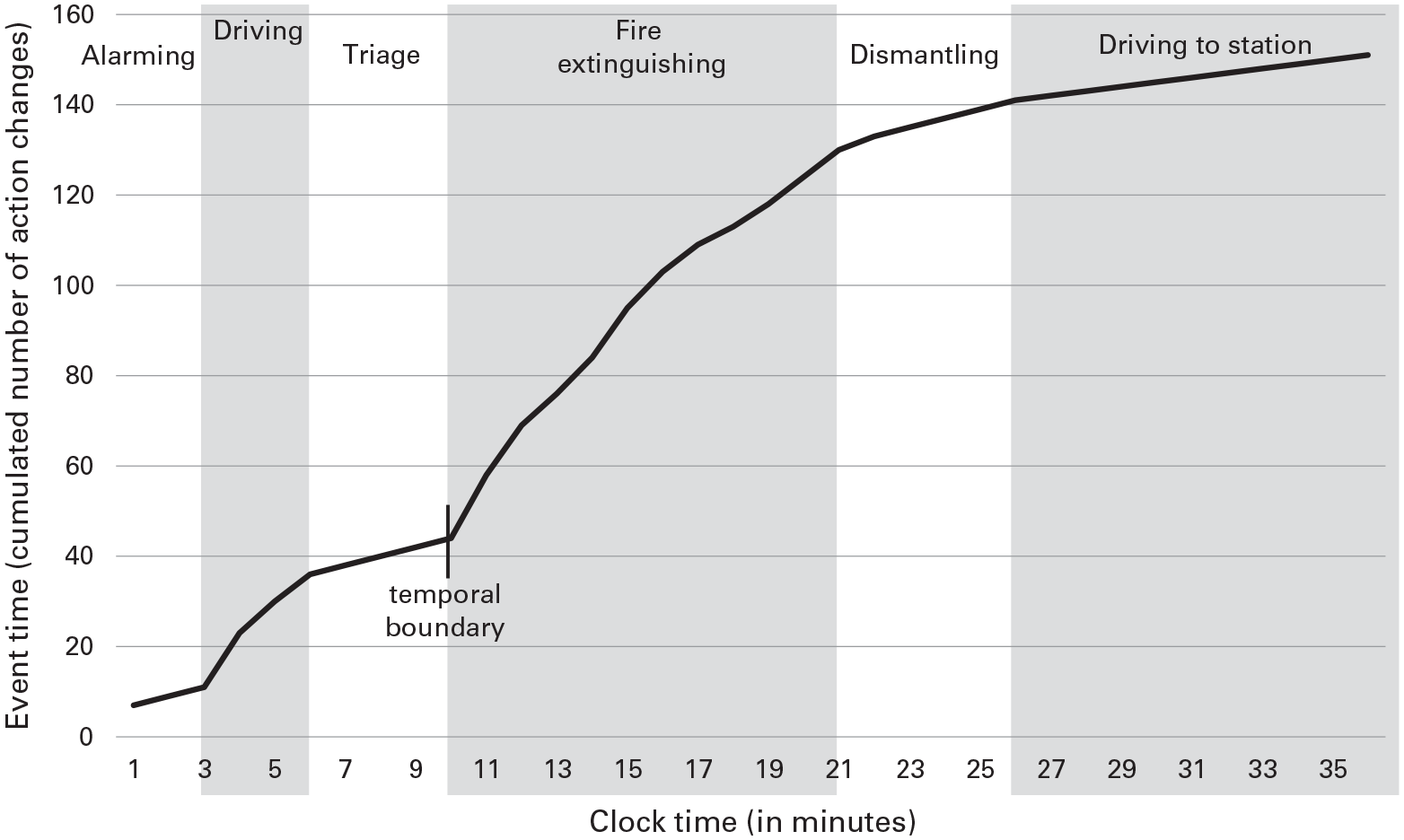
Performance of Temporal Boundary to Set the Temporal Order of Routines under Conditions of High Temporal Uncertainty (Triage, Then Fire Extinguishing)
From this vignette and Figure 3, we get an impression of the temporal ordering of routines we observed during periods with high levels of temporal uncertainty. Vignette 2 also illustrates the role of the triage routine for establishing the temporal order in which routines have to be performed. Right after having arrived at the incident, the temporal uncertainty was perceived to be very high—from the firefighters’ perspective, a critical event could happen any time. Performing the triage routine had the primary purpose of collecting enough information to establish which routines would likely have to be performed in which order to successfully complete the deployment. To accomplish this, the team leader first assessed the magnitude of the fire, found places where the attack teams could enter, and scanned for any potential victims. In the meantime, all his men simply waited for him to return to the trucks with orders. Only after having performed the triage routine was the team leader able to perform the boundary for temporally ordering routines. He did so by instructing his team to prepare the hoses, begin extinguishing the fire with a c-hose from the entrance, and have a safety team outside. This activated a shared expectancy framework among the firefighters on when to do what. As this team leader explained, “In the triage I try to understand the situation, and from this, I lay out what to do next and how.”
As Vignette 2 and Figure 3 reveal, under conditions of high temporal uncertainty, firefighters were usually starting and completing routine performances together, at the same time. Firefighters jointly terminated the performance of one routine before starting the next one together at the same time. This synchronized starting and ending of routine performances was actively enforced, as our data from observing training sessions revealed. For example, cadets sometimes left the truck immediately after arriving in an attempt to start performing a routine without waiting for the triage routine to be completed. In all such cases, the instructor intervened immediately to actively discourage this action, sending cadets back to the trucks. Learning to suppress the impulse to start acting immediately after arriving was an important part of these training sessions. In an interview, a leadership instructor explained: So we rather let them all wait in the truck until we have an overview and know what to do and how. This is sometimes difficult to understand for outsiders; they sometimes knock on the door and ask if we are on a lunch break. . . . But it is not that, we need a structured approach.
Jointly starting and completing the performance of routines under high uncertainty was an important precondition to get the timing of outcomes right. It created a window of opportunity for boundary performances at the transition moments between two routine performances. The performance of temporal boundaries, in turn, was an important basis for the firefighters’ collective capacity to get the timing of outcomes right and quickly adapt the operation as a whole to the situation without losing the capacity to perform any single routine highly reliably. The importance of starting and finishing simultaneously in these situations was expressed in an interview with a team leader: From when we drive to the incident, it is very important for me that all the trucks stay behind each other and we do not lose each other in the traffic. I want us to arrive at the same time. And this carries on; we only start acting after I have performed the triage, and we also leave for home together and so on. . . .
Vignette 2 also emphasizes the importance of the team leader’s role in temporally ordering routines. The team leader is the only team member with the formal authority to select and—if necessary—change the respective expectancy frameworks during boundary performances. A team leader said: Only I can give orders and, thus, alter things here. Imagine if everyone could do that—it would lead to chaos. It is some sort of military style in which we are trained and which is followed. They all look at me and listen to me. Discussions only happen after we are back at the station.
Because the team leader was usually visible or in radio contact with all his men, he could quickly change the temporal expectancy framework for the entire team. This capacity was strengthened by the digital radio technology the firefighters used, which enabled the team leader alone to send radio messages to all team members at once. Other members could talk only to the team leader; their messages would not be heard by the others. An instructor at the firefighting academy noted: The introduction of the new digital radio technology was a breakthrough. Now, not everyone can talk to everyone, which was prone to create misunderstandings; instead, only the team leader is able to send messages to all team members at once. This really avoids chaos on site.
Quick adaptations of the temporal expectancy framework through the team leader’s boundary performances were particularly important for firefighters to be able to respond to unexpected events because this sometimes even demanded a sudden temporal reordering of the operation, as Vignette 3 illustrates.
Vignette 3 (see Figure 4): Alarm message: FEU2, Alsterfleet 2, fire in large warehouse, KLF, HLF, TMF As part of the training, instructors were simulating a fire in a warehouse which was rebuilt, in full scale, on the training ground and could be filled with smoke to simulate fires. The team called in to respond to the fire did not know what to expect before they arrived at the scene since the exercise was aimed to replicate real cases as closely as possible. At 8.24 a.m., the instructor Mike sent out the following alarm message via radio: “Fire 2 (indication of a medium fire without any suspected casualties) in a large warehouse building on Alsterfleet number 2.” Performing the boundary: The team leader Sven confirmed that he received the message and instructed his unit—consisting of two fire trucks and a turntable ladder—via radio to drive to the incident, informing them about the cause of the alarm and the address. Performing the driving routine: Firefighters boarded the truck (as they already had the gear on) and started the short drive to the warehouse on the training ground. Performing the triage routine: Upon arrival, the team waited inside the trucks until Sven returned from the triage. Performing the boundary: Sven instructed his team members to start fighting the fire and enter through two entrances. Performing the fire-extinguishing routine: Following his orders, the operation unfolded and the two attack teams entered the building to extinguish the fire. One team consisting of two firefighters entered from the front; one team of two entered the building on the first floor using the turntable ladder. Since both teams entering the building were using respiratory devices and no casualties were suspected, another team of two waited outside the building as a safety team tasked with the rescue of an attack team in case of an emergency. This team was also monitoring the respiratory devices. Unexpected critical event: While the operation seemed to be unfolding in quite a normal and safe fashion, a man ran out of the front door of the burning warehouse all of a sudden, coughing and shouting for help. Performing the boundary: Sven immediately noticed the man and instructed his assistant Joe to approach the man and take care of him. The man asked Joe if they had seen his colleague Steve who was working with him inside the warehouse. Joe denied and reported the same to Sven: “Another man is suspected to be inside the warehouse and is missing.” Following this, Sven started to act immediately and gave the following order via radio: “There is a missing person inside the building. We switch from fire extinguishing to rescuing. All attack teams start searching for the missing person. Support team 1, enter the building and assist in search efforts.” Upon this command, the entire scene changed dramatically. Performing the searching and rescuing routine: Support team 1 prepared additional water hoses to enter the building to search for the missing person, whereas support team 2 ran to their truck and prepared a patient area to treat the possibly wounded victim. Sven reported back to central command about another man missing and that an additional ambulance and emergency staff would be needed on the scene. Then he started to monitor the ongoing actions by running from team to team, checking what each was doing. Joe took care of the first man by checking for any symptoms of smoke gas intoxication. After a while, the first attack team escorted the missing man out of the building through the front door. They quickly brought him to the patient area where he was examined by one of the firefighters. Performing the boundary: As Sven saw that the second man had been rescued, he gave the following order: “We have found the second man, no more missing persons. As you see there is still fire and smoke developing inside the building, so attack teams continue to extinguish the fire.” Performing the fire-extinguishing routine: The teams, who by now were outside the building, re-entered the warehouse with c-hoses and continued extinguishing the fire.
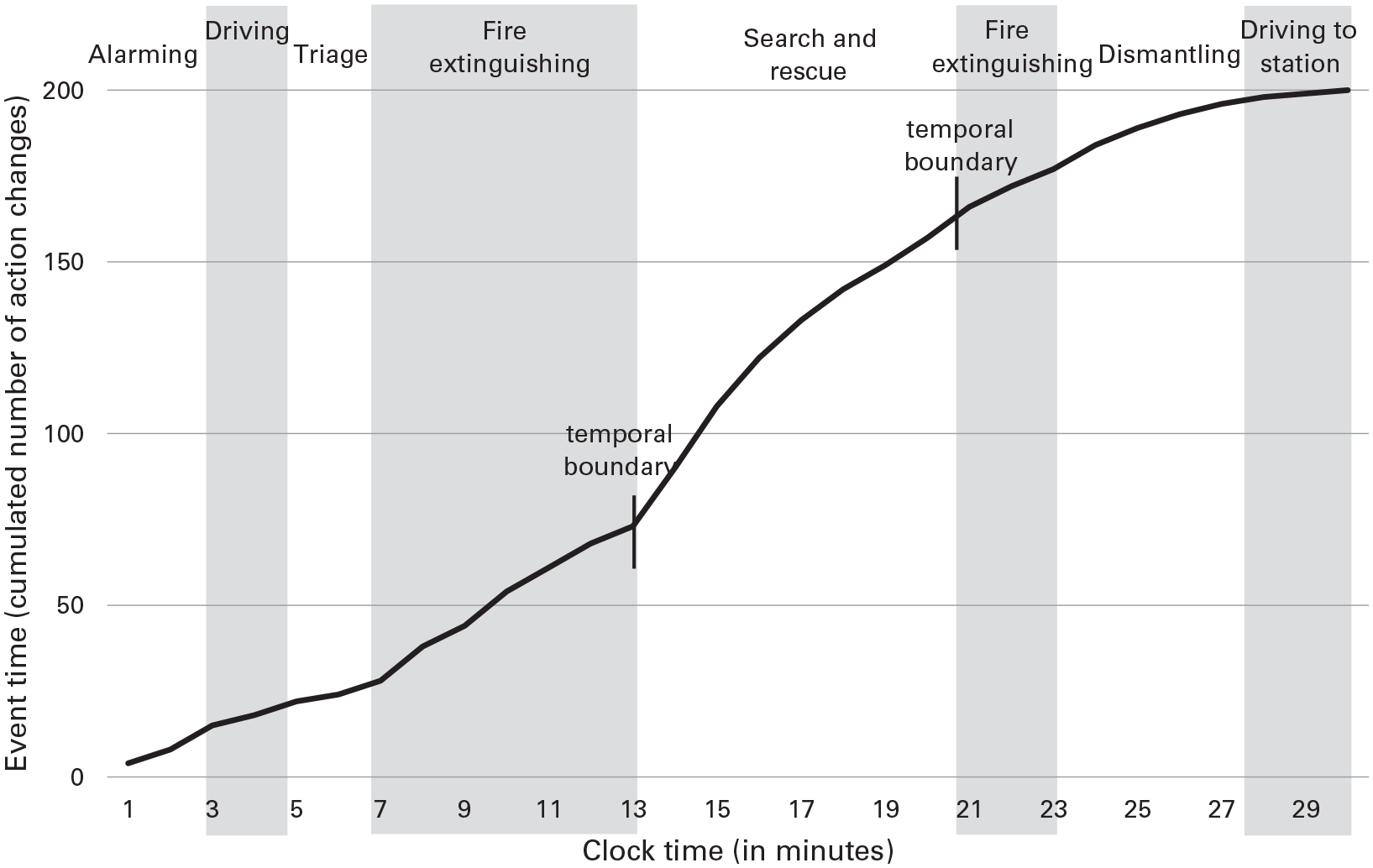
Performance of Temporal Boundary to Set New Temporal Order of Routines in Response to an Unexpected Event (Switch from Fire Extinguishing to Search and Rescue and Back to Fire Extinguishing)
This vignette illustrates the most important advantages of performing only one routine at a time under high temporal uncertainty. First, it supported firefighters in getting the timing of outcomes right by regularly creating windows of opportunity for performing temporal boundaries. Second, performing only one routine at a time has the advantage that when one routine is interrupted, switching to another is comparatively easy. In this case, it did not require complex and lengthy efforts to bring multiple different performances to a halt and re-pool forces so that firefighters could collectively start the search and rescue routine. As the team leader from Vignette 3 explained: You could see how fast we were switching from fire extinguishing to search and rescue. Since we all do the same thing, we can easily switch to something new upon my order. I do not need to see who does what and how to reassemble this. . . . No need for lengthy instructions and discussions.
But performing only one routine at a time also has an important downside. As illustrated in Vignette 2, such a temporal order can mean less efficient use of firefighters’ time and resources, as individual team members sometimes have to wait to start the performance of the next routine together. As one team member told us during an operation: See, currently I have nothing much to do. I simply wait for the others to finish what they are doing. So being able to wait is actually an important part of this job—you might have realized this by now.
As enactment of only one routine at a time means a less efficient use of resources, we observed that firefighters sometimes decided, under conditions of low temporal uncertainty, to enact multiple routines at one time. We describe this next.
Performing temporal boundaries for temporally ordering routines under low temporal uncertainty
Under rather specific circumstances, firefighters perceived the temporal uncertainty to be comparatively low. The environmental cues usually interpreted as signals for a low level of temporal uncertainty were when the area of operation was pretty isolated from other infrastructure (e.g., a relatively deserted industrial area) and when they had reports from people working at the site that no missing persons or other dangers (like explosive chemicals or gas) were to be expected. Vignette 4 illustrates such a situation.
Vignette 4 (see Figure 5): Alarm message: FEU2, Gartenstraße 15, smoke reported in warehouse, 22-KLF, 22-HLF, 22-TMF Early morning in the fire station: At 4.28 a.m., when all firefighters were in bed sleeping . . . Performing the boundary: . . . the entire unit at the fire station Hamburg Central consisting of two fire trucks and a turntable ladder got alerted to a so-called “Fire 2” (level 2 fire). Performing the alarming routine: Firefighters jumped out of their beds, ran down the stairs, and put on their gear very fast, although still tired. Performing the boundary: The team leader said: “It is a fire 2 in Gartenstraße large warehouse. This is huge.” Performing the driving routine: All trucks left the station with signaling lights on, rushing to the site which was easy due to low traffic at this time of the day. After arriving at the warehouse, one could already see heavy thick smoke coming out of the front door. The building was part of a larger structure with multiple warehouses. Performing the triage routine: Stefan, the team leader, exited the truck while the others waited inside. Thereafter, Stefan ran into a man who worked at the warehouse and asked him if he was aware of any missing colleagues or others who might still be in the building. The man replied that this early in the morning, only he was usually around. Stefan instructed Luke the assistant to take care of the man while he performed his triage, particularly looking for entrances into the warehouse. The worker told him that the warehouse had two main gates: one in the front (which they could see), and a similar one in the rear. Stefan then ordered the team members to exit the trucks and gather behind the KLF [truck]. Performing the boundary: He issued the following order, “As you can see, we have a full-scale fire here. So far, no suspected missing persons. We need to split the operation and establish two independent sections, one operating from the front side of the warehouse where we are, and one from the rear. There is an entrance similar to this one and we can go in from there as well. Team turntable ladder, you are assigned to use the entrance on the back side. Tim and John from HLF, you support them. The rest enter the warehouse using c-hoses from the front side. Safety teams are in order for both entrances.” Simultaneous performances of fire-extinguishing routines: After the orders had been given, the team operating at the front entrance repositioned the truck to be closer to the entrance after which they started to prepare the c-hoses, whereas the turntable ladder team boarded their truck and drove to the rear of the warehouse. While the attack team and support team operating on the front side prepared the hoses and water supply, the team at the back parked their truck close to the water distribution point. Next, the attack team at the front side entered the warehouse through the front door carrying the c-hose while the support team waited on standby outside and monitored the respiratory devices. In the meantime, the teams operating at the rear side put on their respiratory gear and prepared the c-hose. While the attack team operating from the front entrance was already inside the warehouse, the attack team working from the rear also entered the building through the back door carrying a c-hose, with their support team waiting on standby outside also monitoring the respiratory devices. While the attack teams were inside the warehouse, Stefan walked from the rear to the front, monitoring the situation without giving any further instructions. In the meantime, Luke spoke with the warehouse worker. One could see that the smoke coming out of the front door was getting whiter; after a while white smoke also came out from the rear side. First, the attack team operating on the back side came out of the warehouse, stating that the fire was out and that they had seen the other team working from the front also leaving. Performing the boundary: Shortly after, the front team also came out of the door, reporting “fire out.” Following this report, the team leader issued the order “Termination” via radio. Performing the dismantling routine: After this order, the team operating at the rear immediately started to roll in the water hoses and load the equipment onto the truck. The team that was operating from the front did the same once they had left the building. Performing the driving to station routine: Immediately after all teams had finished loading the equipment onto the trucks, they drove back to the station together—without signaling lights on.
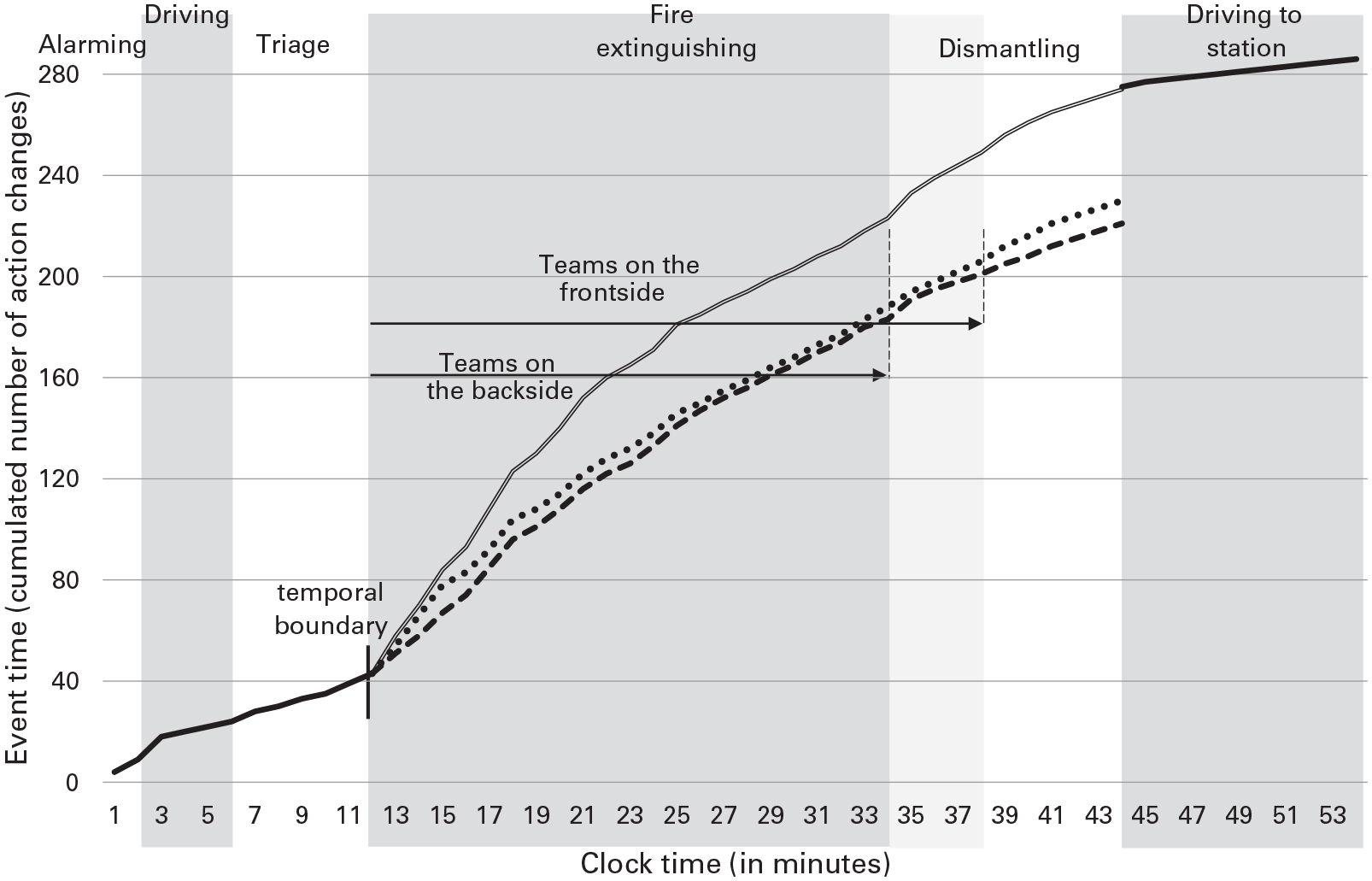
Performance of Temporal Boundary to Set the Temporal Order of Routines (Simultaneous Performance of Two Fire Extinguishing Routines under Conditions of Low Temporal Uncertainty)*
Comparing Vignette 4 with Vignettes 2 and 3 indicates that we observed different temporal “patterning dynamics” (Goh and Pentland, 2019) under conditions of high and low temporal uncertainty. Under conditions of high temporal uncertainty, routines were performed one at a time. This enabled a comparatively easy switching between routines and thus adaptability to unexpected events, but at the cost of not making the most efficient use of resources. When temporal uncertainty was perceived to be low, we saw a different temporal order: a simultaneous performance of routines that was meant to increase the efficiency of the entire operation, as Stefan explained: Working with two teams simultaneously significantly helps to fight the fire more effectively. We only do this if everything is going smoothly and we are quite certain that the situation is under control and risks are low. . . . As you have just seen, we could enter the warehouse through two points; we always look for this, you know, if we have the time and do not need to rescue first. Here it allowed me to easily split the operation into two units, as we call it, and work on each unit independently. As you have seen, this speeds up the entire operation, and every man is busy. Otherwise, I can use only half of my men effectively, but in those situations we can reposition and put everyone in action. . . . Here we were in full action. . . .
However, our analysis also shows that the simultaneous performance of routines comes at a price. It opens up their operation to temporal contingencies because it becomes significantly more difficult to switch between routines to respond to unexpected events. As is visible in Figure 5, in a case of parallel routine performances, teams were not starting and ending routine performances together as each unit operated independently. A leadership instructor explained: What we call working in separate units is good because we make efficient use of resources. But these more complex operations are also more difficult to change if something happens. . . . Every unit just works on its own . . . this is clearly a risk we sometimes take.
Thus our data suggest that temporal uncertainty is a critical factor in the dynamics of temporal patterning. The higher the temporal uncertainty of the situation, the greater the efforts to accomplish what we call temporal autonomy: the temporal patterning of multiple routines in such a way that each single routine performance is actively shielded from temporal contingencies, while the operation as a whole remains adaptive to the unfolding situation.
Unpacking Temporal Patterning Mechanisms
In this paper, we set out to analyze how temporal coordination within and among routines can be accomplished under temporal uncertainty. Temporal uncertainty confronted the Hamburg firefighters with situations that were unknown ex-ante, could change at any moment, and needed to be resolved as quickly as possible. An analysis of the event-clock-time graphs of their deployments supported our initial assumption that the observed “patterning dynamics” (Goh and Pentland, 2019) were not the result of an incremental and situated temporal structuring process. Instead, the idiosyncratic shapes of these graphs pointed us to the temporal autonomy of the deployments. Hamburg firefighters accomplished temporal autonomy—they got ahead of time—with two different temporal patterning mechanisms.
The example of the fire-extinguishing routine showed that within routines, firefighters accomplished temporal autonomy mainly through rhythmicizing routine performances. Doing so enabled the firefighters to get the timing of their actions right and perform like a “well-oiled machine” even in chaotic and uncertain circumstances. We know from previous research that rhythmic performances enable actors “to pace their work, synchronize their energies with one another, and ultimately get into a ‘flow’” (Brown and Eisenhardt, 1997: 24; see also Warner, 1988; Ancona and Chong, 1996; Cunha, 2009). Extending this argument, our example suggests that by getting people into the “flow,” rhythmicizing routine performances also prevents actors from getting dragged into the potentially life-threatening chaos of an unfolding emergency situation. It fosters an inward orientation of the performing actors and thereby shields the routine performance from temporal contingencies. In contrast to the predominant explanations for such rhythms—entrainment to a powerful external pacer or zeitgeber (e.g., Ancona and Waller, 2007; Shi and Prescott, 2012) or the creation of a new rhythm during time-consuming collective negotiation processes (Salvato and Rerup, 2018)—we find that they were established upfront during training sessions. That is, the rhythms of routine performances observed during deployments emerged in “experimental spaces” (Bucher and Langley, 2016), isolated from the temporal uncertainty of real deployments. A certain degree of temporal independence of the routine performances was established this way, illustrating that it can be crucial for safe and effective operations to strive for a certain degree of independence from what often presents itself as a chaotic and uncontrollable situation.
But temporal autonomy should not be confused with complete autarky. It was crucial for the firefighters to remain adaptive to a variety of unexpected yet critical events. Against the background of the rhythmic performances of single routines, firefighters were able to get the timing of outcomes right through performing temporal boundaries during transitions between routines. Boundaries have only recently started to attract the attention of routine scholars. Initial studies illustrate their relevance to both change (Bucher and Langley, 2016) and interdependence (Kremser, Pentland, and Brunswicker, 2019), and we extend this nascent line of research with a focus on issues of temporal coordination of routines. We find two prevalent purposes for performing temporal boundaries during firefighters’ deployments: setting the pacing of routines and setting the temporal order of routines. Others have established that the performance of temporal boundaries is generally accomplished through signaling behaviors (Kremser, Pentland, and Brunswicker, 2019). We find that in our context these signaling behaviors (1) often came from a designated actor—the team leader. These behaviors (2) activated preexisting temporal “expectancy frameworks” (Patriotta and Gruber, 2015), which had been shared during training sessions, and (3) were selected (often by the team leader) based on the experience-driven interpretation of environmental cues. Our findings suggest that these three characteristics of temporal boundary performances played an especially important role in enabling the Hamburg firefighters to get the timing of outcomes right under temporal uncertainty.
Emphasizing the critical role of temporal uncertainty in coordinating multiple routines, we also observed different “patterning dynamics” (Goh and Pentland, 2019) for different levels of perceived temporal uncertainty. In highly uncertain situations, firefighters actively tried to reduce uncertainty through the performance of the triage routine and by performing only one routine at a time (Vignette 2). The sequential configuration of routine performances enabled them to adapt to sudden changes in a matter of seconds (Vignette 3). In situations that were perceived to be less uncertain (Vignette 4), firefighters also enacted more complex patterns, like the simultaneous performance of multiple routines, which made it possible to accelerate the completion of deployments.
Discussion
Our findings enable us to make three conceptual and methodological contributions. First, we contribute to research on temporal structuring by elaborating how organizations enact temporal autonomy under conditions of temporal uncertainty. Second, we introduce the notion of temporal boundary performances to routine dynamics studies. Third, we outline a novel way for visualizing and analyzing process data.
Contributions to Research on Temporal Structuring: Enacting Temporal Autonomy
As previous research on temporal structuring has demonstrated, people produce and reproduce temporal structures to coordinate their activities (Orlikowski and Yates, 2002; Patriotta and Gruber, 2015). But under conditions of temporal uncertainty, it is—by definition—impossible to entrain to “exogenous time-giving temporal patterns” (Rowell, Gustafsson, and Clemente, 2016: 312). And it is often not feasible to accomplish an appropriate timing of actions by engaging in time-consuming negotiation practices—an alternative approach scrutinized in previous research (Faraj and Xiao, 2006; Salvato and Rerup, 2018). Thus our study suggests that under temporal uncertainty, actors have to strive for temporal autonomy, rather than temporal fit (Pérez-Nordtvedt et al., 2008), to effectively accomplish temporal coordination within and among routines. As our findings show, temporal autonomy is accomplished through a combination of rhythmicizing routine performances and performing temporal boundaries.
These findings extend established insight on coordinating under uncertainty. Previous research has demonstrated how actors can adapt to critical yet unexpected events through improvisational action (Crossan et al., 2005), dialogic coordination practices (Faraj and Xiao, 2006), and organizational bricolage (Bechky and Okhuysen, 2011). Integrating event and clock time perspectives in our analysis enables us to add to these insights the important difference between routine performances and the performance of temporal boundaries. During routine performances, extensive dialogue or reflection could jeopardize the accomplishment of routine tasks under temporal uncertainty. In an environment with zero tolerance for misunderstandings and mistakes, this could lead to disastrous and life-threatening results (Klein, 2017). Firefighters’ primary concern was to protect routine performances from disturbances and to focus on the well-trained alignment of actions and actors (Danner-Schröder and Geiger, 2016), thus maintaining a typical rhythm. The important capacity to react to critical unexpected events could then be accomplished during transitions between routines. Our case shows that by performing temporal boundaries, actors can realign collectively held temporal expectations with the evolving situation without jeopardizing the reliability of routine performances.
Combining clock and event time perspectives on routines also allowed us to further extend the insights of Patriotta and Gruber (2015), who argued that clock-time-based expectancy frameworks, like newscast schedules, are important sensemaking resources that help actors integrate unexpected events into routine performances. In contrast to their case (which was a U.S. television station), the Hamburg firefighters could not make use of expectancy frameworks that were based on clock time only (i.e., schedules). Instead, we find that pre-established rhythms—which arise and become visible only at the intersection of clock and event time—can fulfill a similar purpose. Rhythmicizing routine performances created an expectable temporal pattern that helped the firefighters perform reliably under temporal uncertainty.
On the most general level, the results of our research support recent work that challenges established wisdom from the social entrainment theory. Analyzing long-term organizational-level dynamics of a German consultancy, Blagoev and Schreyögg (2019: 40) argued that “organizations temporally uncouple and thereby create a scope of choice to structure their temporality according to their own internal premises and goals. They are time-makers rather than time-takers.” Building on insights from modern systems theory and consistent with our empirical findings, this study highlights that organizations are in fundamental need of temporal autonomy: If an organization would respond to “environmental events that would befall it the minute they happen, it would have little chance to select its mode of reacting” (Luhmann, 1995: 186). In line with this, our analysis demonstrates how firefighters temporally uncoupled their routine performances by orienting toward pre-established rhythms. But temporal autonomy does not imply complete temporal uncoupling. At the same time, firefighters maintained their ability to quickly adapt to critical events. Performing temporal boundaries allowed them to selectively recouple their performances to specific temporal cues. By combining temporal uncoupling with selective recoupling strategies, firefighters gained temporal autonomy—the ability to temporally adapt to selected events—and thus avoided being caught up in a highly chaotic situation. The performance of temporal boundaries let them exercise choices about which environmental events they responded to and how. In uncovering these dynamics of enacting temporal autonomy, we contribute to a better understanding of “the micro-dynamics of temporal uncoupling” (Blagoev and Schreyögg, 2019: 45). Hence our study points to the relevance of performing temporal boundaries as a previously unrecognized temporal patterning mechanism in routine dynamics.
Contributions to Routine Dynamics: Performing Temporal Boundaries as a Patterning Mechanism
From a process perspective, boundaries in organizations are best understood as “sites of difference” (Abbott, 1995: 862). The notion of boundary work then refers us to the enactment of differences (Gieryn, 1983; Langley et al., 2019). Research on boundary work usually focuses on the enactment of differences between actors, for example, with regard to group membership (Abbott, 1988) or expertise and access to resources (Quick and Feldman, 2014). But a routine dynamics perspective generally focuses on actions, not actors (Feldman, 2016). The notion of routine boundaries therefore refers us to differences between actions and action patterns (Bucher and Langley, 2016). Performing a boundary establishes a new, different set of expectations for the routine performance(s) to come (Kremser, Pentland, and Brunswicker, 2019).
Our study adds to and extends insights on boundary performances by introducing the performance of temporal boundaries as a new patterning mechanism. In performing temporal boundaries, actors use different signaling behaviors to activate a preexisting temporal frame of reference for the routine performance(s) to come. Temporal boundaries are performed to help adapt the temporal pattern of routine performances to the unfolding situation. Notably, performing temporal boundaries differs from previously identified temporal patterning mechanisms of sequence- and timing-based patterning, wherein actors orient either toward clock or event time (see Turner, 2014; Turner and Rindova, 2018). Performing temporal boundaries can support actors in productively combining clock and event time through the activation of expectations about the pace, rhythm, and temporal order of routine performances. Performing temporal boundaries is also different from other patterning mechanisms identified in previous routine dynamics research, such as “reflective talk” (Dittrich, Guérard, and Seidl, 2016), “routine regulation” (Salvato and Rerup, 2018), and the creation of “experimental spaces” (Bucher and Langley, 2016). These more dialogical forms of regulating routines are less suited for performing multiple routines under conditions of temporal uncertainty because they require time-consuming negotiation processes (Salvato and Rerup, 2018) that are often not feasible in emergency situations.
Performing temporal boundaries is a previously unrecognized form of managing routines that helps us understand how routines can be temporally coordinated under conditions of temporal uncertainty. Using signaling behaviors to energize expectancy frameworks that are created outside of the temporal boundary performance (e.g., during training sessions) makes it possible to quickly yet reliably reorient actors’ attention toward a new collective frame of reference. Understanding the performance of routine boundaries also allows us to augment classic research on coordination mechanisms such as the standardization of work processes, outputs, or skills, and direct supervision (Mintzberg, 1979). It helps to illuminate the process of coordinating in action. In our case, this led us to insights on how specific expectancy frameworks are selected in practice, allowing us to better understand how firefighters actively deal with the temporal uncertainty of a specific situation. It also helped us to highlight important preconditions of effective boundary performances, like creating windows of opportunity through starting and stopping routine performances together.
Contributions to Process Research: A Tool for Discovering Temporal Patterns
A temporal lens is particularly important for process scholars who understand organizations as an ongoing accomplishment (Tsoukas and Chia, 2002; Hernes, 2007; Langley et al., 2013; Langley and Tsoukas, 2017). While many studies are grounded in a clock time logic, treating time as an independent variable on the x-axis only (Langley et al., 2013), studies on routines as process often have exclusively focused on event time (Turner, 2014; Howard-Grenville and Rerup, 2017). In this regard, sequential data analysis (Pentland, 2003b; Salvato, 2009) and narrative networks (Pentland and Feldman, 2007) suggest important ways for visualizing and theorizing processes (Feldman, 2017). These methods are built on the idea of the sequentiality of action, thus representing event time (Pentland and Feldman, 2007: 793). A method that effectively represents clock and event time as a duality has been missing so far. This is particularly troubling for the analysis of temporal structuring processes, which often require scholars to be able to understand the intersection of clock and event time (Orlikowski and Yates, 2002; Patriotta and Gruber, 2015).
Our method for developing event-clock-time graphs to visualize and analyze process data addresses this gap and provides an alternative to visualizing beyond the commonly used boxes and arrows (Feldman, 2017). Our analysis of processes thus goes beyond displaying a snapshot in time (Tsoukas, 2017) and captures the idiosyncratic flow of processes through time. Our analysis of routines as processes goes beyond recognizing event time, which we have operationalized via inter-team and inter-time differences in the performed actions, by integrating a clock time perspective by setting the observation interval of our event time measure to one minute. This method provides a nuanced understanding of event time relative to clock time and hence acknowledges their duality (Orlikowski and Yates, 2002). The event-clock-time plotting allows us to graphically represent both the rhythm and the pace of routine performances. In Figure 6, we show how the pace and rhythm of processes can be depicted using a coordination system in which the x-axis represents clock time and the y-axis plots event time. When we depict the temporal pattern of a routine in this way, the average slope of the resulting graph represents the pace of the routine, while the shape depicts its rhythm. Figure 6 shows how the same rhythm can be performed at different paces and how different rhythms can have the same pace.
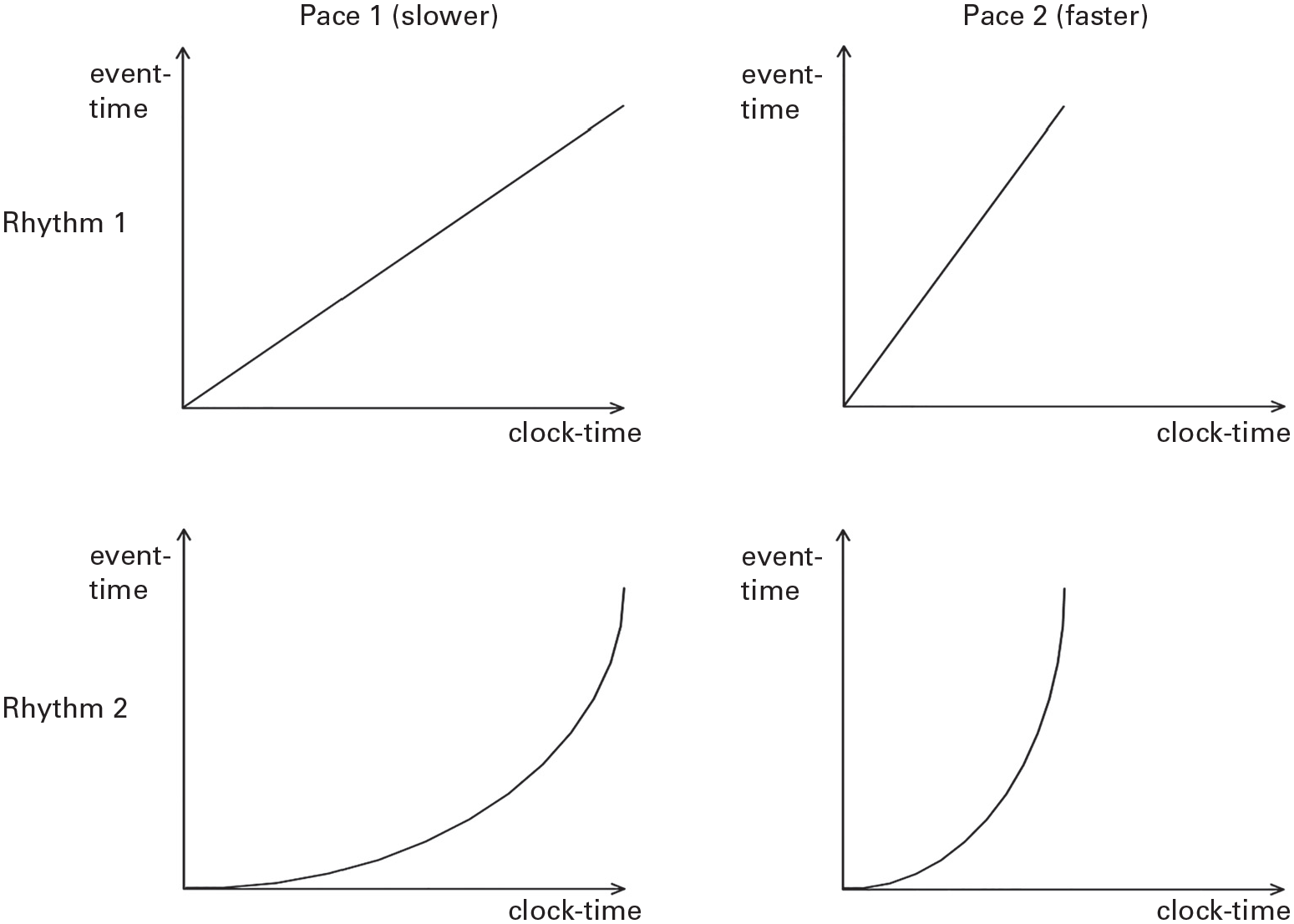
Pace and Rhythm of Routines
Identifying the pace and rhythm of social practices allows the efficient comparison of these patterns, which opens up a new world of opportunities for research on the effects of specific temporal patterns on individuals, work units, and organizations. On the individual level, it would be very interesting to better understand the effect of specific temporal patterns (e.g., the different shapes of the event-clock-time graphs depicted in Figure 6) in the accomplishment of work on experiences of distress and eustress, or on feelings of relaxation or boredom. The same could be done for outcomes at the levels of single work units and whole organizations. One could scrutinize the effect of specific event-clock-time patterns of work units or organizations on outcomes like agility, reliability, or efficiency.
The analysis of such graphs allows for the systematic plotting of large quantities of process data. The resultant opportunities for pattern recognition become increasingly important with the use of digital trace data in routines research (Pentland, Haerem, and Hillison, 2011; Goh and Pentland, 2019). In our case, depicting and comparing temporal patterns that arise at the intersection of event and clock time focused our analysis on differences between routine and boundary performances and helped us illustrate how actors accomplish temporal autonomy under temporal uncertainty. Beyond these specific results, we feel that our method provides an exciting new means for identifying, visualizing, and comparing temporal patterns of social practices. Most scholars have either used coarse-grained and one-dimensional visualizations of event sequences (e.g., a simple timeline that shows progress over the years)—which makes it impossible to identify fine-grained temporal patterns—or have written case narratives and vignettes that can be very fine-grained but make it difficult to identify and compare temporal patterns. Our method enables the discovery of new and unexpected temporal patterns at any level of granularity. As such, it also allows for the opportunity to ask novel questions like: Why do we see a pattern here? How can it be explained? What changes because of this?
Boundary Conditions and Conclusion
Our study is not without limitations. First, firefighters offer a specific context when it comes to the study of time because fixed, clock-time-based targets are less of a concern for firefighters. This is certainly different from settings in which deadlines (defined in clock time) must also be met because of outsiders’ expectations and, as a result, less leeway in the enactment of time exists. Firefighters could therefore be considered an extreme case, and it would be interesting to explore how actors coordinate multiple routines in settings in which relatively stable external pacers play a more important role. Another limitation concerns our operationalization of event time. Counting differences in action steps (inter-team and inter-time) does not allow us to capture the perceived intensity of actions. Theoretically, in our coding, waiting has the same intensity as searching for a missing person. It would certainly be worthwhile to integrate an operationalization of perceived intensity into our coding of event time. Further research could explore how to measure such intensity and thus inform the event-clock-time graph and its effects on coordination. In addition, due to confidentiality issues, we were unable to video record firefighters’ actions in their operations. This would have provided more precision in identifying and coding actions than our approach of taking notes and using a stopwatch. However, our approach allowed us to observe firefighters in real operations and thereby obtain real-life accounts of performing routines in more extreme settings where video recording is not an option. By placing time at the center of our analytical focus, this study has shown how important it is for scholars and practitioners to appreciate the relationship among event time, clock time, and the process of coordinating.
Supplemental Material
Geiger_Danner-Schroeder_Kremser_online_supp – Supplemental material for Getting Ahead of Time—Performing Temporal Boundaries to Coordinate Routines under Temporal Uncertainty
Supplemental material, Geiger_Danner-Schroeder_Kremser_online_supp for Getting Ahead of Time—Performing Temporal Boundaries to Coordinate Routines under Temporal Uncertainty by Daniel Geiger, Anja Danner-Schröder and Waldemar Kremser in Administrative Science Quarterly
Footnotes
Acknowledgements
We gratefully acknowledge the tremendous support of the Hamburg firefighters for allowing us to “shadow” them in their work and sharing their passion and insights. It was a privilege to work with such dedicated and brave women and men. We also want to thank Tina Flemming and Thomas Danner for supporting us with the Excel spreadsheets. Brian Pentland, Davide Nicolini, and participants of the EGOS Colloquium 2016 in Naples and the research group at Wharton School provided us with very valuable feedback on earlier versions of the paper. An earlier version won the “That’s Interesting Award” of the European Group for Organizational Studies in 2017. We are also grateful for the great support during the review process by John Wagner and the comments of the three anonymous reviewers who helped us in pushing the boundaries.

Supplemental Material
1
We explain the codes reflected in these vignettes shortly, when we explain the information team leaders receive in alarm messages. All names and addresses mentioned in the alarm messages and vignettes have been changed to ensure anonymity of data.
Authors’ Biographies
References
Supplementary Material
Please find the following supplemental material available below.
For Open Access articles published under a Creative Commons License, all supplemental material carries the same license as the article it is associated with.
For non-Open Access articles published, all supplemental material carries a non-exclusive license, and permission requests for re-use of supplemental material or any part of supplemental material shall be sent directly to the copyright owner as specified in the copyright notice associated with the article.
