




Abstract
This paper analyzes how the socio-economic development of an industry co-evolves with the articulation of imaginaries of emancipation and domination. Drawing on political discourse theory, I analyze the US’ interracial porn movie industry (1916–2022) from its early, illicit beginnings through its commercial mainstreaming. Organized agents have developed this industry by articulating imaginaries that evoke economic emancipation, but provide new political and fantasmatic relevance to origin myths of racial and gendered superiority. The articulations of each generation of organized agents transgressed prior episodes’ limits to visualizing interracial sex. Yet, transgression remained firmly within the bounds of the disciplinary and security power apparatus of white patriarchical domination. In particular, successive imaginaries modernized the stereotypical myths of black Jezebels, black Brutes, pure white women, and civilized white men. Modernization of myths, technological democratization and mainstreaming went hand in hand. I provide critical explanations for these findings that contribute to the organizational literature on imaginaries. This includes the entrepreneurship-as-emancipation literature, and scholarship on myths, feminism and prefigurative organizing. Emancipatory imagining requires challenging the disciplinary and security limits of origin myths. By default of political and fantasmatic challenging of these mythical limits, they function as empty signifiers that are easily adapted to contemporary imagining. As a result, entrepreneurs’ and performers’ socio-economic emancipation discourse effectively re-articulates an imaginary of domination.
Keywords
Throughout history sex has provided an «imaginary» to discipline, liberate and racialize (Foucalt, 1978: 155–156). An imaginary is a discourse that articulates creative meaning and orientation for a field of activity (Castoriadis, 1987: 128; James, 2019). 1 Modern economic interests have articulated pornographic imaginaries to multiply and optimize feelings of sexual arousal (Foucalt, 1978: 48). This paper develops Foucault’s arguments on the articulation of pornographic imaginaries from a critical, emancipation-centered perspective. Drawing on the historical case of the United States’ interracial porn movie industry (1916–2022), I explore how an industry’s economic development co-evolves with the articulation of imaginaries. Particularly, I analyze how and why organized agents articulate pornographic imaginaries that emancipate from or reproduce relations of domination. Emancipating imaginaries raise awareness of how domination restricts human consciousness (Alvesson and Willmott, 1992: 432), and prefigure dissenting, egalitarian alternatives (Huault et al., 2014).
The organizational literature on imaginaries has focused on a broad variety of topics, from leadership through postcolonial inequalities (e.g. Hensmans, 2021a; Islam et al., 2023; Levy and Spicer, 2013; Lyan and Frenkel, 2022; Picard and Islam, 2020). In line with the seminal writings of Castoriadis (1987) and Sorel (1961), much of this literature argues that historical myths provide imaginaries with greater signification and identification potential (e.g. Bell et al., 2021; Hensmans, 2024). To theorize how organized agents articulate myths into powerful imaginaries, I draw on political discourse theory (Glynos et al., 2009; Laclau and Mouffe, 1985). This variety of discourse analysis theorizes how an imaginary becomes powerful when it articulates myths in terms of particular political and fantasmatic logics. These logics provide critical explanations of domination and emancipation that a socio-economic focus obscures. Furthermore, political discourse theory builds on Foucauldian assumptions of contingency, historicity and the primacy of power.
After expounding my use of political discourse theory’s methodology of critical explanation, I present and discuss my main findings. Organized agents have developed the US’ interracial porn movie industry by articulating imaginaries that evoke economic emancipation, but provide new political and fantasmatic relevance to origin myths of racial and gendered superiority. The articulations of each generation of organized agents transgressed prior episodes’ limits to visualizing interracial sex. Yet, transgression remained firmly within the bounds of the disciplinary and security power apparatus of white patriarchical domination. In particular, successive imaginaries modernized the stereotypical myths of black Jezebels, black Brutes, pure white women, and civilized white men. Modernization of myths, technological democratization and mainstreaming went hand in hand: each generation of agents drew on technological democratization opportunities to sexually arouse an increasingly mainstream audience.
I provide critical explanations for these findings that contribute to the organizational literature on imaginaries. This includes the entrepreneurship-as-emancipation literature, and scholarship on myths, feminism and prefigurative organizing. Emancipatory imagining requires challenging the disciplinary and security limits of origin myths. By default of political and fantasmatic challenging of these mythical limits, they function as empty signifiers that are easily adapted to contemporary imagining. As a result, socio-economic emancipation discourse effectively re-articulates an imaginary of domination.
Articulating imaginaries: Extending organizational theory
The organizational literature on imaginaries has focused on a variety of topics, including climate change (Levy and Spicer, 2013), leadership (Picard and Islam, 2020), digital transformation and organization (Hensmans, 2021a; Islam et al., 2023), the craft industry (Bell et al., 2021), and postcolonial relations of multinational power (Hensmans, 2024; Lyan and Frenkel, 2022). advance the notion of a climate imaginary to analyze the struggle among NGOs, business and state agencies over the prioritization of environmental and cultural values in the organization of production and consumption. They argue that a particular climate imaginary becomes dominant at a particular point in time when it connects with wider popular interests and identities, as well as aligns with economic and technological aspects of the energy system.
Bell et al. (2021) draw on the concept of imaginary at the industry rather than political economy level. They argue that craft imaginaries challenge dominant, modernist imaginaries of industrial production and consumption by articulating alternative social meaning. The authors highlight the organizational possibilities of craft as a source of innovation, inclusivity and disruption. The concept of imaginary can also be used to analyze intra-organizational change. For instance, Picard and Islam (2020) analyze how organizational members rally around an imaginary of liberating leadership. Other scholars analyze how digital transformation agents articulate the mythical powers of technology in fantasmatic imaginary (Hensmans, 2021a). Islam et al. (2023) explore how new age organizations use digital culture to promote an holistic imaginary of personal and social well-being.
Finally, a number of scholars focus on how multinationals articulate a globalization imaginary that connects the West and the Rest, the Global North and Global South in one world society. For instance, Lyan and Frenkel (2022) adopt the lens of industrial espionage to argue for the lingering significance of postcolonial imagery of a superior West. While the latter authors document how a postcolonial imaginary shapes legal disputes between western and emerging market multinationals, Hensmans (2024) analyzes how an emerging market multinational can successfully appropriate this imaginary for emancipatory purposes.
Organized imaginaries: Two shared assumptions
Regardless of the particular research focus, much organizational scholarship on imaginaries converges on two assumptions. The first assumption regards the historical quality of articulation. The articulation of imaginaries has a strong historical dimension. argue that it is the enduring character of imaginaries that provide shared sense of meaning, coherence and orientation around highly complex issues (cf. Anderson, 1999; Taylor, 2004). And Hensmans (2024) explores how a Chinese multinational’s leadership articulated an alternative imaginary of globalization by substituting origin myths from the Global South for Western orthodoxy. Finally, Bell et al. (2021) argue that imaginaries articulate how societies, communities, organizations and individuals embody temporal relations to the past. They highlight the role of historical myths in articulating imaginaries that have the power to extend the past into the present and future.
The second assumption refers to the positive or negative impact of articulation. An imaginary can reproduce the historical status quo, including relations of domination, or prefigure dissent and emancipation. For instance, Hensmans (2024) discusses how a Chinese multinational was able to overcome the postcolonial imaginary of globalization, and articulate an emancipating imaginary from the Global South to the Global North. Entrepreneurship-as-emancipation scholars also emphasize positive articulation possibilities. Socio-economic imaginaries of entrepreneurship as emancipation challenge practices of economic exploitation (Laine and Kibler, 2022; Tedmanson et al., 2012; Weiss et al., 2023) and remove the stigma of sex industries (Ruebottom and Toubiana, 2021). By constrast, feminist scholars problematize contemporary imaginaries of sex and gender. Prasad (2016: 434) calls on organizational scholars to subvert prevailing androcentric imaginaries, and emancipate from sexual origin myths. Likewise, Fotaki (2011, 2013) problematizes the androcentric imaginary prevalent in business schools and management knowledge. This imaginary is at the root cause of women’s continuing exclusion and subordination in processes of knowledge creation.
Articuating myths into imaginaries: Political discourse theory
Foucault (2021: 15) advances the centrality of historical myths for humans’ imaginary of why they exist, and what is natural or not. He argues that humans make historical myths relevant by articulating them in a contemporary “imaginary space.” Foucault does not, however theorize processes or logics of articulation, clarifying how myths are discursively fixed to imaginaries. Likewise, the management and organizational literature does not theorize how myths become articulated in industry imaginaries (Hensmans, 2024). I therefore turn to a perspective that theorizes articulation: political discourse theory.
Originally developed by Laclau and Mouffe (1985), political discourse theory builds on a number of Foucauldian assumptions. The latter theory shares Foucault’s focus on power as a productive and contingent force. The « exercise of power » consists in influencing others’ actions. It « consists in guiding the possibility of conduct and putting in order the possible outcome’ (Foucault, 1982: 789). Like Foucault, political discourse theorists adopt a critical, problem-driven approach, or what organization theorists have called a problematization approach (Glynos et al., 2009; Sandberg and Alvesson, 2011). They focus on the articulation of myths and imaginaries as a response to particular problems in specific historical contexts. This involves studying how myths allow agents to imagine solutions to their own problems, such as how to economically develop an industry.
How does political discourse theory define the seminal concepts myth and articulation? A myth is an “empty signifier,” that is, a “signifier without signified” (Laclau, 1996: 36). Articulation is the practice of fixing meaning to myths, turning them into imaginaries adapted to contextual opportunities and constraints (Laclau and Mouffe (1985: 102). The property of being « empty », « vague » or « highly variable» makes myths a key building block of articulation. By meaning “different things to different people” (Chandler, 2017: 90), myths are a springboard to articulating a variety of popular interests and identities in the same imaginary. This chimes with Levy and Spicer’s (2013) argument that prevailing industry imaginaries articulate a wide variety of popular interests and identities.
How are historical myths articulated in a powerful, contemporary imaginary? Organized agents reinvent them following particular political and fantasmatic logics; logics that make use of contemporary identities, interests and the political and fantasmatic context at large (Glynos et al., 2009: 11–12).
The political dimension of articulation is expressed through the complementary logics of equivalence and difference. The logic of equivalence simplifies the political imaginary by articulating a friend/enemy distinction. The enemy is « the other », « the stranger » (Laclau, 1990; Schmitt, 1932). It is the «constitutive outside » that allows friends to identify each other as part of a morally superior imaginary (Hensmans and van Bommel, 2020). For instance, champions of alternative globalization define their own endeavors as morally superior, denouncing the “neoliberal oligarchy” as an immoral enemy that threatens their form of existence (Hensmans, 2003a; Mouffe, 1999: 50). The logic of difference, by contrast, complexifies political imaginary. It rearticulates the dominant imaginary, making it inclusive of different challenger identities (Hensmans and Van Bommel, 2018; Laclau, 1990: 63).
Articulating myths into a powerful, contemporary imaginary also involves reinventing their fantasmatic appeal. Political discourse theory elaborates the fantasmatic logics that provide myths with contemporary relevance and move human imaginary: the logics of beatific and horrific imagining. Articulated in terms of a beatific discourse, a myth can incite radical, collective action for an « imaginary world », ahead of rationalities that legitimize the status quo (Sorel, 1961: 48). Beatific imagining projects a utopian future of omnipotence and just organizational and societal relations (Dey et al., 2016). It is more likely to grip people when it is articulated in opposition to a horrific alternative: an imagined future of humiliation and impotence (Glynos and Howarth, 2007: 15).
Part of the attractiveness and potency of a fantasy resides in the desire and power to transgress it (Glynos and Stavrakakis, 2008). For instance, Hensmans (2021a: 156) describes how managers at an alternative organization articulated a beatific imaginary of digital transformation to rally different interests and agendas within the organization. To overcome resistance, managers framed this imaginary in opposition to a horrific counter scenario of technical and moral impotence. Paradoxically, managers transgressed their own warnings of horrific costs, accelerating the decline of the organization’s alternative ideals.
Political discourse theory is rarely used in organization and management theory (Hensmans, 2024; MacKillop, 2018). Yet, its analytical focus on political and fantasmatic logics is well suited to explore another organizational dimension of Foucault’s analytics of sexuality as «the hidden aspect and generative principle of meaning» (1978: 155). Imaginaries of sexuality are a pivotal mechanism of two complementary types of power: disciplinary and biopolitical (1978: 139). Disciplinary power aims to optimize the usefulness of subjects by integrating them into systems of efficient and economic controls. This type of power is exerted by a closed disciplinary network of members. Security power, for another, is more open, multilinear and self-regulating in scope (Fleming et al., 2023; Munro, 2012). While the ultimate aim of security power is « control over relations between the human race » (Foucault, 2003 [1976]: 245), its means is centrifugal. It works by organizing the political and fantasmatic imagination of self-governing agents in a security apparatus of power. Such an apparatus encourages conduct that creates and transgresses within «a bandwidth of the acceptable that must not be exceeded » (Foucault, 2007: 21).
Case and methodology
In what follows, I explain why I selected the case of the US interracial porn movie industry (1920–2022). I situate my analysis of the articulation of imaginaries in this industry in a broader methodology of critical explanation,
Case selection: The US interracial porn movie industry (1916-2022)
I selected the historical case of the multi-billion US interracial porn movie industry for different reasons. Since the 1930s, the US industry has produced more than half of all the (interracial) porn movies in the world (Slade, 2000). Having grown into a multi-billion dollar endeavor, the US industry is by far the largest producer of (interracial) porn movies in the world (Statista, 2023). Compared to other US industries, the significance of interracial porn is not so much its size. This industry articulates interracial relations in a manner that is “simultaneously entirely central and entirely marginal” to imaginaries of race in the United States (Kipnis, 1996: 81). The United States’ founding myths in particular provide a fertile context to study the articulation of racial myths along Foucauldian lines. Did organized agents in the US industry emancipate from or reproduce the “mythical concern with protecting the purity of the blood and ensuring the triumph of the race”? (Foucault, 1990: 149). Prejudice worked together with slavery to found racial myths of the United States as a beacon of white emancipation (Eastland-Underwood, 2023: 230; Jordan, 1974, 2013). Founding fathers such as Benjamin Franklin argued: “Why should we in the Sight of Superior Beings, darken its People? why increase the Sons of Africa, by Planting them in America, where we have so fair an Opportunity, by excluding all Blacks and Tawneys, of increasing the lovely White and Red?”“ (Franklin, 1970 [1755]: 471).
Thomas Jefferson added a sexual dimension to calls for the protection of a pure white race. He argued that black people had greater sexual appetites and lower intellectual faculties (Jordan, 2013; Peterson, 1970: 263). To champion a white patriarchal imaginary of US emancipation, the founding fathers “left intact a strong Southern slave tradition” in American politics (Freehling, 1972: 92). Fantasmatically, they tied the ideal of “American emancipation to African colonialism,” the alternative horror scenario being “race riot and sexual chaos.”
Founding fathers such as Benjamin Franklin furthered another foundational myth, with nearly religious fervor: American emancipation through technological progress (Marx, 1964; Noble, 2013). While racial myths are key to this paper, their widespread articulation has always depended on organized agents embracing technological progress and democratization. Indeed, organized agents in the US porn industry have long pioneered the democratization of visualization and information system technologies (Paasonen and Saarenmaa, 2007).
In what follows, I analyze how organized agents articulated the above racial founding myths of US emancipation to develop the interracial porn movie industry. Did organized agents articulate imaginaries and use the democratization of visualization technologies to emancipate from or reproduce relations of white patriarchical domination? Emancipation would mean that agents consciously take on historical relations of domination (Howarth et al., 2016: 102), rearticulating myths in imaginaries free from “restrictions upon the development and articulation of human consciousness” (Alvesson and Willmott, 1992: 432; Hensmans, 2024: 271). Reproduction would mean that imaginaries continue to articulate myths in terms of historical relations of domination, fixing “the relations of power in such a way that they are perpetually asymmetrical” (: 123).
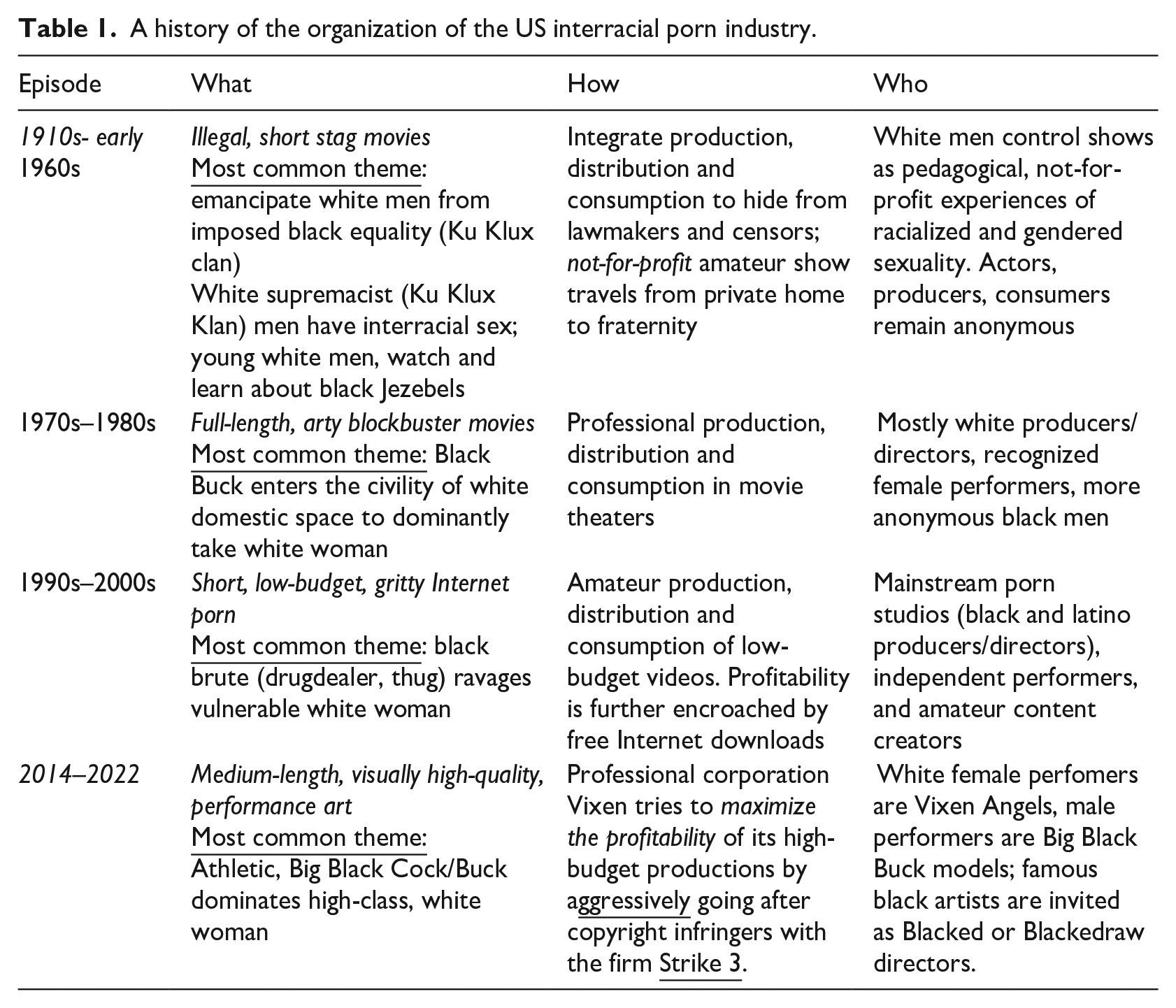
To put the purposiveness of industry actors in sharp relief, I analyze the historical co-evolution of structural possibilities for articulating emancipation – provided by successive black emancipation movements – and the actual articulations by organizational entrepreneurs. To analyze actual articulations in greater detail, I clarify what organized agents represented the main economic interests at any point of time, how they organized the interracial porn industry, and what stereotypical myths they articulated (see Table 1). Based on significant changes in the what, how and why I provisionally identified four historical industry episodes.
A history of the organization of the US interracial porn industry.
Data collection
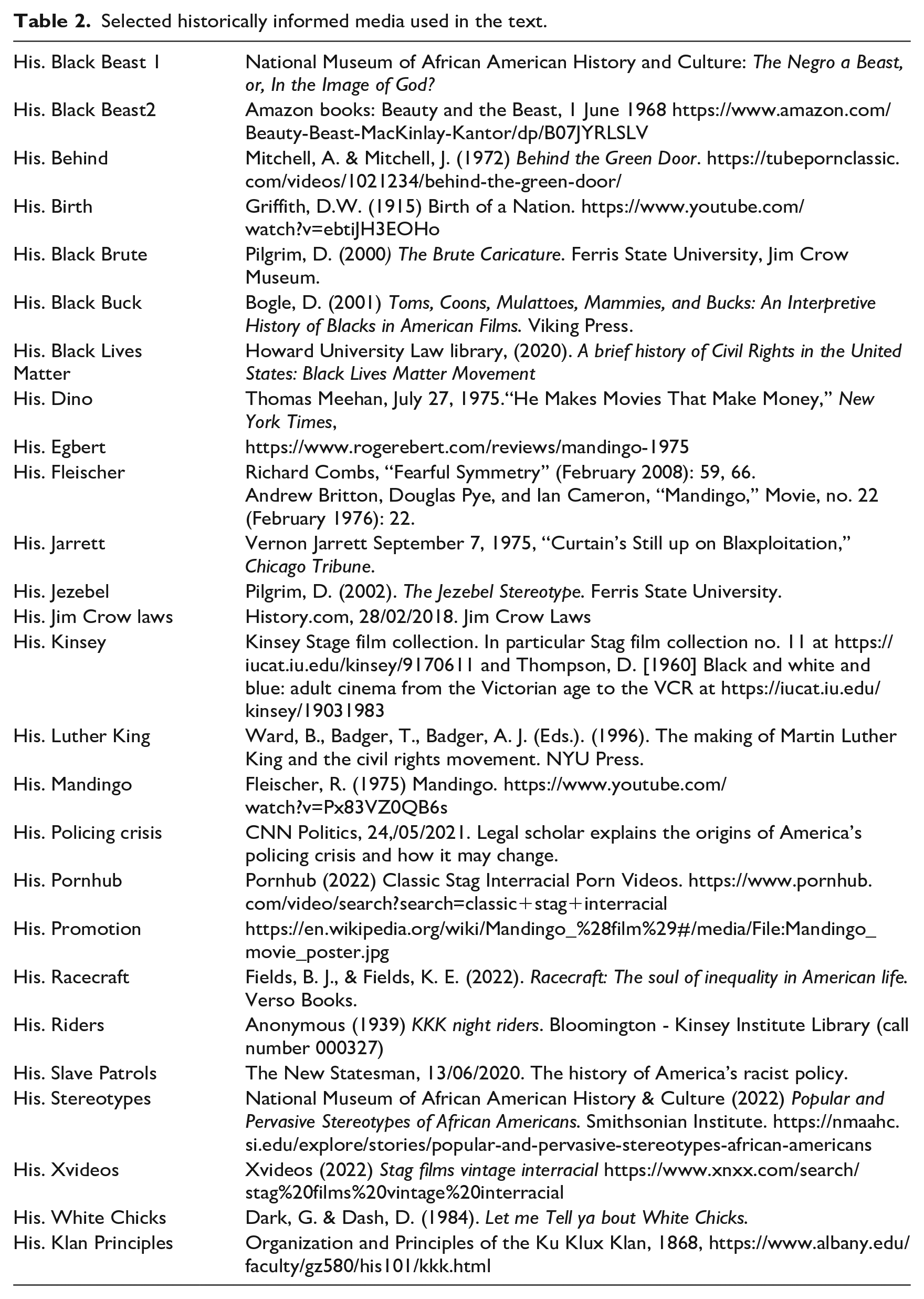
I consulted a number of data sources to inform my research question on the articulation of racial imaginaries of emancipation or domination. To provide historical context to the meaning of emancipation and domination, as well as organized agents’ concrete articulations, I read the most seminal books on historical imaginaries of interracial sex in the United States. I looked for evidence of emancipation or domination in the interracial porn industry in particular (see Table 2). I also watched the most popular interracial porn movies produced in each decade since the early 20th century, available either through the vintage section of existing interracial porn websites [His. Xvideos, His. Pornhub] or the Kinsey archives of stag films [His. Kinsey].
Selected historically informed media used in the text.
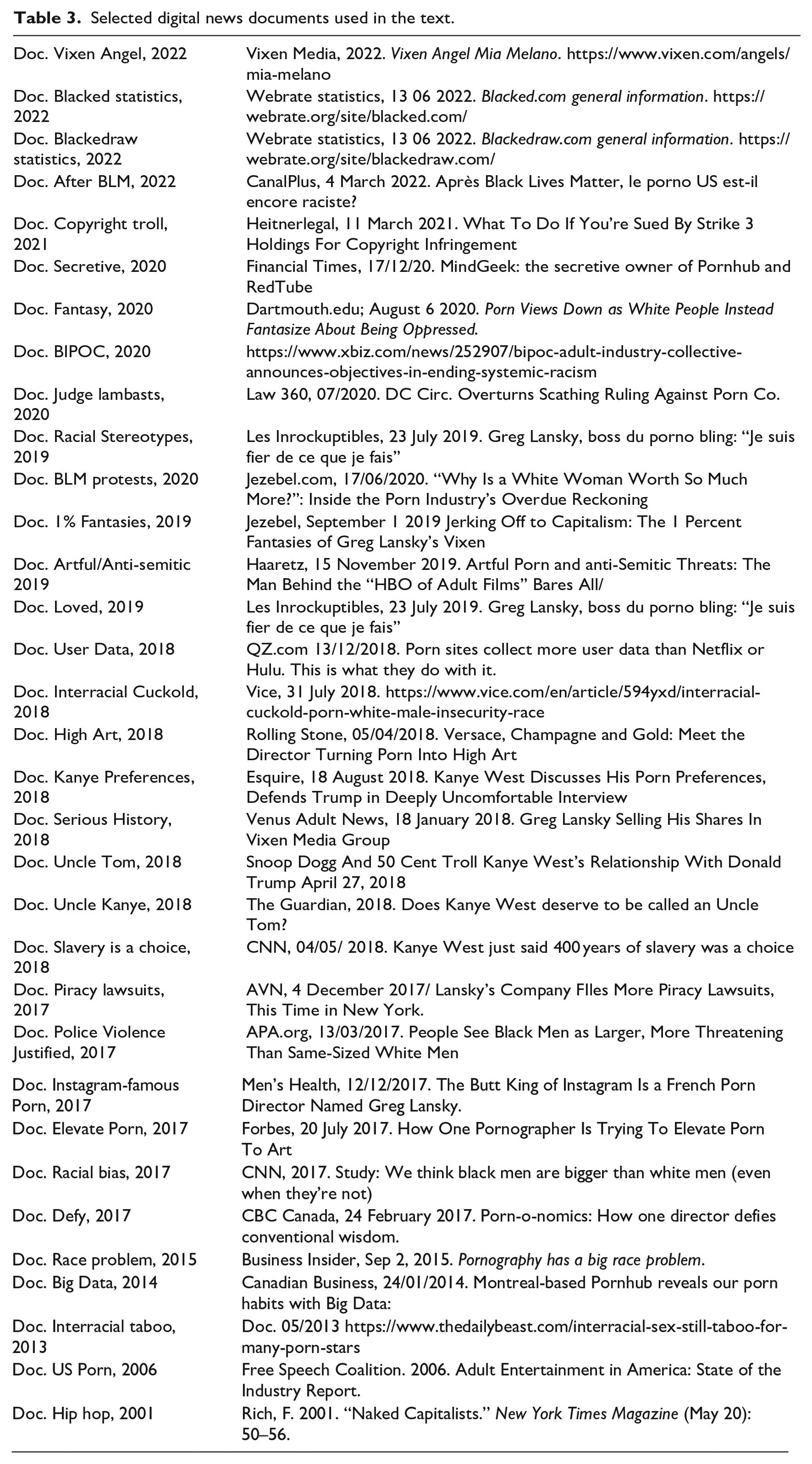
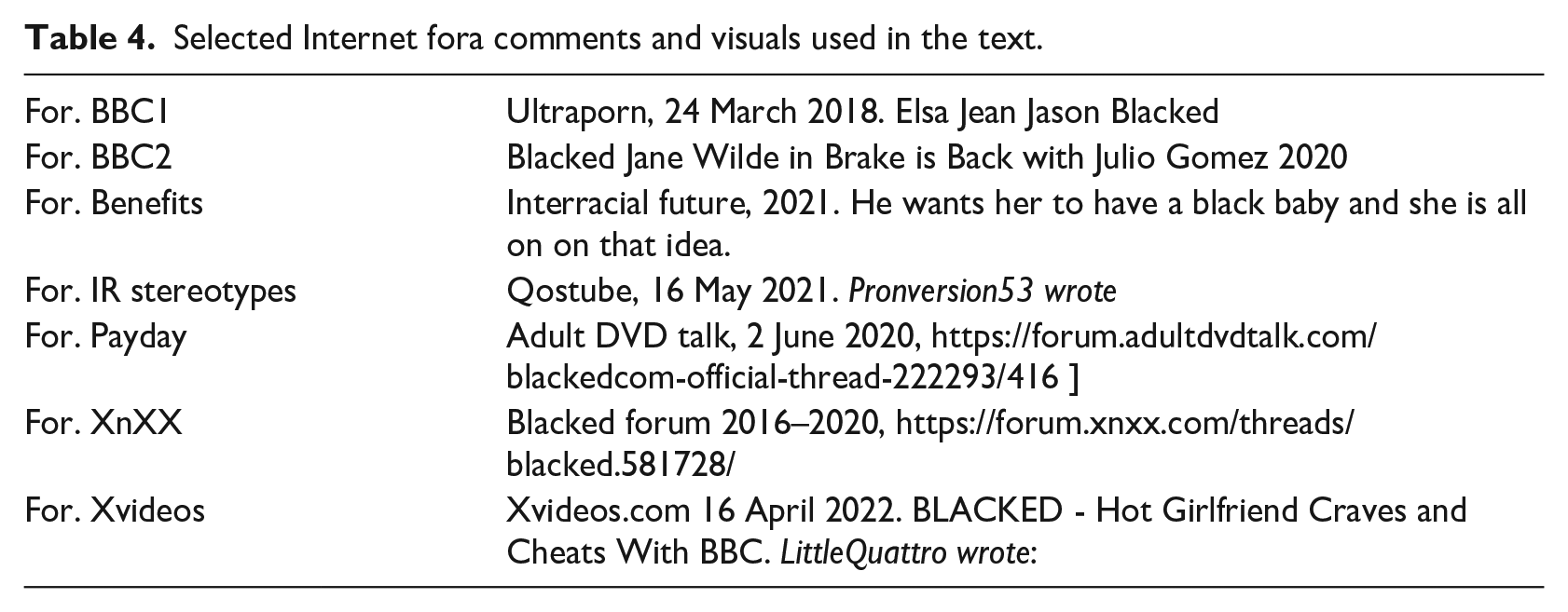
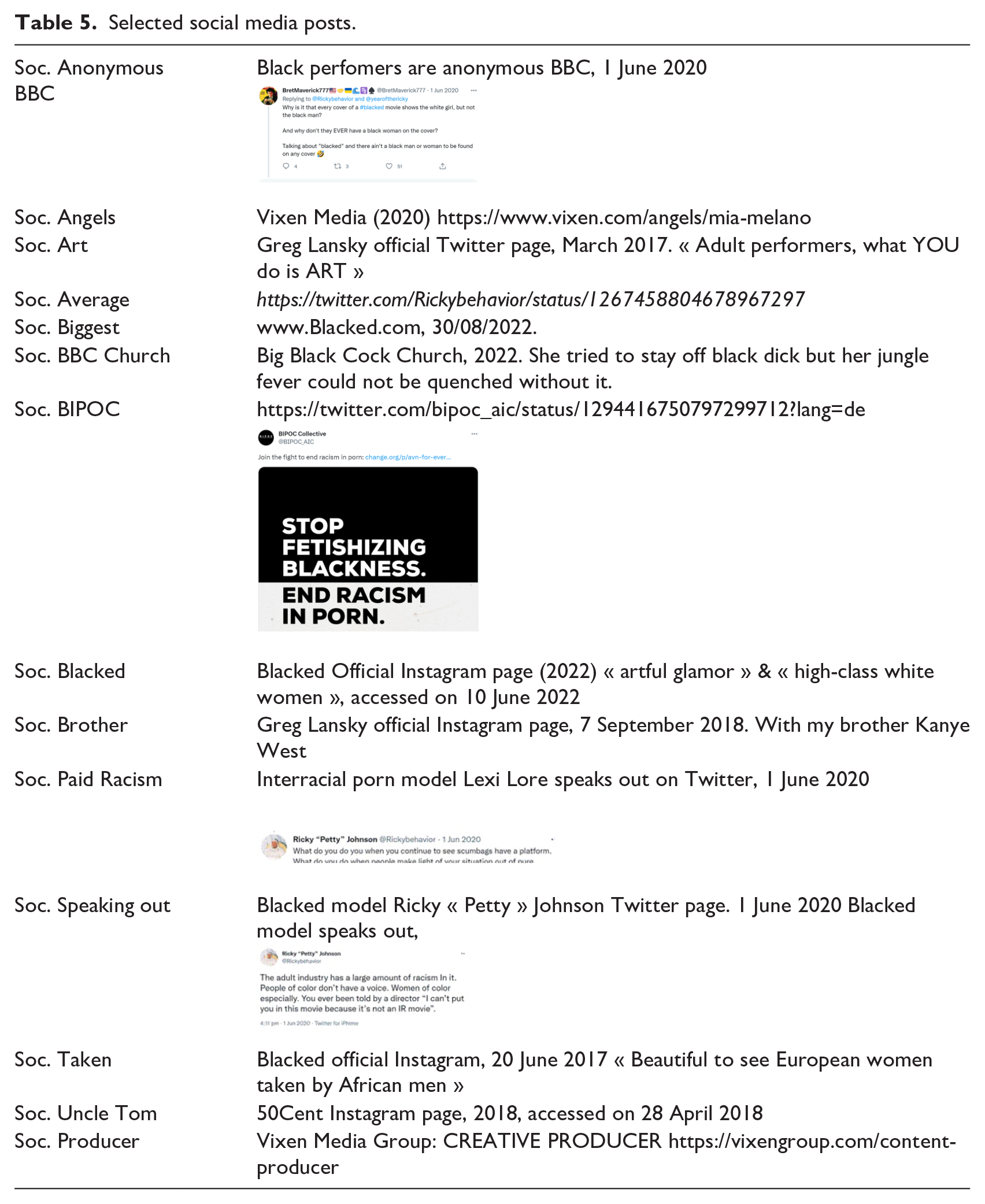
To collect more contemporaneous case data, I took advantage of the « unprecedented opportunities » offered by public Internet communications to access insider perspectives on how and why porn imaginaries are articulated (Varis, 2015: 56–57). Drawing on publicly availalable Internet sources, I was able to collect «rich and detailed accounts» of « lived realities » and «communicative repertoires» of the main protagonists in the interracial porn movie industry (Varis, 2021). This includes social media and internet fora comments that are politically and fantasmatically revealing as to agents’ motivations - emancipatory or domination-reproducing. Concretely, I drew on social media communications (Instagram and Facebook pages, porn performers’ Twitter, Instagram and other social media pages), comments and debates on a diversity of porn fora, and activist sites (e.g. Black Live Matter activists vs white supremacists), published interviews with interracial porn protagonists, as well mainstream newspaper and magazine analyses.
I document all these different data sources in Tables 2 to 5. I abbreviate references to the different data sources respectively as His. (Historically informed media), Doc. (newspaper or magazine analyses), For. (internet fora), and Soc. (social media).
Selected digital news documents used in the text.
Selected Internet fora comments and visuals used in the text.
Selected social media posts.
Data analysis: The political and fantasmatic logics of critical explanation
To critically analyze articulations of the main economic organizational interests in the US interracial porn industry (1916–2022), I draw on political discourse theory’s logics of critical explanation. Methodologically, the logics of critical explanation follows four interconnected, but analytically separate steps (Glynos and Howarth, 2007). Each step helps to refine the bracketing and understanding of four historical episodes of articulation. 2
Step 1: A first step consists in problematizing established assumptions and constructing the research object as a problem at a more appropriate empirical and analytical level. The entrepeneurship-as-emancipation stream of research argues that organized entrepreneurs articulate emancipating worldviews that counteract the exclusion efforts of the dominant (Montesano Montessori, 2016: 538; Goss et al., 2011). A recent study of sex industries confirms this finding (Ruebottom and Toubiana, 2021).
A cursory look at recent articulations in the US interracial porn movie industry seems to confirm the assertions of the entrepreneurship-as-emancipation literature. Mainstream outlets such as Forbes (2017), Rolling Stone (2018), CBC (2017), and Men’s Health (2018) presented the entrepreneur Greg Lansky as the chief emancipator of the US interracial porn industry. Lansky boasted of elevating interracial porn beyond the imaginary of a dirty, illicit, shadowy business [Doc. High Art, 2018; Elevate Porn, 2017]. Adulation of Lansky suddenly stopped in 2020, when the Black Live Matters (BLM) movement denounced the entrepreneur’s fetishizing of black men as Black Brutes, and black women as inferior side-kicks to white Angels [Doc. Black Lives Matter protests, 2020]. Under fire of the BLM movement, Lansky promptly sold his stake in these ventures to invest in another illicit industry: cannabis. Two years later, Blacked and BlackedRaw continued to articulate a stereotypically racist imaginary of sex [Doc. After BLM, 2022].
Step 2: Following this problematization of Lansky’s entrepreneurship-as-emancipation as the clever remarketing of a stereotypically racist imaginary, I engaged in retroduction to identify historical patterns of articulation. Retroduction is the creation and refinement of tentative hypotheses from historical sources that plausibly explain a problematized phenomenon over a longer period of time (Glynos and Howarth, 2007; Hensmans, 2024: 275-276; Hensmans, Johnson and Yip, 2013: 37-39). I sensitized myself to the problematized context from a historical perspective, attempting to abduce an alternative explanation that “may” challenge or extend established theorizing (Peirce, 1960: 106).
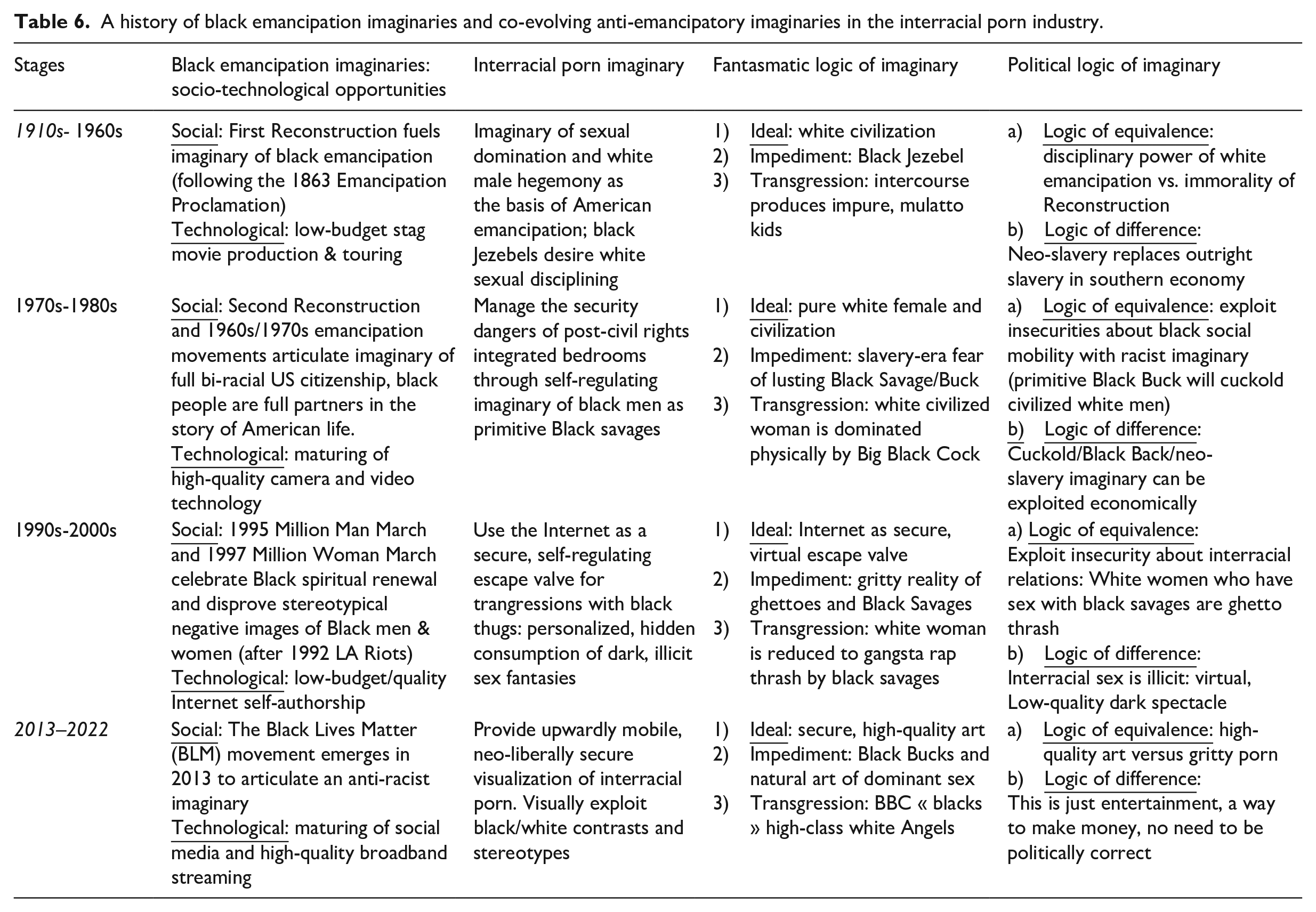
Drawing on retroduction, I identified a remarkable pattern. Each episode started with a combination of technological opportunity and racial dislocation of established imaginaries. As argued by political discourse theory (Glynos and Howarth, 2007: 15), dislocations provide agents with opportunities to articulate emancipation in a direction that humanizes and civilizes outsiders – such as black people, or continues dehumanizing and decivilizing them (see Table 6). Furthermore, in each episode agents drew on the democratization of visualization technologies to articulate transgressive imaginaries of racial founding myths. Articulations subsequently visualized: transgressive interracial sex of white men with black women, legitimized as the white patriarchical need of an escape valve which primitive black women eagerly provided (episode 1); interracial sex of black men and white women, shattering the taboo on visualizing sexual slavery in mainstream move theaters (episode 2); interracial sex of black men and white women in the gangsta rap genre, legitimized by the US ideal of democratization through technological self-authorship (episode 3); and big black cocks dominating pure white angels, legitimized as the technological, « high art » breaking of lingering interracial sex taboos (episode 4).
A history of black emancipation imaginaries and co-evolving anti-emancipatory imaginaries in the interracial porn industry.
Step 3: In a third step I focus on understanding historical patterns of articulation from the viewpoint of agents – within their own historical context. Why did all varieties of agents in the interracial porn movie industry – white, black, female, and male – actively participate in the articulation of a stereotypically racist imaginary, that reminds of interracial relations in times of slavery? The short answer is the ability to commercialize the transgression of earlier taboos, obtaining capitalist opportunity and transgressive freedoms unavailable elsewhere. This goes for the motivations of both performers and pornographers. Thus, in the first episode black female performers negotiated between one form of exploitative work and another, choosing the greater freedom and opportunity as actress in interracial porn movies over redlight zone prostitution and menial domestic labor (Miller-Young, 2014; Mumford, 2007). Immigrant entrepreneurs, on the other hand, gained their economic and professional freedom in the United States by facilitating the illicit stag circuit for members of private white clubs (Gertzman, 1999: 30, 312).
Step 4: Finally, in a fourth step I draw on structural (step 2) and agentic (step 3) insights to produce critical explanations (Hensmans, 2010). Critical explanations challenge historical structures of domination “in the name of a universal human emancipation” (Glynos and Howarth, 2007: 9; Howarth et al., 2016: 100). They expose how political logics exclude rightful challenges by disenfranchised people. And they illuminate how fantasmatic logics induce people to desire relations of domination at the expense of emancipatory concerns (Glynos et al., 2009; Glynos and Howarth, 2019). Table 6 summarizes critical political and fantasmatic explanations.
Critical explanations should also prefigure alternative types of agency, at service of an imaginary that emancipates from relations of domination (Glynos and Howarth, 2007: 9). I single out two lost opportunities for the articulation of an emancipating imaginary in this study: the democratization of new visualization technologies at the beginning of each episode, and the central agentic role of entrepreneurs and black performers – as both outsiders to and middlemen of elites’ power (Hamilton, 1978).
The US interracial porn movie industry: A history of imagining
Each historical episode in the US interracial porn industry emerged in relation to new social and technological opportunities to articulate a racially emancipatory imaginary (Table 6).
Episode 1: Stag movies (1910s–1960s)
The US interracial porn movie industry was established in the 1910s. Its establishment followed the maturing of 8 and 16 mm home movie technology (Lockhart and Wagman, 1970; Slade, 2006), and decades of post-civil war discourse on black emancipation (Ruef and Fletcher, 2003). Interracial porn movies were anonymously directed, produced and consumed in a partly illegal, partly gray zone, outside of the mainstream movie circuit (Williams, 2004a). They were commonly known as « stag » films in the United states, and were projected mainly at southern male-only smokers clubs (Miller-Young, 2014; Phillips, 2018).
During the 1910s, African American movie directors tried to imagine and visualize black emancipation in a modern US nation (Field, 2015). Interracial pornographers instead drew on the imaginary of the first mainstream movie success in the United States: the Birth of a Nation. Produced in 1915, this movie reinvented racist founding myths and mainstreamed the Ku Klux Klan’s imaginary (Ang, 2023; Rice, 2008; Stokes, 2007). The movie depicted the Ku Klux Klan as the champion of a modern US nation, protective of the purity of white women. In the spirit of racial segregation laws in southern states, it visualized black men as « Black Brutes » - savage people who threatened to break free and ravage the sexual purity of white women [His. Black Brute, His Birth].
Stag movies did not visualize sex between black men and white women – as this was legally considered rape and often incurred the extra-legal penalty of lynching (Hodes, 1997). Instead, stag pornographers focused on sex between white men and black women. Black women hereby were invariably depicted as « Jezebels » [His. Jezebel], or “bad-black-girls” (Jewell, 1993). The historical origins of the Jezebel character go back to white plantation owners’ justification of sexual slavery as a natural result of black female sexuality. Jezebels have an insatiable appetite for sex that can only be « gratified by the criminal advances of Saxons » (Redpath, 1859: 141; West, 1995). This justifies white man’s « sexual passion toward her, blaming female slaves for their sexual exploitation » (Hine, 1979: 123).
The Birth of a Nation (1915) featured the first depiction of the Jezebel myth in a mainstream movie. In the movie, the mulatto mistress Lydia Brown corrups white Senator Stoneman with her deceiving and lascivious ways [His. Birth]. One of the most iconic stag movies depicting the Jezebel myth is K.K.K. Night Riders (1939). In this film the black female legitimizes her rape by Ku Klux Klan men with the famous sentence: “Here I am Mr. Klansman I’m all yours.” After the rape, the Klansman brushes off any responsibility with the words: “all night riders must have their fun.” [His. Riders] In addition to visualizing taboo interracial relations, stag films such as KKK Night Riders showed other, minor elements of transgression. For instance, the Klansman having trouble with his amateurish robe, or the female performer’s visual expressions at the sight of the rapist (Miller-Young, 2014).
Overall, however, interracial stag films had a double disciplinary power effect, peculiar to the American experience (Mencken, 1980: 144). Stag films constituted disciplinary rites of passage for young white men. The latter were admitted to stag parties to raise awareness of the transgressive dangers of interracial sex – and the horror of being lured into producing unpure children. Horrifically, stag movies ritually repetated the same crude stories and images (Slade, 2006: 39); of black Jezebels seducing white men (Williams, 2005: 126). Beatifically, stag films articulated the sexual disciplining of black females as a continuation of the ideal of white patriarchical domination in the US’ South. Stag films also had a political effect. Casting black citizens in the role of primitively sexual outsiders made it easier to continue employing them in neo-slavery conditions (Blackmon, 2009).
By acting in stag movies, black women confirmed their sexual outsider position in the United States, and facilitated white patriarchical domination. So why did they choose this line of work? Black women by and large had the choice between interracial porn work, redlight zone work and menial domestic labor. Prostitution was similar to interracial porn work, but came with lesser pay and economic freedom: black pimps used black prostitutes to cater to a white male audience looking for an exotic experience. During Reconstruction, domestic labor was rife of the threat of economic exploitation and rape by white males (D’Emilio and Freedman, 1997; Miller-Young, 2014: 62). 3
Episode 2: Mainstreaming blaxploitation (1969-1980s)
Following Martin Luther King Jr.′s campaign of nonviolent resistance in the late 1950s, activist movements gained serious momentum in the 1960s and 1970s [His. Luther King]. The passing of the 1964 Civil Rights Act repudiated segregationist policies, ushering in the second Reconstruction era. Against this background of restored emancipation hopes, pornographers articulated a new “blaxploitation” 4 imaginary – targeted at a legal, mainstream audience rather than obscure smokers clubs. White fears of black emancipation and social mobility translated in an exploding demand for interracial porn films with black men having sex with white women (Miller-Young, 2014: 51). While portraying black men and women as protagonists on a racial par, Blaxploitation movies mainstreamed another slavery-era myth alongside the Jezebel myth (Williams, 2004b: 75): of the animalistic “Black Buck” or “Black Brute” ravaging the pure white woman [His. Black Buck; His. Black Brute].
Pornographers rode the wave of pop art explorations of porn by the likes of Andy Warhol (with the 1969 film Blue Movie) to step out of obscurity and obtain a mainstream audience. Drawing on both pop art’s ironic blurring of high-brow and low-brow cultures, and maturing video and big screen technologies, the interracial porn industry fully exploited the transgressive “fear of the Black man from the Dark continent.” This resulted in a number of mainstream successes such as the 1972 title “Behind the Green Door” and the 1984 release of “Let Me Tell Ya Bout White Chicks” [His. White Chicks].
The movie Mandingo (1975) epitomizes the Blaxploitation genre, and the commercial exploitation of a transgressive black buck imaginary (Howard, 2008: 12). This full length theatrical film, shown to sexually and racially mixed audiences across the United States, visualized a new “realism” in its depiction of interracial relations on a southern plantation before the civil war [His. Mandingo]. Promising “the savage, the sensual, the shocking, the truth” [His. Promotion], the movie was a commercial success in major cities with large black populations, becoming one of the top 20 grossing films of the year. Production company Paramount claimed that the movie’s success was due its reaching “beyond the sentimentalized South of other films with uncompromising honesty and realism to show the true brutalizing nature of slavery.” [His. Paramount]. The black press begged to differ. Vernon Jarrett, the first ethnically black journalist at the Chicago Tribune, argued in 1975: “[Mandingo is just] money passing from black hands to white pockets for the degradation of black people eager to capitalize on black audiences’ desires to see themselves represented and empowered.” [His. Jarrett] Renown white movie critic Roger Ebert argued that Mandingo was “racist trash” that he “felt soiled by.” [His. Egbert] In sum, Mandingo was not merely another tasteless exploitation film, but a symptom of Hollywood’s racist power structure (DeVos, 2013: 12).
Politically, movies such as Mandingo seemed to confirm historical myths that black men were “primitive,” and that their animal-like sexuality was bound to create highly dangerous situations in the originally white United States. Fantasmatically, the blaxploitation genre undermined the emancipation potential of black people as morally and intellectually developed citizens, by reducing black men to a monstrously threatening penis. The “big black cock” was the “ontological synecdoche” of the black man (Cruz, 2011: 69). The biography of the black actor that played the character of Mandingo reveals conflicting motivations to participate. Emancipation-wise, Mandingo was a “departure” as far as slave pictures went, in that it brought out the “seedy, sexual side” of interracial relations (Norton et al., 2000: 94). At the end of the day, the actor’s motivations were mainly commercial. The film catapulted his boxing career as the “Black Hercules.” His first scene as Mandingo confirmed the stereotypical reduction of black males to their penis: when a white slave-owner “took a look under the hood. . .she was not disappointed.”
Director Richard Fleischer agreed to lead the Mandingo project because “the whole slavery story has been lied about, covered up and romanticized so much I thought it really had to stop . . . The only way to stop was to be brutal as I could possibly be.” [His. Fleischer]. Fleischer was known, however, as « a hack for hire »: an agnostic middleman who admitted to never initiating any of his films [His. Fleischer]. The Mandingo project was the brainchild of the immigrant producer Dino De Laurentiis, also known as “He Makes Movies That Make Money.” [His. Dino]. Thus, high-minded mission notwithstanding, Mandingo was promoted as a salacious blaxploitation movie (Devos, 2013).
Episode 3: Internet and the democratization of hip hop porn (1990s-2000s)
The advent of the Internet ushered in the “democratization of pornography,” and hopes of radical emancipation of “patterns of production, distribution, marketing, and consumption” (Coopersmith, 2000: 12). It allowed for entrepreneurs and newly arrived pornography providers to associate their product with the long-standing American myth of emancipation through technological progress (Coopersmith, 2000: 32; Marx, 1964; Segal, 1985). A “trailblazer in the economics of new technologies,” pornography helped the commercial Internet mature by testing technologies and concepts to attract customers and monetize their desires (Economist, 1997). While the growth of free sites such as Sex.com (1994) and Pornhub.com (2005) steadily encroached profits, pornography initially was one of the few profitable on-line businesses.
The interracial porn industry could have articulated the fantasmatic and political potential of the Million Man March (1995) and Million Woman March (1997). Both marches substituted racist stereotypes for an imaginary of solidarity and personal responsibility (Campbell, 1997; West, 1999). Instead, the industry focused its articulations on the Los Angeles riots (1992) and a particular hip hop imaginary of porn: “gangsta porn.” In doing so, ethnic entrepreneurs such as Jake Steed, as well as more respectable studios such as West Coast, Blacks on Blondes, Elegant Angels, and Bang Bros, revived transgressive fears of the Black Brute. For instance, in his franchise “Little White Chicks. . .Big Black Monster Dicks” (1999–2003), Jake Steed cast himself and fellow “big black cock” actors as gangbangers and drugdealers raping vulnerable white girls.
A variety of black actors and actresses drew on hip hop culture and the self-authorship possibilities of the Internet to advance their capitalist opportunity and professional freedom (Laurence, 1999). For a significant percentage of black men and women gangsta rap (porn) provided the most economically attractive work available to them in the US (Miller-Young, 2007b). Capitalist opportunity did not end there. Ethnic pornographers often acted in and produced gangsta rap videos 5 [Doc. Hip Hop, 2001; Doc. US Porn, 2006]. These videos transgressed earlier limits to visualize interracial sex relations, and often had elements of irony and exaggeration. Overall, however, the videos embraced the reduction of African-American culture to misogyny and violence (Rebollo-Gil and Moras, 2012). To seize profitable opportunities, black actresses accepted the title “hip hop honeys” – a hip hop version of the mythical Jezebel - and black men accepted the label “hustlaz” – a gangsta rap version of the mythical black savage (Miller-Young, 2007a).
Episode 4: Black brutes and white angels performing high-performance art (2013-2022)
The latest episode of articulation in the interracial porn industry emerged in the wake of the emerging Black Lives Matter (BLM) movement (2013), and the maturing of social media and high-quality broadband streaming. Immigrant entrepreneur Greg Lansky’s ventures Blacked.com and Blackedraw.com epitomized the articulation of interracial porn as a new type of « high-quality », « performance art » [Doc. High Art, 2018]. Blacked and Blackedraw invariably figured beautiful and young white women being «dominated» by heavily muscled and tatooed, yet silent black men, in the slavery image of the hypermasculine, violent black brute (His. Black Beast 1&2; His. Black Buck, His. Black Brute Hodes, 1997: 176–208). Blacked and Blacked Raw movie covers often visualized black male perfomers as anonymous, headless half-bodies putting their “big black cock” in the face of white female performers cast as innocent victims [For BBC1, For. BBC2; Soc. Anonymous BBC; Doc. Pornhub, 2022]. Amongst the few black models who figure prominently on covers are Jason Luv and Sly Digger, musicians that are sometimes depicted as “gangsta rappers.”
White female perfomers argued that Lansky provided a « secure » and « premium » working environment. They were able to choose their black male partners – admittedely from a very select group of similar looking actors. Most importantly, women were marketed as « Vixen Angels », in analogy of the fashion brand Victoria Secret’s Angels [Soc. Angels]. 6 Lansky used soft erotic photos of Vixen Angels on mainstream social media such as Instagram and Facebook to lure a mainstream audience into subscribing for his porn sites, [Doc. Instagram-famous Porn, 2017]. Endorsements by celebrities such as Kanye West on prime tv time shows also boosted subscriptions [Doc. Porn Preferences 2018]. 7 By 2017, Lansky’s Blacked had four of the 10 « top-sellers » in porn movie sales (Barnett, 2019: 199). 8 Blacked also became the second most watched channel on Pornhub, the world’s leading Internet porn site, with close to 2 billion views (Pornhub statistics, 2018).9,10 To secure the profitability of his ventures, Lansky used new technological advances, most notably Big Data analytics. For one, his company Strike 3 used Big Data analytics to prosecute, initimidate and shame illegal downoaders. 11 The firm quickly built a reputation of being a “copyright troll” [Doc. Copyright troll, 2021]. 12 Similarly, Lansky’s Vixen Media used Vixen Media used Big Data analytics to identify user preferences and script Blacked and Blackedraw movies [Soc. Producer, 2022]. When asked about the politics of Blacked and Blackedraw, Lansky took a purely neo-liberal stance. The bottomline was to “jerk off to capitalism” [Doc 1% Fantasies]. This required a “big-budget mentality” rather than a change in the imaginary of interracial porn [Doc. Defy, 2017].
The departure of Lansky in 2020 coincided with the foundation of the BIPOC Adult Industry Collective, a group of performers, directors and producers who identify as Black, Indigenous, or as People of Color [Doc. BIPOC, 2020]. BIPOC and Black Lives Matter leaders accused Lansky’s Vixen Media of promoting a racist imaginary reminiscent of colonial “slavery” times. Furthermore, the term “Blacked” carries very negative racial connotations, meaning “made dirty, sullied, or defamed” (YourDictionary.com, 2022) or “to refuse to handle or work with someone” (Cambridge online, 2022). Additionally, Vixen’s pay structure was inculcated with a racist and gendered hierarchy. White Angels were paid most, followed at a distance by big black cock performers, and at a very large distance black female performers. Finally, black female performers only figured as lusty side-kicks – modern Jezebel types – to white Angels. Only black female performers with light skin and traits typical of the “Caucasian. . .pure race” can transcend the sidekick role [His. Racecraft].
A main theme that Big Data analytics had identified as immensely popular in the interracial genre was the white cuckold. Thus, a large majority of Blacked and Blackedraw movies centers on BBC brutes cuckolding the girlfriends or wives of white men. For instance, the 2018 Blackedraw film “Big BBC Surprise For My Boyfriend” by black director Derek Dozer, features the white Angel “Cadence” being dominated by an anonymous BBC, all the while reporting the experience to her controlling boyfriend on the phone. Blacked or Blackedraw movies tend to imagine the white boyfriend or husband as a secretly lusting voyeur of a primitive spectacle that is beyond his civilized upbringing. This is in keeping with the imperial gaze on black men as Black Beasts and white women as pure, vulnerable beings – both of which are in need of supervision and control by white men (Lokke, 2019).
Epilog: Prefiguring an alternative imaginary (2020–2022)
Following BIPOC’s denouncing of racist, fetishized imaginaries in the porn industry [Soc. BIPOC], Vixen Media promised to do away with “certain terms and keywords that have emerged as sensitive, controversial or problematic,” in particular the terms “BBC” and “interracial” [Doc. Black Lives Matter protests, 2020]. Symbolic changes notwithstanding, Vixen Media did not change its articulations of the Black Brute and White Angel imaginary, however. Blacked.com in 2022 still advertised its BBC edge over other porn sites, featuring “10 inches +” penises, “the biggest in the game” [Doc. After BLM, 2022; Soc. Biggest]. Lansky’s neo-liberal stance – the market demands what it demands – had provided a platform for white supremacists and their “porn conspiracy” theories (Kerl, 2020). Some interracial porn performers, however, joined BIPOC to speak out against the internalization of a logic of “paid racism.” Female performer Lexi Lore argued: “It’s often racist to shoot IR [interracial porn]. Just because the black male talent consents doesn’t mean it’s right” [For. Paid Racism]. Blacked.com’s model Ricky “Petty” Johnson called for collective political action: “The adult industry has a large amount of racism in it. . .You have to become the change that you want to see. Dialogue must happen. Awareness must be made.” [Soc. Speaking Out]
BIPOC members advocated an interracial imaginary beyond stereotypically racist myths of white patriarchical superiority. This includes going beyond “cuckold” stereotypes and diversifying the imaginary of black men beyond their mythical penis size – as is the case for white performers [For. IR stereotypes; Peters (2007: 166]. Similarly, white and black or ethnic women should be able to get similar wages and roles. For white women, this means going against the market dominance of the first interracial payday: “The vast majority [of white women] wait for the ‘payday’ associated with their first ‘interracial’ scene. That is, a black male with a white female the vast majority of time.” [For. Payday].
Discussion
This paper analyzes how the socio-economic development of an industry co-evolves with the articulation of origin myths in changing imaginaries of emancipation and domination. Drawing on political discourse theory (Hensmans, 2024; Laclau and Mouffe, 1985), I analyze the US’ interracial porn movie industry from its illicit beginnings through its commercial mainstreaming (1916–2022). The significance of this industry is its simultaneous marginality in US’ public discourse, and centrality in reimagining US’ founding myths for the private pleasures and politics of citizens (Kipnis, 1996; Miller-Young, 2014; Williams, 2004b). I find that organized agents have developed the US’ interracial porn movie industry by articulating imaginaries that evoke economic emancipation, but provide new political and fantasmatic relevance to origin myths of racial and gendered superiority. Building on this main finding, I provide critical explanations that contribute to the organizational literature on imaginaries and prefigurative imagining.
A first contribution consists in highlighting the underexplored and undertheorized role of political and fantasmatic logics in articulating imaginaries of emancipation and domination. For instance, the entrepreneurship-as-emancipation literature focuses on the socio-economic when arguing that organizational entrepreneurs in sex or other industries articulate emancipating imaginaries that counteract the exclusion efforts of the dominant (Goss et al., 2011; Montesano Montessori, 2016: 538; Ruebottom and Toubiana, 2021). Successive organized agents in the interracial porn movie industry put forward a discourse of socio-economic emancipation. In doing so, however, they tacitly reproduced political and fantasmatic logics of white patriarchical domination.
Political and fantasmatic logics condition socio-economic emancipation, as evidenced by this study. Discounting this ignores how humans use sex to engage in « a political ordering of life » (Foucalt, 1978: 123). And how every human « accommodates» a « fantastic animal» that « desires to have sex, have access to it, to discover it, to liberate it, and to articulate it in discourse» (Foucalt, 1978: 76, 156). In sum, by focusing on the socio-economic dimension, organizational and entrepreneurship scholars are in danger of promoting an imaginary that suits the ideological purposes of those with an interest in reproducing relations of domination. This would go against scholars’ own stated goal of promoting a collectively upheld imaginary that connects more deeply with the other and makes the world a better place to live in (e.g. McMullen et al., 2021; Tedmanson et al., 2012).
Research on the resonance of historical myths in contemporary imaginaries (e.g. Bell et al., 2021; Hensmans, 2024) also stands to benefit from political discourse theory’s conceptual focus on empty signifiers (Chandler, 2017; Laclau, 1996). Why did the origin myths of black Jezebels, black Brutes, pure white women, and civilized white men survive more than a century of black emancipation movements and legislation in the United States? Because they functioned as empty signifiers. The above myths’ highly variable character, seemingly empty of contextual essence, prompted successive generations of organized agents to reimagine them in search of economic success. As noted in Table 6, organized agents in the interracial porn movie industry adapted these myths to the changing political and fantasmatic logics of their time.
For instance, the myth of the civilized white man was embodied at one extreme by a raping Ku Klux Klan member in illicit stag movies, and at the other extreme by the cuckolded white man in mainstream Internet productions. Both embodiments enact the white imperial gaze, going back to times of slavery: “If the function of slavery was to guarantee the use of enslaved black bodies for the needs of the master, part of the power of the master’s imperial gaze was the assurance of visual pleasure, and of owning the right to look.” (Miller-Young, 2014: 27). Similarly, organized agents adapted the myth of the Big Black Brute to contemporary political and fantasmatic demand, by staging it consecutively as: a primitive black slave, an exploited black hercules, a ghetto hustla, and a gangsta rapper.
This research also contributes to feminist studies of how contemporary imaginaries reproduce problematic origin myths. Feminist scholars (e.g. Prasad, 2016: 434; Fotaki, 2011, 2013) have criticized the ongoing articulation of sexual founding myths in androcentric imaginaries, calling for emancipatory avenues forward. This study clarifies how political and fantasmatic logics greatly multiply the power of white patriarchical founding myths, and make their historical rearticulation a very attractive capitalist avenue. Likewise, an explicit analytical focus on political and fantasmatic logics could clarify how business schools insidiously reproduce the myth of the female body as the « unwanted version of man’s body » (Fotaki, 2011, 2013: 44).
Another contribution of this paper is to critically explain the complicity of agents as transgressive outsiders and gentile mediators of imaginaries of domination. This study evidenced generations of black female and male performers reproduce political and fantasmatic logics of white patriarchical domination in return for capitalist opportunity and freedom. The agency trade-off between political and fantasmatic complicity and economic emancipation further elucidates the limits of the individuated female subject grounding her professional chocies in a cost-benefit calculs (Rottenberg, 2014; Vogel, 2013). Dissenting with political and fantasmatic logics of domination is key to articulating one’s value beyond professional profitability and the reproduction of uncritical labor power (Rottenberg, 2017; Vogel, 2013). The case of black and white female performers in interracial porn choosing « paid racism » over political and fantasmatic emancipation, however, illustrates the difficulty of collectively articulating a postcapitalist imaginary of emancipation.
A first explanation of the seeming complicity of entrepreneurs, black performers and directors focuses on their transgressive agency. For instance, entrepreneurs such as Lansky use motivations such as liberating white women from the taboo of having interracial sex [Doc. Racial stereotypes, 2019; Doc. Interracial taboo, 2013]. Such boasts are fashionable, as part of the entrepreneurship-as-emancipation imaginary of entrepeneurial agents transgressing established rules (e.g. Brenkert, 2009). But claims of transgression and sexual liberation carry some substance. For instance, at one time masturbation and homosexuality were considered immoral in mainstream Western imaginary. The repeated transgression of this social imaginary is effecting an emancipating transformation. Masturbation and homosexuality are being normalized as part of a healthy sexual repertoire (cf. Langman, 2019).
The imaginary of masturbation and same-sex relations still reflects androcentric origin myths, however. For instance, acceptance of female masturbation is taking much longer, and still is not seen as a normal component of a sexual repertoire – in contrast with men (Kraus, 2017). Similarly, performers’ and pornographers’ attempts to normalize interracial sex are not challenging the security boundaries of white patriarchical founding myths. White men are more likely than black men to play a variety of intimate and brutal, civilized and uncivilized roles in porn movies (Cowan and Campbell, 1994; Fritz et al., 2021). While the possibility of self-authorship has provided black males greater leeway in transgressing stereotypical myths, black male performers overall suffer from Big Brute Cock reductionism. 13 And white women continue to be paid much more than black women – who are bound to act as side-kicks unless they have a pale skin color. 14 In sum, commercial transgression and sexual liberation are still confirming anti-black myths of Black Brutes and Jezebels, and white founding myths of civilized women and men.
If several generations of transgressive agency have not managed to challenge the industry’s white patriarchical imaginary, why do outsider groups with emancipatory intent - black participants and immigrant entrepreneurs - keep participating in it? One answer resides in the question of identity. Outsiders self-impose their status (Lazare, 2005: 180) to provide continuity for themselves while accommodating with capitalist society (Arendt, 2007: 163; Hamilton, 1978). Historically, interracial porn entrepreneurs and performers have enjoyed degrees of economic and professional freedom beyond what they could imagine in other industries available to them. Furthermore, the democratization of civil rights and new visualization technologies allowed for increasing economic ownership and legal authorship of one’s work. This allows entrepreneurs and black participants to claim socio-economic emancipation when they reproduce an imaginary of political and fantasmatic domination.
The lens of power provides another answer to the same, rephrased question: why do outsiders to a dominant imaginary develop a power to act that structurally forecloses emancipation? Foucault claims that « power is everywhere » and « comes from everywhere » so in this sense is neither purely agency nor purely structure (Foucalt, 1978: 63). Nevertheless, his writings document a structural shift over time, of agency centered more on producing disciplinary power and later on security power (Fleming et al., 2023; Munro, 2012). The history of the interracial porn movie industry clearly evidences this shift; from agency centered on disciplinary to security power from episodes two onward (Table 6).
In the first episode of the industry, entrepreneurs and black participants primarily faced disciplinary power limitations to their imagination. Racial founding myths of the US as a land of white emancipation were very much alive in the US. Particularly in the South, white men organized disciplinary events in private smokers clubs to instill a new sense of white superiority. The tremendous commercial success of the movie Birth of the Nation – the first blockbuster in US history - testified to the tremendous resonance of an imaginary of white men disciplining black men and women. The movie depicted the Ku Klux Klan as mythical heroes and defenders of white civilization against black savagery. Further proof came in the form of a host of Jim Crow laws 15 that defied post-civil war Emancipation laws. With pornography cast out of the legal movie industry, anonymous entrepreneurs and black performers saw no other path to economic power than by contributing to a white disciplinary power apparatus.
The popular demise of the Ku Klux Klan, the phasing out of Jim Crow laws, and the passing of the 1964 Civil Rights Act made an imaginary of disciplinary power by and for southern white males commercially untenable. The white imperial gaze remained popular, but as part of a more decentred and security-centered apparatus of power. Instead of serving white disciplinary power, industry agents started articulating interracial porn imaginaries as a form of capitalist self-regulation of “natural desires” (Foucault, 2007). The increasing mainstreaming and commercial globalization of the interracial porn movie industry, within a framework of an expanding neo-liberal security order (Foucault, 2007), brought industry agents large economic dividends.
A final contribution of this study is to the literature on prefigurative imagining of post-capitalist alternatives. This literature argues that the success of emancipation movements such as Black Lives Matter depends on their ability to prefigure post-capitalist alternatives to neo-liberal imaginaries (Mir and Zanoni, 2021). A “post-capitalist” imaginary (Mason, 2016) is egalitarian in that is «based on decentralized authority » and « informed by participatory democracy » (Castoriadis, 1987; Tucker, 2005: 50). Prefigurative articulation requires collective political action with alternative organizations, beyond capitalist social relations (Dinerstein and Pitts, 2022; Schiller-Merkens, 2022; Zanoni, 2020; Zanoni et al., 2017).
This study further provides historical context to how hard it is to prefigure alternative ideals in a capitalist security context (See also Girei, 2016; Hensmans, 2003b, 2021a; Zanoni et al., 2017). In political discourse parlance, interracial porn imaginaries have remained inscribed with remarkably continuous logics through the last hundred years: a political logic of exploiting fear for black social mobility, and a fantasmatic logic of transgressive sex with black primitives. In Foucauldian terms, interracial porn entrepreneurs and performers have enhanced the industry’s economic success by imagining sex within disciplinary and security boundaries that ensure the continuity of a white patriarchical order. Emancipating from a centralized, disciplinary regime is very challenging. The decentered, self-regulating nature of security power further complicates emancipatory articulations. Security power pre-empts postcapitalist imagining by inducing agents to self-restrain fantasmatic and political imagining (Apostolidis, 2011: 189; Goldberg, 2008). As argued by Foucault: while “discipline regulates everything, the apparatus of security lets things happen. . . at the level of the imaginary reality” (Foucault, 2007: 44–47).
This study also advances avenues to prefigure emancipating imaginaries. BIPOC members’ collective political struggle against the white patriarchical order provides some promising insights. BIPOC enacts the three main elements of emancipation (Huault et al., 2014; Rancière, 2009): it actualizes awareness of racist founding myths in interracial porn, articulates collective dissent and advances more egalitarian, redistributive industry practices. BIPOC in effect does what Arendt (2007: 163) recommends to outsiders willing to emancipate from their historical pariah status. Instead of accommodating gentile articulations of disciplinary or security power, BIPOC calls on porn producers, directors and performs to become “conscious pariahs.” Conscious pariahs know better than anyone how political logics exclude rightful challenges by disenfranchised people, and fantasmatic logics induce people to desire relations of domination at the expense of emancipatory concerns (Glynos et al., 2009; Glynos and Howarth, 2019).
Finally, the success of prefigurative imagining also depends on harnessing new technologies. Organizational scholars rarely focus on the socio-technical dimension of imaginaries (Islam et al., 2023). Socio-technical imaginaries are “collectively held, publicly performed visions of desirable futures, supportive of advances in science and technology” (Jasanoff and Kim, 2015: 4). Technology is often imagined as having mythical capacities to democratize and emancipate (Hensmans, 2021b). Historically, interracial porn entrepreneurs have taken full advantage of this imaginary (Paasonen and Saarenmaa, 2007), including by investing in big data and artificial intelligence technologies (Maris et al., 2020). Prefigurative agents such as BIPOC, by contrast, have not championed technological imaginaries for emancipatory purposes. That is, while the relation between technological progress and founding myths provides a particularly powerful avenue to prefigure imaginaries of emancipation. Thus, further research could elucidate how and why technological myths are articulated in imaginaries of domination and emancipation; and how and why prefigurative agents are (not) able to steal the march of mainly profit-seeking agents in this regard.
Conclusions
Drawing on the historical case of the US’ interracial porn movie industry, this paper analyzes how and why organized agents keep articulating political and fantasmatic imaginaries of white patriarchical domination. Doing so has allowed pornographers and performers to grasp personal opportunities for socio-economic emancipation. Founding myths of the United States as the land of white emancipation limit capitalist opportunity to imagine interracial relations beyond the imperial gaze. This gaze produced stereotypical myths that are hard to challenge because of their empty signifier character, and their centrality to the disciplinary and security power apparatus of white patriarchical domination. In sum, this paper explains why industry entrepreneurs and performers keep developing a power to act that makes them structurally powerless to emancipate from imaginaries of domination. In doing so, it provides a stepping stone to further theorization of how the socio-economic development of industries co-evolves with the articulation of political and fantasmatic imaginaries of domination and emancipation. Its theoretical conceptualization of myths, imaginaries, as well as political and fantasmatic logics of articulation, makes if of interest to scholars researching sex and other industries.
Footnotes
Declaration of conflicting interests
The author(s) declared no potential conflicts of interest with respect to the research, authorship, and/or publication of this article.
Funding
The author(s) disclosed receipt of the following financial support for the research, authorship, and/or publication of this article: The author received financial support from the FNRS (research credit n° J.0091.2) for the research of this article.

