




Abstract
Sexual humour has been observed in organisations where it is actively encouraged and in organisations where it is officially proscribed. In this paper, we use Interactional Sociolinguistics to analyse fifteen ‘live’ recordings of walkie-talkie radio conversations in a Finnish restaurant where sexual behaviour was officially proscribed. Our findings illustrate how sexual humour can function as a means of ‘bonding’ or ‘biting’ in a mixed-gender work community, with each exchange carrying distinct power implications. Theoretically, we build on Butler’s notion of ‘linguistic injury’ by proposing that the nature and extent of the ‘injury’ associated with sexual humour varies depending on the function, target, initiator and response. We develop a conceptual framework that positions sexual humour within its interactional, organisational and societal context and which illuminates the distinct power relations enacted by sexual humour involving resistance, subjugation and exclusion.
Keywords
Have you seen our fuck booth?
Huh?
Well uh our fuck booth? I’ll show you. [the waitress takes the researcher to a food storage room] If you hear rattle and moaning [coming from this room] better not to open the door. [laughs]
Okay [I] have to remember [that]. [joint laughter]
[looking embarrassed] What are you doing there?
I’m teaching her [the researcher] the house rules. [laughs]
(Audio-recording from the first day of fieldwork)
Introduction
The above extract, 1 recorded on the first day the researcher entered the fieldsite and was being shown around the building, vividly illustrates the topic of this paper, namely how sex and sexuality feature in everyday humorous interactions in organisations. Sex in the workplace has received considerable scholarly attention, with a particular focus being placed on issues surrounding ‘selling sex’ (e.g. Sanders, 2005), ‘managing sex’ (e.g. Warhurst and Nickson, 2009), ‘sexual harassment’ (e.g. Collinson and Collinson, 1996) and the experience of researching sexualised organisations (Bell, 1999; Brewis, 2005). However, only a relatively small body of literature has examined the role of sexual humour in organisational life.
Despite recent movements such as the #MeToo campaign, there are few signs that offensive language use in the workplace has been eradicated. In the UK, for example, there has been a dramatic increase in tribunals against employers for instances of inappropriate workplace banter 2 over the past 2 years (Coleman, 2022). Even in organisations that advocate equality and dignity, such as the United Nations, sexual humour is found at the top of their list of harassment behaviours (Deloitte, 2019). The problems associated with sexual humour are also widely reported in mass media (e.g. Ames, 2023; Rumbelow, 2022).
In this paper we adopt a critical approach, building on Butler’s (1997b) notion of ‘linguistic injury’, to analyse the various dimensions of power in sexual humour within a mixed-gender workforce. Drawing on insights from audio-recorded data collected from a Finnish restaurant owned by a large multinational food and catering services corporation, we identified 15 episodes of sexual humour which are analysed using the Interactional Sociolinguistics (IS) approach (Gumperz, 1982, 2001; Seals, 2021). This approach to discourse analysis combines micro and macro social contexts and seeks to pay attention to not only social roles, norms and language practices, but also power relations.
To the best of our knowledge, ours is the first study to analyse a corpus of naturally-occurring workplace sexual humour. While the existing body of work can be characterised as drawing on empirical material that is detached from ‘the flow of “real time” or “live” conduct within organisations’ (Llewellyn and Hindmarsh, 2010: 3), our study incorporates audio-recorded data that captures sexual humour in situ as it naturally unfolds, enabling us to get a more in-depth and accurate understanding of such exchanges. Our guiding research question is: What are the dimensions of power involved in workplace sexual humour? In addressing this question, we contribute to theory development by introducing a new conceptual framework that unveils the various dimensions of power at play within workplace sexual humour.
In the following sections, we will review the literature on humour and gender, as well as sexual humour, before introducing Butler’s (1997b) notion of linguistic injury. Following this, we will outline the methodology employed in the study and provide an overview of the research context. The findings will present selected excerpts of ‘bonding’ and ‘biting’ types of humour. In each excerpt, we will discuss the various functions, targets, initiators and responses to sexual humour within its interactional, organisational and societal context. We conclude by discussing the significance of our findings for theory development and also draw connections with broader societal developments.
Sexual humour in the workplace
Humour can be difficult to define due to its ambiguous and subjective nature (Holmes, 2000; Meyer, 2000). What one person views as funny might not be shared by others. Identifying instances of humour is therefore fraught with difficulty. Even when laughter is triggered by an utterance or action, it does not necessarily indicate genuine amusement because laughter can be prompted by social pressure to conform and ‘laugh along’ (Butler, 2015; Marra, 2022; Terrion and Ashforth, 2002). Furthermore, humour can be enjoyed without necessarily being perceived as funny (Plester, 2009) and amusement is not always indicated by laughter (Hay, 2001).
Humour can take many forms and can serve multiple purposes in the workplace (Plester, 2016; Romero and Cruthirds, 2006). Functional and managerial approaches to humour research have sought to understand the productive potential of humour for generating positive organisational outcomes (Barsoux, 1993). For instance, humour has been shown to benefit group effectiveness (Romero and Pescosolido, 2008), facilitate bonding (Cooper, 2008; Plester and Sayers, 2007), help to socialise newcomers (Schnurr and Mak, 2009) and forge a more informal and ‘fun’ organisational culture (Romero and Cruthirds, 2006). At the individual level, research suggests that humour can positively contribute to an individual’s likability (Plester, 2016) and employee satisfaction (Decker and Rotondo, 2001). It can also aid in professional role performance (Martin, 2004; Schnurr and Mohd, 2021), serve as a self-defence strategy (Holmes, 2000; Kwon et al., 2020) or simply help with ‘boredom busting’ (Plester and Sayers, 2007).
However, existing research has also shown that humour has a ‘dark side’ (Plester, 2016). Specifically, critical humour research has shed light on its use as a control mechanism (Billig, 2005; Butler, 2015; Collinson, 2002; Hay, 2000) in enabling exclusionary and offensive workplace practices (Watts, 2007) and reinforcing social distance between employees (Holmes and Marra, 2002; Rodrigues and Collinson, 1995). Given the focus of this paper on sexual humour specifically, there are also gendered power relations at play, to which we will now turn.
Humour and gender
Gender can be understood as a social construct that has ‘an undeniable, ever-present influence on how we behave’ and also therefore how we engage with humour (Holmes and Schnurr, 2014: 166). In this regard, Butler’s (1990) pioneering work on gender performativity holds relevance. Butler emphasises that gender identity and expressions are shaped by social and discursive processes, suggesting that ‘gender is performatively produced and compelled by the regulatory practices of gender coherence’ (Butler, 1990: 34). Essentially, gender is an ongoing ‘doing’ (West and Zimmerman, 1987), characterised as a ‘stylized repetition of acts’ (Butler, 1990: 140). Consequently, the enactment of ‘masculinity’ or ‘femininity’ may seem inherently ‘natural’ due to the internalisation of certain gender schemas. Where Butler’s work diverges from dominant post-structuralist views, such as Foucault’s genealogy of gender and power, is that she redefines gender from a somewhat passive ‘state of being’ to an active ‘way of doing’, implying that gender (and other social) orders can be resisted and destabilised (Butler, 1997a).
Gender can be expressed through a range of self-presentational verbal and non-verbal strategies, and humour is one such strategy (Crawford, 2003). Numerous scholars have explored different types of gendered humour performances (e.g. Ervin-Tripp and Lampert, 1992; Hay, 2000; Martin, 2004; Tannen, 1994; Topić, 2021). Traditionally, constructions of ‘femininity’ involve so-called ‘positive’ forms of humour, characterised by collaboration and the intention to foster good working relationships (e.g. Cooper, 2008; Holmes, 2000; Schnurr, 2009). On the other hand, ‘negative’ forms of humour (Schnurr, 2009), which involve singling out individuals or groups for ridicule, have been found to be more associated with male humour (e.g. Decker and Rotondo, 1999). In particular, aggressive and sexist forms of humour have been associated with the construction of ‘lad culture’ (Jackson and Sundaram, 2020; Kehily and Nayak, 1997). Research from workplace settings (e.g. Terrion and Ashforth, 2002) sheds light on how ‘putdown’ humour and sexist jokes are used to reinforce male in-group cohesiveness and create exclusionary practices. Gender performances and differences in the uses of humour were also observed in Holmes (2006) research on meeting interactions within New Zealand organisations, which observed female-dominated meetings involving more supportive conjoint humour and male-dominated meetings involving more ‘contestive’ humour.
Scholars have also challenged essentialist assumptions concerning the uses of humour based on gender (Hay, 2000; Kotthoff, 2006). For instance, recent studies have demonstrated that employees may employ humour styles indexed as ‘masculine’ or ‘feminine’ regardless of their gender to simply ‘get things done’ (Schnurr and Mohd, 2021: 202–203). For example, women have been observed using hyper-stereotypical femininity through self-parody, subtly challenging and subverting ‘typical’ gender norms (Holmes and Schnurr, 2014). Furthermore, Mullany’s (2004:13) research illustrates how female chairs in business meetings used repressive humour to gain compliance. Similarly, Ladegaard’s (2012) study of a factory show how female leaders employed jocular insults to maintain their superiority. These examples support Butler’s (1990) argument that certain forms of humour, such as parody, can serve as effective tools for destabilising gender relations (see also Pullen and Rhodes, 2013). As such, essentialist understandings of humour as strictly ‘feminine’ or ‘masculine’ oversimplify the complexity of the phenomenon. Additionally, when it comes to categorising humour as ‘negative’ or ‘positive’, Billig (2005) notes that such classifications are driven by ideological and moral judgements, which is why we avoid such terms in this study. We will now turn to consider the literature on workplace sexual humour specifically.
Sexual humour
Considering the close relationship between sexual humour, sexist humour and gendered humour, it is important to define how we understand those terms. Sexual humour involves implicit or explicit references to genitals, sexual actions and sexualised gender relations (e.g. Franzén et al., 2021; Legman, 1968). Whether sexual humour is considered appropriate or inappropriate depends on the context. Research has shown that it can be experienced as enjoyable (Dellinger and Williams, 2002; Lerum, 2004) and liberating (Bing, 2007), but it can also be seen as ‘an inappropriate sexual advance’ and, consequently, a form of sexual harassment (Otsri, 2020: 94).
Sexist humour can be understood as a sub-type of sexual humour that involves offensive gender stereotypes (Kotthoff, 2006; Legman, 1968; Otsri, 2020). It refers to jokes that reinforce harmful labels and negative attitudes towards a particular gender. Such remarks can be seen as direct forms of sexual harassment (Harris et al., 2020) which often perpetuate and validate hegemonic masculinity (e.g. Kehily and Nayak, 1997; Plester, 2015). While sexist humour is commonly associated with jokes targeting women, men can also be victims of sexual harassment behaviours (Berdahl et al., 1996; Middlemiss, 2017).
Gendered humour is a broader term that concerns how humour is used to index types of masculinities, femininities or both (Kotthoff, 2022; Ochs, 1992). The way humour unfolds may reflect the relationship between gender and power, which are tied to the perpetuation of gender orders and societal expectations (Crawford, 2003). Hence, although gendered humour, sexual humour and sexist humour share a commonality in that they all involve humour based on gender and sexuality, they differ in their focus and intentions.
Organisations are known to differ in the degree to which sexual humour, as an example of the expression of sexuality at work more generally, is managed, tolerated, or even encouraged (Brewis et al., 2014; Fleming, 2007; Westwood and Johnston, 2012). Organisations also differ in the ways in which employees respond to sexual humour based on the specific organisational culture they belong to (Dellinger and Williams, 2002; Linstead, 1985; Plester and Sayers, 2007). As previously mentioned, gender plays a significant role in the various manifestations of humour. For example, workplaces dominated by men may foster heteronormative masculine understandings of sexual humour (e.g. Collinson and Collinson, 1996; Plester, 2015; Terrion and Ashforth, 2002; Topić, 2021), sometimes to the extent that ‘being funny appeared to be more important than showing respect and sensitivity’ towards female colleagues subjected to sexualised humour (Kenny and Euchler, 2012: 317).
Studies have also shed light on how women navigate workplaces dominated by masculine forms of sexual humour. In an early study conducted by Yount (1991), female coal miners were found to engage in ‘horseplay’ marked with sexual humour in order to be perceived as ‘one of the boys’ (p. 416). Similarly, Watts (2007) found that female engineers in the construction industry participated in sexual banter as a way of ‘fitting in’. Additionally, more recent studies conducted in a New Zealand IT company (Plester, 2015) and PR firms in the UK (Topić, 2021) revealed that women felt compelled to go along with aggressive and misogynistic forms of ‘banter’ to gain acceptance and advance their careers.
However, it is also important to note people ascribe different meanings to their experiences of workplace sexual humour. Specifically, some studies from restaurant contexts, which are especially pertinent to our research, indicate that sexual humour forms an important part of restaurant work. For example, Giuffre and Williams (1994) studied waiting staff in restaurants and found that employees reported enjoying sexualised banter as long as these involved people with similar backgrounds. Moreover, Brown and Keegan (1999) argue that kitchen staff might find sexual humour helpful when coping with stressful situations. In Lerum’s (2004) research in a high-end restaurant, it was discovered that the most brazen backstage sexual banter was mainly initiated and (seemingly) enjoyed by women, with male staff rarely joining in. Furthermore, Erickson (2010) found that both male and female restaurant employees engaged in sexual banter, innuendo and physical touch to signal friendship.
Sexual humour and linguistic injury
Given the focus of our paper on the power-laden nature of sexual humour, the concept of ‘linguistic injury’ coined by Butler (1997b) is clearly relevant. According to Butler (1997b: 8), language comes with certain consequences: “We do things with language, produce effects with language, and we do things to language, but language is also the thing that we do. Language is a name for our doing: both “what” we do (the name for the action that we characteristically perform) and that which we effect, the act and its consequences”.
Butler proposes that people are linguistically ‘vulnerable’ and can experience ‘violence’ by speech insofar as words can lead to both emotional and physical harm. Building on Althusser’s (1971 [1970]) concept of interpellation, which emphasises the ways that people can internalise certain ideologies, Butler suggests that language not only moulds a subject into a recognisable social being, but also renders them ‘vulnerable’ by disrupting their self-identity. In supporting her argument, Butler deploys speech act theory which considers the ways utterances perform different kinds of acts. 3 By combining Althusser and Austin’s positions, Butler argues that for a speech act to be injurious, there is a need to recognise its interpellation. For example, both creators and receivers of these speech acts must share some social conventions in identifying an utterance, such as the label ‘babe’, as an ‘insult’ or ‘slur’.
Linguistic injury occurs when the subject suffers a disconnect from their self-identity due to the words imposed upon them (Butler, 1997b). The injurious capacity of the words is contingent on the context in which the talk takes place, the power relations between the speaker and recipient, and the historical associations of the words being used. In response to injurious speech, individuals may adopt different responses and survival strategies (Butler, 1990, 1997b). For example, it can involve remaining silent, or taking part but unwillingly, or producing unexpected responses such as resistance or reappropriation. Importantly, even when injurious speech is challenged, it still guides the sense of (non)belonging and identity of those subjected to it, making it a power-laden act of ‘subjection’ (Butler, 1997a). The ‘inner life’ of a subject is influenced by these external forces of power, implying that psyche is therefore ‘constructed’. However, our focus here lies solely on spoken actions given the nature of our dataset.
Butler’s focus the injurious effects of words is closely related to the existing literature’s understanding of humour as a means of ‘doing power’ (Holmes, 2000: 165) and exercising control (Collinson, 2002). For instance, given that discussions about sex often – but not always – revolve around the ‘male sexual drive discourse’ (Ehrlich, 2001; LaFleur, 2022), sexual humour cannot be viewed as a neutral phenomenon. In addition to contributing to gender orders (Kotthoff, 2006), such humour can also be connected to the structures of capitalism. For instance, sexual humour can also relate to systems of neoliberalism (e.g. ‘conforming’ as a performance condition of employment), corporate environments (e.g. relations of discipline and punishment within an organisational hierarchy) and customer-server relations (e.g. relations of deference to customers in service-sector industries).
However, where there is power, there is also resistance (Foucault, 1978). Like other forms of communication, sexual humour can serve as a means to exert power, a means to resist power, or as a ‘release valve’ for employees to express their frustrations. For instance, as a means to exert power, non-conforming individuals can be ‘put in one’s place’ (Butler, 1997a: 4) and offensive humour targeted at specific individuals is one such method. On the other hand, when sexual humour is used to ‘let off steam’ or vent frustrations with those in positions of power, it might also serve to preclude more radical forms of resistance. Therefore, humour can function to diffuse and control power (e.g. Boxer and Cortés-Conde, 1997) and can be perceived as emancipating or subjugating, or even both.
While organisational scholars have utilised Butler’s performative theory of gender (e.g. Tyler, 2020), we aim to shed light on the notion of linguistic injury specifically, a lesser-known concept in the field, within the context of workplace discourse. With this in mind, we build upon Butler’s work on ‘linguistic injury’ by extending the focus beyond ‘hate speech’ and identifying the various power dynamics at play in sexual humour during everyday workplace conversations.
Methodology
Study context
The dataset presented in this paper is derived from the broader multi-sited ethnographic research conducted by the first author in 2017 and 2018. The research involved a case study of a Nordic multinational food and catering services corporation, with data collected from the company’s Finnish headquarters, branch office and seven restaurants in Finland. The original study had an entirely different topic focus, namely on the experience of migrants in the workplace. It was only by chance that sexual humour was later identified in field recordings and became the focus of analysis in its own right.
When analysing sexual humour, it should be noted that Finland ranks among the freest and most egalitarian countries globally (World Economic Forum, 2022), which is likely to have shaped the examples of sexual humour. However, the company did have an anti-harassment policy that explicitly advised all employees against engaging in verbal conduct based on things such as gender or sex. Senior managers were also given training in recognising and avoiding sexual harassment behaviours. The policy specifically stated that: ‘. . .managers and supervisors have special responsibility within their own team, and shall be accountable for taking early and immediate action on potential or actual harassment’. (Extract from document Anti-Harassment Instructions, 2017)
In this paper, we analyse naturally-occurring conversations recorded at one restaurant referred to as ‘LunchTime’ (pseudonym). We would like to emphasise that our small dataset is by no means generalisable, nor do we wish to draw any quantitative conclusions about frequency or prevalence. Rather, this study aims to offer a fine-grained and contextually-specific micro-analysis of how sexual humour was used in one workplace, contributing to the development of our theorisation.
LunchTime was the only restaurant which granted access to the researcher to record walkie-talkie conversations, which we will elaborate on shortly. Situated on the sprawling campus of a multinational corporation, ‘NewTech’, LunchTime primarily served buffet-style lunches to NewTech staff and their visitors on weekdays. The restaurant could accommodate over a 1000 customers. In addition to the main restaurant, the company also operated a separate café in NewTech’s main entrance and reception area and provided catering services for private business events held across the campus. Operating in such environment, the restaurant was considerably more ‘sanitised’ than other hospitality venues where sexualised interactions with customers might be expected or encouraged (e.g. Giuffre and Williams, 1994; Lerum, 2004; Warhurst and Nickson, 2009). The staff’s loose-fitting black uniforms, referred to as ‘the nun’s outfit’ by some employees, were seen by staff as unflattering and somewhat conservative in appearance. Staff did not receive tips from customers and ‘flirting’ was neither expected nor encouraged.
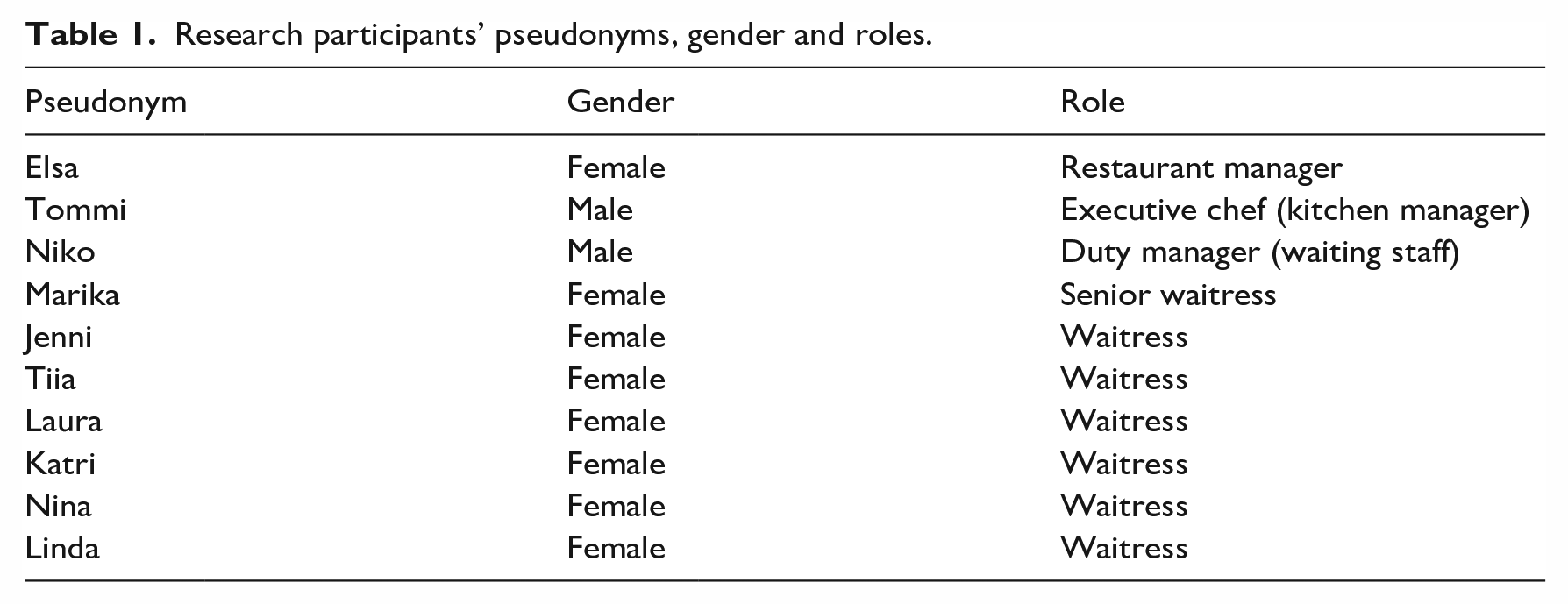
LunchTime employed 18 permanent workers and typically had a few additional temporary workers. However, only seven of the permanent waiting staff members and three managers were frequent users of the walkie-talkie headsets, making them the focus of this study. While one (male) line cook was recorded using a walkie-talkie on two occasions, the remaining kitchen staff did not use them. The waiting staff were all women, while the kitchen staff were predominantly men, with the exception of one woman who worked as a line cook - a not uncommon, gendered division of labour for the restaurant sector. The Restaurant Manager was a woman, but the Group Executive Chef and the Duty Manager were men, hence only two men feature in our analysis. All the individuals listed in Table 1 were white, Finnish and employed on permanent contracts. The researcher established from the fieldwork that the employee age range was 19–60, but most participants listed in Table 1 were in their mid to late 30s. Due to confidentiality reasons, we are unable to provide more detailed biographical information about the participants.
Research participants’ pseudonyms, gender and roles.
Given the use of walkie-talkies, the ‘audience’ of these interactions comprised both men and women, meaning we cannot draw any conclusions about gender exclusive sexual humour (e.g. men conversing exclusively with other men). While the researcher did not explicitly ask questions about participants’ sexuality, no employee openly disclosed a non-heterosexual orientation and all the extracts display heteronormative assumptions about sex. Although we use the terms ‘women’ and ‘men’ in our analysis, we are aware of the limitations associated with such binary classifications (Butler, 1990).
Data collection
While recognising that humour can take verbal and non-verbal forms (Norrick, 2004), in this study, we focus only on verbal forms. The broader study involved 41 hours of observations, access to company documents and policies and 23 hours of recordings of interactions such as meetings, semi-structured interviews and a number of ‘walk-along’ conversational interviews. This broader dataset provided contextual information for our research but does not form part of the analysis. In this paper specifically, we analyse 12 hours and 16 minutes of audio-recorded walkie-talkie interactions captured at LunchTime over three consecutive days. The audio-recorded data allowed us to slow down and replay each episode, enabling a detailed analysis of both the humorous content and sequences. By analysing sequences, we were also able to analyse employees’ audible reactions to humour. This provided us with a key methodological strength, given this level of depth and detail is harder to achieve in studies solely relying on interviews or ethnographic observations.
The walkie-talkies consisted of wireless earpieces connected to handheld radios which could either be clipped onto the person’s belt or placed somewhere nearby. Audio was broadcast only when a button was pressed (to avoid constant background noise) through both the earpiece and the radio. Responses could also be sent via either device. The waiting staff typically wore the earpieces but the kitchen staff and managers tended to use the radio only, which they placed somewhere nearby. The recordings were obtained by placing an audio-recording device next to one of the radios in the Executive Group Chef’s office, which served as the only quiet location for capturing these interactions. Prior to data collection, signed consent was obtained from all participants involved. While our analysis focuses primarily on those speaking during the interactions, managers could always potentially overhear these exchanges, even if they did not directly participate.
In our study context, the walkie-talkies cannot be viewed as neutral artefacts. As a form of materiality (Butler, 1996), they are accessible only to certain employees and as such influencing the maintenance of in-group/out-group boundaries. For example, it is noteworthy that the restaurant’s many migrant employees did not typically use the walkie-talkies. 4 Customers also were unable to hear and respond to sexual comments that occurred ‘behind their backs’. As such, we approach the walkie-talkies as a material medium used in linguistic systems that form part of broader systems of social control, resistance and power.
Data analysis
To analyse the data, the first author listened to the recordings repeatedly and marked on the audio file any moments where an attempt at humour appeared to have been made. We adopted Mullany’s (2004: 21) definition of humour, which is grounded in the work of Holmes (2000), and which acknowledges the analysts’ fundamental role in interpreting what counts as a humorous instance. For example, in classifying an utterance like ‘girls just thinking of bananas’ as attempted humour, it is the analyst that interprets ‘banana’ as a sexual reference rather than a literal reference to the fruit. Importantly, this definition also enables the identification of instances where humour might have been attempted but ‘fails’ and therefore did not spark any response that indexes amusement. We also acknowledge that our dataset does not capture non-verbal aspects of humour (e.g. facial expressions, gestures, body language) or non-radioed dialogue, hence we cannot conclude whether the participants were providing non-verbal signals or speaking ‘offline’ as well.
We followed Gumperz’s (1982, 2001) Interactional Sociolinguistics (henceforth IS) approach to discourse analysis which is widely used in workplace sociolinguistic studies. IS has a broad methodological foundation, drawing on and synthesising ethnography, pragmatics, sociology, Goffmanian and conversation analysis approaches. While it is often ethnographically driven, its analytical emphasis is on real-life recorded interaction. IS involves analysing how social interaction plays out by identifying how interactants use ‘contextualisation cues’ and ‘conversational inference’ (Gumperz, 2001) to interact with each other. Contextualisation cues are the linguistic features (e.g. tone of voice) and wider social knowledge that enable the meaning of utterances to be established, such as the wider social knowledge about musical scores used in pornographic movies used to interpret Extract 3 in this study. Conversational inference refers to how interactants use these cues and their wider social knowledge to interpret the meaning of utterances in order to respond to them. Given that gender and sexuality binaries are both constructed and contested through language (Butler, 1997b), an IS approach therefore allows us to explore how particular spoken rituals, that is, sexual humour, may reflect certain role expectations and socialisation practices (Seals, 2021).
Holmes et al. (1999: 354) assert that workplace interactions are ‘seldom neutral in terms of power’ (see also Holmes and Marra, 2002). In the field of workplace sociolinguistics, power is typically approached as a social relation that can be negotiated, shifted, reinforced, resisted and/or challenged through talk-in-interaction (Holmes and Stubbe, 2015). We see this approach as consistent with Butler’s (1990, 1997a) understanding of power, especially the view that – as linguistic beings – the linguistic ‘injury’ we experience derives not only from the ‘here and now’ of the specific interaction but also from the wider discourses and histories that shape us. Butler (1997a: 18) argues that talk ‘reinvokes and reinscribes a structural relation of domination [. . .] speech does not merely reflect a relation of social domination; speech enacts domination, becoming the vehicle through which social structure is reinstated’. Although individuals do not ‘own’ their voices because they are, according to Butler, always subjected to certain ideologies and power, they can still drive change. This theoretical positioning together with the IS approach allows us to explore various dimensions of power – structural and negotiated – through workplace sexual humour.
Returning to the practical steps involved in the analysis itself, in the initial stages a total of 39 extracts involving humour were identified and transcribed in the source language, Finnish. Out of these, we identified 23 extracts that involved sexual or flirtatious commentary. 5 These 23 extracts were then translated as accurately as possible into English, to enable the co-author (not a Finnish speaker) to participate in the analysis. While recognising that the interpretation of meaning can be affected by the translation process (including lengthy discussions of whether one type of sweet pastry called ‘munkit’ symbolised ‘breasts’ or ‘bottoms’), three extracts were also sent to an independent speaker of both languages to cross-check the translations. From these 23 extracts, we categorised some as ‘romantic’ or ‘flirtatious’ rather than sexual, therefore ending up with 15 extracts of ‘sexual’ humour to analyse.
We categorised the extracts based on their functions (i.e. what the sexual humour appears to be doing), initiators (i.e. who instigated sexual humour), targets (i.e. whether sexual humour was directed at another person or group or not) and responses (i.e. how did recipients react to sexual humour). The categories and extracts were re-examined and re-ordered in eleven iterations. We recognise that there are many other ways in which the extracts could have been grouped and categorised. We also acknowledge that the categories are inter-related and overlap in some instances, something we would expect given the multi-functional role of humour (Holmes, 2000).
We were especially inspired by the work on humour functions by Holmes (Holmes, 2000; Holmes and Marra, 2002; Holmes and Schnurr, 2014), and the playful humour frames that involve ‘bonding’ and ‘biting’ types of humour (Boxer and Cortés-Conde, 1997; Lynch, 2010). Using an inductive approach, but informed by these two categories already identified in other studies, we created two broad categories of function (‘bonding’ and ‘biting’) and four inductively derived sub-categories (‘in-group banter’, ‘in-group gossip’, 6 ‘demeaning complainant’ and ‘lightening up complaint’). ‘Bonding’ refers to displays of familiarity and informality within an in-group. By ‘in-group banter’, a sub-category of bonding, we refer to exchanges where people make jokes about sexual preferences and desires. ‘In-group gossip’ refers to interactions where people use sexual humour as a source of amusement when talking about or fantasising about someone else. ‘Biting’ refers to sequences apparently designed to be ‘mean’ to someone else or ‘malicious’ in some way. These sequences occurred as part of a complaint or criticism sequences. We use the label ‘demeaning’ to refer to exchanges where the person involved in a complaint or criticism uses sexual humour to demean or belittle the other person. ‘Lightening up’ was where a complaint or criticism sequence was made less ‘serious’ or less ‘conflictual’ through the use of sexual humour without any individual or group being demeaned. However, we note the unclear boundaries in all these categories, in line with Boxer and Cortés-Conde’s (1997) argument about the fine-lines dividing types of humour, such as when ‘teasing runs along the continuum of bonding to nipping’ (p. 278).
We also followed existing studies in paying attention to who initiates the humour (Mullany, 2004), which enabled us to identify sexual humour used ‘up’, ‘between’ or ‘down’ various organisational and occupational power or status groups. We also grouped the extracts based on the targets of the humour, that is, who is the ‘target’ or ‘butt’ of the joke (Holmes and Marra, 2002). In our context, the use of walkie-talkies meant that customers and certain employees could be targeted ‘behind their back’ because they did not use the walkie-talkies, even if they were in close physical proximity. For this reason, we also distinguished between humour targeted at someone ‘present’ (i.e. access to walkie-talkies) and those ‘absent’ (i.e. no access to walkie-talkies).
Finally, we categorised the interactional responses to the humour (Hay, 2001). Here, we identified three responses. We used the label ‘joining in’ to categorise exchanges where one or more other person responded to the joke, such as by laughing or by continuing the joke. We used the label ‘joking disapproval’ to categorise exchanges where an admonishment indicating disapproval was made but was delivered in a non-serious, light-hearted manner. We used the label ‘non-response’ for exchanges where no verbal response was audible. Various reasons can lay behind a non-response – such as recipients having not heard the joke, being offended by the joke or not having found the joke funny – hence we cannot be certain about concluding that a non-response is a form of social reprimand. Interestingly, we did not find any extracts involving a ‘serious’ form of disapproval or reprimand.
Findings: Sexual humour at lunchtime
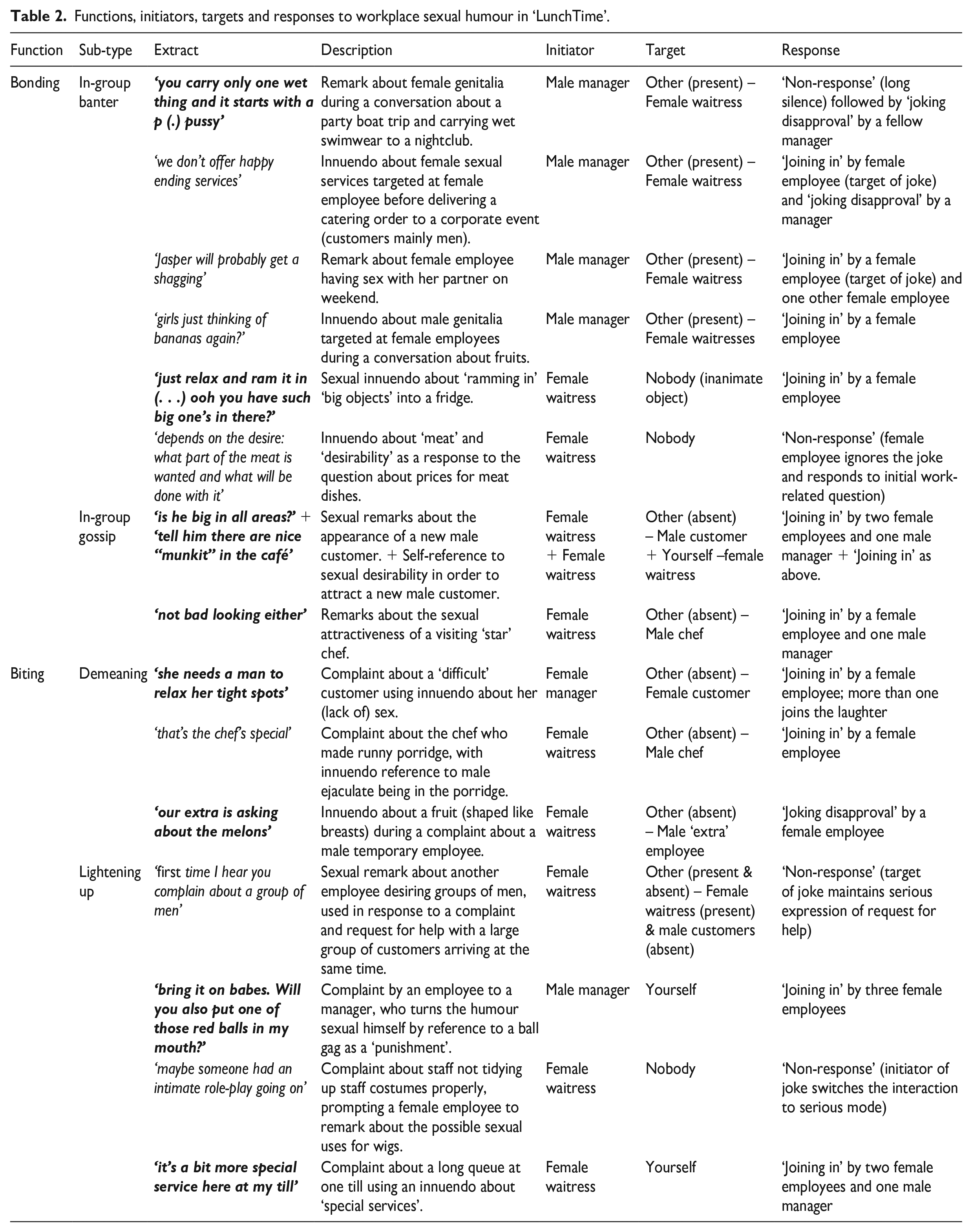
Before presenting a detailed analysis of selected extracts, Table 2 provides an overview of all 15 extracts in the dataset. For each extract, the table provides a short description of the context of the interaction, together with the function, initiator, target and response to the sexual humour. Extracts in bold are analysed in the paper. All other extracts are provided in the online supplementary file (English translation and Finnish original).
Functions, initiators, targets and responses to workplace sexual humour in ‘LunchTime’.
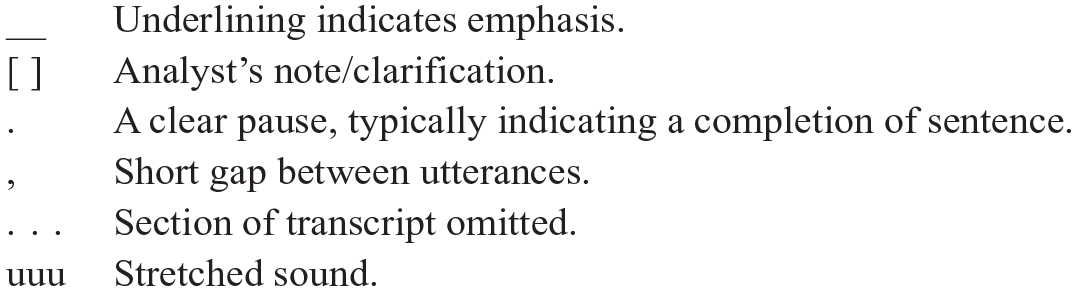
The following simplified transcription conventions are used to enhance readability:
Sexual humour and ‘bonding’
In-group banter
The first six extracts presented in Table 2 all involve sexual humour that appears to function as in-group banter. The two illustrative extracts that follow perform the same function but differ in their power implications. Extract 1 can be regarded as ‘punching down’ because the humour is initiated by a male manager and targeted at a female subordinate. Extract 2, in contrast, provides an example of humorous ‘dirty talk’ sequence initiated by a female waitress and targeted at nobody in particular.
Extract 1: ‘Wet thing’
Interactional context: The employees were discussing an upcoming awayday which involved going first to a spa and then to a nightclub. Niko and Tommi, both managers, later joined in the conversation after Jenni mentioned her preference for leaving behind her swimwear for the spa before going out.
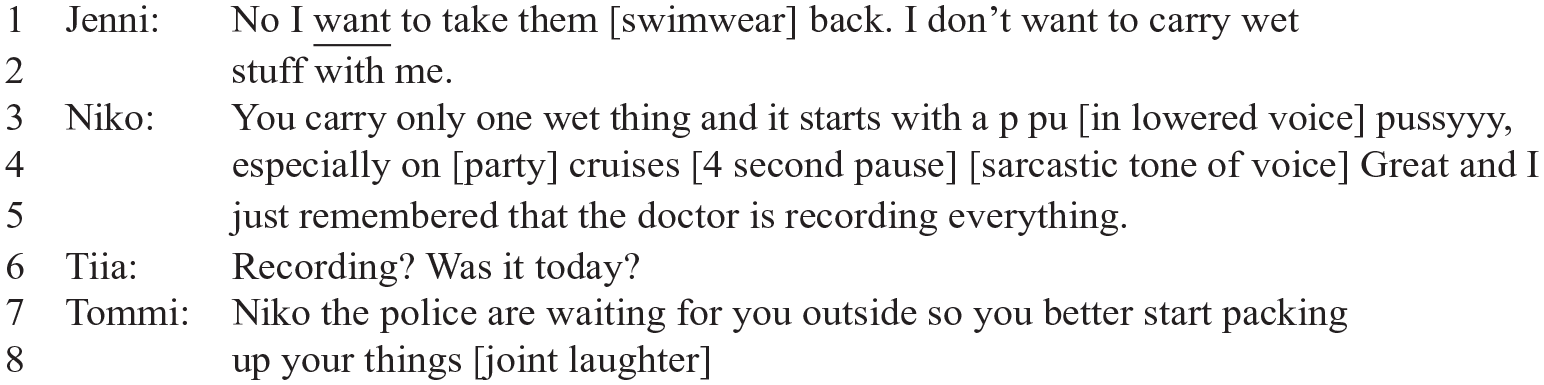
After Jenni mentions her preference for not taking the wet swimwear to the nightclub (lines 1–2), Niko introduces an explicitly sexual element directed towards Jenni (line 3). The type of ‘party cruise’ they are discussing has a reputation for drunken and debauch behaviour. The choice of term ‘pillu’ in Finnish is an informal and vulgar way of referring to the vagina, which we have translated as ‘pussy’. In Finnish, however, it is not considered a swear word per se, although in a workplace context it could be deemed inappropriate. It does not however share the derogatory meaning of ‘pussy’ in English as denoting an ‘effeminate male’.
The notably long pause in line 4 allows for a responding utterance, but Jenni and the others remain silent. The silence is equivocal because it could indicate that the utterance was viewed as offensive, especially for Jenni, or that it was simply not viewed as funny. Niko attributes the silence to the recording being made by the researcher (the ‘doctor’) (lines 4–5). In so doing, Niko implies that, in normal circumstances without a tape recorder running, his joke would have been well received. It is only after Tommi’s joking reprimand about the police being called in (lines 7–8), framing Niko’s comment as ‘unlawful’, that laughter from the others is prompted. At this point, though, the recording was not clear enough to identify whether Jenni was one of those laughing.
We will now examine this extract in relation to the four dimensions and the wider organisational and social context. In terms of function, this extract could be interpreted as a (failed) attempt at reproducing an in-group culture of informality and familiarity, where banter of a sexual nature are told to reinforce a sense of being ‘buddy-like’ and able to exchange vulgar comments without fear of reprimand. With regards to the initiator, this extract involved a male manager initiating the sexual humour directed towards a female employee, thereby reproducing and reinforcing his position of power. The target is an individual who was present and held lower organisational position. This type of interaction carries power effects and can result in significant linguistic injury by potentially causing the target to feel publicly affronted, ashamed or embarrassed. However, it is beyond the scope of interactional sociolinguistic analysis to speculate on Jenni’s emotional response to being subjected to the phrase ‘wet pussy’, beyond noting the absence of any audible reaction from any party.
The researcher’s ethnographic observations are central to our interpretation of the function in this extract. During the fieldwork, the researcher witnessed numerous mutual banter-like exchanges between Niko and Jenni, some of which were initiated by Jenni (see also Extract 2). The ‘waitress’ in the prologue is in fact Jenni, who was proudly introducing the researcher to their ‘fuck booth’ to initiate the researcher into their culture of sexual humour. The manager in the prologue who walks in, asks ‘What are you doing there?’ and looks visibly embarrassed is in fact Niko. In this organisational context, given Niko and Jenni’s relationship history (including explicit ‘closeness’ and socialising activities outside of the workplace), the hierarchical power structures are more complex. Therefore, it is plausible that Niko anticipates that Jenni will respond by joining in and turning the sequence into extended ‘banter’, thereby furthering their close relational ‘bonds’, even if that is not the response he got this time.
In terms of the actual response, two different responses were produced. In the first instance, Niko received a ‘non-response’, which he attributed to the act of being recorded rather than the offence or injury he might have caused the target (line 5). Shared laughter was only elicited when manager Tommi offered a ‘joking disapproval’, where the humorous reference to the police being called displays his recognition of the ‘offence’ committed by Niko. However, it is not clear whether the ‘offence’ is actually ‘offending Jenni’ or ‘breaking the rules’ of expected workplace behaviour in this organisation, or both. At this point, the target of the joke shifts from Jenni to Niko himself, who is jokingly reprimanded for being caught on tape cracking his ‘dirty joke’. Note that the joking reprimand is directed at being ‘caught’ for the act, rather than at the act itself.
Extract 2: ‘Ram it in’
Interactional context: Katri requested if someone could bring milk to the restaurant area. Jenni responded by bringing a box of milk and then returned to the kitchen. Following this, Katri attempted to fit the milk cartons into the small restaurant fridge.
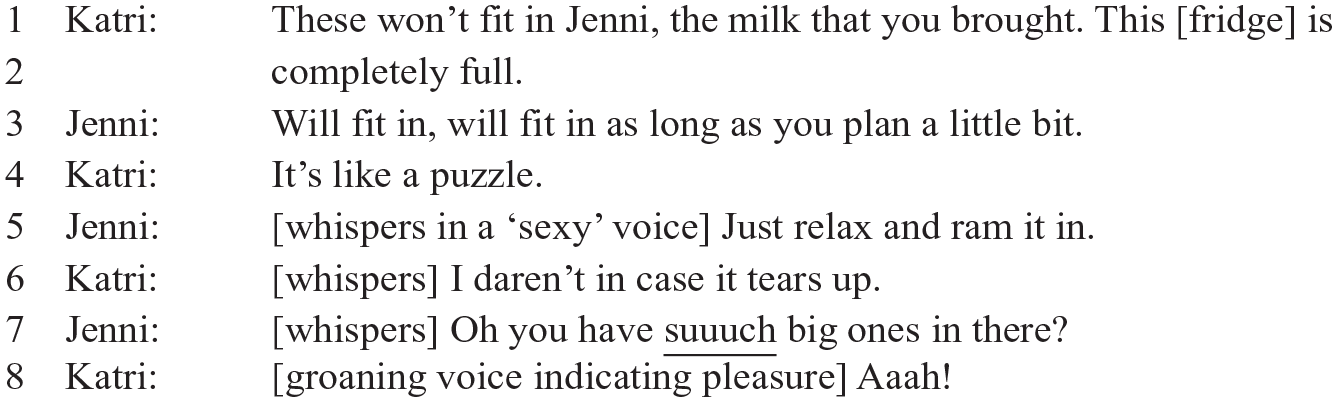
In this extract, the two female employees co-produce a sequence of ‘dirty talk’ from lines 5 to 8. Jenni uses a ‘sexy whispering’ voice to deliver a playful reference to sexual penetration. Building on the humour in line 6, Katri also adopts a whispering tone to deliver an innuendo involving a (metaphorical) vagina being ‘torn’ by an object being ‘rammed in’. Jenni continues the sequence in line 7 by using the sexual innuendo of ‘big ones’ to refer to a large object being inserted into the (metaphorical) vagina. Katri completes the sequence by making an exaggerated groaning-in-pleasure sound, where her imaginary response to having ‘big ones’ ‘rammed in’ parodies the response ‘script’ of pornographic genres. Throughout this sequence, Katri is not directly identified as the target of the joke, which is referenced to a generic third person. The quieter whispering tone used by both employees in lines 5–8 indexes their understanding of the conversation as somehow ‘illicit’ and ‘inappropriate’.
The function of the extract can be interpreted as displaying bonding through in-group banter because it displays and reinforced their sense of familiarity and ‘closeness’ with each other, namely by turning the conversation in a risqué direction without fear of causing offence. The initiator is a female employee, who is engaged in conversation with her equal peer. The target of the humour involves both inanimate objects that have ‘double meanings’ and a generic third person, which may or may not include Katri herself. The response involved ‘joining in’, namely because Katri builds on and embellishes the joke, thereby displaying that no offence was taken. This type of interaction reproduced a broader in-group norm observed during the study, where ‘dirty talk’ was normalised and routinely publicly expressed, even when managers were within earshot.
While the power effects in this extract do not involve the type of ‘linguistic injury’ where an individual or group are being personally degraded or demeaned, it does reproduce the pornographic schema that reinforces particular gender roles and sexual behaviour scripts. In particular, it reinforces heteronormative notions about who acts as the main agent of sexual encounters (i.e. men as active agents, women as passive receivers), what type of sex is desired (i.e. aggressive and/or violent forms), genitalia size (i.e. large penises being acceptable and/or desirable) and the performance of sex acts (i.e. audible displays of pleasure by women). While on the one hand the two women clearly feel ‘liberated’ and ‘empowered’ to openly discuss their sexual desires, they do so only through the schemas and scripts available to them. As such, they also perpetuate ‘linguistic injury’ by reproducing sexualised ideals that serve to dominate and marginalise others and themselves, including men who do not identify with (or feel they meet) these ideals of masculinity. Publicly displaying such sexual behaviours could, therefore, be seen as a form of linguistic violence that can cause injury to those who are involuntarily subjected to them.
In-group gossip
This section presents two examples of sexual humour that contribute to ‘bonding’ through ‘in-group gossip’. These excerpts illustrate how employees use sexual humour to amuse themselves ‘behind someone’s back’, in the first extract targeting a male customer and in the second extract targeting a visiting chef. Note that both of these targets represent categories of people with whom the waitresses are typically expected to have a ‘subservient’ relationship towards.
Extract 3: ‘Is he big in all areas?’
Interactional context: Two waitresses, Linda and Jenni, are working at separate tills and notice a new male customer at the food stations. Their younger colleague, Katri, is working in the café, which is in a different location, meaning she cannot see what is happening in the restaurant and asks her colleagues to check the customer’s ID. 7
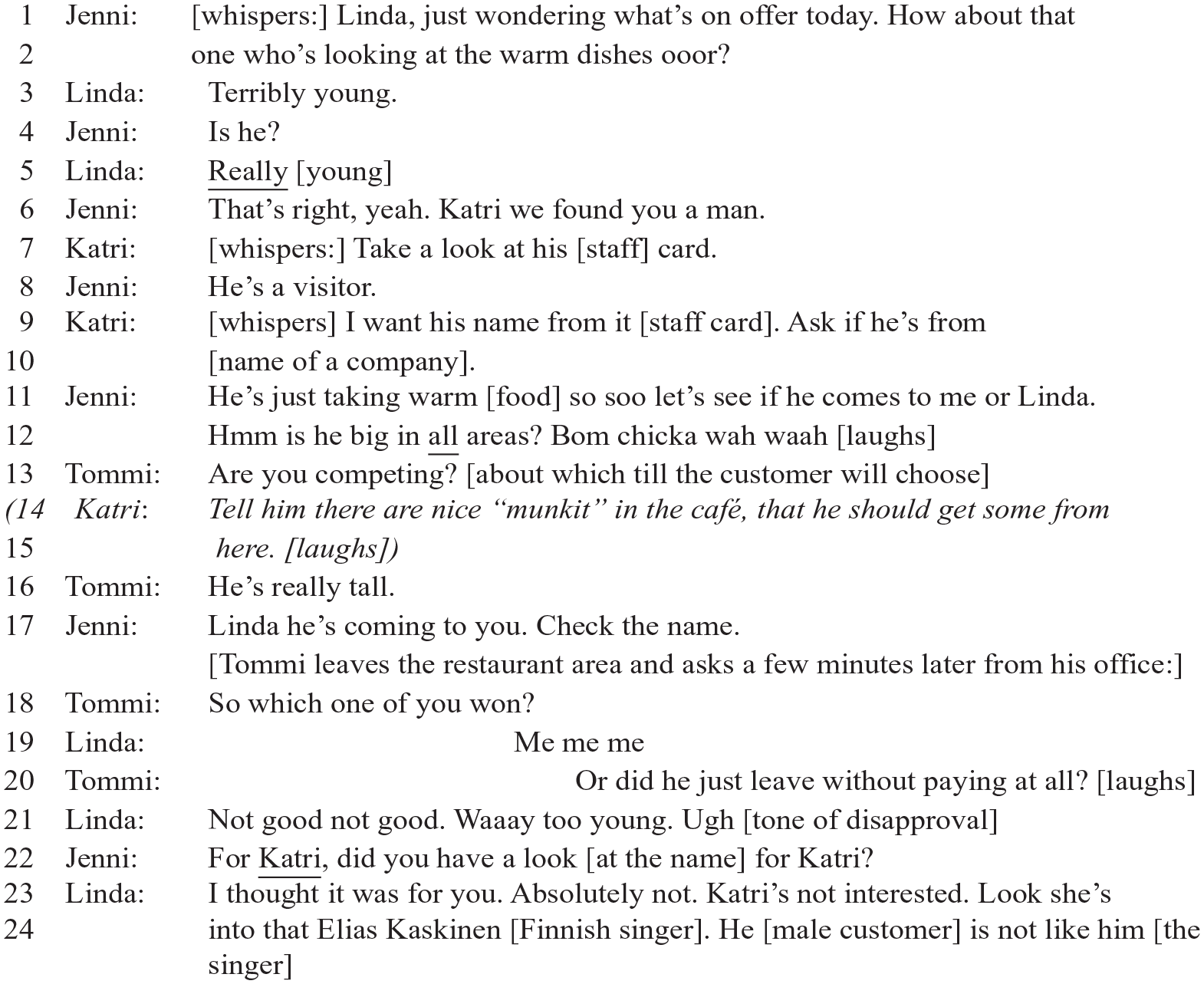
The humour sequence starts when Jenni asks her fellow waiting staff ‘what’s on offer’ (line 1) when a group of customers enter the building, metaphorically comparing the customers’ bodies to a set of ‘items on sale’ and pointing to one male customer in particular for sexualised evaluation (lines 1–2). Linda describes him as ‘terribly young’ (line 3), enacting gender and age-based norms around the suitability of younger men as targets of desire for older women. This age categorisation leads Jenni (line 6) to instead suggests a ‘pairing’ with their younger colleague, Katri. This positions Katri as someone who is seeking a (heterosexual) relationship and wants or needs help ‘finding a man’. The colleagues then discuss trying to identify the customer’s name and company from his staff ID card (lines 8–10). Jenni continues to comment on the male customer’s physical appearance with an indirect reference to assessing the size of his genitalia (line 12) followed by a musical riff (‘bom chicka wah waah’) associated with sex acts in pornographic movies. 8
Katri responds to the ‘offer of help’ by joining in, making a jocular self-reference to her sexual desirability to ‘lure’ the male customer towards her ‘nice “munkit” in the cafe’ (line 14). Here, ‘munkit’ refers to round jam-filled doughnuts, which is metaphorically understood in Finnish to mean breasts. The kitchen manager, Tommi, then joins the interaction by commenting about the women ‘competing’ for the male customer (lines 13 and 18) and joining in the evaluation of the male customer’s attractiveness (line 16). The humorous sequence continues with Linda (line 19) announcing that she ‘won’ the competition (i.e. the customer paid at her till) and Tommi teasing them about whether the attractiveness of the customer means he will not be asked to pay (line 20). After the customer had walked away, Linda re-evaluated the attractiveness of the customer, again using age-based categorisations (line 21). The sequence ends when Linda re-evaluates the ‘pairing’ of the male customer with Katri, on the grounds that the male customer does not look like the Finnish celebrity that they know Katri fancies (lines 23–24).
In terms of function, the participants in the interaction display their belonging to an ‘in-group’ of female employees who openly share their sexual desires and openly ‘objectify’ men. These utterances are not only tolerated but actively encouraged by a senior manager (i.e. responses by Tommi, lines 13, 16, 18, 20). In so doing, the in-group of employees and the manager perpetuate the ‘normalisation’ of the local culture of sexualised verbal misbehaviour in which such acts are viewed as acceptable. The initiator of the overall sequence (line 1) and the sexualised humour (line 12) is a female waitress, who is both engaging in ‘misbehaviour’ in relation to the official organisational policies, but having her behaviour sanctioned by Tommi.
The target of the sexual humour is both a male customer who is not present (i.e. hearing the interaction) and a female waitress (Katri). In this case, the male customer is objectified - and without any opportunity to respond - by reference to his sexual desirability according to a set of idealised attributes, including age, height and genitalia size. As such, he is subjected to the linguistic injury of being reduced to an instrumental role in satisfying the sexual urges of others and being evaluated according to the desirability criteria of others. In terms of interactional response, this sequence contains multiple instances of ‘joining in’ by two other waitresses and one manager, which serve to reinforce the normalisation of the sexual (mis)behaviour and potentially also discourage others from ‘calling out’ such behaviour.
Extract 4: ‘Not bad looking either’
Interactional context: The employees are talking about a visiting ‘star’ chef who is not wearing a walkie-talkie headset.

In this excerpt, the visiting chef is displayed as an object of desire in line 3 by Linda. Jenni goes along with the theme of desire and asks if they can ‘keep him’ in a playful tone (line 4), implying that the chef is comparable to a possession such as a toy or a pet. Tommi, the executive chef who is formally in charge of staffing in the kitchen, responds by playfully teasing the three employees that their behaviour would ‘scare him off anyway’ (line 5).
In terms of function, this interaction seems to serve the purpose of enhancing in-group bonding through gossip. As with Extract 3, the staff displayed a degree of in-group ‘intimacy’ by openly disclosing (illicit) desires in ways that both compliment and objectify the target of the sexual remark. The initiator is a female waitress who, despite hierarchically occupying a lower organisational position than the target, nonetheless belongs to a powerful in-group, given the chef’s visiting status. The target of the sexualised comment is absent (i.e. not wearing the headset) and appears to be positioned as an outsider. As for the response, a female employee and a male manager both join in. Note that the female employee who joins in reinforces the sense that they belong to an in-group that can share illicit desires. Note also that the male manager’s humorous response signals that such illicit conversations do not warrant managerial sanction, also furthering the normalisation of their sexualised behaviours.
Sexual humour and ‘biting’
Demeaning
We use the category ‘biting’ to refer to humour used during a conflict-laden sequence involving some kind of ‘griping’ or ‘sniping’ between two or more people. The first sub-category of function we have called ‘demeaning’ because it involves sexual humour being used to demean, belittle or insult the person (or group) triggering or initiating the complaint or conflict. In what follows, we present one example where employees collaborate in using derogatory sexual humour targeted at a customer and another example of sexual innuendo targeted at a temporary (‘extra’) employee.
Extract 5: ‘Relaxing tight spots’
Interactional context: Nina is approached by a familiar female customer who enquires about the food ingredients.
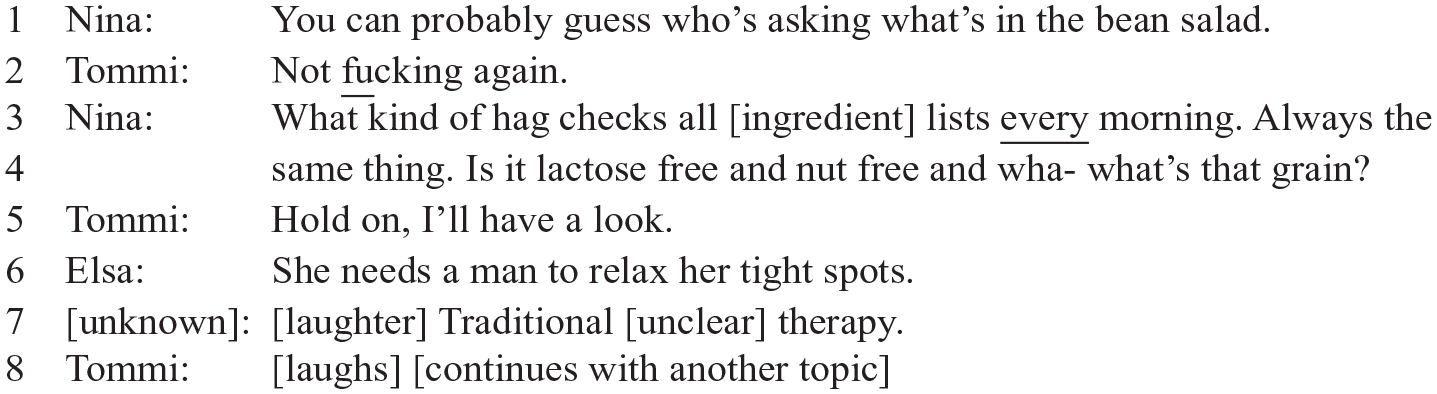
In this extract, the sexual comments serve as an attack on a customer who is perceived by certain employees to be persistently annoying. The rhetorical question posed by Nina (line 1) invites her colleagues to join in her complaint about the customer. Tommi affirms this shared knowledge of the ‘difficult customer’ in line 2 with his swearing remark. Nina further expresses her frustration in line 3 by using a gendered and ageist derogatory insult (‘akka’ in Finnish, translated as ‘hag’). It is the restaurant manager, Elsa, who initiates a sexualised comment in line 6 by implying that the customer is difficult to manage because she is ‘not getting sex from a man’, where ‘tight spots’ acts as a euphemism for vagina. In line 7, the recording was not clear, but one female employee first laughs and then embellishes the sequence by adding a comment which sounded like ‘traditional cock therapy’.
While the initiator of the complaint sequence was waitress Nina and executive chef Tommi (lines 1–3), it the restaurant manager Elsa who initiated the transition towards sexualised humour on line 6. Elsa carries on the ‘biting’ nature of the complaint sequence and her comments function to demean the target by implying that her ‘difficult’ behaviour is due to a lack of sex. By joining in, Elsa also displays an act of ‘solidarity’ with staff grievances, signalling that it is acceptable in this workplace to ‘gripe’ about difficult customers behind their backs. The absence of any serious reprimand by Elsa, both for the complaint itself and for the use of derogatory language such as ‘hag’. It is noteworthy that the company has formal rules regarding the labelling of food ingredients as well as the expectation that customers should be treated respectfully, both of which are disregarded on this occasion. As such, Elsa appears to use sexualised humour to position herself ‘on the employees’ side’. Since the target of the sexual humour, the female customer, was absent from the conversations, this also has power implications as it removes her ability to respond, defend herself or make a complaint. In terms of response, two others join in by either laughing or embellishing the joke (lines 7 and 8). Overall, this sequence reveals how an individual act of linguistic injury is transformed into a collective co-production. The employees ‘gang up’ on someone and they are permitted - or in this case even encouraged and ‘egged on’ - by managers at local level. In its wider societal context, we also see a gendered and sexualised discourse reproduced which categorises women who do not engage in sufficient (heterosexual) sex as ‘unhappy’ or ‘bitter’ and prescribes sex acts as a ‘remedy’ for people who are perceived as difficult.
Extract 6: ‘Melons’
Interactional context: Before and after the upcoming short sequence, there was a period of radio silence. Prior to this, Tiia and others had been complaining throughout the day about one temporary staff member (the ‘extra’) for not being helpful and for just standing around.

When interpreting this interaction as sexualised humour, we were guided both by the playful tone of voice used in line 1, the non-literal interpretation of the utterance and playful response in line 2 and the double-meaning of ‘melons’ (or ‘melonit’ in Finnish), which can be used euphemistically to refer to breasts. The response by an unknown female (voice could not be identified) in line 2 indicates that line 1 was viewed as a sexual euphemism because they playfully ask Tiia to ‘leave’ the extra alone that is, stop teasing him.
The function of the sexualised comment appears to serve as a means of handling a complaint by ‘demeaning’ someone. Although presented as a joke, as signalled by Tiia’s tone of voice, the comment is part of a wider sequence of complaint about the extra’s work effort and work ability. The initiator of the joke is a permanent female waitress, who is hierarchically ‘low down’ but in this instance has higher status than the ‘extra’ who does not know the workplace, has a marginalised employment position and does not have access to the walkie-talkies. The target is absent (i.e. out of earshot) and therefore unable to respond to any of the criticisms and teasing. In terms of response, the demeaning comment was met with joking disapproval when another female waitress appears to display sympathy towards the extra. However, this sympathy is delivered in a somewhat belittling or condescending manner insofar as a stretched ‘Aaaw’ sound is an expression typically used to convey affection towards something endearing but vulnerable, such as a puppy or a baby. Furthermore, the request to ‘leave [him] alone’ also subjugates the target by suggesting that he is incapable of looking after himself and thus needs ‘protection’.
Lightening up
Our final section presents two examples of sexual humour where it appears to serve the purpose of making somewhat ‘tense’ conflictual situations less serious. In the first example the target of the humour turns the sequence sexualised after being ‘told off’ by his subordinates. In the second and final example, innuendo and sexual humour were used to make a humorous remark during a complaint sequence.
Extract 7: ‘Ball gag’
Interactional context: Jenni was expressing her frustration with the duty manager, Niko, who she blames for not communicating clearly the requirements for a catering order.
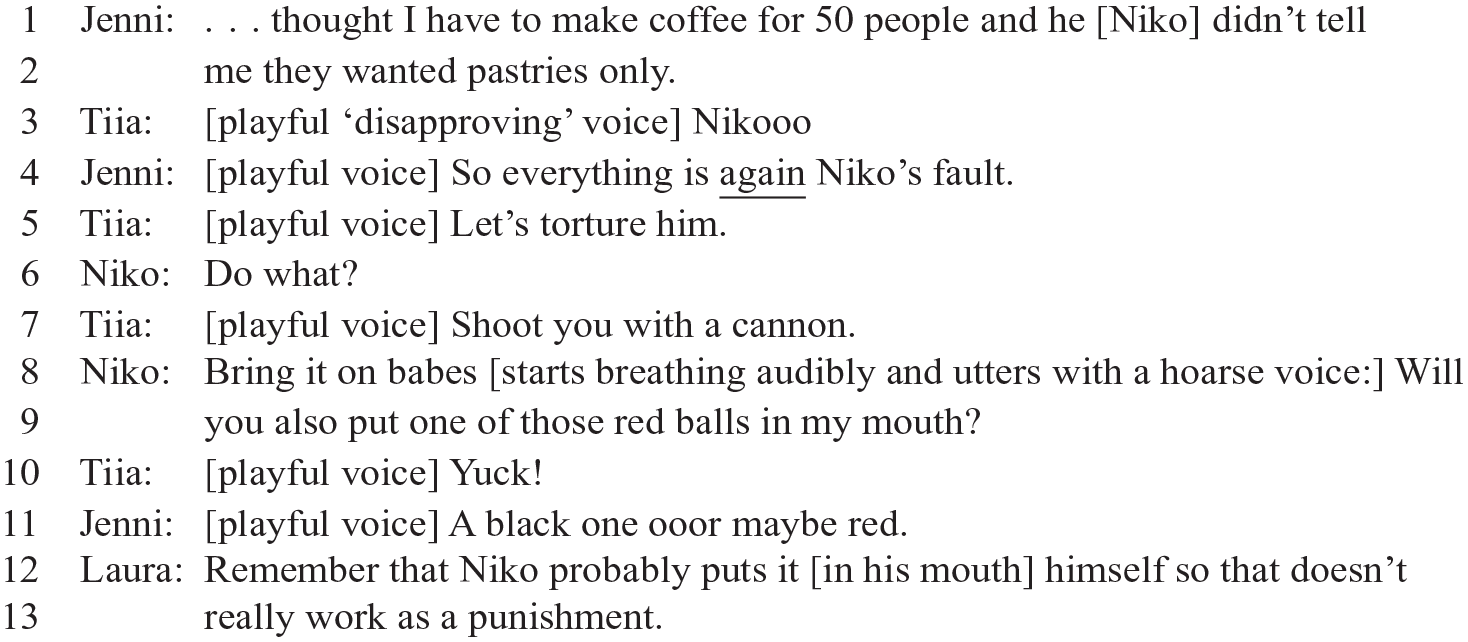
In lines 1–2 Jenni places blame on Niko, her line manager, for messing up an earlier catering order. Tiia joins in line 3 with a playful reprimanding tone, which is followed with a repetition of the ‘blame’ by Jenni (line 4) and a playful suggestion by Tiia of physical punishment (lines 5 and 7) for Niko. It is Niko himself who turns the humour sequence in a sexualised direction (lines 8–9) when he suggests a form of ‘punishment’ associated with sadomasochistic role-play, where a person playing the submissive role wears a ‘ball gag’ in their mouth. Jenni (line 11) joins in the sexualisation of the sequence by suggesting an alternative colour for the ball, with both colours suggested (black or red) associated semiotically with eroticism. Laura also joins in the joke (lines 12–13) by implying that Niko enjoys such sadomasochistic activities and therefore it would not serve as a suitable ‘punishment’ for his catering order mistake.
In this extract, the sexual humour functions to further the attempts by others to ‘lighten’ the mood of the complaint sequence. Given the sequence involved employees complaining about a manager, the use of humour about physical punishment and the playful tone of voice was used to ‘soften’ the complaint. However, Niko’s self-targeted sexual joke also serves as a form of managerial power by trivialising the criticism by Jenni, deflecting the conversation away from discussing the mistake itself and away from him offering any kind of excuse, justification or apology for it. It also subjects others to a discussion of his own sexual ‘kinks’. The initiator and target of the sexual humour was Niko himself. However, in this case, it is not so much a ‘self-inflicted’ injury but rather a highly masculine form of competitive banter and self-mockery, as indicated by the comment ‘bring it on babes’ (line 8) and the audible ‘erotic’ breathing in response to Tiia. By actively inviting further sexualised banter, Niko jokingly performs his masculinity, underscored by his use of the sexualised category ‘babe’ (commonly used to refer a sexually attractive young woman). The reference to submissiveness within sado-masochistic sexual fantasies (i.e. ball gags) transforms the complaint from something requiring an apology into something that warrants a ‘punishment’ that is sexually desired. Here, we note that while categorising this as a ‘lightening up’ sequence, the reference to Tiia as ‘babes’ can also be understood as an act of ‘demeaning’. Our analysis cannot conclude whether the recipients were left feeling embarrassed, upset or affronted by Niko’s remarks. However, we can note that the responses by Tiia, Jenni and Laura showed them ‘joining in’, possibly to ‘play along’ with their manager’s preferences.
Extract 8: ‘Special service’
Interactional context: The following interaction takes place during peak lunch hour. The preceding turns alluded to some tensions between the staff and managers due to the front-of-house being understaffed.
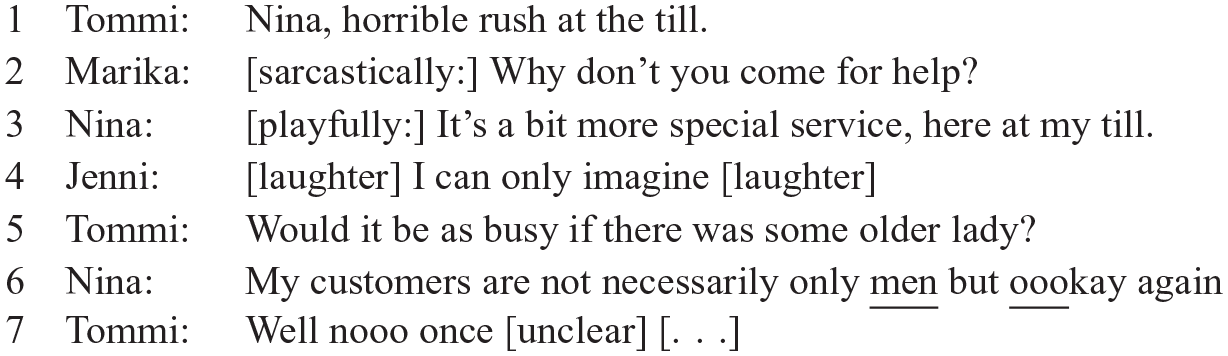
The sequence opens in a non-humorous tone with the executive chef, Tommi, remarking on the ‘horrible rush’ at Nina’s till. It is Nina who initiates the humour in the conversation in line 3. Her reference to the ‘special service’ she provides at her till is ambiguous, however, Jenni’s laughter response indexes that the utterance was interpreted as humorous and sexual (i.e. the ‘special service’ provided by sex workers). Tommi appears to interpret the comment in the same manner in line 5 and introduces two new categories – age and gender, implying that only those who are ‘young’ and ‘male’ would be given the ‘special service’. Tommi’s remark, however, is not validated by the others. In fact, Nina’s disaffiliating move in line 6 can be seen as a rejection of Tommi’s attempt at further humour. In the final turn, Tommi’s tone of voice and agreement (‘well nooo’) suggests an attempt at repair work with Nina, before changing the subject.
The sexualisation of the sequence in line 3 appears to function to ‘lighten up’ or ‘diffuse’ the tension that arises from an exchange that questioned why managers do not help out when staff are over-worked (line 2). The sexualised turn is initiated by the female waitress with the worst ‘rush’ at her till, Nina, and the humour is also targeted at herself. In terms of responses, a female employee and a manager both join in, continuing the sexualised joke sequence. However, when the manager joins in (line 5), the sequence is not continued in a humorous fashion and Nina does not continue the joke. This shift in tone could be understood in the context of the frustration expressed by the staff regarding understaffing issues. It is noteworthy, though, that this was the only interaction where a manager was actively ‘cut off’ from the in-group humour.
Discussion
A key advantage of using recorded data in this study has been the ability to slow-down real-time sequences of interaction to pinpoint who uses sexual humour, what it is used to do, who it is targeted at and how it is responded to. This has enabled us to unpack the distinct power dynamics across four interactional dimensions of workplace sexual humour, which we have labelled as function, initiator, target and response. While each of these dimensions could be understood as carrying a form of ‘linguistic injury’ (Butler, 1997b), these power dynamics are not uniform. We propose that understanding the power dynamics of workplace humour requires us to unpack and differentiate the distinct power relations enacted across each of these four dimensions, which are summarised in Table 3.
Power dynamics of the four dimensions of workplace sexual humour.
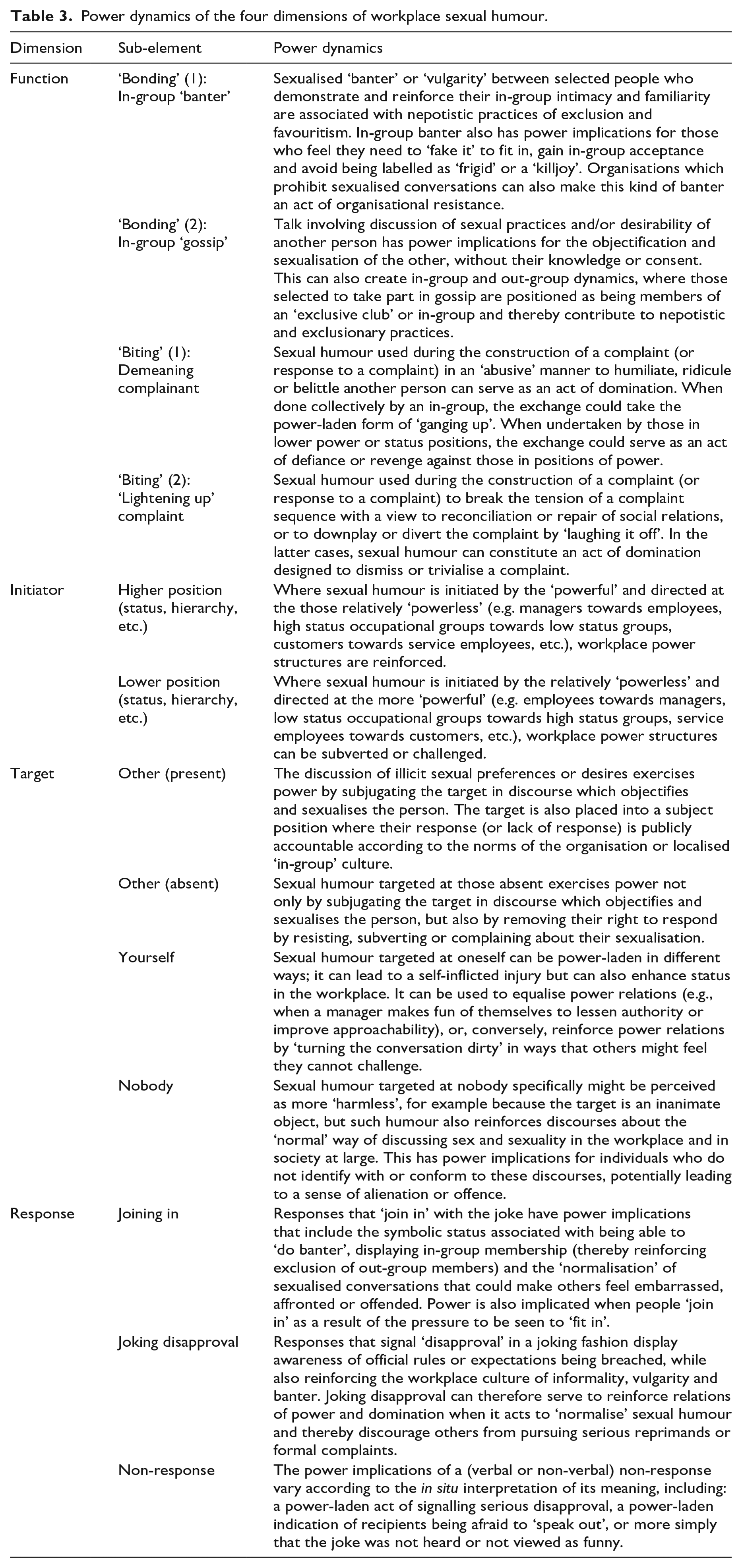
Figure 1 also offers a visual overview of these dimensions, where the contextual backdrop plays a crucial role in providing the wider organisational and social structures, practices and discourses through which sexual humour is enacted. Note that we use the ‘etc’. in Figure 1 to acknowledge that other categories of function, initiator and response are possible, even if they were not present in this particular study.
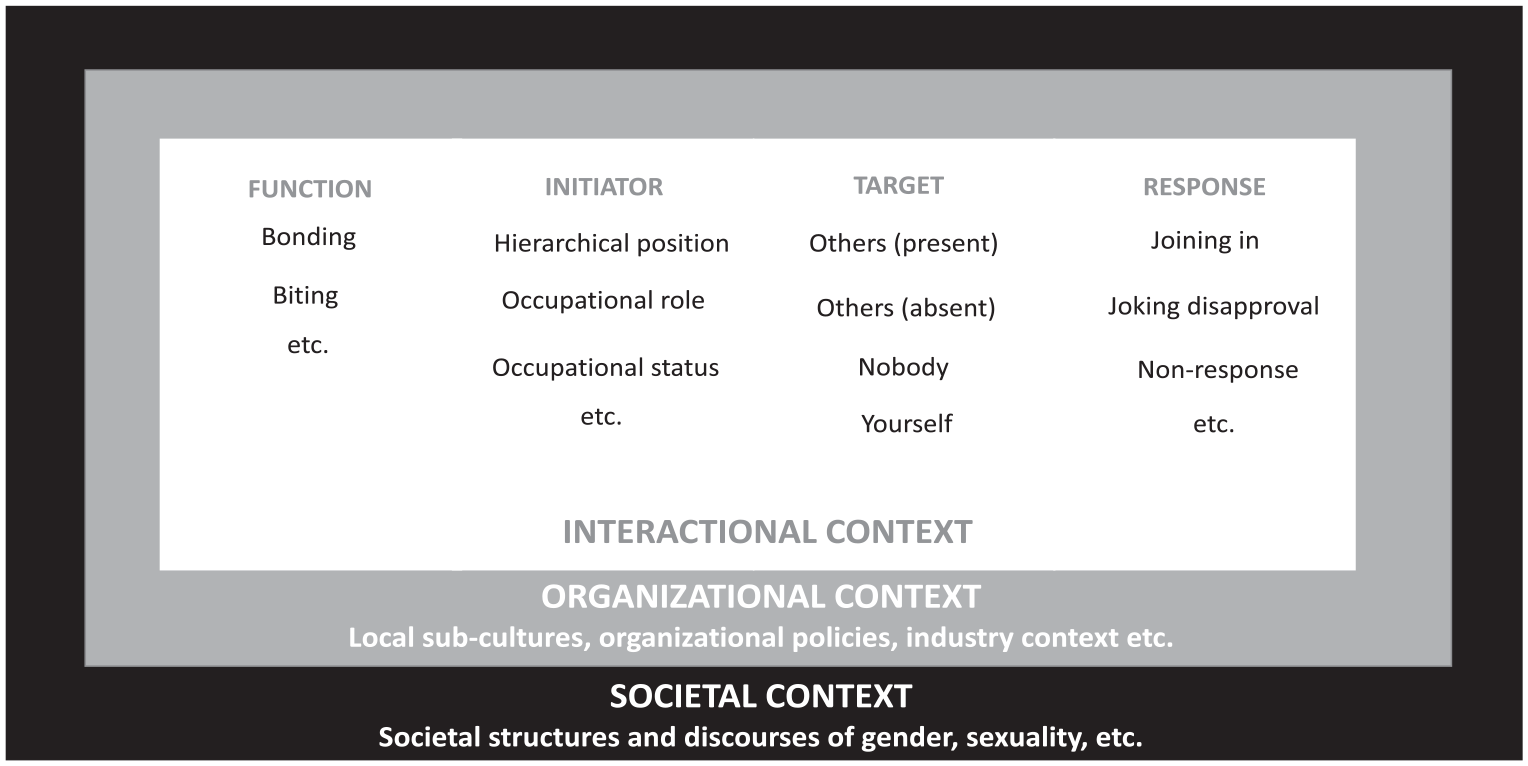
Power dimensions of workplace sexual humour in its interactional, organisational and societal context.
In this study, we build on existing literature that unpacks the gendered power dynamics of workplace banter (Plester and Sayers, 2007; Topić, 2021) by highlighting the way that power is exercised through in-group sexual humour in a mixed-gender group. Firstly, we have shown how power is exercised when people feel they need to ‘join in’ to ‘fit in’ (e.g. Plester, 2015; Watts, 2007; Yount, 1991). This pressure to conform can arise from a desire to avoid being labelled a ‘killjoy’ (Ahmed, 2010) and gain acceptance from an in-group. Given the fact that humour is often viewed as ‘a core facet of belonging’ (Marra, 2022: 147) in a work community, being seen to lack a ‘good’ sense of humor is often associated with ‘a lack of vital human quality’ (Billig, 2005: 11). However, what defines ‘good’ is ambiguous and can rest on fundamentally local understandings of ‘how we behave around here’, with highly eroticised workplaces using extreme forms and more sanitised workplaces preferring more timid or ‘tame’ expressions of sexual humour.
Secondly, we have identified the power implications for those excluded or marginalised from the in-group, where sexual humour can reproduce feelings of alienation or exclusion. Power is enacted in different ways when people actively seek in-group membership but find themselves excluded, when people desire in-group membership but feel unable to ‘perform’ the sexual humour to meet their expectations, and when people actively reject in-group membership because of their alternative cultural, religious or generational value-systems. In our case, for instance, it was noteworthy that no migrant employee was observed engaging in the in-group sexual banter or gossip we captured on tape.
In terms of functions of sexual humour, this study found that participants reproduced the in-group culture of ‘banter’ (Plester and Sayers, 2007) through humorous teasing that involved comments of intimate or illicit sexual preferences or desires. This type of in-group ‘bonding’ (Boxer and Cortés-Conde, 1997) can make both targets and recipients feel embarrassed or affronted, even if they are being complimented rather than criticised. Hence, this kind of sexual humour subjects its targets to the ‘linguistic violence’ (Butler, 1997b) of being reduced to objects of sexual desire and subjected – without their consent and also without their knowledge – to a sexual assessment of their body’s desirability. Recipients and over-hearers, for their part, are also subjected to the sexualisation of the workplace conversation. Even if the joke is not directed at them, recipients and over-hearers are reminded of their position in gendered and sexualised discourses which spell out what is ‘good’ or ‘normal’ for men and women to desire or enjoy (e.g. the genitalia size and aggressive sexual actions of men who are ‘big in all areas’ and ‘ram it in’). In this study, we found evidence of employees as well as managers, and women as well as men, reproducing sexualised scripts associated with male sexual behaviour, pornography, sex work and sexual fetishism (e.g. Extracts 2, 3, 4, 5 and 7). In so doing, we can see how both men and women reproduced aggressive and competitive sequences involving stereotypical gender roles usually associated with masculine forms of humour (Kotthoff, 2006; Plester, 2015; Tannen, 1994).
Importantly, though, this study has also uncovered evidence of humour used for the function of ‘biting’ (Boxer and Cortés-Conde, 1997) – that is, serving to criticise or ‘put down’ another person – which occurred during sequences that involved complaints. Here, the power dynamics differed depending on what the sexual humour was seeking to perform. Power was clearly involved when sexual humour was used to demean someone making a complaint or being targeted with a complaint (e.g. Extracts 5 and 6). Traditionally, ‘putdown’ humour has been associated with male in-group solidarity when it is used to denigrate or demean another person or group (Kenny and Euchler, 2012; Terrion and Ashforth, 2002). In contrast, our study found evidence of both men and women engaging in such ‘biting’ and ‘demeaning’ sexual humour in response to conflict-based interactions. However, this study also found that the power dynamics differ when sexual humour is used in a non-demeaning way to ‘lighten up’ a tense and conflictual interaction. In these interactions, sexual humour functioned in a similar fashion to other forms of humour as a tool of repair or reconciliation (Holmes, 2000; Kwon et al., 2020; Schnurr, 2009). Notwithstanding, though, when it is used to trivialise the complainer or trivialise the complaint, sexual humour can be an instrument of power when it serves to deflect, undermine or make light of the complaint (e.g. Extract 7). Hence, our study builds on existing theories of humour by showing how sexual humour also functions in both collaborative ways and non-collaborative ways (Holmes, 2006).
Moving to the next dimension, the initiator of sexual humour also presents distinct implications for workplace power relations. We found evidence of sexual humour being used to reinforce or challenge multiple power relations, including head office-local workplace, manager-employee, employee-customer, permanent-temporary employee and across distinct job roles (e.g. chef-waiting staff). Building on Lerum (2004), our study presents a more complex and differentiated picture of sexual humour in mixed-gender workplace contexts. Alongside evidence of sexual humour initiated by men and directed at women and used to reinforce masculine cultures (Collinson and Collinson, 1996; Dellinger and Williams, 2002; Kenny and Euchler, 2012; Terrion and Ashforth, 2002; Topić, 2021), in our study, sexual humour was initiated and co-produced by women. Our study also found sexual humour used to ‘punch down’ when managers used it towards employees, but also found it was used by employees to ‘punch up’ or ‘fire back’ to managers or customers. However, caution needs to be exercised when concluding whether an utterance is ‘punching down’ or ‘punching up’. For example, in interactions between managers and employees who have established ‘friendly’ and ‘familiar’ relationships, employees can be treated as ‘in-group’ and such public displays of familiarity and intimacy can serve as expressions of close ‘bonds’ (Lynch, 2010). Hence, while ‘jocular abuse’ can ‘express distance from the target’ (Holmes and Marra, 2002: 82), our study shows that jocular abuse and horseplay can also display familiarity and closeness in relationships. In fact, it could be that closeness and familiarity between managers and employees is ‘tested’ and reaffirmed when vulgar comments are made and the recipient shows they can not only ‘take it’ (and not react badly or file a complaint) but also joins in to show they ‘enjoy’ it.
Another key finding of this study is that the power dynamics of sexual humour differs according to who (or what) is targeted. Sexual humour targeted at others most clearly has the potential to inflict ‘linguistic injury’ (Butler, 1997b) by rendering those targeted sexualised, gendered or objectified. In contrast, utterances targeted at oneself or nobody (e.g. an object) are not power-free, but they are power-laden in different ways. Such interactions force recipients into a sexualised conversation to which they are accountable for responding to. For those opting not to ‘play along’, they can be ‘marked’ as outsiders, for instance. One important power dynamic identified in this study concerns whether the target is present or absent from the interaction. Targeting those present might make them feel (linguistically) violated, but it also positions them as having the power to reply, even if that reply is merely to remain silent. Targeting those absent, on the other hand, robs the target of that right to reply and, as such, arguably intensifies the power dynamics involved. How people feel about being targeted with sexual humour ‘to their face’ or ‘behind their back’ is beyond the scope of this study and one important direction for future research.
The final dimension of power dynamics we have identified involves the responses to sexual humour by others. While we have identified three responses in our data, we recognise that others are also possible, including serious disapproval, reprimand and formal or informal complaint to the initiator or to others. In our study, when others ‘joined in’ by laughing at or embellishing on the joke, workplace power relations were reinforced by those involved signalling not only that they ‘belong’ to the in-group but also that the in-group’s sexualised behaviour was regarded as ‘normal’ and ‘accepted’ by others. As such, when others join in, those who feel appalled or offended can be further marginalised and reminded of their outsider status.
Responses that we have labelled ‘joking disapproval’ also served to normalise the practice of sexualised banter by acknowledging the breach of formal organisational rules or standards of decorum, while also potentially reinforcing those very breaches by delivering the disapproval in a joking fashion. Certain initiators might also be actively seeking such non-serious reprimands as part of their ‘risqué’ workplace persona and might even be encouraged by being reminded of their ‘naughtiness’ in this jocular way. Here, our findings resonate with existing research which shows that offensive humour are often justified as being ‘just a joke’ (Collinson and Collinson, 1996) and part of ‘fun’ workplace interactions (Fleming, 2005). In our view, then, joking disapproval is power-laden because it heightens the risqué and illicit nature of the utterance while also reducing the opportunity for any serious reprimand. Given how difficult it is for victims to ‘call out’ or complain about sexualised workplace behaviour and the ostracisation they typically face (Brown and Battle, 2020), this problem could be heightened after co-workers and managers have acknowledged the breach of expected conduct and only jokingly reprimanded the initiator. Our data also included ‘non-responses’ where no reply was audibly given. Silences such as these can have different power implications depending on their situated meanings, such as a signal of serious disapproval or disagreement (Billig, 2005), or a signal that the recipients are afraid of speaking out or ‘firing back’ (Ahmed, 2010; Watts, 2007), and hence can signal linguistic injury in different ways.
Conclusion
This study has explored the power dynamics of workplace sexual humour through analysis of audio-recorded conversations from a Finnish restaurant. Adopting an Interactional Sociolinguistics framework, we have identified four interactional dimensions through which power was enacted in conversations involving sexual humour. We have shown that sexual humour enacts ‘linguistic injury’ (Butler, 1997b), but where the nature and degree of the injury varies according to what function it performs, who initiates it, who (or what) it is targeted at and how it is responded to by others. For instance, in cases where sexual humour is used to demean an individual or group, is initiated by a person in a position of high-power or high-status and targeted at those ‘below’ them, where others also ‘join in’, this is one such combination which can lead to powerful forms of linguistic injury. In contrast, in cases where sexual humour is targeted at nobody specifically, initiated by a person in a low-power or low-status position, functioning to ‘lighten up’ a complaint and triggers no response, then arguably a different set of power dynamics come into play. Our study therefore contributes to the development of theory by proposing a more nuanced understanding of the power dynamics associated with workplace sexual humour. By considering the distinct power implications of the four dimensions we have identified (see Figure 1), within the broader context of the interactions, organisations and society, our study provides a deeper understanding of the complexities involved in workplace sexual humour.
Making sense of the power implications of sexual humour needs to be understood in the context of wider organisational and societal structures, norms and practices. Our case context was a highly ‘sanitised’ workplace where sexual conduct was formally proscribed in organisational policies created by the corporate headquarters. As such, our data extracts can be interpreted as instances of misbehaviour and resistance to corporate power (Ackroyd and Thompson, 2022; Westwood and Johnston, 2012). Importantly, local managers themselves initiated and joined in with the sexual humour, thereby reinforcing a localised culture of resistance to the official company policies. While the prohibition of workplace sexual behaviours is increasing, what constitutes as (in)appropriate humour (and the boundaries thereof) raises complex questions. One such question is around who holds the authority to define these boundaries and who should be held responsible for stopping transgressive behaviours. In our study context, it is noteworthy that intervention of any kind was not forthcoming from either staff or managers.
In other organisational or industry contexts, we would expect the nature of the power implications of workplace sexual humour to reflect the formal rules and informal norms of these distinct contexts. In particular, in occupations where ‘sex’ is part of the service offering, such as sex clubs, sex shops or certain high-end restaurants where waiting staff are expected to ‘flirt’ with customers (Giuffre and Williams, 1994; Medler-Liraz and Seger-Guttmann, 2021), sexual humour would presumably constitute more of an act of conformity (Collinson and Collinson, 1996) than an act of resistance. At a broader level, this study’s findings can be understood in the context of changing societal values around gender and sexuality (e.g. Bing, 2007; Kotthoff, 2006). In Western contexts such as ours, recent decades have witnessed profound shifts towards liberalisation, changing views of the acceptability of the display of sexual desire by women and the objectification of male bodies. However, we found that both men and women reproduced sexual ‘scripts’ associated with stereotypical gender roles, such as ideas about women ‘needing’ penetration by a man or men ‘needing’ a large penis to be sexually desirable (LaFleur, 2022). Hence, scholars differ according to whether these changes are viewed as a source of empowerment or as a source of further coercion and exploitation (Brewis et al., 2014). While our study found only heteronormative discourse and focused only on a single workplace within a relatively egalitarian and liberalised society, we invite other scholars to explore sexual humour in non-heteronormative workplace discourse and other cultural contexts.
The wider backdrop of our research includes recent moves towards tackling sexual harassment and sexual violence in the wake of the #MeToo movement, which occurred around the same time as this study. 9 While the purpose of our study was not to identify instances of sexual harassment, some of the extracts could be deemed to meet definition of sexual harassment used by European Union member states. 10 Against this backdrop, it is noteworthy that not only did sexual humour occur but also that there was no evidence of it being ‘called out’ or challenged. In fact, to think reflexively about the research process, it is possible that the conduct captured on tape could represent an even more ‘sanitised’ version of the interactions due to the participants’ awareness of being recorded. Hence, to conclude, we join Brewis (2005: 507) in questioning the ‘residual unease with the entry of sex into the organization studies canon’. We address this unease by shedding light on the power-laden nature of workplace sexual humour at a time when work and consumption are becoming increasingly sexualised at the same time as efforts to problematise and proscribe sexualised workplace behaviour are increasing (Brewis et al., 2014).
Supplemental Material
sj-docx-1-org-10.1177_13505084231201277 – Supplemental material for ‘Just relax and ram it in’: Dimensions of power in workplace sexual humour
Supplemental material, sj-docx-1-org-10.1177_13505084231201277 for ‘Just relax and ram it in’: Dimensions of power in workplace sexual humour by Kristina Humonen and Andrea Whittle in Organization
Footnotes
Funding
The author(s) disclosed receipt of the following financial support for the research, authorship, and/or publication of this article: The first author is grateful for the financial support from the Economic and Social Research Council (ES/V011413/1).

Supplemental material
Supplemental material for this article is available online.
Notes
Author biographies
References
Supplementary Material
Please find the following supplemental material available below.
For Open Access articles published under a Creative Commons License, all supplemental material carries the same license as the article it is associated with.
For non-Open Access articles published, all supplemental material carries a non-exclusive license, and permission requests for re-use of supplemental material or any part of supplemental material shall be sent directly to the copyright owner as specified in the copyright notice associated with the article.
