



Abstract
Selecting which aspects of empirical phenomena to investigate is a fundamental yet underexplored challenge in qualitative research. This paper introduces an interactional sociolinguistic methodology to examine how a qualitative research team navigated this challenge during a three-year project. By analysing real-life team discussions, we identify four types of interactionally co-constructed commitments – straightforward, uncertain, repeated and withheld commitments – that enable teams to balance exploratory openness with the need to narrow their focus within the interplay between the observed empirical field and academic discourse. Building on these insights, we propose an interactional sociolinguistic model of collective commitments to ‘what is interesting’ in qualitative research. Our study contributes to methodological scholarship by revealing how linguistic interaction shapes shared direction and methodological decision-making in team-based qualitative inquiries.
Keywords
Introduction
In organizational studies, high-quality research is expected to be thought-provoking, shedding light on research phenomena that contribute both to resolving pressing organizational and societal issues and to advancing theoretical knowledge and academic discourse (Prasad & Shadnam, 2023; Tihanyi, 2020). However, identifying and committing to a relevant phenomenon, and determining what makes certain phenomena – rather than others – worthy of attention (Davis, 1971), presents a complex challenge, particularly in qualitative studies. Such projects often involve open-ended data collection that allows for multiple interpretations, hence lacking the ‘hard evidence’ that might otherwise guide a team’s choices. In qualitative research, teams must typically remain receptive to shifting interests as fresh information and insights arise over the course of conducting a study (Spaar et al., 2022). Moreover, researchers here must navigate a series of interrelated decisions that shape the direction of research, even amid uncertainties about which choices are ‘right’ (Zilber & Meyer, 2022). Ultimately, discovering – or even creating – relevant phenomena to explore (Alvesson & Sandberg, 2024) requires teams to draw on their collective experience and expertise in order to balance ‘the structures by which research will be evaluated when presented to others and their own creativity in uncovering “what is interesting here”’ (Jarzabkowski et al., 2021, p. 71). In light of these inherent features of qualitative inquiry, how research teams collectively construct relevant research phenomena throughout their projects remains an essential yet underexplored methodological challenge in the field of organizational studies.
Given the iterative process of selecting a primary research phenomenon and theoretical focus in qualitative projects, we concentrate on understanding how research teams establish a consistent line of activity – namely, a shared commitment (Becker, 1960) to ‘what is interesting’. Importantly, committing is not a one-off event, and commitments are not precise decisions; rather, committing is a dynamic process that unfolds throughout the research journey (De Costa, 2015). Research teams’ commitments occur repeatedly, hence forming a direction for the project as a whole (Ghazinejad et al., 2018). Starting from an exploratory principle, qualitative research teams continuously discuss and revisit their inferences, negotiating the direction of research amid potentially numerous and conflicting opinions (Ketokivi & Mantere, 2010, 2021). In this context, a collaborative manner of organizing within research teams foregrounds situated argumentation as an essential tool for reaching shared conclusions that guide decision-making (Fachin & Langley, 2024).
To explain how research teams decide ‘what is interesting’ in qualitative research, we view research projects as spaces of collective negotiation. We do so by using the established methodology of interactional sociolinguistics, which remains an underexplored methodological approach in organization studies ripe for contributing to our analytical toolkit. Its focus on naturally occurring communication allows interactional sociolinguistics to combine a detailed analysis of linguistic features with an aim of showing how a given socio-cultural context is negotiated and sustained, or challenged, in conversations (Angouri, 2018; Holmes & Wilson, 2022). By applying interactional sociolinguistics’ nuanced analytical focus, researchers can examine how commitments discursively emerge through repeated interactions between team members without needing to rely exclusively on the explicit formulation of content (Gumperz, 1982, 2001). This approach helps to lay bare the complex process by which research team members negotiate, reinforce and sustain shared direction over time.
Empirically, we bring the methodology of interactional sociolinguistics to bear on a qualitative case study project conducted by a team of early-career scholars who studied an ecological community in rural Finland over the course of several years (2016–2019). Our proximity to this case study enabled us to collect data on the real-life interactions necessary for an interactional sociolinguistic analysis, hence offering us the opportunity to obtain an in-depth understanding of the context of research teams’ interactions. Concretely, two members of the present study’s team of authors were involved in the eco-community case study project, thus providing us with unique access to recordings (amounting to a total of 726 minutes) of all arranged team meetings during the three-year period in which the research was openly discussed. Through our analysis, we explicate how four core types of collective commitments—straightforward commitments, uncertain commitments, repeated commitments and withheld commitments—emerge during the research team’s interactions; and we show how recursive commitments allow research teams to narrow their focus and maintain openness in co-constructing a shared understanding of ‘what is interesting’ in qualitative research.
Our work contributes to advancing qualitative research methods in organization studies by shedding light on the critical methodological challenge of selecting an interesting and relevant phenomenon to investigate. In addition, we advance the use of interactional sociolinguistics in organization studies by offering a methodological exemplar of how it can be applied to analyse collective organizational practices. Taken together, we promote greater reflexivity and transparency in organization studies by emphasizing the role of research team dynamics and interactions in producing qualitative research and advocating for the study of interactions in naturally occurring settings.
The Interactional Sociolinguistic Approach to Studying Collective Commitments in Qualitative Research
In a qualitative research project, committing to ‘what is interesting’ is a fundamental decision that shapes the entire trajectory of the project. Joint understanding of the relevant research phenomenon to be investigated emerges through a series of interactions wherein research team members discuss various viewpoints and research interests (De Costa, 2015; Ghazinejad et al., 2018). Distilling how commitments to ‘what is interesting’ are achieved in a qualitative research project hence requires a methodological approach that zooms in on this interaction while acknowledging the composition of the research team and the social structures of its milieu (Jaspers, 2012). It is with this aim in mind that we turn to an interactional sociolinguistic methodology, which is particularly useful for the purpose of our study as it ‘pays special attention to the ways in which the interactants negotiate meaning and build shared interpretations’ (Angouri, 2018, p. 74).
Interactional sociolinguistics (IS) is an established theoretical and methodological perspective that focuses on situated meaning-making (Schiffrin, 1994). Derived from a variety of disciplines that include ethnography, pragmatics and linguistics, IS focuses on the relationship between situated interaction and its broader context (Angouri, 2018; Holmes & Stubbe, 2003). At its core this method examines face-to-face interaction; yet, from an IS perspective, interaction never occurs in a vacuum and, hence, socio-cultural contexts are imbued with significance for meaning-making. IS analysis therefore attempts to connect micro-level approaches that privilege bottom-up, constructivist accounts of communicative practices with macro-level approaches that interpret communication as shaped by surrounding social and societal conditions.
IS is clearly associated with the work of John J. Gumperz, an anthropologist, as well as that of sociologist Erving Goffman, both of whose work is complementary. Concretely here, Gumperz (1999) focuses on the significance of background information, such as socio-cultural knowledge, to aid interpretation, arguing that context and further background knowledge form key resources for interpreting communicative intent; and Goffman (1983) focuses on the routine and organized nature of speech, proposing the existence of an interactional order that enables face-to-face interaction to proceed.
In an IS approach, the analysis of the moment—the ‘here and now’—constitutes the key inferencing mechanism. By turning our attention to the interactional micro level we can identify how institutional and social contexts are indexed and enacted in situated encounters. In relation to organizations, for example, focusing on what happens during interaction serves to reveal the institutional order at hand (Berger & Luckman, 1973). This institutional order is subsequently perpetuated within ongoing and larger-scale interactions between interlocutors, and, in this way, the (macro-)context is ‘both brought along and brought about in a situated encounter’ (Sarangi & Roberts, 1999, p. 30).
Because of its attention to face-to-face interaction, IS shares the detailed analytical approach and tools of conversation analysis (Holmes & Wilson, 2022; Mondada, 2019), which informs IS’s focus on the organized and sequential nature of interaction, turn-taking and consideration of participants’ orientations prior to interaction, among other elements. However, IS and conversation analysis do differ in their inferencing process: while conversation analysis does not draw on information derived from outside the interactional context, IS positions an encounter within the local context in which interactants are situated. For IS researchers, where and when interaction occurs, who participants are, and the aim of the encounter all constitute critical elements of context that influence how interactants understand interaction. IS connects the micro moment with the wider institutional and socio-cultural (macro) order (Angouri et al., 2024). A central concept in IS is that of ‘contextualization cues’, those subtle verbal and non-verbal signals through which speakers convey how their utterances should be interpreted.
Core data used in IS are audio (and/or video) recordings, which researchers use to analyse the language employed in naturally occurring situations because they provide those utterances, intonations and pauses that signal and influence meaning-making. Due to such a focus on understanding real-life interactions, studies that apply IS commonly draw on ethnographic data, which enable researchers to become intimately familiar with the studied context.
The application of IS has generated critical insight into (intercultural) communication and the (re)production of the social norms surrounding power, gender, ethnicity and further aspects of identity and culture in interactions, often by investigating workplace speech (e.g. Angouri & Wodak, 2014; Holmes, 2014; Humonen & Whittle, 2023). For instance, the New Zealand Language in the Workplace project demonstrates a significant effort at sustained IS scholarship, generating insights into workplace culture and (mis-)communication, also in multicultural workplaces. Applications of IS to themes of relevance to organizational scholars also include Roberts’ (2021) work on interaction during job interviews, as well as a body of work on leadership and teamwork (e.g. Holmes et al., 2011; Larsson, 2017).
Such valuable studies notwithstanding, IS as a methodological approach in organizational studies remains underexplored, and our work here aims at advancing its usage within organization studies by applying it to gaining a deeper understanding of the qualitative research process. We examine the development of a significant research theme as it unfolds within team interactions, specifically as situated in its socio-cultural and institutional context. In this way, we advance scholarship by using IS’s methods to examine how shared commitments to ‘what is interesting’ are co-constructed through sequential interactions.
Similarly to prior studies that apply conversation analysis and IS to investigate decision-making and problem-solving (Angouri & Bargiela-Chiappini, 2011; Barnes, 2007; Clifton, 2009; Halvorsen, 2013), we understand commitment to ‘what is interesting’ as locally negotiated and co-constructed. Yet, in situated interactions decisions often remain invisible, thus complicating the identification of the precise moment in which a decision is made (Boden, 1994; Huisman, 2001) and commitment to a particular research phenomenon of shared interest emerges. Therefore, we apply IS to examining the process of collectively committing by exploring wider decision-making episodes and identifying the often multiple interactional activities that form the basis for an emergent decision. In this process, commitment points represent one such interactional activity within the decision-making trajectory that propels research teams forward in terms of defining ‘what is interesting’.
Application of an Interactional Sociolinguistic Methodology
To address how research teams commit to ‘what is interesting’ in qualitative research, we apply an IS methodology to investigate a case study project over the course of three years, a period during which the project’s research team established a shared understanding of the relevant research phenomenon, thus enabling them to finalize data collection and engage in writing up their results in the form of a manuscript. Two of the five authors of the present study were previously involved in the case study project, thereby offering a conducive starting point for the present study’s acquisition of data and launching into IS analysis, which, crucially, requires a contextual understanding of real-life interactions.
Research context
The research context of our study is a case study project in which an international research team based at a Finnish university studied an expanding ecological community located in rural Finland over the course of several years (2016–2019), with the aim of understanding alternative, sustainable forms of making a living. The research team initially consisted of three members. In spring 2018, a fourth member was included to support data collection efforts, and, later that year, one of the founding members became more preoccupied with other research obligations and less involved in the case study project. At the outset of the project, all four team members were early-career academics engaged in qualitative research projects: one member had secured their first faculty position (in the third year of an assistant professorship), one worked as a postdoctoral researcher (in their second year), one pursued their PhD studies (in their third year), and the member supporting data collection was a (second-year) Master’s student working on their thesis project. The various team members exhibited a range of individual motivations and distinct bodies of knowledge – e.g. socio-cultural, methodological and professional knowledge – that synergistically supported the implementation of the qualitative research design. Importantly, the project was primarily funded through one team member’s research budget rather than an external funding body, meaning that no formal deadline was imposed upon the project. Table 1 provides a description of the research team members (here referred to throughout as R1, R2, R3 and R4).
Description of research team members.
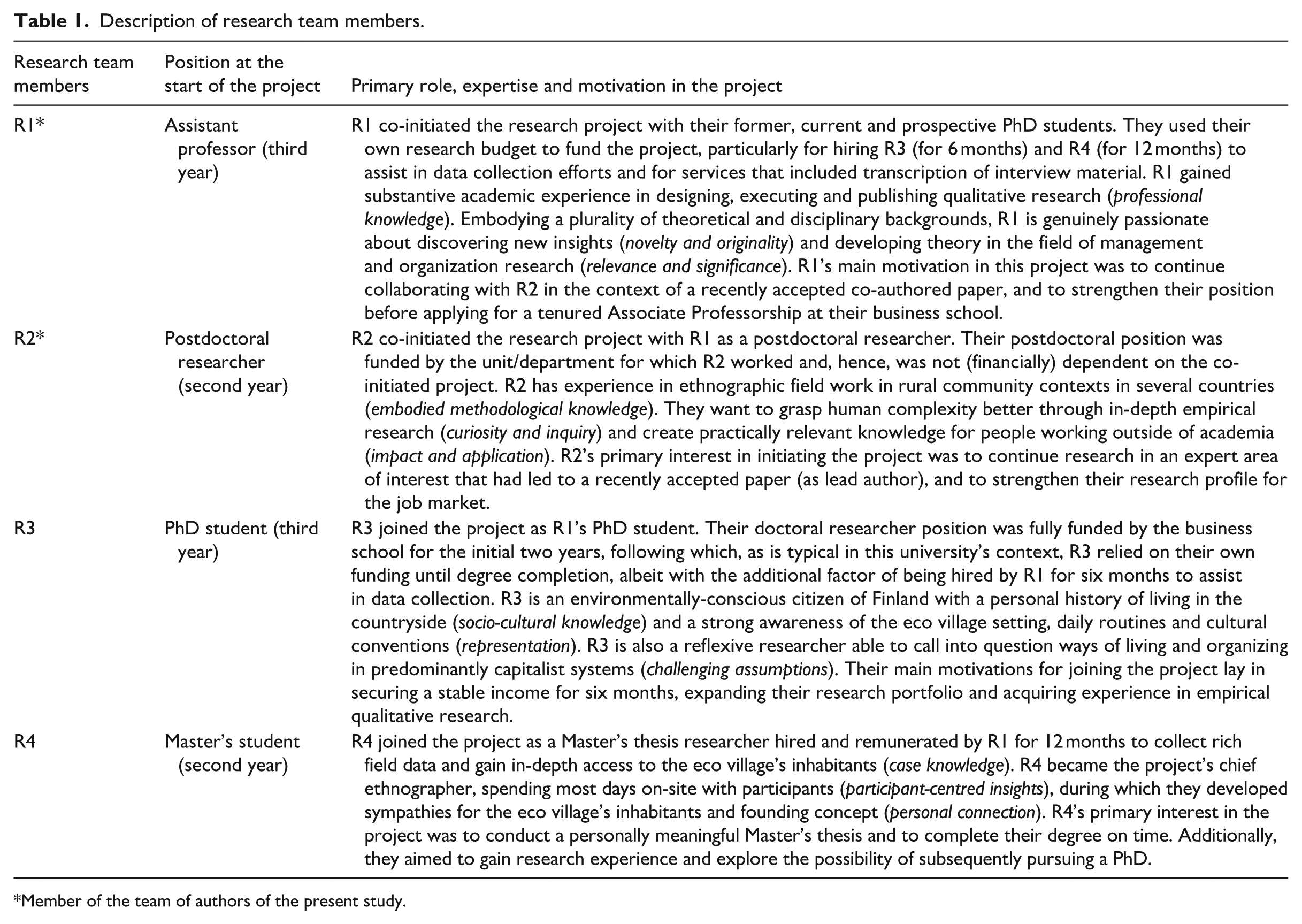
Member of the team of authors of the present study.
As is typical for qualitative case studies, a joint understanding of, and commitment to, ‘what was interesting’ in the ecological community project only emerged during the research process itself. Initially, two founding members of the research team (R1 and R2) discovered an interest in the eco-community because it appeared to offer a fertile context for expanding on the theme of earlier work they had conducted on emotions in local community contexts. In the beginning, the team’s research interests lay in understanding the emotions that underpinned the eco-community’s shared efforts by using different methods for data collection (e.g. observations, autoethnographic diaries and interviews, and also an initial survey that enabled the researchers to establish connections and legitimacy within the studied community); however, over the course of this process, interest shifted to conducting purely qualitative work and the examination of ‘gossiping’ as a form of social interaction that enabled community members to live and work together. The discursively emergent understanding of the team’s core interest provided us with an intriguing point of departure for unpacking how the research team collectively constructed the research phenomenon to be studied, and how their commitments around ‘what is interesting’ enabled the team to settle on a thematic focus that would guide them in writing up the project’s manuscript for subsequent peer-reviewed publication.
Data
Our data consist of audio recordings of the team’s real-life interactions during all 11 arranged research team meetings which were held between December 2016 and November 2019, as well as the accompanying transcriptions, in which names and identifiable information were anonymized. In total the meetings amounted to 726 minutes of team discussions, which offers a rich body of interactional episodes. Meetings were held in (non-first language) English, either face-to-face or partially online, and typically included all team members, although a small number of meetings were held between two members only. These meetings contained no formal agenda and allowed team members to discuss their ideas and observations openly. Figure 1 presents the timing, duration and composition of the research meetings in our dataset (research team members are indicated by R1, R2, R3 and R4).
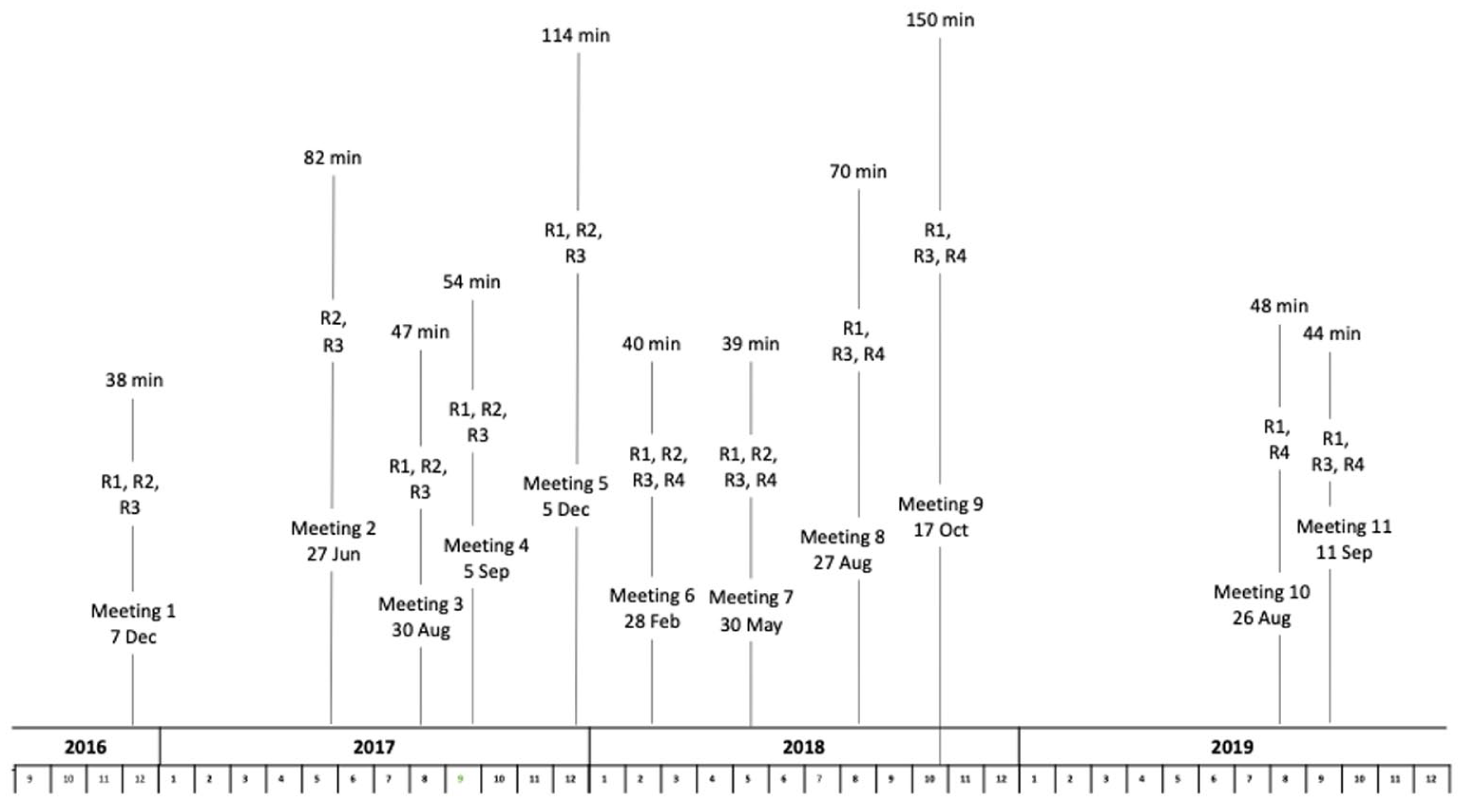
Research team meetings during the case study project.
Our dataset was originally collected for a different purpose, namely to support the quality of the case study research project and to offer a tool for self-reflection and enhancing skills in conducting longitudinal research in a rural community. All research project members provided their consent for the recordings and, due to the use of digital technology (Zoom or Microsoft Teams), recordings could be made in a manner that did not interfere with the conversational flow of the meetings.
Through a closer examination of the case study’s recordings of meetings, the team of authors observed that discussions often included debates, negotiations and shifts in the project’s core interests – and this insight ultimately inspired the present study. In general, audio recordings provide a rich source of data underpinning a core body of work in IS. For our research, such recordings covered all pre-scheduled meetings, which, based on our first-hand experience, were the primary context for the project team’s discussions regarding the project. Since the research team was not co-located, only few informal discussions occurred; instead, all communication was centred around these pre-scheduled meetings, which were subsequently recorded.
Following an IS approach, our units of analysis were specific interactional episodes, which captured the linguistic features of interest, rather than entire meetings, phases or discussion topics. In this way, our dataset provided a rich body of evidence for the patterns we illustrate in the following sections of this paper. It goes without saying that we recognize the inherently selective nature of all recording and transcription methods, and we acknowledge that these cannot capture every aspect of interaction (Bucholtz, 2000; Lester & O’Reilly, 2019). In our case, we were limited to audio recordings that excluded non-verbal communication, such as gestures and body language, both of which can also contribute to collective meaning-making. Nevertheless, our analysis was enriched by contextual information – such as a limited set of documents (e.g. a detailed ‘map’ of residents in the eco-community) and insights from discussions with the two authors previously involved in the eco-community project – thus providing additional layers for analysing the interactional episodes.
Analytical steps
Our analysis can be divided into three main steps. In a first step, we identify the sequences of interactions during which the commitments emerged. In a second step, we zoom in on the different types of commitments made by the research team. The third step concludes our analysis by inspecting how those commitments relate to the qualitative research process.
Step 1: Analysis of the topics and teams’ interactions
We maintain that committing to ‘what is interesting’ stems from a research team’s discussions on a series of interrelated methodological and conceptual choices (Zilber & Meyer, 2022). Therefore, our first analytical step aimed at understanding sequences of interactions (Lutman-White & Angouri, 2022) in which commitments emerge.
To gain an overview of the sequential design of the interactions across meetings we began by repeatedly listening to the audio files, reading the verbatim transcriptions and noting initial thoughts and ideas about what the data might be revealing. Prior to engaging in IS analysis, we applied an exploratory thematic analysis to help us focus on ‘what was said’ and ‘how it was said’ (Kim & Angouri, 2023). We used Excel spreadsheets to aid in data analysis, in addition to annotating hard copies of the transcripts. As a result, we summarized the evolution of discussion topics over the three-year period by creating a narrative map (Langley, 1999), where we paid attention to the frequency and depth of engagement with different topics. Due to this analysis it became evident that some topics were handled only on a single occasion, or were engaged with only slightly across a small number of meetings, while other topics were repeatedly revisited and entailed deep engagement by the research team.
In order to examine the communicative environment, we further explored role relations between the team members in their sequential interactions. From an IS perspective, a project team’s roles and responsibilities, relationships and ways of ‘doing’ are negotiated and jointly constructed by participants in their interaction (Angouri, 2018; Kim & Angouri, 2019). Roles and hierarchies within the team emerge in the interplay between social structure and the agency of individuals; and they are jointly achieved interactionally by both a speaker’s and audience’s understanding of the acceptable and expected ways of communicating in their context. Research in workplace sociolinguistics has identified discursive resources, such as floor management, formulating questions and accepting/rejecting claims of collective identity, as significant in enacting roles, hierarchies and leadership (Angouri, 2018; Barnes, 2007; Holmes & Stubbe, 2015). To illuminate role relations within the team we zoomed in on two interactional features that signal collectivity and were recurrent within the data: the use of first person plurals and the distribution of deontic authority across the team, that is, an individual’s right to determine action and/or ways of understanding. Prior research has established the common use of first person plurals, e.g. ‘we’, to display team membership (Bucholtz & Hall, 2005; Clifton, 2014). Deontic authority can be observed in the ways in which team members’ turns of talk are designed and linked. In collaborative work, deontic rights are distributed among the team rather than claimed by individuals (Stevanovic & Peräkylä, 2012); and this kind of deontic symmetry (Stevanovic, 2013) achieves shared accountability and joint agreement.
Focusing on these linguistic features in our dataset revealed an overall pattern of orientation towards consensus, which is an observation that is consistent with findings in the teamwork literature (Djordjilovic, 2012), as well as a relatively ‘flat’ hierarchy. For example, the meetings lacked formal structure, the floor was managed and negotiated by all team members rather than controlled predominantly by one person, and the enactment of expertise and authority was shared within the team. In this interactional context, R1 (who enjoyed greater formal authority and positional power) refrained from using ‘power-over’ the other team members; instead, the evolution of the research project was shaped by a co-active approach, where all individuals could influence each other, that is, had ‘power-with’ the team (Salovaara & Bathurst, 2018). Avoiding negatively marked disagreement is common in workplaces (Angouri & Locher, 2012), and this held true in our dataset. As a result, such flat and open team dynamics enabled us to analyse shared (rather than individual) commitments interactionally in the construction of the research phenomenon.
Step 2: Identification of types of commitments
The second step of our IS analysis focused on identifying distinctive interactional patterns within the data through which shared commitment was accomplished interactionally.
We suggest that proposing or suggesting a course of action, formulating previous discussions or earlier ways of understanding, and giving an account of prior actions or events are important interactional devices that signal interlocutors’ commitment points (Holmes & Stubbe, 2015; Stevanovic & Peräkylä, 2012). We examined uptake of these propositions, formulations and accounts within the sequential management of the interaction to identify verbal markers of (non-)acceptance and (dis)agreement or (mis)alignment (Steensig & Drew, 2008; Stevanovic & Peräkylä, 2012), evaluative talk, response tokens and topic changes. Importantly however, we do acknowledge our inability to identify embodied and non-verbal uptake due to the limitations of our data. In team members’ interactions, we identified more than 60 interactional moments that signified commitment points in that they resulted in either clear uptake, more nuanced uptake or less conclusive uptake.
To understand differences between the identified commitment points more clearly we followed the prior literature, which highlights how participants orient themselves by the longitudinal nature of their interactions through indexing past, present and future topics, encounters and discussions (Depperman & Günthner, 2015). Temporal references show how participants formulate present or future versions of the project, and how they mobilize constructions of the project’s past as resources for shaping the present and/or future. In linguistic features of speech, temporal references become evident in the usage of grammatical tenses and words that indicate time, such as ‘now’ or ‘will’. When topics were returned to over time, we analysed the nature of the discussions at different points in time and how references were made to previous conversations and future actions (Heritage & Watson, 1979). Furthermore, variation in commitments were revealed through the use of hedging devices such as ‘maybe’ or ‘probably’ (Brown & Levinson, 1987), which indicate the tentative nature of individuals’ formulations.
As a result of the second analytical step, we identified four main types of commitments prevalent in the team’s discussions—straightforward commitments, uncertain commitments, repeated commitments and withheld commitments—all of which could be distinguished by the way in which they emerged in the sequential organization of interactions (examined in step 1) and their unique linguistic features (examined in step 2). Putting together these characteristics enabled us to identify differences in how each type of collective commitment influenced the project’s trajectory.
Specifically here, we considered straightforward commitments discursively to indicate instantaneous shifts in defining ‘what is interesting’ because they accentuated the present and future of the project without (much) hedging, and handled a topic on only a single or a few occasions. In the case of uncertain commitments, interactions involved a pronounced use of future tense and hedging devices over the recursive handling of the topic, and this discursively portrayed the future as undetermined, thereby leaving space for discovering ‘what is interesting’. We considered repeated commitments—which utilize temporal references to past, present and future, as well as hedging, to discuss a topic to which the team returns throughout the project—to advance the discovery of ‘what is interesting’ through recursive iterations that aimed at constructing a coherent line of thinking. Finally, withheld commitments—distinctively involving the use of present tense and only few compliance tokens in discussing topics only once or a few times—supported ideation around ‘what is interesting’ by leaving the discussed ideas behind and choosing not to take them further in the project’s trajectory.
Step 3: Analysis of commitments in the construction of a research phenomenon
In the third step of our analysis, we examined how collective commitments allowed the team to formulate an understanding of the main focus of the qualitative research project. In this analytical step, we moved our focus from solely looking at ‘how’ the team interacted to examining ‘what’ their interactions contained.
In order to connect the various commitments that were made with the qualitative research that was conducted, we zoomed in on how interactants contextualized the meaning of their commitments (Jaspers, 2012). We investigated the usage of ‘indexical’ words (e.g. ‘this’, ‘there’, ‘you’, ‘soon’) and further ‘contextualization cues’, including the co-occurrence of words and changes in intonation that refer to selecting, rejecting and negotiating the (unstated) contexts in which speech achieves its meaning (Erickson, 2011). Subsequently, we utilized the narrative map (which we developed in step 1) to depict discursive change across multiple yet interactionally similar meetings (Voutilainen et al., 2018). In this step we sought to uncover when, and which, topics of discussion spurred the team’s engagement with different types of commitments.
Through these analytical procedures we identified dominant patterns in the clustering of commitments into two main groups: straightforward and uncertain commitments emerged in discussions around practical topics and served in exploring ‘what is interesting’ in the research object, while repeated and withheld commitments primarily emerged when the team discussed theoretical topics and contributed to explaining ‘what is interesting’ for the research audience. We illustrate this pattern in Figure 2, which offers examples of collective commitments made during the qualitative research project.
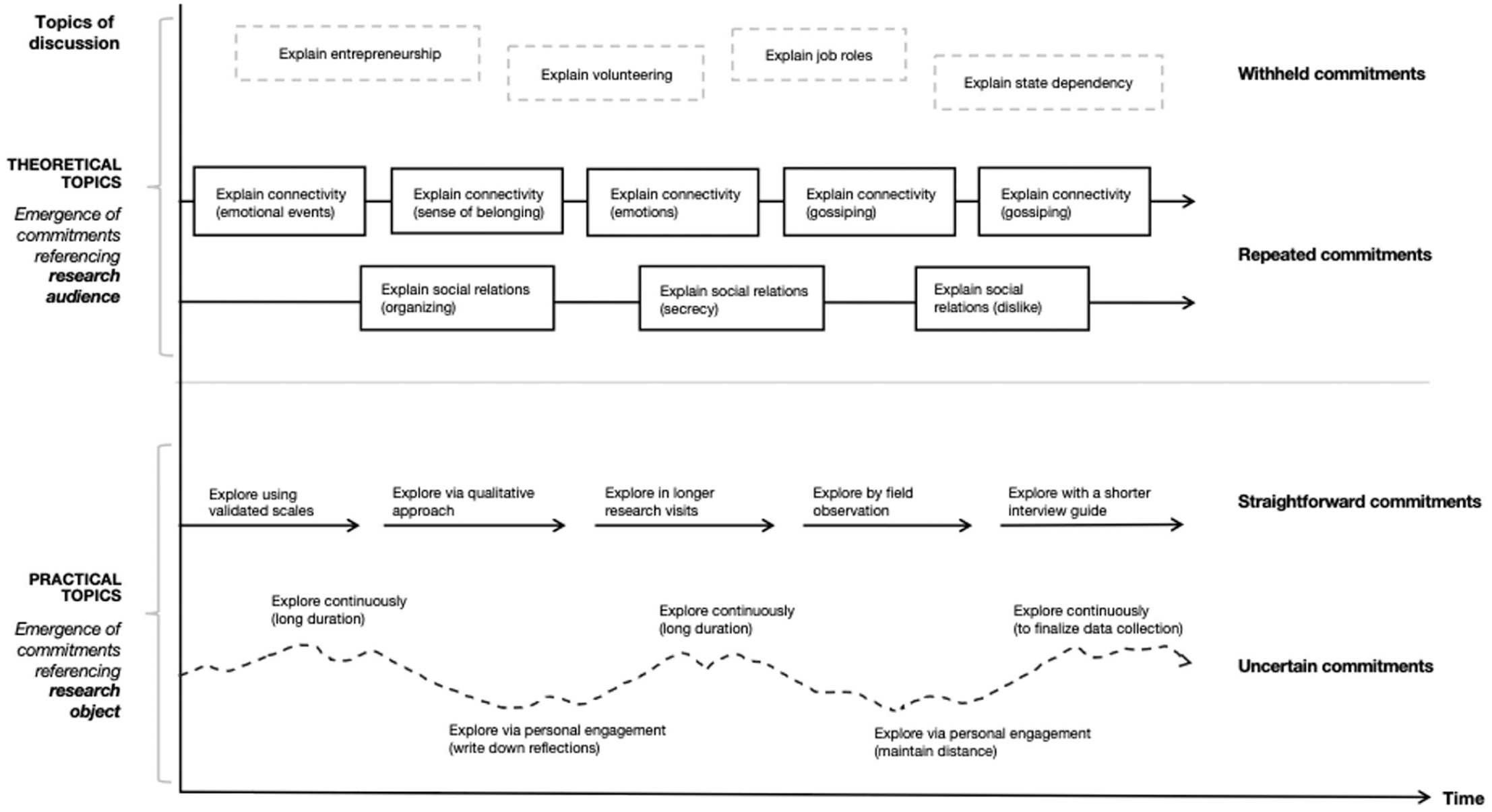
Examples of commitments during the qualitative research project.
As illustrated in Figure 2, when discussing practical topics, the team made both uncertain and straightforward commitments. Here, uncertain commitments concerned, for instance, the overall duration of the fieldwork and managing the teams’ personal relations with the studied community. Alongside these commitments, the team made straightforward commitments to specific actions. Straightforward commitments related, for instance, to using interview guides and the planning of individual research visits.
In turn, repeated and withheld commitments emerged when the team discussed theoretical topics. For instance, repeated commitments that gradually solidified their understanding of the central research phenomenon related to explaining the community’s connectivity and social relations. Intertwined with these theoretical discussions, withheld commitments also emerged in the teams’ interactions. Here, for instance, explaining community entrepreneurship, volunteering and job roles were found to be compelling in the team’s interactions, yet they remained outside the project’s core focus.
In sum, our analysis revealed intriguing dynamics in the construction of a research phenomenon in the nexus of the observed field and academic discourse. Through a detailed comparison of the interactional features of the commitments we discovered that commitments served to narrow focus or maintain openness. Specifically, straightforward commitments (which implicated a clear shift in the research object’s exploration) and repeated commitments (which iterated theoretical insights) were identified to narrow the team’s focus discursively in terms of discovering ‘what is interesting’, with the former applying to research object exploration and the latter to the development of theoretical explanations. In contrast, uncertain commitments (which left future practicalities undetermined) and withheld commitments (which presented ideas solely in the present before leaving them behind) were crucial for maintaining openness in the team’s empirical and theoretical research work, respectively.
Armed with these findings, our analysis allowed us to generate an interactional sociolinguistic model of how teams commit to ‘what is interesting’ in qualitative research.
Towards an Interactional Sociolinguistic Understanding of Research Teams’ Commitments to ‘What is Interesting’
Our findings illuminate how the research team that we examined collectively constructed a shared understanding of a research phenomenon to be examined in their qualitative research project. We demonstrate that this involved interactionally co-constructing four distinctive types of collective commitments, all of which jointly contributed to the discovery of ‘what is interesting’ (Table 2).
Description of collective commitments in qualitative research.
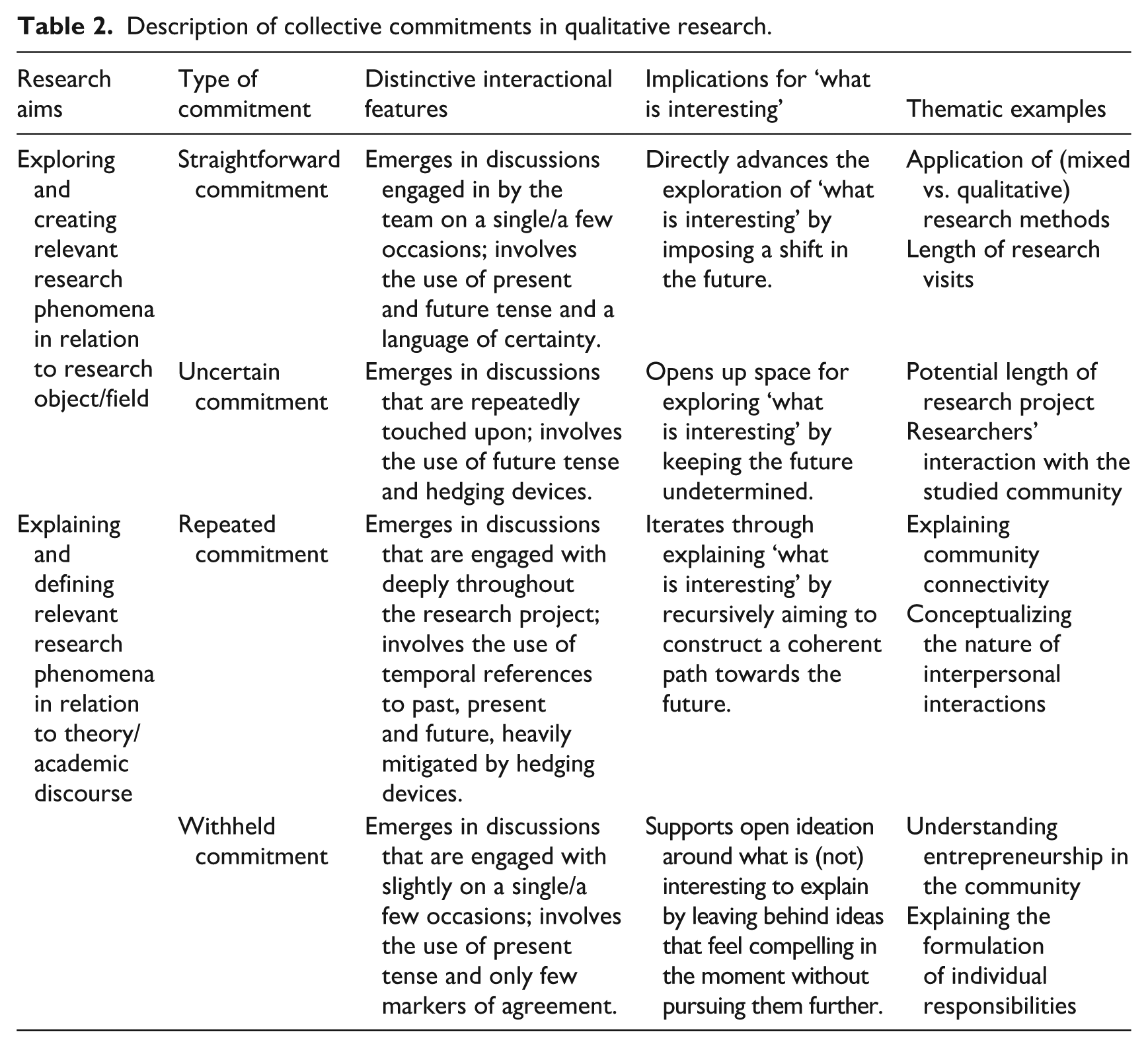
In the following, we provide a transcribed, illustrative example of each type of commitment. Transcription conventions are presented in Appendix 1 and are adapted from Jefferson’s (2004) system (see also Sidnell, 2010) to indicate interactional features of speech, such as pauses and overlap. In line with the conventions of IS, all text excerpts are transcribed by using Courier New, which is a fixed-width font and enables the visual alignment of overlapping talk. All names and identificatory information have been anonymized, and research team members are indicated by R1, R2, R3 and R4.
Straightforward commitments
The first commitment type that we identify is labelled as a straightforward commitment. Such commitments are distinguished by linguistic features that accentuate present and future orientation with non-hedging language and their positionality in individual discussions. Such features suggest that the interaction involves an instantaneous resolution of the topic at hand.
Table 3 offers a representative example of a straightforward commitment. The extract occurs near the beginning of the third project meeting, when the team discusses the transition to only using qualitative data collection methods. The interaction involves the two founding members of the case study project (R1 and R2), while a third member (R3) is also present in the meeting.
Example of interaction in meeting 3, at 00:10:44.
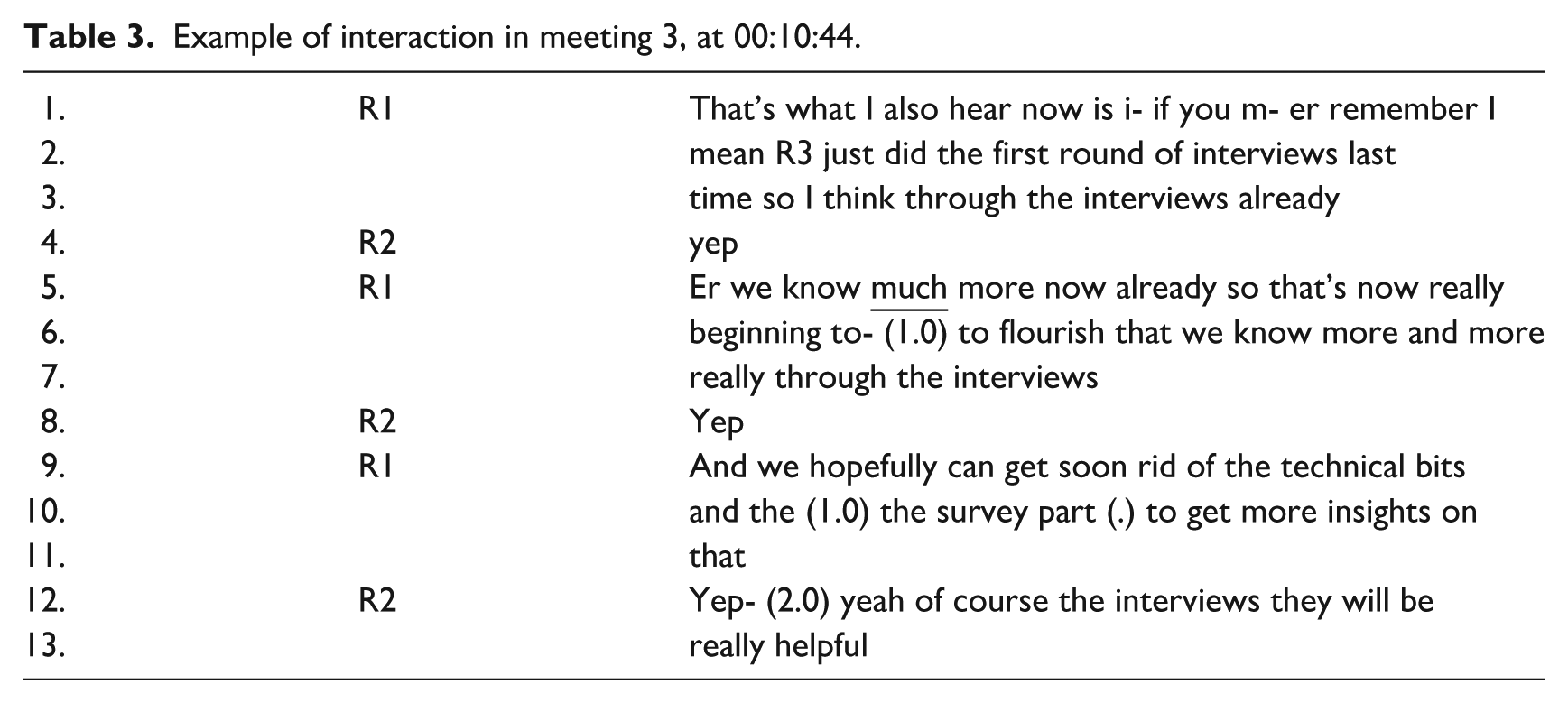
The extract begins with R1 describing the progress of interviews conducted by R3 (a researcher deeply engaged in the fieldwork): ‘R3 just did the first round of interviews last time’ (lines 2–3). R1 proceeds to present an opinion about how useful the interviews have already been: ‘we know much more now already’ (line 5), ‘that’s now really beginning to flourish’ (lines 5–6) and ‘we know more and more really through the interviews’ (lines 6–7). In these contributions, R1 utilizes the present tense to argue for the usefulness of the interviews in constructing the present situation in relation to data collection methods. In lines 9–10, attention moves to positioning the survey’s cessation (that is, the project’s survey element) in the near future through a change in the tense of speech: ‘we hopefully can get soon rid of the technical bits and the survey’. 1 These present and future constructions are illustrative of a commitment point as they present a version of the project’s current methods, as well as how they are to be in the future. In lines 12–13, then, there is further utilization of the future tense by R2 (a postdoctoral researcher co-initiating the project) as they offer ratification of R1’s position on the usefulness of the interviews: ‘yeah of course the interviews will be really helpful’.
Commitment to the choice of research methods is framed by using a language of certainty, specifically in relation to the present tense in ‘we know’ (lines 5 and 6) and ‘that’s now really beginning to’ (lines 5–6), as well as the future construction ‘will be’ (line 12), further marked by an absence of hedging or mitigating language. Agreement with R1’s position is indicated by another team member, R2, through the repeated use of the agreement token ‘yep’ (lines 5, 11, 16, 19) and the overlapping response ‘exactly’ (line 7).
In this interaction, R1 attempts to maintain deontic symmetry in their right to determine the agenda of collective committing. R1’s reporting of the current status of data collection in lines 1–3 is constructed as a recap of previous discussion (‘what I also hear now’) and as a thought (‘I think’). Yet, R1 then moves to using ‘we’ (lines 5, 6, 7), thereby displaying team membership. The collective accomplishment of this commitment is indicated by R2’s explicit ratification of R1’s assertions (lines 12–13), thus highlighting distributed deontic authority.
We found straightforward commitments to emerge in discussions on practical topics in which team members referenced their relations to the research object. In the extract above, the research object’s exploration is referenced in the interaction by drawing attention to ‘interviews’ (lines 2, 3, 7, 12) and ‘the survey’ (line 10), and the interaction signals an instantaneous commitment to shifting the core methods of the project and to start emphasizing a qualitative data collection approach, omitting those methods that hitherto focused on obtaining quantifiable and objective data.
Similarly, straightforward commitments emerged across the duration of this project in discussions relating to the application of validated scales, the length of research visits and the use of observations or a shorter interview guide. Such straightforward commitments moved the project forwards, producing action-oriented outcomes in a ‘stop-motion’, linear manner (Cloutier & Langley, 2020). Through these shifts in the explorations of the research object, the research team collectively engaged in narrowing their focus to (only) ‘what is interesting’.
Uncertain commitments
The second type of commitment that we identify is labelled as an uncertain commitment. Such commitments involve future-oriented language and hedging that underpin recursive engagement with a topic. While this type of commitment provides a lot of room for interpretation, the recursive handling of a topic clearly indicates that a team remains committed to retaining it on their agenda yet feels no need to make a clear decision thereon.
Table 4 presents an example of an uncertain commitment. The interaction portrayed in this excerpt takes place during the fifth research meeting when R1—who initiated the project with their former, current and prospective PhD students—alludes to the potential duration of the project, which is a topic recursively revisited by the team.
Example of interaction in meeting 5, at 01:24:05.
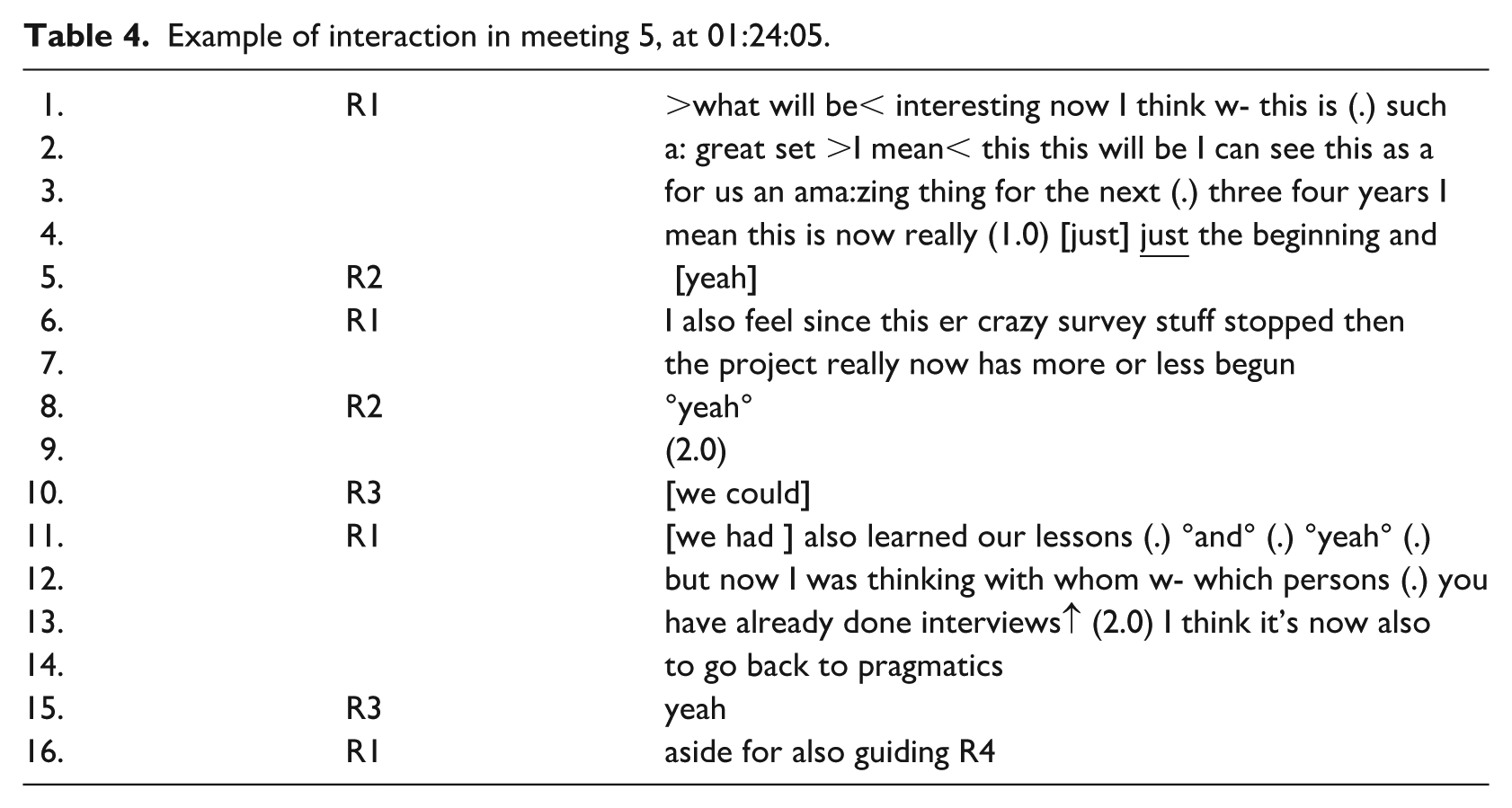
In this extract we illustrate the patterns typically found in uncertain commitments, where interaction involves future orientation and open-ended formulations. Here, R1 indicates excitement about how research is proceeding by using future-oriented language, for instance ‘this will be I can see this as a for us an amazing thing’ (lines 2–3). The projected time horizon is rather long, with R1 referring to the ‘next three, four years’ (line 3). This future orientation is further strengthened by excluding the project’s history, specifically by stating that ‘this is really now just the beginning’ (line 4) and ‘the project really now has more or less begun’ (line 7). R2—a postdoctoral researcher at a stage of strengthening their profile in the job market—signals mild acceptance by saying ‘yeah’ (line 8), and R3—who joined the project as a PhD student—by admitting that ‘we could do’ (line 10). However, the discussion here promptly continues by addressing a different topic and recapping the number of conducted interviews (lines 12–13), thereby leaving the duration of the project ‘up in the air’.
Here, the team’s collective identity is displayed by R1 through the use of the first person plurals ‘us’ (line 3) and ‘we’ (line 11). R1’s turn (lines 1–4) is launched with the use of ‘I think’ near the beginning (line 1), and this framing of speech as a personal thought or perspective projects a degree of uncertainty around the assertion, thus offering other interlocutors the opportunity of engaging in joint work in order to establish a joint understanding of the current or future situation (Stevanovic, 2013). Agreement tokens from R2 and R3 (lines 5 and 8, respectively) signal their acceptance of this distribution of deontic rights to assess that which is proposed by R1.
In the eco-community research project we examined, uncertain commitments typically referenced the research object and emerged from discussions related to the practical implementation of the project. In the extract above, interaction over the long duration of the project (line 3) takes place following a discussion of the emergent insights generated by fieldwork in light of the team beginning to develop positive relationships with the studied ecological community, and it explicitly mentions the ‘interviews’ (line 13) and ‘pragmatics’ (line 14). Commitment to this theme remains uncertain, and the topic change signals that the team is moving forwards without a clear decision.
In addition to the duration of the project, the research team made further uncertain commitments, for instance when discussing how (not) to engage personally with the members of the ecological community they studied. This topic was touched upon repeatedly, thus acknowledging its importance; however, uncertain commitments to such topics left the future undetermined rather than deciding on a particular (re)action. In this way, uncertain commitments served to leave space for empirical explorations and maintaining openness towards ‘what is interesting’. Importantly, uncertain commitment to researchers’ relationships and involvement in the studied eco-community gave the research team members the opportunity to draw their own boundaries in building relations with the eco-community’s members, which was conducive for allowing eco-community members to share personal information and openly discuss events occurring within the community with the researchers.
Repeated commitments
The third type of commitment identified in research interactions is labelled as a repeated commitment. These commitments present a pattern where the interaction at hand portrays a version of the project’s past and present interests yet indicates potential shifts that will occur in the future. Mitigation of the temporal trajectory by means of hedging devices, and the recursive interactions on the same topic, indicate that the discussion topic is not directly resolved and that several ‘rounds’ are needed so as to formulate shared conclusions.
In Table 5 we illustrate a repeated commitment. The sample interaction takes place during a later segment of the team’s fifth project meeting, where discussion about the development of an interview guide centres on the conceptual issue of selecting the appropriate theoretical lens to be applied in the research project.
Example of interaction in meeting 5, at 1:36:20.
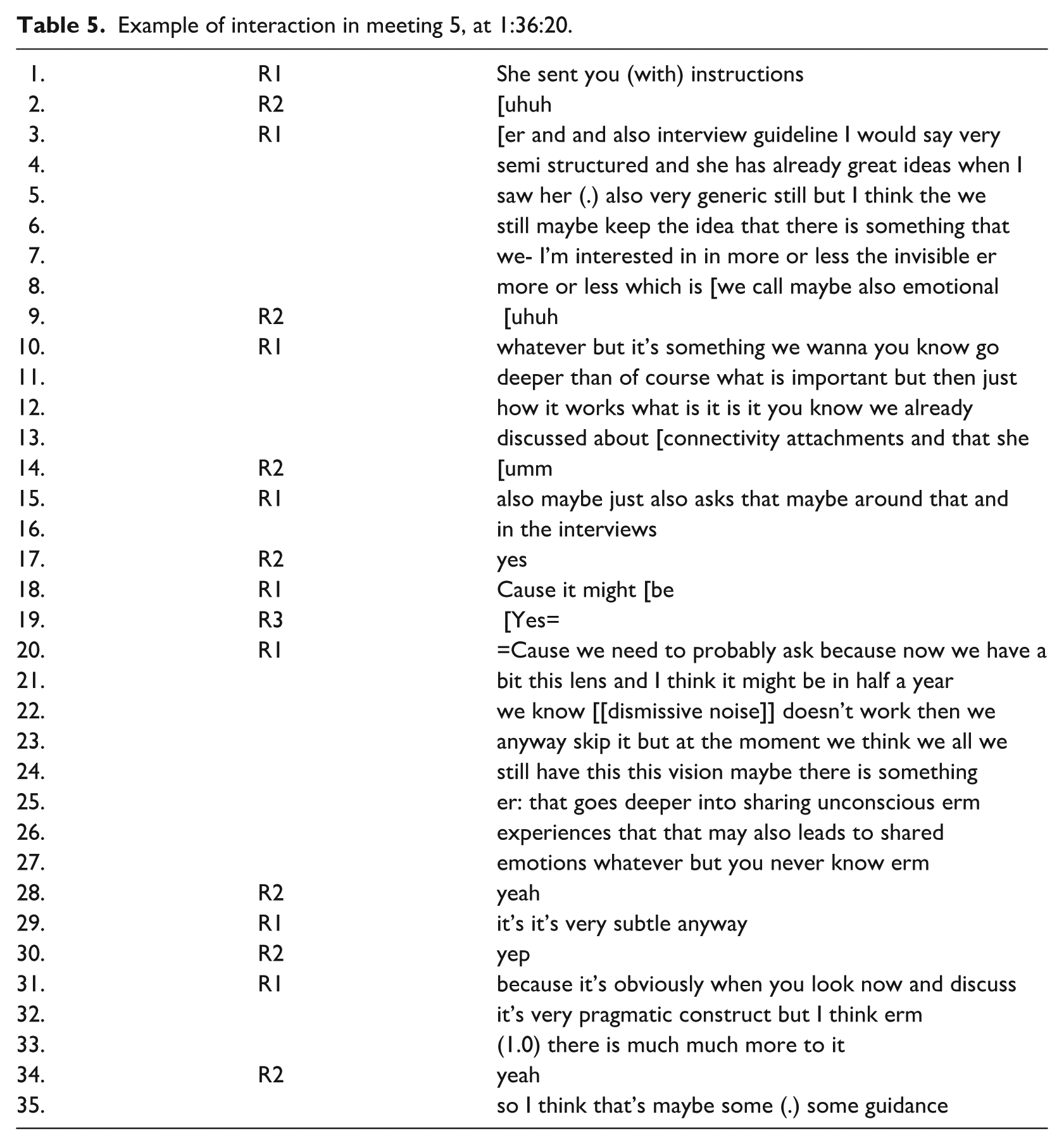
All of the features typical of repeated commitments are present in this interaction excerpt. Lines 3–13 contain indicators of the history of the project and prior discussions thereof, identifiable through the usage of temporal references. For example, in lines 5–6 R1—a team member who possesses substantive experience of qualitative research—states that ‘I think we still maybe keep the idea’, thus suggesting that this idea had been raised previously and should be retained; similarly, the past is also referenced in lines 12–13 with ‘we already discussed about connectivity attachments’. Crucially, through linguistic references to the past, the history of the topic and its resumption are indexed. Additionally, potential future engagement with the topic is indexed in lines 20–23, where R1 speaks about the lens currently employed to frame the project yet also references how this lens might be discarded in the future. The switching of temporal references is heavily mitigated by utilizing hedging devices, including ‘maybe’ (line 6), ‘probably’ (line 20) and ‘might’ (line 21), thereby further illustrating that the team is in the process of grappling with this topic.
R1’s extensive use of ‘we’ displays a collective identity (lines 5, 7, 8, 10, 12, 20, 22, 23). However, in line 7 R1 intriguingly switches from ‘we’ to ‘I’m’, thus foregrounding their personal interests—although they revert to ‘we’ in the following lines and thereafter. Deontic symmetry is suggested though R1’s formulation of their own thoughts (‘I think’, line 5), which distributes to other team members the right to an opinion on the topic. Similarly, the substantial use of hedging devices, e.g. ‘maybe’ (line 6), ‘probably’ (line 20) and ‘might’ (line 21), indexes uncertainty, thus inviting either others’ agreement or their statement of alternative positions; and R2 and R3—the two other members present in the meeting—enact their deontic rights and display verbal agreement to the proposals at hand (lines 17, 19, 28, 30, 34).
Repeated commitments emerged in discussion around theoretical topics that leveraged the research’s potential relevance to the academic community. In the above extract, the team discusses the question of ‘what connects the community’, which is a topic repeatedly returned to over the course of the research project. The putative relation to academic discourse is prevalent in this excerpt, with team members for instance referring to ‘connectivity attachments’ (line 13), ‘sharing unconscious experiences’ and ‘shared emotions’ (lines 25–27). Repeated commitment to this theme signals that the team iterates through its theoretical perspective, gradually increasing collective understandings thereof.
Over the course of this research project, repeated commitments developed cyclically in a conjunctive manner (Cloutier & Langley, 2020), helped the team to iterate ‘what is interesting’, and permitted them to construct a coherent path to follow. In the team’s interactions, repeated commitments revolved around discussing the eco-community’s connectivity and social relations and, ultimately, culminated in shifting the project’s core interest away from exploring shared emotions towards explaining how the studied community functioned even in the absence of identifiable collective action. Here, ‘gossiping’ came to be understood as a focal means for solidifying, yet also concealing, aspects of this community. In this way, repeated commitments were conducive to narrowing down the theoretical focus of ‘what is interesting’.
Withheld commitments
The fourth type of commitment we identify is withheld commitment, which stands out from the other types due to its tendency to involve only minimal tokens of agreement. These interactions typically occur in the present tense and address a topic only once or on very few occasions. What makes this type notable is that a topic is introduced in a way that prompts the team to take a stance – yet such assertion remains mild, and the topic is often not pursued in later discussions. Thus, while interaction indicates that an idea is found to be compelling ‘in the moment’, collective commitment is ultimately withheld.
Table 6 presents an example of a withheld commitment. This sample interaction occurs in the team’s fourth meeting, after the team has gathered data on the studied community that have induced the researchers to question their initial notions of shared actions and emotions. Here, R2—who embodies passion to create practically relevant knowledge—speculates on the possibility of engaging with concepts derived from the entrepreneurship literature so as to understand the community’s dynamics better.
Example of interaction in meeting 4, at 00:23:03.
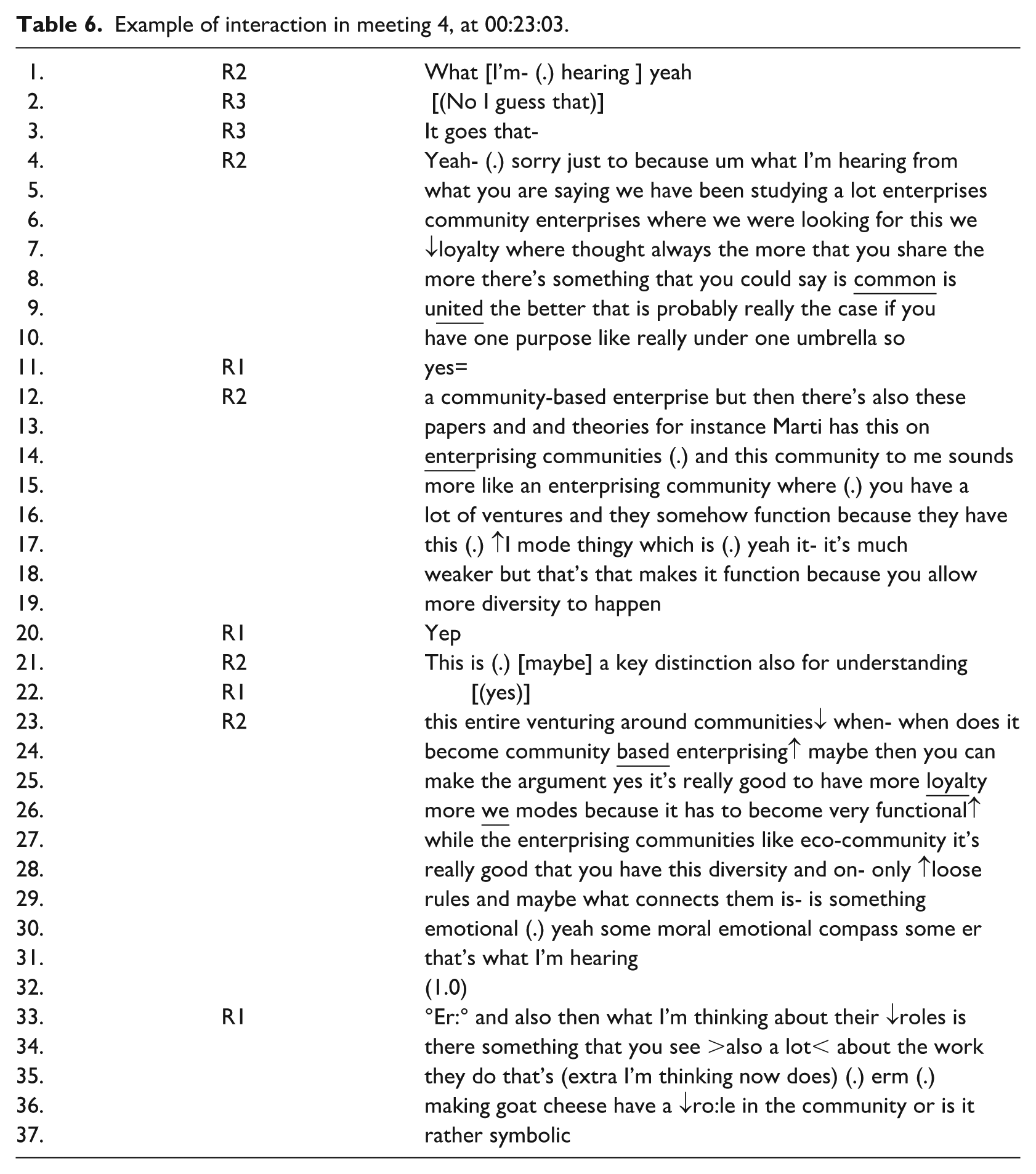
In this excerpt we witness the use of present tense and only a few compliance tokens, as is typical for withheld commitments. R2 utilizes the present tense to describe the proposed concept, evident in lines 14–15, where the researcher states that ‘this community to me sounds more like an enterprising community’. In lines 21–23, R2 claims that ‘this is maybe a key distinction also for understanding this entire venturing around communities’, going on to propose an avenue of interest by connecting this with the ongoing discussion (‘what I’m hearing from what you are saying’ in lines 4–5, and ‘that’s what I’m hearing’ in line 31). R2’s proposed concept regarding enterprising and venturing communities is responded to by R1 (in lines 11, 20, 22), yet in subsequent interaction nobody else either picks up this idea or continues to debate it.
Collective commitment is evident here in that R2 displays team membership through the substantial use of ‘we’. R2 also frames their proposals on enterprising as a recap of others’ perspectives (lines 4–5, line 31), a form of reported speech (Holt & Clift, 2006) and a personal thought (‘to me sounds more like’, lines 14–15). In this way, R2 downgrades their deontic rights as first speaker and invites recipients to engage in collective commitment. The explicit reference to earlier discussants in R2’s turn in lines 4–10 (‘what I’m hearing from what you are saying’) continues and extends the points made by others earlier in the meeting (not shown in this excerpt), thereby further illustrating how the deontic rights of others to make proposals and suggestions are acknowledged and incorporated into the ongoing debate.
Withheld commitments were predominantly associated with the theorizing engaged in by the team, thus connecting their work with the research audience. In the extract above, reference to the research team’s membership in the academic community is evident when interactions refer to the themes of ‘we have been studying’ (line 5), extant ‘papers and theories’ (line 13) and the use of theoretical concepts such as ‘community-based enterprise’ (line 12) and ‘moral emotional compass’ (line 30). Here, the notion of community-based entrepreneurship is raised only in a single instance, and the interaction acknowledges it in the present, without taking this further in the project’s trajectory.
Over the course of the project, withheld commitments supported the open ideation of ‘what is (not) interesting’ to explain, specifically by leaving certain notions in the present without carrying them forwards into the future. These commitments emerged when the team discussed how to explain, for instance, volunteering and the division of labour in the community. In connection to such topics, withheld commitments supported finding interests aligned with the research audience, yet they did so by maintaining openness to ideas even if these were not to be retained and would vanish from the agenda once explaining the research phenomenon.
Committing to the main phenomenon of interest in qualitative research teams
Building on our findings, we present an interactional sociolinguistic model that explains how committing to ‘what is interesting’ unfolds in qualitative research projects (Figure 3). Our model demonstrates how a research team shifts away from an initial commitment (for example, to a long-term and team-based qualitative research project) towards collectively committing to a main phenomenon of interest that will form the core of their study.
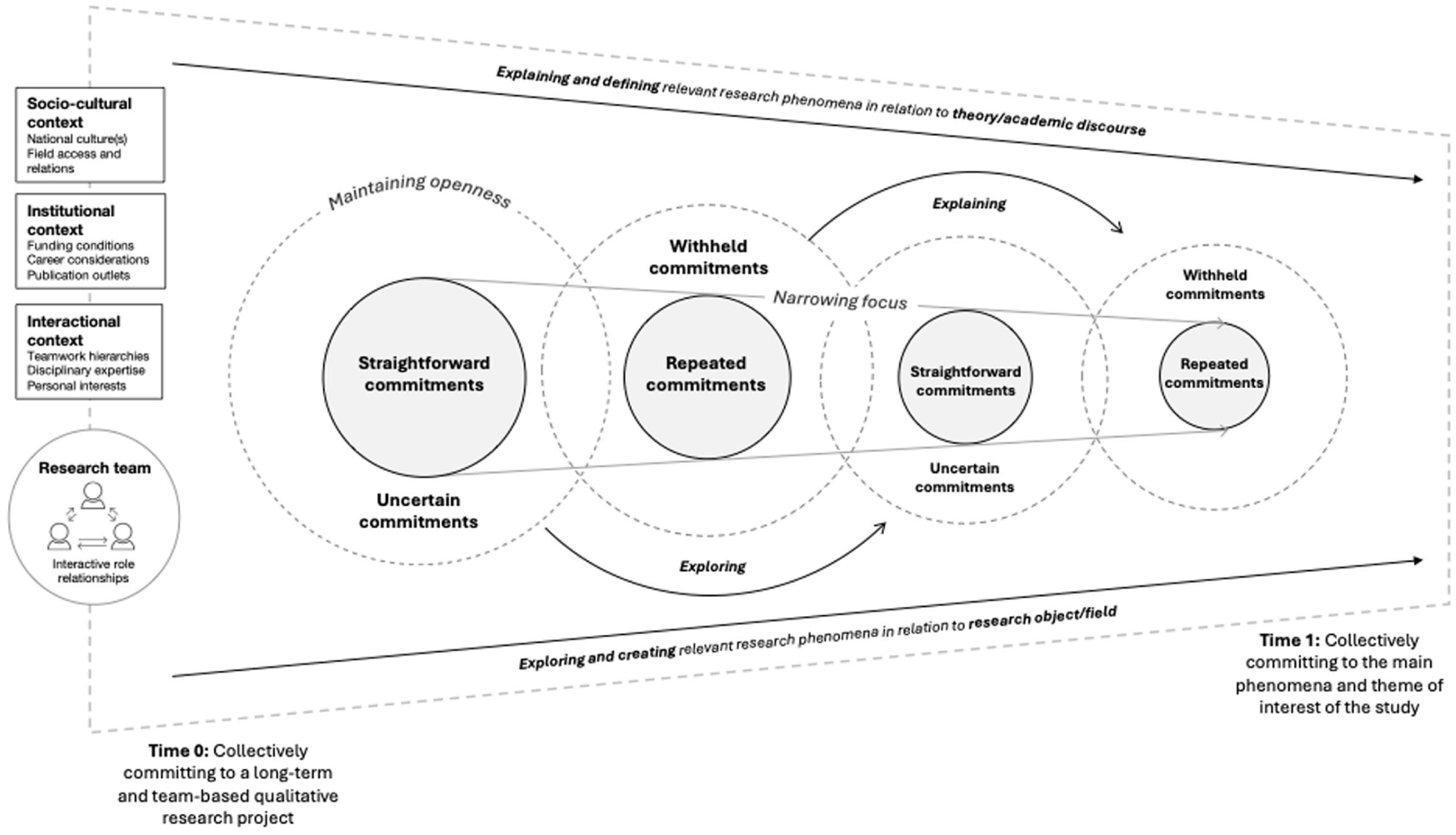
An interactional sociolinguistic model of shared commitments to ‘what is interesting’ in qualitative research.
We propose that the ambition to conduct a qualitative research project orients research teams towards exploring and creating relevant research phenomena in relation to the research object/field while also explaining and identifying relevant phenomena in relation to theory and academic discourse. In the temporal organization of interaction, research teams then engage in recursive ‘bundles’ of commitments that support the discovery of the main phenomenon of interest.
The process of depicting the research phenomenon to be examined inevitably requires commitments that help in narrowing the focus by agreeing on clear steps on moving forwards (‘straightforward commitments’) and gradually solidifying shared understanding (‘repeated commitments’). At the same time, we accentuate the importance of collective commitments in maintaining the openness by leaving discussion topics undetermined (‘uncertain commitments’) and/or within the situated moment rather than weaving these into the project’s trajectory (‘withheld commitments’).
In Figure 3, we exemplify the specific interplay of commitments that we uncovered in our study. The research team that we examined predominantly engaged in straightforward and uncertain commitments as they explored ‘what is interesting’ in the research object. At the same time, this team’s theoretical explanations primarily resulted in the emergence of repeated and withheld commitments. However, we acknowledge that the prevalence of different types of collective commitments, and the way in which they relate to different domains of activity, may vary across research teams. Examining the different combinations of commitments around research object exploration and theoretical explanations warrants further research.
A team’s interactions are situated within socio-cultural, institutional and interactional environments, which form boundary conditions for our model. In qualitative research, socio-cultural context influences the relations both within the research team and with research participants. Funding conditions, career considerations and publication outlets form the institutional environment that shapes interactions and teamwork. The interactional context is dependent on the team’s hierarchies and power relations, as well as members’ disciplinary expertise and the personal interests that direct researchers’ attention (Jones & Bartunek, 2021).
In our study, the team was based at a university in Finland, a setting known for its egalitarian and non-hierarchical work culture, as well as for facilitating open dialogue and honest conversations that are highly unlikely to be sanctioned. The research team also possessed specific social-cultural knowledge that enabled conducting qualitative fieldwork in a rural eco-community. In terms of institutional context, the research team that we examined operated independently from an external funding body, and its members exhibited a high degree of ambition and awareness of the research’s impact on their career development. Under these conditions, identifying and committing to the main theme of research consumed several years, thereby underscoring the challenges inherent in co-constructing a joint understanding of a research phenomenon that is both empirically grounded and theoretically interesting (Alvesson & Sandberg, 2024). Regarding the interactional context, it is noteworthy that team members had prior experience in collaborating and that no significant organizational dependencies existed between them (see Table 1). All team members were associated with organizational research but were also knowledgeable about theorizing and ethnographic fieldwork. This allowed the team to embrace both exploration and explanation in their research and, ultimately, to settle on a shared understanding of ‘what is interesting’.
We posit that our model is adaptable to research teamwork that relies on collective commitments, instead of individuals’ decision-making and formal agreements, which may be more or less prominent in particular socio-cultural contexts. Nevertheless, variation in interactional patterns would likely pertain in different institutional and interactional contexts. In situations where funding sources and time constraints dictate project work, or where significant power differentials between team members limit ideation, we would expect to observe a smaller share of (uncertain and withheld) commitments that tolerate and embrace the lack of a precise focus. Similarly, interactional context—including dispersed knowledge and motivations, or the absence of shared disciplinary grounding—could constrain a research team’s ability to narrow its focus (via straightforward and repeated commitments). In extreme situations, a predominance of withheld and uncertain commitments in a team’s interactions would induce a project to remain constantly open to different possibilities, thereby failing to establish a shared understanding of ‘what is interesting’. With this in mind, we encourage the exploration of our model’s applicability across research paradigms and in different environments.
Discussion
In this paper, we aim to tackle the key methodological challenge of identifying and committing to a relevant research phenomenon in qualitative research – essentially addressing the broader question of what makes certain phenomena, rather than others, worthy of sustained attention (Davis, 1971). Based on an IS analysis, we show how this unfolds as a research team develops a joint understanding of ‘what is interesting’ through recursive and collective commitments that emerge in their ongoing discussions. Through our work, we advocate for a more transparent understanding of qualitative ‘scholars’ journeys and practices’ (Beer et al., 2025, p. 3), sharing ‘behind-the-scenes’ insights (Kibler et al., 2025) into how diverse phenomena come to be considered ‘worthy’ of investigation. We also demonstrate the application of an IS methodology as a tool for examining real-life interactions in organizational contexts.
Advancing understandings of research phenomenon construction in the qualitative research process
The extant body of qualitative organizational research has offered guidance on the tricky question of topic choice, with an eye to enabling researchers to address meaningful problems, the resolution of which contributes to improvements in organizational practices and societal conditions (Prasad & Shadnam, 2023; Tihanyi, 2020). Researchers are encouraged ‘to break away from the established phenomena in existing research fields and to rejuvenate these fields’ (Alvesson & Sandberg, 2024, p. 1760). Nevertheless, to date there has been little empirical research that explains how such research phenomena are identified in qualitative research projects, where research teams must negotiate multiple interpretations of data and allow time for the development of a joint understanding of ‘what is interesting’.
We fill this lacuna by depicting the identification of a research phenomenon as a sequence of different types of commitments, all of which are communicatively co-constructed by a research team. We propose that the main topic of a qualitative research project is formed through a team’s interaction and springs from a plethora of choices made over the course of the research process (Zilber & Meyer, 2022). Through this perspective, our work helps redefine how the nature of qualitative research is understood and discussed. As noted by Beer et al. (2005, p. 3), ‘management scholars, themselves, are rarely “part of the story,” let alone a focus of published qualitative research’ that ultimately emphasizes a sanitized version of research work. In contrast to this, our study focuses on the ‘messiness’ of the research process itself and highlights elements that precede the rigorous leveraging of research methods and clean presentation of contributions resulting from the outcome of such work.
Our study accentuates a research phenomenon as something that is brought into existence through language and interactions, which reveal novel and interesting aspects of reality through a series of iterations (Alvesson & Sandberg, 2024). Here, the strength of an argument is assessed during the interaction that takes place; and, hence, the response to propositions by means of verbal and non-verbal devices, including silence, becomes as significant as their initial formulation. At the same time, the communicative co-construction of commitments essentially depends on the research team’s role relations, as well as on how members mobilize shared background information and (re)interpret the overall aims of their interaction (Jaspers, 2012).
It follows that our perspective highlights the role played by the research team in the articulation of a relevant research phenomenon (Hansen et al., 2023; Jones & Bartunek, 2021). The teamwork engaged in by qualitative researchers requires collective reflexivity (Alvesson et al., 2008), dealing with doubt (Locke et al., 2008) and juggling differing temporal orientations (Sasaki et al., 2024). Specifically, in the sequential unfolding of commitments a research team must take steps forward and coherently engage with the past so as to narrow the focus of their work; yet, this is accomplished in the face of an unknowable future, which can accommodate only a part of the ideas generated by the team.
A key practical implication of our work lies in fostering researchers’ awareness and transparent communication of their qualitative research processes and the ways in which data are produced. This awareness is likely to become increasingly important, both with the growing use of AI in the social sciences (Grossmann et al., 2023) and the increase in transdisciplinary, engaged scholarship and impact-oriented action research designs, where knowledge co-creation with practitioners is an essential part of the research process. In this regard, our paper not only contributes to understanding how research teams commit to producing interesting work, but also underscores the importance of transparency in how data are generated. We believe such transparency is particularly crucial given AI’s potentially expanding role in data analysis, which requires more careful reflection on the kinds of data researchers create over time and feed into qualitative data analysis programs.
Against this backdrop, we hope that our work will spark lively debates about the future of qualitative research and introduce early-career scholars to these practices. Our interactional sociolinguistic model can support research teams (with their own particular interests, see Table 1) in reflecting deeply on their collaboration and its implications when designing and conducting qualitative projects. This includes working with diverse organizations, entrepreneurial actors or communities (each with their own interests), as well as navigating the expectations of academic audiences and publication outlets (which also have distinct interests). More broadly, the model invites academics to reflect on their responsibility in shaping knowledge on themes of both practical and scholarly significance (Gümüsay & Reinecke, 2024).
In terms of teamwork, our portrayal of qualitative research processes calls for research teams to evaluate the context of interactions critically, alongside the ways in which the team’s formal and informal relations and communications enable or limit the identification of a research phenomenon. Crucially, our model accentuates the necessity of collective commitments, which differ from decision-making that can be associated with any particular member(s) of the research team. Achieving collective commitments requires ongoing, sequential interactions and open dialogue, through which shared understanding can emerge. To support this process effectively, researchers must demonstrate a genuine sense of shared ownership of the project. Admittedly, this may be challenging in highly hierarchical work environments or within research teams that embed pronounced power differences due to leadership style or formal/informal structures (Salovaara & Bathurst, 2018). In these types of interactional contexts, it may be advantageous to allocate work to smaller (sub-)groups, who can allow their thoughts to mature before voicing them to the entire team.
Our IS model draws attention to the need to strike a balance between openness and narrowing down the focus over the course of a research project, thus helping research teams assess their work in relation to these different demands. Importantly, the four core types of commitments allow teams to reflect on both their collective decision-making and how they come to terms with ‘what is interesting’. For instance, a team can assess whether they make straightforward commitments to theoretical explanations, and how this impacts their research project.
Finally, our interactional model highlights that a research project inherently involves recursive commitments that unfold over time. We hope that this encourages research teams to be patient regarding the team’s readiness to commit collectively to a topic of interest and accept the time that is necessary for robust research work. As demonstrated in our case study, a research theme evolves through the continuous accumulation of empirical insights and the iterative testing of theoretical interpretations – without a fixed starting point or definitive end when the team’s interaction and joint negotiation would no longer be needed. In this way, the construction of a research phenomenon is not a discrete step in the research process but, rather, an undercurrent that runs throughout it. This perspective frames research as an ongoing journey, punctuated by moments at which researchers pause to articulate and share their insights publicly.
In addition to helping scholars zoom in on the interaction that takes place within a research team, we trust that our work serves as an inspiration for evaluating the broader impact of qualitative academic research (Wenzel et al., 2025). We portray the identification of a relevant research phenomenon as a collective co-construction that involves the entire research team as well as its external audience and the participants of the study. In this way, the identification of a relevant research phenomenon—and the creation of knowledge on the chosen topic—becomes a collective responsibility (Muñoz & Dimov, 2023). Importantly, researchers remain key in distilling insights generated from an empirical field in that they carefully select the theoretical lenses through which they can amplify and/or silence aspects of ‘reality’ by way of the four types of commitments specified in our work. Over the course of this process, human interaction through language does not remain impartial; instead, our work demonstrates its centrality in presenting ‘collectivity’. Concretely, repetition or (un)intentional vagueness of language can serve to cast discursive conclusions, convey linkages between different themes and construct ‘taken-for-grantedness’. Therefore, attending to the types of commitments presented in this paper is crucial for generating a better understanding of the power wielded by researchers in terms of making sense of and impacting the communities and societies in which they conduct their work.
With this in mind, our work also offers fruitful avenues for further research. First, we identify the key role played by a research team in collectively negotiating a research focus and acting as a ‘mediator’ between the empirical and academic worlds. We suggest that examining the relationships between research teams and the communities they study (Langley & Klag, 2019) – often the focus of, for instance, anthropological research on sensitive topics (Mitchell et al., 2024) – can provide avenues for advancing methodologies in organizational studies. Second, further research could explore the socio-cultural and institutional factors, as well as power dynamics within research teams, that contribute to variations in commitment processes and the types of research phenomena that become prioritized. Examining cross-disciplinary research teams could also add insights into how researchers’ ‘personal identity commitments’ (Fachin & Langley, 2024) shape commitments to ‘what is interesting’.
Application of an interactional sociolinguistic methodology in organization studies
We advance the use of IS methodology in organization studies by providing an example that can be adopted or built upon by organizational scholars. While a number of IS studies have effectively illuminated questions that are of importance to organizational scholars, we argue that this method remains underutilized in the field of organization studies. With an eye to facilitating and propelling the application of this methodology in organization studies, we offer practical guidance for planning and conducting IS studies in Appendix 2.
In this paper we have illustrated the efficacy of IS for investigating a complex, team-level phenomenon. IS directs our attention to the sequential organization of situated encounters in how a team collectively addresses topics of discussion, without (over-)accentuating individual speakers and their rhetorical skills. While understanding how actors persuade each other is important for addressing the drivers of organizational or institutional change, an interactional perspective highlights the centrality of contextualizing communicative acts within a particular setting as a means of inducing interpretations and meaning (see Fachin & Langley, 2024). Analysing social interaction in organizations (Jakob Sadeh et al., 2024) enables us to view decision-making and problem-solving as interactional processes that provoke personal and collective change. By directly building on our study, future research could continue to apply IS to examinations of the processes of committing to shared interests in different organizational settings.
Importantly, IS addresses language as the context in which socio-political issues are negotiated, and it considers social interaction as ‘a privileged site for the study of society’ (Jaspers, 2012, p. 91). Due to its focus on naturally occurring situations, we propose that IS can enhance the transparency of research methods in organization studies, specifically by revealing the nuanced features of those linguistic interactions that serve as the basis for analytical conclusions. In our study, we have illuminated how social interactions in a research team construct a joint understanding of whether or not a topic is worthy of a qualitative research project. Beyond this, IS has also proven useful for studying how gender, culture and ethnic background shape communication and access to workplace resources. This offers numerous opportunities to organization scholars dedicated to studying inequality and identity (Clarke et al., 2024; Fachin & Langley, 2024).
Moreover, IS has called for acknowledging the political nature of research in general. IS can serve as a means for revealing how a wider political context is enacted in everyday interactions, for instance by investigating the experience of migration politics (Angouri et al., 2023). By uncovering language-based inequalities, IS opens up opportunities to reflect critically on the linguistic materialization of power and injustice, possibly even mobilizing research as a tool for activism and social intervention (Martín Rojo et al., 2025). We remain hopeful that our detailed illustration of IS drives this methodology’s further use in organizational research, thereby also serving to draw attention to the prerequisites and boundaries of this methodological approach.
Footnotes
Appendix 1
Transcription conventions used in illustrative extracts.
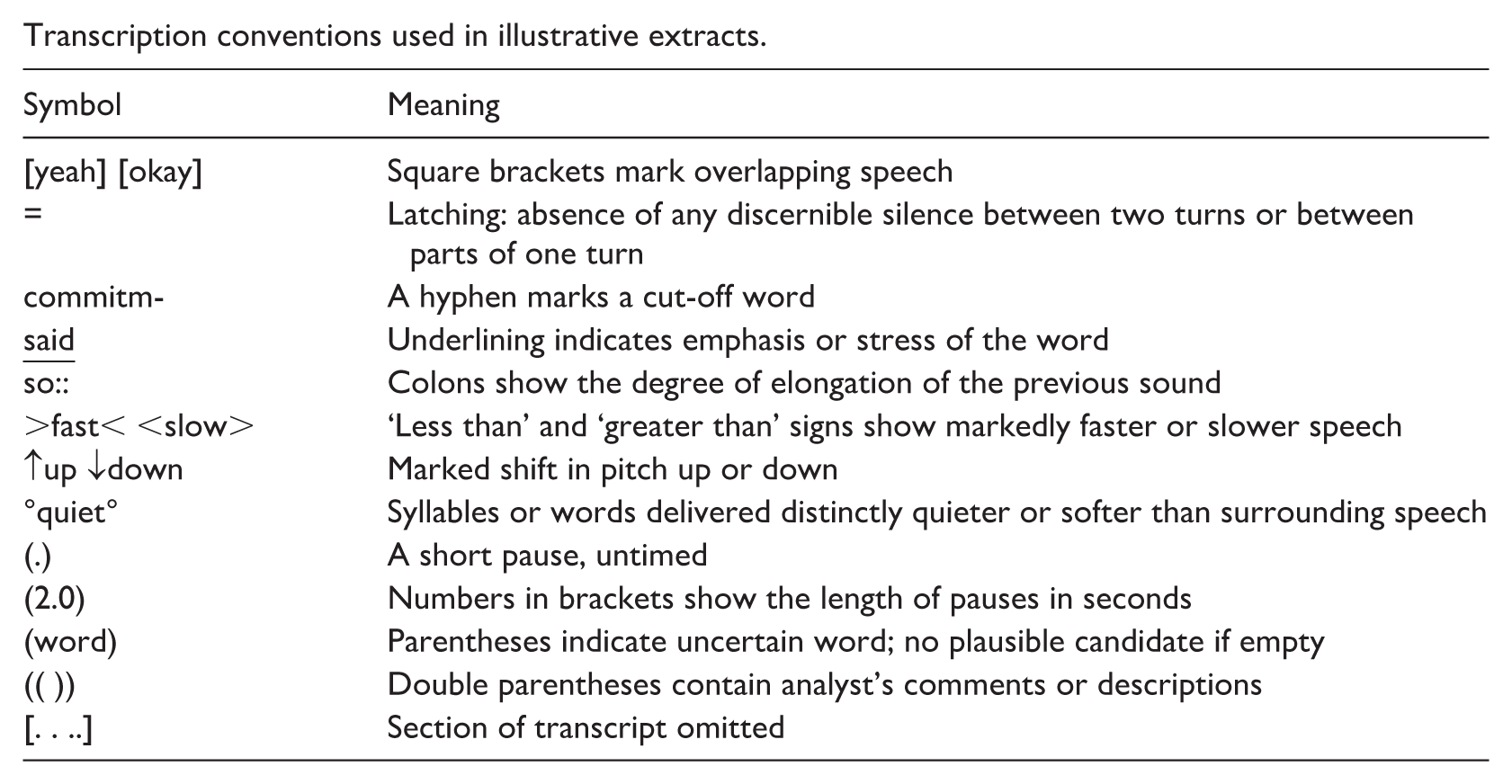
| Symbol | Meaning |
|---|---|
| [yeah] [okay] | Square brackets mark overlapping speech |
| = | Latching: absence of any discernible silence between two turns or between parts of one turn |
| commitm- | A hyphen marks a cut-off word |
|
|
Underlining indicates emphasis or stress of the word |
| so:: | Colons show the degree of elongation of the previous sound |
| >fast< <slow> | ‘Less than’ and ‘greater than’ signs show markedly faster or slower speech |
| ↑up ↓down | Marked shift in pitch up or down |
| °quiet° | Syllables or words delivered distinctly quieter or softer than surrounding speech |
| (.) | A short pause, untimed |
| (2.0) | Numbers in brackets show the length of pauses in seconds |
| (word) | Parentheses indicate uncertain word; no plausible candidate if empty |
| (( )) | Double parentheses contain analyst’s comments or descriptions |
| [. . . .] | Section of transcript omitted |
Appendix 2

Funding
The authors received no financial support for the research, authorship, and/or publication of this article.
Declaration of conflicting interests
The authors declared no potential conflicts of interest with respect to the research, authorship, and/or publication of this article.