




Abstract
This essay tracks how the ‘Global South’ has been represented in Organization’s pages over the past three decades. I argue that although the term remains problematic, discussion of the Global South can and should act as a spur for greater critical attention to the boundaries and content of Management and Organisational Studies.
Keywords
Throughout the ages, civilized communities have contained groups of nameless people. They are the majority—the beasts of burden, who have no time to become men. They grow up on the leavings of society’s wealth, with the least food, least clothes and least education, and they serve the rest. They toil most, yet theirs is the largest measure of indignity. . .They are like a lampstand bearing the lamp of civilization on their heads: people above receive light while they are smeared with the trickling oil.
The 30th anniversary of Organization offers opportunities for theoretical reflection on management and Organizational studies (MOS). One such aspect is where does MOS reside, historically and contemporaneously, within Organization? Or, stated another way, where has theoretical production of MOS happened and in what ways were locations of such production problematized in this journal’s pages?
This essay reflects on these questions of epistemic location, tracking historical answers within this journal to the question of where MOS resides, in terms of the Global South. I begin by clarifying what is meant by the Global South. I then present four ways the Global South has been represented in this journal’s pages. The presence of the South has been both directly visible as well as a tacit backdrop, where the figure is the Global North, so to speak, and the ground the Global South. The final part of the essay problematizes the partial and limited engagement with the vast majority of this planet’s population in the journal’s pages, even as its contributors continue to acknowledge the necessity to reform disciplinary elitism and expand credible reach.
The Global South
The noted South Asian polymath Rabindranath Tagore traveled and stayed in places as diverse as Tehran, Shantiniketan, New York City and Buenos Aires during his peripatetic life, a reminder of the global connections that generate meaning to the phrase “Global South.” The epigraph quotes from a letter he wrote in Bengali, on a visit to Russia in 1930, a letter later translated and published in English. It is evidently the colonized people to whom Tagore is referring. But the quote also acknowledges their class affinities with a larger world including that of the Russians he met, out on their own revolution. Within the passage is a bilingual tension, voicing the locale of these “nameless people” as well as the material forces that render them nameless in the first place.
Similarly the term Global South has overlapping tensions. In this essay the term is understood to approximate the G77 group of countries, which largely comprise regions formerly colonized by countries in North America and Europe. That is, all of Africa, a majority of Asia, all of Latin America, and some of Australasia. This layer of meaning is obviously based on location, and refers to those that reside outside colonial centers of economic power. In the past these centers included metropoles like London, Paris, New York City and Amsterdam. A second layer of meaning is based on deprivation, of those who suffer forms of exclusion and material disadvantages in going about the work of living. Linked to this deprivation is the hope of solidarity, that the oppressed can ally to resist. But both these layers raise quite awkward questions today: where does one place, say, Bangalore or Hyderabad, two Indian cities associated with the global IT industry, economically powerful, yet with severe poverty and inequality? Should today’s metropoles of economic power be updated to include these Indian cities, along with Tokyo, Shanghai, and Dubai? This leads to a third layer of meaning, insufficiency—any cluster of meaning associated with the Global South remains unable to entirely capture the complexity and shifting nature of those named within it (Haug et al., 2021). The term does not equate well with global problems of poverty and racial inequality, nor the social and material inequality within these regions and between countries associated with the term. For example, poverty is widespread in the Global North as well as the Global South. And Southern countries like India exert considerable economic power on other countries, including on the African continent. Yet at the same time the term continues to be used, and gestures to moments of global solidarity including among the G77 countries at the United Nations (Freeman, 2017).
Finding the Global South in Organization
One overarching value in using the term Global South (hereafter GS) is in relation to questions of epistemic location and epistemic exclusion. The term allows us to consider the geo-political locations of theoretical and empirical interest within MOS. Since MOS is dominated by contributions from the United States, Canada, the United Kingdom and Europe, the term in this sense is also a cognate for epistemic exclusion. So we can ask to what extent Organization has offered purchase for constituencies outside its historically dominant North American and Western European readership to also be heard within MOS?
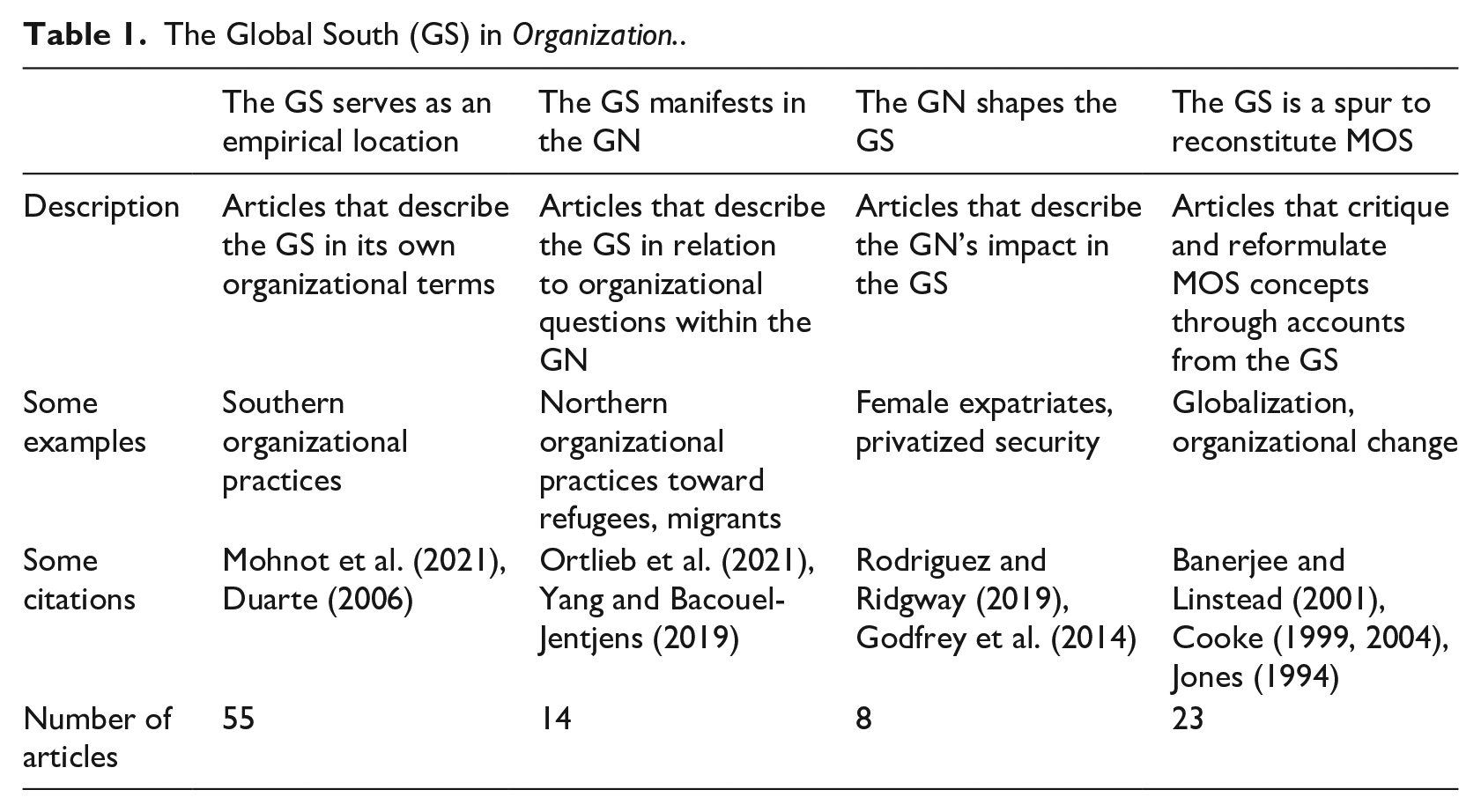
Reading the articles published in Organization over three decades, we can ask where does the article reside? On that basis I identified 100 articles that explicitly engaged with the GS. I then classified these articles by the manner in which they described the GS (see Table 1). In this section I explain how the GS is understood within Organization.
The Global South (GS) in Organization..
The GS as an empirical location
Over half of the selected articles were in this category. These describe the GS in organizational terms, bringing out local-level dynamics, actors, processes, structures and systems. Organizations studied include small businesses, corporations, as well as non-governmental organizations and governmental agencies. Imas and Weston (2012) describe organizational structures and processes pursued by the poor living in informal settlements in Zimbabwe and Brazil. Duarte (2006) and Mohnot et al. (2021) describe unique managerial practices in local-level organizations. In this category the GS is presented as a location apart and distinct from North America and Europe, relatively unknown in MOS scholarship.
The GS manifests in the GN
These describe the GS in relation to organizational questions raised within the Global North, such as corporations employing refugees (Ortlieb et al., 2021), reactions of recent migrants to diversity training (Yang and Bacouel-Jentjens, 2019, communicating social entrepreneur practices (Mauksch, 2017) and corporate reputation building efforts involving Southern farmers (McCarthy et al., 2018). In these articles the GS is a tacit backdrop to Northern management practices. It is not explicitly acknowledged as a location, but it is apparent as a source of difference encountered within Northern organizations.
The GN shapes the GS
These describe the GS in relation to the impact of the GN on it, whether in terms of expatriate female labor in multinational corporations (Dallalfar and Movahedi, 1996; Rodriguez and Ridgway, 2019), Northern private services securitizing the South (Godfrey et al., 2014) and Southern solidarity movements resisting Northern corporations (Ehrnström-Fuentes, 2022). In these texts the Global North is an active force that shapes what is possible within the Global South. Both in this category and the previous one, the lines separating the North and the South are porous, since the attention is on the interaction between organizations and processes deployed across the binary.
The GS as a spur to reconstitute MOS knowledge
Finally a set of articles critique and reformulate MOS concepts by presenting accounts from the GS, including in terms of notions of globalization (Banerjee and Linstead, 2001), secularism (Khan and Koshul, 2011), and theories of organizational change (Cooke, 2004). In these texts the GS is a challenge to universalist knowledge, offering an opportunity to reshape what is otherwise seen as canonical management knowledge, by problematizing its location, and unearthing the interests underlying such locational specificity even as it is portrayed as universal.
The Global South in Organization
Organization is notable and noteworthy in presenting such accounts and doing so right from its inception in 1994. The first volume included a thematic section on globalization with articles on Latin America, while the fourth volume featured a thematic section on organizations in Latin America. Even today such direct focused engagement with the South remains unusual within MOS journals, and it is especially remarkable for that reason that Organization did so right from its start (Mir and Mir, 2013).
The Global South as a strong and consistent focus in Organization
Articles on the GS appeared in Organization from its first volume and have continued ever since. They feature countries like Brazil, Mexico, Turkey, India, Pakistan, Nepal, Bangladesh, Zimbabwe, Ghana, Liberia, Tanzania, South Africa, Lebanon, Tunisia, Indonesia, and Cuba. They include articles on slum-dwellers, small-scale entrepreneurs, rice farmers, domestic workers, garment workers, call-center workers, street vendors, gold miners, female credit groups, female expatriates, and policemen. The articles are of managers who are women, refugees, undocumented migrants, first-generation migrants, and part of indigen ous communities and tribal groups. It is hard to imagine a comparable journal in MOS capable of such a breadth of diverse constituencies, brought together within the scope of organizational research.
The Global South is a geographic location of stark difference
At the same time the articles do show a tendency to place questions of the South within a rather fixed space, situated apart from the rubric of MOS. This is apparent for instance in how many of the articles feature in Special Issues including on post-colonialism (v18-3) the South (v19-2) and decolonizing management (v28-5). 1 This tendency is especially striking when we consider how the GS is represented. About half of these articles, that is the majority of them, present the South as a location of stark difference. Two other ways to consider the South, presented earlier, in terms of the relational traces the South leaves in the North, and the North’s presence in the South, though fewer in number, do raise questions of whether the South can be a clearly delineated location in the first place. It can therefore be argued that the majority of engagement with the GS in Organization’s pages has not placed the term itself within a critical gaze, either in terms of its locational specificity, or its relation to the Global North.
No critique of where MOS is actually located
Similarly there is a tendency to restrict the scope of MOS in these pages. The majority of engagement with the GS does not use the opportunity to consider ways to reconfigure the canonical trajectory of MOS. Remaining within a binary where knowledge production is in the North and its consumption dispersed across the globe, the South is either ignored, oppressed, or demeaned by MOS, depending on the perspective taken up in these texts. But if we consider MOS as an epistemic project based on historically sedimented, relational constructions of knowledge, reliant on different clusters of capitalist demands, it would be also apparent that MOS historically relied as well on Southern knowledge, troubling this binary. Such an assertion has in fact been made within this journal, notably by Mills (1995), Cooke (2004), and Banerjee and Linstead (2001) each of whom trace the ways specific management ideas emerged through an encounter between regions of the North and South. But such articles remain a minority, and scholarship has mostly steered away from thorny locational questions. The South still remains a signifier of difference, but without an equivalent gesture that incorporates such difference within a reconstituted MOS.
Linguistic imperialism is largely ignored
Despite being raised in this journal’s pages (Alcadipani et al., 2012; Ibarra-Colado, 2006; Murphy and Zhu, 2012), the fact that the journal and MOS publish mostly in English is not greatly problematized. Most articles present the GS to an English-speaking audience, the authors serving implicitly as translators and linguistic mediators. For example it is telling that the Brazilian expression “Para ingles ver,” which features twice in these articles (Caldas and Wood, 1997; Irigaray et al., 2021), is translated both times as “for the English to see” without offering the reader the original Portuguese phrase. 2 A few articles do bring out greater linguistic complexity and richness of local idioms, such as jeitinho (Brazilian Portuguese) (Duarte, 2006), and fahlawa (Egyptian Arabic) (Yousfi, 2021). This does raise the question of ways to address such linguistic exclusion, including translating topical pieces from other languages, or initiating innovative collaborations such as between Dussel and Ibarra-Colado (2006) where the authors had a dialog in Spanish, transcribed it, and then one of them translated the text into English. Fundamentally there have to be ways to queer Organization’s linguistic identity, so that phrases, words, expressions from other languages gradually become part of its lexicon, generating a larger semantic dialog within MOS.
A Gramscian reflection
In Organization’s first issue the founding editors rejected Pfeffer’s (1993) call for disciplinary convergence (Burrell et al., 1994). Following Kuhn (2012 [1962]) Pfeffer believed a paradigm is maintained through consistent relations of power that backed shared ideas. It was in the interest of the MOS knowledge community to ensure epistemic consistency since it enabled disciplinary coherence, following the pattern set by powerful disciplines like economics and political science. In response Burrell et al. (1994) advocated for a diversity of views in MOS and their greater theoretical value for the discipline, rejecting epistemic consistency. Their position has been borne out, impressively, within the journal which shows the particular and rich rewards offered by a stance of theoretical and methodological inclusion.
Despite accepting MOS’ capitalist tenets, and an expectation that such interests were best served by training corporate managers, Pfeffer’s essay, ironically enough, at times, channelled that staunch critic of managerial capitalism, Antonio Gramsci. The Prison Diaries, in part, track the ascendance of ideas, especially how ideas, at times, become hegemonic, that is taken-for-granted aspects of knowledge, congruent with dominant structures of power (Gramsci, 2000 [1934]). Based on the Diaries (Gramsci, 1996 [1975]) we can make three distinctions regarding disciplinary knowledge (Srinivas, 2022, 2023): MOS ideas historically relied on common sense, self-evident, often contradictory, inconsistent assertions about the world around us, including that inhabited by self-described managers; some of these ideas coalesced into shared assertions, wedded to interest groups eager to establish the value of such ideas, as they grappled with problems of managerial life; these ideas, have at times extended their reach, capable of speaking for multiple interest groups, powerful enough to have widespread acceptance, becoming hegemonic. 3 An implication of Gramsci’s Diaries is that the boundaries of knowledge are maintained by powerful actors and groups, including by naming the locations where knowledge is deemed to exist in the first place.
Disciplinary hegemony
Ultimately these articles are efforts by academics to incorporate the Global South into their scholarship, and assemble their own interest groups and seek disciplinary hegemony within MOS. Of course these are incomplete efforts, and go only so far. We are after all looking at the production solely in one journal, and so, the hegemony achieved is admittedly a modest one, claims made within a small pond. However they do offer some insights on the interplay of disciplinary knowledge and power.
As Li and Parker (2013: 303) showed, high impact-factor journals within MOS, like the Academy of Management Review (AMR) retain a moderate to high ratio of external citations of their work, while journals like Organization have a lower ratio in this regard. “For example in 2010, 342 other journals cited Organization whilst a total of 1450 other journals are cited by Organization. Compare this to AMR and you have a very different pattern, with 1176 journals citing, against 1175 being cited.” Pfeffer’s hopes have been realized in a sense. A disciplinary coherence has shown itself in MOS thanks to influential journals. It can be argued that dissonant heterodox views, including in Organization, and including from the Global South, remain marginal to the field. “The cost of heterodoxy is the likelihood that work will not be read as much, cited as much, and count for ranking exercises” (Li and Parker, 2013: 320).
When looking back on two decades of Organization Calás and Smircich (2013) observed that high impact-factor journals remained eager to shore up legitimacy, to expand their reach regionally (hosting workshops in Europe and Africa). Similarly such journals can be expected to encompass (or is it co-opt?) dissonant views into their pages by creating sections for editorials and commentaries, or through Special Issues. Academic conferences also try to broaden their thematic areas to anticipate diverging interest groups, and hold professional development workshops to help with the process of submission. All these efforts contribute to journal rankings becoming further naturalized globally as arbiters of knowledge and of “professional development”. So on one hand, while the MOS discipline continues to converge toward paradigmatic views, its influential journals also continue to strive for greater international reach and, in that sense, global relevance. Hegemonic power requires constant legitimacy work, and elite journals are not somehow immune from such pressures. To remain powerful their reach and relevance must not wither. Otherwise they would still exercise dominance but no longer hegemony (Guha, 1997). 4
As North American and European business schools and journals continue to recalibrate to shifts in the global economy, the political visibility of China, the decline of the United States as a credible interventionary power, a slowing global economy, high levels of uncertainty shaped by regional conflicts, they also respond to domestic calls for increased corporate accountability, greater attention to racial inequality, and halting environmental crimes. It is inevitable in such a situation that the quest for legitimacy will continue, and that Organization will have to consider anew ways it can address the Global South, perhaps by translating relevant articles into English, fostering dialogs with influential Southern scholars in their languages, and making a more concerted effort to attract submissions from such locations. Meanwhile the question for its readers, editors and allies to consider is what is the end-goal in going about it, whether it is to problematize the naming of the Global South, the location of MOS, or both. Tagore named the poor of the South beasts of burden without the luxury to “become men.” Leaving aside for a moment the regrettable gender elision in his phrase, the question remains: how will this journal strive for relevance not solely for its disciplinary antecedents but men and women across the world shaped by capital, organizations, and the theories that accompany them, yet still lacking access to the resources vocabulary or ideas that allow them to resist, to stand their ground, and do so on their terms.
Footnotes
Funding
The author received no financial support for the research, authorship, and/or publication of this article.
