




Abstract
The transience of digital platforms poses obstacles for platform workers to create stable meaning and identity in online work environments. Extant literature concerned with work-related identity discusses gig-workers coping with the erosion of organizational structures in online spaces through “personalized holding environments”. We add to this literature by illustrating how actors maintain and create digital platforms as collective environments with the capacity for meaningfulness and identity formation. To do so, we draw on Hannah Arendt’s distinction between human activities in labor (serves necessities), work (creates things), and action (provides identity and meaning). Empirically, we autoetnographically investigated two digital platforms reflecting two prevalent narratives of the future of platform work: a platform dedicated to creative collaboration in an online community (FAWM) and a platform associated with precarious microtasking in the gig economy (MTurk). In both cases, we find that labor activities are required to maintain a digital identity and a digital environment. In turn, work activities establish a digital environment in a state of consistency, without ever adding tangible permanence to the human artifice. Thereupon, while establishing the digital platform as a stable collective environment, collective action (e.g. community building) can be performed. Here, we finally argue, lies the future human condition of platform work: in the ongoing care and creation of stable collective environments in a digital space lacking permanence.
Introduction
Digital platforms are amongst the most pertinent features of the digital transformation with a fundamental impact on the human condition (Benkler, 2006; Castells, 2010; Reckwitz, 2020). Digital platforms form a complex phenomenon and function as meta-organizations that enable interactions and transactions between parties (Boudreau and Hagiu, 2009; Chen et al., 2022; Kretschmer et al., 2022). The impact of digital platforms on working conditions has spurred recent scholarly attention in organizational research (see Bauer and Gegenhuber, 2015; Bucher et al., 2021; Pignot, 2023; Trittin-Ulbrich et al., 2021; Walker et al., 2021). One key concern in this literature is the erosion of organizational and professional identities (see Ashford et al., 2018; Petriglieri et al., 2019; Sutherland et al., 2020), resulting in isolation, uncertainty and a general loss of meaning experienced by online workers (Glavin et al., 2021; Nemkova et al., 2019; O’Meara, 2019; Wood et al., 2019). This effect partially results from the inherent transience of digital platforms: their volatility, incompleteness and intangibility (Garud et al., 2008; Kallinikos et al., 2013; Neff and Stark, 2004). Without stable professional attributes, memberships and relationships, platform workers are missing important cognitive, behavioral, emotional and social boundaries through which their surroundings become manageable and intelligible (see Ashford et al., 2018: 126). As a coping strategy, individuals reliant on digital platforms thus create personalized holding environments to manage isolation, uncertainty, anxiety and loss of meaning (Petriglieri et al., 2019).
Yet, construction of meaning and identity goes beyond individual efforts, as it also includes a critical social component of attribution and recognition of meaning, mutual perception and interaction in a collectively shared environment (Maitlis and Christianson, 2014; Tajfel and Turner, 1986; Weick et al., 2005; Wrzesniewski et al., 2003; Yeoman, 2014). Organizational and professional contexts provide such shared environments in physical spaces where individuals constitute identity and meaning in interaction with leaders (Smircich and Morgan, 1982), professional peers (Vogelgsang, 2022) and colleagues (Wrzesniewski et al., 2003). Yet, with the physical permanence and durability of the “real” world missing, individuals on digital platforms find it difficult to engage in equivalent collective activities (see Duggan et al., 2020; Pignot, 2023; Vallas and Schor, 2020). Platform workers facing transience of digital environments not only struggle with the emotional anxiety of losing stable professional and organizational sources of identification, but also lack a stable collective environment within which they collectively create identity and meaning in interaction.
As we will elaborate below, such a collective environment constitutes a pre-political public with the potential for meaning and identity to emerge, develop and manifest in interaction, as opposed to a particular social institution (e.g. a community, a profession, an organization). Thus, while digital platforms may aptly provide publicity to efficiently exchange goods and services, or coordinate volatile collaboration (e.g. Faraj et al., 2011), in view of their transience the question remains: How do actors create and maintain digital platforms as stable collective environments with the capacity to establish meaning and form identity? With this research question, we are less interested in how individuals on digital platforms collectively construct shared meaning and identity, for instance through sensemaking (Weick, 1995; Weick et al., 2005), community building (Calhoun, 1998; Faraj et al., 2011) or social organizations (Yeoman, 2014), but rather how actors establish digital platforms as environments that provide the foundation for these intentions.
To address this question, we draw on Arendt (2018) theory of the human condition as our theoretical framework. What we describe as a collective environment with the capacity for meaningfulness is denoted, in the words of Hannah Arendt, as a “space of appearance,” or as she describes it, “the space within the world which men need in order to appear at all” (Arendt, 2018: 199). Hence, spaces of appearance are not merely public platforms, but combine both publicity and stability to establish the basis for human (inter-)action and the construction of a meaningful social reality because “the presence of others, who see, what we see, and hear, what we hear, assures the reality of the world and ourselves” (Arendt, 2018: 50). Consequently, Arendt argues that spaces of appearance are not naturalistic or inevitable occurrences of public spaces, but the result of effortful human activity, comprising labor (activities necessary for maintaining the body) and work (activities to create lasting objects and add them to the human artifice), together creating and maintaining the potential for action (to speak and act visibly among fellow humans).
Taking the Arendtian notion of labor, work and action as the base of our analytical lens, we investigate how actors establish spaces of appearance (stable collective environments) under conditions of transience on digital platforms. Empirically, we engage autoethnographically with two contrasting cases that present very different narratives of work in the future: on the one hand, a collaborative platform representing creative online communities and, on the other hand, a microtasking platform exemplary of the digital gig economy. Concretely, we chose the non-commercial music creation platform FAWM and the crowdwork platform MTurk for our empirical investigation. Analyzing labor, work and action on these platforms, we find that labor activities are required to maintain both a digital identity and a digital environment, and autoethnographically experience these activities as mentally taxing, non-routinized and requiring human intelligence. In turn, work activities create a digital environment in a state of consistency, without ever adding tangible permanence to the human artifice. Thereupon, while establishing the digital platform as a space of appearance, activities of collective action (e.g. community building) can be performed.
Building on these findings, we contribute to organizational research concerning work-related identity on digital platforms (see Ashford et al., 2018; Petriglieri et al., 2019). By highlighting how actors on digital platforms employ labor and work to establish spaces of appearance, we theorize the effortful accomplishment of creating and maintaining collective environments online. As such, digital platforms are not only loci for transaction and exchange as organization-market hybrids (see Chen et al., 2022; Kretschmer et al., 2022), but also shared and stable public spaces which participants employ to both convey and perceive identities through interaction. Crucially, these features are not inherent to digital platforms, but are brought forth through the participants’ activities. Considering the future of work, we argue that meaningful engagement with digital platforms thus demands the ongoing creation and maintenance of stability in the ever-transient flows of the digital artifice.
Transience on digital platforms
The greatest change emerging from digitalization and the resultant “network society” is the fundamental transformation of communication, primarily accompanied by new forms of digital mass-media platforms (such as YouTube, Facebook, Twitter, and TikTok), which, above all, promoted connectivity (Castells, 2010). Connectivity rises to what Castells calls “development of social spaces for virtual reality” (Castells, 2010: xxix). These digital social spaces, particularly digital platforms, not only connect people with similar values or interests based on the activity of sharing (Belk, 2010; Lave and Wenger, 1991), but they also become a central arena of collaboration and labor exchange as meta-organizations (Kretschmer et al., 2022, see Chen et al., 2022). The transience of digital platforms—their editability, openness, infinite expansibility, unstableness and granularity (see Kallinikos et al., 2013)—is thereby an important asset when it comes to, for instance, motivation for and coordination of volatile collaboration (Faraj et al., 2011; Garud et al., 2008).
As meta-organizations, digital platforms provide spaces for communities engaging in creative collaboration (see Jarvenpaa and Lang, 2011; Schiemer, 2018). In this context, the transience of digital platforms is an asset since it motivates participants and supports volatile membership (see Jabagi et al., 2019; Peticca-Harris et al., 2020). Disconnected from the tangible and physical human artifice, digital platforms are potentially incomplete and perpetually in the making (Garud et al., 2008). Wikipedia, for example, is designed to always be editable, resulting in ongoing incompleteness, thus making the platform engaging for new contributors. Hence, collaborative activities in online communities face conditions that are quite different from physical places of collaboration (Grabher et al., 2018). Members in online communities must exert extra efforts to convey and perceive identity as the underlying transience dilutes mutual visibility. Grabher and Ibert (2014) argue in their analysis of online communities that the perceived distance of participants leads to significant benefits for collaborative work through, for example, asynchronous communication facilitating reflection in interactive processes. Schiemer et al. (2023) similarly argue that collaborative work in online settings relies upon how members of online communities perceive and convey accessibility.
Yet, digital platforms are also frequently conceptualized as sweatshops of digitalization (Bergvall-Kåreborn and Howcroft, 2014; Pittman and Sheehan, 2016), exploiting cheap labor on a global scale (Duffy et al., 2019) with platform workers potentially feeling both powerless and lonely (Glavin et al., 2021). Platform workers are therefore often considered the precariat of the digital age (Ashford et al., 2018; Duffy et al., 2019). Digital platforms impose new conditions, especially for gig workers, concerning viability (rewarding and stable workload), organization (structuring freedom and establishing routines), identity (creating and maintaining a supporting identity), emotions (loneliness and fear), and relations (constant competition visible to others) (Ashford et al., 2018: 4). As such, they create a social space with unique challenges for the involved individuals (Ashford et al., 2018), for instance, concerning algorithmic management (see Bucher et al., 2021; Duggan et al., 2020; Pignot, 2023; Vallas and Schor, 2020).
In this context, individuals engaging with digital platforms particularly struggle with erosion of identity and meaning without organizational and professional boundaries. Here, the “dark sides” of the transience of digital platforms become most tangible: lacking consistent working conditions and contexts, individuals on digital platforms experience instability and volatility. Petriglieri et al. (2019) find that due to the absence of organizational or professional contexts, gig workers foster their own personal holding environments as connections to routines, places, people, and a broader purpose, which helps them to address key challenges of digital gig work. Moreover, Sutherland et al. (2020) argue that gig workers require a personal holding environment in order to leverage digital platforms productively. When engaging with digital platforms, the holding environment is, in a sense, a central prerequisite for members to feel that they belong somewhere and establish mutual emotional bonds (Gläser, 2001), to build an identity, and to work directly and frequently on a shared project (Bowles and Gintis, 2002). In this article, we build on this argument and further make the case that individuals in the social spaces of digital platforms not only foster a personal holding environment, but also a stable collective environment. To explicate this argument, we draw on Hannah Arendt as our theoretical and analytical framework.
Spaces of appearance in the context of digital transience
Our theoretical argument is based on Arendt’s assumption that a public space without stability and consistency cannot facilitate the emergence, development and manifestation of meaning and identity through what Arendt calls action. Although the public space of markets, in Arendt (2007) terms “the space of adventurers and entrepreneurs,” provides capacity for mutual hearing and seeing, it also dissolves “at the end of the day,” once the involved actors “return home” (p. 45). Therefore, transient collective spaces, such as digital platforms, are unlikely to maintain and secure meaningfulness from the outset, but are more likely limited to a functional exchange of goods and labor. Collective environments, however, only enable meaningful action if they are “saved in a tangible and permanent stage” (Arendt, 2007). Arendt describes this stage as a space of appearance, which provides common visibility and stability as a precondition for action (see also Marquez, 2012). Still, whether and to what extent people reveal themselves through meaningful actions among fellow human beings within spaces of appearance, and thus “realize” themselves, “is potentially there [in the space of appearance] but only potentially, not necessarily and not forever” (Arendt, 2018: 199). A space of appearance is, therefore, an accomplishment of human activity and not an axiomatic characteristic of public environments.
According to Arendt, two core human activities are involved in the constitution of spaces of appearance: labor and work, which together lead to the potential for action. Arendt argues that labor, work and action, though often used equivocally (e.g. Petriglieri et al., 2019), denote different activities and are based on different human experiences. Arendt’s considerations are rooted in what she considers the basic aspects of the “human condition.” Humans engage in three types of activities, namely labor (humans as biological beings), work (cultural beings) and action (political beings). As we will illustrate, this differentiation helps to not only resolve some of the ambivalence in the notion of work as “simultaneously valued for providing the means for self-realization and disvalued for being burdensome and compulsory” (Yeoman, 2014: 235), but also shows the enabling character of work and labor for collective environments with the capacity for meaningfulness.
Labor is the activity “which corresponds to the biological process of the human body” (Arendt, 2018: 7), and is driven by the requirements we have as biological organisms. Labor provides everything the necessities of human bodies and their comfort require (e.g. food, health, warmth, safety, hygiene) and comprises activities like cooking, cleaning, plowing fields, making fires, and eating. Thus, Arendt argues that labor is not specific to humans, but instead a characteristic of animals in general (the human is another animal laborans). An essential aspect of labor is that the activities are cyclical, repetitive and never fully finished.
In stark contrast to labor, Arendt sees activities of work. Performed by the hands, rather than the body, work is an activity specific to humans (homo faber). It denotes the creation of lasting permanence and durability, and “provides an ‘artificial’ world of things, distinctly different from all natural surroundings” (Arendt, 2018: 7). Hence, a key characteristic of work is that its products have a far greater “life-expectancy” (Arendt, 2018: 94) than the products of labor. Work relates to activities of craftsmen or producing (as opposed to performing) artists, who fabricate distinct pieces of work entering societal realms for an extended period of time: “Viewed as part of the world, the products of work—and not the products of labor—guarantee the permanence and durability without which a world would not be possible at all” (Arendt, 2018: 94). Work, therefore, enables human culture to persist beyond their ongoing biological maintenance.
Differing from work and labor, action does not produce a materialized outcome. It is conditioned neither by the need to regenerate nor by the need for stability, but by the need for “meaning and reality” that is conveyed in a human plurality. Thus, action brings to light a “web of human relationships” (Arendt, 2018: 183). This network of relationships guarantees the visibility of personal existence through performance (e.g. speech) among fellow human beings. The pre-condition or stage for this disclosure among individuals is the result of labor and work, however, without action this stage would be “unreal,” only “an object world devoid of meaning” (Arendt, 2018: p. 204).
Hence, labor, work and action are mutually dependent: humans deal with “the natural processes of growth and decay” (Arendt, 2018: 135) through labor, yet also create through work a stable world in which they feel at home and fill this world with meaning and personal existence through action. Spaces of appearance receive their permanence from labor and work, but can only have a meaningful effect for people through action. Just as labor and work are mutually dependent for creating a durable human artifice, so are action, labor and work mutually dependent for creating meaning within the durable world: “without being talked about by men and without housing them, the word would not be a human artifice but a heap of unrelated things” (Arendt, 2018: p. 204).
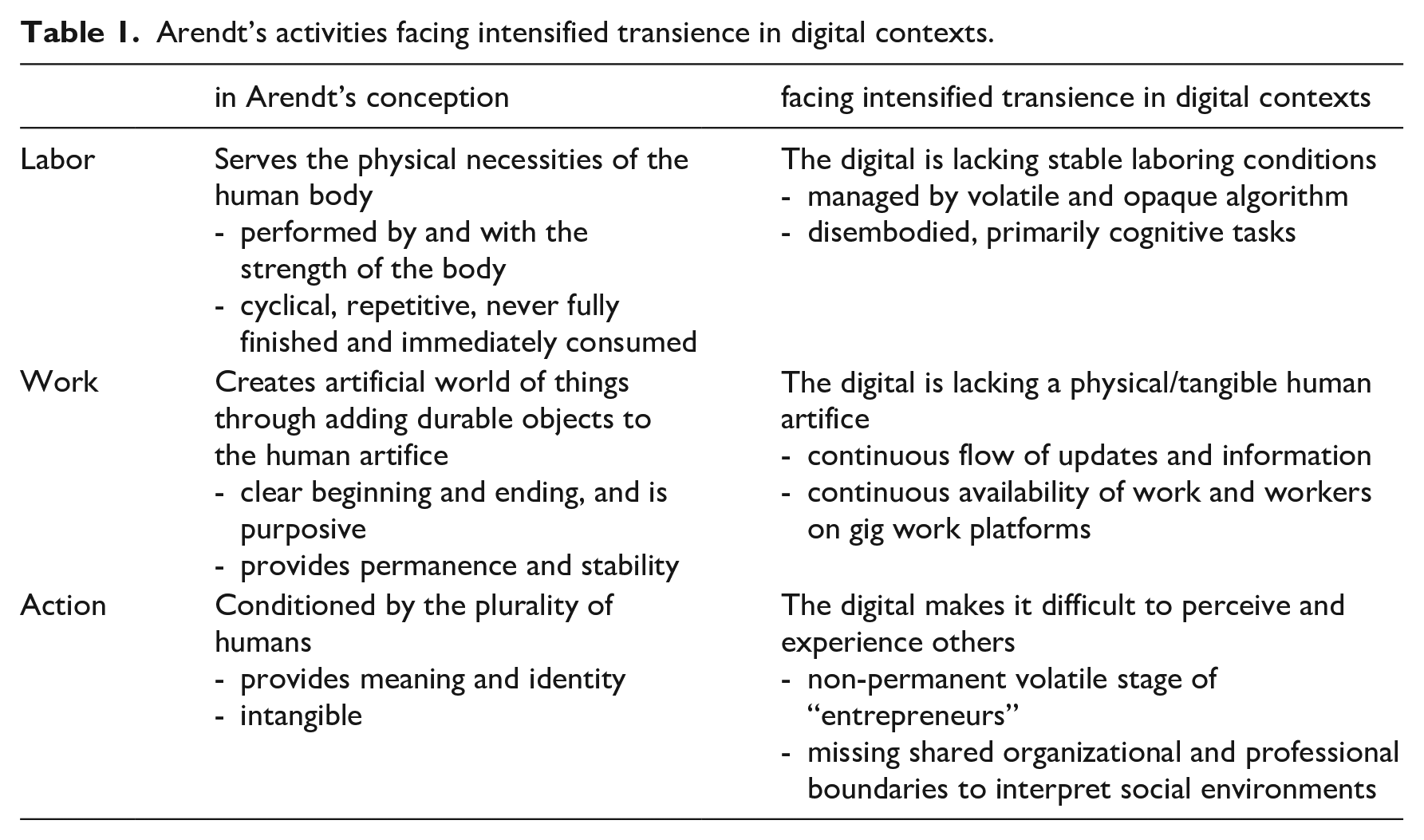
With permanence and stability missing, digital platforms initially comprise merely a volatile and functional space of “adventurers and entrepreneurs.” They enable, quite efficiently though, mutual hearing and seeing for purposes of exchanging goods and services or sharing knowledge, however, they frequently fall short regarding both the perception and the display of identities in interaction (Petriglieri et al., 2019). Employing digital platforms as collective environments with the capacity for meaningfulness—as spaces of appearance—is instead an effortful accomplishment beyond creating and exchanging goods of those laboring and working on the platform. In the transient context of digital platforms, it is unclear how actors maintain and create stable collective environments (spaces of appearance) for mutual visibility and the potential for action (see Table 1). Understanding this puzzle contributes not only to theory of identity and meaning outside of stable organizational and professional contexts, but also provides insights into the (self-)organization of individuals on digital platforms.
Arendt’s activities facing intensified transience in digital contexts.
Methodology
Comparative case design and case selection
To answer our research question, how actors maintain and create spaces of appearance online, we decided on an empirical juxtaposition of two polarizing cases of digital platforms. Our case selection was two-fold motivated: First, we selected cases reflecting the theoretical differentiation of work and labor. Ex ante, we suspected that a case representing creative online communities would be fitting to analyze Arendt’s sense of work on platforms because of its orientation toward creating digital objects (see Schiemer, 2018). Conversely, a case from the digital gig economy would be suitable to investigate forms of Arendt’s labor on platforms because “gig work” suggests a focus on repetitive and fragmented performances (see Bergvall-Kåreborn and Howcroft, 2014). Second, our cases correspond to the two most prevalent narratives of the future of work in light of digitalization between integrated creative work in online communities and precarious microtasking in the gig economy. This juxtaposition seemed particularly interesting against the background of Arendt’s concept of action, and the question of how individuals on both platforms perceive their environment as an opportunity to display and construct themselves in a meaningful way.
As a case of creative online communities, we selected FAWM (acronym for February Album Writing Month, www.fawm.org), a member-initiated online platform where professional, semi-professional and amateur musicians, including songwriters meet every February to work together on song sketches. Software scientist and songwriter Burr Settles founded FAWM in 2004 together with friends as a collective goal-setting group, a place where members meet to pursue a common goal and motivate each other. Settles was inspired by the website nanowrimo.org (National Novel Writing Month), on which up to 200,000 members gather each November to commit themselves to the collective goal of novel writing. In 2017, when the second author joined the community as a researcher and semi-professional musician, 2338 members posted 11,168 songs on the site, of which 963 were documented collaborations.
In contrast, as a case for microtasking in the digital gig-economy, we selected Amazon’s MTurk, a crowdwork marketplace established in 2005. MTurk is the abbreviation for mechanical turk and goes back to a mechanical chess computer that became famous in Habsburg Austria at the end of the 18th century. The chess turk was a complete fraud. Instead of a mechanical machine capable of playing chess, the chess turk was operated by a small human squatting within the machine where the secret mechanics were supposed to be. The platform MTurk uses a similar trick: It wants to provide human intelligence, not through automation, but instead by humans performing tasks from within a crowd. MTurk promises its requesters, task-givers who pay the platform, “the collective intelligence, skills, and insights from a global workforce” in addition to “human judgment.” 1 The microtasks are coined Human Intelligence Tasks (HITs) as intelligent human beings with evaluative capabilities are required for the task performance.
In-depth autoethnographic data collection
We approached these online platforms ethnographically by combining netnographic elements (Bowler, 2010; Kozinets, 2019) with an autoethnographic approach, where the authors build their analyses on personal experiences by maximizing their involvement with the field (Ellis et al., 2011; Pitard, 2019). Autoethnography as a self-focused and context-specific method (Pitard, 2019) can bridge the gap between observing and experiencing, thus providing direct access to the experienced world of online activities (Atay, 2020). Since labor, work and action cannot be observed directly as concrete activities in Arendt’s sense, but rather as the experience that people have with these activities or, in particular, their outcomes (e.g. the experience of necessity during labor, the experience of permanence in work, the experience of plurality in action), we decided to collect our data through autoethnography.
The second author engaged in participant field observations at FAWM. He collected data as a Fawmer on the platform in two consecutive cycles in 2017 and 2018. In addition to netnographic data in the form of documents (screenshots, forum posts, audio files, videos) and 12 narrative interviews with participants, this author also actively participated in nine song sketches on the platform as a semi-professional musician himself. Participation included creating a profile card, uploading songs he had written, and collaborating with FAWM members. He made his double role as a researcher and a participant visible on his profile page and asked his fellow collaborators for permission to document all interactions. The ethnography was recorded in the form of a daily diary (see Table 2).
Data collection.
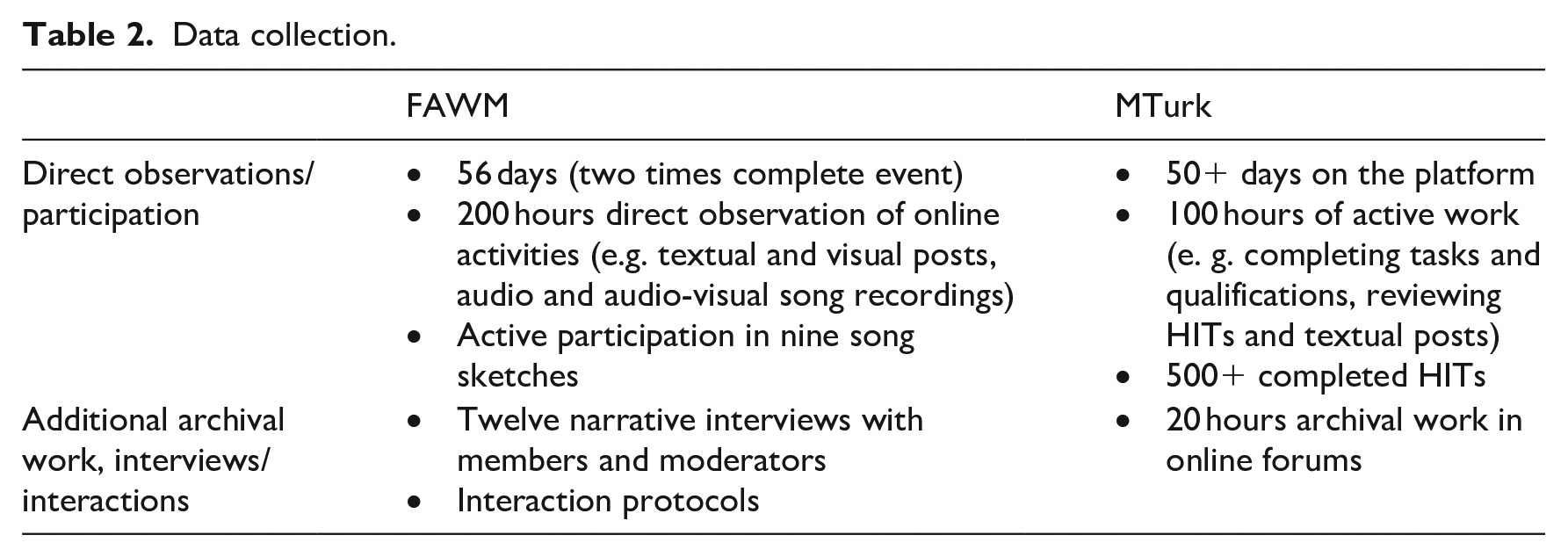
The first author collected in-depth data on MTurk. He became a Turker in 2019 and has been active on the platform up to the writing of this paper, alternating field engagement with analysis. He would consider himself a part-time worker on MTurk, working about 5–10 hours on the platform weekly, typically during after-work hours. He too documented his activities netnographically (Kozinets, 2019) by taking notes and screenshots and copy-pasting descriptions of HITs. As a fundamental aspect of working on MTurk he came in contact with Turker communities, particularly the MTurk community on Reddit, where he engaged in conversations, read and documented threads, and did archival work through searching thematically for topics in past threads. To reflect emerging themes of his activities and the experiences of fellow Turkers, he actively engaged with Reddit forums and openly revealed his identity as a researcher. Furthermore, he collected additional data produced by Amazon concerning MTurk (e.g. the Acceptable Use Policy or the Participation Agreement) and Turker communities (e.g. tutorials for scripts and extensions).
Both data collecting researchers adopted a self-reflective process of participation and parallel documentation through field notes (Kozinets, 2019). This note-taking approach combined daily self-observation with observation of community members and their activities on the platform as well as interaction protocols. However, since this approach relies heavily on the individual impressions, generalizations are limited (Walford, 2004) and we will accordingly discuss them context-specifically.
Data analysis
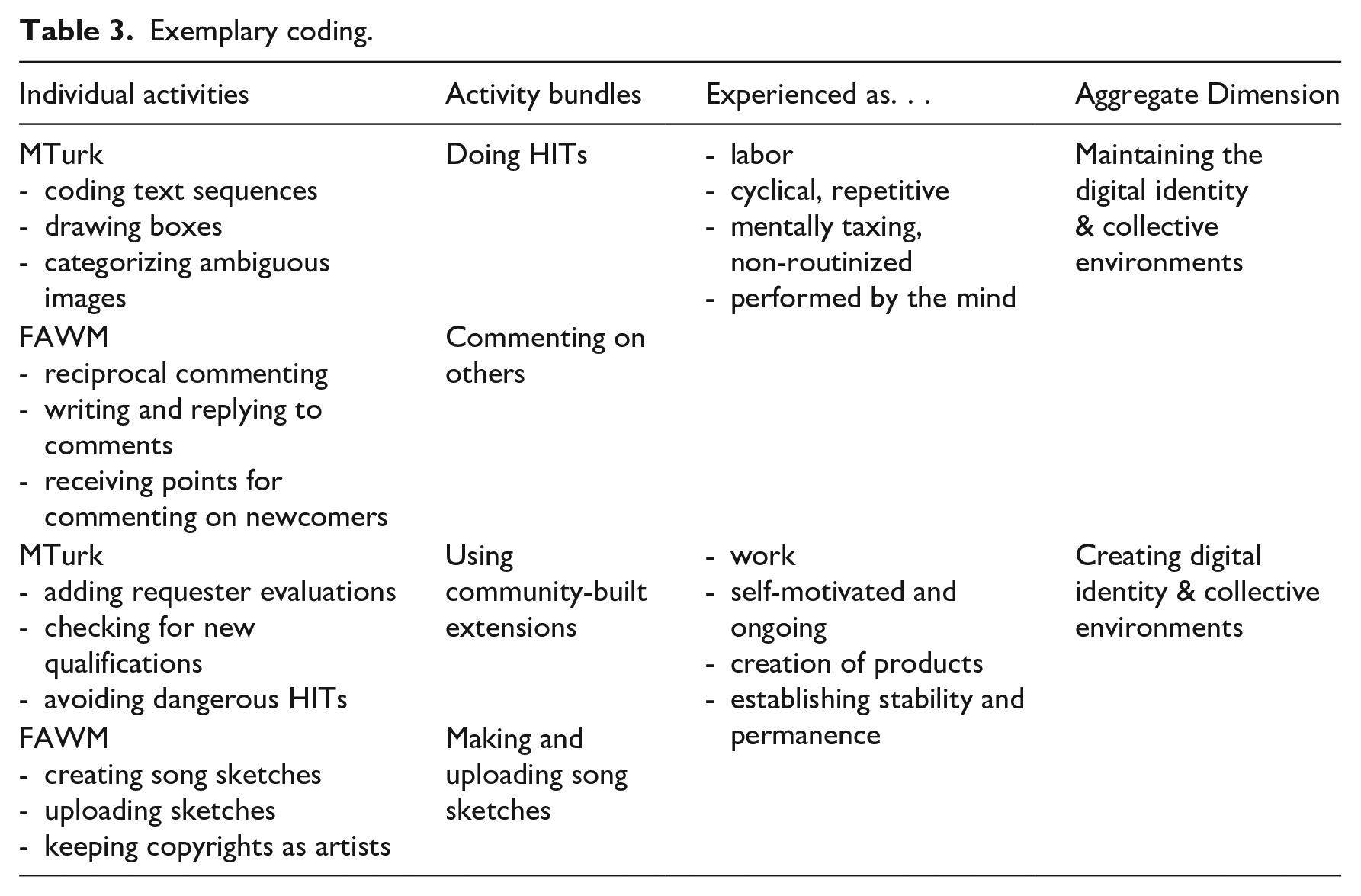
In our analysis, we followed a process as suggested by Gioia et al. (2013). First, together with the third author, we went through our material and coded activities that we performed and observed during autoethnographic observations. This resulted in two case-specific code families showing multifaceted individual activities of engaging with digital platforms, which we comprised into several activity bundles of platform work for each platform. At FAWM we found five activity bundles: making and uploading song sketches; commenting on others; collaborating directly with others; keeping track of the overall progress; and participating in forum discussions central to platform engagement. On MTurk we also found five bundles: doing HITs; qualifying for HITs; keeping bureaucratic overview and resilience; integrating community-built extensions to the workflow; and participating in Turker-forums. In a second step, we reflected upon how we and other participants experience these activities and their outcomes on digital platforms to draw conclusions about the qualitative differences in line with Arendt’s categories of labor, work and action. This second analysis included the feelings we (and others if expressed in interviews or posts) had during the activities (e.g. satisfied, stressed, exhausted), our understanding of what we were doing and why (e.g. motive, motivation, intentions) and the experienced outcomes (e.g. by-products, accomplishments, rewards).
Table 3 offers exemplary coding to show our coding strategy and the alignment of our codes with Arendt’s categories. We specifically made labor and work explicit empirical categories coded directly from our observations, since they can be linked to concrete activities and experiences or to specific outcomes. Building on these codes, we infer Arendt’s notion of action when identities and environments were solidified. These inferences about action were made possible in particular through reflecting on our autoethnographic experiences (e.g. “showing up,” interacting on the platforms). In the next section, we first present our findings separately for each case, contrasting the experience of labor with the experience of work as participants on digital platforms. We then show how these activities create spaces of appearance in which all participants potentially achieve visibility and can thus create ongoing identity and meaning.
Exemplary coding.
Findings
Work, labor and (the potential for) action on FAWM
The core activities on FAWM are making and uploading song sketches recorded on devices ranging from cell phones to sophisticated home studios, motivating other members with comments on their song sketches and giving constructive feedback, collaborating directly with others on a specific song, keeping track of the overall progress, and participating in forum discussions. These activities were necessary to successfully navigate the platform and had to be promoted to keep the community from disintegration, caused by, for example, inactivity of too many users. FAWM’s tagline is to produce 14 songs in 28 days. The members of FAWM describe this goal as motivating and inspiring, an experience that the researcher could confirm in his autoethnography. When 28 days are over, the songs can be further used by the artists, because the rights remain with those songwriters who are named as collaborators for the individual songs. However, the central motivations for participating in the platform were not limited to the production of music, but also consisted of being part of a plurality of like-minded people that acknowledge each other’s activities. As one participant puts it:
“The worst feeling in the world is having a piece of art you have created not even be acknowledged” (Interview participant FAWM)
We found that during a FAWM cycle, a space of appearance forms within which the members of FAWM develop a sense of belonging and a digital identity that eventually bears potentiality of political action in Arendt’s sense, for example, in the form of community building. One can “stay” on the platform (rather than just use it for a certain purpose) among other participants and one can “feel part of a plurality.” For many of the Fawmers, this participation in a potential community was actually the central motivation for engaging on the platform, as explained by one of the moderators. However, such a space of appearance, in which meaningful interaction could take place, did not materialize by itself merely through the (organized) get-together of like-minded individuals. It was created by the activities we identified as work, which in turn were made possible by activities we identified as labor.
Fawming as work
The activities that were experienced as work on FAWM were primarily writing and recording music. Songs as the final products come in the form of music sheets, recordings and written-out lyrics. All three consistent products can be uploaded at FAWM and shared with other members. The second author documented the successful upload of his first finished song in his diary as follows:
I also noticed how difficult it actually is to compose anything properly with Click-Track, and soon I was hooked. I took breaks in between, but I couldn’t wait to finish it and upload it to see what people would say and if anyone would want to collaborate with me. [. . .] About an hour after uploading, there were four very nice feedbacks on the page, explaining in great detail what they liked. That felt good to me. (Fieldnotes FAWM).
Songs as the main product of work in music have a stability as soon as they are manifested in a certain form, such as on recordings or music sheets. They are certainly the most important product of work on FAWM as reified ideas for which authorship can be claimed. The identification with the finished product, which (once uploaded) can be seen and evaluated by others, is a central characteristic of the experience. One member even reports that he put together an entire album of songs that were written during FAWM:
My first record was fully born on out of FAWM. A 100%. Like most of the songs came out of FAWM and I met another guy who was on FAWM who offered to mix them. (Interview participant FAWM).
Through this reification of ideas on FAWM, the community can describe itself as a creative community that works collaboratively on a certain stable outcome. However, not just songs create the experience of stability. When the second author created a profile card as a semi-professional musician and researcher, he manifested a form of digital representation that persisted over time and was retrievable for other members.
Additionally, the experience of permanence and stability on FAWM was conditioned by work on the side of the moderators. For example, when FAWM’s moderators became aware of the relevance of visibility on the platform, they integrated several features that served exclusively to create visibility. When the second author created his profile, he was immediately welcomed by members of the platform on his soundboard via comments. Participants who welcomed newcomers received points on their profile for community engagement that were visible to all others. This quickly led to “feeling welcome” and “being part of something persistent” (Fieldnotes FAWM) for newcomers. Participants also received points when they commented on yet uncommented song sketches that were uploaded to the platform. These mechanisms did not guarantee constructive criticism or further development, but they ensured that no participant disappeared into the plurality of people. As a participant, one could eventually “stay” visible on the website and see others by commenting on their profiles and songs, clicking through forums, or taking part in challenges that are advertised in the forums. It was the conscious decision of the founders to keep communication primarily on the platform, which resulted in this feeling of “stay” within a stable space of appearance. The “Frequently asked questions” referred to the fact that one should not do too much communication in the existing parallel Facebook group, but rather communicate as much as possible on the platform so that the platform remains stable.
Fawming as labor
However, it is not only work on FAWM that ultimately enables a space of appearance for its members: there are also activities that do not directly result in the manifestation of a concrete stable product, but that have to be done repetitively to enable an appearance and participation in the platform. These correspond to Arendt’s labor category, even if they do not refer directly to the biology of the body and its preservation. Rather, labor on platforms is about the sustaining of digital identities and social spaces, in the form of maintenance and administration. As described above, engagement turns the platform into a place to stay. However, there are also activities on FAWM resulting in much more volatile outcomes. These activities make FAWM a space to use, for instance, by commenting to receive comments. When the second author signed up on FAWM he quickly realized that writing back on comments received was a form of unspoken obligation.
I thanked everyone individually for the comment [received on a written and uploaded song sketch]. I think that’s a bit of FAWM culture to respond to something like that right away. There is a separate thread in the forum that points out exactly that. That you shouldn’t reply on your own wall, but on the person’s wall, otherwise they won’t see it. (Fieldnotes FAWM)
Or as one participant explains her everyday routine on FAWM:
Oh, I generally log on in the morning and check who commented and then thank them for commenting. And commenting something on their own side because I always want to pay back. (Interview FAWM participant)
For many participants, this mutual commenting became a kind of labor that had to be done on an ongoing basis in order to maintain the community. In 2018 a newcomer asked the following question on the Facebook group of FAWM:
How do you manage consistent commenting whilst also trying to reach your song goal? I have 60 people on my watchlist which might sound like a lot but when even 5-6 of them have each written 14+ songs in the first week or so, it can be hard to keep up [. . .] (Facebook data FAWM)
One very active member of FAWM replies:
I’ll be honest, I try and write a song, then give 5-10 comments, then write another song. I do NOT try and return every comment and stuff. But, I do as much as I can. If you like/need the feedback encouragement, then I suggest spending a chunk of time listening and commenting. If you don’t need that, then, the feedback can come later or not at all (Facebook data FAWM)
Finally, the development of platform-specific skills also requires labor when it comes to organizing oneself on a daily basis or practicing music. Before the second author could participate in the activities on FAWM, he had to learn with considerable (and repetitive) effort how to operate a digital audio station, what recording programs were available, and how to use them. For this, he had to deal with various posts in the forums (in a sub-forum called “Demo-Recording” where people share their knowledge about recording technique) and YouTube videos for several days that explain how to set up a digital audio workstation. On the second day of his fieldwork, he wrote in his diary:
The technical know-how needed here is much more complicated than I thought. Yesterday was a terrible day. It took me all day just to get my head around all the tools. (Fieldnotes FAWM)
In his time as a semi-professional musician, the second author never dealt with recording technology, but as he learned these skills during the FAWM research, he realized how useful the technology was to capture ideas. Skills can be a by-product of songwriting (that have to be practiced in an ongoing manner) on FAWM, or they can become a main motive to participate on the platform besides appearing and taking part in a like-minded community. One participant explained how he learned to produce semi-professionally through FAWM and set up a home studio. His motivation was originally to write songs, but changed toward becoming a producer. Ultimately, any form of skill requires practice, which, in the case of musicians, is expressed through repetitive activities.
Labor, work and (the potential for) action on MTurk
In contrast to FAWM, a platform for songwriters to collaborate without compensation, MTurk is a platform connecting crowdworkers and requesters of crowdwork who commission tasks. Workers usually call themselves Turkers, and what they do is turking. This indicates a shared understanding of what is being done on MTurk, despite the platform’s deliberate nontransparent architecture, which essentially deprives Turkers of any opportunity for exchange with fellow crowdworkers. Hence unlike FAWM, MTurk seems to be the antipode of a space of appearance, exploiting rather than counteracting the transience of digital spaces. One starts turking without any individually attributed experience, platform-specific skill or relation to a community of platform workers to draw on. It is not possible to personalize MTurk accounts or to communicate personal capabilities. Instead, Turkers automatically receive a MTurk-specific “Worker ID,” visible throughout all activities on the platform. Hence, working on MTurk is experienced in almost complete solitude. However, because no proof of qualifications is needed to join the platform, Turkers have stated in forums that the platform gave them a chance in life “when nobody else would.”
Turking as labor
The first impression of the MTurk platform is a list of tasks, called HIT (Human Intelligence Tasks) groups, functionally and esthetically reduced in its platform-design to bare necessities. Once loaded, the platform is seemingly static until it is deliberately refreshed or a Turker engages in the main activity of turking, that is doing HITs: tasks demanding some sort of “human judgment.” Turking is a practice of labor, with repetitive, fragmented, and exhausting task-performances serving the necessities of the digital identity and the collective environment of the platform. In these labor activities, MTurk and FAWM are similar—digital identities and environments need maintenance. Unlike fawming, however, turking is done in virtual solitude because other Turkers doing HITs remain largely invisible.
For each HIT group there is a list of information provided: requester-name, the HIT’s title, a HIT count totaling the number of individual HITs per HIT group, the time elapsed since the HIT was created, the reward to be gained for a completed HIT and a short description as well as required qualifications. What a HIT demands can vary greatly, which makes doing HITs mentally taxing, difficult to routinize, and exemplary for experiencing the volatility of online gig work on MTurk. Hence, unlike FAWM which is designed as a place to “stay,” MTurk is a place “to use” for continuously performing HITs. Turking means to keep completing tasks, because only that secures a monetary reward. In a forum post answering the question “What are some examples of jobs posted to mturks
2
?” a Turker explains:
Judging whether surgeons are doing a good job, writing, trying to fool AI, surveys, looking at new or existing products, judging cases as a sort of juror, all manner of crowdsourcing, literally from A (producing/judging Art), to Z (writing about Zebras) and trying to trick AI into getting answers about them wrong (. . .) making videos, recording written scripts (Like answering Alexa), tapping along with music on your keyboard (no kidding), a fave of mine this: listening to young children try to say the letter R correctly and judging their progress (I have a closed qual
3
for this and LOVE it, it makes me laugh and smile) (. . .)
4
The first author experienced laborious tasks on MTurk ranging from mundane surveys or repetitive AI training to creatively producing new ideas for products or even making up jokes. For instance, he drew squares around animals and then evaluated the type of animal in the image. Though one develops routine, velocity and skill for this repetitive and precise drawing process, the images were of such a quality that they kept evading clear categorization. Every HIT consisted of 10 images that needed attention and completing the HIT was rewarded with a minimum wage of one USD cent. Drawing hundreds of squares is mentally taxing, also exhausting from a physical perspective, and the ambiguity of the images added uncertainty whether a completed HIT would be accepted.
Another reason why HITs are experienced as labor is because they are smaller parts of broader tasks to be completed by the individual Turkers and they often have little idea about the eventual outcome of a task after completion. Moreover, not every Turker is allowed to do every HIT. Labor in the form of repeated qualifying is necessary for ensuring access to further HITs, and is also needed for maintaining the digital identity of Turkers. This can be experienced as an exhaustive succession of demanding tests about seemingly unrelated topics, such as a HIT requesting to digitize vintage postcards:
In the test, I digitized two postcards by trying to copy what was written on the card. Completing the test took more than 10 minutes. Whether they accept me, I do not know. Life as a Turker seems to be an eternal test. Constantly you are rated, tested. You must be concentrated, bring your best performance, because you do not know how good you have to be to get the qualification. (Fieldnotes MTurk)
Besides doing labor on MTurk by ceaselessly completing HITs and taking tests, administrative activities for maintaining the digital identity on MTurk form another type of labor. For instance, checking repeatedly the elapsed time during HITs or qualifications was necessary to keep overview of invested resources on MTurk, and regularly refreshing the HIT-list is essential to get the latest impression of available HITs. After initially loading the homepage, it remains seemingly static until loaded again either after a completed task or through individual refreshing. If no fitting HIT is available momentarily, regularly refreshing the homepage becomes a necessity to continue turking.
Turking as work
In contrast to FAWM, where the central stable outcome of work is the creation of songs, MTurk’s work activities are more closely linked to the making of professional identities. Certain qualifications, for instance, are experienced as creating rather than maintaining identity on the platform, particularly “closed quals.” These are qualifications available for only a limited number of Turkers and a qualification test once passed can secure continuous assignment of HITs for years. Turkers refer to closed quals as a permanent characteristic of their professional online identity. However, failing a qualification test can also have permanent consequences. Requesters can forbid retaking a failed test, excluding Turkers from certain tasks.
A stable identity is also experienced through metrics designed and implemented by the platform. Specific criteria are whether a HIT is accepted or rejected by a requester, or at times intentionally returned by a platform worker. The result is stored and becomes part of an individual digital representation, visible to requesters (much like FAWM’s feature for receiving points for greeting newcomers). The binary evaluation of whether a task was approved or rejected is translated into a metric that shows the HIT success rate from 0% to 100%. Typically, Turkers aim for a success rate of 99% because to be allowed to perform most HITs, a certain—very high—success rate is required. Thus, even though HITs on MTurk are immediately consumed, every HIT has permanent significance. Moreover, the dynamic metric of the HIT count can hint at experiencing the plurality of other Turkers on the MTurk platform itself. During a categorization HIT of German curse-words, the first author recognized that fellow Turkers would do the same HIT, evident by the decrease in HIT counts. Given the rather strict qualifications needed to do the HIT, the Turkers doing it seemed to have similar characteristics, which made them appear somewhat closer and familiar. Though lacking reciprocity, this micro-instantiation of recognizing others is a starting point for experiencing a sense of belonging to a workforce that acts together.
Besides creating identities, Turkers can also create digital artifacts via work which stabilize the fragmented platform environment. Turkers use screenshots to create a consistent overview of completed HITs or accounting information. These screenshots are necessary because MTurk only secures the individual data of Turkers temporarily. Through documenting their performed activities, Turkers develop overview and resilience against situations detrimental to them, and create consistency and stability on the platform. For instance, securing a “completion code” in a screenshot helps if a HIT is not rewarded by the requester. Screenshots prove task completion and allow to engage with requesters in struggles over unpaid HITs, or they can be used in Turker-forums to illustrate an issue and start a discussion with fellow platform workers. They are a prerequisite for taking action in Arendt’s sense and thus stabilize the transient platform environment in view of action.
As a means for stabilizing the digital environment, Turkers have created browser extensions. These extensions can be downloaded and are MTurk-specific. While active, the extensions add an information panel to the MTurk HIT-list. This panel offers several key points of information about a Turker’s ongoing session of turking, like completed tasks and money earned. It helps Turkers find tasks they preferably want to complete, and also which qualifications and tests they can or should take. Extensions allow Turkers to share information about the money per hour for a completed HIT, malfunctions, bias, or other obstacles in completing HITs. Furthermore, Turkers can add written evaluations about how they experienced a HIT or a requester. The first author also added evaluations that become visible in small pop-up windows when hovering over a HIT or requester name in the HIT-list. Adding evaluations as part of turking creates a less transient, more stable, collective environment.
Yet, turking is also about activities related to establishing consistent relationships with other Turkers on external platform environments like Reddit, pointing to the potential for action in the context of turking. The first author learned about Turker-forums on his first day on the platform. While feeling anxious about the MTurk internal review process for becoming a platform worker, he quickly found Reddit-forum sites with similar stories of anxiety, as well as assessments by experienced Turkers of how this situation will eventually turn out. Contrasting the experience on the MTurk platform, the design of Reddit draws attention to a member count on its right side, which immediately raises awareness for the potentially co-present plurality of Turkers. Even more so, workers on MTurk engage with and participate in forums, thereby establishing connectivity and even collaboration amongst them. One important topic is the exchange of best practices between experienced and novice Turkers. Experienced Turkers advise newcomers like the author to use community-built extensions for enhancing, developing and altering work experiences on the platform.
Thus, action in the form of appearing and engaging in the community as a Turker, very similar to a Fawmer, as seeing and being seen in spaces of appearance, depends on the grouping of Turkers on further platforms. To become visible is unintended by the platform MTurk. However, Turker-forums provide collective environments that can become spaces of appearance as a result of work. Two experiences indicate this. First, forums provide threads specifically designed to welcome and address newcomers to the platform, and make them and their questions or concerns visible, which comes close to the welcoming the second author encountered on FAWM. On Reddit, the first thread is always the “Weekly Newbie Question Thread” that enables inexperienced Turkers to post questions visibly without concerns regarding downvoting (which would render the question invisible). Every question is answered, which adds to the experience that a space of appearance exists here that fosters a sense of belonging. Second, the first author repeatedly read inspirational biographical stories Turkers shared with the forum-community. Usually, they were part of stories about either departing from or returning to the platform. Welcoming returnees or saying goodbye to those leaving was often interwoven with short personal statements indicating personal recognition. In that way, the personal stories became stories of the community and reflected more the experience of a plurality than those of an isolated individual.
Conclusion
FAWM and MTurk, represent two polarized narratives about the future of (platform) work: A well-connected community for the creation of new ideas versus an alienated environment for the exploitation of human labor. While FAWM is designed to maintain and create a stable songwriting community characterized by appreciation and mutual sympathy, MTurk, by design, deprives one of appearing and engaging with fellow peers directly, since every Turker is meant to work on commissioned tasks in solitude. While FAWM is an emblematic example of online relationships between like-minded platform workers, MTurk is one of isolating workers in transient digital spaces.
It is not surprising that a space of appearance is established at FAWM, where the members can show themselves and interact. What is surprising, however, as Arendt’s perspective shows, is that it takes very similar labor and work activities on MTurk to establish the space of appearance. These similarities lead us to believe that the future of work is less found in the outcome of platform work, such as the creative collaboration in making music, or the repetitive completion of tasks, but in the platform workers’ collective response to the transience of a digital environment. A transience that causes meaning and identity to erode if stability is not actively built up through labor and work. Table 4 summarizes how we mapped our findings to Arendt’s concepts and shows how spaces of appearance were established in both settings, eventually enabling platform workers to gain visibility and keep the potential for action.
Summary of Arendt’s activities and platform experiences.
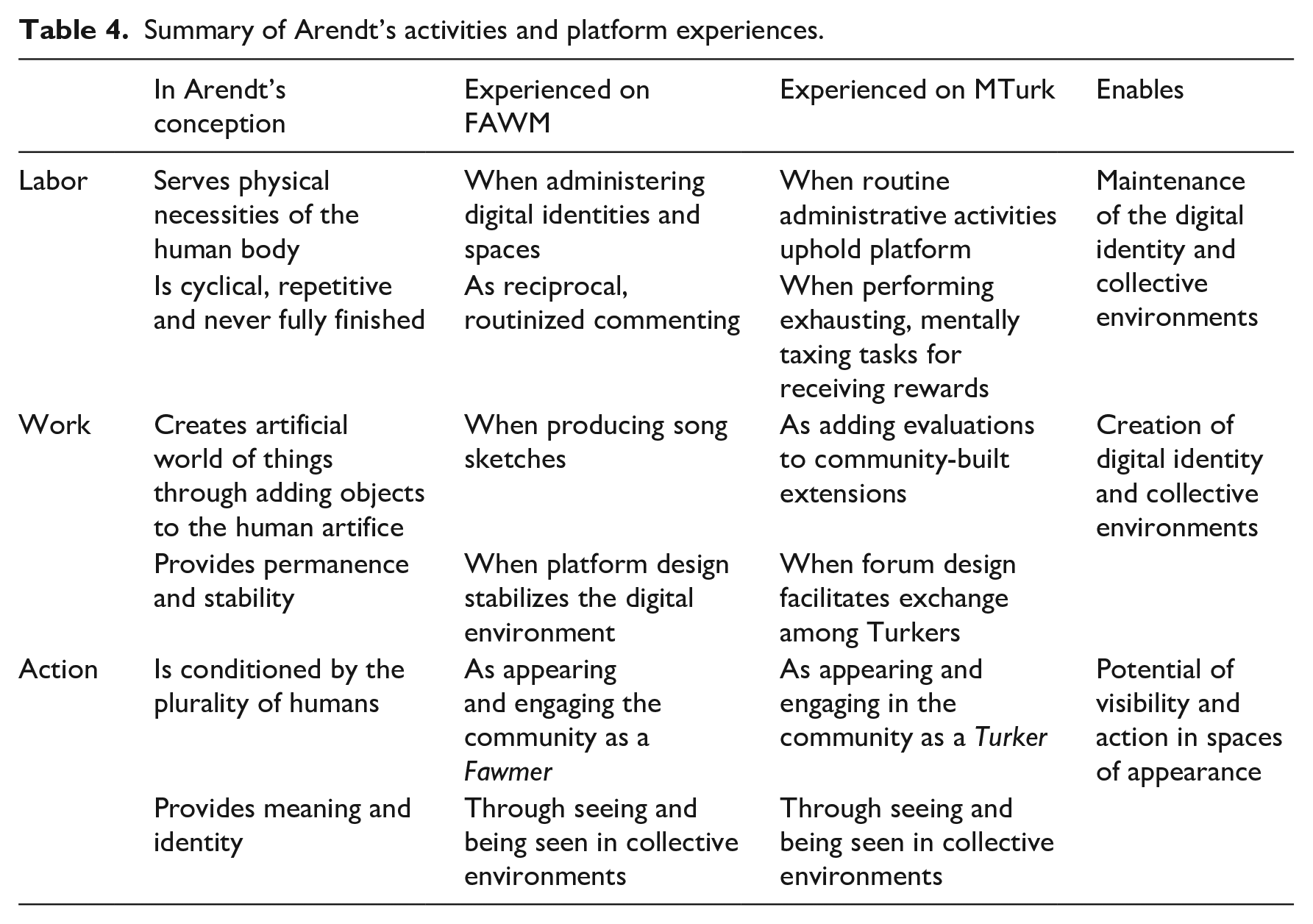
Arendt saw the fulfillment of human bodily needs (labor) as well as the creation of a concrete world (work) as a precondition for action. She understood action as appearing and interacting in a meaningful, stable collective environment, a space of appearance. Our findings show that digital space is less about the biological condition of being human or the necessity for humans to live in a physical tangible world, and more about the creation and maintenance of a digital identity (which can suffer decay if it is not created and maintained with care). The same applies to the digital environment, which, in its ongoing beta versions, is subject to transience of digital platforms if not properly taken care of. Thus, labor on digital platforms is a mentally taxing experience not of the body, but of the mind. The constantly changing inputs and demands to conduct HITs or write comments require a high level of attention and mental awareness. After all, these are human intelligence tasks built on judgment and evaluation. Similarly, most of these laboring activities have lost their routine character but induce change in performance and strategy. There is no single best way to conduct HITs or write a comment that is applicable across the different tasks and contexts, or a single best way to write and comment on a song. These changes to the character and experience of labor relate directly to the human condition on digital platforms: There is a lack of stability in digital environments, which make it difficult to establish a routinized response to the posed challenges. In addition, the transience of the digital environment, and the resultant volatility and instability, create a mentally exhaustive environment. Since everything must be deliberately envisioned and created, we lack a natural mental “resting place.” The same is true for the category of work. While Arendt’s conception still has truly enduring physical elements in mind, digital environments are particularly concerned with a form of consistency that cannot be physically grasped, but nonetheless transcends time. Digital artifacts such as MTurk’s extensions, and FAWM’s forums and features, are products of work, since they provide stability and consistency to the platform. They are there when people log on and remain there when people log out.
Identity construction beyond holding environments
Although organizational literature already theorizes upon the impact of digitalization on management (e.g. algorithmic control, see Bucher et al., 2021; Duggan et al., 2020; Pignot, 2023), organization and coordination (see Dobusch and Schoeneborn, 2015; Kretschmer et al., 2022) and identity construction (see Ashford et al., 2018; Petriglieri et al., 2019), there is little understanding of how individuals construct collective environments on digital platforms to perceive, maintain and create both identity and meaning in interaction. Experiencing and dealing with transience is however a basic condition for humans engaging with digital platforms and shaping how we perform labor and why we perform work.
Our findings, therefore, shed new light on the loss of stability, identity and meaning on digital platforms and the related coping strategies. Petriglieri et al. (2019) show how platform workers cultivate holding environments to respond to the lack of organizational and professional stability on digital platforms. Similarly, Sutherland et al. (2020) argue that personal holding environments are necessary to engage productively with digital platforms. Cultivating holding environments relates to what Marx would call “self-alienation,” the mental, economic and social disconnection of workers from their work (Marx and Engels, 1975). A holding environment can thus support individuals who feel they are losing meaning and identity amongst unstable organizational and professional boundaries. Following these findings, we show that beyond holding environments, individuals on digital platforms also establish collective environments—spaces of appearance—in response to what Arendt calls, in direct opposition to Marx, “world-alienation.” Not only do individuals on digital platforms experience the threat of “losing one’s self” (Petriglieri et al., 2019: 160), but also the threat of losing plurality and publicity necessary to perceive and construct meaning and identity in interaction.
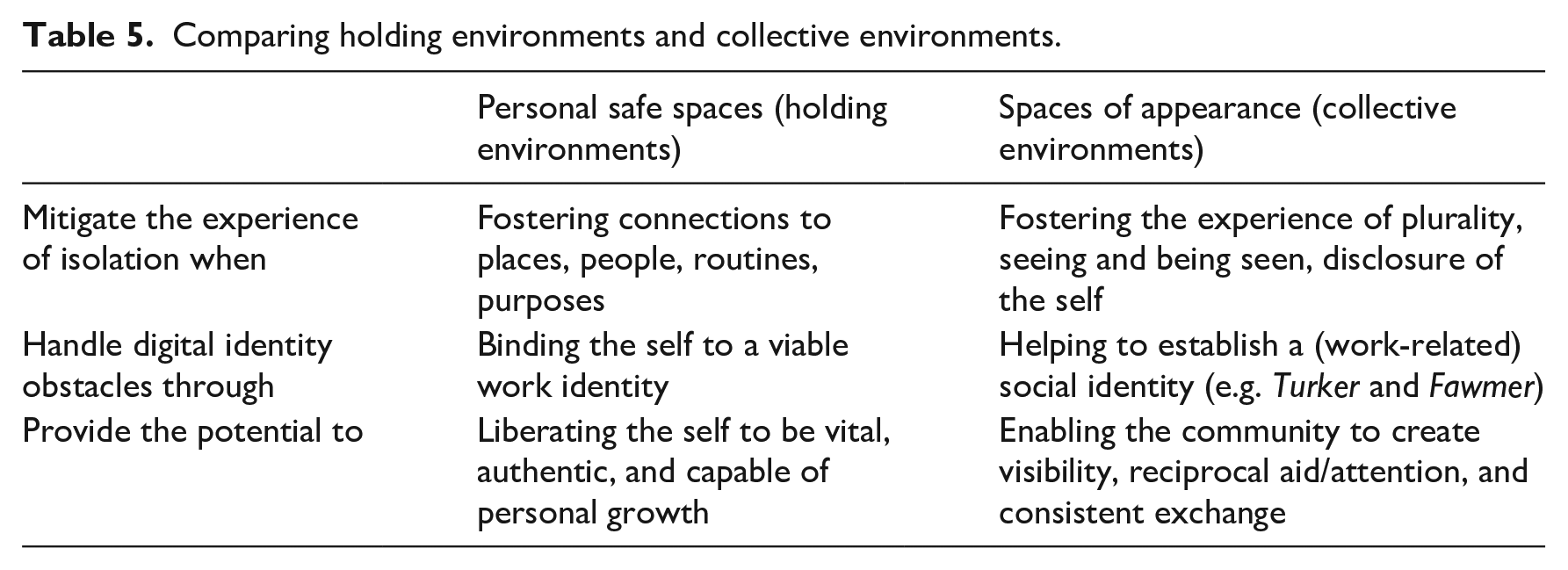
Thus, collective environments are a mechanism not to cope with the alienation of the self, but the alienation of the world. While personal holding environment as a psychological concept looks inward when it comes to the individual experience of the human condition online, the concept of spaces of appearance looks outward. Accordingly, gaining stability, meaning and identity on digital platforms goes beyond a physically anchored and personalized safe space. The collective environment in this context is a condition for shared values or practices that must first be created and maintained. These collective qualities are, therefore, not a necessary feature of digital platforms, but rather an effortful accomplishment of labor and work activities. Reflecting on our findings concerning the future of work, we think weight will be shifted from what is classically conceived of as direct outcomes of labor and work on digital platforms to the ongoing creation and care of environmental by-products (such as communities and identities) which are needed to make activities on digital platforms sustainable. Both personal safe spaces and spaces of appearance provide stability in the face of transience of digital platforms, with the places, persons, and routines (holding environment) on the one hand, communities and digital identities (collective environment) on the other. Table 5 compares both concepts.
Comparing holding environments and collective environments.
Outlook and limitations
We want to conclude our article by quoting again from Arendt’s Human Condition: “For a society of laborers, the world of machines has become substitute for the real world, even though this pseudo world cannot fulfill the most important task of the human artifice, which is to offer mortals a dwelling place more permanent and more stable than themselves.” The future that Arendt diagnoses is that of a permanence-free environment: “we would no longer live in a world at all but simply be driven by a process in whose ever-recurring cycles things appear and disappear, manifest themselves and vanish, never to last long enough to surround the life process in their midst” (Arendt, 2018: 134).
Unsurprisingly, Arendt has already thought of the key aspect we aim to underscore when theorizing work, labor and the potential for action on digital platforms. Taking a closer look at the multiplicity of activities facilitated but also necessitated through digitalization, we see the future of work dealing with a lack of stability and, therefore, a lack of a stable collective environment. In these digital spaces, with their ever-changing and highly fragmenting requirements, it will be vital to analyze how participants create stable collective environments, and thus develop means to support and maintain their digital identities and surroundings.
There are limitations to our investigation that point out avenues for future research about labor and work on digital platforms. Our study is designed as an exploratory, in-depth comparison of two contrasting digital platforms yet focusing on similarities between them. Our approach relies on analyzing individual impressions, which limits our ability to generalize our findings. In addition, further investigations should consider how digital workers manage and experience working on multiple platforms, and how this multi-sitedness is a strategy of coping with the transience of digital platforms in itself. In this context, we would suggest to include social media platforms such as Twitter or Facebook in the Arendtian perspective. A comprehensive perspective (not on the future of work, but on the human condition online) could compare the gig economy platforms, the creative community and social media from Arendt’s point of view, allowing us to gain better insight into the problems and opportunities of the digital transience that so fundamentally will condition us and our work in the future.
Footnotes
Acknowledgements
We thank three anonymous reviewers as well as the editors of the Special Issue for their generous and constructive guidance in developing this paper. We are also indebted to David Terwiel for valuable comments on our argument and S.R. Ayers for editing the manuscript.
Funding
The author(s) disclosed receipt of the following financial support for the research, authorship, and/or publication of this article: The authors gratefully acknowledge funding by the German Research Foundation for supporting the Research Unit ‘Organized Creativity’ (grant no. FOR-2161).
