



Abstract
This article examines the processes of (re)construction and repositioning of influencer-entrepreneur identities during times of social controversies. As digital entrepreneurs, their market performance is closely linked to their online identities, making them particularly susceptible to identity tensions when societal expectations and platform dynamics evolve. Drawing on a longitudinal study combining five years of netnography along with in-depth interviews, our findings highlight key strategies used by influencer-entrepreneurs to address these challenges, including implicit and explicit identity negotiation, image management and repositioning efforts in their evolving identity construction. We demonstrate how influencer-entrepreneurs adapt their digital identities in response to changing audiences/follower expectations, reputational risks and evolving market conditions. We contribute to the literature on digital entrepreneurship and entrepreneurial identity work by shedding light on the complexities and tensions of identity work in digital spaces.
Keywords
Introduction
The entrepreneurship field is experiencing a growing interest in a new wave of entrepreneurial opportunities, broadly characterised as digital entrepreneurship (Nambisan et al., 2019). Digital technologies, such as digital platforms, digital infrastructures and their associated ecosystems, offer the opportunity to a “greater number and diverse set of people” to participate in the entrepreneurship process, from finding and exploring opportunities to launching new ventures (Nambisan et al., 2017, p. 1032). Social media platforms, in particular, have given rise to a new type of digital entrepreneur (Cheng et al., 2024) – the social media influencer: defined here as social media users/content creators who accumulate a large following, become influencers and monetize their influencer status via for example, providing services such as brand endorsements (influencer marketing), creating their own line of products/services, or launching new ventures (Guiñez-Cabrera and Aqueveque, 2022). Those digital entrepreneurs have been referred to in the literature with various names, such as platform-dependent entrepreneurs (Cutolo and Kenney, 2021), social media entrepreneurs (Stephens and Miller, 2024) and influencer-entrepreneurs (Bi and Liu, 2022; Guiñez-Cabrera and Aqueveque, 2022). We refer to them as influencer-entrepreneurs as they create their ventures and accumulate financial wealth by promoting and sharing their knowledge and competence in their chosen field of interest on social media based on their influencer status (Lee and Theokary, 2021).
While the entrepreneurship literature has provided several accounts of the democratising aspects of social media platforms with regard to entrepreneurial opportunities (Cutolo and Grimaldi, 2023; Shaheer et al., 2024), there has been little critical reflection on the tensions and contradictions surrounding the marketisation of this neoliberal entrepreneurial model (Ashman et al., 2018). Specifically, an important characteristic of influencer-entrepreneurs and the business model on which their entrepreneurial endeavours are based is the sharing and consequent monetisation of their private lives online. The appeal of influencer-entrepreneurs is based on their relatability and (projected/perceived) authenticity, which is the reason why their followers support them (Kapitan et al., 2022; O’Neil et al., 2022). Yet, as participants in the monetised ‘attention economy’ on social media (Burr and Floridi, 2020), influencer-entrepreneurs are subject to the ‘straightjacketing’ of the market norms (Ashman et al., 2018). Their individual success and number of brand endorsements (and consequently, financial performance) depend on a carefully balanced curation of what and how they share on social media, and the effect this has on their number of followers, which acts as a form of currency. This inevitably produces tensions for influencer-entrepreneurs and their identity: on one hand, they need to experience an internally coherent sense of personal self-identity (Ibarra and Petriglieri, 2010; Watson, 2009), on the other, they need to pay close attention to their self-presentation and image on social media – the external display of role-appropriate characteristics – (Ibarra and Petriglieri, 2010), as the basis for their ‘private life monetization’ entrepreneurial model. Those identity tensions are amplified during times of disruptions, social turbulence and controversy (e.g. COVID-19, MeToo movement, Black Lives Matter (BLM) movement, etc.), as influencer-entrepreneurs have to decide whether to take a stance and participate in, and potentially lead, discussions on those topics with social importance, or constrain their projected identity on social media to their usual content and avoid such topics altogether. Given the salience of such projected identities for their business model and monetisation, it is important to understand how influencer entrepreneurs deal with identity tensions during times of controversy. Therefore, the research question that we address in this study is: How do influencer-entrepreneurs navigate identity tensions during times of controversy?
In order to address the research question and uncover how controversy affects entrepreneurial identity for influencer-entrepreneurs, we build on the identity work literature (Ibarra and Petriglieri, 2010; Sveningsson and Alvesson, 2003; Watson, 2009), which provides the conceptual apparatus for understanding the mechanisms through which influencer-entrepreneurs deal with identity tensions, emphasising ‘identities-in-action’ in a process of responding to changing social expectations (Brown, 2015). While the concept of fluid and changing entrepreneurial identities has been studied previously (O’Neil et al., 2022; Swail and Marlow, 2018; Vershinina et al., 2022), and recent research has provided insights into identity work in digital spaces (Hanek et al., 2025; Kelly and McAdam, 2023), the influencer-entrepreneurs context is particularly interesting to study the evolving entrepreneurial identity, as their identities may take different turns depending on the developments in the ‘attention economy’ in which they operate. Because their success is based on the projected authenticity of their identity, and the currency of their followers, influencer-entrepreneurs present a fertile context to better understand identity work’s continuous and processual nature and the push and pull of the desire for internal self-coherence and the constantly evolving demands of the external, relational identity projections (Ibarra and Petriglieri, 2010; Watson, 2009). Methodologically, we conducted a longitudinal netnography with eight influencer-entrepreneurs. The netnographic data included five years of influencer-entrepreneur activity on Instagram with a focus on their published posts related to controversial topics such as the BLM movement, the COVID-19 pandemic, the Mexico–US border crisis and was supplemented with in-depth interviews.
This article offers the following contributions. First, we contribute to the literature examining entrepreneurship on digital platforms. Complementing research on how digital platforms bring affordances and opportunities to a greater number of people to engage in entrepreneurship (Cutolo and Grimaldi, 2023; Shaheer et al., 2024), we shed light on the internal struggles and tensions of digital entrepreneurs as they navigate the affordances but also the perils of digital platforms, and the impact this process has on their sense of self and identity. Second, responding to the call to move the study of identity to the digital world (Mmbaga et al., 2020), we contribute to the literature on identity within digital spaces (Hanek et al., 2025; Heizmann and Liu, 2022; Kelly and McAdam, 2023; Shaheer et al., 2024). Our findings provide an understanding about how entrepreneurial identity evolves in terms of being both lost and formed, and is negotiated – implicitly and explicitly – while influencer-entrepreneurs address controversial topics online. In so doing, we highlight the processes and mechanisms that influencer–entrepreneurs use to deal with the daily dynamic of identity work aiming to align their internal self with their externally projected identity. Third, we broaden the scope of the literature on identity work in challenging situations such as personal crises (Chitac et al., 2025; Fisch and Block, 2021; Jiang et al., 2025), by moving beyond personal and proximal crises to understand identity work when entrepreneurs decide to engage directly with broader social crises and unrest as part of their entrepreneurial venturing and identity positioning.
The remainder of this article is structured as follows. We commence by reviewing the literature on the various forms of entrepreneurship on digital platforms, and more specifically, influencers as digital entrepreneurs and the intricacies of their entrepreneurial business model. Next, we present the theoretical grounding of the study – identity work. We then detail our methodology and present the study findings. The discussion section delineates the contributions of the study. Finally, we offer conclusions, along with limitations and future research directions.
Social media influencers as digital entrepreneurs
Digital entrepreneurship is defined as ‘the creation of new economic activities embodied in or enabled by digital technologies’ (von Briel et al., 2021, p. 2), encompassing a wide range of technologies, including digital platforms. These platforms, ranging from exchange and innovation platforms to social media, are generating entrepreneurial opportunities not only for platform creators but also for their users (Cutolo and Kenney, 2021; Reuber and Fischer, 2022). Instagram and YouTube are becoming fertile ground for a new type of platform-dependent entrepreneur, whose business activities rely on the affordances of the platform itself (Cutolo and Kenney, 2021). Responding to the growing prominence and economic impact of such actors, recent scholarship calls for more attention to social media influencers as a distinct category of digital entrepreneurs (Cheng et al., 2024). While scholars increasingly describe them as digital entrepreneurs (Shaheer et al., 2024), influencers also align with more traditional conceptions of entrepreneurship. Although no single definition prevails, operationalisations range from self-employment (Blanchflower and Oswald, 1998) to the creation of market discontinuities through innovation (Schumpeter, 1934) and the pursuit of wealth and prestige via creative endeavour (Baumol, 1996). Viewed through this lens, influencers qualify as entrepreneurial actors: they manage their own ventures, leverage digital tools to build partnerships and revenue streams and disrupt traditional advertising logics (Guiñez-Cabrera and Aqueveque, 2022). Moreover, because their ventures are deeply rooted in human branding, influencers integrate their lived experiences, opinions and identities into their business models, making identity a central, dynamic and performative dimension of their entrepreneurial practice.
In response to the diversity of these roles and practices, a growing body of scholarship seeks to refine the terminology used to capture the specificity of influencer-led entrepreneurship. Terms such as digital autopreneurs (Ashman et al., 2018), contentpreneurs (Johnson et al., 2022), leisure-based aspiring entrepreneurs (Cutolo and Grimaldi, 2023) digital-entrepreneur (Shaheer et al., 2024) and influencer-entrepreneurs (Bi and Liu, 2022) are emerging. Table 1 synthesises these conceptual contributions, outlining the terms, definitions and methodological approaches that collectively reflect the evolving and interdisciplinary nature of this phenomenon.
Entrepreneurship on social media/digital platforms – terms in the literature.
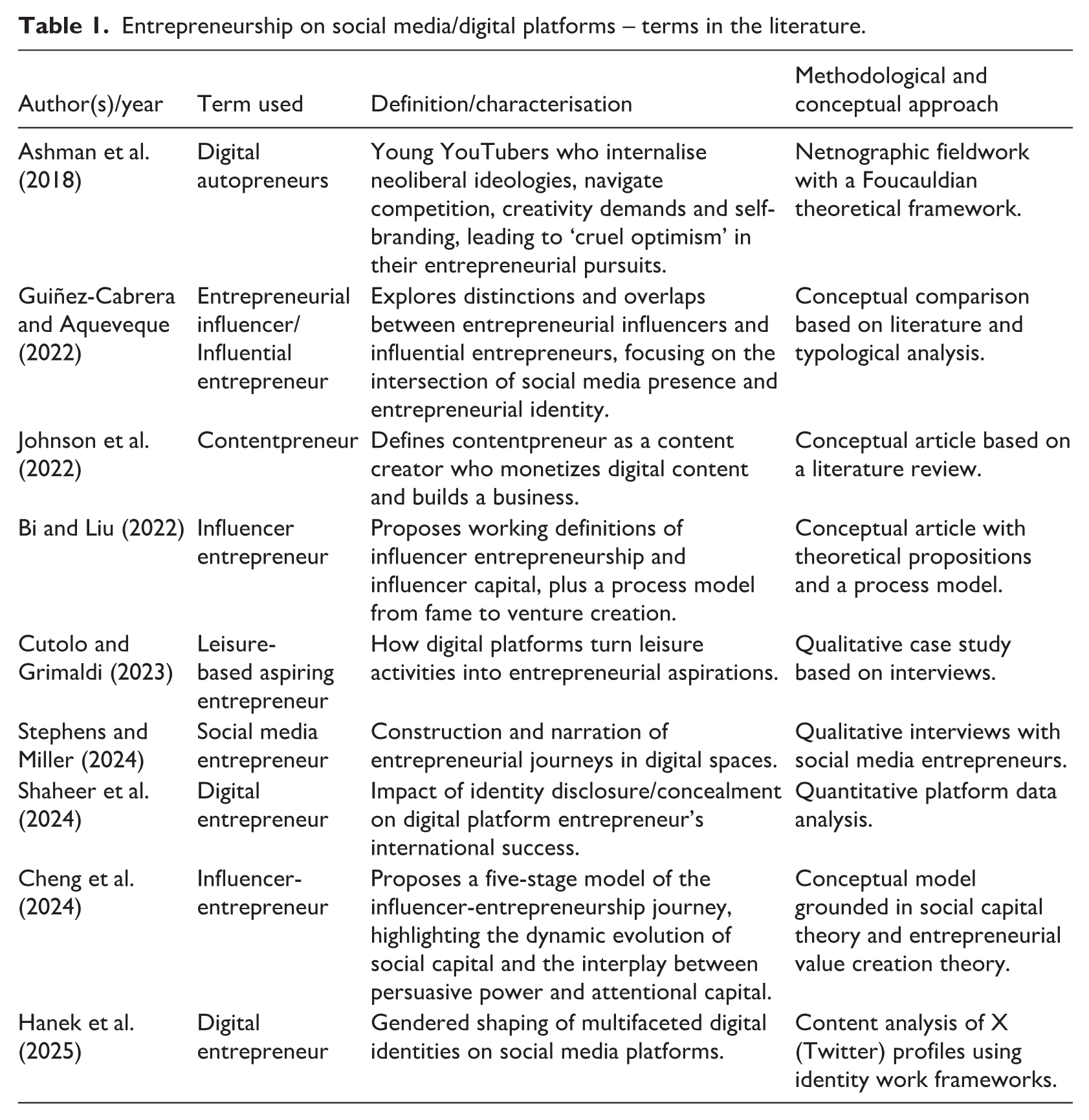
Together, the studies illustrate the conceptual richness and diversity of approaches to social media-based entrepreneurship. Rather than converging on a single definition or trajectory, they show how such entrepreneurship encompasses a range of practices, from content monetisation and strategic self-presentation to the pursuit of visibility and legitimacy on digital platforms. Accordingly, this article adopts the term influencer-entrepreneur to describe social media users who engage in entrepreneurial activities through content creation, community building and brand collaborations. This choice is guided by Guiñez-Cabrera and Aqueveque’s (2022) findings, which highlight the distinct paths and motivations of social media users evolving into entrepreneurial influencers, while acknowledging the hybridity of identity, labour and value creation in this form of entrepreneurship. The term is precise yet inclusive, bridging both the influencer and entrepreneurial dimensions without reducing the phenomenon to either marketing or platform mechanics alone.
The business model of influencer-entrepreneurs is based on the commodification and monetization of their private lives and the labour involved in so doing (Campana et al., 2021; Drenten et al., 2020; Trittin-Ulbrich and Glozer, 2024). The pressures of such commodification in a monetized attention economy present tensions for influencer-entrepreneurs struggling to project their authentic self while negotiating the demands of brands and followers. Thus, a recent shift towards a more raw and educational form of content is being adopted by many influencers, for example, showing unedited and realistic visuals of their body on Instagram, as well as fuelling real discussions on topics such as mental health (Reade, 2021). This shift reflects a growing demand for content that is both informative and relatable, emerging in a context shaped by social and political crises (Hund, 2023). The tensions inherent in trying to be true to oneself while adhering to market pressures present a challenge for influencer-entrepreneur perceptions of the self and projected identities.
Entrepreneurial identity and influencer-entrepreneurs
While there is a variety of theoretical perspectives used in entrepreneurship to approach entrepreneurial identity, our study is guided by identity work (Sveningsson and Alvesson, 2003; Watson, 2009). We focus specifically on examining how times of controversy affect the identity work of influencer entrepreneurs as they project their identity online, all the while experiencing tensions between trying to maintain a coherent sense of self and the social expectations inherent in being an influencer (Arriagada and Bishop, 2021). Identity work is referred to as the ‘forming, repairing, maintaining, strengthening, or revising’ of the sense of self (Sveningsson and Alvesson, 2003). In the context of entrepreneurship, individuals engage in a variety of behaviours to develop, maintain or revise an identity that is coherent, legitimate but also distinctive (Marlow and McAdam, 2015; Mmbaga et al., 2020). Influencer-entrepreneurs create and maintain a marketable identity, but in this process, they encounter many prescribed norms and constraints stemming from the nature of the attention economy (Ashman et al., 2018).
Research suggests that identity should not be viewed as a stable construct, but rather one that is continuously negotiated and renegotiated as people express and shift the presentation of their self-concept (Fox et al., 2018). It is important to note that identity work is always relational as individuals shape their identities in relation to other people in their social environment (Adeeko and Treanor, 2022). Thus, entrepreneurial identity is inseparable from an entrepreneur’s interactions and the context in which those interactions occur (Radu-Lefebvre et al., 2021). Identities are shaped through discourse and enacted in language (Brown, 2015; Watson, 2009), and as Swail and Marlow, (2018, p. 260) note, ‘the self and encountered social discourses are in a constant process of negotiation’. Indeed, the importance of interactions and discourse can be clearly seen in the case of influencer-entrepreneurs who inherently base their projected persona and marketable identity in relation to others (their followers, brands that sponsor them, etc.) through a daily work of discourse. Thus, we build on Watson (2009), who define identity work by incorporating both internal (self) identity and external (relational) aspect: ‘Identity work involves the mutually constitutive processes whereby people strive to shape a relatively coherent and distinctive notion of personal self-identity and strive to shape the various social identities that emerge in relationship to others in the various milieux in which they live their lives’. (p. 257). Watson’s view explicitly bridges Sveningsson and Alvesson’s (2003) idea of work done by people on their self-identity with Goffman’s (1959) notion of impression management or self-shaping in presenting our identity to others. Similarly, Ibarra and Petriglieri (2010) explain: ‘the notion of identity work is based on two underlying assumptions: the importance of external (public) display of role-appropriate characteristics, and the desirability of internal identity coherence’ (p. 11). Identity work from this perspective presents a particularly appropriate framework to study influencer-entrepreneurs, whose entrepreneurial projects are based on a relational self-presentation dynamic and performances supported by scripted actions online (Stephens and Miller, 2024) while trying to stay authentic to themselves and project that authenticity to their audiences (O’Neil et al., 2022).
While entrepreneurs have considerable agency in shaping their identities, identity work is a continuous and dynamic process (Leitch and Harrison, 2016; Swail and Marlow, 2018) that is often triggered by external events or demands (Grimes, 2018). Scholars refer to this process as identities-in-action (Brown, 2015; Weber and Mitchell, 2008) to denote that identity is something we do – especially in circumstances of conflicts and tensions. Indeed, deliberate identity work is needed in situations of crisis or unrest (Watson, 2009). In such situations, psychological-existential worry brings not only self-doubts but also openness for conscious identity work (Sveningsson and Alvesson, 2003). Extant research examines identity work in situations of personal crisis or life changes, for instance refugee entrepreneurs (Adeeko and Treanor, 2022), or liminal spaces of transition to a digital entrepreneurship career (Kelly and McAdam, 2023). We broaden the scope to social crisis situations in which influencer-entrepreneurs must navigate a ‘minefield’ of divisive social opinions. In the context of social unrests and controversies, many influencer-entrepreneurs have had to redefine their projected persona online while balancing their self-concept and the tensions of a polarised social environment. This context brings the potential to unpack the dynamics of entrepreneurial identity as a process of continuous reflection and conscious identity work during which influencer-entrepreneurs discursively construct their identity in interaction with various social actors (e.g. followers, brands) while navigating social discourses. Thus, this context helps illuminate ‘the dialectic between the internal and the external aspects of identity work’ (Watson, 2008, p. 129).
Methods
Research design
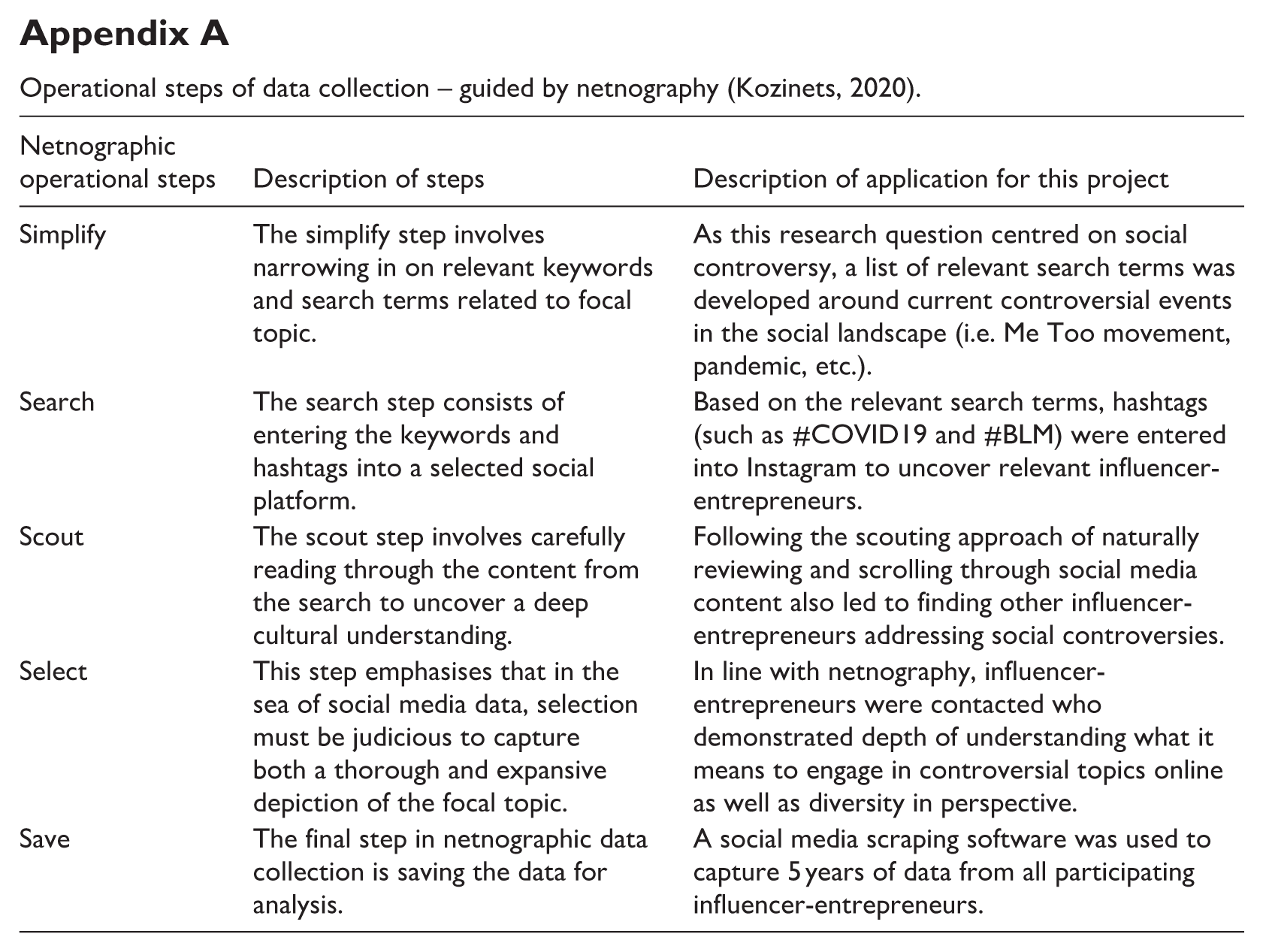
In order to examine how influencer-entrepreneurs manage identity tensions in times of controversy, we embedded our research design in an ontological interpretative perspective, which aligns with our research question and recognises the fluid and performative nature of identity work. Thus, a qualitative research design was selected to understand the experiences of the influencer-entrepreneurs. The research design consisted of two data collection methods, netnography (Kozinets, 2015) in conjunction with in-depth interviews. In-depth interviews allowed influencer-entrepreneurs to share their experience in times of controversy and on their daily reality (Spörl-Wang et al., 2025). As the focus of this project is on the identity work of influencer entrepreneurs who build and support their enterprises through social media, netnography was selected as the guiding methodology for this study. Identity work is a dynamic process continuously reassembled through discourse (Brown, 2015), and as such the discourse influencer-entrepreneurs engage in on social media formed a key part of our data. Netnography is a novel methodology to the field of entrepreneurship, and an approach that unpacks rich and valuable insights from social media data (Jonsson and Roos, 2025). It is focused on the study of relevant online traces, and data collection through this methodology consists of three fundamental elements: investigation, interaction and immersion (Kozinets, 2020). The investigation element guided the selection and collection of data. Interaction refers to the active engagement with participants on social media; in this case, we actively interviewed the participants. Immersion reflects how quality and deep data are indexed and reflected upon through thoughtful examination of social media data. Data collection followed netnographic operational steps, see Appendix A for details.
Sample and data collection
We followed a purposive theoretical sampling approach, similar to other studies focused on a deeper understanding of influencer-entrepreneurs (Campana et al., 2021; Pemberton and Takhar, 2021; Stephens and Miller, 2024). Participants were recruited according to the following inclusion criteria: age (18+), location (Canada and USA), language (English or French) and engaged in a controversial conversation on their social media platforms. We created a database of influencer-entrepreneurs who posted hashtags relevant to social controversy (i.e. #COVID19, #BLM), and participants who fit the aforementioned inclusion criteria were invited to participate in the study. Influencers who did not meet the inclusion criteria, such as those who did not post about social controversy, were not invited to participate in the study. The divisive topics discussed by participants in this study included: the BLM movement, COVID-19, US–Mexico border crossing, political elections, ideological tensions surrounding gender roles and climate change crisis. The influencer-entrepreneurs were contacted via direct messaging on Instagram by the researchers and asked for interviews. Influencer-entrepreneurs provided informed consent to participate in the study. We focused on Instagram because the majority of influencer marketing spending takes place on this social media platform (Kendall, 2025). In addition, Instagram, the image-centric social network, is the strategic self-promotion tool of influencers (Jin and Ryu, 2019).
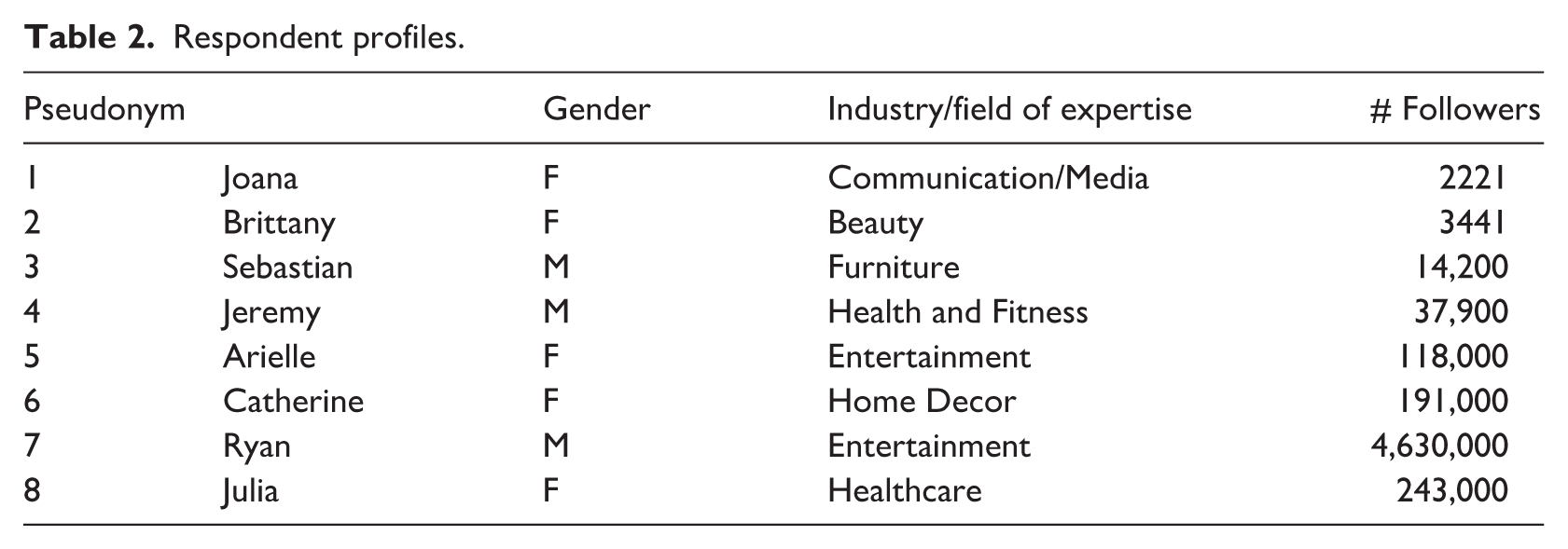
The sample consisted of five women and three men, from different ages, follower numbers and representing a range of industries (e.g. fitness, entertainment, beauty, etc.). The sample shared a variety of similarities, including their influencer status, an audience size over 1,000, experience as a public figure and receiving online comments. Moreover, each of the members of the sample had the shared experience of navigating the decision to engage in a controversial conversation, as well as the consequential implications of that decision. Table 2 presents the profile of the participants.
Respondent profiles.
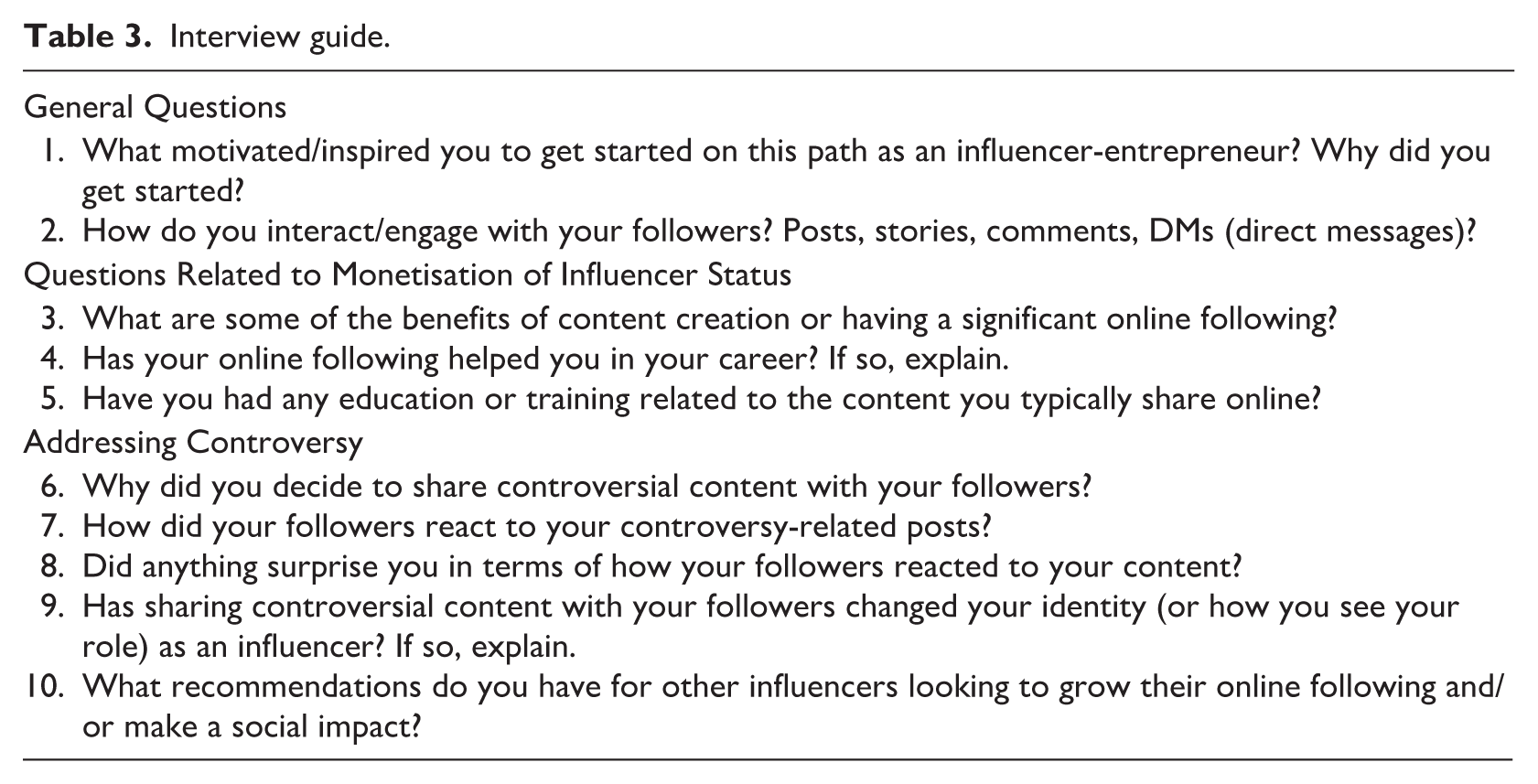
The interviews were between 30 and 60 minutes in length, they were audio recorded and transcribed for thematic analysis (Joffe, 2011). We followed an interview grid comprising questions taken from the literature on entrepreneurial identity, social media and digital entrepreneurship. Table 3 presents the interview guide. The questions were open-ended to foster an in-depth understanding of the perceptions of influencer-entrepreneurs. The interviews began with questions about their beginnings as an influencer-entrepreneur and monetisation of their influencer status. Next, we asked about motivations for posting about controversial issues, such as BLM and COVID-19, with followers and repercussions on influencer-entrepreneur identity due to engaging in controversial topics.
Interview guide.
While interviews provided insights on influencer-entrepreneur motivations, internal struggles and practices, netnography allowed us to assess the externally facing elements of identity work in relation to their audiences (Kozinets, 2015). We adopted a form of netnography known as ‘hanging out’ (as opposed to ‘lurking’ 1 ). With this approach, researchers engaged interactively not only through passive observation, but also directly, and naturally, engaging with the content, through comments, likes and direct messages (Jeffrey et al., 2021; Kozinets et al., 2014). We used social media scraping software to systematically collect all influencer Instagram posts over a five year period (February 2020 to January 2025), as well as follower interactions. During this timeframe, a number of controversies had taken place, including: the BLM movement, the COVID-19 pandemic, the Mexico–US border crisis, among others. More than 3691 posts were analysed. This corresponds to the average Instagram activity of influencers (Thomas, 2023). Finally, thanks to the hanging out posture adopted, the researchers focused on the posts and reels published by the participants and kept an immersion journal of observations of participant tone and expressions of the influencer-entrepreneurs under study (Kozinets, 2020).
Data analysis
The data was analysed by two researchers who coded the responses separately and proposed labels to indicate which factors represent the influencer-entrepreneur’s perception of their identity during a controversial period. The codes were then discussed over several rounds with a third researcher until the researchers considered that sufficient depth and theoretical saturation had been reached. The coding was done manually by the researchers via Excel (Le and Aydin, 2022). For the analysis of the interviews, we adopted the approach proposed by Gioia (2021), following a systematic methodology that balances informant-centred insights – first-order concepts – with theoretical abstraction through the development of second-order themes. This iterative process alternated between analysing empirical data and engaging with the existing literature (Strauss and Corbin, 1998). This allowed us to develop constructs deeply rooted in participants experiences while establishing meaningful connections to broader theoretical discussions.
As codes emerged from the interviews, coders systematically compared and refined them to uncover patterns and relationships (Corbin and Strauss, 2014). Subsequently, we synthesised these insights into aggregate dimensions, derived from the development of first- and second-order themes. In addition to analysing interviews, we examined the social media posts of our participants including images, videos and texts. This multimodal analysis contributed to a ‘multiplication of meaning’ (Lemke, 1998), enriching our understanding of the participant narratives and their contextual significance. By combining these approaches, we ensured that informant voices were prioritised while allowing for the theoretical abstractions necessary to develop credible and revelatory insights (Gioia et al., 2013; Magnani and Gioia, 2023).
Findings
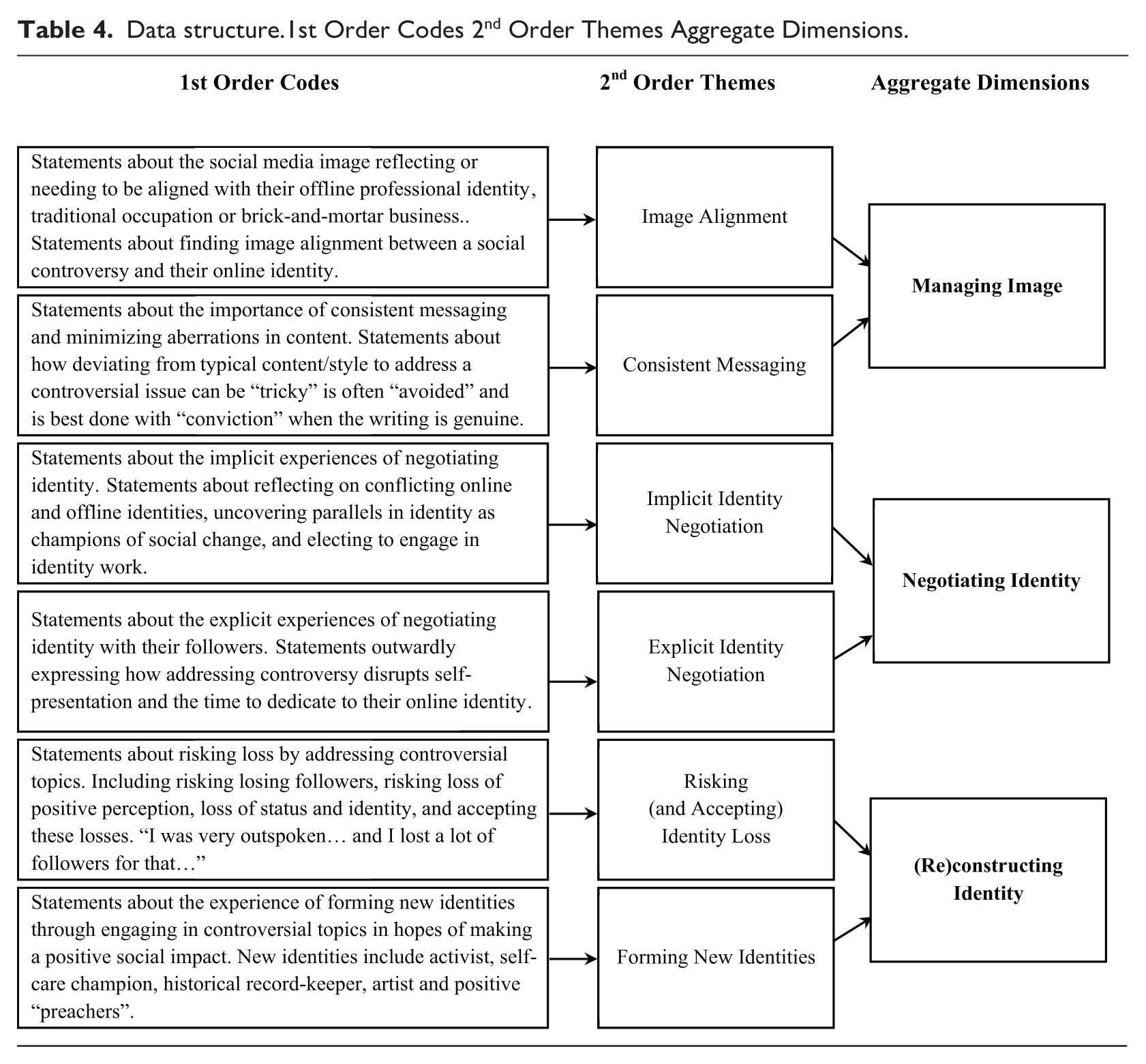
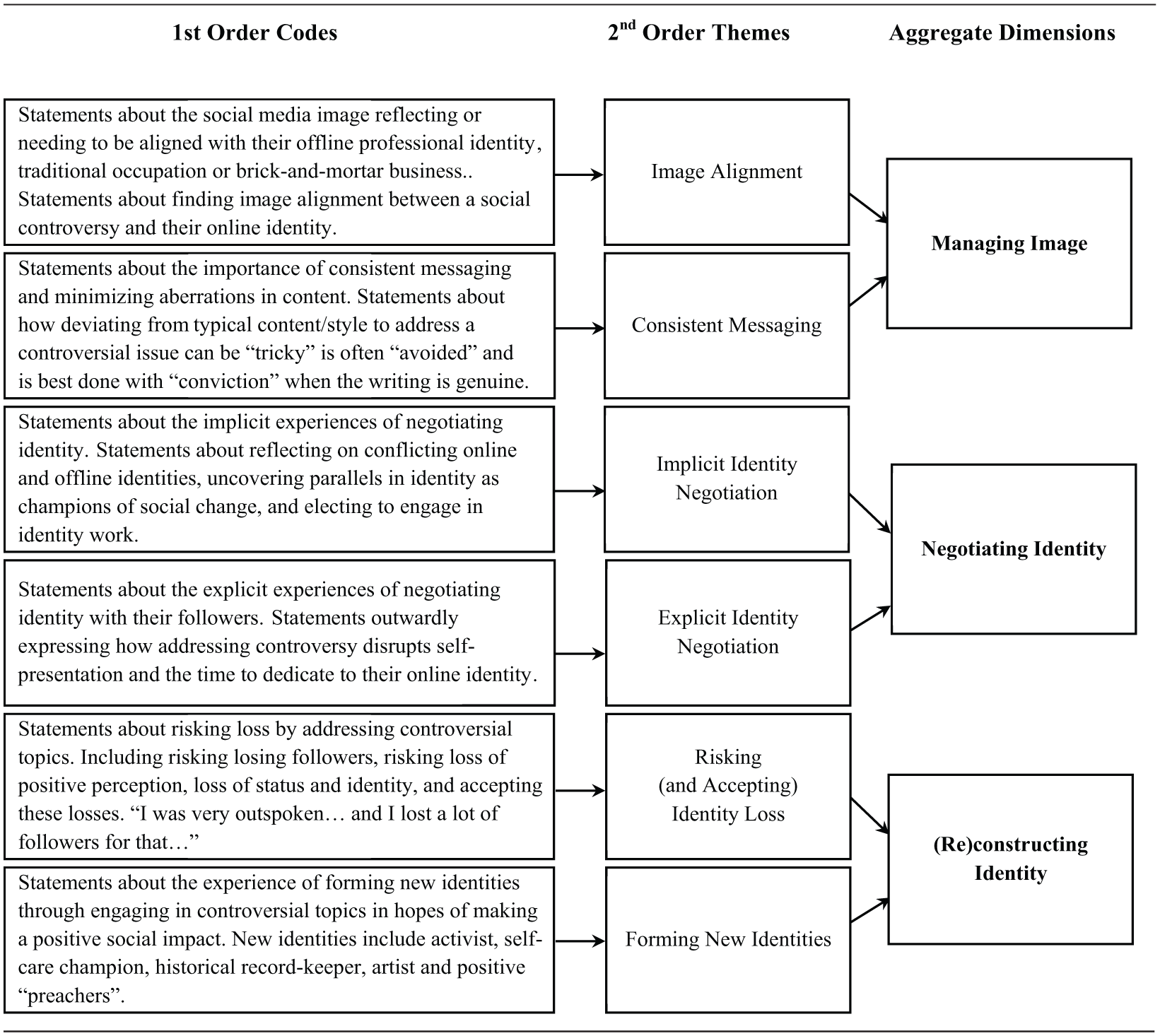
Our findings are grouped into three interrelated identity work processes – aggregate dimensions – which emerged from the data: managing image, negotiating identity and (re)constructing identity, which we discuss next. When an influencer-entrepreneur addresses a social controversy online, it becomes an aberration in their content and conjures identity tensions. Research suggests that internal identity coherence is desirable (Ibarra and Petriglieri, 2010), and participants reported that deviating away from their typical content consequently created tensions, which led to identity work. Moreover, participants shared that the perceived need for managing their image was the reason why they experienced these identity tensions; whereas the other two dimensions that emerged from the findings reflect how the influencer-entrepreneurs respond to these tensions in identity, through identity negotiation and construction. The literature contends that internal and external identity are inextricably linked (Watson, 2009), thus both play a role in identity tensions and the influencer-entrepreneur’s process of identity work. The three interrelated identity work processes of managing image, negotiating identity and (re)constructing identity will be discussed below. Table 4 presents the data structure, which demonstrates the emergence of the aggregate dimensions from the data.
Data structure.1st Order Codes 2nd Order Themes Aggregate Dimensions.
Managing image
One of the aggregate dimensions that emerged from the study was managing image, as influencer-entrepreneurs explained that posting about social controversy was the reason why they experienced identity tensions. Image curation is central to an influencer-entrepreneur building and maintaining their social media following. Managing one’s image is a focal point in shaping their human brand (Argyris et al., 2020), and a core mechanism of entrepreneurial identity work (Sveningsson and Alvesson, 2003; Watson, 2009). Digital platforms require influencer-entrepreneurs to continuously perform and negotiate multiple selves, moulded by their audience, business goals and the expectations embedded in their social and cultural context. In line with Goffman’s (1959) impression management, influencer-entrepreneurs craft idealised personas. However, in digital contexts, this dramaturgical performance is intensified by algorithmic visibility and the persistence of identity traces across platforms (Stephens and Miller, 2024). Managing their image is thus, a crucial component of identity work and amplified by controversial social situations as they increase tensions between the projected, platform-optimised persona and the influencer-entrepreneur’s internal sense of self (Goffman, 1959). The tension reported around managing their image was expressed by the felt need for image alignment and consistent messaging, which we discuss next.
Image alignment
Influencer-entrepreneurs reported feeling the need to align their online and offline identities. A key strategy of entrepreneurial identity work consists of aligning one’s digital image with offline identity and values. Alignment has been seen to foster credibility, coherence and trust among audiences (Watson, 2009). However, during times of controversy, the alignment between personal values, audience expectations and entrepreneurial positioning becomes strained, triggering deeper identity reflection (Hanek et al., 2025). When operating under the status quo, the influencer-entrepreneur may develop a recipe type approach for managing image alignment, in which they can work towards balancing personal values and their projected image. However, this is disrupted by events and social controversies, which can lead to tension or disequilibrium. In an interview, a participant shared the difficulty she experienced in creating content amid the COVID-19 pandemic, debating whether to address the topic directly, as well as how/if she could promote her business during this challenging time. She expressed, I knew that I wanted to show empathy, and I didn’t want to use my platform to be like ‘buy products and buy gift cards for when you can use them’, instead I wanted to really relate to how they were feeling and let them know that if they need to chat, I’m here.
In other words, it was hard for her to align the image she had curated as an influencer-entrepreneur within the changing external landscape. The social controversy upset the balance of how she could weave together content that aligned her personal values and projected image for her audience.
The tensions around image alignment also emerged upon consideration of why so many influencer-entrepreneurs do not address social controversies at all, instead electing to remain silent. Joana reflected on this and articulated, ‘I think that is why some people go quiet because they don’t have conviction or they don’t feel comfortable saying “I don’t really know how I feel about [xyz]”’. This quote demonstrates the vastness of identity work in managing image, as there is not always certainty in values or how one feels about a contentious issue.
Relatedly, in an interview, a participant shared, ‘I feel like [it] was a touchy subject and people didn’t know how to approach it, which made it tricky, so they avoided it. It was an elephant in the room, so everyone avoided it’. This is in line with literature which has shown that it is particularly risky for the influencers to speak about a controversial topic, as it can potentially tarnish their commercial image (Arriagada and Bishop, 2021). As such, choosing to engage with posts about controversies, influencer-entrepreneurs had to carefully position themselves and deal with the tensions this brings to their self-presentation and projected identity.
This illustrates how influencer-entrepreneurs must engage in identity work not only to adapt to situational pressures but also to maintain a coherent self-narrative that resonates with their community (Stephens and Miller, 2024; Sveningsson and Alvesson, 2003). In some cases, controversial circumstances were inherently aligned with the influencer-entrepreneur’s online image. For example, as a gym owner who faced restrictions and gym closures during the pandemic, Jeremy’s approach exemplifies how controversial or disruptive events may reinforce alignment, when the influencer-entrepreneur’s personal values and digital persona converge around a shared narrative of resilience and purpose. On Instagram he posted, Happiness is a CHOICE. Being positive is a CHOICE! Both of my gyms . . . are closed, with ZERO revenue since I don’t have recurring payments, and I CHOOSE to be positive and happy!. . . I have built these gyms from scratch there is no way I will let them fall. . .
This creative reframing enabled him to reassert a coherent narrative identity that reaffirmed his entrepreneurial spirit, personal values and the ethos of his gym, maintaining a consistent messaging strategy, and continuing to engage and nurture followers. This is a key strategy of identity work in fragmented contexts (Sveningsson and Alvesson, 2003; Stephens and Miller, 2024).
In a related example, another participant had considered taking a sabbatical but instead decided to create a comedy rap video about a social controversy, which led to viral success. Thus, by leaning into the contentious conversation, his online following grew substantially and extended beyond his digital platform, strengthening his offline professional identity. This suggests that leaning into controversy can act as a catalyst for rearticulating a meaningful entrepreneurial identity, especially when the influencer-entrepreneur reclaims authorship over the narrative (Watson, 2009; Hanek et al., 2025). This illustrates how, for influencer-entrepreneurs, controversial moments can serve as ‘inflection points’ for rearticulating a narrative of entrepreneurial authenticity (Stephens and Miller, 2024; Watson, 2009). In both cases, identity alignment is not static but reflexive; it is a negotiated outcome of discursive positioning, audience feedback and strategic adaptation (Essers et al., 2025).
Consistent messaging
For influencer-entrepreneurs, the tensions in managing their image stem not only from image alignment between their values and their projected self but also from the felt need to portray a consistent message to their audience. Maintaining message congruence is crucial, as abrupt shifts in content can be perceived as inauthentic and ultimately harmful to their perceived legitimacy. For example, Joana explained, ‘I’m trying to think of what I should do next with my content. I always like to try something new, so I don’t stick to one thing for very long, which is probably to my detriment’. This is supported by past research: followers expect the influencer-entrepreneur to be true to themselves, which requires a consistent content strategy, as sudden changes are not welcome (Meg Lee and Blasco-Arcas, 2020). Influencer-entrepreneurs generate their following by posting a narrow range of niche content, therefore, posting about controversial topics expands the boundaries of their established personal brand and typical content expectations. Consequently, electing to share posts on such topics, they are risking their image due not only to the controversial nature of the topic but also through the added inconsistency of their image as an influencer-entrepreneur. This highlights the tension between the consistency, expected by audiences and platforms and the experimentation, required for creativity and adaptation: a central dilemma in identity work (Hanek et al., 2025; Watson, 2009).
Engaging in identity work, Joana explained how she has been able to deviate from her typical messaging in order to address contentious topics online, ‘To make a social impact, I think the most important thing is actually having something that you have conviction about so that you can speak about it consistently and engage your followers in a natural way’. This aligns with research showing that identity performances grounded in strong values can enhance perceived authenticity, even amid content change (Essers et al., 2025; Stephens and Miller, 2024).
Relatedly, another participant shared a post that deviated from their typical messaging in order to support a social cause. Despite being an aberration from their typical online content, the participant shared the following post on Instagram, For far too long, Black women’s voices have gone unheard, even though they’ve been using their voices loudly for centuries to enact change. Today, more than ever, it is NECESSARY that we create a unifying action to centre Black women’s lives, stories, and calls to action. We need to listen to Black women. This is why we have chosen to #ShareTheMicNow.
This social media post demonstrates that despite a stark change in content, deliberate identity work along with a clear conviction provides a genuine tone of voice which may ameliorate concerns of inconsistency of content. In such cases, the articulation of purpose becomes a stabilising force in entrepreneurial identity (Watson, 2009). As managing image is critical to the continuity and growth of an influencer-entrepreneur’s following, it is vital to consider how to preserve content consistency while maintaining perceived authenticity across diverse topics.
Negotiating identities
Influencer-entrepreneurs are continually negotiating identities as they curate their online presence during controversial moments. These identity tensions are shaped by implicit and explicit constraints such as competing demands between personal beliefs, business objectives and audience expectations. This section explores how influencer-entrepreneurs negotiate these tensions through both implicit and explicit identity work (Sveningsson and Alvesson, 2003; Watson, 2009), often marked by moments of self-doubt and self-openness.
Implicit identity negotiation
Implicit identity negotiation appeared in participants’ internal reflections and emotional struggles about whether or how to speak out, revealing tensions between guarding their entrepreneurial projects and posting content aligned with their values. A participant explained: ‘I probably would still comment [on the pandemic] if I wasn’t an influencer. . . because I am a nurse’. Notably, the pandemic was not the only contentious conversation at the forefront of social media in the early 2020s. The participant added, ‘because I am a nurse, I would comment on the pandemic anyways, but for me, Black Lives Matter isn’t nursing related, so “I don’t have to” comment on that, but it is something that as I have a large following, I felt like I should comment on’. The participant suggested that private identity commitments (e.g. as a healthcare worker) can conflict with perceptions of professional risk. This reflects the multiplicity and inherent tensions among the various identities that individuals inhabit, particularly in public-facing entrepreneurial roles (Brown, 2015). This is consistent with Mmbaga et al. (2020), as they contend that identity work often involves reconciling incongruent roles across private and public domains. Such moments illustrate the influencer-entrepreneur’s efforts to preserve a coherent self in contexts of uncertainty, while managing the risk of alienating parts of their audience or compromising commercial goals. This reflects classic entrepreneurial identity tension between personal values and market orientation (Essers et al., 2025; Watson, 2009).
In other cases, influencer-entrepreneurs tried to balance their own discomfort with silence and their desire to avoid conflict. One participant mentioned that to avoid any misunderstanding, he will not discuss anything related to politics or take sides on what he believes. He said, ‘I took myself out of the game. I said bye’. In other cases, expressions of vulnerability suggest that self-openness may serve as a coping mechanism to reduce the psychological strain of silence. Such negotiation is often implicit and internal, aligned with Hanek et al. (2025), who describe the backstage emotional labour required to preserve a sense of self amid controversy. This supports the idea that identity work is not purely rational or strategic, but deeply emotional and political, especially in contexts where individuals must legitimise themselves within dominant norms (Heizmann and Liu, 2022).
As life unfolds for influencer-entrepreneurs, they also implicitly negotiate how vulnerable to be with their followers about their changing identity in the context of social controversies. For example, Arielle grew up and came into adulthood under the public eye, and she is now seen by many as a role model on social media. Despite societal pressures to conform and align with externally imposed expectations of weight and overall appearance, she has shared every version of herself openly, which has drawn disparaging comments online, and reflects the ideological tensions surrounding gender roles and the double standards of female beauty. Such sustained, longitudinal identity work exemplifies how identity is a temporally unfolding narrative, told both to oneself and to others (Brown, 2015). Remaining true to herself, she has implicitly decided not to hide these experiences and is now promoting her documentary podcast on body image. One of her posts mentions, ‘This project is me in all my honesty and vulnerability, it’s a little secret baby that has been growing inside me for a year and that now exists for everyone. . .’ This moment illustrates a form of identity work that resists external pressures while affirming one’s evolving self-narrative, in line with Watson’s (2009) view of entrepreneurial identity as a story told by the self and to the self.
Explicit identity negotiation
Explicit identity work was observed when influencer-entrepreneurs made public decisions to justify their actions or reposition themselves. For instance, a participant posted, ‘And you’ll forgive me if I’m not blogging and YouTubing as much . . . right?’ This statement reflects a discursive repositioning of the self in relation to reduced productivity, perhaps signalling an attempt to manage expectations of their followers during hardship. As shown in Essers et al. (2025), such discursive identity acts are crucial for restoring legitimacy when normative expectations are in flux.
As another example of how negotiation is explicit, a participant overtly thanked her followers, ‘I wanted to say thanks to you all [my followers] . . . without you this little business of mine wouldn’t be here. So, thank you’. This kind of direct engagement reinforces relational identity work by acknowledging the co-construction of the influencer-entrepreneur’s legitimacy with their audience. It reflects how influencer-entrepreneurs publicly manage gratitude and dependence without undermining authority, a fine balance essential for maintaining a desire for authenticity and continuity in times of uncertainty (Essers et al., 2025; Watson, 2009). Another influencer-entrepreneur shared this in a moment of visible uncertainty, Been a while since I posted on Instagram because I’m trying to figure out— what do I actually want to say? What do I want to do? Feels like everyone is confident about what their niche is and what they add to the world, but not me.
This quote reveals a core identity tension: the desire to remain visible and relevant, while grappling with uncertainty about one’s value proposition and self-concept. Such moments of self-doubt prompt deeper reflection about one’s entrepreneurial direction and identity legitimacy, highlighting the iterative and uncertain nature of identity construction in digital spaces (Hanek et al., 2025; Watson, 2009).
Another clear example of explicit identity negotiation came from a participant reflecting on the professional consequences of their social media presence. For instance, when discussing posting about controversial topics, a participant shared during an interview, ‘If I wanted to go higher up in my [offline] career, I would probably have to post less on social media’. This quote reveals an identity tension between online visibility and offline advancement. It illustrates how influencer-entrepreneurs must strategically manage the boundaries between personal branding and institutional expectations – a negotiation at the heart of entrepreneurial identity work (Essers et al., 2025; Watson, 2009). This emotional dissonance was echoed by another influencer-entrepreneur who posted, The truth this week: my house is a mess, I’ve had a headache for a week straight, we’ve had sick kids, and I’m SO sick and tired of juggling everything & trying to manage motherhood, business, friendship, marriage during a p*n*emic. I love to keep this space inspiring & upbeat, but don’t forget that the internet isn’t ‘real life’. . . lots goes on behind the scenes. . .
This public disclosure of exhaustion and overwhelm reflects self-openness as a form of resistance to the constant performance of positivity and productivity. It highlights how influencer-entrepreneurs explicitly navigate identity tensions by selectively revealing vulnerability to maintain an image of authenticity without undermining their personal brand. Such narrative management of emotional contradictions is consistent with identity work in fragmented, high-pressure environments (Hanek et al., 2025; Sveningsson and Alvesson, 2003).
In sum, influencer-entrepreneurs navigate identity tensions during times of controversy through intertwined practices of implicit and explicit identity negotiation, often involving emotional strain, strategic silence and moments of reflexive self-positioning. Rather than resolving these tensions, identity work enables them to live with and adapt to these contradictions (Sveningsson and Alvesson, 2003), sometimes reinforcing their role as public-facing entrepreneurs that monetise their public image (Hanek et al., 2025; Stephens and Miller, 2024).
(Re)constructing identity
In electing to post about controversial topics on social media, influencer-entrepreneurs reported experiencing reconstructing identity through risking, and accepting, identity loss and forming and publicly displaying new identities. This theme of reconstructing identity is echoed in the literature. Sveningsson and Alvesson (2003) depict identity as frequently in movement with fragmentation and integration and describe identity work as on-going (Heizmann and Liu, 2022). Moreover, specific events or transition moments are ‘identity inflection points’ where deep identity work is triggered (Sveningsson and Alvesson, 2003; Watson, 2009). Thus, social controversies can act as a catalyst for influencer-entrepreneurs to not only confront risking identity loss but also ignite the formation of new identities altogether.
Risking (and accepting) identity loss
Influencer-entrepreneurs carefully curate the content they post with their followers, continually making decisions about what and how to share content online. This continual and deliberate curation of self-projection is in line with prior notions describing digital identity as fluid, evolving with platforms, algorithms and social dynamics (Hanek et al., 2025). Indeed, identity construction is best understood as ongoing, fragmented and sometimes contradictory, rather than as a stable essence (Brown, 2015; Sveningsson and Alvesson, 2003). Extant literature has focused on how identity work is necessary and beneficial, but there have also been calls for research on the costs or dis-benefits associated with identity work (Brown, 2015).
When addressing controversial topics on social media, influencer-entrepreneurs experienced some of these costs, sharing how this decision was paired with risking loss of followers and positive perception and receiving more negative comments and accepting those losses. This is a departure from the literature, in that entrepreneurs have been seen to seek out social validation from their communities, as there is value in stakeholder relationships (Vershinina et al., 2020). In a digital enterprise, the value of social acceptance is clearly marked, as an influencer-entrepreneur’s number of followers signals their status as an influencer, and even dictates their level of monetisation; thus, their following quantifies and qualifies their identity online. Digital identity construction has been described as vital for the accumulation of online capital, virtual resources and stakeholder relationships (Shaheer et al., 2024). Participants reported risking a loss of followers due to publicly addressing controversial topics on social media. For example, in an interview, a participant shared, ‘I was very outspoken for Black Lives Matter, and I lost a lot of followers for that. . .’ In addition to influencer-entrepreneurs reporting a direct loss of followers, they also shared sentiments about coming to terms with or accepting a decline in following. Another participant shared in an interview, ‘I don’t care if you do not like it, just unfollow me’. In another vein, a different participant reflected in an interview on the various types of followers, weighing the impact of a reduced follower count. ‘I remind myself that I can have a hundred followers that are loyal clients, or I can have a thousand followers and have none of them come to me’. By engaging in controversial conversations, influencer-entrepreneurs needed to consider loss of followers as they are subject to the ‘straightjacketing’ of market norms (Ashman et al., 2018), and the monetisation of their digital venture is rooted in the size of their audience. Identity is shaped within a social context (Adeeko and Treanor, 2022). Defying societal expectations means facing a reduction in social approval and a loss of identity within one’s social sphere.
The risk of loss extended beyond the number of followers, as participants also reported experiencing negative comments in response to their choice in engaging in controversial topics. Many participants, particularly those with smaller followings, reported generally experiencing a positive online sentiment in their community and discussed how posting about controversial topics risked that positive sentiment. For example, in an interview a participant shared, ‘there were about 20% people that [shared negative comments on those controversial posts]’. In addition to a higher volume of negative comments, when posting about pandemic health recommendations, a participant shared an example of some of the negative phrasing, ‘some people were telling me that they were upset that I was being “bought” by the government’. This is in line with the notion that the process of identity work is generally emotionally charged and social (Brown, 2015). Furthermore, Brown contends that identity work, both opportunities and resources, is restricted for some individuals due to their organisational status; they are thus, less able to freely customise an individuated self. In this context, the influencer-entrepreneurs manoeuvred identity work amid the constraints of public perception.
While many participants reported risking these costs, or identity losses, they also accepted them, and engaged in the controversial conversations despite these risks. For example, another participant shared, ‘I just say what I have to say . . . and then whatever anyone else’s opinion is, is fine’. Likewise, another participant shared, ‘I speak my mind a lot about current issues and social justice things so they [followers] will interact with that a lot either to say that they disagree or to say that they agree with me’. Losing followers and positive online sentiment were risks the participants in this study accepted. This process of loss and acceptance demonstrates how this identity reconstruction is both dynamic and transformative.
Forming and publicly displaying new identities
Engaging in controversial topics did not solely garner losses of identity for influencer-entrepreneurs, rather they also reported experiencing the formation of new identities. These novel identities stemmed from their aspirations of making a positive impact and presented in a myriad of forms including community activists, self-care champions, artists and record-keepers of history. These findings align with the literature as there is a propensity for growth and for individuals to work towards a positive self-transformation (Jiang et al., 2025). Many participants reported subtly or even entirely shifting the type of content they create on social media in how they formed new identities as they engaged in controversial topics.
In an interview, a participant shared how the COVID-19 closures limited her ability to post her typical content but also challenged her to create meaningful online discussions and even form new identities. Detailing how her identity as an influencer-entrepreneur evolved throughout the early 2020s, this participant shared, ‘The pandemic hit, and then literally everything I used to do, I couldn’t do, and then I thought, this is a very important time in our culture, and actually an exciting time in a way because it’s historical. . .. I’ve got to write this stuff down because it will be important one day’. In discussing her newfound identity as a historical record-keeper, she added, ‘It has really helped me break out of my professional box that I always put myself in and I explored and was more creative and adventurous’. By leaning into rather than avoiding controversial content, this influencer-entrepreneur embraced a new identity and shifted to an entirely new genre of content creation. This demonstrates how risking change and engaging in fragmentation and integration to achieve and project a new external identity can have positive outcomes as it relates to feelings of growth and fulfilment (Jiang et al., 2025).
Forming new identities is not without its challenges, as existing and newly formed identities can be in conflict and create identity tensions (Jiang et al., 2025). Several influencer-entrepreneurs in this study engaged in an assortment of difficult conversations online, navigating the addition of new identities in order to make an impact as activists. For example, politics is a divisive topic that is often sidestepped by individuals online, however, a participant in this study decided to reveal her political affiliations to encourage her followers to vote during a polarising election. While concealing political ideologies is commonplace to prevent backlash, identity tensions, or other unintended consequences, this participant took a risk to embrace a new identity as an activist to promote what she believes would help build a better society.
I voted for [name of the political party]. I voted for the most ambitious plan to fight climate change. I voted for the party that proposes the most measures to reduce inequalities. [. . .] Go vote early now, there are still a few hours left! . . . It’s really time to change eras, gang.
Some participants abandoned the way they usually project their personal identity to address controversial situations with their followers, straying from their typical content/style to becoming champions of change or positivity ‘preachers’. As an example, Ryan mentioned that: ‘Millennials will care about something that advances the cause like BLM or let’s be green and save the earth’. These are not his usual subjects, but he believes that his voice can make a difference to his audience. As another example of taking on a role as a champion of social change, a participant shared a post raising awareness for International Women’s Day.
I would first like to reiterate my admiration for the women who fought for the rights I enjoy today. Let’s continue these struggles, which are many and varied, including: the decriminalisation of sex work, the sovereignty of Indigenous peoples, climate justice, pay equity, the abolition of the prison system, violence against women, bodily autonomy, fatphobia, access to education, and more. Let us not forget that these struggles can be compounded by different facets of oppression.
In another example of forming a new identity to approach a controversial conversation, a participant took on a poet/artist identity as she delicately shared a post about the divisive US–Mexico border wall.
The divide between two destinies. On the left, legend has it, lies a bounty of opportunity. It’s the place where dreams come true. The milk and honey on the other side. It’s not for me to say whether the legends are true, but for those on the right side of this great divide it’s worth the most treacherous of adventures to find out.
This post showcases how influencer-entrepreneurs may reflect through their writing and even take on new artistic and pro-social identities. In a society in which there are big opinions about politics, vaccinations, global conflict and a plethora of other topics, influencer-entrepreneurs can choose to avoid the dark side altogether and focus their content creation solely on lighter and safer topic areas, or to take a stance and evolve their digital identity.
The influencer-entrepreneurs reported that addressing social controversies sparked the need to reconstruct their identity through risking identity loss and forming new identities. In other words, their decision to shift their content disrupted their homeostasis, and they entered a state of flux. McAdams (1993) notably suggests that identity work can serve as a buffer from the pressures of the external world, shielding one from the fragmentation of identity. Thus, this study builds on and contributes to the literature by illuminating how influencer-entrepreneurs navigated addressing social controversy through identity work, by processing the loss of identity and championing new identities altogether.
Entrepreneurs on social media are expected to reinvent themselves to support their business either due to changes in their lifestyle or in response to shifting needs of followers (Stephens and Miller, 2024). This process of reconstruction has been described as emotional, and the management of the emotional experience is still underdeveloped (Jiang et al., 2025; Maitlis, 2011; Winkler, 2018). The influencer-entrepreneurs in the study risked a variety of losses in order to reconstruct their digital identity.
Internal and externally focused identity work elements of influencer-entrepreneurs
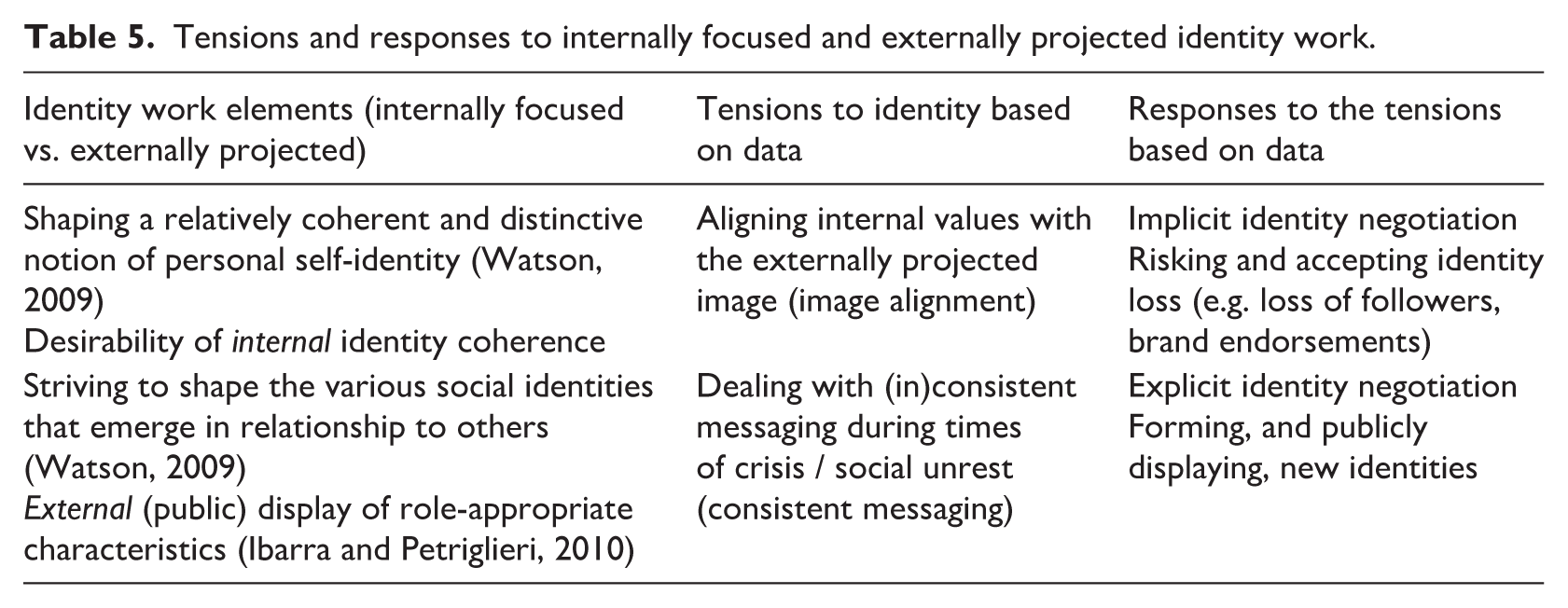
The evidence presented reflects theories on identity work (Ibarra and Petriglieri, 2010; Watson, 2009), as the influencer-entrepreneurs experienced both internally focused and externally projected identity work elements. On one hand, participants reported the desire for a personal self-identity that is internally coherent (Watson, 2009), whereas on the other, participants also described a desire to align with social identities shaped from relationships and the need to adhere to role-appropriate characteristics (Ibarra and Petriglieri, 2010; Watson, 2009). The literature contends that internal and external identity are linked and mutually constitutive (Watson, 2009), and the distinction between the internal and external is solely for purposes of analysis (Jenkins, 1996; Watson, 2008). In this line, these findings can be analysed into internal and external identity work elements, as seen in Table 5. Participants reported internally focused identity work related to managing tensions around image alignment, and they responded to those tensions through implicit identity negotiation and through risking, and accepting, identity loss. Those processes of internally coming to terms with risk and loss were a hallmark of continuous and conscious identity work aimed at alignment with their values and perceived self-concept. Moreover, participants shared their experience navigating externally projected identity work elements due to tensions around consistent messaging. In response, the influencer-entrepreneurs engaged in explicit identity negotiation and forming, and publicly displaying, new identities. This externally focused identity work was seen as necessary to maintain their image as an influencer-entrepreneur during times of social controversies while simultaneously maintaining a sense of purpose and being true to oneself.
Tensions and responses to internally focused and externally projected identity work.
Discussion
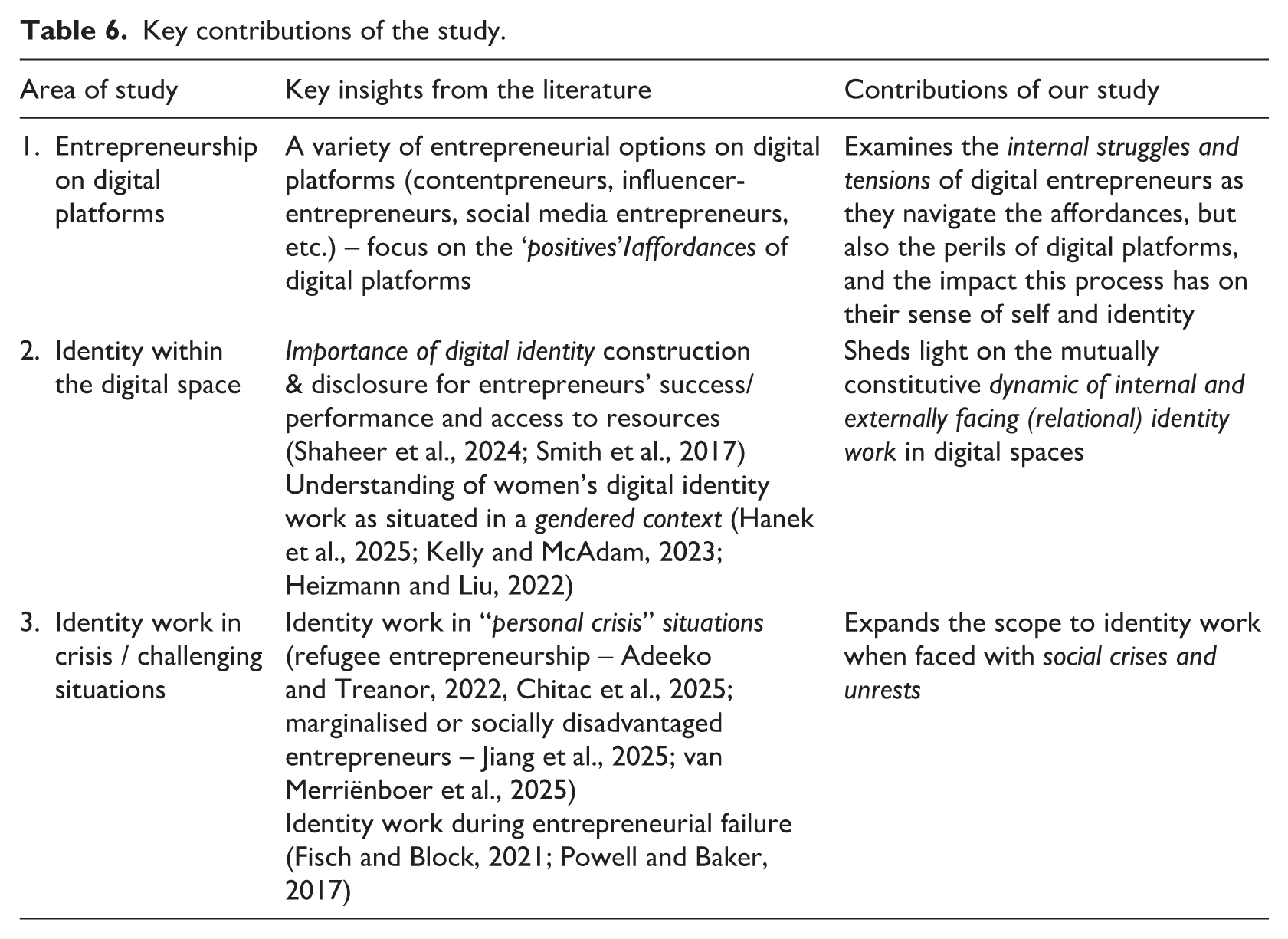
In this study, we set out to examine how influencer-entrepreneurs navigate identity tensions during times of social controversies. As digital entrepreneurs whose performance is intricately linked to their projected identity online, influencer-entrepreneurs are subject to continuous identity work which manifests even more strongly when the expectations of the market norms clash with the struggle of being true to oneself in times of social unrest. Our findings point to the importance of attending to the entrepreneurial process of positioning and repositioning a human brand, while maintaining a human struggle of identity construction in an industry that imposes neoliberal measures of success based on the currency of attention (Khamis et al., 2017). The study offers three key contributions to the literature, which we discuss below (see also Table 6 for a summary).
Key contributions of the study.
Entrepreneurship on digital platforms
First, we contribute to the digital entrepreneurship literature by bringing to light the little-explored tensions and contradictions inherent in the labour of platform-dependent digital entrepreneurs. While the digital entrepreneurship literature provides numerous examples of how the affordances of digital technologies can aid entrepreneurs and present democratising opportunities for them (McAdam et al., 2020; Schou and Adarkwah, 2024; Ughetto et al., 2020), the internal world of the entrepreneur as it is affected by digital processes remains underexplored. Scholars discuss a variety of entrepreneurial options on digital platforms heralding their affordances, access to resources and networks, and the resulting entrepreneurial opportunities (e.g. contentpreneurs who monetise digital content – Johnson et al., 2022; leisure-based digital entrepreneurship – Cutolo and Grimaldi (2023); entrepreneurial journeys of social media entrepreneurs – Stephens and Miller, 2024).
While understanding the use of digital affordances by entrepreneurs is important (Nambisan et al., 2017), it is equally crucial to unpack how the process of using digital affordances influences an entrepreneurs’s sense of self, and the internal struggles of influencer-entrepreneurs as they navigate the affordances, but also the perils of digital platforms. By going beyond the accepted positives of digital platforms, our findings help explain why influencer-entrepreneurs felt compelled to engage in controversial social topics and identity shifts online, even at the detriment of their market performance; for example, knowing that engaging in controversial topics will lead to fewer followers and so, fewer brand endorsements. We also illuminate how influencer-entrepreneurs contest the ‘straightjacketing of the market norms’ by prioritising their internal and coherent sense of self and a broader human identity that departs from a pure marketisation-of-my-private-life logic. As such, we open new avenues for research that looks not only at how projected identities can secure access to resources/entrepreneurial success, but also how entrepreneurs may be willing to forgo such resources in order to maintain a coherent sense of self and align their internal and external image.
Identity within the digital space
Second, our study offers contributions to the emerging literature on digital identity. We heed the call for more research to acknowledge the importance of operating in digital contexts and its impact on entrepreneurial identity (Mmbaga et al., 2020). Extant research demonstrates how digital identities affect access to resources and entrepreneurial success (Shaheer et al., 2024; Smith et al., 2017) and also examines how the digital identity of women entrepreneurs is situated in a gendered context (Hanek et al., 2025; Heizmann and Liu, 2022; Kelly and McAdam, 2023). Building on identity work and the notion of aligning internal self-coherence and public display of socially shaped identities (Ibarra and Petriglieri, 2010; Watson, 2009), our findings advance this literature by unravelling the mutually constitutive dynamic of internal and externally facing, relational, identity work in digital spaces. Identity work is a core aspect of the success of influencer-entrepreneurs, who are heavily dependent on their digital identities. We illuminate the mechanisms of identity work during times of controversy through internal self-identity work such as implicit identity negotiation, accepting identity loss and externally focused, relational aspects of identity work such as explicit identity negotiation, forming and displaying new identities. Those processes reflect intensive and deliberate identity work (Sveningsson and Alvesson, 2003) by our study participants, as they were engaging in a shifting ground of deciding what to post, coming to terms with the potential losses of those decisions, and (re)shaping their digital identities by taking on various roles – for example, activist, positive preacher. Understanding identity struggles and the mechanisms of digital identity (re)construction has critical implications for influencer-entrepreneurs as their market performance and entrepreneurial success is intricately connected to their projected digital identity (Fischer and Reuber, 2014; Smith and Smith, 2021).
Identity work in crisis situations
Our research on influencer-entrepreneurs identity work in times of controversy naturally extends the broader literature on entrepreneurial identity. Scholars call for more research which brings light to how the entrepreneur’s proximal environment and relationships affect identity shifts, especially in moments of crisis and uncertainty (Radu-Lefebvre et al., 2021). While current literature provides examples of responses to more proximal adversity such as entrepreneurial failure (Fisch and Block, 2021; Powell and Baker, 2017) or identity work in personal crisis situations (Adeeko and Treanor, 2022, Chitac et al. 2025) or by marginalised or socially disadvantaged entrepreneurs (Jiang et al. 2025; Van Merriënboer et al., 2025), global/social adversities have been left underexplored. By focusing on the identity work of influencer-entrepreneurs and tracing their engagement with controversial topics over a period of five years, our findings allow us to unpack their shifting identity construction during uncertain times, the struggle to stay true to an authentic self while managing an expected social image, and the consequences of this tension for the evolving identity of influencer-entrepreneurs. The notion that identity work is amplified in crisis situations is understandably relevant for a variety of entrepreneurs navigating broader social controversies, and it is not limited to influencer-entrepreneurs. The literature examines how entrepreneurs pivot in times of crisis (Manolova et al., 2020) but there remains a dearth of research on the process of identity work for entrepreneurs in these circumstances. In the modern entrepreneurship landscape, social media is ubiquitous with the majority of small businesses not only using these platforms but also reporting that social media creates a positive impact on their business (Verizon Business, 2025). Social media adds another layer to identity work in crisis situations. Influencer-entrepreneurs uniquely document a projected identity, and this context sheds light on how times of disruption or social controversy amplify identity work for entrepreneurs in the modern landscape. Entrepreneurs operating online and off may share similar experiences with navigating identity work during times of controversy; and thus, these insights may be valuable for a variety of entrepreneurs.
Conclusion, limitations and future research directions
This study provides valuable insights into the identity (re)construction and repositioning processes of influencer-entrepreneurs in times of social controversy. Drawing on identity work theory (Sveningsson and Alvesson, 2003; Watson, 2009), we understand identity not as a fixed or inherent trait, but as a dynamic, performed and negotiated process shaped through discourse, social interaction and platform affordances. By highlighting the negotiation of identity, the challenges of managing digital image and the evolution of entrepreneurial identity, our findings contribute to a deeper understanding of the intricate and ongoing identity work that influencer-entrepreneurs must navigate. Our findings highlight three interrelated identity processes: image management, negotiation and reconstruction, that illustrate the dynamic and situated nature of identity work among influencer-entrepreneurs during moments of social controversy. These processes reflect both internally-focused identity efforts, centred on maintaining a coherent sense of self, and externally oriented actions, driven by audience expectations and role alignment (Ibarra and Petriglieri, 2010). As noted by Watson (2009) and Jenkins (1996), internal and external identity dynamics are analytically distinct but mutually constitutive – a pattern confirmed in our empirical material. Our research underscores the significance of digital identity positioning and repositioning as a key entrepreneurial process, emphasising that success in digital entrepreneurship extends beyond economic capital to include strategic identity management and audience perception.
Despite these contributions, our study has limitations that open avenues for future research. First, our sample size was relatively limited, which may affect the generalisability of our findings. Moreover, all data were collected from Instagram, which constrains our analysis to the identity dynamics of a single platform. We did not focus on a specific domain or industry, which limits our ability to compare across entrepreneurial sectors. Future research could expand on this by including a broader range of influencer-entrepreneurs across different platforms and industries. Platforms such as TikTok, YouTube, Twitch, or Substack may involve distinct affordances, audience dynamics and content strategies that shape identity work in specific ways. Second, while our study incorporates in-depth interviews and netnographic methods, relying on publicly available digital content may still not fully capture the internal struggles or offline coping mechanisms employed by influencer-entrepreneurs. Future research could further explore these aspects through additional qualitative approaches or psychological assessments to deepen our understanding of these dynamics. For instance, diary methods, or multi-platform comparative approaches could also shed light on how identity work unfolds over time and across public/private boundaries. Furthermore, while our study highlights the impact of social controversies on identity (re)construction and repositioning, future research could explore how different types of controversies shape entrepreneurial identity through mechanisms such as shifts in audience expectations, reputational risks, changes in brand partnerships, or increased engagement in advocacy roles. It would also be valuable to examine how audiences perceive and respond to identity repositioning, and how such responses influence the perceived legitimacy, adaptability and sustainability of influencer-entrepreneurial ventures.
In conclusion, our study advances the understanding of entrepreneurial identity negotiation and (re)construction in digital spaces, particularly in moments of social controversy. By offering a situated, process-oriented perspective, it highlights the emotional and strategic labour required of influencer-entrepreneurs as they navigate tensions between personal values, public expectations and entrepreneurial viability. We encourage future research to build on these insights by exploring the interplay between platform logics, identity negotiation, repositioning strategies and audience reception across diverse entrepreneurial contexts. Such efforts will deepen our knowledge of digital entrepreneurship and its evolving challenges in an increasingly interconnected and socially responsive world.
Footnotes
Appendix
Operational steps of data collection – guided by netnography (Kozinets, 2020).
| Netnographic operational steps | Description of steps | Description of application for this project |
|---|---|---|
| Simplify | The simplify step involves narrowing in on relevant keywords and search terms related to focal topic. | As this research question centred on social controversy, a list of relevant search terms was developed around current controversial events in the social landscape (i.e. Me Too movement, pandemic, etc.). |
| Search | The search step consists of entering the keywords and hashtags into a selected social platform. | Based on the relevant search terms, hashtags (such as #COVID19 and #BLM) were entered into Instagram to uncover relevant influencer-entrepreneurs. |
| Scout | The scout step involves carefully reading through the content from the search to uncover a deep cultural understanding. | Following the scouting approach of naturally reviewing and scrolling through social media content also led to finding other influencer-entrepreneurs addressing social controversies. |
| Select | This step emphasises that in the sea of social media data, selection must be judicious to capture both a thorough and expansive depiction of the focal topic. | In line with netnography, influencer-entrepreneurs were contacted who demonstrated depth of understanding what it means to engage in controversial topics online as well as diversity in perspective. |
| Save | The final step in netnographic data collection is saving the data for analysis. | A social media scraping software was used to capture 5 years of data from all participating influencer-entrepreneurs. |
Author contributions
The authors contributed equally to the development of this manuscript.
Funding
The authors disclosed receipt of the following financial support for the research, authorship, and/or publication of this article: This research was supported by a MacEwan School of Business Seed Funding Grant.
Ethical considerations
This project has been approved by the MacEwan University Research Ethics Board on August 28, 2020, File No: 101836. All participants provided written informed consent prior to enrolment in the study.

Data availability statement
The data generated and analysed during the current study are not publicly available due to privacy and confidentiality reasons.