




Abstract
Orchestration of digital platform ecosystems has been well examined in the context of markets and the private sector where an orchestrator is a resourceful firm exploiting commercial opportunities in an industry. However, little is known about how it occurs when a government organization orchestrates to address societal challenges. We build upon the construct of “robust action”—identified with chess masters who play to advance a broad strategy while simultaneously maintaining flexibility—to explain how orchestration by a government organization might overcome initiation, stabilization, expansion, and meta-governance challenges through digital platform-enabled participative architecture, multivocal inscriptions, and distributed experimentation. Evidence for our theoretical framework is drawn from empirical studies of the Aadhaar, a platform ecosystem orchestrated to address multiple societal challenges stemming from identity and its management.
Keywords
Introduction
Governments confront a wide range of societal challenges despite often lacking the resources and innovation capacity to do so. One way some government agencies have attempted to address such societal challenges is by mobilizing heterogenous actors and resources toward shared goals. Governments and public agencies have long been shaped by digital platforms that offer open standards and collaborative architectures (Fishenden and Thompson, 2013). And with increasing sophistication, government agencies of cities, states, and nations have turned to digital platforms and the ecosystems they enable as part of strategies to address a range of difficult-to-solve societal challenges. For example, in the context of smart cities, government platforms are helping to address societal challenges such as pollution, sustainability, security, and health by aggregating and sharing critical data with private and public organizations that can create new services (Abella et al., 2017; Aguilera et al., 2017; Alawadhi et al., 2012).
Societal challenges might be addressed by various actors other than government, including actors from the private or third sectors that may also deploy platforms. For example, third sector actors have deployed digital platforms to address a range of important problems such as coordinating volunteers (Mos, 2021), addressing hunger and food wastage (Michelini et al., 2018), enabling remote learning (Ravi et al., 2021), or integrating social services (McCall et al., 2021). In such examples, however, the scope and scale of challenges and their interventions are typically delimited a priori and digital platforms might merely support an established intermediary role of the third sector actor rather than implicate them as digital innovators or ecosystem orchestrators exploring open-ended arrangements to resolve open-ended challenges.
We focus on government orchestration because government possesses monopoly over various resources and can play a unique role in how societal challenges are problematized and addressed. Government has been understood as a “problematizing activity” (Rose and Miller, 1992: 181), partly because “policy cannot get to work without first problematizing” (Osborne, 1997: 174). Government actors can also exploit enormous power, influence and cross-cutting reach to address societal challenges whose scale and scope is far beyond the capability of other actors.
Although information technology in government has long been studied and has a rich body of insights in Information Systems and related literature, digital platform and ecosystem innovations by government present underexplored puzzles for theory and practice. Digital platform has varied definitions across different bodies of literature (Koskinen et al., 2019; Sedera et al., 2016), but due to its complex linkages with institutions, markets and other socioeconomic arrangements, we adopt a sociotechnical understanding in this study. 1 We also consider digital platforms in relation to their potential to underpin ecosystems, “the set of distinct yet interdependent organizations [that] coordinate [around the digital platform] without full hierarchical fiat” (Jacobides et al., 2018: 2255). 2
The topic of platform orchestration has had “some empirical support [. . .], but little theory development” (Verhoeven and Maritz, 2012: 4) and is generally considered under-researched (Heidenreich et al., 2016; Pittaway et al., 2005). This observation is even more true of platform orchestration by government organizations because scholars of strategy who study orchestration of innovation networks and ecosystems do not focus on government and the public sector as domains for research, whereas scholars interested in technology and government do not typically pursue research questions through strategy lenses. This blind spot is problematic because many government agencies around the world are now adopting strategies, technologies, and practices of digital platforms from the markets and private sector (Niehaves and Plattfaut, 2011; Nilekani and Shah, 2015; O’Reilly, 2011; Saint-Martin, 2000).
Public managers and government actors in countries like Singapore, Estonia, and pertinent to this paper, India, pursue pragmatic and strategic approaches to platform innovation (Chan et al., 2008; Dattani, 2019; Ha, 2013; Hanna and Knight, 2012; Quah, 2018). A strategic approach could be contrasted with ideologically-driven or paradigmatic approaches of digital change suggested in the E-government and related literature. 3 But notwithstanding the clear strategic intent and crucial role of government actors, little is known about how they orchestrate platform ecosystems in their maneuvering to address broad societal challenges. Specifically, how might government orchestrators resolve tricky hurdles in the evolution of digital platforms and their ecosystems, such as initiation/ignition, stabilization, expansion, and (meta)governance?
To explore these questions, we synthesize ideas from across bodies of work to paint a coherent picture of digital platforms as sociotechnical systems embedded in the strategically charged arenas of government action and societal challenges. Further drawing on the robust action perspective which has been developed in different social sciences, we build a theoretical framework that helps explain the phenomena and clarify its elements for scholars and practitioners.
The rest of the paper unfolds as follows. We establish a theoretical foundation by distinguishing attributes of societal challenges. We then outline relevant concepts on digital innovation from the perspective of government, platform and ecosystem orchestration. We describe our method and proceed to develop our theoretical framework and its implications with evidence from 66 empirical studies of India’s Aadhaar.
Theoretical foundation
Societal challenges are multifaceted, uncertain, relentless, cut across multiple criteria and organizational boundaries and are evaluative or subjective in nature (Ferraro et al., 2015). 4 They also comprise complex feedback loops and are non-linear and highly dynamic (Voegtlin et al., 2022). Examples vary but might include poverty, inequality, and all of the 15 problem areas identified as the United Nations Sustainable Development Goals (UNSDGs) (United Nations, 2015). Societal challenges require coordinated and collaborative effort across a range of organizations, sectors, and actors (George et al., 2016) as well as “bold ideas and the adoption of less conventional approaches” (Colquitt and George, 2011: 432).
In effect, addressing societal challenges requires a commensurately high level of complexity in resources including digital technology, organizational configuration, and strategic action (Schneider et al., 2017). Societal challenges therefore lend themselves to strategic action rather than ideological or paradigm-driven responses that mark traditional approaches in government and the public sector (Ferraro et al., 2015; Sabel, 1994; Sabel and Zeitlin, 2012). 5 Furthermore, societal challenges have been associated with high levels of creativity and generative innovations that could lead to positive externalities or spillover. Examples might include the development of the internet and space travel technologies. The internet’s development was pioneered by the US Defence Advanced Research Projects Agency (DARPA) and subsequently expanded and commercialized through private sector involvement of telecom and computer industries (Newman, 2002). Similarly, space travel development was driven by the national aeronautics and space administration (NASA) and ultimately resulted in over 2,000 spinoffs including digital cameras, mobile phones, dental X-rays, and many more that have widespread everyday utility beyond space travel (NASA, 2021).
Digital change from the perspective of government
Government has traditionally lagged in innovation and entrepreneurialism compared to the markets and private sector (Antonsen and Jorgensen, 1997; Moe, 1990; Osborne and Gaebler, 1992; Pesch, 2008). Government work is also characterized by conflictual politics, vested interests, and high levels of resistance to change—all of which affect the nature and trajectory of digital change (Fountain, 2001). For these and other contextual reasons, digital change associated with government is fraught with high levels of ambiguity (Ravishankar, 2013; Sahay, Aanestad et al., 2009; Sahay, Monteiro et al., 2009), as well as higher rates of risk and failure (Hazlett and Hill, 2003; Heeks, 2005; World Bank Group, 2011, 2016).
Recent Information Systems literature distinguishes between two kinds of digital change—digital transformation and digital innovation (Drechsler et al., 2020). Digital transformation is associated with fundamental changes in elements of technology, processes, structure, identity, culture, value propositions, and strategies within organizations (Vial, 2019). It involves overcoming sociotechnical inertia due to such factors as legacy technologies and practices, and a focus on helping a focal organization to adapt to its changing environment (Schmid et al., 2017). Digital transformation is said to differ from IT-function-driven or enterprise systems-enabled organizational transformation phenomena widely studied in previous eras of IS research (Besson and Rowe, 2012; Drechsler et al., 2020: 522). 6
Digital innovation on the other hand is perceived as having broader scope in its opportunities for collapsing the boundaries of organizations, creating new infrastructures, products and services, and entirely new ways of organizing (Yoo et al., 2012). Digital innovation enables novelty through the unique properties of digital technologies—flexibility, generativity, malleability, re-programmability, among others (Kallinikos et al., 2013)—and the loose coupling of layers of devices, networks, services, and contents (Benkler, 2006; Fichman et al., 2014; Yoo et al., 2010).
With advancements in digital technology coupled with their widespread diffusion via trends such as consumerization, 7 digital innovation involving platforms, ecosystems, and infrastructures have found their way from the markets and private sector—where they have been well studied—into governments, where their implications are under growing scholarly scrutiny (Brown et al., 2017; Kim and Teo, 2013; Mukhopadhyay, Bouwman, and Prasad, 2019). With new digital technologies embraced by government, a difference is observable between the heavyweight organizational IT systems that were linked to specific functions, and emergent lightweight systems that have greater potential for collaboration and generative innovation (Bygstad, 2017).
Unlike the rigid heavyweight IT systems associated with many government functions, and well-studied in the e-government and related literature, innovation in government now involves new technologies that offer greater flexibility and a range of novel possibilities. Digital technologies such as platforms are characterized by generativity—“the overall capacity to produce unprompted change driven by large, varied, and uncoordinated audiences” (Zittrain, 2006: 180)—which allows increased possibility in how solutions are envisioned and deployed. Platforms expand the boundaries of government organizations by allowing diverse stakeholders to collaborate in addressing public sector problems as part of government strategy (Ansell and Gash, 2018; Brown et al., 2017).
Government platform orchestration
E-government literature has considered orchestration in light of increasing digital platforms and platform organizational configurations in government—a phenomenon dubbed government as a platform (GaaP) (O’Reilly, 2011). In such studies, orchestration has been considered as governance mechanisms (Cordella and Paletti, 2019; Janssen and Estevez, 2013), consistent with similar approaches in the IS literature (Queiroz et al., 2018). These are to be managed by the orchestrator, typically a government organization attempting improvements within a domain of government functions and services.
This GaaP view of orchestration is premised on the transformational potential of ICTs and the IT function within a government organization or configuration of government organizations. It considers the effective management of organizational systems, for example, internal platforms, or inter-organizational systems such as supply chain, and industry platforms for the enhancement of efficiency (Brown et al., 2017; O’Reilly, 2011), co-production of services (Janssen and Estevez, 2013), or delivery of public value (Cordella and Paletti, 2019).
Importantly, orchestration is considered to occur “ex-ante” for the production of outcomes such as public value, through decisions about the actors involved and conditions under which resources such as data can be accessed (Cordella and Paletti, 2019: 10). In this view, orchestration “does not involve the design and configuration of the technological platform that mediates the interaction among different actors and organizations involved in the production of public services” (Cordella and Paletti, 2019: 4).
In short, by focusing on transformation to address “tame” or complex public sector problems within established government structures, the picture of orchestration in the e-government literature resembles an implementation and collaboration focused perspective of digital change (typically involving heavyweight IT) rather than a generativity approach we associate with open and lightweight IT relevant for addressing societal challenges.
What appears missing is a view of orchestration not simply as a governance mechanism of enterprise IT systems and inter-organizational systems in their configuration as platforms within government organizations, but as a dynamic and strategic process that is relevant at different stages of a platform’s evolution. Such a view of orchestration as a dynamic and strategic process is better developed within management scholarship on innovation networks and ecosystems, to which we turn.
Orchestrating innovation through ecosystems
While some scholarship has emphasized self-organization as an attribute of some ecosystems, a significant body of work has highlighted the critical role of orchestrators. Orchestration involves “the set of deliberate, purposeful actions undertaken by a focal organization for initiating and managing innovation processes [. . .] enabling the focal organization and network members to create value and/ or extract value from the network” (Verhoeven and Maritz, 2012: 5).
It has been typically studied in the context of firm strategies, usually that of a “keystone” firm trying to leverage assets that it does not own (Iansiti and Levien, 2004), or to exploit opportunities through participation in innovation networks or ecosystems (Dhanaraj and Parkhe, 2006; Hurmelinna-Laukkanen and Nätti, 2018; Linde et al., 2021). Compared to hierarchies (such as government bureaucracies) and market modes of organizing, networks have advantages such as enabling access to resources and capabilities, enabling trust and reciprocity among network members, increasing or constraining power and control, and creating signaling mechanisms (Zaheer et al., 2010).
However, because problems arise when collective and individual goals are not readily aligned within networks (i.e. as might occur in markets with signals like price), coordination and careful direction (orchestration) are needed. Orchestration is a dynamic process that requires a range of capabilities from an orchestrator to enable the creation and extraction of value from the network (Linde et al., 2021). It requires purposeful actions such as ensuring knowledge mobility within the network, coordination to ensure the stability of the network, and managing the appropriability of innovation to prevent opportunism and free-riding (Dhanaraj and Parkhe, 2006; Hurmelinna-Laukkanen and Nätti, 2018).
Orchestration might also involve switching between contingent roles at various times depending on the type of orchestrator (Hurmelinna-Laukkanen and Nätti, 2018). Studies of orchestrator types and their role in ecosystem success identify the resource base and relational position as determinants of their type and role (Hurmelinna-Laukkanen and Nätti, 2018). Orchestrators could be players or non-players, with players posing a competitive threat to partners (Leten et al., 2013; Roijakkers et al., 2013). A non-player orchestrator might be a facilitator by intermediating collaboration based on their strong relational position. Unlike player orchestrators that are profit-seeking and competitive, facilitator orchestrators only pursue common interests and network viability to ensure the spread of innovative ideas (Hurmelinna-Laukkanen and Nätti, 2018). Between the two types of player and facilitator is a third type, the sponsor orchestrator that might pursue its own commercial goals without being a competitor in the end market, for example, by acting as a broker and benefiting from fees.
The set of activities associated with roles played by the types of orchestrators might also overlap, thereby requiring role switching capabilities. For example, player orchestrators carry out roles (bundles of activities conducted in different ways) like those of architects (agenda setting and mobilization), judges (coordination, appropriability, mobilization, and agenda setting), gatekeepers (knowledge mobility), or conductors (knowledge mobility and coordination) (Hurmelinna-Laukkanen and Nätti, 2018: 68). A facilitator orchestrator’s roles might include promoting (agenda setting and network stabilizing), and leading (agenda setting and network stabilizing). Sponsor orchestrators could also act as representatives (innovation appropriability and knowledge mobility), coordinators (network stability, coordination, and mobilization), developers (knowledge mobility), liaisons (knowledge mobility), or auctioneers (agenda setting and mobilization).
From the review of relevant scholarship, government orchestrators resemble facilitators insofar as their primary objective is not to pose a competitive threat to other ecosystem players or to pursue commercial benefits. Facilitators are “boundary spanning actors interested in the development within and of the network as a whole by ensuring wide spread of innovative ideas and mutual cooperation” (Hurmelinna-Laukkanen and Nätti, 2018: 68). From that perspective, how might a government orchestrator facilitate digital innovation in the ambiguous contexts of addressing societal challenges? Next, we present the robust action construct as a useful strategic action perspective to underpin an explanation.
The robust action perspective
Navigating ambiguity is known to be requisite for innovation (Jay, 2013; Sgourev, 2013), and strategic action is known to occur effectively through the exploitation of ambiguity (March and Olsen, 1976; Sillince et al., 2012). Robust action identifies a set of principles that aid in the strategic exploitation of ambiguity in the context of conflicted or contested interaction (as is the case during government platform orchestration to address societal challenges where multiple stakeholder interests are at stake).
Robust action—defined as “noncommittal actions that keep future lines of action open in strategic contexts where opponents are trying to narrow them” (Padgett and Powell, 2012: 24)—is a form of strategic action found in ambiguous and competitive settings (Padgett and Powell, 2012). Originally identified in the analysis of strategies of chess masters, it describes moves that advance a broad strategy while maintaining the flexibility to improvise based on an opponent’s unknown moves (Leifer, 1983, 1991). Given that a protagonist’s moves depend on the unknown moves of an opponent, robust action assumes that “an ex-ante [fully defined] framework will be useless, as evaluations and strategies are in continuous flux” (Leifer, 1991: 26). As such, rather than see many moves ahead, as is commonly assumed about good chess players, what distinguishes chess masters from novices is the ability to preserve flexibility in their moves until a more opportune time when gains could be consolidated, and the game won.
The construct has been applied to explain approaches to innovation and institutional change (Hargadon and Douglas, 2001; Sgourev, 2013). In organizational contexts, robust action describes a balance between short-term goals and long-term flexibility given that “future problems and opportunities are always uncertain [and] present actions should not constrict [. . .] ability to adapt to new situations as they evolve” (Eccles and Nohria, 1992: 11). It involves acting without certitude, preserving flexibility, acting with political savvy, sensitivity to timing, effectively judging situations at the moment, crafty use of rhetoric, and navigating multiple agendas (Eccles and Nohria, 1992: 41–44).
Building upon work that depicts how robust action can be distributed across human and non-human networks (Hargadon and Douglas, 2001; Hutchins, 1990; Weick and Roberts, 1993), it has been suggested that focal actors can employ robust action to generate innovation, sustain engagement across various stakeholders, and to ultimately help address societal challenges (Ferraro et al., 2015). Robust action strategies do not directly resolve societal challenges but “spark a process of evolutionary learning that contributes to the discovery and production of new understandings and novel alternatives, pursued not independently and autonomously, but rather in a distributed fashion” (Ferraro et al., 2015: 378).
Such robust action strategies to address societal challenges include developing a participatory architecture, designing and deploying multivocal inscriptions, and pursuing distributed experimentation. These three strategies reflect the temporal, interpretive, and practice dimensions of robust action that enables sustained engagement of heterogenous stakeholders to act along multiple, distributed paths of actions that have a higher probability of eventual success (Ferraro et al., 2015).
Participatory architecture refers to the structures and rules of engagement that allow diverse and heterogenous actors to interact constructively over prolonged timespans (Ferraro et al., 2015). This is important for challenges that require collaboration and cooperation between varied interests and actors across space and time. The complexity, scale, and scope of the challenge often dictate the number of relevant stakeholders required for success (Callon, 1998; Freeman, 1984), and although consensus is not always possible or required, an effective participatory architecture helps to prevent disengagement even when interests are not aligned. However, effective participatory architecture by itself does not guarantee positive outcomes in addressing societal challenges. A key problem remains how the varied actors can effectively work together despite their subjective evaluations of the challenges at hand.
An answer lies in the use of multivocal inscriptions, defined as the discursive and material activities that sustain different interpretations among stakeholders without necessarily requiring an explicit consensus. Multivocal inscriptions allow interpretive flexibility (Pinch and Bijker, 1984, 1987) in a manner that accommodates multiple evaluative criteria and interests of stakeholders as they maintain an ongoing engagement. It allows stakeholders to be enrolled more easily and for the network of actors to expand. Consistent with the literature on ambiguity and its strategic uses (Gioia et al., 2012; Sillince et al., 2012), multivocality allows a level of vagueness in communication that promotes flexibility for future adjustments as well as greater commitment from a range of stakeholders.
Finally, distributed experimentation allows the exploration of multiple “solution” paths given that societal challenges tend to have no obvious a priori solution. Pursuing multiple paths of action encourages incremental learning, the accumulation of small but encouraging wins, and the maintenance of ongoing engagement among stakeholders. Distributed experimentation allows varied local actions in a “bottom up” and often richer context, rather than “top-down” where information and contextual sensitivity might be lacking. Furthermore, from a risk mitigation perspective, it allows unsuccessful attempts to be abandoned and successful ones to be fine-tuned and diffused, thereby enhancing the probability of success at addressing a societal challenge.
Methodology
To understand how governments orchestrate platform ecosystems to address societal challenges, we chose to study orchestration of the Aadhaar platform and its ecosystem by the Indian government to address exclusion and deprivation associated with the problem of identity. Although governments orchestrate various types of platform ecosystems to address a myriad of societal challenges, the Aadhaar was chosen as an illustrative case due to its innovativeness, openness, and the ambitious if not unprecedented scope of societal challenges it addressed.
Data was drawn from a purposefully selected corpus of published empirical studies on Aadhaar which we interpreted to draw new themes. Themes were identified as patterns in the data that related to our research (Braun and Clarke, 2006: 82). We chose to analyze themes because it was helpful for uncovering concepts and relationships in our data through inductive and deductive means (Boyatzis, 1998; Bryman, 2001; Miles and Huberman, 1994).
Data corpus of Aadhaar studies
Data was gathered through secondary research as outlined in Table 1.
Summary of data approach.
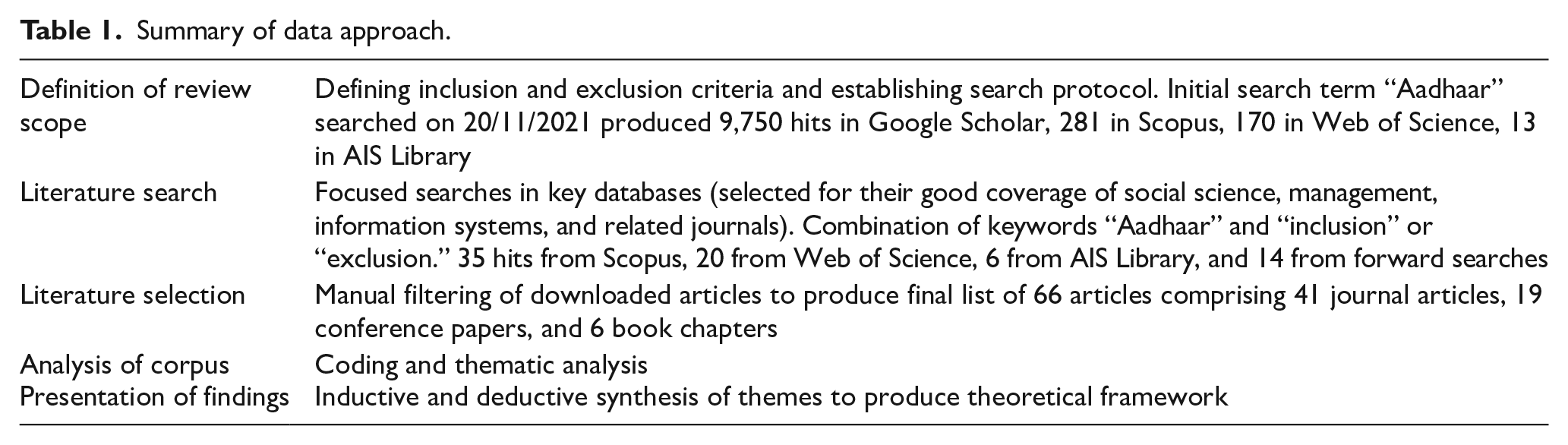
We first defined the scope of the literature by searching for “Aadhaar” in databases that cover a significant number of social sciences, management, information systems, and related journals. We obtained the following hits for our initial search: Google Scholar (9,750 hits), Scopus (281 hits), Web of Science (170 hits), and the AIS Library (13 hits). We then decided to focus on peer-reviewed journals, conference papers, and book chapters written in English and indexed in the databases that had good coverage of the social science, management, and information systems literature.
Our main search was done on the title, abstract, and keywords of studies in Scopus, Web of Science, and AIS Library using a combination of keywords “Aadhaar” and “inclusion” or “exclusion.” We did not use “orchestration” in our keyword search as we wanted to interpret it from relevant literature and not risk excluding relevant studies that did not explicitly use the term. We iteratively searched each database and exported relevant studies to a master folder for further analysis in a spreadsheet. 35 hits were obtained from Scopus, 20 from Web of Science, and 6 from AIS Library. Additional forward searches on the most cited studies added 14 highly relevant studies, making a total of 75 studies.
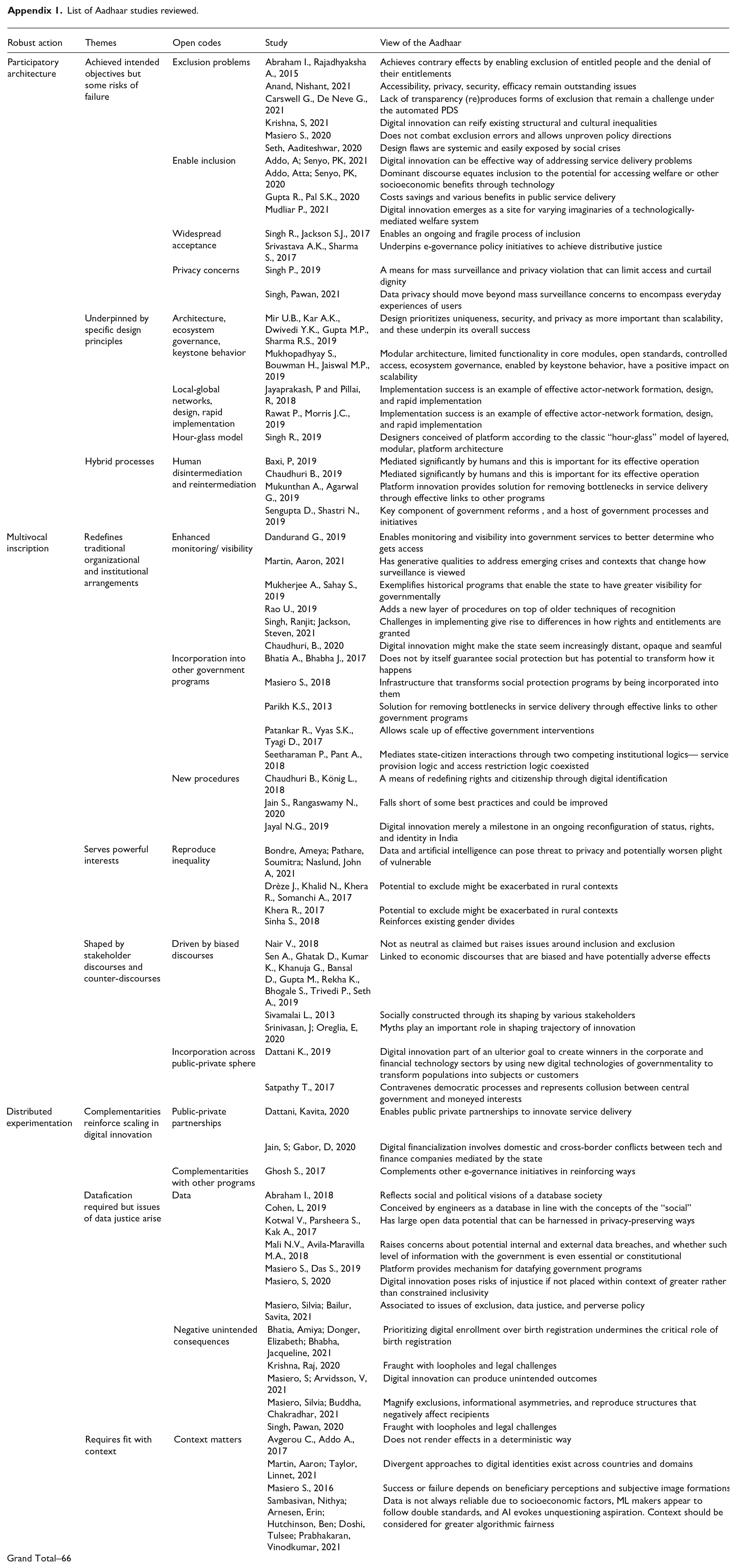
The 75 studies were screened to exclude duplicates, as well as articles that were not a good fit, for example, articles that mentioned Aadhaar in passing but did not focus on substantive aspects, and engineering articles that did not address issues related to inclusion or exclusion. Our final corpus of 66 articles comprised 41 journal papers, 19 conference papers, and 6 book chapters. Appendix 1 lists the studies that were read and analyzed.
Data analysis
We followed the approach outlined by Braun and Clarke (2006) by familiarizing ourselves with the data, generating initial codes, searching for patterns (themes), reviewing the themes, defining and naming themes, and then producing the report. The literature was read and re-read to determine the range of issues concerning the role of government and how Aadhaar was orchestrated. The empirical connection to government orchestration was determined by focusing: (a) the objectives and research questions of the study, (b) its empirical evidence, and (c) the contribution of the study.
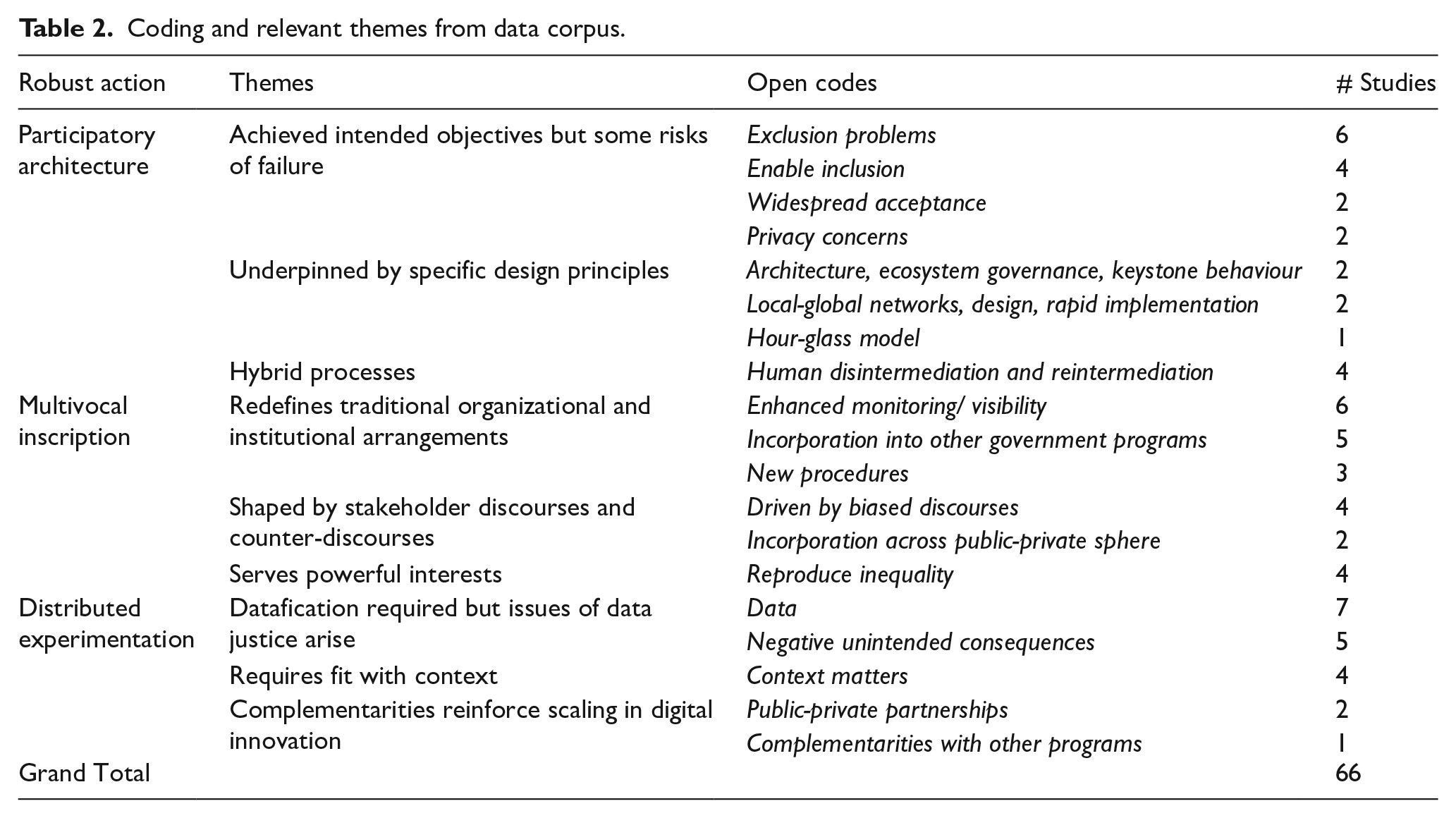
An initial set of codes (open codes) were produced, compared, and clustered to identify patterns in the data (themes). We only focused on a dominant theme within each study rather than coding for multiple themes. The final set of themes were aggregated according to the theoretical perspective of robust action strategies (participatory platform, multivocal inscriptions, and distributed experimentation). Coding ended when each study was satisfactorily classified (Table 2).
Coding and relevant themes from data corpus.
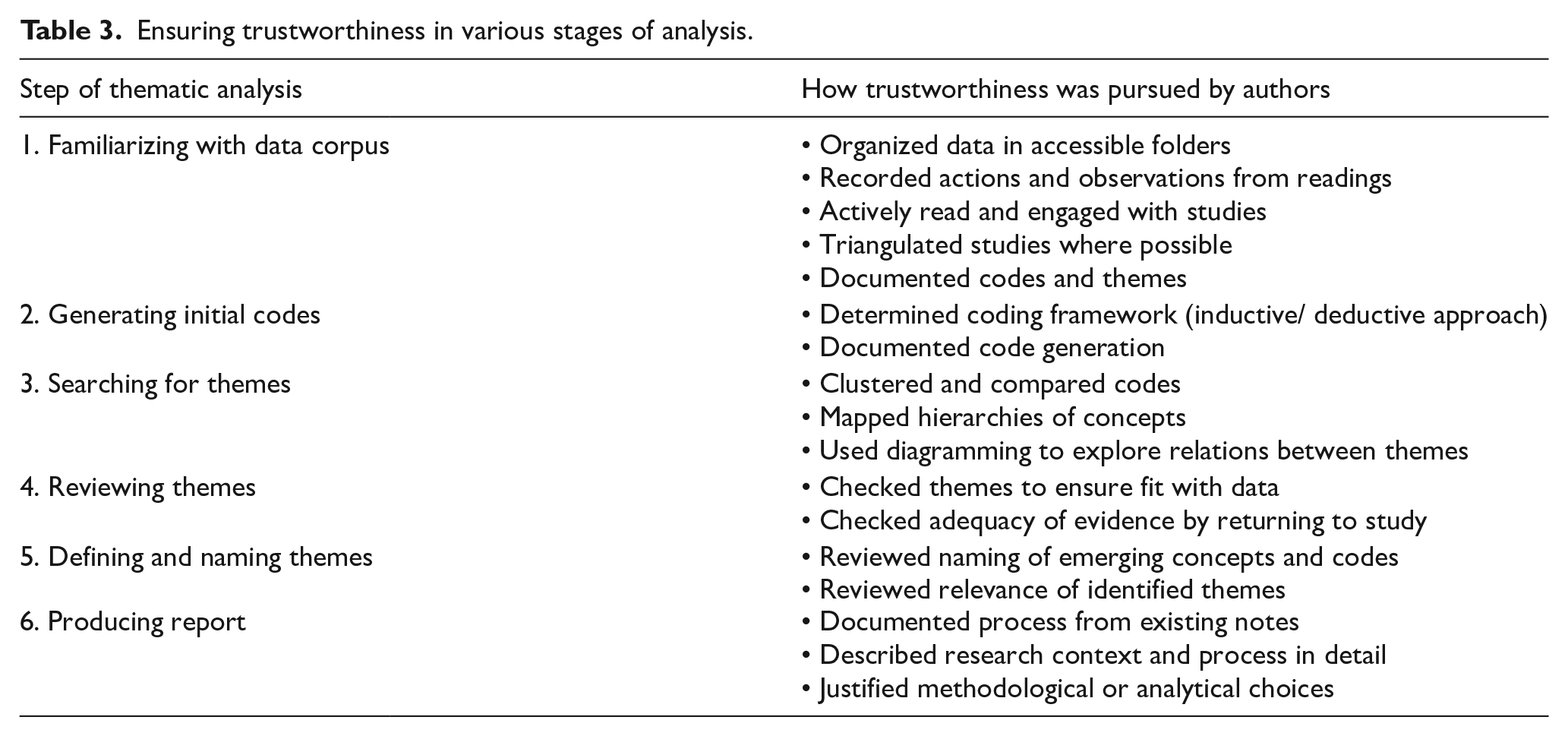
The inductive and deductive approaches helped to develop a theoretical framework that connects the empirical observations of Aadhaar orchestration with the theoretical understanding developed from the literature. We followed criteria of quality and rigor by ensuring trustworthiness, consistency, and exhaustiveness by recording, systematizing, and disclosing how research unfolded (Lincoln and Guba, 1985; Nowell et al., 2017). These steps are summarized in Table 3 (Nowell et al., 2017).
Ensuring trustworthiness in various stages of analysis.
Aadhaar
Problem context
Identity is a societal challenge around the world, particularly in developing countries, because of its implication for human development and effective governance. The World Bank (2017) has estimated that 1.1 billion people (about 15% of the world’s population) are locked out of socioeconomic benefits because they are unable to prove their legal identity to access services. Marginalized groups including women in developing countries are worse affected with almost 50% not having a means of formal identification (World Bank Group, 2019: 2).
This “identity gap” (Gelb and Clark, 2013) mostly affects the poor, vulnerable, and already marginalized groups, and poses an obstacle to the achievement of socioeconomic development (Nemschoff, 2015; Nilekani and Shah, 2015). Furthermore, the lack of identity documents and systems contributes to the perpetuation of a poverty cycle by limiting access to education, health, financial services, and economic opportunities (Zelazny, 2012). Consequently, addressing the identity gap is believed to enable tangible gains across relevant areas such as financial inclusion, social protection for the poor and vulnerable, empowerment of women and girls, and improvements in health access (World Bank Group, 2019).
The World Bank’s identification for development (ID4D) initiative and the UN’s Sustainable Development Goals (SDGs) (United Nations, 2015) recognize the far-reaching significance of the identity gap. The SDG target 16.9 aims to “provide legal identity to all, including through birth registration, by 2030,” and towards this objective, more than 40 countries in Africa, Latin America, South, and Southeast Asia have or are implementing ID systems, with over $1.2 billion committed to such initiatives by the World Bank and other development partners (Biscaye et al., 2015; World Bank Group, 2019).
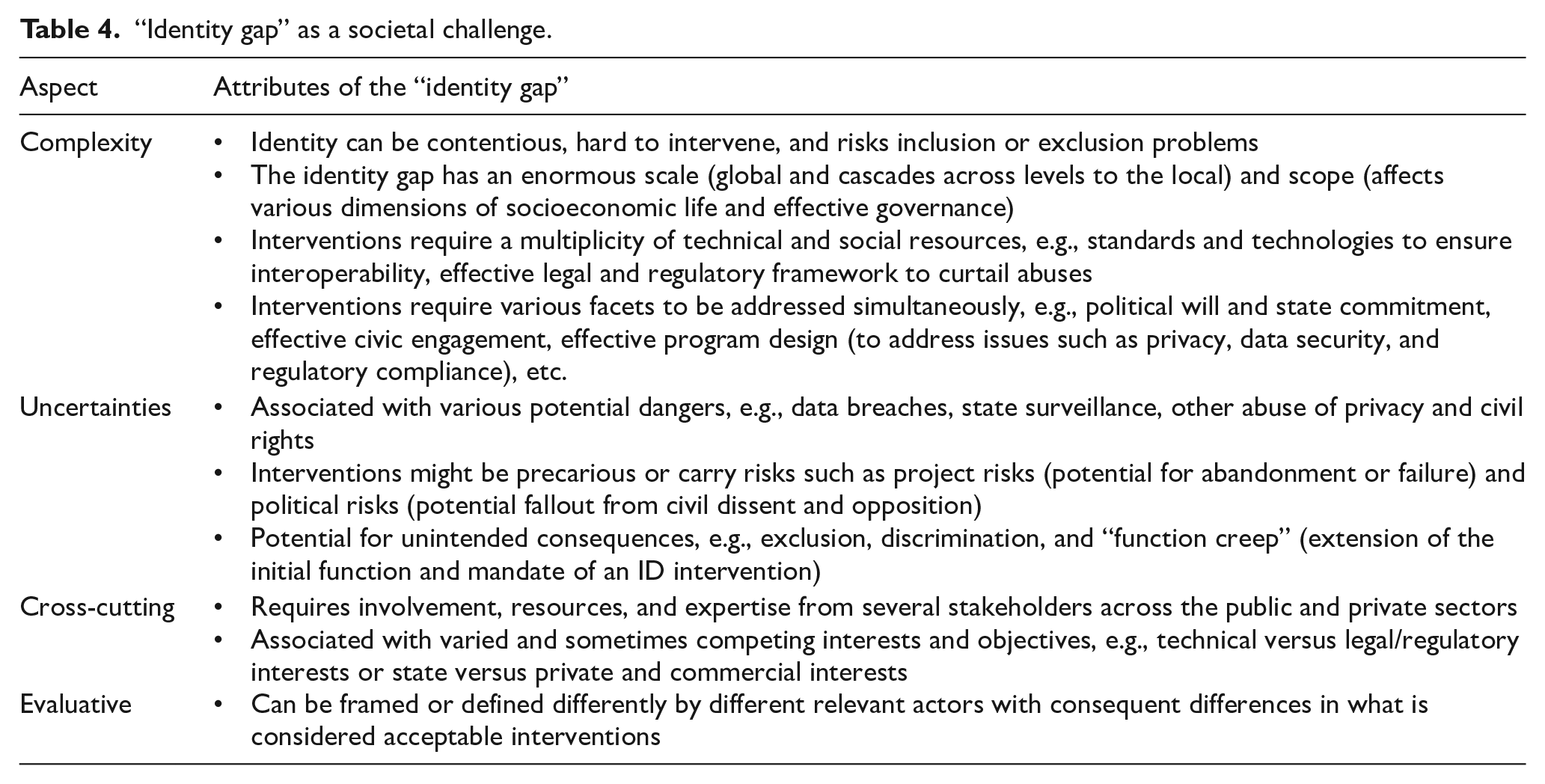
Identity (and the identity gap) could be considered a societal challenge because of its complexity, uncertainties, cross-cutting, and evaluative nature (Ferraro et al., 2015) as summarized in Table 4.
“Identity gap” as a societal challenge.
The UN notes that “given the size of the global identification gap, no single country, international organization, NGO, or private sector entity can surmount this challenge by working alone –coordination is needed at the global, regional, and national levels” (World Bank Group, 2018: 3). Nonetheless, the role of government remains crucial as it can incentivize or disincentivize other actors such as corporations and could thereby attract or divert their effective participation (George et al., 2016: 1889).
Two justifications are commonly suggested for addressing the identity gap with government-orchestrated digital identity systems. Firstly, digital identity is said to provide an effective and cost-efficient way for individuals that are otherwise unknown or “invisible” to the state and formal organizations to become visible. Secondly, from the perspective of the state, particularly in developing countries, many developmental hurdles are suggested to be linked to the lack of legal identity, the absence of a national/harmonized means of unique identification and authentication, and a centralized record of individuals within the state.
In the Aadhaar case, problems such as fraud and leakage in public distribution (Masiero, 2015a), as well as inefficient targeting or mistargeting of welfare beneficiaries were attributed to the lack of unique identification (Nilekani and Shah, 2015). Other phenomena such as absenteeism and “ghost” workers on public payrolls in developing countries also drain the public purse and might be ameliorated with effective identification systems (Dovlo, 2005; Nafiu et al., 2016).
The first justification linked to addressing the identity gap among the poor and marginalized has frequently been argued in terms of socioeconomic inclusion (Addo and Senyo, 2021). In this view, digital identity is the missing link that could potentially connect excluded populations to benefits such as financial services, as well as their entitlements to public goods and services (Gelb and Clark, 2013; Gelb and Decker, 2011; Srinivasan and Johri, 2013). However, by its complex nature, socioeconomic inclusion requires the participation and collaboration of a range of actors and organizations across the public and private sectors. A platform ecosystem is therefore important not only for providing the sociotechnical means of digital identity but also for allowing collaboration.
Solution context
Aadhaar, which means “foundation” in many Indian languages, is among the largest government-orchestrated platform ecosystems in the world and provides digital identity to enable access to a range of services (Dass, 2011). Launched in 2009 by the Unique Identification Authority of India (UIDAI), a national agency created to develop and implement a unique identity solution for all Indian residents (Government of India Planning Commission, 2009), the Aadhaar Unique Identification (UID) consists of a twelve-digit number that is linked to the bearer’s demographic data such as date of birth, name, gender, as well as biometric data such as fingerprints, iris scan, and photograph. Physical cards are not needed because what matters is the unique number that identifies the bearer through their enrolled personal information (Unique Identification Authority of India (UIDAI), 2012a). As of May 2020, over 1.21 billion Aadhaar had been issued (almost 90% coverage of the Indian population) (UIDAI, 2020). By not requiring a physical card, the Aadhaar presents a notable innovation over most national identification schemes that require one (Biscaye et al., 2015).
Aadhaar has been trumpeted in the Indian government narratives as a triumph of Indian engineering capabilities, social reformist vision, and formidable leadership (Cohen, 2019a; Nilekani and Shah, 2015). It aspires to a kind of “objectivity” that is deemed lacking from previous identification schemes that relied on caste, religion, ethnicity, language, or other social categorization that have traditionally provided cleavages for conflicts and discrimination (Solinas, 2018). UIDAI’s official characterization of the Aadhaar (Table 5) distinguished it from previous identification schemes by emphasizing its ambitions and the use of a unique 12-digit number instead of profiling information.
Official description of the Aadhaar (Unique Identification Authority of India (UIDAI), 2012b).
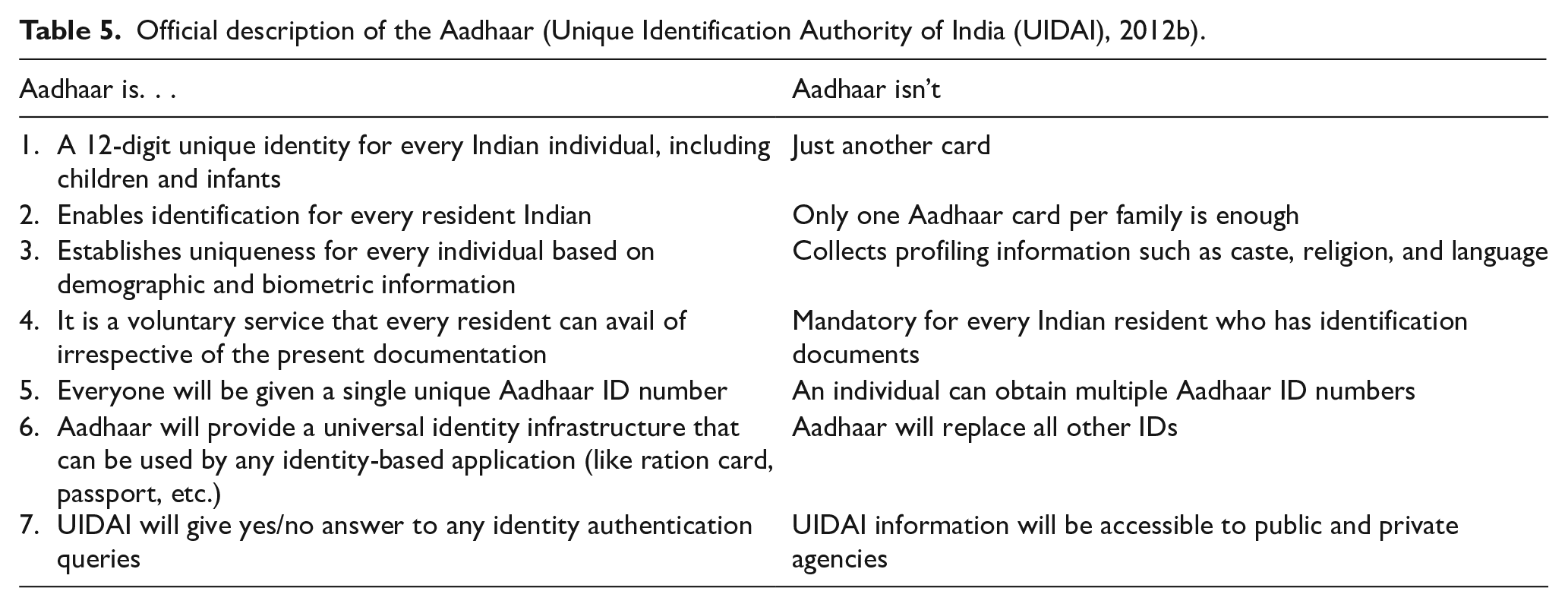
Although the Aadhaar did not by itself guarantee benefits, services, or citizenship (Unique Identification Authority of India (UIDAI), 2012b; Venkatesan, 2013), its real-time identity verification infrastructure enables access to myriad government services like utilities, the National Rural Employment Guarantee Scheme (NREGS), benefits under the National Social Assistance Program (NSAP), and subsidized rations of daily necessities like kerosene and food from the Indian Public Distribution System (PDS). It also enables access to social-leveling services such as banking and telecom that were previously inaccessible due to the lack of proof of identity (Nair, 2018; Nilekani and Shah, 2015).
Orchestrating Aadhaar through robust action
Aadhaar’s orchestration overcame various hurdles that were not predictable from the outset. Despite a common narrative that depicts Aadhaar as an inevitable masterstroke of design and engineering (Cohen, 2019a; Mir et al., 2020; Nilekani and Shah, 2015; UIDAI, 2012), the Aadhaar’s unfolding was characterized by high levels of ambiguity and flexible maneuvering through a storm of opposition from civil society, technologists, activists, and several other stakeholders. By reviewing evidence from studies of Aadhaar, we identify themes related to how orchestration unfolded via robust action strategies and capabilities of digital technology (Appendix 1).
Participatory architecture
Given the vast scale and scope of resources required to tackle the challenges of identity and inclusion, Aadhaar was by design grounded in the logic of a participatory architecture to invite productive activities from diverse participants from outside the resource base and direct control of the government. This was true in terms of both the organizational and technical design of the system which allowed complementors to provide various contributions as depicted in Figure 1.
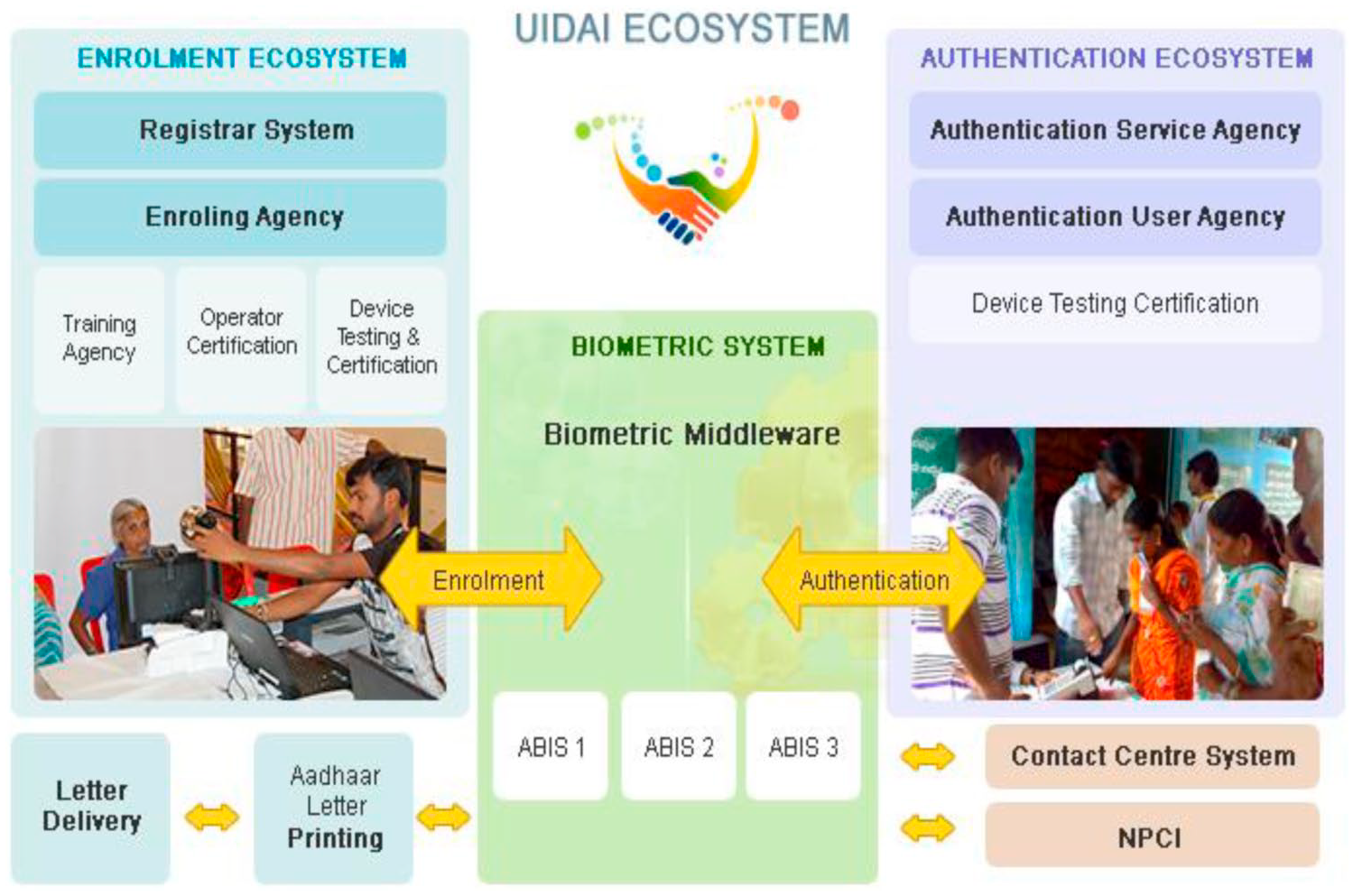
Schematic of Aadhaar ecosystem (source: UIDAI).
Organizationally, India’s federal structure meant that flagship Aadhaar schemes were driven by the state rather than the central government. Crucially, although the UIDAI controls the Aadhaar’s core, the central identities data repository (CIDR), and oversees the strategy and operation of the system, nearly all other activities related to enrollment and authentication were carried out by participants external to UIDAI (Table 6).
Aadhaar participants.
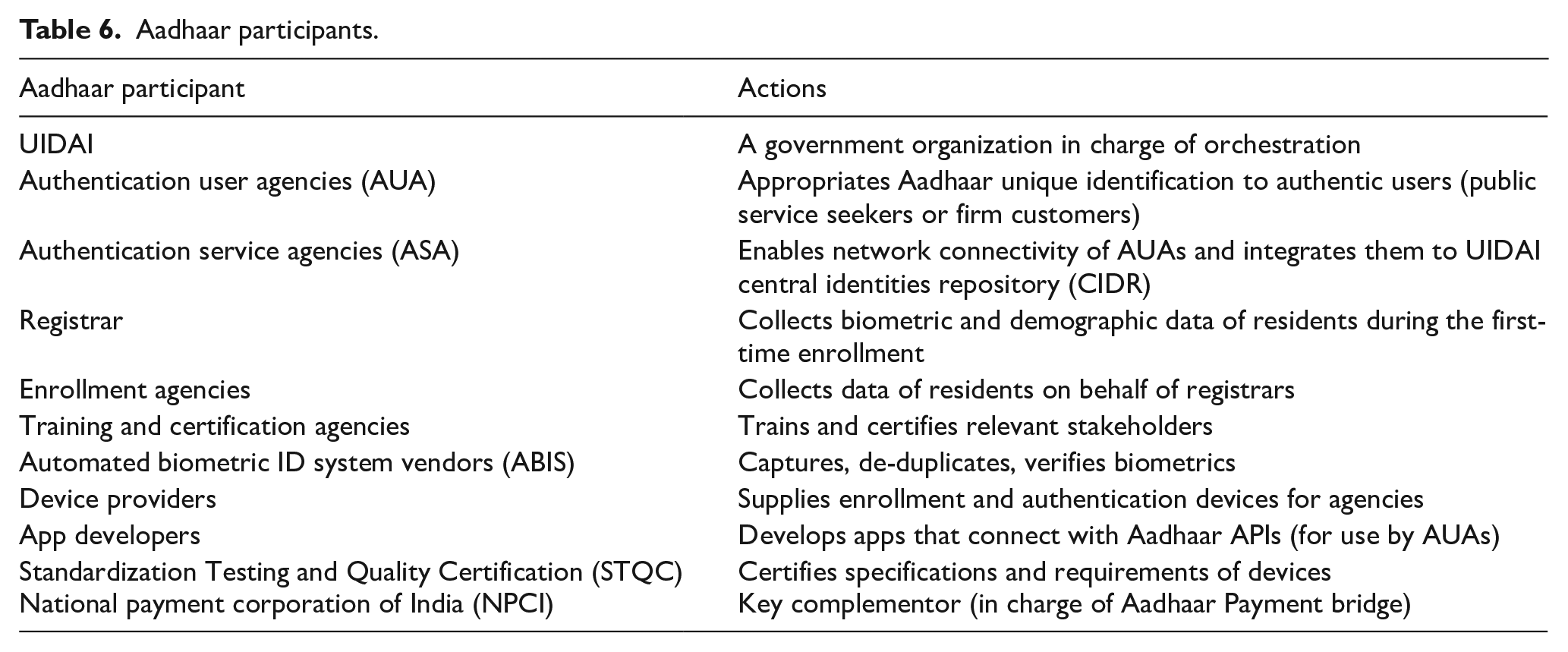
Participatory architecture was underpinned by Aadhaar’s platform configuration which emphasized a lean (Olleros, 2008) and open core (central identities data repository or CIDR) with interfaces (APIs) to support interaction among complementors from both the enrollment and authentication ecosystems (Mukhopadhyay, Bouwman, and Jaiswal, 2019). Open standards and effective ecosystem governance also enabled scalable participation and effectiveness. The technical architecture of Aadhaar is further detailed in Figure 2.
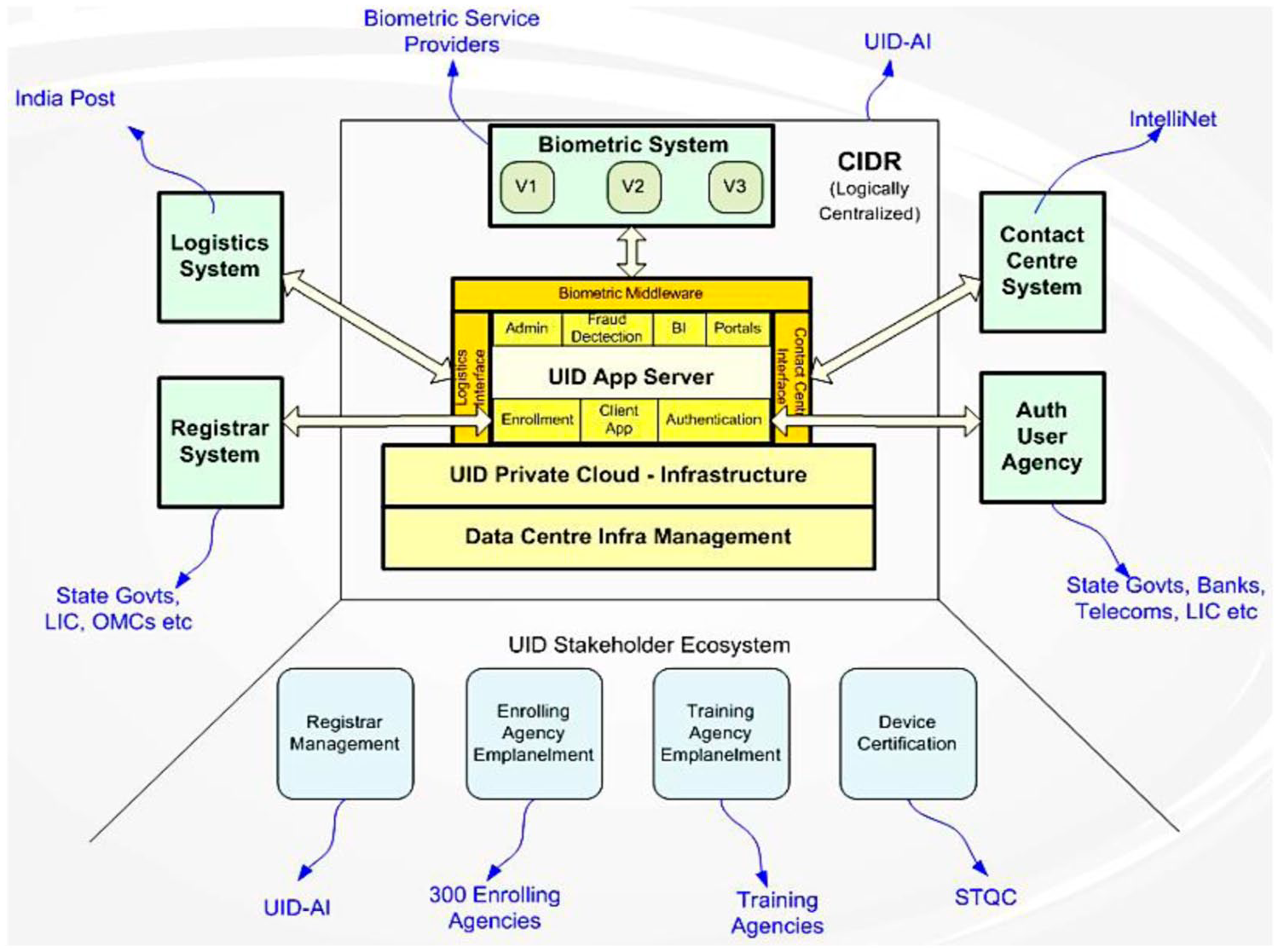
Architecture of the Aadhaar (Zelazny, 2012, p. 10).
Digitally enabling a participatory architecture for problem-solving created symbiosis between actors who were able to create and share value. Studies of Aadhaar present the following themes related to participatory architecture.
Underpinned by specific design principles
Similar to the design of large complex architectures like the internet (Akhshabi and Dovrolis, 2013; Zittrain, 2019), Aadhaar designers conceived the system in terms of the “hour-glass” model of layered modularity that allows digital innovation and recombination within and across the layers (Singh, 2019). Such architecture underpins the vision for the India Stack, a government initiative to create a “presence-less, paperless, and cashless service delivery” across government and society (Figure 3).
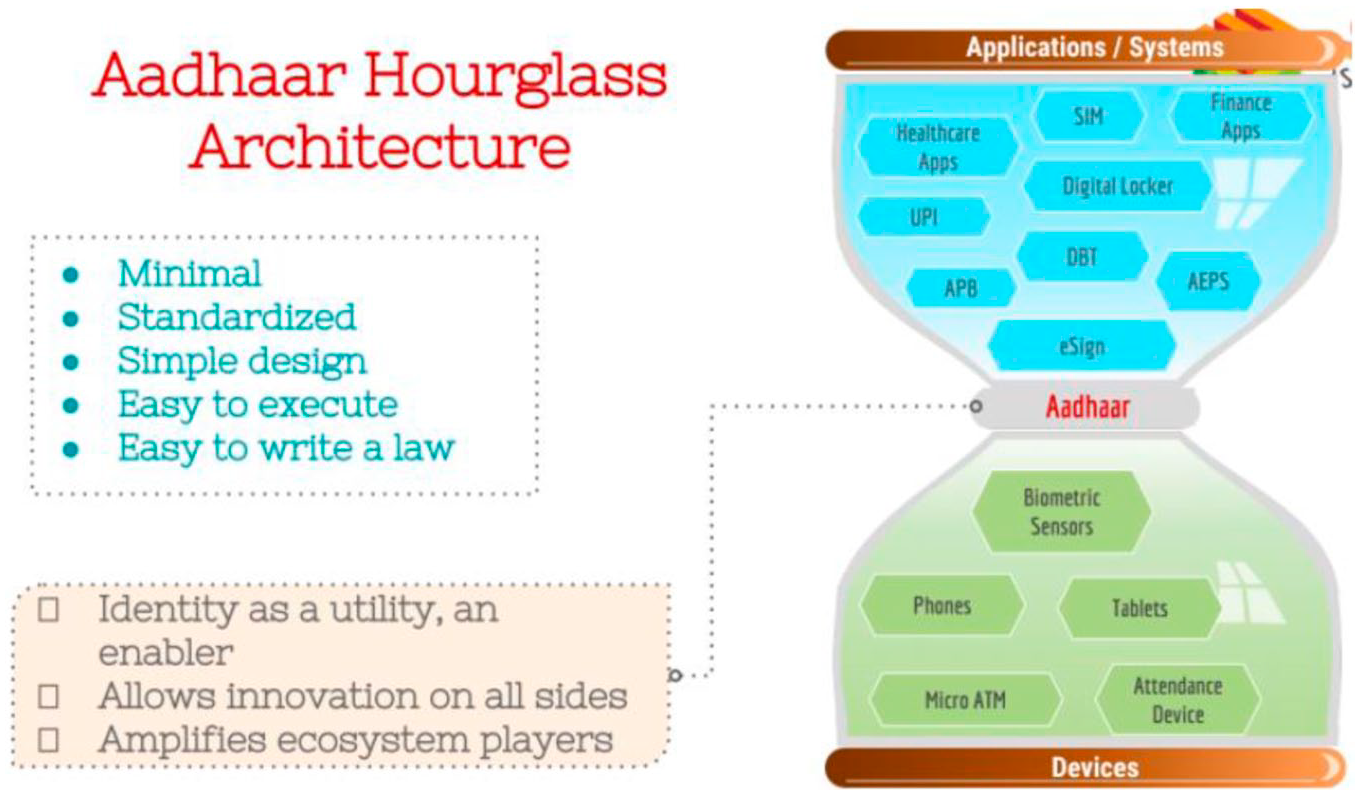
Hour-glass architecture of Aadhaar-enabled India stack (source: IndiaStack.org).
The hour-glass design was associated with rapid implementation by networks of local and global actors (Jayaprakash and Pillai, 2018; Rawat and Morris, 2019). By having a modular architecture with open standards, limited functionality in core modules, and controlled access, the ecosystem was easier to govern and the government able to effectively play a role as a keystone actor (Mukhopadhyay, Bouwman, and Jaiswal, 2019). Security, privacy, and uniqueness were also critical factors for the system’s success overall (Mir et al., 2020).
Achieved intended objectives but some risks of failure
Implementing a participative architecture was associated with the biggest transformation of all, in terms of the inclusion of marginalized individuals and groups in service provisioning. In addition to advancing distributive justice through widely accepted e-governance initiatives, costs savings, effectiveness, efficiency, and various improvements in welfare and public service delivery were realized (Addo and Senyo, 2020, 2021; Gupta and Pal, 2020; Mudliar, 2021). However, such inclusion was at times fragile (Singh and Jackson, 2017), and risks of exclusion remained a threat. Accessibility, privacy, security, and efficacy were raised as concerns with Aadhaar application in certain programs (Nishant, 2021). Systematic design flaws (Aaditeshwar, 2020) and lack of transparency (Carswell and de Neve, 2021) could also help reify existing structural and cultural inequalities that drive exclusion of marginalized people and groups in society (Krishna, 2020).
Involves hybrid processes
Aadhaar innovation helped remove certain bottlenecks in various service systems. For example, leakage in the public distribution system (PDS) was significantly addressed by disintermediating middlemen who were often fraudulently involved in siphoning rice and other subsidized provisions to the black market (Mukunthan and Agarwal, 2019). Financial management systems were also improved through increased transparency, greater efficiency, and the elimination of certain forms of bureaucratic discretion (Sengupta and Shastri, 2019). However, in other contexts human mediation was necessary to extend platform-based services to low-literacy or underserved communities (Baxi, 2019; Chaudhuri, 2019).
Multivocal inscriptions
Aadhaar embodies various “inscriptions” (Callon, 1991: 143)– that is, specific assumptions, beliefs, and discourses around perceived societal challenges and their appropriate solutions. These inscriptions have implications for what the Aadhaar is to be used for, who is to use it, when and how it is to be used, as well as its status in relation to other forms of identification and regimes of recognition and belonging. The ambiguous nature of Aadhaar—whether a physical card like other IDs, a database, a platform, an ecosystem, an infrastructure, a surveillance program, or something else—generated fervent interest and confusion. While it is correct to consider the Aadhaar straightforwardly as a 12-digit ID number linked digitally to a bearer’s biometric information (Table 4), the sociotechnical design and configuration of the system are not to be taken for granted because the Aadhaar qua identity system could have been otherwise.
Ambiguity and multivocal inscriptions could be considered to have purposeful and strategic value. It has been suggested that the government in its National Identification Authority of India Bill (“the Bill”) that launched the Aadhaar, deliberately left “many things unsaid” with definitions that were “almost all open-ended” (Kak and Malik, 2010: 485). But although the initial backlash to the system was fueled by such vagueness in the Bill and the potential scope for interpretations that undermined privacy, Aadhaar’s ambiguity has served strategic purposes.
Multivocal inscriptions allowed the whole-sale transformation of government programs and its link to a broader agenda of a “digital India” through the set of APIs known as the India stack (Dattani, 2019). For example, in the case of the public distribution system (PDS), India’s main food security program that provides commodities to poorer residents at highly subsidized prices, the grand design behind Aadhaar seeding was more radical than initially presented to the public (as a marginal fix to leakage) and was part of a shift of anti-poverty programs into cash transfer schemes. Cash transfer systems were piloted in a few states (Saini et al., 2017), and represented the ultimate destination of the JAM trinity (the combination of the Jan Dhan accounts, Aadhaar, and mobile).
Multivocal inscriptions anchored Aadhaar within varied stakeholder communities by encouraging participation, engagement, and controlled appropriation of digital resources such as APIs and development tools to create new products and services. Private institutions developed services and programs based on Aadhaar’s capability to allow immediate authentication of a user thereby reducing the possibility of fraud. Banks and other financial service providers, for similar reasons, adopted Aadhaar to fulfill the government’s know-your-customer requirements (e-KYC). Ethics of such processes are a matter of contention as activist groups have raised concerns about the privacy implications and India’s Supreme Court verdicts on Aadhaar have restricted its scope of usability by companies.
The literature suggests the following themes in relation to Aadhaar’s multivocal inscriptions.
Redefining traditional organizational and institutional arrangements
The system introduced new procedures in terms of how citizens mediate their rights and interact with the state and other service providers (Chaudhuri and König, 2018; Jain and Rangaswamy, 2020; Jayal, 2019). This allowed the elimination of bottlenecks and the transformation of service delivery processes (Bhatia and Bhabha, 2017; Masiero and Prakash, 2019; Parikh, 2013; Seetharaman and Pant, 2018). By being incorporated into various services, it allowed effective and sometimes universal scale-up of welfare and social programs (Patankar et al., 2017). However, despite the potential for enhanced monitoring and visibility into service provisioning (Dandurand, 2019; Mukherjee and Sahay, 2019), the platform made the state seem distant and seamful (Chaudhuri, 2020), and complicated how government surveillance could be regarded (Martin, 2021).
Shaped by stakeholder discourses and counter-discourses
Aadhaar is not neutral but shaped by discourses and counter-discourses of stakeholders (Nair, 2018). In the process of its social construction, Aadhaar discourses redefined organizational and societal phenomena in line with powerful interests, sometimes to the neglect of less powerful interests (Sivamalai, 2013). Discourses of Aadhaar tend to be based on technology myths (Srinivasan and Oreglia, 2020) and are biased in favor of unproven policy directions (Masiero, 2020), and dominant economic agenda of government even where such is potentially adverse (Dattani, 2019; Satpathy, 2017; Sen et al., 2019).
Serves powerful interests
Multivocal inscriptions enabled widespread acceptance while deferring potential political fallout and resistance until specific Aadhaar service innovations were fait accompli. For example, although Aadhaar was initially positioned by the government as voluntary and restricted to the purpose of financial inclusion, it later became embedded in an increasingly large number of government programs and private services, effectively making it a de facto requirement for conducting everyday transactions (Bhattacharya and Anand, 2018; Khera, 2017; Mahapatra, 2015). Another example of a politically charged and contentious application of Aadhaar was when in November 2016, the Government of India without warning banned about 86% of the nation’s banknotes in a move known as “demonetization.” Demonetization was claimed by the government as an effort to combat corruption and black money in the country (Chauhan, 2017; Gupta and Auerswald, 2017), but was seen widely as a move to drive massive adoption of Aadhaar and Aadhaar-based financial service innovations. The Ministry of Finance referred to “demonetization through digitalization,” asserting that the poor—whose money is largely held in cash—would be proactively helped into the digital economy by technologies designed for their needs (Agarwal et al., 2018; Bose, 2019; Lahiri, 2020).
However, despite the significant economic costs and hardship imposed demonization proved to be largely unsuccessful in achieving its objectives (Safi, 2018). In general, established social inequalities, rather than being eliminated, have been suggested to be reproduced for rural dwellers (Drèze et al., 2017; Khera, 2017), women (Sinha, 2018), and other disadvantaged groups (Abraham and Rajadhyaksha, 2015).
Distributed experimentation
An Aadhaar architect noted that Aadhaar and its applications “help a billion people to participate in the digital economy and avail services tailored to them” (Varma, 2014). This process of “tailoring” services with Aadhaar occurs through distributed experimentation (in a process known as “seeding”) to harness innovations from the activities of varied complementors. Such distributed experimentation occurred through the massive enrollment of residents (enrollment ecosystem) and its increasing incorporation into services (authentication ecosystem). The following themes emerged in relation to distributed experimentation.
Datafication required but issues of data justice arise
Aadhaar’s architects considered the system as an enabler of a database society (Abraham, 2018; Cohen, 2019b). Aadhaar allows open data that could be harnessed in privacy-preserving ways (Kotwal et al., 2017), and also provides a mechanism for datafying government programs (Das and Masiero, 2019). In the case of the Public Distribution System (PDS), state ministries have data on residents’ poverty status and integrate them with Aadhaar records (UIDAI, 2018). This means that UIDAI does not only hold the Aadhaar records of citizens, but such data is linked to the poverty status of bearers that make them entitled to the PDS, as well as to the numerous other schemes designed for those living below the poverty line (Masiero and Das, 2019). The chief purpose of incorporating Aadhaar in the PDS was to eliminate diversion because it had been fraught with high levels of commodity leakage to private markets (Khera, 2011).
Through datafication, complementors aggregate different types of data to enable effective services to citizens and ultimately reform public services (Ghosh, 2017; Masiero, 2015b). A set of pilot projects between 2012 and 2013 incorporated Aadhaar in the last-mile delivery of national anti-poverty programs, including the Mahatma Gandhi National Rural Employment Guarantee Act (MGNREGA), a rural employment guarantee program, providing 100 days of paid employment at the minimum wage as a right to all rural households who request it. Aadhaar-enabled MGNREGA pilot projects focused on payments to the scheme’s workers, whose livelihoods were frequently affected by delays. In northern Andhra Pradesh, a scheme based on Aadhaar-enabled smartcards allowed people to instantly obtain their payments, bypassing the long paper-based process to which they were previously accustomed (Muralidharan et al., 2016). Dozens of schemes are now seeded with Aadhaar, and even as the list keeps growing (Deepalakshmi, 2017), various benefits and potential risks have been noted (Raju et al., 2017).
Datafication has, however, been associated with various risks such as the potential for loopholes and legal challenges (Krishna, 2020; Singh, 2020), data breaches (Avila-Maravilla and Mali, 2018), violations of norms of data justice, and pursuit of perverse policies (Masiero and Bailur, 2021a, 2021b). Furthermore, negative unintended consequences or “degenerative” outcomes are possible (Masiero and Arvidsson, 2021).
Requires fit with context
Divergent approaches exist in digital identity systems across countries (Martin and Taylor, 2021), but the Aadhaar shows a significant fit with various aspects of the Indian context. Given that digital innovation does not render change in a deterministic way, peculiar political, economic, social, and historical conditions were crucial for eventual outcomes (Avgerou and Addo, 2017). Furthermore, eventual success or failure was contingent on beneficiary perceptions and subjective image formations (Masiero, 2016).
Complementarities reinforce scaling
Because of distributed experimentation, various services were connected by Aadhaar and its underlying database. This enabled complementarities to exist across programs and other platforms (Ghosh, 2017), thereby reinforcing the adoption and scaling of Aadhaar. Furthermore, private-public partnerships led to service innovations in areas such as digital finance (Dattani, 2019; Jain and Gabor, 2020).
Discussion
We have suggested that a platform ecosystem could be orchestrated to address societal challenges, “wicked” problems that can be usefully distinguished from those driving other kinds of digital change. To address the puzzle of how a government organization might orchestrate a platform ecosystem to address societal challenges, we have analyzed the case of India’s Aadhaar from the perspective of robust action. We show through our thematic analysis of relevant studies that contrary to extant literature that views government orchestration of platform ecosystem as a governance function that occurs “ex-ante” without invoking design or configuration (Cordella and Paletti, 2019), orchestration could involve more than governance mechanisms and might encompass dynamic processes and contingent roles across phases of a platform’s evolution.
It involves a balancing act between planned, technical-rational decisions that unfold by design, and emergent but guided outcomes rooted in experimentation and practice. The need to preserve this balance requires the orchestrator to avoid making firm commitments that are path-dependent (for example, adopting a turnkey IT solution that quickly becomes obsolete or irrelevant as new problems emerge), and to as far as possible pursue “noncommittal actions that keep future lines of action open” (Padgett and Powell, 2012: 24). In the face of conflicting interests and positions about the nature of a given societal challenge and its acceptable solutions, maintaining such flexibility is key to successful orchestration by a government organization. In that sense, robust action provides an appropriate theory of action for understanding the actions undertaken by a government organization as it strives to harness resources and collaboration of varied stakeholders with otherwise little to no incentives to cooperate.
Government orchestration of a digital platform ecosystem to address societal challenges might involve three digitally constituted strategies of participatory architecture, multivocal inscriptions, and distributed experimentation. These strategies address the structural, interpretive, and practice dimensions of organizational change (Ferraro et al., 2015). Given the long-term nature of societal challenges, participatory architecture provides temporal and spatial structures for various stakeholders to engage on an ongoing basis. Multivocal inscriptions create interpretive latitude for stakeholders to engage and coordinate approaches without first attaining or committing to an explicit consensus on exactly how to proceed. Distributed experimentation allows effective solutions to emerge through openness, iteration, and learning by doing, while selecting successful outcomes and rejecting undesirable ones.
Towards a framework of government orchestration through robust action
Although these broad strategies have been identified in non-technology-related approaches to addressing societal challenges (Ferraro et al., 2015), their consideration in relation to digital innovation (as we do in this paper) provides a rigorous perspective for understanding the phenomena of government platform ecosystem orchestration. Of central importance is the significance of a digital platform architecture to techno-organizationally underpin participation of heterogenous users and complementors, distributed experimentation (through ecosystems), and the multivocal inscriptions to sustain these.
From our analysis of the Aadhaar, we derive a framework of platform ecosystem orchestration through robust action (Figure 4).
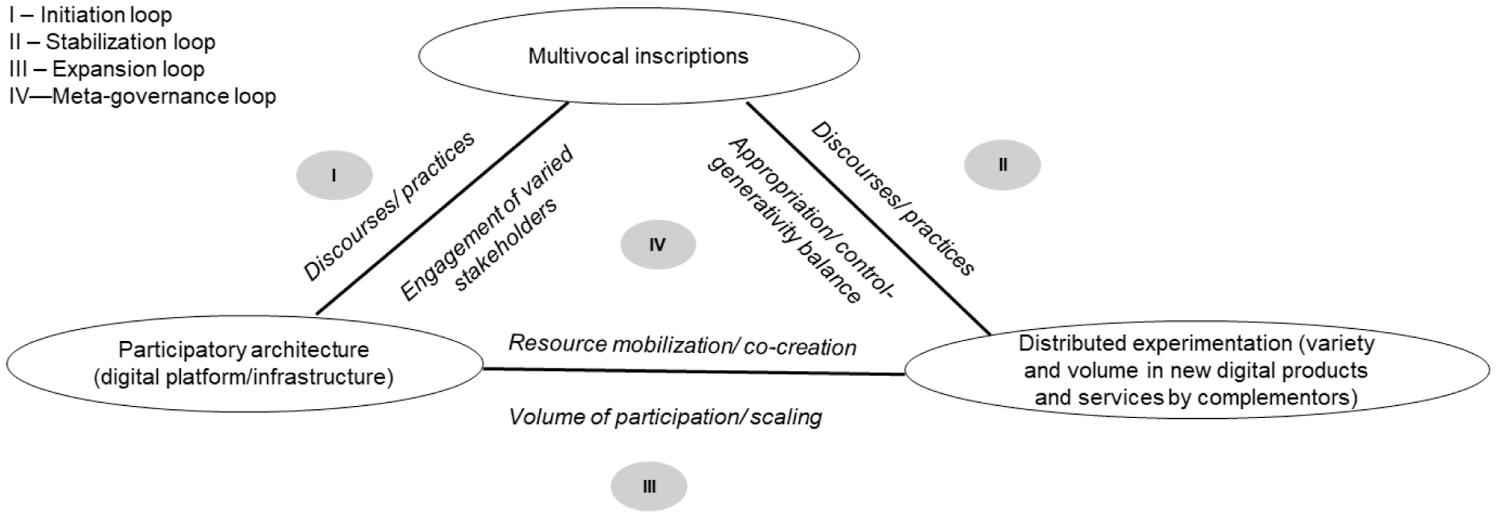
Government platform ecosystem orchestration through robust action.
The framework conceptualizes the significance of digital technology for each of the three robust action strategies and suggests dynamic and reinforcing interactions between them, depicted by interactions (I-IV). We suggest that the trajectory of a successful platform ecosystem to address societal challenges must overcome 4 important obstacles well identified in the literature: how to ignite the platform (initiation), how to avoid decline (stabilization), how to grow and scale innovations (expansion), and how to direct all sociotechnical elements and dynamics towards common objectives (meta-governance). We elaborate on these with the following propositions.
Proposition I: Initiation through participatory architecture and multivocal inscriptions
The literature on platform models has highlighted the problem of “ignition,” that is, the need to overcome the chicken-and-egg problem as the first step to successful digital innovation on multi-sided platforms (Caillaud and Jullien, 2003; Evans, 2009; Evans and Schmalensee, 2016). This is where one side of a multi-sided platform, for example, complementors, will only participate if the other side, for example, users are already in place (and vice versa) (Parker et al., 2016).
Multivocal inscriptions enable initiation by positioning the system to various sides as beneficial to their participation. This happens through practices and discourses linked to the architecture of the system. For example, through boundary resources like application programming interfaces (APIs) or software development kits (SDKs), the platform owner can engage and channel inputs from complementors to enable value-added derivatives that will benefit users (Kazan et al., 2018). Multivocal inscriptions also anchor complementors to the objectives of a government platform by allowing them to envision ways they might appropriate the bundle of digital resources profitably as a “backbone” or infrastructure for continuous value delivery (Kazan et al., 2018).
Furthermore, in the interfacing of varied entities and ecosystem players, tussles could emerge to jeopardize initiation and ongoing participation on the platform. Participatory architectural features like the flexible and modular hour-glass design allow “tussles”—that is, “the ongoing contention among parties with conflicting interests” (Clark et al., 2005: 462)—to be accommodated at the design level. This means the design allows for variability so it can flex without breaking or attracting violations and system rejection because it doesn’t meet the needs of particular players (Clark et al., 2005: 466).
Proposition II: Stabilization through multivocal inscriptions and distributed experimentation
Given the non-contractual basis of participation on platforms and in ecosystems, the risk of defection (leaving the platform), and non-participation (failing to play the role of your side) by complementors and users is ever-present. These challenges can destabilize the platform ecosystem and threaten its sustainability.
They might occur where the platform and ecosystem are governed poorly by the owner; for example, where there is a poor balance between control and generativity thereby enabling undesirable actions that drive away other participants or stifle new services (Eaton, 2012; Ghazawneh and Henfridsson, 2013).
Good platform governance bridges the range of interests expressed through multivocal inscriptions and the distributed experimentation that produces variety and volume in new products and services. Platform governance sets conditions for the nature and scope of legitimate participation, as well as how digital resources and innovations are to be appropriated within the ecosystem. It is known to occur through technical means such as boundary resources (APIs, standards, SDKs, etc.) (Ghazawneh and Henfridsson, 2013; Schreieck et al., 2016), and non-technical means such as policies, laws, norms, and market mechanisms (Lessig, 1999).
Proposition III: Expansion through participatory architecture and distributed experimentation
Given the wide scale and scope of societal challenges, effective interventions require scalable solutions. For this reason, effective orchestration of platform ecosystem to address societal challenges involves growth in the volume and variety of innovative products and services as well as scaling of the platform user base and complementors. Adopting an effective platform architecture (based on openness, modularity, flexibility, programmability, etc.) allows coordination of resources and co-creation within the ecosystem. This enhances distributed experimentation (variety and volume in new digital products and services), which in turn enhances adoption and the volume of participation on the platform.
Proposition IV: Meta-governance as balance of initiation, stabilization, and expansion loops
Ultimately, the effectiveness and sustainability of a platform ecosystem to address societal challenges requires directing and balancing between the sociotechnical elements and dynamics outlined. The initiation, stabilization, and expansion loops might each require a degree of governance, hence their meta-governance.
The three outlined dynamics might also be more reinforcing than sequential although each might be more salient at a different stage of the evolution of the digital platform innovation, for example, initiation more salient in the early stages and stabilization and expansion at more mature stages. Such a view considers orchestration as encompassing rather than a separate function, related to, for example, governance mechanisms alone.
Implications
A theoretical implication of our study is that societal challenges can be fruitfully considered as a unique class of problems that requires a government orchestrator to engage relevant stakeholders with an approach to digital change that maximizes chances of overall success, minimizes its costs and resource demands, and increases the likelihood of sustainability.
Societal challenges are a lightning rod for tussles between various interests. Similarly, complex systems and infrastructures also face tussles that must be overcome or accommodated at various stages across design, redesign, implementation, or run-time (Clark et al., 2005: 465). Our theoretical framework suggests an approach by which tussles might be sociotechnically accommodated to achieve effective and sustainable solutions at scale.
A platform ecosystem presents opportunity for such an approach to digital change although its orchestration to address societal challenges requires flexible strategic maneuvering that spans the evolution from initiation to stabilization and expansion. Digital technologies and their affordances are essential for constituting a participatory architecture, enabling multivocal inscriptions, and for underpinning distributed experimentation, whatever forms these might take.
By viewing platform ecosystem orchestration in this way, rather than as a narrow governance function once systems are in place, the multiple roles of a government organization as a facilitator orchestrator can be more clearly understood and its practical implications revealed. These roles might include acting as architects (to set the agenda and mobilize resources for digital innovation), judges (to set conditions for appropriating digital innovation), gatekeepers (to allow or prohibit participation and knowledge exchange across the platform ecosystem), or conductors (to perform meta-governance across the platform ecosystem). The view of orchestration as a set of dynamic capabilities, bundle of roles, and broad strategies to address societal challenges holds promise for explaining the significance of government organizations in digital platform ecosystem orchestration and can be developed further in future research.
Limitations
Digital innovation is inherently complex and unpredictable and hence the robust action framework we propose is not to be understood as a “how to” guide or success checklist. Rather we suggest it as a part of the intellectual toolkit and vocabulary to better understand the complex set of problems and tensions that might occur across cases of government orchestration.
Given the wide range of digital platform ecosystem innovations pursued by governments around the world, it might be reasonable to expect significant differences for digital platform interventions that are less open-ended, have a narrower focus, or require less scale and scope for intervention. Furthermore, given difference across national and organizational contexts, caution is to be exercised in drawing generalizations from the Aadhaar case.
More research is also needed to better understand why some digital platform ecosystem innovations succeed while others fail. Differences between innovations in the private versus public sectors, as well as across national and institutional contexts, also require closer scrutiny. For example, interesting parallels can be seen between the Aadhaar and the infamous Google Glass project that ultimately failed (Klein et al., 2020). Both were open-ended platform and ecosystem innovations that from their outset raised significant privacy, ethical, and abuse concerns even while promising potentially impactful benefits. They were magnets for significant controversies, but their unfolding was starkly different and requires more careful unpacking than can be accomplished in the purview of this paper.
The paper has not considered the moral or ethical implications of a robust action approach to digital innovation, particularly for the public sector where transparency and accountability are important ethos. The robust action premise of leaving lines of action open by actively cultivating ambiguity and opaqueness is in stark contrast to the high levels of disclosure necessary for technology and digital initiatives to be considered ethical (Introna, 2007; Introna and Wood, 2004). Such ethical considerations might also implicate context in important ways. For example, universal digital identity initiatives like the Aadhaar appear to have faced stronger opposition in western democratic contexts than elsewhere (Whitley, 2009; Whitley and Hosein, 2010).
In that sense, our findings are limited by the context of our case, and admittedly, the Aadhaar and Indian contexts differ from what exists with other digital platform ecosystems. Moreover, despite the prevalence and relevance of societal challenges in diverse government contexts, government is not to be understood as a monolith given that various traditions and institutional approaches exist across countries (Painter and Peters, 2010). The study is further limited by not considering other aspects of orchestration in the public sector such as politics, stakeholder engagement, vested interests, or the implication of market dynamics and diverse institutional logics. Future research might usefully engage with such nuances by, for example, pursuing studies of public managers, public organizations, and their practices of strategizing and orchestration to address societal challenges.
Conclusion
As government organizations increasingly turn to digital platform ecosystems to address societal challenges, a better understanding is needed of how it occurs. The framework developed in this paper advances understanding of the rather messy phenomenon by conceptualizing it as a form of strategic action that can be explained through a combination of a suitable theory of action (robust action) with sociotechnical theories of digital innovation (on platforms and ecosystem) and domain theory of governance problems (wicked problems/societal challenges).
Our approach is consistent with evidence that digital innovation in government contexts is fraught with ambiguity and contention among various stakeholders who must nonetheless collaborate for effective outcomes, despite the lack of direct profit incentives for them to do so (unlike in the private sector where market mechanisms accommodate alignment of incentives). The robust action perspective draws parallels between orchestration and masterful chess play, where rather than knowing many moves in advance (as is commonly assumed), the master player prioritizes flexibility over potentially costly firm commitments (Leifer, 1983, 1991). In this view, orchestration is not strictly a feat of clockwork engineering and design, nor an entirely reactive process of harnessing spontaneous participation. Rather, it requires the dynamic combination of broad yet flexible digitally enabled strategies to promote participation, collective interpretation, and distributed experiments to produce useful joint outcomes.
Given the limited research on platform ecosystem orchestration by government organizations, this paper’s eclectic approach of drawing from diverse streams of literature to address the central puzzle suggests the utility of transcending paradigms and theoretical approaches in this area of research. The eclecticism of government and public sector digital innovation practices around the world might benefit from such an approach given the sophistication and multifacetedness of interventions.
Footnotes
Appendix
List of Aadhaar studies reviewed.
| Robust action | Themes | Open codes | Study | View of the Aadhaar |
|---|---|---|---|---|
| Participatory architecture | Achieved intended objectives but some risks of failure | Exclusion problems | Abraham I., Rajadhyaksha A., 2015 | Achieves contrary effects by enabling exclusion of entitled people and the denial of their entitlements |
| Anand, Nishant, 2021 | Accessibility, privacy, security, efficacy remain outstanding issues | |||
| Carswell G., De Neve G., 2021 | Lack of transparency (re)produces forms of exclusion that remain a challenge under the automated PDS | |||
| Krishna, S, 2021 | Digital innovation can reify existing structural and cultural inequalities | |||
| Masiero S., 2020 | Does not combat exclusion errors and allows unproven policy directions | |||
| Seth, Aaditeshwar, 2020 | Design flaws are systemic and easily exposed by social crises | |||
| Enable inclusion | Addo, A; Senyo, PK, 2021 | Digital innovation can be effective way of addressing service delivery problems | ||
| Addo, Atta; Senyo, PK, 2020 | Dominant discourse equates inclusion to the potential for accessing welfare or other socioeconomic benefits through technology | |||
| Gupta R., Pal S.K., 2020 | Costs savings and various benefits in public service delivery | |||
| Mudliar P., 2021 | Digital innovation emerges as a site for varying imaginaries of a technologically-mediated welfare system | |||
| Widespread acceptance | Singh R., Jackson S.J., 2017 | Enables an ongoing and fragile process of inclusion | ||
| Srivastava A.K., Sharma S., 2017 | Underpins e-governance policy initiatives to achieve distributive justice | |||
| Privacy concerns | Singh P., 2019 | A means for mass surveillance and privacy violation that can limit access and curtail dignity | ||
| Singh, Pawan, 2021 | Data privacy should move beyond mass surveillance concerns to encompass everyday experiences of users | |||
| Underpinned by specific design principles | Architecture, ecosystem governance, keystone behavior | Mir U.B., Kar A.K., Dwivedi Y.K., Gupta M.P., Sharma R.S., 2019 | Design prioritizes uniqueness, security, and privacy as more important than scalability, and these underpin its overall success | |
| Mukhopadhyay S., Bouwman H., Jaiswal M.P., 2019 | Modular architecture, limited functionality in core modules, open standards, controlled access, ecosystem governance, enabled by keystone behavior, have a positive impact on scalability | |||
| Local-global networks, design, rapid implementation | Jayaprakash, P and Pillai, R, 2018 | Implementation success is an example of effective actor-network formation, design, and rapid implementation | ||
| Rawat P., Morris J.C., 2019 | Implementation success is an example of effective actor-network formation, design, and rapid implementation | |||
| Hour-glass model | Singh R., 2019 | Designers conceived of platform according to the classic “hour-glass” model of layered, modular, platform architecture | ||
| Hybrid processes | Human disintermediation and reintermediation | Baxi, P, 2019 | Mediated significantly by humans and this is important for its effective operation | |
| Chaudhuri B., 2019 | Mediated significantly by humans and this is important for its effective operation | |||
| Mukunthan A., Agarwal G., 2019 | Platform innovation provides solution for removing bottlenecks in service delivery through effective links to other programs | |||
| Sengupta D., Shastri N., 2019 | Key component of government reforms, and a host of government processes and initiatives | |||
| Multivocal inscription | Redefines traditional organizational and institutional arrangements | Enhanced monitoring/ visibility | Dandurand G., 2019 | Enables monitoring and visibility into government services to better determine who gets access |
| Martin, Aaron, 2021 | Has generative qualities to address emerging crises and contexts that change how surveillance is viewed | |||
| Mukherjee A., Sahay S., 2019 | Exemplifies historical programs that enable the state to have greater visibility for governmentally | |||
| Rao U., 2019 | Adds a new layer of procedures on top of older techniques of recognition | |||
| Singh, Ranjit; Jackson, Steven, 2021 | Challenges in implementing give rise to differences in how rights and entitlements are granted | |||
| Chaudhuri, B., 2020 | Digital innovation might make the state seem increasingly distant, opaque and seamful | |||
| Incorporation into other government programs | Bhatia A., Bhabha J., 2017 | Does not by itself guarantee social protection but has potential to transform how it happens | ||
| Masiero S., 2018 | Infrastructure that transforms social protection programs by being incorporated into them | |||
| Parikh K.S., 2013 | Solution for removing bottlenecks in service delivery through effective links to other government programs | |||
| Patankar R., Vyas S.K., Tyagi D., 2017 | Allows scale up of effective government interventions | |||
| Seetharaman P., Pant A., 2018 | Mediates state-citizen interactions through two competing institutional logics— service provision logic and access restriction logic coexisted | |||
| New procedures | Chaudhuri B., König L., 2018 | A means of redefining rights and citizenship through digital identification | ||
| Jain S., Rangaswamy N., 2020 | Falls short of some best practices and could be improved | |||
| Jayal N.G., 2019 | Digital innovation merely a milestone in an ongoing reconfiguration of status, rights, and identity in India | |||
| Serves powerful interests | Reproduce inequality | Bondre, Ameya; Pathare, Soumitra; Naslund, John A, 2021 | Data and artificial intelligence can pose threat to privacy and potentially worsen plight of vulnerable | |
| Drèze J., Khalid N., Khera R., Somanchi A., 2017 | Potential to exclude might be exacerbated in rural contexts | |||
| Khera R., 2017 | Potential to exclude might be exacerbated in rural contexts | |||
| Sinha S., 2018 | Reinforces existing gender divides | |||
| Shaped by stakeholder discourses and counter-discourses | Driven by biased discourses | Nair V., 2018 | Not as neutral as claimed but raises issues around inclusion and exclusion | |
| Sen A., Ghatak D., Kumar K., Khanuja G., Bansal D., Gupta M., Rekha K., Bhogale S., Trivedi P., Seth A., 2019 | Linked to economic discourses that are biased and have potentially adverse effects | |||
| Sivamalai L., 2013 | Socially constructed through its shaping by various stakeholders | |||
| Srinivasan, J; Oreglia, E, 2020 | Myths play an important role in shaping trajectory of innovation | |||
| Incorporation across public-private sphere | Dattani K., 2019 | Digital innovation part of an ulterior goal to create winners in the corporate and financial technology sectors by using new digital technologies of governmentality to transform populations into subjects or customers | ||
| Satpathy T., 2017 | Contravenes democratic processes and represents collusion between central government and moneyed interests | |||
| Distributed experimentation | Complementarities reinforce scaling in digital innovation | Public-private partnerships | Dattani, Kavita, 2020 | Enables public private partnerships to innovate service delivery |
| Jain, S; Gabor, D, 2020 | Digital financialization involves domestic and cross-border conflicts between tech and finance companies mediated by the state | |||
| Complementarities with other programs | Ghosh S., 2017 | Complements other e-governance initiatives in reinforcing ways | ||
| Datafication required but issues of data justice arise | Data | Abraham I., 2018 | Reflects social and political visions of a database society | |
| Cohen, L, 2019 | Conceived by engineers as a database in line with the concepts of the “social” | |||
| Kotwal V., Parsheera S., Kak A., 2017 | Has large open data potential that can be harnessed in privacy-preserving ways | |||
| Mali N.V., Avila-Maravilla M.A., 2018 | Raises concerns about potential internal and external data breaches, and whether such level of information with the government is even essential or constitutional | |||
| Masiero S., Das S., 2019 | Platform provides mechanism for datafying government programs | |||
| Masiero, S, 2020 | Digital innovation poses risks of injustice if not placed within context of greater rather than constrained inclusivity | |||
| Masiero, Silvia; Bailur, Savita, 2021 | Associated to issues of exclusion, data justice, and perverse policy | |||
| Negative unintended consequences | Bhatia, Amiya; Donger, Elizabeth; Bhabha, Jacqueline, 2021 | Prioritizing digital enrollment over birth registration undermines the critical role of birth registration | ||
| Krishna, Raj, 2020 | Fraught with loopholes and legal challenges | |||
| Masiero, S; Arvidsson, V, 2021 | Digital innovation can produce unintended outcomes | |||
| Masiero, Silvia; Buddha, Chakradhar, 2021 | Magnify exclusions, informational asymmetries, and reproduce structures that negatively affect recipients | |||
| Singh, Pawan, 2020 | Fraught with loopholes and legal challenges | |||
| Requires fit with context | Context matters | Avgerou C., Addo A., 2017 | Does not render effects in a deterministic way | |
| Martin, Aaron; Taylor, Linnet, 2021 | Divergent approaches to digital identities exist across countries and domains | |||
| Masiero S., 2016 | Success or failure depends on beneficiary perceptions and subjective image formations | |||
| Sambasivan, Nithya; Arnesen, Erin; Hutchinson, Ben; Doshi, Tulsee; Prabhakaran, Vinodkumar, 2021 | Data is not always reliable due to socioeconomic factors, ML makers appear to follow double standards, and AI evokes unquestioning aspiration. Context should be considered for greater algorithmic fairness | |||
| Grand Total–66 |
Declaration of conflicting interests
The author(s) declared no potential conflicts of interest with respect to the research, authorship, and/or publication of this article.
Funding
The author(s) received no financial support for the research, authorship, and/or publication of this article.
