



Abstract
This article analyses the well-being of migrants in the global South for whom employment precarity has become normalized, and working and living conditions are associated with poor health, isolation, limited voice and a general lack of protection. Well-being in such contexts may be considered as a multifaceted phenomenon which manifests itself across work and other life domains to include collective sources of well-being. We also recognize the politics of working life in how precarious workers construct well-being, presenting them as engaged in a struggle for meaning in the absence of objectively meaningful work. First, we explore the objective constraints on well-being at multiple sites (personal, relational, organizational, communal) and, second, we draw from a sociological perspective of meaningful work to explore worker agency in deriving subjective autonomy, recognition and dignity. Qualitative data from 41 Bangladeshi migrants in Mauritian construction, food and textile manufacturing firms showed that despite considerable challenges to personal well-being, workers engaged in informal and agentic strategies which shaped their efficacy, voice and relationships to create meaningful work. The findings reveal mechanisms underlying the construction of meaning in precarious work, showing the implications for gendered and culturally-derived agency, and broadening theory on holistic and contextualized perspectives of well-being.
Keywords
Introduction
This article explores migrant worker well-being in conditions that typically deny accepted notions of decent work. Precarious work, characterized by insecurity, low income, and the absence of worker bargaining power or protections, is linked to poor physical and psychological health (Allan et al., 2021; Lewchuk, 2017). Such precarity is a continuing concern for migrants across the globe, and especially for ‘south-south’ migrant labour, the focus of the present analysis, which grew as western economies shifted production facilities to developing countries in the global South. This now comprises one-third of the world’s international migrants (Migration, 2020; OECD/ILO, 2018).
Studies of migrants are often subsumed in the voices of those who migrate northwards to the exclusion of a southern perspective (Hammer and Ness, 2021). Yet, the socio-political, historical and economic circumstances which shape south-south migration are distinctive. Receiving and sending countries here have longstanding associations with poverty and poor infrastructure (Gough and McGregor, 2007). Compared to the global North, there is a lack of effective policy frameworks, such as, inter-country migration agreements, support for citizen participation and statutory regulations to manage adverse working conditions and discriminatory practices (OECD/ILO, 2018). In the present study, we focus on Bangladeshi migrant workers who have experienced poor housing, xenophobia, poor working conditions and rights, low pay, and discrimination across the global South (Akhter et al., 2017; Ewers et al., 2020; Hammer and Ness, 2021; Jamil and Kumar, 2021; Kuhn et al., 2020; Reza et al., 2019; Sookrajowa and Joson, 2018). The Bangladeshi government has invested little in the protection and welfare of its workers overseas (OKUP, 2019), contributing to a normalizing of precarious working and living conditions, and making Bangladeshi migrants especially vulnerable to ill-health and ill-being.
Migration and such extreme precarity highlight the value of broadening the concept of employee well-being beyond the workplace to other life domains, and beyond only individualized constructs, such as psychological adaptation. Dominant well-being discourse has tended to de-contextualize employee experiences from wider structural and power dynamics, such as the ‘continuum of exploitation’ which characterizes migrants’ work relations given often precarious legal status (Zou, 2015). Research has focused on well-being as a subjective individualized experience (Diener et al., 2018), its within-person dynamics (Sonnentag, 2015) and work design and practices which enhance both worker happiness and productivity (Peccei and Van De Voorde, 2019). The ‘wellness movement’ similarly ignores wider societal and structural constraints by individualizing the responsibility to stay ‘well’ (Dale and Burrell, 2014).
Our aim is to expand critical scholarship by providing a contextualized understanding of what ‘being well’ entails in precarious settings using the exploitative empirical context of south-south migration. This context allows us to understand the objective realities of employment and life which shape both ill- and well-being. Additionally, we contribute theoretically to more holistic accounts of well-being which avoid the depiction of precarious workers and such migrants as mere victims (Nail, 2018). Well-being has been conceived as a social, relational or collective phenomenon which incorporates quality of life factors, meaning or purpose, and individual agency (Fisher, 2014; Nussbaum, 2011; Pirson, 2017; White, 2017). We build on such multifaceted frameworks to explore meaningful work (MW), a concept considered integral to well-being (Fisher, 2014; Yeoman, 2014). Recent theorizing proposes that meaning can be found and sustained even within objectively degrading contexts, such as low-quality work (Bailey et al., 2019). Drawing from a typology of MW which is embedded in the politics of working life (Laaser and Karlsson, 2022), we analyse the interplay between structural mechanisms which define the objective nature of employment and the agential ‘bottom-up’ actions of workers which constrain or enable meaning in work. This allows us to represent migrant well-being as a ‘struggle’ for MW.
By locating the study in a southern context, we also make an empirical contribution to research on well-being. It is rare for studies to reveal the workplace dynamics and circumstances of migration (Ewers et al., 2020). Studies of global North migrants, equally, do not capture southern realities, such as layers of inequality related to historical legacies, ethnicity and gender (see Varaden et al. (2020) on Mauritius). Exploring the culturally-embedded lived experience of migrants in developing countries informs holistic models of worker well-being and interrogates the relevance of globalized discourses of MW (Barreto et al., 2022), redressing the imbalance of knowledge produced largely in the global North (Mahali et al., 2018).
We begin by making the case for linking MW and well-being in precarious contexts. The typology provided by Laaser and Karlsson (2022) represents alternative scenarios of MW created from the interplay of objective and subjective dimensions of autonomy, recognition and dignity. Importantly, MW may exist even in the absence of objective dimensions, as in the lack of autonomy typical of low skilled work. We apply this typology to a multifaceted framing of well-being around personal, relational, organizational and communal domains (Prilleltensky, 2008). Research questions explore the objective constraints on well-being at multiple sites, and how workers create and sustain meaning through processes reflecting subjective autonomy, recognition and dignity. Qualitative data from 41 Bangladeshi migrants in Mauritian construction, food and textile manufacturing firms shows that despite objective denials of decent work, workers displayed agency in deriving subjectively MW. We discuss the implications of our findings, especially the advantages of theoretical tools which integrate the politics of working life into our understanding of how precarious workers construct well-being, and the contribution of studies of south-south migrants to more robust theory-building.
Meaningful work and well-being in precarious contexts
Well-being encompasses a range of concepts (Diener et al., 2018). More holistic perspectives tend to acknowledge the complex interplay of contextual factors which shape subjective well-being, such as the contribution of various life domains to life satisfaction or socio-cultural context and values, especially salient in developing countries (White and Blackmore, 2016). Framing well-being as a holistic concept goes beyond individualized accounts of cognitive or emotional experience to recognize individuals’ capacity to create value when objective measures of well-being are absent or threatened. This allows for the importance of meaningfulness in subjective evaluations of work (Baumeister and Vohs, 2002), aligning with the concept of eudaimonic well-being which identifies desirable psychological characteristics which contribute to a ‘good life’; for example, finding purpose, realizing one’s potential, relationships or religiosity (Deci and Ryan, 2008; Tay et al., 2014). It also highlights that finding meaning and personal well-being can reflect the wider value of work beyond the self (e.g. to other individuals, groups, organizations, and higher powers (Gough and McGregor, 2007; Rosso et al., 2010) perhaps in search of unity or in service to others (Lips-Wiersma and Wright, 2012). In short, meaningfulness reflects a ‘positive, subjective, individual experience’ (Bailey et al., 2019: 4) linked to how one evaluates the significance of work, and is related to life satisfaction, positive affect, and life meaning as well as lower anxiety, hostility and depression (Allan et al., 2018; Lips-Wiersma and Wright, 2012; Rosso et al., 2010).
A variety of ‘pathways to MW’ are possible (Rosso et al., 2010). Self-oriented mechanisms include identity and values (Pratt and Ashforth, 2003) or a need to express one’s full potential (Lips-Wiersma and Wright, 2012). External influences include others (e.g. family well-being) (Bullock and Waugh, 2005) or high-quality jobs providing employee-centred HRM (Peccei and Van De Voorde, 2019) or the flexibility to craft one’s job (Wrzesniewski and Dutton, 2001). These sources of meaning, however, neglect the politics of working life, generally assuming harmonious work relationships. Enlightened organizations with practices which promote meaning are in the minority for precarious labour and migrants (Lewis et al., 2015) for whom the labour process is subject to strict control. Countries in the global South especially are historically predisposed to weaker institutions and ongoing precarity (Scully, 2016) making migrants more likely to face systemic marginalization and acculturation issues, exclusion from mainstream health policy in host countries, and suppressed human rights (Ewers et al., 2020; Jamil and Kumar, 2021; Reza et al., 2019; Sookrajowa and Joson, 2018). While such migrants are active agents in determining their own course of action, notably the decision to migrate in search of a better life (Nussbaum, 2011), it is still vital to recognize the structural constraints they face.
Edwards (2015) argued for the importance of a fine-grained analysis of how workers’ interests are served in different circumstances, even for those in the most subordinated positions. Research focused on the construction of meaning in blue collar, manual, low wage, or ‘dirty’ work has shown that meaningfulness may be captured in ‘transcendent moments in time’ rather than as a sustained state (Bailey and Madden, 2017: 15) or driven by psychological needs; for example, for relatedness (relationships) or beneficence (helping others) (Saari et al., 2021). Workers also may actively reframe their jobs in order to derive self-worth and satisfaction from work designated as ‘dirty’ or ‘risky’, for example, emphasizing how it offers freedom, solidarity or a bright future (Deery et al., 2019; Lips-Wiersma and Wright, 2012; Peticca-Harris et al., 2020).
A sociological perspective elaborated in Laaser and Bolton (2022) and Laaser and Karlsson (2022) proposes a MW typology based on three interdependent dimensions – autonomy, recognition and dignity – and captures the tensions between worker agency and the structural conditions of work. Laaser and Bolton focus largely on the central role of what they refer to as ‘core autonomy’ in building communities of coping to secure a safe space to mediate managerial demands. In this space, workers derive their dignity and build relations in which respectful recognition is exchanged. Laaser and Karlsson develop the notion that each dimension can be either objectively or subjectively derived and contribute to meaning creation under a variety of conditions. Objective autonomy is visible in organizational structures and mechanisms that support opportunities for direct participation or worker discretion over tasks, processes and schedules. Objective recognition is present when organizations satisfy workers’ desire for equity and voice, and objective dignity refers to policies and practices that create a respectful environment between workers and management; for example, just rewards or a safe and healthy working environment (Bolton, 2007). All three dimensions also can be recast as subjective concepts which are not dependent on formal management structures. Subjective autonomy emerges as workers create informal spaces driven by their own voice, rules, values and activities which allow them to derive meaning (Hodson and Roscigno, 2004). Subjective recognition emerges through unconditional respect and esteem gained from others (Sayer, 2011); and subjective dignity emerges through informal channels which allow workers to experience self-worth and pride (Hodson, 2001).
Laaser and Karlsson’s typology presents these dimensions as mutually reinforcing. Experiencing subjective autonomy or agency is fundamental for the creation of informal spaces for meaning creation, but subjective recognition and dignity restate and further enhance subjective autonomy. Laaser and Karlsson refer to interaction-producing tendencies and propose five empirical scenarios with respect to MW. Relevant to this paper, the ‘struggle for MW’ scenario illustrates tendencies of subjective autonomy, dignity and recognition in conditions where the corresponding objective dimensions are absent. As part of this struggle, workers actively search for ways to mediate and re-shape the formal organization via formal and informal practices and relations. These actions ‘give workers the feeling of belonging, exchanging recognition for certain roles and work effort in the organization, deriving dignity from communities of coping, while forming relationships and rituals that result in shared identities and sources of meaning over time’ (Laaser and Karlsson, 2022: 811). Thus, meaningfulness emerges through ‘bottom-up’ individual and collective strategies and in informal spaces that reflect (and may emerge in resistance to) the formal structures and demands of work environments which deny objective autonomy. Consistent with this framing, examples from southern contexts show workers in low status occupations as active agents, forming relationships or building on networks to form communities of coping and organizing dissent (Choudhary, 2021; Noronha et al., 2020; Quayyum, 2019).
Considering meaning creation as the inter-relationship between subjective autonomy, recognition and dignity provides a foundation for a more holistic understanding of well-being. For example, dignity can be derived from how one is treated or regarded by others beyond the workplace (Hodson and Roscigno, 2004; Pirson, 2017; Sayer, 2011), also described as the social bases for self-respect (Rawls, 1971). Such a relational view of dignity is especially salient in cultures where someone’s worth is guided by others or societal norms of behaviour. In collectivist ‘face’ and ‘honour’ cultures, fulfilling obligations to family, community and society all play a role in one’s sense of autonomy or self-respect (Aslani et al., 2016). Likewise, finding autonomy is important for allowing agency and preventing violations of dignity (Hodson and Roscigno, 2004; Yeoman, 2014), as well as supporting well-being (Deci and Ryan, 2013). Crucially, this is not defined only by the labour process; Laaser and Karlsson’s typology suggests that MW emerges even when autonomy, recognition and dignity are objectively absent.
A framework for analysing migrant well-being and the struggle for MW
We apply Laaser and Karlsson’s (2022) typology of MW to a well-being framework developed within critical community psychology literature (Prilleltensky and Prilleltensky, 2007; White, 2017) which proposes multiple ‘sites’ of well-being. This multifaceted approach holds that a focus solely on personal well-being (e.g. psychological coping skills) neglects wider social and structural context. Well-being can be identified at different ‘sites’ (e.g. individual, relationships, community), and manifestations or ‘signs’ at each site, either objective or subjective, indicate the presence or absence of well-being. Synergies across sites reflect the fulfilment of the needs of relevant entities, and the dynamic interaction of protective and risk factors (reflected in signs) for individuals. Thus, as well as identifying objective sources of negative or positive well-being at different sites, meaning creation and agency contributing to subjective well-being is also revealed across sites.
Four sites are relevant for the precarious migration context. First, the ‘personal’ site, concerns a self-evaluation of circumstances including life satisfaction and other domains, such as work or health. Signs may be objective (e.g. fatigue, frequency/type of illness) as well as subjective experiences of work and the migration journey. Second, ‘relational’ sites recognize that well-being is pursued in relation to other people. Objective signs include support systems, such as family, friends, colleagues and other networks. Subjective signs occur when these relationships reflect care, are long lasting and involve mutual exchanges, respect and opportunities for voice. Third, ‘organizational’ sites (e.g. workplace, hospitals) are where material and psychological resources and goods are exchanged; for example, access to training, adequate remuneration, leave entitlements, safe and healthy working/living conditions, healthcare. Subjective signs include evaluations of fair treatment and support in how resources are deployed.
Finally, ‘communal’ sites (of which organizational sites are a subset) refer to physical spaces fostering equal access to resources; for example, healthcare, housing. This may start at the workplace but also includes wider conditions; for example, feeling safe, relationships with host country residents. Relationships with people of different as well as similar backgrounds are referred to by Prilleltensky (2008) as providing migrants with bridging and bonding social capital, respectively. A subjective sign of communal well-being, for example, may be when individuals feel integrated in the host community while still maintaining their right to be different as group. This highlights perceptions of social justice, including legal protections, social integration and fair treatment in the host country (Nussbaum, 2011).
Applying both the MW typology and this multifaceted well-being framework, we explore the following research questions (RQ): RQ1 How do objective conditions shape migrant worker well-being across multiple sites representing personal, relational, organizational and communal domains? RQ2 To what extent, and in what ways, do migrant workers exercise agency and navigate through sites of well-being to create meaning in the struggle for MW?
Methods
Data is drawn from a wider project on the health and well-being of migrants from Bangladesh working in Mauritius, countries designated as least developed country and upper middle-income, respectively (Development Assistance Committee, 2022). With 22 million people living in poverty, Bangladesh has become one of the worlds’ top five migrant-sending countries (Bangladesh Development Update, 2017). Mauritius has hosted foreign labour since the implementation of the Export Processing Zone (EPZ) in the 1970s, particularly within textile manufacturing, and by 2000, there were over 30,000 migrant workers in Mauritius, of which more than 80% were from India, Bangladesh and China (Kothari, 2013).
An exploratory qualitative research design was used to understand migrants’ evaluations of work, life and well-being. One of the authors is a female Mauritian national of Indian origin, with close links to a confederation of trade unions which facilitated access to migrant workers by contacting employers from construction, textile and food manufacturing through their migrant resource centre. Unpublished work permit statistics from the Ministry of Labour Mauritius show that manufacturing and construction are the top two sectors employing Bangladeshi workers, especially textiles and food manufacturing. Twenty-three migrant participants were recruited for interviews onsite and 18 by invitation to a social day organized by the resource centre based on their database of workers who had used its services.
In total, 41 workers (coded P1-P41) were interviewed; 14 women (five in food manufacturing, nine in textiles) and 27 men (one in food manufacturing, three in construction, 23 in textiles) (Table 1). This number was sufficient to provide information power (Malterud et al., 2016) given the relevance of the target group for the research questions and that data represented participants’ narratives. Individuals reflected different genders, age groups and length of stay in the country. The small number of participants in construction limited any conclusive sectoral comparison. Potential bias from some workers being selected by senior management was limited by also recruiting workers through the resource centre. We also found consistent themes emerging from different recruitment cohorts.
Study participants.
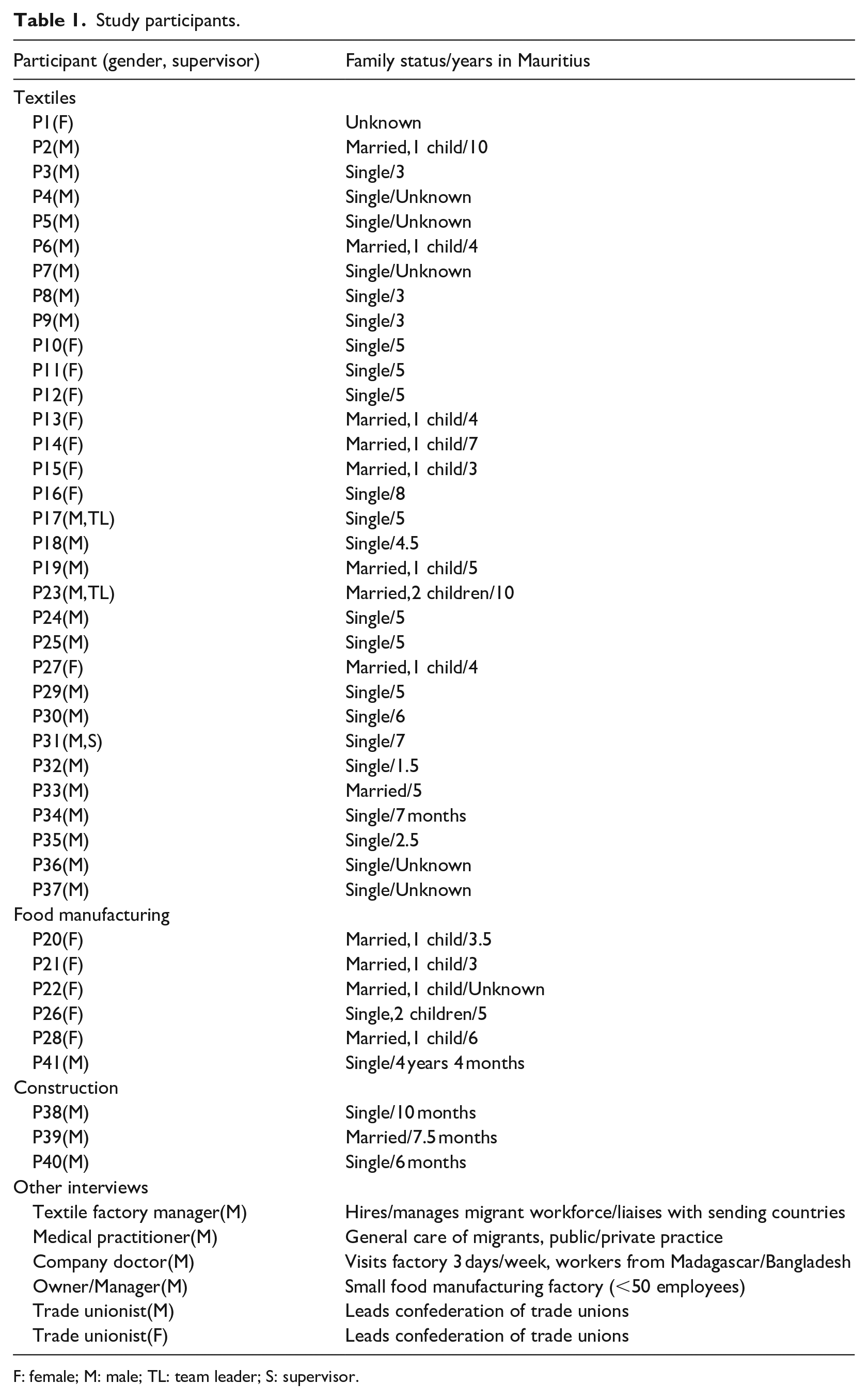
F: female; M: male; TL: team leader; S: supervisor.
Participants provided verbal informed consent at the start of the interview and were assured of their right to anonymity and to stop the interview if they felt discomfort. A single interview (30–50 minutes) was conducted with each participant in Hindi (38), Bangla (two) and English (one). The interviewer was accompanied by a male and female interpreter from the resource centre who did not know the workers. A supervisor was present during one, and team leaders during three interviews. Potential for intimidation or intervention was minimized as the supervisor was a native Mauritian and did not understand Bangla/Hindi. Two of the three team leaders (P17/P23) were also interviewed to increase their engagement in the study.
Interviews were semi-structured to encourage flexibility and vivid narratives. Questions covered initial migration through to future aspirations: pre-migration experiences (e.g. life in Bangladesh, reasons for migration); experiences of work/life (e.g. living arrangements, food, leisure, typical working day, workplace culture, working with Mauritians, conflict resolution); future plans (e.g. aspirations); and objective and subjective signs of ‘feeling well’ (e.g. health/safety, support networks, resources, autonomy/belonging, adaptation to Mauritian culture, religious freedom). In-depth methods, such as storytelling, may have allowed deeper insights relevant to transient migration experiences. However, our main interest was the nature of work and living conditions (in dormitories) which are relatively stable given tightly regulated contracts, allowing sufficient richness to emerge from each interview. Interviews with managers focused on resources for leisure activities, health services, safety at work and compounds, religious/cultural facilities and rewards. Interviews with a general practitioner and company doctor covered workers’ health and treatment.
Thematic data analysis used hybrid coding based on pre-empirical and emergent codes (Fereday and Muir-Cochrane, 2006). Initial coding was based on a priori themes related to biographical information, broad interview areas and the four sites of well-being, distinguishing between positive/negative objective and subjective signs. Table 2 shows Prilleltensky’s (2008) original positive/negative signs (in italics) and themes identified in the data. Both a priori and a posteriori codes were collapsed to produce final sub-themes reflecting how participants experienced well-being at each site and how workers displayed agency to reclaim meaning as represented by positive subjective signs (efficacy, voice, support, belonging). This iterative phase, carried out by both authors, involved re-reading and coding each interview as more themes emerged. Further categorization linked these positive subjective signs to Laaser and Karlsson’s (2022) typology to reveal meaning creation through the interplay of subjective autonomy, recognition and dignity. Figure 1 presents this interplay as a triangle with two-way flows between each dimension in navigating the struggle for meaningful work. As an illustration, positive subjective signs at the relational site related to voice were manifested in informal collective organizing. The themes representing voice were then categorized as reflecting either or both ‘subjective autonomy’ and ‘subjective dignity’ based on the typology’s definition of these dimensions (see Supplemental Table for full set of themes and illustrative quotations). Interview transcripts and fieldnotes were coded using NVivo and ATLAS, respectively.
Themes for four sites of well-being.
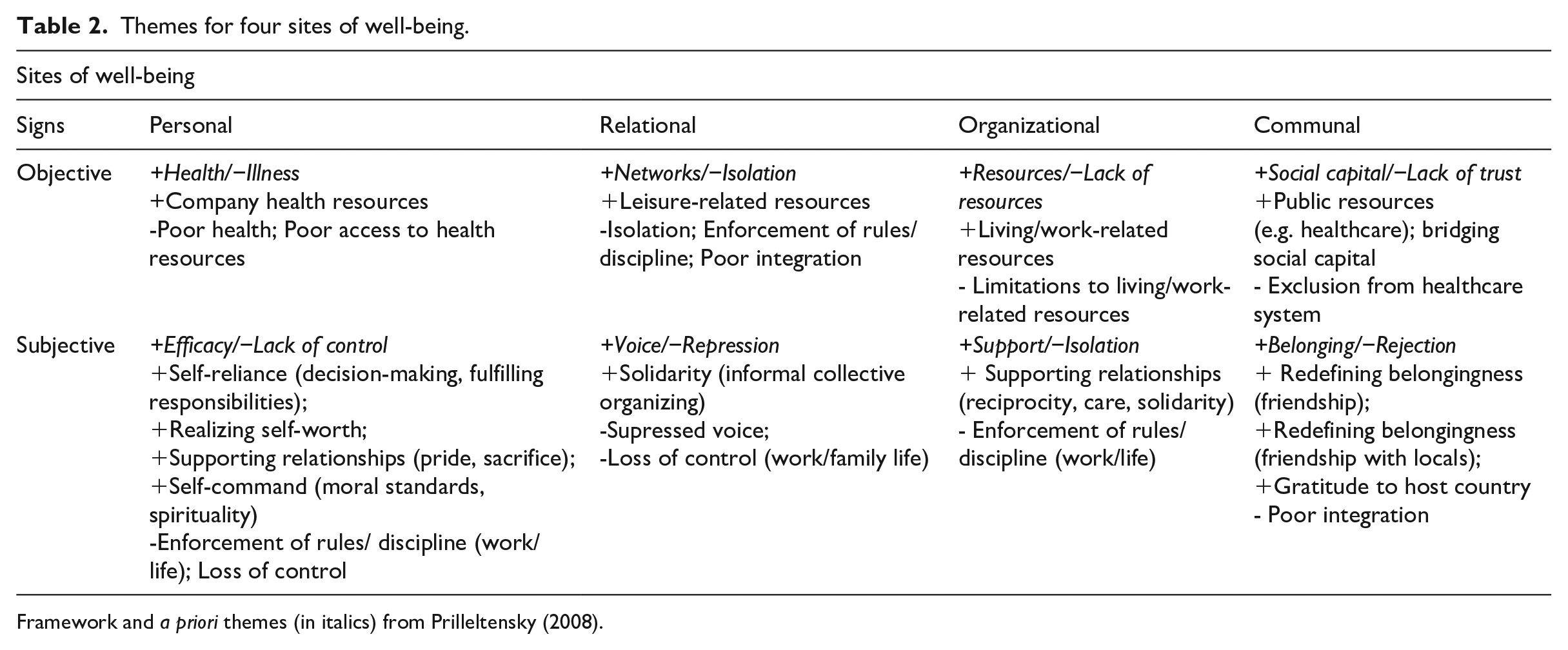
Framework and a priori themes (in italics) from Prilleltensky (2008).
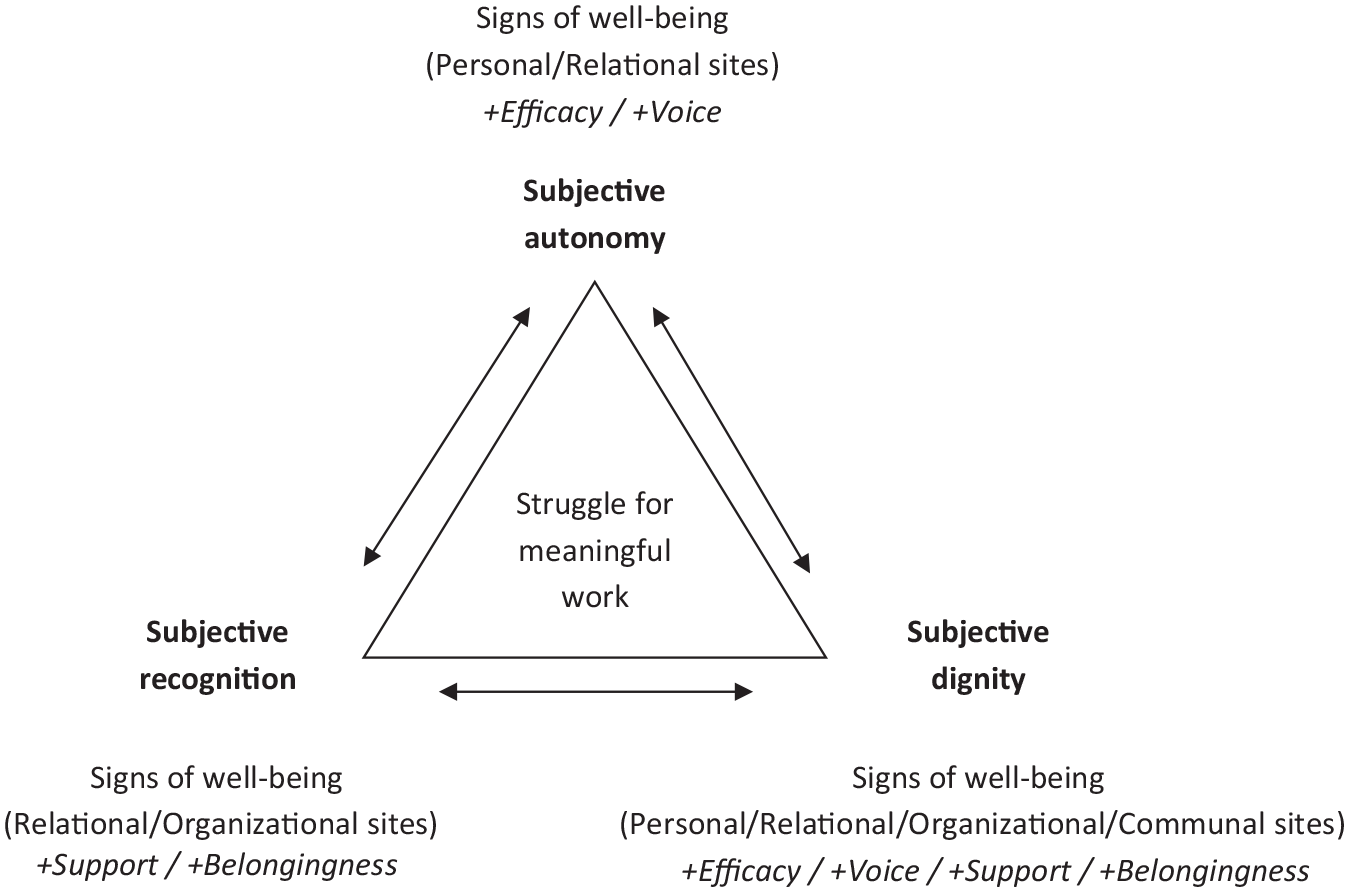
Signs of well-being and the interplay between subjective autonomy, recognition and dignity.
Findings
We first summarize objective conditions and signs for each site of well-being (RQ1), showing how organizational and social control permeated work and life. We then elaborate on workers’ efforts to mediate these conditions (RQ2).
Objective signs of well-being and the formal structures of work and life
Personal site: Access to resources, health and daily life
Signs of positive personal well-being were found in companies’ provision of healthcare, food, housing, transportation and leisure-related resources. These were part of the employment contract to promote a healthy workforce, provide a safe place to live and work, job security and economic stability, but were accompanied by strict rules and structures. The following account illustrates both a feeling of being well looked after and strict curfews: ‘We do not go out because we got everything. Downstairs of our house there is a shop. At 9 pm we have to be at home. At 10:30 all lights must be off. We must sleep’. (P23) Similarly, despite health provision, workers reported suffering from several types of pain and chronic fatigue as mentioned by the medical practitioner who interacted regularly with workers: ‘They come and they say that they are getting pain, back pain, body pain, headache here and there. . .. They tell me that their belly is hurting, that they have not eaten . . . most of the time it is only male workers who come’. (Medical practitioner, public/private)
Companies differed in their approach to providing healthcare. Only one textile company offered the weekly visit of a company doctor, although workers here had to buy their own medicine. In others, the common practice was to hire a nurse or offer onsite first aid. Migrants faced language barriers and relied on a team leader for translation. This limited access to healthcare as the worker-team leader ratio was relatively high. In public hospitals, a ‘no team leader no treatment’ policy was common and team leaders often discouraged workers from follow-up appointments as it disrupted productivity. One textile worker explained why she doesn’t follow up on a recurring illness: ‘I told the team leader and he said, afterwards’. (P13) For workers seeking private healthcare, language barriers remained a problem: ‘The doctor told us to speak in creole or English which I don’t know’. (P13) Ten out of 27 textile workers faced difficulties in accessing adequate healthcare, either due to team leader and/or transport availability and/or production pressures. Two out of the three construction workers and three out of the five food manufacturing workers reported similar issues; for example: ‘I told my company that for two days I was very ill. I told all the staffs, but nobody was taking me to the hospital. So, I went to the office and remain seated there from morning. So, then he [the boss] took me to the hospital in the afternoon then he got me admitted. Then nobody came to see me’. (P38)
Participants reported feeling anxious, sad or depressed. Of the 10 workers who described at least one instance of poor mental health, nine were male and one was female. Anxiety was often linked to debts. More male workers had taken loans than females, resulting in repayment anxiety for some: ‘I do not feel good here. I want to go to Bangladesh now because I have to give back the money for the bank loan, that is why I am living’. (P36) Construction workers expressed unmet expectations with respect to personal protective equipment: ‘whatever we were told we got nothing. We got only helmet and safety belt. We got only two things and nothing else’. (P38) Conversely, female workers felt positive about supporting their families in Bangladesh: ‘I did not feel happy because I left everyone and came. . .It is good now, I am working and sending money to Bangladesh monthly’. (P22)
Companies provided either a food allowance or ready-cooked food, but those receiving food described it as poor quality and unsatisfying. In one company, management was in direct control of food provision and workers’ calorie intake, as described by the manager: ‘Now we are also working on balanced diet, we are seeing how many calories they are eating, how much food wastage there is per person’. Although this was intended as beneficial to workers, the medical practitioner’s comment above suggests otherwise. One construction worker described the food as only ’to feed my belly and then enough for me to go to sleep’. (P40)
The lack of sensitivity to workers’ preferences and needs, and their limited opportunities for voice, can also be seen in housing arrangements. Dormitories, the only type of accommodation provided, consisted of shared, gendered facilities. As described by one participant: ‘It is a roof on top of our head, but the place is not good. We have no place to keep our clothes here. We have many things to keep but in only two lockers. What can we keep in it?’ (P36)
The lack of facilities to exercise their prayer ritual, Namaz, was a concern. One female textile worker found it difficult to pray in the allocated TV room in the dormitory while ‘some girls walk around, talk on the phone’ (P12) and a male textile worker described reclaiming time from lunch during work: ‘Friday, the day for Jummah, the time we get for lunch, we save 20 or 30 minutes from that then we read Namaz’. (P37)
Thus, employment was conditional on rules which transcended working life into daily existence. The degree to which formal social control saturated life and work can be seen in the following account: ‘We wake up at 6 o’clock in the morning, on waking up at 6, we get fresh, we eat food then we go in the vehicle then we go in the company. We do the full duty of the company. Then after that we are sent back to the dormitory. Then we get fresh and eat food then we sleep again. That is our routine’. (P37)
Relational site: friendship alongside isolation
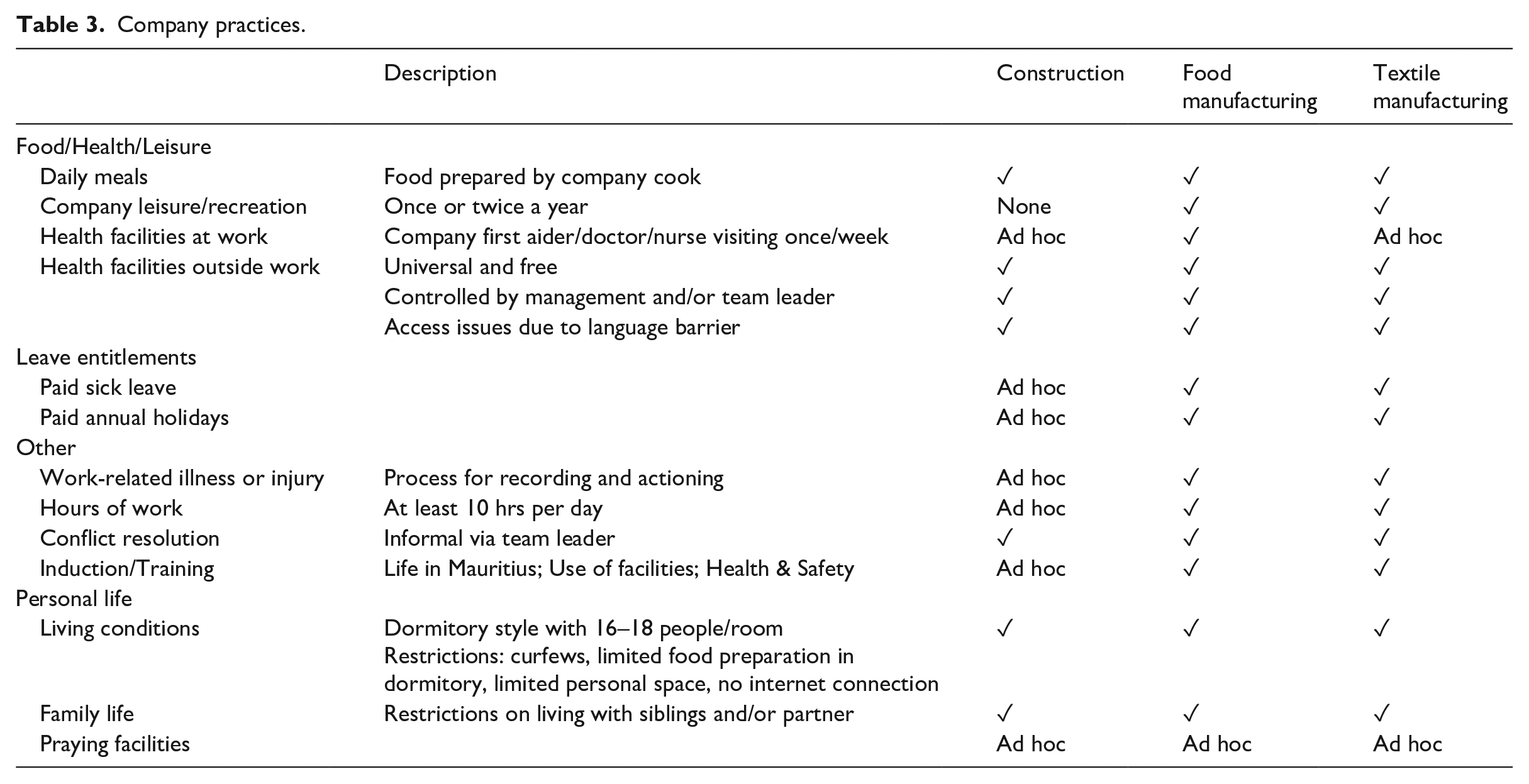
Signs of positive relational well-being were found in companies’ allowance for buying food and company-organized excursions (Table 3). When asked what made them happy, one participant described social bonds with fellow migrants: ‘We sit among friends and talk about something and we get happiness like that. Nothing much [more] than this’. (P36)
Company practices.
Relationships were challenged, however, by the enforcement of rules and discipline. Workers were not allowed to live with their partner or siblings. One textile worker explained how he could not live with his wife and had to follow rules with regard to his married life, such as making sure she did not get pregnant: ‘The agent told not to do this and not to do that. . .if anything like this happens then there may be some problems’. (P19) Eight participants had siblings in Mauritius but were not allowed to live together, indicating that workers have limited voice and choice over family life. As described by P10′s team leader during her interview ‘we prefer to keep them [relatives] separately to prevent conflicts’. Other rules like dormitory curfews and sleep times, and limited interaction with other migrant workers caused migrants to be isolated from wider society although feelings of loneliness were not expressed by any participant. Workers experienced limited contact with local workers and were given few opportunities to talk in the workplace other than for completing work: ‘If we are working in a production line, we will have to ask for tasks if same is not being sent to us by our colleague working behind’. (P6)
Organizational site: control and discipline
Company resources (Table 3) were all linked to rules that controlled work, health, sleep, religious practice and leisure activities, signifying the absence of objective autonomy, worker recognition and dignified treatment. Workers were aware of and accepted these rules, team/house leaders implemented them, and those who deviated were sanctioned. Company rules were the backbone of control and discipline and were cited mostly as negative subjective experiences, with little evidence of contributing to personal well-being beyond provision of health and leisure resources.
Production lines in textile and food manufacturing were driven by technical control over the direction and speed of work. A team leader noted the need to ensure production targets were met and identify those who deviate: ‘There are some people who have become expert in the field, so they won’t have target issues. But we also have some lazy people, these people will be sent to the office’. (P23) ‘Shouting’ or ‘taking the lazy worker to the office’ were common practices. One worker (P2) in the same company also described how ‘shouting’ is necessary to discipline Bangladeshi workers to work hard.
The formal structure in all companies included a house and team leadership system which functioned as a link between workers and management. Team and house leaders implemented rules and provided support for workers in and outside work. In addition to helping workers access healthcare at public hospitals, they played an important role in the grievance procedure and conflict resolution, although grievances often were not taken to top management as described by this team leader: ‘Every month we go to the place where they live and see if there is a problem of food or sleep or fight. Fight problems must be seen the same day. For food we sit every month with every dormitory and we solve the problem ourselves’. (P23) Workers’ formal voice was also suppressed, as narrated by this textile worker: ‘Boss sent back those who are not good, those who talk a lot, those who fight, some days ago there was a fight you know, he sent them all back. If there is problem at work, we do not talk to the boss. It is the supervisor who talks. We do not know anything. We are just working’. (P29)
Table 3 shows that ad hoc practices were more prevalent in the unregulated construction sector. Textile and food manufacturing companies are closely regulated as part of the EPZ scheme, yet formal practices were often ignored. In construction, P38 and P40 were denied sick leave, and had limited access to training despite having no previous experience: ‘The safety officer told a bit here and there. To look after my health, to be careful a bit, so I did not get any training. They just put me to work’. Similar issues were faced by a textile worker describing not receiving the pay he was due for his role, as specified in his work permit: ‘Like that they cheat us a lot’. (P37) Another two textile workers (P17, P29) reported that their contracts were retained by the company, indicating lack of transparency and trust.
Communal site: social justice and exclusion
The host country’s social justice system and public resources, including free access to healthcare, freedom of religion and right to vote (after 2 years residency) can be characterized as supporting personal and communal well-being. Many participants felt safe and accepted by the host community, as in this example: ‘Mauritius is good for roaming and staying as well. People don’t treat us as stranger[s], instead they will help us. They stay in unity and treat us as their own’’. (P9)
These protections were limited, however, as observed in the personal accounts of accessing healthcare and legal restrictions on personal life. Moreover, workers lacked integration in the host country due to limits on the duration of the employment contract and living and working arrangements that limited their contact with locals or those from the same ethnicity: ‘Normally we don’t know too many people here. It’s only in our work that we know few Muslims. And not everyone is so friendly like inviting us at home. They do talk, joke etc. but only at work nothing more’. (P1)These workers, therefore, were cut off from wider society, both in the host country and home, for an appreciable period of time.
Subjective signs of well-being and the struggle for MW
Personal efficacy and voice
Despite the absence of objective autonomy in their work and lives, participants derived a sense of efficacy and voice which was reflected in signs of personal and relational well-being and contributed to subjective autonomy and dignity (Figure 1). Positive subjective evaluations related to efficacy often were connected to fulfilling family duties and obligations. Most came from large families ranging from four to over 12 people. Twelve out of 27 male workers and 12 out of 14 female workers confirmed that they were financially supporting their family in Bangladesh (e.g. educating their children or younger siblings, paying for parents’/grandparents’ medical treatments). Fulfilling one’s family obligations engendered self-worth and pride, as expressed by this female whose husband also worked in Mauritius: ‘We know how many difficulties and patience we need at work here. Now, I think bigger for my children. They will not do such work. They will study more - then [she] decides what she wants to do’. (P22)
For men, self-reliance, self-worth, pride and sacrifice were also evoked in repaying migration-related debts. Eleven of our 27 male workers took loans compared to only two female workers and most participants had taken bank loans through mortgaging property and/or money from family and friends. These debts were significant due to high agent recruitment fees. They were entrusted with repaying debts and were acutely aware of ensuring the collective decision for them to migrate was worthy. Our interviews showed that self-worth was derived from repaying debts as well as making sacrifices over one’s personal well-being to fulfil these obligations. This single male textile worker reflected: ‘Health - what is it? That I live well, that’s it and I work more and send money to Bangladesh, that’s it’. (P36) Following reimbursement, life decisions indicated a freedom to choose, either to stay or return, and gain voice with respect to the future, reflecting personal and relational well-being: ‘I have repaid that in the last 7 months. Now I will stay here to work for 2 months. I will go back later’. (P39)
Self-reliance was also manifested through control on decisions about their future and that of their family. They mentioned saving for their weddings, building a house or starting businesses. For men, plans were self-determined and dynamic: ‘I will have to see how the situation is . . . if it is not good then I will have to return here to Mauritius or any other place. If it is good in the village. . .then I will look for a good shop’. (P24) Another stated: ‘My aim was to come to a new country earn some money, help my family future building’. (P3) Women often described their plans as other-oriented; for example, when asked if she wanted to renew her contract, this worker responded: ‘Yes I would like to. But if ever I got married after going to Bangladesh then maybe my husband won’t allow me to come back here’. (P16) Women placed importance on saving money, as in this single mother. ’I want to build a house. If I do not have a house, how can I live with my children? That is why I keep some money for my daughters. I do not have a son’. (P26) Three women spoke about setting up a business when they return to Bangladesh and two about supporting their future husbands. One commented: ‘My mum saved my money for marriage . . . if my husband is nice, am going to open a business for him’. (P16) Patriarchal cultural norms also influenced women’s decisions. For example, P16 described her plans as follows: ‘I will get married. Help my husband in his business. Have children. Stay at home. If my husband doesn’t want me to work I will go roaming’.
Self-command demonstrating personal well-being was evident through migrants’ ability to re-organize work schedules to accommodate spiritual and religious practices. They engaged in Namaz (praying) at different intervals during the day despite companies having minimal workplace provisions for prayer. Men were able to find alternative times and spaces during the Ramadan fasting month: ‘I eat near the canteen and at one o’clock I read Namaz there and on Friday I go to the mosque’ (P19). Females recreated this spiritual space outside work, although this occurred in shared common areas.
Expressions of voice linked to relational well-being were visible through informal collectively organized activities, such as planning and preparing food and assigning roles: ‘we do a group of around four to five people for a full month. We run the mess room (kitchen). The group goes to the market for a month then the second group goes to the market’. (P37) Opportunities for informal gatherings and working together to improve living conditions instilled a sense of agency and purpose, responding to unsatisfactory organizational provisions. Collective activities were more evident for men, as can be seen in these contrasting accounts of leisure time: ‘I go out with friends, talk to my relatives abroad. There is a playground there, one day I played football with 10 to 20 people’. (P17, male) ‘I will wake up at 9am, have my breakfast, do my chores, go to buy groceries then prepare my food and eat and then sleep. What else?’ (P16, female)
This preference for staying in, cooking and reading the Quran was expressed by half of our 14 female participants. Such personal efficacy was the primary source of subjective autonomy for women who did not engage in organized collective activities. Unlike male workers, their ‘voice’ manifested mainly as part of their role as family providers but this remained culturally defined. Seven out of 12 females who spoke about family responsibilities also explained how important decisions at home remained male-driven: for example, ‘I gave the money to my father who bought land’. (P28) Male workers took collective action when problems arose, as narrated by this construction worker: ‘At first we were getting none [holidays and bonuses], then we did strike, then the company gave holidays. Later we got food problem. So, we went to the Labour Office and now the company is giving full holidays’. (P38)
Expressions of voice, therefore, which are important for subjective autonomy and dignity, differed for men and women. Women displayed little agency in creating autonomous spaces and organizing collectively. Formal structures played a key role in this, but culture and spirituality also shaped their form of agency. For example, moral standards and spiritual beliefs often underpinned female workers’ problem-solving and help-seeking strategies. Their efforts to maintain moral standards shows compliance to spiritual beliefs where they sought direction from a higher power, described as God or Allah, rather than from colleagues or management. These women expressed hope about the future by placing their faith in this entity:
Interpreter: ‘Don’t you feel scared when you are in a foreign country?’ Respondent: ‘No never. No one feels scared. Everything will happen depending on Allah’s choice. I pray a lot’. (P15) ‘Yes, sometimes I do get ill. There is a doctor at the office, but God keeps me well’. (P27)
For men, religion was more a basis of self-discipline at work, as one explains: ‘Do work on time and remember God the other time’ (P29). Applying these moral standards maintained social order and avoided undesirable behaviour, as in the case of alcohol consumption recounted by one team leader (also Bangladeshi): ‘You know, we are Muslim and as the house leader I asked everybody not to drink as it is inauspicious. There are some who are bad but not all. I asked them never to drink as it is not good for Muslim and if five would dance ten will get disturbed’. (P17)
Supporting relationships and belongingness
Formal organizational provisions supported well-being to some extent, but these practices were ad hoc, ignoring individual needs. Informal collectives instilled values of care, respect and esteem from peers, usually expressed through solidarity, supporting relationships and belongingness. These were manifested as signs of well-being within and beyond the workplace across relational, organizational and communal sites, and provided a source of recognition and dignity which mediated the hardships of working life (Table 2/Figure 1).
Subjective recognition was evident in the mutual exchange of information, goods, emotional support and time. Workers received pre-migration information from networks which protected them from the most exploitative workplaces and offered them choice: for example, ‘The company leader is a good friend of my brother. I left job there and came here. I am working here well since 5 years’. (P25) Others talked about their aspirations for family; for example, ‘I want to bring my little brothers here; I will see if I get a good company. . .They too would work and become someone’. (P28) Workers also shared leisure time and helped in case of illness, as described by P28 who sewed dresses for her friends, and P12 who explained: ‘If someone is having [a] hormonal issue, then I will read Quran for them. I will give them sacred water’. Male participants showed a strong sense of solidarity by sharing resources during menu planning; for example: ‘Everybody gives and contributes their part. If there is a lack of money too there is no problem, we add. If the money is left, then we cook special biryani’. (P23) Both male and female workers were able to redefine belongingness guided by values of care, solidarity, reciprocity and friendship, as captured here: ‘Here, I got a big house but still I feel that I am living in a village. All living together. Some are from different places. . .Bengali people are here. Our relations became brothers and friends here’. (P36)
Support networks extended beyond the workplace with strong connections to family in Bangladesh and partners and siblings who also had migrated: ‘I go on Saturday afternoon after work then I leave at night. We cook a delicious food then we talk, we phone our family to talk to my mother, sister. We talk together then they are happy as we are together’. (P30)
Workers also felt respect from locals. They expressed gratitude for the opportunity to work and live in Mauritius, valued the country’s good legal system, its free healthcare system, the level of safety and peace, its people and the freedom to practice their religion. This perception of social justice norms is an indicator of communal well-being through being given access to resources otherwise restricted in Bangladesh. Although the control imposed through the employment contract made full integration unachievable, the reflections of one female illustrate feelings of freedom, respect and a safety net expressed by many participants: ‘Mauritians respect Bangladeshi people a lot because they know we do not have anybody here. . .but Bangladesh is not like that. There you go to the hospital; you may die if you have no money’. (P22)
In terms of personal relations with the local community, the sentiments of this worker were common and reflect some bridging social capital based on interactions with the host community: ‘They [Mauritians] are nice; they address me as their daughter’. (P11)
Discussion
By presenting precarious work as a ‘struggle’ for meaning, we situated employee well-being within the politics of working life. Our empirical focus was migrants in the global South, whose struggle takes place in the contested terrain of global capitalist organizations and social and economic marginalization. Findings showed positive objective signs of well-being derived from company resources and host country integration (e.g. access to healthcare), however, these resources were ad hoc or dependent on managers’ discretion. Organizational control permeated work and life, repressing autonomy and voice, and poor health and isolation were evident. Despite these challenging conditions, subjective signs of well-being indicated autonomous actions and informal collectives which enhanced personal efficacy, voice, relationships and belonging. These signs of well-being were shown to reflect the relational interplay between Laaser and Karlsson’s (2022) three subjective dimensions required for the creation of MW (autonomy, recognition and dignity). Analysis also showed how individuals’ construction of well-being navigated across sites, such that denials at one site (e.g. personal) were buffered by efforts to reclaim meaning at another (e.g. exchange of material and non-material resources beyond the workplace at relational, organizational and communal sites of well-being). Men and women often followed different pathways in their construction of meaning, but, for all participants, self- or collectively-organized activities were guided by, and generated, self-reliance, self-efficacy, pride, moral standards, reciprocity, solidarity and social capital bonds with other Bangladeshis.
The study’s overarching theoretical contribution is to provide a contextualized understanding of what ‘being well’ entails. We do so in three distinctive ways. First, we add explanatory depth to multifaceted conceptualizations of well-being which span multiple life domains by situating employee experience as a struggle to mediate the absence of objectively meaningful work (MW). Laaser and Karlsson’s (2022) sociological typology of MW provides critical realist theoretical tools to analyse both structural context and worker agency in constructing well-being. The typology was applied in a novel way to a framing of well-being which differentiated personal, relational and communal sites (Prilleltensky, 2008). Informal organization and actions (reflecting worker agency) were found to drive meaning creation (strong subjective tendencies) even when objective MW is absent. Such meaning creation was linked to well-being identified at relational and communal, as well as personal sites.
Second, this framing offers an alternative to individual-level theorizing of well-being which focuses on explaining physiological and psychological experience, considering context only as an antecedent or moderator; for example, focussing on individual reactions to excessive demands or organizational (coping) resources (Sonnentag, 2015). A germane illustration is provided in Allan et al.’s (2021) expansive integration of macro-level and psychological theory on work precarity, which links (a) socioeconomic/historical structural forces (e.g. marginalization of migrants), (b) the nature of work (e.g. absence of workplace rights/protections) and (c) individual-level outcomes (e.g. less meaningful work, mental ill health). These authors call for interdisciplinary and integrative theory to expand understanding of these links. Conceptualizing well-being in precarious work as a struggle for meaning offers a deeper understanding of the purpose of work and its connections with other aspects of life (Hammer and Ness, 2021) as well as elaborating on the nature of, and interplay between, the social and psychological mechanisms underlying the construction of meaning (Rosso et al., 2010). Our study confirmed the structural constraints to migrants’ agency and well-being, but also demonstrated informal strategies which shaped personal efficacy, voice and relational concepts. This offers alternative routes to well-being from what may be expected; for example, the presumed negative effect of job insecurity on work identity and well-being (Selenko et al., 2018).
Related to this, a third contribution comes from findings accentuating the gendered and culturally-determined nature of agentic meaning mechanisms. Men derived autonomy, collective voice and recognition from informal activities with peers, even enabling direct action against abuse at work. Women appeared culturally bound by norms and religious values that made them less willing to express dissatisfaction. This was evident in their reluctance to visit the doctor or discuss their mental health and preference for solitary activities (e.g. cooking, praying). Subjective autonomy and dignity were derived from the well-being of others; for example, pride or feelings of competence in contributing to their families. Such findings mirror the ‘displaced well-being’ of other female migrants (Boccagni, 2016) and show how migration enhances women’s well-being through acquiring the role of family provider compared to their potentially lower status pre-migration (Wright, 2011). However, the culturally-embedded nature of women’s reluctance to express agency means their voices remain more marginalized than men, especially in southern contexts, where they are also difficult to access (Akhter et al., 2017).
For both genders, cultural values and spirituality were a source of meaning. Remembering and protecting the family was dominant, as was self-discipline in work and life, often reinforced by Muslim faith. Such behaviour symbolizes a dignified conduct that involves not burdening others unnecessarily and taking responsibility for oneself (Sayer, 2011). Definitions of wellness and well-being, however, are dominated by Western assumptions and embraced by mostly individualistic cultures such as Europe and North America (Dale and Burrell, 2014; Mahali et al., 2018; Oishi and Gilbert, 2016). Similarly, research on meaningful work has tended to rely on Western-orientated values, which often promote individualistic goals, ignoring collectivist or spiritual values beyond the workplace, and cultures where work is more likely a pathway to family and community fulfilment rather than personal well-being (Barreto et al., 2022; Lysova et al., 2019; Rosso et al., 2010). For all migrants, simple dichotomies of well-being as either present or not are inappropriate (Boccagni, 2016) but especially so in southern cultures. Our theoretical framing allowed us to operationalize well-being in a way that is more sensitive to such economic, social and cultural characteristics and how this context shapes resistance to conditions. The study, thus, contributes knowledge on the culturally-embedded lived experiences of well-being, broadening theory developed in generally more individualistic, Western contexts to reflect culturally-sensitive realities (Muzio, 2022).
Given these arguments, a final contribution of this study is empirical, responding to the need for studies from non-Western, southern contexts (Hammer and Ness, 2021; Mahali et al., 2018; Muzio, 2022). This journal itself has long promoted voices which challenge Western-centric assumptions within organization theory (Mir and Mir, 2013). For south-south migrants, as for other migrants, human flourishing constitutes more than an internalized process of ‘feeling well’ (Mahali et al., 2018), and our data from a distinctive population enhances more holistic and contextualized representations of employee well-being. Our focus on an under-researched group also contributes to more robust theory-building through ‘polycontextualization’ (Filatotchev et al., 2022); that is, the use of findings from multiple and especially non-Western contexts.
Going further, the relatively fewer state- and workplace-level protections for migrants in the global South versus North (OECD/ILO, 2018) amplify these migrants’ marginalization and vulnerability. Northern-centric views of precarity rest on different assumptions about the experience of work and life (Allan et al., 2021) and in studies of migration, the complexities of choices and constraints are often subsumed in the narratives of the general workforce or a focus on migration northwards to the exclusion of a southern perspective (Hammer and Ness, 2021). Drawing from data on the lived experiences of south-south migrants, therefore, was especially appropriate for theorizing well-being as a struggle for meaning within an employment context where precarious work has become normalized.
Conclusions
Given that most research has focused on Western and northern contexts, questions remain on the relevance and applicability of dominant discourses of well-being in non-Western contexts, both the cultural universality of key concepts and the contingencies of political economy in how such well-being is understood (Laaser and Karlsson, 2022). Conceptualizing well-being as a struggle for MW moves away from individual-level theory to incorporate both structure and agency, thus avoiding conceptions of precarious workers as simply victims of exploitative employment systems. Despite confirming degradations in work and life, the study identified south-south migrant workers’ strategies for deriving subjective autonomy, recognition and dignity, which underpinned MW. We also provided evidence of culturally-embedded agentic behaviour in the struggle for meaning. For instance, by looking at well-being as a process of constructing meaning through informal actions, women’s reluctance to organize informal collective activities as a route to deriving autonomy risks further marginalization in such precarious southern contexts. Nevertheless, the study also showed women derived subjective autonomy, recognition and dignity from providing for their family’s welfare and future.
The finding that precarious workers construct subjective meaning and well-being in exploitative working environments by no means diminishes the need for state, sectoral and organizational interventions to ensure decent work. Receiving countries and organizations must provide resources which promote migrant worker well-being and health; for example, collaborations between employers and public health providers (Jamil and Kumar, 2021). Global, competitive pressures drive firms to reduce labour costs and enhance efficiency, but efforts to regulate employers and redress employer-employee power imbalances which sustain structures and cultures of exploitation remain vital for ensuring worker well-being.
Supplemental Material
sj-docx-1-org-10.1177_13505084221145631 – Supplemental material for Migrant worker well-being as a struggle for meaningful work: Evidence from Bangladeshi migrants in a developing country
Supplemental material, sj-docx-1-org-10.1177_13505084221145631 for Migrant worker well-being as a struggle for meaningful work: Evidence from Bangladeshi migrants in a developing country by Pratima Sambajee and Dora Scholarios in Organization
Footnotes
Acknowledgements
The authors wish to thank Knut Laaser for his very helpful comments on an earlier draft of this paper.
Funding
The author(s) received no financial support for the research, authorship, and/or publication of this article.

Supplemental material
Supplemental material for this article is available online.
Author biographies
References
Supplementary Material
Please find the following supplemental material available below.
For Open Access articles published under a Creative Commons License, all supplemental material carries the same license as the article it is associated with.
For non-Open Access articles published, all supplemental material carries a non-exclusive license, and permission requests for re-use of supplemental material or any part of supplemental material shall be sent directly to the copyright owner as specified in the copyright notice associated with the article.
