



Abstract
Objective
The impact of augmented reality (AR) exercise apps on health-related behaviors and outcomes remains underexplored. Grounded in affordance theory, this study investigates how the utilitarian, hedonic, and social affordances of these apps influence user engagement, ultimately affecting continuance intention and subjective well-being in China.
Methods
Data were collected via an online survey of 399 users of AR fitness apps in China, recruited through the professional research platform Credamo.com. All constructs were measured with validated scales adapted to the AR exercise context. The hypothesized relationships were tested using structural equation modeling (SEM).
Results
The results indicate that utilitarian (environmental embedding, visibility), hedonic (playfulness), and social (competition) affordances are positively associated with user engagement. This engagement, in turn, positively influences users’ subjective well-being and their intention to continue using AR exercise apps.
Conclusion
This study extends affordance theory by identifying the affordances in AR fitness apps and validating user engagement as the critical underlying mechanism. The findings suggest that designers should prioritize these affordances and health policymakers should leverage them to develop effective, AR-driven digital sports initiatives.
Keywords
1. Introduction
Augmented Reality (AR) integrates digital content into the physical environment, transforming how users perceive and interact with their surroundings.1,2 Various fields leverage AR for different applications, notably in healthcare, retail, education, and tourism. 3 According to Statista, 4 the mobile AR market was valued at USD 11.9 billion in 2024, with projections indicating a rise to USD 13.8 billion in 2025. In the fitness sector, AR exercise apps have emerged as a promising frontier in digital health. 5 These apps enable users to interact with virtual elements, such as workout instructions, virtual coaches, and immersive scenarios, while engaging in physical activities and exercises. A notable example is Tiantian Rope Skipping, an app that offers AR-enhanced workouts (e.g., rope jumping and fitness programs) to over 4.9 million predominantly young urban Chinese users by superimposing virtual coaches, interactive scenarios, and real-time feedback onto physical exercise via smartphones or tablets. 6
The primary goal of AR-enabled fitness technologies is to improve users’ health-related behavior and outcomes. 7 Aligning with the digital health literatures that emphasize sustainable behavior change and holistic health enhancement,5,8,9 this study elucidates how AR exercise apps lead to positive health behaviors (e.g., continued use of AR exercise apps) and derive health outcomes (e.g., subjective well-being). Continued use of AR exercise apps reflects health maintenance behavior 10 and serves as a critical factor in achieving long-term health benefits. 11 However, fitness apps often face the challenge of user abandonment, as individuals often fail to engage with them consistently over time.12,13 Meanwhile, subjective well-being captures the psychological benefits of AR technology-mediated exercise, assessing the extent to which immersive experiences contribute to users’ emotional fulfillment and perceived quality of life. Given that enhancing well-being is a central goal of many public policies and considering scholarly calls for research on the sustained use of fitness technologies, this study investigates how AR exercise apps can effectively promote both continuance intention and subjective well-being.
While existing AR studies have primarily focused on domains such as retailing, tourism, and education,14,15 scholarly understanding of its application in fitness remains limited. Although a growing body of work has begun to examine AR technology in exercise settings, these studies describe that AR can be effective but lack the framework to explain how it works. It remains unclear how and why AR exercise apps are effective in generating wellness outcomes, as well as the psychological mechanisms through which they influence user perceptions and health-related behaviors.
Affordance theory, rooted in ecological psychology 16 and adapted to technology research, highlights users’ perceptions of a technology’s potential to enable specific actions. 17 This theoretical perspective provides the necessary framework for AR fitness, as it moves beyond a feature-centric view to explain how the relationship between the user, the AR app, and the exercise environment facilitates specific outcomes. Although existing studies have explored the utilization of AR-enabled fitness technologies and the effects of their use,7,13,18,19 research through an affordance lens remains scarce. Therefore, our study applies and extends the affordance perspective to investigate the mechanisms through which AR exercise apps foster health behaviors and outcomes. Furthermore, the features of affordances are not universal but are multidimensional and context-dependent. 20 Therefore, identifying the multidimensional nature of the affordances in the AR exercise apps context is crucial. Thus, this leads to our first research question:
What are the dimensions of AR exercise apps’ affordances, and how do these affordances influence psychological perception and health-related behavior?
Furthermore, user engagement has been widely recognized as a key psychological mechanism through which technology affordances lead to positive outcomes.21,22 Evidence from mobile app research indicates that affordances can stimulate user engagement, which subsequently shapes behavioral intentions.23,24 User engagement emphasizes the deep involvement and interactions with AR exercise apps, its specific mediating role between AR affordances and deeper outcomes like subjective well-being and continuance intention remains inadequately explored. By treating engagement as a multidimensional construct comprising cognitive, emotional, and behavioral dimensions, 14 this research clarifies the underlying psychological mechanism between technology affordances and outcomes. This leads to our second research question:
How does multidimensional user engagement mediate the relationship between AR exercise app affordances and outcomes, including subjective well-being and continuance intention?
To address these questions, we construct a comprehensive research model by integrating affordance theory to investigate how AR exercise app affordances foster continuance intention and subjective well-being through the mediation of user engagement. This study makes the following theoretical contributions. First, this study extends digital health research by delineating the mechanisms through which AR exercise apps drive health-related behaviors and outcomes, thereby providing empirical evidence for their effectiveness. Second, the research advances affordance theory by contextualizing it within AR fitness, identifying three salient affordance dimensions: utilitarian, social, and hedonic, that align with user exercise motivations and technological features. By contextualizing these three dimensions, our study enriches the existing literature by explaining how AR-specific actionable possibilities shape key outcomes such as well-being and sustained usage. Third, this study explores the mediating role of user engagement between affordance and AR exercise app use outcomes, providing a deeper understanding of how cognitive, affective, and behavioral engagement translate technological features into tangible benefits. Additionally, this study also offers valuable guidance for stakeholders in the fitness and technology industries, paving the way for the development of more effective and engaging AR-based fitness solutions.
2. Theoretical background
2.1. AR exercise apps
AR exercise apps are digital platforms that integrate AR technology to enhance physical exercise experiences by overlaying digital information, visuals, or interactive elements onto the real-world environment. 13 Unlike conventional fitness technologies such as step counters or instructional apps, these apps transform the physical space into an interactive exercise environment, enabling users to engage with virtual elements in real time and in context.13,18
Recent research on AR in sports and fitness indicates that AR technology effectively fosters behavioral changes by enhancing motivation and situational presence. 19 For example, Jeon and Kim 18 discovered that AR-based exercise programs enhanced the sustainability of physical activity and mitigated muscle atrophy in older adults. Sun and Yuan 13 characterized AR exercise apps as “virtual gyms” that positively affect users’ psychological perception and experiential value. Together, these previous studies demonstrate that by shifting from passive monitoring and screen-based instruction to situated and interactive coaching, AR exercise apps have the potential to enhance user engagement and improve health outcomes.
2.2. Affordance theory
The concept of affordance, originating from ecological psychology, highlights the opportunities or specific actions that the environment offers to individuals. 16 This foundational notion has been expanded into the field of technology and defined as “the possibilities for goal-oriented actions afforded to specified user groups by the technical functionalities of technical objects” 25 (p. 622). Affordance theory emphasizes the dynamic interplay between technological capabilities and user goals within specific contexts. Crucially, affordances are not inherent in the technology itself but are actualized through users’ perceptions and interactions with those contexts. 26
Summary of Affordances in digital contexts.

Given that users typically seek instrumental performance, intrinsic enjoyment, and social connection when exercising with fitness apps, 32 and considering the immersive and interactive characteristics of AR exercise apps, 13 we adopt the classification framework proposed by Wang, Li 28 to categorize affordances into three dimensions: utilitarian, hedonic and social affordance. These dimensions closely correspond to users’ primary goals during exercise and illustrate the mutuality between the user, the features of AR fitness apps, and the exercise context. Specifically, utilitarian affordance serves to fulfill instrumental goals by assisting users in achieving their exercise and fitness goals more effectively. Hedonic affordance refers to the pleasure-oriented capabilities offered by AR exercise apps. Social affordance encompasses those capabilities that foster and sustain social connections among users.
Within these dimensions, we further identify five specific affordances: environmental embedding, anytime-anyplace connectivity, visibility, playfulness, and competition. Firstly, environmental embedding, anytime-anyplace connectivity, and visibility constitute the pivotal utilitarian affordances that facilitate users in attaining fitness goals through AR exercise apps. Specifically, environmental embedding pertains to the extent to which users can obtain integrated and authentic experiences by visually integrating virtual content into their real-world environment. 33 This affordance enhances the user’s sense of spatial presence by making digital objects appear naturally situated in their surroundings. Anytime-anyplace connectivity illustrates “a physical association between users and technology artifacts that afford the users access to services anytime and anywhere” 34 (p. 3). Rooted in mobile ubiquity, this affordance supports instrumental goals such as consistency and accessibility. 13 Visibility indicates the potential for users to access the clear, intuitive presentation of fitness information, such as instructions, performance data, and progress metrics within the AR exercise interface. 20 This affordance ensures that workout feedback, guidance, and statistical cues are overlaid in an intuitive and legible manner, enabling users to monitor their exercise performance. Collectively, these affordances enhance the functional value of AR exercise apps: environmental embedding establishes an immersive context, visibility supports cognitive monitoring of performance, and connectivity provides ongoing accessibility.
Furthermore, playfulness represents a core hedonic affordance, pertaining to the capacity of AR apps to elicit intrinsic enjoyment.31,35 Playfulness encompasses a variety of enjoyable interactions facilitated by AR technology, such as game-like interactions, imaginative scenarios, and intrinsically motivating challenges, emphasizing its potential to make the exercise experience more captivating and pleasurable. 36 Additionally, competition embodies the social affordance dimension, reflecting users’ perceptions that AR exercise apps enable them to compare their performance with others. 37 Through features such as leaderboards, real-time rankings, and asynchronous challenges, this affordance stimulates social comparison and strengthens interpersonal connections among users.
2.3. User engagement
O’Brien, Cairns 38 defined user engagement as “a quality of user experience characterized by the depth of an actor’s cognitive, temporal, affective, and behavioral investment when interacting with a digital system” (p. 29). This concept transcends superficial interaction, representing a state of deep connection and involvement that arises from meaningful immersion in technology-mediated activities. It is widely regarded as a key driver of positive behavioral outcomes, such as user retention,21,23 WOM intention, 24 and co-creation. 39 These outcomes underscore the importance of fostering deep and sustained engagement, particularly in interactive digital platforms such as fitness apps.
By overlaying interactive virtual content onto the user’s physical environment, AR exercise apps create a uniquely immersive platform that fosters user engagement. Unlike traditional fitness apps, which often depend on static screens and pre-recorded content, AR exercise apps integrate physical movement, spatial awareness, and real-time feedback into the workout experience, enabling embodied and contextually embedded interactions. 33 This integration of digital elements with real-world environments has the potential to intensify users’ cognitive absorption, emotional excitement, and behavioral persistence, thereby transforming routine physical activity into a compelling and engaging experience. Previous studies have revealed that AR technology significantly promotes user engagement.40,41 For instance, Jessen, Hilken 42 showed that AR enables creative customer engagement by visually displaying the relations between products and services. However, most studies on AR and engagement have centered on retail, education, and tourism contexts.1,14,15,43 Despite the rising popularity of AR in fitness, little is known about its effect on multidimensional user engagement in this domain. As Zhou, Krishnan 22 highlighted, understanding engagement with fitness technology is vital for promoting sustained use and lasting health benefits. Therefore, understanding how AR exercise apps affordances shape user engagement is critical to unlocking their full potential in promoting long-term fitness adherence and subjective well-being.
This study considers user engagement as a multidimensional construct, encompassing cognitive, emotional, and behavioral dimensions.14,21,44 Cognitive engagement reflects the extent of cognitive effort and focused attention that users invest during their exercise process. 23 High cognitive engagement means users are mentally absorbed in the AR-enhanced workout, actively processing real-time feedback, and maintaining sustained concentration to overcome virtual challenges. Emotional engagement pertains to the feelings and emotional connections that users develop with AR exercise apps.14,45 Emotional engagement involves experiencing positive affective states such as excitement, enjoyment, and passion during AR exercise sessions. Behavioral engagement reflects the observable actions and effort users exert in interacting with the AR exercise app. 45 It includes the time, energy, and persistence invested in using the app, such as completing full workout sessions, exploring new AR features and exercise programs, or consistently tracking fitness progress.
3. Research model and hypothesis developments
Building on the existing literature, our study constructs a research model to examine how technology affordance influences subjective well-being and continuance intention through user engagement. Specifically, by classifying affordance into three dimensions, we specify the effects of utilitarian, social, and hedonic affordances on user engagement (H1-H5). Subsequently, we propose hypotheses delineating the relationships between user engagement and subjective well-being (H6) as well as continuance intention (H7). In addition, user engagement is treated as a second-order factor consisting of cognitive, affective and behavioral engagement (Figure 1). The research model.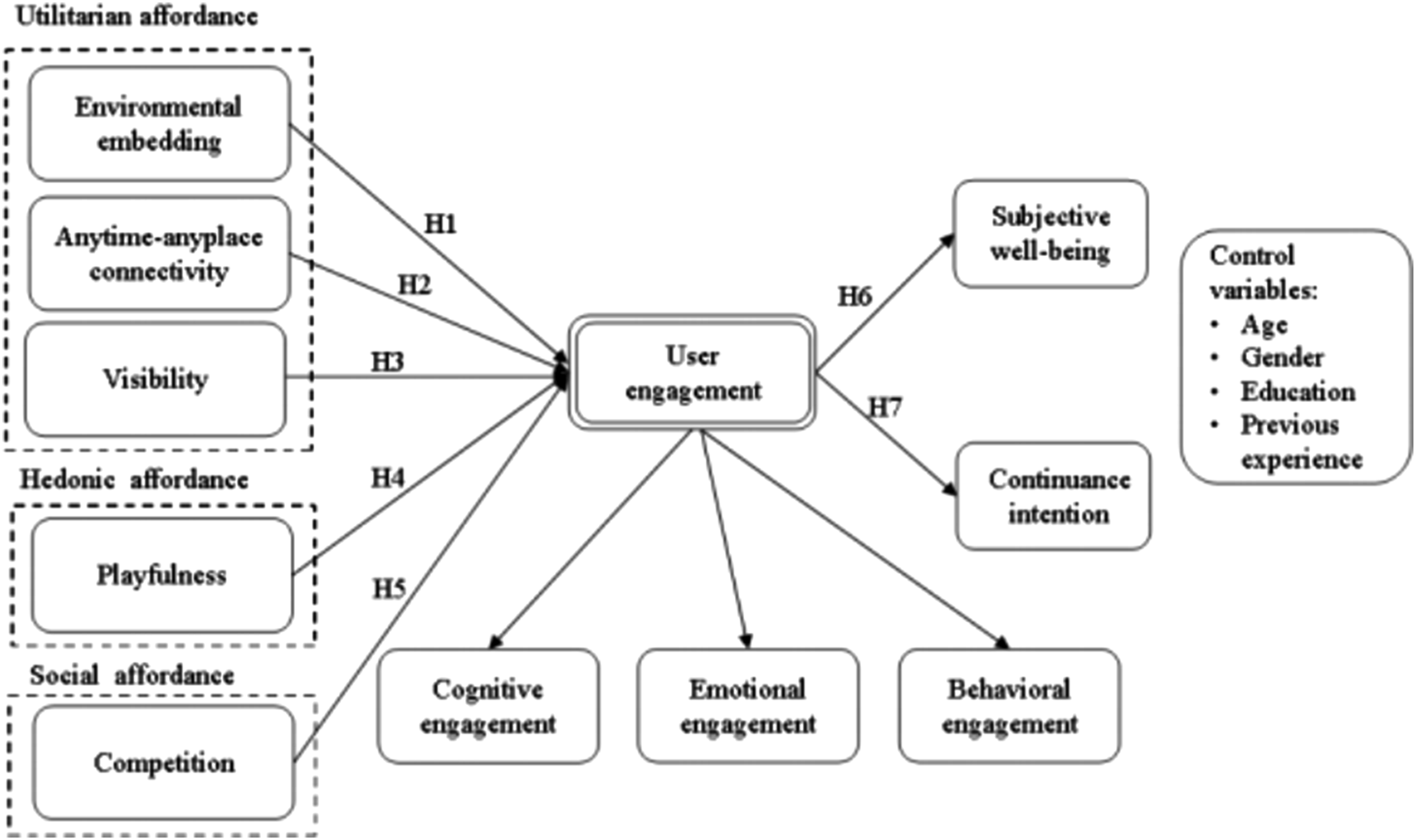
3.1. Utilitarian affordance and user engagement
Environmental embedding, regarded as an empowerment factor of AR,2,43 enables users to align their exercises and postures with real-time virtual scenarios. This affordance transforms the exercise experience by creating a unified reality where digital objects coexist interactively with the user’s environment. 13 The perception of environmental embedding evokes users’ sense of spatial presence and realism, which in turn is considered to enhance user engagement. 46 Furthermore, the seamless integration of virtual elements with the user’s bodily awareness fosters a state of sensory immersion, 47 characterized by focused attention and reduced distraction from the external environment. This immersive experience makes the exercise more captivating and enjoyable, 33 ultimately generating emotional involvement and positive arousal.2,46 Therefore, we propose the following:
Environmental embedding exerts a positive influence on user engagement.
As a foundational feature of mobile and AR technologies, anytime-anyplace connectivity affordance enables users to integrate physical activity seamlessly into their daily routine, whether at home, in the office, or while traveling.13,40 These seamless accessibility offers users greater flexibility in scheduling and location choice, potentially lowering barriers to exercise initiation and encouraging more frequent physical activity engagement. As Alalwan, Algharabat 48 argued in the context of mobile shopping, ubiquitous connectivity is likely to cognitively and emotionally contribute to customer engagement. Although ubiquitous connectivity has become increasingly normalized in today’s digital ecosystem, its value may persist when combined with AR’s immersive and interactive features, as it transforms ordinary spaces into engaging workout environments. In the context of AR exercise apps, the ability to exercise in any setting without sacrificing interactivity or immersion may increase perceived convenience, reduce barriers to exercise, and foster greater enjoyment and satisfaction. 49 Thus, we postulate that:
Anytime-anyplace connectivity exerts a positive influence on user engagement.
By enhancing information transparency and cognitive legibility, visibility enables users to effortlessly perceive and interpret their performance status. 20 For instance, when user see a real-time feedback cue such as “95% accuracy”, they can instantly evaluate the alignment between their movements and target performance standards. This clarity enables users to allocate greater attentional resources to comprehending and refining their exercise execution. This visibility affordance further amplifies goal-gradient motivation, leading users to intensify their effort as they perceive themselves moving closer to desired outcomes. 19 Meanwhile, the presentation of positive performance feedback during training stimulates feelings of satisfaction and triggers positive emotional reactions. 50 In addition, consistent and positive performance feedback could reinforce perceived competence, a core psychological need in self-determination theory. 7 As users encounter clear and confirming evidence of their progress, they cultivate stronger self-assurance in their capabilities, which in turn enhances intrinsic motivation and promotes deeper behavioral engagement. 21 Therefore, the following hypothesis is proposed.
Visibility exerts a positive influence on user engagement.
3.2. Hedonic affordance and user engagement
Playfulness, a core hedonic affordance of AR, may arise when users participate in activities such as virtual scavenger hunts in their living rooms, hitting rhythm-based targets that appear in sync with music, or receiving playful visual rewards for completing exercise sets.51,52 Playfulness plays a crucial role in fostering users’ intrinsic motivation for autonomy, 53 which in turn has been demonstrated to enhance user engagement.22,24 Furthermore, playfulness is often associated with positive emotions, such as joy, excitement, and amusement, and can facilitate immersive experience or flow states.35,54 By positively influencing cognitive and emotional states, playfulness affordance encourages deeper engagement with AR exercise apps, promotes functional exploration, and prolongs interaction time. Consistent with this, Zhou, Lin 35 found that playfulness affordance strengthens the desire to engage and enriches emotional experiences in virtual co-creation contexts. Therefore, the following hypothesis is proposed:
Playfulness exerts a positive influence on user engagement.
3.3. Social affordance and user engagement
Social affordance encompasses the social capabilities facilitated by AR fitness apps. While AR platforms support various social affordances, such as collaboration and social support, this study focuses on competition due to its prevalence in gamified fitness apps and its capacity to drive performance-oriented engagement through direct feedback and status differentiation. 52 By incorporating gamified elements such as leaderboards, real-time rankings, and head-to-head challenges (e.g., “PK mode”), competition can elicit feelings of challenge, exhilaration, and enjoyment, thereby enhancing affective engagement and extrinsic motivation. 50 Drawing upon social comparison theory, competition motivates users to improve their performance through upward comparisons with others, thereby stimulating greater cognitive investment and participation in fitness activities. 21 As such, competition can be an effective mechanism to capture users’ attention, evoke positive emotions, and deepen their involvement in exercise activities. Therefore, we propose that:
Competition exerts a positive influence on user engagement.
3.4. User engagement and subjective well-being
Subjective well-being refers to an individual’s self-assessment of their quality of life and emotional states. 55 It encompasses both hedonic aspects, such as positive emotions and life satisfaction, and eudaimonic dimensions, including the sense of meaning and fulfillment. The ultimate objective of exercise apps is to assist users in establishing a healthy lifestyle and improving their overall well-being.7,56 Research has shown that physical activity facilitated by digital platforms can enhance subjective well-being. For example, Iii, Seo 57 demonstrated the positive influence of participation in physical activity through social networking sites on individuals’ subjective well-being. Similarly, Hu, He 58 found that engagement with fitness apps reduces emotional exhaustion and enhances life satisfaction. In AR contexts, regular physical activity, stimulated by sustained engagement, promotes the release of endorphins and other neurochemicals associated with stress reduction and mood enhancement. In addition, highly engaged users experience satisfaction of their core psychological needs for autonomy, competence, and relatedness, thereby enhancing self-evaluation and perceived life quality. 7 Therefore, we propose that:
User engagement exerts a positive influence on subjective well-being.
3.5. User engagement and continuance intention
Continued intention, commonly termed post-adoptive intention, reflects the degree to which users intend to continue using AR exercise apps.13,59 According to the Theory of Planned Behavior, 60 intention serves as a primary predictor of actual behavior, with stronger intention increasing the likelihood of consistent action. Previous research has revealed a positive relationship between user engagement and continuance intention, suggesting that individuals with high levels of cognitive, emotional, and behavioral engagement are more inclined to sustain their usage of digital services.21,23,61,62 For example, Zhang, Shao 21 found that user engagement positively influences user retention in mobile payment contexts. Cheung, Pires 45 confirmed the role of multidimensional engagement in fostering repurchase intention and ongoing usage behaviors. In the context of AR exercise apps, when users invest cognitive attention, develop emotional attachment, and maintain active behavioral involvement, they are more likely to intend to continue using these apps. Therefore, we propose that:
User engagement exerts a positive influence on continuance intention.
4. Methods
4.1. Measurement of constructs
Construct, items and sources.

4.2. Survey design and data collection
This study employed an online survey to collect data for testing the theoretical model. The questionnaire comprised three sections. The initial section included a brief introduction to the study and a consent form. The form clarified that participation was voluntary and anonymous, described data protection measures, and assured participants that their responses would be used solely for academic purposes. These measures were taken to encourage honest responses and minimize social desirability bias. Participants indicated their consent by clicking an “I Agree” button before proceeding and were informed of their right to withdraw at any time. The second section began with two screening questions: “Have you ever used AR exercise apps in your life?” and “How often do you use the AR exercise apps?” These questions were used to filter out respondents who did not meet our requirements. The third section mainly collected the socio-demographic information of the participants. The questionnaire was developed in Chinese following a back-translation procedure to ensure conceptual equivalence. 65 The questionnaire was initially tested in a pilot study involving fifteen college students and two faculty members, and minor revisions were made based on their feedback.
After obtaining approval from the Institutional Review Board (IRB), we deployed the questionnaire on Credamo.com, a leading Chinese platform that provides services similar to MTurk. With over three million registered users, this platform has become a favored choice among scholars for distributing questionnaires. 66 This study relied on the platform’s default randomized stratified recruitment protocol for participant sampling. Each participant who completed the questionnaire got a financial reward.
Demographics of the participants (N=399).

4.3. Control variables
According to previous studies on the usage behavior of fitness apps and AR technology,67–69 socio-demographic factors such as age, gender, education, and prior experience may influence empirical results. For instance, Zhu, Wang 70 demonstrated the role of gender in affecting users’ adoption of fitness apps. Therefore, this study considers age, gender, education, and prior experience with AR exercise apps as control variables. These control variables were measured categorically and incorporated into the structural equation model as exogenous variables to account for their potential influence on subjective well-being and continuance intention.
5. Empirical analyses and results
We employed partial least squares structural equation modeling (PLS-SEM) to test the research model. PLS-SEM is deemed appropriate for studies with sample sizes less than 500 and demonstrates flexibility in handling non-normally distributed data. 71 In addition, it is suitable for exploratory studies and the examination of complex relationships. 72 Therefore, PLS-SEM is particularly appropriate for the context of our research. Using SmartPLS 4.0, we first evaluated the measurement model to assess reliability and validity, followed by estimation of the structural model to test the hypothesized relationships. 72
5.1. Common method bias
Given that the data were solely self-reported and obtained from a single source, the potential for common method bias (CMB) exists in our study. To assess CMB issues, we first conducted Harman’s one-factor test. 73 The results indicated that the maximum covariance explained by a single factor was 38.83%, below the 50% threshold. 74 Second, we assessed the variance inflation factor (VIF) values, which ranged from 1.390 to 1.985, all below the threshold of 3.3, 75 indicating low multicollinearity and a negligible CMB treat. Third, we conducted the marker variable technique. 76 We used age as a marker variable because it had the lowest degree of correlation with the study variables. The findings revealed that the marker variable had no significant path coefficients with the primary variables, and the significance of all predicted paths did not change. Therefore, CMB is not a serious problem in our study.
5.2. Reliability and validity analysis
Reliability and Fornell-Larcker criterion.

Note. The bold diagonal elements represent the square root of the AVEs for each construct.
Factor loading and cross-loading.
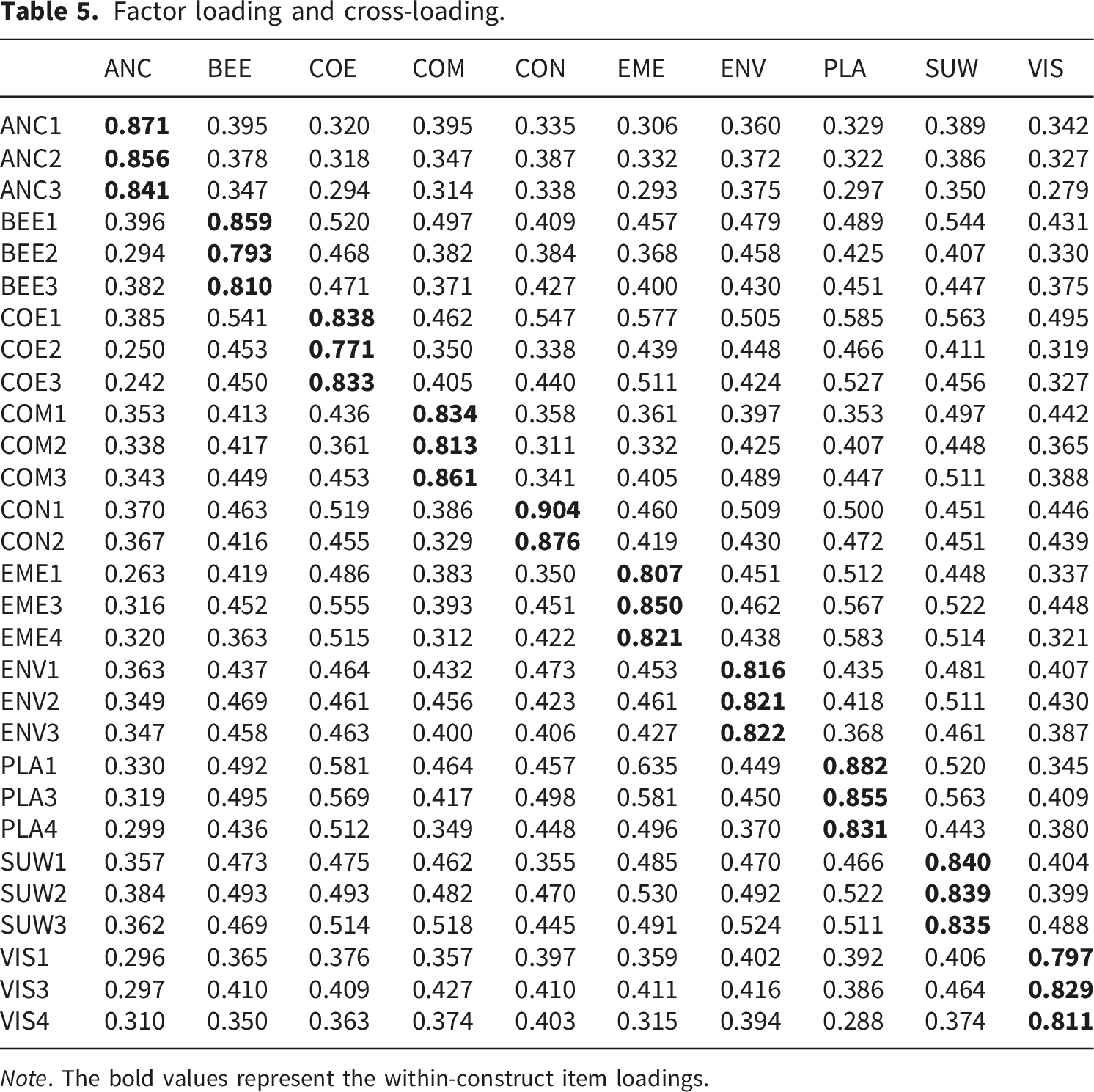
Note. The bold values represent the within-construct item loadings.
The HTMT results.

5.3. Structural model testing
To assess the significance of the path coefficients, a bootstrapping procedure with 5,000 resamples was employed, applying bias-corrected and accelerated confidence intervals across all model paths. This approach also enabled evaluation of the model’s explanatory power (R2) and effect sizes (f2). The results are presented in Figure 2 and Table 7. Except H2, all hypotheses were supported, as indicated by p-values below 0.05 and t-values exceeding 1.96. Specifically, the affordances of environmental embedding (β = 0.269, p < 0.001), visibility (β = 0.123, p < 0.01), playfulness (β = 0.469, p < 0.001), and competition (β = 0.114, p < 0.01) exerted significant positive effects on user engagement, supporting H1, H3, H4, and H5. However, the anytime-anyplace connectivity affordance did not exert a significant influence on user engagement (β = 0.076, p > 0.05), thus H2 was rejected. Furthermore, user engagement positively impacted subjective well-being (β = 0.694, p < 0.001) and continuance intention (β = 0.607, p < 0.001), supporting H6 and H7. Finally, the first-order factors (cognitive engagement, emotional engagement, and behavioral engagement) were largely and significantly loaded on their second-order factor (user engagement). Results of hypothesis testing. Hypotheses test results.
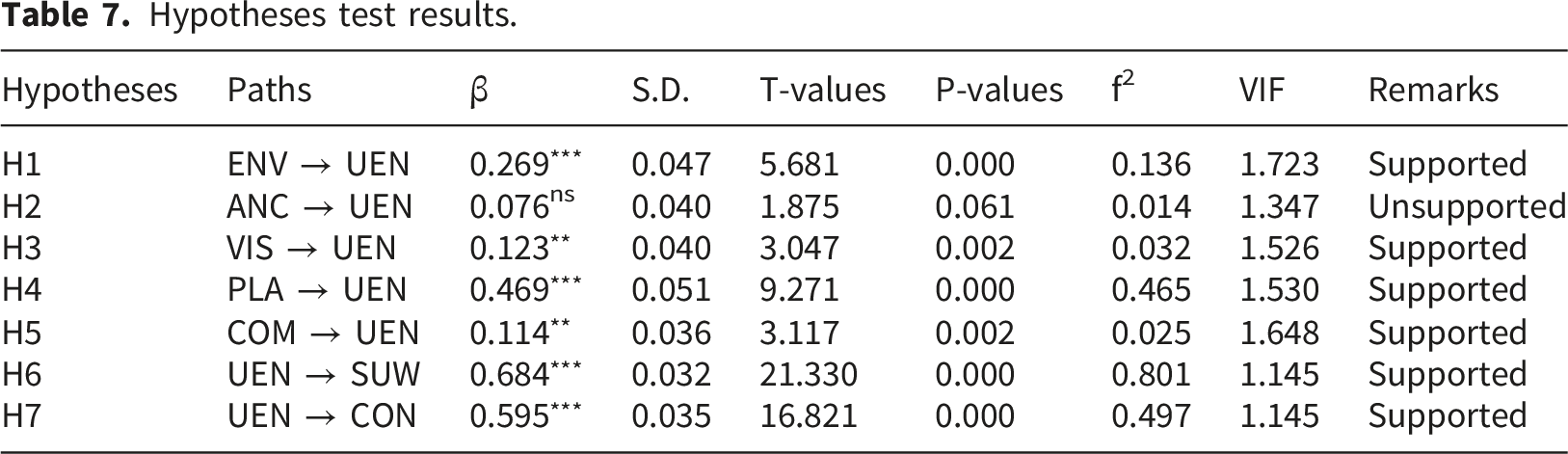
Additionally, as shown in Figure 2, our model explains 69.0%, 49.0%, and 37.7% of the variance (R2) in user engagement, subjective well-being, and continuance intention, respectively. These R2 values indicate moderate to substantial explanatory power. Furthermore, following Hair, 78 f2 values of 0.02, 0.15, and 0.35 indicate small, medium, and large effect sizes, respectively. The results in Table 7 show that three links (e.g., playfulness to user engagement, user engagement to subjective well-being, and user engagement to continuance intention) depict a large effect size with f2 values greater than the threshold 0.350. The f2 values of 0.014 from anytime-anyplace connectivity to user engagement, less than 0.02, demonstrate a negligible effect. The remaining paths depict small effect sizes (0.02 < f2 < 0.15). Regarding control variables, only education significantly influenced subjective well-being (β = 0.067, p < 0.05), showing a positive association. Age, gender, and prior experience showed no statistically significant effects on either subjective well-being or continuance intention.
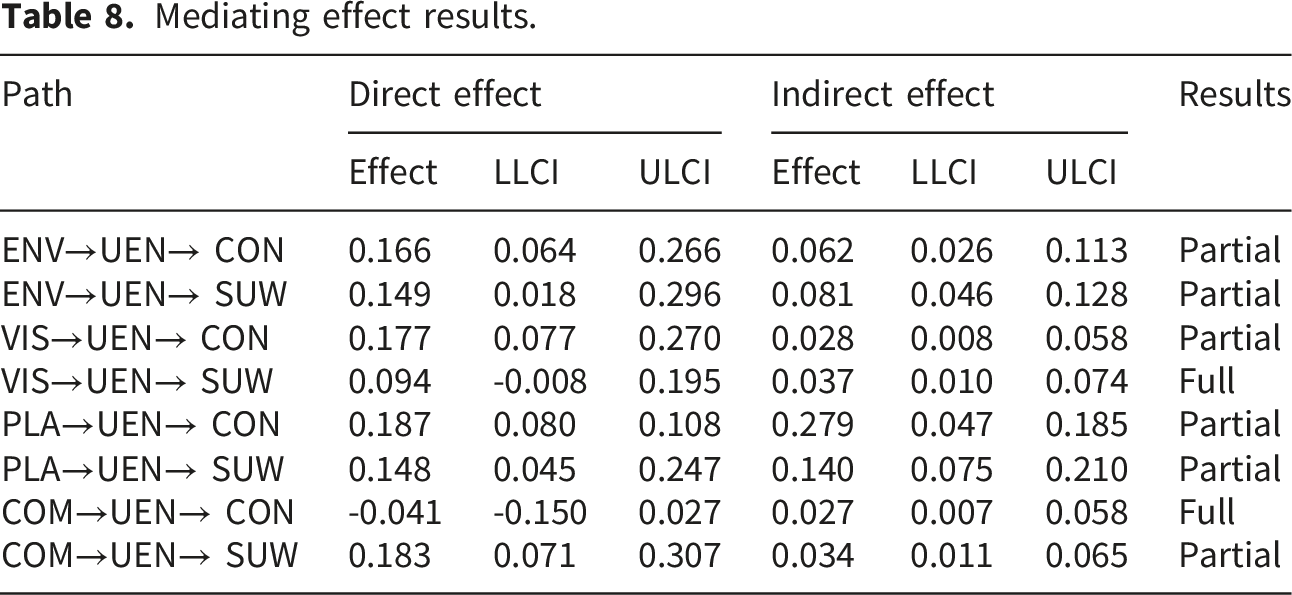
Mediating effect results.
6. Discussion and implications
6.1. Discussion
This research elucidates how the affordances of AR exercise apps influence user engagement and, in turn, shape users’ subjective well-being and continuance intention. Our empirical results yield several research findings.
First, the results demonstrate that utilitarian affordances, particularly environmental embedding and visibility, positively influence user engagement. Although the effect size of environmental embedding was small (f2 < 0.15), its significant positive impact is consistent with previous findings2,41,42 that AR’s capacity to integrate digital content into physical environments enhances user interaction experience. Visibility also exhibited a significant positive effect on engagement, with small effect sizes (f2 < 0.15). This finding aligns with prior research by Chen, Zhu 79 and Li, Lu, 80 which emphasizes the importance of perceptual clarity and feedback visibility in shaping users’ mental states and behavioral intention. In the context of AR exercise apps, enhancing the visibility of interactive elements, such as real-time performance metrics or progress indicators, may help sustain user engagement over time.
However, our analysis did not reveal a significant correlation between anytime-anyplace connectivity and user engagement, which seems to contradict previous research findings. 48 One explanation is that in China’s current digital landscape, ubiquitous connectivity is largely taken for granted, diminishing its novelty and motivational force. In this context, connectivity may function more as a hygiene factor, necessary but insufficient to drive engagement. Another explanation is that our sample’s familiarity with always-on mobile technology likely reduced the perceived salience of connectivity. Future research could employ longitudinal or experimental designs to better disentangle the boundary conditions under which connectivity influences engagement, particularly among less tech-savvy user groups or in contexts with intermittent access.
Second, we found that playfulness emerged as the most powerful driver of user engagement. This finding aligns with the arguments presented by Holdack, Lurie 36 and Mclean and Wilson, 81 who suggest that the playfulness affordance derived from the immersive augmentation of AR brings user enjoyment and intrinsic motivation for frequent and prolonged exercise. This finding supports prior research by demonstrating that enjoyment-driven design is not merely supplementary but central to engagement in fitness contexts.
Third, our investigation reveals that competition affordance has a significant positive impact on user engagement. This finding aligns with previous research on online gamification-based exercise, 37 which suggests that incorporating competitive elements into mobile fitness apps can significantly enhance user motivation and participation. The greater the competition affordance individuals perceive, the more likely they are to engage actively with AR-enabled exercise activities.
Finally, our findings suggest a positive association between user engagement and subjective well-being. This finding aligns with previous literature indicating that higher levels of engagement in various activities, such as exercise and digital interactions, are associated with improved emotional states and overall life satisfaction.7,8 Furthermore, user engagement positively correlated with continuance intention, aligning with existing studies21,23,26 that user engagement serves as a critical mechanism that translates technological capabilities into sustained usage intentions.
6.2. Theoretical implications
This study makes several contributions to the existing literature. First, this study broadens the scope of AR research and advances the fields of digital health and sports. While previous studies have primarily focused on the influence of AR technology in areas such as tourism, shopping, and education,14,15 this research demonstrates how AR exercise apps promote health-related outcomes through immersive, technology-mediated physical activity. By establishing a direct link between AR exercise app affordances and user engagement, subjective well-being, and long-term exercise adherence, this study extends the current understanding of AR technology within digital health ecosystems.
Second, this study extends affordance theory by applying it to the emerging context of AR exercise apps. Affordance theory is particularly well-suited to capturing the complex relational structure between a fitness app and its users, which shapes potential outcomes in specific contexts.17,31 While previous research has applied the theory to digital platforms such as social media and live commerce,28,82 this study advances the theory by identifying and validating a set of context-specific affordances that are salient in AR exercise apps. Based on the core characteristics of AR exercise apps and users’ exercise motivation, we identify five affordances: environmental embedding, anytime-anyplace connectivity, visibility, playfulness, and competition, which reflect the utilitarian, social, and hedonic dimensions of affordances. By integrating affordance theory into the domain of AR exercise apps, this study establishes a theoretical link between context-specific affordance and health-related outcomes, showing how AR-enabled possibilities for action can promote subjective well-being and behavior change in digital health contexts.
Third, this study uncovers the mediating mechanism of user engagement within the context of AR exercise apps, demonstrating that technological affordances generate a deeper, more immersive form of engagement, thereby enhancing subjective well-being and continuance intention. Unlike traditional fitness apps that might support motivation through instruction or tracking, 22 AR exercise apps' unique value lies in their ability to seamlessly merge digital challenges with the physical environment, thereby creating a heightened state of focused attention and enjoyment. These findings reveal that the advantage of AR in exercise contexts stems not merely from superior visual presentation, but from a fundamentally more effective psychological pathway for sustaining meaningful engagement and promoting lasting behavior change. By investigating the antecedents and consequences of user engagement in the context of AR exercise apps, we extend the existing literature on technology-mediated engagement.63,83
6.3. Practical implications
This study offers several practical implications for designers, industry practitioners, and public health stakeholders. First, for AR exercise app designers, it is essential to optimize utilitarian, hedonic, and social affordances. To enhance environmental embedding, designers could incorporate realistic 3D models, develop intuitive interfaces that simplify interaction with AR elements, and enable integration with wearable devices. Visibility can be strengthened via customizable AR overlays that display real-time feedback, such as heart rate, repetition count, or form guidance, while allowing users to adjust the size, position, and transparency of these elements to reduce visual clutter and cognitive load. To strengthen hedonic affordances, designers are encouraged to integrate playful features that increase enjoyment and motivation. Examples include AR mini-games that align with physical movements, themed workouts based on engaging narratives such as adventure or fantasy scenarios, and unique AR-specific challenges that leverage spatial interaction. For competition affordance, it is recommended that designers offer diverse competition modes to cultivate a more dynamic and interactive user experience. Designers may introduce reward-based mini-games tailored for beginners, skill-driven challenges for advanced users, and asynchronous competitions that allow users to compete with friends over time.
Second, for fitness industry practitioners, they could embed AR features into comprehensive fitness ecosystems. For example, fitness equipment manufacturers can collaborate with app developers to enable seamless AR integration on smart treadmills or mirrors, allowing users to visualize workout data or virtual coaches directly in their training environment. Similarly, gym operators can deploy AR-enhanced group classes, such as immersive dance or martial arts sessions to differentiate their offerings and attract younger, tech-savvy members. In addition, from a business perspective, introducing AR features as pilot add-ons to existing apps can help assess user engagement and retention benefits before committing to large-scale development, providing a clearer basis for evaluating return on investment.
Third, from a public health standpoint, AR technologies offer a promising avenue to increase population-level engagement in physical activity. Policymakers are encouraged to collaborate with industry stakeholders in integrating AR into digital health and wellness strategies. For example, policymakers can establish safety standards and data privacy regulations to ensure user safety and foster trust in AR-based digital health solutions. Policymakers can also partner with app developers and local governments to co-design public health initiatives, such as location-based AR fitness trails in parks and urban recreational areas, and launch AR scavenger hunts that encourage walking or cycling.
6.4. Limitations and future research
Our study also has some limitations. First, the study sample is limited to a single cultural background, specifically the Chinese context. Cultural factors, such as attitudes towards competition and playfulness, may significantly influence how AR affordances are perceived and valued. Future research could enhance the generalizability of the findings by including samples from different cultural backgrounds.
Second, the questionnaire data used in this study are cross-sectional, which constrains causal inference and precludes examination of long-term engagement dynamics. The cross-sectional data cannot establish temporal precedence, leaving open the possibility of reverse causality (e.g., whether higher well-being leads to more positive affordance perceptions) or the influence of unobserved variables. More critically, this static data cannot address the crucial question of sustained engagement. A key theoretical challenge is understanding how playfulness can be maintained over time and how habituation effects can be mitigated. It is plausible that the hedonic affordances found to be powerful drivers of initial engagement may see their effect diminish with repeated exposure as the novelty wears off. Future research could adopt longitudinal or experimental designs to verify the proposed causal pathways and to investigate how dynamic design elements, such as adaptive challenges, evolving content, or user-generated features, might be necessary to combat habituation and sustain the psychological appeal of AR fitness apps in the long run.
Third, our study relied on self-reported survey data. Some bias (e.g., social desirability bias and acquiescence bias) might exist. Additionally, the use of continuance intention as a proxy for long-term actual behavior inherently encounters the intention-behavior gap. Therefore, future research could incorporate multi-method approaches, such as integrating in-depth interviews to explore subjective experiences, or tracking objective behavioral data through longitudinal field studies or application usage logs, to provide a more comprehensive and robust understanding of user behavior in AR exercise contexts.
Fourth, this study did not theorize about or empirically examine how individual differences might systematically moderate the relationships in our model. These differences include demographic factors (e.g., age, gender) and personality traits (e.g., competitive vs. collaborative orientation), and users' prior experience with AR technology. For instance, it is plausible that the effect of hedonic affordances on engagement is stronger for younger users, or that the importance of utilitarian affordances varies by gender. Similarly, competitive affordances may enhance engagement for users with a competitive orientation, while potentially alienating those with a more collaborative or avoidant motivation. Furthermore, the lack of a defined minimum user experience level means we could not precisely isolate the effects of the affordances themselves from the influence of prior familiarity. Further research could employ methods such as multi-group analysis to investigate how user characteristics shape the psychological mechanisms of AR exercise apps, thereby enhancing the personalization and targeted design of digital health strategies.
Finally, this study primarily examined the independent effects of the five affordances on user engagement, leaving their potential interactions and broader influences unexplored. In practice, these affordances may operate synergistically (e.g., where competitive features enhance playfulness) or even exhibit trade-offs (e.g., when overemphasis on utilitarian functionality diminishes hedonic enjoyment). Moreover, our model does not account for other theoretically relevant factors, such as health consciousness, 11 goal setting, 84 and users’ familiarity with AR. 85 These variables may act as antecedents, moderators, or mediators in the engagement process. Future research could therefore adopt a more integrative framework to simultaneously investigate the dynamic interplay between affordances and the broader role of individual and contextual variables, ultimately advancing a more nuanced and contextualized understanding of the underlying mechanisms in AR fitness apps.
7. Conclusion
Drawing upon affordance theory, our study delves into the mechanisms underlying how three distinct dimensions of technology affordances influence health-related behaviors and outcomes within the context of AR exercise apps. Our findings validate a research model that positions multidimensional user engagement as the central psychological pathway linking AR exercise app affordances to health outcomes. The empirical results confirm that utilitarian affordances (environmental embedding, visibility), hedonic affordance (playfulness), and social affordance (competition) are significant drivers of user engagement, which in turn influence both continuance intention and subjective well-being. Theoretically, this study extends affordance theory by contextualizing and validating it within the AR fitness domain, providing a nuanced explanation of how AR exercise apps create value through psychological mechanisms. Practically, it calls for a strategic shift in app development from novelty-driven approaches to integrated designs that balance contextual utility, intrinsic enjoyment, and social motivation. For public health policymakers, AR fitness emerges as a viable tool for population health, warranting initiatives such as location-based AR trails in public spaces and clear data privacy standards to harness its societal potential.
Supplemental material
Supplemental material - Enhancing fitness and health outcomes through augmented reality exercise apps: The role of technology affordances and user engagement
Supplemental material for Enhancing fitness and health outcomes through augmented reality exercise apps: The role of technology affordances and user engagement by Yilong Chen, Yanhong Chen and Yaner Yang in Digital Health
Footnotes

Consent to participate
Informed consent was obtained from all subjects involved in the study.
Author contributions
Conceptualization, YL.C. and YH.C.; methodology, YH.C. and YE.Y.; formal analysis, YH.C.; investigation, YL.C. and YH.C.; software, YH.C.; writing—original draft preparation, YL.C. and YH.C.; writing—review and editing, YL.C., YH.C. and YE.Y.; project administration, YL.C.; funding acquisition, YL.C. All authors have read and agreed to the published version of the manuscript.
Funding
The authors disclosed receipt of the following financial support for the research, authorship, and/or publication of this article: This research was funded by the MOE (Ministry of Education in China) Project of Humanities and Social Sciences (24YJC890006).
Declaration of conflicting interests
The authors declared no potential conflicts of interest with respect to the research, authorship, and/or publication of this article.
Data Availability Statement
The raw data supporting the conclusions of this article are available upon reasonable request from the corresponding author.
Institutional review board statement
The authors obtained informed consent from all participants, and the study did not involve any personal or private information. The study was conducted in accordance with the Declaration of Helsinki, and the protocol was approved by the Ethics Committee of Jinan University on 10 July 2024.
Supplemental material
Supplemental material for this article is available online.