




Abstract
Using digital technology to adapt to their host country is an integral part of social inclusion for migrant and refugee populations. However, researchers have not empirically examined how digital technology use may affect subjective well-being among migrant populations. This study aimed to examine the association between increased digital technology use, technological self-efficacy, and subjective well-being. Using the 2020 Digital Divide Survey in Korea, our sample consists of 6520 native South Koreans and 699 North Korean migrants aged 18 years and older. We examined the three-way interaction of technological self-efficacy and being North Korean migrants in the relationship between the increase in the use of five types of digital technology, technological self-efficacy, and subjective well-being, using hierarchical linear regressions. North Korean migrants were statistically lower than South Korean natives in all types of increased digital technology use. Moderation analysis showed that technological self-efficacy positively moderated the relationship between increased digital technology use and subjective well-being. A three-way interaction showed that this relationship was stronger in North Korean migrants for three types of utilization, networking, information sharing, and life services. A psychosocial approach needs to be taken to digital technology education for North Korean migrants, in light of the potential benefits of technological self-efficacy.
Keywords
Introduction
Since the unprecedented outbreak of the coronavirus disease-19 (hereinafter COVID-19) pandemic, subjective well-being levels have generally worsened compared to pre-COVID-19 pandemic levels.1,2 Ethnic minorities are particularly vulnerable to such problems.3,4 Home confinement,5–7 changes in physical activity,8,9 stress, fear of COVID-19,10,11 and social relationships 12 have been identified as factors associated with subjective well-being during the pandemic. In addition to these factors, individuals who reported low levels of digital technology use tended to report lower subjective well-being compared with those who reported high levels of digital technology use during the COVID-19 pandemic.5,13,14
Digital technology use became more important during the pandemic, with individuals being recommended to find information online, avoid face-to-face contact, and communicate virtually.14–17 Since the COVID-19 pandemic caused social distancing norms and nationwide lockdowns, the use of digital technologies has surged.18,19 The COVID-19 pandemic has also promoted the development and implementation of telemedicine20,21 and distance education,22,23 albeit this has widened the digital divide for those who do not have access to digital devices and those who lack digital literacy.20,21,24,25
Digital technology use among North Korean migrants
Digital technology use is presented as a key axis of social inclusion for immigrant and refugee populations.26,27 As a result of language or cultural differences 28 and a lack of social support systems, 29 immigrants and refugees tend to rely on online information for various purposes, especially for younger generations. 30 Although there have been reports that digital technology use can help immigrants and refugees adapt and settle in host countries,31,32 how this use may relate to subjective well-being as well as how digital technology (e.g. information and communications technology, ICT) use may differ among migrant populations are topics that remain to be examined.
As of 2021, it was estimated that 33,815 North Korean migrants (9475 men and 24,340 women) had entered South Korea. The North Korean migrant is defined as “a person who has a residence, lineal ascendants and descendants, spouses, workplaces, or else in the area north of the Military Demarcation Line, and who has not acquired any foreign nationality after escaping from North Korea.” 33 Although North Korean migrants and native-born South Koreans speak the same language, these migrants still face difficulties when coming to South Korea due to their lack of experience with democracy and capitalism.
Furthermore, they can be considered “digital immigrants” who migrated from the so-called analog to the digital environments 34 ; this is because they are likely to have had minimal chances of being exposed to computers and the Internet in North Korea, with research reporting that only a few elite groups have been able to access information via the Internet prior to their migration to South Korea. 14 For example, about 81.3% of the North Korean migrants answered that they had never received digital education in North Korea, and even among those who had received any, the education program was limited to document creation, not the utilization of the Internet. 35 Given their limited exposure to the Internet and the Internet utilization rate in South Korea revolving around 96.5% 36 and North Korean migrants have a strong information need for their settlement, 37 digital education is one of the most popular education programs among North Korean migrants when they are re-educated in Hanawon, which is the North Korean resettlement support facility which they should seek or are directed to upon arriving in South Korea. 38
Technological self-efficacy and subjective well-being among North Korean migrants
The relationship between digital technology use and subjective well-being has been the question of many studies conducted among adolescents,39,40 older adults,41–44 and the general populations. 45 Nevertheless, the relationship between digital technology use and subjective well-being remains complicated due to conceptual pluralism and contextual differences in digital technology use. 46 It depends on the population, 47 the degree of use,48,49 the purpose of use,46,50 the type of digital technology, 51 and socioeconomic status. 52 In particular, passive digital technology use (e.g. browsing) was negatively related to subjective well-being, and active and purposeful digital technology use (e.g. posting and liking) was positively associated with subjective well-being. 46 However, empirical studies on the differential effects of these various types of digital technology use on subjective well-being are lacking.
As the central tenet of social cognitive theory, self-efficacy has been discussed as a significant predictor of behavior. 53 Within the technology context, this concept becomes technological self-efficacy (TSE) and is defined as “the belief in one's own ability to use new technologies, or the anxiety with the new technology.” 54 Extended from the Internet self-efficacy 55 and ICT self-efficacy, 56 the concept of TSE has been extensively examined in the educational literature,57–59 but its role has been extended to health-related behaviors.60,61 Although North Korean migrants might have a lower entry barrier to digital technology use compared with other migrants because North Koreans and South Koreans speak the same language, 62 they show a lower capacity to utilize digital devices than the native South Koreans 14 because of cultural differences and the frequent use of foreign languages in South Korea. 62 Accordingly, when they receive digital education, most report a delayed education path because of the fear of new devices and new digital terminologies. 35 In addition to digital education, North Korean migrants need the capacity and self-efficacy to utilize the Internet and digital devices. 14
Compared with native-born South Koreans, North Korean migrants report lower scores for subjective well-being, 63 and it is reported that their subjective well-being tends to decrease as they spend more years in South Korea. 64 Previous studies have found that economic65,66 and psychological factors, such as a sense of autonomy, loneliness, 63 self-esteem, 66 and discrimination 67 were associated with subjective well-being among North Korean migrants during the pre-COVID-19 pandemic. However, few studies have examined subjective well-being among North Korean migrants and explored the impact of changes in digital technology use or TSE on their subjective well-being during the COVID-19 pandemic. The COVID-19 pandemic impacted the use of digital technology,68,69 and its patterns of utilization may vary amongst North Korean migrants and native South Koreans.
The present study
The current study had four aims. First, it aims to compare the subjective well-being of North Korean migrants with that of native South Koreans during the COVID-19 pandemic. Second, it attempts to examine the factors associated with subjective well-being, with a particular focus on increased digital technology use during the COVID-19 pandemic. Third, it investigates whether TSE moderates the relationship between the increase in digital technology use and subjective well-being. Figure 1 presents the proposed moderated moderation model. Fourth, it examines whether the relationship between the increase in digital technology use and subjective well-being is moderated by the interaction between TSE and North Korean refugee status.
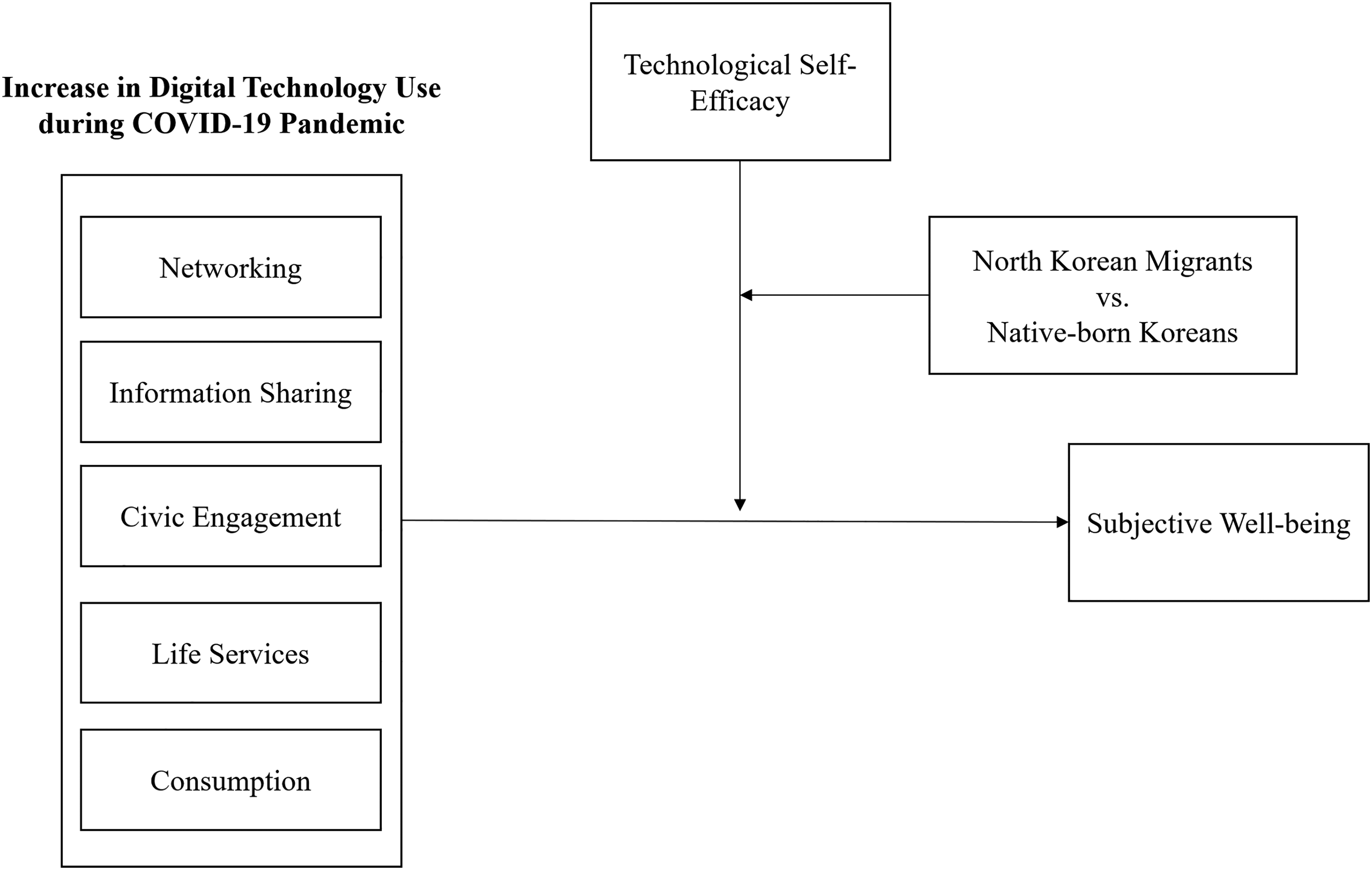
Proposed moderated moderation model.
Methods
Recruitment participants and procedures
The current study analyzed data from the 2020 Digital Divide Survey conducted by the Ministry of Science and ICT and the National Information Society Agency of South Korea. Participants provided verbal consent for participation in the survey. With its application beginning in 2002, this repeated cross-sectional survey aims to provide data on the digital divide in vulnerable populations. 70 It includes six subsamples: the general population, people with disabilities, low-income, farmers and fishermen, North Korean migrants, and marriage migrants. Stratified probability proportional to size sampling based on metropolitan area is used to sample the general population, while quota sampling is used to sample North Korean migrants based on gender, age, year of entry, and metropolitan area. The survey is based on face-to-face interviews, and the data were collected from September–December 2020, namely, during the COVID-19 pandemic. For the current research, the sample comprised people aged 18 years and older from the North Korean migrants (n = 699) and native South Koreans (n = 6520) subsamples.
Measures
Dependent variable: subjective well-being
We utilized the five-item Satisfaction with Life Scale 71 translated into Korean. The questionnaire contained five statements to assess subjective well-being: (1) “In most cases, my life is close to my ideal.’ (2) ‘The conditions of my life are excellent.” (3) “I am satisfied with my life.” (4) “So far, I have gotten important things I want in life.” and (5) “If I could live my life over, I would change almost nothing.” Responses were rated on a 4-point Likert scale ranging from 1 to 4 (not satisfied at all to very much satisfied). We used an average score calculated from five responses. The Cronbach's α of the scale was 0.8615 for North Korean migrants and 0.8067 for the native South Koreans, respectively.
Independent variable: perceived increase in digital technology use due to COVID-19 pandemic
The independent variable was the perceived increase in digital technology use due to the COVID-19 pandemic. The questionnaire included the following question, “How has your usage of the following services changed due to COVID-19?” Further, the question included five different types of online services: (1) online networking (e.g. maintaining relationships with existing contacts or developing new relationships), (2) online information-sharing (e.g. sharing information, news, video, and photos via internet bulletin boards), (3) online civic engagement (e.g. expressing opinions on social interests, making a donation, volunteer activities, online voting, signing petitions), (4) online life services (e.g. daily life information, online banking, e-government services), and (5) online consumption (e.g. online shopping, food delivery, over-the-top (OTT) media service, or electronic book subscription services). Responses were provided on a 5-point scale ranging from 1 to 5 (decreased a lot to increased a lot). In the current study, answers were categorized as a dichotomous variable; increased and increased a lot are coded as one, and others (decreased a lot, decreased, and similar) are coded as zero.
Interaction terms: technological self-efficacy (TSE) and North Korean migrants
TSE was assessed based on the short version of the validated self-efficacy subscale of the acceptance of mobile applications among South Koreans. 72 It includes three statements: (1) “I tend to adapt well to new technologies and products;” (2) “I feel confident that I will learn to use new technologies and products by myself;” and (3) “I am better than others when using new technologies and products.” Responses were provided on a 4-point Likert scale ranging from 0 (not at all true of me) to 3 (totally true of me). We used the average score from the three responses, and Cronbach's α was 0.8166 for North Korean migrants and 0.8566 for native South Koreans. Further, we created the dichotomous variable of whether the respondent is a North Korean migrant or a native South Korean as an interaction term.
Control variables
Age, gender (male and female), monthly household income (<$3000 or not, as the national median is approximately $3000), and level of education were used as control variables. Educational level was coded into a categorical variable with three categories: less than high school, high school graduates, or college graduates. For North Korean migrants, the level of education included the education they received either in North Korea or South Korea. $1 was calculated as about ₩1.
Analytic strategy
We conducted hierarchical linear regressions to examine the relationship between increased digital technology use and subjective well-being. We also generated the two-way interaction terms between each type of increase in digital technology use and TSE to examine whether a moderation effect exists. Two-way interaction terms also included the interaction between TSE and North Korean migrant status (vs Native South Koreans). Then, we created the three-way interaction terms between each type of digital technology use, TSE, and being North Korean migrants. Descriptive and bivariate analyses were performed using Stata, version 17.0. Across the tests, the significance level was set at a p < 0.05.
Results
Descriptive statistics
Table 1 shows the participants’ characteristics. The mean scores for subjective well-being of North Korean migrants and native South Koreans are significantly different (2.61 vs 2.66, respectively), but TSE was not significantly different (2.70 vs 2.72, respectively). The increase in digital technology use during the COVID-19 pandemic is significantly different across all types among North Korean migrants and native South Koreans. More people in native South Koreans reported that their digital technology use increased after the COVID-19 pandemic for all online service types compared with North Korean migrants. Both North Korean migrants and native South Koreans reported that the online service type which increased the most in use after the COVID-19 pandemic was online consumption services, followed by online life services. This result shows low subjective well-being among North Korean migrants and suggests that the increase in digital technology use may interact differently with technology self-efficacy.
Participants’ characteristics, n (%).

$1 was calculated about ₩1.
On average, North Korean migrants were slightly younger (45.64 years, standard deviation (SD) = 11.15) than the native South Koreans (47.07 years, SD = 17.69). The native South Korean group showed a balanced gender distribution, whereas the North Korean migrants had more women (74.25%). Most people in the native South Koreans (83.05) reported a monthly household income of more than $3000; however, less than half (43.35%) of the North Korean migrants reported so. More than half of the native South Koreans (51.17%) graduated from high school, and more than one-third graduated from college (37.80%). Among North Korean migrants, the average number of years living in South Korea was 12.18 (SD = 5.63), ranging from 2 to 45 years. North Korean migrants also reported leaving North Korea between 1975 and 2018.
Two-way interactions
As shown in Table 2, TSE is positively associated with subjective well-being across models. Without considering the moderation effect and controlling for TSE and North Korean migrant status, the increase in digital technology use for three types (networking, information sharing, and consumption) was not significantly associated with subjective well-being (Model 1). On the other hand, the increase in civic engagement use (β = 0.093, p < 0.001) and life services use (β = −0.112, p < 0.001) was significantly associated with subjective well-being when controlling for TSE and North Korean migrant status. According to Model 2, the relationship between TSE and subjective well-being was moderated by increased digital technology use across all five types. The association was stronger when digital technology use increased during the COVID-19 pandemic than people who reported that digital technology use had not increased. The results show that the coefficient for the two-way interaction terms of TSE and increased digital technology use was significant for networking (β = 0.141, p < 0.01), information sharing (β = 0.164, p <0 .01), civic engagement (β = 0.151, p < 0.01), life services (β = 0.181, p < 0.001), and consumption (β = 0.107, p < 0.05).
Hierarchical linear regressions for three-way interactions.
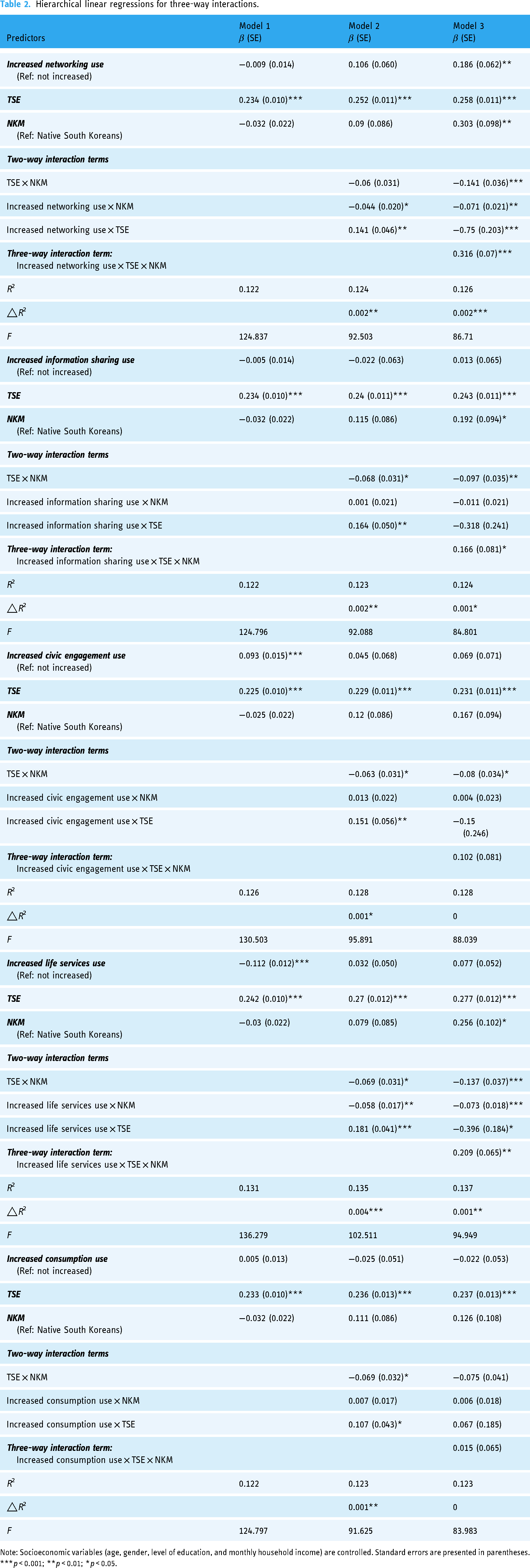
Note: Socioeconomic variables (age, gender, level of education, and monthly household income) are controlled. Standard errors are presented in parentheses.
***p < 0.001; **p < 0.01; *p < 0.05.
Three-way interactions
According to Table 2, the following combinations resulted in significant three-way interactions: increased networking use, TSE, and North Korean migrants explained subjective well-being (β = 0.316, p < 0.001), increased information sharing use, TSE, and North Korean migrants explained subjective well-being (β = 0.166, p < 0.05), and increased life services use, TSE, and North Korean migrants explained subjective well-being (β = 0.209, p < 0.01). The interaction of increased civic engagement use, TSE, and North Korean migrants and the interaction of increased consumption use, TSE, and North Korean migrants were not significantly associated with subjective well-being.
The significant three-way interactions are plotted in Figure 2. For both North Korean migrants and native South Koreans, the relationship between TSE and subjective well-being is positive. It also suggests that when digital technology use has increased during the COVID-19 pandemic, TSE has a stronger positive effect on subjective well-being. However, the moderating role of increased digital technology use is far stronger among North Korean migrants for the increased networking, information sharing, and life services use.

Three-way interaction between increased digital technology use, technological self-efficacy, and North Korean migrants.
Discussion
Principal results
By analyzing data from a nationally representative survey of North Korean migrants and native South Koreans, this study examined the associations between the increase in digital technology use, TSE, and subjective well-being in the context of the COVID-19 pandemic. First, the average TSE scores of North Korean migrants and native South Koreans showed no statistically significant differences. On the other hand, the increase in digital technology use during the COVID-19 pandemic differed between North Korean migrants and native South Koreans. A significantly smaller number of North Korean migrants reported increased use of any type of digital technology than native South Koreans, even though the average number of years living in South Korea among the North Korean migrant sample was 12.18 years. Second, TSE showed a positive effect on subjective well-being in the model with TSE after controlling for socio-demographic factors. This finding concurs with that of one study, which reported that TSE is negatively associated with related technostress, implying a positive impact of TSE on subjective well-being. 73
Furthermore, the moderating effect of TSE on the relationship between the increase in digital technology use during the COVID-19 pandemic and subjective well-being was significant across all five types. This result suggests that the interaction with TSE, a psychological variable, is a critical variable in subjective well-being, not simply the increase or non-increase of digital technology use. In particular, this study only dealt with active or purposeful digital technology use, 46 and even in that case, the moderating role of TSE could be a key mechanism associated with increased subjective well-being to disentangling the complicated results of the relationship between digital technology use and subjective well-being. This result supports that the well-being of technology users can be increased when accompanied by a psychosocial intervention that not only guarantees the dissemination and accessibility of digital technology but also increases TSE and attitudes. 74 Further, examinations focused on the increased digital technology use during the COVID-19 pandemic catapulted the importance of digital technology for many aspects of individuals’ lives, including searching for information and connecting with others.69,75,76
Being a North Korean immigrant in the study moderated the moderating role of TSE between the increase in digital technology use and subjective well-being for the three types: networking, information sharing, and life services. Thus, TSE had a strong moderating effect between increased digital technology use and subjective well-being, especially among North Korean migrants. These results show that in disastrous situations such as the COVID-19 pandemic, psychological TSE as well as digital technology use and promotion for North Korean migrants interact and influence the improvement of subjective well-being. Coupled with the assumption that most North Korean migrants are likely to have narrower social networks than native-born South Koreans, particularly during the COVID-19 pandemic and the associated social distancing measures, this result implies the eagerness of North Korean migrants to participate as members of the South Korean society via online networks. It also suggests that interventions to increase TSE can have a positive effect on subjective well-being, something that may not hold true for the current education programs, which teach these migrants ICT-related techniques. This result might be attributed to the fact that native South Koreans tend to have a higher degree of social capital and networks than their North Korean migrant counterparts 77 ; they may have other channels for social interactions and participation in South Korean society, even amid social distancing measures due to the COVID-19 pandemic.
Strengths and limitations
This study is innovative in that it identifies the degree to which North Korean migrants use digital technology and the impact of such use on subjective well-being within the context of the COVID-19 pandemic. The study also found that the direction of the relationship between TSE and subjective well-being was reversed for North Korean migrants and native South Koreans, with the findings showcasing the importance of promoting TSE in these migrants.
Despite these strengths, our current study was limited by its design. First, all items were self-reported, which may be a source of bias. Specifically, the analyses for the sub-variables of the increase in digital technology use due to the COVID-19 pandemic include the possibility of recall bias. Second, our study focused on the increase in digital technology use and TSE, but it did not control how participants obtained information at the individual level, for example, through social networks. 78 Third, since the dataset we used is cross-sectional, the results are not based on longitudinal data, thus limiting analyses of causal relationships. For example, the negative interaction effect of TSE on the relationship between the increase in digital technology use and subjective well-being indicates a correlation, not a causal effect.
Implications for further research, policy, and practice
Policy intervention is needed to promote North Korean migrants’ TSE and improve their digital technology use. In addition to extending the duration of informatization education in early settlement training institutions such as Hanawon, ICT education must be implemented periodically and systematically in community-based organizations related to the settlement of North Korean migrants, such as Hanawon Centers. 79 In this case, it would be optimal to modify the current informatization education programs, which are primarily based on information delivery-oriented methods and may not be optimally contributing to TSE, by adding psychological factors that may be efficient at improving TSE into the program. The addition of these psychological factors becomes even more critical when we consider the potential benefits of TSE for these populations and contrast this potential with what the current information-focused education programs deliver for them.
Some studies conducted with migrants who experienced specific life events suggest that social support plays a role in mediating subjective well-being, having a protective function that significantly lowers post-traumatic stress and depression. 80 Further, a qualitative study shows that the use of the Internet provides both informational and emotional support to North Korean migrants. 38 Hence, although there are many reports on the negative correlation between Internet addiction and subjective well-being, 81 it may be that digital technology use among new migrants, such as North Korean migrants, is associated with the positive psychosocial adaptation processes. Our results and prior literature point to the possibility that technology in such contexts can act as a social capital source and have positive effects on mental health.
This study used subjective well-being as an outcome variable; however, researchers have thoroughly demonstrated the strong correlation of subjective well-being with various mental health variables (e.g. depression, quality of life, and post-traumatic stress disorder). For example, a study shows high levels of depression, anxiety, and post-traumatic stress disorder symptoms among North Korean migrants 82 ; this emphasizes the need for further investigation into the relationships between mental health outcomes, TSE, and digital technology use. In addition, other research reports that migrants may find seeking help online particularly attractive because they do not have to disclose personal information and are not stigmatized. 83 Thus, stakeholders should develop innovative intervention methods for health behaviors in North Korean migrants by leveraging technology and focusing on online mental health information-seeking behaviors.
Footnotes
Contributorship
NY and SJ conceived, designed the study, analyzed the data, and wrote the manuscript.
Declaration of conflicting interests
The author(s) declared no potential conflicts of interest with respect to the research, authorship, and/or publication of this article.
Ethical approval
This study utilized secondary and publicly available data without personally identifiable information and additional IRB approval was not required.
Funding
The author(s) received no financial support for the research, authorship, and/or publication of this article.
Guarantor
None.
