



Abstract
The present study examined how identity is affectively organized online in an online men’s rights community, responding to calls to explore how sites like Reddit serve as spaces that host and support varied misogynist language and communities. We utilized scholarship of affective organizing and communicative constitution of organizations to study the identity construction through the social and communicative processes that facilitate and limit online communication. We analyzed 35,643 comments from a popular men’s rights community to interrogate how affective and gendered organizing contributed to identity construction using text mining, semantic network analyses, and qualitative analyses. Our findings revealed that affect was not merely prominent in the forum but served as a constitutive means through which the members of the men’s rights community constructed their identity individually and within their Reddit community. We advance an affect-centered approach within organizational communication scholarship, theorizing how masculinity is constituted through the interplay of affective contradictions, affective sensemaking, and affective identification.
Keywords
Across social media, radical right-wing activist communities have emerged (Freelon et al., 2020). A growing subset of these activist spaces is organized around regressive forms of gender associated with misogyny and antifeminist talk and advocacy (Eddington, 2020; Ging, 2019; Jarvis & Eddington, 2021; Marwick and Lewis, 2017). These types of spaces are often sustained through identifications of antifeminism, misogyny, rape apologism, and far-right political conspiracies; these spaces have flourished on some social networking platforms thanks to “libertarian” freedom of speech ideas, limited content moderation, and U.S. federal protections against platforms that host these spaces (Marwick and Caplan, 2018; Marwick and Lewis, 2017).
Of interest in our paper is Reddit, a social media platform that supports and promotes misogynist behaviors (e.g. brigading, trolling) and practices (e.g. presence and visibility of right-wing activist communities on the main page, generation of revenue from these communities, and limited content moderation) that organize communities (known as subreddits; Marwick and Caplan, 2018; Taylor, 2014). Because of growing trends, scholars (e.g. Ging, 2019; Massanari, 2017) have called for increased attention to the identity politics that organize and convene on Reddit and the broader manosphere network. 1 O’Donnell (2020) described the manosphere network as organized, coordinated, and cooperative around various men’s rights issues and causes that have both off- and online impacts. The present study adopts an organizational (and organizing) approach, in which we shift focus to the emergent process through which organizations come into existence. We are concerned with organizing as a gendered discursive enactment that occurs “outside and between organizations” (Ahrne et al., 2007: 619), one which engenders and reaffirms worldviews through shared and negotiated sensemaking processes. We give particular attention to the continuing constitution of an online identity organized through gendered and affective forms of language. Thus, our study offers a glimpse into how the forms of language shared in (and throughout) the broader manosphere activate fear, anger, and resentment toward minoritized groups (mainly women) in both on- and offline settings to mobilize masculinities and men toward hegemonic and anti-social justice actions and beliefs (Ashcraft, 2021; Bleijenbergh, 2022). We argue that to create opportunities for offline interventions to reduce the growing trends of harassment and incivility that have increasingly occurred both on- and offline, it is important to understand how specific spaces organize online. Analyzing these types of organizing enactments is critical to understanding how affective and gendered contra-organizing develops through online identity construction and “travels” offline to be practiced in various forms of misogyny. Scholars have begun to highlight men’s behaviors toward women and toward evaluating each other’s masculinity in the offline world as a product of their online membership (Alichie, 2022). Furthermore, given the charged political-culture tensions surrounding gender and freedom, these insights foster important conversations surrounding masculinity and manhood in the United States.
We consider one subreddit,/r/TheRedPill (TRP), as an exemplar of affective and gendered organizing. On the surface, TRP operates as a supportive space for men to learn pick-up artistry, but it also integrates elements of men’s rights activism (MRA) and alt-right logics. It does so not only by focusing on identity (re)construction vis-à-vis sexual activity or labeling emotion but also by promoting individual sexual activity through capturing and using sensate experiences expressed as emotion, and constitution of identification via sexual strategy “. . .in a culture increasingly lacking a positive identity for men” (Eddington, 2020; The Red Pill, n.d). Although we focused on TRP as a context and site for inquiry, the attitudes, communicative practices, and values that constitute TRP can be traced throughout the evolving manosphere network, which has contributed to inspiring and inciting violence against women and other minoritized individuals (Marwick and Caplan, 2018; Van Valkenburgh, 2021). In studying TRP’s organizing mission, the alignment with backlash discourses evokes the intersection of gender politics (and perceived crises) with anger and ire for the perceived displacement of men in modern society (Faludi, 1991).
We argue that exploring how online MRA communities (like TRP) communicatively constitute a social identity through affective and gendered contradictions is necessary. Online spaces have emerged as fertile grounds for various affective, fear-based movements, including white supremacist, terror-based, and men’s rights organizations, thanks to their adoption of affective language (Allan, 2016; Hearn, 2022; Marwick and Lewis, 2017). When looking alongside and beyond the language used, we illuminate the affective states of belonging that the men of TRP experience even as they attempt both dispassionate (e.g. about authentic relationships) and passionate (e.g. about lack of recognition or slights toward their identity constructions and affirmed and supported identity transitions into idealized men of the manosphere. These organizing practices demonstrate how the intensification of affective appeals and gendered backlash intertwine to constitute and organize identity in online spaces communicatively, giving men the language and worldview through which to understand and make sense of their anger and vitriol. As such, our study is guided by the following research question: how do members of TRP utilize affective and gendered organizing to construct their social identity?
Drawing on scholarships of affective organizing and communicative constitution of organizations (CCO), we explore how identities are created through the transmission of affect vis-à-vis affordances that both limit and facilitate communicative becoming. We utilize a multilevel, computational analysis to examine communicative enactments and processes that constitute TRP through nearly 36,000 comments in the Top 100 posts of all time in TRP. Our methodological approach focuses on the micro/macro affective enactments of identity shared throughout TRP. Our findings contribute to recent theorizing around men and masculinities in online MRA spaces (Hearn, 2019), illustrating how individuals’ affective engagement (vis-à-vis their use of comment threads on Reddit) constitute microscale identities for members (e.g. a Red Piller), and the larger, macroscale organizational identity of TRP and the broader MRA. The affect communicated around and through gendered issues of the networked manosphere both sustain and evolve in individual and organizational forms of identity online by enacting sensemaking processes that aid in legitimizing and promoting hegemonic ideals and practices of men.
Affective and gendered organizing in the manosphere
Affective organizing
In interrogating the identity formation of TRP, we draw on a critical feminist lens. Within and beyond feminist theorizing, definitions and boundaries of affect are contested (Clough, 2008; Fotaki et al., 2017; Hemmings, 2005; Liljeström, 2015). For our paper, we adopt Stewart’s (2007) conceptualization of affect as a sensate experience that occurs through “impulses, sensations, expectations, daydreams, encounters, and habits of relating, in strategies and failures, in forms of persuasion. . .that catch people up in something that feels like something.” (p. 2). Broadly, the affective turn represents an intellectual engagement with the intensities of sensate experiences (Fotaki et al., 2017; Just, 2019); however, Ashcraft (2021) expands the early descriptors of the affective turn by engaging in ontological boundary-spanning. In pushing boundaries, Ashcraft conceives of the affective turn as one that approaches “the nature of things as a doing—practice, performance, enactment, activity, event, something that is happening. Things are fluid, plural, and above all, relational, made in and through connection” (p. 11). Thus, affect moves beyond challenging the mind/body duality, connecting bodily sensations to emotions, thinking, and action (Ashcraft, 2017; Seigworth and Gregg, 2010), and considers the ongoing processes of becoming through which communication is known and performed. Feminist scholars have been concerned with how the negotiation between affect and emotions intersects with power, regulation, and control (Liljeström, 2015).
Through affect, research has begun to highlight how the intensity of feeling can serve as the impetus for communicative and organizational processes (Ahmed, 2004; Just, 2019; Michels and Steyaert, 2017). For example, Hardy and Cruz (2019) theorize “affective organizing” as a process through which activists have built a collective consciousness through shared identity. Similarly, Ashcraft (2021) characterizes affect in relational terms–‘‘as fluctuating intensities that arise from encounter, as bodies of all kinds (not only human) come into contact” (p. 3). Through these relational enactments, affect can be transformational or world-building (Ashcraft, 2021; Hemmings, 2012).
Gendered organizing
The hegemony of men and practices of misogyny
While most research addressing gendered solidarity examines the processes by which subordinated and marginalized groups organize against systems of oppression (Cranford, 2012), we examine gendered solidarity through the theoretical and discursive organizing of the hegemony of men. 2 Hegemony is a pervasive structure that entices some to aspire to impossible ideas of self, communities, and societies. Rather than adopt a hegemonic masculinity theoretical positioning, the present study examines men’s social practices that engendered various forms of inequality and violence—what Hearn (2004) calls “the hegemony of men.” 3 As Hearn (2004) contends, “[the] hegemony of men seeks to address the double complexity that men are both a social category formed by the gender system and dominant collective and individual agents of social practices” (p. 59). When conceptualized as a social category and through practices, it is possible to illuminate the varied ways men access and wield power and dominance (Hearn, 2004, 2019). One social practice within the hegemony of men is misogyny.
Common definitions of misogyny focus on systems of hatred toward women; Manne’s (2017) popular book, Down Girl, proffered that misogyny “ought to be understood as the system that operates within a patriarchal social order to police and enforce women’s subordination and to uphold male dominance” (p. 33). However, scholars have recently critiqued conceptualizations of misogyny for its conceptual ambiguity (e.g. Wrisley, 2021). For example, misogyny analyses are often conflated with sexist everyday interactions and chauvinism (Wrisley, 2021). Wrisley’s (2021) critique of Manne’s work (and others) brings forth both the affective and emotional aspects of misogyny that are central (yet often sidelined) in prevailing conceptualizations of misogyny that are interpersonally enacted: Misogyny is a complex amalgam of social feelings that simultaneously inspire and justify the social maltreatment of women. It arouses distorted judgements – judgements that claim, for example, that ‘she deserved it’ or ‘she actually wanted it’ – because misogyny itself is based in a distorted judgement about the inferior moral value of women. (p. 18)
For example, misogyny emerges vis-à-vis backlash feelings and masculinity crises (Hearn, 2022) as social orders shift given various socio-political-economic changes, when (white) men’s feeling of threat leads them to react in an exaggerated masculine performance (Reeser, 2019). Thus, misogyny is enacted in the affective sense in that there are feelings of displacement and crisis. Some men see the changing configurations of identity, family, workplaces, and society as an assault on their traditional status. Given our framing of the hegemony of men, we focus on a particular configuration of men and masculinities prevalent online: men and the practice of geekdom online.
Geek masculinities
Organizing is inherently gendered, as women and men resist gendered divisions, construct meaning, and, through solidarity, assemble shared identities (Buzzanell and Liu, 2005; Salzinger, 2003). These assemblages of masculinity become enacted through an affinity toward “geekdom” (Kendall, 2002), an extension of subordinate masculinities (Connell, 2005). The geek privileges intellect and “may show little interest in physical sports and may also demonstrate awkwardness regarding sexual/romantic relationships” (Massanari, 2017: 332). For example, Salter (2018) illustrated the online identity construction of geek masculinity, wherein masculine mastery of technology is constituted through parallel configurations against feminine ineptitudes (Murray, 1993). Geek masculinity also is frequently referenced in connection with growing trends of trolling, harassment, and toxic technocultures (Ging, 2019; Massanari, 2017). In instances such as geek masculinity, where identity is fostered online, solidarity is formed through affective intensification (Just, 2019), antithetical identification (Eddington, 2020), and binary logics (Knights, 2015).
In online contexts, research into gendered solidarity has shown that whereas women may use the Internet to strategize against harassment and amplify anti-racist and feminist activism (Vickery and Everbach, 2018), men have established solidarity through anti-women hate discourses (Kim, 2018). These essentialized categorizations are not fixed but represent a continuum of possible gendered-power relations (Connell, 2005). However, they nonetheless illustrate trends within men’s collectivism online that orient in and order political activism. For example, Dignam and Rohlinger (2019) argue that while TRP is not political, the platform was critical in mobilizing some of Trump’s most fervent supporters during the 2016 U.S. Election. Dignam and Rohlinger suggest that while the collective identity, fostered and enriched online, is not innately political, the community leveraged their identity as a form of political awakening for other alt-right activists, not only mobilizing Trump supporters but also growing subscribers to their forum. Furthermore, Hearn (2019) called for increased attention to dual areas of mediated contexts of men and masculinities given the growing prevalence of masculinist and antifeminist ideologies shared in online spaces like the Manosphere. Given how collectives within the manosphere, whether TRP or other MRA organizations, leverage emotions and insecurities to induce political action (Jasper, 2011), we next turn to review how affective masculinities are constituted within the manosphere.
The affective masculinity of the Manosphere
Writing about the role of affect in constituting masculinity, Reeser (2019) argued affect could act as a contagion whereby “the transmission of affect may be experienced as. . .as intensifying the masculinity of a male body” (p. 109). In online spaces, affective interactions are rooted in relative and hierarchical comparisons to other men and are organized in response to enduring perceptions of an ongoing “crisis of masculinity” (Hearn, 2022; Kimmel, 1994). As Schmitz and Kazyak (2016) argued, “MRAs’ online strategies are ideologically-charged in their attempts to make sense of complex realities that they interpret to be largely detrimental to men, which they argue is the result of feminism” (p. 11).
Scholarship has given much attention to MRAs’ offline organizing by highlighting different affective tropes employed (e.g. men being ashamed of being men), with many of these appeals connected to myths of identity that elevate “deep masculinity” or “whiteness” (Bly, 1990; Ferber, 2000; Giazitzoglu, 2022; Kimmel, 1987, 2013). These tropes are affectively employed to affirm men’s perceived embattled gendered identities as they attempt to regulate or reassert fundamental/traditional gender roles and structures in online settings (Buzzanell, 2010; Putnam and Ashcraft, 2017). Our attention to TRP is critical given its popularity (both in popular media and throughout the manosphere (Ging, 2019; Van Valkenburgh, 2021). In popular media, TRP’s influence is evident through the prevalence of phrases like “take the red pill,” that have proliferated because of conservative media, like Fox News, and the 2016 U.S. Presidential campaign of then-candidate Donald Trump (Dignam and Rohlinger, 2019). Online, TRP’s language, praxeology, and guiding philosophy are a “key concept that unites” various networked spaces within the manosphere (Ging, 2019, p. 3). Thus, the discourse shared throughout TRP is constitutive of the broader manosphere.
The communication constitution of organizing
CCO theorizing contends that organizing is enacted through communicative processes (Schoeneborn et al., 2014) and “the production and comprehension of text; action is mediated by text, but only when the text has been submitted to an interpretation” (Taylor et al., 1996: 6). Interpretation through sensemaking can provide the communicative construction of organizations (and their activities) by engaging texts in interactions known as conversations (Cooren et al., 2011). Thus, CCO positions organizing as enriched through sensemaking practices, wherein members learn, adapt, and construct the material/social environment (Taylor and Robichaud, 2004). Building from this foundation, we position the affective and gendered as integral parts of the communicative constitution of organizing (Ashcraft and Mumby, 2003). As a form of communicative organizing, these dual perspectives become essential components of the talk-in-action between organizational texts and individuals that communicatively constitute how organizations (and their members) enact identities. Our focus on affective forms of communication as a component of CCO theorizing imbricates power and agency to “motivate what happens next” (Ashcraft, 2021: 3). Communication is, as Ashcraft and Kuhn (2017) assert, the “constitutive process of affective contact and transfer” (p. 182). We argue that making explicit affective and gendered communication within CCO aids in understanding how gendered organizing and organizational processes are enacted in collectivities like TRP by identifying and recording both the affect utilized and the ways that individuals (and bodies) are materially constituted and awakened to onto-epistemological ways of knowing both off- and online. By doing so, we accord attention to affective communication as the sensate rationale for identities in the making (Ashcraft, 2017, 2021; Ashcraft and Kuhn, 2017). Adopting this approach to CCO gives attention to the multiple ways organizing complexities and contradictions are reproduced and structured in technocultures whose communicative, technological, and social affordances both enable and limit users’ communication with one another.
Communicative constitution of online identity
Individuals contribute to the communicative constitution of organizing and the social construction of identity processes (Dawson, 2018). A rich body of literature on organizational identity has argued that identities are cultivated through identification processes (Alvesson et al., 2008; Burke, 1969; Cheney, 1983; Cheney et al., 2014), and an emerging body of research is focused on how identity is constituted online. Barbour and Lammers (2015) noted that recent theorizing about identity examines the interactions between individuals within organizational contexts, thus building on interactional and textual discursive and material aspects that constitute organizational identity processes. Similarly, Putnam et al. (2016) argued that contradictions and paradoxes enable the construction of identity by fostering “a sanctuary for dialog or communicative practices that seek energy from tensions, engage in the ongoing interplay between opposites, and keep paradoxes open” (p. 129). Online identity dynamics may be catalyzed through the promotion of technocultural norms, communication patterns, and logics, and a variety of communicative, technical, and social affordances that help link individual users to communities (Dawson, 2018; Leonardi and Vaast, 2017; Rice et al., 2017). In online settings, these sociotechnical assemblages aid in spreading affect (and affective intensities) in faster and more amplified ways (Ashcraft, 2021; Just, 2019).
Thus, TRP exists as an organizational space constituted by affect to enact various communicative processes, including identity (Eddington, 2020), which aid in sensemaking. As Ashcraft (2021) contended, affect is “world-making,” and similarly, TRP appears to leverage affect online to create an impression that the world (and members’ identities) is in crisis. This form of sensemaking allows for new users to join in an affinity and belief that their experiences are felt and valid. In turn, their engagement and mobilization of members communicatively construct an affective and empowering identity online. For example, they co-opt the language and logics used by social justice advocates to subvert and organize; their use of terms like “red pill” is an inverted synonym of “wokeness.” In utilizing these logics, TRP’s descriptions of sensate experiences of the offline world are driven partly by affect and their relationship to it. Less understood is how interplays of affect, gender, and mediated communication construct identity.
Method
Given the dynamism and ongoing flow of communication occurring online, we utilized semantic network analyses to uncover how affect is both seemingly communicated (unbeknownst to TRP members) and serves to trace potential understandings of experiences vis-à-vis antenarratives, or stories “told without the proper plot sequence and mediated coherence” and are “too unconstructed and fragmented to be captured by retroactive sensemaking” (Boje, 2001: 3). Although we present static network visualizations and interpret the ongoing conversations, we acknowledge that TRP members utilized the subreddit as a storytelling space through which their configurations of identity (both social and organizational) are in various states of becoming. As Just (2019) noted, analyses of affect “must begin by tracing the affective circulation to be studied, not just as a matter of description, but as an active process of identifying the various fragments that are connected by this affective current or force” (p. 722). Thus, our methodological choices allow us to trace identities in the making or becoming through the everyday conversations and interactions that construct pre-fixed agentic individual and organizational selves.
Data collection
Founded in 2012 by Reddit user pk_atheist (also known as former New Hampshire Republican lawmaker Robert Fisher), TRP’s original focus was an online space devoted to sexual activity (Lewis, 2017; Red Pill Handbook, n.d). Within the official “Red Pill Handbook” TRP, pk_atheist, argues that TRP, as an organization, is quick to blame feminism and feminists for social problems; however, the user describes feminism as a sexual strategy employed by women for their happiness: Feminism is a sexual strategy. It puts women in the best position to find and select mates, determine when they want to switch mates, locate the best DNA, and garner the most resources they can individually achieve. The Red Pill is men’s sexual strategy. Reality is happening, and we need to make sure that we adjust our strategy accordingly. (p. 7)
TRPers contend that feminism promotes inequality and affords women sexual power over men as feminism offers women personal choices related to their sexual politics and activities. Because members of TRP see a loss of their sexual power, they argue that the establishment of TRP serves as the counterpart to feminism. Sexual activity is strategically linked to control, and TRP, as a movement, seeks to subvert the influence of feminism within society (Eddington, 2020; Jarvis and Eddington, 2021). The perceived dominance of feminists throughout society has created a prevailing feeling of denial and challenges to men’s sexual prowess, rooted in traditionalist views of manhood and masculinity (Ferber, 2000). For instance, men should be masculine (and not feminine), stoic, emotionless, athletic, and strong.
The data for our study were collected in 2017 and 2018. TRP had a user community of over 261,000 Redditors and nearly 2000 active members posting regularly on the subreddit during this timeframe. A Pew Research Center (2019) survey found that almost 15% of adult men in the U.S. use Reddit, with 18–29-year-olds being the most active age group on the site (“Who uses YouTube, WhatsApp, and Reddit,” 2019). Given TRP’s popularity, we scraped data from the Top 100 posts of all time. Top posts were identified through Reddit’s social currency, Upvotes, which are used to support ideas, and, thus, make posts more visible (Massanari, 2015).
Our data set comprises both the original post and discussion comments of each Top 100 post. To ensure that we captured all the text data within the comment threads, we utilized the Google Chrome Add-on, “Reddit All Comments Viewer Secure,” that expands all comments hidden behind links or comment threads (Tureki, 2015). Data were collected by copying the text from the Top 100 posts of all time, which generated 35,256 comments, or just over 5938 pages of text.
Data analysis
We utilized a threefold process to investigate the text corpus of TRP’s Top 100 posts. First, we engaged in text mining. As a research method, text mining explores the potential meanings and relationships of words, concepts, and knowledge connected within large text corpora (Krippendorff, 2013; Lambert, 2017). The comments from the top 100 posts within TRP were preprocessed using AutoMap. Preprocessing is a necessary step in pre-analysis as it helps remove irregularities within the text corpus that could skew analysis and results. Preprocessing extracts noise words and metadata and fixes typical spelling and stemming issues within the text. For instance, frequently appearing words like “fucking” or “fucked,” were converted to the root word, “fuck.” Although we engaged in preprocessing, we made a deliberate choice to minimize changes to the text corpus; however, using AutoMap’s thesaurus function, concepts like “TRP,” “red pill,” “the red pill,” or “RP,” all became the concept, “the_red_pill” within the dataset. Once we completed preprocessing the data, it was imported into AutoMap (Diesner and Carley, 2005). AutoMap created a co-occurrence list, or pairs of words frequently appearing together, which is imported into NodeXL for analysis (Smith et al., 2010).
Second, we conducted semantic network analyses to organize the central ideas and concepts within the text corpus (Doerfel, 1998; Doerfel and Marsh, 2003). We used graph metrics to identify central nodes (e.g. nodes that are more connected to others within the network) and then conducted cluster analyses to categorize the text data into conceptual topics and conversations (Doerfel, 1998; Doerfel and Marsh, 2003). Cluster analyses arranged nodes “into groups such that there is a higher density of edges within groups than between them” (Clauset et al., 2004: 1). The textual clusters represent broader themes, with each cluster containing structurally similar nodes within the network (Eddington, 2018, 2020; Jarvis and Eddington, 2021). Each cluster is thematically organized around topics of conversation with TRP; however, it is vital to return to the original text body to interpret the clusters. Thus, we began by examining central nodes within each cluster and revisited the text corpora to uncover and contextualize the various meanings embedded within each cluster (Mohr et al., 2015).
Finally, we adopted a qualitative, abductive approach using the constant comparative method (CCM) to uncover themes within the visualizations (Corbin and Strauss, 2015; Mohr et al., 2015). We argue that this analytical step is necessary given that the visualizations act as a guide for understanding and contextualizing the meanings embedded within the text corpus. The incorporation of qualitative analyses allowed us to attend to the semantic network data’s fragmented, dynamic, and sensate aspects. As a cyclical, inductive coding process, we categorized relevant words and phrases to delineate themes (Boeije, 2002). This step was necessary as it precluded us from ignoring the complexity of the data by merely “dump[ing] a lot of text into a processor and pop[ping] out images” (Boje, 2001: 73).
The first author began coding the keywords-in-context phrases generated throughout the clusters and compiled a list of open codes. During the second round of coding, open codes were grouped into higher-level categories. For example, codes like “attitudes toward feminism,” “rape culture,” and “special snowflakes” were grouped into larger family categories like “The villains in society.” During coding rounds, all authors discussed the data analysis and returned to the semantic network visualizations as a reference point for clarifying the findings. The authors uncovered a series of affective contradictions about identity through conversations and reading the data. Thus, a final reading of the data focused on issues, moments, and descriptions of sensate experiences wherein identity (both social and organizational) characteristics and conversations were revealed through these contradictions. Finally, following the Association of Internet Researchers’ ethical guidelines, we paraphrased comments to protect the anonymity of Redditors (Franzke et al., 2019).
On researching/r/TheRedPill
In examining the organizing of men’s rights activist communities online, we wrestled with different aspects of the research project. The first author experienced tensions in terms of being critical of the logic, arguments, and worldviews espoused by members of TRP while simultaneously empathizing (not legitimizing) the emotional experiences of the members of TRP. To conduct the study, the first author drew upon critical empathy “as a methodological framework to account for the difficult and sometimes problematic emotional dimensions of research on ‘unsavory’ populations” (de Coning, 2021: 2). In trying to unpack the men’s experiences and connect them to broader themes, the tension between the researchers’ visceral responses to the data while concurrently striving to understand the logics of TRP was an ongoing process. Critical empathy was influential throughout the research process for all authors. The second and third authors maintained an open line of communication throughout the analysis process. Additionally, considering the toxic and problematic content shared throughout TRP, they offered support, understanding, and solidarity with the first author during the data collection, analysis, and writing process to construct the worldviews of the TRP.
Findings
On the other hand, members of TRP reject the “victimhood narrative” perpetuated through leftist, progressive culture. In other words, they despised the victimhood narrative employed by progressives and “snowflakes”; however, TRPers co-opted similar language to situate their own experiences within larger conversations, specifically those related to the effects of misandry on men. By noting this fundamental thematic contradiction that constitutes TRP’s organizational identity, the work of TRP sustained the problematic nature of the affects used throughout the space while also recreating an ongoing need for engagement in TRP.
Imbricated within the victimhood contradiction is the entanglement of sexual activity throughout every conversation within TRP (Eddington, 2020; Jarvis & Eddington, 2021). TRP members frequently engaged in discussions and conversations about men’s declining status within society and how their societal status has created oppressive conditions for men. Sexual activity and the role of women are inverted within TRP, particularly around two main conversational focal points. First, social institutions like marriage are seen as expressions of men’s oppression—particularly when discussing the effects of divorce on men. Ideas around the absence of sexual activity within marriages and women’s denial of men’s perceived needs abound within TRP. In this vein, women are objectified (as sexual objects) and villainized (if/when they deny men’s sexual desires; Jarvis and Eddington, 2021). Second, a common discussion revolved around the critiques of progressive politics and rape culture. Within this conversation, members discuss concepts such as “divorce rape” and “rape allegations” as examples of how sexual activity and women’s resistance to men’s sexual demands move from relational to systemic nightmares for men. In sum, these two conversational topics highlight the tensional aspect surrounding TRP’s critique of the progressive “victimhood culture” while simultaneously (and ironically) framing themselves as the actual victims of oppression.
Marriage and divorce
Sexless marriages
A prominent conversation within TRP views modern social institutions, like marriage, as inherently designed to disenfranchise men. For members of TRP, marriage is a social institution that strips men of their “biological” nature (e.g. naturally sex-driven with needs to have multiple sex partners). TRPers often frame marriage and long-term relationships as disappointing and unfulfilling because their wives deny their needs. By describing their experiences in these terms, the sensate experience of sexual activity (and lack thereof) crafted a sense of belonging for TRPers as they can share similar experiences and engage in sensemaking to understand these experiences.
Figure 1 showcases “marriage” as the central node within the subgraph and is connected to other nodes like “crumble” and “sexless.”
5
Exemplars of these ideas are evident in sentiments like the following: Women don’t get how important sex is to me. It’s bigger than just a physical release—it’s about feeling connected and accepted. Sex is about being desired for men. The truth is that we’ve learned that most women don’t view us as sexually desirable, we get rejected, treated as creeps, or worse than murderers. Because of that, our relationships become stale, and our
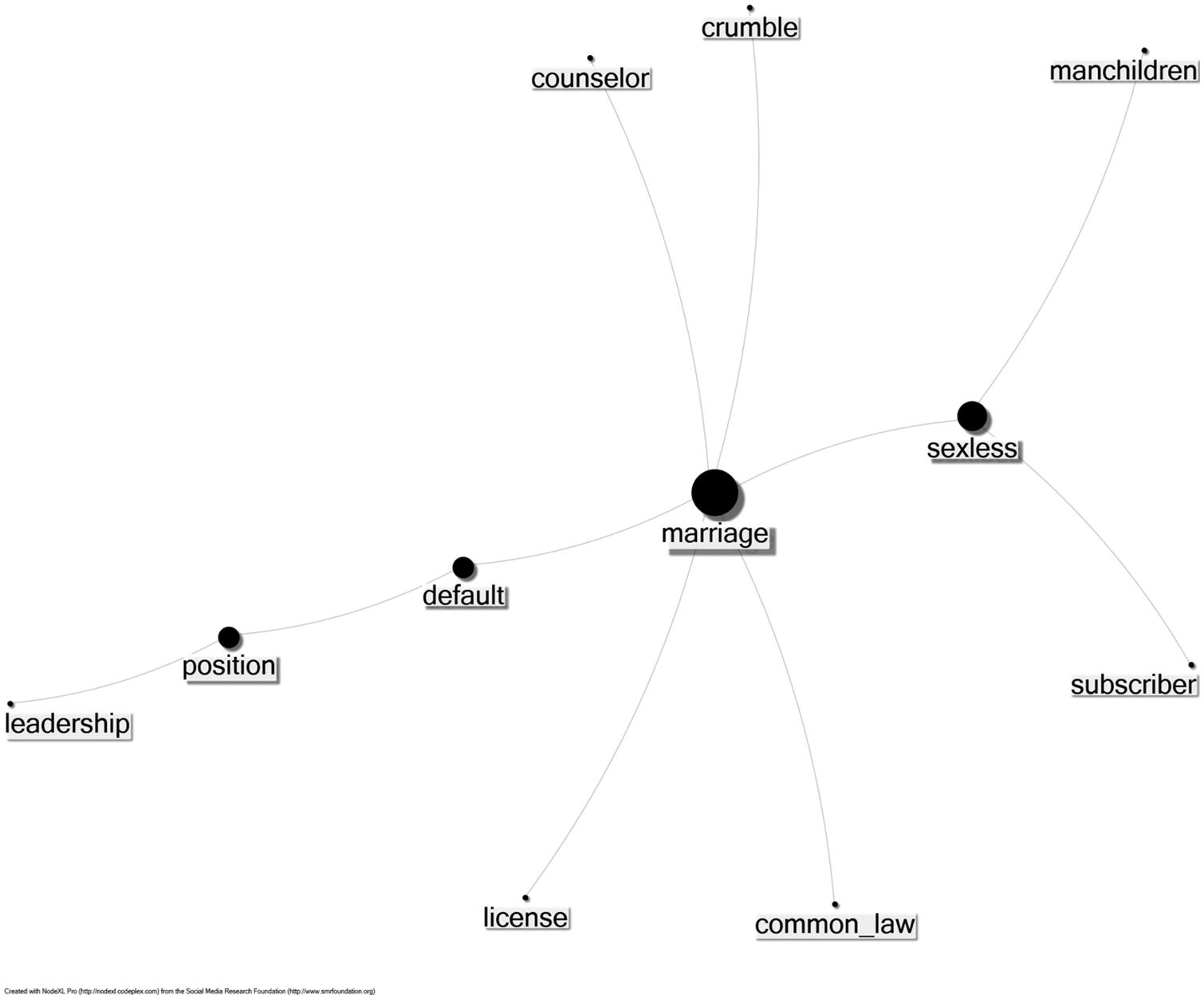
Conversations about marriage within TRP.
Frequently throughout TRP, users lamented the loss of relationships and marriages because of a lack of sex. As evidenced above, the user recognized a sense of loss, exclusion, and connection. For many members of TRP, the sensate experience of sexual activity was a form of acceptance, and the absence of sex within a relationship threatened men’s sense of self. Sex operated as a form of emotional and physical approval for men and a form of relational currency. One member described his marriage as both unbalanced and sexless: My
Sexless marriages and men’s general unhappiness with their lives were also mentioned as one avenue that brought men into the TRP subreddit. One user intimated, “We’re
Perceived abuses of divorce courts
TRP members often argue that key reasons men stay in unhappy marriages and long-term relationships are because of the legal system.
7
To them, the legal system privileges women at almost every turn and serves to disenfranchise men. Figure 2 demonstrates the semantic network of conversations clustered about the legal system. Important node pairs include “
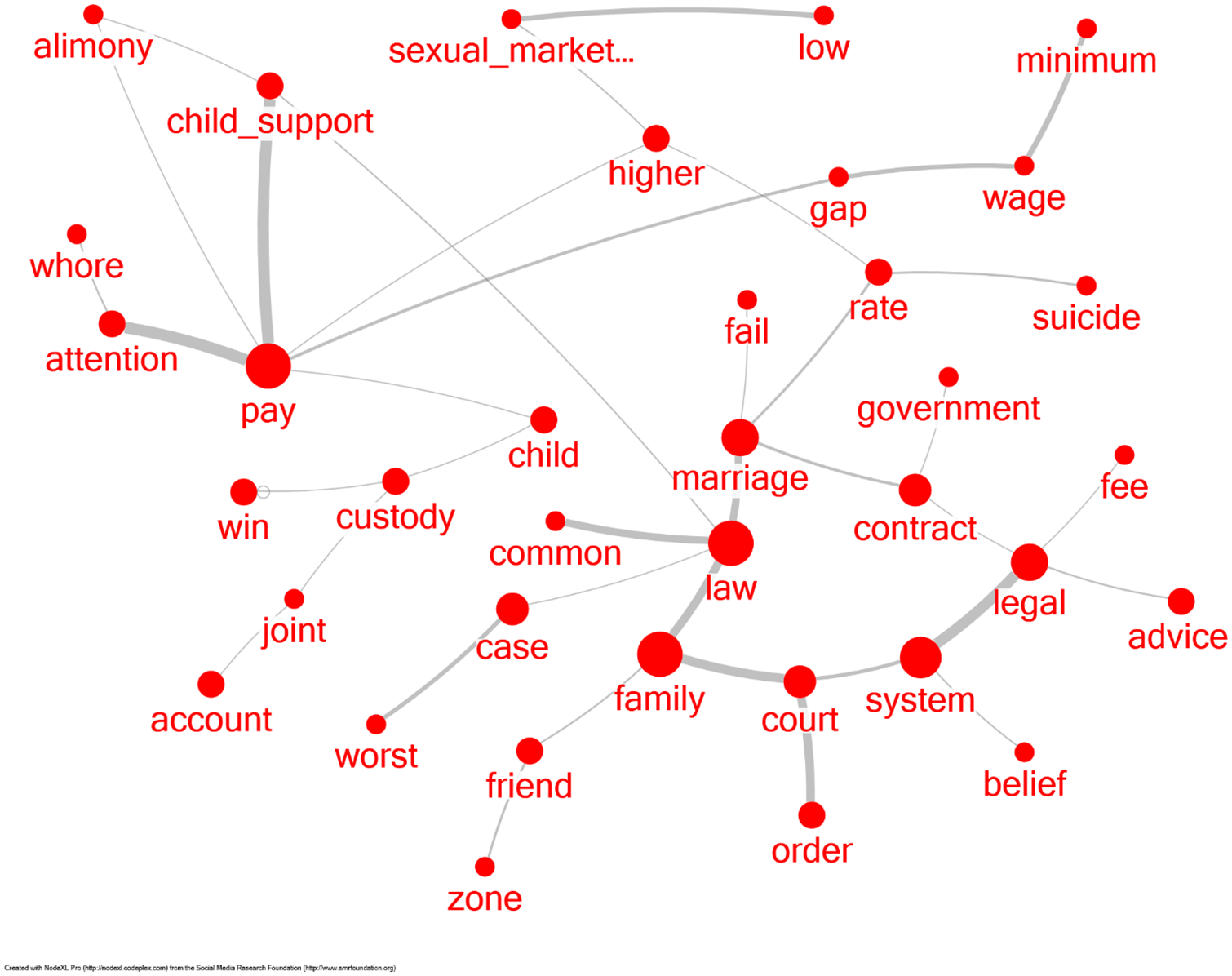
Conversations about the legal system within TRP.
In the text corpus, members often shared their firsthand experienceswith divorce. Frequently, they referenced how they perceived courts placed the financial burden of divorce on men through child support payments and alimony. These two areas are also in Figure 2 connected to the node, “pay.” By weaponizing child support, members recalled multiple examples of women “tricking” men into having children only to divorce them later to collect child support. One member stated, If a woman has the kid, she’ll just name you as a father to CPS [Child Protective Services]. . ..She can sue the father for
Furthermore, TRP members posted articles from different U.S. states where men are ordered to pay tens of thousands of dollars for children who are not their own. To TRP members, paternity issues are but one nightmare scenario compounded by the perceived weaponization of divorce courts. Even in marriage, TRPers must “be smarter, work harder, and protect [themselves]—especially if he fears that his wife will use the
These tensions refer to divorce and its corresponding financial and emotional losses as the TRP creation, “divorce rape.” There is a conspiratorial belief to TRP members that men are being “divorce raped” by the conspiracy of scorned wives and feminist/activist judges within legal systems. This framing positions court systems as feminist and, thus, anti-men. TRPers expressed fears that anti-men institutions wish to subjugate and disenfranchise most men, and, as one user shared, “Even dead fathers would have to pay
Perceptions of feminism and rape culture
Feminist culture
Feminists (particularly feminist women) received much of TRPers’ ire and backlash, as they are viewed as significant sources of men’s displacement and disenfranchisement in society. Figure 3’s central node, “feminist” is connected by other nodes such as “radical,” “propaganda,” “sjw,” and “criticize,” which illustrates how TRP, as an antifeminist space, contends that feminism is destructive to society. Antifeminist sentiments within TRP further sedimented men’s beliefs on- and offline about their status in society while affectively producing bonds with one another over their shared beliefs. One user argued, “
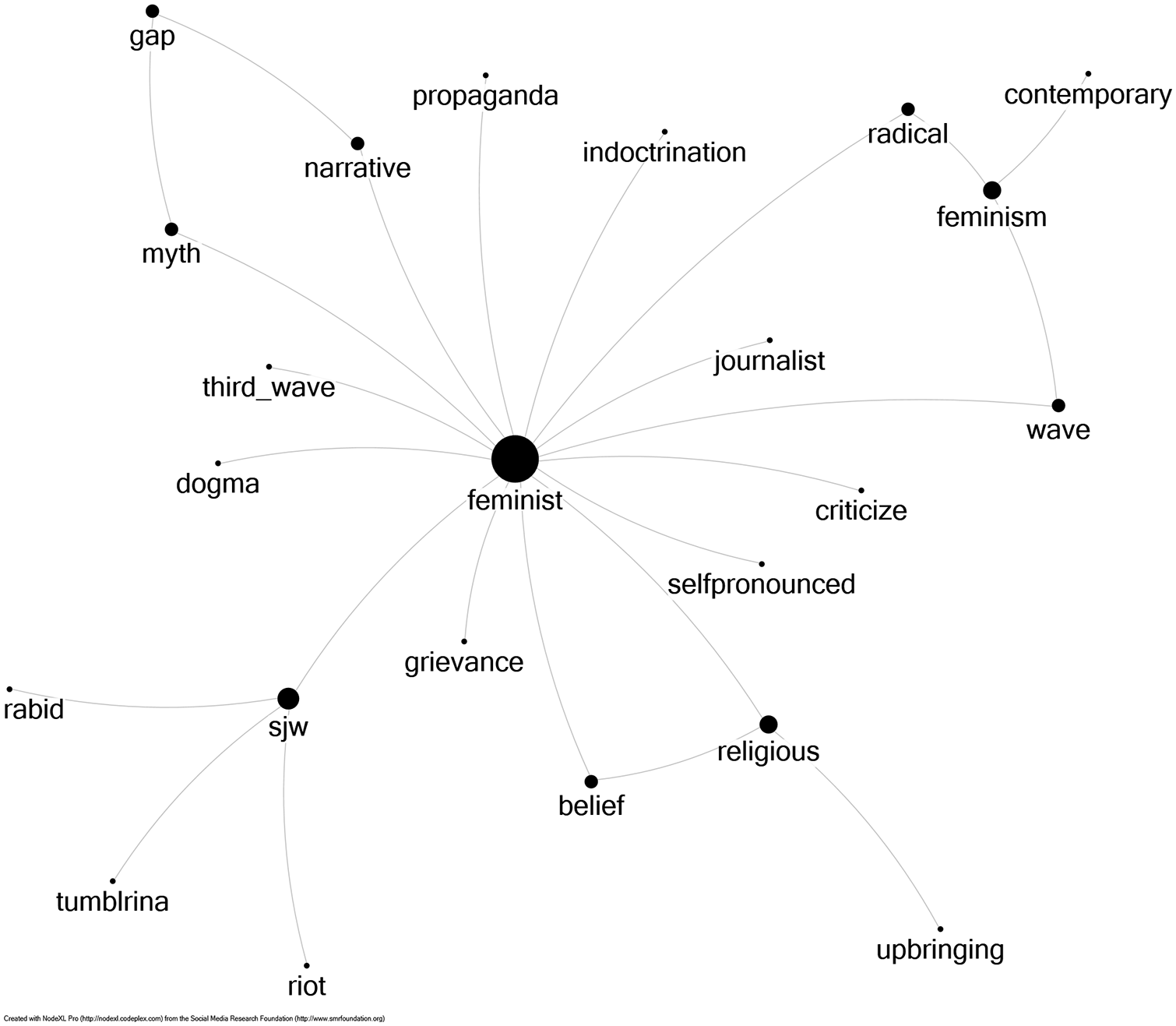
Feminists and SJWs within TRP.
Moreover, the users perceived feminists and progressives to be a ruling class within society. In an “Ask Me Anything” with conservative political commentator, Milo Yiannopoulos, one TRP member asked, “How can we fix the things that the
Rape culture
False rape allegations were another manifestation of men’s backlash. False rape is used as a phenomenon that highlights the intersections of sex, legal institutions, and women as villains The specter of false rape also illuminated the affective contradiction of the TRP identity regarding social backlashes: We don’t typically call ourselves the victim here, but when your government targets you with weapons like
The discussion excerpt showcases a nuanced way that the TRP identity coalesces around oppression but not self-victimhood; however, they continually deplore external institutions that serve to protect women over men. They argue that women and political institutions like the U.S. government foster a culture that negatively targets men; however, the central organizing premise of TRP is that women are sexual objects beholden to men’s desires. Thus, the weaponization of sexual activity (vis-à-vis false rape allegations) represented another inversion of the victimhood contradictions in that there is a belief that rape is overreported while accused men bear the brunt of the consequences. As such, discussions and conversations about rape issues are where affect is intensified (Just, 2019).
Discussions about rape in TRP occur in two primary ways: (1) sharing examples of news items related to false rape cases and (2) offering strategies for combatting rape allegations. Both are evident in Figure 4 as “rape” is the central node, and “accusation,” “allegation,” and “regret” are some of the nodes directly connected to it. For example, one user defiantly shared, “We spend a lot of time in TRP disproving
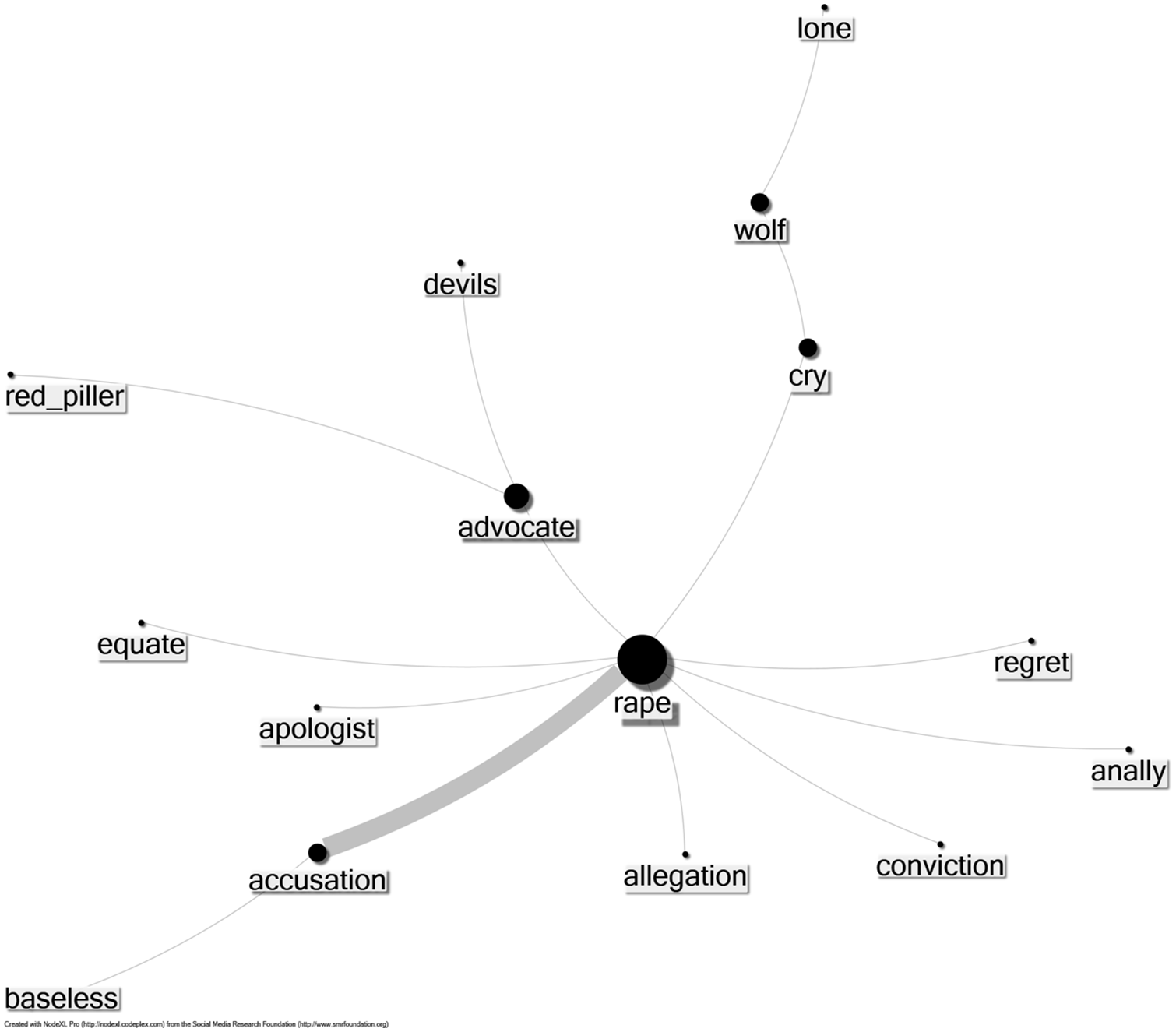
Rape accusations within TRP.
TRPers argue that there are always inherent risks with sexual activity. TRPers frequently argued, “If you want to have sex, you need to know the risks. Have a plan for dealing with
Discussion
Our findings contribute to organizational and organizational communication scholarship by showcasing the constitutive potential and consequences of affect in online organizations. For TRP, the sex/backlash discourses are vital forms of affective communication as they serve to constitute TRP’s online identity through sensemaking processes. That is, TRP’s adoption of affect amplified the sensate experiences shared by members of TRP. From a sensemaking perspective, TRP’s adoption of affect is epistemic, as it incites anger and fear within their members, and ontologic, as it is used to relationally decry the condition of men, garnering attention from outsiders (particularly newcomers). Our findings demonstrate how sensemaking occurs within TRP through affective masculinities constituted communicatively vis-à-vis enactments of contradictions, sensemaking, and identification.
Affective contradictions
In invoking affects, TRP members utilized affective contradictions throughout their engagement on TRP. According to Putnam and Ashcraft (2017), organizations are rife with various paradoxes; however, we highlight the connection between affect and contradiction, shedding light on how these are uniquely situated within online environments. As Lewis (2000) asserted, contradictions are first understood on an emotional level; however before emotions can be understood, they are “felt more than expressed” (Ashcraft, 2021: 3). Yet, the language adopted (e.g. politically incorrect phrases and subversion of experiences) intensifies feelings about how and why individuals come to understand the world around them, how they make sense of their experiences, and contributes to the “making” of self (e.g. identity; Ashcraft, 2021).
Through adopting affective contradictions of backlash, TRP members seemingly demonstrated what Putnam et al. (2016) conceptualize as a “more-than”/transformative approach to understanding contradictions. The men are often pulled together as the TRP collectivity shapes and recognizes their feelings and fears, moving them toward an oppressive view of reality rather than multiple other possibilities. They share loyalty for one another as they believe there is a “crisis of masculinity”; however, the crisis is caused by feminist society. TRPers frequently argue that men are socialized to become weak and feminized. TRPers crafted and shared horror stories about legal systems and other institutions that deliberately discriminated against men in favor of women. Women are cast as villains, “divorce-rapists,” and liars (i.e. false rape allegations). If women are villains, it is reasonable that men would reject and ignore them altogether; however, within TRP, the contradiction existed in their need for women. Because TRPers adopted the language of backlash, their identity was constructed vis-a-vis affective contradictions centered around the dualisms of fake and real victimhood. Thus, the paradoxical language and meanings aided members’ sensemaking of their experiences by not just creating meaning, but by invoking affective sensations that bring into being an embodied and constituted assemblage of identity and self that is unfolding, shifting, and relationally constructed with others in TRP (Ashcraft, 2021).
Affective sensemaking
Moreover, the affective contradictions also engender sensemaking processes for the men of TRP. As Weick (1995) described, sensemaking is predicated on sensate experiences. Thus, affect is a necessary part of the communicative sensemaking process. For example, as TRPers engage with one another, the anger and ire are “acts of discovery” in which the men’s language, experiences, and emotional responses to each other are forms of authoring their individual and collective identity (Weick, 1995: 14). In considering the context of TRP, this process is catalyzed through a converging backlash and sex discourse, which incites sensemaking as the discursive constructions and framing of experiences make men’s experiences sensable (e.g. the feelings of worry, stress, anger) and meaningful. TRP’s use of affective backlash discourses is essential to how the TRP identity is discursively enacted through affect. As Reeser (2019) offers, One contribution of affect as analytic lens, then, is to factor in the role of the body in questions related to an individual’s feeling and thereby take the role of intensity seriously. If a homophobic, sexist, white supremacist expresses his anger about gay rights, feminism, and anti-racism to another man, for instance, he may have already responded viscerally and physically to a situation related to these cultural movements. (p. 104)
Due in part to an online technoculture that amplified the “viscerality” of the written text within TRP through the technological affordances of visibility embedded within Reddit’s platform (e.g. Upvotes), their adoption of uncivil language is used to both incite anger within their members and garner attention from outsiders (particularly newcomers) looking to make sense of, decide upon, and begin to name their perceived experiences.
Affect greatly influences the sensemaking processes; after all, as people process and experience emotions, they necessarily shape their interpretation of events (Weick, 1995; Weick et al., 2005). Psychologists Salvatore and Freda (2011: 131) explain the cognitive processes of affective sensemaking, noting, “No situation is affectively neutral. People cannot help affectively making sense, just as they cannot help perceiving or thinking.” For TRP members, each time they share members’ subjective experiences of another abuse of court systems or another false rape allegation where the system seems to be privileging feminine identities over the masculine, they become increasingly angry. The ire compounds as members shift thinking from proven abuses and falsities to speculation and conspiracies, thus moving from retrospective sensemaking to future-oriented sensemaking. As members transition to future-oriented sensemaking processes, they shape and frame future interpretations and strategies (e.g. planning for false rape allegations; Taylor and Robichaud, 2004).
Moreover, as analyses revealed, affect bolsters the ongoing processes of becoming, or “a movement into a new way of performing gender instead of a movement backward in a conservative mode of stasis” (Reeser, 2019: 105). In doing so, the affective sensemaking within TRP ignites a deliberate attempt to shape the sensemaking of others using persuasive appeals and sensate experiences that surface as a result of the appeals (Ashcraft, 2021). The sensate moments of interaction on TRP incite new ideas that create new worlds of understanding (Ashcraft, 2021; Maitlis and Lawrence, 2007; Pratt, 2000). Within the analysis, it became clear that not only were members sharing personal stories and fears, but they were actively encoding interpretations of others, codifying affective interpretations into their already existing belief that men’s identities are in peril.
These processes are fundamentally tied to how individuals and collectives construct identities, developing self-esteem and self-efficacy while preserving their preferred self (Brown et al., 2008). In other words, the strategies the members took to reaffirm their belief system and the legitimacy of TRP’s philosophy became evident in the analysis of TRP. As Allan (2016) noted, “by turning to affect the men’s rights activists do not need to prove the truth of their claims because their affects—the feeling that it is true—trump the veracity of the thing causing the feeling” (p. 7). Eddington (2020) contended that the use of contradictory logics centered around TRP’s perceptions of a feminist society aided in cultivating alternative forms of resilience that served to (re)construct online identities; however, their use of affective appeals in their ongoing conversations is another critical element of the identity construction process.
Affective identity construction
Finally, while our study draws on the feminist theorizing of affect to investigate the contradictory identities of TRP, the use of affect in a study on MRAs reveals developing insights into the ongoing constructions and reproductions of the hegemony of men. Whereas feminist approaches to affect have highlighted the use of alternative logics to reduce, resist, and eliminate the dualities and inequalities that exist (Zembylas and Chubbuck, 2009), an affective approach to TRP’s identity reveals a reliance on inequalities and differences as communicative through discourse and alternative logics (Eddington, 2020; Jarvis and Eddington, 2021). Our study illustrates the potential of affect not merely to constitute an identity of TRP but as a resource to critique the embedded nuance and contradictory logics within the social identities of masculinity and men (Pullen et al., 2017).
Findings situate affect as a central organizing component of TRP, as men continually discuss their fear, shrouded in anger, of a system that has abandoned them; however, they attempt to demonstrate authenticity through affect by making it rational. As Allan (2016) contended, “by turning to affect the [MRAs] do not need to prove the truth of their claims because their affects—the feeling that it is true—trump the veracity of the thing causing the feeling” (p. 6). Thus, in rationalizing affect, TRPers’ adoption of affective contradictions aids in their continued reification of the hegemony of men. Further, in justifying their use of affect, the men of TRP attempt to divorce affect from the sensate into the cognitive and linguistic, which coincides with Reeser’s (2019) theorizing on affective masculinities: Affect may be a problem for normative or hegemonic masculinity because it reveals that a male body is not in full control, since affect affects it in unpredictable ways. . .Lacking control over himself may imply that he cannot assert control or power over others. His visceral reaction to feminism may be an issue for him because it implies his inability to influence the gendered situation. (p. 105)
Thus, given the uncertainty and lack of control over one’s body because of affect, men of the TRP seemingly rationalize their affective experiences to reclaim their perceived lost power discursively.
Moreover, the men of TRP are challenged by a tension of (dis)embodiment. Slater (2002) critiqued the idea that, within online spaces, users can textually disembody their physical identity. Complicating this tension, however, are the material consequences rendered as users hail their bodies as means to signify their perceived loss while simultaneously reasserting their power (Hakim, 2018). In other words, while TRPers may feel detached from their offline presence (Slater, 2002), their offline presence serves as the rationale for their participation and membership in TRP. As a result, while men are frequently framed as emotionless and rational offline, their online identity is fraught with feelings and irrationality (Buzanell, 1994; McElhinny, 1994). In recognizing the prominence of affect in shaping sensemaking, identification, and organization, TRP reasserts the body as a central configuration of their community. Consider, for example, the visceral responses many members had to others’ experiences. Their bodies are not absent from the process but rather exist in the liminal (dis)embodied duality. Thus, building on the already complicated and tenuous nature of (dis)embodiment online, this study diverges from a lineage of organizational theorizing that positions the male body, masculinity, and male norms as wholly cognitive and thus disembodied (Hakim, 2018; Knights, 2015), instead highlighting this tension between disembodiment and embodiment as pronounced and constitutive of masculine identities online and the ongoing reification of men’s hegemony. Not only are they advancing toxic configurations of masculinity (which epistemologically treats men’s bodies as neutral and aligns with a mind/body divide), they perceive themselves as thusly disembodied while ironically engaging in embodied, affective communication.
Conclusion
Over the last two decades, anger and vitriol have become normative aspects of online environment. Still, it is only recently—within the last decade—that these online conversations have shown their capabilities to engender offline violence (Marwick, 2022). Through attention to the constitutive and world-making affect and sensate capabilities of TRP, we aim to illustrate the potentialities for intervention. Not merely can these findings reveal a deeper and more nuanced understanding of what these men discuss online, but why they discuss such concerning and contentious topics. Building an emerging brand of scholarship attuned to critical empathy in toxic spaces (de Coning, 2021; Eddington, 2020), this study provides theoretical and practical avenues to intercede and disrupt hate.
Footnotes
Funding
The author(s) received no financial support for the research, authorship, and/or publication of this article.
