




Abstract
Some occupations are subject to more complex identity work processes than others. This rings true for those professional endeavours that are relatively poorly known and that cannot rely on institutions as a reference for identification, such as digital nomadism. Digital nomads can broadly be defined as professionals who embrace extreme forms of mobile work to combine their interest in travel with the possibility to work remotely. Building on a two-stage data collection process, this paper proposes a typology that characterises four archetypes of digital nomad lifestyle promoters’ narratives found online and show how these online narratives play a role in the process of identity work of other digital nomads. Our contributions are two-fold. First, we show that while the archetypes act as an important online identity regulatory force, they do so through dis-identification. Second, we explain how identity work for digital nomads involves evaluating discursively available subjectivities and propose a three-step reflexive process that entails (i) interpreting, (ii) dis-identifying and (iii) contextualising. We contend that our findings extend beyond the specific case of digital nomads and shed light onto the intricacies of work identity for ‘new’ occupations that are romanticised and monetised through social media and beyond.
Introduction
The discourses that surround a particular profession (i.e. that are disseminated through popular culture) provide information about workers, the nature of work, workplaces and organizations, even if they are not an accurate reflection of how professional and social realities unfold in practice (Jubas and Knutson, 2012; Rehn, 2008). While individuals are not completely ‘passive in the face of these discursive pressures’ (Watson, 2008: 124) and may even develop means of resistance (Barros, 2018), these representations and discourses both shape and challenge subjectivities.
Some professions have, for various reasons, been romanticised more than others. For example, lawyers on the TV show L.A. Law are presented as ‘interesting people who lead glamorous, colourful lives and who deal with one fascinating human problem after another’ (Friedman, 1989: 1600); a depiction to which many (lawyers) would probably object. In a different account, Pritchard (2020) examined the ways in which Human Resource Management (HRM) professionals are portrayed in images found in web repositories and online stock photos and argued that such visual repertoire contributes to the ‘simplification’ of both workers and the nature of their work. Similarly, depictions (in novels, films or TV series) of university professors in the image of a 40-something, white male living an intrepid life, lecturing to an enchanted audience and changing the course of the world through incredible discoveries is not only terribly stereotyped but also (in our opinion at least) far removed from the truth. As such, there is often a marked distance between how many professions are portrayed and how they are experienced (Armstrong, 2008).
In this paper, we are interested in the building process of identity work in a new professional context where actors cannot rely on the usual sources of identification (e.g. organization, professional associations, diplomas, occupation, etc.). The concept of ‘identity work’ encompasses the activities that an individual undertakes in constructing an understanding of self that is coherent, distinct and positively valued (Alvesson et al., 2008). Technology-related professional endeavours that remain poorly known and are still very much emerging are more prone to complex identity work processes. Vaast and Pinsonneault (2021) have, for instance, shown that it is difficult for data scientists to establish clearly who they are, and that this can be detrimental to both the occupation and workers. This is also the case for over-hyped internet-driven lifestyle occupations, such as bloggers, YouTubers and Instagrammers, which rely on a patterned set of mythologies invoking the ideals of fun, authenticity and creative freedom (Duffy and Wissinger, 2017). Our interest here lies in one such glamorized occupation, namely digital nomadism.
Digital nomad is an umbrella term that refers to professionals who embrace extreme forms of mobile work to combine their interest in travel with the possibility of remote working (Nash et al., 2021). While the term was coined over 20 years ago (Makimoto and Manners, 1997), digital nomadism started to enjoy a higher visibility in the past few years, both on social media and in the general press (see Bonneau and Aroles, 2021). In 2007, Tim Ferriss published The 4-hour workweek: Escape 9-5, Live Anywhere, and Join the New Rich which, together with a series of similar endeavours, played a significant role in popularizing the digital nomad’s lifestyle. In this book, he proposed the principle of ‘geoarbitrage’, which involves relocating oneself in a place where living costs are lower, while enjoying the benefits of first-world income. Some 10 years later, Chiang Mai (the largest city in northern Thailand) was named ‘the digital nomad capital of the world’, following the massive influx of digital nomads who seem to have put the geoarbitrage principle in practice (Elgan, 2017). This somehow illustrates the strength (and effectiveness) of the narratives used by promoters of digital nomadism.
What makes the case of digital nomadism particularly interesting and distinctive is the presence of a whole set of economic activities based on the ‘selling of a dreamed lifestyle’ by one group of digital nomads – hereafter designated as the ‘digital nomad lifestyle promoters’ (DNLPs) – who show their dominance over other digital nomads who practice location-independent work without monetising their lifestyle. Against this backdrop, our paper is concerned with exploring both groups and sets out to answer the two following research questions: How do the online narratives of DNLPs shape other digital nomads’ identity work? What is the role of virtual platforms in the building process of identity work for lifestyle occupations?
We explored these questions through a two-stage data collection process. First, we adopted a qualitative approach to online content analysis. We scrutinized a multitude of online sources connected to the digital nomad community and identified 60 DNLPs. Here, we use the expression ‘lifestyle promoters’ to refer to digital nomads who ‘monetise their lifestyle’ by turning their nomad experience into a profitable business (e.g. public speaking, online coaching, affiliate marketing, etc.). Through our empirical analysis of the online narratives of DNLPs, we identified four archetypes that reflect the most common online identities of ‘glorified’ digital nomads. Clearly, digital nomadism exists alongside a continuum of practices and the aim of crafting these archetypes was not to create neat boxes into which all digital nomads can be placed, but rather to gain a better understanding of the key narratives put forward by DNLPs and to highlight how these archetypes normalize specific trajectories, experiences and identities, in turn affecting DNs. We then conducted a series of 17 in-depth, semi-structured interviews with digital nomads and location-independent workers to explore the lived experience of those whose income is not primarily derived from the monetisation of their nomadic status. This second stage allowed us to investigate the role of DNLPs’ online narratives on the identity work of other nomads who experience this promoted lifestyle in different ways.
Our contributions are twofold. First, we highlight the role of archetypes in online identity creation. More specifically, we show that while the archetypes act as an important online identity regulatory force, they do so through dis-identification. Essentially, the archetypes participate as an online identity reference from which to distance themselves, as a counterexample. Second, we explain how identity work for digital nomads involves evaluating discursively available subjectivities and propose a three-step reflexive process that entails (i) interpreting, (ii) dis-identifying and (iii) contextualising.
This paper is structured as follows. First, we review previous work on identity work and online identities to situate our research in the existing literature. The third section discusses digital nomadism in the light of these literatures. We then provide an overview of the methodological approach underlying this research. This is followed by a presentation of our analysis, which unfolds in three parts: first, we describe the four archetypes that reflect the most common online identities of DNLPs; second, we show how such archetypes can shape the identity work of other digital nomads; third, we explain how such identity work unfolds. In the discussion, we describe the role played by social media on identity regulation and resistance for lifestyle occupations. Finally, the conclusion brings together the main contributions of this paper.
Online identity and digital nomadism
Identity work
The concept of identity has received a lot of interest in the Management and Organization Studies (MOS) literature (Brown, 2019; Thomas, 2009; see Alvesson et al., 2008 for a thorough review on this topic). Within that broad area of research, a significant body of literature has looked into how individuals construct a sense of self through what has been termed ‘identity work’ (Beech, 2008; Brown, 2015; Sveningsson and Alvesson, 2003; Watson, 2008). The concept of ‘identity work’ draws our attention onto the active ‘work’ that individuals undertake in an attempt to enact coherent, distinctive constructions of themselves (Alvesson and Willmott, 2002). Identity work is a reflexive process involving ongoing actors’ efforts to both understand and display who they are; it encompasses a wide array of interlinked activities through which people create, incorporate, modify, adapt, claim, negotiate and reject identities from a range of available resources (Brown, 2017; Mendonca et al., 2022).
Discursive approaches to identity work are primarily interested in the intricate ways through which the self is enacted via narrative and/or dialogical practices (Brown, 2017). Narratives, discourses and storytelling practices materialize a wide array of practices, beliefs and actions in organisations (Blanco-Gracia, 2020; Boje, 2014; Gabriel, 2000; Palo et al., 2020). The use of certain terms as well as specific discourse techniques play a key role in the making and assembling of events and actions in organisational worlds (Cabantous et al., 2018; Kornberger and Clegg, 2011) and, paradoxically, in the set-up of organizational control through the regulation of professional identity (see Alvesson and Willmott, 2002). Likewise, discourses can be powerful resources in the creation of a group identity to which professionals can identify (Doolin, 2002; Kuhn, 2006).
Importantly, individuals are not passive receptacles of discourses but can actively and critically interpret them (Alvesson and Willmott, 2002). Hence, resistance might enact the process of identity work (Barros, 2018). It can occur as ‘individuals confront and reflect on their own identity, recognising contradictions and tensions, and in doing so unsettle and subtly shift meanings and understandings’ (Thomas, 2009: 174). For example, workers experiencing stigma, such as ‘dirty workers’ transform the meaning of their work through reframing their work as essential service to the public or emphasizing non-stigmatized aspects of their job (Mendonca et al., 2022). Such resistance can take the form of dis-identification, that is defining one’s identity as opposed to a professional identity created and imposed by a group or an organization (Costas and Fleming, 2009; Dey and Teasdale, 2013; Elsbach and Bhattacharya, 2001). It can also involve the creation of a new group identity (Barros, 2018). Hence, such dis-identification has mainly been conceptualised as a negative connection between the self and the organization (Thomas, 2009). However, it can also happen at other levels, such as between the self and the social narratives that are available regarding who one can be and how one should act.
While MOS scholars have examined identity at various analytical levels, ‘the organization level remains the most common in mainstream management scholarship’ (see Alvesson et al., 2008: 5). Yet, different types of ‘agents’ intervene in the process of identity work; the ‘human being’s notion of who and what they are is shaped by the discourses which surround them’ (Watson, 2008: 124). This is particularly visible with digital nomads given the emerging nature of their profession and the absence of institutions that would frame practices and professional norms. Our paper sets out to investigate further the interplay between public online narratives and identity work activities in the context of digital nomadism.
The making of online narratives
Online platforms, such as social media, offer a space where individuals craft a self-narrative to define who they are (Cover, 2015; van Dijck, 2013). The pervasiveness of social media within daily practices has contributed to a blurrier distinction between work and non-work activities (see Ollier-Malaterre et al., 2013). In that context, individuals might decide to split their online identities into multiple segregated profiles to keep a boundary between their professional and private roles (see Lauriano and Coacci, 2021), or to create a unified representation that fits their different roles so as ‘to appear as a univocal person online’ (Fieseler et al., 2015: 156). Either way, networked technologies, such as social media, afford forms of strategic self-presentation that exceed the capabilities of face-to-face interactions, as they allow users to better conceal that which they do not wish to convey, while accentuating that which they do (Walther, 2007).
Hence, social media enable new forms of identity work, which are both collective and visible (Barros, 2018). These changes suggest that social media is more than a communication channel or a stage but rather constitutes a new workspace (Bonneau et al., 2021) where the professional self is not only expressed, but also literally brought into existence through different mechanisms (Bröckling, 2016).
In addition, it has been shown that online arenas tend to produce identities that are reduced to stereotypical images (Sundén and Sveningsson, 2012; Wajcman, 2010). Given the possibility to create multiple profiles, the capacity for anonymity or pseudonymity and its asynchronous nature, social media grant individuals new means for impression management, by allowing them to present ‘desired selves’ (Zhao et al., 2008), to avoid being associated with stigmatising stereotypes (Lauriano and Coacci, 2021), and to engage in more strategic self-presentation to maintain positive self-images (Ellison et al., 2006). This particular aspect will be explored in this paper through the case of digital nomadism.
Digital nomadism as a lifestyle: Blending professional and personal identities online
An overview of digital nomadism
It has been almost 40 years since Toffler (1981: 199) predicted that progress in personal computing would lead to a generalization of telework for professionals belonging to the category of ‘knowledge workers’. The spread of high-speed and wireless Internet, together with the growing availability of mobile communication and collaboration tools, fostered the emergence of new forms of work characterized by greater flexibility in terms of places, times and ways of working (Aroles et al., 2019).
While it is relatively easy to have a general grasp of what digital nomadism is, it is much more difficult to provide a more holistic definition of this phenomenon (Müller, 2016; Reichenberger, 2018). We see two main reasons for that. First, digital nomadism has been studied through various disciplinary lenses, each having their own focus and preoccupations (see for instance Müller, 2016; Sutherland and Jarrahi, 2017; Thompson, 2018). Second, there is a lack of consensus, within the digital nomad community itself, with regards to what could form a legitimate claim to being a digital nomad (frequency of travel, duration of stays, professional conditions, etc.) (Aroles et al., 2020). In turn, this means that there is a great diversity of profiles encountered in the digital nomad community; some of them clearly overlap with other types of remote or location-independent workers.
One key element that sets digital nomads apart from other mobile workers is the importance given to mobility and remoteness. Digital nomads select locations based on aesthetics and leisure considerations (Müller, 2016), aspiring to escape traditional work structures. As such, the professional activities of digital nomads must be flexible in a way that allows them to use whatever spaces they find in the locations they choose to visit. Both professional and personal arrangements must make it possible to afford a life of travel, and in some cases, to embrace a permanently mobile lifestyle, in which the notion of fixed home is rethought, which involves selling all possessions or engaging in some level of minimalist travelling (e.g. only keeping things that can be carried) (Aroles et al., 2020). To do so, they incorporate work into a form of ‘lifestyle mobility’ (Cohen et al., 2015), in which private life is an integral part of their work, and vice-versa.
Hence, digital nomadism should not only be conceptualised through the specificities of its mobility – which is continuous and on a global scale (Aroles et al., 2022) – but also as a lifestyle, in which leisure considerations take precedence over employment-based location (Thompson, 2019). How digital nomads articulate the centrality of leisure in their lifestyle raises questions regarding their professional identity, thus, constituting an interesting case to investigate different aspects of identity work.
Digital nomadism and identity
The critical MOS literature that approaches identity in constructivist and processual terms assumes the presence of multiple, hybrid, fragmented, shifting and competing identities at the workplace and beyond (Alvesson et al., 2008; Brown, 2017). In ‘traditional’ organizations, for instance, people are required to take on various corporate identities, which are likely to differ or may come into tension from the ones that they adopt in other parts of their lives (Watson, 2008). For digital nomads, those different aspects are blended into a ‘lifestyle identity’, in which the boundaries between personal and professional lives are hardly distinguished. Indeed, the conversion to a nomadic lifestyle does not only involve the adoption of a new work modality, but often entails embracing new life choices. Digital nomads can choose a job, employer or entrepreneurial project that allows them to live that lifestyle. Alternatively, they can choose this lifestyle first, and then they seek professional opportunities that would suit. Either way, the intentionality of this lifestyle (i.e. the free choice of living in such a manner) constitutes an important aspect (Hemsley et al., 2020).
Earlier work (Bonneau and Aroles, 2021) has examined the themes generally found in the online self-presentation of DNLPs. First, they mobilise narratives of self-transformation by clearly identifying a ‘decisive’ event that acted as a wake-up call to become a digital nomad. Heavy financial commitments, combined with the high cost of living in western cities and the boredom associated with a 9-to-5 job, appear as obstacles that can only be overcome through a radical life change. Second, their stories convey a ‘younger generation-specific’ view on work-life balance (which relies on the excitement, adventures and inherent challenges that come with travel) that serves as a justification for choosing the digital nomad lifestyle, but also, as a marker distinguishing them from out-groups of old/traditional workers. Third, they promote a ‘do-it-yourself’ ethos to convince others that success is achievable to anyone willing to take the risk. This research showed the importance of online storytelling in the legitimisation process of digital nomad lifestyle promoters. Here, we expand this research by examining how their narratives can be characterized into recognizable archetypes and exploring their role in the identity work of other digital nomads.
Methodology: A two-stage process
Stage 1: Online research
The objective of the first step of our research was to identify the main archetypes illustrating the narratives of DNLPs. In the absence of other form of identification (organisations, professional associations, diplomas, etc.), they constitute the primary means through which we can recognise digital nomadism as an occupation. If one has heard about digital nomadism, it is mainly because this group is highly visible on social media (and because their stories were then told in the press), and that they rely on such visibility to make a living of their lifestyle. For that reason, we felt that it was important to characterize these public figures, as they play a key role in the dissemination of information pertaining to that particular occupation. As such, the group studied in this first phase of our research consist of online personalities identifiable by their attention-seeking and reputation-management practices (Abidin, 2015; Marwick, 2015).
We thus started our research by exploring popular nomad-oriented online forums, groups and blogs and performed a systematic search in the general press for media coverage related to the digital nomad community. This phase of the research was conducted between November 2018 and May 2019. Through this process, we identified 60 individuals corresponding to our definition of DNLPs, which implies that they monetise their lifestyle by selling product, services or advertising associated with it and that they make themselves and their experience as a nomad visible on social media. By the time we had sampled 50 profiles, we noticed that we had reached data saturation (Saunders et al., 2018), with the same elements recurrently emerging. We decided to examine a further set of 10 DNLPs to ensure that we had not missed anything of significance. The data were collected through an immersion into their ‘online visibility ecosystems’, namely their publicly available social media accounts as well as the press coverage they received. Table 1 gives an overview of the data sources used, along with the number of nomads’ profiles for which the source was analysed.
Online data sources.
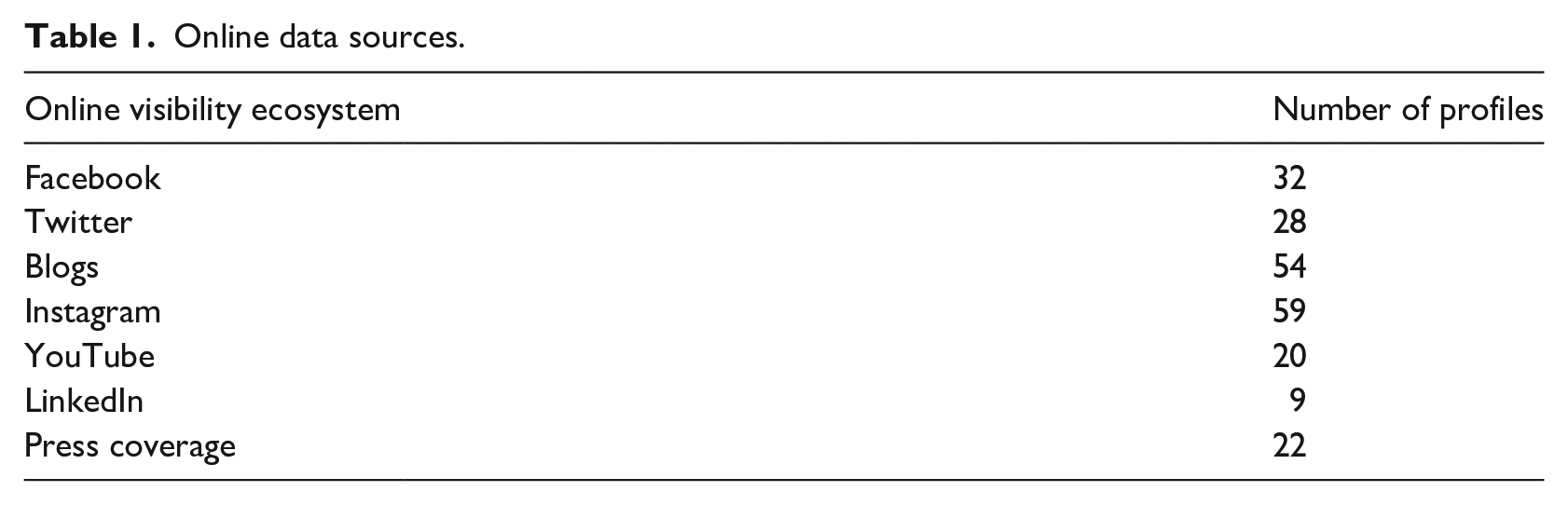
This phase of the research involved collecting data in a passive way, as we did not have direct interactions with the 60 DNLPs sampled here. Since the objective of our research was to study narratives, and not to analyse the sociodemographic profile of their authors, we did not need to collect their personal information. Therefore, we did not record any associated metadata, such as geolocation data. In addition, we decided to only collect posts found on public accounts, where users likely have no expectation of privacy.
We performed a manual thematic coding of the data collected in an open and inductive manner. This included coding for the emergent themes related to the activities through which DNLPs can monetize their lifestyle. This not only involved examining closely the professional journey of these digital nomads but also unpacking the narratives upon which DNLPs craft their digital selves as well as the aesthetics carried by the images. Therefore, our analysis considered both the visual and textual elements of posts, using the descriptions, hashtags and comments to contextualize the pictures (Latzko-Toth et al., 2017).
The objective of such analysis was to build a typology identifying the archetypes characterizing the main narratives of DNLPs. We use the term ‘archetype’ not as a direct reference to Jungian archetypal theory, but rather in its commonly used assertion, that is, a ‘typical example’ of a particular kind of person. Here, archetypes serve as conceptual devices to regroup similar traits through various, seemingly unrelated narratives. Hence, such typology ‘sorts out distinctions that allow us to reason in more differentiated and nuanced ways about the nature of phenomena’ (Sandberg and Alvesson, 2021: 501). When we encountered similar traits repeatedly in various DNLPs, the basis for one archetype was shaped. More specifically, we built our categorization by comparing the characteristic of their main messages (e.g. who they address in their publications), their tones (e.g. pedagogical), the terms they frequently use (e.g. live your dream), the aesthetic features (e.g. pictures of themselves in paradisiac settings), the elements put forward in their narrative (e.g. their own success stories) and the types of revenue-generating activities they conduct (e.g. coaching services). This allowed us to distinguish the dominant narratives and to personify them into four archetypes that capture the essence of the 60 DNLPs who form the basis of our corpus of data.
Stage 2: Interviews
The objective of the second stage of our research was to examine the role played by the online narratives of DNLPs in the identity work of other digital nomads and location-independent workers whose income is not primarily derived from their nomadic status. From May 2019 to September 2020, we conducted a series of 17 in-depth, semi-structured interviews with digital nomads and location-independent workers based in Montreal at the time of the interview. By choosing Montreal as the current point of passage for the nomads we interviewed, we ensured that we would not focus exclusively on trajectories that are already well documented in the literature, 1 and that we would be able to draw on a greater diversity of experiences, thus extending the discussion on the professional identity of digital nomads beyond the representations found online. It is however important to note that our respondents have also been to many places across the globe, including ‘exotic’ locations and popular spots for digital nomads. The selection of respondents was made through purposive sampling in order to interview individuals who may have a unique, different and important perspective on the phenomenon (Mason, 2017).
Each interview lasted approximately 1 hour and 30 minutes and revolved mainly around how digital nomads and location-independent workers construct their identity. 2 Semi-structured interviews encourage a retrospective reflexion on the participants’ experience, where they ‘get to tell long stories without interruptions’ (Watson and Mcluckie, 2020: 384), stories that participants draw on to position themselves, thus contributing to their identity work. Interviews were conducted in French and took place either ‘physically’ in public spaces in Montreal or online (on Zoom) due to the pandemic. In all cases, interviews were audio-recorded and then professionally transcribed. All three authors regularly met online to discuss the interviews and to clarify specific elements pertaining to the response provided by the interviewees and the directions we wanted to explore further. As with the first stage of the research, data saturation guided our process of data collection. By the time we had conducted our 17 interviews, we had reached saturation with similar points and concerns raised by interviewees. Table 2 provides information on the profile of our interviewees (all names used are pseudonyms).
Profiles of interviewees.
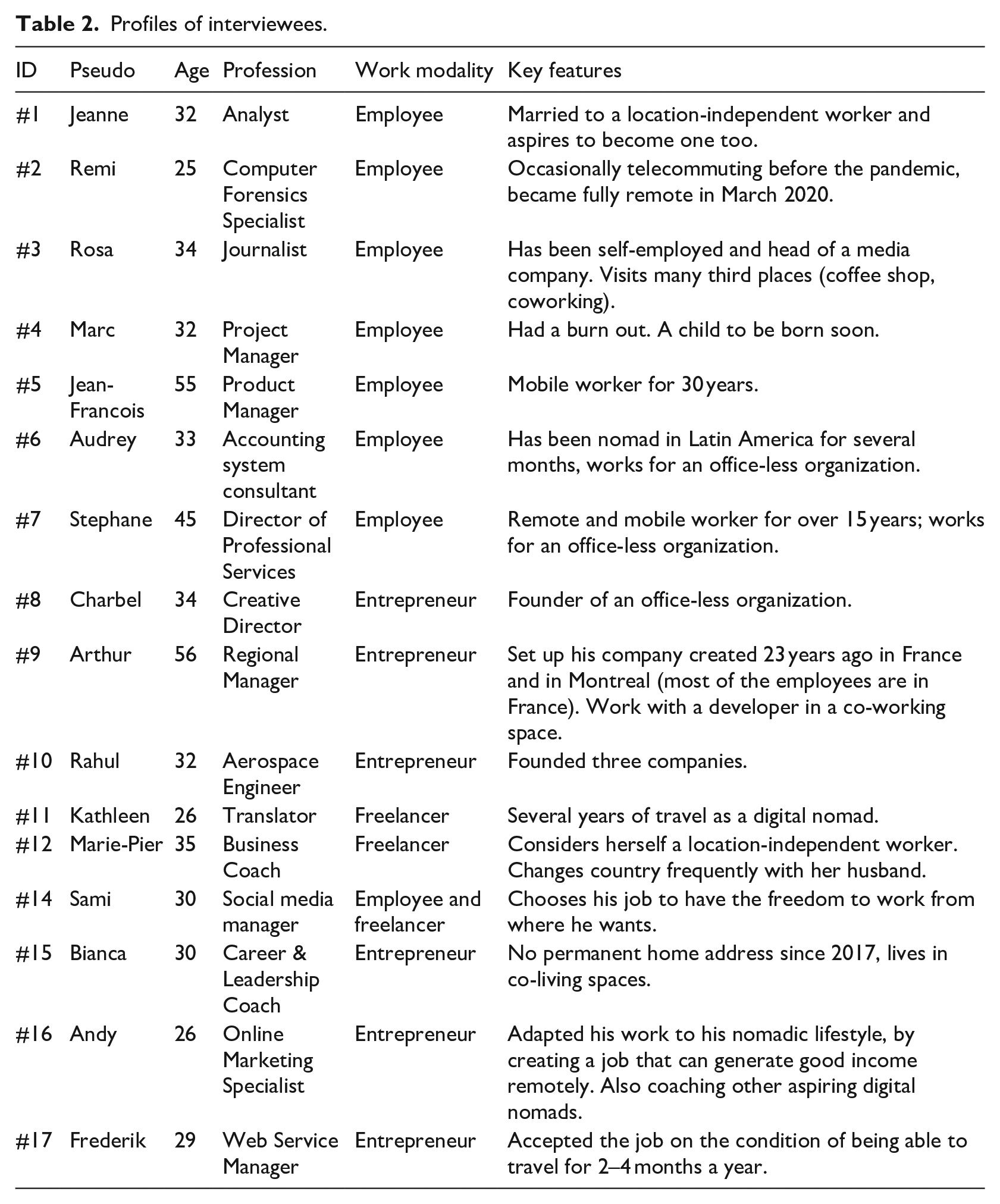
In order to articulate the themes and concepts emerging from the interviews, all three researchers systematically analysed and coded the data through an open and inductive manner (Miles et al., 2013). More precisely, a ‘three-stage process’ was followed, which first involved coding for descriptive features. First-order codes were used to describe the main themes encountered, such as the professional trajectory, the type of mobility, the personal aspirations, the lifestyle, the aspirations, the difficulties, the definition of digital nomadism and the references to online representations or digital nomad lifestyle promoters. Following an engagement with the literature on identity work and team discussions, second-order constructs were then crafted to describe the gaps between self-identities and online narratives. This approach resulted in a number of direct quotations chosen in order to explore how digital nomads distinguish themselves from the online narratives and how they proceed to construct their professional identities. The third and final step in the analysis was to systematically code interviews with reference to the key activities, selling propositions and legitimacy markers discursively contained in the online narratives of DNLPs, as characterized in each archetype. This allowed us to link the criticisms formulated by DNs in the interviews to specific characteristics put forward through each archetype. Explicitly outlining those links was useful in understanding the role online narratives play in providing specific (counter) examples, especially in the absence of other sources of reference for identification and dis-identification (such as organizationally-imposed discourses, for instance).
Findings: Online narratives as building blocks for identity work
Characterizing the narratives used to portray DNLPs: Four archetypes
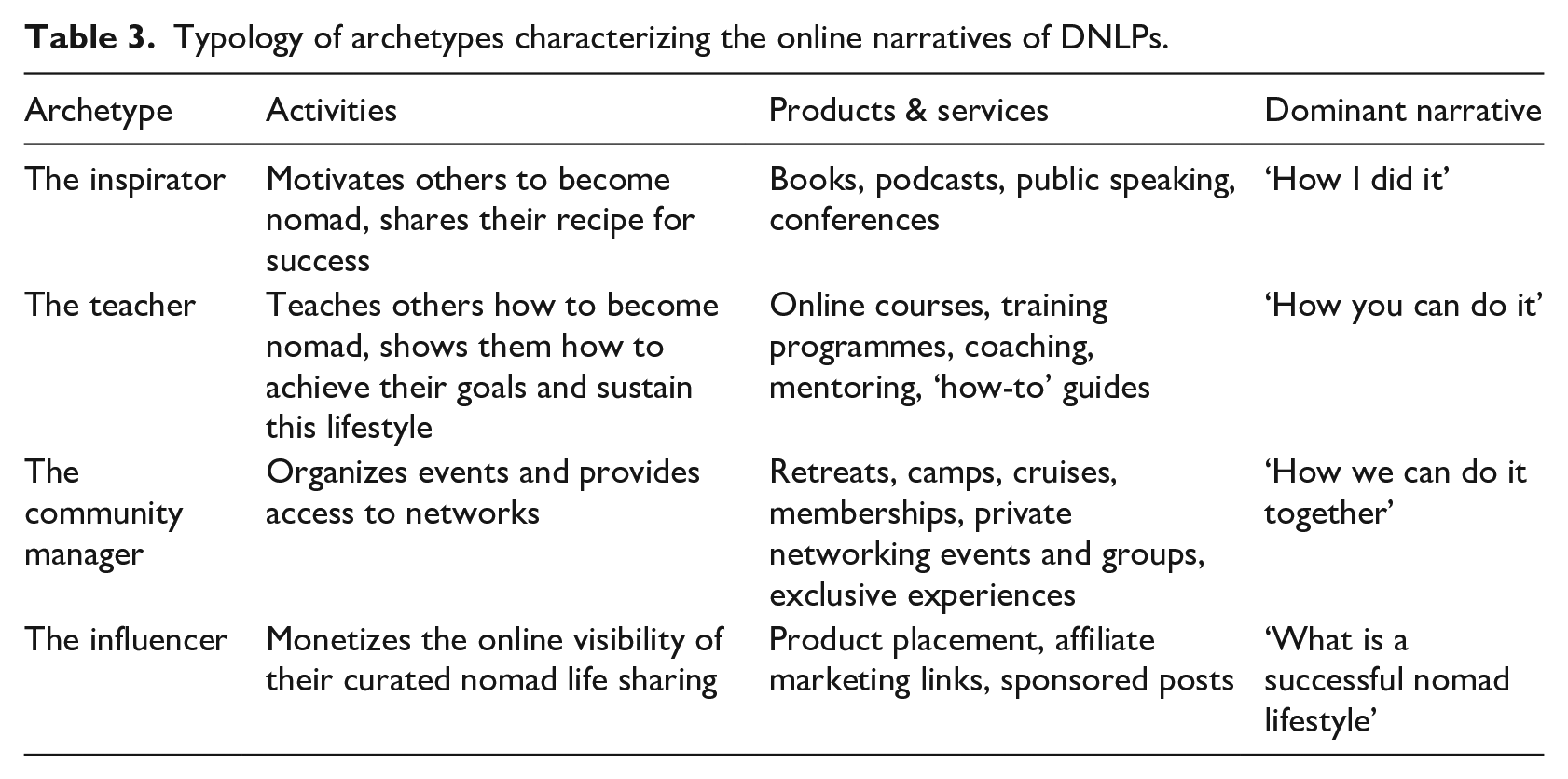
For DNLPs, validity and legitimacy are achieved primarily through online storytelling. In our exploration of such online storytelling, we identified four archetypes characterizing the narratives put forward by DNLPs. Here, we present our four archetypes through a description of their professional activities, the products and services they commercialized and their dominant narratives. We provide a summary of these features in Table 3.
Typology of archetypes characterizing the online narratives of DNLPs.
The inspirator
This first type of DNLPs sets out to motivate others to become nomads; they monetize their secrets, tips, strategies, tools, tactics and advice for success and happiness in the form of books, podcasts, public speaking and conferences. Attempting to convince others that this is not only a sustainable mode of life but also one that can be reached by anyone with the right mind, the inspirator relies on a ‘how I did it’ narrative when conveying professional and life advice. The inspirator is a well-travelled individual who has typically explored over 30 countries and who purposively makes their lifestyle visible through pictures of themselves in various exotic settings. The inspirator’s success as a digital nomad is experienced in two different ways: for some, it is about financial accomplishments. For example, the inspirator can be one of those ‘serial entrepreneurs’ who launched several profitable online businesses and developed ‘passive income’ generators such as dropshipping e-commerce websites. Their promotional narrative revolves around the idea of working less, earning more and retiring early to enjoy life. For others, success as a nomad is rather dependent on their ability to adopt a minimalist lifestyle: selling most of their possessions and spending less to be able to support their travel. Stories revolving around their own success, coupled with motivating lines such as ‘I can do it why can’t you do it too?’, lie at the heart of the discourse of the inspirator.
The teacher
The second type of DNLPs helps others achieve their own goals through coaching sessions, online courses, training programmes, mentoring sessions and ‘how-to’ guides. The teacher relies on a very appealing ‘how you can do it’ narrative through which they can turn their vast experience as digital nomads into ‘proven’ methods and resources for less-experienced individuals. By doing so, they set out to empower their ‘clients’. Teachers would target aspiring digital nomads and newcomers to help them think differently about the way they work and live. More concretely, they provide guides that teach how to make money online and sustain long-term travel. They highlight their years of experience as a marker of expertise. Through their ‘educational’ stance, the teacher seeks to highlight how digital nomadism can be learnt/taught, just like any other profession. To some extent, the logic of the teacher bears similarities with that of the inspirator – yet, while the inspirator would weave their narratives through their own experiences, the teacher would endeavour to connect more directly with their audience. While sharing similarities with the ‘anyone can do it’ narratives found in digital entrepreneurship, the promises carried by the teachers’ discourse encompass both life and work: ‘I wanted a particular lifestyle, so I engineered it for myself’. In these narratives, anyone willing to try can transform a trip into a career, or shape their lifestyle to make constant travelling possible. Their promotional discourse gyrates around empowerment and self-discovery, convincing aspirant nomads that they can have anything if they equip themselves with their knowledge and put it in action today.
The community manager
The third type of DNLPs sets out to cater for the digital nomad community. Drawing from their own previous experience, they are engaged in business activities that revolve around the material and professional needs of others attempting to become digital nomads. The community manager organizes various events aimed specifically at the digital nomad community (such as digital nomad conferences, cruises, camps, festivals and summits). Usually held in breath-taking locations, these events come at a price. For example, the different access packages for a major digital nomad annual conference range from 197 to 997 euros per person. Their events regroup like-minded individuals who prioritize the same values and are willing to invest in their development. The community manager also provides access to certain networks (some community managers specialize in arranging access to networks of highly successful individuals). Some present themselves as the gatekeepers of exclusive experiences that are not necessarily open to anyone interested; a thorough selection process is often involved to make sure that the participants match precise criteria or correspond to a pre-defined profile. For example, a nomad limits the access to his ‘gastronomad’ experiences to only 10 ‘adventurous foodies’. The community manager contributes to the professionalization of digital nomads by positioning these different events, networks and places as passage points in the process of becoming a fully-fledged digital nomad. The promotional discourse of the community manager is mainly built around exclusivity, professionalization, credibility and legitimacy.
The influencer
The fourth type of DNLPs monetizes their relative online popularity, notably through product placement and sponsored posts. They showcase their successful nomad experiences to build the audience and credibility needed for brand endorsement. Hence, the influencer dedicates a lot of time and effort to generating attention and engagement from readers and followers by meticulously curating their nomad life on their blog and social media accounts, not only to share spectacular travel-related content, but also to express their life vision. Contrary to the previous archetypes, the influencer does not earn income from other nomads or aspirant nomads, but rather from advertisers. They often build their narratives around a ‘distinctive niche’, for example, the ‘vegan & environmental-conscious’, the ‘family in a van’ or the ‘luxury travel’ nomad. For the influencer, visuals play a key role in the aesthetical dimension of digital nomadism and largely contributes to the ‘romanticization’ of digital nomadism as a lifestyle. Photos more often convey what is desirable about the digital nomad’s lifestyle. Interestingly, though probably the least sustainable (financially speaking), this fourth type is clearly the most persuasive when it comes to convincing others of the appeal of digital nomadism. This is due, we contend, to the fact that it generates assumptions and expectations about how easily such a lifestyle can be sustained while downplaying the amount of work that goes into the maintenance of a carefully curated digital identity.
It is important to note that this typology presents ideal-type categories and, in practice, they often overlap. For example, a DNLP can generate revenues through product placement (cf. The influencer) while also selling coaching services (cf. The teacher). The point of this typology is to explore the nature of a messy phenomenon and to raise some important questions for the second part of our project: To what extent do other digital nomads recognize themselves in these archetypes? How does their own experience of digital nomadism differ from these stories?
‘Other digital nomads’ professional identity: Between online storytelling and legitimacy claims
Through our interviews, it was very clear that other digital nomads experienced digital nomadism very differently as compared to how it is portrayed online by DNLPs. Our analysis shows that these digital nomads build their identities in part by rejecting the digital nomad label for three main reasons: (i) the impossibility or refusal to fully embrace the projected lifestyle; (ii) a conflict between the projected values and their own values; and (iii) a fear of undermining their professionalism and credibility.
Lifestyle
While other digital nomads share the same main goal as their DNLPs counterparts (i.e. to be able to work from wherever they want and achieve freedom of movement), they do not necessarily want to (or cannot) fully embrace a digital nomadic lifestyle, for instance, by ditching their permanent home address or living the so-called ‘van life’: “A digital nomad, for me, is someone who doesn’t really have a real home, someone who moves from hostel to hostel, or from van to van (laughs). But I don’t really identify with that”. (Audrey)
An interviewee distinguished himself from those who attend the main conferences for digital nomads. For him, these people are more like backpackers, while he primarily identified as a digital entrepreneur: “The feedback I got from DNX (. . .) is that “it’s a lot of hippies, vegans, roots, who are a little lost, who find themselves in these movements, without really understanding what’s going on” (. . .) It’s a big difference, for me, between the backpacker and the digital nomad (. . .) You might be a nomad, but you’re not a digital nomad, because you don’t work remotely, you don’t create online income”. (Andy)
Our interviews show that there is a difference between wanting to be location-independent and fully adopting the digital nomad lifestyle. Hence, digital nomadism appears as one particular manifestation of the ‘Working From Anywhere’ phenomenon. In the narratives of DNLPs, digital nomadism was presented first and foremost as a lifestyle. For Bianca, location independence was rather experienced as a work modality: “Most of the nomads became nomads because they first wanted this lifestyle, and then they found a job that would allow them to live this lifestyle. Whereas, for me it was rather the opposite: I first decided on my job and then I developed it in a different way to have more flexibility, but my first choice was my core business and not only the lifestyle”. (Bianca)
While some of our interviewees aspired to ‘geographical flexibility’, ‘continuous mobility’ was neither achievable nor desirable for most of them. Marie-Pier, who described herself as a location-independent worker, has not had a fixed location since 2016: “My husband and I have decided to sell most of our properties, and we live in four suitcases. We change places, normally, when we feel like it: sometimes we spend two years in one place, sometimes three months.” (Marie-Pier)
Others, like Jeanne, Andy and Frederik, would spend a few months abroad, but would not consider abandoning their home address: “I don’t want to have nothing when I come back and say to myself: “I travel and then I jump in the car and I don’t know where I’m going when I get home”. That’s another thing I really appreciate (. . .) I know I have my home and I’m going back to work.” (Frederik)
The ‘mainstream definition’ of digital nomadism conveyed online implies continuous mobility and underplays the extent to which there are likely to be many variations of ‘what it is to be a digital nomad’. In response to this, Andy proposed a more nuanced definition, one that allows more diversity in terms of experiences: “That’s just the definition of the term digital nomad, but it can be experienced in many ways. I define it as having the freedom to travel more or less when you want, to have earned your income online, and after you travel. Well, if you travel just two weeks a year, it’s not really digital nomadism, but from, let’s say two months a year, if you do it while working, for me, you’re a nomad.” (Andy)
As we saw in the description of the fourth archetype, defining the parameters that circumscribe the application of digital nomadism in its ‘ideal form’ lies at the heart of the influencer’s business activities. Indeed, our respondents made explicit references to the specific digital nomad lifestyle represented in the written and visual narratives that are meticulously and incessantly generated by the influencer on social media. It is from such restrictive definition that other DNs position their own experience, indicating how their trajectory and aspirations deviate from it.
Values
The question of diversity also led us to consider the criticisms made by some of our respondents regarding the Western, male-dominated views carried by the digital nomad label. Our female respondents identified several examples of men’s patronizing stance towards local women. On that topic, Kathleen strongly voiced her oppositions to behaviours she encountered while in Chiang Mai, which she described as a ‘digital nomads hotspot’: “When I was in Chiang Mai, I used to go to work in a cafe and during the day I would buy coffees, cupcakes and things like that. And every now and then, there was a group of boys, maybe six of them, they would come and sit next to me, they would just buy a little coffee, they would stay there for eight hours straight, with all their laptop support like that, with the keyboards up, Bluetooth, they would talk on Skype to customers and bragged about having a Thai girlfriend who didn’t speak English and couldn’t understand them (. . .) They were bragging about exploiting the country, women, etc., without giving anything back. That’s why I don’t go to Chiang Mai anymore (. . .) I want to discover, I want to integrate into new cultures, and I want to feel it. I’m not here to display or live a fantasy of Western supremacy, and I’m very uncomfortable with that.” (Kathleen)
While Chiang Mai is an important hub for the digital nomad community, it has also become emblematic of the troubles caused by the influx of nomads and their questionable behaviours. Similar to mass tourism in general, digital nomadism reproduces the traditional imbalance between tourists and locals and can have detrimental effects on local communities. Another nomad who also visited Chiang Mai was shocked by such negation of locals within the digital nomad community: “Chiang Mai is completely invaded by nomads and that’s a bit scary. Suddenly 30% of the population is nomadic and not local. What also bothered me was that there were no Thai people in the nomadic community. We are in Thailand, so where are the Thai nomads?” (Bianca)
Like other professionals, DNs construct their identities also through their choice of locations. Indeed, identities are closely related to both spaces and places. As location is particularly important for the digital nomad lifestyle, it is a crucial identity marker. Participants position themselves in relation to the locations which are presented as inescapable ‘passage points’ by the community manager. When organizing conferences, festivals, retreats and other organized stays, the community manager not only defines the ‘ideal itinerary’ of digital nomads, but also, who can (and cannot) be part of the ‘community’. Such events and network are usually expensive, which in turn restricts their access to different profiles of nomads, such as locals. Those usually participating have come to understand and consider the ethical repercussions of digital nomadism, and distance themselves from the places and ‘communities’ that now symbolize values they do not share.
Professionalism
As other workers, digital nomads must present themselves to others as credible professionals. However, the leisure-driven narratives put forward by DNLPs can seriously undermine their credibility, and make it difficult for them to legitimize their status and prove the value of their work to their clients, employers as well as the public: “I don’t have the same life at all as what you can see on the Internet and through the media. I’m not in flip-flops and shorts and I don’t work only 3 hours a day. So yes, it bothers me a little bit, because I work a lot with big companies that are more in corporate business mentality (. . .) I don’t want people to think: “she’s funny, she works on the beach and then she wants to sign a big contract with us” (. . .) I think it can hurt our credibility”. (Bianca)
Andy sought to differentiate himself from digital nomads who are not serious about their business. At the core of his self-identity were his qualifications as a serious and dedicated entrepreneur: “In the nomad community, there were a lot of people who were very ‘wanna be’, you know? ‘Wanna be entrepreneurs’, etc. . . They’re considering it, but they’re never ready to move on, or to pay for something or invest in it.” (Andy)
During our interview with Kathleen, she made explicit references to Ferriss’ book The 4-hour workweek: Escape 9-5, Live Anywhere, and Join the New Rich which indicated a level of personal discomfort with the ‘get rich quickly’ narratives: “Well I’m not a big fan of the [DN] label because (. . .) if I think about the people who really use that label, often it’s going to be the type of people who are going to make videos on Facebook saying: “Ah you too, you want to live my dream life, work on the beach? If you pay 500$ for this easy course, it will teach you how to live exactly the life I live!” Those are the people I have in mind when I think of that label, and (. . .) I have nothing in common with them”. (Kathleen)
Bianca was also annoyed by the online narratives that give digital nomadism an image of apparent easiness: “There are a lot of nomads who make other people dream on the internet by saying: “from tomorrow, you can be free and have fun on the beach and work with your computer with lots of sand on it”. No! Under 40 degrees! No! (. . .) I think it’s not easy, because it requires a lot of adaptation, change. It requires a very organized system; it’s kind of like, adding an extra challenge to the fact that we are entrepreneurs (. . .) As a result, there are a lot of digital nomads who think they will make money easily. That really pisses me off!” (Bianca)
By highlighting some of the fundamental problems and misconceptions lying at the heart of the narratives conveyed on social media and in the general press, our interviewees show that the romanticization of digital nomadism is not only detrimental to aspiring digital nomads, who are lured into the promises of this lifestyle, but also to well-established ones, who have to constantly prove their credibility and professionalism. Indeed, the promises of digital nomadism can only be expressed by simultaneously making a few winners highly visible, while others remain invisible: “Yes, the media and the bloggers are really playing on that, they want us to idealize their life to feel important. When they have ‘likes’, for them it’s their way of being, their reasons for being. (. . .) I am not looking for that personally. (. . .) Because sharing “everything is beautiful, everything is pink”, that’s not what life is about, and that’s not what entrepreneurship is about. I mean, yes, I have nice days where I’m going to have nice contracts (. . .) But behind that, how many rejections are there? (. . .) And that’s what we have to share”. (Frederik)
Stories and images found in those glorified digital nomads’ narratives contribute to the normalisation of positive experience and necessarily exclude and silence alternative experiences or darker aspects, such as issues of loneliness and coopetition: “In the media, they only show the beautiful sides of things and they never talk about the subtleties, the challenges that a nomad can have. In our conversations between nomads, these are subjects that come up quite regularly, like for instance, the solitude.” (Bianca)
Speaking of difficulties, the Covid-19 pandemic has been an obstacle to a digital nomad lifestyle, with travel restrictions imposed in many countries. However, it is also likely that by forcing, for many, work from home, it has further accentuated and demonstrated the importance and worth of flexible working. Indeed, many employers have since embraced ‘Working From Anywhere’ policies, leveraging a forced but successful telework experiment to appeal to a workforce that no longer wants to return to the office: “I hope that many more companies will be open to telework and freelance. Because before, from 2016 to 2018, when I sent my resume to many companies, they all said: “oh it’s a full-time job position, we don’t need remote workers”. I was getting angry, because I knew this was going to be the future. I think that one of the positives of the Covid is that these companies are now going to be open to it.” (Sami)
In their online narratives, DNLPs promise easy access to this flexible lifestyle in exchange for their products and services. Our participant Kathleen referred directly to the teacher’s business activities based on selling courses and coaching to nomadic wannabes. In her view, this promise of ‘purchasable’ accessibility has come to represent the digital nomad’s label, which is why she no longer adheres to it. Bianca also took issue with the rhetoric put forth by the inspirator, who sells advice to work less and earn more, which, in her opinion, undermines her credibility as a serious professional. This was the same for Frederik who evoked the need for the influencer to generate engagement on social media publications, thus focusing on the beautiful sides of nomadism and masking the difficulties inherent in entrepreneurship, as he experienced them himself.
A representation of digital nomads’ identity within the online spaces
As highlighted through our interviews, the archetypes of DNLPs are challenged and called into question. Other digital nomads (and location-independent workers) attempt to resist the romanticisation of their status by distinguishing themselves from such portraits. Hence, identity work involves the evaluation what is visible ‘out there’ (i.e. the discursively available subjectivities) and a three-step reflexive process that entails (i) interpreting, (ii) dis-identifying and (iii) contextualising.
Interpreting
The repertoire of possible archetypes is made visible through the ‘presencing’ and ‘media accounting’ activities of DNLPs, but also through their commercial activities that monetise their lifestyle. This process of online storytelling not only allows for the construction and objectification of the professional self, but also normalises and enforces specific paths and identities as legitimate for digital nomads. Such online narratives are effective ways of producing and disseminating knowledge about the new world of work. Given that digital nomads cannot rely on an established institution or profession to build their identity, they try to make sense of who they are by positioning themselves in relation to what is commonly conveyed online and in the media (i.e. the archetypes we described). These archetypes can be understood as personifying common narratives on social media. The high visibility, even the omnipresence, of these narratives on (social) media makes them somehow unavoidable in the identity work process of other nomads, who assess, interpret and reflect upon them in the light of their own experience. Hence, social media is used as a space of comparison, where other nomads become aware of the mismatch between the social ideals promoted through these narratives and their own notion of who they are and aspire to be.
Dis-identifying
Such “gap awareness” calls for more identity work, as individuals must deal with deviation from normalized representations or reconcile contradictions. We noted that identity work issues are particularly salient for digital nomads in part because they need to establish and maintain their professional credibility in the face of scepticism about their lifestyle. They often feel that the digital nomad ‘label’ is associated with assumptions and behaviours that can be detrimental to their reputation. Hence, they compare their experiences (e.g. by anchoring their presentation of self on the value of hard work rather than a quest for leisure), and reject specific aspects they are not comfortable with or that do not fit their trajectories. To do so, they work on their identity by highlighting ‘what it is not’. Through dis-identification, digital nomads distance themselves from subject positions offered in discourse (for example: I am not a backpacker) and engage with a subject position with a positive value (for example: I am an entrepreneur). Our respondents recognized the strong connection between digital nomad identity and the geographical hotspots. Hence, dis-identification can also be enacted by physically by staying away from popular location (e.g. Chiang Mai). We see here that identity work is not confined to our interviews, but occurs continuously as digital nomads constantly enact specific choices through their daily practices and justify their lifestyle to significant others (such as clients, employers, family and friends). In addition, we see that in the absence of an organization of reference, dis-identification can happen between the self and available online archetypes.
Contextualising
Part of the identity work done by our respondents is to highlight other aspects of their personal and professional identity, such as their willingness to integrate the local culture in a meaningful way, or their professional expertise, to be seen as ‘more’ than digital nomads. They draw upon their professional expertise or non-work sources of self-definition, such as other elements of their life history (ex.: challenges and difficulties), which are often silenced in the online mainstream portraits. Rather than setting a canon for digital nomadism, this contributes to diversifying views, perspectives and experiences of digital nomadism, thus offering a form of embodied counter-narrative to the glamorised depiction of digital nomadism. While de facto gaining less traction, this move away from spurious and misleading identities in favour of something more ‘original’ (with all the risks and problems associated with this term) might, in turn, constitute a vessel of references for those who go beyond the more glossy depictions of digital nomads.
Discussion: The role of online archetypes in identity work
Online archetypes as a form of control
The archetypes are crucial to both understand how (other) digital nomads construct their professional identities (with the idea that this is done in relation, or response, to these archetypes) and examine the role of virtual platforms in shaping both online and offline (professional) identities. How digital nomadism is (re)presented online is pivotal given that digital nomads cannot draw from the same sources of identification (such as the organization or the profession, to name a few) that other workers use in their construction of the self (Brown, 2017). In addition, while depictions of lawyers in movies, or elsewhere, are not proposed by lawyers themselves, the online portraits of DNLPs are crafted by people who are de facto digital nomads, which endows these narratives with a certain degree of legitimacy. More importantly, while the archetypes circulating about lawyers (if we pursue this parallel) might somehow shape how they construct their identity, the romanticisation of their profession is not driven by commercial purposes, since they do not sell products or services associated with their lifestyle. We believe that unpacking online narratives of DNLPs and understanding what they mean for the professional identity work is pivotal to our understanding of the role of social media as a means of identity regulation and resistance for lifestyle occupations, beyond digital nomadism.
By looking at how DNLPs construct their identity online and how this affects other digital nomads’ perception of themselves, we delved into the processes underlying the identity work performed by individuals who try to make sense of ‘sometimes overlapping, sometimes conflicting, discourses and subjectivities to craft a self which is, to an extent, ‘their own” (Watson, 2008: 130). The first part of our empirical research showed how the narratives of DNLPs are personified into distinguishable archetypes that influence perceptions of digital nomadism. These online archetypes constitute efficient means of emulation and might be inspiring or helpful to newcomers in their quest for success. They inform other nomads (and those aspiring to this lifestyle) about the characteristics that define success within digital nomads’ scheme of life. Importantly though, the representations carried by such online narratives may also ‘constitute a kind of invisible identity cage’ (Alvesson et al., 2008: 17), especially when there are no competing discourses available. Hence, the online narratives of DNLPs not only gratify their authors’ sense of legitimacy, but also exert a form of insidious control.
This form of control is obviously different from ‘organizational control’ (Alvesson and Willmott, 2002; McKenna et al., 2010), since it is not driven by objectives set up by senior management teams, but is rather a ‘by-product’ of commercial purposes. Given that DNLPs’ objective is to monetize their lifestyle, they have a financial interest in romanticizing specific aspects of their life or journey. Hence, this form of control essentially stems from defining a desirable path in order to derive revenues from others’ attempt to achieve it. As Thompson (2019: 38) notes, these commercial activities ‘becomes almost like a pyramid scheme of selling the dream to the next group of aspirants to fund another’s lifestyle’. This is what distinguishes digital nomadism from other professions: while lawyers or professors do not benefit economically from the romanticisation of their professions, DNLPs derive revenues from the monetisation of their lifestyle and thus foster the creation of an expected identity to be embodied and performed by aspiring digital nomads. Paradoxically yet, they may also become trapped into the identity that they carefully craft, thus having to constantly (re-)perform it online (van Dijck, 2013).
Online archetypes can be seen as a new vehicle for identity regulation, but it does not imply that they are effective in the shaping of identity. As with other forms of control, their effects may be to amplify cynicism, spark dissent or catalyse resistance (Alvesson and Willmott, 2002). Through our interviews with digital nomads, we found that such online archetypes mostly regulate by disidentification. In essence, they constitute an online identity reference from which our participants distance themselves, by highlighting ‘what it is not’ (Carroll and Levy, 2008). Nordbäck et al. (2022) had already shown that identities are closely related to both spaces and places. In our case, we saw that dis-identification can also be enacted by physically staying away from specific locations associated with the negative sides of digital nomadism. Though less politically versed, this dissociation resonates with the notion of satirical deconstruction (Barros, 2018) inasmuch as digital nomads move away from images, narratives and places that they find to have been besmirched.
Figure 1 below provides a graphical overview of the role of virtual platforms in the building process of identity work for digital nomads.
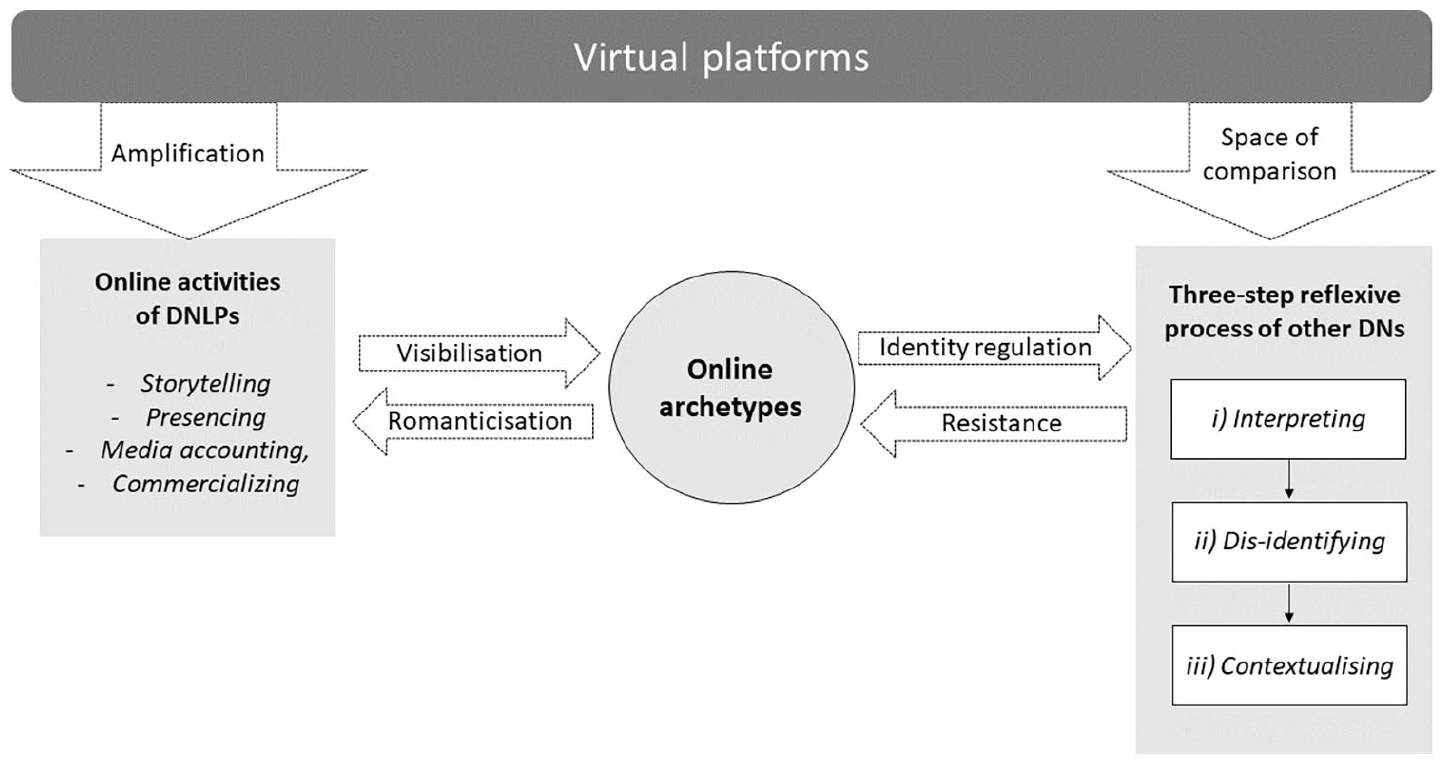
The role of virtual platforms in the building process of identity work for digital nomads.
Social media as a means of identity regulation and resistance for lifestyle occupations
Alacovska and Kärreman (2022) showed that for some professionals (in their case, creative workers), well-delineated organizations and transparent occupational ideologies do not constitute decisive factors in identity formation. Increasingly, identity work involves an active engagement with other form of social imaginaries, such as public online narratives, which can be considered as ‘materials out of which identities are crafted’ (Alvesson et al., 2008: 18), but also as new ways in which identity regulation is enacted outside organizations (Alvesson and Willmott, 2002). While social media facilitates a broader and more dynamic representation of professional identities than those offered in television or films (Riley and Robertson, 2021), the visibility, frequency and intensity of distinguishable traits cause them to predominate and to align identity in a specific way.
The goal of DNLPs is to monetise their nomad status, and to do so, they need to relay the evidence of their positive experience to a much broader, and less geographically proximate, audience. Their commercial endeavour shapes the ways in which they invest social media, to introduce, reproduce and legitimize the presence/absence of discourses associated with their lifestyle and its associated commodities. The symbolic power of the romantic portrayal shapes the accepted understanding of digital nomadism, thus producing an idealised and normative discourse that play out at the professional (i.e. types of activities) and personal (i.e. Western-centric, masculine, heteronormalized, white) levels.
In a context where social media is an important space where lifestyle identities are performed, our arguments resonate beyond the specific case of digital nomads. Indeed, the process of identity regulation and identity work we described can help guide research on other lifestyle occupations deeply affected by social media romanticisation such as social media influencers, bloggers, YouTubers, for which consumer culture has created an expectation that for life to always be fun, work must be experienced differently (Duffy and Wissinger, 2017). Hence, such expectation not only applies to digital nomads, but also goes hand in hand with the larger ‘myth of glamorized millennial labour, where the Internet provides access to boundless opportunities’ (Rosenblat, 2018: 30). As such, the romanticisation of certain professions, via social media, far extends the boundaries of social media-related occupations and comes to shape perceptions of activities pertaining to the much larger sphere of the gig economy. Workers are repeatedly exposed to online archetypes and stories, through which a set of reference points about ‘what is important and desirable’ becomes established. Importantly though, individuals are not necessarily passive actors and social media can be mobilised as a catalyst for resistance in the context of the gig economy (see Anwar and Graham, 2020; Kaine and Josserand, 2019).
Conclusion
While it may be argued that digital nomadism solely concerns a fringe of the population, the recent vague of organizational flexibility clearly fostered both temporal and spatial freedom. Thus, the pandemic will not sound the death knell for digital nomadism; rather it is likely to attract new adherents who wish to take advantage of evolving organisational policies to increase their flexibility in the future, thus making digital nomadism an interesting case through which to theorise matters pertaining to work identity.
In this paper, we proposed a typology of DNLPs that characterises four archetypes based on narratives found online, namely the inspirator, the teacher, the community manager and the influencer. We then delved into the role played by these online archetypes in the process of identity work of other digital nomads. While these archetypes can serve to control (aspiring) digital nomads, we found that they developed various means of resistance. In particular, we highlighted how identity work, for digital nomads, entails evaluating discursively available subjectivities and subsequently proposed a three-step reflexive process that entails (i) interpreting, (ii) dis-identifying and (iii) contextualising. In that context, social media appear as a central space for identity regulation and resistance for lifestyle occupations.
Finally, this research also offers a starting point in the critical exploration of the political implications of the ideals carried by the discourses promoting the ‘new world of work’, thus allowing us to better understand the power implications of online environments. Through our interviews with digital nomads, we found an apparent mismatch between the ideals of digital nomadism, as promoted through online narratives, and individual understandings of the self when it comes to professional activities. One may argue that, regardless of the profession considered, there is always a gap between representation and experience. The difference with digital nomadism is that these representations are mostly constructed through online narratives, which means that they circulate somehow more quickly and that more individuals can partake in their construction. Those constructing such mainstream representations of digital nomadism have a particular objective, and their ways of crafting their online identities are intentional and deliberate. However, they also create opportunities for other individuals to think critically about their practices, by interpreting and using these identities in their identity work. Of course, we do not wish to reduce identity work to a process of reacting to online representations. The interplay between public online narratives and identity work activities could be further conceptualized by examining how it is entangled with other relevant influences.
Footnotes
Funding
The author received no financial support for the research, authorship and/or publication of this article.
