




Abstract
The construction, performance, and regulation of identities in the online world have deep implications for individuals, organizations, and society, particularly as digital technologies become increasingly omnipresent in our daily lives. In the last decades, analyses of online identities’ processes have moved from the exploration of identity play, through identity performance, toward a growing identity regulation through algorithmic management and the monetization of personal data. Despite a significant tradition of critical management and organization studies literature on identity, online identities have to date received only scant attention. This Special Issue explores what critical management and organization studies can contribute to research on online identities. Drawing on empirical analysis of virtual forums, social media, and platforms, the six papers included here highlight the struggles that accompany identity processes in the online environment and their implications for workers, activists, and other organized selves. In this introduction, we contextualize these contributions with reference to online identities studies and metaphors of the internet as a place, a tool, and a way of being. We comment on the contributions they make relating to the role of the body, and individual and collective dynamics in online identities processes. Following this, we propose critical ways forward concerning new forms of digital work, multiphrenic context collapse, and online references and sources of identity. We invite researchers to not only critically explore but also to engage with this brave new world that increasingly shapes our individual and collective selves.
Introduction
In the final decades of the last century, the online world promised to be a new frontier for identity construction (Haraway, 1991; Turkle, 1995). Adopting a postmodern perspective on the self as fluid, fragmented, and multiple (Brown, 2022; Slater, 2002), scholars suggested that virtual technologies would sanction a new era of symbolic playfulness in which individuals could experiment with diverse identities (Rheingold, 1993). For example, games such as Second Life and new platforms such as Metaverse would, it was argued, afford people the possibility of “being” a different person online. However, the reproduction of inequitable social structures online (Kendall, 2011; Kitzie, 2019; Nakamura, 2002), as well as recent strengthening of platform control (Lehdonvirta, 2022) and user data monetization have somewhat undermined fantasies of the disembodied playground (Marwick, 2013), pushing people into regulated online expressions within ever more ubiquitous, invisible virtual environments (Cover, 2016; Hine, 2020; Markham and Stavrova, 2016).
At the same time, some have argued that identity processes remain qualitatively different online (Castells, 2004; Han, 2019; Hine, 2020; Markham, 2016). Scholars across disciplines including sociology, psychology, cultural studies, education, and new media studies (Poletti and Rak, 2014) have explored these phenomena. One suggestion is that virtual technologies have developed during the course of three separate but overlapping phases—Web 1.0, Web 2.0, and mobile—that have affected identity processes in different ways (Han, 2019). Markham (2003, 2016) has analyzed these different phases and ascribed them respectively as metaphors for the internet as a (i) place, (ii) tool, and (iii) way of being. These metaphors refer to the different modes through which actors interact with each phase’s dominant online technology.
From a critical organization studies standpoint, online technologies and social media are increasingly omnipresent in the contemporary organizational landscape (Husted and Plesner, 2017; Trittin-Ulbrich et al., 2021; Upchurch and Grassman, 2016). This “brave new world” creates new challenges for how people create, regulate, and resist identities in and around organizations (Barros, 2018). However, despite recognition of the importance of online phenomena for critical organization researchers (see, e.g. Wilner et al., 2017), the implications for identity and the study of identities have been mostly overlooked.
That said, online technologies are an established and still growing topic of interest in organization studies (Leonardi and Vaast, 2017) and for critical organization researchers (Etter and Albu, 2021; Knights et al., 2007). Indeed, critical organization researchers have recently developed a robust literature on online technologies (Husted and Plesner, 2017; Kostakis, 2018; Munro, 2016; Ossewaarde and Reijers, 2017; Upchurch and Grassman, 2016). Critical organization scholarship has progressed beyond initial enthusiasm for the emancipatory potential of virtual tools to examine actual practices of politics (Husted and Plesner, 2017; Upchurch and Grassman, 2016), resistance (Kostakis, 2018; Munro, 2016; Ossewaarde and Reijers, 2017), and emancipation (Martinez Dy et al., 2018) associated with the online world.
Additionally, interest in identities is long-standing in our field (see reviews by, e.g. Ashforth and Schinoff, 2016; Baumeister, 1986; Caza et al., 2018) with critical organization scholars in particular having made significant contributions (Alvesson et al., 2008; Brown, 2015, 2020). There is a rich tradition of critical identity studies based on the works of Foucault, Butler, and Lacan among others (Alvesson et al., 2008; Brown, 2015, 2020). Studies focus on, for example, the micro-politics of identity (Watson, 2008; Zanoni et al., 2017), identity resistance (Barry et al., 2006; Lutgen-Sandvik, 2008), regulation (Kärreman and Alvesson, 2004; McDonald et al., 2008), and precarity (Collinson, 2003; Coupland and Spedale, 2020; Thomas and Linstead, 2002).
Nevertheless, the intersection between critical identity studies and online phenomena in organizations is rather limited. There has been some recent research on the “dark side” of digitalization, but this has only indirectly and tangentially discussed identity in online spaces. For instance, Etter and Albu (2021) analyzed how certain social media affordances—interlinking, assembling, and augmenting—can negatively impact social movement organizations’ actions, including how they “symbolically construct a collective identity” (p. 70). Elmholdt et al. (2021) examined the ways a corporate health initiative, through a sleep tracking device, “may link an employee’s aspirational identity to the organization” (p. 179). Pazaitis and Kostakis (2022) investigated the impact of commercial interests on websites, suggesting that peer-to-peer “identities appear to still maintain resilience” (p. 762).
As yet, however, our field lacks a thorough and systematic exploration of the role of organizations in managing online identities and of the ways individuals’ and collectives’ “virtual selves” are constructed, performed, regulated, adapted, discarded, and resisted in and around organizations. The goal of this Special Issue (SI) is to encourage, from a critical perspective, cross-fertilization between the fields of online technologies and identity studies. Our aim is to understand better the implications of virtual environments with their specific socio-material conditions (Brown, 2019).
This introduction provides some context and showcases the contributions of the six papers that comprise this SI and how they develop our understanding of online identities from a critical perspective. In the following section, we first review some critical research across disciplines on online identities. Next, we explore the different metaphors of the internet as place, tool, and way of being, how they affect identity and identity processes, and how the SI papers presented here contribute to advancing each of these perspectives. We then consider the different themes featuring across the contributions. Finally, we conclude with some suggestions for future studies that might further expand our understanding of current struggles for the “digital self.”
Three moments in critical research on online identities
At least since the publication of Haraway’s (1985) “Cyborg Manifesto” scholars have been interested in the impact of virtual technologies on individual identities. In what is considered the first wave of online identity studies (Rheingold, 1993; Turkle, 1995), and adopting a postmodern view of identity as fluid, fragmented, and multiple (Butler, 1990), scholars proposed that individuals would be able to use the internet as a symbolic playground where they could escape their “real” bodies (Bell, 2001) and experiment with provisional (Ibarra, 1999) and potential “second selves” (Han, 2019). Initially, Haraway (1991) and Turkle (1995) argued that hybridization between humans and machines would enable individuals to engage in disembodiment (Slater, 2002) and decontextualization (Boyd, 2010) processes that open up space for identity play (Rheingold, 1993; Turkle, 1999). Easier access to and the creation of emerging online communities was also predicted to help develop collective identities that support individuals’ self-expression (Fox and Ralston, 2016).
The focus on freedom of expression was transformed with the emergence of social media in web 2.0 (Han, 2019). In this phase a new wave of online identities scholars turned the emphasis away from play and creation toward identity performance and collective mobilization based on it (Boyd, 2002; Nakamura, 2002). With the new social technologies enhancing user-generated content, digital affordances—such as interactivity, anonymity, visibility, persistence (Leonardi and Vaast, 2017), and multimodality (Stöckl, 2004)—allowed for new expressions of the self (Plant, 1995). Individuals enjoyed using the public space of social networking sites to present versions of themselves, but also to share their opinions and political positions, etc. (Zhao et al., 2008).
Indeed, social networking was used by social movements (Ackland and O’Neil, 2011; Wall, 2007), such as Black Lives Matter and MeToo# to develop collective identities (Castells, 2004; Etter and Albu, 2021). It allowed for the speedy spreading of messages and slogans, considered essential for a sense of group belonging, which in turn promoted a greater level of political mobilization among a larger number of people (Ackland and O’Neil, 2011). The connectivity and horizontality of virtual tools now became the identity glue that held contemporary alternative political movements together (Gerbaudo and Treré, 2015; McCaughey and Ayers, 2003).
Finally, a third wave of scholars analyzed how “virtual” and “real” selves are no longer easily distinguishable (Cover, 2016) in a period of growing corporate colonization of the online space and corporate platform owners’ exploration of the economic benefits of the commercialization of user data (Banner, 2014; Marwick, 2013; Van der Nagel and Frith, 2015). In these novel “circuits of communicative capitalism” (Dean, 2009), online political subjects “slacktivism” is commodified and monetized. In addition, new identity tools, designs, and underlying algorithms (Cover, 2014) increasingly reinforce the value of the data profiles collected and sold by organizations (Haimson and Hoffmann, 2016).
The initial identity “freedom” offered by the internet has, over time, led to a greater convergence between offline and online identities (Hongladarom, 2011; Markham, 2016) and enhanced possibilities for identity regulation (Poletti and Rak, 2014). Digital cultures, long heralded as spaces of belonging and self-expression, have increasingly been used and appropriated by corporations, extending their control to private spheres (Reed, 2018). In this new world, public institutions often exploit the wealth of available data to surveil, evaluate and control the online identities of employees and other stakeholders (Martínez-Béjar and Brändle, 2018).
Moreover, despite the original neutral discourse of “play,” these ever more corporatized online arenas may still resort to the “default subject position.” Gendered and racialized expressions are mostly still excluded from the online space or reduced to stereotypical imagery (Sundén and Sveningsson, 2012; Wajcman, 2010). Relatedly, individuals from marginal contexts and regions are constrained in many different ways in how they are able to deploy digital technologies to perform online identities (Miller et al., 2016).
Three key metaphors of online identities
The three waves of online identities scholarship (Han, 2019) described above relate to Markham’s (2016) metaphors of the internet as a “place,” “tool,” and “way of being.” These metaphors roughly follow the evolution of digital technologies throughout the last decades and have influenced the changing relationships between individuals and the online space, including how people create, perform, and regulate their identities. The three phases have not been linear and neatly separated, but have followed a process of sedimentation and accumulation of different technologies and associated identity processes. All types of technologies presented here coexist today with different emphases, capabilities, and possibilities for online identity construction.
In fact, some technologies span these different metaphors and have accumulated elements of each in their development. For instance, virtual worlds were spaces of interaction in early games (Shah et al., 2017), but have progressively been used as a tool by communities (Saffo et al., 2020), and more recently have increasingly been controlled and individualized within corporate owned algorithms (Jungherr and Schlarb, 2022). Our goal is not to suggest some form of technological determinism, which would attribute particular characteristics of online identities processes to specific tools—something which is sometimes criticized in current online research (Loader and Mercea, 2011). On the contrary, the following discussion stands as a springboard from which we may analyze the current critical research on online identities and consider different perspectives and contributions.
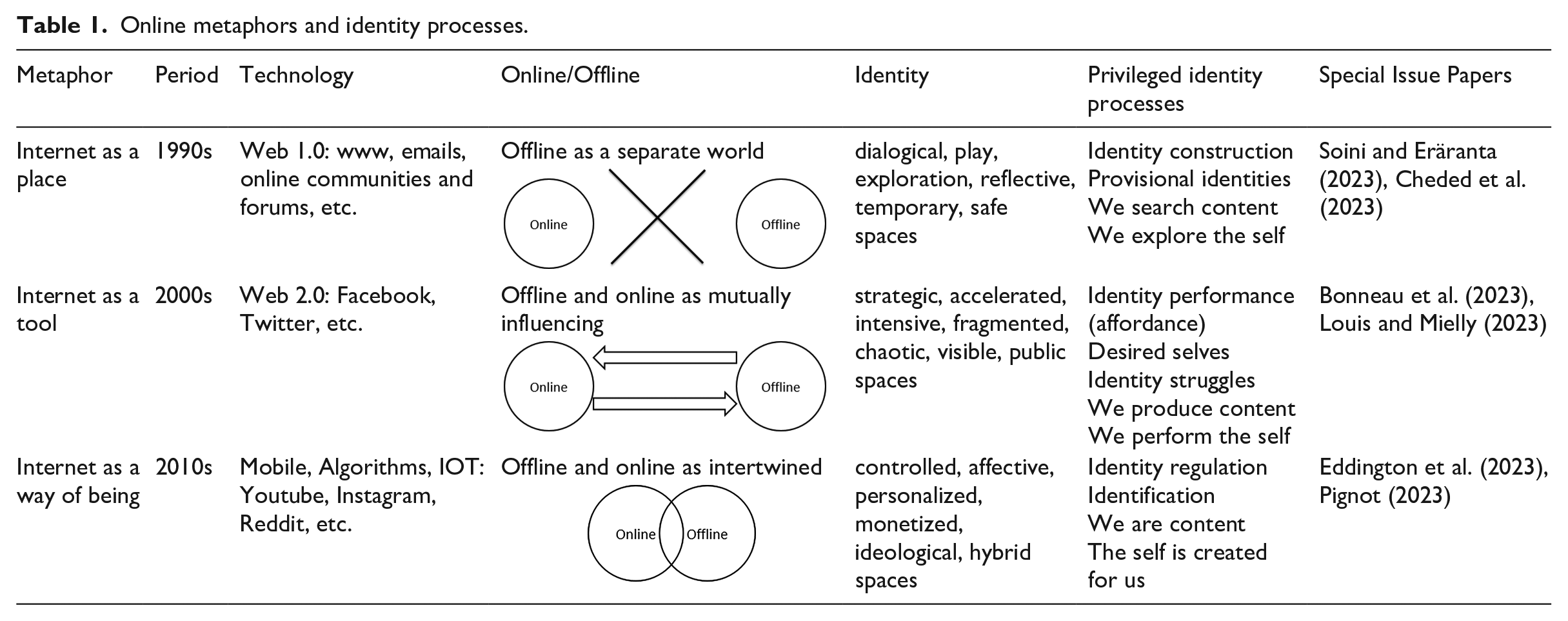
Here we describe each of the three metaphors, their privileged technologies, and how they enact a particular relationship between the online and offline worlds (see Table 1).
Online metaphors and identity processes.
The internet as a place
The idea of the internet as a place arose with the advent of virtual technologies in the 1990s (Haraway, 1991; Turkle, 1995). Web 1.0 created the internet primarily as a space to “surf” where the opportunity for expression remained mostly limited to online forums and similar interactive spheres (Rheingold, 1993). At this point, the virtual world was considered a separate reality in which one might play a different self while “leaving the meat behind” (Bell, 2001). This world, where identity markers—name, icon, etc.—were still limited but flexible, was regarded as a safe space to explore provisional and precarious selves (Dixon, 2014; Ibarra, 1999). This “place” was a conclave for identity exploration and creation by users where one could find and relate to—more easily than in the “real” world—other users who shared and supported experimentation with the same passions, problems, and perspectives (Dixon, 2014).
In online forums, individuals entered into dialog with a geographically distributed collective and could search for content to reflect their own identity (Micalizzi, 2014; Pullen and Cooper, 2010). While some suggested there existed, at this time, a putative balance between collective norms and expectations and a person’s own identity exploration and developmental path (Cabiria, 2011), studies of online communities have shown that in virtual spaces certain identities became privileged while others were marginalized (Dixon, 2014; Kendall, 2011; Nakamura, 2002). Nakamura (2002) discussed the question of race in online communities and criticized “identity tourism” wherein individuals could play any race, but ultimately reproduced racist stereotypes and practices. In a similar vein, Kendall (2011) suggested that, while gender identity construction in online communities has made some advances since the early days of virtual forums, considerations of race and class have been mostly ignored, reinforcing hierarchies online.
Two papers in the SI have built on this perspective of “the virtual” as a space. First, in their analysis of LGBTQ online forums, Aleksi Soini and Kirsi Eräranta (2023) explore the way gay and lesbian employees safely explore possibilities for identity disclosure. The authors discuss how the dialog between forum members allows them to explore the internet’s affordance of interactivity to develop a collaborative identity and resist the heteronormativity of the corporate world. Through these processes, members dialogically construct and question two potentially conflicting identity categories—“in the closet” and “out and open”—and the identity threats associated with them in participants’ experiences of the workplace. Soini and Eräranta (2023) contribute to the debate on online identities through a detailed examination of the collaborative identity work that takes place in online spaces. In their paper, they analyze the dialogical and dialectical stages of consulting, questioning and legitimizing different (and potentially contradictory) identity expressions that help participants to navigate their work life. Despite people considering the forum a safe space, the authors’ study highlights the contested aspects of identity exploration.
Mohammed Cheded, Niall Curry, Gillian Hopkinson, and Alan Gilchrist’s (2023) paper examines an online biosocial community, a virtual group focused on biomedical identities. Using membership category analysis (MCA), they show how participants use different oral and textual resources to legitimize their inclusion and to sustain collective responsibility for the precarious identity category of “previvor,” that is, a survivor of a predisposition to cancer. The authors propose that precarious identities benefit from being developed in the space provided by an online community in which members may navigate categorizations and biomarker knowledge of genetic predisposition; however, this exposes those navigations to a socially sanctioned regime of compliance to a collective moral order. While reinforcing the idea of online communities as a space for identity exploration and construction, Cheded et al. (2023) provide an important contribution to the field by exposing the obligations contingent on belonging to a specific social category. Members seeking support and information balance this openness with strategies of belonging based on self and other surveillance and assessment. As illustrated by the authors, the tensions between the individual and the collective in online biosocial communities both “construct and constrict” identity formation in complex ways that may be of relevance to other biosocial fields.
The internet as a tool
The idea of the internet as a tool emerged with the transition toward more collaborative social media technologies (Han, 2019). With greater possibilities for users to generate data, individuals were enabled to express their identity publicly, outside of closed online forums, through enhanced markers: uploaded photos, “friend” connections, status updates, (dis)likes, comments (Boyd, 2002; Nagy and Koles, 2014). The “virtual” and “real” worlds, which were originally considered separate places, begun to mutually influence each other and identities constructed online increasingly spilt into offline social interactions (Barros, 2018; Fieseler et al., 2015).
With increased access and visibility in public virtual spaces, users were able to experiment with their identities and focus on strategic self-representations of desired selves (Marwick, 2013; Nagy and Koles, 2014; Zhao et al., 2008) performed for progressively larger audiences (Haimson and Hoffmann, 2016; Slater, 2002). People could strategically produce and expose huge amounts of content about themselves to stand out from the crowd (Papacharissi, 2010). However, the increasingly large number of voices also meant that identity performances could become entangled and lost in the multitude. Additionally, participants’ efforts to increase shareability would slowly deprive their self-presentations of meaning (Dean, 2009).
Scholars who have examined online identity processes during this second phase have shown how virtual profiles reflect a normative lifestyle deemed socially desirable (Hoffmann et al., 2018; Kendall, 2011; Kitzie, 2019). Giles (2006) has analyzed how individuals portray their anorexia as a positive identity and lifestyle instead of an eating disorder. Giaxoglou and Georgakopoulou (2021) examined how a cancer patient through her vlog storytelling projected an “affective self” that aimed to “create and maintain a sense of control over the illness” (p. 254). Kendall (2011) discusses how blue-collar individuals try to “convey a sense of middle-class culture” when online (p. 141).
At the same time, organizations sought to use digital tools to forge their connection with members through increased identification (Bennett and Segerberg, 2011; Fieseler et al., 2015). In critical online identity studies, the use of social media affordances (Khazraee and Novak, 2018; Leonardi and Vaast, 2017) to create a collective identity that fostered engagement and commitment among participants by social movements was particularly examined (Castells, 2004; Etter and Albu, 2021; Gerbaudo and Treré, 2015; McCaughey and Ayers, 2003). Findings from these studies were mixed in terms of the effectiveness of these actions in creating a shared identity, with some highlighting the easier sharing of symbolic resources (Ackland and O’Neil, 2011) and others claiming that virtual exchanges are unable to develop strong emotional connections (Coretti and Pica, 2015; Wall, 2007).
Two contributions to this SI have explored online identities from the viewpoint of the internet as a tool. First, Claudine Bonneau, Jeremy Aroles, and Claire Estagnasié’s (2023) paper brings an interesting perspective to identity performance within the context of new forms of online work. The exploration of how “digital nomads,” that is, “professionals who embrace extreme forms of mobile work,” represent themselves in virtual spaces highlights the predominance of online identity work in the absence of traditional identity sources. Most significantly, their study shows how certain individuals were able to perform basic archetypical narratives of their occupation based on the romanticization of desirable selves. The performed identities in Bonneau et al. (2023), however, stand in stark contrast to “real” digital nomads’ offline practices. While the former influence is recognized, the authors show that offline nomads disidentified with the romanticized façade presented by occupational “influencers.” The online world, therefore, worked both as an amplification of these performative voices, but also as a space from which offline actors could take an interpretative distance from these online narratives and contextualize their experiences as different from these online narratives.
Dima Louis and Michelle Mielly (2023) offer a distinctive perspective on the construction of a social movement’s collective identity. They show how different temporal narratives chaotically expressed on Twitter by participants in the emerging moments of the 2019 Lebanese Revolution, helped to articulate the collective movement’s identity. The authors propose the idea of entangled temporality as an (ante)narrative that, through its fragmentation, can accelerate the disruption of hegemonic grand narratives. Louis and Mielly’s contribution suggests a need for a reevaluation of the incompleteness of social media, which is usually considered a shortcoming of social media mobilization. More positively, the authors suggest that entangled temporalities can build collective identities by deconstructing the past, echoing present mobilizations, and prefiguring the future.
The internet as a way of being
The advent of mobile digital technologies made the online world increasingly pervasive and invisible (Cover, 2016; Hine, 2020; Markham and Stavrova, 2016). According to Markham (2016), this phase marks an “ontological shift, whereby we understand social reality as fully mediated” (p. 1141). The online world is becoming an inseparable part of the self and “our identities are always on” (Cover, 2016, p. x) leaving continuous virtual traces. These elements prompt the metaphor of the “internet as a way of being” where there is a greater “fusion between the online and the offline selves” (Hongladarom, 2011, p. 533).
‘During this third technological phase, there has been greater emphasis on identity regulation with virtual space increasingly personalized through micro-targeting techniques based on group identification (Valenzuela and Michelson, 2016). Search engines concentrated in a few platforms now follow increasingly narrow and individualized information paths (Demuth and Watzlawik, 2021). Techniques of algorithmic surveillance blur the “digital” and “real” worlds by regulating private and professional identities and practices (Rosenblat, 2018). Corporations interested in the monetization of data (Banner, 2014) have campaigned against identity play or performance in favor of a single, fixed salable user identity (Marwick, 2013; Van der Nagel and Frith, 2015). In these processes, the self is more malleable and negotiable with and through platforms, algorithms, and other virtual technologies (Markham, 2003). However, at the same time, the online space also interpellates individuals (Butler, 1990) with demands to develop social belonging and identity coherence (Cover, 2016).
Two papers in the SI investigate the online “way of being” perspective. Sean Eddington, Caitlyn Jarvis and Patrice Buzzanell (2023) study how the Reddit men’s rights community shaped participants’ identities through affective and gendered organizing. Touching on the current issue of the “manosphere”—an “organized, coordinated, and cooperative [online network] around various men’s rights issues and causes”—and other radical right-wing activist communities, the authors show how the online community used affect to navigate contradictions, engage in sensemaking, and create group identification. This process developed an affective identity reclaiming men’s supposed loss of power. Aligned with debates on the current blurring of online and offline worlds, the contribution by Eddington et al. (2023) is central to understanding how affective dynamics, combined with algorithmic control, are essential to regulate the ever-precarious self. The authors show that affect fulfils both the need for group attachment and identity consistency despite contradictions in their offline and online experiences. Their study also opens up an important discussion about the role of (male) embodiment as the main force and the result of their process of identification, and the concrete material consequences of this. Finally, the paper also allows us to understand the role of online identities in creating discriminatory ways of being.
Edouard Pignot (2023) focuses on the algorithmic management of employees, in the platform economy, through affective and ideological control. The author proposes that employees accept algorithmically developed ideology based on perceived benefits in terms of job security and stable identity. Moreover, he shows the role of organization tolerance of “illegal” practices in enacting employees’ desired identities. By seductively promising the fantasy of control, the organization’s ideology creates identity-constituting practices that helps to fix subjects. In his analysis of algorithmic management, Pignot makes an important contribution to understanding the negotiability of identity at a time when virtual technologies invade our personal and professional lives. Adding to the affective understanding of identity regulation, he shows how the fantasy of control, of “cheating the system,” creates an acceptance of ideological domination. The impression of enacting desired selves, however, hides the managerial constitution of the ideal, docile employee.
Online identities: Interrogating bodies and collective/individual dynamics
While the papers in this SI contribute individually to the different waves of critical research on online identities, they also bring to the forefront some essential issues that helps to expand and enrich current research. Critically exploring debates on the construction, performance, and regulation of online identities, the authors in our SI unpack important phenomena that have so far received little attention in critical management and organization studies. Responding to our call, researchers have focused on how the virtual world enables and/or constrains different identity processes, how corporations and users exploit different online identities tools and affordances, and how these practices affect power dynamics. In the following subsections, we highlight several common themes in the SI papers related to “online bodies and identity” and “online dynamics of individual and collective identity.”
Online bodies and identity
A primary theme in many of our contributions is the differing relationships between online identities and the body. The limited engagement with the corporeal body in the identity literature has been commented upon (Brown, 2019). The disembodied identity perspective is, arguably, in part a product of “the dominant discursive, linguistic and often masculine narratives” (Knights and Clarke, 2017, p. 340).
In the virtual space, the relationship between “real” and “virtual” bodies has been the subject of animated debate over recent years (Hansen, 2000; Schultze, 2014). Initial studies considered the body as an identity marker that could be left behind for identity play without physical constraints (Hine, 2020). However, scholars subsequently suggested the increasing presence of an “embodied disembodiment” (Hansen, 2000) in which virtual actions are no longer “separable from our everyday, embodied, and corporeal subjectivities” (Cover, 2016, p. xiv). Accordingly, “experimentation with representing one’s identity online can also allow people to embody potential future selves” (Haimson and Hoffmann, 2016, p. 1). Moreover, online experiences seem to provoke physical and affective embodied reactions in users (Schultze, 2014), when even controlled expressions of emotions transform into “acts of unintended embodied positioning” (Giaxoglou and Georgakopoulou, 2021, p. 257).
The authors in this SI provide contributions in two different ways. First, both of the papers that examine online communities bring different perspectives on the role of the body in identity exploration, an online process in which the body was normally considered invisible. Soini and Eräranta (2023) suggest that disembodiment is essential to explore possibilities of sexual identity disclosure, while also arguing that this disembodiment informs how participants navigate this embodied issue in their workplace. Conversely, Cheded et al. (2023) contend that inclusion in the biosocial identity category depends on certain moral expectations regarding the body and its manipulation.
Second, situations in which the online and offline worlds merge have allowed the question of “disembodied embodiment” and “embodied disembodiment” to be explored, with studies showing the role of affect. Most particularly, Eddington et al. (2023) explore the question of the intermingling of “virtual” and “real” bodies—a “liminal (dis)embodied duality”—in the affective regulation of participants’ identities in an online men’s rights community. Here, the authors put forward affect as central to a “tension of (dis)embodiment,” particularly between their claimed offline rationality and the role of emotions in the constitution of their online identity.
Online dynamics of individual and collective identity
A second theme developed by our SI authors concerns the different interactions between collective and individual identities. The literature on identity has in the last decades turned increasingly toward understanding the interactive identity dynamics between individuals and organizations (Brown, 2017; Haslam et al., 2017). Developing from an initial perspective in which organizations were portrayed as having mostly monolithic identities and on which employees had little impact (He and Brown, 2013), there is increasing recognition of the mutual constitution of employees’ symbolic interpretations and organizational identities and self-representations (Hatch and Schultz, 2004; Ravasi and Schultz, 2006).
In online identity studies, for instance, studies of virtual communities have suggested that they possess “a sense of [their] own identity as a social formation distinct from others” (Hine, 2020: 34). However, while individuals may be concealed within a collective identity (Gerbaudo, 2015), some suggest that a dialogical dynamic is often established (Pullen and Cooper, 2010). In these processes, users attempt to craft their own self through, for example, interactions with their peers (Micalizzi, 2014). Others, studying social movements’ collective identity formation, suggest that space and time distribution makes it difficult to coalesce individual selves into a coherent shared identity (McCaughey and Ayers, 2003).
In this SI, authors make several distinct contributions. In their study of online biosocial communities, Cheded et al. (2023) bring a power perspective to identity play in a collective environment that is usually considered to be based on an open dialogical process. Their study examines the dynamic of individual and collective identities by exploring their influence on participants’ precarious identity exploration. Their research found collective identity to be particularly pertinent to the development of identity since participants were required to belong to a membership category premised on compliance with a set of responsibilities and moral demands.
In the case of a social movements’ collective identity, Louis and Mieilly’s (2023) contribution is to contradict the perception that there are definite limits on members’ physical separation in the creation of a collective self. Their study also suggests that, for social movements to mobilize, individuals do not necessarily need to coalesce neatly around a shared identity. On the contrary, their analysis of temporal (ante)narratives shows the benefits of messy and incomplete voices in building a collective identity.
Finally, two studies add to the debate about the online individual and collective identity dynamic by discussing the increasing importance of online collective identity in the regulation of individual identities with reference to the precarity of the self. Bonneau et al. (2023), while acknowledging the ability of online communities to provide dominant archetypes in the absence of previously established professional references, analyze individuals who construct their identity by disidentifying with collective romanticized portrayals. Eddington et al. (2023) explore member identification in relation to an online men’s rights space, emphasizing the affective dimension that constitutes the subject and shapes misogynistic identities.
Online identities in and around organizations: A critical research agenda
There is a consensus that virtual technologies are a permanent and evolving fixture that will increasingly define how we experience and conduct our daily organizational lives. Therefore, there is an urgent need to address the virtual dimension of identity processes. The contemporary relevance of the virtual space for understanding identity construction and the struggles associated with it has become more evident in the wake of the Covid pandemic, which triggered the sudden and exponential rise in the use of remote technologies that blur the boundaries between life spheres. Within that context, we suggest some pathways that that would benefit from further exploration.
Identity in new forms of digital work
New forms of work have been created through the development of the “virtual world” which bring a specific set of challenges. YouTube essayists, Instagram influencers, and other actors on social media have identity construction and performance as a core element of their roles (Senft, 2008). With enhanced accessibility, there is an added requirement of “authenticity” of desirable identities required to connect with a potential audience (Marwick, 2013). Thus, these new forms of digital work could have damaging impacts on individuals who carry marginalized and non-normative identities (Haimson and Hoffmann, 2016; Marwick, 2013).
There is already discussion and some criticism of how YouTube’s search engine algorithms treat traditional profiles of content providers (Kopf, 2020). Gender identities, as well as identities related to class and race (Kendall, 2011), may in particular be displaced from the privileged information paths of most social media users. Further studies are needed to understand how individuals perceive these threats and resist neoliberal commodification (Dean, 2009) and the interference of artificial intelligence (Demuth and Watzlawik, 2021) in the visibility of the expression of alternative identities.
Multiphrenic identity
Selves are increasingly prone to multiphrenia, that is, multifaceted identity construction based on the connection of diverse social roles linked to specific personal, professional, and social contexts (Gergen, 1991). Our engagement with multiple identities is one aspect of the modern human experience that predates the internet. Arguably, the increasing intensification and acceleration of networked connections, information overload, and interaction with social technologies has accelerated this trend (Boyd, 2002; Castells, 2004; Markham and Stavrova, 2016).
The online self, saturated by multiple social demands, can be even more problematic because of the recent push for notionally “real” representations online (Haimson and Hoffmann, 2016; Marwick, 2013; Van der Nagel and Frith, 2015). The use of verifiable names on different platforms might be regarded as representing a situation of “context collapse” (Marwick and Boyd, 2011). Unlike in offline situations, it can be difficult for individuals to vary identity presentations, something that is often required for different environments or audiences (Boyd, 2002), which can lead to further blurring between, for instance, professional and private spheres online. Context collapse may constitute an additional source of stress and contradiction for actors in the construction or performance of their selves and this too is worthy of study.
Identity references and sources
Studies on the sociology of science have forecast a “postsocial world” (Knorr-Cetina, 2001) in which traditional sources of belonging and identity relating to communities and families will shift toward interaction with technologies. What we witness with virtual technologies, however, is not necessarily a replacement of offline with online interactions, but a reduction in the divide between the online and offline worlds (Cover, 2016; Hine, 2020; Markham and Stavrova, 2016). With the rise, intensification, and invisibilization of virtual technologies and their spread in our daily lives, online identity references may become interchangeable with traditional ones and the “real” self may become “thoroughly negotiable” online (Markham, 2003). This perhaps explains why, in recent years, individuals who are not able to fulfill expectations pertaining to socially desirable selves (Hoffmann et al., 2018; Kendall, 2011; Kitzie, 2019) have turned for answers to social media.
The rise of extreme right movements and the manosphere, discussed in this SI, are examples of the exploitation of precarious selves in search of belonging and identity coherence (Cover, 2016). As we write, the critical scholarly community needs to investigate the construction of alternative sources of identity that can circumvent current trends toward misogyny and racial discrimination and other “easy answers” to existential anguish in neoliberal times.
These are just some possible avenues of research for critical scholars in the fields of management and organizations. There are, of course, many other issues that academics could explore in this “brave new world” of digital technology, which is helping to shape who we are.
Conclusion: The need for critical engagement with online identities
This SI aims to bring together the identity and online critical research communities in order to investigate the ways in which selves have been constructed, performed, regulated, and resisted in virtual spaces. The papers in the SI help us explore different actors, technologies, and processes, and indicate new ways forward for studies of online identities from a critical perspective. The contributions bring to light, inter alia, issues pertaining to the role of online bodies and the interaction between individual and collective identity processes.
However, this SI is not just a call for further critical studies of online identities. It is also a more general plea for critical engagement with digital technologies, the power they exercise over our selves and the ways we respond to them. In this digitally enhanced world, we as critical scholars need to go beyond critical deconstruction and find ways to occupy this space that elicit new alternatives for actors submerged in perhaps “inescapable” online networks of identity-constituting meanings and practices.
Moreover, considering our current lack of control over the tools that increasingly seem to underlie our processes of symbolic construction, there is a need for more and more thoughtful engagement with movements involved in algorithmic appropriation and digital commons (Negri, 2019). We need to envisage ways to bring collectives together to govern online platforms and other virtual spaces. Ultimately, we propose an online critical performativity (Spicer et al., 2016) in which we investigate and engage with, alongside individuals and organizations, the increasingly toxic virtual dynamics that have discursive and material effects on societies.
Footnotes
Funding
The author(s) received no financial support for the research, authorship, and/or publication of this article.
