




Abstract
Wearable technology (WT) use in organizations is accelerating despite ethical concerns about personal privacy, data security, and stress from increased surveillance. Technology media, a key producer of meanings about WT, gives some attention to these issues but they also routinely promote WT as if they are a panacea for employee wellness. We critically analyze 150 media articles to understand how they justify the adoption of WT into organizational life. We contribute by extending previous work on surveillance technology to show how and why WT media discourses use neo-liberal justifications to justify WT implementation. We explore implications including competing health and wellness discourses and make suggestions for further research.
Keywords
Introduction
Wristbands that tell an employer whether or not workers are happy are now on the market. For instance, employees working from home and wearing the two-button ‘Moodbeam’ wristband can press the yellow button if they are feeling happy and the blue button if they are sad. Managers have a dashboard to see how employees are feeling and coping, ostensibly to help them understand the emotional wellbeing of their staff and intervene with human resource initiatives to bolster well-being. The Moodbeam device can be linked to other human resource interventions such as personalised medical healthcare plans (Bearne, 2021).
Communication technologies carried on the body, such as two-way radios, have been commonplace since the 1930s. Personal computers, although not wearable at first, encouraged remote work from the 1980s and were the precursor to BlackBerrys, laptops, and personal cell phones, which enabled third-place work (in cars, trains, cafes) since the 1990s. The increased connectivity that has accompanied these technological developments has been critiqued previously (see Dery et al., 2014; Kolb et al., 2012), often with a focus on the collapse of work–life boundaries and surveillance issues such as over-monitoring (Ball, 2010; Sewell, 1998; Sewell et al., 2012; Sewell and Barker, 2006). Researchers have pointed out that too much connectivity can become a hazardous trap—the autonomous paradox—as identified by Mazmanian et al. (2013) in their study of professional employees using mobile email. Wearable Technologies (WT) take advantage of the connectivity capabilities of earlier communication technology developments and have intensified trends noted above by researchers.
WT refers to a range of devices worn on the body which augment human capacities and capabilities. WT are now ubiquitously used in organizational settings and innovations are accelerating. In this article we are primarily concerned with so-called health and wellness devices such as Fitbits and Smart Watches. These devices enable vast amounts of biodata 1 to be gathered from employees and organizations. This information is a key profit and competitive advantage mechanism for corporate entities. Digital innovation, of which WT is just one example, has revolutionized organizational life. Lupton (2014: 5), a leading media and digital health researcher, argues “life is now digital” because we are no longer living with media but living in media. Digital devices (such as WT) “are incorporated into our everyday routines, entangled with our sense of self, our experience of embodiment, our acquisition of knowledge and meaning making and our social relations.” Consequently, critical empirical studies are needed to understand the rapidly developing phenomenon of WT ubiquity in organizational life.
In this research we build upon a stream of previous research emphasizing the impact of technological surveillance on employees. Sewell’s work (1998, 2006, 2012) has been important and influential in showing how organizational surveillance practices mold employee’s thinking and behavior toward norms. Sewell et al. (2012) have argued that surveillance acts as a soft power so that employees need little or no coercion to behave productively in others’ interests and so, in a sense, may act against their own interests. In further development, Ball (2005: 92) argues that the body has emerged “as a legitimate surveillance target” that provides “immense levels of detail” about a person, and this enables the organization to “divide and classify par excellence at the level of the individual.” Furthermore, employees are unsure how to “evade, resist, or negotiate big data practices” (Ball et al., 2016: 59). However, challenge is possible, and resistance is inevitable because, as Ball (2005: 104) argues, the impulse for surveillance comes from “dominant patriarchal and capitalist tendencies” that can be resisted and questioned.
Our study on WT is linked to these earlier surveillance studies (Ball, 2010; Sewell and Barker, 2006; Sewell et al., 2012), with our specific concern being WT media discourses. Technology media is a key communicator of norms about what WT can and should be doing in organizations. Discourses about “healthy bodies” and employee well-being are central to contemporary media debates about surveillance. Ball (2010) warned that biometrics and covert surveillance would develop significantly, and our media texts illustrate that this “dystopian” prediction has indeed arrived. Because media plays a central role in the production of discourses about new technologies, and is a conduit to their acceptance, our study is a critical analysis of texts that promote the use of WT in the workplace—technology media. Thus, our guiding research question is: “How and why does technology media justify the use of WT in organizations?”
We explore this question through a critical analysis of technology texts to show that articles, whether promoting or critiquing WT use in the workplace, invariably use neoliberal justifications for the adoption of health technology such as WT. Neoliberalism is a term used to describe ideas associated with free-market capitalism, or a “theory of political economic practices” that suggest “human well-being can best be advanced by liberating individual entrepreneurial freedoms and skills” within a capitalist framework (Harvey, 2005: 2). Most significantly, we contribute by showing both individualistic (“I”) and social (“We”) discourses are used to justify WT adoption, and both use neoliberal values for framing. In the following sections we review relevant surveillance research and introduce three concepts needed to appreciate the significance of contemporary WT discourse: surveillance capitalism, organizational biopolitics, and the quantified self. We then present and discuss our study of media articles showing the high level of adherence to neoliberal values even in articles critical of WT, clarify our contributions, explore implications in some depth, and make suggestions for further research before concluding.
Wearable technology use in organizations
We need three interrelated concepts to appreciate contemporary challenges around WT. Calvard (2019: 273–274) states that research should be pragmatic yet also include multiple levels of analysis (e.g. societal, organizational, and individual) to “balance the autonomy and rationality of individual users with wider structural conditions of work, employment and control.” The three concepts we introduce in this section broadly map onto our concerns with (i) the wider environmental context to do with profiting from biodata, (ii) the organization (policies and practices to do with wellness), and (iii) the individual (worker). First, we introduce “surveillance capitalism” (Zuboff, 2015, 2019a), to appreciate the role global technology companies, especially health companies, now play in organizational and employees’ lives. Second, we introduce the concept of “organizational biopolitics” in relation to WT, which we use to elicit issues around management of healthy ideal bodies in organizational life. Finally, we consider individuals and specifically the concept of the “quantified self,” which helps explain how subjects’ identities and behaviors can be shaped by WT.
Surveillance capitalism
Zuboff’s (2015, 2019a) work on surveillance capitalism provides a comprehensive analysis of the emerging global digital economy of which WT is becoming a significant part. Surveillance through big data is becoming the dominant force governing economic and social relations, and organizational life. Zuboff (2015, 2019a) argues that Google and Facebook invented surveillance capitalism when both companies pioneered profit models that monetized data points about their users. By collecting “behavioral data” and selling these data points to third parties (particularly advertisers), surveillance itself became an economic mechanism. This has institutionalized an economic logic that “produces hyperscale assemblages of objective and subjective data about individuals and their habitats for the purposes of knowing, controlling and modifying behavior to produce new varieties of commodification, monetization, and control” (Zuboff, 2015: 85). Importantly for workplace relations, surveillance capitalism accumulates not only surveillance assets and capital but also rights. Because users must agree to release information for apps to work properly, digital technologies commonly operate without meaningful mechanisms of consent. Concerns range from traditional ethical issues of privacy and consent to significant concerns regarding ownership of behavioral data and the potential for it to be used to modify both online and offline activities that provoke political, cultural, and social change (Andrew and Baker, 2021; Zuboff, 2015).
Information collected through surveillance devices—WT is just one example—provides the economic value fueling a new kind of global corporate sovereign power (Zuboff, 2015). Personal data has become a valuable resource, sometimes called “data exhaust” (the metaphor is car exhaust fumes), which paradoxically infers that personal data is a waste product and thus demeans its value to the very people who are creating value—called “users.” According to Zuboff, surveillance capitalism generates dangers to freedom, autonomy, and wellbeing with significant implications for vulnerable social groups, privacy, and political control. She describes how technology allows global companies to intensify connections between work and home so that all work and personal life has become regulated and commodified and the already permeable boundaries between work and life have now collapsed completely. Principles of self-determination are routinely forfeited because of “ignorance, learned helplessness, inattention, inconvenience, habituation, or drift,” and she says a key problem with analysis is that “we tend to rely on mental models, vocabularies, and tools distilled from past catastrophes” (Zuboff, 2019a: 62). Existing models to understand and resist control are insufficient to meet the new challenges of surveillance capitalism (Cinnamon, 2017; Zuboff, 2019b).
Power, according to Zuboff, operates invisibly through vast networks of interlocked entities whose interests are not necessarily aligned, such as governments, technology companies, media companies, health providers, businesses, and app developers and this occurs through processes that are “largely invisible” (Zuboff, 2015: 77). Once introduced into a workplace, technology, and the collection of data from employees, quickly becomes taken-for-granted and regarded as “natural” (Pauchant and Mitroff, 1992). As surveillance capitalism installs new institutional arrangements of power, “new possibilities of subjugation” also become normalized because “innovative institutional logic thrives on unexpected and illegible mechanisms of extraction and control that exile persons from their own behavior” (Zuboff, 2015: 85).
Organizational biopolitics
Contemporary life is increasingly understood through new disciplines such as statistics, demography, epidemiology, and biology that make it possible to govern individuals and collectives by practices of “correction, exclusion, normalization, disciplining, therapeutics and optimization” (Lemke, 2011: 5). Biopolitical relations is an umbrella term derived from Foucault’s biopower (Foucault, 2003; Guerra-Barón, 2017) and developed by Rabinow and Rose (2006) to understand how and why power works at the level of populations (i.e. through perceiving populations as biological and political “problems”). Biopolitics is a concept that describes specific strategies and practices embedded in these emerging power relations (Fleming, 2014; Guerra-Barón, 2017), and organizational biopolitics is thus concerned with the policies, procedures, and norms that govern organizational lives based on these larger disciplinary forces. In this paper we use the term organizational biopolitics to discuss organizational practices which use biodata, and especially wellness initiatives using WT.
Biopower is understood as a form of subjectification compelling individuals to “work on themselves under certain forms of authority” (Rabinow and Rose, 2006: 197; also see discussion of quantified self in next section). Biopolitical goals and self-quantification manifest a marriage between employee self-improvement and organizational performance improvement so that workers engage in the normative expectation that their bodies should be monitored (Rabinow and Rose, 2006). One obvious concern is that without intervention on behalf of equity, such processes create performative norms that can be discriminatory, for example gendered norms that privilege one version of masculinity over other genders (Aloisi and Gramano, 2020).
Quantified self at work
The “quantified self” refers to optimizing the “self” through personal tracking practices involving constant bodily measurement and self-regulation facilitated by technologies and devices such as smartwatches and smart clothing (Lupton, 2013a; Moore, 2018). The term became popular in 2008 after a series of events in Silicon Valley promoting and endorsing self-tracking. Lupton (2012, 2013a, 2013b, 2013c, 2014, 2016a, 2016b) and Moore (2017, 2018) have established a body of research on self-tracking as a “profoundly social practice” (Lupton, 2014: 77).
Self-tracking can be “private, communal, pushed, imposed and exploited” (Lupton, 2016a: 101), and autonomous selves are “dispersed” and “mediated” (Cooper, 2010: 249) by technological monitoring. These developments suggest that the “ideal self” is becoming an augmented self that uses technological means to become stronger, smarter, and more in control. So-called “faults” are edited through technological feedback loops that digitally benchmark the self against others to encourage body maintenance, control and continuous improvement. Implicit in this ability to monitor the self is the normative expectation that the body should be monitored, and this expectation is rapidly becoming an accepted professional responsibility (Rabinow and Rose, 2006).
Some researchers see self-quantification, or the collection and use of one’s own and others’ biodata to improve well-being and performance, as positive (Schüll, 2016), but many have warned that practices involve high levels of bodily control, and almost limitless access to body data (Crawford et al., 2015; Nafus, 2016). Both Lupton (2016b) and Moore (2018) have identified a key issue of consent, especially as it relates to workplaces where worker consent for surveillance is given as a trade-off for the benefits of employment. Moore (2018: 55) says quantified workplace initiatives intensify subordination in another “emerging form of Taylorism” which leads to burnout, anxiety, and overwork and says employees are at “psychosocial risk” (Moore, 2018: 57).
Prior research indicates disquiet about surveillance, privacy and the security of employee data (Ball, 2010; Ball et al., 2016; Cooper, 2010; Sewell et al., 2012; Sollie, 2007; Verbeek, 2009; Zuboff, 2015, 2019a). We build upon previous work in organization studies critiquing human enhancement technologies in the workplace (e.g. Ball, 2010; Ball et al., 2016; Bloomfield and Dale, 2015), and surveillance technologies such as work intensification, surveillance stress, control, and intensity of work engagement (Manley and Williams, 2022; Mazmanian et al., 2013; Sewell et al., 2012). Media are a key institution in these interwoven assemblages of power (Filardo-Llamas and Boyd, 2017) which legitimate practices of powerful larger institutions including governments, organizations and individuals, and so we now turn to our methods of analyzing technology media.
Methods of analysis
Our empirical research aimed to explore the following question: How and why does technology media justify the use of WT in organizations? As introduced earlier, technology media have a central role in promoting adoption of new technology. As critical, interpretive researchers (Alvesson and Deetz, 2000) we sought to understand the role of power in shaping how knowledge is produced; through discourse. Discourses are “systems of meaning arising out of the organization of social institutions” (Kress, 1985: 31, see also Foucault, 1991), and are important in enabling the circulation of ideas and ensuring that they are seen as valid. Media has a role in setting “clearly definable rules” (Foucault, 1991: 63) that determine what can be said and by whom. However, as critical researchers we consider meaning-making to be a contested process because consumers of meaning, such as individual and organizational WT users, may resist attempts to impose ideological meaning. We consider this issue further in our future directions for research section.
Our data set was collected from 2017 until early 2020. Our initial data set was scoped and compiled over 3 months, from October to December 2017. Our preliminary search criteria broadly aimed to discover how WT was being used in organizations and what technology media experts reported about WT. Initial sampling generated too large a sample for meaningful analysis, so we then adopted a focused purposive sampling approach. We set up Google alerts, following links within articles that provided further resources. Our search string included “activity trackers,” “Fitbit,” “e-skin,” “smartwatch,” “apple watch,” “smart clothing,” “WT,” “Internet of Things,” “self-tracking,” “life-logging,” “personal informatics,” “fitness tracking,” “company fitness tracking,” “business technology,” “wearable tech,” “wearable ID cards,” “fitness trackers,” “smartwatches,” “geo-tracking,” and “WT at work.”
Our searches generated texts that we classified by author, purpose, and intended audiences, and from these we chose articles that talked about the organizational use of WT, and discarded articles that were not relevant to our focus on organizational life. The technology news website Techmeme (https://www.techmeme.com/lb) provided information about leading authors and publications tracking technology trends. We noticed through our Google alert mechanism that articles were often published in a variety of places. Because tech media writers sell their work to multiple outlets, we conferred with an insider—an IT industry expert—to understand more about the technology publishing ecosystem. Our IT informant has over 30 years’ experience in the IT industry, operating at a senior level within several IT organizations. As an IT professional, our expert follows IT trends and developments, and he sent us multiple articles that he encountered in his daily engagement with IT knowledge platforms and discussions with other IT professionals. These articles often became seed articles for further searches to seek out trends and innovations in WT.
From our large initial sample we selected 150 texts for in-depth analysis which represented the broad range of outlets, styles, and arguments in technology media. We analyzed a broad range of articles because WT is perceived as a popular innovation across diverse fields of societal interest. Our texts derive from technology organizations, media, business, and academic magazines. We analyzed texts from different contexts to examine the wide-sweeping broad interest in this phenomenon. Appendix 1 has information on textual sources selected including technology organizations (e.g. Google and Facebook), well-known technology media outlets with specialist technology sections (e.g. Computerworld.com) and business outlets with specialty technology sections (e.g. Financial Times).
All texts were imported into NVivo 11 for analysis. Building on Calvard’s (2019) multi-level approach, our method of textual analysis was attuned to three levels of discourse: individual, organizational, and societal. These are mirrored in the three concepts we discussed earlier to highlight contemporary issues relevant to WT as a surveillance technology: the quantified self (self), organizational biopolitics (organizational), and surveillance capitalism (societal). Our critical discourse analysis (CDA) focused directly on the structural features of discourse to identify reasons given for support (or concerns) regarding WT adoption.
CDA is concerned with progressive, contemporary change (Prichard et al., 2004) and it should position analysis within its social context to explore social problems (Van Dijk, 2008). Clearly WT and associated technologies can be used to detrimental effect, but also digital management processes can have beneficial outcomes, as well as enable new forms of resistance and alternatives to power (Thompson and Laaser, 2021). Our analysis is informed by debates and tensions identified in the literature and the articles we examined, for example: does collecting biodata through such technologies as WT actually contribute to employee well-being? Fairclough (1992: 230) says discourse analysis can help illuminate important changes and emerging power struggles, and “moments of crisis.” Our review of literature highlighted that WT signal an intensification of previous challenges to do with surveillance technology that preface new predicaments and alternative power dynamics. While not yet at “crisis” point, the three concepts of surveillance capitalism, organizational biopolitics, and the quantified self, signal novel power forces at work, and new struggles are emerging in data management. In a world of easy, immediate access to information, organizational processes are influenced by the rhetorical, discursive texts found in media, technical, and organizational articles and CDA is useful to examine such texts.
CDA engages with power relations central to understanding and transforming social practice, and organizational realities are shaped and influenced by the discursive practices that people are exposed to and engage in (Grant et al., 2004; Mumby, 2013). CDA involves bringing a healthy skepticism to technology texts, especially around the “moral status of beliefs and values” (Lemke, 2013: 85) they promote. Our continued explorations of technology media reinforced our perception that they have a consistent, highly rhetorical, persuasive style that necessitated critical analysis to look beyond the techno-enthusiasm of technologists. Textual material can disseminate ideological politics, which can have significant social effects (Filardo-Llamas and Boyd, 2017).
CDA is used by social scientists from a wide range of disciplinary fields to challenge and critique dominant discourses that perpetrate inequalities and injustices (Huckin, 1997). CDA particularly focuses on underlying ideologies that contribute to dominance, power relations, and inequality (Van Dijk, 1995). Huckin (1997) offers a framework for interrogating texts, and our coding followed his process. First, we read each text from a general, typical reader position trying to understand the text in a non-critical way. Thus, our initial coding reflected the authors’ perspective and positioning, and simply noted the benefits and challenges authors depicted regarding WT in organizational life. Second, we applied a critical lens to the text as we carried out thematic coding (Braun and Clarke, 2006, 2019), considering each text from different analytical levels: (i) the individual level exemplified in literature about the quantified self; (ii) the organizational level, looking for organizational biopolitical themes; and (iii) the broader, societal level, considering how biodata is framed in terms of its value, linking to the concept of surveillance capitalism. This level of coding allowed us to look beyond immediate interpretations and we began to identify relationships between different interests and a consistent ideology in the WT discourses.
Following Huckin’s framework, we also identified the genre of the text (e.g. news article, technical report, company article). We considered the framing of the text by exploring the angle the writer had taken. We questioned what might have been left out (omission), what was foregrounded, and what features were backgrounded. We also examined rhetorical features such as “loaded language” and any ideas that seemed to be “taken for granted” (Huckin, 1997: 89), such as the assumption that WT was universally beneficial.
As we deepened our CDA we also sought to relate our understanding of the texts to earlier studies concerned with surveillance and monitoring of employees (Sewell and Barker, 2006: 935–936; Sewell et al., 2012). We iteratively read back and forth between the selected texts and previous research to enable us to identify “normative statements” about surveillance, asking the text’s purpose, and how, what, and who is affected by technology (Clarke, 2009; Sewell and Barker, 2006: 935–936)? We interrogated our texts for a focus on the self and self-discipline (the “I” in self-quantification) while also looking at how the “self” might become co-opted into a wider, collective, organizational ethic of responsibility (the “We”—see Huber and Knights, 2022) concerned with wellbeing.
Our next section contains representative examples of data excerpts from our 150 documents and our interpretation of three themes corresponding to our literature review.
Empirical material: “I” and “We” in WT discourse
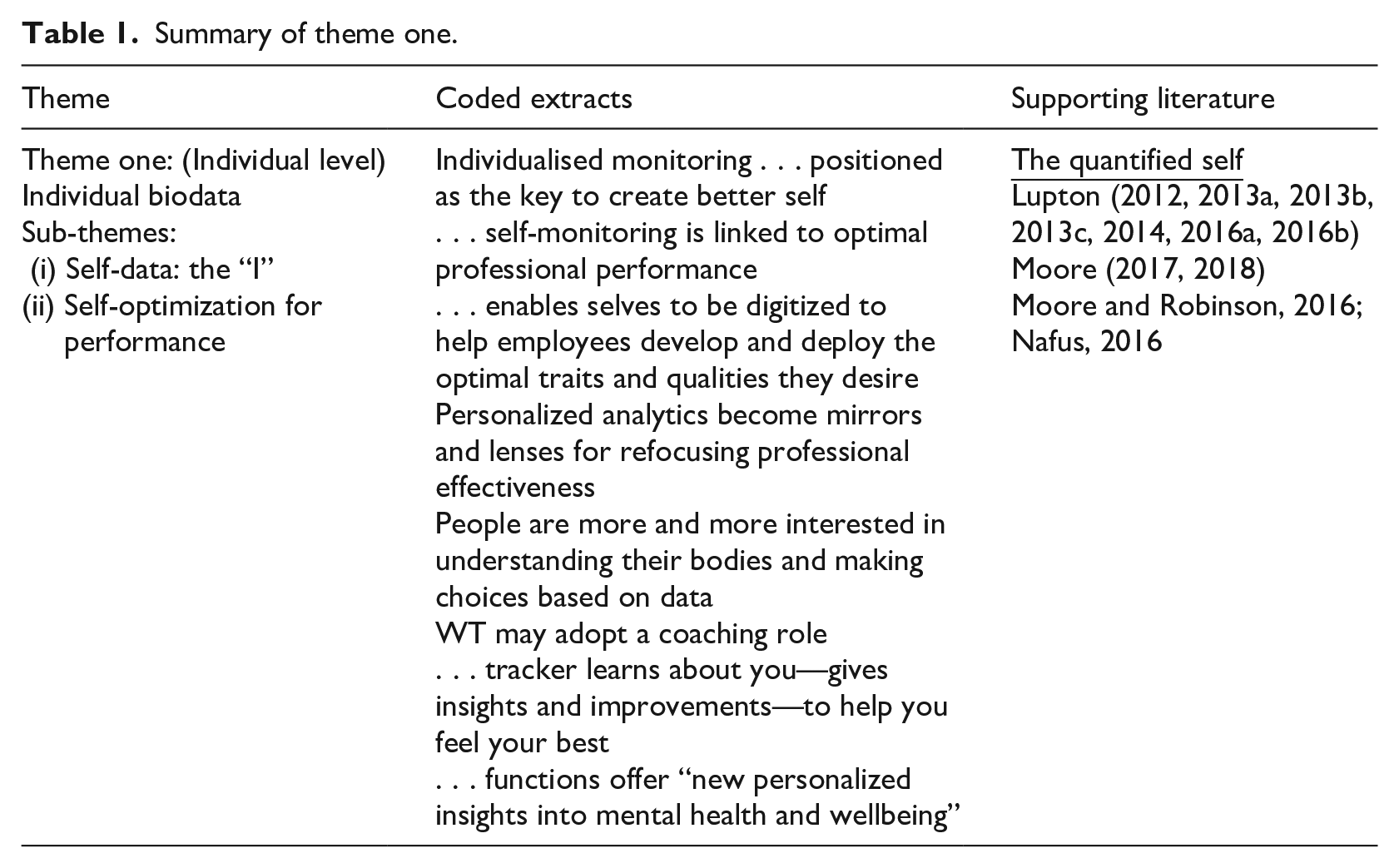
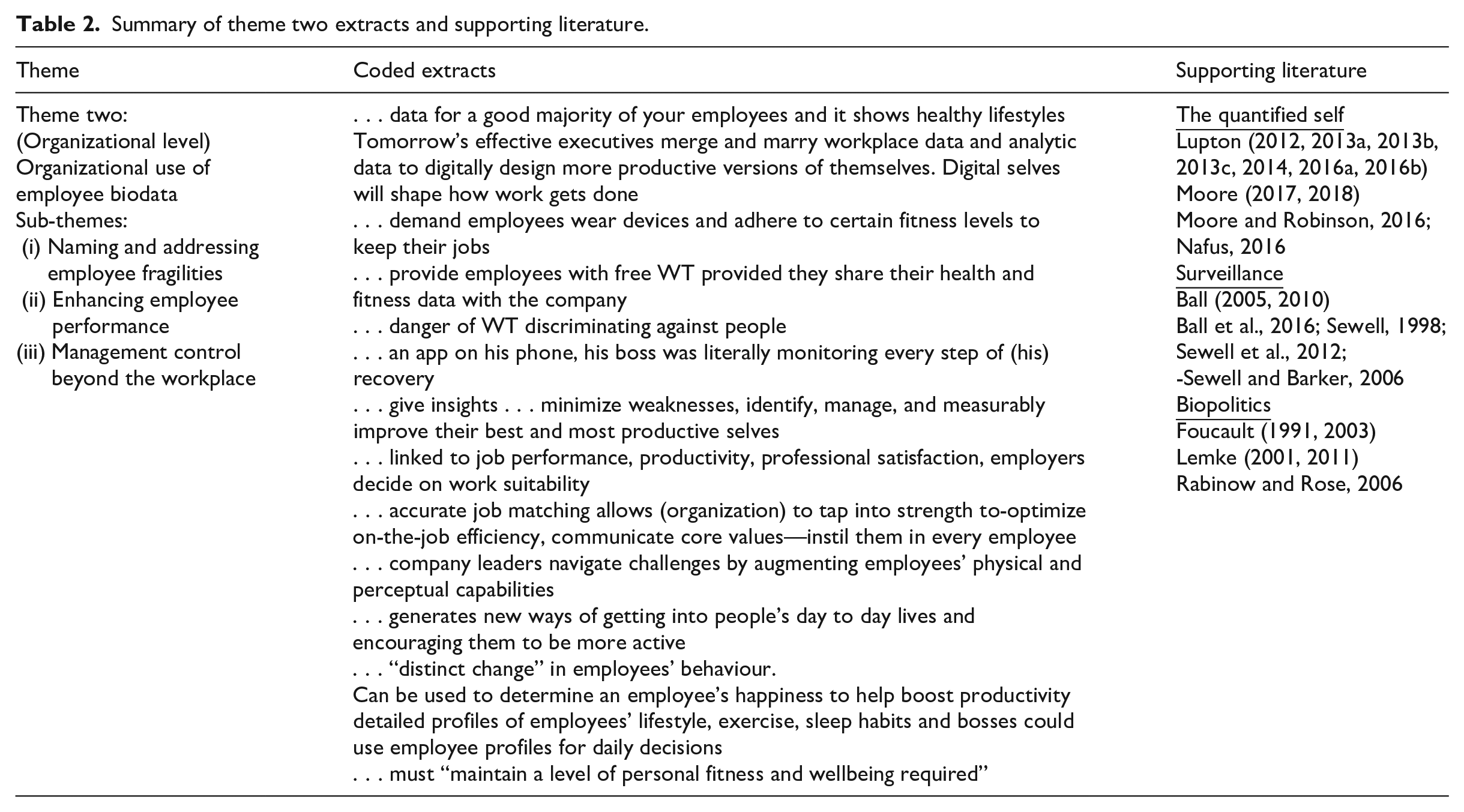
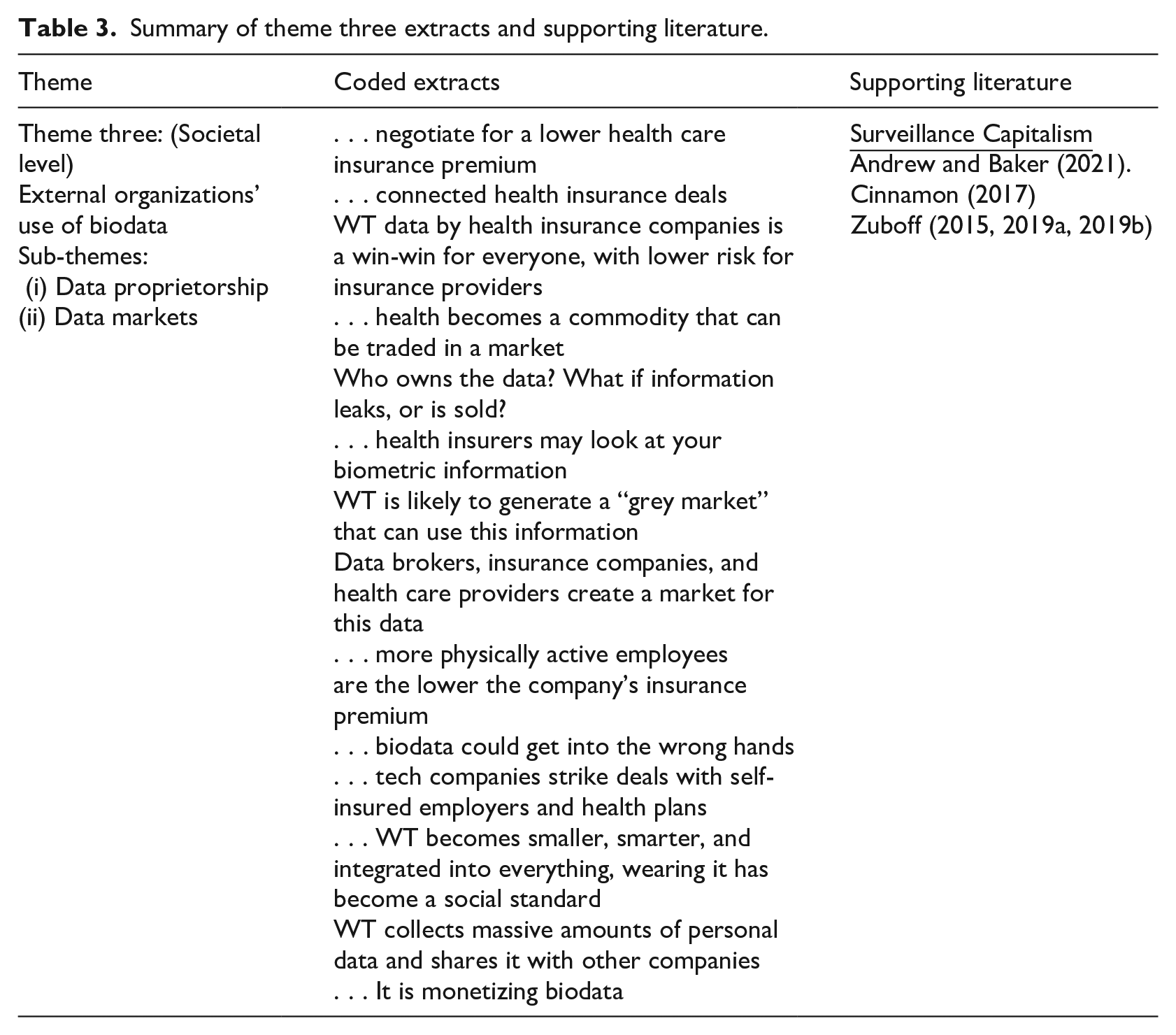
We identified three key themes with sub-themes, underpinned by our literature review. We include representative coded extracts from the documents that illustrate each theme. At the end of each thematic section is a short table summarizing the coded extracts and supporting literature (Tables 1–3). The entire extract is placed under the theme in which it mainly belongs even when there is overlap in the extracts.
Summary of theme one.
Summary of theme two extracts and supporting literature.
Summary of theme three extracts and supporting literature.
Theme one: The “I” in quantifying the self
The first theme comprises tech media’s framing of WT as beneficial to individual employees through appeals to health and wellbeing benefits of managing and quantifying personal biodata. Sub-themes identify neoliberal notions of (i) self-data and (ii) self-optimization for better performance .
Sub-theme (i): The “I” in self-data
Self-autonomy is linked to better decision-making, using feedback data so users can make personal decisions about their physical and mental wellbeing based on their biodata.
People are more and more interested in understanding their bodies and making choices based on data. (Gokey 2016, Business Insider)
These functions offer ‘new personalized insights into mental health and wellbeing’. (Schrage 2017, HBR)
The tracker learns about you—gives insights and improvements—to help you feel your best. WT . . . tracks breathing, sleep, activity and monthly cycles through the smartphone app. It has breathing routines (for stress) and automatically tracks everything, syncs the info and offers metrics and personal coaching. (Akpan 2015: Popular Science)
The analytic capabilities of these devices continue to grow more sophisticated as they become a type of ‘digital therapist’ that ‘diagnoses moods, alerts users to mood changes before they’re consciously aware of them and transforms how people monitor and manage their moods and mental health’. (Schrage 2017, HBR)
These extracts elicited from an academic magazine, a business source, and a science publication, indicate the broad reach of discourses of self-monitoring. Focus is on the individual and how WT devices can be used to track, monitor, understand, discipline, and improve the self. All four extracts indicate that biodata is a useful way to monitor the self and that insights are personalized to the individual. Individualized improvement with “data-based” decisions are presented as ideal. Trackers “automatically track everything” showing the pervasiveness of WT devices and data becomes metrics for individualized “coaching,,” again encouraging self-improvement. WT devices are “sophisticated” and also able to monitor moods and mental health, in effect creating a “digital therapist..” These extracts suggest the ubiquity of WT devices, the increasing ability to track internal bodily, cognitive, and emotive states and promote a focus on self-improvement at the individual level (the “I”).
Sub-theme (ii): Self-optimization for better performance
Media, technological and business texts commonly provide advice on how to track, monitor and ultimately improve the self. This is an underlying narrative in most of our 150 documents. We categorized this influence as “self-optimization,” as it endorses the notion that modern (westernized) people strive to develop their “best self,” and texts confirm that this is highly achievable through using WT.
. . . Individualised monitoring . . . positioned as the key to create better self. Digital self-monitoring is linked to optimal professional performance. (Tsekleves 2015: The Guardian)
‘Augmenting introspection’, WT enables selves to be digitized to help employees develop and deploy the optimal traits and qualities they desire. Personalized analytics become mirrors and lenses for refocusing professional effectiveness. (Butkin 2014, New Scientist)
Sources here are a scientific publication, and The Guardian, a popular news source. Both extracts use the term “optimal” inferring that employees should become the best that they can be. The use of the terms “better self” and “optimal” suggests that people should be striving to improve themselves, promotes self-discipline as desirable, and infers that individuals may currently be sub-optimal. This implies an expectation of continuous self-improvement and links self-care to workplace expectations of effectiveness, performance and professionalism. There are two levels apparent here, the individual level with an expectation of developing the “best self” (the “I”)—assumed to be desirable, coupled with the link to organizational level expectations (the “We”). Individual and organizational justifications are both clearly linked to improved work performance.
Theme two: Organizational biopolitics
Theme two identifies the organizational control (biopolitics) of employee bodies through biodata collection and management. Three sub-themes demonstrate biopolitical strategies of (i) naming and addressing employee fragilities, (ii) enhancing employee performance, and (iii) management control extending beyond the workplace into all aspects of life.
Sub-theme (i): Naming and addressing employee fragilities
On his 21st day back at work after a heart attack and triple bypass surgery, Chris Zubko received a call from the main office. Through an app on his phone, his boss was literally monitoring every step of Zubko’s recovery. (Roland 2019, The Washington Post)
A variety of sensors detect and record when an employee is sitting, standing, typing and records who they are talking to, and for how long. Can be used to determine an employee’s happiness to help boost productivity. (Lee 2015, Ubergizmo)
Tomorrow’s effective executives merge and marry workplace data and analytic data to digitally design more productive versions of themselves. Digital selves will shape how work gets done. Data will give insights and advice on what to say, when to speak up, and with whom to network to digitally amplify talents and attributes, monitor and minimize weaknesses, identify, manage, and measurably improve their best and most productive selves. (Schrage 2017, HBR)
These three extracts from a tech blog, a university business magazine, and a regional USA newspaper with a wide national audience, show a broad range of interest in WT applications. The first extract illustrates intense monitoring of an employee’s recovery by his work manager. The extract suggests that WT allows managers to identify employee frailties such as illness (heart attack in this case) as well as moods (happiness is cited). Note here the personal aspect of illness (the “I”) has become a collective focus (the “We”) as the manager monitors “every step” of the employee’s progress, suggesting the employee’s well-being is important to him.
The extracts frame everyday human states as organizational deficits to be managed and minimized (or maximized) to increase employee productivity. This tranche of extracts indicates that employee fragility can be identified through WT, fragility is not desirable, and biodata will allow targeted improvements. Individual fragility becomes a collective organizational problem to be addressed. Improvements focus on employee productivity through monitoring physical strength, behavioral decisions, and moods. We note that personal employee biodata can go straight to managers, as illustrated in the first extract. The “I” has become a “digital self” and this is linked to collective digital practices on how work will be accomplished. We infer the influence of data-driven work decisions, where biodata becomes a collective resource for both individual and collective optimization.
Sub-theme (ii): Enhancing employee performance
The second biopolitical sub-theme identifies discourse emphasizing WT’s potential to increase productivity through amplification of employee capacity and capabilities. As Schrage (2017, HBR) states, “The computational commingling of personal and professional behaviors is inevitable..”
. . . company leaders navigate challenges by augmenting employees’ physical and perceptual capabilities, amplifying their physical strength. . .and alerting for hazards. All of this has the potential to significantly boost productivity and safety. (Shatsky & Kumar 2018, Deloittes)
Exoskeletons are smart clothing that offers augmented strength. . .They boost strength without restricting physical coordination, increase productivity and ‘preserves employees’ wellbeing’. As WT becomes smaller, smarter and integrated into everything, wearing it has become a social standard. (Friedman 2015, Brainxchange)
‘Fitbit for your mind’ is a preventive measure to build mental resilience among employees . . . (Tyrrell 2017, West Australian; Bradshaw 2016, Financial Times)
Hitachi employees wear happiness measuring sensors in badges—collects data on employee movements, time spent sitting, walking, nodding, typing, and talking. An algorithm measures happiness. WT data is linked to job performance, productivity, professional satisfaction, employers decide on work suitability. (Frankel 2016, Quartz)
WT . . . facilitates accurate job matching allows (organization) to tap into strength to-optimize on-the-job efficiency, communicate core values—instil them in every employee. (Go 2017, HRD magazine).
Our extracts originate from technology publications and business sources including a Human Resources magazine displaying business and technical interest in WT. The extracts illustrate a wide scope for generating employee improvements, ranging from interventions that enhance physical capabilities to cognitive and behavioral enhancements. We note a neoliberal attitude normalizing organizational collection and monitoring of employees’ biodata to generate personal improvements aimed at increasing organizational productivity. The “I” must serve the “We” for collective success. Improvements are identified as augmented strength, improved mental resilience and activity, health and happiness boosts, and values-matching. These individual improvements are linked to organizational benefits of productivity, performance, social standards, and safety.
Sub-theme (iii): Management control beyond the workplace
WT data could create unintended consequences as employee tracking outside of work could help paint a detailed picture of a person’s private life. WT shows whether they spend lots of time in bars. WT records bio data enabling detailed profiles of employees’ lifestyle, exercise, sleep habits and bosses could use employee profiles for daily decisions. (Rutkin 2014, New Scientist)
Britain’s 650,000 nurses and midwives have been told to shape up, so they are fit enough to do their job and to set an example to patients. They have a ‘professional responsibility for adopting a healthy lifestyle’ and must ‘maintain a level of personal fitness and wellbeing required to meet people’s needs’. (Donnelly 2017, Telegraph UK)
This third sub-theme identifies how WT enables organizational monitoring of biodata beyond work hours, thus displaying another dimension of organizational biopower facilitated by WT. Moore and Robinson (2016) also argue that wearables demonstrate a form of neoliberal control that extends and reaches into the body and operates 24/7. This development is profoundly intensified as WT innovates. The first extract raises the possibility of unintended consequences such as collecting data about employees’ private lives. The second extract overtly espouses the collective societal and organizational focus on a personal health and fitness, presenting this as an individual obligation for the collective good.
Three sub-themes show how persuasive justifications dominate and obscure the ways adopting WT fundamentally changes the nature of the employment relationship because WT is pervasive and can extend beyond workplace boundaries. Issues of consent are murky, and in the employment relationship there is a further tension because there is “implied consent.” Employees may be obliged to share their data while on the job as well as after hours. Organizations are increasingly obliged to take a duty of care approach to data. However, organizations do not always have control of their own employees’ data, and organizations themselves are “data points,,” often not controlling the data collected (as is the case with exercise trackers, which are often given for free when a wellness program is introduced).
Theme three: External organizations’ use of biodata
The third theme shows that biodata collected from WT in the workplace is framed by technologists as a free resource (i.e. digital exhaust) whose collection is justified by employers and the broader industries (such as insurance and medical) to help increase wellbeing across populations. Our texts highlighted ethical and privacy issues implying that biodata could be used for purposes about which employees and organizations are unaware. We coded documentary extracts into two sub-themes, and the first addresses data proprietorship. Many of our extracts show that the possession of biodata is transferred from within the organizational boundary to external parties with different objectives for its use. Thus, sub-theme (ii) identifies emerging data markets and recognizes the market appetite for biodata generating new economic activities involving the buying and selling of personal and organizational biodata—an activity that we later discuss as an emerging form of surveillance capitalism. Within these sub-themes we can see that the justification provided coalesces around “We” (i.e. benefits to the “economy”).
Sub-theme (i): Data proprietorship
You may agree to share your information and health insurers may look at your biometric information and detect anomalies so people can address problems. (Evans 2017, Applemust.com)
Companies provide employees with free WT provided they share their health and fitness data with the company. The more physically active employees are, the lower the company’s insurance premium. WT monitors sleep, every health infraction—bachelor(ette) party, Saturday night takeaway or Netflix movie marathon on the sofa—could increase your health premium. There is a danger of WT discriminating against people and marking the end of privacy. (Tsekleves 2017, The Guardian)
WT raises questions such as the distinction between personal and professional life? When can employees take a smartwatch off? Who owns the data? What if information leaks, or is sold? (Evans 2017, Computerworld)
The biggest concerns with companies like Apple and Fitbit collecting health information is that biodata could get into the wrong hands. Fears are amplified as tech companies strike deals with self-insured employers and health plans. WT could be used to keep tabs on employees and may invade privacy in other ways (Farr and MacCracken 2017, CNBC).
These extracts suggest that employees may be required to share their data, with consent merely implied within the employment context. Data can be repurposed, both illegitimately and legitimately, indicating that data ownership is a contentious issue and not straightforward. The extracts indicate wider interest in obtaining employee data, and cause speculation about who might acquire biodata and benefit from it. The question of data ownership is articulated, as is the possibility of data leakage, and individual privacy invasion. All of these extracts recognize the relevance of external data markets and support the notion that biodata is a valuable resource that may be bought, sold, or even stolen.
Sub-theme (ii): Data markets
This sub-theme exemplifies the emergence of new data markets, and the extracts identify the significant presence and involvement of players such as private health insurers promoting the uptake of WT in organizations. Technologists recognize the role of private health companies and ethical issues with data privacy and security, data monetization, and work–life boundary transgression, but they also justify WT as being a critical tool for public health, identifying significant social benefits. Surveillance capitalism theories suggest that new markets are emerging as companies try to predict and modify user behavior. These extracts suggest that new markets are developing from the accumulation and collation of biodata that can be on-sold to companies interested in its economic potential, but they also justify the collective gains (the “We”) from these activities.
If you have data for a good majority of your employees and it shows healthy lifestyles, then it could be easier for you to negotiate for a lower health care insurance premium. (Boitnott 2015, Entrepreneur magazine).
Employers will look for connected health insurance deals . . . to provide legally required employee health coverage at lower premiums and will demand employees wear devices and adhere to certain fitness levels to keep their jobs. (Evans 2017, Computerworld)
WT data by health insurance companies is a win-win for everyone, with lower risk for insurance providers and customers leading healthier lives. There are opt-in incentives and apps track progress and rewards. This ‘Big Brother’ scenario constantly tracks food, drink, sleep, and activity and health becomes a commodity that can be traded in a market. (Kaul 2014, Tractica)
Information collected by WT is likely to generate a ‘grey market’ that can use this information. Data brokers, insurance companies, and health care providers create a market for this data and are already collecting anything they can to further define you so that they can market better. (Eadicicco 2014, Business Insider)
Briggs, CTO at Deloitte notes, ‘Everyone’s digital exhaust is going to be available—it’s just a matter of who can take advantage of it within the right ethical bounds’. (ABI Research Forecasts 2017)
WT collects massive amounts of personal data and shares it with other companies. Existing health privacy laws don’t generally apply to WT. It is monetizing biodata. (Gross 2016, ComputerWorld)
Although they recognize the ethical issues, our texts claim or infer that if managed “appropriately” WT is beneficial to corporations, the businesses adopting the technology, and to a lesser extent employees (e.g. in terms of health insurance). Tech experts link WT to the health of the global economy, so that wearing WT is framed as a desirable philanthropic, social, and economic behavior. From these texts we can also see new ways of framing socially collective responsibility emerging. Managing health conditions through “simple lifestyle, diet, and activity changes” means WT “could have profoundly positive impacts on the global economy” (Evans, 2017, ComputerWorld). New data markets are not widely understood nor acknowledged (Zuboff, 2019a), and we examine the connection between individual biodata collection (the quantified self), organizational management of biodata (biopolitics) and the broader market emphasis and economic justification for accumulating biodata (surveillance capitalism) in our discussion section next.
Discussion: Justifications and implications in WT wellness discourses
In this section we first clarify our main two contributions. We then discuss implications of these two contributions under three subheadings: first the implications of our findings for further surveillance studies; second by drawing attention to competing and not necessarily commensurate discourses of health and wellness; and finally drawing attention to what appears, on the surface at least, to be two contradictory capitalisms at play. In the final part of this section we identify areas for future research.
Neoliberal justifications
Our first contribution relates to answering the “how?” part of our research aim and is the main finding of our empirical analysis. Our research sought to explore how technology media justifies the implementation of WT in organizations. We argue that media plays a central role in the production of discourse about new technologies, and we have shown in our critical analysis of media texts that articles, whether they promote or are critical of WT use in the workplace, invariably use neoliberal justifications for WT adoption, even when social benefit (We) is inferred. Three themes provide a detailed accounting of how these justifications are framed. We identify appeals to self-improvement and achieving better individual performance to become an ideal worker hence enhancing employability; organizational improvement through reinforcing values of continuous improvement founded in knowledge derived from biodata, including data gathered from lives outside of work hours; and appeals to the benefits for individuals, organizations, and societies at large through seizing the opportunity biodata can bring to managing productivity.
Our second contribution relates to “why?”: why does technology media justify the use of WT in the ways it does? Although the motivations of individual technology writers are impossible to determine from our research, we can discern an economic logic underpinning the ways benefits and challenges are framed and presented. And the simple answer to this question is, unsurprisingly perhaps given the neoliberal logics at play—to make money. But this simple answer belies greater complexity and contradiction because justifications for WT use in the workplace obscure the underlying profit motive by appealing to health and wellness, a basic human consideration. In our analysis we have untangled and unhidden how appeals to health wellness need to be interrogated cautiously, but vigorously. We have achieved this untangling by bringing three concepts necessary to understand WT into conversation with previous surveillance studies: surveillance capitalism, organizational biopolitics, and the quantified self. WT is part of an assemblage of technologies, systems, and knowledge that facilitates the transfer of vast amounts of biodata, and thus the value that data accrues, to corporate entities, and they make fortunes from these technologies.
Obscuring surveillance capitalism
The first implication we develop is regarding how this research dovetails into previous surveillance studies and implications for future studies about WT’s impacts. Our finding that neoliberal justifications are used to appeal to the development and betterment of the self to bolster ideologies of productivity, agrees with previous research which has noted surveillance technology constructs people in ways that are not necessarily in their interests (Ball, 2010; Sewell and Barker, 2006; Sewell et al., 2012). For instance, Sewell et al. (2012: 208) state: ‘. . .the ethical status of organizational surveillance cannot be separated from the way that surveillance ‘constructs’ people in organizations – that is, the way surveillance as a form of performance management helps to fashion subjectivities of ‘good’ workers and ‘bad’ workers through local debates about what it means to be a loyal and productive employee.’
Over 10 years ago, Ball (2010) argued that surveillance is developing in “increased use of personal data, of biometrics and of covert surveillance” (p. 91). Because our research is specifically focused on these developments, we add two insights into the ways surveillance technologies align people in organizations toward productivity goals. The first insight is that health and wellness justifications are being used to facilitate adoption of the technologies into acceptance. This focus on healthy bodies of workers (and relatedly “healthy emotions”) distinguishes WT discourse as we have discussed it, from earlier work on surveillance. The circuit between health and wellness of the ideal worker and performance means these discourses are not just about health and wellness, but about making workers ideal in their physical, mental, and emotional behaviors. In effect, surveillance is moving beyond a process to improve individual performance at work and into a simultaneously coercive and controlling, “whole of life” mode (life, the body, human experience), signaling the role biopolitics is now having beyond the workplace. Biopolitics “marks the inscription of the biological into the political” (de Vaujany et al., 2021: 683) and we suggest that WT discourse promotes ideal workers as modern assets—using the rhetoric of self-care as a motivational but coercive driver.
A further insight relates to the role of organizations and a general trend toward managing wellness as an organizational obligation. Justifications for the adoption of WT go further than what has been previously noted in surveillance technology research because justifications now revolve around the health and wellness of organizational health as well. Although Sewell et al. (2012) position managers as “servants of capitalists” (p. 193) the new focus that WT brings to discourses of health and wellness (self-quantification which is neoliberal in its appeal to competitive self-improvement) acts as a fun-house mirror which obscures the ways that capital is arranged (e.g. surveillance capitalism). This means that organizational control needs to be understood at multiple levels—how individuals (workers) are conscripted into discourse through power and how organizations themselves (including managers) are also conscripted and come to adopt technological innovations such as WT. This means that future organizational studies on surveillance, as we have modeled by following Calvard’s three-pronged approach, need to consider multiple levels also. The value of this approach can also be seen in Thompson and Laaser’s (2021) study of algorithmic management in which they assert that technological analysis must consider the integration of political, economic, institutional, and employment relations.
Competing wellness discourses
A second main implication, which dovetails with the one above, builds on the finding that neoliberal values are the primary justification for WT adoption. The use of the terms “values” and “justifications” indicates a moral discourse, aimed at persuasion through appeals to what is perceived as good and proper behavior. Other surveillance technology researchers have identified “care” discourses as being central to understanding how and why these technologies are adopted into organizational life. For instances, Sewell and colleagues have shown how discourses of care and coercion both shape how people make sense of surveillance (Sewell and Barker, 2006; Sewell et al., 2012). Huber and Knights (2022) point out that sometimes coercive power relations can be “ethically positive and productive of life” (p. 2) and can create cooperative norms. They argue technology can create demands for care and responsibility and may combine “exogenous norms, endogenous freedoms, and a responsibility for others” (p. 3), further contending that ‘ethical relations of responsibility within cooperative modes of organizing . . . outweigh the dangers that normative control can encompass’ (p. 54). Our research concurs with these previous conclusions but draws attention to competing discourses of health and wellness. There is considerable tension between the neoliberal mode of persuasion being used to justify WT adoption (e.g. betterment of the self; the achievement of the organization’s competitive performance goals), and surveillance capitalism which operates almost invisibly but also has its own discourses associated with wellness—ones emanating from biopolitical strategies. In brief, neoliberalism valorizes freedom of choice at the individual level, and biopolitical values stem from arguments at the population level. Our study shows there are at least two discourses of health and wellness used as ethical justifications for WT adoption. Consequently, we suggest health and wellness discourses need more attention from organizational research attuned to their underlying economic logics.
Contradictory capitalisms
Our third implication relates to both the capitalisms we can see operating in WT discourse and to our second contribution relating to revealing the profit-motive driving WT justifications. Here we focus on major financial benefactors from these developments; private health entities such as pharmaceutical companies and insurance industries (also called “big-health tech”). There is no doubt that financial benefits from biodata accrue to investors in big-health tech and these developments are described by Zuboff (2015, 2019a). Benefits of biodata gathering are extolled in the contexts of moral justifications based largely in biopolitical terms. The argument is that the collection, collation, and use of biodata will benefit organizations and their participants. Furthermore these benefits are framed as meaning that the organization cares, and so if not adopted this implies that there is a moral deficit. However, as we have shown in our analysis of the articles, adoption of WT means that employees’ biodata can be used for insurance schemes and additionally, this data may be on-sold to third parties for other purposes. Clear and obvious dangers to equity goals are apparent. Our main concern as CDA researchers is with equality. Social inequity is already being exacerbated as employees’ biodata becomes extracted from the context where it was gathered and used for multiple alternative purposes, to benefit different entities. As Eubanks (2015) has argued, digital surveillance tools have already had significant effects of the global distribution of wealth, ultimately punishing the poor who have worse health and wellness outcomes. Put simply, our paper provides an example of showing the “hidden hand of capital” (Thompson and Laaser, 2021: 156) as we make visible economic, political, employment, and institutional relations. More research is needed to unpick the various forms of capitalism at play and more fully understand how complex capitalist relations operate around technologies such as WT. And to be clear, we are not advocating that surveillance technology itself, or biodata, is the problem, but rather the multiple “invisible hands” which sometimes work at cross purposes. We explore what can be done in the next section, concerned with future considerations arising from our study.
Further research
Along with organizational researchers that have come before us, we call for more research focused on organizational biopolitics and implications for workers and for equity. We have identified the ways discourses of wellbeing are being used to justify the introduction of WT. The extraction and on-selling of biodata and the value of its return needs to be more transparent than is currently the case. We suggest that organizational promotion and endorsements of wellbeing schemes linked to other organizational objectives (e.g. to reduce health insurance costs), and the repurposing of personal data without legitimate employee consent requires transparent articulation and local and global regulation. Specifically we note the need for regulatory frameworks to clarify “terms of ownership and rights for biodata assets” (Calvard, 2019: 274), which is starting to happen in some countries (European Commission, 2021). Our research has not probed resistance to the developments we have articulated. The surveillance researchers we have cited have all provided entry points for further research into resistance and alternatives. Additionally Sayers (2022) has provided a discussion of potential and actual avenues to repurpose WT for more to equitable means which covers developments such as big data activism and the data sovereignty movement. Consequently, we also call for more critical organizational empirical research to understand employee resistance to WT as well as other alternatives such as biodata activism.
Conclusion
No doubt wearables will have an important role to play in future workplaces. There have been radical shifts in how businesses operate during the COVID-19 pandemic and so the workplace may never look or feel the same. Technological media and health technologists are already prolifically and ardently promoting the benefits of WT to manage COVID-19 (Channa et al., 2021). No doubt WT will have a role to play in helping people return to work safely and keep them healthy. Our paper is not aimed at undermining the use of WT to keep people, especially the vulnerable, safe, and well. However, we do draw attention to larger technological and economic forces, which are largely invisible and opaque, and are not necessarily working in workers’ interests nor in the interests of social equity. What we are concerned to do is to draw attention to justifications for surveillance health-technology and how these justifications can obscure processes of surveillance capitalism. The context of economic and institutional relations has shifted dramatically even in the last 10 years and well before COVID-19 started to make many of the tensions we have outlined in this paper even more obvious and urgent (Rajan, 2006). Pharmaceutical and health innovations are new goldfields for financial gain, and careful analysis of digital global capitalism needs to be conducted that does not throw out the baby of organizational, social, and individual health and wellness with the bathwater of greed.
Footnotes
Appendix 1
Acknowledgements
We would like to acknowledge Professor Peter Boxall for his reading of drafts and kind suggestions. We thank Paul for his technical assistance and help with technical documents.
Funding
The author(s) disclosed receipt of the following financial support for the research, authorship, and/or publication of this article: from a MURF grant Massey University, 2018.
