




Abstract
Collaborative practices underlie the creation of innovation yet how and when these practices emerge is not well understood, particularly given the presence of flexible and open workspaces. Based on seven case studies of entrepreneurial Tech/FinTech firms in London, we explore how collaborative spaces lead to collaborative practices, when they do. Our findings suggest the enabling and inhibiting role of interstitial spaces (e.g. informality and spatiality) and identify catalysts in the emergence of collaborative practices in a coworking space. A theoretical and critical contextualisation advances our understanding of how collaborative practices emerge and articulates the conditionality of openness in the form of underlying mechanisms for collaboration and, subsequently (open) innovation outcomes. We discuss implications for future research and management of coworking spaces.
Introduction
Organisational space, by delineating where and what people make and do at work, constitutes an important element of work practices and can have important implications for the interaction between individuals and, ultimately, impacts innovation (Allen, 1977; Fayard and Weeks, 2007, 2011; Moultrie et al., 2007). While research on organisational spaces has extensively covered the physical design, efficiency and processes, control and socio-spatial perspectives (Beyes and Steyaert, 2012; Clegg and Kornberger, 2006; Dale, 2005; Elsbach and Pratt, 2007; Gieryn, 2000; Taylor and Spicer, 2007; Zhang et al., 2008), a recent scholarly debate points to the emergence of new work practices and workspaces, driven by various technological and social changes (Blagoev et al., 2019; Garrett et al., 2017; Johns and Gratton, 2013; Waber et al., 2014).
Amongst these work transformations, the emergence of coworking spaces as new forms of work has redefined the traditional physical, temporal and spatial boundaries of organisations’ beyond the liminal space or third place concept (Oldenburg, 1989). A nascent literature on coworking (Capdevila, 2015; Gandini, 2015; Spinuzzi, 2012; Spreitzer et al., 2015; Waters-Lynch and Potts, 2017; Waters-Lynch et al., 2016) has largely tackled the community aspect in examining the sense of belonging of its members (Garrett et al., 2017; Jakonen et al., 2017). But more recently, the attention of academic research has focussed on understanding the organisational dimension of coworking and has started to shed light on the organisational elements that shape the space beyond the sense of community in a mix of formality and informality (Blagoev et al., 2019) as well as pointing to the complexity and inherent tensions (e.g. collaboration and competition) that can occur within the coworking space (Vidaillet and Bousalham, 2020). Building on the organisational insights gained, the complexity and challenge of successfully engaging in collaboration in the coworking space warrants more research in order to better understand the potential emergence of collaborative practices beyond the beneficial sense of belonging to a community. Driven by the pursuit of more mobility and openness (e.g. open innovation), collaboration becomes increasingly materialised and shaped by a collaborative space (Binz et al., 2014; Garrett et al., 2017; Toker and Gray, 2008). And while emerging collaboration can partly be attributed to firms and communities liaising with a breadth of partners outside firms’ boundaries (Fabbri and Charue-Duboc, 2013; von Krogh et al., 2003; West et al., 2014) the practices that lead to collaboration in coworking spaces remain unexplored.
Yet, despite the emergence of coworking spaces as new work practices, little is known about the formation of collaboration and specifically the emergence of collaborative practices given these open and flexible workspaces to meet and interact with employees of other organisations. Innovation has a higher propensity to materialise when there are collaborative practices as innovation builds on collaboration (Hemetsberger and Reinhardt, 2009; Powell et al., 1996; Verona et al., 2006) as well as openness (Chesbrough, 2003; West and Bogers, 2014). As the seeds to agreements on alliances and open innovation, collaborative practices are often taken for granted or traced only to the level of joint membership in committees (Rosenkopf et al., 2001). Shared workspace represents an opportunity, and little is known about the formation of collaborative practices in coworking spaces. We define collaborative practices as a formal or informal collaborative activity involving more than one organisational entity in the aim of creating an innovation outcome. 1
The study of collaborative practices in coworking spaces warrants special attention for organisation and innovation scholars for two reasons. First, coworking spaces are at the centre of collective activity building on formal and informal relationships (Blagoev et al., 2019) entrenched within communities (Garrett et al., 2017) that can generate significant and radical innovations (Hippel and Krogh, 2003) on the micro (Furnari, 2014; Toker and Gray, 2008), meso (Cohendet et al., 2010) and macro levels (Binz et al., 2014). Second, these inter-organisational spaces and the emergence of coworking spaces have reshaped the typical physical and temporal boundaries of organisations’ work and practices (Oldenburg, 1989). Studies suggest that there is a rise in productivity, a sense of belonging to a community resulting from these spaces (Garrett et al., 2017; Waber et al., 2014), a broadening of firms’ innovation projects and scope of collaboration (Spreitzer et al., 2015), and research on coworking started to ask about productivity and the organisational phenomenon that coworking represents (Blagoev et al., 2019). At the same time, a critical set of studies have also started to look at the coworking phenomenon. While these spaces can act as catalysers for networking and collaboration, a tension emerges in these spaces when it comes to (anti)-corporate identities (De Peuter et al., 2017) and the ambivalence between a symbolic collaborative community and a collaborative individualism (Bandinelli and Gandini, 2019). As such, scholars are interested in understanding the conditionality and contingencies that can lead to new work and collaborative practices (and ultimately an innovation outcome) as part of the emergence of coworking spaces as new forms of work.
Put simply, our purpose is therefore to explore the following question ‘how do collaborative practices emerge in coworking spaces?’ In order to address this question, the literature on interstitial spaces and the genesis of new practices (Furnari, 2014; Kellogg, 2009) provides a useful theoretical lens to explore the emergence of collaborative practices in collaborative spaces for two reasons. First, external collaboration implies engaging in liminal spaces – physical or virtual – that is discerned between various external actors (Turner, 1975). In this context, the informal, occasional and temporally bounded interactions of interstitial spaces that occur between different organisations in collaborative spaces can further enhance our understanding on how and what precedes innovation. This angle of interstitial spaces can further complement the literature on spaces which has so far focussed on physical design and innovation outcomes (Fayard and Weeks, 2007; Moultrie et al., 2007). Second, while the literature has mainly emphasised the diffusion and institutionalisation of existing practices (Tolbert and Zucker, 1999) in relational spaces (Kellogg, 2009; Smets et al., 2012), interstitial spaces can explicate why and how collaborative practices may emerge as well as qualify the interactions that happen within.
We conducted a qualitative exploratory study of seven start-up firms in a leading coworking space in London (United Kingdom) focussed (but not limited) to the Tech and Fintech sectors, known as Level 39. Our empirical setting of Tech/Fintech start-ups provides a unique opportunity to answer our research question. First, with external collaboration and collaborative innovation becoming a more common practice among companies (Chesbrough et al., 2006), the study of collaborative practices in a synthetic and confined spatial environment constitutes an appropriate setting to explore our research question. Second, the rise of a disruptive Fintech ecosystem (Palmié et al., 2020) along with its heterogenous sub-sectors (e.g. blockchain, payments, cyber-security, money transfer, loan) have indeed reshaped how we think about money and is thus well suited to examine the emergence of new practices representing a more general setting of coworking for technology innovation (Milian et al., 2019).
Building on evidence from our study, we develop a contextualisation for understanding how collaborative practices emerge in a coworking space in the form of underlying mechanisms and contingencies for collaboration and, subsequently, (open) innovation outcomes. Our findings suggest the enabling and/or inhibiting role of interstitial spaces (e.g. informality and spatiality) and catalysts in the emergence of collaborative practices in a coworking space.
Next, we outline the theoretical background in relation to interstitial spaces and organisational and collaborative spaces. Then we go over the methodology and sample and, next, we explore the findings of our case study. Following that, we discuss the results, articulate propositions and present our critical contextualisation on how collaborative practices emerge in coworking spaces. We also discuss implications for literature and practice.
Theoretical background
Organisational space and the emergence of coworking
Management studies on organisational spaces – the concrete spaces organisations use like office floors – have mainly focussed on institutional issues of space with a special interest on physical design, efficiency and processes (Clegg and Kornberger, 2006; Elsbach and Pratt, 2007; Gieryn, 2000; Taylor and Spicer, 2007) and legitimacy related to spatial transformations (de Vaujany and Vaast, 2014). Organisational places do not only personify organisations from their stakeholders’ standpoint (Dale and Burrell, 2008; Wasserman, 2011) but also are places where actual work takes place. They have an impact on organisational processes such as communication (Allen, 1977), productivity (Olson et al., 2002), concentration (Banbury and Berry, 1998) and interaction between various individuals (Kabo et al., 2014). As such, organisational spaces, by delineating what people make and do at work, can facilitate or hinder interaction, collaboration and innovation (Allen, 1977; Fayard and Weeks, 2007, 2011; Moultrie et al., 2007).
Looking at spaces from the angle of interaction and innovation, the extant literature has mainly focussed on the features of communication and the physical characteristics of spaces that may spur collaboration and innovation. Exploring our research question requires a broader look at related work starting with physical space, openness and the organisational aspects of coworking spaces. Starting with the role of physical space, Allen (1977) showed that R&D employees have a higher probability of interaction and communication between themselves the closer their offices are to each other. More recently, studies have shown that colocation increased the productivity of workers by two fold (Olson et al., 2002) and the probability of collaboration increases when people are within immediate proximity such as in the same division or floor (Kabo et al., 2014). Spaces that are dedicated to back firms’ innovation (e.g. innovation labs) can support firms’ strategy, symbolism, efficiency, capabilities, teamwork and customer involvement in the innovation process (Moultrie et al., 2007). As such, these studies tended to emphasised the physical aspect of space design (Lewis and Moultrie, 2005) and leave much room to fully capture the evolution of workspaces and new practices in coworking spaces outside the regular office space or the third place (Garrett et al., 2017; Johns and Gratton, 2013; Oldenburg, 1989).
The emergence of coworking spaces as new forms of work has also been triggered by firms’ increasing drive for openness as central part of their innovation strategy (Chesbrough, 2003). The open innovation literature, which has generated a panoply of studies in the last decade (for an overview see: Bogers et al., 2017; West et al., 2014), has well documented the benefits of openness and collaboration on innovation outcomes and performance (Dahlander and Gann, 2010; Laursen and Salter, 2006; West and Bogers, 2014). Yet, little is still known about the formation of collaboration, which is often taken for granted or restricted to the level of joint membership in committees (Rosenkopf et al., 2001). This becomes an important question for both scholars and practitioners as innovation builds on collaboration (Powell et al., 1996), which in turn is increasingly materialised and shaped in a collaborative space (Binz et al., 2014; Garrett et al., 2017).
The emergence of coworking spaces has redefined the typical physical and temporal boundaries of organisations’ work and practices beyond the ‘third place’ (Oldenburg, 1989). Given the multitude of practitioners’ definition and lack of a unified academic definition, we hereby define in this paper coworking as an open, shared, and diverse workspace with flexible structures gathering knowledge workers from different backgrounds and objectives. Initially established in 2005 in San Francisco, there are currently over 1.2 million people working in over 13,800 coworking spaces worldwide which grew at rates as high as 250% in the last 5 years (Deskmag, 2017) and is likely to continue to grow. Given the resulting increased productivity, business network and sense of community derived from these coworking spaces (Deskmag, 2017; Waber et al., 2014), firms like Google and SAP have adopted the coworking space model for their employees in an attempt to ‘tap into new ideas’ via serendipitous encounters and, ultimately, collaboration (Spreitzer et al., 2015), providing learning opportunities and tacit knowledge exchange (Bouncken and Aslam, 2019; Capdevila, 2015) as well as social support (Gerdenitsch et al., 2016) that positively helps knowledge sharing materialise into creative performance in a coworking space (Rese et al., 2020)
A more recent stream of research has started to focus on the organisational dimension of coworking. Blagoev et al. (2019) showed that coworking spaces represent more than just a feeling of community belonging (Garrett et al., 2017; Jakonen et al., 2017) and can thus organise work as collective action via a mix of formal and informal relationships. As an emerging organisational phenomenon, coworking spaces can hence be the subject of additional complexity and tensions between the supposed cooperation and the potential competition (Vidaillet and Bousalham, 2020). This insight leads us to consider in more depth the interstitial dimensions in space.
The literature on coworking has also been looked at from outside managerial and innovation literature in an emerging strand of critical coworking studies. While coworking spaces enable the performance of network sociality and fostering social relations and collaboration, this platform for collective action yields a tension between its anti-corporate identity and neoliberal capitalism (De Peuter et al., 2017). While these coworking spaces act as ‘heterotopic’ catalysers and facilitate members’ networking and collaboration within and beyond the shared space, these same spaces create an ambivalence oscillating between a symbolic collaborative community and a self-oriented ‘collaborative individualism’ (Bandinelli and Gandini, 2019).
Given this emerging organisational phenomenon, further research is needed in order to better understand the organisational dimensions and practices in relation to the dynamics of collaboration and work practices (Fabbri and Charue-Duboc, 2016; Garrett et al., 2017; Johns and Gratton, 2013; Moultrie et al., 2007; Spinuzzi, 2012) as more organisations are either embedded in a coworking space or designing their own.
Interstitial dimensions in space and emerging collaborative practices
The literature on interstitial spaces and the genesis of new practices (Furnari, 2014; Kellogg, 2009) can provide a useful theoretical lens in order to better grasp the emergence of collaborative practices in coworking spaces. Interstitial spaces are defined as ‘small-scale settings where individuals positioned in different fields interact occasionally and informally around common activities to which they devote limited time’ (Furnari, 2014: 2). While previous studies have focussed on exploring relational spaces in situated interactions in different fields and within organisations (Kellogg, 2009), interstitial spaces constitute inter-field spaces where new practices could emerge from ‘meet-ups, informal gatherings, small-scale workshops, and hangouts’ (Furnari, 2014). Such spaces usually happen at the intersection of fields but can also be created on purpose at the interface of various fields (Furnari, 2016). Extant studies have recognised the benefits of informal interactions on the rate of innovation (Allen, 1977), cooperation in teams (Pinto et al., 1993), and sustainability of social networks (Brass et al., 2004; McEvily et al., 2014). Yet, ambiguity remains given inconclusive results on how to foster informal interactions stirred by the lack of conceptual framework to explicate how a setting or space facilitate or hinder informal interactions (Fayard and Weeks, 2007).
The interplay between institutional change and practice is increasingly attracting scholarly attention (Furnari, 2014; Kellogg, 2009; Lounsbury and Crumley, 2007; Smets et al., 2012). Practices correspond to regular patterns of activities that are ‘infused with broader meaning and provide tools for ordering social life and activity’ (Jarzabkowski, 2005). Thus practices form activities that are both ‘meaningful and recurring’ from the eyes of certain people or groups (Zietsma and Lawrence, 2010) by being ‘material interactions or behaviours that are made understandable and durable by their interpretation with wider cultural rules’ (Lounsbury and Crumley, 2007).
The extant literature has mainly focussed on the diffusion and institutionalisation of existing practices (Tolbert and Zucker, 1999) rather than on the emergence of practices that can be institutionalised in a later period (Lawrence et al., 2002; Padgett and Powell, 2012). Recently, there has been an increase in exploring when and how new practices emerge and better understand how actors are involved in the genesis of new practices. Even tough past studies have pointed to the role of experimentation and progressive approval of new ways of doing things in fostering practice change, recent work highlights the importance of space in enabling or hindering change and emerging practices with a particular interest in interstitial spaces (Furnari, 2014). Specifically, we’re interested in exploring the emergence of practices of collaboration: that is the initiation of joint problem solving between organisations.
As such, coworking spaces provide an ideal setting to empirically test the concept of interstitial spaces and the emergence of collaborative practices. Given the open, diverse and shared nature of coworking spaces, such spaces trigger collaboration between individuals coming from different fields (Spinuzzi, 2012; Spreitzer et al., 2015; Waber et al., 2014), act as intermediary for open innovation (Fabbri and Charue-Duboc, 2016), and create a sense of community (Garrett et al., 2017). The informal, occasional and temporally bounded interactions that occur between different organisations in coworking spaces fulfil the defining features of interstitial spaces (Furnari, 2014) which contribute in developing collaborative practices. Hence, given the latest workspace transformations and the increased interest in collaborative innovation in (coworking) spaces, this topic becomes an important one given the interrelatedness of space, practices and collaboration in further contributing to the genesis of collaborative practices.
Method
Case setting and context
The setting for our study consists of a leading coworking space based in London (United Kingdom), known as ‘Level 39’. The latter is one of Europe’s largest coworking spaces mainly dedicated to the Tech and Fintech sectors. Opened in 2013, Level 39 is located in the financial district of Canary Wharf in London and has grown to over 150 members in 3 years as of Q1 2016 out of over 1500 applications received. Level 39 does not only provide a mere shared space for companies to work in but also is the base for various events, workshops and seminars, conferences, informal meet-ups, mentoring, investor meetings and launch events. Level 39 hosts a diverse and international community, of which more than one third originates from outside the United Kingdom (U.K.).
The coworking space has a membership-based system where a financial rent is paid on a monthly basis and depending on the size and growth stage of the start-up or team in place. There are four types of membership schemes: hot desk, fixed desk, internal space and high growth space; which accommodate a variety of actors between freelancers, remote workers, but mainly Fintech and tech start-ups. Level 39 is composed of three distinct floors spanning over 80,000 square foot of space. Floor 1 and Floor 3 are high growth spaces where member companies are at an accelerated growth stage and with employees ranging between eight and fifty people. Floor 2, which has a considerable open space layout, includes desk members and young companies that are between four and twelve employees. All of the floors have a common area to work, talk or take a break, a shared kitchen, a lounge bar and an open space layout except in certain high growth spaces where larger start-ups have their own internal offices within the space. Appendix A presents the overall spatial layout of the coworking space.
Level 39 is a coworking space that is primarily focussed on the Tech and Fintech sectors, representing about seventy percent of all member companies. However, there is ample heterogeneity in the Tech and Fintech ecosystem (Milian et al., 2019; Palmié et al., 2020) given the numerous sub-fields which can be categorised into six broad categories: data and analytics, payments, banking solutions, trading, foreign exchange (FX) and crowdfunding related. Also, there are other fields and technology involved such as machine learning, artificial intelligence, blockchain and cyber security that further differentiate the various sub-fields mentioned above. Besides, the emergence of FinTech is part of a larger industry system-level change that has led to disruptive innovation ecosystems (Jacobides et al., 2018) and the emergence of new actors beyond traditional industries or incumbents where product or service innovations are increasingly being developed by the means of collaboration rather than lone firms (Walrave et al., 2018).
A technology oriented coworking space offers a unique case setting opportunity to study the emergence of collaborative practices in a collaborative environment for the following reasons. First, the spatial and social characteristics of Level 39 provide a suitable setting to examine the interplay between practices, collaboration and (interstitial) spaces. The likelihood of informal and temporal interactions resulting from the coworking spatial and social configurations can shed light on the role of interstitial spaces in the genesis of new practices. Second, with external collaboration and the innovation process becoming more open (Chesbrough et al., 2006), exploring collaborative patterns and practices in a synthetic environment constitutes an appropriate setting to test the prospect of the emergence of collaboration practices in a collaborative space like Level 39. This is also the opportunity to investigate the impact of interstitial spaces on collaboration and emerging practices in start-ups. Third, the recent rise of the Fintech industry, its different sub-fields, and the numerous innovations that have redefined how individuals and companies think about money are well suited to examine the emergence of new practices. In fact, London being the global leading hub for Fintech (Ernest and Young, 2016), allows to be immersed in the Fintech revolution. The UK Fintech sector, which encompasses 50% of European Fintech companies, generated more than £20 billion in revenues in 2015 (UKTI, 2016). This sector, being heterogeneous with numerous sub-sectors, provides an ideal research context for an exploratory study into collaborative practices in a collaborative space. This industry is thus similar to other sectors that are reliant on technology, knowledge workers and innovation and can hence be applicable to several other industries.
Data collection
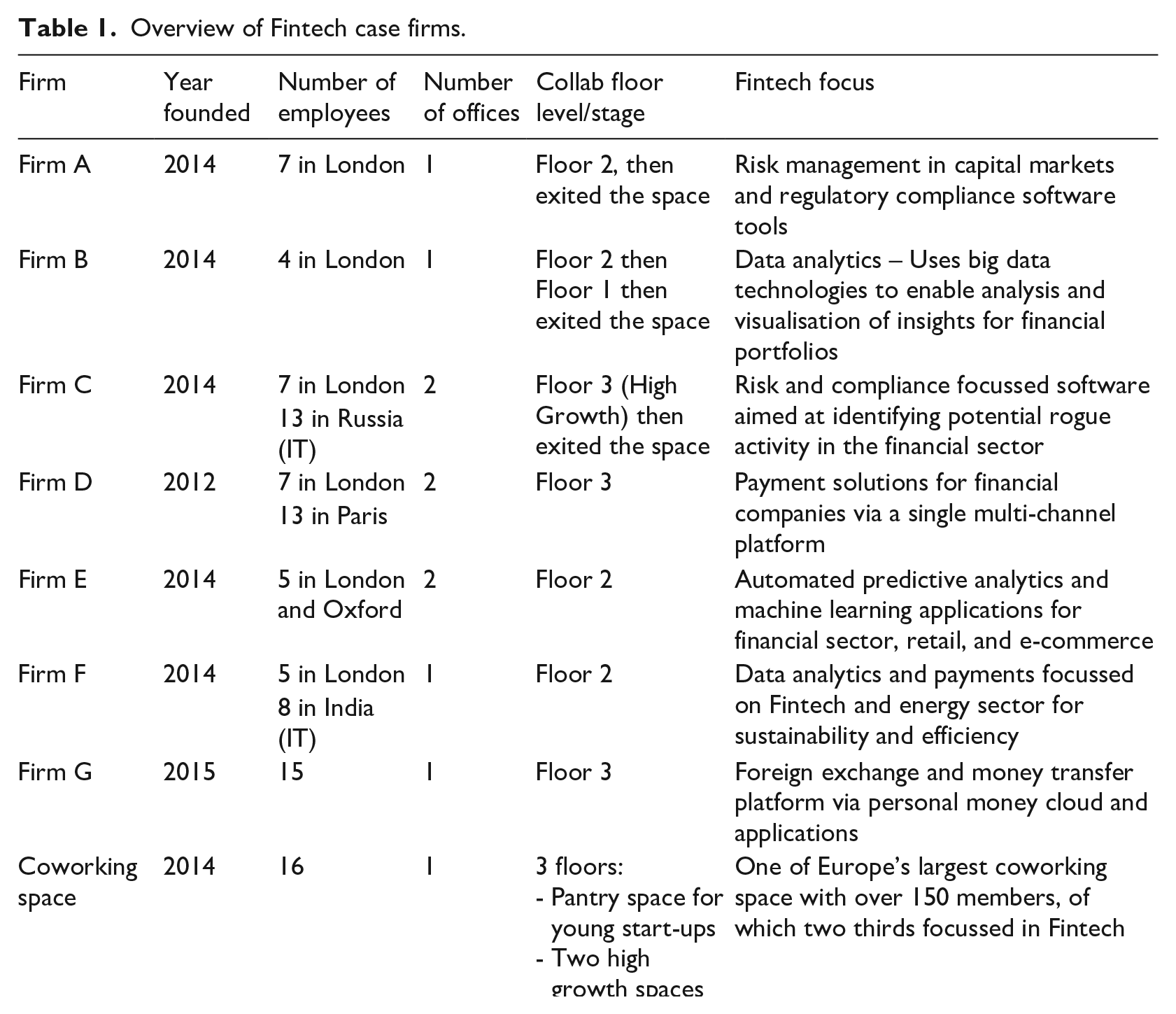
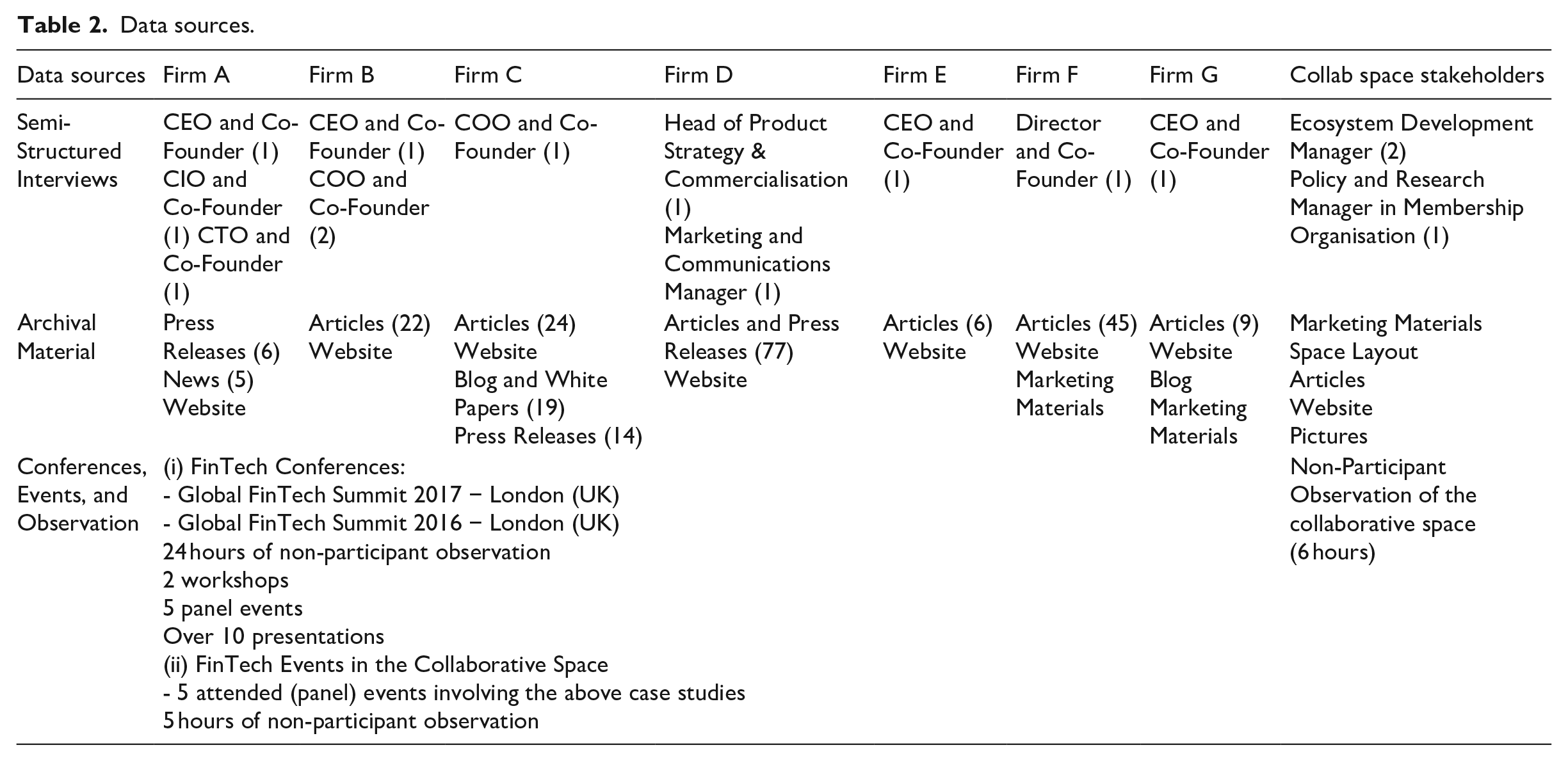
In this paper, we explored the emergence of collaborative practices in seven Fintech start-ups that are located in Level 39 (coworking space) that took place between 2015 and 2016. We have used an exploratory case study approach which is suited in a situation where little is known about the phenomenon with the aim to build theory (Eisenhardt and Graebner, 2007). We have used three main types of data sources: semi-structured interviews, archival material and participant and non-participant observations. Tables 1 and 2 present an overview of the case studies and data sources.
Overview of Fintech case firms.
Data sources.
Semi-structured interviews
Interviews were a primary data source for our study. We conducted fifteen interviews with members of Level 39, ranging from start-ups to the management team of the coworking space. All of the interviewees participated in the coworking space. We identified and contacted founders, CEOs, decision makers in the start-ups and other stakeholders that play a part in the coworking ecosystem. Within our sample, we have interviewed founders and senior managers of seven Fintech start-ups that operate at Level 39. These selected firms display enough heterogeneity in their sub-fields within Fintech (e.g. payments, data analytics, risk and compliance, machine learning), growth stage (various floor levels within the coworking space) and size (number of employees). Almost all interviews were done in person (or by phone), lasting at least half hour, and were professionally transcribed whenever permitted for reliability purposes (Eisenhardt and Bourgeois, 1988). Informants were asked general questions about the organisation, their innovation and collaboration patterns and their experiences and practices being part of the coworking space.
Archival data
We have also gathered secondary data from articles, marketing materials, press releases, space layout, photos and websites. Besides looking at press releases and marketing materials of member companies in our sample, we performed a search in Factiva database for any additional news coverage or articles that can give us further insight on collaborative practices and the space setting. We then use these materials for triangulation purposes so we can either confirm or spot new directions in our study.
Observations
The lead researcher participated in numerous events and conferences in relation to Level 39. First, we attended two major conferences in Fintech, the Global Fintech Summit in London in 2016 and 2017, with about 24 hours of non-participant observation, two workshops, and five panel events. Second, we attended five panel events involving the selected member companies where we observed patterns of collaboration and practices in interstitial spaces that may arise in these events. Besides, we had 5 hours of non-participant observation in the coworking space in just being part of the lounge and open floor setting across the three floors at Level 39. All of this helped us develop a deeper understanding of the coworking space in place.
Data analysis
As per the traditions of an inductive case study research (Eisenhardt and Graebner, 2007; Yin, 2013), there is an overlap between data collection and data analysis stages that involves several iterations. Following on Pratt (2009) propositions on depicting qualitative research, we aim to show our results using a combination of ‘power quotes’ in the body text as well as ‘proof quotes’ in comparative tables. We scanned the interview notes supported by our observations and archival materials looking for emerging themes. This process involved going back and forth to the literature on drivers of collaborative practices such as interstitial spaces, coworking spaces and collaboration. The emerging themes of informality, spatiality and catalysts were observed and coded accordingly in Table 3. First, informality denotes informal and occasional interactions such as in events and workshops, which was rated as low, moderate or high. Second, spatiality refers to the spatial dimension and proximity of the coworking space drawn from informants’ response and archival materials. We added a note on the status of spatiality for each case which outlines the spatial position of the member company in the coworking space (e.g. Floor 2, then Floor 3) or whether they exited the space during the course of the study (also see Appendix A). We have noticed either a facilitator or inhibitor role when reading through informality and spatiality quotes, which we then coded accordingly. Third, catalysts designate ‘actors who sustain others’ interactions over time and assist the construction of shared meanings’ in helping to generate new practices (Furnari, 2014). In this case, catalysts include stakeholders like the management company of the coworking space, NGOs and policy players in relation to Level 39. We rated the importance and relevance of catalysts from each case’s standpoint as low, moderate or high. Besides, following the above iterations and checks with the corresponding literature, we then uncovered two themes related to the development of practices in a coworking space: collective exploration and the emergence of collaborative practices in the process. We identified the respective quotes and materials for each case where we again rated these as either low, moderate or high. These patterns across different cases with representative quotes were then presented in tables and ultimately built a coherent contextualisation that we will discuss in the next sections of the paper.
Drivers of collaborative practices.
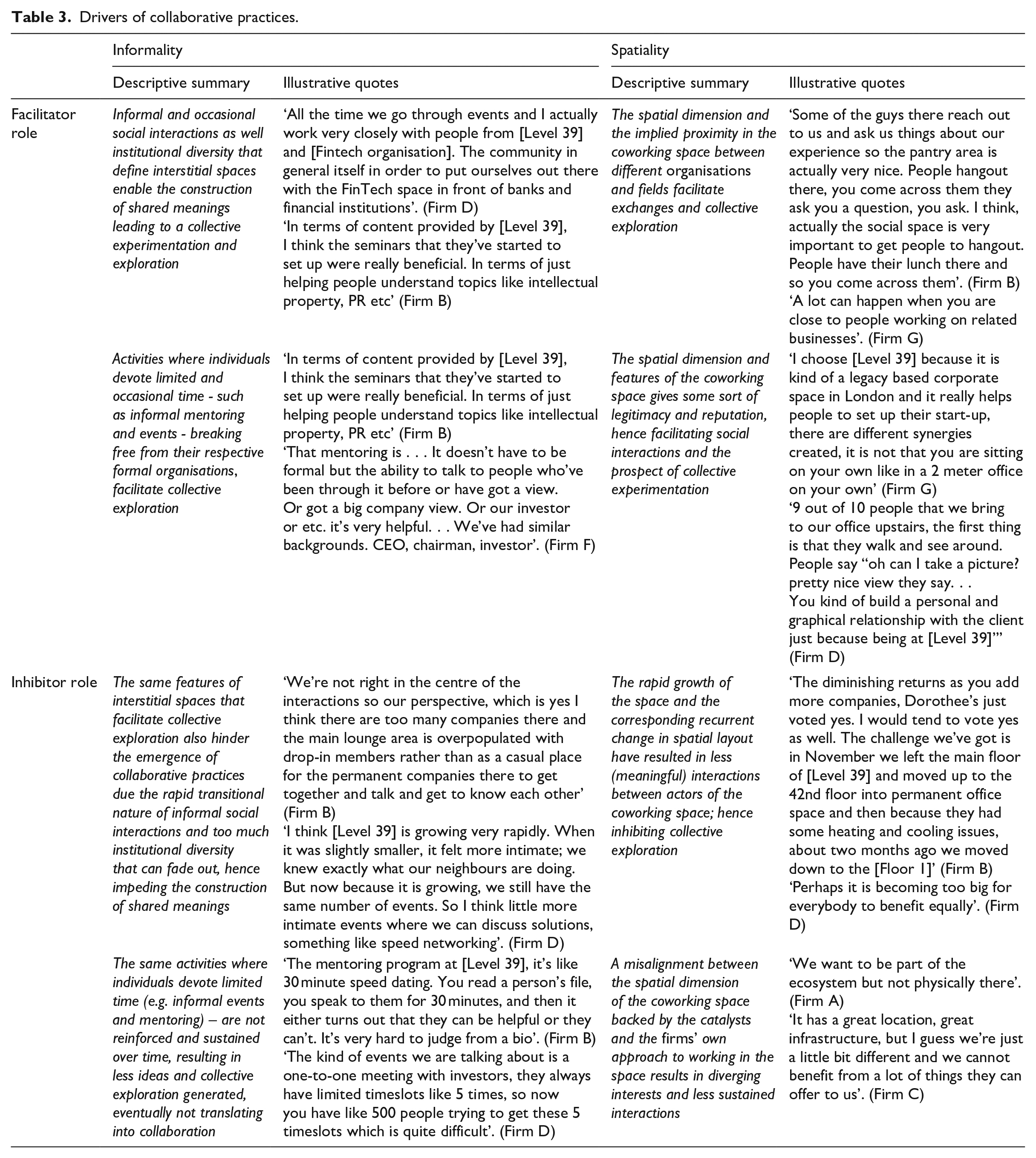
We will discuss our findings in the next section which include quotes from our interviews with member companies of Level 39 as well as excerpts from archival materials or observations during our study. For the purpose of confidentiality, all identifiable companies or individuals’ names have been anonymised without compromising on the content.
Findings
In this section, we begin by outlining the building blocks of collaboration by developing a critical contextualisation on the emergence of collaborative practices in coworking spaces. The data advocated for a model, presented in Figure 1, and connect the concepts and their relationships. Tables 3 and 4 provide an overview on how the various constructs described in Figure unfolded.
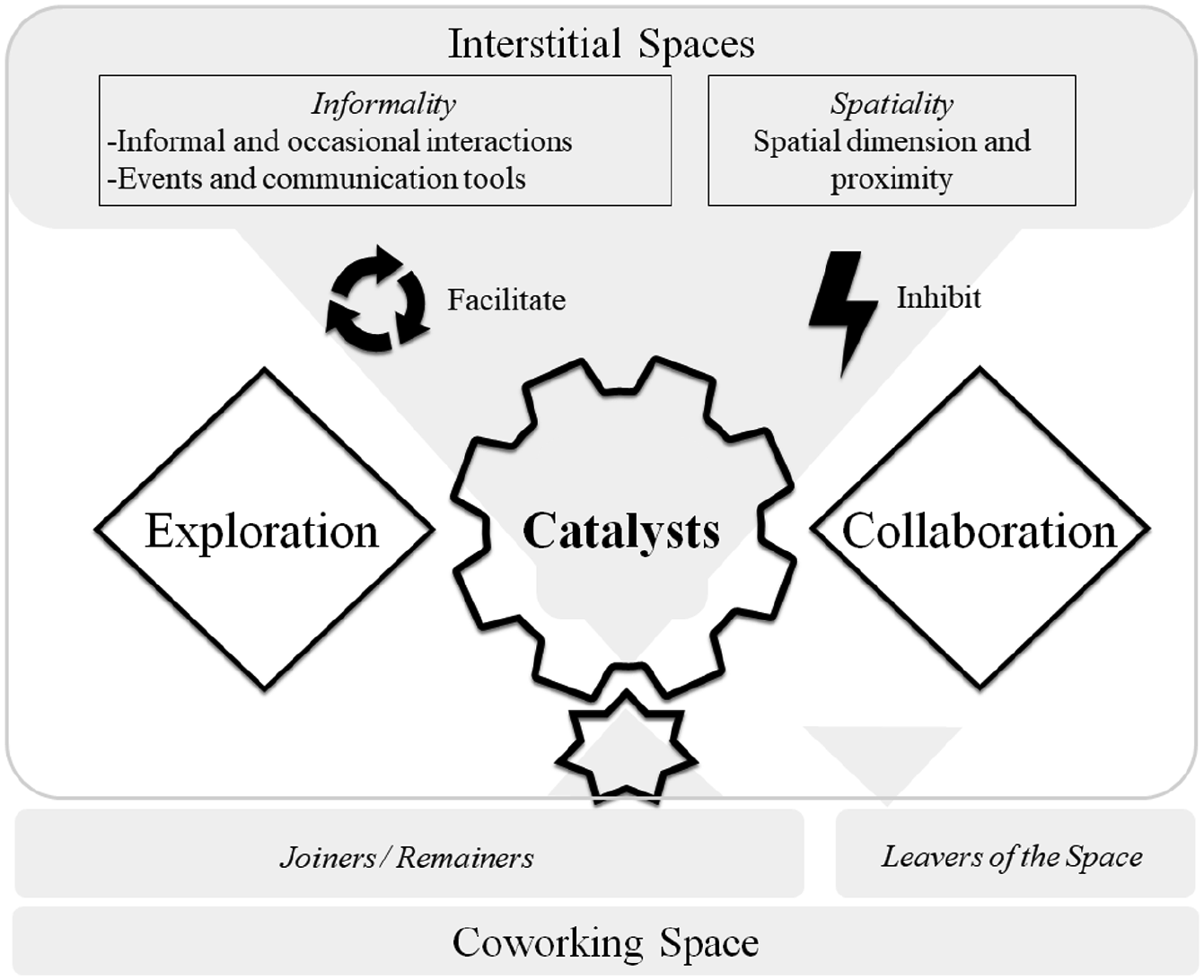
Critical contextualisation on how collaboration emerges in coworking spaces.
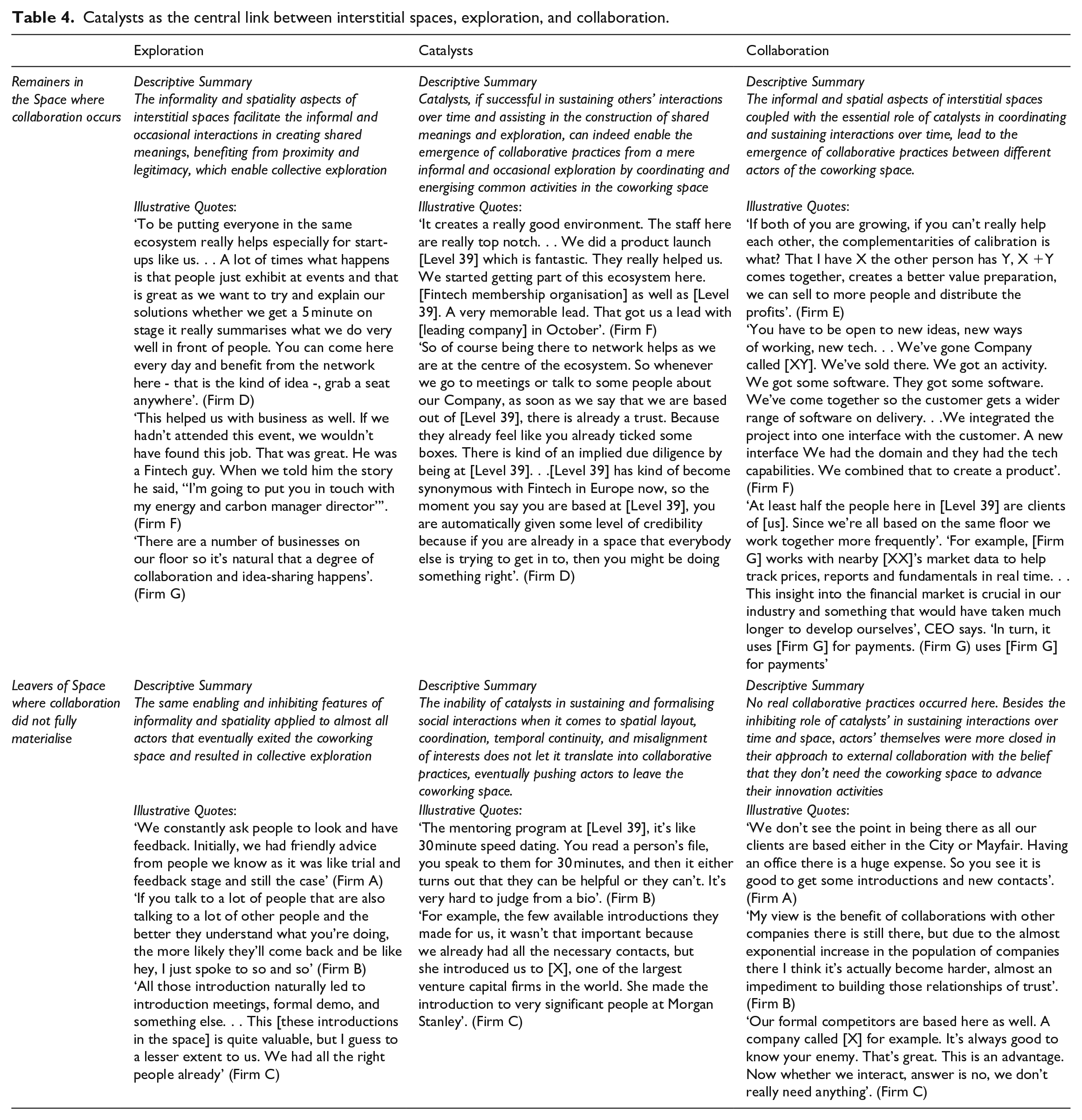
Catalysts as the central link between interstitial spaces, exploration, and collaboration.
The dual role of interstitial spaces as both facilitator and inhibitor of collaboration
While evaluating our cross-case comparisons, we noticed an alternating role of interstitial spaces – informality and spatiality – in first facilitating collective exploration then hindering the development of collaboration within the coworking space. We offer respective explanations for each emerging construct underneath with related quotes. Table 3 presents data on the dimensions of interstitial spaces in relation to catalysts and collaboration.
Informality
This term refers to informal and occasional interactions between various actors in the coworking space. In conducting our analysis, we noticed that informality had an enabling role on collective exploration but an inhibitor effect on the emergence of collaboration. We will first outline the facilitating impact followed by the inhibiting one.
Facilitator
First, activities where individuals devote limited and occasional time – such as informal mentoring, meet-ups and events – breaking free from their respective formal organisations, facilitate collective exploration. Informal mentoring sessions have been mentioned repeatedly as one such instance: ‘That mentoring is . . . It doesn’t have to be formal but the ability to talk to people who’ve been through it before or have got a view. Or got a big company view’. (Firm F)
Second, informal and occasional social interactions as well institutional diversity that define this aspect of interstitial spaces enable the construction of shared meanings leading to a collective experimentation and exploration. For instance, the various events and diverse workshops that happen at the coworking floor and backed by the catalyst role of the management company of Level 39 space, constitute an enabler for collective exploration. This has also been corroborated by our observations at Level 39 where people from different fields informally met during one of these workshops or casual events that occur on the floor.
‘All the time we go through events and I actually work very closely with people from Level 39 and [Fintech membership organisation]. The [Level 39] community in general itself is beneficial in order to put ourselves out there with the Fintech space in front of banks and financial institutions’. (Firm D) ‘In terms of content provided by [Level 39], I think the seminars that they’ve started to set up were really beneficial. In terms of just helping people understand topics like intellectual property, PR etc’ (Firm B)
Inhibitor
Informality has also its shortcomings as it inhibits the transition from exploration to the formation of a collaboration in the coworking space. The same features of interstitial spaces that facilitate collective exploration also hinder the emergence of collaborative practices due the rapid transitional nature of informal social interactions and too much institutional diversity that can fade out, hence impeding the construction of shared meanings.
‘I think [Level 39] is growing very rapidly. When it was slightly smaller, it felt more intimate; we knew exactly what our neighbours are doing. But now because it is growing, we still have the same number of events. So I think little more intimate events where we can discuss solutions, something like speed networking’. (Firm D)
Besides, the same activities where individuals devote limited time (e.g. informal events and mentoring), when they are not reinforced and sustained over time, result in less ideas and less collective exploration generated, eventually not translating into collaboration.
‘The mentoring program at [Level 39], it’s like 30 minute speed dating. You read a person’s file, you speak to them for 30 minutes, and then it either turns out that they can be helpful or they can’t. It’s very hard to judge from a bio’. (Firm B) ‘The kind of events we are talking about is a one-to-one meeting with investors, they always have limited timeslots like 5 times, so now you have like 500 people trying to get these 5 timeslots which is quite difficult’. (Firm D)
The informal factor seems to fade with time as informality hinders the transition from exploration to collaboration. Given the transitional aspect of interstitial spaces such as informality, if these interactions are not sustained and supported by other actors like catalysts as we will tackle later in this section, the emergence of collaboration will be harder to materialise.
Spatiality
This term refers to the spatial dimension, space layout and actors’ proximity in the coworking space. As previously mentioned, Level 39 has three floors: Floor 1 and Floor 3 for high growth spaces and Floor 2 for desk members and young companies. All of the floors have a common area to work, talk or take a break, a shared kitchen, a lounge bar and an open space layout except in certain high growth spaces where larger start-ups have their own internal offices (see Appendix A). Similar to informality, this emerging dimension is another important element of interstitial spaces that has both an enabling and inhibitory role for collective exploration and collaboration respectively.
Facilitator
Like informality, spatiality has a facilitating effect on collective exploration within the coworking space. First, the spatial dimension and the implied proximity in the coworking space between different organisations and fields facilitate exchanges and collective exploration between different actors. For instance, the space configuration (Appendix A) enables various interactions in the pantry area, kitchen, lounge and breakout areas within the open space layout. These interstitial spaces within the space create occasional and informal opportunities that can enable collective exploration.
‘Some of the guys there reach out to us and ask us things about our experience so the pantry area is actually very nice. People hangout there, you come across them they ask you a question, you ask. I think, actually the social space is very important to get people to hangout. People have their lunch there and so you come across them’. (Firm B)
Second, the spatial dimension and the reputable features of the coworking space give some sort of legitimacy, hence facilitating social interactions and the prospect of collective exploration between various actors. Level 39 has a spacious and brand-new floor layout with panoramic views of London, which further enhances the spatial experience. Based on the layout (Appendix A) and our observations, we can say that the spatial layout, breakout area, its legacy in the tech start-up field, and the location of Level 39 have an enabling effect on interaction and exploration. For instance, the event space allows for numerous opportunities to have occasional and informal interactions for a certain time, either from meet-ups, workshops or mentoring to name a few. Hence the potential of the facilitating effect of spatiality in fostering collective exploration through the actual spatial component of Level 39.
‘I choose [Level 39] because it is kind of a legacy based corporate space in London and it really helps people to set up their start-up, there are different synergies created, it is not that you are sitting on your own like in a 2-meter office on your own. A lot can happen when you are close to people working on related businesses’. (Firm G) ‘9 out of 10 people that we bring to our office upstairs, the first thing is that they walk and see around. People say “oh can I take a picture? pretty nice view they say. . .You kind of build a personal and graphical relationship with the client just because being at [Level 39]”’ (Firm D)
Inhibitor
Similarly to informality, spatiality has also a hindering effect on the emergence of collaboration in coworking spaces. Out of seven start-ups cases, three firms (Firm A, B and C) have actually left the Level 39 space as the benefits of a collaborative space did not endure and they perceived spatial drawbacks in relation to interaction. It seems that the (interstitial) space’s positive effect in relation to collective exploration does not necessarily last and make it harder to morph into a sustained collaboration, especially with the lack of catalysts in enforcing and sustaining those interactions over time.
First, the rapid growth of the space and the corresponding frequent changes in spatial layout by the Level 39 management company (counter-productive measures of catalysts) have resulted in less meaningful and sustained interactions between actors of the coworking space; hence limiting the formation of collaboration over time. With time and the scaling-up of the coworking space, there appears to be decreasing returns due to spatiality.
‘The diminishing returns as you add more companies, Dorothee’s just voted yes. I would tend to vote yes as well. The challenge we’ve got is in November we left the main floor of [Level 39] and moved up to the 42nd floor into permanent office space and then because they had some heating and cooling issues, about two months ago we moved down to the Floor 1’ (Firm B) ‘Perhaps it is becoming too big for everybody to benefit equally’. (Firm D)
Second, a misalignment between the spatial layout features made by the management of the coworking space and the firms’ own approach to spatiality results in diverging interests and less sustained interactions over time.
‘We want to be part of the ecosystem but not physically there’. (Firm A) ‘We’re not right in the centre of the interactions so our perspective, which is yes I think there are too many companies there and the main lounge area is overpopulated with drop-in members rather than as a casual place for the permanent companies there to get together and talk and get to know each other’ (Firm B)
Physical presence in the coworking space appears to yield diminishing returns over time that start-ups are present. Repeated attempts at orchestrating the space become seen as distracting or disturbing. In other words, the interstitial characteristics in spatial terms bear negative effects on the emergence of collaboration between occupiers of the space.
Catalysts orchestrate the relationship between interstitial spaces, collective exploration and the emergence of collaboration
In order to better unravel how and why collaboration occurs in coworking spaces or in other cases why it doesn’t materialise, we looked at these comparative situations and identified specific processes that stimulate collaboration in coworking spaces. As per Figure 1, results suggest the central role of the catalytic process in orchestrating the relationship between interstitial spaces and the coworking space. For the purpose of clarity, catalysts refer to actors who facilitate and encourage activities that sustain other’ interactions and induce cooperation. For example, catalysts can be moderators, hosts or organisers within the coworking space who provide continuity and ultimately assist in the construction and institutionalisation of collaborative practices. In this case, catalysts include stakeholders like the management company of the coworking space, NGOs and a government-backed organisation to grow the Tech ecosystem in relation to Level 39 and beyond. Table 4 presents the comparative data on the central role of catalysts in relation to collective exploration and the emergence or not of collaboration.
Remainers in the space where collaboration occurred
In this case, we will outline situations where collaboration transpired in the coworking space backed by the catalytic process and how it did so. We will then contrast in the next section by looking at cases where collaboration did not occur and where firms eventually left the space.
Catalysts
Catalysts have a central role in not only enhancing the facilitating role of interstitial spaces in collective exploration but also in mitigating the inhibiting aspect of these same interstitial features (as previously discussed in Table 3) on the formation of collaboration. Catalysts coordinate and energise common activities in the coworking space, hence assisting in the construction of shared meanings, trust, and collective exploration in the first place before ensuring sustained and repeated interactions that can stimulate collaboration between various actors of the coworking space over time.
‘It creates a really good environment. The staff here are really top notch. . . We did a product launch [Level 39] which is fantastic. They really helped us. We started getting part of this ecosystem here. [Fintech membership organisation] as well as [Level 39]. A very memorable lead. That got us a lead with [leading company] in October’”. (Firm F)
The host or the management team at Level 39 has indeed been an important contributor to the collaborative space environment in making numerous introductions and sustained follow-up meetings. The collegial and open environment at Level 39 further sustain these relationships and help them transition into new practices over time.
The uniqueness of Level 39 as the specialised Tech coworking space coupled with a rigorous application process for start-ups to be based there (more than 1500 applications received) have propelled Level 39 into being a catalyst in itself for the member companies and entrepreneurs. The seasoned team backed by influential business groups and policy makers enhance the legitimacy of the space. As such, it acts as a catalyst by further sustaining the relationships and ensuring continuity of its members who can benefit from interaction with a multitude of partners and actors.
‘So of course being there to network helps as we are at the centre of the ecosystem. So whenever we go to meetings or talk to some people about our Company, as soon as we say that we are based out of [Level 39], there is already a trust. Because they already feel like you already ticked some boxes. There is kind of an implied due diligence by being at [Level 39]. . .[Level 39] has kind of become synonymous with Fintech in Europe now, so the moment you say you are based at [Level 39], you are automatically given some level of credibility because if you are already in a space that everybody else is trying to get in to, then you might be doing something right’. (Firm D)
Exploration
The informality and spatiality aspects of interstitial spaces facilitate the informal and occasional interactions in creating shared meanings, benefitting from proximity and providing legitimacy, which enable collective exploration as the first phase as explained earlier.
‘To be putting everyone in the same ecosystem really helps especially for start-ups like us. . . A lot of times what happens is that people just exhibit at events and that is great as we want to try and explain our solutions whether we get a 5 minute on stage it really summarises what we do very well in front of people. You can come here every day and benefit from the network here - that is the kind of idea -, grab a seat anywhere’. (Firm D)
Collaboration
The informal and spatial aspects of interstitial spaces coupled with the essential role of catalysts in coordinating and sustaining these interactions over time, stimulate the emergence of collaboration between different actors of the coworking space. In fact, some start-ups have developed collaborative practices and institutionalised the practices in ongoing projects and external collaboration with other actors in the space. Building on the early facilitating role of interstitial spaces in fostering collective exploration, the catalytic process of building trust, shared meanings, and frequent and sustained coordination between actors, overcome the same inhibiting factors and ultimately stimulate collaboration beyond the occasional interactions.
‘You have to be open to new ideas, new ways of working, new tech. . . We’ve gone Company called [XY]. We’ve sold there. We got an activity. We got some software. They got some software. We’ve come together so the customer gets a wider range of software on delivery. . .We integrated the project into one interface with the customer. A new interface We had the domain and they had the tech capabilities. We combined that to create a product’. (Firm F)
Leavers of the space where collaboration did not fully materialise
Contrary to the previous cases where collaboration did occur, we also identified situations where the interactions of the coworking space did not result in stimulating collaboration. This was mainly due to two factors. First, a series of decisions by the management company of the coworking space (the catalyst) in relation to spatiality were seen as disadvantageous: frequent and unilateral changes in the spatial layout within and between different floors affected some firms. The decision to aim for rapid growth and scaling up by accepting new firms in the coworking space changed the perceived informality and involuntarily led to the accentuation of the inhibiting effects of the interstitial spaces on social interactions and hence on collaboration. Second, a number of firms in the coworking space perceived a misalignment of strategic priorities and a divergence of goals between themselves and the catalyst. With a strategy of rapid growth, the management company of Level 39 became increasingly reliant on a set of KPIs such as occupancy, scalability and profitability at the detriment of optimal spatial layout, a closer and more tailored relationship with the start-ups, resulting in a less informal environment that hindered informal interactions and potential collaboration. However, the latter was also exacerbated by some firms’ closed managerial approach to collaboration and innovation comparing with other more open firms where collaboration materialised despite some counterproductive actions by the catalysts. It is only when these two conditions (misalignment of interests from both sides) are met that we observed the lack of sustained interactions and collaboration which eventually led these start-ups to leave the space.
Catalysts
The inability of catalysts in sustaining and formalising social interactions are mainly the result of misalignment between the actors of the coworking space and the catalysts’ view when it comes to spatial layout, coordination, temporal continuity and firms’ own strategic approach and objectives vis-à-vis the space. Hence, this adverse, yet involuntary effect of catalysts’ decisions, accentuate the inhibiting effects of interstitial spaces, leading to less collaboration and eventually pushing actors to leave the coworking space.
‘For example, the few available introductions they made for us, it wasn’t that important because we already had all the necessary contacts, but she introduced us to [X], one of the largest venture capital firms in the world. She made the introduction to very significant people at Morgan Stanley’. (Firm C)
Exploration
The same enabling features of interstitial spaces (informality and spatiality) applied to almost all actors that eventually exited the coworking space and resulted in collective exploration. The coworking space, backed by both the positive impact of interstitial spaces coupled with the boost from catalysts in coordinating and energising interactions, have led to a collective exploration even though these firms did not engage in more sustained collaboration.
‘We constantly ask people to look and have feedback. Initially, we had friendly advice from people we know as it was like trial and feedback stage and still the case’ (Firm A) ‘All those introduction naturally led to introduction meetings, formal demo, and something else. . . This [these introductions in the space] is quite valuable, but I guess to a lesser extent to us. We had all the right people already’ (Firm C)
Discontinued collaboration
No sustained collaboration occurred in some cases for two main reasons. First and as mentioned in the paragraph earlier, the adverse role of catalysts in managing the coworking space coupled with the inhibiting impact of interstitial spaces in sustaining interactions over time and space, did not eventually stimulate collaboration between various actors of the space.
‘My view is the benefit of collaborations with other companies there is still there, but due to the almost exponential increase in the population of companies there I think it’s actually become harder, almost an impediment to building those relationships of trust’. (Firm B)
Second, we observed that firms in these cases were more closed in their approach to external collaboration with the belief that they don’t need the coworking space to advance their business or innovation activities ‘Our formal competitors are based here as well. A company called [X] for example. It’s always good to know your enemy. That’s great. This is an advantage. Now whether we interact, answer is no, we don’t really need anything’. (Firm C)
Thus, catalysts, if successful in sustaining others’ interactions over time and assisting in the construction of shared meanings and exploration, can indeed enable the emergence of collaborative spaces from a mere informal and occasional exploration by coordinating and energising common activities in the coworking space. They play an important role in providing continuity, order and a suitable environment for interaction which can eventually be more institutionalised into a new collaborative practice.
Discussion
In this study, we have addressed the question of how collaborative practices emerge in coworking spaces. To investigate this question in depth, we have used the analytical lens of interstitial spaces to develop a theoretical contextualisation and critical discussion that explicates the mechanism of the formation of collaborative practices in coworking spaces (Figure 1). Our results suggest the enabling and/or inhibiting role of informality, spatiality and catalysts in the genesis of collaborative practices in a coworking space. This study provides three contributions to the literature related to organisational studies and coworking spaces in particular.
First, the study contributes to the literature on the organisational dimension of coworking spaces. While earlier studies emphasised the important sense of belonging to a community (Garrett et al., 2017; Jakonen et al., 2017), this study adds to the emergent discussion about the formality of organisation of coworking spaces (Blagoev et al., 2019; Vidaillet and Bousalham, 2020) especially with the important role of semi-formal organisations in shaping employees’ productivity and collaboration (Biancani et al., 2014). Blagoev et al. (2019) argued that it is the interplay of the multiple organisational dimensions between formal (e.g. layout of the space, events, membership fees and some set of rules) and informal (e.g. informal interactions, routines, co-discipline, participation) that shape the organisational dynamics of coworking spaces. Building on this insight and given the tensions between the supposed cooperation and the potential competition in the coworking space (Vidaillet and Bousalham, 2020), we develop a critical contextualisation that helps explicate the mechanism of the formation of collaborative practices in coworking spaces. Using the theoretical lens of interstitial spaces (Furnari, 2014), we explain the underlying mechanisms that shape these practices in the coworking space through the contrasting effects of informality, spatiality, and catalysts. We deepen our understanding of the process and role of space (e.g. breakout area, common kitchen and open space) as both facilitating the development of collective exploration and, at the same time, hampering the emergence of collaborative practices in the coworking space. We also highlight the interaction of catalysts – actors who facilitate and encourage activities that sustain other’ interactions and induce cooperation – who have an important enabling factor in the emergence of collaborative practices. It is indeed the micro-interactions of informality, spatiality and catalysts that shape (or not) the emergence of new practices in the coworking space. Our results lead us also to have a more explicit understanding on how organisational spaces (Beyes and Steyaert, 2012; Dale, 2005; Taylor and Spicer, 2007) can shape organisational and collaborative dynamics. Our results also back some of the arguments on the role of the formal organisation (Du Gay and Vikkelsø, 2016) containing explicitly informal arrangements that can support collaborative practices under specific circumstances (Biancani et al., 2014; Blagoev et al., 2019).
Second, the conditions of the emergence of collaborative practices is extremely relevant in inter-organisational settings where collaboration is a precursor to innovation (Hemetsberger and Reinhardt, 2009; Powell et al., 1996; Verona et al., 2006). Using the lens of interstitial spaces, this study provides a more granular understanding of the mechanism and contrasting roles of (in)formality and spatiality in the emergence of collaborative practices in the coworking space. Thus, given the recent transformation of work practices associated with various technological and social changes (Johns and Gratton, 2013; Waber et al., 2014), this research captures the overall evolution of workspaces and the emergence of new practices beyond the traditional spatial, temporal and physical boundaries (Garrett et al., 2017; Oldenburg, 1989; Sewell and Taskin, 2015; Spinuzzi, 2012).
This paper also connects to the wider critical literature on coworking spaces as new forms of work. While recent studies have pointed to the enabling effect of these spaces on collaboration, inhibiting factors emerge such as the tension related to (anti)-corporate identities (De Peuter et al., 2017) and a symbolic collaborative community propelled by a collaborative individualism (Bandinelli and Gandini, 2019). Our findings contribute to the conditions and contingencies under which collaborative practices emerge, if they do, and they echo the critical view of a collaborative community that may become symbolic only due to strong growth or a transactional approach by the catalyst.
Third, we extend recent work on the contingent drivers of informal interactions in coworking spaces as new forms of work. Previous research has acknowledged the benefits of informal interactions on the rate of innovation (Allen, 1977), cooperation in teams (Pinto et al., 1993) and sustainability of social networks (Brass et al., 2004). Yet, studies provided ambiguous results on how to foster informal interactions through the openness or centrality of a space (Fayard and Weeks, 2007). The latter pointed to the lack of ‘integrated framework to explain how the physical and social characteristics of a setting combine to foster or inhibit informal interaction’ where they advanced the notion of social affordances to explicate the dynamics of informality in a setting. We articulate the special and central role that catalysts play and add a tentative framework for the emergence of collaborative practices in this type of work setting.
Conclusion
Our study reveals how collaborative practices can emerge in coworking spaces through a case study of start-ups. By outlining the context and using the theoretical lens of interstitial spaces, this study articulates the conditionality of collaboration and openness in these open shared spaces. The emergence of coworking spaces as new forms of work has redefined our understanding of the traditional physical, temporal and spatial boundaries of organisations. Thus, these transformations represent a considerable opportunity for firms and entrepreneurs; yet challenges remain as little is understood about how these open and flexible spaces foster collaboration and subsequently promote innovation. To the best of our knowledge, our article provides one of the first empirical studies that demonstrates how and when collaborative practices emerge, thus extending our understanding on the emergent discussion of the organisational dimension of coworking spaces (Blagoev et al., 2019).
This study has also important implications for practice. Given the constructs used in our critical discussion, the actions of the various players involved in the coworking space can have disparate effects in building collaboration and creating innovation. For membership organisations based in the space, their abilities to adequately benefit from the informal and spatial elements of the shared space as well as capture the enabling effect of catalysts is crucial to result in collaborative practices. Start-ups have to maximise both the spatial proximity and the informality at the earlier stages of their involvement in the space in order to reach the collective exploration stage. For example, the informal and occasional interactions such as events, workshops and the talks in the open kitchen/lounge that happen in the coworking space act as facilitator in building the first step of a collaborative practice and should be encouraged. However, once the stage of collective exploration has been reached, these same features hinder the emergence of collaborative practices, and thus should be rather controlled in order to achieve a collaborative practice. At the same time, it is important for firms present in the coworking space to benefit from the positive effects of catalysts such as the management company of the coworking space, non-profit organisations and policy players in relation to the coworking space. Besides, our study has equally relevant implications for managers running the coworking space and how they should be doing things differently with these recent work transformations. It is vital for a manager of a coworking space to create that ‘catalyst’ effect on the actors of the space in order to ensure continuity and sustainability of the interactions and experimentations in the aim that they successfully transition from a collective exploration stage to generate a collaborative practice. Having said that, the manager of the space should be aware of the tricky balance between control and governance and fostering openness and ultimately innovation (Sewell and Taskin, 2015) within the resulting coworking space community (Garrett et al., 2017; Spinuzzi, 2012).
Future research can further look at the relations between control/management and collaboration in the coworking space, thus extending our understanding on the ambiguity of informal interactions. Given the recent technological innovations, the Fintech sector provides an interesting setting to study the formation of collaborative practices within the emergence of coworking spaces. The setting of our study in the Fintech space is a potential limitation as we cannot compare our findings with other settings in terms of working culture, governance and so forth. It would be beneficial to see when and how collaboration is formed in other settings (e.g. low-tech, non-profit or creative industries) and whether there are different forms of collaboration that may arise in different contexts. Building on this study, these questions could further inform organisation scholars on the dynamics and various aspects of new work practices and workplaces in this exciting, emerging stream of research.
Footnotes
Appendix
Funding
The author(s) received no financial support for the research, authorship, and/or publication of this article.
