




Abstract
Coworking is a rapidly growing worldwide phenomenon. While the coworking movement emphasises equality and emancipation, there is little known about the extent to which coworking spaces as new forms of organising live up to this ideal. This study examines inequality in coworking spaces in the Netherlands, employing Acker’s framework of inequality regimes. The findings highlight coworking-specific components of inequality regimes, in particular stereotyped assumptions regarding ‘ideal members’ that establish the bases of inequality, practices that produce inequality (e.g. through the commodification of community) and practices that perpetuate inequality (e.g. the denial of inequality). The study provides an update of Acker’s framework in the context of coworking and speaks, more broadly, to the growing body of literature on (in)equality in emerging organisational contexts.
Introduction
An increasing number of people worldwide are working in coworking spaces, defined as organisations where knowledge workers and creative professionals find a work desk, additional technical and physical facilities as well as like-minded individuals for the exchange of business ideas and personal interests (Grazian, 2020; Howell, 2022). Since the first contemporary coworking spaces were observed in the San Francisco area in the early 2000s (Pratt, 2002), estimates suggest that by 2022, there were nearly 14,000 commercial coworking spaces worldwide (Coworking Insights, 2023). The continuously growing significance of digital, location-independent and freelance work will contribute to further proliferation in the future (Barley et al., 2017; Montanari et al., 2021).
Coworking spaces typically embody the spirit of the sharing economy, embracing the ideals of egalitarian community and collaboration (Coworking Wiki, 2023; Gandini, 2015; Garrett et al., 2017). This makes them particularly intriguing for research on workplace equality, diversity and inclusion, which examines whether new forms of work organisation lead to improved opportunities for historically marginalised groups or, conversely, give rise to new types of disadvantage. With this in mind, the starting point of this study was the expectation to find more equal, more diverse and more inclusive working environments compared with traditional work organisations. However, during empirical fieldwork conducted in coworking spaces in the Netherlands, it became evident that the promise of an egalitarian community is far from fulfilled. Instead, various dimensions of inequality prevail in these organisations. This article aims to shed light on the nature and underlying practices of this unexpected inequality in coworking spaces, thereby enhancing our understanding of this important new way of working.
The study employs the framework of inequality regimes proposed by Acker (2006). Originally, Acker focused on how organisations are structured by culturally and historically shaped systems of domination and subordination that (re)produce systematic disparities in employees’ power, resources and outcomes. The fruitfulness of the framework has been demonstrated not only in studies at the organisational level but also at the level of industrial sectors (Cohen et al., 2023; Tatli and Özbilgin, 2012). This research demonstrated that depending on the sector-specific context, different components of inequality regimes have varying degrees of salience. Expanding this line of research, and based on site visits, interviews and observations, this study reveals coworking-specific components of inequality regimes, despite the egalitarian discourse and the potential for new approaches to equality.
By uncovering coworking-specific mechanisms of creating and perpetuating inequality, we provide a critical and systematic extension of earlier research (Grazian, 2020; Sargent et al., 2020) that touched upon existing patterns facilitating inequalities in coworking spaces (e.g. pricing policies and gendered branding). Therewith, this study also responds to calls to investigate ‘how coworking can perpetuate or even generate social problems’ (Blagoev et al., 2019: 912) and, more specifically, given the widespread perception of coworking spaces as organisations promoting equality among its members, to study ‘the processes, relations and mechanisms that render inequalities invisible and legitimate’ (Tatli and Özbilgin, 2012: 260). Thereby, this study relieves the widely propagated image of coworking as ‘an inevitably positive innovation’ (Gandini, 2015: 194) or even ‘an equalizer’ (Howell, 2022: 16). On a broader level, this study contributes to the growing body of literature that investigates (in)equality in emerging organisational contexts (e.g. Gill, 2002; Sobering, 2016; Solebello et al., 2016) and suggests an update of the inequality regimes framework in the context of coworking spaces.
Coworking spaces as workplaces
Although people in coworking spaces do not work as employees in the traditional sense, their workplace experiences are similar. For an average membership fee of a few hundred US dollars per month (e.g. USD 214 in the Netherlands; Coworking Insights, 2023: 15), they can avail themselves of office space and additional resources such as meeting rooms, cafeteria or kitchen facilities, high-speed internet, printers/plotters and sometimes recreational or fitness areas (Howell, 2022; Montanari et al., 2021).
Hosts employ various means to create a positive atmosphere and encourage interactions and collaboration among members (Merkel, 2015). Examples include aesthetically pleasing furniture and space design, architectural layouts that facilitate encounters and social events such as weekly breakfasts and regular networking meetings, which also allow members to showcase their products and ideas (Blagoev et al., 2019; Spinuzzi, 2012). Other service elements for coworking members include blogs, bulletin boards and sometimes invited talks, seminars and consulting. Furthermore, members can benefit from the reputation of the coworking space when engaging with clients, partners or investors (Howell, 2022; Sargent et al., 2021), and may find potential collaborators for their business or art projects among fellow members (Garrett et al., 2017; Spinuzzi, 2012).
While coworking spaces typically are characterised by informality, the – often ritualised – social events and frequent interaction with others help members to structure their work activities (Blagoev et al., 2019; Gerdenitsch et al., 2016), build up a sense of community (Garrett et al., 2017) and draw boundaries between their work and private lives (Blagoev et al., 2019; Orel, 2019). Thus, coworking spaces offer an alternative to the isolation of home offices and the distractions in public places such as cafés. Furthermore, they shape members’ identities as professionals (Cnossen and Stephenson, 2022) and parts of a desirable social collective (Blagoev et al., 2019; Garrett et al., 2017). Altogether, coworking spaces do more than offering a place to work. By providing specific amenities, aesthetics, a community philosophy and social activities, they shape their members’ workdays, social interactions and subjectivities.
Inequality in coworking spaces
Building upon her influential work on gendered organisations (e.g. Acker, 1990), Acker (2006) proposes that ‘[a]ll organizations have inequality regimes, defined as loosely interrelated practices, processes, actions, and meanings that result in and maintain class, gender, and racial inequalities within particular organizations’ (Acker, 2006: 443). Inequality regimes emerge within specific cultural, historical and societal contexts. They are fluid and changeable, and they can vary between organisations and across subunits within organisations.
Acker suggests examining inequality regimes as consisting of six components. First are the bases of inequality in terms of social identity categories. While Acker focuses on gender, race and class, as well as their intersections, she also considers other bases of inequality, such as sexuality, religion, age and ‘physical disability’ (Acker, 2006: 445). The second characteristic is the shape and degree of inequality, for instance reflected in the steepness of the formal organisational hierarchy, job segregation and wage disparities. Thirdly, organising practices and processes are a key component of inequality regimes. Examples include formal and informal activities in recruitment and hiring, job design, wage setting and supervision, as well as informal social interactions among organisational members. Many of these activities are based on assumptions and expectations about ‘ideal workers’, who may be women or men, White people or People of Colour, depending on the nature of the work tasks to be accomplished. Importantly, the assumptions surrounding ideal workers not only give rise to problematic practices that produce inequalities but, conversely, these practices reproduce the stereotypical ideal worker norms. Furthermore, visibility and legitimacy are important components of inequality regimes. When people are unaware of existing inequalities or perceive them as justified, it impedes efforts to address and diminish them. Similarly hindering change, the final component is organisational control, for instance via bureaucratic rules, technology or individual beliefs, which results in compliance with the existing inequality regime.
Several studies have shown that Acker’s (2006) framework is also fruitful for examining inequality regimes beyond the organisational level, for instance those by Tatli and Özbilgin (2012), on race- and class-based inequality in the arts and cultural sector, and Cohen et al. (2023), on gender inequality among university professors. This research demonstrates that the significance of the six components outlined in Acker’s framework varies depending on the context, but the central role of invisibility and legitimacy in perpetuating inequalities remains consistent. Moreover, common underlying mechanisms are (White) male, middle-class bias and homosociality, by which people tend to enter professional relationships primarily with others of the same gender.
Further research shows that such inequalities are not limited to industries and organisations with long-established and conservative histories, such as the arts and academia. They are also present within relatively new organisations that explicitly espouse egalitarian principles (Meyers and Vallas, 2016; Scott, 2000). For instance, in her study on gender (in)equality in a worker-recovered cooperative, Sobering (2016) concludes that despite the cooperative’s collectivist structure, gender equality policies and commitment to community and solidarity, it functions as a ‘gendered organisation’ where gender moulds individuals’ roles, identities and access to power. Moreover, research on social cooperatives employing disadvantaged people (Priola et al., 2018), the creative industries (Gill, 2002; McRobbie, 2015) and industries with balanced gender representation (Caven et al., 2022), demonstrates that even organisations perceived as egalitarian, with a strong awareness of gender issues, flat hierarchies and an equality agenda, can still reproduce inequalities.
Research on inequality in coworking spaces is emerging but still scarce. The study by Sargent et al. (2021), which closely aligns with our research, shows how coworking spaces’ accessible membership fee pricing policies, space design and allocation practices, as well as the absence of organisational or occupational hierarchies, can promote proximity between individuals of different genders and races, contributing to the diversification of networks and collaborations, and ultimately alleviating gender inequality. Conversely, when luxurious amenities are coupled with exclusionary pricing policies, they reinforce power imbalances along gender lines, resulting in greater gender segregation in coworking spaces with higher member fees. Also focusing on gender-based inequality, Grazian (2020) highlights how market-dominating coworking spaces (e.g. WeWork) tend to cater their branding towards young men, often at the expense of women. For example, ‘offices featuring taps of endlessly flowing beer (that mostly men seem to drink), ping-pong and arcade games (that mostly men seem to play), and posters celebrating violent macho movies’ (Grazian, 2020: 1009) might not only be more appealing to men but also deter (potential) women members as they might feel excluded from the image of the ideal member portrayed by such branding.
Likewise, Blagoev et al.’s (2019) study provides insights into inequalities in coworking spaces. While informality, individuality and equality are highly valued in the examined coworking space, it becomes apparent that social compatibility is crucial as well. The multitude of social events, which are deemed vital for the functioning of the coworking space, carry the risk of excluding members who may not fit in or who may be more reserved and have limited language and social skills (Grazian, 2020), as well as the risk of perpetuating traditional gender dynamics (Ortlieb and Sieben, 2019).
These are important insights into possible inequalities that may question the widely propagated dazzling image of coworking spaces. Yet, such critical voices are rare. To date, there has been a limited systematic exploration of inequality regimes in coworking spaces, with the exception of Sargent et al. (2021). Furthermore, Sargent et al. (2021) primarily highlight factors that mitigate inequalities rather than those that generate and sustain them. Their findings indicate that significant inequality exists only in one out of the nine coworking spaces analysed. However, since Acker (2006) proposes that all organisations – and not just a few ‘evil’ ones – have inequality regimes, this assessment may rest on simplified conclusions. In contrast, and in line with Acker’s claim that ‘complexity is part of the answer’ (Acker, 2012: 209), this study aims to provide a systematic analysis that allows for the complexities and depth that workplace inequalities come with, asking: What does inequality in coworking spaces entail, and how are inequalities created and perpetuated in this context?
Methods
The fieldwork for this study took place in the Netherlands. The favourable fiscal conditions for international workers (Dutch Tax Authorities, 2023), combined with the omnipresence of the English language and the country’s intensive international trade, result in an international working culture, especially in more urban areas. This makes the Netherlands a good setting to study new developments in work and organisation such as coworking. Furthermore, although the country is known for its advancements in anti-discrimination law, egalitarian discourses and organisational promotion of equality, diversity and inclusion, researchers frequently attest that traditional employers are deficient in this regard (e.g. Bleijenbergh et al., 2014; Ghorashi, 2020). Thus, this study was motivated by a curiosity about how coworking spaces, as contemporary organisations dedicated to fostering egalitarian communities, create equitable work environments that traditional employers could learn from in the future.
The study started with site visits to six coworking spaces located in Amsterdam, to gain a comprehensive understanding of the field. During these visits, which lasted between two and four hours, hosts showed us around. We asked both the hosts and the members of these coworking spaces about day-to-day activities, organised events, membership composition, membership fees and house rules. During this explorative phase, we noticed that both hosts and members stressed the social and inclusive nature of their coworking spaces. They highlighted the warm welcome extended to new members and the diversity of professions represented. However, we also observed that historically marginalised social groups were only sporadically present, and equality principles did not seem to be central in policies and day-to-day activities.
To gain deeper insights into this unexpected observation, we interviewed hosts and members in four additional coworking spaces. While we were interested in coworking spaces in various cities in the Netherlands, and addressing various types of members, we decided not to investigate coworking spaces specifically targeting particular social groups based on gender identity or ethnicity. Our intention was to examine how self-proclaimed ‘places for everyone’ addressed equality matters. In addition, we gathered data during a large international trade conference for the coworking industry named ‘Coworking Europe’. The conference, which we consider as a field-configuring event (Schüssler et al., 2014), took place in Amsterdam and attracted a broad audience, including key actors from the coworking industry, providing valuable insights into the debates and trends shaping the coworking landscape.
Interviews at coworking spaces
To secure interview partners, we reached out to coworking space hosts via phone or in person, using existing contacts. Four out of six hosts allowed us to conduct interviews at their coworking spaces (located in The Hague, Rotterdam, Tilburg and Nijmegen) and also introduced us to members available for interviews. Additionally, we approached members directly on-site as potential interviewees, resulting in interviews with four hosts and nine members.
The interview guidelines comprised questions regarding respondents’ perspectives on equality (i.e. fair distribution of rights, opportunities and status for all members), diversity (i.e. demographic differences among members) and inclusion (i.e. the degree to which respondents felt that they are valued members of the space). While the emphasis for interviews with members was put on their own perception of equality, diversity and inclusion, as well as related practices and policies in the respective coworking space, interviews with hosts also included questions concerning their own role in that regard.
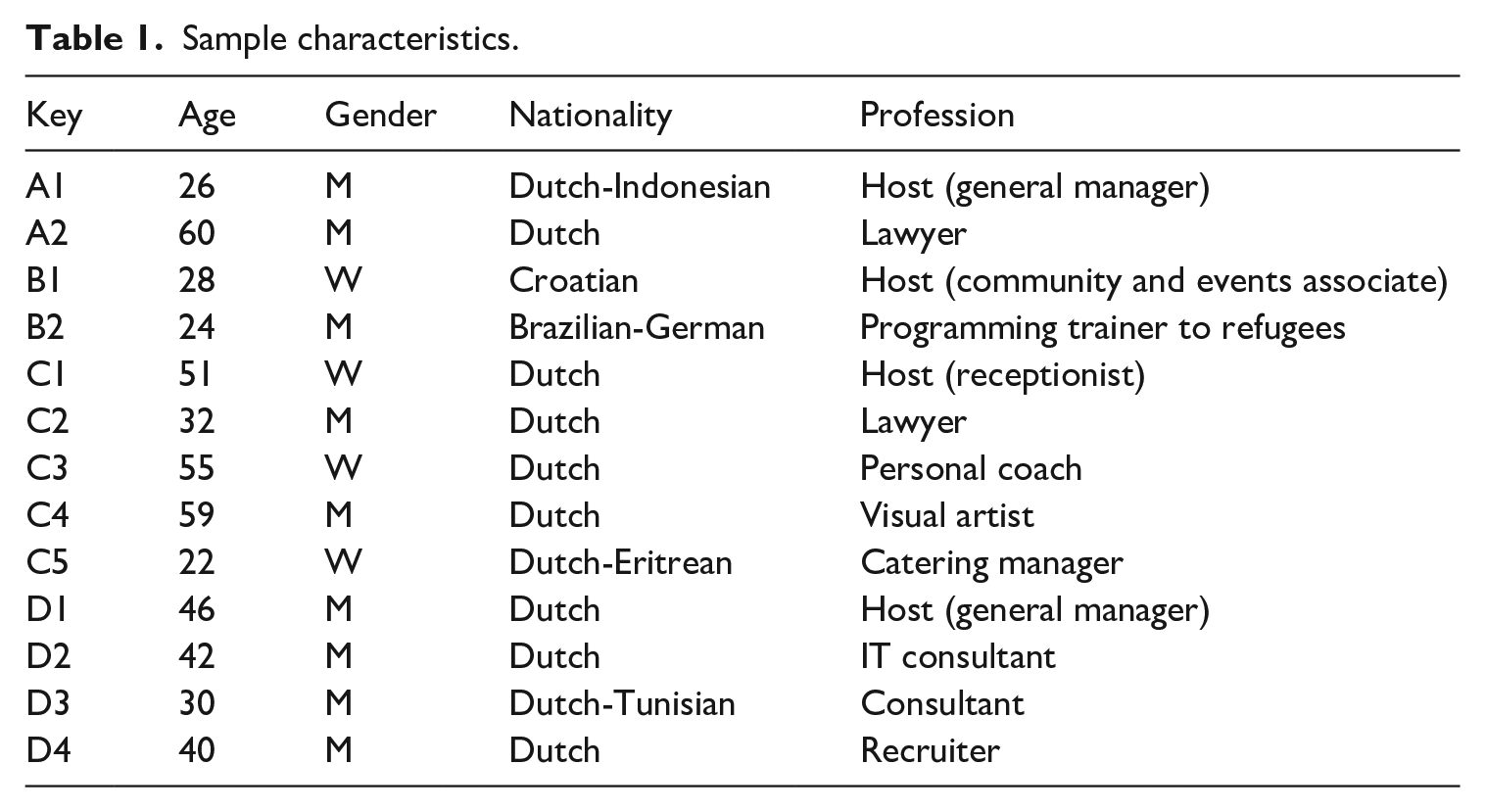
Depending on the respondents’ preferences, the interviews were conducted either in Dutch or English. Interviews took place on-site, lasted between 30 and 60 minutes and were recorded. They were transcribed verbatim and translated into English if necessary. To ensure anonymity, we labelled the respondents using a combination of a letter indicating the coworking space (A through D) and a number indicating the individual (hosts are assigned the label ‘1’, while subsequent numbers are assigned to the members). Table 1 provides an overview of the sample.
Sample characteristics.
Data gathered at the Coworking Europe conference
The Coworking Europe conference is an annual major event that brings together key international players in the coworking movement and industry, including activists, investors, founders and hosts of coworking spaces. During the four days the conference lasted, we attended panels, keynote lectures and workshops, and engaged in informal conversations with founders and hosts of coworking spaces. For example, we participated in a workshop on the business potential of diversity and inclusion in coworking spaces and spoke to founders of coworking spaces regarding their efforts to make diverse members feel included. Throughout the entire conference, we took fieldnotes and photographs, and recorded and transcribed parts of lectures and workshops. We also sampled content from the conference programme. We used this extensive data to better understand what contemporary coworking is and should be, and specifically the significance of issues related to inequality in this field.
Data analysis
The data analysis followed the suggestions by Gioia et al. (2013) and involved three steps that were conducted and discussed iteratively in the team of authors. First, employing a broader view on equality, diversity and inclusion, we open-coded the interviews, keeping close to the respondents’ own language. We then critically assessed the coding in order to limit misinterpretations and calibrate for the next coding rounds. A few rounds of coding followed, until a list of first-order concepts represented the empirical material in a satisfactory manner.
Next, we categorised the first-order concepts into more abstract themes and repeatedly revised these emerging themes. During this analytic step, we reconfigured the coherence within themes and interpreted the relationships between themes, while engaging with the relevant literature. As a result of these discussions, themes emerged that we felt were closely related to Acker’s conceptualisation of inequality regimes (Acker, 2006). For example, we noted several clusters of codes indicating how inequalities within coworking spaces were produced or legitimised. What followed were several loops of recoding and aggregating our material through the lens of inequality regimes. Revisiting the data in that way, we distilled nine second-order themes.
In the third and final step, adhering to claims regarding the iterative consideration of relevant literature and themes emerging from interview data (Locke et al., 2022), we ‘asked of our data’ (Sharma and Bansal, 2020) how inequality regimes emerge and operate in coworking spaces. We paid attention to each of the components Acker has identified as underpinning inequality regimes and examined if and how these manifested in the coworking spaces. Resulting from this analytic phase, we identified three aggregate dimensions synthesising the functioning of inequality regimes in the context of coworking spaces (Figure 1).
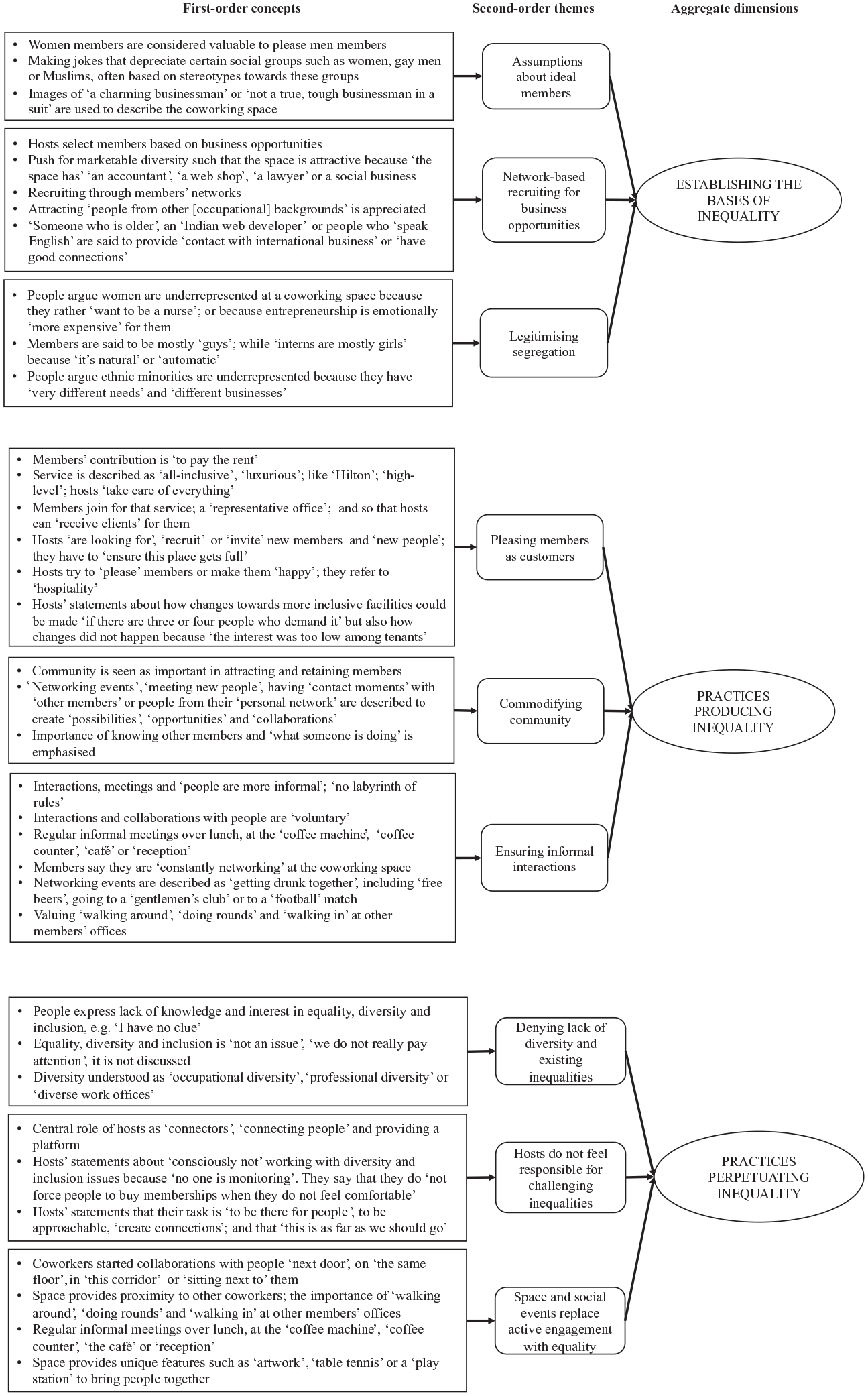
Data structure.
Findings
In the following, we present our findings along the three identified dimensions: establishing the bases of inequality; practices producing inequality; and practices perpetuating inequality.
Establishing the bases of inequality
The first dimension pertains to the underlying processes and assumptions concerning membership in coworking spaces. The inclusion or exclusion of individuals, determining who becomes a member (or what kind of member) and who does not, is crucial for the constitution of inequality. We identified gender, ethnicity/race, religion, disability status and class/socio-economic background as the primary bases of inequality. Three themes explain how these bases of inequality are established: assumptions about ideal members; network-based recruiting for business opportunities; and legitimising segregation.
The theme assumptions about ideal members mirrors Acker’s (2006) description of images of the ‘ideal worker’ that determine who becomes part of the organisation. In our data, these assumptions about what makes ideal versus less acceptable members were noticeable in the way respondents talked about other members and non-members. For example, several respondents made offensive jokes during the interviews, drawing on stereotypes of women, gay men and Muslims, addressing some individuals directly as less ideal members. One host described how the gender-neutral bathrooms that had to be introduced following instructions from their US headquarters were ridiculed: The sign in our toilets literally says: ‘choose the toilet you feel most comfortable with’. And when you first read that sign – people are making so many jokes here. We were like ‘shit, but we have to do it’. Because [Headquarters] tracks every room, and they expect, when they come, that the sign is there. (B1)
Parallel to Acker (2006), who explains how women can be seen as ideal workers too, but for different functions (e.g. in the back office) or reasons (e.g. because they dutifully accept orders), our data revealed assumptions on the functionality of certain social identity groups as ideal members. For example, one host explained how he regretted not having more women members, as these could make the space more enjoyable for men: Too few women. I think I have one, two. [. . .] Coincidentally, next week some people will sign up, two ladies will join. Let’s count them too, that makes five. So five independent female entrepreneurs of – pfff – everything together 100 companies. [. . .] I mean, the ladies who are about to sign [as new members] – they will bring new life, but it is also men’s nature that they always enjoy having females around. That is funny. In my opinion it should be more [women], but it is very difficult [to get them to sign up]. Very strange. (D1)
The second theme, network-based recruiting for business opportunities, is reflective of Acker’s (2006) proposition that hiring through social networks confirms existing bases of inequality in organisations as networks tend to be rather homogenous (e.g. if men recruit more men through their networks; see also Holgersson, 2013). This theme illuminates how new members were recruited through members’ networks and how the coworking spaces’ and their members’ business goals determined the selection of new members by prioritising professional diversity. One host helped us to understand why professional diversity (rather than other diversity dimensions) was so central to all respondents. She stressed its importance for the functioning of the coworking space, and pointed out how this influences the selection of new members: Regarding tenants, they need to be promising partners. For instance, a lawyer is important since Company 1 and Company 5 are dealing with companies that went bankrupt. [. . .] But not something like a book store that wants to publish. So, selectively we look for who is eligible to come into this building. (C1)
The theme legitimising segregation comprises statements to justify the under-representation of women and other minorities in coworking spaces. Many respondents described coworking spaces as dominated by men members, while women were typically associated with the role of hosts or interns. Further, when asked about the small share of women, respondents mentioned that women, unlike men, are not interested in entrepreneurship – a stereotype that has been disproved (e.g. Kanze et al., 2018; Yang and Aldrich, 2014). Further, respondents attributed ‘different’ business needs to ‘Moroccan or Turkish guys’ (D1) when explaining why members of the largest ethnic minorities in the Netherlands (Statistics Netherlands, 2022) are hardly found in the respective coworking space. It was typically gender- and race-based othering that was used to legitimise the segregation of majority members from minority non-members. However, in some cases, class-based perspectives, with regards to education and occupation, were used to legitimise the presence of racialised minorities: [T]hat really made us so proud with all the Syrian refugees [who joined B]. We were like ‘fuck that, we love having them!’. Like, you know [. . .] They are very young people and they – some of them are really well-educated people who just had to leave because of the shit that is going on there. But they are enjoying, they are going out, they have jobs that look good, you know, it is awesome. (B1)
Particularly revealing in this quote is the expression ‘fuck that’, combined with an explanation that these members were not ‘regular’ refugees, but highly educated ones – implying that some standard (with regards to race-based segregation) was actively rejected for the sake of class-based inclusion.
Practices producing inequality
The second dimension reveals how inequality between people working at coworking spaces is created. We identified the following three practices: pleasing members as customers; commodifying community; and ensuring informal interactions.
Pleasing members as customers shows the exchange between coworking spaces’ services and members’ payments, as well as the implication of this exchange for inequality. Most coworking spaces have a business model in which member fees cover the costs of business. A higher membership fee gives members access to additional amenities and a higher level of services, while hosts sometimes gain bonuses for signing up new members or getting members to upgrade their membership. This means that the coworking-specific hierarchy is one in which hosts depend on their members, and in which members who can afford to pay more tend to get more in terms of amenities and business opportunities, producing inequalities among members with higher versus lower financial leverage (see also Sargent et al., 2021). Hosts were aware that their service was the main driver for people to join and stay with the respective coworking space: Because it is like a Hilton for coworking spaces, they come and everything is set up for them. Like, they have our service whenever they want, from 8:30 till 6 p.m. we are here. They have food, they have coffee, they have showers, they have massage rooms, a nursing room, a meditation and praying room. Everything you want. If you want an event we can help you, we have meeting rooms whenever you want. (B1)
Most interviewed members appreciated the service and facilities and emphasised how the space helped impress their clients, and pointed to the increased visibility they enjoy because of their membership.
Despite the hosts’ dependency on members’ payments and, thus, satisfaction, we noticed a tendency among hosts to only act on individual needs if requested by several members. This also pertained to issues of special needs or religious practice. One host explained how the accommodation of his members’ individual needs is related to business considerations: We really try to fulfil as many needs as possible. I mean, there is no room for prayer, but we could create one. No problem. I have respect for that. So yes, but to immediately start creating that, since it would not be of importance yet, since the numbers do not require it – if there are three or four people, then a room will be created. [. . .] So we are looking for opportunities. So then there is an added value, being able to provide even more service, so you can extend your target audience even further. (D1)
This quote exemplifies that members are seen as paying customers who should be pleased, but that individual customer needs are only considered if they help to make the space more attractive to more paying members.
The second theme, commodifying community, illuminates how the community of the coworking space is expected to attract new members and retain existing ones, thereby creating inequality among members. The central goal of fostering and maintaining this community is to create business opportunities for members (and, ultimately, for the coworking space itself). One member explained how he promotes his business to others in the coworking space: You are constantly explaining everyday – especially in the beginning. What do you do? [. . .] I also experience it as an advantage. [D] has hosted an event during new year, in the beginning of January, and I was allowed to show my products to all these guys from [D]. (D3)
Accordingly, the community was described as a platform to present one’s work, so that new collaborations may emerge. In the interest of these commercial purposes, the community (i.e. composition of members, how they interact and the opportunities they provide for others) is commodified, while the interests by commercially aware members with attractive businesses and strong networks tend to be prioritised within the community.
The view of a coworking space’s community as a commodity also emerged when we attended the Coworking Europe conference, which many companies used to sell products that would help managers of coworking spaces promote interactions within their communities (e.g. digital announcement boards and planning tools for social events). Further, the invited speakers in a session in the programme titled ‘The Business Case for Diversity, Inclusion, and Accessibility’ discussed how coworking spaces could benefit economically from making their spaces more diverse. This commercial appropriation of difference (cf. Swan, 2010) not only suggests that the organisers assumed an unpolitical and instrumental view on diversity by their target audience, but it also promotes the idea of superficial changes towards diversity (e.g. tokenism), while inequalities can flourish unobstructed.
The third theme, ensuring informal interactions, points to respondents’ insistence on the absence of rules as these would be perceived of as obstructing members’ flexibility and freedom. Members and hosts alike enjoy the absence of rules. Respondents described how there are no fixed meetings or formal interactions, and that conversations happen spontaneously at the coffee machine, in the hallway or at informal social events. However, the appeal of freedom and the explicit appreciation for just letting social patterns develop on their own gives further space to the emergence of informal hierarchies. For instance, while respondents mentioned the importance of (informal) networking at the coworking space, they described respective occasions as ‘getting drunk together’ (B2) or ‘watching football’ (C2), without demonstrating awareness about the biased nature of such activities, and how this might exclude women, religious and ethnic minorities and produce inequalities within the coworking space (Mickey, 2022; Ortlieb and Sieben, 2019).
Practices perpetuating inequality
The third dimension entails organisational practices that ensure compliance with inequality regimes in the context of coworking spaces and hinder change: denying lack of diversity and existing inequalities; hosts do not feel responsible for challenging inequalities; and space and social events replace active engagement with equality.
The theme denying lack of diversity and existing inequalities reveals how respondents expressed a lack of interest or avoidance of topics related to equality, diversity and inclusion altogether. Instead, when asked about these topics, they often referred to professional diversity (in line with their assumptions about appropriate members). Others seemed to be thinking about potential inequality at their workplace for the first time during the interview: ‘It is particularly male, I notice since you asked’ (D4). This particular quote also shows how the obvious lack of diversity and ignorance towards existing inequalities are believed to be unproblematic. Acker (2006) calls such mechanisms internalised and invisible controls, which hinder change towards more equal workplaces.
Similarly, the second theme, hosts do not feel responsible for challenging inequalities, comprises statements in which hosts make clear that issues related to equality, diversity and inclusion are not on their agenda. In the following quote, a host explains how they want to be open for everyone, while comfortably referring to self-selection: I think it depends on what people want themselves. People choose to work within this space, they choose the concept. So people make their own choice whether they come here or not. [. . .] I do not know if I want to introduce this [inclusion], I just want to offer a platform with the help of events and my team, who are open towards everyone. And also to create connections, and I think this is as far as we should go. (A1)
Other hosts seemed overwhelmed by the idea of addressing equality, diversity and inclusion, and described how they have decided to focus on other business aspects instead, given a lack of monitoring: There are some audit forms of which I sometimes think ‘oh yes, I need to do that’. But I am not working with it, [there is] no one who is monitoring. So we are working with that [equality, diversity and inclusion] as a company, that we watch over it. But I do not think about it. It sounds stupid but – no. [. . .] People are not aware of it. It is a waste of time – it is not . . . [T]he awareness among people is just not there. It is not my business. (D1)
As a consequence, nobody feels responsible or can be made accountable for inequalities. When asked about their actions to promote equality, diversity and inclusion at their coworking spaces, hosts explained that they ‘try to avoid speaking to the same people all the time’ (A1); that they ‘created a WhatsApp group [. . .] so everyone is being involved’ (C1); or simply said that nothing was done (D1). One exception was mentioned, which in fact highlights the lack of a formal policy: The only thing that we did something was like one guy at least – he was a student and he was in a wheelchair. So then we decided to make a special box with snacks for him, because in the kitchen he had to reach too high. (B1)
The implicit message in this statement is that a ‘special box’ is sufficient, while access to the kitchen (like everyone else has) is just not possible. Many coworking spaces may lack resources to make their entire space wheelchair accessible. But what is of interest here is that the host does not perceive this solution as suboptimal. Instead of expressing a desire for a kitchen accessible to wheelchair users, he presented this as an example of inclusion. This normalises a situation in which all a wheelchair user gets is a ‘special box’, thereby enhancing power asymmetries between individuals with impairments and those without (Van Laer et al., 2022). As hosts do not recognise the exclusionary effects of such practices, they contribute to internalised and invisible control.
The final theme of this dimension, space and social events replace active engagement with equality, shows how the physical space, and the social events that are organised in it, are supposed to make people feel included. This refers to a somewhat naïve belief that if coworking spaces feel welcoming and have the ‘right’ facilities and a programme of social events, there is no need for formal policies promoting equality. For example, hosts and members often highlighted how the unique features of coworking spaces facilitated interactions: So, how we interact is just – we stumble across each other and ask about how we are doing, basically. Well, there is the coffee machine, there is a game room. You know, sometimes you text people to ask for ping-pong. Then you find out some more about them, what they do, and then you try to see the connection. (B2)
However, relying on such spatial affordances (in combination with the aforementioned informality) bears the risk of increased homogeneity in established connections (Baron et al., 2007).
The Coworking Europe conference provided additional insight into how the physical space and social events replace active engagement with equality. A founder of a coworking space and regular attendee revealed that the organisers of panels and workshops focused on equality, diversity and inclusion continuously have to fight for spots in the official conference programme. She explained that the conference organisers constantly suggest discussing these issues informally during breaks, while she and other panel organisers think it is very important to have them included as an official part of the programme.
Discussion
This study started with an interest in workplace equality in the supposedly egalitarian and emancipatory context of coworking spaces as these largely function without the traditional hierarchies and managerial control systems that typically produce and perpetuate inequality in established organisations (Acker, 2006; Howell, 2022). The findings show that the promise of an egalitarian community in the young sector of coworking spaces is far from fulfilled, as bases of inequality are established and inequalities are being generated and maintained. While the findings largely resonate with Acker’s (2006) conceptualisation of inequality regimes, they also demonstrate the context-specificity of its components and the regimes’ functioning (Healy et al., 2019; Sargent et al., 2021). In the following we explain how our study contributes to an update of the inequality regimes framework in the context of coworking spaces.
Despite the propagated claim that coworking spaces would be ‘for everyone’, certain individuals are not heard, or excluded from the community altogether, without any indication of visible resistance to or contestation of this predicament. Because the community itself has to be marketable and profitable as well, more versus less valuable members are constructed based on their membership level (and payments) or attractiveness to new members. This study helps to understand that this largely uncontested marginalisation is possible because of biased assumptions regarding ‘ideal members’ in the alleged inclusive community. Since many coworking spaces target entrepreneurs and early-stage businesses as their clientele, the images of masculinity, whiteness, middle-class professions and knowledge-based roles that are still associated with entrepreneurship (Berglund et al., 2017; Howell, 2022) fuel assumptions regarding suitable members and influence recruitment endeavours, thereby establishing the coworking-specific ‘ideal members’ and bases of inequality.
However, by systematically excluding certain individuals from the space altogether, inequalities remain largely invisible. At the same time, existing segregation and inequalities are legitimised, for instance by actors’ stereotypes or business reasons. Against the backdrop of largely invisible and legitimate inequalities in coworking spaces, equality is pushed to the margins of actors’ interest, and possibilities for change are hampered (Acker, 2006). In line with earlier research (Cohen et al., 2023; Tatli and Özbilgin, 2012), this also demonstrates the central and contextually expansive role of invisibility and legitimacy in creating and maintaining inequalities. The denial of existing inequalities and the lacking sense of responsibility for equality, diversity and inclusion are largely reflective of internalised, invisible forms of control that Acker (2006) describes as the belief that this is how things naturally are and ‘that there is no point in challenging the fundamental gender, race, and class nature of things’ (p. 454).
Given that individuals in coworking spaces pay to work there, one might assume that they have more power than their counterparts in traditional organisations, and that this may also benefit people from historically marginalised groups (Howell, 2022). Indeed, our study findings show that because members are paying customers, their needs determine ‘the rules of the game’. However, needs have to be expressed by a critical mass to be marketable and profitable for the space, facilitating a system that is ruled by the majority and that is less interested in individual concerns and needs. For example, the insistence on informal interactions echoes insights from earlier studies (Blagoev et al., 2019; Gerdenitsch et al., 2016; Grazian, 2020) that showed how social interactions rather than formal rules or responsibilities pattern work in coworking spaces. While the appeal of freedom might be explained by the coworking field’s glorification of entrepreneurship and creativity in the face of eroding social securities and precarisation (Loacker, 2013; McRobbie, 2015; Sutherland et al., 2020), the resulting informality may allow similarity to shape people’s willingness to interact with one another, creating additional hurdles for ‘dissimilar’ coworkers (Baron et al., 2007; Byrne, 1971). As part of this majority’s preference for informality, the space itself and social events are used to replace active equality efforts. This focus on the physical space and social patterns is specific to coworking spaces (Blagoev et al., 2019); however, we argue that this focus is also a context-specific form of control as it affords how people can project themselves into the space and envision how they fit in with the dominant majority.
While our findings speak to earlier research on egalitarian organisations (e.g. Gill, 2002; Sobering, 2016) – showing that organisations with concrete aims of fostering equality can still end up (re)producing inequality – they also differ from that research in that joining a coworking space is a consumer choice. Therefore, the lack of policies promoting equality might be questioned less by those who do decide to join. Instead, what most members seem to expect from a coworking space are business opportunities and network ties so that diversity is reduced to aspects that serve these goals (e.g. professional diversity). However, harnessing diversity for members’ business goals is problematic. First, such networks are often characterised by (partly concealed or implicit) competition between members (Gandini, 2015), which might contribute to biases and stereotypes towards ‘dissimilar’ coworkers or restrain them from joining a coworking space altogether. Moreover, the emphasis on professional diversity is partly employed as a justification for hosts and members not to actively incorporate other dimensions in their concept of diversity or include a truly diverse member base.
To sum up, our study demonstrates the various ways by which inequalities in coworking spaces are created and reproduced. By specifying the bases of inequality and concrete practices that produce and perpetuate inequality, we provide a nuanced empirical picture of inequality regimes in this setting. Furthermore, studying inequality regimes in this context enables us to make a theoretical contribution to the literature on inequality regimes. In doing so, we adhere to the logic proposed by Whetten (1989), who suggested that we gain insights into explanatory factors when it turns out that a theory works in a new setting, even when this was not expected. Specifically, we maintain that organisations’ business logic and economic pressures perceived by managers and workers act as drivers for continuing inequality regimes.
We had expected that the inequality regimes framework would not be applicable in the new setting of contemporary coworking spaces as Acker (e.g. 2006) established the framework based on her studies and observations in traditional business organisations. While some of the cases she studied were characterised by flat hierarchies and egalitarian values too, there are certain practices, such as wage setting and formal performance evaluation, that are driving the production of inequality in Acker’s framework, but that are absent in coworking spaces. Conversely, given the promoted philosophy of coworking spaces and as highlighted by Sargent et al. (2021), we assumed that less inequality would prevail in coworking spaces and that there are certain practices that may prevent inequalities from being produced and perpetuated. However, we find severe inequalities and powerful new practices behind them that are specific to the coworking context and are driven by a commercial mindset, such as the commodification of the community and pleasing organisational members as customers. The role of commodification of workers and the connections they build at work was, to our best knowledge, overlooked in earlier theorising on inequality regimes. For example, Acker’s work was more focused on hegemonic masculinity and the privileges of dominant groups in organisations. Yet, we propose that the business logic plays a key role in establishing and maintaining inequality regimes – and this applies not only to coworking spaces, where workers pay membership fees, but it will apply to all types of business organisations because they also aim to attract and retain the most suitable individuals for the organisation (Ortlieb and Sieben, 2013; Priola et al., 2018), and trends towards the commercialisation of workplaces can be observed in all sectors of the economy (Yu et al., 2022). Therefore, we suggest that in future research, more attention should be paid to how organisations benefit from inequalities economically.
It should be noted that like other critical research on inequality, this study repeated identity categories, thereby potentially reproducing existing hierarchies. Future research should delve deeper into the meanings of specific identity axes and their intersections in coworking spaces. Such an intersectional perspective seems particularly promising given the very recent rise of women-only or feminist coworking spaces, which still have challenges when it comes to including People of Colour and people from working-class backgrounds (Poussier, 2020). Moreover, this study is contextualised in the Netherlands, where equality efforts have been criticised to be insufficient despite oftentimes well-meaning intentions (e.g. Bleijenbergh et al., 2014). Coworking spaces in other countries should be studied to better understand macro-level boundary-conditions such as country-level variance regarding salience and meaning of certain diversity dimensions and how that might shape the establishment of bases of inequality in coworking spaces.
This study also suggests several practical implications. Firstly, if coworking space hosts aim to uphold their proclaimed ideals of community and sharing, they must put equality, diversity and inclusion on their agendas. To that end, they must first develop awareness to recognise the sometimes invisible inequality and question the problematic consequences of stereotypes regarding minorities and ‘ideal members’ for legitimising and perpetuating inequality. To integrate ‘dissimilar’ members into their predominantly homogenous communities, hosts should diversify their marketing activities, appreciate the unique perspectives of diverse members and actively work towards breaking stereotypes attached to entrepreneurship and new forms of work organisation (Drazic and Schermuly, 2024). Secondly, members and prospective candidates should make equality a central concern by talking and asking about it and pushing hosts to prioritise it – in everyone’s interest of business success but, more importantly, as a moral imperative stemming from the community philosophy underlying the coworking movement (Garrett et al., 2017; Merkel, 2015). Thirdly, investors in coworking spaces, once educated about inequality issues (Kanze et al., 2018), should hold hosts accountable and request regular updates on member demographics, policies and practices that promote equality, as well as members’ perceptions in this regard. Finally, since many coworking spaces receive public funding and support, political decision-makers need to sharpen their radar for these organisational forms. Informed political actors can contribute to raising awareness within society and advocate for more equitable coworking models.
Conclusion
This study illuminated inequality in coworking spaces. Despite the egalitarian discourse that proponents of these work environments put forward, there exist specific inequality regimes – rather than new approaches towards equality, diversity and inclusion. These inequality regimes can be explained, in part, by key actors’ assumptions and distinct organisational practices. The more nuanced understanding of these factors that this study provides can contribute to a more egalitarian design of work, not only within coworking spaces but also in other emerging organisational forms.
Footnotes
Acknowledgements
We extend our sincere gratitude to Editor Joana Vassilopoulou and the three anonymous reviewers whose invaluable feedback greatly contributed to the refinement of this article. Our appreciation also goes to the organisers, discussants, and participants of the Annual Meeting of the Academy of Management 2019, as well as the 2nd International Symposium of the Research Group on Collaborative Spaces for their constructive comments. Special thanks are due to Bram van Bindsbergen for his assistance in this research.
Funding
The authors disclosed receipt of the following financial support for the research, authorship, and/or publication of this article: This work was partly supported by the Dutch Research Council (NWO) [grant number 407-12-008].
