




Abstract
School principals and teachers are expected to continuously innovate their practices in changing school environments. These innovation processes can be shared more widely through collaboration between principals and teachers, i.e. collaborative innovation. In order to gain more insight into how school principals enact their leadership practices in leading collaborative innovation, we interviewed 22 school principals of primary, secondary and vocational education in the Netherlands. All participants have implemented the same collaborative innovation programme, aimed at enhancement of collaboration between teachers and school principals within schools, that has already been implemented by 900 Dutch schools. They were interviewed twice during the implementation year. Interview transcripts were analysed using an open coding strategy looking for leadership practices. Based on 11 leadership practices, we described two main leadership patterns: school principals enacting leadership practices as either a team player or as a facilitator. We conclude that our findings suggest a wider repertoire of leadership practices than is reported in previous studies. Future studies would need to address the generalisability of the practices and patterns as found in this specific context of collaborative innovation.
Keywords
Introduction
Schools operate in demanding and rapidly changing environments. Therefore, school principals and teachers are expected to continuously innovate their school practices to maintain their educational quality (Serdyukov, 2017). In his theoretical work, Fullan (2016) argues that shared responsibility is essential for innovations to succeed. This sharing of responsibility in turn requires work on innovations to be collaborative (Fullan, 2007, 2016; Hill et al., 2014), an approach that has been described as collaborative innovation in recent organisational literature (Bekkers and Noordegraaf, 2016; Sørensen and Torfing, 2016). In this article, we study primary, secondary and vocational education schools in the Netherlands that have all implemented the same large-scale collaborative innovation programme which is aimed at stimulating collaboration between school principals and teachers. These programmes’ innovation processes focus directly on enhancing collaboration and shared responsibility that indirectly may lead to both improved approaches to ‘classroom-based teaching, learning and assessment, as well as changes in the school organisation’(definition of OECD in Looney, 2009: 5).
School principals have a vital role in creating suitable conditions for innovation processes and in leading these processes (Bush and Glover, 2014; Fullan, 2007, 2016; Hallinger and Heck, 2010). However, school principals often struggle with their role in innovation and collaborative school processes (Drago-Severson, 2012; Wildy and Louden, 2000). On the one hand, they are expected to collaborate with teachers and be democratic and participative (Wildy and Louden, 2000). On the other, they have to decide and direct, and assume overall responsibility for their school’s educational quality and the establishment of essential innovation conditions (Fullan, 2016; Wildy and Louden, 2000). This article aims to explore Dutch school principals’ leadership practices in leading collaborative innovation. We study their leadership practices during the first year schools work with the collaborative innovation programme, as this year entails the implementation phase. This intensive implementation year provides an interesting opportunity to study how school principals enact leadership practices when challenged with searching for how they should (re)form and enact their leadership in collaborative innovation.
Theoretical framework
Collaborative innovation in schools
The concept of collaborative innovation is mainly used in the public sector context (Bekkers and Noordegraaf, 2016; Sørensen and Torfing, 2016). It is characterised by a multi-actor approach to innovation, both vertical and horizontal, wherein resources, knowledge and ideas are exchanged, resulting in mutual development (Owen et al., 2008; Torfing, 2019). Vertical processes involve collaboration that cuts across different organisational levels, functions and hierarchies (Torfing, 2016), which in schools would be between teachers and school principals. Horizontal processes imply collaboration between persons and organisations at the same level, which in schools would be between teachers.
Collaborative innovation is argued to strengthen and improve all different phases of an innovation process, namely the phases of problem definition, idea generation, idea selection, implementation and diffusion (Sørensen and Torfing, 2016; Torfing and Triantafillou, 2016; Van de Ven et al., 1999). However, collaboration is not easily fostered in the educational context, since schools are loosely coupled systems (Orton and Weick, 1990): it is common for teachers to mainly focus on their own classroom (practice) and tasks, resulting in their work activities being largely autonomous and isolated (Admiraal et al., 2012). Consequently, innovation in schools is often seen as an isolated activity of one teacher or a minority of teachers who decide to initiate change (Sales et al., 2016). This hinders innovation, since we know that teachers in schools with collaborative structures and cultures tend to learn more from each other as compared to schools without collaboration (Drago-Severson, 2012).
Leadership and leadership practices in collaborative innovation
In both organisational and educational theories, leaders are thought to have a vital role in leading innovation processes (Bush and Glover, 2014; Fullan, 2016; Torfing, 2019). A recent review of 20 years of effective school leadership literature has demonstrated the importance of active support for instruction and effective communication, as well as the positive influence of school principals’ leadership on building organisational climate and culture, trust and collaboration (Daniels et al., 2019).
In the context of collaborative innovation, Torfing (2016) for instance theoretically studied leadership. He identified three types of leaders who can stimulate collaborative innovation in the public sector: conveners (e.g. spur interaction), facilitators (e.g. promoting collaboration) and catalysts (e.g. prompting actors to think out of the box). Sørensen and Torfing (2016) and Torfing (2019) acknowledge the guiding role of leaders in collaborative innovation and call for further research on leadership in collaborative innovation (Torfing, 2019).
In order to gain more insights into leadership of school principals in collaborative innovation, we use the concept of leadership practices. Leadership practices of school principals can be defined as the actions that shape their leadership (Chreim, 2014). A significant discussion in studying leadership is which theoretical framework helps to understand leadership practices. Several researchers (Aas and Brandmo, 2016; Daniels et al., 2019; Leithwood et al., 2020) argued that leadership practices should be studied from an integrative perspective, combining theories such as those of instructional, distributed and transformational leadership, instead of studying solely one fixed leadership theory. For instance, Alqahtani et al. (2020) and Noman et al. (2018) chose the integrative perspective of leadership practices and explored the leadership practices of school principals in Saudi Arabia and Malaysia respectively. In addition to this focus on leadership practices, Leithwood et al.’s (2020) review showed that there is little understanding of how school principals enact leadership practices, and they call for further exploration of how school principals enact certain practices.
Previous research has established well-known categorisations of leadership practices. The first categorisation entails top-down and bottom-up leadership practices. Top-down refers to a leadership practice characterised by a high degree of control, resulting in the restriction of teachers’ views. Bottom-up refers to a practice based on cooperative interactions and efforts to include various views (Draaisma et al., 2018; Fullan, 2016). The second long-standing categorisation is task- and relation-oriented leadership practices (Lee and Carpenter, 2018; Leithwood, 1994). The task practices emphasise the achievement of organisational goals, by organising and directing others’ work. The relation practices emphasise positive interpersonal interactions by showing warmth, help and giving the appearance of trust and open communication (Lee and Carpenter, 2018). The third categorisation is based on a study by Leithwood et al. (2020) in which they indicate four core categories of leadership practices in relation to student achievement, namely: setting direction, developing people, redesigning the organisation and managing the instructional programme.
In the current article, we empirically explore leadership practices of school principals, with the aim of providing insights into leadership in collaborative innovation within schools. We inductively investigate which leadership practices are enacted by school principals in collaborative innovation and how school principals enact these practices. We focus on the vertical processes, as school principals are argued to have a vital role in leading innovation (e.g. Fullan, 2016). Our study is guided by the following research question: ‘How do school principals enact leadership practices in leading collaborative innovation?’ Based on previous literature, to which we compare our findings in the discussion section, we expect to encounter the well-known categorisations of leadership practices mentioned in the previous paragraph.
Methods
The research described in this article has an exploratory and qualitative research design. Data were gathered by interviewing school principals about their leadership practices during collaborative innovation. The research described here is the first study of a larger research project on the effects of a Dutch school programme, which is further explained under the heading ‘Sample’. We will proceed with studying the relation between leadership practices and outcome measures such as distributed leadership, teachers’ teaching skills and student achievement in follow-up studies.
The Dutch context
We explain two characteristics of the Dutch educational system that may reinforce school principals’ struggles in leading collaborative innovation: school autonomy and educational sectors.
School autonomy
Dutch schools operate in a highly autonomous and responsible policy context (OECD, 2014), which has consequences for the role of school principals. Schools are free to pursue educational visions of their choice (Waslander, 2010), and everyone has the right to establish a school (Hooge, 2017). Schools can have their own school board or be part of a larger association of schools that share a board. School boards in turn mandate school principals to take responsibility for their school’s quality. Due to this highly decentralised form of governance, school principals have a range of responsibilities, including for financial matters and for ensuring that teaching and learning follow the school’s educational goals as well as a national framework developed by the government (De Wolf et al., 2017). The Inspectorate of Education, under the responsibility of the Minister of Education, monitors both the quality of education and compliance with statutory and financial rules and regulations (De Wolf et al., 2017).
Educational sectors
The Dutch educational system consists of four educational sectors: primary (students aged 4 to 12), secondary (students aged 12 to 18), and vocational and higher education (students aged 16 and older) schools. Secondary schools are divided into streams, and primary schools recommend a specific stream to each final-year student. Students can choose any secondary school that offers their recommended stream, which provokes competition among schools for student numbers and corresponding school funds. This further increases school principals’ responsibilities since they are responsible for attracting new students. In this article, we studied school principals in primary, secondary and vocational educational sectors.
Sample
School programme on collaboration
We studied leadership practices in the context of a programme that aims to stimulate collaborative innovation between teachers and school principals. The programme uses a methodology that is partly based on Agile principles, meaning a team-based approach to improving processes step by step. The methodology consists of weekly stand-up meetings, sprints and retrospectives, among other things (see Rigby et al., 2016), and consists of two phases. Firstly, an intensive implementation phase during one schoolyear. External advisers of the programme help schools to learn the methodology. The expected outcomes of this phase are enhancement of collaboration and shared responsibility. Secondly, there is a phase moving towards independence and sustainability of the collaborative innovation processes in schools. The period of this second phase is school-dependent. An independent foundation initiated the programme in response to the international study by the OECD (2016) which highlighted that the educational quality of Dutch schools is more than sufficient but could be further improved by enhancement of collaboration within schools. So far, approximately 900 Dutch primary, secondary and vocational education schools have implemented the methodology of this programme.
Participants
Each school year, around 120 new primary, secondary and vocational education schools choose to implement the methodology of this programme. We randomly selected schools that started working with the programme in September 2017 and 2018. The school principals received a short explanation about the investment required and the benefits of participating in the study. This resulted in 11 schools participating in our study in September 2017 and 11 schools in September 2018.
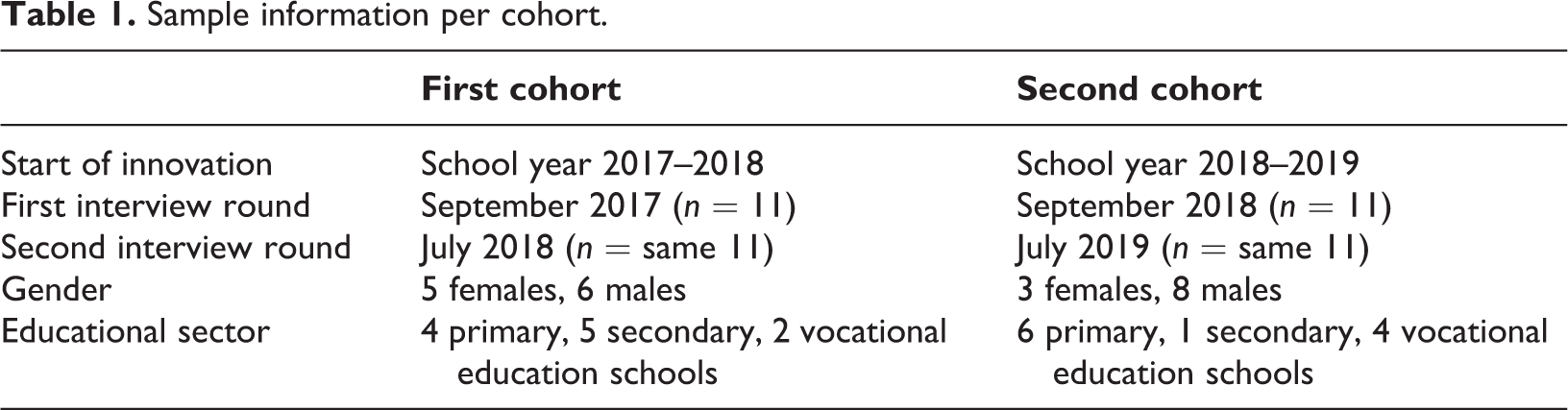
In Table 1, we provide an overview of our sample of 22 school principals. Two school principals of secondary schools and all vocational education school principals were responsible for a department in a larger school; the other school principals were responsible for the whole school. The schools were well spread throughout the Netherlands and were all in the implementation year (Sørensen and Torfing, 2016). In this year, schools learn how to apply and work with the methodology.
Sample information per cohort.
Data collection: Interviews
The first author conducted one-hour face-to-face interviews twice with every school principal, at the beginning and end of the implementation year (see Table 1) to study possible differences within the implementation year. We interviewed them twice to obtain a thorough understanding of the rationale of the leadership practices shown. Informed consent forms were signed before the interview started. The interview questions were developed as part of the larger research project, which aims to study context and intervention variables, including leadership practices, in relation to the effects of the programme. In order to explore leadership practices, in this study we used the following broad and open questions: ‘How do you see your role as a school principal, regarding the implementation of the programme and in general?’ ‘Who is responsible for leadership in this school?’ and ‘What is the responsibility of teachers regarding innovation and leadership?’ We asked the school principals to describe their practices in detail and to illustrate them with examples.
To decrease the researchers’ influence on the data collection (Varpio et al., 2017), interviews were audiotaped and transcripts were written during the interview by an assistant, and member checks were conducted by asking all school principals to check their transcript. This process led to negligible changes in the transcripts of five interviews.
Data analysis
Our analyses are inspired by the grounded theory approach (Glaser and Strauss, 1967; Thornberg et al., 2014), using constant comparative analysis by multiple rounds of coding and two cohorts of interview data. The two cohorts were treated as a split sample in the analyses (Watling and Lingard, 2012). In this way, we used the concept of saturation to reach a ‘good enough’ information power, following Varpio et al.’s (2017: 45) criticisms on the challenges ‘about whether theories, data or themes can ever be truly saturated’. Our data analysis involved three rounds that will be further explained below: open, axial and selective coding.
Open and axial coding to study leadership practices
The first author read all interviews for open coding, using N-Vivo Pro 12. To include the context of the answer, the unit of analysis was the whole interview question together with the answer of the school principal. Data were coded on whether the units were about leadership practices or not, based on Chreim’s (2014) definition of leadership practices. Interview units that were not about leadership practices were mainly covering themes like expectations of the innovation and school background information. The first and second author coded two not yet coded interviews and reached consensus with sufficient reliability (Cohen’s Kappa .64) on the main code leadership practices.
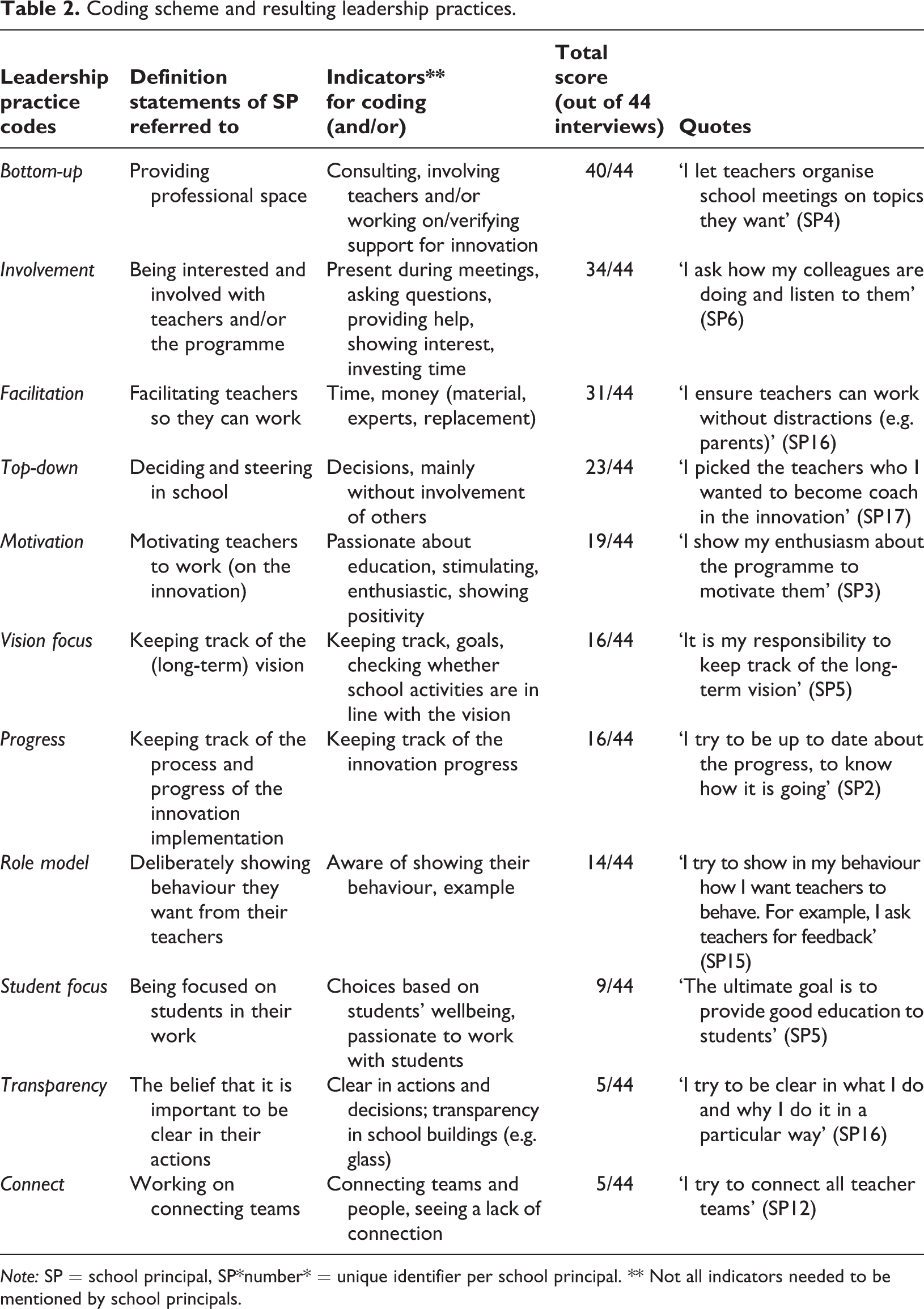
Then axial coding was applied (Corbin and Strauss, 2008) to inductively identify leadership practices, resulting in a coding scheme. Multiple codes could be scored on one unit. The first and second author had three rounds of peer debriefing and formulated indicators of each code. Afterwards, no new codes were needed to code the interviews. The reliability of this coding round was good (Cohen’s Kappa .81). Table 2 depicts the coding scheme.
Coding scheme and resulting leadership practices.
Note: SP = school principal, SP*number* = unique identifier per school principal. ** Not all indicators needed to be mentioned by school principals.
Selective coding to study the how of leadership practices
To explore how school principals enact their leadership practices, selective coding was entailed by rereading the leadership practices, found in the open and axial rounds of coding. By doing this, we aimed to identify meaningful differences between school principals’ leadership practices. The differences we found concerned school principals’ involvement in collaborative innovation processes in their schools.
Indicators that helped us to discover leadership practices of more involved school principals were words such as: ‘us’, ‘we’, ‘together’, ‘collectively’, ‘our process’ and verbs like: ‘being present’, ‘being up to date’, ‘asking questions’, ‘advising’, ‘listening’, ‘cooperating’, ‘thinking along’, ‘coaching’, ‘showing vulnerability’, ‘providing professional space’, indicating involvement in leadership practices. Less involved leadership practices were indicated by words such as: ‘teachers' process, ‘their process’, ‘they’, and verbs like: ‘hearing’, ‘steering’, ‘letting go’, ‘being at a distance’, ‘controlling’, ‘working commercially’, ‘focusing on management’. We also scored the explanations school principals gave about why they acted a certain way and whether they acted consciously.
We did not find substantial differences within the implementation year in school principals’ enactment of leadership practices. The preliminary findings of the first cohort were thus confirmed in the second cohort of data. The results are therefore assembled in one results section.
Results
School principals’ leadership practices
Based on the open and axial coding, we identified a repertoire of school principals’ leadership practices in collaborative innovation. Next to the bottom-up and top-down leadership practices that can be recognised directly, we identified nine other leadership practices. In Table 2, the 11 leadership practices are ordered from most to least often.
School principals’ leadership patterns
The selective coding resulted in the identification of two leadership patterns. The term leadership pattern was chosen because this term indicates a focus on behaviour and practices, and because it helps to maintain our integrative approach to studying leadership practices.
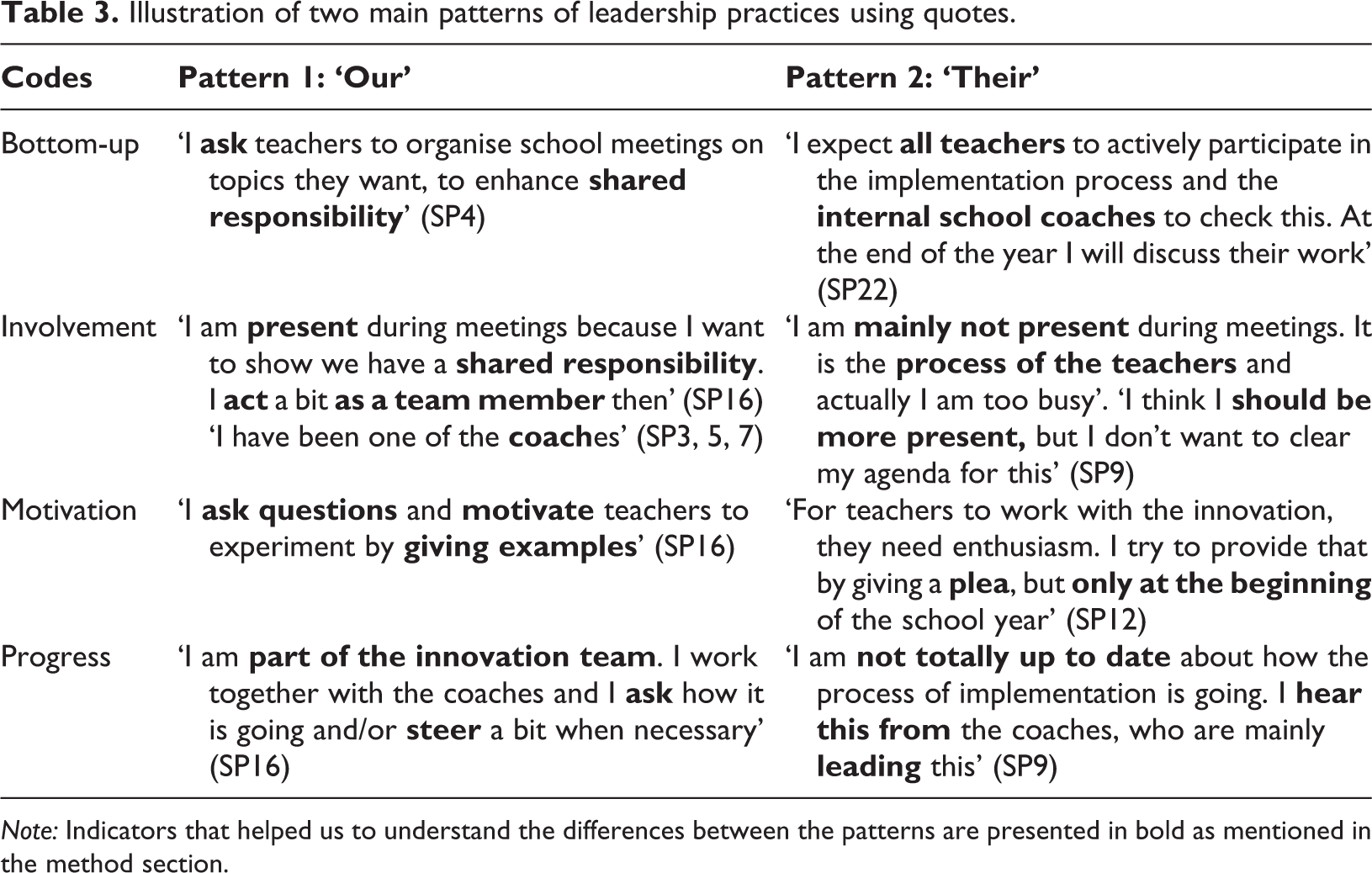
Table 3 illustrates the differences between the two patterns, based on four leadership practices. We found this distinction for 10 leadership practices. One of the 11 codes, Student focus, did not provide a distinctive or meaningful insight. All school principals mentioned being focused on students but did not further explain how they enacted their leadership regarding students. This code is therefore not included in the leadership patterns. We labelled the two leadership patterns ‘Our’ and ‘Their’ to indicate how school principals’ involvement in collaborative innovation varies.
Illustration of two main patterns of leadership practices using quotes.
Note: Indicators that helped us to understand the differences between the patterns are presented in bold as mentioned in the method section.
Leadership pattern ‘Our’
The first leadership pattern is characterised by school principals showing more involved leadership practices (see Table 3). These school principals are characterised by their willingness to share the responsibility for implementation. Furthermore, they are actively involved in meetings and stimulate teachers to take responsibility, so the processes become shared, with teachers able to determine their own share. Therefore, we labelled this as leadership pattern Our.
A notable finding regarding the ‘Our’ pattern was that 2 out of the 13 school principals differed from the other 11 in their leadership practices in one important aspect. These school principals stressed that innovation is ‘collaboratively owned’ by teachers and the school principal, which fitted with the ‘Our’ pattern. However, they also mentioned that they were doing all the work and were too deeply involved. These school principals evaluated their own practices as too involved but state that they aim to share the responsibility more in the future. As an illustration, one school principal said: Actually, I am involved too much. When I am not here, the programme meetings do not take place and that will be the end of the innovative processes in our school. I promised the teachers that I will pull them through…that is why I do this now. I do not feel like I can step back now. (SP6)
Description of main patterns and sub-pattern of leadership practices.

Leadership pattern ‘Their’
The second leadership pattern is characterised by school principals showing less involved leadership practices (see Table 3). These school principals identify teachers and internal school coaches (i.e. trained teachers) as responsible for the implementation of the methodology of the programme. Furthermore, they are more distant from the innovation process. Therefore, we labelled this as the leadership pattern Their. Because we found no clear sub-patterns within the ‘Their’ pattern, we refer to school principals with this leadership pattern as facilitators (see Table 4).
These facilitator school principals evaluated their practices mostly as too uninvolved. Most school principals attributed this to a lack of time. Only two school principals mentioned that they sometimes choose to be more distant to enable teachers to share responsibility for the programme’s execution. All facilitator school principals mentioned that they see their main task in collaborative innovation as facilitating the teachers to work with the programme.
Recognition of bottom-up and top-down practices
Although we identified distinct leadership practices and patterns, we found a similarity between key players and facilitators, as both patterns display bottom-up and top-down leadership practices (see the first and fifth rows of Table 4). For key players, we found top-down practices in which the principals organise and handle everything related to the implementation of the innovation themselves. In contrast, facilitators provide (strict) frameworks and take decisions in a top-down manner, but delegate the actual organisation of the implementation to teachers. Bottom-up practices exercised by key players were the involvement of teachers in decision-making processes, while being active themselves as well, whereas for facilitators, they shifted responsibilities to internal school coaches and teachers, while being passively involved themselves.
Educational sector differences
We also identified small differences between educational sectors in leadership practices. Most primary school principals showed ‘Our’ leadership practices (see Table 4). In contrast, most vocational education school principals showed ‘Their’ leadership practices.
Discussion
This article explored how school principals enact leadership practices in collaborative innovation within schools. Based on interview data we identified leadership practices and leadership patterns that were discussed in turn.
Repertoire of leadership practices in collaborative innovation
Confirming the expectation of finding a repertoire of leadership practices, we identified 11 leadership practices: Bottom-up, Involvement, Facilitation, Top-down, Motivation, Vision focus, Progress, Role Model, Student focus, Transparency and Connect. The well-known ‘bottom-up’ and ‘top-down’ practices are consistent with other studies on leadership practices (Draaisma et al., 2018; Fullan, 2016). Furthermore, in the leadership practices Involvement and Motivation, we recognise the established concept of the relationship-oriented practices, and in the practices Vision focus and Progress, we recognise the task-oriented practices (Lee and Carpenter, 2018). Additionally, the four categories of leadership practices stated by Leithwood et al. (2020) can be related to those described in this study: the leadership practice Vision focus is related to ‘setting direction’, Involvement is related to ‘developing people’, and Connect is partly related to ‘redesigning the organisation’. ‘Managing the instructional programme’ is less apparent in the leadership practices identified in the current study. A possible explanation for this might be that Leithwood et al. (2020) focused on leadership practices related to student achievement, while the programme of this study and the role of the school principal are primarily aimed at collaborative innovation and thus enhancing collaboration and shared responsibility, and student achievement is a possible indirect outcome. The leadership practices Facilitation, Role Model and Connect correspond to subcategories mentioned by Leithwood et al. (2020). Interestingly, our leadership practices Student focus and Transparency have not yet been distinguished between in earlier studies. Both practices are relevant in the specific context of collaborative innovation in schools and show different ways in which school principals can relate to teachers, other school staff and students. All in all, we see that even in a small sample of school principals a wide variety of leadership practices can be found.
Leadership patterns in collaborative innovation
In an attempt to explain the variety in leadership practices between school principals, we described three leadership patterns. The ‘Our’ leadership pattern refers to school principals who participate in the innovation process, and was divided into two sub-patterns: team player and key player. Firstly, team player school principals enact leadership practices to promote innovation becoming the joint process of teachers and school principals. This pattern shows similarities with patterns described by Torfing (2019) and Eckert (2019), who also described school principals supporting collaboration and shared responsibility. We choose not to use their label of ‘catalytic’ leadership for our sub-pattern, as we did not study its effect on innovation outcomes (e.g. whether the school principals accelerate the process), but describe leadership practices in collaborative innovation. Secondly, key player school principals reported leadership practices in which innovation is seen as a collaborative process of teachers and school principals that is directed by school principals. Even though previous literature (e.g. Soini et al., 2016; Torfing, 2019) suggested that school principals should be actively involved in collaborative innovation, these school principals seem too deeply involved (by their own evaluation). These school principals mention they have a strong tendency to take ownership of the process, since they do not believe, or trust, that teachers will work on innovation productively without their interference. This finding is in line with a previous study which also found that school principals still tend to play a major role in complex school processes (Zwart et al., 2018).
The school principals in the ‘Their’ leadership pattern, were labelled facilitators, which refers to school principals who partake less in the innovation process. They leave the collaborative innovation to the teachers, although they exert control ‘from a distance’ (e.g. establishing frameworks). This concept of school principals remaining at a distance is identified in the review of Antonakis and Atwater (2002). They regard leaders’ distance as an element of leadership influence and state that leaders may appear to be at a distance physically, socially or regarding infrequent contact. The facilitators indeed seem to act at a distance, both by remaining physically remote and by making contact infrequently. According to Klein (2017), mixed results have been reported regarding the effects of leader distance on the innovation process (such as on trust and exchange of knowledge). This study adds an early understanding of school principals’ reasons for being distant (e.g. time constraints, different prioritisation). Furthermore, based on the fact that half of our sample of school principals enact these distant practices, we emphasise the importance of the effectiveness of this pattern being addressed by future studies.
Overall, the presented patterns of leadership practices describe how school principals view their roles in vertical collaborative innovation. School principals who enact key player and team player leadership practices have frequent interactions with teachers, and a vertical collaborative relationship is consequently present. In contrast, facilitators do not (wish to) build up a collaborative relationship with their teachers, instead remaining at a distance. School principals described by either of the three (sub)patterns seem to consciously reflect on who is responsible for collaborative innovation in schools, but act in different ways regarding for instance the sharing of responsibilities with teachers and their own involvement.
Lastly, we found that most primary school principals enact ‘Our’ leadership practices, while most vocational education school principals enact ‘Their’ leadership practices. The size of the schools they lead might present a tentative explanation. In the Netherlands, primary schools often have (far) fewer students and thus fewer organisational layers and fewer subject teachers than in vocational education. It might be the case that the smaller the school the more involved a school principal can be regarding collaborative innovation.
Future research and limitations
We studied how 22 school principals enact their leadership in collaborative innovation and identified a set of leadership practices and patterns. Obviously, future studies will need to address whether these leadership practices and patterns are also found in larger samples of school principals, and whether these findings apply in schools using other collaborative innovation-based interventions than the specific programme researched here. Moreover, it would be interesting to follow the grounded theory approach even further and actively search for counter examples of these leadership practices, a research strategy which is advised by Corbin and Strauss (2008). Nonetheless, we consider this study an important step towards insights into leadership practices and patterns, which helps provide an understanding of how school principals lead in the context of collaborative innovation.
Additionally, future research could further explore the influence of school context variables on leadership practices in collaborative innovation, or could link the leadership practices to outcome measures. Now that we have identified leadership practices and patterns in collaborative innovation, we will study the relationship between leadership practices and outcome measures such as distributed leadership, teachers’ teaching skills and student achievement in follow-up studies. Furthermore, this current article provides insights into the potential relevance of the context variables educational sector and school size. Future research could include school culture, since leading collaborative innovation in schools does involve school cultural change (Díaz-Gibson et al., 2014). Another relevant context variable may be the motives for collaborative innovation in schools, as schools can have different motives for implementing programmes focusing on collaborative innovation: while some schools in our study started the programme to improve their education in general, others started because they were under supervision of the Inspectorate of Education and considered this programme as their last means to achieve sufficient educational quality.
Furthermore, to understand why school principals enact certain leadership practices in a certain way, future research could study their rationales further. Our findings of leadership practices and patterns raise several questions that still remain to be answered, such as: ‘Why do some school principals feel more connected to or involved in the innovation processes, and/or why do they prioritise these processes in different ways?’
In addition, as this study focused on leadership practices in vertical processes, it would be valuable for future studies to focus on the horizontal processes, i.e. between teachers. Including teachers’ perspectives could also contribute to our understanding of the enactment of leadership practices of school principals, as the way teachers interact could be considered a relevant context variable.
Lastly, a significant point to bear in mind is that the principals in our sample were all in the implementation phase of innovation. We noticed that some of the school principals talked about their leadership practices normatively. Key players and facilitators both mentioned their respective excess or lack of involvement. We consider this to be a reflection on a leadership struggle (as mentioned by Drago-Severson, 2012; Wildy and Louden, 2000). We would expect that leadership struggles change during the continuous improvement phase of innovations (Van de Ven et al., 1999) and the school principals did not yet seem fully satisfied with their enactment of leadership practices. We would encourage scholars to longitudinally look at leadership practices to study the sustainability of leadership practices (Sørensen and Torfing, 2016; Van de Ven et al., 1999).
Conclusion
All in all, the finding that both top-down and bottom-up leadership practices are necessary (Hill et al., 2014; Meirink et al., 2010; Soini et al., 2016) needs more nuance in an educational context in which collaborative innovation is implemented (Torfing, 2019): distributed leadership (Thien and Chan, 2020), teacher agency (Pantić, 2015) and participative decision making (Thoonen et al., 2011) all play an important role.
Based on our qualitative results, we confirmed several well-known leadership practices reported in educational leadership literature (Draaisma et al., 2018; Fullan, 2016; Leithwood et al., 2020) and have contributed two relevant leadership practices, Student focus and Transparency, as being at work in this context. Additionally, we have contributed to the call of Leithwood et al. (2020) to explore in greater depth how school principals enact leadership practices since our leadership sub-patterns of team player, key player and facilitator describe in detail how school principals enact their practices in leading collaborative innovation. Furthermore, our integrative view on leadership practices helps further understanding of school principals’ struggles in leading collaborative innovation. These struggles in leading indicate that school principals’ leadership practices and patterns can be shaped in various ways, despite the fact that they chose to implement the same programme, aimed at collaborative innovation. The overview of leadership practices and patterns in collaborative innovation that we present in the current study enables school principals to reflect on their own leadership and to consider whether they exert a leadership role that is suitable for their school.
Footnotes
Acknowledgements
We thank all participants in this study for their cooperation. Furthermore, we thank the following students who helped transcribing the interviews: Hilde Bekkers, Johanna Klein, Denise Kramer, Inge Tromp, Aline Tuls, Milly Verburg and Henriëtte Vergoossen.
Declaration of conflicting interests
The authors declared no potential conflicts of interest with respect to the research, authorship and/or publication of this article.
Funding
The author(s) disclosed receipt of the following financial support for the research, authorship, and/or publication of this article: This research is part of a larger research project, supported by The Netherlands Initiative for Education Research (Dutch acronym: NRO). The project is named: “The power of LeerKRACHT! A search for effects”, project number: 405.17812. The research project aims to identify the effects of the programme and understand the underlying mechanisms in a study from 2017 – 2021.
