



Abstract
The current study examines the ways in which new age organizations use digital culture to promote “holistic” visions of personal and social well-being. Concepts of holism are common in contemporary and new age management settings, but are largely undertheorized by organizational scholars; moreover, the relations between holism and techno-culture, increasingly recognized by digital sociologists, are largely missing from organizational scholarship. Using the lens of “communicative capitalism,” we carry out a case study of “HappyAppy,” a French techno-startup association concerned with well-being related applications, to understand how holistic ideas are deployed and shaped within this association. We find that that holism is marked, on the one hand, by “autarkic” fantasies, involving subjective integration and immersion, and on the other, by “relational” fantasies, involving interpersonal connection and participation. Moreover, each of these versions of holism is associated with distinct critical possibilities. We use these results to theorize the role of digital holism at the intersection of new age management and digital culture, outlining an agenda for future research.
The abolishment of the separation between different spheres of life, requiring interaction of a more holistic nature. . .is experienced by some as a genuine gain in freedom (Stalder, The Digital Condition p105)
A specter of holism haunts contemporary organizations (e.g. Bell and Taylor, 2004; Gog et al., 2020). Whether through a renewed focus on self-exploration and individual growth (Bell and Taylor, 2004; Pagis, 2016), workplace mindfulness and spirituality practices (Islam et al., 2017), or programs promoting self-expression and authenticity (Fleming, 2009), contemporary management approaches claim to re-enchant workplaces by integrating the “whole person” within fragmented and alienating work conditions (LoRusso, 2017). While a burgeoning organizational literature assesses, deconstructs, and critiques such developments (e.g. Cederström and Spicer, 2015; Endrissat et al., 2015; Fleming and Sturdy, 2011; Jenkins and Delbridge, 2014), less noticed has been the role of digital technology in shaping fantasies of wholeness and reenchanting workplaces.
Digital technology is not a bystander in the workplace transformations envisaged in holistic approaches; it is essential to a culture of “technê-zen” that infuses contemporary capitalism with a counter-cultural ethos (Hancock, 2019; Lusoli and Turner, 2021; Turner, 2006; Williams, 2011). From the 1960’s, post-Taylorist critiques of alienated work produced cybernetic visions of holism and flow, imagining the seamless integration of worker and technology in ways resonant with a phenomenological focus on the unity of the self (Coyne, 1999; Rutsky, 1999; Williams, 2011). Such unity often centered on individuals by default, with a lone worker imagined in meditative engagement, a tendency which has drawn recent criticism (Cederström and Spicer, 2015; Williams, 2011). As Przegalinska (2019: 79) notes, technologically-mediated subjectivity “reduced visions of social change to dreams of individual transformation.” In parallel, however, notions of digital “tribalism” emphasized holistic visions of community, whether through a new communalism (Turner, 2006), or a nostalgic yet elusive “digital commons” (cf., Kostakis, 2018; Ossewaarde and Reijers, 2017). Despite these variations, the notion of holism was a persistent component, in need of attention within organizational scholarship.
Digital cultural fantasies of holism dovetail with emerging critical perspectives around “new age” organizational scholarship, highlighting ongoing tensions between humanistic promises of individual fulfilment (e.g. through self-actualization or authenticity; e.g. Land and Taylor, 2010; Pagis, 2016) and the collective possibilities of new age organizing (cf., Islam and Sferrazzo, 2021). This tension lays at the heart of neo-normative critiques that take the foreclosure of the social as an endemic shortcoming of humanistic management (e.g. Walsh, 2018). How holism is shaped within technê-zen transformations of digital culture, however, remains less well-understood. For instance, while digital technology is invoked to integrate different life domains (e.g. Peticca-Harris et al., 2020a), and produces fantasies of organizational transformation (Hensmans, 2021), a broader theorization around how the promise of holism is sustained, and how certain forms of holism are privileged over others, remains elusive. Understanding holism in the context of digital technologies is key to a robust theory of the role of the digital in enchanting organizational life, and to a critical theory of digital organizing. Thus, our study asks:
How are discourses around digital technology mobilized to produce holistic organizational visions, and how do such visions enable or foreclose on critical possibilities within the workplace?
This two-part question involves a descriptive account of how holism operates in the context of digital technologies, and a normative/critical aspect, situating this operation within the wider critical literature on new age organizations to understand how it creates or obstructs workplace critique. By focusing on discourses around holistic “visions,” we refer to how actors imagine organizational reality (cf., Bell and Taylor, 2004); when these visions become invested with affect or desire, they function as psychological “fantasies” of holism, and this feature of fixing desire will be central to our critical perspective on digital holism (cf., Dean, 2005).
As an analytical lens, we draw upon Jodi Dean’s work on communicative capitalism, a critical-psychoanalytic approach centered around technology in generating economic value from human affect (Dean, 2010). Dean (2005: 67) argues that digital technology generates a fantasized “imagined totality,” where the social world is presented as an integrated whole “unruptured by antagonism.” This fantasy supports capital accumulation by leading people to channel attention into repetitive patterns of frustration as they seek the unattainable connection. Dean’s Lacanian-Marxian approach has the advantage of both descriptively analyzing digitalization of social relations (e.g. Dean, 2010) and highlighting the ideological uses of individuation and collective desire (e.g. Dean, 2016), a combination ideal for the current context. While work using this approach is still incipient in organizational scholarship (e.g. Bell and Leonard, 2018; Mumby, 2016; Zanoni, 2020), increasing concerns with critical assessments of technology suggest that it is a promising approach for organization studies. Through an inductive study of a French technology association dedicated to workplace well-being-related software applications, we examine the varieties of digital holism and their implications for the critical possibilities of these technologies.
“Digital holism” and the enchantments of new age management
While managerial techniques have drawn on technological imaginaries at least since Taylorism, the holistic turn in management’s relation to technology derives from a techno-spiritual movement closely linked to new age countercultural movements (e.g. Lusoli and Turner, 2021; Turner, 2006; Williams, 2011). What Williams (2011) termed “technê-zen” developed from a heady mix of cybernetics, Buddhist religion and Japanese management (see also Turner, 2006, for the relation between cybernetics and digital culture). In its early versions, this mix was embodied in programs like Total Quality and Lean management that promised to seamlessly integrate technical and human elements (Alcadipani et al., 2018; Williams, 2011). Later generations involved self-knowledge and holistic well-being initiatives such as Google’s “Search Inside Yourself” program (LoRusso, 2017), and similar physical and spiritual practices such as yoga (Peticca-Harris et al., 2020b) and mindfulness (Purser, 2019), which increasingly involved digitalized variants (cf., Mrazek et al., 2019; Przegalinska, 2019).
These developments form part of a broader set of attempts to “re-enchant” neoliberal workplaces and reframe work as socially and personally valuable (Endrissat et al., 2015; Fleming, 2009). Enchanting productive activity often involves claims of holism (e.g. Mauksch, 2017; Stalder, 2017), that is, a suturing of disparate life elements—for example, self and other, work and leisure, instrumental, and expressive—into an integrated whole experienced as fulfilling or self-realized (cf., Heelas, 2008). While re-enchantment, as the name suggests, often invokes nostalgic, romantic, or pastoral images to clothe productive activity as culturally authentic (cf., Fleming, 2009), technê-zen offers a future-oriented holism that sees technology as instrumental in re-connecting humans to each other and to their environments (Williams, 2011).
We refer to “digital holism” as the participation of digital technologies such as mobile telephones and applications in the ideal of seamless connection, a development which has greatly potentiated the technê-zen discourses of holism and enchantment (cf., Coyne, 1999; Leeker et al., 2017). While holism is only one part of the re-enchantment of new age work, it points to an ideologically powerful form of affective and subjective investment that can effectively capture other critical tendencies within capitalism (Dean, 2009). Digital holism aims at a smart spirituality, uniting aesthetic design, functionality, and personalization to perfect the seamless integration promised by the cybernetic prophets of technê-zen (Williams, 2011).
The idea of holism as a supplement to capitalism is not new; as (Heelas, 2008) notes, capitalism since the 19th century has drawn upon romantic, pastoral, or transcendentalist ideologies to provide a sense of connection and suture its structural tensions. Digital holism shares with its more pastoral variants a focus on fulfillment and connection, coupled with a normative and technical control apparatus that shapes behavior and extracts rents in often imperceptible ways (Beverungen et al., 2015). As an analytical lens to frame this issue, we turn to the communicative capitalism perspective (e.g. Dean, 2005, 2009), focusing on how the digital mobilizes desires for connection and collectivity.
Communicative capitalism and the fantasy of wholeness
Communicative capitalism (Dean, 2005, 2009, 2010) refers to the processes by which mediated social interactions enter into capitalist relations. Responding to overly “cognitive” digital theorizing (Dean, 2013), Dean draws upon Lacanian psychoanalysis to theorize digital culture in terms of affect and drive, where digital communications individuate fragmented subjects while holding out a promise of collective connection (e.g. Dean, 2010). Communicative capitalism describes a world in which “access, inclusion, discussion and participation come to be realized in and through expansions, intensifications and interconnections of global telecommunications” (Dean, 2005: 55). Although some have argued that digital tools support a culture of networked individualism (e.g. Castells, 2002), Dean (2016: 101) adds that digital technologies “reassure us that we are not unique, but common” and that the promise of attaining connection are driving forces behind digital technology’s popularity.
Yet, while the promise of connection is an intrinsic part of digital technology’s appeal, it also enables the expropriation of value under communicative capitalism. As Dean (2012) notes, the impossibility of total connection constitutes a political reality whose disavowal leads to ideology. Rather than acknowledging separation as a starting point or “horizon,” communicative capitalism convinces subjects that this horizon can be attained definitively through inventive technology. The fantasy of unity keeps actors invested in technologies, motivating compulsive action, because the “technological fetish covers over and sustains a lack on the part of the subject” (Dean, 2009: 37), a lack that is itself shaped, paradoxically, by the instrumental rationality built into the technology. Noting the irony of a capitalism constructed from the fantasy of an integrated whole, Dean (2016: 5) describes digital social communications as a “communist form of expression, social products appropriated by capitalism.” In this sense, the fetishism of digital technology lies in the fact that it creates a fantasy of wholeness even as it undermines this fantasy in practice.
From the analytical frame of communicative capitalism, we can consider our research question in relation to the forms of wholeness promoted through digital holism, and the varieties of personal and social lack that are represented and stood in for by digital technologies. Like other new age phenomena, these can involve individual forms of enjoyment and well-being (Jenkins and Delbridge, 2014) or can be communal (Toraldo et al., 2019) or spiritual (Bell and Taylor, 2003). The lack of empirical research around digital holism suggests that inductive, qualitative research around how it is constructed in practices is the appropriate starting point for a discussion over these diverse forms.
Methods
Site selection and background
Our goal of understanding holistic discourses in digital culture led us to HappyAppy, a non-profit meta-organization founded in 2017 to coordinate, organize, and promote well-being related technology start-ups and their partners. The organization describes its core membership as involving innovation-related start-ups (“happy solutions”), clients who invest in employee-well-being solutions (“happy users”), and institutional actors, experts, and communication and media in the well-being ecosystem (“happy partners”). HappyAppy’s focus on personal (and personnel) development, combining well-being with work, and linking technological solutions to psycho-social issues, resonated with our readings of technê-zen and the holistic ethos (Turner, 2006; Williams, 2011), making HappyAppy an intuitive site for empirical examination.
HappyAppy was formed as part of a larger attempt to position French technology firms as leaders in an emerging “happiness” industry, with Paris as the center of this emerging sector, as explained to us by Sean, (co-Founder & CEO of Socian and cofounder of HappyAppy). HappyAppy was imagined by two initial start-ups to respond to a growing demand from large businesses to promote well-being-related solutions. In addition to voluntary membership with annual fees, HappyAppy implements strict selection criteria and claims that technology acts as a vehicle through which ideas about well-being can be designed and promoted.
HappyAppy organizes and spreads its mission by conducting collective events and informal meetings, where start-ups are invited to share their practices, form business networks facilitated by the HappyAppy hub, building legitimacy around well-being-related technology as a group. Sample technologies handled by these members include virtual reality systems and neuroelectric headgear, mobile applications, artificial intelligence systems, and tools for managing personal health and group coordination.
Because HappyAppy is an overarching meta-organization comprised of member-startups, it exerts some normative control around the principles of the group as well as control in selecting and retaining members. At the same time, each member organization is distinct in business model, founding members, and other organizational aspects. Our focus on digital holism thus allows diversity and even contradictions among members, although such diversity has some limits in that the start-ups must share the overarching stated well-being related goals. This plurality was conceptualized by HappyAppy through six categories by which it explained its approach to well-being in its communications with external stakeholders: “Improving the environment and working conditions,” “Improve mental and physical health,” “Encouraging physical activity,” “Facilitate daily life/work-life balance,” “Promote exchanges and communication,” and “Enable the expression of opinions and feelings.”
Data collection
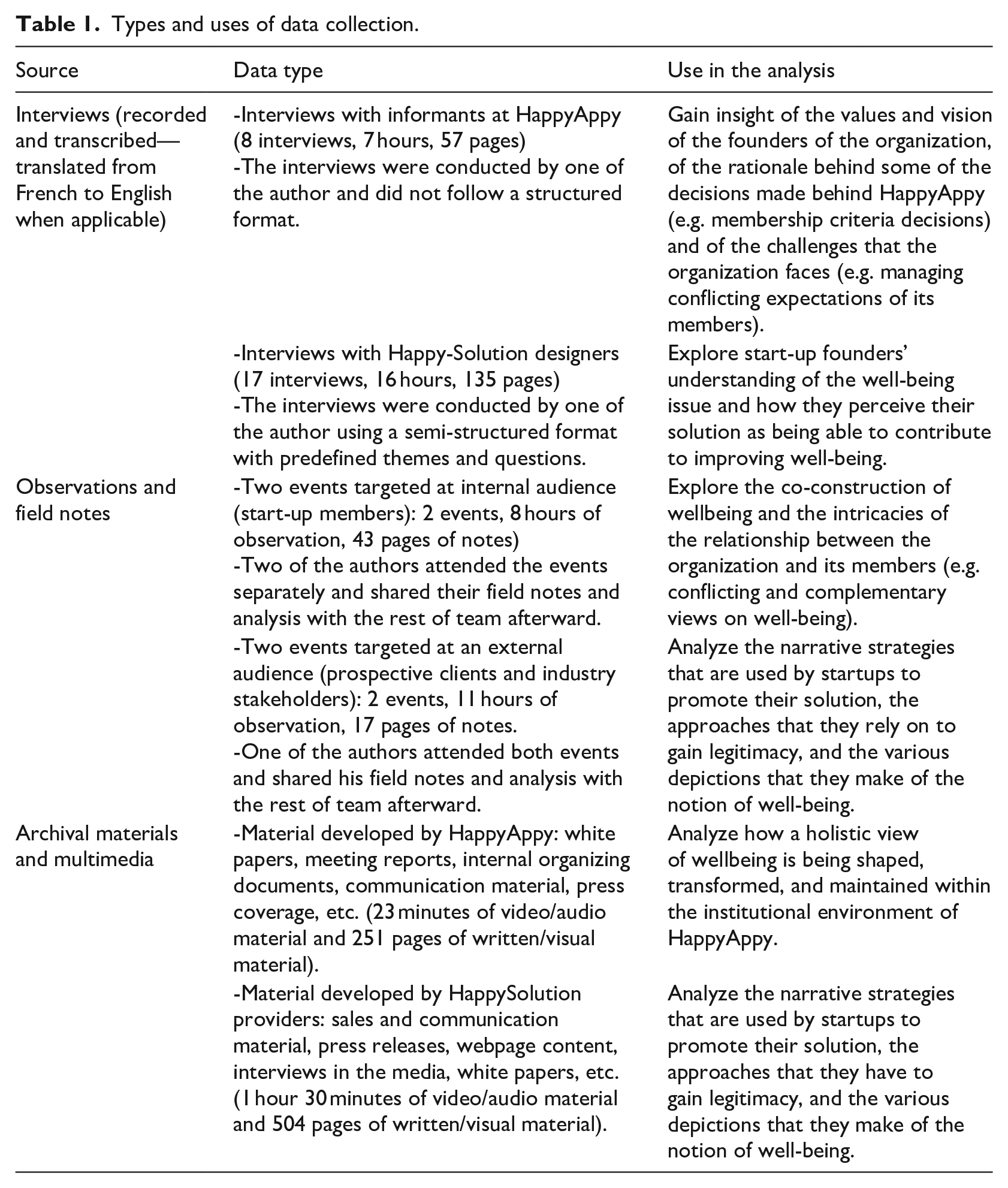
Our data collection took place between November, 2017 and June, 2019, and involved observations, interviews and archival materials such as organizational documents, images and marketing materials. We contacted the leader of the HappyAppy organization in 2017, to discuss the organization and its goals and practices, and were granted access to observe and interview the members. At this moment, HappyAppy included five initial start-ups, but had grown to 30 members by the time of our first interviews 4 months later. We attended HappyAppy’s organized events, including the “Monthly Happy,” where the members gathered to discuss the practices and strategies of the group. These meetings centered around the purposes of HappyAppy, as well as ways to put into practice and measure impacts of the members. The group also organized a “summit,” in which the by then 36-strong membership pitched their models to a crowd of several hundred audience members. During these events, we engaged in observation, took field notes, and recorded/transcribed conversations and informal interviews. After the events, we made follow-up calls to the organizing team to discuss the events. We interviewed the executive team, start-ups, and partners, to ensure diverse views on the organization, and held regular meetings with our informants to keep track of news and internal issues for the organization. In total, during this period, we collected 28 interviews, observations, and field notes over four events and collected over 700 pages of written and marketing material from the events as well as from the web pages of the individual start-ups. We summarize our data collection and use of the different data forms in Table 1, while Table 2 gives an overview of the start-ups affiliated to HappyAppy and details about interviewees.
Types and uses of data collection.
Startup and interviewee details.
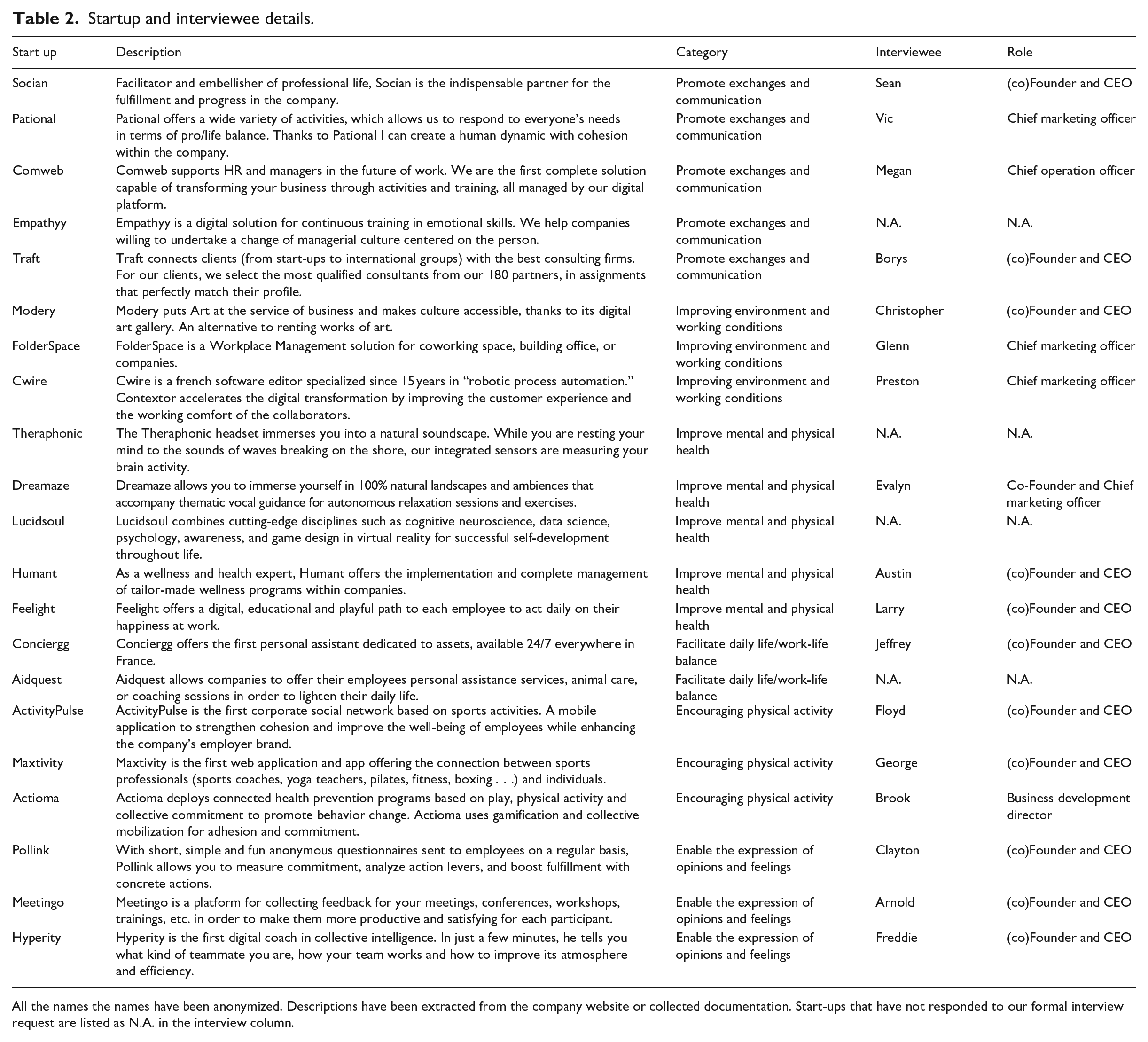
All the names the names have been anonymized. Descriptions have been extracted from the company website or collected documentation. Start-ups that have not responded to our formal interview request are listed as N.A. in the interview column.
Analytical strategy
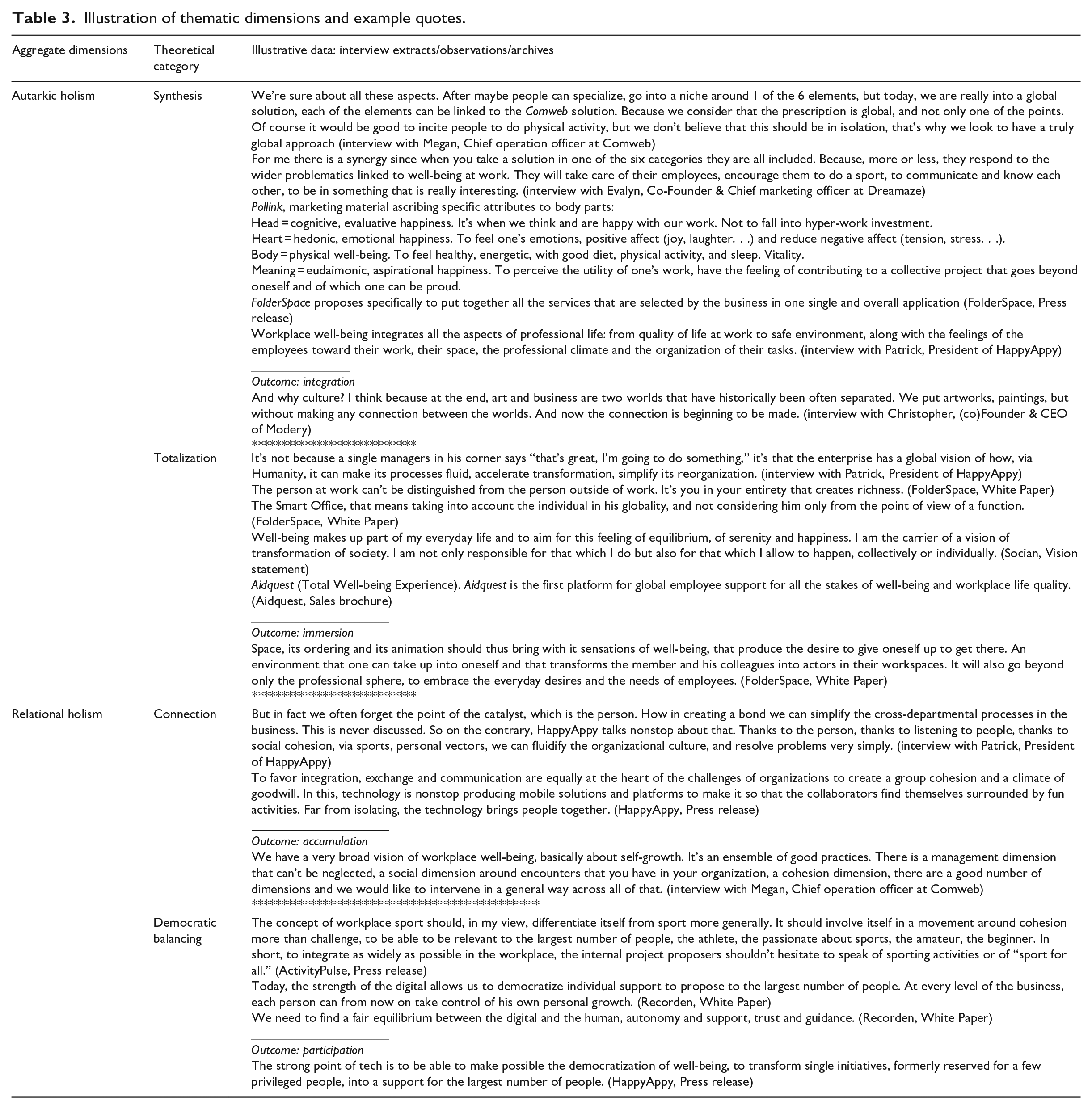
To analyze our data, we followed an abductive approach, moving iteratively between our theoretical question, data, and emerging codes. At each stage of coding, the authors met to compare and theorize emerging categories, progressively moving beyond categorizing toward theoretically explaining how each form of digital holism involved distinct ways of imagining self and other, expressing different ways of valuing the resulting whole (see Table 3, Figure 6 below). This grounding of digital holism variants supported our subsequent discussion around technê-zen aspects of digital culture, comparing them to show their distinct ideological premises and emancipatory promises.
Illustration of thematic dimensions and example quotes.
Our initial analytical focus involved a broad search for moments related to holism, connection or unity as discourses surrounding the digital technology. Initially, we were led to a categorization scheme composed of individual, group, and contextual fantasies of holism, suggesting a notion of holism organized by “levels.” Yet as we composed and discussed these categories, we noticed a surprising feature; namely, that individual (i.e. persons and their self-related activities) and contextual (i.e. nature, societal/cultural, and other “macro” issues) often seemed almost indistinguishable, which was initially surprising to us. For instance, notions of self-development would be described as “changing the world” or natural landscapes would be portrayed with a single individual on the horizon. While the distinction between “micro” and “macro” levels seemed blurrier than we expected, the “meso” level of interpersonal interactions was clearly distinct. For instance, social and group relations were rarely depicted in natural or “cosmic” terms.
This insight led us to return to the data and recode around a revised conceptual axis, this time resulting in a general distinction between what we termed “autarkic” holism, in which a self-contained and unified subject seemed to be the object and the goal of holism, and a “relational” holism, in which the subject appeared with “others” in situations of coordination, communication, or participation. Discourses of balance, harmony, or completeness ran throughout both conceptions, but took distinct and sometimes opposing forms, providing a conceptual discovery in our analysis. While we do not consider these forms to be mutually exclusive, they represent distinct personal and social fantasies and, as we explain below, carry different critical and ideological possibilities.
Finally, as a last step in theorizing these possibilities, we analyzed the interviews and promotion material in terms of the values and justifications given around holism. In many cases, productivist motives of performance or financial gain were given to make the “business case” for holistic solutions. Yet, many of the startups also claimed emancipatory goals in their promotional materials. We organized the different forms of holism according to how they took up these productivist versus emancipatory discourses, with implications for the critical possibilities of digital holism that we discuss below. Table 3 provides illustrative examples from our analysis.
Conceptions of holism
HappyAppy was pervaded with discourses and images of holism related to digital technologies, communicated through collective events, interviews with start-ups, and in the promotional materials and media images of the organization and its members. The complex relationship between holistic fantasies and business success ran throughout our data; for instances, as noted in one start-up description: “The objective of Lucidsoul is to allow each individual to have a complete vision of himself and to reach self-knowledge: they will reach consciousness of their physical and mental states, of the mechanisms that will permit them to develop powers of the mind and of the body.” (Lucidsoul, Sales brochure, December 2018):
Here, the relation between holism (“complete vision of himself”) and the motor of performance (“develop powers”) is exemplary of the neoliberal fantasies described in the communicative capitalism framework. Yet the heterogeneous forms of holism reflected different underlying configurations and conceptions of wholeness, which we analyzed in terms of the relation between the “whole” and its “other,” and which, as mentioned above, we termed “autarkic” and “relational” holism. These two ways of presenting holism involved distinct underlying conceptions of wholeness, based on the importance of other actors in the construction of an integrated whole. We treat each of these in turn.
Oneness with self and world: Autarkic holism
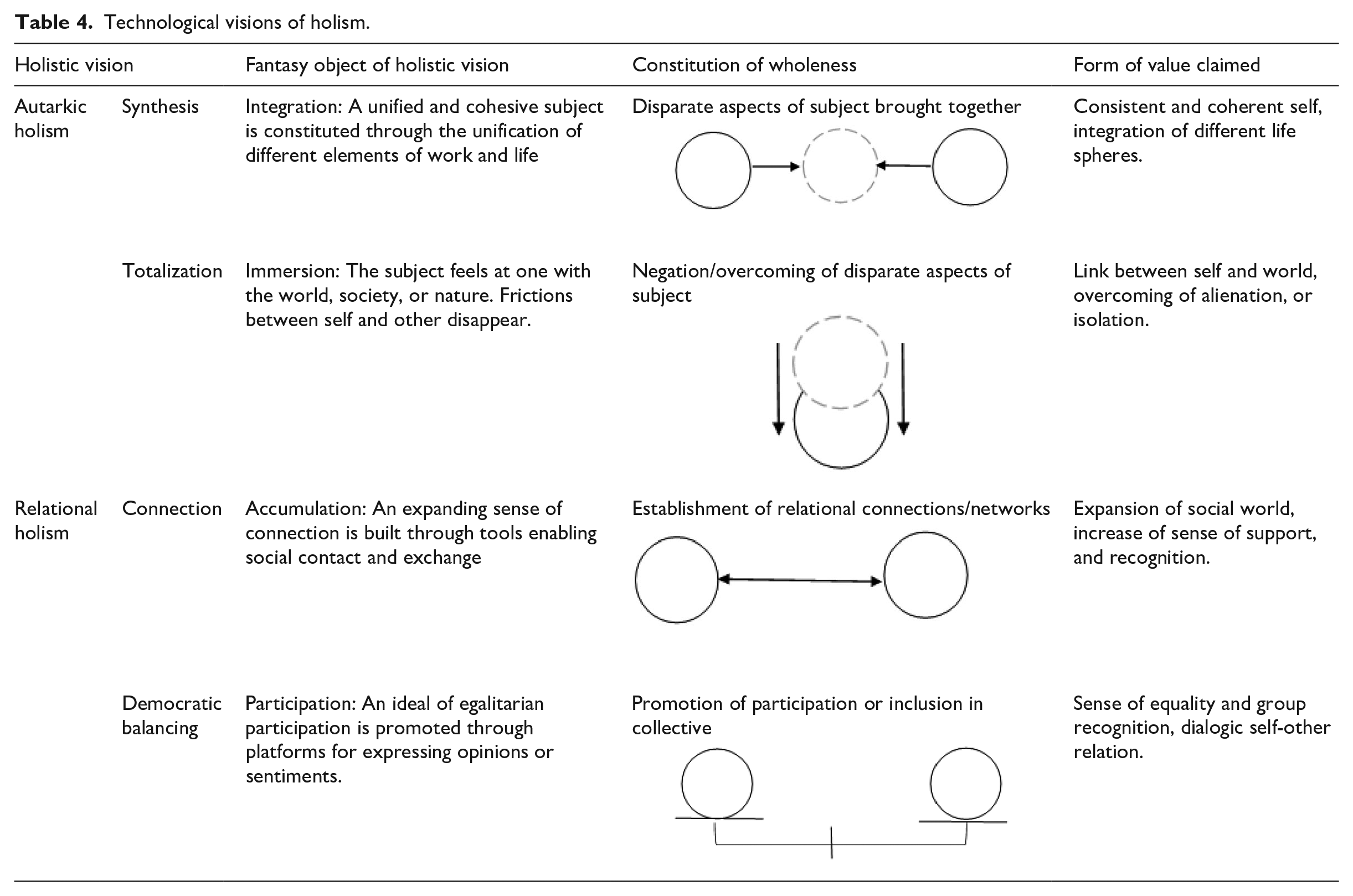
We termed “autarkic” a broad array of holistic discourses in which the idea of holism involved visions of unity where divergent terms were absorbed into a complete and single whole. In autarkic holism, opposing pairs or pluralities (e.g. mind and body, self and other, personal, and social) were unified and seen as part of a single thing. Autarkic holism displayed a logic of “from many to one,” which could result in a vision of a “whole” person (i.e. one who has overcome internal fragmentation) or an integrated world (where nature, society or the universe are seen as some kind of unity), supported through the digital technology. In both cases, the erasure of difference supported the ideal of a self-contained person, which inspired us to adopt the label “autarkic.” Under this broad label, we distinguished between digital technologies aimed at synthesizing, in which multiple terms were claimed to be brought together into a unity, and totalizing, where the distinction between the two was negated or obscured.
Holism as synthesis
HappyAppy, whose stakeholders involved business clients and whose members produced well-being related digital applications directed at organizational actors, emphasized the interface of work and life, economic and personal. Holistic visions in their organizational discourse (e.g. in events and documents), as well as across the member startups, functioned to bring these parts of life together in a form of synthesis. Solutions aimed at transcending partial views to provide “global” well-being. As George, (co)Founder & CEO at Maxtivity, noted in an interview: “Finally, why did we choose HappyAppy? because the external stakeholders will be looking for a global solution, not only sport, not only healthy food, not only massage. And to have a global offering. . .in the end the client wants a global offer.”
We note in this statement the logic of “not only X, not only Y, but the whole thing,” summarizing the idea of synthesizing with its goal of a unified and integrated whole (autarkic holism). A similar example was noted in Comweb, a digital application focused on soft skills (e.g. conflict management, improving concentration, telework policy). Megan, its Chief operation officer, explained the well-being aspects of the technology as follows: “Today we opt for a global solution, with each element linked to the solution. We consider that our service should be around a global prescription, not merely on one of the points. For sure, it would be nice to incite people to physical activity, but we don’t think it should be something in isolation – that’s why we look to have a truly global approach.”
The synthesizing logic transpires in the statement that specific activities should be apprehended in a global rather than an isolated manner. This does not negate the uniqueness of specific well-being solutions but stresses their togetherness within an overall “global solution.”
Synthesizing as a fantasy of integration
Synthesizing as a vision of holism envisaged the integration of distinct parts, where difference is accepted in a first moment, only to then be superseded by a unity. Fantasies involved overcoming difference to reach wholeness. HappyAppy itself approached its mission as integrating distinct solutions covering unique aspects and finding useful complementarities by combining them, thus synthesizing the disparate startups into a movement. Its president detailed this vision in one interview: “A start-up may concentrate on team building or cohesion but may pay much less attention to mood questionnaires or commitment. Or it might not pay attention to stress-reduction solutions and end up competing with these. But in an ‘integrated well-being blueprint’ all these solutions, in an urbanized way, address different problematics and will all be coordinated together.”
Here, the emphasis is on bringing together elements covering distinct well-being facets. Patrick recognizes diversity in the different digital applications (although not, as we do here, in the diverse forms of holism they may embody) and is committed to an “integrated well-being blueprint/masterplan.” As he notes, integration into a unified whole is considered the condition for “transformation” on the basis of well-being.
Illustrating the fantasy of integration with an example from a presentation from the technology start up Pational (see Figure 1 below), we note how the self is considered as composed of disparate elements or capacities (psychological, sportive, artistic, intellectual), where the function of the application is to integrate a “personalized” (cours personnalisés, top right-hand side) self that is at the same time a “common core” (tronc commun, bottom left-hand side). The slightly overlapping images of meditation, design, debate, and sport are visually separated, but then reintegrated as part of the self-development of the client.
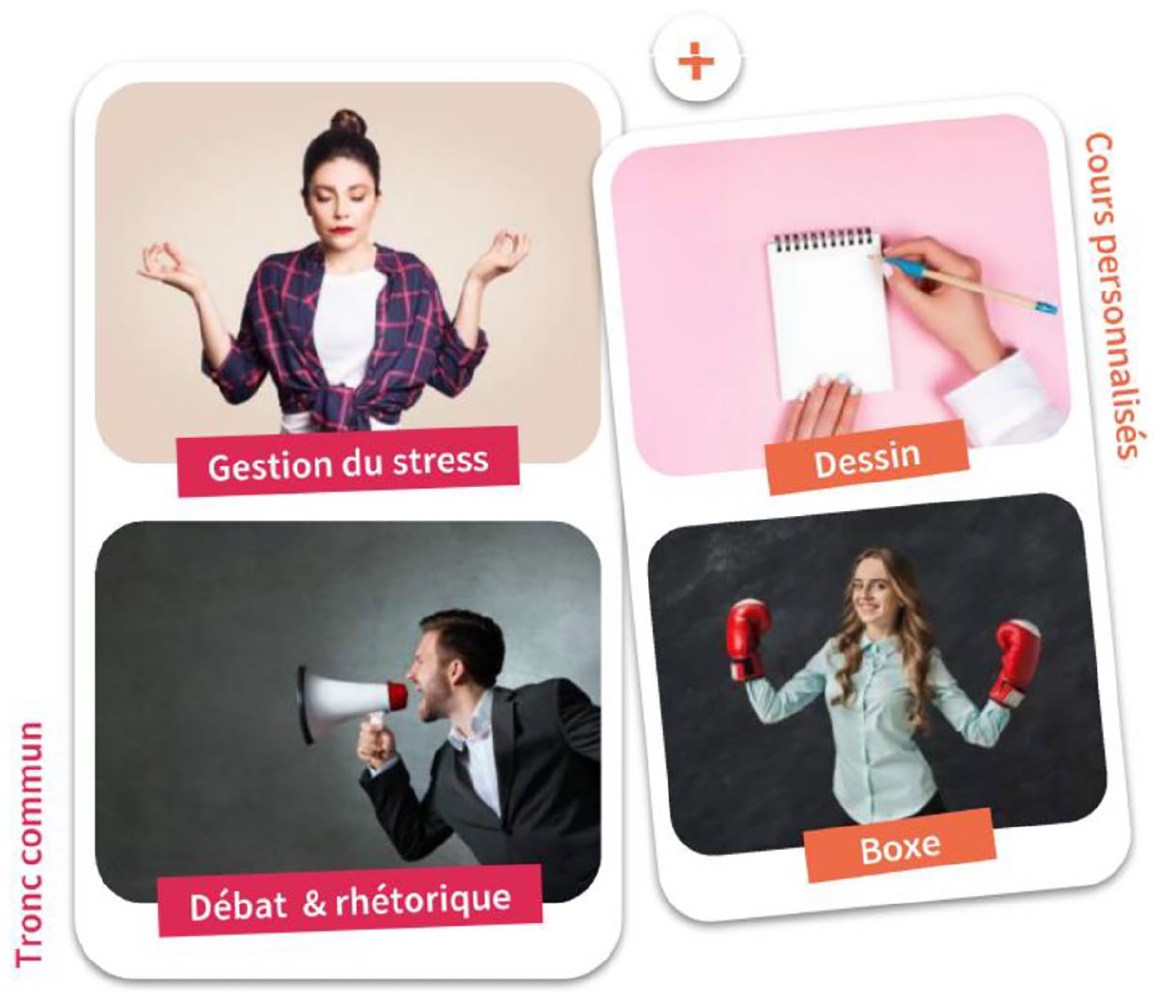
Visual example of fantasy of integration (Pational, Sales brochure).
Holism as totalization
Distinct from synthesizing, which involved bringing together distinct parts, we termed “totalization” a vision of holism in which individual and context were seamlessly integrated, often with cosmic implications or the denial of difference between the individual and the world through the use of the technology. Totalization tended to involve a vertiginous leap between individual and context through digital engagement, skipping over local relationships or constraints (e.g. rather than technology facilitating communication, the technology would “change the world”). Further, totalization involved a “remainderless” aspect in which the self-world connection was seen as frictionless and easy. For instance, an app publicity material stated, “Dreamaze permits you to immerse yourself in 100% natural landscape”(Dreamaze, Sales brochure), while a similar application, Theraphonic, frames such immersion as without tension (Theraphonic, Sales brochure):
“Nothing that is invasive or painful. And no need to have 20 years of meditation experience to get there. A few aversions to the sound of strolling through the forest, to the songs of birds or underwater diving. . . may be felt initially. These may be symptoms of their lingering stress!”
The denial of negativity (“nothing[..]invasive or painful”) frames the remainderless world in which any friction (“a few aversions”) is left-over from a previous non-totalized state.
In interviews, HappyAppy members expressed their visions of totalization by linking individual happiness to the social good, to nature, or to other universalistic or broad concepts. These visions tended to emphasize a seamless continuity between individual and environment, an astute denial of possible tensions or frictions. Such experience was narrated by an anonymous participant who was interviewed after experimenting with one of these immersive solutions during a Welltech Summit: “Sensory immersions with Theraphonic, stretched on the couch, you’ve got a background sound and all of the music vibrating in the couch. So you feel the music. And the other one I did was an aquatic immersion, you plunge into and are completely under water, you find yourself under a waterfall, and it’s really done by sound, with your eyes closed, and the feeling of the couch.”
In such technologies, multiple perceptual stimuli combining sound, visual, and even sometimes olfactory perceptions have a totalizing effect. Similarly, the idea of changing society or “the world” through technology often involved totalizing aspects that jumped from relatively technical details to bombastic claims of revolutionary change. This surfaced during an internal HappyAppy event, whose purpose was to reach consensus on the group’s collective purpose. The following excerpt from the end of the event shed light on the emphasis on totalization: “We’ve identified that HappyAppy’s role is to spark a global cultural transformation. . .. In short, technology has enslaved employees and finally through HappyAppy we will liberate employees through technology. And produce, as a result, a virtuous circle, the Happy Circle.” (transcription of the recording of an internal HappyAppy event)
Technology is here described as either “enslaving” or “liberating,” but if used in the right way, as supporting a “global cultural transformation.” The totalization involved in this global vision is repeated in the virtuous “Happy Circle,” a metaphor invoking a totalistic whole.
Totalization as a fantasy of immersion
Totalizing as a vision of holism frames well-being as a fantasmatic immersion in which difference is negated and a unity of self and world is imagined as a discovery of full potential. Fantasies of holism as totalization frame the digital experience as an expansive and absorptive self-world relation where otherness disappears and the person is at one with their environment. We illustrate this mode of fantasy with a promotional image from Dreamaze, whose immersive application purports to link self and universe (see Figure 2 below):
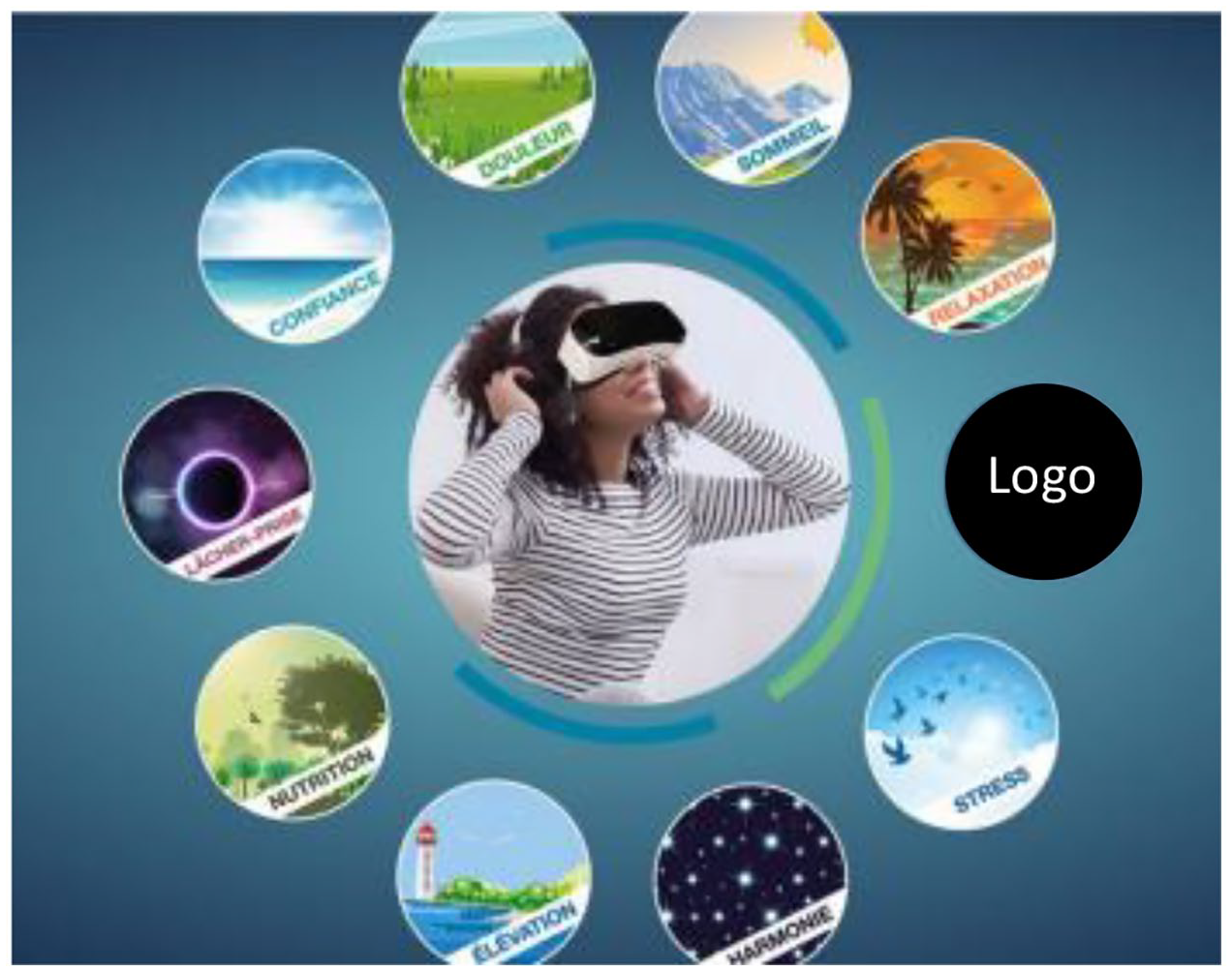
Visual example of fantasy of immersion (Dreamaze, Sales brochure).
This image, with the masked self in the center, surrounded by natural and cosmic images, demonstrates a totalizing vision of the self in which other persons are absent, and the only other living beings are birds. Visions of horizons lead the person beyond the here-and-now of situated experience into a suggestion of transcendence. The company logo (blurred for anonymity) is included in the circle of the imagined world and shaped to suggest an infinite circle to suggest a fantasmatic completion of the real with the imputed totality, mediated by the digital product. The upward-turning face and direction of the visual regard seem to suggest an aspirational and dreamlike state that is neither introverted nor engaged with specific social interactants.
Frictionless interaction: Relational holism
In addition to autarkic holism, in which unity trumps plurality through either synthesis or totalization, we observed an approach to digital holism focusing on interpersonal relations, communication, and participation. We termed these “relational holism” because they focused on smoothing interpersonal boundaries and promoting connection, without thereby erasing the plurality of actors. Start-ups around team organizing, communication tools, or team-building often involved technologies focused on relational holism, which raised a paradoxical situation: how to maintain the sense of a plurality while emphasizing the wholeness or connection of actors? This tension was often palpable in the slight-of-hand between team affirmation and disciplining of members, as noted on the website of the startup Hyperity, a technology that “reinforces the team spirit that is already present and also points out the strengths and weaknesses of each one to improve our common work” (Hyperity, Sales brochure). We note the eagerness to avoid intra-group antagonism (“team spirit that is already present”) while disciplining individual members into the common (“improve our common work”). Two ways of framing holism to allow this move to the group level were observed, which we labeled “connecting” and “democratic balancing,” both of which attempted to frame holistic visions in pluralistic ways.
Holism as connecting
We described holistic fantasies as “connecting” where they imagine holism as bringing people together into networks or relationships. Rather than an integrated self, connecting involves integration among social relationships (see Figure 3 below).
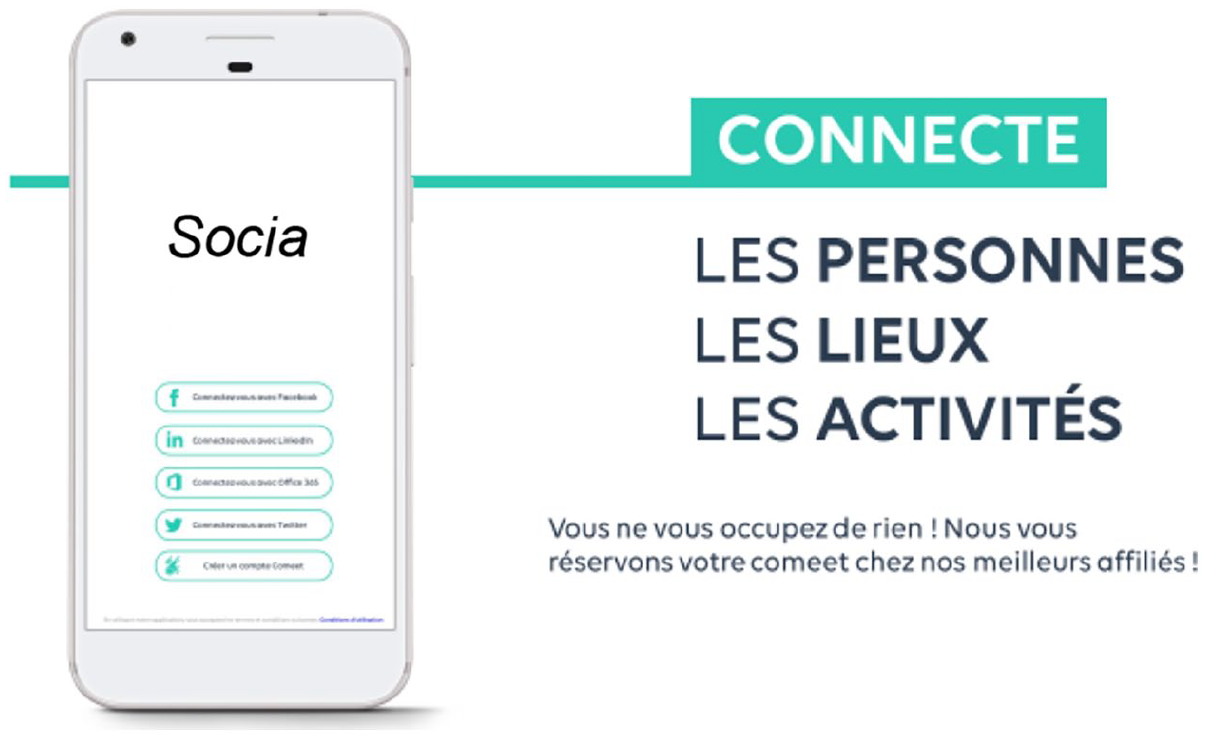
Visual example of connecting (Socian, Sales brochure).
Some HappyAppy technologies dealt directly with connecting through messaging and team-related technologies, with specific missions of creating networks. In these situations, building social connections was the direct goal of the technology or program. Socian, for instance, is an application that encourages people to meet and develop social ties. The app “Connects people, places and activities” (see Figure 3) (Socian, Sales brochure). When interviewed, Socian’s founder, Sean, noted the centrality of connection as a form of holism that is often overlooked by a fascination with the “virtual”: “We are the inverse of the course of history, of the digital world. You put on a virtual reality headset and you’re cut off from the world, you’re integrated in a totally digital mode, while us, we say that HappyAppy should forget that and re-center on the human, re-evaluate the human. Consider Socian for instance, you totally forget the virtual and come back to the real world to remake activities with other people. . .Socian creates occasions to find each other in the real world. It’s ‘leaving the Matrix’, and that’s the vision.”
As noted, the vision of connection, rather than aiming for a peaceful immersion or unified self, administers a dose of “reality” (“the opposite of the virtual”), and emphasizes the social rather than the transcendental self.
Connecting was also apparent in relation to digital applications that created broader ecosystems to connect various stakeholders (e.g. partners, individuals, suppliers). Connecting takes the form of matching groups that have overlapping or complementary goals or resources. Connecting also involves optimizing resource allocation within a given ecosystem. A holistic vision in such systems means placing the individual and their needs at the core of the matching process. As Borys, the founder of Traft, a platform connecting individual consultants and business organizations, explained: “The idea of Traft was ‘we need to put the person in the center of the tool (dispositive). . . making the model virtuous in this way, no one is hurt and everyone finds their niche (trouver son compte). The ensemble of the parties is encouraged to help the other parties to find their interest.”
As can be seen here, actors pursue distinct interests that converge in a virtuous manner. The idea that “everyone finds their niche” acknowledges the uniqueness of each party but shows that these can work in harmony when each and everyone’s interest is apprehended in a holistic manner. Connecting, in this view, operates at the process level and influences the nature of transactions and social and economic exchanges.
Similarly, Clayton from Pollink notes that connecting goes beyond data matching to involve the relational aspects of the person: “if you just have calibrated data, beautiful data, you’re not necessarily going to take action. There is a step between data and action. We think that this stage is dialog. (interview with Clayton, (co)Founder & CEO at Pollink). Building on this rationale, Pollink encourages employees to express their feelings, emotions moods, and any other affects through its weekly polls. The ritualized weekly dialogs that are supposed to result from these polls require emphatic listening which Pollink defines as “being attentive to the person, lifting our own filters and blocks to receive the entire message your interlocutor is willing to send you” (Pollink, Newsletter). Pollink’s model of affective, cognitive, and communicative bonding is visually illustrated in Figure 4:
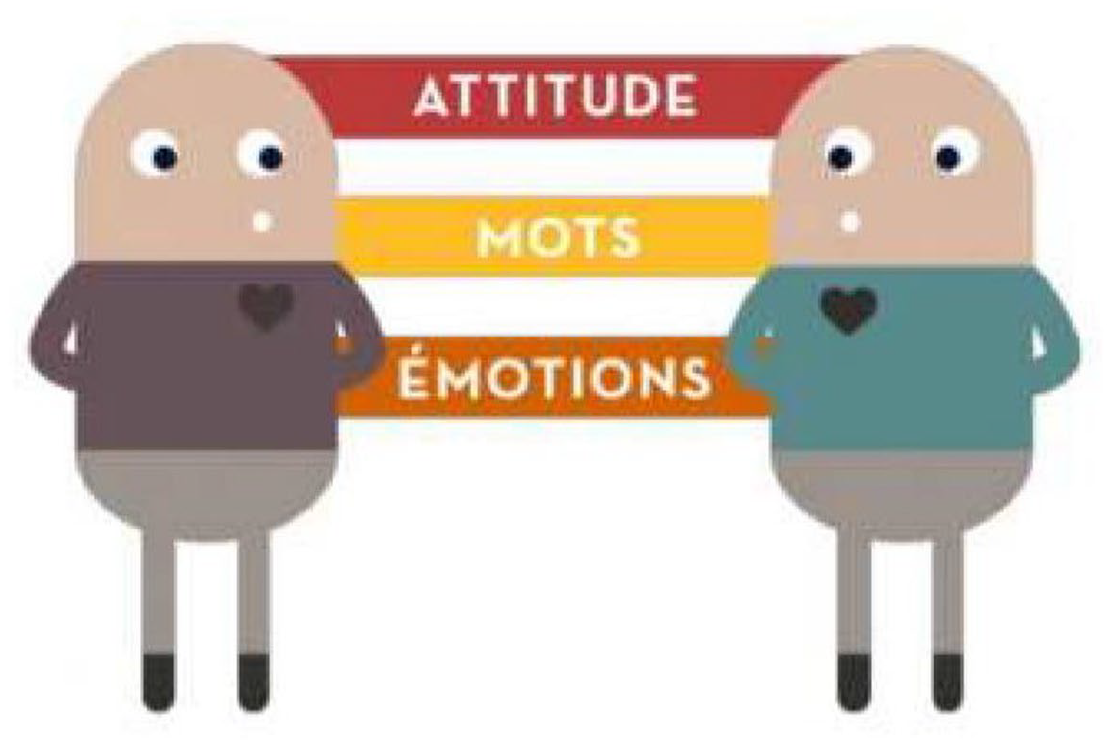
Visual example of connecting (Pollink, Newsletter).
Connecting as a fantasy of accumulation
Connecting at HappyAppy involved the idea of a plurality, with the goal of building networks or creating relationships. Some of these networks were limited to small groups and work teams and so reached numerical limit while others held out the possibility for limitless expansion of connections (e.g. Socian). Either way, the holistic vision was additive, being achieved through accumulating connections to expand or consolidate a group. In this sense, we describe connection as embodying a fantasy of “accumulation,” through which added relationships bring one closer to a state of connectedness. Whether technology is at forefront (e.g. a communication medium) or in the background (e.g. an algorithm automatically connecting individual and groups), the underlying accumulative nature of expansion was apparent in several segments. FolderSpace is a business solution that pivoted from real estate management app for coworking spaces to a “smart workplace management solution focused on people” (FolderSpace’s website). As part of its offering, it elaborates on the new Welcome Manager role it has created: “Welcome Managers are creators of social ties between different groups in the same building. By capitalizing on collective events, they can lead to new ties developing among the residents. To enrich office life, it is thus fundamental also to create bonds between colleagues or employees of different companies. Participating in collective activities can help reveal aspects of one’s personality that can then be put in the service of a professional mission, but also lead to personal fulfillment. (épanouissement)..It’s also about attracting new employees, creating a demand for activities and services, and offering them a work environment that is qualitatively favorable to help retain employees.” (FolderSpace, White paper)
The accumulative nature of strengthening the links between firms that share the same office building is visible through the use of notions connotating an additive meaning: “capitalize,” “enrich office life,” “personal growth,” “attracting new employees.”
Holism as democratic balancing
Many of the HappyAppy startups and discussions emphasized participation as a value and a source of happiness. We termed “democratic balancing” a kind of holistic vision in which inclusivity, participation, and voice are emphasized as parts of a “whole” organization (see Figure 5 below). Differently than a totalizing or synthesizing vision, democratic balancing kept to the concept of a plurality within a team or organizational context and focused on addressing asymmetries of participation or voice within the plurality. Generally limited to a small group (e.g. a work team), such balancing was often achieved technologically through some kind of coordinating application or input service through a smart device.
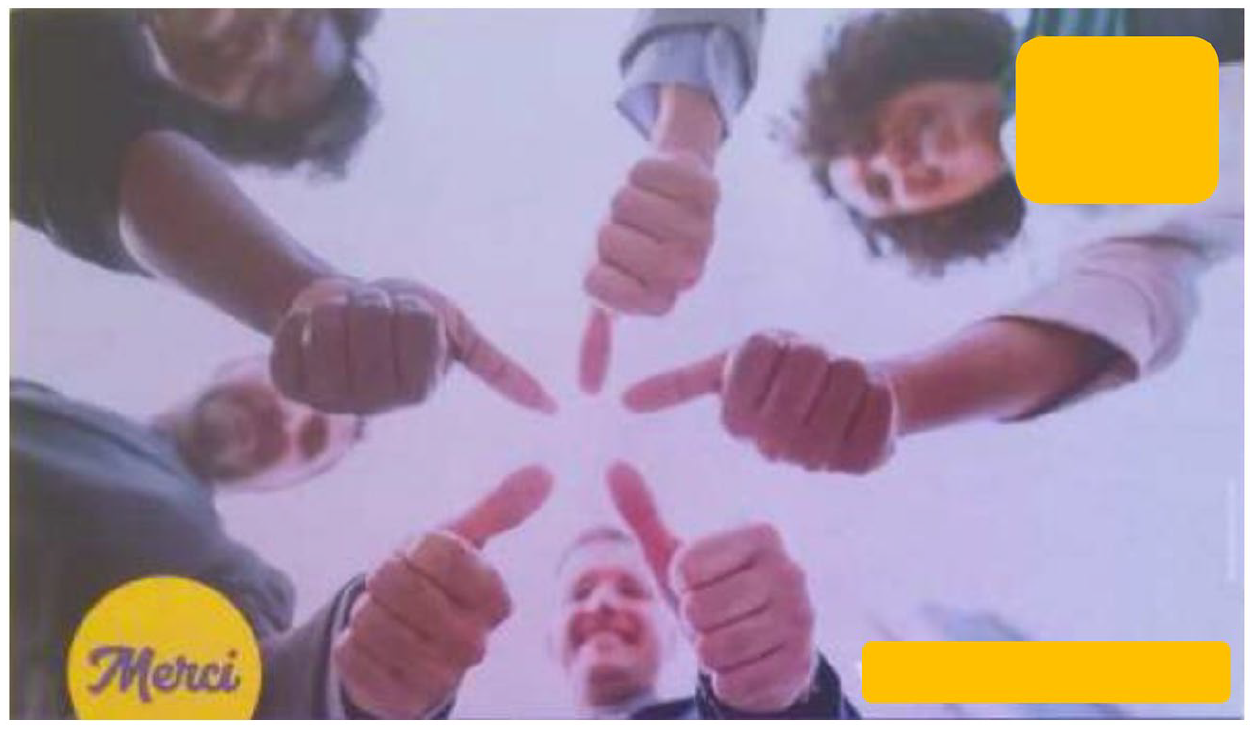
Visual example of democratic balancing (Feelight, Sales brochure).
Democratic balancing tended to assume a core value of participation within the group, with the goal of enabling or motivating participation. The desired result would be to achieve a harmonious or happy group with increased cohesion. For instance, to address the lack of individual employee recognition, Empathyy developed an application allowing each employee to distribute a number of digital “accolades” to their colleagues. Its founder, Felicia, details the initiative, saying “It’s about managerial innovation, we distribute the power of recognition among everyone in the firm” (observation from notes taken during the Welltech Summit organized by HappyAppy). The idea of balance and plurality, along with the mutual dependence of people for each other’s approval, is seen as a way of creating well-being through “democratic” design.
Democratic balancing also tended to highlight the medium of participation as equivalent to “giving voice” and focused on opportunities to participate. Applications that provided feedback, for example, were considered to promote participation regardless of their use or the content of participation. Several of these created opportunities for employees to express feedback through small questionnaires, with the goal of increasing motivation through a feeling of voice. (e.g. Pollink). Others were more geared toward balancing participation in specific instances such as meetings (e.g. Meetingo). Antony, the CEO and founder of Meetingo, shared the following anecdote during an interview: “Putting oneself in a position of active listening is to make a first step toward well-being. I spoke earlier about communication channels, that means a bottom-up channel, from that one all the way down at the bottom of the pyramid, toward the managerial levels that are a bit higher, has an effect that is hyper positive.”
As Antony notes, top-down listening to the “bottom of the pyramid” creates a sense of well-being that is “hyper positive,” and while it preserves the structure of the organizational hierarchy, this is made more supple through “active listening.” The metaphor of a “bottom-up” channel conveys the essence of democratic balancing concept, where communication between those at the top and those at the bottom are harmonized.
Democratic balancing as a fantasy of pluralistic engagement
Democratic balancing tended to frame a lack of workplace democracy as a consequence of lack of adequate tools for open self-expression and engagement. For instance, Jeffrey, (co)Founder & CEO at Conciergg, expressed his discomfort toward unfair situations as a driver for his own business. He developed an online concierge service where requests can be automated through the use of a chatbot, to lower the cost of concierge services and contribute to accessibility. He noted: “at the end, we launch a product called Conciergg, and a solution directed at all organizational members, so we’re looking for volume, so we don’t propose solutions for the elites, for the Parisians, or for those who live in the crown of the west of Paris.”
Invoking an image of the masses (“volume”) as going beyond the “Parisian” elites, the application was imagined as fulfilling an idea of participation that resonates with a democratic ethos. The fact that the service was directed at “all members of the organization”—not just a selected elite living in globalized capital cities—shows that unfair situations can be solved with appropriate technological means.
In short, democratic balancing constructed a holistic vision of collective participation, that was relatively power-free, enabled by technology, and involving the seamless flow of individual inputs into a group form whose goal was to have an engaged, pluralistic, and committed work group.
Overall, holism appeared in varied forms through HappyAppy, with each form composing a distinct fantasy around the unity or relationality of wholeness. Table 4 represents our attempt to visualize these different positions, in terms of the nature of otherness within the fantasy and the way that otherness is imagined in terms of integration or immersion (autarkic holism) or participation or accumulation (relational holism). Each of these positions represents a distinct fantasy, with implications for its relation to capital, as suggested above. Yet, these positions were also deployed in distinct ways by the organization, and this has implications for the critical and political possibilities of such fantasies. We turn to this aspect below.
Technological visions of holism.
Discussion: Holistic discourses and critical possibilities
From the above discussion and initial theorization, we can see how technologically mediated fantasies of wholeness take heterogeneous forms depending on their focus on a single integrated individual (autarkic) versus an interactive and mutually engaged plurality (relational). While these categories are not mutually exclusive and should be seen as dynamic and overlapping, by examining each of these ways of constructing holism, different fantasy elements can be seen to operate around the technological applications on offer.
This conceptualization allowed us to address the second part of the research question, involving conceptions of holism and their relation to the critical possibilities of digital technologies. This aspect was crucial to understand the complex ideological situation of subjective participation in holistic fantasies, in which, as Dean (2009) notes, notions of “emancipation” are fraught and subject to processes of cooptation and appropriation. Wrestling with the more difficult question of critical possibilities, we turned to the data to characterize the verbatim in terms of their ostensible goals, with a focus on generating productive value for individuals and organizations, on the one hand (which we termed “productivist” discourses) or allowing personal or collective change or well-being, on the other (which we termed “emancipatory” discourses). Because HappyAppy’s stated mission involved well-being related workplace applications, we expected discourses that attempted to combine productivist and emancipatory discourses; this was indeed the case, with, much of HappyAppy’s discourse spanning across these categories. Yet our interest was to see how the different ways of conceiving holism related to these overall goals, and on this question a somewhat different picture emerges.
We illustrate in Figure 6 the discourses around relational and autarkic holism in relation to productivist and emancipatory claims. Not surprisingly, productivist discourses ran across both forms of holism, as the start-ups claimed personal and organizational performance enhancements through the technological supports. Yet, emancipatory claims centered around autarkic holism specifically, in which claims of personal fulfillment, connection with nature, and self-world unity were the focus of emancipatory claims. In contrast, the more “social” technologies were largely productivist in orientation, focusing on team productivity, enhanced communication, or coordination.
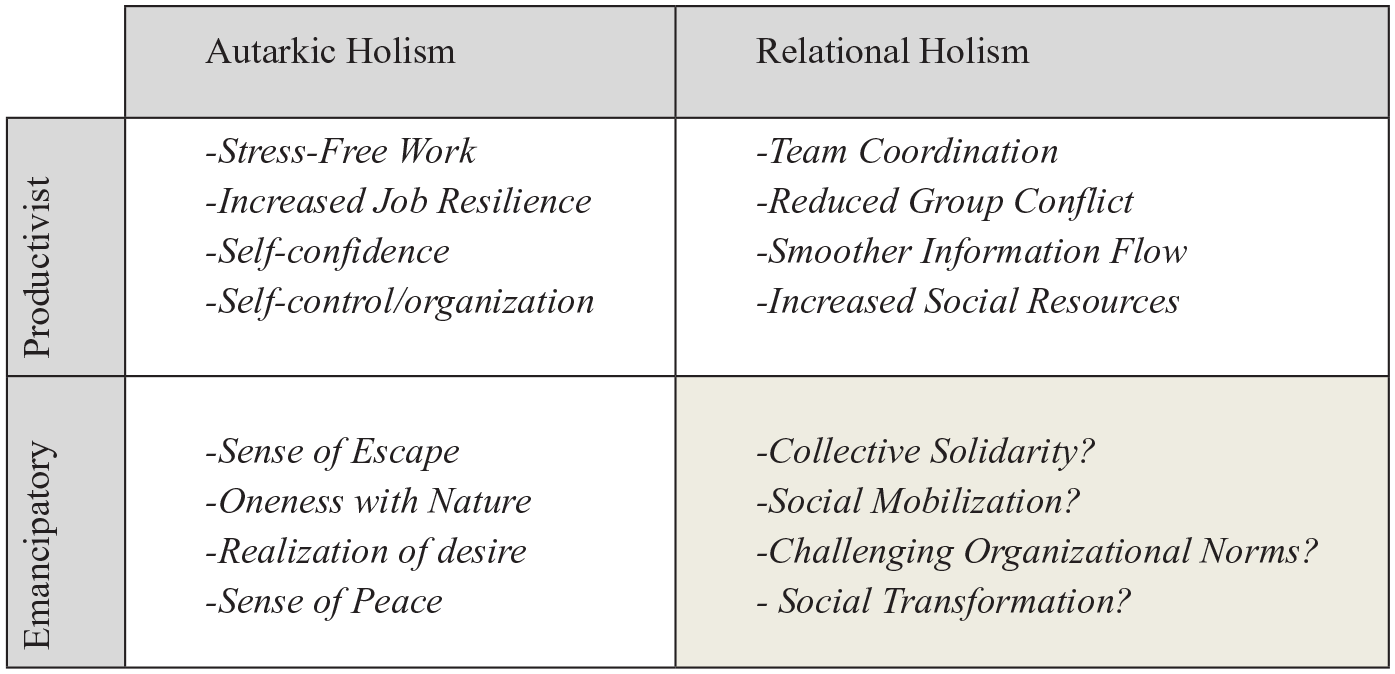
Productivist and emancipatory aspects of digital holism.
Put differently, the notable absence of relational, emancipatory discourses, that is, “4th corner,” was surprising, given the focus of critical theorizing on the social nature of emancipatory or collective movements. HappyAppy’s emancipatory focus centered on autarky, while relational visions were channeled into productivism (e.g. such as productive teamwork). This perplexing asymmetry has important implications for the role of technology in communicative capitalism, because it is exactly the relational, emancipatory aspect of holism that might underwrite visions of solidarity and collective organization (with important caveats, see Dean, 2012, 2016). It thus points to the limits of current technê-zen conceptions of holism, while also suggesting how technology could be framed in ways that more actively target collective change, such as promoting autonomy through cooperation rather than in isolation, or less instrumental conceptions of teamwork.
Theoretical contributions
Our study examined the interface of digital culture and new age management by examining the concept of digital holism. We build on views of contemporary capitalism as promoting a technê-zen (Williams, 2011) approach that integrates digital technology into an ideology of connection that usurps counter-cultural tendencies (Lusoli and Turner, 2021; Turner, 2006). Linking these views with an emerging critical literature on new age management (Cederström and Spicer, 2015; Endrissat et al., 2015; Przegalinska, 2019), we identified a common denominator in holistic fantasies in which the self, group, or society are integrated, seamless, and connected. As an understudied aspect of new age, holism mobilizes ideologies of connection to shape subjective desire (Dean, 2009, 2015), making it theoretically interesting for understanding the interface of connective technologies and well-being. Problematizing these fantasies by drawing on Dean’s notion of communicative capitalism, we examined diverse fantasies within digital holism to understand their ideological implications. We identified two broad forms of holism, autarkic (synthesizing and totalizing) and relational (connecting and democratic balancing), where the first imagines a self-contained individual absorbing otherness, and the second imagines a seamless relation with others in an idealized group dynamic. Notably, while the former, more individualistic view is pervaded by a discourse of emancipation and freedom, the latter tends to be more business-focused and claims to support team performance.
Seen against the broader project of understanding the role of the digital within the ideological apparatus of contemporary management, our study offers contributions to two ongoing discussions. The first, around new age management, asks how discourses of well-being and personal-development—of which digital holism is an example—shape ideologies in and around organizations, while the second, around digital organizing, asks how critical perspectives can take account of digital tools as they relate to organizing. Situated at the crux of these two discussions, we discuss our contributions to each of these in turn.
Contributions to new age management
The current study contributes to an emerging literature around critical aspects of new age organizing (e.g. Endrissat et al., 2015; Land and Taylor, 2010). This literature has examined the ambivalences and tensions in contemporary work’s promises of authenticity, happiness, or self-expression. It has noted how such promises become instrumentalized and leveraged as normative control mechanisms (e.g. Fleming, 2009; Toraldo et al., 2019). While often implicit, promises of wholeness run throughout the empirical sites characterizing this literature, and some have noted the sometimes-violent consequences of questioning such promises (e.g. Picard and Islam, 2020). While some previous work has noted links between new age management and digital technology (e.g. Przegalinska, 2019), how digital culture empirically mobilizes new age fantasies remains in need of analysis. By drawing on communicative capitalism (Dean, 2005, 2010) as a theoretical frame, we highlight the ways that an emergent “happy” sector can leverage technological infrastructures to mediate promises of wholeness.
Specifically, we find that a plethora of holistic discourses around digital products support fantasies of autonomy and relationality, where the former frames an “integrated” mind-body subject linked to nature and the latter imagines smooth teamwork and mutual understanding. While autarkic holism invokes fantasies of freedom and fulfillment, more relational holistic visions tend to be performance-related. Put differently, it is precisely at the point where collective action and relation are foregrounded that this is most framed in productivist terms, while fantasies of freedom are woven around individualist themes. Rather than claiming that positive management forecloses on emancipatory imaginaries, therefore, it may be more apt to claim that it distracts from relational visions of freedom, while promoting visions of freedom at the level of individuals. The suggestion is that one can have collectivity, or freedom—but not both. As an ideological aspect of new age management, this orthogonal positioning of fantasies of freedom and imaginaries of collectivity constitute a powerful ideological tool against what Dean (2012) calls “the communist desire.”
The previous point, however, begs the question of whether such socialized emancipatory discourses would themselves be subject to Dean’s (2009)critique of communicative capitalism, even if they do not fall into the individualizing tendencies of neoliberal fantasies (Dean, 2010). The problematization of “emancipation” in Lacanian analysis (upon which Dean draws extensively) raises doubts about whether such socialized fantasies would be emancipatory in any “true” sense or simply another form of ideology. As Dean (2012) notes, however, to the extent that ideologies of collectivity are reconceptualized not as “wholes” but as “horizons”—that is, projects for action based on difference that cannot be imagined away—there is a possibility for alternative organizing that does not require disavowal (cf., Zanoni, 2020). In this sense, the emancipatory potential of relational forms of holism would depend on the kinds of closure or openness of the “whole” that they allowed, a point which is somewhat moot in the current site given the lack of relational holism observed. That important bridge may need to be crossed at some point in the “horizon,” although it is beyond the horizon of the current analysis.
Regarding digital holism, linking emergent critiques of digital well-being with communicative capitalism traces a path by which social value in digital culture is converted into economic value (Mumby, 2016). The practices supported by digital holism create a bridge between individual motivation and the digital business models created to harness, amplify and extract value from those motivations. While a core aspect of the recent critical perspectives on wellness has been an over-focus on individual vis-à-vis social and structural processes (e.g. Cederström and Spicer, 2015), digital holism is one of the mechanisms by which individual fantasies and technological infrastructures are entwined to simultaneously imagine new kinds of subjects and new forms of value capture (Dean, 2009). Communicative capitalism, as a theoretical frame, is uniquely positioned to explore this interface because of its double-facing focus on desire and fantasy, on the one hand, and structures of extraction on the other. By no means limited to digitally mediated communication, the latter provides a striking case to highlight the co-constitution of digital technology and subjective fantasy.
Contributions to digital organizing
The above contribution connects to a growing critical literature on digital organizing, in which the forms of connectivity enabled by digital tools are understood both as material infrastructures of organizing and as social imaginaries (e.g. Beverungen et al., 2019; Hensmans, 2021). Recent works have emphasized the extractive capabilities of digital tools, in which desires and communicative processes become raw materials for capitalization (Beverungen et al., 2015; Zuboff, 2019); these approaches are consistent with communicative capitalism in their emphasis on the material extraction underlying the “virtual” layer of digital technologies. Given this extractive dynamic, the ideological function of holism may be to form integrated subjectivities who are affectively invested in such extraction, as Dean (2009, p.56) notes, “neoliberalism affirms technology’s fantasy of wholeness to tell us who “we” are in a global sense.” The value-extraction logic of communicative capitalism would thus be complemented by the ideological force of technê-zen (Williams, 2011), the fantasies of self-fulfillment and social connection that drive users to seek well-being through engagement with digital applications.
In this way, the communicative capitalism approach combines a material critique with an exploration of the collective desires embodied in such fantasies; this duality, in our case, led us to explore the visions of holism and well-being that were woven around the technology and its discourses. By describing and theorizing the different forms of digital holism promoted at HappyAppy, we take a first step toward understanding the ways in which people lean on such technologies to discover themselves and others, and the detours involved.
In sum, an important interface between new age management and critical technology literatures is traced by the concept of digital holism. Digital organizing literature has explored the subject-constituting effects of technological artifacts, and how these can support new forms of control (cf., Beverungen et al., 2019). Yet, the materiality of technology has always been supplemented by ideological discourses, which offer technology as a panacea for the fullness of the self or of the community (Turner, 2006). Technê-zen is a paradoxical combination of the ephemeral and the mechanical, the fantasy of virtual connection supplementing the mechanical and control-oriented engineering of employee selves. By examining this convergence of the technological and the new age, we contribute to understanding how subjective desires are shaped in the context of digital technologies.
Future research directions and conclusion
While the current study examined how digital holism is expressed through diverse visions of self and others, more research is needed about how different ways of imagining wholeness relate to each other and to wider organizational structures. For instance, what would be the conditions under which relational fantasies of wholeness are articulated together with visions of nature or the cosmos, a combination largely missing from our site? Such articulations may face constraints from wider cultural imaginaries or the interests of firms or clients of digital applications. Future research should examine how the diverse “promises” of digital holism are produced and distributed, based on whose interests, and how technological fantasies can be shaped, transformed, or subverted.
Relatedly, digital holism may work in ways that are distinct from (and perhaps potentiate) the “romantic” utopias of most new age management. While the latter focus on vintage, artistic, or communitarian ideologies (e.g. Toraldo et al., 2019), digital holism combines communitarian thinking with technological progress (Turner, 2006), to create futuristic utopias that hold out “promises.” These promises support fantasies in distinct ways from the “nostalgic” fantasies of romantic utopias (Heelas, 2008). For one, the future-oriented imaginings of digital holism may be powerful motivators that increase worker adherence to neo-normative controls, especially where these require releasing personal data or other risky prospects. By contrast, backward-looking authenticity discourses may be more conservative and less likely to spur risk-embracing leaps into the future. Empirical research should examine how traditional forms of spirituality or community are remade in the mold of digital media technologies.
Theoretically, invoking Dean’s communicative capitalism raises myriad questions around the Marxist-Lacanian heritage of this work, around the possibility and nature of emancipatory politics in this tradition (cf., Laclau, 1996). Dean’s (2009) work tends to regard traditionally emancipatory notions such as participation and communication as subsumed under capital accumulation, although her subsequent work (e.g. Dean, 2012) allows, if not a criterion for emancipation, a “horizon” against which progressive organizing is possible. As we explained, we remained cautious in our exploration of this horizon, although our goal of critically evaluating digital holism does reveal our own emancipatory interest in such research. Future research building on this interest would involve examining digital cultures, holistic, or otherwise, which contest or go beyond the commodification of well-being as presented here. Whether such cultures would emphasize the relational-emancipatory aspects of holism lacking in the current context, or go beyond holistic discourses altogether, is a discussion worth having. Examining technologies-in-use, including implementation and alternative uses, could provide insights both into the extent to which users internalize such fantasies, or alternatively, their strategies of resistance, resignification, or reengineering of technological solutions. Given the prevalence of DIY, user-communities and open software, the construction of digital visions of the social are likely to be sites of struggle (Cavanagh, 2013).
Finally, looking to the current historical moment raises the question of how digital culture will shift in a post-Covid-19 world where digital work may become increasingly ubiquitous and precarious (e.g. Fuchs, 2020). It is too soon to speculate on whether the techno-culture exemplified by digital holism will survive the normalization and massification of digital technologies across virtually all spheres of social life (e.g. Zuboff, 2019). Future research should remain aware of the time-sensitivity of research around digital culture and interpret the current findings in light of their historical moment.
In sum, bringing a communicative capitalism lens to bear on the material and economic critique of technology allowed us to explore the urge to connect, to work on oneself, and to search for happiness through the looking glass of the digital screen. Providing a powerful tool for capital accumulation, holistic fantasies may seem more complete, coherent, and desirable than the fragmented realities on the other side of the screen; the desires they foment powerfully shape digital culture and those within it.
Footnotes
Funding
The author(s) received no financial support for the research, authorship, and/or publication of this article.
