



Abstract
As digital technology becomes increasingly omnipresent in virtually every aspect of market and social life, macromarketing's focus on consumer well-being is shifting to encompass the implications of hyper-digitalization in marketing and consumption. This study addresses the emergence of digital well-being as a stand-alone concept and as a market, reflecting the conceptual and practical need to find a balance between technology use and nonuse in consumers’ pursuit of personal well-being in hyperdigital marketplaces. Given the dual nature of digital technology as both a potential threat for consumer well-being and a source of their empowerment, this research examines how digital well-being is articulated within market discourses through the lens of technology dualities and discusses broader implications of such duality for consumer quality of life. Drawing on a critical discourse analysis, the research reveals four modalities through which digital well-being market offerings position themselves between the (potentially) empowering and threatening aspects of technology. By offering a nuanced analysis of digital well-being's relationship with both consumer empowerment and vulnerabilities, this study enriches the critical debate on digital well-being in terms of technology dualities, consumer responsibilization, and the meaning of consumer well-being in the light of growing interconnection between consumer subjectivities and digital technologies.
Keywords
Introduction
With the utmost diffusion of digital technology in virtually every market and social realm (Dholakia et al., 2021; Roy et al., 2023; Zwick & Dholakia, 2008), a long-standing macromarketing concern with consumer well-being and quality of life (Pancer & Handelman, 2012; Sirgy, 2001, 2021; Sirgy et al., 2007; Sirgy & Lee, 2008) has been growingly embracing issues of digital transformation of markets, marketing, and consumption. Beyond the impact of increased technology use on consumers’ quality of life in specific contexts such as food (Ulusoy et al., 2024), aging (Mahmoud, 2024), sharing (Shen et al., 2023), religion-based practices (Kamarulzaman et al., 2016), or entertainment (Huston et al., 2023), digitalization allows adding a new and timely angle to the study of a general concept of consumer well-being transformed due to consumers’ intensive participation in hyperdigital markets (Dholakia et al., 2021), characterized by ubiquitous data tracking (Airoldi & Rokka, 2022; Zuboff, 2019) and exploitation of consumers’ attention (Bhargava & Velasquez, 2021).
In the growing fusion between digital technologies and the meaning ascribed to living a good life (Burr & Floridi, 2020; Thyroff et al., 2023), a specific phenomenon of digital well-being has started to gain prominence. On the one hand, digital well-being is conceptually concerned with the possibility of finding a satisfying balance between digital technology use and nonuse for individuals and societies at large (Vanden Abeele, 2021). On the other hand, digital well-being stands for a set of tools and strategies that consumers employ to actuate specific hedonic and eudemonic goals in the context of their everyday interactions with digital technologies (Eichner, 2020; Jorge et al., 2022; Lyngs et al., 2019; Monge Roffarello & De Russis, 2019, 2021; Valasek, 2022; Van Bruyssel et al., 2023). The latter produces a growing market of apps, gadgets, services, and info products that seek to empower consumers in achieving a “personal sense of well-being” with the help of “healthy technology habits” (Android, 2022; Google, 2022). The concept of digital well-being is being socially constructed (Berger & Luckmann, 1966) by the increasing spread of the market of digital well-being with its characterizing discourses, which are yet to be appropriately captured and critically understood.
One particularly puzzling and (potentially) problematic aspect of digital well-being emerges from the Janus-faced vision of technology enacted in the digital well-being market phenomenon. This market simultaneously treats digital technology itself as both a threat to consumer well-being and as a responsible and consumer-empowering solution. Driven by the overall concern with this duality, this research analyzes promotional discourses of digital well-being market offerings and seeks to understand i) how digital well-being is being negotiated in between the duality of digital technology in marketing and promotional discourses of digital well-being market offerings, and ii) what consequences for consumer well-being does this duality (potentially) produce.
This study's contribution to macromarketing is threefold. First, it provides an in-depth and balanced examination of digital well-being vis-à-vis both consumer empowerment (Denegri-Knott et al., 2006; Papaoikonomou & Alarcón, 2017; Shankar et al., 2006) and consumer vulnerability (Baker et al., 2005, 2007, 2015; Commuri & Ekici, 2008) repercussions. Second, it adds to the ongoing theoretical conversation around the concept of digital well-being (Burr & Floridi, 2020; Lyngs et al., 2019; Monge Roffarello & De Russis, 2019, 2023; Vanden Abeele, 2021; Vanden Abeele et al., 2022) by demonstrating a range of modalities, with which market discourses actually employ it. Third, more broadly, a critical inquiry of market discourses of digital well-being leads to some conclusions—albeit many more questions—in terms of consumer responsibilization (Bajde & Rojas, 2021; Caruana & Crane, 2008; Giesler & Veresiu, 2014; Pellandini-Simányi & Conte, 2020) as well as the meaning of consumer well-being (Ganglmair-Wooliscroft & Lawson, 2012; Gupta et al., 2024; Sirgy, 2021; Sirgy et al., 2007) in the light of growing interconnection between markets, consumption, and digital technologies.
The remainder of the article is structured as follows. First, the phenomenon of digital well-being is introduced through a synthesis of previous interdisciplinary research efforts and an overview of the corresponding market trend. Second, the conceptual background section will build up the connection between the phenomenon of digital well-being and broader considerations around technology dualities and the interplay between consumer empowerment and consumer vulnerabilities. Third, the results of a critical discourse analysis of product-level discourses of 320 cases of digital well-being market offerings will reveal four modalities through which the digital well-being market negotiates its own position between technology's (potentially) empowering and threatening aspects. These modalities include such dual framing of technology as competence vs. incompetence, distracting vs. productive, advanced vs. basic, and isolating vs. connecting. Each modality will be explained in the findings section by outlining the specific role projected for digital well-being as balancing the opposing poles of technology dualities. Each will also be further discussed in terms of the (potential) consequences for consumer empowerment and vulnerabilities. The paper will conclude with a general consideration of the study's contributions, limitations, and avenues for further research.
Digital Well-Being
Emergence of Digital Well-Being as a Concept
In broad, postphenomenology-inspired terms (Ritter, 2021), digital technology can be seen as an interactive mediator of human-world experiences, including that of consumer well-being. In this perspective, digital technology could be either instrumental in achieving higher levels of consumer happiness, life satisfaction, and societal welfare, or, on the contrary, could subtract from consumers’ quality of life (see Table 1 for a summary of research on the effect of technology on consumer well-being). As opposed to an overtly optimistic techno-utopian view on technology as progress (Kozinets, 2008) that has long guided understanding of a wide array of (potentially) positive effects of digital technology on consumer quality of life, the recent decade of academic and public discourse has assumed a much less optimistic and more techno-skeptical stance. For instance, research shows that excessive consumption of digital services could be detrimental to consumer well-being because it may lead to cognitive overload, loss of attention, exhaustion, stress, decreased satisfaction with social experiences (Aagaard, 2020; Almourad et al., 2021; Vanden Abeele, 2021), and even to binge behaviors and addiction disorders (Raghubir et al., 2021; Reimann & Jain, 2021). Likewise, developing an inflated number of social connections enabled through social media inevitably leads to chronic distractions and self-esteem issues (Dennis & Ziliotti, 2023). Furthermore, excessive or dysfunctional social media participation may result in personal identity distress, social approval anxiety, reduced levels of happiness, loss of self-confidence and loneliness, and lowered task performance (Aagaard, 2020; Brooks, 2015; Huston et al., 2023; Kozinets, 2019; Kozinets et al., 2017; Vanden Abeele, 2021; Vanden Abeele et al., 2022; Webster et al., 2021), making concerns about mental health of some populations, such as adolescents, particularly critical and widespread (Haidt, 2024; Sewall & Parry, 2024).
Previous Research on Digital Technology's Effect on Consumer Well-Being.
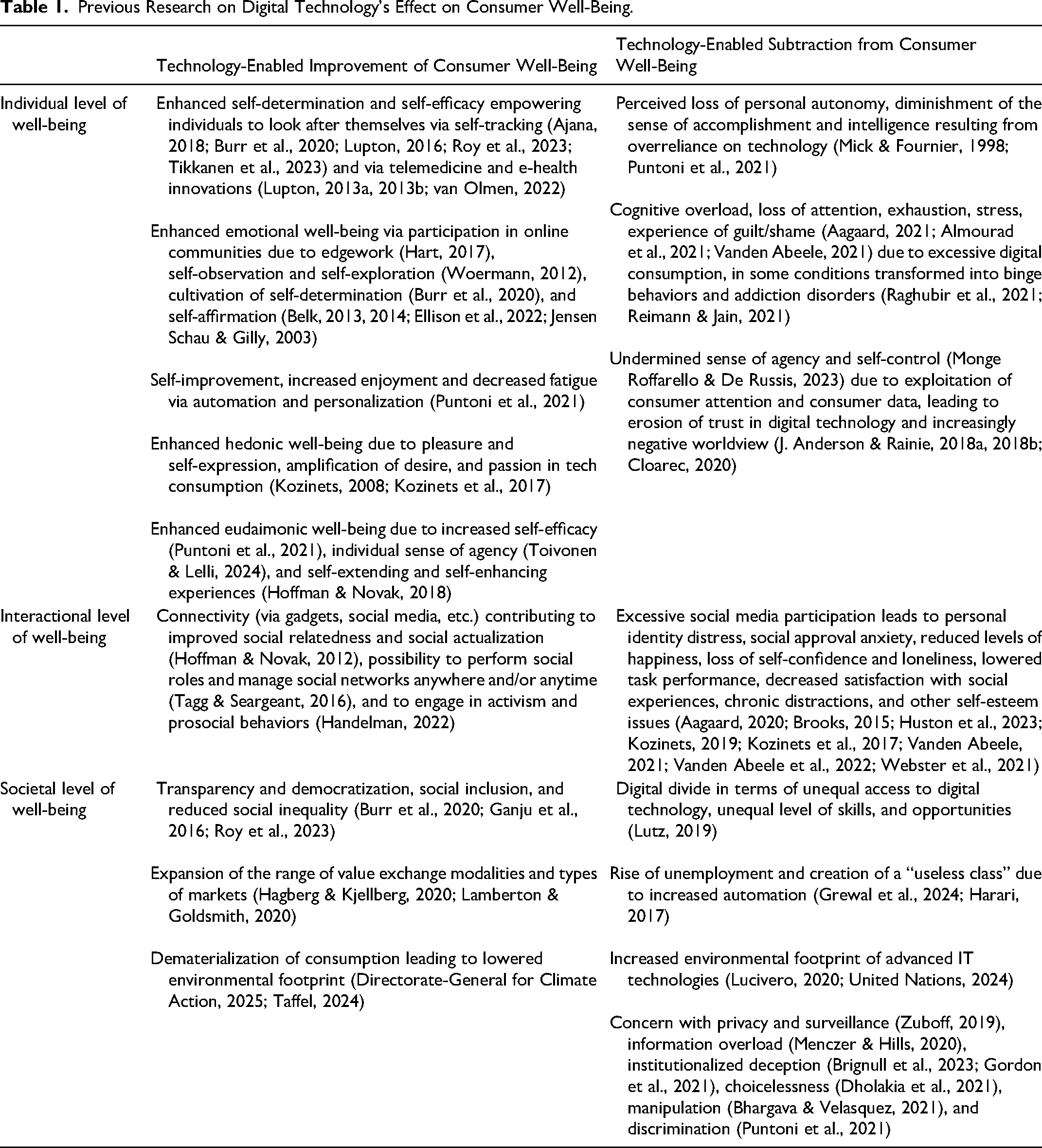
Driven especially by the rise of knowledge on a variety of ways in which digital consumption can subtract from consumer well-being, digital well-being has emerged as a concept that seeks to counterpose the “negatives” of the technology consumption and eventually find a satisfying balance between digital technology use and nonuse on both individual and social levels.
As an emerging stand-alone yet still ambiguous concept (Vanden Abeele & Nguyen, 2022), digital well-being has been addressed from several interdisciplinary perspectives (see Table 2 for a review of its definitions). For instance, communication studies scholars (Beattie & Daubs, 2020; Büchi, 2024; Vanden Abeele, 2021; Vanden Abeele et al., 2022, 2024; Vanden Abeele & Nguyen, 2022, 2024) emphasize the subjective and experiential dimension of digital well-being as a dynamic state at the intersection of personal, technological, cultural, and other contextual factors aimed at maximization of perceived control and minimization of the sense of loss control in an environment characterized by overabundance of digital connectivity. Sociologists (Gui et al., 2017) and ethicists (Burr & Floridi, 2020) further specify that digital well-being can be applied not only to an individual but also to communities. Human-computer interaction scholars (Bartsch, 2019; Gennari et al., 2023; Lyngs et al., 2019; Monge Roffarello & De Russis, 2019, 2021, 2023), rather concerned with the effectiveness of design interventions, tend to focus on the intentionality of digital technology consumption by its users against the backdrop of deceptive and addictive design architectures prevalent in the current technological landscape, echoing a psychological take on the issues (Dadischeck, 2021). In a similar vein, marketing and consumer scholars (K. C. Anderson et al., 2024; Mertz et al., 2024; Roy et al., 2023) have advanced the idea of digital well-being as a process of deliberately managing one's digital consumption.
Interdisciplinary Conceptualizations of Digital Well-Being.
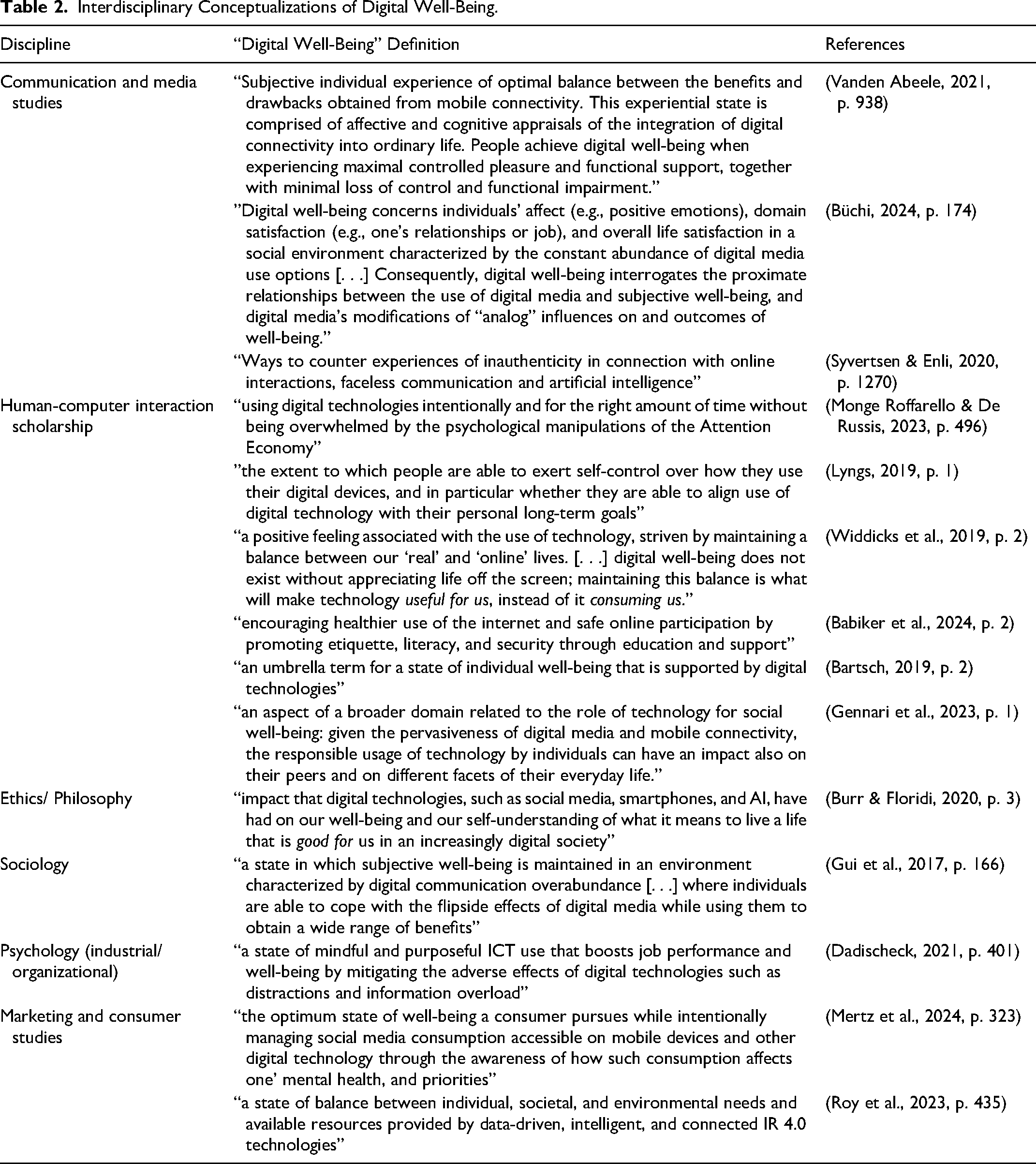
With only a few exceptions (when definitions treat digital well-being as a broad term that largely overlaps with the concept of well-being per se), the current conceptualizations have several aspects in common. First, the common premise is that digital well-being is a specific subtype of well-being, which can be considered an ever more important contributor to the general state of well-being due to technology's growing infiltration in all realms of social life. Second, digital well-being is driven by the desire to neutralize negative side effects of modern technologies. Yet, considering the overwhelming negatives, digital well-being does not negate the possibility of positive effects that technology can have in consumers’ lives. Third, they juxtapose individual preoccupation regarding well-being with structural conditions of the technological landscape (e.g., designs promoting surveillance, information overload, attention exploitation, algorithmic manipulation etc.). Finally, in the duality around technology, digital well-being is concerned with finding a balance between the positives and the negatives of digital consumption.
Emergence of Digital Well-Being as a Market
Theoretical interest in digital well-being coincides with the tech industry's interest in introducing digital tools under the umbrella term of “digital well-being” or “digital wellness” (Beattie & Daubs, 2020). Google, for instance, has pledged to commit to “giving everyone the tools they need to develop their own sense of digital well-being, so that life, not the technology in it, stays front and center” (Google, 2022). The company translates this pledge into introduction of various information resources and in-build self-tracking tools that help consumers in developing “healthy technology habits” (Android, 2022; Google, 2022). Similarly, Apple launched analogous initiatives with Screen Time functionality (Apple, 2024), and Meta (formerly Facebook) promised to optimize its feed algorithms to “mak[e] sure the time we all spend on Facebook is time well spent” (Beattie & Daubs, 2020; Zuckerberg, 2018).
In addition to tech giants of Google and Apple's caliber, myriad smaller players offer “digital self-control tools” to help monitor, understand, and limit technology use (Lyngs, 2019; Lyngs et al., 2019, 2024; Monge Roffarello & De Russis, 2019, 2021, 2023). The digital well-being market thus largely comprises four categories of apps and browser extensions (Lyngs et al., 2019; Monge Roffarello & De Russis, 2023). The first is primarily concerned with prevention of digital overconsumption by means of blocking and/or removing digital technology's distracting or potentially harmful content or features. Some examples of this include time limits, timers, prompts or digital device blocking to help shorten the time users spend online, or social “do not disturb modes” designed to block the digital technology to rechannel the users’ attention toward non-digital interactions and tasks (Widdicks, 2020). The second offers informational support in the form of self-tracking, thus helping users quantify and visualize the extent of digital device usage and thus eventually provide support to other forms of self-control strategies implemented by consumers. The third provides motivational support in the form of goal advancement tools that primarily remind users about the original motivation for or about the ultimate goal of digital well-being. The fourth category, albeit a minority, moves from mere support toward the area of reward or punishment interventions triggered by (in)sufficient adherence to the goals of digital device use self-regulation. An example of this approach can be a social networking app that entrusts an accountability partner to administer a monetary or ego-boosting reward (vs. punishment) for (non-)successful adherence to a pre-set digital well-being plan. In addition to digital tools, the digital well-being market also spans tangible gadgets (e.g., Faraday cages, dumbphones) as well as services (e.g., digital detox retreats) and info products (e.g., self-help literature, webinars, training certification) aimed at improving the level of awareness and consumer education about the (potentially) dangerous effects of digital technology (ab)use.
Previous researchers looking into the market of digital well-being have focused on consumer willingness to pay (Babiker et al., 2024); consumer awareness and adoption rates (Parry et al., 2023); product adoption motives and challenges (Almourad et al., 2021); usage patterns, especially in the context of multiple product and device combinations (Lyngs et al., 2024; Monge Roffarello & De Russis, 2021; Monge Roffarello, De Russis et al., 2023); levels of consumer satisfaction (Parry et al., 2023); user profiles (Nguyen et al., 2024; Vanden Abeele & Nguyen, 2024); and on how to improve the effectiveness of digital self-control tools (Lyngs et al., 2019; Monge Roffarello & De Russis, 2019, 2023). Only a handful of previous studies (Beattie & Daubs, 2020; Jorge et al., 2022; Valasek, 2022; Van Bruyssel et al., 2023; Widdicks, 2020) has addressed this market from a more societal and critical standpoint, and most of them build on the empirical analysis of disconnection market offerings. While not completely separate from digital well-being, digital disconnection represents only one subset of the digital well-being market that promotes liberatory escapes from the reality and arguably represents “a spatiotemporal or an ideological aberration” (Kuntsman & Miyake, 2019). In contrast, digital well-being rather attempts to provide a wider range of balancing solutions that seamlessly integrate not only in getaway experiences but also in consumers’ everyday activities.
In addition, the digital well-being market—even more so than the theoretical discussion around the concept of digital well-being alone—highlights duality and ambiguity around digital technology. This market simultaneously treats digital technology itself as both a threat to consumer well-being and as a responsible consumer-empowering solution, further complicating the consumer relationship with digital technology and even (potentially) obscuring pathways toward balancing digital consumption and well-being. This study is driven by the goal of making better sense of this ambivalence.
Technology Dualities
The Janus-faced duality that emerges in digital well-being connects it with an ample body of social research that, on the one hand, uses duality framing as a conceptual tool to deal with technology's complexity, and, on the other hand, examines the duality of the consequences of technology use in terms of consumer empowerment and consumer vulnerabilities.
Duality as a Conceptual Tool
It may be argued that thinking through binary oppositions—such as black/white, true/false, yes/no, mind/body, open/closed, private/public, theory/practice, macro/micro—is inherent in human reasoning (Elbow, 1993). In this general situation, dualities represent a particular case of oppositions. Dualities are understood as interactions of two opposing elements that are complementary despite their contradictions (Putnam et al., 2016). Both poles in dualities are equally true, necessary, important, and/or correct (Elbow, 1993), and while they are analytically distinct, they might also be realistically indissoluble in the specific contexts (Janssens & Steyaert, 1999). In case of technology, duality framing has been previously used as a conceptual tool to understand technology's complex role in managerial decision-making (Kozinets & Gretzel, 2021; Orlikowski, 1992; Zuboff, 1985), consumer experiences (Kemppainen & Paananen, 2024; Mick & Fournier, 1998; Puntoni et al., 2021), and markets and societies at large (Darmody & Zwick, 2020; Dholakia et al., 2021; Kozinets, 2008).
For instance, in her seminal work on adoption of IT in the workplace, Zuboff (1985) advanced an understanding that digital technology plays a dual role in organizations by automating processes, on the one hand, and, on the other hand, “informating,” or essentially making visible the underlying activities and processes through which organizations accomplish their work. Thus, information and deeper comprehensibility become simultaneously the condition and the consequence of automation. Duality framing per se becomes a compass for managerial attention shifts meant to indicate to decision-makers which aspects of strategies will likely remain unintended if only certain aspects of technology are emphasized and exploited consciously and intentionally.
Building on Giddens’s (1991) notion of structuration, Orlikowski (1992) conceptualized technology as simultaneously acting as a structural deterministic force within an organization and a product of human action. Such a reading of technology's duality leads, first of all, to a more realistic consideration of both intended and unintended consequences of technology use. Second, it becomes an analytical tool that allows scholars to expand levels of analysis (e.g., across organizational boundaries, across time and space) and that encourages context-specific investigations “that seek patterns across certain- contexts and certain types of technology, rather than abstract, deterministic relationships that transcend settings, technologies, and intentions” (Orlikowski, 1992, p. 423).
In marketing research, too, the technology duality perspective has demonstrated its analytical utility. Mick and Fournier (1998), nearly three decades ago, identified eight central dualities that structure consumption of technology: control/chaos, freedom/enslavement, new/obsolete, competence/incompetence, efficiency/inefficiency, fulfills/creates needs, assimilation/isolation, and engaging/disengaging. Using examples of technologies ranging from lawnmowers, washing machines, and TV sets to CD players, video cameras, telephone answering machines, and caller-identification devices, to name a few, they concluded that technology consumption is always a paradox, where contradictions and conflicts between the antithetical structuring conditions are inevitable and irresolvable. Because experience of paradoxes leads to anxiety and internal conflict, consumers use coping strategies to resolve them. Such strategies take place at pre-acquisition or post-acquisition stages and comprise the acts of avoidance, confrontation, or a mix of both. Yet, while coping helps consumers achieve a sense of a balance, the underlying contradictory elements persist and continue to operate simultaneously. Here, the duality perspective affirms the non-resolution of oppositions (Elbow, 1993) and thus creates a new joined concept that functions in its own right as a “thirdness” (Janssens & Steyaert, 1999) that is not merely a choice between the two alternatives but an ongoing negotiation and interplay between duality's opposing poles.
Puntoni et al. (2021) advanced a similar view on the interpenetration of contradictory elements in technology consumption yet did so in a much more recent context of AI. By identifying four types of tensions in feeling served/exploited, understood/misunderstood, empowered/replaced, and connected/alienated in, respectively, data capture, classification, delegation, and social consumer experiences with AI, their research has encouraged researchers and managers to build the complexity of technology dualities into the decision-making process. Comparing their conclusions with Mick and Fournier’s (1998) earlier work, it is evident how the paradoxes and coexistence of technology's opposites endure over time despite the fast-paced technological change.
Dualities serve higher-level analysis of technology consumption on a societal macro level as well. Relying on Greimas's semiotic squares, Kozinets (2008) described technology's ideological space as dynamically navigating between such oppositions as economy/nature, progress/sustainability, work/pleasure, and social good/individualism. Multiple dualities employed in this analysis show that the coexistence of the oppositions is a constant dynamic process of social renegotiation.
Because digital well-being is primarily concerned with balancing the oppositions inherent in technology consumption, duality becomes a natural way to approach its understanding, especially from a more societal and critical standpoint that looks not only into the successful instances of the achieved balance but also at the less harmonious instances of non-consensus, non-winning, and irresolution. Moreover, duality framing is a useful tool to drive a better understanding of consumer well-being's meaning in the digital age.
Duality of Technology's Consequences
Dualities also propel a dichotomous understanding of the consequences of technology use as both the sources of consumer empowerment and, paradoxically, of consumer vulnerabilities. While consumer empowerment and especially its opposite—consumer vulnerabilities (Baker et al., 2005, 2007, 2015; Commuri & Ekici, 2008)—include a range of experiences attributable to socioeconomic characteristics of individuals and/or social groups (i.e., “vulnerable consumers”) as well as to any consumer's transient psychological states and subjective meanings attributed to particular situations (i.e., “dispositional vulnerabilities”), this section will focus exclusively on “digital vulnerabilities” (Helberger et al., 2022), that is, on the structural issues directly attributable to today's technological practices and architectures that (dis)empower consumers.
Digital technology's “informating” aspect (Zuboff, 1985), with its ability to visualize the processes of technology's use and leave traces in terms of data, results in a dualistic set of consequences. On the one hand, it brings about consumer empowerment not only in terms of automation's efficiency, increased convenience, and productivity but also in terms of higher levels of transparency and democratization, encouragement of societal progress, and new opportunities for value creation across fields and markets (Burr & Floridi, 2020; Dholakia et al., 2021; Hagberg & Kjellberg, 2020; Nunan & Di Domenico, 2013). On the other hand, it also produces the opposite vulnerability-inducing effect of propelling overwhelming surveillance (Ball, 2017; Wood & Ball, 2013; Zuboff, 2019), where every (connected) individual is traced not only in terms of their behaviors but, growingly, also in their intimate preferences and intentions (Darmody & Zwick, 2020; Dholakia et al., 2021). In addition to privacy and surveillance, the ultimate concern around efficiency-driven automation is de-skilling of individuals, increased unemployment, and the creation of a “useless class” (Grewal et al., 2024; Harari, 2017; Kozinets, 2008; Puntoni et al., 2021).
The dematerialization that characterizes digitalization substitutes a range of material artefacts with electronic equivalents, which provides consumers with better access to market offerings, drives down the transaction costs, and expands the range of market exchange modalities (e.g., sharing, access-based consumption, etc.—Hagberg & Kjellberg, 2020; Lamberton & Goldsmith, 2020) and has implications in terms of waste-reduction and sustainability (Directorate-General for Climate Action, 2025; Taffel, 2024). At the same time, dematerialization challenges consumers’ sense of ownership and control (Atanasova & Eckhardt, 2021; Watkins et al., 2016) and, as a growing body of research demonstrates, does not alleviate the environmental burden as expected (Lucivero, 2020; Taffel, 2024). In contrast, the environmental footprint of advanced technologies such as AI, due to high consumption of nonrenewable energy, waste, and CO2 emissions involved in hardware production and data center management, is estimated to account globally for 1.5–3.2% of greenhouse gas emissions (United Nations, 2024). Moreover, the issues of digital divide exacerbate environmental inequity among different regions, placing a disproportionate burden on communities that are already more susceptible to environmental harms, such as carbon-dependent or water-stressed regions (Ren & Wierman, 2024).
Due to the speed and volume of data and information generated in the course of digitalization, one of the prevailing logics behind digital designs has become that of attention economy. On the one hand, this stands for the realization of the scarcity of users’ attention capacities (Simon, 1971) and integration of such preoccupation into algorithms and management of information systems. Such a situation may in fact create marketing practices and specific services that alleviate consumers’ information-processing efforts by narrowing and filtering information for them, creating visual and hierarchical structures, and nudging users toward more relevant content, thus preserving their executive function for other tasks (Davenport & Beck, 2001). On the other hand, the economy logic has transformed into the logic of economics, where scarcity (of attention) became synonymous with rarity and thus desirability. In the conditions where attention has an exchange value (Napoli, 2003), the competition produces such negative unintended consequences as the spread of design architectures that maximize user engagement times (Monge Roffarello, Lukoff et al., 2023), proliferation of attention-catching titles (Humphreys, 2016), fake news (Vosoughi et al., 2018), and other instances of institutionalized fakery on digital platforms (B. R. Gordon et al., 2021; Read, 2018). This, in turn, raises such important consumer vulnerability topics as information overload (Menczer & Hills, 2020), intentional deception (Brignull et al., 2023; Monge Roffarello, Lukoff et al., 2023), manipulation (Helberger et al., 2022), and addiction (Bhargava & Velasquez, 2021), especially with regard to less protected consumers, such as adolescents (Haidt, 2024; Sewall & Parry, 2024) and those lacking digital literacy (Hartford & Stein, 2022).
Another macro structural factor that results in a dual set of consequences concerns personalization. Building on the opportunities of behavioral hyper-targeting, personalization has become an imperative that permeates different practices of digital marketing (Kumar et al., 2021). Due to the offered benefits of convenience, relevance, time and effort-saving, and enjoyment, personalization of recommendations, communications, interfaces, etc. becomes an implicit consumer expectation in the digital marketplace (Puntoni et al., 2021). Yet, personalization also entails a trade-off, where consumers need to share (or often unavoidably surrender) their personal data in exchange for a higher level of personalized relevance. This personalization-privacy paradox results in a threat to consumers’ ownership of personal data, challenges to personal control, and diminishment of trust toward the commercial providers of customized offerings (Aguirre et al., 2015; Awad & Krishnan, 2006; Cloarec, 2020; Puntoni et al., 2021; Ruckenstein & Granroth, 2020). Furthermore, the mechanism of algorithmic predictions that stands behind personalization (Agrawal et al., 2018) improves relevance for consumers to the point when it becomes hyper-relevance, that is, so specific and personally meaningful that it creates “a world specifically designed for each consumer” (Darmody & Zwick, 2020, p. 8). In contrast, what appears to consumers as a situation of improved, intuitive, and dynamic choice, as a matter of fact propagates the condition of utter choicelessness, where the algorithm not only predicts but de facto also enacts the choice by dynamically nudging consumers into the pre-set direction (Dholakia et al., 2021). In addition to the concerns with manipulation and mock consumer autonomy in digital environments, personalization and hyper-targeting raise questions about the inherent biases in classification of individuals into segments that guide algorithmic outputs (Kleinberg et al., 2018; Puntoni, 2024; Ruckenstein & Granroth, 2020). Needless to say, incorrect and prejudiced classifications could result in discrimination and exacerbate existing limitations of choice on vulnerable consumers (Hermann et al., 2024).
Cumulatively, the disempowering consequences of technology lead to erosion of consumers’ trust in digital technology, disillusionment, and an increasingly negative worldview (Anderson & Rainie, 2018a, 2018b; Cloarec, 2020; Cloarec et al., 2022). Such a situation, in turn, has contributed to the surge of digital well-being, which ironically, at least in its current market form, is largely based on digital technology consumption itself. Fascinated by the phenomenon of digital well-being and equipped with technology dualities as a framework for critical analysis, this research examines digital well-being market offerings via marketing and promotional discourses and addresses two research questions: i) how is digital well-being being negotiated in between the duality of digital technology in marketing discourses? and ii) what consequences does this duality produce for consumer well-being (or consumer vulnerabilities)? In doing so, the research follows the macromarketing call (Kravets, 2017) to question how technology and its discourses shape consumer subjectivities and the social world.
Research Design
To scrutinize the duality of digital technology in digital well-being market, this research engages with a critical discourse analysis of marketing and promotional discourses of digital well-being market offerings. Based on a theoretical assumption that the social world both constructs and is constructed by the discourse (Fairclough, 2010; Foucault, 1972), critical discourse analysis is helpful in assessing the prevalent meanings around technology and well-being that are disseminated in the digital well-being market and that produce certain digital well-being practices. Methodologically, critical discourse analysis parts from the local analysis of the texts, that is, vocabulary choice and framings, stylistics devices and tropes, syntactical structures, and intertextual connections with other texts. It then connects the analysis's linguistic level with the sociological level by relating the structures of the text with the macro-context of the discourse's sociocultural functioning (Lupton, 2010). By linking the textual with the social, critical discourse analysis provides insights into social meanings as well as their consequences on social practices (Fairclough, 2010). Essentially, it helps “unpack and make explicit assumptions and norms that might otherwise remain naturalized and therefore beyond critique” (Fitchett & Caruana, 2015, p. 9). Given the critical impetus for this research, this approach is both appropriate from a macromarketing perspective and useful for uncovering the implicit (rather than explicit) assumptions, meanings, and emerging norms around digital well-being.
Data Collection
The textual material for the critical discourse was collected from online sources and included promotional marketing and institutional communication of digital well-being market offerings. The data collection was driven by the desire to capture different approaches to digital well-being, while mapping this market as comprehensively as possible.
A review of the literature on past empirical studies on digital well-being products and services (presented earlier in this work) has provided the first input for data collection strategy. Two previously published studies by human–computer interaction scholars (Almourad et al., 2021; Lyngs et al., 2019) and two by communication researchers (Syvertsen & Enli, 2020; Van Bruyssel et al., 2023) openly disclosed the lists of the products that were analyzed in their studies and thus provided the starting point for the sample generation. As shown in Figure 1, these lists were first cleaned and updated and subsequently expanded via systematic keyword searches on appropriate platforms (Google PlayStore, Apple AppStore, TrustPilot, Amazon), libraries (Crunchbase, Meta Ads), and search engines (Google). The keywords (“digital well*being,” “digital wellness,” “digital detox,” “digital disconnection”) were chosen based on the literature review and a series of tests and trials. The search was conducted between January and July 2024 from a European location and was limited to sources accessible in the English language. An attempt to use non-European VPNs was made to access a few apps that were discoverable through search engines but not accessible from a European location. This strategy resulted in the identification of 320 instances of market offerings that fall under the digital well-being umbrella. For convenience, the full list is split into four subgroups: i) digital tools, comprising apps and browser extensions; ii) info products and self-help tools, comprising (online) courses, training sessions, certifications, tutorials, challenge kits, and journals; iii) hospitality services, comprising retreats, travel agencies, and holiday experiences; and iv) gadgets and accessories, comprising mechanical and electronic devices such as wearables, Faraday cage containers and cases, and mobile phones.
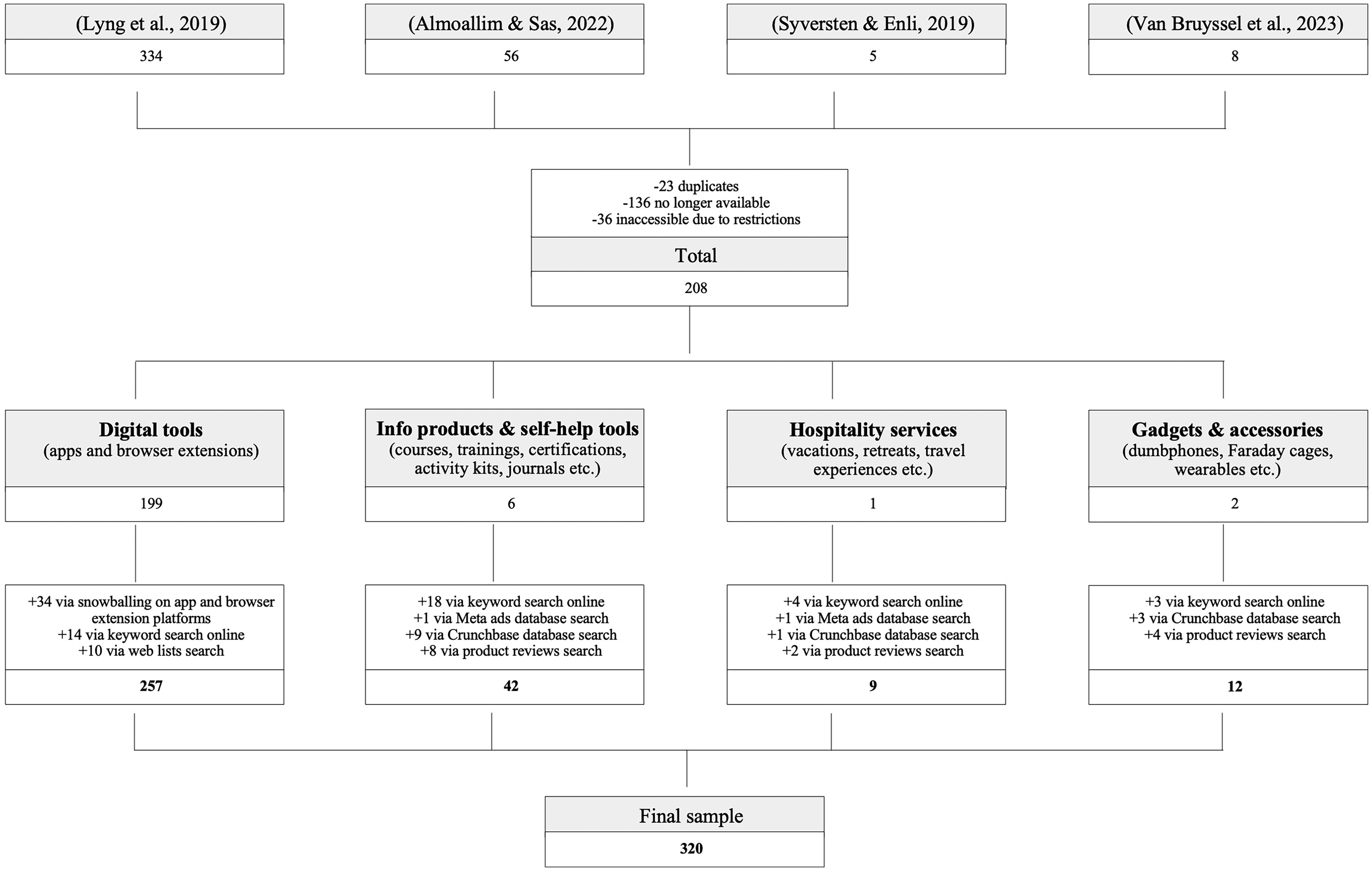
Process of identification of digital wellbeing market offerings.
For each selected item in the list, product-level discourses were collected from company websites and/or products’ listing pages on the respective distribution platforms (e.g., Google Play, App Store, crowdfunding sites, etc.). They included online promotional marketing and institutional communication by the identified products and services, supplemented (where available) by inclusion of company blogs. To preserve not only textual data but also visuals that constituted product discourses, the data were captured by printing as a pdf and/or screenshotting the accessed web pages in their entirety and with the original layout. The saved files were accessed via Atlas.ti CAQDAS software, which allows simultaneous visualization and coding of both textual and graphic data. The final dataset thus included 4,834 screenshotted pages.
Data Analysis
The dataset was subjected to critical discourse analysis with the aim of denaturalizing the hidden, naturalized meanings around specific visions of technology duality advanced in market discourses of digital well-being (Fairclough, 2010). The analytical process started with familiarizing with the texts, applying multiple rounds of iterative reading, and thematically coding the contents with the help of Atlas.ti CAQDAS software. It then moved into a more focused reading of the texts aimed at locating the instances of framing technology as a duality. Close attention was paid to how technology is discursively presented as a threat that needs to be addressed via digital well-being solutions. Using the semiotic square toolset (Mick & Oswald, 2006), the oppositions (as well as contradictions and complementarities) to these threats were derived from market discourses as well. With the help of constant comparison (Glaser & Strauss, 2009), the oppositions were contrasted with each other and eventually produced a list of key dualities that framed digital technologies in the dataset: competence vs. incompetence, distracting vs. productive, advanced vs. basic, and isolating vs. connecting. Digital well-being's role was then read in terms of a balance between the opposing poles of technology dualities (see first two columns in Table 3).
Role of Digital Well-Being in Different Forms of Dualities of Digital Technology.
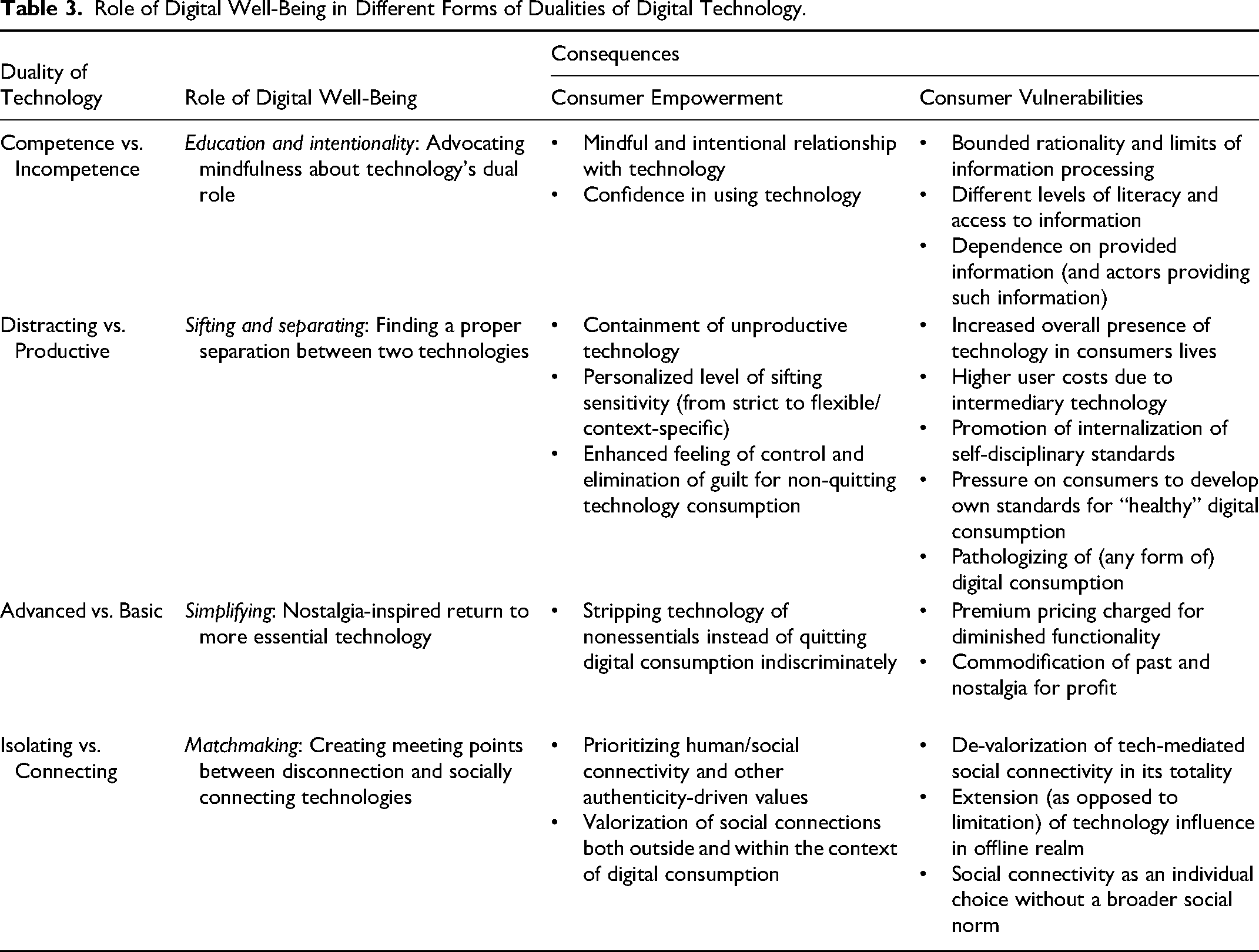
Further, a broader sociological (Lupton, 2010) reading of texts was conducted by placing the identified themes and meanings in connection with wider social discourses and academic knowledge. This was done to project the possibility of consequences of different versions of digital well-being in terms of consumer empowerment and consumer vulnerabilities (see last two columns in Table 3), and it required connecting the interpretation of digital well-being with the extant literature in such fields as health and food marketing research, psychology, technology, political economy, and ethics.
Findings
Not one, but multiple versions of technology dualities structure market discourses of digital well-being. In each, digital well-being is negotiated as a balance between two sides of the technology in its own distinct way (see Table 3). Each of the multiple versions of digital well-being also creates distinctive sets of potential consequences, both in terms of empowering consumers toward their well-being goals and (inadvertently) leading to consumer vulnerabilities. This section will outline the premises and define the role of digital well-being solutions for each set of dualities using illustrations from the empirical dataset and reflect on the (potential) consequence of their underlying logic in terms of consumer empowerment and vulnerabilities by engaging with the extant literature.
Competence vs. Incompetence
The first version of technology duality distinguishes between users’ ideal and the real-life competence level. Based on the belief that power is knowledge, it is intended that the proper use of technology can facilitate gratifying and liberating experiences and vice versa, whereas improper use will result in negative experiences of restrictions and inefficacy. Thus, the problem is not technology per se but the consumers’ inadequate skill set and/or relationship with technology. As provocatively put by a Japan-based digital well-being coach from Lowsalt Internet Movement: People who simply let the information presented to them flow through their eyes and ears without heeding it are no different from livestock that only eat as much as they are given. [. . .] To put it simply, just as food makes the body, information makes the brain. If that's the case, it's natural to be careful about the information you put into your head, just as you are careful about the food you eat.
Building on legitimization of technology as neutral (cf. Miller, 2021), this vision conceptualizes digital well-being in terms of consumer education, better-informed decisions, and overall mindfulness and intentionality when it comes to technology consumption's benefits and threats. Increasing consumer awareness about the dangers of passive consumption is considered the first step in consumer education. In the context of digital well-being market offerings, it is often conveyed to consumers in terms of sensationalist titles and appeals of shocking revelation, such as in the following example from one of the leading digital well-being education providers, Digital Wellness Institute: There is no doubt that we spend a lot of time in front of screens. The question is: How much time is a lot? The precise number will surprise you, often more significant than you expected. In the United States, the average time spent in front of screens is 7 hours and 4 minutes, according to DateReportal. Our phone time is almost equal to our sleep time, which is shocking. Compared to the time you devote to other activities during the day, it occupies a considerable portion of your day. Countries around the world differ on the average time spent on screen. Some European countries, such as the UK, have a lower average, closer to 6 hours. Other countries have much higher averages, such as South Africa, which is over ten and a half hours. Being more mindful of what we do on a mobile phone, and how we do it, is now a choice. [. . .] The Punkt. phone helps you choose what you wish to do, without being drawn in to the things you don't, making for better mental well-being, a healthier relationship with your tech, and with others around you. While there are other apps available that are designed to restrict phone usage, AntiSocial feels strongly about empowering the user by giving them the information they need to take necessary action. This is done through the clearest and most simple interface available and is the only app to deliver detailed reports full of all the information you need to make an informed decision. Once installed, AntiSocial works in the background of your phone without you even knowing it. It accumulates all of your activity and delivers an easy-to-understand report. More importantly, you will be able to learn whether you use your phone more or less than everyone else. Knowledge is power, and from there it's up to you whether you want or need to take action to control your cell phone usage.
On top of guiding informed decisions, self-tracking is set to function as a panopticon (Foucault, 1975), where the mere thought of visualization of one's technology usage statistics leads to a more disciplined consumer conduct. The digital well-being market emphasizes that self-tracking is not only knowledge-enhancing but also “motivational” per se. An app called Attentive put it as follows: To reach your screen time goals, visualizing and celebrating your achievements is key. Insights lets you see your personal growth and self-improvement at a glance. It's a perfect habit tracker for staying motivated and on course towards better phone habits. Feel great for making progress!
While the digital well-being market players’ propositions might seem new due to the market's young age, information remedies have been studied and criticized as inefficient in other consumption realms where education was proposed as a meaningful solution, such as healthy eating (Silchenko & Askegaard, 2021) or financial responsibility (Pellandini-Simányi & Conte, 2020). From a psychological perspective, there are substantial limits to information remedies due to the bounded rationality problem (Kahneman, 2011; Simon, 1991; Tversky & Kahneman, 1974), which suggests that individuals are unable to make perfectly weighted rational decisions due to lack of resources, time, or limitations of human brain capacities in processing information perfectly. Further, knowledge alone is rarely useful unless it is combined with the motivation to act on that knowledge (Moorman, 1990).
Equating digital well-being to information remedies and consumer education raise other concerns too, including those about inequalities. Access to information and capacity to interpret it properly is unequally distributed, generally speaking, and the inequality aggravates in the digital context (Hill & Dhanda, 2004). The digital divide continues to affect consumers all over the world due not only to unequal access to computers and the Internet but also to its more subtle expressions, such as inequalities in digital skills and the benefits one can derive from the use of digital technologies (Lutz, 2019). Moreover, structural constraints, such as social class and economic means, are largely underestimated when well-being solutions are framed in terms of information and education.
Finally, in Foucauldian reading (Foucault, 1980, 2001), information and education-based remedies advanced by this vision of digital well-being represent instances of disciplinary power. This creates a situation of vulnerability for consumers whose well-being becomes de facto dependent on the knowledge possessed and provided (upon payment) by the profit-driven business actors. Considering the political history of the origins of positive computing tenets rooted in the disciplining of human subjects (Valasek, 2022), digital well-being framed in competence vs. incompetence terms may be inadvertently enforcing social and economic inequalities.
Distracting vs. Productive
Different from the first approach, duality of technology can be seen in terms of productivity. On the one hand, digital technology is indispensable for achieving life and professional goals, sense of achievement, and life balance. On the other hand, some forms and/or occasions of digital consumption are distracting. When multiple attention-grabbing patterns built into modern technology interfaces combine, the results can be overwhelming for the consumers, as the Attentive app, for example, emphasized: “We’re all navigating a world full of distractions: with just one tap away, what starts as a quick look at a text message can easily escalate into 30 min of random scrolling and news checking.”
In addition, digital distractions may result not only in occasional drops in productivity but eventually can become utterly detrimental for focus and quality of life. One of the pioneers in the digital well-being market, Digital Detox, expressed it as follows: Your focus turns to frazzle. The weight of digital stress slams into your chest. You bury your head in your phone while real life whizzes by—just outside of your periphery. And it disconnects you from others. Being present with your family, your kids, and your friends becomes impossible. Interpersonal skills go extinct. Social media increases your anxiety. So do the hundreds of notifications that demand immediate attention every day. You feel as if you just. can't. keep. up. Our physical and mental health suffers, and we lose precious time. We spend an hour on our phones before we go to sleep. And we wake up a decade later, unsure where all the time went. While the simplest solution we found was to simply stop taking our phones with us everywhere or switch to a flip phone, we quickly realized how important smartphones have become. We use them to hail a ride, document our days with pictures and notes, get directions, and countless other things that truly enhance our daily lives. By giving up our smartphones, we would be forced to give up these luxuries we so take for granted.
In this scenario, the opportunity for achieving digital well-being derives from the conviction that digital consumption's distracting forms and occasions can be contained with the help of special tools and rule-based techniques. Digital well-being market offerings subscribing to this position therefore act as sifters that separate technology's distractive and productive aspects. This can be achieved via blocking of undesirable distracting content or restricting access to certain features, apps, software, or even hardware to protect consumers from being “betrayed by their own fingers.”
The separation benefit offered by digital well-being solutions can come from both stricter and softer approaches. The market offers a great range of sifter sensitivities, depending on their target consumer worldviews and contexts of application. Scrolling through a LinkedIn feed can be classified by some consumers (or on some occasions) as a productive professional networking activity, and by others (and on other occasions) as compulsive social media doomscrolling. Thus, for those who seek decisive solutions to their self-diagnosed “addiction” or those doubting their self-control, the benefits of stricter forms of separation loom large. Market offerings in this case would offer irreversible setups of time-based or location-based blocking as well as all-or-nothing types of access restrictions (see Figure 2).
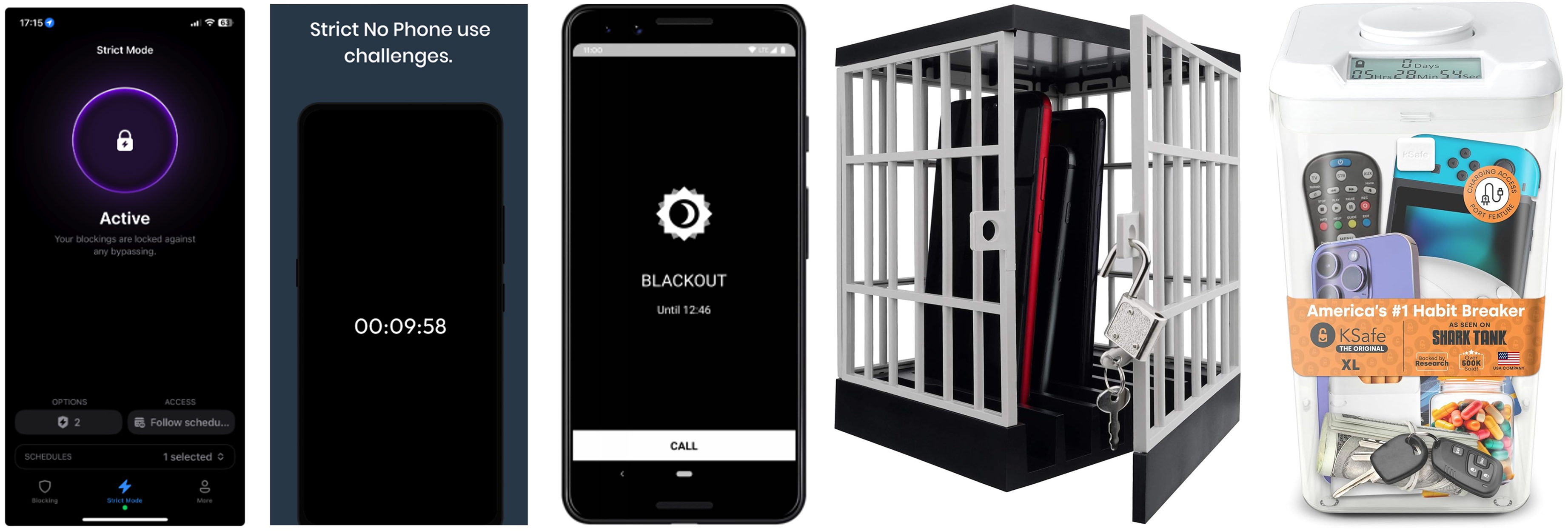
Examples of digital well-being market offerings providing strict blocking of undesirable distracting content, gadgets, or their select features. Sources (left to right): AppBlock; Anti Addiction: Screen Time; Blackout; Jail Lock box; kSafe.
Other forms of commitment devices (Bryan et al., 2010) such as setting the lists of sites that are safe (vs. unsafe) to consume, programming the rules for device block activations, pledges made with friends, family or coworkers, or placing a bet against oneself are used as well. Several involve other people, the so-called accountability partners, as gatekeepers, such as the example of the Clearspace app: Sharing your screen time password with friends or family is a great way of holding yourself accountable when trying to achieve certain goals. Giving access to others who understand what needs to get done but do not have direct control over it themselves can provide an extra layer of accountability. It also gives those same friends permission (but not obligation) to check up on progress from time to time so there is always someone around keeping tabs on where things stand at any given moment.
This is currently achieved by providing such functionalities as rule pausing, rule exemptions, on-demand rule change, and setting allowances. Similarly to Baggaley’s (2012) conceptualization of (dis)connectivism as a continuum, these softer sifting solutions build on the assumption that “it is important to be able to shift dynamically between connectedness and disconnectedness at the right moment, just as one changes one's clothes to suit the weather” (2012, p. 122).
In addition to straight blocking, sifting can also be achieved thanks to subtler nudges and frictions (see Figure 3). Different from blocking, such actions do not overtly constrain digital consumption but merely activate users’ own self-control, as shown in the quote from Are you sure? extension: Are you sure? is a simple extension to help you stay productive on the internet. Distracting sites can be fun, but it's too easy to just visit them without thinking. You can be in the middle of some important work and, before you know it, your fingers have betrayed you and you’re looking at cat gifs again. This extension just pops up a simple dialog box asking “Are you sure?” when you visit a distracting site. It doesn't try to stop you, just helps you be aware of what you’re doing so you can make a fully informed decision. It will ask at most once every 5 minutes by default.
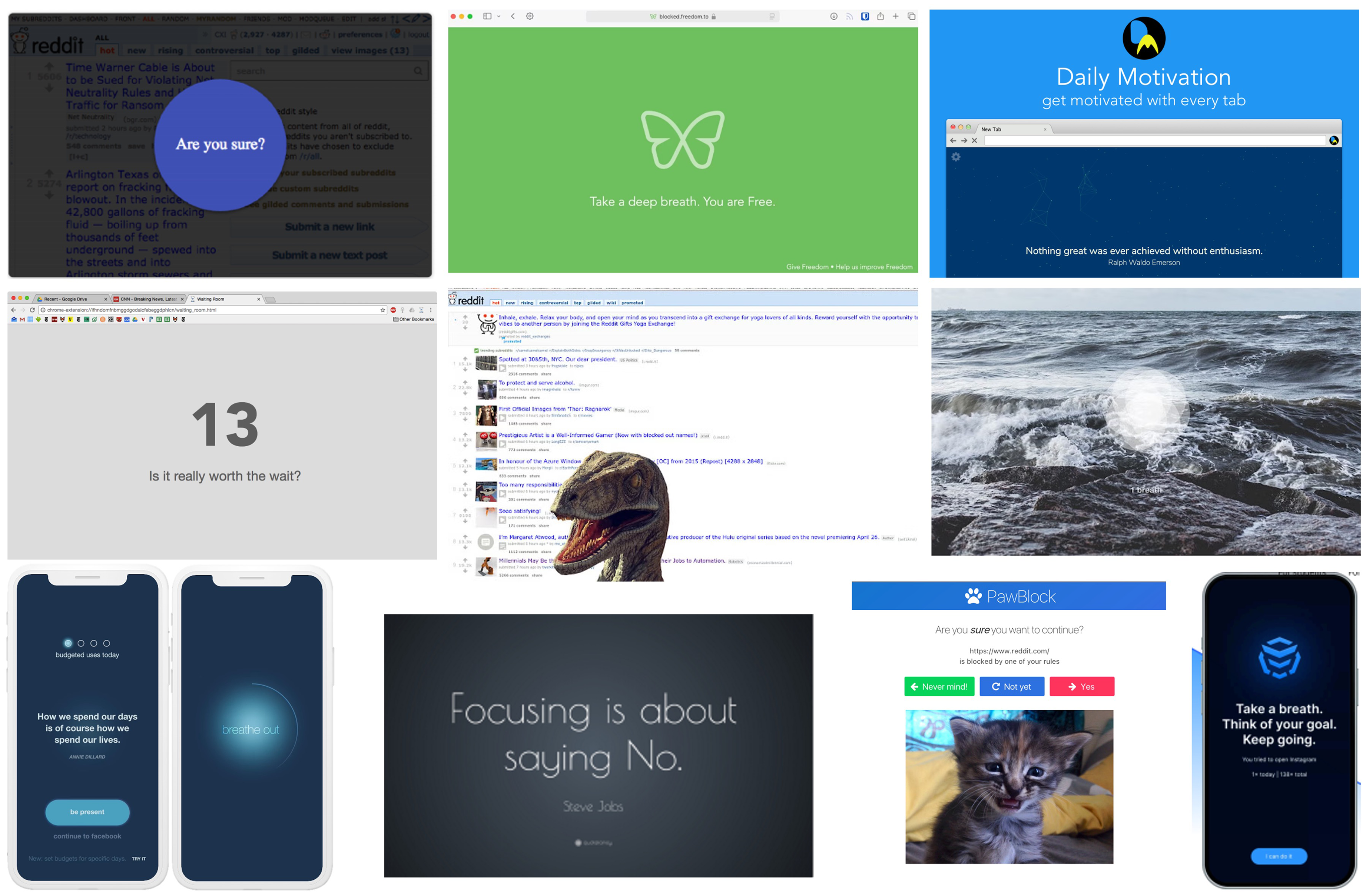
Examples of nudges and frictions used by digital well-being apps and browser extensions. Sources (left to right, top to bottom): Are You Sure; Freedom; Daily Motivation – Motivational Quotes; Delayed Gratification; ANNoy Distractions; Breathe: Website Blocker; Clearspace; Concentrate; PawBlocker; Appblock.
All of the above approaches provide the feeling of being in control and using technology “on your own terms” as well as eliminating guilt about continuing to use technology despite being fully aware of its distractive character. As the promoters of the Brick device put it, the objective is “to keep my phone as a tool, not a distraction.” In contrast, a more critical reading of digital well-being benefits framed in terms of distraction and productivity leads us to consider a number of challenging consequences for consumers.
First, while the introduction of intermediaries specifically tasked to separate distracting from productive technology can be useful, it also increases user costs, both monetary and nonmonetary. In addition to the monetary cost of the blocking app itself and the nonmonetary costs of its choice and installation, we are also talking about increased use (and therefore costs) of web traffic, the device's working memory, higher battery recharge rates, etc. Ironically, this means that consumer strategies of technology restriction increase the overall amount of technologies present in consumers’ lives, with related consequences in terms of big data, privacy, dependence on tech, and growing environmental impact.
Second, digital well-being framed in terms of precommitment and self-discipline puts additional pressure on consumers to control themselves and adhere to their commitment. Such promotion of the internalization of self-disciplinary standards clashes with psychological and behavioral economics insights into the limits of individuals’ disciplinary capacities (Thaler & Sunstein, 2008).
Furthermore, considering the utmost level of flexibility when it comes to the guiding principles of separating technological distractions and efficiencies, the pressure is once again put on the consumers themselves to come up with their own definition and benchmarks for the appropriate level of “healthy” digital consumption and choose the right course of action despite constantly changing elastic rules, forcing them into a condition of restlessness (Lezaun & Schneider, 2012). Consumer restlessness entails the effort of continuously deliberating on what is and is not correct and nervously shifting one's own stance, which may eventually desensitize consumers in the end cause whatsoever.
In the situation of the de facto absence of standards and the flexibility given to consumers, this also means that virtually any type of digital consumption can be pathologized and defined as inefficient, unproductive, distracting, and even addictive. The digital well-being market uses the medicalized framing of addiction disproportionally, often sweepingly equating virtually every digital consumer to an addict, with such claims as “If this [feeling of addiction] sounds familiar to you, don't feel bad—you are not alone! You are just a modern day tech user like all of us!” (Attentive app). And yet, pathologizing consumer as addicts is worrying per se not only due to digital addiction's controversial status in clinical terms (Orben & Przybylski, 2019; Wadsley & Ihssen, 2023) but also to its potential to trivialize the suffering of those who are seriously affected both physiologically and mentally and to reinforce inequality with regard to consumers traditionally associated with addiction or those with preexisting health conditions (Aagaard, 2021; Beattie & Daubs, 2020; Sutton, 2020; Valasek, 2022).
Advanced vs. Basic
Another duality positions technology in terms of its evolution. The premise here is that technology, in its basic form, is neutral (cf. Miller, 2021) or at least non-detrimental to human well-being. Yet, the advanced forms of technology have evolved over time into more complex and contradictory formations, which have counter effects on consumer well-being. Punkt. conveyed it as follows: Technology can bring great things, but like any good relationship, there should be healthy boundaries. The tendency to add “more and more” to tech products has placed an increasing burden on us. As we spend more time looking down at a screen we are missing the opportunity to look up, look around and engage with life.
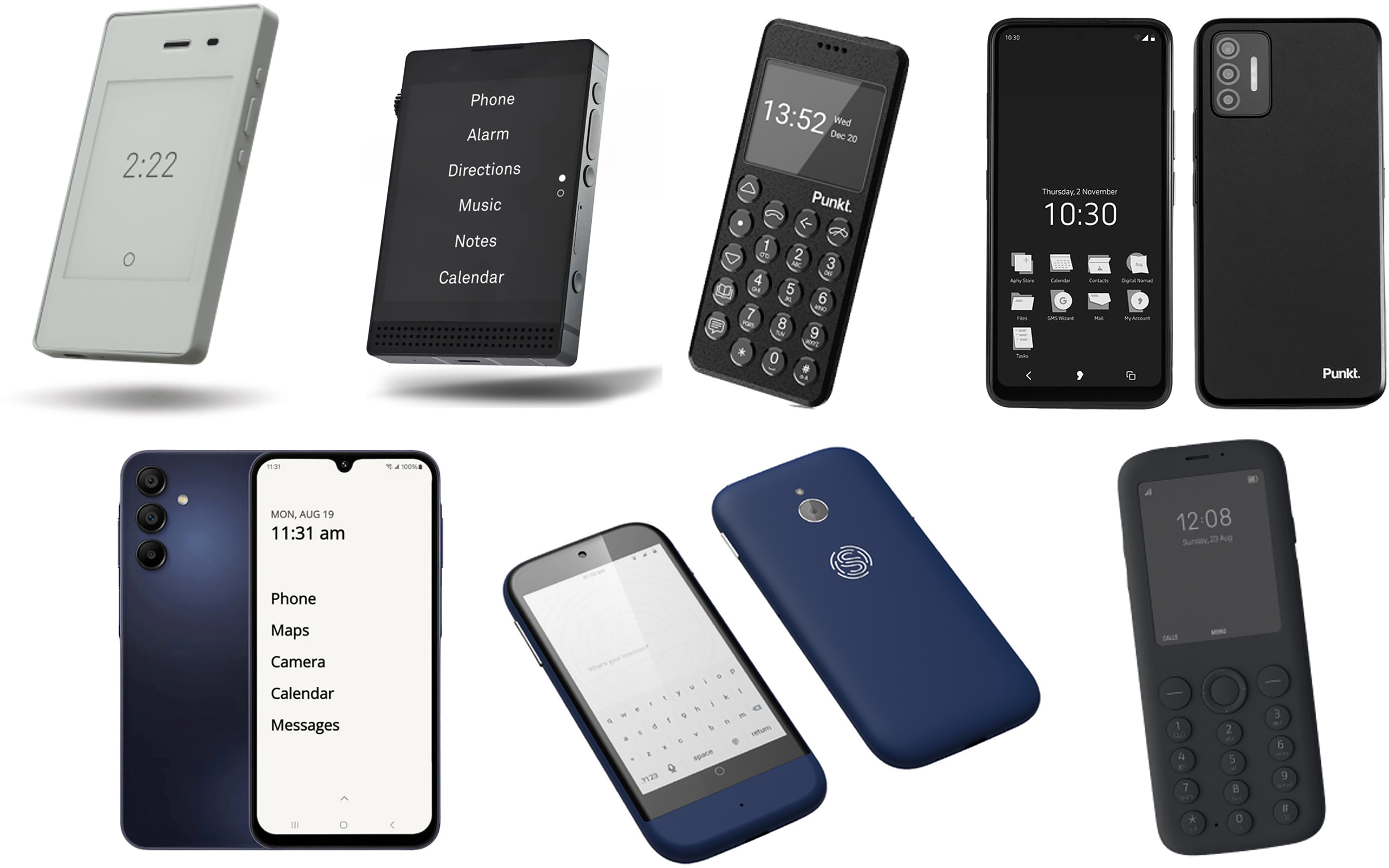
Examples of minimalist smartphones. Sources (left to right, top to bottom): Light Phone II, Light Phone III, Punkt MP02, Punkt MC02, Wisephone II, Siempo, Mudita Pure.
Alternatively, simpler minimalism-based interventions can be implemented with or without special software (often with the help of guidance from well-being coaches), such as cleaning up the home screen or turning colored phone displays into grayscale. For example, the Clearspace app promotes “a variety of features and benefits that aid in dumbifying your smartphone,” including the following: Turning your iPhone to grayscale is one of the quickest and simplest ways to promote healthier interaction with your device. Grayscale strips away the eye-catching allure of vibrant colors, which apps use to keep users engaged, reducing the “digital dopamine” that often leads to addictive scrolling and excessive screen time. The lack of color can make the device less stimulating, helping to curb device usage and promoting an overall healthier amount of screen time engagement. When we are living our lives through hyper-connectivity, going light is a profound shift. Our users describe the hours they get back each day, and the peace of mind that comes from more intentional internet usage. [. . .] Going light can be whatever you’d like it to be. Stay present during precious moments. What are you missing out on when you pull out your smartphone hundreds of times a day? Life is just too short. Take your passions seriously. Going light gives you space you need to focus on what really moves and inspires you. A breath of fresh air. It's so refreshing to break free from your smartphone habits and the perpetual feeling of missing out and needing to check and re-check.
Finally, is it actually fair to charge a premium price for reducing, not adding, functionalities? It seems that, just like in the food domain, price functions as an index of superiority that helps distinguish healthier alternatives from standard-level options (Silchenko & Askegaard, 2021). At the same time, establishing digital well-being as a luxury premium product excludes lower-income consumers from the equation (Syvertsen & Enli, 2020; Valasek, 2022). Such a situation further exacerbates the economic inequalities among individual consumers and among more and less developed markets.
Isolating vs. Connecting
Similarly to the advanced vs. basic duality, nostalgia and romanticism drive another technology duality, where the specific focus emphasizes socialization. On the one hand, technology is believed to enhance human interaction via new forms of connectivity. On the other hand, it provides alternatives to real-world activities that debilitate “natural” social interactions, that is, those that take place outside the digital realm. In this perspective, digital well-being solutions aim at creating meeting points between disconnection from isolating technology and the technology that creates social connections. For instance, the Clearspace app has specified that the trickiest to achieve is the balance between being part of the digital and “real” worlds: With the holiday season just around the corner, you’re probably gearing up to enjoy a restful period with loved ones. However, heavy smartphone users may struggle to unplug and make the most of their time with family and friends. While digital technologies can foster connection in some contexts, research shows that high levels of smartphone use can negatively impact family harmony and happiness. After all, spending time with someone constantly scrolling social media feeds can be frustrating, demoralizing, and downright boring. [. . .] Unplugging during the holiday season isn't meant to be a punishment. By following some of the tips above, you could help your closest relationships thrive and discover parts of yourself you never knew existed. Just remember to ease yourself back into the digital world carefully when the new year hits, using the lessons you’ve learned to pursue a more balanced approach to technology use.
In addition to travel, disconnection can be achieved using technology itself. For instance, technology based on Faraday cages offers the chance to reconnect to social life by literally disconnecting smartphones from Wi-Fi, 3G/4G/5G, Bluetooth, and RFID signals when they are placed inside a box or a case. Stolp, a developer of digital well-being devices designed to keep smartphones silent and offline to avoid distractions, explained this as follows: Don't get us wrong. Phones are great. But despite all the good they bring, our bottomless scrolling habits and the culture of “always-on” comes at a price. We tend to disconnect from our environment and those around us we care for most. Take back the dinner table or movie night. Have everyone drop their phone in the Stolp Phone Box for 30 minutes. You’ll be amazed at how much togetherness and flowing conversations you’ll rediscover. For more slowing down. For more time being present with those you love.
In addition to escapist digital detox experiences, the digital well-being market provides numerous tips and “hacks” on how to substitute technology habits with meaningful alternatives such as work, study, personal projects, hobbies, sleep, play, and other instances of “offline life.” Based on his personal experience, an Italy-based coach of the Digital Detox Logout Livenow training course, described the substituions that he encourages users to adopt as follows: Many times I made the gesture of taking the phone out of my pocket to show, record, capture a moment or search for something on Google. But this is more than normal, especially because it is an automatic behaviour of our mind, it is more than a habit. So since I didn't have my phone with me I had to find other ways to do these things: When you want to show something, you can simply describe it; When you want to cook, you can experiment without the help of the recipe on the internet. Nobody will die, perhaps . . . When you want to ask for something that you cannot describe in another language, try to make it understood with gestures and other words, without the translator. Ok, in fact we Italians are already masters in this; When you get lost in the car, ask the locals and not Google Maps; When you want to capture something, you can simply live it; When you have to remember something you can write it down on a piece of paper.
Alternatively, the digital well-being market positions digital technology itself as the space for reconnection to the present moment, to the self, as well as to the (significant) others. For example, the “smarter” minimalist phone Punkt. adopts voicephone-first functionality “that makes texting not impossible, but definitely more tedious in order to prefer a synchronous interaction via voice.” In other cases, digital well-being market offerings promote some forms of social competitions, social comparisons, and involvement of accountability partners in the process of implementing consumers’ self-help strategies.
When digital well-being relies on the socialization-focused technology duality, this too creates a number of potential challenges. First, contrasting offline socialization with online leads to devalorization of technology-mediated social connectivity in its totality. And yet, “we are no less social when we are online” (Sutton, 2020, p. 17), and past research has established a vast number of positive implications of connectivity for consumer well-being (Belk, 2013, 2014; Brooks, 2015; Ellison et al., 2022; Ganju et al., 2016; Handelman, 2022; Hart, 2017; Hoffman & Novak, 2012; Jensen Schau & Gilly, 2003; Tagg & Seargeant, 2016). In the case of marginalized individuals and communities (Bruhn & Rebach, 2014; Ekpo et al., 2018; Fletcher-Brown et al., 2021; Hård Af Segerstad & Kasperowski, 2015; Kamarulzaman et al., 2016; Yalamanchili et al., 2023), these effects amplified as online communication and socialization can help them overcome isolation and reinforce (personal and social) self- identity construction.
Second, when technology is used to prioritize (or even remind about) human connectivity, this may ironically lead to the extension (as opposed to limitation) of technology's influence in non-technological realms. Not to mention that such a situation would lead to intensification of surveillance and expansion of data collection from online to offline activities as well.
Finally, social connection clashes with the overall stance of the majority of well-being market offerings’ value propositions that are based on the premise of an individual choice. And yet, communication and social connection require, by default, more than one individual. So, an individual-driven quest for enhanced sociability can hardly be successful unless it becomes part of a wider social norm (see Nunan & Di Domenico, 2013).
Discussion
Driven by goal of making better sense of the emerging market of digital well-being through the lens of technology dualities, the present analysis emphasizes that technology consumption is indeed based on the perpetual non-resolution of the oppositions that structure our understanding of today's digital technology. As ambivalence and conflicts between technology's antithetical structuring conditions are inevitable, the digital well-being market in itself is an act of consumer coping that combines avoidance with confrontation, while using the same set of tools and possessions (i.e., Internet browser and smartphone). Though the digital well-being market emphasizes the negatives of technology to justify its existence, it is precisely the interaction and the interpenetration of the opposing poles of technology dualities that supports it. Furthermore, the coexistence of multiple dualities highlights the dynamism of social renegotiation around the role of technology in consumers’ lives. Consequently, the technology duality's non-resolution results in digital well-being market offerings that simultaneously create consumer-empowering solutions, yet also further complicate consumer relationship with technology due to (inadvertently) also contributing to consumer vulnerabilities.
Theoretical Contributions
The study makes several contributions to macromarketing. Firstly, it offers an in-depth analysis of the emerging concept of digital well-being by examining not only the interdisciplinary theory-building but also the market phenomena that both shape and are shaped by the social discourses at the intersection of concerns about technology and consumers’ quality of life. Based on the empirical examination of market discourses of a vast number of digital well-being market offerings, this study further emphasizes the simultaneous interplay of consumer empowerment (Denegri-Knott et al., 2006; Papaoikonomou & Alarcón, 2017; Shankar et al., 2006) and consumer vulnerabilities (Baker et al., 2005, 2007, 2015; Commuri & Ekici, 2008). Current digital well-being solutions offered to consumers, instead of affording a permanent equilibrium between the two technologies, rather perpetuate an ongoing paradoxical (Mick & Fournier, 1998) fluctuation between empowering and threating consequences on consumer well-being, both on individual and societal levels.
Second, this study enriches the ongoing theoretical conversation surrounding the concept of digital well-being (Burr & Floridi, 2020; Lyngs et al., 2019; Monge Roffarello & De Russis, 2019, 2023; Vanden Abeele, 2021; Vanden Abeele et al., 2022) by showcasing not one but a range of modalities with which the digital well-being market positions itself in the act of balancing between two opposing poles of technology. Each of the modalities derives from a different conceptualization of technology and its forces in regard to consumer well-being and therefore employs different meanings to negotiate in between the duality of digital technology. These meanings are also translated into different sets of functionalities offered by the digital well-being market offerings to their consumers. Furthermore, application of technology duality lens adopted in this study allows to reflect back on the common premises of digital well-being definitions used in the academic literature (see Table 2). Adding nuance to the previous conceptualizations, this study shows that digital well-being is growingly treated as not merely one of the many components of generalized well-being, but as the common thread uniting a variety of both micro-level individual and macro-level structural contributors to consumers’ quality of life due to technology's growing influence in all realms of social life. Rather than neutralization of the negative side effects of modern technology, digital well-being appears to be concerned with dynamic (re)negotiation between the opposing poles of technology dualities. Duality perspective as a matter of fact shows how the opposites co-construct each other, making neutralization of either one unattainable. Consequently, considering the dynamic interplay involved in digital well-being, it would be more appropriate to talk about it in terms of balancing rather than of balance.
Third, this study provides a needed critical examination of digital well-being and its market (see e.g., Valasek, 2022). The results of this study serve as further confirmation of how digital well-being is almost unequivocally equated with an individual responsibility (Jorge et al., 2022; Monge Roffarello & De Russis, 2023; Van Bruyssel et al., 2023; Vanden Abeele et al., 2022). Despite the digital well-being market being a response to a market failure (Redmond, 2018) of the hyperdigital markets driven by the logics of surveillance (Airoldi & Rokka, 2022; Zuboff, 2019) and the attention economy (Bhargava & Velasquez, 2021; Cloarec, 2020), it is still the consumer who is responsibilized (Giesler & Veresiu, 2014; Shamir, 2008) to be self-motivated and disciplined to actuate self-improvement strategies in terms of self-education, self-help, and consumption of tools specifically designed for their digital well-being quest. In turn, responsibilization leads to increased burden and blame on individual consumers for the failure of their strategies and enforces social and economic inequalities. It further diverts attention from structural macro-level solutions, such as regulation change, economic reforms, or sociocultural norms change, which can range from, for instance, reduction in employment and domestic labor hours (Valasek, 2022) to the building of a digital well-being culture of care about others while engaged in communication online (Gui et al., 2017).
More broadly, the disproportional focus on self-optimization and productivity advanced in the analyzed market discourses leads to a question about the implications of digital well-being on our understanding of consumer well-being per se. Is digital well-being contributing to a joyless consumer culture, where everything is about self-control, discipline, setting the limits, and maximizing personal ROI? Is the “productivity imperative” (Valasek, 2022) leaving any space for more hedonic values and experiences necessary for well-being? Is this striving for human optimization a symptom of growing technophobia influenced by the growth of AI and the perceived threat of substitutions of human workers (or maybe even human consumers/choice-makers)?
In its current shape, the market of digital well-being offers only some rare exceptions to the overwhelming focus on consumer responsibilization and optimization. For instance, some market players overtly emphasize in their marketing communication that the offered digital well-being solutions should be adopted at the corporate and organizational levels, not only the personal level. This would redistribute the burden of personal responsibility across the entire social group and help build the social norms of balanced technology use. Google itself, in its digital well-being rulebook, promotes such ideas as digital citizenship and respect for other users, yet without providing specific tools to realize them. However, such ideas remain thus far exceptions in the dominant discourses characterized by personal blame for digital addiction. The predominant approach of the digital well-being market is to mobilize individual resistance to the structural failures of the hyperdigital marketplace—akin to mobilizing consumers to address the “Goliath” of digital technology from the position of a “David” empowered by digital well-being tools and hacks. The debates about how to responsibilize the industry, remodel the current problematic systematic practices, or introduce alternative systems are timid in comparison. Responsibilization-based solutions are positioned as realistic things that anyone can actually do, while the alternatives are merely mentioned as idealized—yet unrealistic—solutions. Even the rare virtuous counterexamples present in the market somehow perpetuate the idea of unattainability. For example, Punkt., a minimalist smartphone producer, in many ways challenges the status quo by, among others, developing its own alternative operating system, Apostrophy OS, concerned primarily with privacy and data ownership. It further designs its products with a sustainability mindset focusing on durability and reparability as well as on the possibility of using its gadgets as platforms that would decrease the overall amount of technology in individual consumers’ lives and homes. And yet, compared to a plethora of freemium or 99-cent apps, Swiss-designed and premium-priced Punkt. products come off as a luxury realistically available only for an extremely restricted group of consumers.
Limitations and Further Research
A critical inquiry into digital well-being, although leading to a number of insights and some conclusions, also opens new avenues to many more questions and further research directions. For instance, building on the conceptualization of digital well-being as a balance, this study revealed a range of possibilities of different balances based on different technology dualities. However, if technology is conceptualized differently, such as an assemblage of human and nonhuman actors (cf. Hoffman & Novak, 2018), would it still make sense to see digital well-being's role as a balancing act? Or would a different trope be needed?
Due to the perimeters of the present research design, the sample included primarily digital tools, such as apps and browser extensions. Although the sample was expanded with the addition of info products, hospitality services, and some gadgets, the present description of the digital well-being market cannot be considered exhaustive. The market offerings (and the surrounding discourses) in this domain constantly evolve, and therefore the data needs to be read in connection with the specific time frame of data collection and analysis (January–August 2024). A longitudinal focus on digital well-being market emergence and historical evolution may shed new light and help understand it better. Similarly, the focus on market discourses excluded both consumers’ voices and the policy perspective, both of which can be meaningfully researched to advance our understanding of the complexities that orient consumer well-being in the context of the hyperdigital marketplace.
A critical and interpretative inquiry presented in this paper could also build up to the advancement of the research aimed at refining measurement indicators for digital well-being in particular and, more generally, indicators of consumer well-being that includes digitally related quality of life. While some attempts to measure digital well-being subjectively, in psychological tradition, have been made (Monge Roffarello & De Russis, 2023; Vanden Abeele & Nguyen, 2024), the question of macro indicators remains a promising avenue for future macromarketing research.
Footnotes
Acknowledgments
The author would like to thank the Editors and three anonymous reviewers for their constructive criticism and actionable feedback. I also thank track chairs and participants of the 49th Annual Macromarketing Conference organized by the University of Helsinki and Hanken School of Economics for their encouraging comments on the earlier version of the manuscript. A special thanks to Maddalena Vidale, Sara Viavattene and Lapo Edoardo Van Den Berg, Student Assistants at the Università della Svizzera italiana for their help in data collection.
Associate Editor
Alexandra Ganglmair-Wooliscroft
Data Availability Statement
The datasets generated during and/or analyzed during the current study are available from the corresponding author on reasonable request.
Declaration of Conflicting Interests
The author declared no potential conflicts of interest with respect to the research, authorship, and/or publication of this article.
Funding
The authors disclosed receipt of the following financial support for the research, authorship, and/or publication of this article: Università della Svizzera italiana's FIR (Fondo Istituzionale per la Ricerca) 2022 grant supporting Early Career researchers.
