



Abstract
This article contributes to the debate on the enterprise culture, which is characterised by the celebration of risk-taking and self-realisation, which in turn also implies self-responsibilisation and atomisation of the workforce. It does so by investigating organisations created with the aim of finding alternatives for freelancers, who epitomise the processes of individualisation typical of late capitalism. The organisations studied, both companies and cooperatives, aim to enable freelancers to combine autonomy in running their business with access to labour and social rights and inclusion in a collective. Drawing on a multiple case study conducted in France and Italy, the article investigates how organisations can counteract the processes of self-responsibilisation and atomisation of the workforce by enacting principles typical of alternative organisations. This study thus provides a twofold contribution to critical organisational theory and sociological literature on the individualisation of work and feasible alternatives to it. Our findings show, first, that the enterprise culture can be challenged through alternative organising even when freelancers – a category of workers embodying the contemporary processes of individualisation – are at stake. Second, the study of these emerging organisations also contributes to the flourishing debate on alternative organisations by adding an original empirical contribution to ongoing reflections on alternatives to market capitalism.
Keywords
Introduction
During recent decades, all spheres of life have been increasingly permeated by economic notions such as profitability, investment or self-responsibilisation, which have given rise to an ‘enterprise culture’ whose effects, in Western countries, can be perceived at the political, organisational and individual levels (Du Gay, 1996; Gorz, 2001; Rose, 1990). This dynamic was already identified in the 1970s by Foucault (2008[1979]: 226), who argued that the subject tended progressively to perceive themselves as an ‘entrepreneur of himself, being for himself his own capital, being for himself his own producer, being for himself the source of [his] earnings’. By praising autonomy, risk-taking and self-reliance, the diffusion of an enterprise culture fostered processes of individualisation and contributed to the emergence of enterprising selves, urged to assume the entire responsibility for all the hazards affecting their lives and careers (Beck, 1992; Beck and Beck-Gernsheim, 1996; Sennett, 1998). Freelancers epitomise these processes (see Boltanski and Chiapello, 1999), as they embody both the celebration of self-realisation and the self-responsibilisation of the workforce, based on transferring to individuals the responsibility for all the risks and costs connected to their work (Fleming, 2017; Moisander et al., 2018). Because of their legal independence, freelancers are indeed deprived of the social rights and protections associated with wage-employment, and the market pressures may lead them to enter competitive logics, giving rise to an isolation that is difficult to cope with (Kallinikos, 2003; Storey et al., 2005; Vallas and Cummins, 2015).
In response to this phenomenon, particular organisations have emerged to improve the social protection of freelancers while preserving the autonomy in running their business (Bajard and Leclercq, 2019; Bureau and Corsani, 2017). By adopting different legal statuses and contractual arrangements these organisations become the formal employers of workers who have their own clients and autonomously negotiate their rates, as genuine self-employed workers would do. But instead of creating their own enterprises, these workers use the legal umbrella of the employer structure to bill their clients and benefit from the rights typical of wage-employment. These organisations also claim to allow freelancers to escape isolation by joining a collective based on mutualisation and solidarity (Charles et al., 2020; Martinelli, 2017).
This article investigates whether and how the dominant model of the enterprise culture and the celebration of self-realisation and self-reliance can be challenged. How can organisations counteract the processes of self-responsibilisation and atomisation of workers? How can they offer alternatives to a category of workers embodying the contemporary processes of individualisation? To answer these research questions, we conducted a cross-national multiple case study within five freelance organisations in France and Italy, two European countries where access to social protection has been historically connected to wage-employment (Córdova, 1986; Supiot, 1994).
The contribution of this article is two-fold. By analysing organisations aimed at preventing freelancers from individual confrontations with the market, this research shows how the dominant enterprise culture can be challenged, even in the case of a category of workers epitomising the processes of individualisation. In particular, it sheds light on organisational attempts to counteract individualised forms of work and propose an alternative to self-employment for freelancers. The study of these emerging organisations, therefore, also provides an empirical contribution to the ‘library of alternative case studies’ (Parker and Parker, 2017: 1382) that several researchers are calling for, suggesting alternative dimensions of organisations currently overlooked in the debate.
The remainder of this article is structured as follows. First, we present the theoretical framework, discussing the enterprise culture epitomised by freelancers and the alternative potential of freelance organisations to undermine the dominant logic of individualisation. We then describe the research context and the methodological approach and present our empirical findings on the freelance organisations studied in France and Italy. We finally discuss these results underlining the potentialities and ambivalences of such organisational answers to work individualisation and emphasising the contributions of this research to a wider discussion on alternative organisations and collective attempts to counteract the norms of enterprise culture.
From individualised workers to alternative organisations?
An enterprise culture embodied by freelancers
The growing diffusion of an ‘enterprise culture’ has been affecting Western societies at different levels, extending the logics of profitability and self-responsibility far beyond the frontiers of the firm (Du Gay, 1996; Gorz, 2001; Rose, 1990). Many researchers have analysed how this political, cultural and managerial shift is reflected in the subjective construction of individuals, who are enjoined to become ‘entrepreneurs of themselves’, therefore seeing themselves as a capital to be managed and taking responsibility for their destiny (Foucault, 2008[1979]; Gorz, 2001). This exhortation to personal responsibility goes hand-in-hand with a celebration of work autonomy and a valorisation of self-realisation through entrepreneurship (Beck and Beck-Gernsheim, 1996; Miller and Rose, 2008). Moreover, it contributes to dissolving the sense of collective belonging by fostering competitive logics among individualised workers (McCabe, 2008; Rose, 1992; Sennett, 1998).
If the enterprise culture conveyed by managerial discourses affects employees’ subjectivities (Ekman, 2014; McCabe, 2007), its implications are even more significant in the case of freelancers, who usually work on their own and set up a business without the protections connected to wage-employment (Fleming, 2017; Moisander et al., 2018). Freelancers can therefore be considered emblematic of the emerging entrepreneurial subjects, looking for freedom while facing the consequences of highly individualised forms of work (Scharff, 2016; Storey et al., 2005). On the one hand, freelance work may reflect the growing desire of workers to increase their autonomy (Fleming, 2017; Hesmondhalgh and Baker, 2010). For individuals looking for a job they can manage independently, freelancing can represent a way of escaping the subordination relationship and to regain control over their work (Mondon-Navazo, 2017; Sturdy and Wright, 2008). The opportunity to organise their time and to refuse uninteresting assignments can in fact be perceived as emancipatory and empowering (Norbäck, 2021). On the other hand, the promise of autonomy is not always fulfilled, including situations in which workers are forced by their former employer to become legally self-employed without enjoying any kind of autonomy (Muehlberger, 2007; Spreitzer et al., 2017).
Focusing on the effects of these processes, not only on individual workers, but also on organisations and the wider economy, Fleming (2017) discussed how the current individualisation of the workforce relates to the diffusion of the human capital theory, which has found a wide audience, especially in the business world. By encouraging workers to take over the maintenance and enhancement of their skills, the human capital theory acted as an ‘ideological precipitator’ for the ‘radical responsibilisation of the workforce’, which makes workers – and especially freelancers – solely responsible ‘for all the costs and benefits associated with being an economic actor’ (Fleming, 2017: 692–693). Indeed, the management of social and business risks is increasingly transferred from employers to individuals, placing on the shoulders of freelancers the heavy burden of administrative and fiscal obligations that wage-employed workers usually do not have to deal with (Ainsworth and Hardy, 2008; Barley and Kunda, 2004; Storey et al., 2005). Moreover, being deprived of collective protection against unemployment, sickness or occupational accident, freelancers must assume individually the responsibility for any risk affecting their career, experiencing structural phenomena, such as unemployment, as a personal fate (Beck, 1992; Kallinikos, 2003).
The neoliberal prioritisation of individual responsibilisation also exacerbates the growing atomisation of the workforce, by redefining the relations of freelancers both with their peers and with the employees of the organisations contracting them (Moisander et al., 2018; Sennett, 1998). Freelancers working remotely do not enjoy a full integration into the collective dynamics of the company they are working for and, even when they work in the client’s premises, their specific position may impede their ability to share a collective identity or common claims with employees of the organisation (D’Amours and Crespo, 2004; Murgia and Pulignano, 2019). Because they are prompted to respond individually to market pressures, freelancers also tend to enter into competitive dynamics with their peers (Cross and Swart, 2020; Lane, 2011). The necessity to get more assignments can lead them to focus on increasing their individual visibility instead of building collaborative networks (Pink, 2001; Scharff, 2016; Vallas and Cummins, 2015). This contributes to dissolving the sense of collective belonging of freelancers and exposes them to a feeling of ‘aloneness’ (Ashford et al., 2018), which can easily become an experience of isolation that proves difficult to cope with.
The alternative potential of freelance organisations
The spread of the enterprise culture does not mean that workers passively absorb the exhortation to self-responsibility and competition (Fournier, 1998; Fournier and Grey, 1999). Beyond examples of subjective distancing regarding such logics (Alvesson and Willmott, 2002; Storey et al., 2005), a few studies have recently analysed attempts by freelancers to organise on a professional basis to counteract the ongoing processes of individualisation (Maestripieri and Cucca, 2018; Norbäck, 2021). In the European context, specific organisations have also emerged to gather freelancers from different sectors and offer them an alternative to self-employment (Bureau and Corsani, 2017; Murgia and de Heusch, 2020). These freelance organisations – at the core of our study – were created with the explicit aim of supporting freelancers by improving their access to social protection and including them in a community without encroaching on their business autonomy (Bajard and Leclercq, 2019; Charles et al., 2020).
The desire of many scholars to prefigure and make visible alternatives to capitalism has given rise to a flourishing debate on alternative organisations (see Gibson-Graham, 1996; Parker et al., 2007, 2014a; Zanoni, 2020; Zanoni et al., 2017). Empirical cases, such as intentional communities, workers-owned cooperatives, community currencies, local exchange trading systems or open-source communities have thus been increasingly discussed by organisational scholars (Barros and Michaud, 2020; Bousalham and Vidaillet, 2018; Daskalaki et al., 2015; Dey et al., 2016; Esper et al., 2017; Meyer and Hudon, 2017). Such organisations are often defined by difference, as opposed ‘to the familiar, traditional, mainstream, predominant, or hegemonic institutional arrangements’ (Cheney et al., 2014: 1) or ‘to the orthodox, hierarchical, for-profit organisation’ (Diefenbach, 2019: 552). Several authors have nonetheless proposed defining them according to their adhesion to a set of principles. Among the main contributions that have fuelled this debate, Parker et al. (2014b) elaborated a ‘manifesto for alternatives’, identifying three principles – autonomy, solidarity and responsibility – that should guide critical scholars eager to explore alternative organising. Focusing mainly on work organisations, Atzeni (2012: 10) also proposed autonomy, solidarity and democracy as a set of alternative values to ‘the authoritarian, alienating, job-deskilled, profit-driven reality of a capitalist work organization’. Albeit from a different perspective, alternatives to capitalism or real utopias were discussed also by Wright (2013), who pointed out three moral principles on which these alternatives should be based: equality, sustainability and democracy (which also includes individual self-determination).
Within the debate on alternative organisations, there is thus a general consensus about the support of autonomy and the growth of individuals’ freedom of choice, which is mentioned as a crucial element of alternative organisations not only by the authors mentioned above (see also Atzeni and Vieta, 2014; Rothschild, 2016). Solidarity and equality are also transversally pointed out as key elements of these organisations (see also Jaumier, 2017; Kokkinidis, 2015; Webb and Cheney, 2014). The idea of solidarity – which includes both the dimensions of equality and specificity (see Arendt, 1998[1958]; Strauß and Fleischmann, 2020) – is proposed by both Parker et al. (2014a) and Atzeni (2012), while Wright (2013) focuses on the sole component of equality. This second principle refers to the acknowledgment that human beings should receive the same fair treatment and are tied by mutually interdependent relationships. Finally, the idea that alternative organisations should be aware of the long-term consequences of their actions is another cornerstone of this debate. In particular, Parker et al. (2014b) propose the concept of responsibility, while Wright (2013) talks about sustainability, to underline that alternative organisations should worry about ‘the sorts of people [they] create and the sort of organisational arrangements that they make and that make them’ (Parker et al., 2014b: 632). By encouraging horizontal methods and the construction of non-hierarchical relations, the responsibility principle therefore also includes the defence of democracy, pointed out by many authors as a constituent component of an alternative organisation (Atzeni, 2012; Atzeni and Vieta, 2014; Barros and Michaud, 2020; Cheney, 2005, 2014; Harnecker, 2012; Kokkinidis, 2015; Wright, 2013).
According to this discussion, the emerging freelance organisations addressed in this study seem to meet several principles at the core of alternative organisations. Indeed, these organisations claim to preserve the individual autonomy of freelancers in running their businesses. They are also likely to foster solidarity among freelancers by developing mutualised services. Some of them, by adopting the legal status of cooperatives, further rely on collective ownership and internal democracy. However, the discrepancies between what social actors say they do and what they can be seen to be doing are typical topics investigated in organisational studies (Ybema et al., 2009). As an example, several scholars investigating worker-owned cooperatives underlined how the pressures of the market can lead cooperative members to jeopardise their alternative project (Atzeni, 2012; Bretos and Errasti, 2017; Heras-Saizarbitoria, 2014). In this frame, this article proposes to investigate how the organisations studied challenge the enterprise culture by adopting principles characteristic of alternative organising, and how instead – despite pursuing these principles – they risk reproducing the logics typical of contemporary capitalism.
Research context and methods
The legal framework: French and Italian specificities
In France as in Italy, the construction of social protections has been historically built on the distinction between employment and self-employment. Moving progressively from ‘security at work’ to ‘security through work’, a national system of labour law has been developed in both countries for employees, whereas self-employed workers’ activity is still regulated mainly by civil law (Córdova, 1986; Supiot, 1994). To compensate for the lack of protections for self-employed workers, relatively new legal solutions, based on peculiar contractual arrangements, have emerged in both countries (cf. Figure 1).
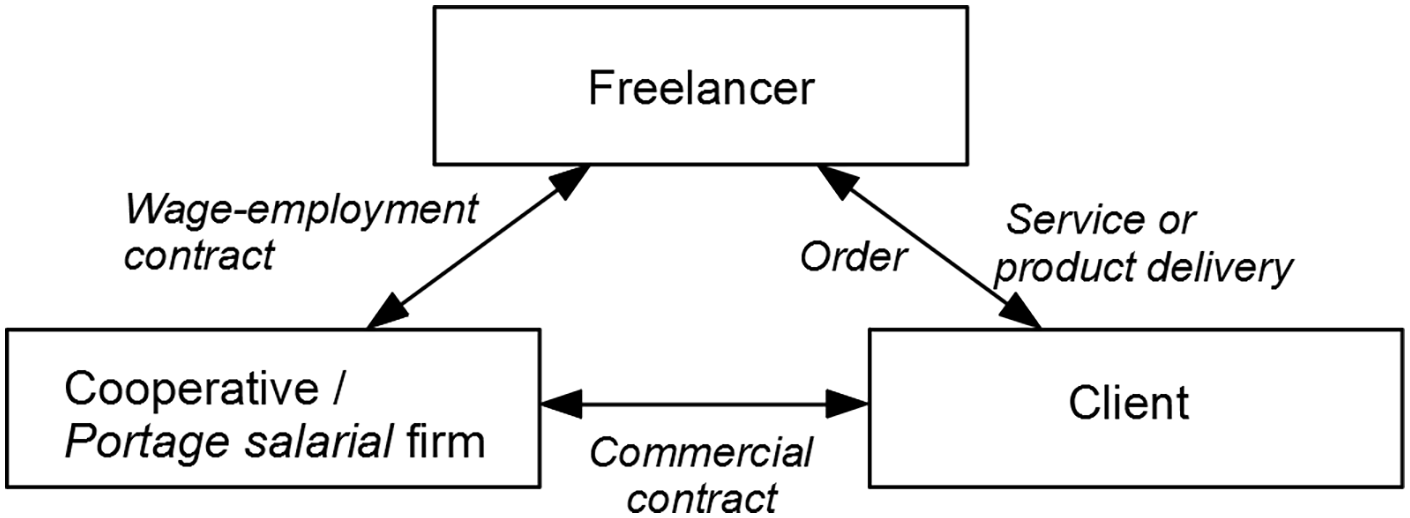
Contractual arrangement characteristic of the studied organisations.
In France, the first portage salarial (‘wage portage’) companies were created in the mid-1980s. Initially founded by senior consultants, they give high-skilled workers the opportunity to access wage-employment protections while being remunerated as self-employed by their clients (Kessler, 2016; Menger et al., 2007). These companies developed their activities without any precise legal framework until a first legal acknowledgement in 2008. There is no equivalence to portage salarial companies in Italy, but – in both countries – there are cooperatives created with the explicit intention of offering freelancers, both high-skilled and low-skilled, an alternative to self-employment. In both Italy and France, the cooperative movement – historically based on manufacturing workers-owned firms (Jaumier, 2017; Pansera and Rizzi, 2020) – gave rise to targeted cooperatives allowing freelancers to be formally wage-employed, while working independently. In France, the CAE – Coopératives d’Activité et d’Emploi – business and employment cooperatives (Bodet et al., 2013; Bureau and Corsani, 2017; Martinelli, 2017) have been legally acknowledged since 2014. Thanks to a specific contract, members start working for clients without receiving a wage in order to accumulate a cash reserve within the cooperative. They can then sign an open-ended contract with the cooperative with a fixed salary. For freelancers wanting to be legally wage-employed without this strong commitment, French cooperatives also give the opportunity – in most employment sectors – to sign fixed-term contracts for each order received by members. In Italy, there is still no specific legal framework for such organisations, but some cooperatives have found ways to provide members with the protections acknowledged by wage-employment. They use mainly ‘on-call contracts’, which allow them to hire freelancers on a long-term basis, even when the activity is discontinuous. This employment contract, indeed, remains ‘latent’ when the member is not working, but is immediately activated when the freelancer starts working for a client. The main inconvenience is that the use of this work arrangement is limited to specific sectors. As a result, Italian artists and entertainment workers can be wage-employed whereas freelancers from other sectors remain self-employed, benefiting only from the administrative support of the cooperative. Regarding their economic model, both the portage salarial companies and the cooperatives described above fund themselves by collecting fees on the income earned by freelancers before its conversion into a wage: the commission rate may vary from 8.5 to 14%.
The selected organisations supporting freelancers
To conduct this research, we identified five organisations – three in France and two in Italy – that claim to provide freelancers with social protection and an alternative to highly individualised forms of work while keeping autonomy in running their business. We shall clarify that we chose to call the members of the studied organisations ‘freelancers’ because this expression does not correspond to a specific legal status and refers rather to an independent way of working. In fact, the workers we are referring to negotiate their pay with clients and manage their professional activities in complete autonomy, even though – by working through the organisations described above – they formally become employees. We included in our sample one French portage salarial company and four cooperatives, two in France and two in Italy (cf. Table 1).
Main characteristics of the studied organisations.
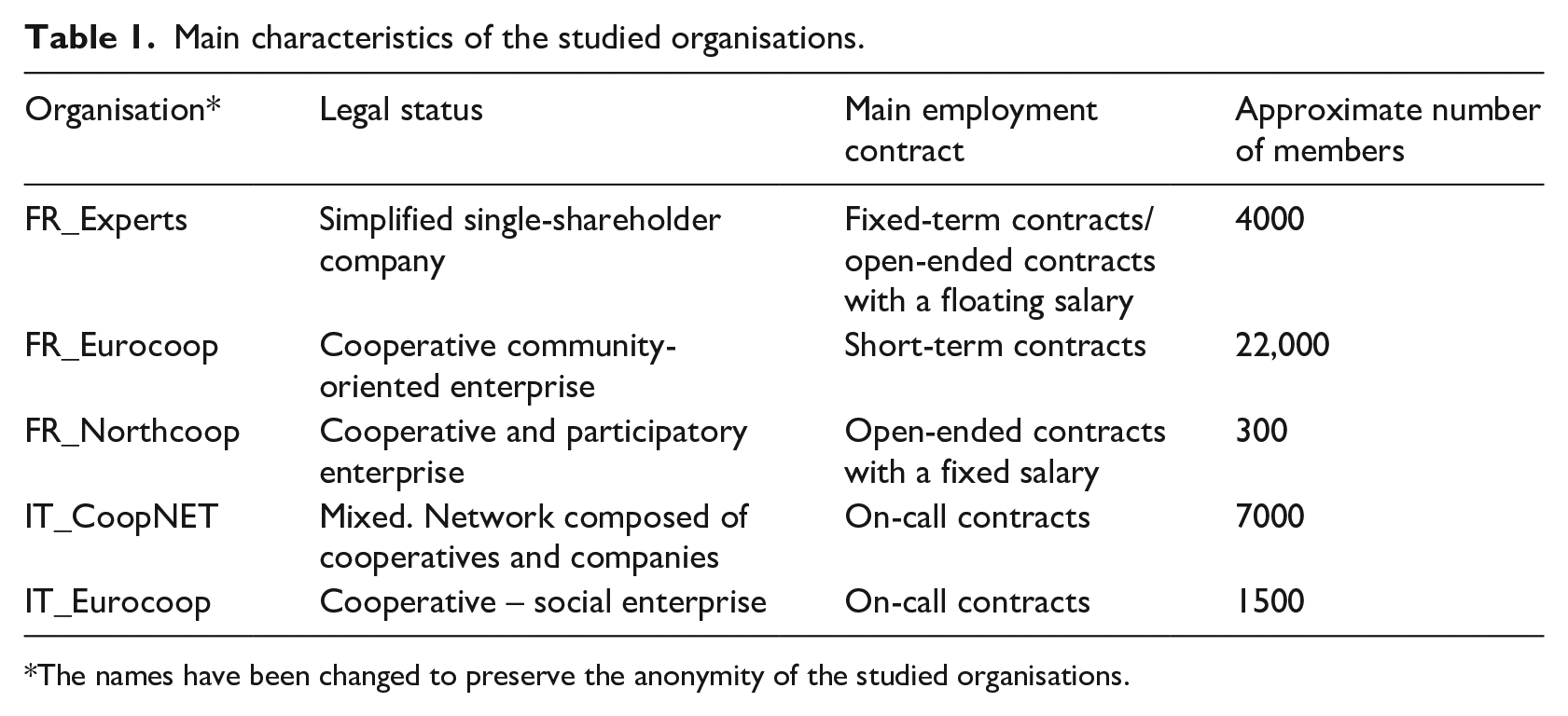
The names have been changed to preserve the anonymity of the studied organisations.
The methodological approach
This study started from an initial research interest in understanding the blurring boundaries between employment and self-employment and current attempts to support and represent freelancers and solo self-employed workers in Europe (Murgia et al., 2020). While conducting the fieldwork, we realised that, in some European countries – alongside trade unions, employer associations and grassroots groups – there were also particular organisations offering freelancers an alternative to self-employment. We decided thus to analyse these specific organisations as a ‘critical case’ (Flyvbjerg, 2006) of building alternative organisational forms, given their claim to have found an alternative to self-employment that allows freelancers to improve their access to labour and social protection and break their isolation.
From July to December 2018, the fieldwork was conducted by two native-speaking researchers, who carried out a cross-national multiple case study (Mangen, 1999) in France and Italy, within the headquarters and some local branches of the five studied organisations. The access to the organisations and the terms of cooperation were negotiated both with the management and with members of the organisation. We could observe meetings with freelancers, participate in public events (and in one case also in internal meetings), spend time in the co-working spaces (when present) and conduct interviews with the management as well as with workers in different positions, from advisers to administrative and financial staff. During the participant observation, informal interviews were also conducted with freelance members of the organisations studied. Moreover, we were provided with a range of material intended for internal and external use – from annual reports to internal studies – and we realised a desk analysis of the organisations’ websites. In addition to the participant observation, 31 semi-structured interviews – 19 in France and 12 in Italy – were carried out to further understand the alternatives to self-employment offered to freelancers by the studied organisations. All research participants provided written informed consent. The fact that, thanks to previously conducted studies, researchers were already familiar with parts of the studied organisations allowed us to achieve a high quality of relationships with their members. Moreover, while conducting the fieldwork, researchers were hosted as visiting scholars in local universities or research centres, and they could rely on a network of local experts who could further facilitate their access to the selected organisations.
Interviews were conducted in French and Italian before being transcribed and translated into English. The fieldnotes were taken in French and Italian as well, and in some cases directly in English, and then digitised to be shared with the entire research team. Indeed, all the digitised texts were shared via a remotely accessible server every 2 weeks, to also allow post-data collection based on collective conversations and reflexivity. While team members were conducting the study in different countries, we had almost daily communications via email and a messenger group, and biweekly meetings for collective discussions on the ongoing fieldwork and preliminary results via online video calls. This continuous exchange of experiences within the team made it possible to deal with multiple interpretations and collectively discuss emerging paths of analysis. Therefore, this process also allowed our observation protocol and interview guides to be refined several times during the fieldwork.
We analysed the collected data following an inductive and iterative approach (Schwartz-Shea and Yanow, 2013). We first read the fieldnotes, interview transcriptions and documents collected in each country independently, to be able to frame the organisational practices within the national legal context and to grasp differences and similarities between organisations based in the same country. By using Atlas.ti 8, we coded the data providing descriptive accounts of how the studied organisations claim to support freelancers. Then, through the open coding, we sought both to give voice to research participants and to identify any gap between stated objectives and practices of alternative organising investigated during the research process. At that point, the individual organisational cases were compared not only within, but also across countries, to find patterns of commonalities and differences.
Exploring alternative organising for freelancers: A cross-national qualitative study
In our empirical analysis, we investigated the alternatives to classical self-employment offered by the organisations studied. In some cases, they managed to create forms of work for freelancers able to counteract the dominant individualising enterprise culture. In other cases, they tended instead to reproduce logics typical of contemporary capitalism.
Social rights
One of the main aims of the studied organisations consists of providing freelancers with access to wage-employment and to the labour and social rights connected to it. These organisations offer different types of employment contracts: even if an open-ended contract with a regular wage offers more guarantees than a fixed-term contract, the access to social protection of wage-employed freelancers is in any case better than what they would have been entitled to as self-employed workers, both in France and in Italy. Moreover, at the time of the fieldwork, the studied cooperatives were engaged in lobbying activities to improve access to social protection not only for their members, but for all freelancers. In France, FR_Eurocoop participated in discussions about the European Pillar of Social Rights promoted by the European Commission. In Italy, the two cooperatives lobbied instead for the extension of the job on-call contract – then limited to certain categories of workers – to all freelancers from the creative and cultural sectors, to allow them to become employees of the cooperative.
In parallel to this long-term commitment, all organisations studied, both cooperatives and companies, interplayed with labour legislation to convert self-employed workers into employees. They developed experimental arrangements in grey zones that were not yet clearly regulated, using potential vacuums or uncertainty within the existing norms at the national level. At FR_Eurocoop, one of the research participants ironically claimed that the organisation was promoting a kind of ‘bogus wage-employment’, and during one of the interviews at IT_Eurocoop it was stated that: What we are doing: we take independent workers who remain independent, and we transform them into wage-employed workers. (IT_Eurocoop, Interview)
To boost freelancers’ access to the welfare system, organisations exploited the existing legislation, adjusting it to the specific needs of their members. As the benefits from parental leave, unemployment benefit or retirement pension require the validation of a minimum worked period, a crucial element for freelancers was to demonstrate that they had worked as long as possible. Members had therefore the opportunity to ‘spread’ their income, declaring more consecutive days than the days they actually worked to extend their contribution period.
Someone working for 6 months for 500 euros per day, we could pay him for one year on the basis of 250 euros per day. We can pay the minimum wage if the consultant asks for it to get a social coverage, to accumulate points for his pension. . . we can spread his income. (FR_Experts, Interview)
On the contrary, the organisations did not allow members to under-declare their working time, because it would have been problematic in case, for instance, of an injury at work. This restriction in some cases impeded freelancers working through the organisation, especially when the income received from their clients was not high enough to respect the minimal remuneration rules applicable to wage-employment. Therefore, in case the income was not sufficient in relation to the minimal hourly net salary, advisers refused freelancers the registration of their contract.
I’m in the coworking and I can follow an interview between an adviser and a potential new member, a woman who is working as a projectionist. They are trying to register one of her contracts. At one point, the freelancer suggests declaring less hours than she would actually work, in order to be able to respect the minimum remuneration for projectionists. The adviser answers that it wouldn’t be prudent because she wouldn’t be insured during the hours she would actually work, and ‘it would not be consistent with the aims of the cooperative’. (FR_Eurocoop, Fieldnotes)
The organisation, in this case a cooperative, thus looked for a balance, being ready to exploit the gaps in the existing legislation to better protect freelancers, but also being careful to respect the norms, whose circumvention could put members at risk or expose the organisation to legal sanctions, threatening its very existence.
FR_Experts also respected the law, but the portage salarial company differed from the four studied cooperatives as, in some cases, it seemed to prioritise the satisfaction of clients’ demands at the expense of workers’ social protection needs. Indeed, there were cases where the organisation actually contributed to the precarisation of workers by hiring former employees forced by their employer to work through a portage salarial company. Consequently, wage-employed workers were turned into independent contractors through the intermediation of FR_Experts, thus being deprived of the security granted by a long-term contract.
We call it an ‘imposed portage’. For example, someone working with a fixed-term contract in a company reaches the end of his contract. They want him to stay, but for certain reasons they cannot hire him. Instead, they will host him in a portage salarial firm. We did that recently in a training enterprise, about ten people were involved [. . .] These people automatically found themselves with a new employer, they are not necessarily prepared to do that, and they are not necessarily happy. (FR_Experts, Interview)
The studied organisations thus provided freelancers with social rights by experimenting with solutions that led to a resignification of the existing employment regulation. The position of the studied portage salarial company was instead more ambivalent, as its practices in some cases contributed to lowering the access to rights of workers instead of improving it, as claimed by the organisation.
Autonomy
A second element identified in the studied organisations concerned the high levels of autonomy guaranteed to members, both in running their businesses and in relation to the organisations themselves. Indeed, the members of all organisations used to look for clients by themselves and negotiate directly with them. They could decide with whom, how and when to work, without receiving any kind of directive from the portage salarial company or the cooperatives, which were legally their employer. Beyond their autonomy in managing their relations with clients, freelancers also had great control over jobs and payments. For instance, they could decide whether they wanted to get paid by a client through the organisation as an employee, or outside of it, as a self-employed worker. An online simulator provided by each organisation allowed them to calculate how much they would have received as a net salary without having to interact with the organisation. When members decided to register a new contract, they could do it online in all organisations but IT_Eurocoop.
Once the contract with the client was signed, freelancers could also decide, as mentioned in the previous section, how to manage the income they received for the performed work. In all organisations, members were thus in the position to choose to use part of the money paid by the client to get their expenses reimbursed, instead of converting all their income into a wage. This facility was perceived as particularly important by freelancers who travelled a lot or needed to buy expensive equipment. In all organisations but IT_CoopNET, members could also store part of the income earned from a client on their personal account within the organisation. This cash-reserve was used to afford future low-paid performances, (non-paid) holiday or unemployment periods.
In the end the adviser checks: ‘What should I do? Do we leave this money in your virtual wallet?’ This opportunity is used very often by members, it is much more frequent than what I was expecting, I must confess. (IT_Eurocoop, Interview)
This high level of autonomy greatly relied on a mutual trust relationship. Both in France and in Italy, freelancers could in fact misuse the granted autonomy and threaten the financial balance of the organisations. In FR_Northcoop, for example, freelancers were required to have at least 3 months’ salary in their personal account, to ensure the viability of their open-ended contract. In case they did not earn enough money through their freelance activity, they would have to resign or accept a mutually agreed contract termination (rupture conventionnelle). As there was no legal way to force them to do this, freelancers acting as free riders could have potentially ‘stolen’ money from the cooperative by refusing the termination of their contract and by increasing their overdraft as much as possible. Although this was a significant risk for the organisation, according to research participants it never happened: We really try, when we integrate new people, to explain that the cooperative framework is really a trust framework. We are their employer, but we are not their boss, this is what we tell them. We are co-responsible for their activity. We are colleagues, we are all taking part in the cooperative project. It is uncommon to have cases of people wanting to cheat the system, at least I don’t know any case. (FR_Northcoop, Interview)
Reciprocally, members had to trust organisations, which could also behave in an unfair way towards them. As Italian cooperatives were not allowed to intermediate workers, the commercial agreement between the cooperative and the client concerned the purchase of a service and not the placement of a single worker, and therefore did not include the name of the freelancer performing the task. This means that members had to trust their cooperative, assuming that they would have done their best to meet the demands of both members and clients.
Generally, we try as much as possible to build a trust relationship. I will do the best for you, I do it, and I explain to you why [. . .] To build a trust relationship has a cost – in terms of minutes or hours of work – but it is important. (IT_Eurocoop, Interview)
The autonomy that members could enjoy acquired thus a collective dimension as it leaned on a strong trust relationship between freelancers and permanent workers in charge of running the organisation. At the same time, exactly because these organisations did not intervene in the relationship between clients and freelancers, the latter had to negotiate by themselves to make sure that purchasers did not encroach on their autonomy.
With my adviser, we did the calculation and she suggested to ask my client travel expenses. . . that he refused [laughs]. Anyway, thanks to her I have already started to negotiate it for next year. (FR_Eurocoop, Interview)
The client represented thus for freelancers an important source of heteronomy, which in the last resort escaped the sphere of action of the studied organisations, even if most advisers were doing their best to support members during the negotiation process. Another situation in which individual autonomy was undermined refers to the practice of imposed portage salarial mentioned in the previous section, where freelance status was de facto enforced.
Mutualisation and cooperation
Both in France and in Italy, the studied organisations implemented mutualisation mechanisms and promoted internal collaborative dynamics among members working in very different sectors. However, the funding mechanisms of mutualised services also showed quite a contrast between the portage salarial company and the four cooperatives. Indeed, FR_Experts applied a decreasing commission rate to freelancers, which could vary between 10 and 3% according to their turnover: the more freelancers earned, the lower was the share of their revenue they had to dedicate to the funding of the common services. In the four cooperatives, on the contrary, the fees to be paid by members corresponded to a fixed rate of their turnover.
For us, the 8.5% that we ask on member’s turnover is not a ‘price’, but the value of mutualism. There are members who invoice 200,000 euros, instead there are members who invoice 2,000 euros per year, but both pay 8.5%. (IT_Eurocoop, Interview)
The cooperatives thus relied on a stronger financial solidarity between well-paid freelancers, such as successful actors or software consultants, and members earning a lower income, like dressmakers or cooks. Despite this difference, in all organisations the fees were used to fund mutualised services, such as invoice production or collection services, and most of them provided legal assistance, professional insurance and support for international mobility. Regarding services, there were also some differences according to the country in which the organisations were operating. The three French organisations, different from the Italian ones, acquired specific licences, which were necessary to work in particular sectors, such as art and show production, training activities and care services.
During the presentation meeting, the adviser refers to the ‘shared license of show production’ used by many freelancers. She underlines the importance of using it in a spirit of solidarity. Indeed, if one of the freelancers does something illegal, the cooperative could lose its license and all members working in the art sector would suffer the consequences. (FR_Eurocoop, Fieldnotes)
A second difference between countries concerned the organisation of training, which in the French organisations remained mostly limited to sporadic thematic workshops. In Italy, instead, IT_Eurocoop and IT_CoopNET offered general training on personal branding or business models, as well as modules focused on specific professions. Differences were also found by looking at the workspaces available for members: while the three French organisations provided freelancers with free access to a coworking space within their own premises, the two Italian cooperatives negotiated discounts for members who wanted to use their partners’ coworking spaces network.
Moreover, some organisations stood out from others because of their specificities regarding their offered mutualised services. FR_Eurocoop and IT_Eurocoop had a guarantee fund that tackled one of the main problems faced by freelancers: getting paid regularly. Financed by members’ fees, it allowed freelancers to be paid even when clients paid late or did not pay at all, the shortfall being absorbed by the collectively financed fund. IT_CoopNET could instead be distinguished from the other organisations because of the wide range of services offered to members: from a travel agency organising tours to an e-commerce platform allowing freelancers to sell their products. Moreover, it had a tender office supporting members eager to answer a public call. In all organisations, mutualised administrative services therefore helped members to cope with the obligations connected to their freelance work, but members of IT_CoopNET benefited from a wide range of business support services while freelancers employed by FR_Eurocoop and IT_Eurocoop enjoyed a greater protection against economic risks.
Alongside mutualism, the studied organisations also tried to break the isolation of freelancers by promoting cooperation among members. The five organisations, indeed, included in their administrative support the possibility for members to work collectively: freelancers could work together with colleagues, and the income received from the client was divided between the members who collaborated on the same project. They also had the opportunity to answer public calls collectively. In FR_Northcoop, as well as in IT_Eurocoop and IT_CoopNET, consolidated teams belonging to the cooperatives were granted a certain financial autonomy and used their own brand, even if the team did not have any legal value. This was especially useful in the Italian context, where informal groups of freelancers, such as small theatre companies or music bands, often pre-existed entrance into the cooperatives.
Beyond the support to existing groups, the role of organisations also consisted of contributing to the emergence of new networks among members, with limited results in most cases. Except for IT_Eurocoop, which was not very focused in this aspect, several events – from breakfasts to after-work drinks – were organised in the other four organisations, with the aim of giving members the opportunity to meet and begin collaborating. FR_Experts also built an internal social network to foster connections between freelancers, and FR_Eurocoop invested in the creation of third places, where members could meet in shared offices, workshops and makerspaces. In a few cases, these initiatives resulted in effective collaborative dynamics between freelancers engaged in the same profession or sector. For instance, an event organised by FR_Eurocoop encouraged ten members working as sociologists and anthropologists to create a group to collectively answer public tenders. FR_Northcoop also invited communication professionals to an after-work meeting and, around two years later, a group of eight freelancers in the field of communication left the organisation to create their own cooperative. Within IT_CoopNET, the creation of a community of performing arts technicians was stimulated by the cooperative as well, and the common claims around safety issues gave rise to a consistent group that started organising national annual meetings. However, the community building process was given different degrees of importance: The branches have a vision totally oriented towards the member [. . .] In this context, organising an event for them also means wasting time. The problem is that everyone is often completely absorbed by the needs related to the pure management of everyday life and does not have time to think about what can be important to develop and enhance this work. (IT_CoopNET, Interview)
All the studied organisations thus fostered solidarity by offering common services based on mutualisation processes and by promoting cooperation through administrative support to existing and emerging work teams. A process of community building was promoted in most of the contexts we observed, but participation was often limited in the case of events not connected to professional issues perceived as relevant or urgent by members, and, apart from a few examples of cooperation, most freelancers were still working on their own at the time of the fieldwork.
Collective decision-making
The promotion of democracy and horizontality was another element that characterised all the studied cooperatives. The portage salarial company – a classical firm that distributed part of its profits to shareholders – was instead based on a hierarchical model, where only the executive board and the stakeholders could discuss the financial balance. In the case of cooperatives, where profits must be reinvested into the organisation, the governance model was based on members who are also owners. This means that each freelancer was supposed to buy a share to formally become a member of the cooperative, and everyone had one vote, no matter how many shares one owned. During annual general assemblies, members were invited to examine the social and financial report, to discuss the strategies of the cooperative and to elect the administrative board and the other committees. However, in the four cooperatives we found a relevant gap between the intentions to propose an alternative to mainstream management and the actual practices. In particular, the main challenge was the low participation of freelancers in collective decision-making, in both France and Italy. Freelancers, in fact, approached the cooperative mainly to find a way to become legally wage-employed, but they did not seem committed to the values of the cooperative. This was the reason advisers sought to make freelancers aware of the importance of internal democracy.
During the collective information session, several participants keep talking of FR_Eurocoop as a portage salarial company [even if it is a cooperative]. At the end, a few of them speak about the 8.5% commission rate, saying it is cheaper than in other organisations: it seems to be the main argument to join FR_Eurocoop. Afterwards, the adviser tells me that the group of today was not so interested in the cooperative dimension, but in her view, it is not a problem: the idea is to integrate them and then to make them aware of the importance of the cooperative values. (FR_Eurocoop, Fieldnotes) CoopNET now has a broad social base. However, a significant part of this social base has entered the cooperative network for convenience. In most cases they are interested in participating in projects, but not in decisions [. . .] So, we need a good marketing and communication strategy to make them perceive the real value of being part of a cooperative. (IT_CoopNET, Interview)
Another reason mentioned by research participants to explain the low engagement of members in the decision-making process was the large size of the cooperative, considered to be an obstacle in the construction of an effective internal democracy.
A member of the management team explained to me that most of the CAE [business and employment cooperatives] have around 80 members and adhere to the principle that ‘small is beautiful’. It is obviously much more complicated to involve members in the decision-making of an organisation with several thousands of members. (FR_Eurocoop, Fieldnotes)
The low participation of members in the formal mechanisms of internal democracy did not mean, however, that freelancers were not taken into account when important decisions had to be made.
There are other ways to participate. The way we manage to listen to members and to answer to their requests is not so much during the assembly, but mainly through the dialogue between members and the colleagues in the local branches. (IT_CoopNET, Interview)
In IT_CoopNET, there was a continuous information exchange between headquarters and advisers working in the branches, who were in direct contact with freelancers at the local level. In the other cooperatives, research participants expressed their will to improve the involvement of members in the collective decision-making, and, in some cases, new participatory programmes were already at the experimentation phase at the time of the fieldwork. As an example, after implementing annual meetings in each local branch, FR_Eurocoop was planning participatory workshops allowing members to collectively formulate recommendations to be adopted by the executive board. The findings show, therefore, the exploration of different communication channels through which the organisations tried to overcome the low participation of members and to foster a decision-making process based on horizontality.
Discussion: Counteracting enterprise culture by enacting alternative principles
This empirical exploration of freelance organisations contributes both to the flourishing debate on alternative organisations and to the discussion on enterprise culture and individualisation at work. Indeed, the organisations studied are likely to challenge the dominant enterprise culture (Du Gay, 1996; Gorz, 2001; Rose, 1990) by enacting – to varying degrees and in different ways – principles characterising alternative organisations (Atzeni, 2012; Cheney, 2014; Parker et al., 2014a; Wright, 2013).
All organisations studied claimed to support the individual autonomy of members, and to a large extent they actually succeeded in doing so, by allowing freelancers to manage independently both their business and their income, thanks to a mutual trust relationship between members and the organisations they belonged to. The main limitation concerned the heteronomy resulting from the interactions with clients, over which the organisations had no direct influence. However, if the four cooperatives supported members throughout the negotiation process with clients, FR_Experts instead compromised freelancers’ individual autonomy by accepting practices of imposed portage salarial.
By developing shared support services, all organisations fostered solidarity mechanisms among freelancers, partly keeping the promise to break their isolation by helping them to deal with all the bureaucratic tasks connected to their business. In this case too, the portage salarial company differed from the other organisations: its support of mutualism was in fact more limited than in the four cooperatives, as its funding mechanism was less based on financial solidarity. Nevertheless, differences were also observed among cooperatives, depending on whether the prevailing focus of the service offer was on business support or economic stability of members. Cooperation dynamics also contributed to developing solidarity among freelancers, but the claimed objective to encourage the emergence of collaborations between them was not reflected in many examples of actual partnerships.
The four cooperatives studied also expressed a sense of responsibility – conceptualised as an alternative dimension by Parker et al. (2014a) – by developing practices oriented towards promoting collective ownership and participatory decision-making. In doing so, the four organisations formally adhered to the defence of a participatory democracy (Atzeni, 2012; Cheney, 2014; Kokkinidis, 2015; Wright, 2013). However, this commitment did not result in the effective participation of members in internal governance, which is an issue faced by many alternative organisations (Heras-Saizarbitoria, 2014; Storey et al., 2014; Webb and Cheney, 2014). The studied cooperatives also showed awareness of their responsibility by lobbying to improve freelancers’ rights. This political engagement was configured as a commitment to the wider community, another key dimension of alternative organisations (see Cheney, 2014).
In addition to the principles already widely explored within the debate on alternative organisations, this study highlights a dimension overlooked by the authors concerned with alternatives to the dominant capitalist model, namely the extension of and access to social and labour rights. The capacity to respond to the social vulnerability of freelancers was indeed at the core of the studied organisations, which managed to become the formal employers of freelancers – with some limitations, especially in Italy, in terms of employment sectors – and to find their original way into the folds of industrial relations systems by exploiting their regulatory gaps. Joining the few studies that have shown the importance for alternative organisations of guaranteeing or improving access to labour and social rights (Ghielmi, 2012; Heras-Saizarbitoria, 2014), our findings therefore suggest including the reinforcement of rights among the principles that an alternative organisation should pursue to ensure ‘the conditions for our individual and collective flourishing’ (Parker et al., 2014b: 10). Nonetheless, these alternative dimensions are not to be considered as mandatory criteria, but rather to be mobilised as sensitising concepts, ‘suggest[ing] directions along which to look’ (Blumer, 1954: 7), to researchers interested in documenting further alternative case studies.
The analysis of the discrepancies between what organisations set as objectives and what they actually managed to do allowed us to grasp the internal diversity of freelance organisations regarding both their performance of alternative principles and their ability to counteract the dominant enterprise culture. If significant similarities between France and Italy were observed, we also identified some specificities according to the organisational context. Indeed, we found ourselves distinguishing the portage salarial company from the four cooperatives with respect to the support of individual autonomy, financial solidarity among members, internal governance and access to social rights. As underlined by Parker et al. (2014a), no organisational model is intrinsically good or bad, but researchers still must differentiate between ‘what is alternative and what is mainstream’ (Parker et al., 2014b: 629). According to this epistemological positioning, the distinction was not so much between a classical company and the cooperatives, but mainly in the former’s practice of imposing portage salarial, thereby eroding the rights and the autonomy of workers who previously worked as employees. Such practice undermined the freedom of choice of workers and contributed to the reproduction of dynamics typical of the enterprise culture, by endorsing the transfer of risks from employers to workers (Ainsworth and Hardy, 2008; Storey et al., 2005). At the same time, in line with researchers inviting a refusal of deterministic approaches and conceiving of organising as a lively and reflexive process (Dorion, 2017; Storey et al., 2014; Webb and Cheney, 2014), we are aware that our findings may change over time. In this perspective, as far as the four cooperatives are concerned, we tried to highlight their attempts to build alternatives for freelancers although they did not always achieve concrete results, therefore focusing on ‘difference and possibility rather than dominance and predictability’ (Gibson-Graham, 2008: 626). We then analysed the limitations without interpreting a provisory and contextual situation as a structural and unsolvable weakness, threatening the feasibility of the whole alternative project. Most studied cooperatives were in fact engaged in a reflexive analysis of their practices and were exploring new tracks to overcome the reported obstacles, organising professional meetings to encourage collaborations, developing new programmes to foster participation in organisational governance or lobbying to improve the social protection of freelancers.
In light of the cases studied, therefore, the commitment in supporting individual autonomy, improving the social rights of members, promoting collective decision-making and fostering solidarity through mutualisation and collaborations allows organisations to build a sound response to the diffusion of the enterprise culture. The four cooperatives managed to counteract the radical responsibilisation of workers analysed by Fleming (2017) by providing freelancers with shared services to deal with the obligations connected with their business and by including them in a social protection system allowing them to face risks on a collective basis. They also tackled the prevalence of competitive logics and the loneliness of freelancers (Ashford et al., 2018; Scharff, 2016) by integrating them into collectively-owned organisations and organising socialising events to promote cooperation. Therefore, they preserved the individual autonomy of members, taking seriously the aspiration expressed by freelancers and keeping the emancipatory promise of the enterprise culture (Norbäck, 2021; Storey et al., 2005). This research thus highlights how – particularly in the case of freelancers – alternatives to the dominant enterprise culture lie in overcoming the trade-off between individual autonomy, on the one hand, and social rights and collective belonging, on the other. By taking into account workers’ desire for autonomy while at the same time tackling the harmful consequences of individualisation processes, indeed, organisations not only counteract the dominant enterprise culture but also tend to overcome it by redefining autonomy, experienced as embedded in social relations rather than resulting from individual strategies. Beyond the ‘liberal-individual sense’ of autonomy (Kokkinidis, 2015: 849), workers epitomising individualisation processes can then enjoy a form of autonomy that is collectively enacted and enhanced thanks to mutualism and solidarity.
Conclusion
This research intersects two central debates of organisational studies – on enterprise culture and on alternative organisations – to shed light on contemporary attempts to resist individualising processes that are typical of late capitalism. It thus provides a twofold contribution to critical organisational theory and sociological literature on the individualisation of work and its alternatives. First, it fuels the discussion on alternative organisations by providing an empirical evidence of an experimental process of alternative organising, in some cases subject to tensions or even contradictions. It also highlights the relevance of social and labour rights, a crucial dimension currently overlooked in the literature on alternative organisations. Second, this study demonstrates that the enterprise culture can be challenged thanks to alternative organising even when freelancers – an emblematic category of work individualisation – are at stake. There is thus space for emerging responses to the wide diffusion of the enterprise culture, allowing to overcome the neoliberal trade-off between individual autonomy and social rights – that has always characterised the experience of freelancers – and to pave the way for collectively elaborated forms of autonomy.
Beyond the contribution to the academic debate, this work also aims to support alternative freelance organisations. By making them more visible, we hope to contribute to the public relevance and political clout of such emerging initiatives. An inspiring example of this standpoint can be found in Argentina, where researchers investigating worker-recuperated enterprises helped them to shift ‘from the status of a provisory economic experiment that could be ended by politicians [. . .] to the status of credible organizational alternatives to capitalism’ (Esper et al., 2017: 35). Indeed, organisations supporting freelancers are facing several regulatory constraints in Europe: to increase the visibility of such initiatives and to contribute to a wider understanding of their practices can support their alternative projects and allow the multiplication of similar experiments.
Footnotes
Acknowledgements
We would like to thank the two anonymous reviewers for the time and effort they put into reviewing this manuscript. Many thanks also to Silvia Gherardi and Marie-Christine Bureau for their comments on a previous version of this work. We are also very grateful to the editors Yvonne Benschop and Patrizia Zanoni for their support and the associate editor Rafael Alcadipani for the insightful feedback provided during the review process. We are especially thankful to the organisations studied and the freelancers interviewed for their generosity and the time and discussions they shared with us.
Funding
The author(s) disclosed receipt of the following financial support for the research, authorship and/or publication of this article: This article is part of the project SHARE – ‘Seizing the Hybrid Areas of work by Representing self-Employment’, which has received funding from the European Research Council (ERC) under the European Union’s Horizon 2020 research and innovation programme (Grant agreement No. 715950).
