



Abstract
The delivery sector has undergone profound changes in the way work is organised, particularly under the influence of platform capitalism and its algorithmic management. This phenomenon exacerbates processes of work precarisation that have been underway for decades. Alternatives have started to emerge, known as platform cooperativism, which aim to rethink the organisation of work. Despite their long socio-economic history, cooperatives have not been extensively researched from a physical and mental health perspective. The results of our investigation into the psychodynamics of work among couriers in a French cargo bicycle delivery cooperative show that health-related aspects – inseparable from the subjective relationship to work – shed light on individuals’ choices to embark on an alternative ‘entrepreneurial adventure’. We suggest that this way of working could signal an alternative to the model proposed by neoliberal economics, with their deleterious effects on health, on the collective, and more globally on politics.
Keywords
Introduction
For more than a decade, market economies have undergone profound transformations in the ways in which work is organised, under the influence of the development of platform capitalism (Srnicek, 2018) and the penetration of this model into a growing number of companies (Casilli, 2019), often with the support of public authorities (Zuboff, 2020). Numerous studies have examined the ‘dark side of digitalisation’ (Trittin-Ulbrich et al., 2021), 1 and especially the influence of algorithms in the reorganisation of social relations of production under a variety of aspects, including knowledge asymmetries between platform owners and users (Rosenblat and Stark, 2016), tensions between control and autonomy of workers (Ivanova et al., 2018), transformations in the relations between workers and consumers through quantitative individualised performance evaluation (Glöss et al., 2016) and the mental health effects of activities where aggressiveness directly drives work commitment (Le Lay and Lemozy, 2021a). Managerial choices made by platform owners in terms of labour relations have been shown (Scholz, 2017) to have contributed to a worsening of employment conditions, a process that has been underway for several decades in many economic sectors, including the bicycle courier sector (Pupo and Noack, 2014).
According to the findings of these empirical investigations, the exploitation of work under the aegis of platform capitalism is a phenomenon with four dimensions: 1/ productive, as there is a profound dissymmetry in power relationships in the organisation of work; 2/ financial, as there is a significant imbalance in the distribution of the value created, since most of it is extracted by platforms without their users even being aware of it; 3/ statutory, as we are witnessing a downgrading of salaried employment into piecework, with a lack of social protection and a disruption of the boundaries between domestic and productive work; 4/ ‘pathic’ (Dejours, 1993a) as the aggressive impulses and defensive strategies adopted by workers to preserve their mental health directly serve the financial objectives of platforms.
Faced with these trends, two forms of resistance by workers have been explored: the unionisation of digital workers, as pursued by several major European trade union federations (Bouvier, 2018; Vallas, 2019); and ‘platform cooperativism’ (Scholz, 2017). The present article focuses on this second alternative, examining a cargo bike delivery cooperative located in a large French city, the Société Coopérative et Participative (SCOP) Salmo. We analysed how delivery workers acted collectively to challenge an erosion of individual autonomy in their activity and to contest the processes of social and mental alienation that characterise work driven by digital platforms. Focusing on the bicycle delivery sector has two critical points of interest. Firstly, delivery systems have been at the centre of the transformations linked to platform capitalism and occupy a key place in the new circuits of exchange. It should be emphasised that the platformisation of work has ‘fed’ on existing social precarisation 2 and reinforced the latter’s effects on the most vulnerable workers (Le Lay and Lemozy, 2021b). The period preceding the arrival of platforms was marked by a destabilisation of employment conditions (lower wages, temporary contracts, flexible working hours, etc.), especially in the service sector, to which couriers belong. Also, critics have pointed to a fragmentation of the labour force between permanent insiders and temporary outsiders and a shifting of the costs of acquiring investment capital and the related maintenance costs onto the couriers (Pupo and Noack, 2014).
Secondly, a focus on the bicycle delivery sector can address a gap in the critical scholarship. The platformisation of delivery work has given rise to numerous controversies, relating to legal aspects (are delivery workers salaried or self-employed?), economic aspects (does delivery activity offer an additional form of remuneration or constitute a new mode of exploitation of vulnerable workers?) and structural aspects (are platforms markets distinctive organisations or a hybrid form? does platformisation entail new processes or a return to historical forms of labour, with their origins in the 19th century?). Several studies have been conducted into political and trade union issues, exploring the driving forces behind the collective mobilisation of delivery workers (Abdelnour and Bernard, 2019; Edward, 2020; Tassinari and Maccarrone, 2020). However, few studies have focused on the health of delivery workers, and those that exist are concerned principally with physical health issues (Bérastégui, 2021; Dennerlein and Meeker, 2002; Leblanc et al., 2019), neglecting the psychic dimensions of the work (Gregory, 2021; Le Lay and Lemozy, 2021a). We hypothesise that these dimensions are central to understanding forms of commitment to work, including in circumstances where workers attempt to achieve a cooperative organisational alternative.
In this respect, it is noteworthy that, despite their long socio-economic history, 3 cooperatives have not been extensively researched from the perspective of physical and mental health; this holds true for the 2014 issue of Organization devoted to Worker Cooperatives. 4 Most authors have focused principally on the social, economic and political dimensions of cooperatives (Bodet and Lamarche, 2020; Brullebaut et al., 2020; Cheney et al., 2014; Conte and Jones, 1985; McKinsey, 2012; Rothschild-Whitt, 1979), or on the probable causes of their failures (Basterretxea et al., 2022; Blair et al., 2000; Whyte, 1978). As Wells (1981) pointed out in her paper on an American agricultural cooperative, studies on workers’ well-being have tended to focus more on pay levels (notably due to methodological ease and cultural bias), rather than the subjective experience of working in a cooperative. Our survey shows that health-related aspects that are inseparable from the subjective relationship to work provide insights to help understand the choice to embark on an alternative entrepreneurial adventure, despite the difficulties that this individual and collective decision pose on a daily basis. In this respect, our analyses expand on the work carried out in the 1980s by Leon Grunberg (Grunberg, 1986; Grunberg et al., 1984) on the impact of cooperative work on workers’ health and safety.
The first section sets up the theoretical and methodological framework of our study. The second section concentrates on the specific features of the organisation of work in the delivery cooperative mentioned above, examining the emergence and general organisation of this SCOP, focusing in particular on the place occupied by the desire to collectively control decisions about forms of organisation and working activities, through deliberation. Finally, the last section focuses on the importance of taking the matter of health into account when trying to understand the future of work, despite it being largely omitted or insufficiently covered in current scientific research. In addition, we discuss the political and ethical ambiguities that might arise when the cooperative faces a strong economic pressure.
Theoretical framework and methodology
This article draws on the findings of field work conducted by researchers on the basis of the main theoretical and practical assumptions of the psychodynamics of work. This research was pursued within the framework of a project financed by the French Ministry of Labour that sought to study the subjective effects of ‘new’ work organisations (cooperatives, platforms and freedom-form companies). A cargo bike courier cooperative responded by showing interest in the proposed research method.
A theory of work
The psychodynamics of work as it has been developed in France in the last four decades is a theory and a method for studying work whose stated objective is an analysis of the relationship between work, subjectivity and action. More specifically, this approach focuses on a notion of ‘living work’, as a concept that makes it possible to conceptualise together subjectivity, politics and culture. Marx already used a notion of ‘living work’, to point out that work is vital in a double sense: first, to produce the concrete conditions of existence (in particular with a view to satisfy other people’s needs), second, for each individual to, as it were, ‘produce themselves’ within a social and cultural collective (Deranty, 2017). For Dejours (2009), living work designates the entire process which, starting from the engagement in activities aiming at a production of use value (poiesis), ends in the work of oneself on oneself, a process that can be beneficial to subjects when ethical conditions are met.
The thesis of the centrality of work lies at the heart of developments in this field of research and postulates that work, as a mediator between the individual and the social organisation, is located at the very centre of the human condition and the evolution of society (Dejours, 1993a). The centrality of work in the formation of subjectivity hinges on four dimensions: 1/ the subject’s health, 2/ the structuring of social relations, 3/ democratic activity, and 4/ the production of knowledge (Dejours and Deranty, 2010: 169). For our purposes, we will focus on the first three dimensions.
To understand the role of work in the health of individuals, the conception of work proposed by psychodynamic theory based on the contributions of French ergonomics points to an irreducible gap between prescribed work (the task) and the actual work (the activity) performed by each individual worker, notably to cope with all that is not functioning, which the organisation of work had not foreseen (Dejours, 2009). Failure at work, that is, the confrontation with reality and the resistance it puts up against the worker’s mastery, emerges in an affective mode (irritation, anger, annoyance, etc.). This bodily experience of suffering requires a specific psychic work to be dealt with, as well as practical intelligence (notably the ‘tricks of the trade’), to find solutions to unforeseen problems. This work arising from the risk of failure can lead to positive outcomes through the acquisition of new techniques, new skills, new forms of know-how. Thus, working is not only about transforming the world (producing, acting on the objective world), but also involves transforming oneself through subjective engagement with the reality of work challenges, which can lead, in sufficiently supportive circumstances, to what Dejours calls the acquisition of ‘new registers of sensitivity’, via the familiarisation with working activities (what psychodynamics of work calls corpspropriation 5 – bodypropriation).
From the point of view of the impact of individual’s psychological investment in their task, the desire to do well and to contribute to work of high quality is very important. However, this individual (and even collective) engagement in work cannot be envisaged without some form of reward in return. “In exchange for their efforts, for the risks they take, for the intelligence they bring to bear, for the suffering involved in confronting the organization of work and the social relations of work, individuals essentially expect recognition”. (Dejours, 1993b: 48)
From the perspective of the psychodynamics of work, it is not so much material reward (remuneration and bonuses) that is fundamental, as symbolic recompense, in the form of recognition, which can have the double sense of gratitude and acknowledgement. This recognition may come either from aesthetic appreciation of work by colleagues (what in the psychodynamics of work is called jugement de beauté, or ‘beautiful work’ from the peers’ point of view) or an affirmation of its perceived utility by hierarchical superiors and beneficiaries of the work (what in the psychodynamics of work is called jugement d’utilité).
These two forms of recognition are linked to three types of cooperation, understood as the set of links constructed by workers with a view to achieving a common goal: horizontal (between couriers), vertical (between couriers and dispatchers) and transverse (between couriers and customers). These forms of cooperation require the commitment of workers in intersubjective relationships, to deal with work problems, shape normative agreements, establish work rules and share common values as to the purpose of the work. In its absence, shared activities become problematic, symbolic reward impossible, and efforts to contribute appear futile. Cooperation provides the foundation of the work collective, which forms the second dimension of the centrality of work for psychodynamics of work, in conjunction with social division of labour.
All these individual and collective dimensions are decisive in shaping the outcome of suffering and the dynamics involved in mobilising intelligence and personality in activities. However, in order for the deployment of practical intelligence and the establishment of cooperation to take place, collective deliberations – what the psychodynamics of work calls ‘deontic activities’ – are necessary. These deliberations concern both the technical, including the legitimate means of ‘cheating’ to cope with the gap between task and activity, and the ethical elements of work. Deontic activities have an impact not just within the workplace, but also on the evolution of society, since the way in which tasks are organised practically and ethically contributes to shaping sociality (what psychodynamics of work calls vivre-ensemble – living-together), as we will see precisely in the case of the courier cooperative: engaging collectively in a work organisation that advocates solidarity and respect for ecology does not have the same political implications as working alone for a delivery platform whose goal is to maximise the extraction of digital data via the largest possible number of orders. This illustrates the political dimension of the centrality of work for psychodynamics of work. Defining a conception of work is also defining a conception of the relationship to society. The question of the organisation of work and vigilance with regard to its possible deleterious effects on mental health are central issues for democratic life. Thomas Coutrot (2018) argues along the same lines when he highlights ‘how experiences of submission imposed in the workplace push employees towards passivity or political authoritarianism in public life’ (p. 9).
An investigation in the psychodynamics of work in a French courier cooperative
In the psychodynamics of work, the investigation phase involves the formation of a focus group made up of volunteers who are willing to talk about their experiences at work, to listen to what the others think and to look for a common understanding of the situations experienced. To achieve this objective, we insist on a number of prerequisites, notably the willingness to participate and share individual and collective experiences of work, in addition to analysing those experiences; and the anonymity and confidentiality of comments in order to allow for free and honest expression.
The investigation with Salmo couriers was conducted between March and October 2020. During this period, which was disrupted by the Covid-19 crisis and two lockdowns, we met six times with the participants. The first step was to inform the workers of the SCOP about the method of the investigation. The quality of the exchanges during the investigation depends largely on their authenticity and it is therefore essential that the participants are fully informed about what is at stake. A preliminary information meeting, not mandatory but open to any interested person, was led by the researchers to present the principles of the investigation and answer questions. This meeting lasted about an hour and a half, in the premises of the SCOP. A few days later, seven volunteers (Table 1) came forward to begin the actual collective interviews.
Presentation of the participants.
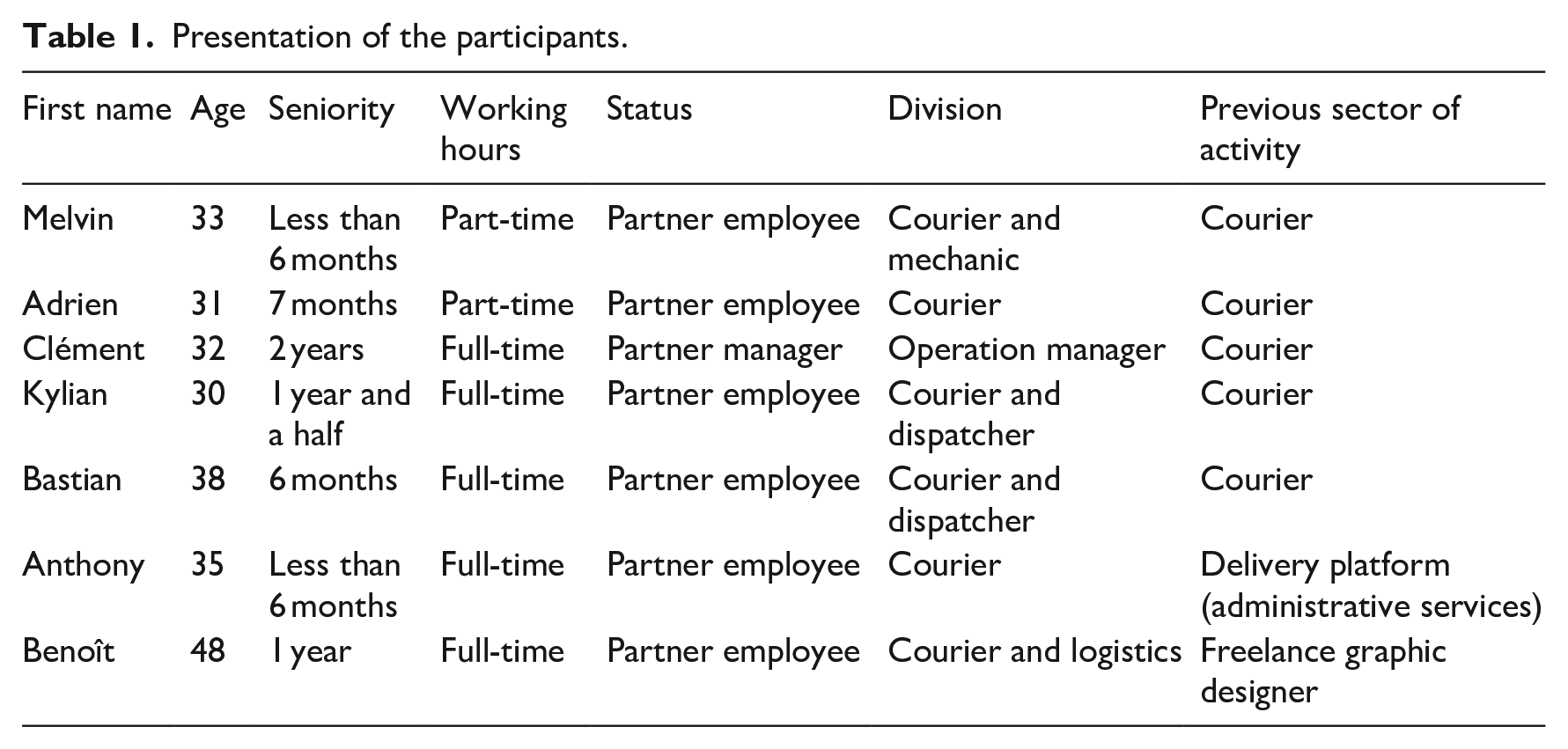
The next four meetings (March, May and two meetings in June) with the seven couriers, also conducted on the company premises, lasted 3 hours each, during which we talked about the organisation of work and the activities carried out in the SCOP, the world of bicycle couriers, and the participants’ subjective experiences. These discussions were conducted by the two researchers, monitored by a colleague, clinical psychologist specialising in occupational health issues. At the end of the four meetings, we wrote a first draft report, where we presented our analyses and interpretations to the seven members of the group. This presentation took place during a full-day meeting (October 2020) at the Institut de psychodynamique du travail. During this day of collective discussions, the written material was corrected and enriched in order to produce the final report. Our article is based on elements from this report. In particular, all the verbatim extracts are taken from it.
The participants are white men of French origin, with the exception of Anthony, who comes from the French West Indies. Their socio-demographic characteristics are representative of the majority of Salmo’s employees, which included only one woman at the time of the survey, and for which few foreign couriers (mainly from South America) were working. With the exception of Benoît, all participants in the survey had previous experience (sometimes over a very long period) in the bicycle delivery business, in other courier companies (sometimes subcontracting for larger companies) and sometimes as micro-entrepreneurs. They are also representative of the employees of the SCOP in terms of their subjective relationship to cycling and their intimate knowledge of the social space specific to couriers and the messlife. 6 The social and cultural homogeneity already described in other research on couriers (Fincham, 2007) is thus found also in Salmo. Whilst these workers are representative of the traditional couriers, we are fully aware that they are not representative of cooperative workers more generally. However, our ambition is far more modest than provide a full image of cooperative’s workers social characteristic. We want to understand the subjective dynamics workers engage in a specific field of work.
These participants were already familiar with the issues of suffering at work. Indeed, they readily contributed during the sessions and provided descriptions of their previous career paths, highlighting the central role of work in the dynamics affecting mental health. Now integrated within a work group where they found a certain social stability and psychological balance, the members of the group were keen to perpetuate those positive elements in order to contribute to the growth of their company.
Collective empowerment in the organisation of delivery work
Rethinking the future of work requires the study of cases like the Salmo company and its workers. Its transition into a SCOP and the collective takeover of the organisation of work illustrate the possibilities for reviving the promises of the centrality of work in the formation of subjectivity. The subjective relationship to work shared by the couriers during the investigation indicates favourable outcomes for their health, thanks to the possibility of converting experiences of suffering into new skills and new registers of sensitivity, and therefore into a strengthened sense of subjectivity. This would not be possible without cooperation and deliberation on work and shared norms. This is not without consequences for the structuring of social relationships and the relationship to public life, this relationship to the organisation of work contributes to the ethical conditions of living together within the company, but also has broader political implications.
Salmo: The slow transformation of a delivery company into a unique SCOP
Salmo is a small mechanical or electric cargo bike delivery company based in a large French city. It had 24 employees at the time of the research. Its activity involves managing the pick-up, transport and delivery of various products to individual customers (individuals, or B2C in business language) or groups (companies, or B2B) on behalf of various client companies. This work is performed by couriers, generally working half-day shifts organised into rounds by the dispatcher (or ‘dispatch’ in internal language), using a dedicated computer application. The delivery teams are backed by IT and sales staff. In addition to the delivery teams responsible for carrying out the rounds, there are also mechanics and logisticians.
Salmo’s workers are contributing to a rare form of work organisation in the French bicycle couriers industry. The company was founded by former Deliveroo delivery workers who wanted to build an alternative to that platform. The company was one of the first in the bike logistics sector to have opted for cooperative legal status. This was at a time when traditional companies were competing everywhere with digital platforms and the proliferation of ‘independent’ delivery personnel. 7
The creation of Salmo in 2019 resulted from a traditional SME being turned into a SCOP following financial difficulties, thus constituting a ‘conversion’ (Whyte and Blasi, 1982) or ‘defensive’ (Oliver, 1984) cooperative. 8 Rather than filing for bankruptcy, the majority partner decided to sell part of his capital (below its real value) and turn it into a SCOP so as to avail interested couriers with an opportunity to join the new cooperative structure. 9 This choice changed the structure of ownership of capital and the production tools. In France, employees of a SCOP are entitled to become partners (sociétaires) by acquiring a share in equity. 10 The associates proceed to elect the company manager at a General Assembly for a period of office of 4–6 years depending on the legal status of the enterprise. They also decide collectively on how profits are to be distributed. Three alternatives are available: 1/ increasing the employee remuneration by profit-sharing (on top of the minimum 25% of the profits), 2/ allocation to company reserves (on top of 15% of the profits) and 3/ paying out dividends to the sociétaires (a lesser amount than for the employees and reserves). Salmo’s profits are distributed as follows: 40% to the employees, 20% to partners and 40% to reserves.
This emergence of a SCOP in the courier sector was initially unwelcome as businesses already under pressure from the competition of digital platforms saw this as a new threat. Furthermore, Salmo began by hiring self-employed entrepreneurs (whereas couriers are generally salaried) who had to handle a heavy workload, mainly focused on food delivery (for Deliveroo). Conditions were not good and there was little room for the pleasures of cycling as described by ethnologists of the courier community (Fincham, 2007; Kidder, 2011). In addition, at the time the organisation of work was seen to be flawed: ‘the former majority partner did everything, took no pay and even slept on the premises’, ‘dispatching was done from the bike and there was no organization of the rounds’ (Bastian). Since then, things have slowly improved, but there is still a need for more efficient procedures in this young business, something the couriers are working on as they review workplace organisation. The division of labour is in the process of being stabilised, tasks being organised around the ‘core activities’ (Melvin), which are embedded within a specific social-technical system with the occupation of courier at the centre of concerns. This determines how the company functions on a daily basis with the consensus view that ‘everyone rides’ (Melvin) as an accepted rule. The rationale to explain why the core activities are so important to the couriers 11 is based on two main issues to which we shall return in detail: firstly, the concern to work well and not forget the subjective efforts made to pursue the activity successfully; secondly, the concern for versatility (with everyone knowing how to ride and being able to do so) and the organisational flexibility that comes with this.
The completion of delivery rounds (between one and three per half-day, depending on geographical coverage and timing) is first organised by the dispatch, whose first role is to plan the rounds using dedicated software (known as Onfleet) the previous day. Final adjustments are made just a few hours before the couriers are to leave. A map of the city is displayed on a computer screen and two panels are also opened, one for the delivery points to be organised into rounds (entered into the system either directly by the customer or manually by dispatch) and the other for the list of available couriers. Dispatch sets up the delivery rounds by dragging and dropping the addresses of the points of delivery onto the map so as to obtain ‘optimal’ rounds which are then allocated to given couriers.
Meanwhile, the couriers have Onfleet on their mobile phones so that they can follow the delivery schedule. 12 The dispatch roster calculated by the dispatcher using the computer application is therefore imposed on the riders. However, unlike the algorithms used by digital platforms that remain opaque and conceal the criteria used to organise and dispatch orders from the riders (Ivanova et al., 2018; Rosenblat and Stark, 2016), Onfleet offers couriers the option of obtaining full information about their round. This is especially relevant with respect to the scheduled delivery times for each customer as it makes it possible to re-organise segments of the rounds to deal with contingencies, always in concertation with the dispatch, thus reducing delays to a minimum. At Salmo there is constant contact between the couriers and dispatch right from the moment when the courier arrives on the premises to load his or her round onto the cargo bike and the moment the bike is put away. This interaction allows the dispatch to pay particular attention to each of the couriers and to adapt the rounds according to their state of wellbeing. Telephone conversations and messaging are frequent, both to re-adjust the round as appropriate and to check up on the latest news. This relational aspect is an important element of the investigation, as it underlines the ‘living work’ that takes place on a daily basis between couriers in charge of delivery and couriers in charge of dispatch. It’s in opposition to the ‘dead work’ 13 of the algorithm that distributes the deliveries on the digital delivery platforms where the couriers generally find themselves alone with an application that remains indifferent to realities on the ground (Lee et al., 2015; Veen et al., 2020); and where delivery workers spend most of their energy to craft ‘direct and indirect compliance practices vis-à-vis algorithmic management in order to ensure their continued participation on the platform’ (Bucher et al., 2021: 57) instead of discussing about their work activity.
Refocusing on the core activities is a way of not hindering the subjective relationship to work with prescriptions or procedures subject to managerial concerns that would be disconnected from reality. Consequently, more room is reserved for the courier to engage his personality, his idiosyncratic ways of doing in the activity, and to draw benefits from it from an individual point of view, which register positively in his mental health. Unlike platform workers who have limited control over their activities, Salmo’s couriers are in a position to intervene at various stages in the delivery chain (and in the different divisions of the business) to make adjustments as required. This point corroborates Oliver’s (1984) early analysis of the desire of workers to cooperate in gaining greater control over their work situation. Here, this was made possible by two important dimensions of the work that we will discuss in turn: the control of the activities carried out, and collective decision-making.
The good courier: A ‘salmon’ in the urban flow
For a courier the subjective relationship to work is particularly evident in one aspect of the job: riding a bicycle. The work activity allows them to transform what is for some of them a passionate relationship with cycling from a very young age into a social utility. The encounter with the reality of delivery work in an urban environment has allowed them to develop a singular form of practical intelligence and to discover new skills. The activity of riding is not equated with ‘riding fast’ by the participants. Discussions emphasised the need to acquire and maintain a number of physical and handling skills aimed at fluidity of movement rather than just pedalling power aimed at speed. To characterise this specific relationship to cycling, participants used an animal analogy: the good courier behaves like a ‘salmon’. ‘make the right choices in traffic, it must be smooth: don’t stop in traffic, do the salmon. The best courier in the city, we know him. He is discreet, does not drive fast, but does the salmon and has an efficiency 1.5 times higher than the others’. (Kylian)
The salmon is a ‘cyclist who goes up a bike path against the flow’ (Benoît), as the animal does with the stream of the river. The notion covers all the behaviours and practices that must be implemented in order to ride a cargo bike in a large city: ‘it’s very subtle, very precise, a science of anticipation’ (Anthony). Bastian calls ‘instinct’ (one which can be acquired) this capacity of a skilful and attentive body to anticipate, without thinking about it, a sign alerting to the fact that a car driver is acting strangely, or recalling a problematic situation one has already encountered. It is difficult to be exhaustive in describing all of these skills, part of which is ‘looking for indirect signs in the environment that can help make inferences about what might be going on while cycling’ (Melvin). 14 This involves for example anticipating a car overtaking without blinking, locating the licence plates which are not from the area, being attentive to the behaviour of the pedestrians to deduce the state of the traffic on the road, or to the synchronisation of traffic lights, riding in bus lanes, scrutinising the reflections of the windows or the rear-view mirrors to locate the position of the hands on the wheel of the car opposite, and so on.
It is interesting to note that participants attach value to a relationship with the body mainly located in the upper parts, close to the brain (eyes, ears). However, the whole body is necessary to control the cargo bike and to find ‘good trajectories’ (Anthony). On this point, participants are clear: ‘we don’t need to think about what we’re doing and haven’t had to do it for a long time!’ (Melvin). Indeed, they become one with their bike (‘when you are two with the bike, it means you are on the ground!’, Kylian), and the most skilful riders push the intimate relationship between body, bike and road to its limits: you have to ‘feel’ the state of the road, but you also have to perfectly master the spatiotemporal relationship to the trajectory of the bike. Going too fast in a curve, lying down too hard on an unsuitable surface (wet, greasy, gravelly), and a fall awaits. ‘Using the bike has become instinctive. I don’t think any more if I should take this path, or if I should brake gently or hard. The cargo bike, I put it where I want.’ (Melvin)
In the psychodynamics of work, this affective and unconscious relationship between body and work activity is called corpspropriation. By their work activities, couriers transform themselves, that is, they acquire new skills, new registers of sensibility, a new way of experiencing the world. These registers of skill and sensitivity continue to expand, since intimate knowledge of the city (and of its own transformations) is necessary, even to the point of feeling its ‘pulse’, so as to be able to arbitrate between the topography of the route (organisation of street traffic, sequencing of delivery points), delivery deadlines, road traffic, traffic regulations, safety for oneself and for others. According to participants, Salmo’s couriers rarely complain of an accident (‘it’s more fear than harm usually’, Melvin), while noting that ‘there are no slow couriers. Everyone here is fairly salmon’. (Kylian), that is, a ‘good courier’.
But defining what is a ‘good courier’ is not limited to a way of riding, since the service relationship is an important dimension of the activity. In this respect, punctuality is important and is a concern already, before setting off, when each courier loads his bike with the products to be delivered on his round. Couriers must be very organised when stowing goods: they have to know how to sort them by size and volume in accordance with the order of the deliveries, to ensure stability (and a good visibility when driving), but also to be able to seize a parcel as quickly as possible without having to empty the whole cargo, while being delicate with the different products so as not to damage the most fragile ones – which is not easy, for example, when delivering bunches of flowers or crates of fresh herbs. When a courier does not pay attention to this dimension of work, he is said to have a ‘shitty cargo’. This aesthetic preoccupation with the arrangement of goods has already been identified in the scientific literature among order pickers, who do not hesitate to qualify whether the preparations are ‘beautiful palettes’ or on the contrary ‘monsters’ (Gaborieau, 2012). Behind the aesthetic dimension, Gaborieau shows there was a whole concept of the quality of the work that had to be preserved and transmitted. 15 At Salmo, this aesthetic dimension continues to matter during the delivery to the customer. It is important to be meticulous to protect the integrity of the delivered products, in particular the most fragile, and not to harm the quality of service. They are not florists, but they do not hesitate, for example, to recompose a bunch damaged by the tour before delivering it to the customer.
The relationship that the participants have with other couriers, with customers, with the material transported, or with the bicycle and the way they ride, is not a degraded one as we can often observe on platform delivery (Lemozy and Le Lay, 2021), quite the contrary. Their way of working means they engage with the world and act within it in a way that is not just instrumental, time- or cost-effective, but also obeys standards of quality and even aesthetics. At the individual level, this point has positive consequences. The efforts they invest in dealing with the reality of their work are transformed into pleasure, as shown by a strengthened sense of subjectivity through an increased capacity to experience themselves (notably in new sensitive registers of the body) and to experience the world in which they act. On a collective level, a normative agreement emerges: the good courier is not simply a cyclist engaged in a race against the clock for his own wage. He also has to comply with the precise rules of the craft. This agreement is made possible by the second dimension we now want to address: the collective deliberation on work.
The will to deliberate on work: The example of doctrine
The individual, subjective relationship to work gives an insight into what occurs at the collective organisational level. The fact that there are normative agreements and established work rules reflects the engagement of workers in intersubjective relationships to deal with work problems. It is through this possibility of making collective decisions about work that relationships are built that help to create a true work collective based on cooperation. In the psychodynamics of work, strong emphasis is put on cooperation as a dimension that underpins ‘living work’ at a collective organisational level. The collective rules resulting from a shared experience of the context of work and similar forms of decision-making create a framework that makes it possible to evaluate the work of others. The example of the ‘good courier’ we just saw typically involves an aesthetic judgement, made by peers, which in turn determines the possibility for each SCOP worker to see his singular and original contribution recognised.
At Salmo, deliberations around work are organised around two main sets of rules: the rules of the craft (stabilised normative agreements concerning the ways of carrying out activities) and what in the psychodynamics of work is called the doctrine of the enterprise – that is, more general principles guiding conduct in the reality of the work. Participating in the development of a not yet stabilised work organisation is an opportunity to invest one’s subjectivity in a deeper way. The SCOP gives individuals the possibility to be recognised in their work, but also to recognise themselves in the values promoted by the organisation of the work.
The basic elements of Salmo’s doctrine are framed by three principles: ecological, ethical and solidarity-based. In this respect, Salmo can be compared to the movement of platform cooperativism (Scholz, 2017). In relation to the ecological footprint, the couriers’ attention is focused on the means of transport and the goods transported. The use of electrically assisted cargo bikes for all deliveries is seen as a means to help change the logistical landscape of cities and the dynamics of urban metabolism by reducing the number of combustion engine vehicles and the associated noise, chemical and energy impacts. 16 The participants’ claims to ‘ecological militancy’ are supported by the shared feeling that their work performed by biking legitimises a kind of reinforced right to use the urban space: ‘you have more rights on a bike, you’re ecological’ (Bastian).
The companies Salmo is prepared to work with are also subject to ethical scrutiny. Local consumption, short production circuits and limited packaging are valued. There are local shops, social economy companies and eco-responsible companies. Conversely, firms that do not share the same values as the SCOP have been blacklisted: ‘Amazon contacted us but it didn’t work, even though we were broke at the time. Amazon is an awful company that exploits its employees and crushes small businesses’. (Clément)
Finally, solidarity-wise, the SCOP and some of its employees focus on activities that can be of benefit to disadvantaged people, whose social profile is far removed from the customers who usually deal with couriers. This is evidenced in the case of one of the participants teaching bicycle repair in an association for social integration through work. Similarly, during the Covid-19 lockdown, couriers were given the opportunity to do voluntary delivery work on behalf of an association preparing packed lunches and acting against food waste after a number of solidarity networks had been set up. The latest example of such activity was when the municipality called on the SCOP to organise the delivery of several thousand masks and hundreds of solidarity fruit and vegetable parcels. Despite the potentially disruptive effect this may have had on their organisation of work, these activities were meaningful for the couriers. They stressed how important they were in terms of social utility and the meaning it gave to their work.
The political outcomes of living and cooperative work
These deliberative spaces are not limited to formal spaces (such as meetings), but refer also to the more informal spaces and moments where it is possible to discuss work. This is first of all achieved through close-knit relations of friendship and rituals of polite exchange (‘When we say hello to each other as we come in in the morning, we share information about how we are getting along’, Benoît) and especially at shared meals at lunchtime financed by Salmo. 17 These moments of relaxation can sometimes continue through into the evening when drinks are organised on a more or less regular basis. People turn up or not depending on family or other obligations, while some shy away due to reticence relating to past excesses. Indeed, for the participants, Salmo represents the ‘centre of sobriety within messlife’ (Clément). The ‘party spirit’ (Clément), so clearly identified as part of bike messengers’ cultural element, remains strong in the SCOP (in after work get togethers, around the pizza oven, with music, beverage, etc.), but in a more regulated way. Despite the consumption of alcohol, marijuana or, more rarely, other illicit drugs, the couriers are largely protected from the self-destructive behaviour that can be reported in other courier collectives. The contribution of cooperation and normative agreements on work issues are not unrelated to these forms of regulation and sometimes new recruits have been turned down for reasons of excess as they are seen to threaten the balance found by members of Salmo. The forms that cooperation takes within the SCOP, such as solidarity, attention to others, conviviality, and the concern to preserve it, contribute to the social and ethical conditions of living-together.
These shared principles inevitably alter the social relations of production at Salmo. The couriers say it themselves, their involvement in the SCOP was not a matter of chance, 18 but a ‘political act’ that involved putting the ‘value of work right at the heart’ of the organisation by seeking to subvert the classical capitalist exploitation relationship (‘we’re not looking to make it [the company] profitable on the backs of the employees’, Bastian). This aspect of Salmo’s organisation reminds of Safri’s analyses about ‘the undocumented immigrant laborers [who] had a strong desire to organize a carpentry worker cooperative’. For these workers, discussing ‘the various organizational characteristics (governance structure, decision-making practices, form of aid given out, etc.)’ was also ‘an avenue to pursuing wages that were higher than what they would get as day laborers employed by construction crews’ (Safri, 2015: 929–930). Whilst the latter did not think of their work ‘as having an economic character’ (Safri, 2015: 932), Salmo’s couriers have this issue in mind. Work has been organised to give the couriers the best possible conditions and employment rights. The differences in the way of conceiving the ownership structure and the organisation of work appeared important between Salmo and its competitors, especially the delivery platforms. In the latter supervisory functions have been delegated to algorithmic management and forms of subordination are prevalent via independent contracts. The consequences for workers are increased economic dependence, forms of exhaustion, and loneliness. These work organisations exert forms of domination and fail to keep the promises of emancipation that can legitimately be attributed to work in better contexts.
A broader inflection emerges from this case study, concerning the very conception of political economy and the definition of value. At Salmo, value is not limited to a monetary or accounting result. As can be seen from the analyses above, the issue of living work runs through arbitrations concerning the valorisation of activities, both from the perspective of courier remuneration and the prices set for services, since the rounds are organised in such a way as to take into account the specific features of the job in hand (or even a given courier’s individual wellbeing) and the logistics of the delivery itself. Ethical concerns of not harming the conditions of horizontal and transverse cooperation also enter into play. Unlike most capitalist enterprises, where dead work dominates production relationships, Salmo seeks to establish and preserve production relationships where (living) work transforms the couriers as they act collectively on the world in accordance with a series of ethical principles. All these elements indicate that the members and employees of Salmo are seeking to ‘reinvent’ a business model in the delivery sector that breaks with the one promoted by lean work platforms, without reverting to the one that existed in older courier companies. This double break is not without ambiguities, nor without major implications for the subjective relationship to work and health.
Discussion
Health through work: A blind spot, yet a determining factor in the question of the future of work
What has been discussed so far concerning the Salmo cooperative echoes many contributions in recent literature. In particular, we find here the ‘meso-critical space’ that these particular structures can represent, as proposed by Bodet and Lamarche (2020), for whom ‘cooperatives perform a critical function with respect to the dominant economic dynamics’ (p. 73). Cooperatives’ innovations and inventions provide a response to a number of inequalities and undesirable effects of mainstream companies, as they emerge and develop on the margins of the capitalist space into which they inevitably mesh, as Paranque and Willmott (2014: 607) pointed out. The examples provided in the literature on another economic sector invested by platform capitalism, that of home help, may be relevant as a comparison to understand how cooperatives constitute alternatives to the inequalities generated by capitalist developments. The work of Atanasoski and Vora (2015) and van Doorn (2017) highlights how on-demand butler services take advantage of, and even contribute to, the precarisation trend and gender and racial inequalities already at play in the sector. For van Doorn (2017), it is this ‘workforce-as-a-service model that currently dominates corporate “future of work” imaginaries’ and ‘promotes a technocratic ideal of flexible labour market optimization organized and managed by platforms’ (p. 908). Yet Berry and Bell’s (2018) work shows how home help cooperatives introduce organisational conditions that diminish the effects of casualisation and inequality historically present in this economic sector, while at the same time challenging the future proposed by home help platforms: ‘at the worker cooperative, home health aides had relatively stable work schedules and hours, medical benefits for the worker and dependents, nearly full participation in 401k retirement plan programs, training beyond mandatory minimums, and as worker-owners, participated in decision-making and received a share of profits generated by the organization. These findings suggest that the worker cooperative organizational form was the key differentiator in alleviating some aspects of precarious work’. (p. 385)
It is important to stress that the construction of these alternatives requires the organisation of work be brought into question by the workers. The work by Wren (2020) details the common elements in the organisational culture of cooperatives. A whole life perspective, consistently shared values, self-ownership, self-control, and secure employment are significant themes in the work organisations he has studied, and could easily be placed at the heart of the work organisation that is emerging at Salmo. Like Berry and Bell, Wren places special emphasis on the results of collective deliberations regarding the organisation of work and the organisational norms it is based on. Such norms can be straightforwardly apparent as with material rewards (remuneration and financial benefits), contractual (stability of workers’ status and social protection) or discursive (under the principles set out by the work organisation).
These authors’ contributions are invaluable, yet we should also point out a blind spot in them, relating to health. What our study brings to light is that questions concerning the subjective relationship to work and health are decisive. Salmo represents a work organisation that has succeeded in warding off the mental and physical health risks to which at least some of its workers were subjected, which is hardly a minor achievement. This is especially significant, since it contrasts with the previous experiences they underwent, where suffering in various guises was a constant feature. Couriers described multiple experiences where social relations were strained and work collectives fragmented. For example, Melvin, a former design engineer in a biotechnology laboratory, saw his team gradually come apart as people left in disgust, before he himself changed jobs to escape a work environment where career issues and competition sapped relations between workers. Benoît, a former computer expert, mentioned the sheer ‘hell’ of working for the subsidiary of a telecommunications company and for a banking service with ‘evil people’. Former platform delivery workers also explained how, in some of these companies, the collective experience of work proved to be an illusion, while in others the collective side had gone out of the window when the platform owners ran off with the company cash. There was among them a sincere sense of regret as to the loss of the ‘spirit of camaraderie’ (Clément), especially in work collectives whose activities revolved around biking.
Sad memories of these poor relations at work were still very much present, for example when Melvin told of being haunted in his dreams by his former boss who so often shouted at him. However, it was the descriptions of health problems that indicated the extent to which these past experiences had harmed the couriers’ subjective experience. For example, Bastian talked about his ‘burn-out’ in a courier company a few years earlier, going to work with a ‘lump in his stomach’ and coming back with his ‘nerves on edge’. Benoît told of his depression and how he had been treated by a psychiatrist before starting work at Salmo. Adrien talked about his problems of multiple drug abuse, which he had managed to bring under control since working at the cooperative. The descriptions of these situations were in stark contrast with the positive picture the participants gave us of what they were now experiencing in Salmo. This positive environment was created thanks to cooperation amongst them, based on the will to work towards an organisation of work oriented towards an alternative entrepreneurial commitment. The enterprise is still based in the capitalist economic space, but they are able to generate their own value, beside the strictly financial one. They remind us of the experiences of self-management in three workers’ cooperatives located in Athens described in Kokkinidis’ (2015) research. As the workers’ collectives are ‘guided by horizontality, prefiguration and direct democracy’ (p. 848), they create more autonomous space and more inclusive work organisation which allows ‘exploring workable alternatives within capitalism’ (p. 867).
This study confirms that questions of individual health are a necessary link in understanding engagement and efforts to redefine work value in a cooperative like this one. The results of collective deliberations emerge only as a second step, when the subjective relationship to work has found a favourable outcome, thanks to everyone’s contribution towards quality of work and recognition provided by the three types of cooperation highlighted. These forms of cooperation all helped to promote good mental health, which had been under threat in previous work organisations. The couriers clearly felt better since joining the cooperative. Other studies confirm this health effect, notably in verbatim accounts from workers in the cooperatives studied by Wren (2020: 767) or in the activity and employment cooperatives studied by Corsani (2020: 279). The study of these work organisations offers a critical alternative to the dominant economic approach and underscores the fact that health in and through work is a major issue. On the margins of the capitalist system, the concern for health and well-being is often what motivates a commitment to cooperative work. This expresses an important lesson for the future of work, pointing to the need to consider what it can afford individuals in terms of health, whether it be via self-fulfilment or collective emancipation.
If health is not deliberately considered in the organisation of work, then the latter may generate deleterious effects on the individual, as economic or material issues take precedence over well-being. There can be a drifting away from the initial objectives when economic and managerial dimensions begin to hold sway over the aims of the collective normative agreement between workers involved in the organisation of work. Then the health of the workers might again be endangered and their subjective commitment might no longer find a favourable outcome. At Salmo, there is a need to maintain constant vigilance in this respect. To build and develop over time a work organisation favourable to the individual and collective emancipation of workers is a demanding subjective commitment for those who try to do so, since it requires carrying out productive activities while respecting ethical, social and economic requirements that are sometimes difficult to reconcile. If contradictions arise, they can destabilise workers’ wellbeing.
Ambiguities in values and company doctrine due to economic pressures
The sustainability of activities based on Salmo’s doctrine (the agreed-to rules of work in a particular workplace) depends on choices that might not appeal to all couriers as they sometimes entail moving away from some of the cooperative’s basic principles: competitive market constraints force compromises between economic necessities and doctrinal positions. This tension was apparent from the very beginnings of Salmo’s history, even before it became a SCOP, since it was by working as a subcontractor for the Deliveroo platform that the company was able to generate turnover and buy bikes to expand its fleet when the drivers were self-employed. ‘We were Satan’s children’ (Clément). By ironically using this pejorative image, the couriers accepted that part of their collective history, but insisted on the difficulty of operating from within capitalism without compromising their moral principles by working with partners who do not share the same concerns or actively undermine them. This was the case, for example, with a drinks company whose practices were intolerable for the couriers, from an ecological point of view (they used plastic bottles and packaging, trashed out-of-date stock), a social point of view (they hired temporary workers, interns, self-employed workers from the Side platform to dispose of out-of-date goods in the Salmo site toilets) and a human point of view (the managers were unbearably arrogant and contemptuous). Despite the negative sentiments created by these conditions, the couriers explained that working with this kind of company remained advantageous for economic reasons and in the end benefitted the SCOP. 19
This market pressure was also felt during the period of uncertainty surrounding the coronavirus pandemic. For example, a new contract with gourmet restaurants that had embarked on home delivery offered the prospect of a business transformation that was especially annoying to one courier, that of becoming a ‘luxury Deliveroo’ (Melvin). The economic arguments put forward by his colleagues, of protecting jobs and expanding the fleet, led him to view the partnership differently. The delivery of flowers in the midst of the pandemic also fuelled fierce debate (‘we’re exposing ourselves and others’, Bastian), but here too, ‘there was a reason with regard to the competition’ (Melvin).
A final example, post-lockdown, concerned the management of Salmo’s commercial premises. The couriers had recently moved into new, larger and more logistically efficient warehouses and decided to sublet two plots to small companies looking for premises. There was little negative feedback on this illegal practice except in relation to the type of products that one of the two sub-tenants was offering with helium-filled balloons and environmentally unfriendly promotional accessories. Here, the couriers considered that subletting would provide an economic opportunity for young self-employed people to make a living, while (at least temporarily) ensuring additional revenues for Salmo.
All these elements show the tensions between economic rationality and value rationality 20 that can arise from the awkward compromises one has to make with the constraints of the delivery market to ensure the cooperative’s economic viability. Finding a balance is a perilous operation since the very survival of the collective depends on it. Meanwhile, too great an imbalance in favour of a purely economic goal would destabilise subjective investment in work. The feeling of a lack of ethics, or even self-betrayal, would then threaten the couriers most concerned by these doctrinal aspects.
Conclusion
The case of Salmo, a cooperative of bicycle couriers offering an alternative to delivery platforms, presents an example of an enterprise whose members question the future of work by challenging recent transformations in work organisation that undermine mental health and the notion of living work. What distinguishes Salmo and makes it a useful social model are the doctrinal principles that underpin working activities. Being a part of this cooperative venture involves making a break from the traditional environment and mores of bicycle couriers (and even more so with that of platform deliverers), often conceived as being somewhat individualistic and crazy. This represents a collective endeavour to challenge the ideology underpinning work organisation in capitalist enterprises, through the adoption of principles, values and rules at work more in tune with current societal concerns, sharing many common features with the principles of platform cooperativism (Scholz, 2014).
Salmo represents a collective attempt to revive the promises of emancipation in and through work, by focusing on what the latter is capable of generating regarding the mental and physical health of workers. However, from the perspective of the psychodynamics of work, the centrality of work cannot be reduced to questions of health but rather extends into political dimensions. When deliberating on the organisation of work, the workers of the SCOP address problems that public authorities have difficulty regulating or preventing: issues of health at work, the processes of precarisation that delivery platforms profit by (and to which they contribute) and the ecological challenges posed by urban mobility. Salmo offers prospects for the future of work that are much more beneficial than those of dedicated platforms, provided that the organisation of work continues to be the subject of discussion among workers.
Limitations and suggestions for future research
Although conditions found in the cooperative with regard to the health of the workers and the subjective relationship they have with their work as couriers were seen to be favourable, new concerns emerged during the investigation, specific to the organisation of work in cooperatives. The occupational commitment (as courier) is intertwined with an entrepreneurial commitment (as sociétaire). There is a real psychological tension in this dual commitment that generates a form of anxiety with the fear of not being up to the task as part of a collective and fully assuming their individual responsibility for ensuring the success of the enterprise.
This ‘ethic of responsibility’ (Weber, [1919] 2003) affects the subjective attitudes of members of the collective all the more as everyone agrees that joining Salmo cannot be a matter of chance but signals a form of voluntary and well-thought-out commitment that represents a break from other forms of labour. Expectations are therefore commensurate with this singular situation and the fear of collective failure is shared by all as this would mean, in addition to economic failure, a return to past sufferings, considered to be unbearable, and standing alone once again in the face of despair. Any negative event likely to threaten the image of the cooperative and its future (whether a simple delivery error or a pandemic) can be experienced as an intolerable occurrence that triggers guilt, anxiety and doubt and can entail mental health issues. The present study could be extended to investigate in greater depth this phenomenon specific to member involvement in partnership. This would involve looking more closely at the subjective relationship members have with this specific activity, the suffering it may generate and the defensive strategies that enable them to cope.
Footnotes
Acknowledgements
The authors are grateful to the two anonymous referees, as well as Jean-Philippe Deranty and Sarah Waters for their constructive critics on a first version of this article. Of course, the authors remain responsible for any limitations.
Funding
The author(s) disclosed receipt of the following financial support for the research, authorship, and/or publication of this article: The authors received financial support from the Direction de l’animation de la recherche, des études et des statistiques (Dares), in the ministère du Travail, for this research, as part of a call for projects entitled “Santé mentale, expériences du travail, du chômage et de la précarité”.
