




Abstract
This paper is a narration on practices of unlimited liability Marwari businesses of a textile town in Western India. Although depicted as an ‘outdated’ form of incorporation, these businesses were surprisingly resilient prompting us to engage in exploration of their ways of doing business. We deployed Mignolo’s concept of colonial-matrix-of-power to anchor our interpretive sense-making of enactments of our participant businessmen. The daily doings of the businessmen and their families enacted a ‘way of life’, Marwaripan. Activities created an intermesh across ‘local’ spaces of family, business and religion, constituting, what we call, a decolonial matrix-of-praxis. It created a ‘local’ form of Marwari governance where circulation and access to capital depended on extensively (and labouriously) negotiated construction of ‘status’ within open spaces of ‘enunciation’. However, preserving Marwaripan also required arduous striving and collective toil to continuously construct subjectivities based on customary dharma through a communitarian pedagogy that could wean away actors from the state driven pedagogy of regular schools.
Keywords
Introduction
‘Vyano kai hai, company ghata maa ho, nafa maan ho. Seth toh calcutta hai, salary uthave crodo mein, bhale hi mill ghata mein ho, maza hai. . . atte vala kai kare, nahi kare, kai dhyan. . . payo heng banka ro hai, aur khud ro toh ki laagyio nahi, itti purani hai, kodiya re bhav zammen aayigi, machine beeji heng depreciate hon free hoigi. . .
atte toh bhaisa khud ri poonji laagyo ro hai, khud kaam karno pade, sharir dukno aajaave, baithno pade, munima re bharose ki koin chale. . .’
[Translation: Whether the company is in profit or loss, it does not matter to them. The owner family lives in Calcutta and draws salary in millions even when the mill is in losses, and they enjoy. . . back in Liba [pseudonym], whether managers really work or not, who knows. . . Most of the capital for the mill today comes from banks, current owners have not put anything, it’s all inherited – land purchased in 1940s at very low prices, most machines and building freed up after depreciation. . .
For us, it’s all our capital, we have to work ourselves, sit all day, the body starts paining, can’t really depend on supervisors and accountants]
- A local businessman, owner of a medium sized enterprise, commenting in the local dialect used by Marwaris about the biggest mill in his industrial town
The world of the modern mill
The company, referred to above, is the biggest textile mill in the industrial town of Liba (pseudonym), incorporated in 1940s as a modern ‘limited liability private limited’ company, employing approximately 3000 workers on monthly salaries. It is owned and controlled by a prominent billionaire business family that has embraced modern business practices, with its works supervised by an elaborate managerial cadre. The integrated mill with captive power and effluent treatment plants, however, stutters and stops, defaults to banks and creditors and has been declaring intermittent losses for over a decade now. The owners live in a metropolitan city, more than 1000 miles away from the mill town. The senior management of the mill are locally based professional career managers holding academic certifications such as chartered accountants, degree in corporate law, textile engineering and MBA. They arrive to the mill in cars, have corner offices to sit for designated fixed hours and work, wear a formal look with dark coloured plated trousers, light coloured shirts, tie, formal black shoes and are clean shaved. They have lunch in the mill itself and after day’s work and meetings, straightaway return to their home. They do not have family roots in Liba and they live in nuclear families.
The world of Liba Bazaar
On the other hand and in sharp contrast, almost all other textile firms in Liba cluster, numbering around 4000 and churning out a larger cumulative turnover than the mill, are traditional unlimited liability owner-managed enterprises, recognized in law as sole proprietorships or partnerships, identified as petty, non-professionalized small businesses by the State apparatus as well as the ‘texts of law and management’ in academia. Liba houses one of the prominent textile clusters in western part of India situated on the banks of Bandi river and lies along a trade route that was prominent since the medieval period. Today, its economy is dependent upon dyeing of fabrics, a job undertaken by a thriving set of small and medium enterprises operating across the value chain. Owners of majority of local textile enterprises hail from Liba-Marwar or nearby villages and belongs to traditional mercantile castes such as Oswals, Agarwals and Maheshwaris, recognized by the ethnonym – Marwaris (Timberg, 1978) and considered a rich community by others. Locally, most of the members of this community do not hold professional degrees and have picked up the acumen of trade and commerce within their family and community. Enterprises are managed by owners themselves, often with the help of just one or two Munims (supervisors cum accountants), while other workers are paid on piece-rate basis. Their family configuration is joint in nature where octogenarian and septuagenarian father, mother, uncles, aunts, married brothers and their children, all live in one house, often with a common kitchen. Younger businessmen/merchants wear dark coloured printed shirts with contrasting non-plated trousers or jeans, fancy shoes and accessories, gold chain around the neck and bracelet on the wrist, have stubble, are deeply religious, have lunches at home and do not spend whole day at workshop, with evenings spent with businessmen friends and are back home only late at night. Characteristics of senior generation is also similar except that clothing is little toned down, as they spend more time in spiritual matters and remain actively involved in community affairs.
As the first author immersed himself in narrations of inhabitants of the bazaar of Liba, the contrast in imageries of the two worlds stood out; it represented difference, almost a binary. ‘Texts’ in the business school would represent the binary as a hierarchy. The narrations around the mill world had the desirable markers of modernity, of management and organization knowledge (MOK), with its professionalism, risk taking form of incorporation as limited liability, certified managers at the helm of affairs, large size of operations with scale and scope economies and financing from modern institutional sources of finance. The Bazaar world, in contrast, had all the wrong markers, with small size, non-professional, uncertified owners, non-existence of trained managers, a daily routine of hard work that entangled business, social and personal spaces and above all incorporation as unlimited liability enterprises to organize capital.
Yet, our observations also pointed to the thriving commercial bazaar and the intermittent sickness of the mill, casting doubts on the ‘textual’ representation of the inferiority of the non-modern bazaar world. ‘Texts’ of knowledge and the existential reality experienced through immersion in life in Liba, were at odds. This paper is our interpretive journey into the interiorities of the life of the sub-altern Marwari world (as practitioners of a denigrated form of business that ostensibly awaits upgradation to more modern forms). It began with decolonising attempts to understand and explain the markers of difference that were most glaring, hoping that it would evoke interest in the academic discourse as a claim from the global South worthy of engagement. How could the Marwari world, organizing its capital under outdated form of ‘unlimited liability’ experience uninterrupted business success over decades? This was as close as we could get to the traditional ‘research gap’, framing instead a ‘puzzle’ that can elicit a worthwhile conversation.
We describe below our own interpretive journey, as we stumbled from more superficial markers of differences between the two contrasting worlds that seemed to exist in disdain and benign neglect of each other to deeper sense-making of the praxis of the community, expressed in their own words as Marwaripan, or a way-of-life, where enactments in localized spaces spread across the family, business-place and community temples are intermeshed, co-constituting each other, and holding each other. The enactments emerged as personalized and embodied, requiring time and bodily effort to be devoted in its accomplishments. We took support and shelter in the conceptual tools provided by the political philosopher Walter Mignolo in this rather jolty interpretive journey. Our writing retains the jerkiness we ourselves experienced. The most crucial step in this sense-making journey was the triggering of our own reflexivity about our location in the colonial project of universalized knowledge, as prisoners of its episteme, its disciplinary and conceptual tropes. This reflexivity enabled us to turn ‘vernacular’ to think with the informants whose ‘way-of-life’ we were seeking to make sense of. It was only after this that the significance of Marwaripan and the struggles and pains behind upholding it started to emerge. We literally discovered ‘colonial-matrix-of-power’. We realized that it is subtle, yet total!
Our discovery of the colonial matrix of power and its bearing on the unlimited liability world of Marwari commerce and the unravelling of the decolonial re-existence implicit in Marwaripan occurred together, for relinking for re-existence can be worked out (or enunciated) only when what to delink from is also clear. Our study provides a possible path to an un-disciplinary exploration for decolonial alternatives. We also show how Marwaripan could relink to the customary precepts of dharma enshrined in teachings of the ‘deity’ of the community that provided the epistemic foundation through its cosmology of the roles of various actors in society, and slowly build a fabric of intermeshed enactments across familial, commercial and religious spaces propped by the collective labour of the community that could reclaim communitarian political authority through extensive negotiability of ‘status’. Circulation and access to capital (poonji) was co-extensive with accretion of ‘status’. Our account provides an illustration of an-other capital that co-exists with modern capitalism and its political economy based on separation of economy/polity, personal/business and economic/religious spheres by delinking from its epistemics and its pedagogy.
In the next section, we briefly review the decolonial literature. We then describe our methods and data. Section 4 locates the colonial encounter in the Indian context, especially as it impacted the commercial world of indigenous commerce. Section 5 presents the findings, while the next section delves into wider implications of our findings for the decolonial project.
Literature review: What can decolonising MOK mean?
As the call for papers for this Special Issue notes, the last decade has witnessed a significant rise in scholars from the South, writing on management and its practices in societies where they live and work, bringing a much-needed diversity in the geographic location of the production of globally circulating texts of Management and Organization Knowledge (MOK). However, can geographic diversity of authorship alone decolonize MOK? Can an author from the South ‘speak’? Academicians from the South are known to experience ‘silences and omissions’ about practices and contexts that are closer to ‘lived life’ (Weston and Imas, 2018). Decolonising MOK, thus requires developing a deeper understanding of coloniality and its forms of power. Towards this, Quijano (2000) in developing the concept of coloniality of power, identified four key levers of coloniality – control of the economy, control of authority, control of gender and sexuality and control of knowledge and subjectivity. Mignolo and Walsh (2018) also argues that in contemporary times where States of the South have political independence through decolonialization, coloniality is experienced as a subtle – yet total – form of power wherein its expression and mode of dominance is epistemic. It works through denial of claims to knowledge by those living and working in its exteriority.
Coloniality, thus, imposes its power across space and time, in a sense that it acquires a form, resembling a complex matrix that interlaces multiple spheres beyond the social to commercial, spiritual and religious ones, as (universalizing representations)/(enunciative denials) diffuses across places and spaces. Given this colonial matrix of power, Maldonado-Torres (2010) maintains, ‘as modern subjects we breathe coloniality all the time and every day’ (p. 97) such that decoloniality while engaging in a ‘struggle against’, also reproduce the dimensions of the matrix of coloniality of power. To this, Mignolo draws on the distinction between enunciations, that are always local, for it always requires an enunciator and a context of enunciation for an enunciation, while the enunciated as a representation can become free-floating, decontextualized and delocalized. Mignolo locates epistemic power and dominance in the power, through institutions of coercion and violence, that make enunciations of the local West, transform into representational claims as universal/global knowledge for rest of the world, where local actors were denied enunciations relevant to their respective lived realities and contexts.
To tread a path of decoloniality in face of an ongoing imposed matrix of coloniality, praxis of struggles for an otherwise needs to be political, epistemic and existence based (Walsh, 2018a: 24). It is in this context that the praxis, concepts and analytics of decoloniality is proposed to be understood to provide venues and paths that transcend the singular authoritativeness of abstract linear universals that coloniality came to be characterized with. Exploring the idea of transcendence, Gordon and Gordon (2006) argues that the goal should not be to dismantle colonial apparatus, which if attempted so in futility, would make it similar to the project of coloniality. Rather they talk about the notion of casa adentro which involves building one’s own houses of thought at the community level so that when enough are built, the hegemony will cease to affirm its imperial status (Gordon and Gordon, 2006). Transcending is also the preferred decolonial path as coloniality is not static in time and space but presents itself in a form of a matrix, complex and powerful enough not to be dismantled through acts of resistance.
Within the field of management in general, and strategic management in particular, theories from the West have become popular in academic circles around business schools, while knowledges of the South could never emerge. Wanderley and Faria (2012) showed how sub-altern knowledges such as that of Furtado could not come to forefront while Chandler studying the same subject, but from different perspective local to the US (the West) became popular mirroring the asymmetric diffusion of management knowledge as theories of the North became a toolbox for corporations of the South overlooking its own local polity, geography and history, creating misfit and numerous problems.
Attempts to decolonize MOK, however, remain restricted due to a paucity of empirical studies that engage deeply with embodied existence of business life in the South. There is also very limited engagement with issues that are at the core of functional requirements of the disciplinary knowledge of business and management, for knowledge about ‘an-other’ existence, needs to converse with existential concerns such as survival of organizations, its forms of incorporation and pooling of capital, ownership forms and issues of governance in the businesses of the South. Since, coloniality in the South, in its multitude of locations, are experienced differently and in specific forms, dominance itself has to be explicated and discovered locally. Towards this, decolonising MOK, aims to move beyond the hegemony of US-led Eurocentric MOK, in its mainstream as well as critical versions, which privileges the modern corporation and reproduces a particular regime of ‘organization’ (see Dussel and Ibarra-Colado, 2006; Ibarra-Colado, 2006, 2008). Researchers are expected to locate themselves at exteriorities of capitalist modernity to move beyond Eurocentric capitalist modernity/coloniality by struggling against the corresponding matrix of coloniality of power. Decolonial researchers in search for liberation beyond emancipation tend to engage first with the sub-altern ‘Other’ struggling against colonial difference (including researchers themselves) and secondly with productive organized activities ‘otherwise’ struggling against Eurocentric capitalist modernity. In this study engagement with practices of Marwari business community working with sub-altern form of organizing capital (unlimited liability enterprises) yet surviving through generations in a sustained mode of existence provided us the theoretical opportunity to engage in decolonial ‘doing’ of research.
The endeavour of decolonial conversations is not only to critique the dominant Eurocentrism and its designs (Mignolo, 1993) but also to imagine, highlight and develop the alternative to this hegemony (Mbembe, 2016) which requires that decolonising projects be signified and constructed in a manner that provides endurance. To achieve that in practice, decolonial researchers need to be border thinkers-doers (Faria, 2013) at situated exteriorities of modernity who embody in a multiplicity of ways the longue durée of decoloniality and coloniality within a world in which many worlds co-exist. Furthermore, Olvera (2017) speaks of the ‘pedagogies’ that are understood as methodologies and processes of enacted practice and praxis that are embodied and situated, thereby providing perpetuity to the agency of the resurgent (c.f. Roberts, 2015: 174, 181), not in contingent terms, but constitutive of daily living. It is also consistent to the idea of Dussel (2014: 322) that without praxis, no pathway is made. Another way to think of enactments and its praxis is to look at the exercise of cimarronaje, an embodied standpoint, understood to rethink oneself while resisting culturally (Grueso, 2006) towards ‘insurgency of knowledges (cultural, ancestral, spiritual) . . . as a project of life’ (Lozano Lerma, 2010: 346). Endurance also comes from inter-generational learning that ‘makes present collective memory [of the community] as a teaching and pedagogy for the new generations [towards] struggle for existence and freedom’ (as told by Salazar (2017) to Walsh, 2018b: 43).
Methodology
This study of practices of the entrepreneurial Marwari community of Liba, a trading and textile town in Western India, began with a pilot field study by the first author, who is himself a Marwari. The early field visits revealed a complete absence of the managerial class and thus of tools, models and frameworks of management and organizational knowledge (MOK) taught in the business schools where all the authors hold academic appointments. The discourse of the b-schools, what Srinivas (2012) refers as institutionalized business education of western import, or what Carter et al. (2010) calls the ‘master-discourse’, was conspicuously absent in the thriving business ecosystem at Liba trading town. Numerous enterprises incorporated as unlimited liability proprietorship or partnerships dotted the business space. Unlimited liability enterprises, however, were absent in the ‘texts’ of MOK in business schools and the ‘silence’ left us without anchors to conceptualize conversations about our field observations. Beyond the silence in the ‘texts’ of MOK, however, we encountered Marwari business and their kinship networks in ‘texts’ in academic disciplines of sociology and anthropology (Bayly, 1983), while ‘limited liability joint stock corporations’ as a form of pooling capital/finance emerged as a colonial foist by the British lawmakers into Indian commercial world in late 19th century in postcolonial ‘texts’ on legal history (Birla, 2009). These ‘texts’ provided us the early referents to contextualize our fieldwork in relation to the ‘texts’ of disciplinary conversations.
In ethnography, as we moved into deeper engagement with the field (by the first author) in search of ‘an-other’ (Faria, 2013) account and understanding of the knowledge of organizing/pooling of capital, we framed our purpose of the research as ‘seeking to understand governance mechanisms behind the success and survival of the enterprises’, thus relating/linking our study with a key disciplinary question in the ‘science of the west’ (Mignolo, 2000) of MOK literature, especially strategy, our academic disciplinary home, thus avoiding the ‘cultural’ trap (culture of the orient) of European ethnography. The multiplicity of the lived experience of the authors 1 brought multiple perspectives, informed by respective historicized and culturalized locations, into the research team, about which we became reflexively aware as the research progressed (Jack and Westwood, 2006; Jack et al., 2011). Finally, the contrasting imagery of the thriving Marwari Bazaar and the faltering limited liability joint stock textile mill in the same textile milieu of Liba that the first author encountered in initial visits stood as a reminder, not only of the business success of the Marwari community and plausibility of ‘an-other’ (Faria, 2013) form of organizing capital, but also of the glaring ‘silences and omissions’ (Weston and Imas, 2018) of knowledge in MOK ‘texts’.
Context: Liba – the place, society and business
Within the business community of Marwaris, doing business is not a choice, but a ‘way of life’ – Marwaripan, as some of our early informants narrated. It is an embodied acumen that comes along with material/financial inheritance, an acumen that is widely shared within the community and is inculcated into subjects over prolonged period of nurture and socialization of children. As ‘texts’ on the community, written by anthropologists (Bayly, 1983) point out, the commercial sphere of the Marwaris remain entangled with their private, family and community lives, giving their practices and acumen an idiosyncrasy that is often difficult to fathom for ‘outsiders’ to the community. India’s post-independence policy of Nehruvian socialism that curtailed profit-making in selected pillar industries under State direction, also created distrust for the community (and its profit making dispotiffs) (Guha, 2007), leading them to be secretive about their practices with outsiders, including those representing the machineries of the State. Our association with state-funded academic institutes could have made access to the community life extremely difficult. The first author had to develop relations of trustworthiness with informants in the community.
‘Liba’, a small industrial town in Marwar region prominently known for textiles with more than 600 dyeing factories and about 4500 traders, with a large concentration of businessmen from the Marwari community was a convenient place to access Marwaris. As ethnographic ‘texts’ on this close-knit mercantile community indicated, and our early field exposure confirmed, religion and its associated rituals enacted in organized community places of worship played significant roles in the commercial life of the community members.
In Liba, the members of business community, primarily, belonged to two religions – Jainism and Hinduism. Relatively, Jains were more successful and prominent in Liba. For instance, seven out of top ten business houses [business house refers to a set of firms in the same family] were owned by Jains. While Jains, in addition to their own religious practices also followed most of festivals and rituals of Hindus, the vice-versa is not true. Jains were internally differentiated on multiple bases. Based on shared consanguinity and lineage, this highly endogamous community consisted of several exogamous sub-groups. At another level, multi-level differentiation amongst the community was also visible around two main Jain sects – Digambara and Svetambara – which were further divided into smaller groups. In Liba, majority of Jains belong to Svetambara sect which itself is organized in three subgroups, which were further divided in Gachs. This organization of Jain religion and its followers is led by saints (or monks) at various levels.
We also found further sub-divisions and diverse groupings, wherein few businessmen who had mutual allegiance to a common saint, would come together and create a religious organization (called ‘mandal’ locally) irrespective of their sect or Gach, under the leadership of their saint, with businessmen occupying key posts in their Karyakarini (trans: executive council) This organization was more on the spiritual lines than on strict religious lines. In terms of spaces, followers had built temples and bhawans (trans: monastery) wherein there were seats of both, the common deities of worship as well as the head-priest and other saints (Images 1 and 2). Despite this differentiation, these several sub-groups would remain broadly under the ambit of the sect and gach (trans: sub-sect) to which they belonged and would also participate in their festivals and rituals, wherein they would represent their group (Images 3 and 4). Several such groups existed in Liba and some of them had members spread across cities with allegiance to a common saint.
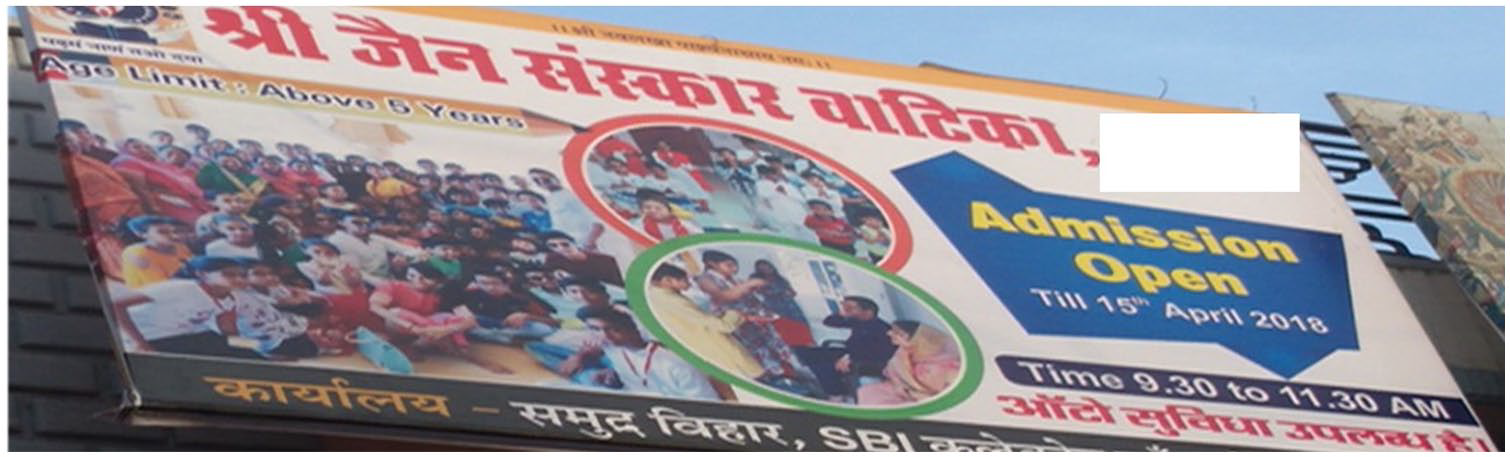
Hoarding on a temple announcing admission to Dharma school.

Children attending classes on Dhrama.
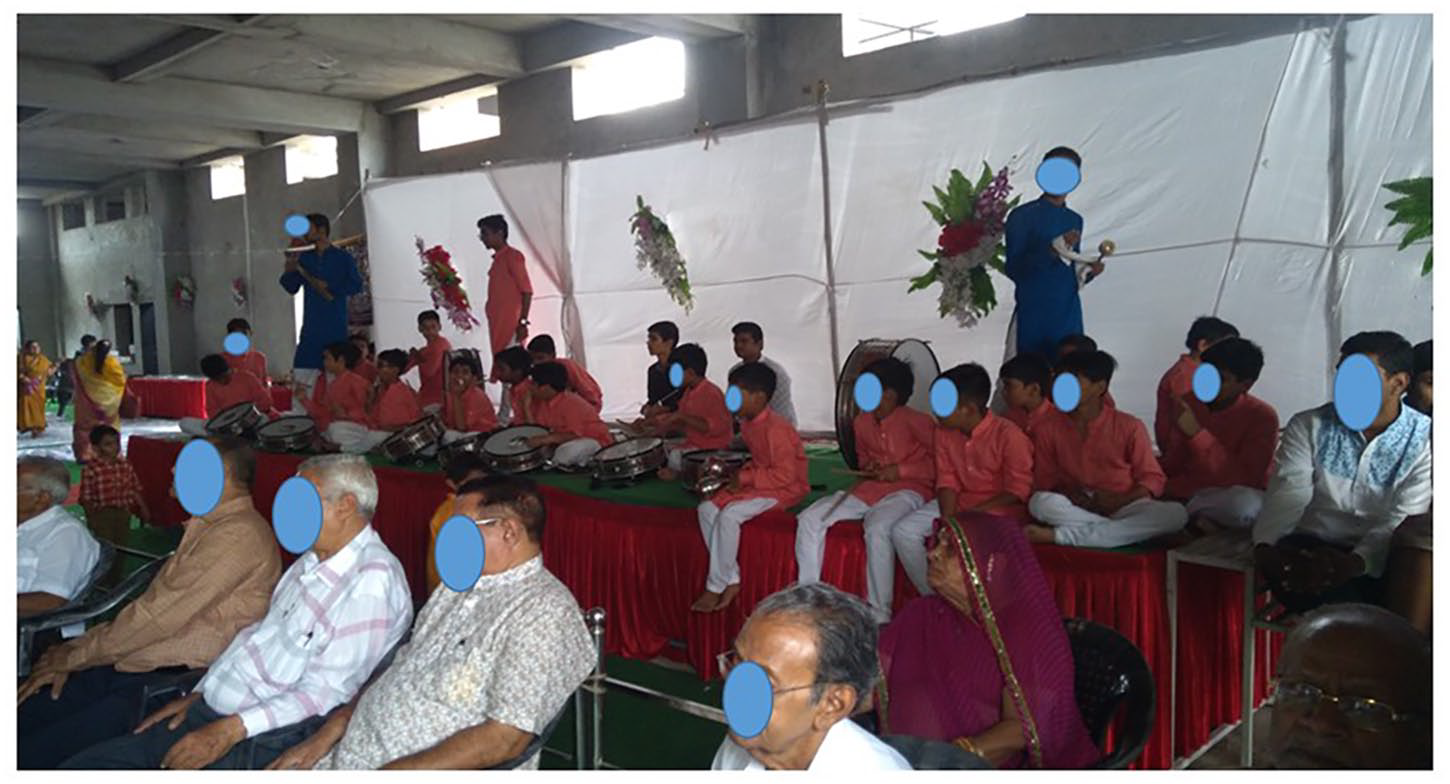
Children playing band in religious functions, announcing winning of bids.
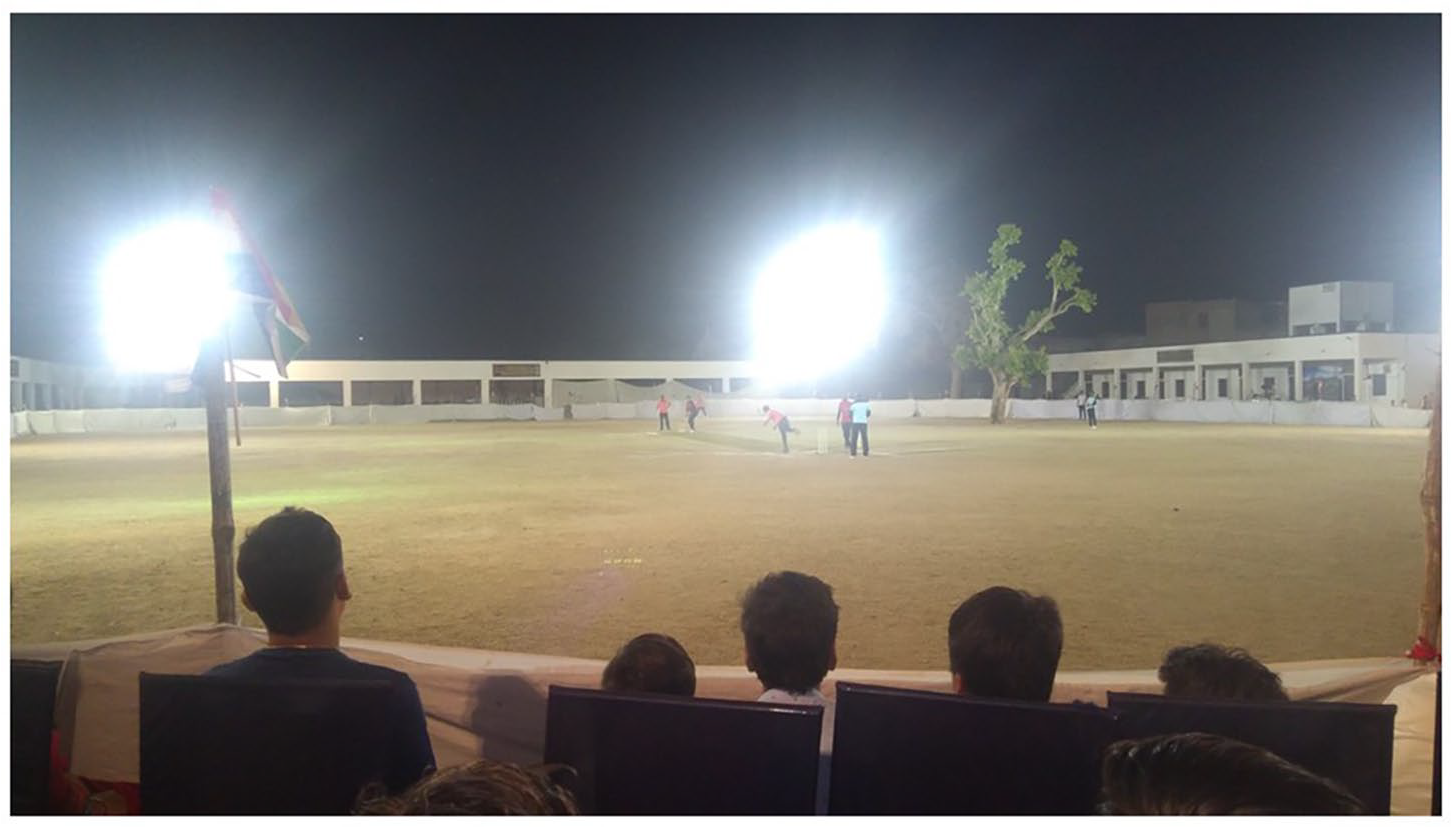
Children attending a community level cricket tournament.
Relation of the researcher with the community
Our engagement with the community of Marwari businessmen was informed by three contingencies that we sensed in our pilot study – firstly, there was a tendency of the community to be secretive to outsiders that ‘texts’ of anthropologists had talked of (Hardgrove, 2004); secondly, the seamless fusion of professional and personal spaces, made separate observations of business practices difficult pointing towards the need for holistic immersion in community life; and thirdly business practices that had evolving continuities over centuries implicated historicized actors and informants in present-future-past relationality (Gadamer, 1989), making it difficult for informants to consciously articulate to an interviewer about business practices and its rationale. ‘An-other account’ (Faria, 2013) of business organization would thus require an emic perspective, to understand how markets in specific location at Liba operated and deployed capital (Hart, 1973; Hertz, 1998).
The first author shifted with his family, wife and kid, to Liba, a town that was neither his hometown, nor his university town. Going into the field with the family enabled to get a two bedroom house within a bungalow of a local businessman. The ground floor was occupied by the business family (husband, wife, four children and occasionally visiting parents from the native-village intermittently) while the basement housed his textile workshop where finished fabric, dyed through outsourced dyers, were folded and packed for onward trade. Neighbours in the locality were also businessmen and all were informed about the research project. The presence of the family of the researcher at the site, allowed access to intimate family spaces usually beyond the bounds of non-family males.
After a month of parleying and negotiation through gatekeepers, the first author gained daily access to a five-decade old textile business house engaged in dyeing (outsourced) and trading, run now by the second as well as the third-generation of owners. Gradually, he involved himself within the context as a ‘munim’ (local word for office assistant), sitting beside owners and doing daily office work given to him to help him in the conduct of his business. His training as an MBA, with adequate skills of accounting came in handy, serving the business interests of the family that had reposed trust in the first author. The position of a ‘munim’ is often one of trust, since he has wide access to transaction information on business. The acceptance of the first author in the role of a ‘munim’ was thus important for the conduct of this research. This immersion in the business milieu of Liba, for around a year (between January-December 2018) allowed the first author access to closely observe as well as engage with diverse set of actors beyond the boundaries of the business house, spanning the business community within which these actors are entrenched in socio-commercial relations, particularly across the textile value-chain, often extending beyond Liba to other cities. Familiarity of the first author with the local dialect as well as the broader cultural practices, arising from his childhood experiences in Marwar (the same geographical region where Liba is located) provided some kind of commonality (however, only partial) between the researcher and the researched.
‘Scholars with an intimate knowledge of the context. . . [can define] the questions to ask. . .evidence found provides material and important insights into the actual setting at hand’ (Bruton et al., 2012: 9).
Data
The business house where the first author worked during the research period was prominently engaged with various local community institutions, with the businessmen of the family paying regular physical visits to several community sites/places in the neighbourhood. At the workshop, the first author was allocated a seat just behind the owner’s seats at the back table and his status as a researcher was communicated to employees. This allowed him to observe owners’ daily doings and join them in their formal as well as informal discussions and occasionally accompany them to community events, providing access to enactments in those religious and social sites. He was also allowed controlled access to internal business documents and was sent to other business houses for work related matters and allowed to even interview them after informing them of his research agenda. By shadowing owners to their homes, other business houses, parties, community festivals, fairs, religious ceremonies celebrating child-birth, marriages and mourning of deaths, and temples the first author collected data in the form of field notes, ethnographic interviews, documents, artefacts, photographs and videos.
Around 200 pages of field notes, ethnographic interviews of 40 actors consisting of businessmen of all age-groups across the textile value chain, children of businessmen, housewives and saints, around 500 photographs and few videos of various enactments, collections of business documents such as bahi-khata (books of accounts), sauda book (trans: purchase book), costing sheets as well as community level documents such as coupons, cards and brochures comprised the data corpus. We were able to collect historical facts about Liba and its business through interviews of septuagenarian and octogenarian businessmen recalling about their forefathers and their entrepreneurial journeys.
Data analysis
There was interpretive dialogue between the first author (relationally embedded in the local context) and the other authors on emerging themes from the data on field observations. The data was clustered around different spaces, households, temples and business places and the activities therein. The activities in the religious, familial and business spheres were clearly related. In order to interpret and organize the emerging relationalities between activities in various spheres, we initially used the tropes of corporate governance with a hope of seeing the functionalist implications of the Marwari mode of governance of capital.
Our interpretive journey in this research has not been smooth, however. It was fractured into two phases, and as the research progressed across the two phases, the data corpus slowly morphed from flat textual (representational) data that throws up patterns from its patterns of repeated relations (as in most qualitative studies) in the first phase described above to data that was layered and lively, reflective of enacted life lived in spaces implicating the enunciator and the local context of enunciation revealing personalized relationships in the second phase. In the first phase, as authors of this interpretive journey, making sense of the ethnographic immersion, we uncritically imposed categories from the academia [MOK literature] around Eurocentric notions of corporate governance such as principal-principal and moral hazard problems, casting a Eurocentric gaze on indigenous practices. Critical reviewer comments infused the needed reflexivity, making us aware of our own locations within Eurocentric management discourse. We attempted getting over the limitation by engaging in dialogues in the local language, dropping English from our conversations to leave behind the conceptual tropes of the English language MOK literature. Thinking in the local language (the vernacular) helped us overcome the categorical separations that were earlier seeping in unconsciously through the English language and slowly made visible the ‘an-other’ (Faria, 2013) logic of organizing in the Marwari community. Data on enactments were thus located, in micro-spaces in Liba, and amongst enactors whose personifications started emerging as significant. As we started depicting the data as enunciations and enactments, the ‘texts’ of the arguably Eurocentric academic world (of anthropologists studying Marwaris and those studying the legal history of the corporate forms in India) that had anchored our initial thoughts on Marwaris and their forms of incorporation, also became enunciations, articulated from specific disciplinary locations and spaces. This was a crucial step for us, helping us articulate better the ‘silences’ in the academic texts. In this paper, we present findings of the second phase of analysis only, but we transparently reveal the intermediate step (whose outcome we rejected) that we went through as a part of the struggle of the ‘doing’ of decoloniality.
Looking back at history: Texts on colonial law and modern governance forms
Mignolo argues that local histories play a crucial role in ways through which decoloniality is constructed and signified. Marwaripan did not evolve in isolation to coloniality but interacted and struggled with it. Our question: ‘how could the Marwari world, organizing its capital under outdated form of “unlimited liability” experience uninterrupted business success over decades?’ required us to access the history of corporate forms in India through encounter with the British colonial government’s legislative enactments in India creating the new (modern) institutional apparatus to govern and control the market. Since decoloniality is born in the unveiling of coloniality, we also bring forth in this section, the struggle of Liba businessmen to deal with the modern corporate codes and retain unlimited liability as the primary form of governance of capital.
British legal interventions in 19th century India
Our access to the history of corporate forms in India was through ‘texts’ of legal history. India has a long history of colonial rule which brought Eurocentric systems and practices in all walks of life including trade and commerce (Markovits, 2008). The postcolonial cultural anthropologist Ritu Birla (Birla, 2009), while studying the emergence of modern ‘market subjectivity’ of Indian capitalists and the role of laws therein from her disciplinary perspective, depicts how colonial administration intervened with the indigenous trade practices to craft what she calls organization of the socio-economic space into the private/public dyad. While it sought to define the private sphere as that of the family (specifically Hindu Undivided Family) where economic organization, including matters such as inheritance, would continue to be governed by traditions (and personal laws, where British jurisprudence did not directly seek to intervene, preferring to defer to traditions and culture of Indian), it simultaneously crafted the ‘public sphere’ as a legal space of free contract under newly enacted laws enforced through the colonial State apparatus. British law also defined the ‘family’ in overtly restrictive terms as those living under the same roof and sharing a ‘hearth’. Marwari concept of family was however extensive, captured often through the notion of joint-family where this joint-ness was beyond the immediate members – father, mother, sons, daughters, daughters-in-law and their children – that co-resided. It also included other relatives by way of consanguinity, lineage or marriage that were beyond the walls of the residence, in stark contrast to western understanding of family as composed of members only in co-residence (Kakar and Poggendorf Kakar, 2009). British jurisprudence thus sought to make a restrictive redefinition of the category of family and private space where personal law and traditional norms of commerce could operate. Birla (2009) argues that this was a step in the direction of creating ‘locationless’ markets, abstract and universal, where exchange and circulation of capital would be unconstrained by norms specific to locations and its internal embedded relations that were the established principles of organization of indigenous business of those times.
The introduction of Companies Law in India in 1866, just a few years after its introduction in England, was one such legal intervention to create the public space defining forms of incorporation of businesses. It foisted on Indian commercial scene the ‘limited liability joint-stock company’ as the modern way of managing pooling of capital to undertake risky and worthy large-scale investments, such as railroads, shipping, mining etc. By the time this happened, there was a large-scale proliferation of registration of limited liability companies in England as well (Harris, 2000) and the legal changes in India were effected with a desire to introduce convergence in legal environment between England and its colony in India.
Limited liability form and local tradesmen in India
Back in India, organizational form of limited liability did not immediately become popular. While limited liability forms led, in England, to numerous ventures exploring investments in global trade and in businesses such as shipping as circulation of capital got freed up from norms of mediaeval guilds, in India limited liability companies got embroiled in a series of frauds. In 1870s, lots of British financed enterprises that had attracted investment of Marwari indigenous merchants, moneylending and trading groups in Bombay and Calcutta went down through speculation and fraud by British directors and managing agents. Many Marwari shareholders lost their capital as British directors absconded after bankruptcies (Birla, 2009). Unlimited liability forms of incorporation continued to be more common in Indian indigenous commerce, with personal reputation of merchants playing significant role in raising capital.
While British law did not tamper with the unlimited liability forms, gradually restrictions were placed, and firms were induced to embrace the limited liability form as business and capital expanded. British law, however, constrained the operation of unlimited liability forms indirectly. The pervasive legal changes over the last decades on 19th century, by crafting a private/public distinction in organization of economic activities, struck at the power and authority of numerous caste, kinship and business groups that mediated disputes and laid down norms of conduct of business and capital, including that of credit flows. Between the private space of personal laws and the public space of State enacted laws, there was no intermediate authority or norms that was recognized, throwing several practices of merchant and caste groups into a legal vacuum (Birla, 2009).
Epistemic west as role model for independent India’s design of institutional apparatus
At the time of independence, the elite Indian capitalist class largely comprised those who made fortunes by being the agents of British companies in India (Timberg, 1978; Tripathi, 2004). Post-independence, the Indian rich capitalist class expanded in multiple industries, and aligned itself to the western corporate ways of governing in terms of their policies and organizational forms (Guha, 2007). The Indian state, on the other hand, initially aligned itself to mixed-economy model for four decades and then since 1990s it is gradually aligning itself to the corporate governance ideas of the West, seeking to ameliorate principal-principal problems of corporate governance by strengthening rights of minority shareholders and crafting strong laws for protecting rights of debtors. The political economy of the State remained beyond reach for most small businesses, while acts of law and policy making at the State did affect economic fortunes of businesses as the State exercised its regulatory roles with gusto.
Liba businessmen struggling to deal with modern corporate codes
Bazaar of Liba, a textile industry cluster, constituted of firms that were operating in product categories with very low margins (four to 5% gross margin on sales), what economists call as perfectly competitive markets and key texts in the master-discourse of strategy christen as ‘unattractive’ industries. Another peculiarity of Liba’s businesses was their capital structure, which rarely constituted of loans from formal banking systems or equity from capital markets. Such formal institutional apparatuses of financial system were closed to them and marked by their palpable absence within the thriving commercial milieu of Liba.
Loan cheeje yaane, kin cheez maate loan deva, ki hai koni yaane kan. . . kale shutter neeche karne bhag jayi [trans: they need loans (in a sarcastic tone). . . on what basis (collateral) should we give loan, they don’t have anything to show, tomorrow they may close shop and run away] (A banker, remarking on local businessmen’s untrustworthiness and their incapacity to produce formal papers)
Businesses in Liba sourced their capital from the community, through links of reputation, kinship and myriad forms of communitarian associations. Informants, however, would refer to poonji to talk about the finances invested in their businesses. Poonji, for lack of an equivalent word in Eurocentric finance, could be considered partly similar to capital, was mainly raised through intra-community reputation. So, one’s surplus or profit, when advanced to others became poonji for the receiver. Poonji had many colours, some resembling debt, while others closer to equity in Eurocentric terms, but it had extensive negotiability and were seldom governed by rigid contracts. However, all local forms of poonji did not follow the risk management frameworks and governance models of the west to manage risk, one reason being Marwari firm owners in Liba continued to embrace unlimited liability, where the separation of the person from the enterprise did not exist. The form of unlimited liability seemed not to fit with the ideas of pooling capital through impersonal, dematerialized and unitized shareholdings to finance firm growth. The bazaar of Liba, however, had very few limited liability forms of enterprise even though the State apparatus continued to nudge businesses to embrace the limited liability form with growth of business.
Company banaune mein bahut matafori hai, bina matlab ri likha padhi karo, alag hu aadmi rakho. . . kharcho kitto badh jayi, margin he kittok, heng poonji doob jayi [trans: Forming a company (limited liability form) is a frustrating process. . . keep futile records, hire more men (accountants). . . it will increase costs in a low-margin business, all poonji (capital) will be lost] – A businessman reflecting upon the consequences, if they were to convert to limited liability form
While even today the ‘popular state’ has not banned unlimited liability form, it has brought in a slew of regulations adapting India to what they call the global best practices/designs of compliance and information disclosures. The regulatory reforms have concentrated on the limited liability form, implicitly relegating unlimited liability forms, a vestige of the past, to decay as the economy grows. This neglect notwithstanding, our informants in Liba displayed no eagerness to convert to the limited liability forms and engage with the formal systems of compliance that it required.
Findings
Our findings section is divided into two sub-sections. We first describe enactments at various physical sites, locating the actors and their subjectivities in the conduct of their daily business life, exemplifying the practical collective logic of ‘Marwaripan’.
Next, we tease out how enactments at different sites draw on other enactments (often at other sites and times), revealing an intermeshing, within which actors enact their subjectivities, negotiating on interpretations of compliance to Marwaripan, seeking ‘status’ as well as means to expand their capital in circulation, that is, grow their businesses. With little access to formal finance from banks and financial institutions governed through State laws (and the political economy of modern capitalism), their daily doings and sayings revealed deep intra-community intermeshing giving us an initial impression of a self-standing governance system. The logic of how ‘coloniality’ interjected (and powerfully!) was only revealed very late even to us as we mapped and interpreted our findings. Our findings retain this asymmetric build-up to transparently lay out the emergence of our findings, that is, its enunciation instead of its eventual product, the enunciated as a final piece of knowledge. We bring in the coloniality as revealed to us only in the next section.
Becoming of Marwari business family: Learning and enacting Marwaripan within the larger community
The daily schedule of the Marwaris in Liba involved visits to multiple sites, where their enactments signified different subjectivities ranging from social, religious to commercial ones. We noted that the engagements at these sites were mostly non-delegable, requiring one’s ‘body’ to move across diverse sites (Figure 1), drawing on significant personal time for their appropriate performance. Various categories of actors apportioned their limited personal time differently, signifying shifting subjectivities as they pass through different phases of their lives; for example, the elderly would spend more time at the temples while the younger male members would spend more of their time at Paan shops, dhabas (local kiosks and eatery joints) and womenfolk at homes.
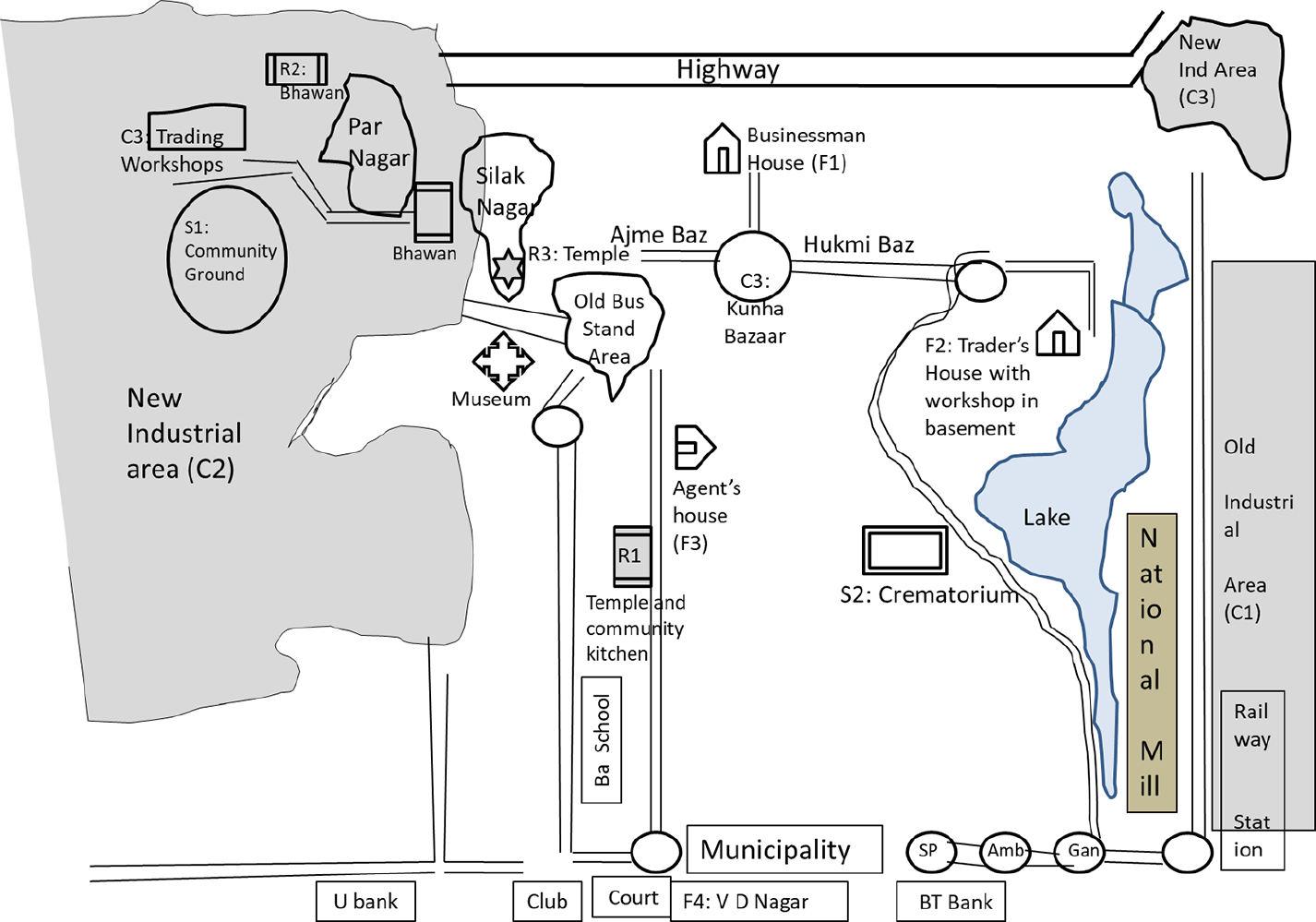
Pictorial map of Liba (drawn by first author).
Children: Inculcating faith, building subjectivities by (re-) schooling
The Marwari child usually receives education at mainstream 2 convent 3 schools, whose pedagogy and curriculum emphasized the civic logic of the State, its laws and its political economy building the subjectivity of a ‘modern citizen’, where they mingled freely with classmates who belonged to other (non-business) classes and communities. In parallel, the Marwari child, however, also attends various forms of community sponsored schools exclusive to the community. For example, the kids would attend dharma 4 classes (R3 of Figure 1) daily during summer vacation and on weekends round the year where they were incentivized for being regular and diligent (Images 1 and 2) signifying the collective effort to ensure that children get involved in the community pedagogic initiative. Children would be given small gifts (say, a bowl, spoon, ball etc.) daily for attending each class in addition to prizes for scoring well in exams that would quiz them on verses and teachings of their deity.
Every day they give something useful [for me], but only if they attend that day
(A homemaker on sending her children to dharma classes)
Most of the gifts were of utility for the household, keeping mothers interested and motivated to wake up early morning during vacation and send their wards, who walked hurriedly through narrow roads to reach in time and attend the dharma classes.
Dharma schools not only served to groom the children in the community to develop the subject position of a devotee, imbibing the teachings on the conduct of life, it also strove to develop the skills required for children to play their specific roles in the conduct of ceremonies and rituals enacted in community settings in the temple. A feature of most rituals in Jainism, a religion to which a large section of Marwari families belonged, was the competitive bidding processes through which members of the community secured the rights to perform various rituals or donate towards expenses for building and maintenance of religious structures. Adequate opportunities existed for several families to simultaneously win bids corresponding to a variety of rituals and expense heads. The bidding events were large carnivals ( Image 3 ) with members of business families in attendance (R1 of Figure 1: Nava temple site on the map). Such competitive bidding processes, while outwardly noisy and chaotic, followed a specific routinized ritual. Amidst the din, the volunteers (seniors within the community) encouraged people to bid. Each round of bidding was ceremonially concluded with children noisily playing the band upon appropriate signal ( Image 3 ).
Children gain confidence, learn to work in groups and get disciplined while performing an enjoyable activity. Otherwise, it is difficult to teach them these virtues. . . also children would get bored at such religious events and start troubling us, so playing band keeps them engaged. . . (A parent highlighting the utility of such an arrangement)
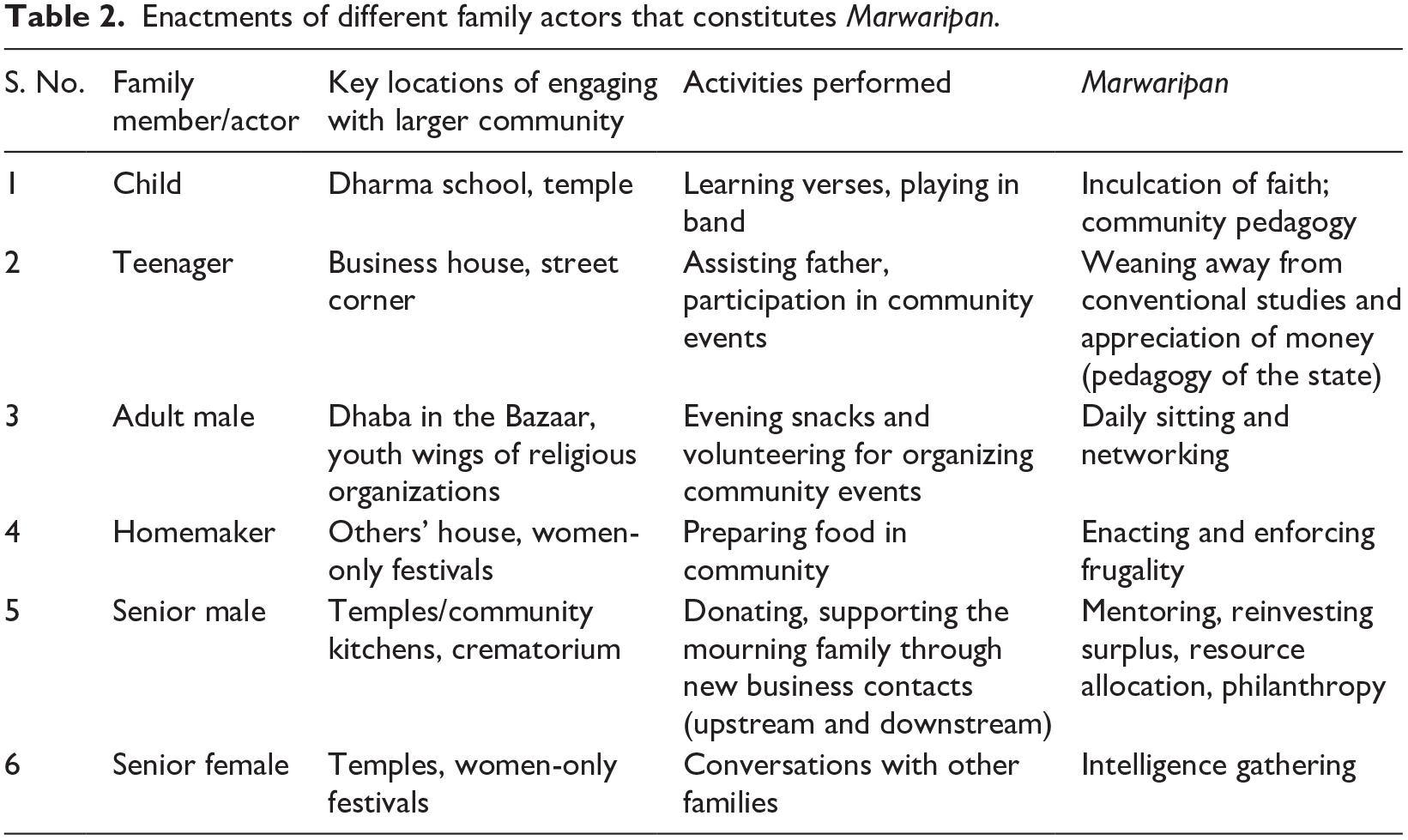
Ahead of such events, the wards of businessmen are duly trained at the dharma schools to play the instruments and on the day of the event, they excitedly accompany their parents to the venue dressed in fine clothing. The precision with which they play the instruments and the related number of opportunities that they get becomes a badge of honour and a point of discussion among children (S. No. 1, Table 2).
Teenagers: Becoming acquainted with paisa (money) and business
During vacations and weekends, school going teenagers were sent to family’s business-place (C3, Figure 1) and were initially tasked with checking bills. They were also sent to close relatives’ businesses (C1, Figure 1) to gather perspective of a different line of business. Furthermore, they were given tasks such as posting letters which required them to navigate through the crowded lanes of the bazaars. Often, they would be allowed to drive a two-wheeler to carry out certain tasks, as an incentive and as a taste of freedom. Teenagers are also allowed to purchase a few things independently from the bazaar (C3, Figure 1). Once they return home (F1, Figure 1), they are asked about the price they paid and are routinely ridiculed by elders for paying the printed price of the product. They are told to get into habit of bargaining and not feel shy about it. Furthermore, children are trained not to disclose the price of their belongings to their friends and if forced to reveal, they are trained to always quote an inflated price.
Visitors to the business-place would often ask the teenagers about their plans for future. One aspect that was quite common among teens of business families was their aversion towards conventional studies (in the convent school) and preference for roaming around and playing.
I want to get into dyeing business. I do not like studies. . . (Fifteen-year-old telling a visitor of his career plans at his maternal-uncle’s textile business – his father is a pharma drug distributor).
As teenagers started getting pulled into volunteering at youth wings of religious organizations (R2, Figure 1), assisting father in elections to local industry associations, playing in cricket tournament at the community level (S1, Figure 1), aversion to formal schooling and professional careers in the corporate world increased. Amongst teenagers, discussion on businesses or product lines that are fetching high margins or have growth potential entered their daily conversations at these venues as also gossip about the riches that some families were making through their business. These new venues that teenagers accessed, became hotspots for their conversations, and a site for coming-of-age in the business community (S. No. 2, Table 2).
Adult Male: Doing dhandha under the watchful eyes of elders and the deity
When sons (and very seldom daughters in what initially appeared to us as a gendered patriarchal space!) formally joined the business place, strictness of senior male members ensured that sons did not shirk. Senior male members also acted as trainers, imparting knowledge about the business in general as well as their rules of thumb to trade at business place (S. No. 3, Table 2).
What to do? Seth-Saab keeps us busy whole day and there is no time left to go anywhere. . .everyday it is just home to factory and back. (Businessman replying to a relative in a marriage after she complained that he has not visited them for a long time now)
5
In public, sons would address their father as seth-saab (trans: rich businessman) and not as father or any of its equivalent in the local language. This form of addressing constituted a particular system of meaning indicating ‘business as usual’ even if the other transacting party was relative of one’s father.
Seth-Saab will scold me if I sell goods to you without an agent. (Businessman conveying to the wholesaler that he may not be able to deal, even if, he was father’s close friend).
Such internal governance mechanisms at business place (F2, Figure 1) based on patriarchal control would ensure that jobs delegated to the younger generation were conducted fairly and not at deviance with the long-standing formulated rules as well as community values. There were other governance mechanisms in place so that younger generation follows fair practices with their close relatives and business partners. One such internal governance mechanism to counter the possibilities of expropriation by any member of the family was arrangement of share-of-deity 6 in the firm.
Figure 2 depicts a simple case of a business house with shares divided among two human partners and the Deity in whose benevolence they had mutual faith. Business, conceived thus, is not merely about earning profits; it was also sacred. The family Deity is allotted a share in profits according to a predetermined formula (usually a community level norm that specified the share as a range) that provisioned for donations to the temple (the deity’s abode). This makes it incumbent upon each partner to be fair in reporting business profits to the partner, for cheating a partner by misreporting profits would lead to an act of sacrilege. Cash donations to the temple (from the provisioning of deity’s share) made publicly also provided a means to the larger community to sense the financial health of an ongoing business without elaborate public disclosure of private financial information.
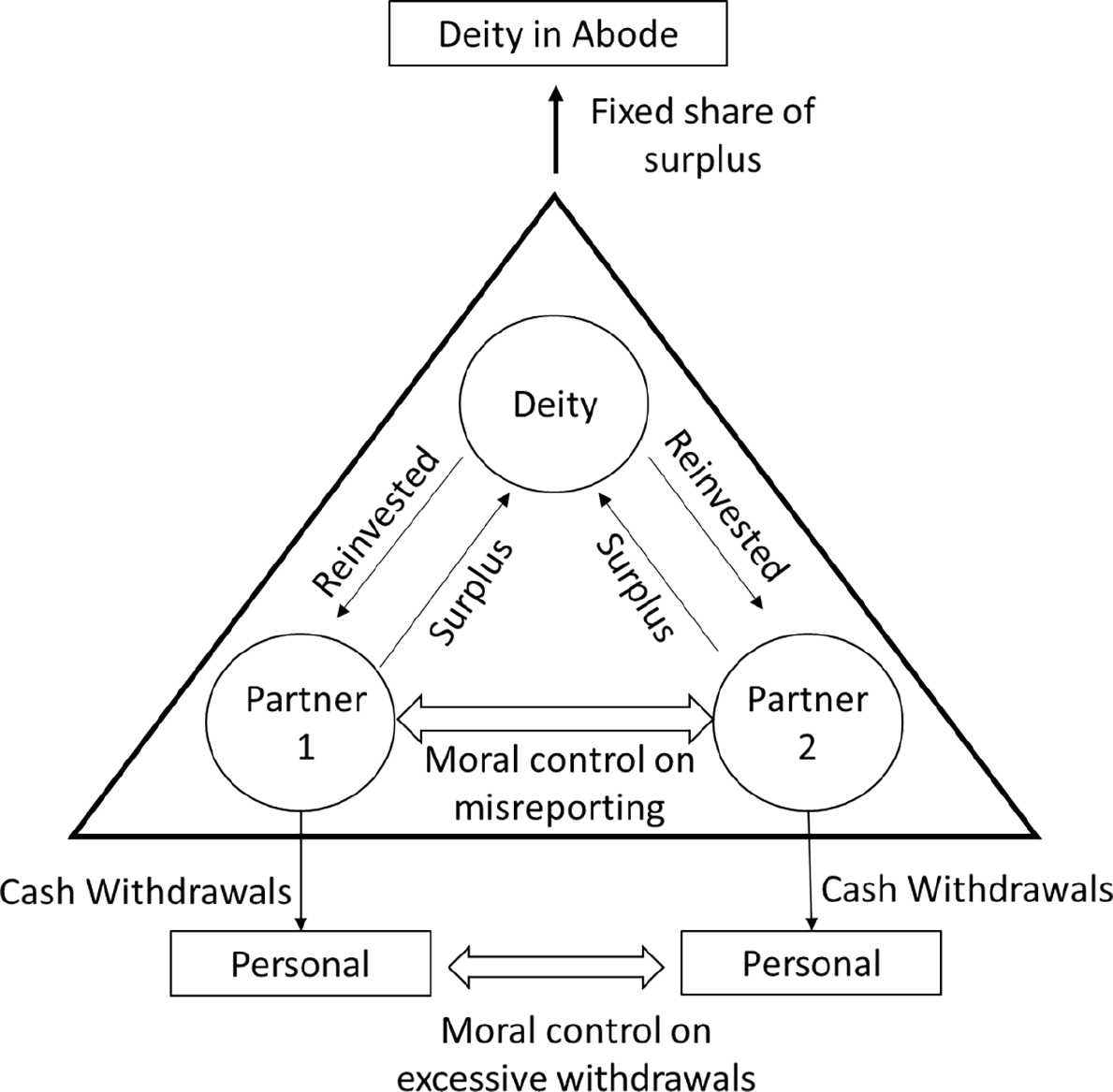
Share-of-deity.
Furthermore, it was observed that partners considered themselves as ‘in service to’ the deity and treated the deity as the abiding owner of the business and therefore conducted themselves accordingly in their daily doings. The abiding presence of the deity as owner constituted a notional point (sacred) of accumulation of capital in the business for which the partners strove in earnest, providing a counterpoint of negotiability when partners differed on the need to draw out cash for family/personal expenses instead of reinvesting in the business and grow the accumulation cycle. Accumulation and circulation of capital within the business thus was constituted as a sacred act.
Does Kanjilal and sons have allocated share to deity? (A credit provider asking the agent about the borrower’s business house)
Since share-of-deity had potential to ensure fairness among partners and push them towards prioritizing accumulation within the business, adherence to the practice signified allegiance to Marwaripan and its intermeshed intra-community governance, often providing comfort to providers of credit and capital.
Homemakers: Enforcing frugality and enacting distributed intelligence
Women held sway over the domestic (gendered) space. Elderly females were responsible for guiding younger females (daughters and daughters-in-law) of the household. Furthermore, septuagenarian, and octogenarian females were the major source of family history and lineage for everyone within the family as well as relatives outside and storytelling was a regular feature in their daily routine. Elderly females, being free from cooking the breakfast, sending children to school early morning and household chores (as it could be delegated to younger ones) would gather at temples and bhawans in forenoon hours (R1 and R2, Figure 1). These were the sites where conversations revolved around family issues, thereby senior homemakers becoming a repository of societal information for the business family on which, as we will show subsequently, males depended to construct credibility of others to trade and advance poonji (capital) (S. No. 6, Table 2). Junior homemakers were responsible for domestic chores but not restricted to one’s house. Periodically, they worked in groups to make ready-to-eat food (pickles) and non-food items (washing soap) depending upon seasonal cycles of raw-material harvest and availability. This not only reduced costs but guarded them against the volatility of vegetable and food prices in the bazaar as they processed crops by sun-drying them, increasing their shelf life to couple of years.
These days, Vimla ji does not join. . . since they have become richer, her mizaz (trans: egocentric) has changed, boasting of her newly earned wealth. . . (a homemaker remarking about another, who has exited the group)
These groups comprised homemakers from different families, either related to each other or living as neighbours. These groups were not frozen and displayed significant dynamics as older members left as their positions (‘status’) in the society changed and new members came in. It was not uncommon for new groups to form as well. The groups would gather for whole day at different houses by rotation. Even here, conversations negotiated compliance to Marwaripan and its associated meanings, evaluating others and justifying oneself, constructing ‘status’ based on adherence to precepts of Marwaripan. Unmarried daughters of the house also participated in these activities in addition to homemakers and their participation was noted resulting in positive word-of-mouth about them in the community. These venues were a learning ground for prospective brides gaining insight into familial dynamics in addition to culinary skills as well as inculcating long-held practices that constituted frugality, a characteristic that Marwaris are known for (S. No. 4, Table 2).
Senior (male) generation: Custodian of Poonji (capital) and sustainability work
Senior male members of the family spent time at various places beyond the house and the business-place. They would daily go to temples (R1 and R2, Figure 1), community kitchens and in case of death of a known person in the town, would go to crematorium (S2, Figure 1). They kept a close eye on their children in terms of company they keep, right from their early childhood days.
I would be back before my father came home. My sisters would save me from my father when he scolded me for playing cricket all day with friends belonging to other non-entrepreneurial castes. (A firm owner on his adolescent days)
This control extended to their adulthood as they were only paid pocket money (and not share of profits in family business) for many years even after they got married and had children. Elderly males (grandfather, father and uncles) were the custodian of the family’s wealth, ensuring fairness in inheritance without compromising sustainability of the family. Since Marwaris were configured into a joint-family system, most expenses were covered by the business-house directly (Table 1), that is by the senior generation and only a few personal expenses such as entertainment were to be met out of pocket money allocated by elders out of surplus in business to the younger members. This ensured control over expenses, towards maximizing capital, leading to wealth creation for the family in the long run (S. No. 5, Table 2).
Management of expenses within a Marwari joint family.
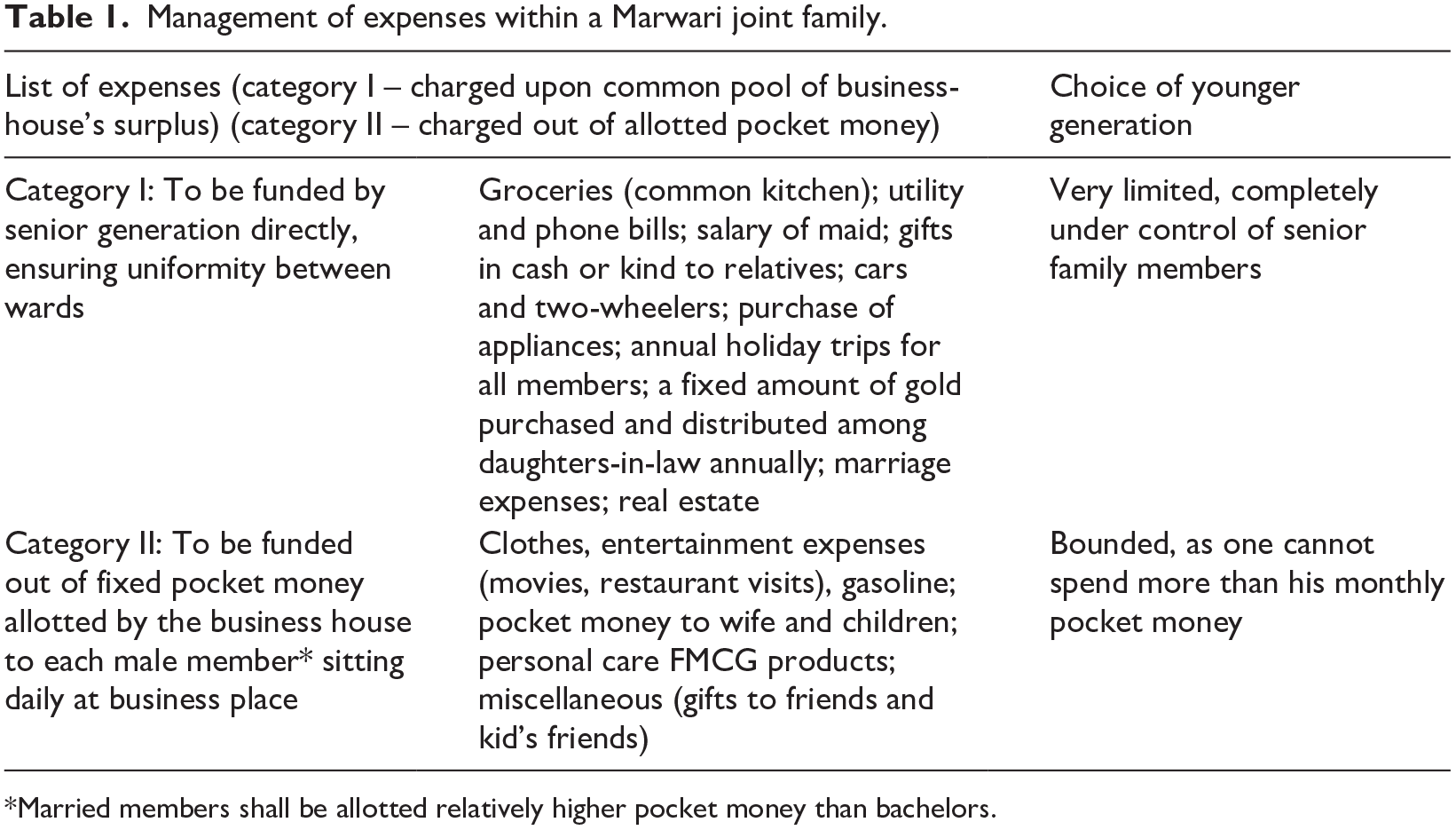
Married members shall be allotted relatively higher pocket money than bachelors.
Enactments of different family actors that constitutes Marwaripan.
This convention of management of expenses within family also served many other purposes. Prominent among them was liberating the younger generation from the pressure of immediate financial performance, allowing them to initiate new ventures and grow them over 7 to 10 years by ploughing back surplus into the business without making cash withdrawals to meet personal expenses.
Members of Marwari families expended labour and time at various sites, engaging with the larger community and creating enactments which signified Marwaripan (Table 2). Such enactments involved local physical presence, significant contextual labour and its associated bodily toil, and attention from various members of the family, which as we show next, intermeshed with each other to create cues from which a Marwari businessman would draw to carve out a way to govern capital and its accumulation.
Intermeshing spaces, actors and activities: Negotiability across subjectivities as spaces of enunciation
The Marwari way of living generated many cues on a continuous basis constructing status, signifying adherence to widely held norms, while enactments across spaces and time gave actors the spaces of negotiability. Marwaripan was not a given construct; it was negotiable and was recrafted and reinterpreted in widely dispersed spaces of enunciation. A wide variety of actors across different subject positions participated in such spaces of enunciation; norm following was not mere compliance to rules coming from elsewhere. The intermeshed enactments and the flow of information it created for those sharing the way of life christened Marwaripan was invisible and inaccessible to outsiders, creating a spatio-communitarian boundary within which the reach of their particular form of governance remained limited. In this sub-section, we trace the relations between enactments and activities of different actors (and their subjectivities) in various sites. Each row in Table 3 describes two enactments as a troika of location, actors and activity to signify its enunciation (the location, L; actors involved, A; activity, Ay) and the inter-relation between the enactments. Each pair of enactment and its inter-relation signifies an intermeshing of different spheres/roles involving the actors and is supported by a set of doing/believing. Implicit in each dyad of enactments (and their inter-relation) are implicit subjectivities of the actors who enact the activities. We draw from the table and decipher the significance of different types of intermeshing for the doing of accumulation and circulation of Marwari poonji (capital).
Intermeshing among enactments.
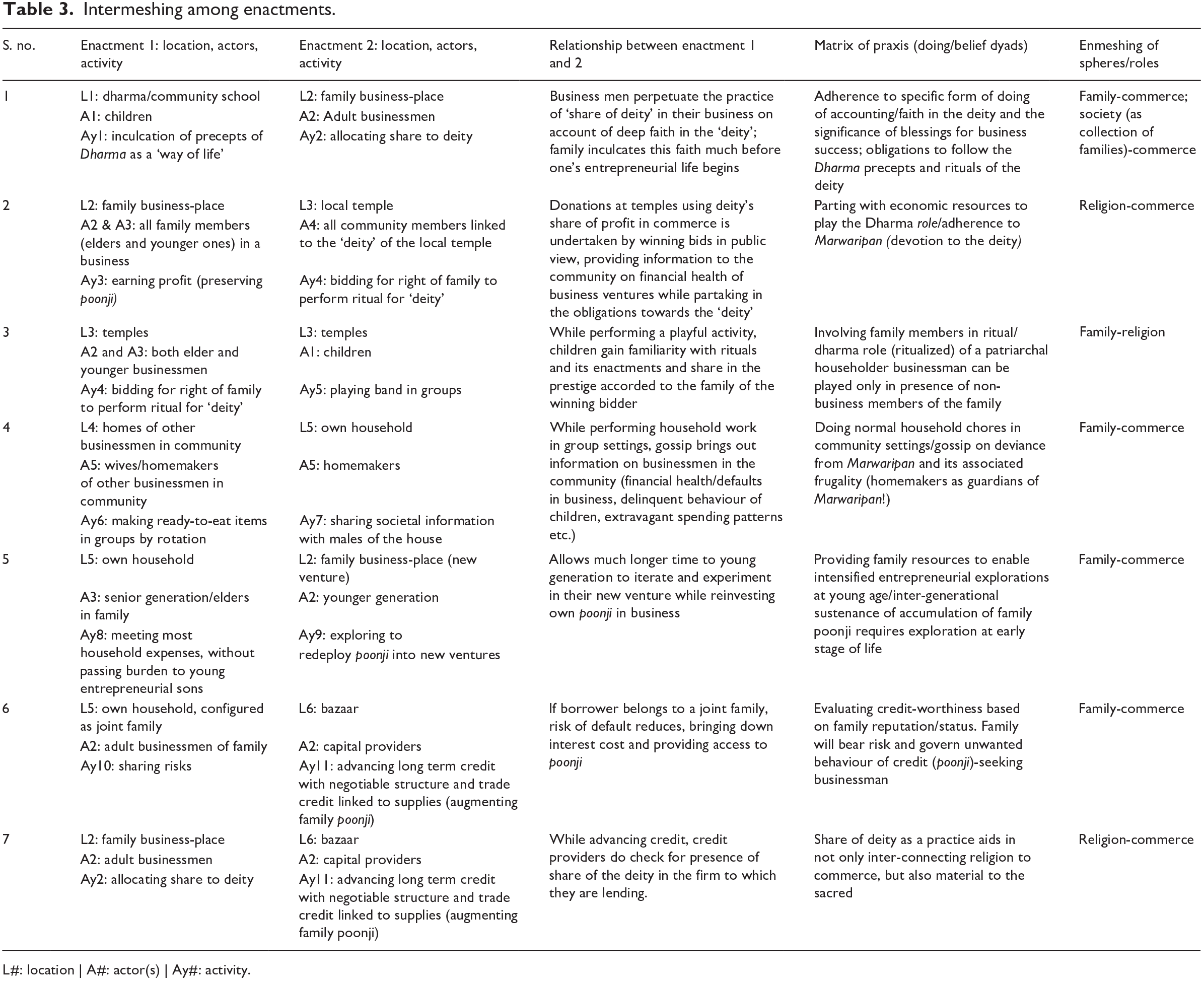
L#: location | A#: actor(s) | Ay#: activity.
Governing over space: Spatial circuits of circulation of capital
Temples occupy an important place in the Marwaris’ life. The system of temple worship was differentiated with numerous groups and sub-groups (mandals) configured around the monk group they had allegiance to. The deities had a share in family businesses and certain ceremonized rituals at regular intervals were organized by monks during festival periods which were attended by followers (A4, Table 3). At these large gatherings, donations were accepted through transparent bidding processes involving business families who bid to offer share dividend (image 5). In these religious events, bidders would assemble and each business family with a budget in mind (corresponding to share-of-deity) would bid (Ay4, Table 3). The name of donors (A2, Table 3) was on display, some temporarily, while others on a permanent basis through inscriptions in temples and other community spaces (image 6). Furthermore, we also found that in community messes, even pictures of donors were framed and put on its walls. Post-event, for many days, people discussed bidding at their homes, offices, shops and parties. They talked about the business houses that were in the race, who won, who lost, the quarrels and the surprises around bidding. Through these daily talks on bidding and donations, several actors participated in a dispersed space of enunciation, where the good financial health of a business and the status of its owner-donors was negotiated.
He does not have the capacity to donate this much. . . last year was very tough as some wholesalers defaulted in Punjab. He is just showing off (businessman remarking at an informal get-together on someone who won the bid at an amount beyond his means).
Since people knew about each other’s businesses and their capacities, donations that were too high were seen with skepticism initially and then confirmed through other sources if it corresponded to business fundamentals (Ay3, Table 3). On the other hand, donations from business houses that were far lower than the community’s expectations, also became a point of discussion. These were the spaces where legitimacy got established and reinforced as well as the nouveau-rich and their means got revealed to the community. The enactment of open and transparent bidding at religious spaces in presence of numerous members owing allegiance to the ‘deity’ (in a relation of devotion, and thus purportedly following the precepts and practices enshrined in the teachings of Deity) intermeshed the religious space (the temple site) with numerous business spaces (the site of the business houses whose members were in attendance), thus creating a spatial fabric that provided a space of enunciating ‘status’ and reliability of a business partner for access to poonji (capital) for the conduct of trade and commerce. Ceremonized ritual practices within the religious space not only enacted dharma, but it acted as platform where triangulating of commercial information could be performed as well.
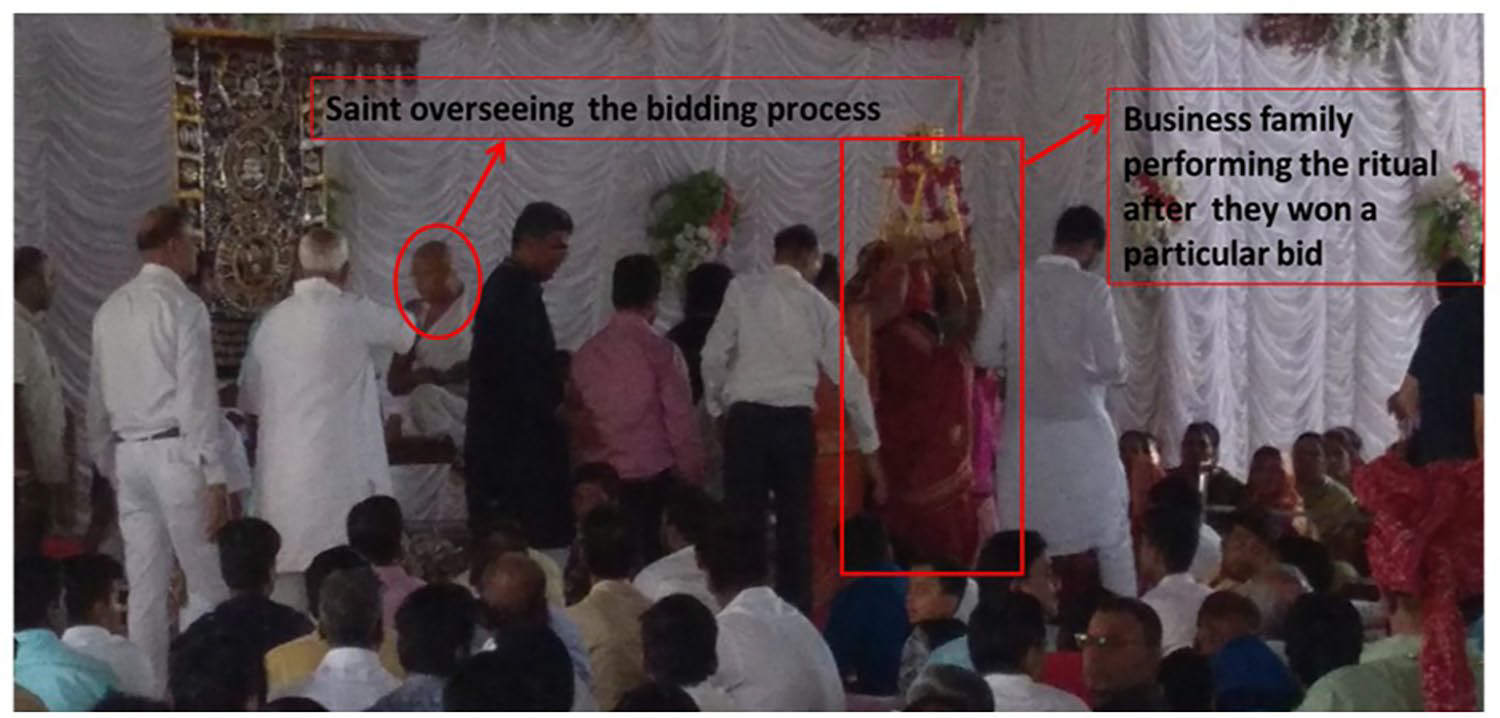
Family performing a ritual after winning a bid at a religious event.
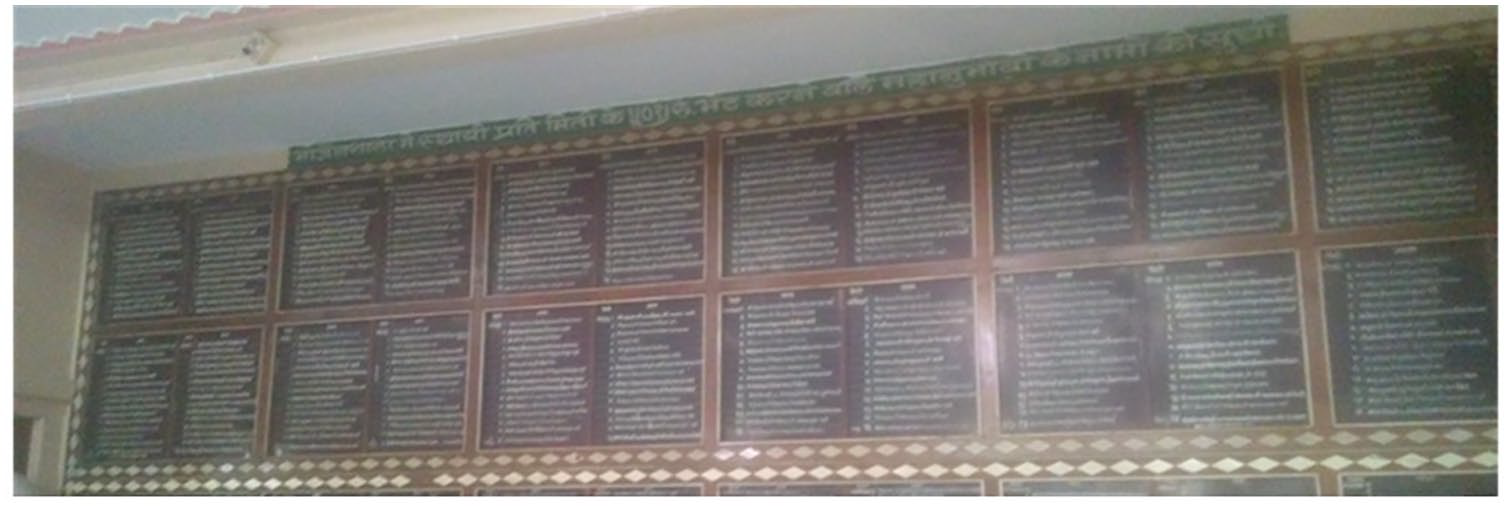
Name of donors inscribed in a community kitchen.
Within Marwari business community, capital flows primarily in the form of loan advances or working-capital advances in form of goods. Loans/advances are not backed by collateral or protected through contractually codified covenants that could be legally enforced. So, these kinds of non-secured loans were advanced solely based on credibility which was exhibited through numerous enactments such as mentioned above. Additionally, systems such as joint family and share-of-deity were cues for capital providers within the community to assess creditworthiness by evaluating and judging adherence to Marwaripan and its central tenets. Since Marwaris in Liba largely depended on intra-community capital, joint family system was a form of non-monetary collateral. In Marwaris’ system of meanings, it was the family who would bear risk and govern unwanted behaviour of credit seeking businessman. Furthermore, it was also presumed that since new businesses were started by wards of joint business-families, they will not have to set aside large amounts for personal expenses, thereby improving business liquidity and minimizing the chances of delay/defaults in repayments. This also resulted in reduced interest costs for the borrower belonging to a joint family. The religion-commerce intermeshing tied up spaces in an interlock where enactments could be related for sense-making of commercial (credit) risks to aid the circulation of capital. This spatial interlock, created as it is through enactments and bodily toil of actors who needed to move between the sites, also provided spatial limits and boundaries to the spaces of enunciation of ‘status’ of creditworthiness.
Governing across time: Sustaining the poonji
Mechanisms formulated within commercial space could only be effective over the long run (inter-generationally) when subsequent generations were inculcated with certain beliefs and values. Inculcation of religious beliefs in childhood (A1 and Ay1, Table 3) at dharma classes (L1, Figure 1) as part of parallel schooling ensured deep faith in deity which later allowed the share-of-deity concept to play its part (row 1, Table 3). Business and the accumulation of capital and the bodily toil that it involved through deep personal involvement and commitment were sacred enactments.
The joint configuration of business families (L5, Figure 1) in Liba ensured that sons do not have to worry about day-to-day expenses in running of the house which otherwise would be a demanding aspect in a nuclear family (row 5, Table 3). For instance, kitchen being common, we observed that in Marwari joint families, the senior generation (A3, Table 3) was buying all the groceries for the entire family and no contribution was taken from sons even if they were to manage a business unit independently. This formulated convention of management of expenses within family met multiple purposes. Prominent among them was liberating the younger wards from the pressure of showing earnings every quarter that western businesses generally face. This allowed them to start intensive entrepreneurial ventures and grow them over 7 to 10 years by ploughing back surplus into the business and not take it out to meet personal expenses. Additionally, it gave them ample time to undergo learning by doing business and learn the tricks of the trade and take a venture to a stable state. Enactments that sought to govern actions by different actors taken across time through a temporal interlock, often separated by generations, were accomplished through family-commerce or family-religion intermeshing that could draw on the natural inter-generational continuity implicit in the notion of a family and a lineage. Interrelated enactments instilled a sense of search for sustenance of capital and its circulation as a guide to the daily doings of the Marwari businessman.
Spilling over subjectivities: Constructing authority of the family
The domestic life of the Marwari, we found, was gendered with a clear separation of activities that were domestic, where womenfolk ruled, and men often had little access. Homemakers while carrying out the day-long domestic labour in groups (A5, Table 3) at one of the homes, however, accomplished and enacted several other negotiated constructions beyond the making of food items (Ay6, Table 3). In parallel, conversations around new happenings within the community would also continue (row 4, Table 3). Some talked about their relatives’ family such as childbirth, matrimonial alliances and so on, with other women also adding to such information, either confirming or falsifying it. Such gossips (Ay7, Table 3) would bring out information on business aspects as well such as their financial health, defaults, delinquent behaviour of children, extravagant spending patterns and so on.
I didn’t know about it. . .my wife informed me today, hearing from someone at yesterday’s samayi (trans: local version of meditation) that Singhvis’ son had misused credit card and spent on [questionable and socially unacceptable] activities in Mumbai. . .we have also heard earlier few things, but not of this magnitude. . . if he continues like this, how will he manage dhandha (business) in future. . . for now, we know that his father, who we deal on a daily basis is good, but future looks bleak. . . (young businessmen gossiping at 8:30 pm at friend’s office)
Individual homemakers (A4, Table 3) would share information captured while performing chores in community settings with their male counterparts at the end of the day. It added to the information base of businessmen which many times had implications in commerce. So, homemakers while performing household chores, in parallel, contributed to the fast flow of information on deviance from the Marwaripan.
Inculcation of religious beliefs in children also involved training them and making them understand the procedural knowledge of rituals and its sacredness. This was achieved by engaging in playful activities of children at the site of religious rituals and festivals (row 3, Table 3), something in which adults (A2 and A3, Table 3) will only be interested in. For instance, playing band (which children enjoyed) was incorporated into the bidding process at temples. Such arrangements ensured that children (A1, Table 3) gain familiarity with enactments and share prestige accorded to the family of the winning bidder. Prestige and status in Marwaris’ system of meaning was not a unitary or individualistic terrain, but it was enact able only in the presence of the non-business members of the family.
Thus, Marwari womenfolk, as doers of the tasks of ‘preparation of food’ at home or the doer of ‘rearing the child’ inhabited gendered spaces in a purportedly patriarchal system, in their role as negotiators of family ‘status’ in interpretive tussles about adherence to precepts of Marwaripan, or as the bearers of the ‘status’ to be accorded to the successful businessmen who performed their dharma of donation at the abode of the deity almost in proportion to their business success, the womenfolk were central actors in the preservation and construction of ‘status’. Neither adherence nor celebration could occur without them. The work of women, otherwise seen as gendered, spilled over into the business/social space, as their negotiability often determined the status accorded to the male doer in the business sphere. In the inter-relation of their domestic work with other activities (family-commerce; family-religion intermesh), that constructed and enacted the authority of the family, their gendered subjectivities spilled over. It was this authority of the family that the broader social fabric could draw upon in the construction of the spatial governance that we described in 5.2.1. While the temporal interlock required effort and bodily labour to stitch together (assembling in the common temple, say), the concomitant interlock around naturally occurring activities (gossiping among women) constituted an easier inter-relation that could be maintained far more easily (also cheaply!) and could serve as a foundational building block of authority.
Discussion: Conversations across ‘local enactments’ and ‘global texts’
In the conventional format of presentation of a research paper within MOK, this is a ‘place’ to tie the ‘knowledge claims’ (global/universal?) of a paper to conceptual tropes in the globally circulating ‘texts’ [the literature, so to say]. We spoke, in a preceding section, of ‘silences and omissions’ in the global ‘texts’ of MOK about our context, our enactors and their forms of conducting their business; we disputed the universalized claims of knowledge in MOK; and we began with a puzzle about how a community whose practices are ‘scoffed at’ in ‘texts’ of MOK enact consistent business success through generations. Over the last section, we sought to provide a glimpse of Marwaripan as a way of life, intricately linked to the circulation and accumulation of capital (poonji) through involved toil of the body that provided some answers to the puzzle we began the paper with. We have one more step in our own interpretive journey that needs to be laid out. The way of life of the Marwaris, interwoven as it was, within intra-community spaces of family, commerce and religion, appeared to stand on its own. Where was the colonial matrix of power? Our first drafts of this paper bordered on portraying an ethnicity that existed outside of and beyond the colonial matrix. We had to take recourse to a deeper rereading of Mignolo, prompted by the review process, before we could discover the ‘colonial-matrix-of-power’ and its silent pervasive workings! It was then we could feel the joy of having arrived at a place to rest (temporarily) to be able to narrate snippets of knowledge that can carry the weight of the ‘enunciated’. But this claim to knowledge, a giving back through the ‘enunciated’ to the circulating world of ‘texts of MOK’ must be read with the process of its ‘enunciation’ – the journey itself with its actors, situated contexts and emotions that we also have sought to lay down.
Let us revisit the contrasting imagery of the world of the large modern limited liability mill and the teeming world of the bazaar of small unlimited liability enterprises with which we began the interpretive journey of this paper. The financial vagaries and fluctuations of the modern mill, its distant owners who seldom visited, its access to formal finance etc. pointed to capital circulating/allocative processes shrouded in mysteries of anonymity or in distant, little understood workings of the political economy of the State and its arms of formal finance, mediated as it was by laws and policies enacted by the State. This anonymity and mystery existed alongside generation of written reports, disclosures, compliances and other such practices that formal corporate governance entails. The workings of the bazaar, in contrast, lacked the written accounts; writing compliance reports were in fact scoffed at by the informant businessmen and yet we discovered wide participation by diverse set of actors in extensive negotiability of ‘status’ that underpinned the processes of circulation of capital and access to it for growing a business. Circulation of capital and access to credit was provisional on the accretion of ‘status’, negotiated through performance of familial, religious and social roles implicit in Marwaripan through enactments in various intermeshed sites. Status was negotiated in everyday enactments in spaces of ‘enunciation’. The an-other way of circulation of capital and conduct of commerce of the Marwari was built on collective communitarian enactments, where the process of enunciation and its local context was open to negotiability and participation of community members/actors.
Quijano (2000) identified four levers of control of coloniality: control of economy, control of authority, control of gender and sexuality and control of subjectivity and knowledge. As Mignolo points out, the global domination of coloniality was experienced as a specific socio-historical process at each ‘geo-location’ and its contours of epistemic dominance that it enacted differed significantly. The imposition of modernity and its epistemics in India, as we reviewed briefly in section 4 created a legal vacuum for existing communitarian structures of authority, by forcing an organization of society around a separation of private and public domains. While domestic life (family life, on issues such as marriage and inheritance) was left to what it called traditions (of the Indians), the economic life (except in small unlimited liability family enterprises) was sought to be re-built around modern principles of the public domain relying on law and the written contracts. Authority was centred around the institutions of the state and its law-making activities that could regulate economic life. Thus, authority was sucked out into the distant State and its machineries with its regulatory role, while the domestic space and the gendered work of womenfolk was relegated to functions within the private family. The performance of the economy depended on the political economy of regulations that controlled access to various resources and could change economic fortunes of businesses. Religious institutions, however, were left largely untouched, and the family as the quintessential carrier of the lineage continued to have a say in matters pertaining to the domestic sphere where customary practices had a sway.
The intermeshed enactment of Marwaripan that we described in section 5 above, can now be seen as a recovery of authority within the ‘space of enunciation of the community’, a belaboured building of an-other re-existence seeking to reverse the colonial usurpation by the British colonizers and the masters that followed their epistemic model. It (re)-claimed this authority by denying the economy-polity separation and by refusing to deal with the ‘representational’ world of written contracts and juridical enforcement through state machineries. The surviving religious institutions (the religious sites and its enactments) could serve to tie spaces/sites of enactments and their actors in tight community fabrics as we described in the last section, enacting and bestowing ‘status’ and authority on the carriers of Marwaripan. The freedom to practice customs in the domestic spaces provided the possibility for families to re-emerge as the foundational element of authority within the community.
This building of ‘an-other’ re-existence, however, involved immense toil of the Marwaris. ‘The body pains’ – as one of our informants narrated as Marwaripan is enacted and preserved through the toil of a multitude of actors. The enactments and its staging also depends crucially on the cultivation of faith on the set of customary beliefs that accompany acts/doings of the actors. Preserving such beliefs amidst cultural forces of Westernization and its inculcation within the community require the labour of specific communitarian pedagogies (the dharma schools). It is only when this deep labour that formed the crux and the core of the building of Marwaripan was revealed that the pervasive power of the colonial matrix of power revealed itself to the authors. It was revealed in the uphill struggle to lure younger generation away from the modern pedagogy of the State seeking to build secular citizens, who would respect the separation of economy/polity, personal/business, religion/business and so on. Each such epistemic separation would chew away from the core of the belief underlying enactment of Marwaripan, intermeshed as it was between these multiple spheres.
It was revealed in the irritation that our informants demonstrated on every occasion where demands for compliance and keeping of records took personal time and bodily toil away from enactments that mattered for growing capital and seeking ‘status’ through Marwaripan. The exasperation of the Marwari when called upon to maintain records and other representational artifacts of compliance was evident.
Din bhar pencil ghasha toh dhandho kade kara. . . ghar-bar hai, aur bhi kaam hai, samaj mein uthno-bethno, dharam karno [trans: If I am going to do paper-work whole day, then when will I do dhandha (business). . .I have family, other work, sitting/engaging in social circles, doing religious rituals] This expression of disdain points to the contesting demands on the time and bodily labor of the Marwari businessman.
Although the State did not ban unlimited liability as a business form, neither did it channel resources through the state mediated processes of political economy preferring to keep it in a state of neglect. Unlimited liability remained alive as a viable form for the circulation of capital through the toil of Marwaris who enacted an-other decolonial governance.
Our findings showing the intermeshed enactments in familial, business and religious spaces, point to the constitutive and generative power of ‘an-other’ ‘way-of-life’ [Marwaripan]. It is a matrix-of-praxis. It is constitutive, building and supportive of a whole way of life that denies the separation between familial and business spaces, religious and commercial spaces, as well as spaces of status/authority and of the economy. It is decolonial because it reverses the enunciation/enunciated separation that colonial powers inflicted by tearing away authority from communities and locating it in the State whose workings of political economy remained beyond reach and shrouded in mystery for most small businesses (such as our participants in the study). It is decolonial because its enactment (the intermeshed praxis) created a space of enunciation where various constituents of the community had extensive negotiability. It was this constituted political society that was the basis of authority that ‘status’ granted and the basis of sustained circulation and reproduction of the Marwari poonji. The risks of unlimited liability enterprises that ‘global texts of MOK’ look down upon could be managed only within this constituted political society that functioned through extensively negotiated ‘status’. The construction and enactment of Marwaripan provides a way forward for the re-building of an-other re-existence. Marwaripan could delink from the colonial matrix because it delinked from the global texts of MOK in guiding its practices, preferring to anchor and thus relink to the customary knowledge of dharma enshrined in teachings of the ‘deities’ of the community. Such teachings provided the precepts and guidance for the construction of extensive negotiability by dispersed constituents through their praxis across spheres and domains.
Our study, itself a decolonial act, for its un-disciplinary nature (Faria et al., 2013), also contributes in a small way to seek to displace received wisdom about Marwaris in the works of historians, anthropologists and sociologists. With our focus on the conduct of business, necessitated by our business school location, we could recover a pragmatic account of Marwaripan that has eluded enquirers from other disciplinary perspectives. The ‘texts’ of anthropologists and sociologists on Marwari community that served as our initial anchor points had alerted us to the ‘kinship-based’ nature of their business. We were also aware of the role of ‘status’ in the circulation of capital in the community. However, both ‘status’ and ‘kinship’ were markers of ‘tradition’, of complex communitarian norms, and of unchanging rigidity in the ‘texts’ that pitted the business practices of the community against the unconstrained, dynamic and entrepreneurial ‘market-logic’. As Birla (2009) pointed out, the discursive construction of Marwari practices in legal and policy debates cast their business practices and thus the circulation of capital as captive to mazes of moribund rules and tradition. Those descriptors, however, elided the question of how either ‘status’ or ‘kinship’ was constructed. By focusing on the enactments and the doings in local spaces, not easily accessible from a distance (as texts are), our study shows that the making of ‘status’ did not rest on traditions and moribund rules – it was constructed in everyday doings and was thus also contested. Status and authority of groups in social spaces intermediate between the private co-residing family and the public state was an existential reality at Liba, although, as Birla (2009) argued, its legal existence was sought to be erased through the colonial legal act of framing economic life within a strict private/public duality. Dynamics of status and kinship could be used to create a ‘negotiability’ that held their practices of exploring new businesses, products, markets and business relations as a constitutive element of the matrix-of-praxis. Circulation of poonji was far from being caught in moribund custom.
Our study brings out the role of elaborate enactments across spaces that construct ‘status’ or a ‘kinship’ relation through the ‘toil of the body’. The epistemic shift away from ‘texts’ (such as texts of law) to the toil of the body, its physical presence at sites of ritualized enactments (Jammulamadaka, 2018) illuminates the ‘epistemic force of local histories’ (Escobar, 2004). A nexus of beliefs, such as bazaar norms, familial beliefs (such as thrift and appropriate spending habits), community values (social service) and religious faith (following the precepts of the Dharma inculcated through community spaces of Dharma schools) support the ‘doings’ of Marwaripan. The beliefs and the doings of Marwaripan emerged as a contrast to that in the modern ‘market logic’, where the commercial sphere and its governance remained delinked to the familial or communitarian spaces (or its demands), depending instead on contracts and the accompanying production of ‘data’ and other representational artifacts of compliances for governing the contracts. Growth of capital is thus an economic accumulation in the modern world and its political economy; quite unlike what we found in the study where accumulation of capital depended on accretion of ‘status’ and its extensively negotiated construction based on performance of the social, religious and familial roles as much as on economic success of entrepreneurial moves.
Can a new journey to pluriversality begin?
The context explored in this paper is unique, as prima facie, Marwaris (largely, seen as privileged middle-class capitalists) are not viewed as a suppressed (sub-altern) class in India, but historically, as our study shows, they have lived, and are living the colonial difference struggling against the imposition of Eurocentric ideas and practices it supports. The matrix-of-praxis in intermeshed practices that emerged in our interpretive journey is local, for it is embedded in situated spaces of community life. The bodily toil that supported the spatial governance tying spaces together itself limited the expanse over which governance could hold sway. Boundaries of governance, where authority held its sway, was always constructed. It sure could wax and wane; but it always remained limited – and could never aspire to a universal domination. The an-other way of commerce (and of life that is intermeshed with commerce) or an-other capital (in contra-distinction to modern capitalist forms) is decolonial in this sense. It not only thrives in open spaces of ‘enunciation’, enabling extensive negotiability amongst various community actors that forms the basis of collective and communitarian political power unrelated to and beyond the political economy of the state, the very construct of the an-other capital would never allow for its colonizing universalization as well.
We also believe that our approach in using conceptual tools provided by Walter Mignolo can be an exemplar of numerous attempts at discovering ‘an-other’ logic of organizing and management across different contexts of the South. Mignolo, in his writings, never tires in reminding us that the dominance experienced by the subtle workings of the colonial matrix of power is unique in each location. Decolonial knowledge thus can be generated only through multitude of such attempts across locations, where the narrative of ‘an-other’ existence, socio-historically situated, can be recovered. In writing this paper and the doing of this research, we experienced the incipient power of the colonial-matrix and we could stand at a decolonial moment when differences that we live in (such as Marwaripan, that as Indians we see around us!) became a marker of pluriversality (Faria, 2013), and not one of hierarchical colonial binary. That drop of joy, that moment of ‘embodied thinking’ is our contribution to enactment of decolonial MOK.
Footnotes
Acknowledgements
We are grateful to the anonymous reviewers as well as to the guest editors of the special issue for their invaluable comments in enriching the manuscript. This paper also benefitted immensely from presentation and discussion at EGOS 2019 in Edinburgh as well as conversations at Indian Institute of Management Tiruchirappalli, where first author pursued PhD and second author served as associate professor of strategy and entrepreneurship. We also thank Professor Manikandan K. S., Hari Sreekumar, Apoorv Khare and V. Gopal for the valuable feedback and their considered comments.
Funding
The author(s) received no financial support for the research, authorship, and/or publication of this article.