




Abstract
Assumptions regarding digital technologies in business schools have become part of the hidden curriculum. It is generally assumed that students have the same levels of access and prior exposure to digital technologies as well as information and digital literacies (IDL) skills. Little attention has been given to the issues of social-digital inequalities and the impact of this hidden curriculum on students from disadvantaged backgrounds. In this study, using a phenomenographic approach, we examine how students from rural, socio-economically disadvantaged backgrounds in Pakistan, experienced digital technologies in the context of a full-time, in-person MBA program. The findings reveal the students initially had an alienating experience of digital technologies which for most transitions to either an engaged or instrumental experience. While the students exercised agency in transitioning from an alienation experience this was as a result of their own effort, time and labor. We conclude that without additional support offered to students from socio-economically disadvantaged backgrounds, the hidden curriculum associated with digital technologies potentially perpetuates, or maintains socio-digital inequalities within management education.
Keywords
Over the past decade, business schools have attempted to increase the participation of students from socio-economically disadvantaged backgrounds (Fernando & Kenny, 2021). Educators have embraced the role of digital technologies as a “game-changer in education” (Oblinger, 2012, p. 11) and the idea of “kick-starting 21st-century learning” (Selwyn, 2016b, p. 437) with equal optimism. However, management education literature gives little attention to the issue of digital inequalities in terms of limited, or no exposure to digital technologies that many students from disadvantaged backgrounds experience (Müller & Wulf, 2020).
The literature focuses mainly on online management education to explore faculty adoption of digital technologies (Comer & Lenaghan, 2013; Hwang, 2018; Redpath, 2012) or innovative ways to design and develop courses that demonstrate technology-enriched pedagogies (Cavanaugh et al., 2016; Friga et al., 2003; Leigh & Gibbon, 2008; North-Samardzic & de Witt, 2019; Ring et al., 2013). More recent studies have begun to research issues around student satisfaction and engagement with digital technologies for the new realities of a tech-savvy student profile in business schools (Kardes, 2020).
In other disciplines, research has suggested that digital technologies help reduce inequalities linked with limited access, connectivity, and digital skills disparity, particularly for students from disadvantaged backgrounds (Nguyen et al., 2021; Srinivasan et al., 2021; Watts, 2020). However, the benefits of using digital technologies are spread unevenly as some studies have argued that digital technologies can reinforce or exacerbate disadvantages, particularly for less privileged students (Eynon & Geniets, 2016; Funes & Mackness, 2018; Macgilchrist, 2019; White & Selwyn, 2012). Czerniewicz and Brown (2013), for example, examining South African students’ experience, found that students from more rural areas had a lack of prior exposure to digital technologies and that this impacted their experiences of learning, peer-to-peer interactions, and their overall experience of university life. Media and communications research on digital inequalities links access, skills, and the use of digital technologies to traditional inequalities (Helsper, 2012; Muschert & Ragnedda, 2013).
Management education research, for the most part, has failed to address potential issues of digital inequalities for students who have limited skills or exposure to the use of digital technologies. We know little about disadvantaged students’ experiences of digital technologies within management education and the different ways in which they adapt and attempt to address the challenges of socio-digital inequalities as they transition within the technologized learning environments of business schools. Such research is important as university students from socio-economically disadvantaged, rural backgrounds in the global north and global south are one of the least represented and under-researched student groups and little consideration is given to their issues of digital inequalities within learning environments (Czerniewicz & Brown, 2018; Mgqwashu et al., 2020). McKenna and Boughey (2016) claim that universities tend to see socio-disadvantaged students as decontextualized learners; in other words, to treat all students as homogeneous groups in terms of access to and prior exposure to prescribed digital technologies (Jones et al., 2010). Heath (2019) suggests it is common for academics not to consider students’ IDL skills and varying exposure to digital technologies within their teaching practices.
In the majority of MBA courses, the unspoken, implicit expectations and demands linked with students’ information and digital literacies (IDL) skills and prior exposure to digital technologies have become part of the hidden curriculum (Allan, 2007; Jackson, 1968; Nahardani et al., 2022; Öztok, 2019; Sambell & McDowell, 1998; Snyder, 1970). The relationship between socio-digital inequalities and hidden curriculum in the context of in-person, full-time MBA programs however has not previously been reported in the literature. In this article, we offer insights into this relationship based on a phenomenographic study of the different ways in which students experience and use digital technologies as they adapt and respond to their socio-digital disadvantage within an in-person, full-time MBA program. Our focus in the article is on specifically students from rural disadvantaged backgrounds who have had little or no prior exposure to digital technologies before joining two well-reputed business schools in Pakistan for a full-time, on-site MBA program.
In the next section, we discuss the literature on digital inequalities within higher education. We then look at the research on IDL skills within management education. Next, in the methodology section, we provide relevant details about the research context and the phenomenographic approach adopted in this study. In the following section, we present our empirical findings of the different ways students from disadvantaged backgrounds experienced digital technologies during their studies. Our analysis revealed that the students initially had an “alienating experience” of digital technologies, which for most later transitioned to either an “engaged” or “instrumental” experience. In the article, we draw on Mann’s (2001) work on learners’ experience within the online learning environment, to define the term “alienation experience” as when someone feels unable to participate and/or contribute in meaningful and productive ways. We then discuss the findings in relation to Dweck’s (1986, 1991) work on goal orientations (or the general approach or mindset adopted toward goals)—with a focus on learning and performance goal orientations. In the discussion section, we also suggest how students, with limited or no exposure to digital technologies, could be supported in navigating issues of hidden curriculum and digital inequalities within increasingly technologized management education programs. In the final section, we draw conclusions and make suggestions for future research.
Literature Review
Digital Inequalities Within Higher Education
Digital technologies are said to be woven deeply into the fabric of university teaching and learning (Selwyn, 2016a) and the curriculum. Higher education institutions across the world are attempting to improve the quality of education through digital technologies (Jones et al., 2010; Raju & Naidoo, 2012). This is evident considering the extensive use of digital blackboards, learning management systems (LMS), Internet, and e-journals as well as personal computers/laptops, and widely used word-processing, emails, etc. One assumption underpinning such efforts is that students will draw benefits from using relevant digital technologies to undertake academic tasks and improve their learning (Oyedemi & Mogano, 2018). It is also claimed that introducing digital technologies will help students develop digital literacy and prepare for the changing nature/future of professional work (Allen, 2020; Allen et al., 2022).
Digitalization of higher education however poses a significant challenge for university students from disadvantaged backgrounds with little or no prior exposure to the use of digital technologies. They are nevertheless expected to interact with a range of digital tools and resources critical for undertaking daily educational activities (see Raju & Naidoo, 2012). Scholars have suggested that in some global south countries, patterns of access, knowledge, and skills in using digital technologies are highly differentiated and unequal, and those living in rural, materially poor dwellings are likely to be the most disadvantaged (Oyedemi & Mogano, 2018). Studies of indigenous communities within dispersed and remote rural areas have also highlighted issues of digital inequalities being faced by such communities (Guenther et al., 2022; Klyne, 2023; Koch, 2022; McMahon et al., 2021; Park, 2017). For example, Park (2017) discussed the challenges linked with digital exclusion in relation to social and economic implications for Australia’s rural communities. Similarly, McMahon et al. (2021) highlighted rural and indigenous communities in Canada having little access to technological infrastructure and/or IDL skills training opportunities.
Within the extant literature, the idea of digital inequalities has been discussed with reference to disparities in terms of access, exposure, knowledge, and prowess in using digital technologies effectively (Brown & Czerniewicz, 2010; Islam & Inan, 2021; Zhong et al., 2021). Kajee and Balfour (2011) argue the gap between university students’ information and digital literacies (IDL) and institutional expectations and requirements regarding the use of digital technologies is a point of concern, particularly for students from rural socio-economically disadvantaged backgrounds. Tacit assumptions and expectations about using digital technologies appear to be part of the hidden curriculum within business schools (Blasco, 2012; Burke & Rau, 2010).
Hill and Lawton (2018) claim that the digital age has not even started for millions in rural parts of the global south countries. Studies based within the South African context highlight how students from rural disadvantaged backgrounds have limited exposure to, and competency in using digital technologies, along with poorer quality of schooling, and socio-cultural as well as economic inequalities (Czerniewicz & Brown, 2018; Oyedemi & Mogano, 2018; Timmis & Muhuro, 2019). These issues contribute to the social stratification of disadvantaged students within South African universities, with implications for how the students collaborate and work together with others from more privileged backgrounds. Students from disadvantaged backgrounds experience anxiety and “bewilderment with using digital devices” (Timmis & Muhuro, 2019, p. 261) within university settings. Studies based in other global south countries have also highlighted similar challenges for the students. For example, Iftikhar et al. (2023) and Islam and Inan (2021) discuss issues of digital exclusion, unequal access, limited technological infrastructures and capacities to use and benefit from digital technologies for disadvantaged students in Bangladesh and Pakistan.
According to Madge et al. (2009), there is a need to shift the thinking from seeing rural, disadvantaged students as the problem, to recognizing wider inequalities and issues such as poor technological infrastructure, lack of connectivity and gaps in IDL skills development opportunities as the problem underpinning the students’ (lack of) participation within technologized university settings. Students from disadvantaged backgrounds are reported to exercise initiative and problem-solving to navigate the complexities linked with digital systems, norms, and practices within universities. For example, Mgqwashu et al. (2020) argue that students from rural backgrounds draw upon their histories and lived experiences as they transition and learn how to act within higher education settings including, it seems, how to navigate the hidden curriculum. However, such efforts do not necessarily imply that these students are able to transcend offline differences and inequalities that influence their use of digital technologies (Ng’ambi et al., 2016).
There have been calls for more research on hidden curriculum, digital inequalities and implications for the information and digital literacies (IDL) of students particularly from disadvantaged backgrounds (Allan, 2007; Nahardani et al., 2022; Orón Semper & Blasco, 2018; Öztok, 2019). To date, we know little about the different ways in which these students adapt and attempt to address their issues of socio-digital disadvantage within management education.
Information and Digital Literacies (IDL) in Management Education
IDL skills are broadly defined as the ability to use digital technologies to find, evaluate, create, and communicate information, requiring both cognitive and technical skills (ALA, 2022). According to Allen (2020), IDL in the context of business education includes an understanding of functionally important technical skills, as well as having awareness of strategic utility, benefits, and limitations of using various digital technologies that enable disruption.
Much of the emphasis in the literature on IDL skills in management education has been on testing new ideas in terms of pedagogical approaches to develop IDL skills for academic as well as professional work purposes (Allen et al., 2022; Cullen & Noonan, 2021). However, Cullen (2013) notes that nothing in the MBA education literature explicitly discusses the best means for imparting IDL skills to business students. Similarly, Leigh and Gibbon (2008) discussed the lack of IDL skills in undergraduate management students in the context of perceived over-reliance on the use of free website citations in students’ academic work and their tendencies to treat learning materials and information uncritically.
Existing studies of students’ IDL skills tend to be predominantly based in the global north countries (see Allen et al., 2022; Leigh & Gibbon, 2008). In these studies, the general assumption has been that students are familiar with using computers, the Internet, social media, and other different digital platforms, although the pandemic showed that this may not always be the case (Fishbane & Tomer, 2020). In global south settings, research suggests that students from socio-economically disadvantaged backgrounds are often left to navigate on their own issues of lack of IDL skills and the hidden curriculum of technologized environments as they transition within university settings (Ng’ambi et al., 2016; Nkambule et al., 2014; Timmis & Muhuro, 2019). Challenges faced by students from such backgrounds are compounded by tutors’ lack of awareness and preparation for supporting the learning needs of these students (Nkambule et al., 2014). While studies that have explored IDL skills development of students from the perspective of formal curriculum have been useful, less attention has been given to the relationship between digital inequalities and the implicit dimensions of educational experiences or the hidden curriculum. According to Cullen and Noonan (2021): “these are [IDL] skills unfortunately that are not often part of formal curricular instruction of business school students. Instead, often it is assumed students can develop them on their own or can attain them with a quick ‘one-shot’ workshop from the school’s librarians” (p. 21).
Students are expected to meet the set of unspoken or tacit institutional assumptions, or hidden curriculum (Allan, 2007; Anderson, 2002; Jackson, 1968; Öztok, 2019). The implicit expectations tend to be embedded within the overall learning environments of the institution and indirectly conveyed to students (Sambell & McDowell, 1998). As Snyder (1970) argued, unstated social and academic norms and expectations are primarily responsible for much of students’ anxiety and stress.
With few exceptions (see for example Blasco, 2012; Høgdal et al., 2021; Mousa, 2022), the concept of hidden curriculum has been largely unexplored within management education, particularly in the context of students from disadvantaged backgrounds. Similarly, studies on hidden curriculum and the use of digital technologies in education have focused more on distance education programs and experiences of e-learners within virtual learning communities (Allan, 2007; Anderson, 2002; Öztok, 2019). We found no discussion on using digital technologies or varying IDL skills as part of the hidden curriculum within in-person MBA programs or other similar management courses. We also know little about the variation in students’ responses to issues of digital inequalities and the hidden curriculum of technologized environments within business schools. Consequently, research into digital inequalities and IDL skills is important as they play a significant role in shaping the overall experience of students from disadvantaged backgrounds. Öztok (2019) claimed hidden curriculum contributing to inequitable learning experiences does not occur randomly but represents existing societal inequalities at play.
In the context of Pakistan, where this research is located, studies examining students’ IDL skills have emphasized the lesser-developed digital infrastructure in higher education institutions, and the complicated issues of developing IDL skills among students (e.g., Ameen & Gorman, 2009). Ameen and Gorman (2009) found a low level of information literacy even within educated classes at the time of their study. Their article invokes the importance of making IDL an integral part of learning programs at all levels. In a later article, Anwar and Naveed (2019) are also critical of the lack of IDL policy in Pakistan as well as the limited provisions offered by educational institutions for imparting IDL within the curriculum. As per their findings, the situation in Pakistan is not so different from other developing countries in the region and the global south more widely. Others (e.g., Rafique & Khan, 2018; Zeeshan et al., 2020) however have found that in general most graduate students wish to be literate in the library-, subject-, and research-related content, and have expertise in using digital tools to obtain and authenticate the information collected.
However, with widening inequalities, uniformity in students’ skills, exposure, and access to digital technologies cannot be assumed. According to Helsper (2019), those experiencing social disadvantage tend to be excluded from the benefits of digital technologies. This further highlights the importance of focusing on the experiences of university students from disadvantaged backgrounds as they are ‘caught between’ the technologized and non-technologized worlds (Kajee & Balfour, 2011). This is given the different material circumstances between urban and rural regions as well as growing poverty and intra-country inequalities within global south countries like Pakistan that contribute toward varying IDL skills among students (Adam & Dzang Alhassan, 2021). In the next section, we describe the empirical context and the phenomenographic research approach adopted in this study.
Methodology
Research Context
Pakistan, like many global south countries, is undergoing uneven modernization with significant disparities between its prospering and under-developed regions in terms of literacy rates, poverty, digital inequalities, access to quality education, and infrastructural facilities. According to the Ministry of Finance (2021), the literacy rate in some of the cities is up to 75% but falls to as low as 9% in certain under-developed rural, remote areas of the country. The Pakistani government in collaboration with the country’s Higher Education Commission (HEC) and some universities is taking measures to widen the participation of disadvantaged and under-represented groups in higher education. This includes financial support, provision of laptops and other technological accessories to the students, and the upgrade of the technological infrastructure of various universities (Higher Education Commission, 2023).
This study of MBA students’ experiences of digital technologies was based in the context of two well-reputed business schools located in major cities in Pakistan. The students were enrolled in the 2-year, on-site, and full-time MBA program in the two business schools which we refer to as S1 and S2 for confidentiality purposes. S1 had a well-established technological infrastructure, and most of the students at this business school tended to be from urban elite regions of the country. S2’s technological infrastructure and resources appeared less developed compared to S1 and it catered to both the urban and rural student population of the area.
Research Approach
A phenomenographic research approach was adopted to study variation in the students’ experiences of digital technologies. Adopting an interpretivist perspective, phenomenography aims to identify the different ways in which a group of participants “. . . experience, conceptualise, perceive and understand various aspects of the world around them” (Marton, 1981, p. 181). Within phenomenography, it is assumed that there are a limited number of ways in which a group of participants experience a phenomenon and that these ways can be studied and communicated (Marton & Booth, 1997). Variations in the way participants experience the phenomenon are presented in the form of categories of description. Phenomenographic research also explores how the different ways of experiencing a phenomenon are built on each other, or involve an internal relationship (Åkerlind, 2012).
Data Collection
Within phenomenographic research, semi-structured interviews are considered the preferred method for data collection (Åkerlind, 2012). The recommended sample size tends to be between 12 and 15 participants depending on whether there is an increasing degree of similarity in the responses (Trigwell, 2000). After securing permission to collect research data at the two business schools, one-to-one semi-structured interviews were conducted with 45 students, out of which 11 students were from socio-economically disadvantaged and rural backgrounds. In this article, we focus specifically on the experiences of these 11 participants from disadvantaged backgrounds who were all enrolled as outreach scholarship program students. The scholarship program is a government initiative to widen the participation of students from rural and socio-economically disadvantaged communities within mainstream universities in the country. All participants were in the second and final year of their MBA. This was to ensure that they had exposure to the different digital technologies used in their studies. The first author conducted the interviews and asked the following questions to each participant:
• Can you describe how you use digital technologies in your studies? Can you tell me the benefits if any that you have experienced during your MBA program?
• How is using a range of digital technologies helpful in your studies? Can you describe examples of that?
Follow-up questions varied depending on the responses of the participants and were asked in order to seek clarification and elaboration of their experience. The interviews lasted between 30 and 40 minutes and were audio-recorded with the participant’s permission under the agreement of anonymity and confidentiality. They used both English and Urdu during the interview discussions.
Data Analysis
A standard phenomenographic data analysis approach that seeks to identify variation in the ways participants experience a phenomenon was followed (Booth, 1993; Marton, 1981; Marton & Booth, 1997). The analysis process began with the first author translating and transcribing the interviews. The transcripts were first grouped into two sets (S1 and S2) according to the business schools. The transcripts were read in several iterations to identify initial themes based on the way the participants described using digital technologies within their MBA studies. Representative statements from each transcript (e.g. quotes and excerpts) that were similar in meaning were sorted into separate pools of data (Åkerlind, 2012). Following this, the quotes and excerpts in the pools of data were compared to unpack similarities and differences in meanings associated with the initial themes, and if some of the initial themes were found to be interlinked, they were grouped together. The original transcripts were referred to as the excerpts and were compared to ensure the meanings of the excerpts were being preserved and that distinctions between emerging categories could be identified and described.
In the next stage of analysis, the emerging categories from the first dataset (S1) were juxtaposed with the ones from the second dataset (S2). If these emerging categories from the two datasets were found to be similar in meanings, they were collapsed into one category. For example, emerging categories of “enhanced collaboration and coordination with other learners,” “access to a wider set of learning resources,” and “improved communication with peers” were found to be interrelated and were merged into the category of “engaged experience” of digital technologies. A new category of description was only formed when the meanings of emerging categories expressed a different way of experiencing digital technologies within their MBA studies.
The remaining categories were continually reviewed and linked back to the original transcripts. Also, these categories were shared with the co-authors to review whether the categories met the crucial criterion of phenomenographic analysis—that is, each category “tells us something distinct about a particular way of experiencing the phenomenon” (Marton & Booth, 1997, p. 125). We collectively discussed the categories, and once satisfied that the criterion had been met, three categories were identified as the final set of categories of description. For consistency and rigor, the original transcripts were reviewed to see if the final categories and the internal relationship reflected the students’ descriptions. The categories of description identified in the study and their internal relationship are represented pictorially in Figure 1.
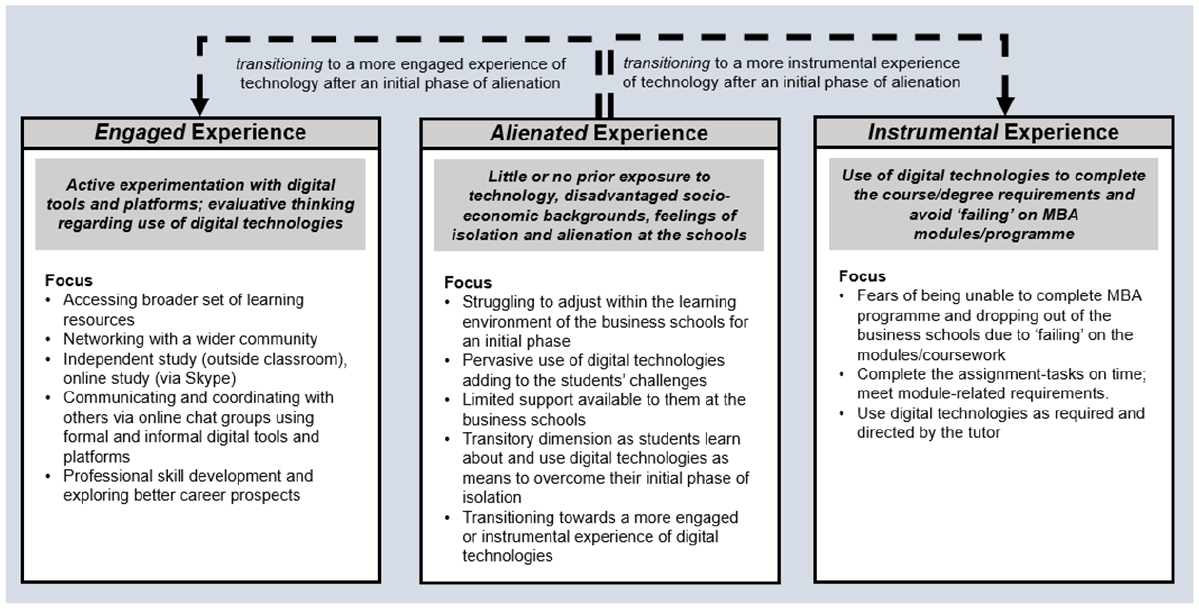
Alienating experience, and its transitions.
Categories of Description
Alienating Experience of Digital Technologies
The analysis revealed that all 11 participants from rural disadvantaged backgrounds described experiencing an initial phase of alienation and isolation at the business schools with the pervasive use of digital technologies. These participants described their struggle to feel part of their MBA classroom and cohort given their limited exposure to digital technologies that were being commonly adopted within the MBA modules/program. The students described experiencing a phase of dissociation with the technologized learning environments during the initial stages of their studies as the extensive presence of, and dependence on digital technologies within the MBA studies was said to be overwhelming for them. According to one participant: I saw a multimedia projector for the first time at this university . . . when I came to university, it was all new [to me] the LMS, Moodle, use of websites and digital resources for doing assignments and projects, conducting online study sessions . . . it was more than what I could absorb and understand at a time . . . (S1–18)
These students used words such as surprised, confused, puzzled, and struggle in using digital technologies. Some of them had not heard about different smartphone applications or social media platforms being adopted for academic work prior to joining the business schools. They found it difficult to draw connections between the use of digital technologies and assigned academic work and described instances of not meeting the preconceived expectations of their tutors (also referred to as instructors/teachers/lecturers within the article) with respect to students’ skills with digital technologies. For example, given their previous educational experiences, the participants from disadvantaged backgrounds initially assumed the module assignments were to be hand-written and submitted in person. The expectation however was to submit work online via the university’s LMS, and this led to uncomfortable and embarrassing experiences for them, as one participant said: I could see the surprised faces [of the students and module tutor] looking at me, and I felt so embarrassed that I was unaware of the fact that some software had to be used to type my assignment, and to email it to the lecturer. (S2–21)
The students explained that their prior educational experiences were situated within educational institutions in less developed/socio-economically disadvantaged rural areas that were much different from the business school in terms of availability and access to digital tools and platforms. This contributed to their difficulties in understanding the technological aspects of their coursework which further added to their challenge of transitioning to the learning environment of the business school and engaging with the learning activities. According to another student: I think if I had some previous experience of using technology . . . I would have felt a lot more comfortable. I was disadvantaged in the sense that my attention was diverted to learning the digital tools rather than my studies and assessments. (S1–06)
The students from disadvantaged backgrounds struggled to communicate with their tutors and peers as they had not previously used digital tools like Moodle and Blackboard as well as social media apps/platforms (like WhatsApp, Facebook, or Skype) prior to joining the business schools. The unsettling encounters the participants experienced were reminders of their social and digital disadvantages. This added to the students feeling alienated and isolated, and of being unsure whether they had made the right decision to be studying at the business schools. A student stated: The initial days were quite difficult in the sense that I could see other students using software, websites, and other Internet-based tools quite comfortably to complete their assignments . . . I often felt I should have opted for a different university in my hometown as I did not know how to use all these tools . . . (S2–03)
Having little or no prior exposure to digital technology and limited IDL skills also contributed to the students feeling disconnected from their peers from relatively privileged backgrounds who were seen to be fairly comfortable in using digital technologies. This accentuated their difficulties in collaborating with other group members who were familiar with using the latest smartphone applications and social media platforms. A participant described feeling excluded from online student discussions: I felt left out, to be honest, as I was not aware of any discussions being conducted on online groups . . . as they were managed and used by class fellows who were quite comfortable using technology . . . I felt I could not match their pace . . . (S1–14)
The above excerpt also describes a hierarchical relationship within the cohort based on skills in using digital technologies. The students from disadvantaged backgrounds perceived that the online chat groups and social media interactions “. . . were only for a select few students who were well versed in the latest digital technologies” (S1–06).
The alienating experience of digital technologies was however found to be transitory in nature for the participants. Our participants described making significant efforts to learn about and use digital technologies in attempts to overcome this initial phase of isolation and to adjust to the learning environment. In doing so their initial alienating experience transitioned to either a more instrumental or engaged experience of digital technology.
Instrumental Experience of Digital Technologies
Our analysis revealed that for some students, their alienation experience transitioned to a more instrumental experience of digital technologies—that is, they began using technology as a means for pursuing a specific aim. Their descriptions of experience focused on learning about and using a range of digital tools with the educational aim of avoiding to receive a fail grade on their MBA module coursework. They described their fears of being unable to meet the module requirements due to their limited knowledge and skills in using digital tools/platforms and completing their MBA studies. For example, one of the students said: . . . I knew the isolation I was in could not continue for long, as I had to complete my coursework, interact with others and eventually focus on completing the degree . . . I felt I had to take some affirmative action for myself rather than waiting for others to rescue me . . . [learning] technology provided me with the required support to come out of this isolation zone . . . (S1–06)
The students perceived that without developing at least basic skills to use the university’s formal learning platforms as well as social media platforms and other smartphone applications, they would not be able to “. . . complete their MBA degree” (S2–15). They relied on their module tutors’ suggestions regarding the use of digital technologies for the module assessments, as one student stated: My biggest concern was the completion of my assignments and projects, and I did not want this isolation phase to affect my grades. So, I worked on my technical know-how and skills so that I can complete my [module assessment] work according to the requirements of the teachers and get better marks . . . and technology is supporting me in this effort. (S2–17)
Learning about digital tools and platforms being used within their MBA program facilitated these students to overcome their feelings of isolation and begin focusing on academic activities. One student said: Using technology [social media/Facebook/Skype] has been quite helpful during this adjustment phase . . . I knew the sooner I learned the digital tools, the easier it would become to focus on my studies and secure grades. (S1–14)
Limited skills and knowledge of digital tools were said to impact how well the students from disadvantaged backgrounds could participate in academic activities. For some of them, the experience of alienation and isolation continued for several weeks while for others it was for longer durations (one or two teaching terms/semesters). One student described: . . . not having any prior exposure to technology back home . . . I had to start things from zero . . . in addition to the coursework I had to first learn the digital tools being used extensively in our university . . . I suppose it was the added burden and the shock that I could not come out of that initial isolation for almost two semesters . . . (S1–13)
The focus of the students’ description here as they described their transitory experience of isolation and alienation, was to use digital technologies primarily as a means of completing their module coursework on time. The students’ interest in digital technologies centered more on meeting the module-assessment requirements and being able to complete their MBA modules/program.
Engaged Experience of Digital Technologies
Some of the students from disadvantaged backgrounds described how their alienating experience transitioned to a more engaged experience of digital technologies, in which they actively explored and experimented with diverse types of digital tools and platforms available to them. Their initiatives to experiment with digital technologies were not limited to the pre-defined educational objective to avoid failing in the MBA modules/programs. On the contrary, the students in the category of engaged experience perceived their lack of skills and prior exposure to digital technologies to negatively impact their learning on the MBA program as well as their career prospects and personal development. For example, a student from a disadvantaged background described: As I began to interact with the available digital tools, I realised it was starting to open up new learning avenues for me [for self-improvement] . . . there were so many things to be explored which requires time, and I feel things have started to move in the right direction for me. (S1–04)
The students with engaged experience of digital technologies described being able to develop feelings of self-reliance and self-confidence as they used digital technologies to overcome their initial sense of alienation. This aspect of developing self-confidence and self-reliance was not reported by those who described an instrumental experience. The students perceived developing self-confidence and skills in using digital technologies to be useful in contributing to their academic and future professional work. One student described: I feel the use of digital technologies during my MBA has given me the confidence to do things myself. I am no longer dependent on others for [technology-related] tasks . . . Technology has helped me to come out of the initial isolation phase and I am happy that I can now do most of my academic work, without any external help. With time, I believe I have developed myself and my skills in a way that would help me after my MBA in the professional world. (S1–11)
Students who transitioned to a more engaged experience described developing an evaluative approach to assess the potential benefits (and limitations) of the digital technologies vis-a-vis their academic and vocational goals along with the socio-digital disadvantage experienced within management education. These students assumed responsibility for financially supporting their families after graduation through finding relevant employment. They assessed the available digital technologies and learned to use a range of digital tools for self-development and to help enhance their employment opportunities. One of the participants said: We [students in the outreach scholarship programme] come from a rural area of Pakistan and have never used any digital tool, except for a phone. Students like us [who come from rural areas] always aim to get a good salaried job after our studies, as most of us have the responsibility to provide financial support to our families. Therefore, for me, the motivation to learn technology was to understand how to use Job Portals, Facebook Groups, and pages to find a suitable career opportunity. These days I am studying online courses from Coursera to acquire some skills about ERP [Enterprise Resource Planning] systems as I think this would help me secure a good internship opportunity . . . (S1–18)
In addition to taking the initiative to learn to use digital technologies within their studies, these students also formed peer-to-peer informal networks to support others from similar disadvantaged backgrounds to overcome the challenges linked with using digital technologies. Within these networks, the students stated they shared online learning resources, offered suggestions and comments on each other’s academic work (via social media platforms), and in some cases, provided informal training and guidance to others on using different digital tools. One of the students said: . . . after a series of experiments, we created a separate WhatsApp group, in which only some of us [OSP] were participants . . . we felt more connected . . . we felt we could discuss and share our ideas more openly and freely . . . somehow we knew we had to help ourselves to come out of this situation. (S2–13)
According to them, such informal peer-to-peer networks helped to explore how different digital technologies can be productively used for a variety of purposes ranging from better communication and coordination to improved academic and social participation in their MBA program as well as personal and professional development. The excerpts highlight how these students, who without much prior exposure to digital technology, learned on their own how to use different digital tools and platforms, to overcome some of the challenges they were facing during their MBA studies. During the interviews, none of the students described receiving formal institutional support/guidance to help with their struggles of transitioning within the learning environments of the business schools. For example, one participant described feelings of frustration as the business schools failed to recognize the learning-related challenges faced by the students from rural disadvantaged backgrounds. He said: It gets depressing and frustrating when the teachers and the university assume all students to have the same level of technological skills . . . there is a need to understand and realise, probably at the institutional level that we have different skill levels, and we might need additional training than most of the other students who have sufficient prior exposure to technology. (S2–11)
The students described learning about and using digital technologies to not only adjust but also be active participants in the MBA program. These students experimented with various digital tools and platforms to develop a better understanding of how the use of digital technologies could benefit them with, and beyond their MBA studies. According to their descriptions of experience, they used digital technologies to work on mitigating the socio-digital disadvantage they perceived within management education and future employment prospects. This was a key distinction from the instrumental experience of digital technologies where the focus was more on efforts to avoid failing MBA modules/programs. As we will discuss in the next section, the variation in the students’ experiences of digital technologies is seen to have a relationship with how they navigate the demands and expectations linked with the formal and hidden curriculum of their MBA programs.
Discussion
In this article, we highlight that the increasing digitalization of management education has become part of the hidden curriculum of business schools. This has implications for the way particularly students with limited prior exposure to digital technologies and IDL skills experience transition within business schools (Czerniewicz & Brown, 2018; Kajee & Balfour, 2011; Mgqwashu et al., 2020; Niyigena et al., 2020; Timmis & Muhuro, 2019). In our study, we found that the pervasive use of digital technologies, along with the associated (stated and implicit) assumptions within management education, contributed to an alienation experience for students from rural, disadvantaged backgrounds (Öztok, 2019). The physical and social context of the business schools, concerning the availability and visibility of digital technologies along with its associated collective norms and practices, was different from that of these student’s prior educational experiences. For example, in several modules, it was assumed that all the students within the MBA class would bring their laptops, have a 3G/4G-enabled smartphone and would know how to use the internet, email, institutional LMS as well as the latest social media applications. The tutors would also encourage students to use digital platforms and Apps (e.g., WhatsApp, Facebook) to connect and collaborate with one another to work on module tasks. Exposure to digital technologies and having IDL skills were part of unpublicized features of the educational experience, the hidden curriculum of their programme (Jackson, 1968). Students from disadvantaged backgrounds however had little or no prior knowledge and skills in using these digital technologies. This created unrecognized and unanticipated challenges for these students who struggled to productively participate in technologized learning environments.
Assumptions about students’ IDL skills within the MBA program added to the students’ stress, anxiety, and labor in making sense of the demands of the formal and hidden curriculum at the business schools and reinforced broader socio-digital inequalities (Høgdal et al., 2021; Mousa, 2022). We found that the students exercised agency in transitioning from alienation experience to either an instrumental or engaged experience as they learned about and experimented with the digital technologies (individually and/or in groups) to navigate the stated and implicit demands and expectations on them from the business schools. These findings challenge the assumption that students from disadvantaged backgrounds are passive recipients of information (Mgqwashu et al., 2020) and that socio-economic class impacts one’s attitude toward the use of digital technology (Robinson et al., 2015; van Deursen & van Dijk, 2019).
All the students from disadvantaged backgrounds initially had an alienated experience of technology. This study highlights there were many nuances in the way these students adapted and transitioned within the technologized learning environment of the business schools. They made significant efforts to learn about and develop skills in using digital technologies and navigate the demands and expectations of the formal and hidden curriculum. This was however with little or no support by the business schools. The way the students adapted to the business schools’ learning environment and used digital technologies within management education appeared to be linked with their goal orientations (Dweck, 1986, 1991). The students who transitioned toward a more engaged experience of using digital technologies tended to have a learning goal orientation with a focus on learning new skills and knowledge and self-development. These students were more reflexive about their socio-digital disadvantage. In relation to the expectations of the formal and hidden curriculum of the business schools, they evaluated the potential benefits of different digital technologies to work on their self-development and enhance their academic output as well as employability prospects. They were more successful than some of their peers in adopting digital technologies to seek opportunities for lessening the influence of their socio-digital disadvantage on their MBA studies as well as school-to-work transition.
On the other hand, the students who transitioned toward a more instrumental experience seemed to take a performance goal orientation (Dweck, 1986, 1991) with a greater emphasis on completing their MBA modules/program over personal learning and growth. These students appeared to adopt a syllabus-bound approach to adopting digital technologies as their focus was predominantly on doing enough to succeed in passing the modules and complete the MBA degree. Their response to the expectations of using digital technologies within management education was to follow the cues and guidance of the module tutors in terms of digital technologies to learn about and use for given learning activities. Students with instrumental experience were more reliant on tutors’ input on using digital technologies in order to meet module-related requirements. Their approach to addressing issues of digital inequalities and the hidden curriculum of technologized management education appeared to comprise unconnected and isolated ideas (Biggs & Tang, 2011) as they worked through the technological requirements of the different modules in terms of submitting the assessments and completing the modules. They paid little attention to learning about and using digital technologies beyond their focus to succeed in MBA module activities and did not endeavor to use them for self-development and/or enhancing employability prospects.
Despite their self-initiated and self-managed efforts to navigate the formal and hidden curriculum at the business schools, these students were less able to transcend their social-digital disadvantage (Ng’ambi et al., 2016). We found that even in their final year of the MBA program, they continued to report ongoing challenges and difficulties, despite having readily available access to digital technologies.
Implications for Business Schools/Management Educators
The findings of this study draw attention to issues associated with giving little, or no attention to students’ varying IDL skills within management education alongside the expectation to use digital technologies being part of the hidden curriculum of business schools. Given the range of challenges faced by students from rural disadvantaged backgrounds, the findings throw doubt on the approach of offering a one-stop workshop imparting functionally valuable technical skills to develop IDL skills of students (Allen et al., 2022; Cullen, 2013; Cullen & Noonan, 2021; Leigh & Gibbon, 2008). They alone are not sufficient to address the socio-digital inequalities faced by students from rural, disadvantaged settings (Cullen, 2013; Cullen & Noonan, 2021; Hill & Lawton, 2018; Niyigena et al., 2020; Oyedemi & Mogano, 2018).
With increased efforts to widen participation within business schools (Fernando & Kenny, 2021), more is required than a one-stop IDL workshop. Targeted, ongoing support to address the challenges of navigating a technologized hidden curriculum and socio-digital inequalities within management education should be offered to students from rural disadvantaged backgrounds (Cavanaugh et al., 2016; Friga et al., 2003; Leigh & Gibbon, 2008; North-Samardzic & de Witt, 2019; Ring et al., 2013). This is important as, anecdotally, we heard that some students from disadvantaged backgrounds in both the business schools had dropped out of the MBA program due to being unable to manage the stress, anxiety, and labor of transitioning to new and alienating learning environments. Considering that some students from disadvantaged backgrounds managed to continue studying in the MBA programs while others dropped out, highlights the need to not see students as decontextualized learners or to assume uniformity in students’ IDLs skills (Heath, 2019; McKenna & Boughey, 2016). It also brings into focus business schools’/management educators’ lack of support, knowledge and awareness of issues related to these students’ experiences of alienation. Support to students from disadvantaged backgrounds will be beneficial and also corresponds to the nuances in the ways they adapt, and address challenges linked with transitioning within technologized learning environments.
Designing such support sessions will require paying close attention to the implicit and hidden curriculum dimensions of the learning environment at business schools as they significantly influence the educational experiences of students from disadvantaged backgrounds (Blasco, 2012). For example, IDL skills development workshops for these students could offer sessions that focus on using digital technologies for a range of daily module-learning activities (e.g., assessment submission, information-searching, student presentations, and collaborating with other students). A program of such workshops could also include supporting students from disadvantaged backgrounds in terms of recognizing their socio-digital disadvantage and their varying goal orientations to help them address the issues they face regarding the inequalities within management education and school-to-work transition.
In addition, we suggest that offering one-to-one mentoring support to students from disadvantaged backgrounds with an education developer or other more experienced students could be helpful. This would allow them to discuss their alienation experience and challenges of navigating the hidden curriculum at the business schools, in a safe and less anxiety-provoking setting. We also suggest that module tutors’ evaluating the assumptions underpinning module designs with reference to socio-digital inequalities, could further enhance their sensitivity to the issues of varying IDL skills of students and the possibilities of students’ alienating experiences. This may also encourage module tutors to offer different/better guidance to students from rural disadvantaged backgrounds.
Conclusion
Our study highlights that amongst socio-economically disadvantaged students in business school, homogeneity in their prior exposure to digital technologies or IDL skills cannot be assumed (Allen, 2020; Brown, 2016; Cavanaugh et al., 2016; Ng’ambi et al., 2016; Williams-Pierce, 2016). The view that digital technologies within management education are inevitable, integral, expected, and beneficial may be true (Alavi & Gallupe, 2003; Allen, 2020; Allen et al., 2022; Arbaugh, 2014; Cullen, 2013; Cullen & Noonan, 2021; Müller & Wulf, 2020; Whitaker et al., 2016). However, there is a need to address issues relating to the hidden curriculum of digital technology within management education. And, more specifically, the contextual socio-digital inequalities and associated lack of IDL skills of students from socio-economically disadvantaged backgrounds.
Scholars (for example Madge et al., 2019; Mgqwashu et al., 2020) have argued for moving away from viewing students from disadvantaged backgrounds as the problem behind the lack of participation and engagement within technologized university settings. This article contributes to the management education literature by problematizing how the digitalization of management education and the assumption that students have prior exposure to digital technologies and IDL skills are part of the hidden curriculum of business schools. Such assumptions, we argue, potentially perpetuate, or maintain socio-digital inequalities within management education.
As attempts are made to diversify the student population in business schools, we call for more research into the relationship between socio-digital inequalities and socio-economic disadvantage within management education. This study is based on interviews with 11 students from rural, disadvantaged backgrounds in two business schools in Pakistan. Future studies with larger sample sizes, including those students from disadvantaged backgrounds who dropped out of their MBA programs, could offer useful contributions to the literature on socio-digital disadvantages within management education. We also suggest that more research is required on the design of IDL skills training and interventions to support students from rural disadvantaged backgrounds. Such research could closely explore the relationship between students’ alienation experience, their goal orientations (Dweck, 1986, 1991) and efforts to address issues of socio-digital inequalities and hidden curriculum at business schools.
Footnotes
Declaration of conflicting interests
The author(s) declared no potential conflicts of interest with respect to the research, authorship, and/or publication of this article.
Funding
The author(s) received no financial support for the research, authorship, and/or publication of this article.
