




Abstract
This study reveals the tactic of purification as a form of neo-colonial marginalisation present in contemporary development strategies on Indigenous lands. The research is based on my fieldwork study of exclusive tactics in a contemporary development conflict on Indigenous lands: the Arctic Railway project in Sápmi, in Northern Europe. The tactic of purification works through the selective use of opposites in excluding Indigeneity. On the one hand, ‘pure’ Indigeneity is an excuse for proponents of extractive development projects to exclude Indigenous knowledge and identities as ‘too Indigenous’ according to modern standards, denouncing them as ‘backward’, ‘only culture’, ‘not profitable’, or ‘without knowledge’. Yet, simultaneously, a resemblance to profitable livelihood practices, beyond culture, the use of several knowledge systems, and multi-ethnicity in communities, is deemed ‘too modern’, therefore ‘not pure enough’, thus invalidating Indigeneity. Building on classification systems introduced during colonialism, settler societies employ purification as a tactic to deny Indigenous peoples their right to decolonisation projects, and strengthen their control of Indigenous lands. The purification tactic thereby enables the expansion of the modern-colonial capitalist world order.
Keywords
Introduction
Skolt Sámi Tiina Sanila-Aikio/Paavvâl Taannâl Tiina, former president of the Sámi Parliament of Finland, stated in her speech at an event concerning the Arctic Railway, 12 April 2018:
Today, I hope to broaden your understanding of what it’s like to be and live as an Indigenous people in the surrounding society, which, as the key points in today’s opening speech about the Arctic Railway suggested, wants to harness our home for its own economic interests. Changing, damaging, destroying, extinguishing, and terminating the conditions of our life, the opportunities to practice our culture . . .
The Sámi way of life, with its languages and cultures, has been and still is under constant threat due to the decisions and activities undertaken by the majority population, consciously or unknowingly . . .
Our lands and our waters need protectors, perhaps now more than ever. We can no longer be relocated due to competing land use. If we want to pass on our nation to the generations to come, with our livelihood, languages, and cultures, we can no longer give our lands and waters for purposes that are contrary to life itself.
Entrepreneur Peter Vesterbacka, in charge of advancing the Arctic Railway project, Finest Bay Area Development, responded to the Sámi decision opposing the project (Pölkki 9 May 2019, Newspaper article):
Well, it’s not like we’re going to be tearing places up, but enabling new things. We believe we can provide solutions and get everyone involved . . . It’s always good to be involved in generating growth.
The quotes above express the situation in Sápmi, the home territory of the Indigenous Sámi people, which extends across the Northern parts of Scandinavia and the Kola Peninsula. The opening statements by the former president of the Sámi Parliament express how the Sámi experience the proposed growth-oriented development strategy for their territory, founded on the construction of the Arctic Railway and projects aligned with this infrastructure project. The first ideas about a railway connection from Helsinki to the Arctic Ocean appeared around a 100 years ago. Since the Finnish Chairmanship of the Arctic Council in 2017-19, the plan has been advanced with enthusiasm by business actors, industry organisations, and regional and municipal development organisations.
Were the Northern Sea Route to be free of ice, the proposed Arctic Railway would enable increased sea transports between Europe and Asia. The development strategy was founded on an imaginary representation of Finland as the logistical hub of the Arctic between Europe and Asia. Peter Vesterbacka’s statement above is a manifestation of the assumptions that underlie the modern ontology and epistemology. The gradual occupation of the Sámi lands by outsider businesses, to benefit from the land and its resources, is characterised by knowledge controversies on sustainable development, and a particular form of invalidation towards the decolonising projects of the Sámi people.
The ongoing Sámi struggle against the proposed development strategy is mirrored around the world in places where Indigenous peoples and local communities are fighting for recognition for epistemic dimensions of Indigeneity (Banerjee et al., 2023; Blaser, 2010; Conde, 2017; De la Cadena, 2015; De La Cadena and Blaser, 2018). As conceptualised by Sámi scholar Kuokkanen (2007: 56–57), Kuokkanen (2008), I refer by epistemic dimensions to the exclusion of dynamic and constantly evolving cosmologies, ontologies, epistemologies, philosophies, and value systems founded on relationality, as well as the practices stemming therefrom. Ignoring Indigenous cosmologies, ontologies, and knowledge systems is closely connected to resource-intensive patterns of consumption and production, which have led to the contemporary sustainability crisis (see e.g. Ripple et al., 2020; Wiedmann et al., 2020).
When Indigenous peoples defend their lands and the worlds upon which their lives are founded against further territorial occupation, those desiring to exploit the land and its resources employ a selection of tactics to legitimise their incursions. The characteristics of the conflict in Sápmi encouraged me to conduct an in-depth analysis on how the developers and proponents of the Arctic development strategy responded to the Sámi claims. I therefore ask: What tactics do the developers and proponents of the Arctic development strategy employ, and how are epistemic foundations of the contemporary development paradigm present in their tactics to exclude the epistemes of the Sámi?
This paper contributes to the study of business-society relations in Critical Management Studies (CMS), drawing especially from studies on relations between the extractive industry and Indigenous peoples. CMS scholarship has addressed different dimensions of power asymmetries that underlie the exclusion of Indigenous peoples from extractive development projects on their lands (Banerjee, 2000, 2003, 2008a, 2008b; Ehrnström-Fuentes and Kröger, 2017; Kennedy Dalseg et al., 2018; Kuokkanen, 2019; Lawrence and Larsen, 2017; Misoczky, 2011). I divide those dimensions into distributional, participatory, and epistemic. Recent studies have reported that as their tactics to obtain consent from local communities and silence resistance, businesses emphasise positive socio-environmental impacts of a project, while simultaneously benefitting from tensions in communities and redirecting the blame onto them (Banerjee and Bonnefous, 2011; Kraemer, 2016; Kraemer et al., 2013; Maher et al., 2022). However, the epistemic dimensions and patterns that underlie tactics to marginalise groups, whose cosmologies, ontologies and epistemologies differ from those of majority populations, remain under-researched.
To address this pattern in contemporary development conflicts, the present study approaches the situation as a conflict involving forms of domination and exclusion enacted through socio-material epistemic practices between partially connected actor networks in the pluriverse (Alcadipani and Hassard, 2010; De la Cadena, 2010, 2015; Ehrnström-Fuentes, 2016b, 2022b). The empirical material was collected in 2017-20 and covers visits in the Sámi homeland and other qualitative materials.
The conflict in Sápmi teaches us that a central tactic used in development projects to invalidate the issues raised by Indigenous groups is characterised by a particular pattern of ‘purification’, a concept drawn from Actor-Network Theory (ANT) (Latour, 1993). ‘Purification’ is a form of neo-colonial marginalisation, manifesting in the search for purity and characterised by the selective employment of dualist either-or distinctions that work in two directions simultaneously. On the one hand, for businesses, developers, and proponents of extractive development projects, ‘pure’ Indigeneity is deemed ‘too’ Indigenous, hence ‘backward’, ‘only culture’, ‘not profitable’ and ‘without knowledge’.
However, in parallel, any resemblance to profitable livelihood practices, beyond culture, the use of several knowledge systems, and multi-ethnicity in Indigenous communities, is deemed ‘too modern’, therefore ‘not pure enough’, thus invalidating Indigeneity. A notion lacking to date in the CMS literature on business-community relations is that claims of ‘purity’ and ‘not pure enough’ are employed simultaneously by settler society, such that it invalidates Indigeneity and issues raised by Indigenous communities. This article argues that ‘purification’ is a central tactic to benefit from existing tensions in Indigenous communities, and silence resistance to extractive development strategies on Indigenous lands, thereby enabling further appropriation of Indigenous lands.
From distributional and participatory to epistemic dimensions of exclusion in business-community relations
The critical research on business-community relations has addressed different dimensions in its characterisation and critique of the power asymmetries that underlie the exclusion of particular groups related to extractive development projects on Indigenous lands. Here, I categorise those dimensions as distributional, participatory, and epistemic, and contend that a particular form of neo-colonial marginalisation, founding itself on modern ontology, needs to be addressed.
Research that focuses on
Researchers have also taken an interest in exploring how companies strategically benefit from tensions present in communities or deliberately foster conflict in communities when seeking legitimacy. Kraemer et al. (2013) and Kraemer (2016) provided evidence that Vedanta, an oil, gas, and metals company, employed a number of counter-mobilisation tactics against community groups resisting corporate activities, as one of its tactics to obtain community support for a mining project. These counter-mobilisation tactics included funding youth clubs, producing pro-industrialisation videos and other materials among its supporters, and framing project opponents as outsiders or as criminals. Maher et al. (2022) explored strategic company responses to accusations of human rights abuses in the extractive industries, showing that companies use several neutralisation tactics simultaneously. According to the study, companies emphasise the positive socio-environmental impacts of a project, while simultaneously redirecting blame onto others, such as communities or authorities. The study did not, however, show in detail how that actualised, nor how the blame-redirection technique connected with existing power asymmetries between the actors involved.
Based on these studies, emphasising the positive impacts while benefitting from intracommunity tensions, and redirecting blame onto resistant community members, can be anticipated as common tactics in contemporary conflicts between the extractive sector and communities.
It has been noted that histories of colonialism are embedded in how development is understood, and in the normalising of criteria used with notions of development. Since the rise of the sustainable development paradigm, it has been suggested that what is claimed in the name of sustainable development often extends the epistemic violence of colonialism (Banerjee, 2000, 2003; Misoczky, 2011).
A number of in-depth studies on extractive development projects in the fields of anthropology, development studies, and environmental governance underline that when Indigenous communities fight extractive development projects on their lands, they are defending the life-sustaining webs of relations on which their lives depend. These studies emphasising
The key contemporarily relevant issue addressed by these studies is that despite recent advances in the globally agreed Free, Prior and Informed Consent (FPIC) principles being implemented by states, businesses, and investment institutions, it remains impossible for Indigenous peoples to be recognised on their own terms. This is because the predominant understanding on sustainable development continues to be conditioned by the Western hegemony and its criteria founded on modern ontology and epistemology.
Many of these studies draw on critiques concerning the consistency between ‘coloniality’, ‘modernity’, and capitalism, as suggested by the decolonial and political ontology literatures. Decoloniality scholarship reminds us about the epistemic foundations of the contemporary development paradigm, and of the complicity between universalistic knowledge claims and the production of identity categories in the expansion of the modern/colonial/capitalist world order (Grosfoguel, 2013; Misoczky, 2011). Political ontology scholarship is founded on postcolonial theory, the decoloniality literature, actor-network theory (ANT), and post-humanist feminist approaches. Political ontology shares with the former approaches the conception that the hegemonic position of ‘the West’ depends on its ability to construct hierarchical binary opposites between the West and ‘the rest’ (De Sousa Santos, 2014; Frenkel and Shenhav, 2006; Grosfoguel, 2013; Misoczky, 2011; Prasad, 2003a). However, by including ANT and post-humanist feminist approaches with detailed ethnographies of Indigenous cosmologies, political ontology emphasises the ontological foundations of power asymmetries. Thus, political ontology suggests that the contemporary world order is an outcome of the ability of Western modernity to create hierarchies between the modern and non-modern, as well as the human and the natural; and of the enactment of the unilinear conception of time, according to which all collectives should follow Western understanding of development (Blaser, 2010, 2013).
Research drawing on decoloniality and political ontology has addressed the epistemic foundations and consequences of corporate presence in Indigenous lands (Ehrnström-Fuentes, 2016a, 2016b, 2022a, 2022b; Misoczky, 2011). Yet, it has not revealed how those foundations are present in tactics used to benefit from tensions in communities and direct blame to resistant community members. The conflict over the Arctic Railway calls for attention to be paid to the epistemic foundations that underlie a central tactic used by the developers and proponents of the project to invalidate the Sámi decision. I conceptualise the tactic as ‘purification’.
Purification as tactic to exclude Indigenous claims in business-society relations
To address purification as a particular tactic to exclude Indigenous claims, I find the following notions and theories essential. First, Banerjee’s (2000) empirical observation on the use of anti-essentialism among the settler society in the context of mining conflicts in Australia. Banerjee (2000) reminds us that discussion on Indigenous identity politics is dominated by settler society that often subsumes Indigenous identity into a hybrid settler identity, and deems Indigenous identity politics essentialism. He stated that accusations of essentialism among settler society work to deny Indigenous people their right to decolonisation projects. Second, the notions on classification systems introduced during colonialism to surveil the purity of subjects (Grosfoguel, 2013; Wolfe, 2006). Grosfoguel (2013) argued that the colonisers pursued ‘purity of blood’ as a social classification system to surveil the purity of the subjects. This practice is also addressed in the settler colonialism literature, which suggests that colonialism introduced the ‘one drop rule’ as a classification system whereby any ‘non-Indian’ ancestry compromised the Indigeneity of those racialized as ‘Indians’ (Wolfe, 2006: 387–388).
Third, Latour’s (1993) critique of modernity and the practice of ‘purification’ as an enabler of modernity, together with some central notions of ANT, help address purification as a particular tactic to exclude Indigeneity. Latour suggested that ‘the modern constitution allows the expanded proliferation of the hybrids whose existence, whose very possibility, it denies’ (Latour, 1993: 34; Frenkel and Shenhav, 2006: 5). By this he meant that human-nonhuman hybrids are inseparable in all human life. However, as modern ontology is built upon modern/non-modern and human/nature distinctions, it denies the existence of hybridity through the practice of ‘purification’. Purification ‘creates two entirely distinct ontological zones: that of human beings on the one hand; that of non-human on the other’ (Latour, 1993: 11). The drawing of categorical divisions between human/nature and between modern/non-modern serves as ‘purification practices’ in the production of the modern (Frenkel and Shenhav, 2006; Latour, 1993; Lee and Stenner, 1999).
According to ANT, the scale of an entity, such as a company, industry organisation, regional industry network, or modern colonial-capitalist world order, depends on its ability to attach new parts of other networks to itself, where its function may be translated into serving the purpose of that entity. Actor networks work hard to avoid and obscure situations that do not serve its purpose, and deem other agencies fake, non-modern, irrational, unreal, or invalid (Law and Hassard, 1999: 4; Lee and Stenner (1999), Strathern (2004): xxix; Latour, 2005: 56, 217–218). What is accepted as fact and what is deemed merely a concern speaks of the borderlands of inclusion and exclusion (Latour, 2005). Returning to political ontology, the modern/colonial/capitalist world order expands by ontologically and epistemologically invalidating other ways of conceptualising the world, and applies the same process to the ‘pluriverse’ as a world where many cosmologies, ontologies, and epistemologies as world-making practices should be able to co-exist (De La Cadena and Blaser, 2018).
These notions help understand what I mean by purification as a tactic to exclude Indigenous world-making practices and their claims in the contemporary development conflict. This article shows how purification works to exclude Sámi world-making practices through the selective use of opposites.
Methodology
Research methods and research ethics in this study
To study epistemic dimensions in tactics used by the proponents required a methodology that would simultaneously do justice to Indigenous ways of conceptualising the world and reveal exclusive patterns. The methodology is therefore founded on decolonising methodologies (Wilson, 2008; Kovach, 2009; Smith, 2012; Faria, 2014), and methodologies founded on relational ontologies (Barad, 2003; Kuokkanen, 2007; Latour, 1993; 2005; Blaser, 2010; De la Cadena, 2015; Ehrnström-Fuentes, 2020). Following Latour’s work (1993, 2005), ANT was employed as a methodological tool alongside its role as a conceptual model. I aligned the research approach with the conceptual and analytical frameworks of pluriversality, thereby approaching the conflict in Sápmi as a confrontation between actor networks in the pluriverse. It was assumed that the actor networks would realise their own, albeit partially connected (Strathern, 2004), socio-material and epistemic practices to reach their objectives (Blaser, 2010, 2013; De la Cadena, 2010, 2015; De la Cadena and Blaser, 2018). I interpreted colonialism and neo-colonialism as a system of domination enacted through different sets of political relations (Alcadipani and Hassard, 2010). Further, I investigated how the ordering of hierarchies through socio-material epistemic practices results in a particular order, and inclusions and exclusions (Barad, 2003; Czarniawska (2006, 2009); Alcadipani and Hassard, 2010).
The application of ethical principles (Boekraad, 2016; Kovach, 2009; Smith, 2012; Tulk and Starks, 2020; Wilson, 2008) in this research meant it was founded on community consent from the community leader, and from the Sámi Parliament. It also embraced partnership between the community and the researcher, such as writing expert statements in relevant policy processes related to mining activities. The research process included critical awareness of how research has been employed to appropriate Indigenous lands and knowledge (Banerjee and Linstead, 2004; Prasad, 2003b). It also included critical reflexivity on my positionality (Alvesson and Deetz, 2000; Dar, 2018; Fournier and Grey, 2000; Girei, 2017) as a researcher belonging to the majority population. The application of ethical research principles and my positionality involved tensions on which I reflect elsewhere (Jääskeläinen, work in progress).
Collection of research materials
The research materials were collected during
Analysis
The research material was processed by reading the materials and the diary notes. I paid particular attention to issues that the community members themselves underlined, and to issues that evoked their emotions in research situations, such as disappointment, frustration, anger, sadness, and warmth. Having evidenced the Sámi worlds, I noted how the very existence of crucial elements that make up those worlds was ignored in the socio-material epistemic practices of the project proponents. In the analysis, I interpreted actions to extend industrial relations into the Finnish Sámi homeland, and tactics to invalidate the existence of the crucial elements that made the Sámi worlds, as iterative and relational enactments of boundaries, in other words, as enactments of inclusions and exclusions (Barad, 2003: 823; Latour, 2005: 56).
Background on Sápmi as the geo-economic location of contestation
The study is located in the surroundings of the Vuohčču/Vuotso community and the Lappi reindeer-herding cooperative. The community is located in the southernmost part of the Sámi homeland, and the Northern parts of the municipality of Soađegilli/Sodankylä, the majority of which lies outside of the Sámi homeland border. The Sámi homeland comprises the municipalities of Eanodat/Enontekiö, Aanaar/Aanar/Anár/Inari, and Ohcejohka/Utsjoki, as well as the Lappi reindeer-herding district in the municipality of Soađegilli/Sodankylä. These municipalities have various development strategies of their own, and the majority of the population are Finns.
Sámi scholars Tervaniemi and Magga (2019) wrote that Sápmi is to be understand as a dynamic and relational process or network that encompasses many overlapping regional realities, rather than as a region with clear borders. However, as a legally defined administrative region, the Sámi homeland seeks to secure the Sámi people legal status in their home region. Thus, in safeguarding their position in the region as a response to the processes of Finnicization, this is of great significance to the decolonising projects.
The Sámi Parliament of Finland, as the elected political body representing the Sámi in Finland, opposes growth in industrial scale activities in the homeland. The Sámi consider reindeer herding one of the foundations of the Sámi way of life, and the main livelihood strategy in their homeland, as does the Vuohčču/Vuotso community. The development policy of the municipality of Soađegilli/Sodankylä, on the other hand, is built on further industrialisation (growth in tourism, in mining, the Arctic Railway). Although the Sámi view of places and territories is relational, Vuohčču/Vuotso marks the borderland of contestation, where the decolonising struggles of the Sámi people and the expansion of extractivist development strategy are in confrontation.
Today, a number of laws and practices, which implement international law regarding the rights of Indigenous peoples, provide the Sámi with institutional protection. These include the Finnish constitution’s prohibition on weakening the culture of Sámi people, the Sámi Parliament Act, the Sámi Language Act, and Akwé: Kon guidelines. The Reindeer Husbandry Act provides special protection to all reindeer herders irrespective of ethnicity, in a wider special Reindeer herding area. These laws and statutes, negotiated at the international level, should implement the rights of Indigenous peoples. The FPIC principles are of particular note. Be that as it may, ontological and epistemological dimensions remain poorly recognised in the implementation practice (Heinämäki et al., 2017; see also Näkkäläjärvi, 2017).
The area known today as Vuohčču/Vuotso has formerly been referred to as Sompio. It has been inhabited for thousands of years, and identified ethnic groups since the 1300s have included, at first, the Forest Sámi who were already subject to taxation by the Swedish Crown in the 1340s (Huurre, 1998; Magga and Ojanlatva, 2013; Mustonen and Mustonen, 2011). The Swedish Crown pursued the colonisation of the area from the 12th century CE onwards, and in the 1600s began encouraging settlers from the southern parts of the peninsula to move to the region. As a consequence of these processes, Finnish settlers mixed with the Forest Sámi between the 1600s and 1800s, and the Sámi language formerly spoken by the Forest Sámi was lost (Mustonen and Mustonen, 2011; Sammallahti, 2015).
Due to the 19th century closures of the state borders between Sweden, Norway and Finland as part of the Grand Duchy of Russia, the Fell Sámi were forced to search for new pastures either side of the borders (Lehtola, 2015). Groups of Fell Sámi settled in the Sompio region. Thereafter, larger-scale nomadic reindeer herding assumed a more important role in the livelihoods of multi-ethnic communities in Sompio (Mustonen and Mustonen, 2011). After independence from Russia in 1917, the nation-state building and Finnicization continued the legacy of colonisation. Examples of these processes include the modernisation of Sámi reindeer-herding by the state for the market (Mazzullo, 2010; Reinert, 2014), appropriative land use forms (Aikio-Puoskari and Magga, 2010; Mustonen and Mustonen, 2011; Sammallahti, 1975), and assimilation through the educational system and language choices (Seurujärvi-Kari, 2012).
Today, members of the Vuohčču/Vuotso community are mostly descendants of three ethnic groups: the Fell Sámi, with a history of nomadic rotational herding, who have maintained a distinct identity; the Forest Sámi, who had earlier identified themselves as Finns alongside settler colonisation; and Finns, who have arrived in the area down the centuries as settlers. Some of the descendants of Forest Sámi are trying to be recognised as Sámi, but have not been accepted by the Sámi community. Although there are disagreements over identity, the community members are relatively united in how they relate to future livelihood strategy.
In the Sámi context, colonialism is often referred to as a form of ‘settler colonialism’, emphasising that the contemporary continuity of the colonial structure results from the state-led occupation of Sámi lands, especially from the 17th century onwards (Magga, 2018). The structure established by ‘settler colonisation’ and settler-colonial society enables its continuous expansion into Sámi lands at the cost of Indigenous territorial sovereignty. Settler-colonial society always strives for more land, replacing the extant Indigenous territorial sovereignty and livelihoods with the organising principles of its own society (Wolfe, 2006).
Life-sustaining world-making practices of the Sámi and their reasoning on the Arctic Railway
Pekka Aikio, leader of the Sámi Reindeer Herders’ Association of Finland, and ecologist, described the relationship between reindeer and reindeer herders to me: ‘. . . Reindeer-herding is a culturally bounded way to use the environment. I tend to refer to studies that point out that in extreme conditions Northern tundra can sustain only 5% of the life that coniferous forest sustains. In other words, the area we need in the tundra is 20 times that of forested land. Thus, it is not possible to use Northern tundra as intensively as coniferous forest. My late father used to explain that we must use the tundra carefully as “so thin is the layer that life inhabits”. Reindeer and humans have together formed a somewhat symbiotic space of actorhood, whose combined ability to adapt to these conditions is greater than that of either separately. Reindeer informs the human how the human should act in particular conditions, and is sensitive in informing about the weather and other conditions.. . .’.
Sámi scholar Helander-Renwall (2016) wrote that the relationship between reindeer herders, the land, and reindeer is intersubjectively experienced and organised through interdependent relationships with each other. Lands are perceived as living entities and active in relation to humans and animals. Today, the way herders perceive the world is a mixture of traditional herding practices and worldviews with modern practices, technologies, and pressures, which in many ways influence herders’ possibilities to maintain their way of life. At the same time, reindeer herders have animistic ways of being and perceiving the world.
In terms of epistemic dimensions, the essential attribute is that although reindeer herding has changed alongside colonisation/modernisation, and digital technologies play an important role in reindeer-herding practice today, the practice is still founded on nomadism. Reindeer herders still emphasise the foundations of reindeer herding as free grazing, detailed knowledge about the herd, movement through which the reindeer herder connects to the place where the reindeer is grazing, and conditions to pass the livelihood on to the next generations (Jääskeläinen, 2020; Lassila, 2018; Lawrence and Larsen, 2017; Mazzullo, 2010).
Despite this, the Sámi continuously communicate that reindeer herding is misinterpreted, whether as an economic practice or as culture. The board members of the Vuohčču Sámiid Searvi Association explained to me that a railway disrupts the rotation cycle of reindeer herding. As a consequence, the reindeer would need to learn its routes anew, and the herding land would become even more fragmented than it already is. This was also stressed by Jensen and Sandström (2020) in their study located elsewhere in Sápmi, namely Kiruna, Sweden. However, what remains incomprehensible in much of the public debate related to extractive projects in Indigenous lands, is that the intensification of land use destroys Indigenous ways of life by reorganising the relations upon which those ways are founded.
Although many of the shamanistic practices were lost as a result of state and church bans (Helander-Renwall, 2016), sensitivity to the environmental conditions, spiritualism, and sensing are an inherent part of the reindeer-herding practice. An elderly male reindeer-herder illustrated this to me: ‘You become sensitive, when you are there [doing the herding practice], and then you hear and sense. . . and I can anticipate – what is about to come’. After a while, he continues, ‘. . . If there were mines and a railway here, it would change everything again. The workers would move here and – they have their own needs’.
What he expressed illustrates that he knows how land use intensification proceeds. Were there to be more settlers, he knows what their needs would be, since he has experience of how a web of extraction evolves. He knows how differently the settlers would relate to the land, and the needs they would have regarding land use. This would also change prevalent values related to land in the area. Such reorganisation of relations would introduce new hierarchies and values, which would become dominant at the expense of the Sámi’s work in maintaining, reclaiming, and developing Indigenous conceptions about land, sustainability, and responsibility. Many of the Sámi in Vuohčču described it as ‘its own planet’ and ‘its own world’, a place where it feels safe to live as a Sámi, very different to the town of Soađegilli/Sodankylä, where they feel faced with discrimination. The community leaders said that when they are negotiating on land use, they needed to ‘jump between worlds’, use expressions and terms other than their own, and be able to understand multiple worlds. Thus, they do not want their territory to become reorganised into something where their world becomes excluded and partially destroyed.
The Sámi stressed that the project would lead to environmental destruction of the fragile lands, and thus weaken their ability to maintain their heritage. A female Sámi reindeer herder talked about the interrelatedness of environmental destruction and the destruction of cultural heritage, and how Joik, as a particular form of expression of Sámi reindeer herders and reindeer-herding practice in this community, was destroyed: So I prepared a session, it was about the sounds of the earth, what Joik says about the land, and what kind of sound comes from this land, and then I realised that [deep sigh of frustration and a long break] damn it, it was the destruction of the land that led to losing Joik. Not that alone, but I know that when we protect the land, we protect the cultural heritage, and so everything that exists in this area. And the Arctic Railway would tear everything apart once again.
Joik carried knowledge, but was no longer in use in the herding practices of this community, due to a series of disruptive events: the closing of the state borders, assimilation through the Finnish reindeer-herding management system and Finnish school system, the construction of artificial reservoirs in the surrounding lands, and other forms of intensified land use.
As inferred in the Introduction, Sámi politicians, such as Tiina Sanila-Aikio/Paavvâl Taannâl Tiina, former president of the Sámi Parliament of Finland, repeatedly stress that further intensification of land use would lead to both the destruction of the living conditions of the Sami way of life, and the impoverishment of the land. These two dimensions were also the key messages in a series of demonstrations held by Sámi communities in September 2018 against the railway project. On their banderoles, the demonstrators exclaimed: ‘Eennâm lii eellim’, the Inari Sámi referencing ‘Land is life’. Other slogans on display included ‘No consent, no access’, ‘Our land, our future’, and ‘Stop co2lonialism’, referring to the coloniality of carbon calculations. In the media, the Sámi repeatedly question the claimed sustainability benefits of the project, stating that the Arctic Railway would (1) contribute to climate change, (2) bring heavy infrastructure to the fragile Arctic nature and (3) curtail reindeer grazing lands (Näkkäläjärvi, 2017).
As these expressions and events address, the experience of exclusion, not as a human individual but a human in a world comprising relations with non-humans, provides knowledge on how to protect yourself and the relations at stake, in order to fight future exclusion and destruction. When the Sámi are weighing up how to transfer their way of life to the next generation, and their position on the development strategy founded on the railway, they combine knowledge from different knowledge systems. That is, traditional and experienced-based knowledge about the land with scientific evidence in the fields of ecology and climate sciences. It can be argued that the Sámi have a holistic understanding of the impacts that further industrialisation would have on the territory and on themselves.
The Sámi have told us that they refused to accept the Arctic Railway project for two reasons in particular. The first, based on their experience as knowledge on how the settler society appropriates the land for its own purposes, they knew that the project would accelerate the reorganisation of the relations on which their way of life and livelihood strategy are founded. The second, based on their experience, is that they knew the land would suffer even more from the intensity of land use to which the project would lead.
Invalidation tactics in the reorganising of Sápmi
Socio-material epistemic practices and invalidation tactics among the proponents
The development strategy founded on the construction of the Arctic Railway and on increased mining activities is furthered by a large number of actors: industry organisations: regional and municipal development organisations, such as the Regional Council of Lapland, Lapland Chamber of Commerce, Business Lapland, the Arctic Economic Council; stakeholder businesses, such as Finest Bay Area Development and Boliden; research projects and partnerships, such as Arctic Business Concept; and, major political parties. The aim of the development strategy is to turn Finland into a key Arctic logistics hub between Europe and Asia. In the Internet materials and video (https://arcticcorridor.fi/) produced by the Regional Council of Lapland with EU development funding, the railway is marketed as: A global economic region as well as a transport and development corridor. It connects Finland and Europe to the deep-water ports of the Arctic Ocean, large production areas of oil and gas, and the western end of the Northern Sea Route.
Despite notable resistance, the Regional Council of Lapland decided to include the Railway in its Regional Plan. The assessments listed that the railway would be an environmentally friendly mode of transport to the tourist centres of Eastern and Northern Lapland, and curb climate change by reducing CO2 emissions from transport: . . . the rail connection would cut transport CO2 emissions as part of goods and passengers would shift to using a train connection thus helping mitigate climate change. The assessments also address that the railway would extensively change the environment: To the close surroundings of the track, its construction would have far reaching effects. (Final report. . . LVM. . . 2019: 11). When the Sámi said they would not approve the project, and reasoned why, the Council, charged with drafting the Regional Plan and assessing its impacts, was forced to admit that the impacts on the Sámi would be severe.
Nevertheless, the proponents simplified the controversies related to the claimed sustainability benefits of the project, emphasising the environmentally friendly mode of transport dimension, and diluting the seriousness of negative impacts. ‘The railway would be an environmental act’, stated a local politician and Member of Parliament (Leisti, Press release 11 March 2020). The project was then presented as an enabler of Sámi culture: ‘I believe that the railway will bring jobs and income, which will enable favourable development for the population. As a result, the Sámi languages and culture will be secured far into the future’. (Leisti, Press release 11 March 2020).
Meanwhile, the project leaders justified their activities by stating that: ‘No formal discussions will take place with the Sámi Parliament, the Regional Council of Lapland or potential investors until all the necessary facts are known’. (Leisti, Press release 11 March 2020). Companies planning projects in the ancestral lands of Indigenous peoples are obliged to engage with groups potentially affected by the operations. However, at the time that this study was submitted to a scientific review process in early 2022, Finest Bay Area Development Ltd had no human rights policies and processes in place. Neither had the company even tried to adhere to any of its duties and responsibilities regarding FPIC and due diligence, as determined by international institutions of FPIC, the UN Guiding Principles on Business & Human Rights and Indigenous Peoples, and International Finance Corporation performance standards on Indigenous Peoples’ rights.
Instead, the company evades engagement with the Sámi, emphasises positive impacts and its responsibility to generate growth, simultaneously claiming that negative impacts will be reconcilable and negotiable once all the necessary facts are known. The railway was at the same time actively advanced. In March and June 2019, Finest Bay Area Development negotiated a confidential Memorandum of Understanding (MoU) on funding and loan packages of 15-20 billion euros, for the construction of the Arctic Railway and a tunnel from Helsinki to Tallinn, Estonia. The contracts were signed with China’s Touchstone Capital Partners, which includes the OBOR (One Belt One Road) Consortium Group, and with three other Chinese state-owned companies. Together, these forward China’s Belt and Road Initiative (Chen, 2020).
The Regional Council had earlier produced marketing materials, with visual and audio elements, which imagined one united and exotic Arctic, a united Arctic nation-state of Finland centred between Europe and Asia, an empty land waiting to be developed and used for extraction. This material included claims, such as:
(a) Climate change and the melting ice open the Northern Sea Route,
(b) A project confirmed to start in the 2020s,
(c) An estimated 20-30% of the world’s untapped gas reserves and 5-13% of its oil reserves are located in Arctic Regions,
(d) ‘The missing part from the railway route between the Mediterranean to the Arctic Ocean is the gap between Rovaniemi and Kirkenes’, and,
(e) ‘The destination traffic is significantly increasing up to an estimated 38 Mt in 2020 and 80 Mt in 2030’. (https://arcticcorridor.fi/).
As evidenced above, knowledge, technology, natural resources, and ‘increases’ are expressed as facts, and as if already in place, but the Sámi decision and their knowledge of how the fragile environment would be destroyed is invalidated into a manageable concern (Latour, 2005).
When the Sámi, once again, expressed their refusal to countenance the project, Vesterbacka redirected the blame onto the Sámi leaders, as illustrated in an interview with the Finnish national media (Kaski, Press release 10 May 2019): ‘It was a little surprising that their feedback was that black and white. Perhaps even such lavish negativity was a little surprising’. According to Vesterbacka, the feedback was emotionally laden, showing that the project needed to be discussed, and that much remained to be negotiated. He was adamant that strong opposition would not make him withdraw from the project. ‘Well, it’s not like we’d be planning genocide, just an Arctic Railway. I’d hoped for some kind of sense from them in those speeches. . . Social media feeds this kind of escalation and polarization. Perhaps this tells us something about modern times, characterised by the escalation of opinions’.
As the above illustrates, the company does not reflect on the issues the Sámi have raised throughout the process, but deems their decision and reasoning a black-and-white opinion, and an act that furthers the polarisation of society.
As the planning process proceeded, the railway project’s proponents mobilised, creating anonymous Twitter accounts, such as @ArcticRailway, which described itself as a ‘factual twitter account’. The proponents mediated posts such as: Arctic Railway brings massive success to candidates in Sámi Parliament elections who give the project their moderate support (tweet 1, 1 October 2019). Another redirected tweet from the same account stated: All five candidates that give moderate support for the Arctic Railway were elected to the Sámi Parliament, including both the male and female biggest vote pullers (tweet 2, 1 October 2019).
These posts were based on a vote by five of 31 elected members, a number of whom stated in different ways that they considered the railway should be examined further as one possible option. Actors advancing the railway, the leaders of Finest Bay Area Development and members of the Regional Council amongst them, retweeted these releases that obscured voting situations in the Sámi Parliament. The posts exaggerated the claimed support for the project, while deliberatively omitting the existence of a broad opposition. The tweets circulated on social media, where the conflict concerning the railway had already led to expressions of aggression towards the Sámi: A culture that does not renew dies. There’s no life in any open air museum. Come up with something new (tweet 3, an entrepreneur, 5 April 2019). It served as an example of the epistemic sources that deem the Sámi way of life inferior. In line with Kraemer et al. (2013), this illustrates how the developers running the railway project deliberately supported counter-mobilisation against the Sámi communities, and were involved in fostering conflict in the local communities.
As this example demonstrates, the developers employ a vast array of tactics, most commonly at first ignoring the issue completely, later avoiding addressing issues at stake, and then denying their significance after notable resistance. These responses were followed by the use of knowledge selectively, obscuring numbers in voting, redirecting the blame to the Sámi, and supporting counter-mobilisation, all with the intention to invalidate the Sàmi reasoning and their decision.
Purification as invalidation tactic among the proponents to exclude the Sámi claims
This research investigates how the proponents of the development strategy, as part of their socio-material epistemic organising practices, selectively employed opposites as means to invalidate the Sámi claims. These expressions were employed by a number of proponents (developers, authorities, members of local communities) and in several encounters, thus interpreted as discursive practices to invalidate the existence of the crucial elements that made the Sámi worlds, as iterative and relational enactments of inclusions and exclusions (Barad, 2003: 823; Latour, 2005: 56). Specific situations, locations or positions are not mentioned in order to ensure the anonymity of the subjects in these conflicted communities. I address how the project’s proponents use opposites as means to invalidate the Sámi decision opposing it: (1) deeming contemporary reindeer-herding practices non-profitable and unsustainable, and, (2) questioning the Sáminess of the Sámi communities and individuals’ belongingness to the Nation.
(1) Common responses among the proponents to invalidate the Sámi decision opposing the project are: ‘Reindeer herding is not profitable. . .it is only culture’ and ‘Reindeer herding has become modern. . . it is not sustainable’. According to the first line of thought, reindeer herding is not modern enough according to modern profitability standards. And according to the second line of thought, the claimed sustainability benefits of the Arctic Railway, and the problems related to the condition of pastures, are used as means to avoid dealing with what the Sámi express. I do not have a stance on the sustainability of contemporary reindeer-herding practices, nor do I claim that the pastures are in good condition. This is not a deliberate act of blindness on my part, rather that the problem of pastures has been, and continues to be, discussed and acted upon in the Sámi communities, in reindeer-herding management, and in a number of studies in a variety of disciplines (e.g. Mazzullo, 2010; Reinert, 2014).
I pay attention instead to the dynamics between these two common responses. According to the first line of thought, reindeer herders’ notions are invalidated by referring to reindeer herding as ‘only culture’, therefore not modern enough, therefore invalid. And according to the second line of thought, reindeer herding has become ‘too modern’, hence invalidating Indigeneity. Simplified stories about the sustainability of the railway project and unsustainability of reindeer herding help to dismiss the reasoning expressed by the Sámi, by redirecting the blame onto the Sámi reindeer herders. In this case, the Sámi are blamed for primitivism and extremism, a phenomenon recognised by Misoczky (2011: 355) in her work on responses to Indigenous mobilisation against extractivist developmentalism in Peru and Ecuador. Yet, the modern-colonial-capitalist world, which first forced Sámi reindeer herders to adapt according to the standards of modern production, now deems reindeer husbandry too modern as well as unsustainable.
(2) Similar dynamics can be identified in how the proponents of the development strategy invalidate the Sámi decision by questioning the Sáminess of the Sámi communities and individuals’ belongingness to the Nation. Common responses amongst the proponents to invalidate the Sámi decision are: ‘X is not all that Sámi [of a Sámi who is a central actor in the Sámi community], X has Finnish ancestors..”’. and ‘It’s just the overexcited Sámi who talk loudly. . . it’s not like they represent all Sámi. . .’.
The responses merit noting the dynamics between how the proponents of the development strategy employ the claim of hybrid settler identity and identity conflicts in the communities to invalidate the Sámi decision. Again, I do not take a stand on who should and should not be accepted as Sámi, and neither do I claim that discussions on identity in the context of Indigeneity are straightforward. In line with De la Cadena (2010): 347–348, (2015), Indigeneity is a historical formation that is partially connected to and participates in the practices and institutions that created it, but not limited to it. Indigenous identity politics are understood to play a central role in the decolonising projects of Indigenous peoples, but simultaneously an outcome of what adaptation to colonialism has forced upon Indigenous peoples. This includes the presence of tension related to how to maintain flexibility and respect principles of self-identification (Corntassel, 2003), as well challenges caused by the phenomenon of identity appropriation (Junka-Aikio, 2019).
The research material shows that the proponents invalidate the Sámi knowledge and their decision by selectively using mutually exclusive classifications of the communities and individuals at stake. According to the first line of thought, no individual is ‘Sámi enough’ to be a legitimate representative of the community. And according to the second line of thought, some Sámi individuals are indeed recognised as ‘Sámi’, but their claims are invalidated as most members of the community are not considered ‘Sámi’ when compared with the representatives. Other examples of the dynamics at play to invalidate the Sámi reasoning and their decision are summarised and connected to the discussed literature in Table 1.
Purification tactic to invalidate the Sámi claims and the underlying foundations connected to the discussed literature.
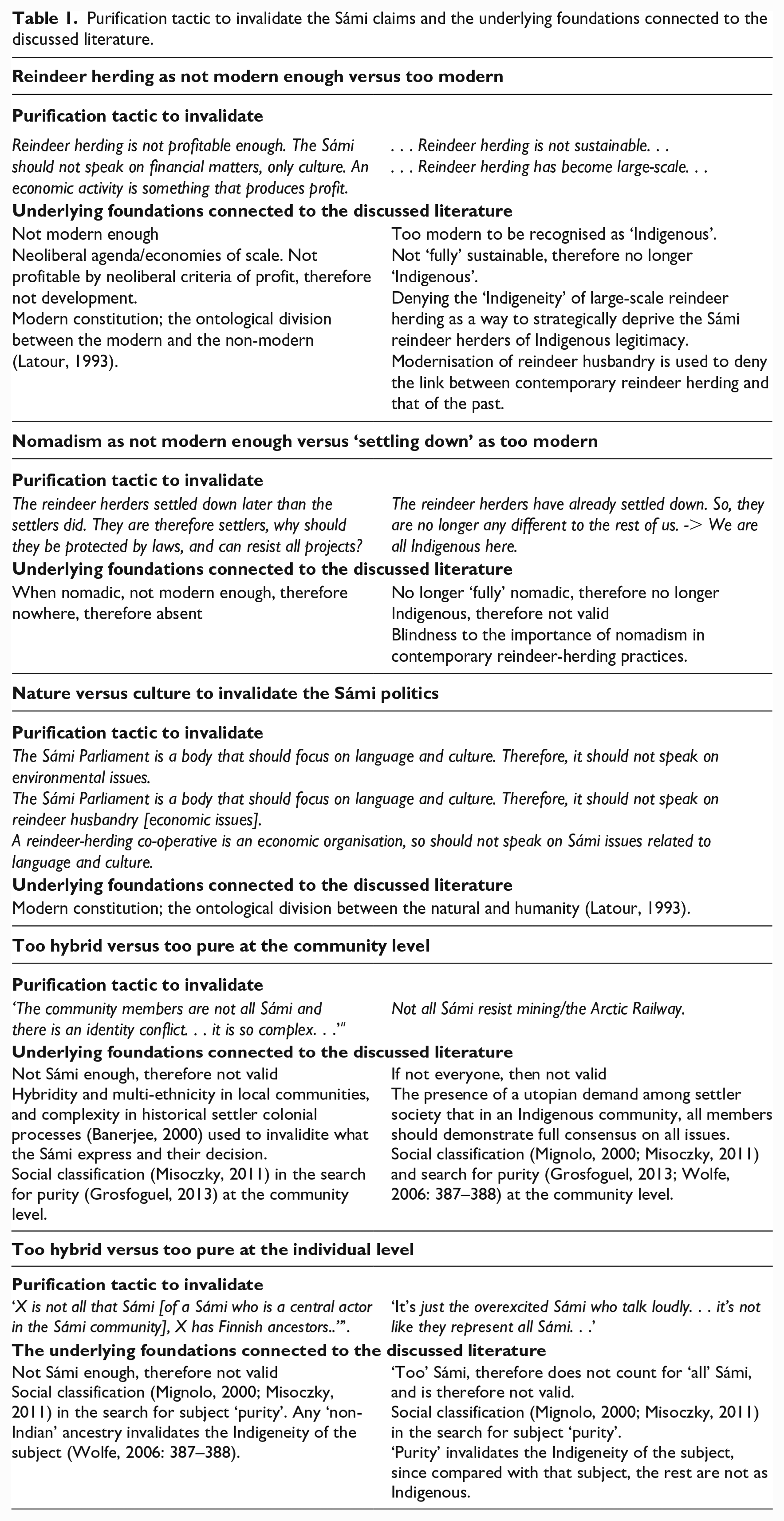
Each of these responses merits proper reflection that I am unable to articulate in an article of this length. However, what the expressions reveal about the epistemic foundations of the tactics is that the exclusion works through the selective use of opposites, founded on dualisms of: not modern enough versus too modern nature versus culture too pure versus not pure enough, both at the level of a community and an individual
The conclusion to be drawn on the dynamics that underlie this tactic is that the proponents of the development strategy selectively use opposites to exclude the Sámi claims. For the Sámi people, as an example of an Indigenous people, it is impossible to be heard. No matter what they say, the issue will be invalidated by appealing to the logics of ‘not modern enough’ or ‘too modern’, or ‘too Indigenous’ or ‘not Indigenous enough’, in other words, ‘too pure’ or ‘not pure enough’.
The selective use of opposites contributes to the process of exclusion, where ’the modern’ has separated between the modern and the non-modern, and, the natural and the cultural. Consequently, ’the modern’ as developed standards on how to be more rational, efficient, and profitable. These standards then provide the excuse to deny the knowledge of those situated at the margins, by deeming them either ‘not modern enough’ or ‘too modern’ according to the standard. By selectively employing opposites, exclusion involves the invalidation of relevant knowledge held by the group, their decisions, and their groupness. To illustrate, what the Sámi express is deemed ‘not modern enough’ by modern standards, so the knowledge would be on a par with ‘modern’ knowledge. Simultaneously, it is deemed ‘too modern’ to be considered Indigenous knowledge. Similarly, a human subject of the collective is simultaneously deemed ‘too pure’ to be recognised as a representative of a collective that is so ‘hybrid’, and ‘not pure enough’ to be recognised as a representative of a group that is ‘so Indigenous’.
The use of dualist, mutually exclusive opposites, including identity categorisations, has not been addressed by studies on business-community relations and corporate tactics as a means to manage resistance. This identified pattern is termed here the purification tactic.
Conclusions
This study reveals the tactic of purification as a form of neo-colonialism present in contemporary development strategies on Indigenous lands. The tactic works to marginalise Indigenous peoples and their epistemes, enabling further appropriation of their lands, and the destruction of the pluriverse.
The characteristics of the development conflict explored in this study encouraged me to focus on the epistemic foundations of the tactics deployed by project proponents to invalidate the Sámi decision. I therefore provided an in-depth analysis on how epistemic dimensions of Indigeneity as one of the foundational reasons why Indigenous politics, such as the principles of Free Prior and Informed Consent (FPIC), were established in the first place, became invalidated. I compared what the Sámi expressed with the responses among project proponents to invalidate their decision. In so doing, a focus of empirical attention was how the project proponents selectively used opposites related to the sustainability of current reindeer-herding practices, and to Sámi identity politics, as a tactic to ignore the Sámi decision.
The study connects with earlier work arguing that ideas on the development and practices of capitalist accumulation continue the legacy of colonialism that disempowers specific groups of people (Banerjee, 2000, 2003, 2008a, 2018; Downey et al., 2010; Ehrnström-Fuentes, 2016a, 2016b, 2022a, 2022b; Ehrnström-Fuentes and Kröger, 2017; Misoczky, 2011). It adds understanding on the tactics used by corporates, developers, and project proponents to benefit from tensions in local communities and to silence resistance (Kraemer, 2016; Kraemer et al., 2013; Maher et al., 2022), by addressing how epistemic foundations of modernity are present in those tactics. The analysis confirmed an earlier notion by Banerjee (2000) that settler-society claims of Indigenous peoples’ hybrid settler identity often serve to deny Indigenous groups their right to decolonisation projects.
However, an observation thus far inadequately addressed in the CMS literature on business-community relations was that when reaching for land and resources in the wake of international legal institutions related to FPIC, the modern colonial-capitalist world legitimised its expansion by selectively employing binary opposites simultaneously. To interpret the centrality that dualist and parallel either-or distinctions, including dualist identity categorisations, occupied in the responses, we returned to the notions of ‘purification’ and ‘one drop rule’. According to these notions, modernity breeds by drawing categorical divisions between human/nature, and between modern/non-modern (Frenkel and Shenhav, 2006; Latour, 1993). During colonialism, this has manifested in the founding of classification systems to surveil the ‘purity’ of the subjects (Grosfoguel, 2013), and of institutions such as one drop rule, according to which any non-Indigenous ancestry invalidates the subject’s Indigeneity (Wolfe, 2006).
The pattern identified in this study teaches us that, today, the search for purity and one drop rule are present as a form of neo-colonialism manifesting in two directions simultaneously. Nothing was ‘sustainable enough’ or nobody was ‘pure enough’ to be recognised as Indigenous. Ironically, the same people deemed ‘not pure enough’ were simultaneously deemed ‘too Indigenous’. Hence, the search for purity works in two directions simultaneously to provide an excuse to exclude Indigeneity. Thereby, purification works to deem other ways of life non-modern and inferior, for example, ‘backward’, ‘only culture’, ‘not-profitable’, and ‘without knowledge’. In line with Latour’s critique of modernity (1993), purification renders the relationality of Indigenous ways of relating to the world either absent or inferior. In this direction of purification, the modern allows itself to proliferate from human-nonhuman hybrids, while remaining blind to the non-human agencies and epistemes built upon recognition of non-human agencies. However, in parallel, any resemblance to ‘development’, beyond culture, profitable livelihood practices, use of several knowledge systems, and multi-ethnicity in communities, was deemed ‘not Indigenous enough’, therefore ‘not pure enough’. In this other direction of purification, the modern deems non-purity to be modernity, thus invalidating Indigeneity.
Purification and the standards to surveil the purity of the subjects (Grosfoguel, 2013; Wolfe, 2006) manifest in contemporary development strategies on Indigenous lands, using the following pattern:
‘If pure, then too Indigenous, therefore not thinking in the correct way, therefore inferior, and therefore the claim has no validity’.
‘If the subject has learned how to think, then too modern, therefore not Indigenous enough, and therefore the claim has no validity’.
This case study indicates that both the claims of purity/non-modernity and non-purity/modernity are selectively employed such that they exclude Indigeneity. What Indigenous communities are today, what they do today, how they do it, what they know today, how they know it, what they decide, and how they decide, is ignored by deeming their being, knowing and deciding ‘too pure’ and ‘too modern, therefore not pure enough’ simultaneously. The collectives are not welcome with their own heterogeneous ways to decolonise the existing conditions of modernity/coloniality and reclaim Indigeneity.
This article argues that the situation resembles in form how the modern ontology and the repression of particular subjectivities and their epistemes (De la Cadena, 2015; Grosfoguel, 2013; Latour, 1993), manifest in contemporary development strategies on Indigenous lands. Founded on the modern ontology, the modern/colonial/capitalist world expands by employing what it is founded upon: forming binary opposites, and their selective employment for its own profit. While purification renders the cosmologies, ontologies and epistemologies beyond the modern rationale non-existent, it plays a role in depriving Indigenous peoples of their right to decolonisation processes, and enabling the expansion of the modern colonial-capitalist world order.
Business strategies that benefit from tensions and redirect blame onto those already excluded, together with the identified pattern of purification, function as eye-catching tricks that avert the gaze from business wrongdoing and sustainability challenges. Based on this study, I anticipate that today, when strengthening their access across territories, the extractive industry and extractivist development organisations will increasingly use purification as a tactic to benefit from tensions in communities. They might also seek to influence indirectly how Indigeneity is defined, and who is recognised as Indigenous.
Empirically, this is relevant not only to Indigenous peoples, but to all local communities that continue to suffer from the power asymmetry conditioned by neo-colonialism and extractivism. This study was located in a territory where the state implements participatory processes. I encourage critical scholars to explore how purification plays out in varying state-capital systems. More discussion on this pattern is important, because, at a time when businesses are evaluating their responses to what Indigenous peoples express, whose knowledge is most valid will increasingly be contested. Thus, we need to study how the use of standards related to sustainable and responsible business activities (such as carbon calculations, sustainable development goals, FPIC principles) allocate epistemic, distributional, and participatory rights in communities, and find ways to counter the persistent production of non-existence of particular groups, subjects, and the worlds to which those subjects relate.
In this case, the pattern of purification did not succeed in silencing the Sámi, nor in gaining wider access to Sámi lands. The Sámi employed a number of tactics to resist and delay the project. Epistemic dimensions played a role especially in gaining international media attention, and solidarity from Indigenous and environmental movements around the world. However, the determining factor for the Regional Council of Lapland to remove the railway from the Regional Plan was its unfeasibility according to economic calculations. Since Russia’s 2022 attack on Ukraine, a transport route running through Russian waters has been identified as too risky. It remains to be seen whether the railway will be realised via a routeing through Sweden. The pattern of purification, however, remains a central feature in other conflicts in the Sámi homeland.
Footnotes
Appendix 1. A list of reports and media sources referred in the study
Acknowledgements
I thank the community members for their time and for sharing their experiences with me, Eennâm lii eellim! I thank Janne Tienari, Karl-Erik Sveiby and the anonymous reviewers for their comments and ideas, as well as their encouraging words during the writing process.
Declaration of conflicting interests
The author declared no potential conflicts of interest with respect to the research, authorship, and/or publication of this article.
Funding
The author disclosed receipt of the following financial support for the research, authorship, and/or publication of this article: This research received funding from The Alfred Kordelin Foundation (grant nr 180172), The Foundation for Economic Education (grant nr 14-7577) and Kaute Foundation (grant nr 20200615).
