




Abstract
Augmenting Antonio Gramsci’s concept of hegemony with Johan Galtung’s concept of structural violence and using multiple data sources this study examines the structural phenomenon food waste and the agentic phenomenon dumpster diving. I derive my interpretations from an analysis of reports on food waste by international organizations, US media coverage of food waste, and interviews with dumpster divers. At the structural level, the analysis shows how international organizations and media frame food waste as an economic and environmental—rather than a social justice issue and how they reproduce hegemonic neoliberal conceptualizations and discourses of food and food waste. At the agentic level, the analysis shows how these hegemonic conceptualizations and discourses affect dumpster divers and how an environmental ideological motivation contains an anticapitalistic ideological motivation. Building on my neo-Gramscian analysis, I highlight the potential threat that environmental discourses might stabilize neoliberal hegemony by offering appealing consent-structures and contain more fundamental, social justice-based, critique of the neoliberal social order. To preserve its inherently critical and counter-hegemonic potential, I develop a conceptual model of food waste and discuss its relevance for critical management and organization studies.
Introduction
“Every day, the average American throws away about one-and-a-half pounds of food. [. . .] Although it doesn’t sound like much, those nearly one-and-a-half pounds add up – 31 million tons end in landfills or incinerators each year. That’s roughly equivalent to the weight of 74 Golden Gate bridges. These dumps are not only unsightly, they produce 34% of the methane in the U.S. – a greenhouse gas more than 20 times as potent as carbon dioxide” (USA Today, June 16, 2010).
According to the Food and Agriculture Organization of the United Nations (FAO), approximately one-third (i.e. about 1.3 billion tons per year) of all food produced for human consumption is lost or wasted globally (FAO, 2013a; Gustavsson et al., 2011). Food waste is a significant economic, environmental, and social challenge, and a top public policy priority in many countries (Gruber et al., 2016). Research on food waste has primarily aimed at quantifying the amount of food wasted and identifying measures for its reduction (e.g. FAO, 2013a; Gustavsson et al., 2011; Kantor et al., 1997; United Nations Environment Program [UNEP], 2016). Waste in general and food waste in particular however, are the “conditio sine qua non” (i.e. necessary precondition) for dumpster diving—rooting through dumpsters for edibles or other reusable items (see Edwards and Mercer, 2007; Hill and Stamey, 1990; Pentina and Amos, 2011). Originally considered a consumption practice for those in need (e.g. Eikenberry and Smith, 2005; Hill and Stamey, 1990), recent media coverage (e.g. Moynihan, 2010) and research (e.g. Clark, 2004; Edwards and Mercer, 2007; Fernandez et al., 2011) show that dumpster diving is performed by individuals for varying reasons in a number of social strata.
There has been increasing scholarly attention to both, food waste and dumpster diving in agriculture research, anthropology, consumer research, geography, and sociology (Barnard, 2011; Clark, 2004; Edwards and Mercer, 2007; Eikenberry and Smith, 2005; Fernandez et al., 2011; Porpino, 2016). Prior research on food waste improved our understanding of reasons- and potential remedies for food waste, while prior research on dumpster diving explicated why people dig into supermarket dumpsters to search for food. The present study investigates the intertwined phenomena food waste and dumpster diving with a special focus on the fact that huge amounts of food are wasted while simultaneously about 900 million people are undernourished worldwide (FAO, 2010, 2013b). The present study argues that a joint investigation of the agentic phenomenon dumpster diving and its structural precondition food waste, in the tradition of critical management studies (e.g. Spicer et al., 2009; Willmott, 1992), enhances our understanding of neoliberal hegemony and its ability to contain fundamental-, social justice-based critique.
The aims of this study are to provide a critical alternative- to the hegemonic reading of food waste as an economic and environmental problem, discuss food waste’s relevance for fueling a discourse of social inequality, and show how environmental discourses contain its potential for a critique of the hegemonic neoliberal social order. Towards these aims, this study poses the following research questions: How does an alternative understanding of food waste contribute to a critique of neoliberal hegemony? How do environmental- and management discourses of food waste contain this food waste-based critique of neoliberal hegemony?
To answer these research questions this study conducts a neo-Gramscian analysis (e.g. Böhm et al., 2008; Cox, 1983; Levy and Egan, 2003; Levy and Newell, 2002) of food waste and dumpster diving. Since discourses, as particular ways of understanding the social world, struggle for hegemony and as hegemony requires consent, a neo-Gramscian analysis is well suited to investigate the interplay between structural and agentic phenomena (see Emirbayer and Mische, 1998; Jørgensen and Philipps, 2002; Kebede, 2005).
More precisely, this study augments Gramsci’s concept of hegemony with Galtung’s (1969) concept of structural violence and applies this theoretical framework to the phenomena food waste and dumpster diving. Hence, this study conceptualizes the simultaneity of food waste and hunger as structural violence and argues with Wright (2010: 18) that food waste is a major crack in the neoliberal social order that could render visible “the contradictions and gaps in the process of social reproduction” and “open up spaces in which collective struggles for new possibilities are possible.” However, this study shows that such a critical reading of food waste competes with hegemonic, neoliberal conceptualizations that contain the phenomenon’s critical and counter-hegemonic potential.
At the structural level of analysis, this study first shows that international organizations conceptualize food waste as an economic and environmental problem, caused by inefficiency. Consequently, international organizations suggest that research, sound management practices, and market-based solutions will solve the food waste problem. Next, this study shows that mass media are mainly concerned with food waste’s environmental impact and that its conceptualizations of food and food waste parallel international organizations’ conceptualizations. That is, both, international organizations and the media conceptualize food as commodity and highlight food waste’s economic and environmental costs but neglect its social costs. Social justice is not part of the media discourse on food waste. This study argues that neoliberal conceptualizations of food and food waste are “sedimented” (see Jørgensen and Philipps, 2002; Laclau and Mouffe, 1985) in our society—they are hegemonic and naturalize food waste. Consequently, for many people food waste is a given, food waste is normal, and hence its critical, counter-hegemonic, potential is contained.
At the agentic level of analysis, this study shows that for dumpster divers, who are potential antagonists to hegemonic understandings of food and food waste, it is difficult to emancipate from these hegemonic conceptualizations of food and food waste. For dumpster divers, who experience the “global food scandal” (Stuart, 2009) on a first hand basis, developing and upholding an anticapitalistic ideological motivation for dumpster diving is difficult in the face of hegemonic, neoliberal conceptualizations of food and food waste. That is, an environmental ideological motivation contains an anticapitalistic ideological motivation and curtails dumpster diving’s potential to fuel a counter-hegemonic discourse of social inequality. Consequently, this study argues that more generally, the environmental discourse helps neoliberalism to maintain its hegemony by providing attractive consent-structures (e.g. green economy, sustainability, zero waste; see Candeias, 2011; Valenzuela and Böhm, 2017) not only to the general public but also to potential antagonists. This study adds to critical management and organization research as follows.
First, this study introduces structural violence into neo-Gramscian analysis (e.g. Bo et al., 2019; Böhm et al., 2008; Levy and Egan, 2003; Levy and Newell, 2002) and shows how the structural violence perspective on the economic sphere facilitates a social justice-based, fundamental, critique of the hegemonic neoliberal social order.
Second, this study adds to research on social movements (e.g. Böhm et al., 2008; Spicer and Böhm, 2007) by providing an empirical account of an infra-political social movement, bridging structural and agentic levels of analyses, and showing how the destabilization potential of a counter-hegemonic practice is contained by hegemonic conceptualizations and discourses.
Third, this study contributes to research on climate change (e.g. Böhm et al., 2012; Levy and Spicer, 2013; Swyngedouw, 2010; Wittneben et al., 2012) by showing that the climate change discourse (or broader: the environmental discourse) contains a social inequality discourse.
Fourth, this study contributes to the (re-)politicization of waste (see Corvellec, 2019; Valenzuela and Böhm, 2017) and shows that according to this study’s augmented neo-Gramscian reading, food waste could be a prime source for anticapitalistic critique and counter-hegemonic emancipation.
I next review literature on food waste and dumpster diving. Then, I develop my theoretical framework, augmenting Gramsci’s theory of hegemony with Galtung’s (1969) concept of structural violence. Thereafter, I introduce my methodology before I present my findings. I end with a discussion of these findings, their contribution to critical management and organization studies, as well as the study’s limitations, and suggestions for further research.
The phenomenon food waste and the phenomenon dumpster diving
About one third of all produced food is lost or wasted before it is consumed by people (FAO, 2013a, 2017). Food loss (i.e. “a decrease in edible food mass at the production, post-harvest, processing and distribution stages in the food supply chain” FAO, 2013a: 18) and food waste (i.e. “food appropriate for consumption being discarded, usually at the retail and consumer levels” FAO, 2013a: 18) is responsible for 8% of all anthropogenic greenhouse gas emissions and almost $940 billion annual global economic losses (FAO, 2017; UNEP, 2016). At the same time that a substantial part of the world’s food produce is lost and wasted, large parts of the world suffer from hunger and malnutrition, despite the fact that there is enough food in the world to feed its inhabitants (Stuart, 2009). That is, food is unevenly distributed; while many people starve, others have food in abundant supply (Melbye et al., 2017).
Global interest in food waste and action against food waste by governments, research institutions, producers, distributors, retailers and consumers is increasing (FAO, 2017). However, while food waste is an increasingly discussed and researched phenomenon (FAO, 2017; Porpino, 2016), prior research and, as this study will show, international organizations as well as mass media have little to say about the simultaneity of food waste and hunger. For example, only very recently did the FAO, an organization that deals with both topics, refer to food waste and hunger within a single text on their website, stating: “Hunger is still one of the most urgent development challenges, yet the world is producing more than enough food” and “Up to one third of all food is spoiled or squandered before it is consumed by people. It is an excess in an age where almost a billion people go hungry, and represents a waste of the labour, water, energy, land and other inputs that went into producing that food” (FAO, 2017).
References to the simultaneity of food waste and hunger however, are present in some research on dumpster diving (e.g. Barnard, 2011; Edwards and Mercer, 2007). Due to the fact that dumpster diving has been employed by social classes other than the homeless and the development of social movements like “freeganism” and “food-not-bombs,” the phenomenon has gained some media attention (e.g. Kurutz, 2007; Moynihan, 2010). Prior academic literature primarily investigated individuals’ motivations for dumpster diving (e.g. Edwards and Mercer, 2007; Fernandez et al., 2011). In an ethnographic investigation of punk cuisine Clark (2004) has found that punks attempt to free food from commodity-fetishism. Punks therefore, purchase food in brandless bulk or directly from farmers, home-grow food, steal or reclaim food from garbage dumpsters. For punks, the respective food is stripped of its alienating qualities and comes closer to a wild diet, free of commodification and hierarchical relations of production (Clark, 2004).
Ideological reasons for dumpster diving have also been emphasized by Edwards and Mercer (2007). They have identified “dumpster diving” (i.e. the act of procuring food from a supermarket dumpster bin for individual consumption) and “Food Not Bombs” (i.e. a global-spanning group who collect left-over food from markets to cook and serve to people on the street) as two international youth subcultures that confront the scandal of food waste in over-consuming capitalist societies. Another ethnographic study has found that dumpster diving is the most central practice for “freegans” in New York (Barnard, 2011). In contrast to other dumpster divers (see Edwards and Mercer, 2007; Eikenberry and Smith, 2005), the freegans portrayed in Barnard’s (2011) study actively seek coverage by mainstream mass media and seek to convey a message that is critical of the consumer society and food waste. Building on elements of new social movement theory (e.g. Melucci, 1980) and Goffman’s (1959) concept of social dramaturgy, Barnard (2011) has concluded that dumpster diving has strategic components for the freegan movement by projecting a favorable image, attracting new participants, and by achieving a positive portrayal in the mainstream media.
In addition to economic and ideological reasons, Fernandez et al. (2011) have identified positive feelings and benefits accruing from community, surprise, and adventure as psychological motivations for dumpster diving. Furthermore, these authors have found that dumpster divers view themselves as market resistors and adopt a hero identity that permits them to resolve tensions inherent in resisting while consuming (Fernandez et al., 2011). These findings are in line with Pentina and Amos (2011) who have identified environmental reasons, excitement and adventure, savings, and material value obtained from dumpster diving and squatting as main motivations expressed in blogs on freegan activities. In contrast to Fernandez et al. (2011), these authors have found few members explicitly discuss political or philosophical underpinnings of their Freegan activities in blogs (see Pentina and Amos, 2011). To sum up, early (e.g. Hill and Stamey, 1990) and recent research on dumpster diving identifies an amalgam of economic, ideological and psychological motivations for dumpster diving (Barnard, 2011; Clark, 2004; Edwards and Mercer, 2007; Eikenberry and Smith, 2005; Fernandez et al., 2011; Pentina and Amos, 2011).
Despite their relevance for research on hegemony and resistance (e.g. Bo et al., 2019; Girei, 2016), social movements (e.g. Böhm et al., 2008; Spicer and Böhm, 2007), climate change (e.g. Levy and Spicer, 2013; Wittneben et al., 2012), and framing of waste (e.g. Corvellec, 2019; Valenzuela and Böhm, 2017), to date few critical management and organization studies have investigated the phenomena food waste and dumpster diving. In a study of food waste, Corvellec (2014) shows that the transformation of food waste into biogas is an instance of overflow management that successfully redefines food waste from problem to resource. The social practice of management thereby normalizes overflows, substitutes the shame of wasting with the pride of recycling, and ultimately deflects a more radical questioning of food waste production (Corvellec, 2014). To some extent, either food waste or dumpster diving are implicit in recent studies on waste (see Corvellec, 2019; Valenzuela and Böhm, 2017) and social movements (Böhm et al., 2008; Ergas, 2010; Spicer and Böhm, 2007). Arguing that waste is a dimension of organizational life addressed only occasionally by organizational scholars, Corvellec (2019) proposes a scatolic reading of waste (i.e. considering waste as unavoidable and worthy of interest) as starting point for challenging contemporary social and material organizing and a social critique of wasting practices. Likewise, Valenzuela and Böhm (2017) aim to (re-)politicize waste in their Marxist-Lacanian analysis of the zero-waste and circular economy-discourse. Emphasizing that discourses of circularity have de-politicized the discourse of unsustainability of capitalism, Valenzuela and Böhm (2017) argue that new and distinct counter-frames on waste and sustainability are needed to confront market ideology which casts the market as natural and moral (Lakoff, 2010).
Some prior studies investigated dumpster diving in the light of social movement theory (e.g. Barnard, 2011) and in line with Böhm et al. (2008) and Spicer and Böhm (2007) dumpster diving can be conceptualized as an infra-political (i.e. decentralized, non-hierarchical, grassroots-based) social movement located in civil society. Social movements are central agents of resistance to hegemonic discourses (Laclau and Mouffe, 1985) such as the hegemonic discourse of management (Spicer and Böhm, 2007; Willmott, 2005). However, while prior research has delineated social movements’ different strategies (i.e. political or infra-political) and locations of struggle (i.e. workplace or civil society), and highlights the importance of the infra-political dimension to resistance, there is a need for empirical insights into the processes and challenges of contesting hegemony (Böhm et al., 2008; Spicer and Böhm, 2007).
This study jointly investigates the structural phenomenon food waste and the agentic phenomenon dumpster diving with a critical focus on their meanings for the hegemonic neoliberal social order and the organization of consent to this order. In this respect, this study situates the dumpster diving practice in its enabling structural context. To facilitate this investigation this study augments Gramsci’s (1971) concept of hegemony with Galtung’s (1969) concept of structural violence and conceptualizes the simultaneity of food waste and hunger as structural violence.
Theoretical framework: Hegemony and structural violence
Hegemony, a core concept in Antonio Gramsci’s political philosophy, is widely adopted in the social sciences generally (Candeias, 2007; Merkens and Diaz, 2007) and specifically in critical management and organization studies (e.g. Böhm et al., 2008; Levy and Egan, 2003; Levy and Newell, 2002). While in the prison notebooks Gramsci uses the concept hegemony sometimes ambiguously (also due to imprisonment; see Anderson, 1976 for a discussion), today the common reading of hegemony is that hegemony of a ruling power bloc (i.e. a dominant social class) is based on coercion in the sphere of the state and consent in the sphere of civil society (Candeias, 2007). That is, a dominant group maintains its hegemony largely because it naturalizes its particularistic worldviews and successfully presents its interests as the interests of those dominated (see Cox, 1983; Girei, 2016). Hegemony however, is contingent and unstable as dialectical tensions between economic and ideational realms produce underlying contradictions and fault-lines (Levy and Newell, 2002).
To maintain hegemony, a power bloc can, according to Gramsci (1971), resort to passive revolution as a “way to restore fragile power by revolutionizing all social relations—not only restoring order but developing bourgeois, capitalist rule, by actively pushing forward society” (Candeias, 2011: 2). Hence, a passive revolution is reformist change from above, attempting to preserve the essential aspects of social structure (Bo et al., 2019; Levy and Newell, 2002). In this respect, the notion of “trasformismo” designates the integration of subaltern segments’ interests while keeping them in a subaltern, powerless position (Candeias, 2011). While in Gramsci’s (1971) prison notebooks trasformismo describes foremost the co-optation of potential subaltern leaders into an established power bloc, it can also serve as a strategy that absorbs and assimilates potentially counter-hegemonic ideas into the hegemonic doctrine (Cox, 1983).
According to Gramsci (1971) social classes need organic intellectuals to establish-, or counter, hegemony and build a historic bloc (i.e. “[. . .] alliances among various social groupings and also [. . .] the alignment of material, organizational, and discursive formations which stabilize and reproduce relations of production and meaning,” Levy and Newell, 2002: 87). For Gramsci intellectuals are organically connected to a social class and they develop and sustain mental images, technologies, and organizations, which bind together the members of a class and a historic bloc into a common identity (Cox, 1983). Gramsci (1971) argues that class domination is an intellectual and moral victory as much as it is an economic fact and hence subaltern classes need organic intellectuals that create “new forms of hegemony by shattering the universalistic claims of older worldviews” (Billings, 1990: 7).
Neo-Gramscian analyses in critical management and organization studies emphasize that hegemony is sustained in three spheres: state, civil society, and economy (Bo et al., 2019; Böhm et al., 2008; Levy and Newell, 2002; Levy and Spicer, 2013). Gramsci himself did not neglect the role of the economic sphere as he emphasized the interrelatedness of structure and superstructure, conceptualized civil society as battleground for hegemony, located between state and economy, and saw Fordism’s rationalization of production and work fundamental to ruling class’s hegemony (Candeias, 2007). Yet, in the reception of Gramsci, the economic sphere as third basis of hegemony remains relatively opaque (Candeias, 2007) and undertheorized. This study proposes that structural violence (Galtung, 1969) is a suitable characterization of the economic sphere under current neoliberal hegemony that augments Gramsci’s concept of hegemony (see Figure 1).

An augmented conceptualization of hegemony.
According to Galtung (1969) violence is personal, or direct, when there is an actor that commits the violence and violence is structural, or indirect, when there is no such actor. “There may not be any person who directly harms another person in the structure. The violence is built into the structure and shows up as unequal power and, consequently, as unequal life chances” (Galtung, 1969: 171). The inequitable distribution of food is a drastic example of structural violence. While more than one billion tons of palatable food are thrown away every year (e.g. FAO, 2013b; Jones, 2005), about 900 million people are undernourished worldwide (FAO, 2010, 2013b). According to some estimates up to fifty percent of food supply is wasted (Skidelsky, 2009). In his conceptualization of structural violence, Galtung (1969) explicitly refers to the issue of hunger. “The important point here is that if people are starving when this is objectively avoidable, then violence is committed, regardless of whether there is a clear subject-action-object relation, as during a siege yesterday or no such clear relation, as in the way world economic relations are organized today” (Galtung, 1969: 171).
Following Galtung (1969), this study conceptualizes the simultaneity of hunger and food waste as structural violence (see Figure 2). Augmenting Gramsci’s (1971) concept hegemony with Galtung’s (1969) concept structural violence enables a critical analysis of “sedimented” (see Jørgensen and Philipps, 2002; Laclau and Mouffe, 1985) conceptualizations and discourses of food and food waste in our neoliberal social order.
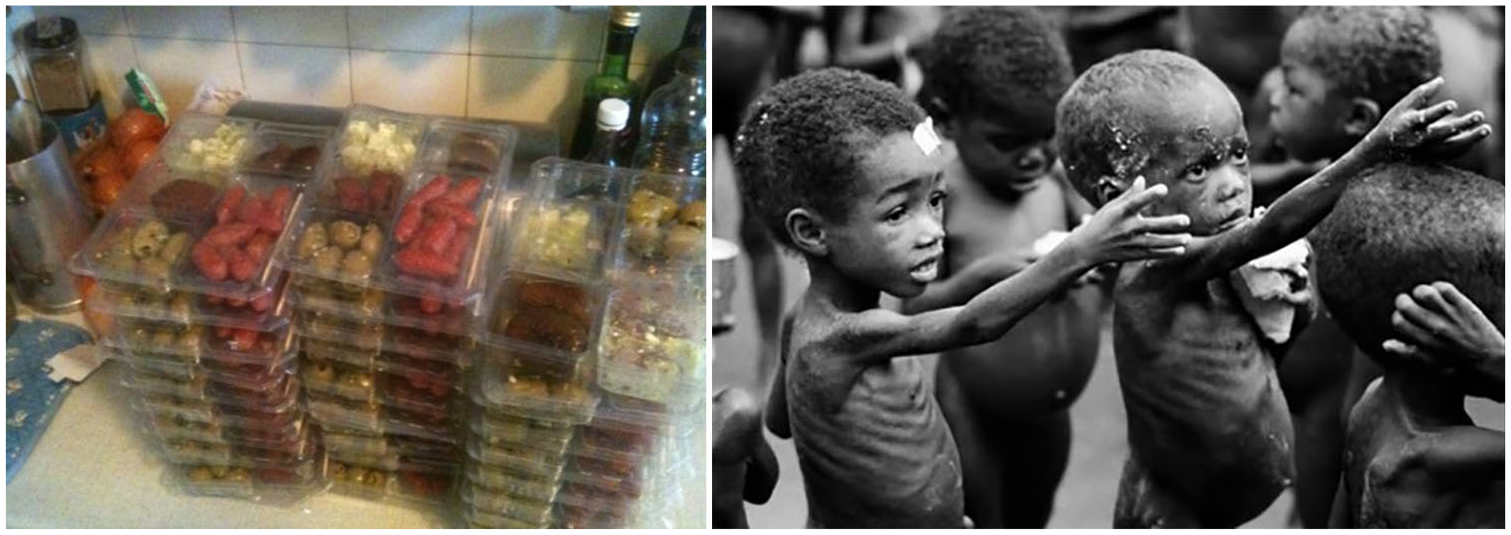
Food waste (i.e. pre-packed Italian antipasti) and hunger.
Methodological approach
This study performs a neo-Gramscian analysis (e.g. Bo et al., 2019; Böhm et al., 2008; Cox, 1983; Levy and Egan, 2003; Levy and Newell, 2002) of the structural phenomenon food waste and the agentic phenomenon dumpster diving. A neo-Gramscian approach is well suited to investigate intersections between macro-and micro processes as hegemony requires consent, consequently, actions that challenge hegemony are directly involved in ideological struggles (Kebede, 2005). In this respect, a neo-Gramscian approach accounts for the “double constitution of agency and structure” and is sensitive to the fact that “temporal-relational contexts support particular agentic orientations, which in turn constitute different structuring relationships of actors toward their environments” (Emirbayer and Mische, 1998: 1004).
The analysis employs analytical concepts from Gramsci (1971), Laclau and Mouffe (1985), and Fairclough (1993), focuses on the role of discourses in constituting and sustaining unequal power relations, and seeks to scrutinize how particular conceptualizations and discourses of food and food waste are privileged while others are marginalized (Fairclough and Wodak, 1997). As a main idea of discourse theory is that meaning can never be ultimately fixed or total and discourses, as particular ways of understanding the social world, struggle for hegemony, discourse analysis often employs Gramsci’s concepts (Jørgensen and Philipps, 2002).
In data collection, I followed a triangulation approach (Denzin, 2006) and collected data on food waste and dumpster diving between 2010 and 2016 using several methods. First, with an initial focus on the phenomenon dumpster diving, I conducted phenomenological interviews (Thompson, 1997) with nine key informants practicing dumpster diving in Austria and Germany. I recruited two initial informants through my personal network and subsequent informants through snowball sampling. Informants were between 23 and 28 years old; three informants were female and six were male; all informants either were students or had a job (see Table 1). Dumpster diving therefore, was not a necessity for informants.
Profiles of interview participants.
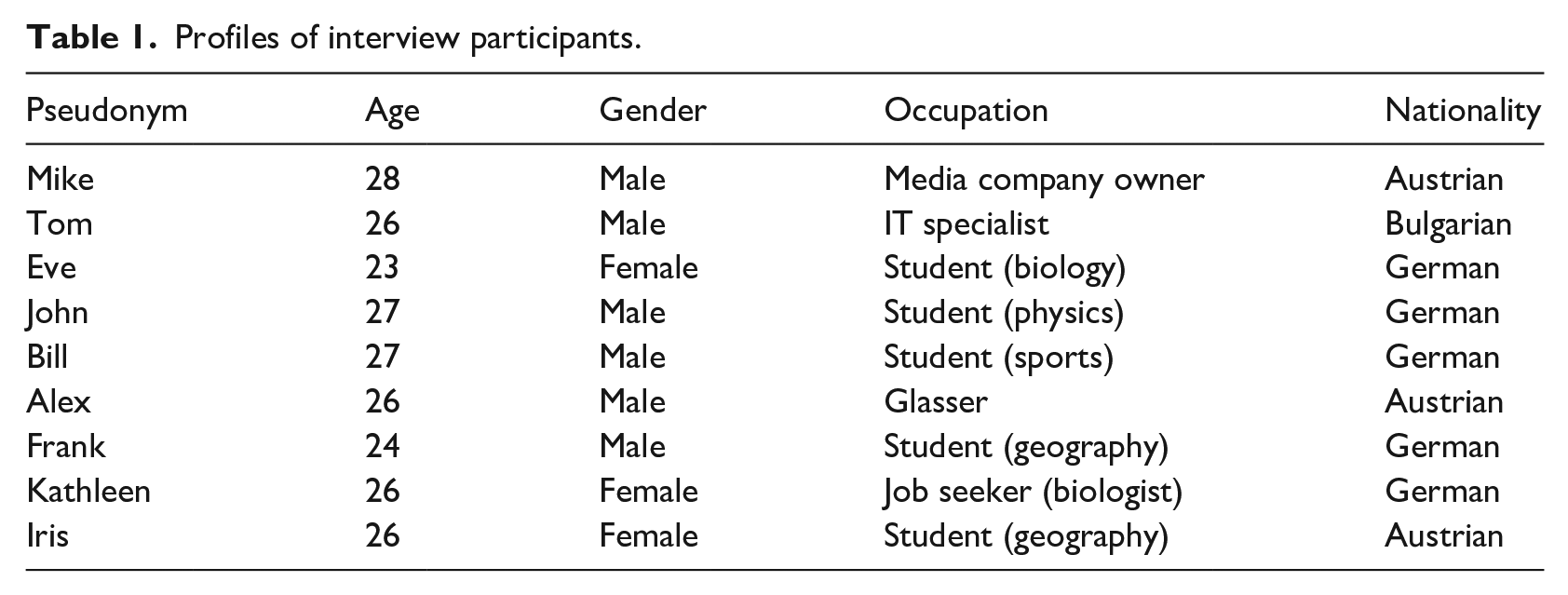
Throughout the process of collecting and interpreting data as well as reflecting on emerging literature on dumpster diving (e.g. Barnard, 2011; Fernandez et al., 2011) my research interest evolved and I sought to complement the agentic level analyses of the dumpster diving phenomenon with a structural level analysis of food waste—to situate the dumpster divers’ practice. Food waste is the “conditio sine qua non” (i.e. the necessary precondition) for dumpster diving. Hence, to capture expert discourse (Jaeger, 2012) and public discourse of food waste I analyzed international organizations’ reports on food waste and conducted an automated content analysis of newspaper coverage (e.g. Humphreys, 2010; Humphreys and Thompson, 2014) of food waste. I chose these data sources, to represent the structural level, because newspapers often refer to international organizations’ reports and media texts are principal sites for establishing and maintaining hegemony in modern societies (see Carragee, 1993; Van Bommel and Spicer, 2011).
The data basis for the analysis of expert discourses were four reports, specifically dealing with food waste or including a chapter on food waste, prepared by the Food and Agriculture Organization of the United Nations (FAO), the United Nations Environment Programme (UNEP) and the World Bank (see FAO, 2011, 2013a; UNEP, 2009; World Bank, 2011). To cover public discourse of food waste in the US, I searched the Lexis-Nexis database for all articles containing the word “food waste” that appeared in the New York Times, the Wall Street Journal, and USA Today (see Humphreys and Thompson, 2014). For the time-period 1997 to 2016, this search-procedure yielded 278 articles for analysis.
To develop categories for automated content analysis I openly and theoretically coded (see Corbin and Strauss, 1990) a randomly chosen subset of articles (n = 28). I coded these articles several times, line-by-line, until theoretical saturation and stability in interpretation were reached. This process resulted in a custom dictionary for automated content analysis consisting of the categories amount, dumpster diving, environment, location, management, quality, reasons, structural violence and type (see Table 2 for sample words). I used the software Wordstat 6 to conduct automated content analysis.
Word list for automated content analysis.
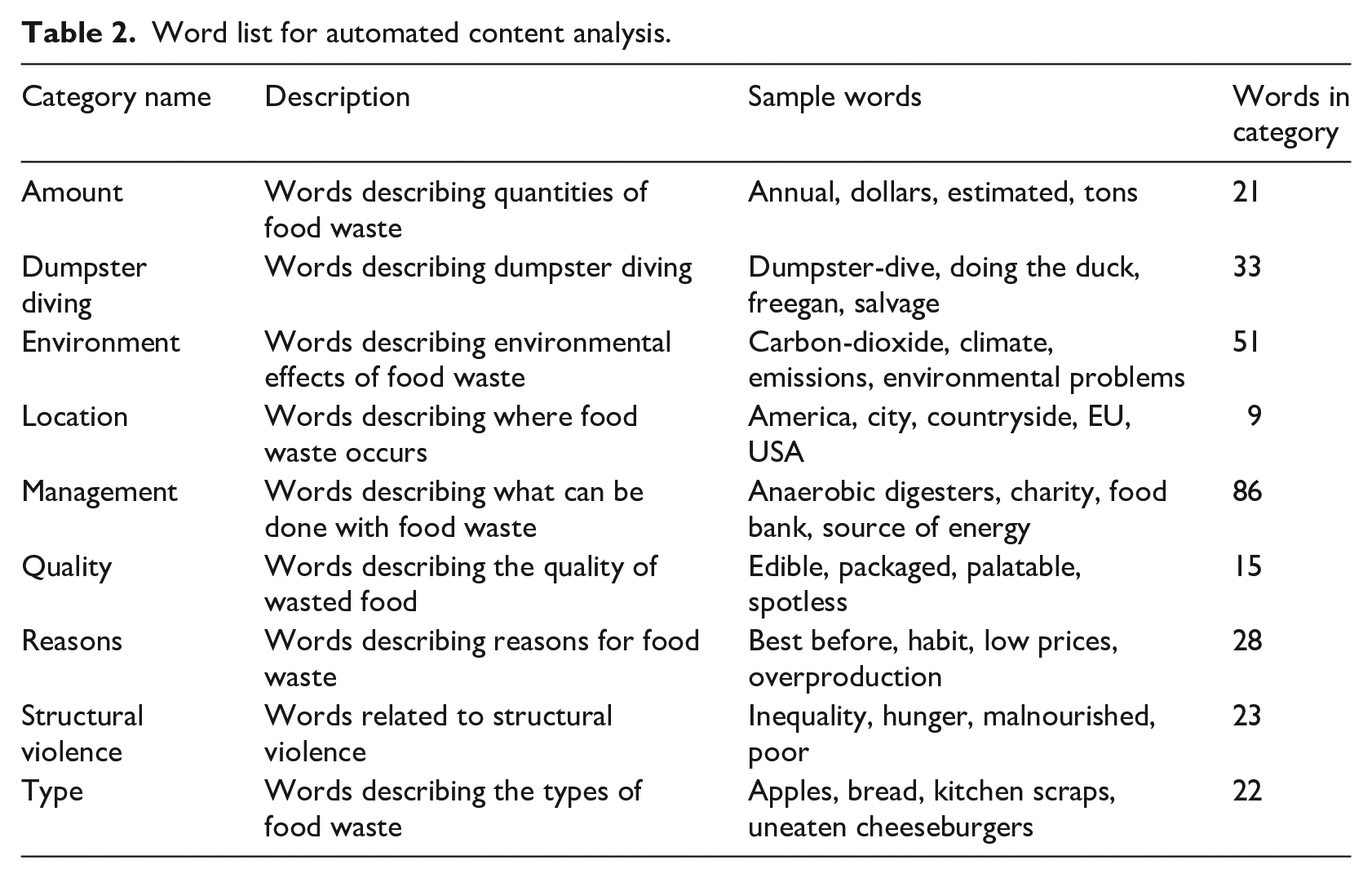
Findings
Hegemonic conceptualizations: International organizations’ normalization of food waste
Following Fairclough (1993) the analyzed reports belong to the genre of scientific research.
Both the factual language used and the figures and tables provided, immediately evoke associations pertaining to scientific rigor. The reports are structured like scientific papers; they provide sections such as executive summaries, introductions, methodology sections, findings-sections and discussion sections. As in every scientific paper, references are provided. Regarding the interpersonal identity function of a text (Fairclough, 1993) the reports seek to constitute a scientific identity for the authors and the respective organization (i.e. FAO, UNEP, World Bank). The reports also have interpersonal relational functions (Fairclough, 1993) as the reports try to constitute specific relations with certain groups or the readership. The intended audiences for the reports are similar international organizations, policy makers, and the media.
The concept of interdiscursivity highlights the heterogeneity of texts in being constituted by combinations of diverse genres and discourses and seeks to identify which discursive practices are being drawn upon and in what combinations they appear (Fairclough, 1993). The reports analyzed clearly follow the structural logic of scientific research papers and combine discourses from economics and management science.
Terms such as supply chain, efficiency, and management, used throughout the reports, illustrate these economics and management science discourses. While in principle the possibilities in discursive practice seem limitless, Fairclough (1993) building on Gramsci (1971) argues that discursive practices are limited and constrained by the state of hegemonic relations and hegemonic struggle. In what follows, I show how the specific combination of different discourse elements from natural sciences (i.e. agronomy, biology, chemistry), economics, and management science employed in international organizations’ reports reproduces the hegemonic neoliberal discourse of food and food waste.
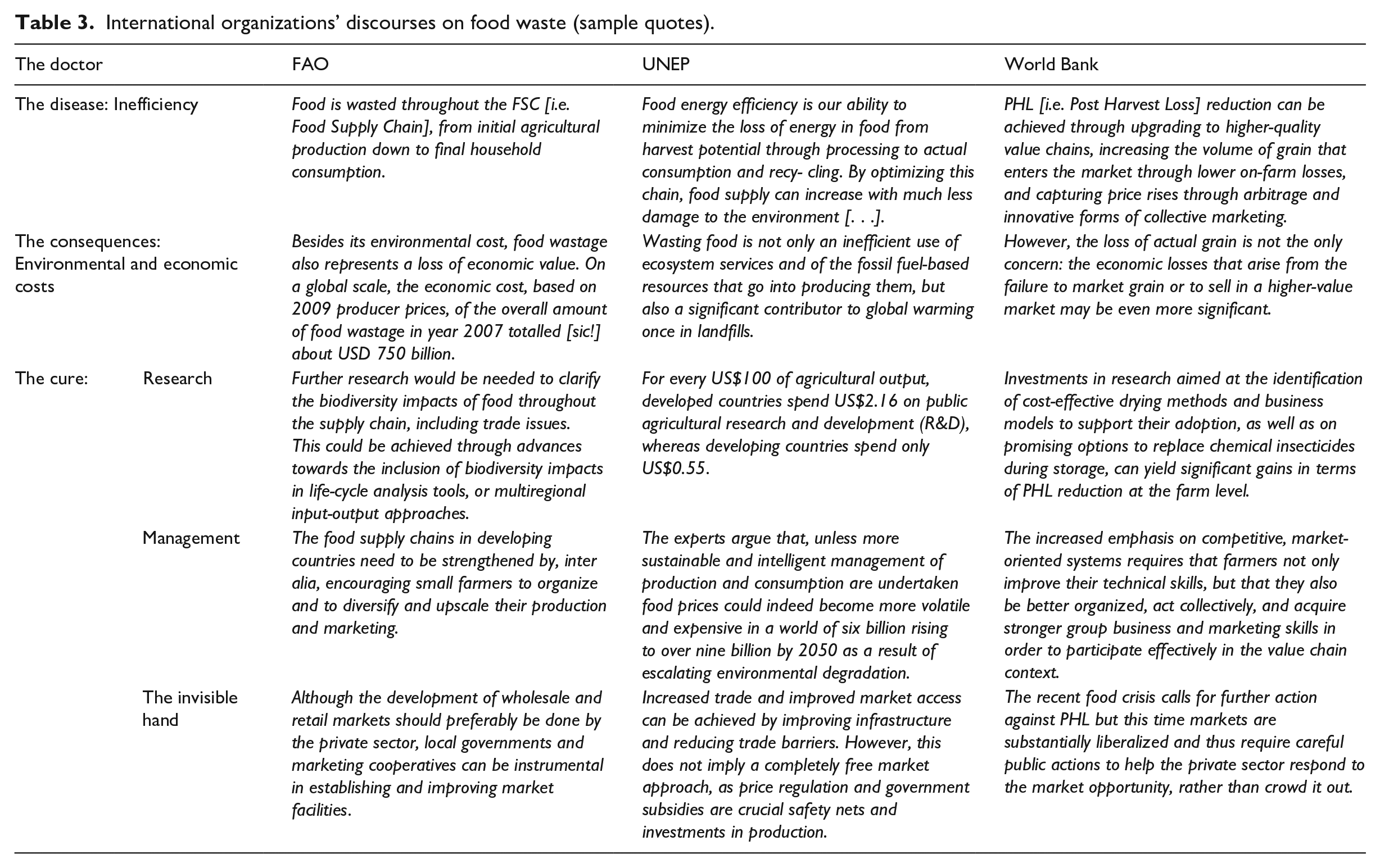
The iterative comparative analysis reveals an overarching narrative that is common to all four texts. While the reports propose a range of different measures to solve the problem of food waste, the comparative analysis reveals that all the reports rely only on the hegemonic neoliberal repertoire to envision possible solutions. The overarching narrative is illustrated with the metaphor of an experienced doctor (i.e. FAO, UNEP, World Bank) who examines a patient (i.e. the global food system), immediately identifies the disease at hand (i.e. inefficiency) and instantly knows which medication to prescribe (i.e. further research, proper management, market-based solutions).
The disease: Inefficiency
The analyzed reports all agree that food waste is a serious problem. In each report, the trope of the chain serves to identify the locus of the problem. Food is lost along the supply chain due to inefficiencies at every single link. The FAO outlines the problem: “Roughly one-third of the edible parts of food produced for human consumption gets lost or wasted globally, which is about 1.3 billion ton per year. Food is wasted throughout the FSC [i.e., Food Supply Chain], from initial agricultural production down to final household consumption” (FAO, 2011: 4).
The trope of the chain serves as an important precondition for international organizations’ proposed cures for food waste. In a chain, each link is readily identifiable and consequently each inefficiency can be traced and rectified if the suggested measures are applied. In this way, the chain makes the problem manageable. All the reports highlight that inefficiencies, which result in food waste, entail costs. While these costs are threefold, social (i.e. people not fed), environmental (i.e. resources wasted, pollution), and economic (i.e. money lost), the analyzed reports emphasize the environmental and economic costs but neglect social costs: “Besides its environmental cost, food wastage also represents a loss of economic value. On a global scale, the economic cost, based on 2009 producer prices, of the overall amount of food wastage in year 2007 totalled [sic!] about USD 750 billion. This is approximately the GDP of Turkey or Switzerland in 2011” (FAO, 2013a: 55).
This overemphasis of the environmental and economic costs is coherent given the fact that the reports employ elements of economics and management science discourses with rational actors, where the conceptualization and organization of food as a commodity is taken for granted and naturalized: “There is little incentive for smallholders to provide well-cleaned grain for marketing, as there is usually no premium for quality: rather, there is every incentive to leave foreign matter in the grain, especially at the bottom of sacks, so that profits from sales can be maximized” (World Bank, 2011: 10). “The experts argue that, unless more sustainable and intelligent management of production and consumption are undertaken food prices could indeed become more volatile and expensive in a world of six billion rising to over nine billion by 2050 as a result of escalating environmental degradation” (UNEP, 2009: 5).
The cure: Research, management, and the invisible hand
The reports provide much data on food waste and ascribe research a central role in dealing with the problem. Thereby, the reports also perform a legitimizing function for the respective international organizations, as they constitute these organizations as experts in the food system. From a critical perspective, it is not a coincidence that the reports are structured like scientific papers. Science is associated with neutrality, integrity and credibility. After all science creates authority (Adorno and Horkheimer, 1997) and authority is valuable to reproduce and legitimate the hegemonic neoliberal discourse of food and food waste. Prototypical for international organizations’ reports on food waste, besides research, the World Bank emphasizes the central roles of management and the market for solving the food waste problem.
“The increased emphasis on competitive, market-oriented systems requires that farmers not only improve their technical skills, but that they also be better organized, act collectively, and acquire stronger group business and marketing skills in order to participate effectively in the value chain context. Thus technical training must be accompanied by the development of business management and entrepreneurial skills” (World Bank, 2011: XV).
While many of the best practice examples, technical measures, and management suggestions are appealing to the reader, from a critical discursive perspective, the specific combination of discourse elements from natural science, economics and management science is remarkable. All reports build on hegemonic, neoliberal conceptualizations and discourses of food (i.e. commodity) and food waste (i.e. inefficiency) while alternative conceptualizations and discourses of food (e.g. public good; basic human right) and food waste (e.g. distributive injustice; systemic feature of the neoliberal economic order) are omitted. The above quote also supports Giesler and Veresiu’s (2014) finding that one central way of disseminating and sustaining the neoliberal order is responsibilization (i.e. to make the individual responsible for addressing social issues). However, in this case it is not the consumer—but rather the rational producer who, according to economic theory, due to his individual self-interest, will contribute to an optimal allocation of resources: “The food supply chains in developing countries need to be strengthened by, inter alia, encouraging small farmers to organize and to diversify and upscale their production and marketing. Investments in infrastructure, transportation, food industries and packaging industries are also required. Both the public and private sectors have a role to play in achieving this” (FAO, 2011: V).
While emphasizing that both the public and private sectors are needed to address food waste the following quote illustrates that in the analyzed reports market-based solutions are preferred over state interventionist strategies.
“The recent food crisis calls for further action against PHL [i.e., Post-Harvest-Loss] but this time markets are substantially liberalized and thus require careful public actions to help the private sector respond to the market opportunity, rather than crowd it out” (World Bank, 2011: 1).
In this vein, the analyzed reports reproduce the market, which is not capable of allocating food in a way that provides the necessity for everybody, as the main solution for food waste. More specifically, according to economic theory the simultaneity of food waste and hunger is an instance of market failure as no decentralized pricing system is capable of determining the optimal level of collective consumption (Samuelson, 1954). Market failure however, legitimizes government intervention when the pursuit of private interest does not lead to either an efficient use-, or a fair distribution, of a society’s resources (Weimer and Vining, 1992). In the case of food, both conditions are fulfilled, as an estimated number of 925 million people in the World are undernourished (FAO, 2010) while billions of tons of palatable food are thrown away every year (e.g. Jones, 2005). The analyzed reports however, prescribe more liberalization and more market-based approaches rather than government interventions to cure the disease. Ironically, electricity and transportation infrastructure are conceptualized as public goods while food is conceptualized as a marketable commodity and the role ascribed to the public sector is to provide the framework for more market-based private sector solutions.
“The private sector’s efforts to develop improved postharvest systems need to be underpinned by an environment that encourages private sector investment. It begins with the improvement of the enabling public environment and provision of
To summarize, the reports analyzed constitute an expert discourse that unfolds as follows: Food waste is a result of inefficiencies along the supply chain, researchers must collect more data to identify inefficiencies, once inefficiencies are identified, sound management practices and market-based solutions will lead to more efficient provision of food and less food wastage thereby mitigating environmental impacts. From a critical perspective, that means the enlightened rational man, employing sciences (i.e. agronomy, biology, chemistry, management science) as well as management practices, and the self-healing capability of the market will cure the food waste disease. Following the critical tradition (e.g. Adorno and Horkheimer, 1997), this implies that issues of inequality, power, domination, and class struggle are written out of these reports rendering alternative conceptualizations of food and food waste unfeasible. The status quo, where food is commodified and, like any other commodity, traded and discarded with Man not being entitled to the necessity (i.e. food conceptualized as basic human right) and the public sector not being responsible for allocating food (i.e. food conceptualized as public good), is thus reproduced and naturalized. In this respect it is the omitted or unsaid (Foucault, 1980) that restricts the discourse of food waste and reproduces the market, represented by the rational producer and the responsibilized consumer, as the only viable option for solving the food waste problem. The following excerpt from an FAO press release related to the FAO (2013a) report aptly summarizes international organizations’ lines of argumentation: “High priority should be given to
Overall, the analysis of international organizations’ reports on food waste indicates that on a structural level there is no discussion of the connections between food waste, inequality, unequal distribution or the broader economic and social order. Rather, international organizations emphasize the environment over people by framing food waste as a threat to the environment that originates from inefficiencies along the food supply chain (see Table 3 for an overview).
International organizations’ discourses on food waste (sample quotes).
The passive revolution: Food waste—A threat to the environment
US-media discourses on food waste resemble international organizations’ discourses on food waste. On an aggregated level the automated content analysis of US newspaper articles shows that the share of coded words for the respective category is 27.44% for environment, 18.18% for location, 15,72% for type, 13.90% for reasons, 9.89% for amount, 9.89% for management, 2.82% for quality, 1.52% for structural violence and 0.64% for dumpster diving. Figure 3 shows the changes of shares for semantic categories from 1997 to 2016.
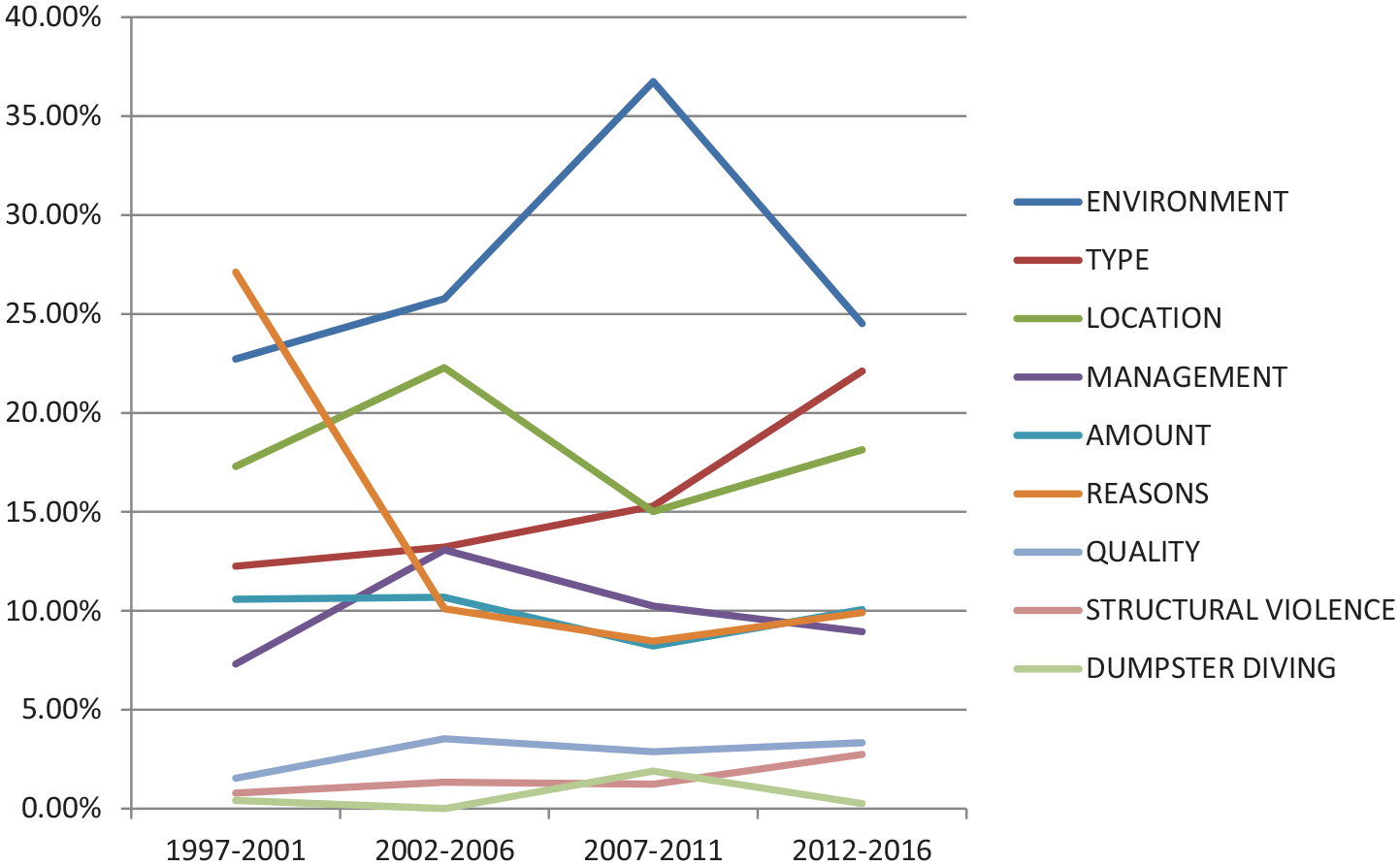
US-media discourses on food waste: Changes in coded categories 1997–2016.
The analysis reveals that newspaper coverage of food waste largely conveys an environmental discourse. That is, besides reporting on the locations, amount, type, quality and reasons related to food waste, US media mainly frame food waste as a threat to the environment. For example, USA Today reports: “American households throw away about $640 each worth of food every year, and consumers don’t really care about the environmental impact of trashed leftovers piling up in landfills, according to a survey out Wednesday from the American Chemistry Council. [. . .] Wasted food accounts for about 2% of greenhouse gas emissions, 35% of freshwater consumption, 31% of cropland and 30% of fertilizer usage, according to data cited in an article on food waste from John Hopkins Bloomberg School of Public Health, published in the journal PLOS this month” (USA Today, June 25, 2015).
Furthermore, this environmental discourse also entails discussions on how food waste can be managed. For example, The New York Times describes how food waste can be put to further economic use by generating biogas: “The United States is also exploring the use of biogas, though natural gas prices depressed by the shale gas boom make it harder for the fuel to compete on cost. In Brooklyn, the Newtown Creek Wastewater Treatment Plant mixes food waste with sludge to generate biogas, and it plans to start purifying the fuel so it can be pumped into New York’s natural gas grid. National Grid, the company managing the purification facility, says it will be ready in 2016 and could provide enough gas to heat 5,200 homes” (The New York Times, October 30, 2014a).
There is relatively little discussion of dumpster diving in the analyzed newspaper articles. In several years, there is not a single word related to this semantic category. Likewise, the percentage of words related to structural violence (e.g. hunger, poverty, inequality) is low throughout the years. One exception is a New York Times article about Valentin Thurn, who directed the food waste documentary “Taste the Waste”: “A filmmaker and journalist, Mr. Thurn had not planned to start a food revolution, or even a sharing website. But while shooting a segment about Dumpster-diving, he was shocked by what he encountered. “’The feeling I had, when I saw the great amount of edible food in the bins, was anger,” he said. His documentary, “Taste the Waste,” which was released in 2010, struck a chord in Germany. With its images of discarded lettuce, bins of bright, red tomatoes and entire warehouses of old bread, as well as emotional interviews with German farmers about potatoes that – whether too big, too small or too strangely shaped for supermarket shelves – simply rot in fields, the film became a touchstone for the burgeoning movement to reduce the wasting of food” (The New York Times, November 27, 2014b).
Overall, the automated content analysis indicates that media discourses on food waste, like international organizations’ reports on food waste, largely follow hegemonic neoliberal conceptualizations and discourses of food and food waste. Dumpster diving as a potential counter-hegemonic practice was little successful in making inroads into mass media and could not extend the hegemonic discourse representing food waste as a manageable (i.e. increase efficiency along the supply-chain, compost, generate biogas) threat to the environment with a discourse on social inequality.
Dumpster Divers: The potential organic intellectuals?
Findings derived from the interviews reveal that dumpster diving is a profitable and exciting consumption practice for informants. Informants haul large amounts of food from dumpsters and thereby benefit economically as they need to spend less money on conventional shopping. Just like grocery shopping, informants go dumpster diving regularly, once or twice a week. Informants are both, fascinated and shocked by the amounts of food they haul from supermarket dumpsters. For example, Eve explains that dumpster diving lowers her food expenses substantially: “Other people told me that they need to spend 200 to 250 Euros per month on food. In my case, it is only 50 Euros. The least was 15 Euros. It depends. You are dependent on what you find. If you know the spots then you also know what you can get” (Eve, 23, student).
While the amount of edible food varies between different locations and weekdays, typically informants find plenty of food. Informants mainly dive into supermarket-dumpsters for food and toiletries, they do not search for items like furniture and scrap metal, items poor divers additionally haul from supermarkets’ or home improvement stores’ dumpsters for consumption or resale (Hill and Stamey, 1990). Informants either consume their findings individually or share them with friends. Preparing a meal for friends that contains solely “dumpstered” ingredients is a frequent practice among informants. As dumpster diving is at the border of legality, informants normally go dumpster diving after sunset and try to be as quiet as possible. Dumpster diving is adventurous and exciting as informants never know what they will find. As a social practice, dumpster diving is normally performed in groups of two or three friends. The practice is also associated with down-to-earth subsistence like farming or hunting and acquiring practices of foraging societies. In this vein, dumpster diving acts as a re-enchanting and de-alienating practice as some informants perceive it to be more natural than conventional shopping: “There is a bit of adventure to it. You know, I grew up in a big city. It’s really like you head off and procure your food. It is not that you produce your own food but you feel good about the fact that you get your own food, maybe it’s like being a farmer who tills his field - but you are not as close to the soil of course, rather you head off and procure your own food, that creates a good feeling” (John, 27, student).
While these findings in terms of economic and psychological motivations confirm prior research’s findings (see Fernandez et al., 2011; Pentina and Amos, 2011) this study finds that the ideological motivation of informants is more differentiated than described in prior literature.
Informants recurrently emphasize that they are reclaiming food that is otherwise lost and thereby reduce the amount of overall waste. Several informants highlight that dumpster diving is a resource-conserving consumption practice. By going through supermarket trash, informants experience the injustice the prevailing neoliberal social order authorizes on a first hand basis. However, only occasionally and very subtly as Eve’s account illustrates, do they mentally combine food waste and inequality: “It’s horrible to throw away so much food that definitely works, I heard that 25 to 30% of produced food is discarded; in America even 40%, for me this is terrible, if one considers what is happening in other countries” (Eve, 23, student).
Informants express an environmental ideological motivation represented by the desire to reduce waste and reclaim discarded food rather than an emancipatory anticapitalistic motivation for dumpster diving: “For me the main reason is that I can eat healthy food and I don’t like the stuff to be thrown away; so it doesn’t get wasted. [. . .] We live in times where we should really think of what we do to the environment and to ourselves as well” (Tom, 26, IT-specialist).
When talking about effects besides providing costless food and adventure, informants portray a pessimistic picture of dumpster diving. For example, Bill (27, student) explains that the larger systemic injustices are not affected by dumpster diving and to not spoil the experience it is better to not think about the big picture. Some informants are also aware of the potential contradiction that stems from profiting from the defects of neoliberal market economy. Informants however, either suppress systemic injustice as they perceive it to be too depressing and disillusioning, or they resolve this tension by emphasizing to benefit the environment by reducing waste. The following excerpt from John’s interview illustrates this reasoning: “Anyway, it doesn’t improve the system. So, it is not a sustainable possibility to [. . .], it’s really just to appreciate the defects in the system. [. . .] Through containering [i.e. dumpster diving] you are not doing something good to the environment, you just simply do less evil. [. . .] I think I would be happier if I did not find anything in the dumpsters. Of course, I’m profiting from this. [. . .] I don’t want to think about how much is actually thrown away. It is a very small percentage that can be returned to the food chain” (John, 27, student).
When envisioning a solution for the problem of food waste, dumpster divers have several ideas on how to solve the problem. Some informants argue that close to expiry or deterioration retailers should make food available to consumers at lower prices or give it to charitable organizations and people in need. In this respect, some informants argue that expiry date regulations for some foods such as dairy produce are probably too strict. Some informants also think that individual consumers’ behaviors can be decisive in addressing the food waste problem.
Overall, part to whole analysis of interviews reveals that dumpster diving is a profitable consumption practice that is adventurous and exciting, and has some ideological potential for identity construction. Interview-informants however, hardly discuss the connection between the systemic injustice of the current neoliberal economic order, food waste, unequal food distribution, and global misery. Dumpster divers seem to suppress the unjust logic of neoliberal market economy in order to avoid conflicting feelings, doubt in society, and self-doubt. Dumpster divers’ main motivations are the cost-savings, the reduction of waste, and the adventure involved.
More specifically, dumpster divers negotiate the simultaneity of large-scale hunger and large-scale food waste by reframing food waste primarily as an environmental issue and not a social justice issue. Thereby, dumpster divers are able to resolve the contradiction of profiting from the defects of the neoliberal economic order. Dumpster divers perceive to do something good to the environment. For informants the conceptualization of food as a commodity is something given and natural and a radically different conceptualization, such as food as basic human right, is not part of the discursive space on food. Thus, the conceptualizations of food and food waste on the individual and the structural level are similar and subscribe to the hegemonic neoliberal ideology. The next section discusses this study’s findings, develops a conceptual model of food waste and details the study’s contribution to critical management and organization research.
Discussion
The hegemonic neoliberal social order produces inequitable outcomes and sustains social inequality (e.g. Coburn, 2000; Gill, 1995). Despite unprecedented levels of global wealth, this wealth is unevenly distributed within and between countries (Korzeniewicz and Moran, 1997). However, “Inequality is not a necessary condition produced by extra-human forces. Degrees of inequality are clearly influenced by international, national and local political policies, which are amenable to change” (Coburn, 2000: 144). The major premise of this study is that food waste is a major crack in the neoliberal social order that could render visible “the contradictions and gaps in the process of social reproduction” and “open up spaces in which collective struggles for new possibilities are possible” (Wright, 2010: 18). Augmenting Gramsci’s (1971) concept of hegemony with Galtung’s (1969) concept of structural violence enabled a critical analysis of “sedimented” (see Jørgensen and Philipps, 2002; Laclau and Mouffe, 1985) conceptualizations and discourses of food and food waste in our neoliberal social order. Simultaneous food waste and hunger can be conceptualized as structural violence and it is the prevailing neoliberal social order that commits this violence. In contrast to this critical reading of food waste, at a structural level, this study shows that international organizations and mass media frame food waste as an environmental and an economic rather than a social problem. Furthermore, international organizations frame food waste as an inefficiency that needs proper management and the self-healing capability of the market. Thereby, these organizations support neoliberal ideology by arguing that even in the case of market failure the solutions are to be delivered by the market (Mirowski, 2013).
The environmental and economic discourses and the aligned conceptualizations of food as commodity and food waste as inefficiency are hegemonic. That is, these discourses and conceptualizations reach temporal fixation or closure (Laclau and Mouffe, 1985). By reproducing these discourses and conceptualizations, international organizations and mass media prevent a discussion about the inherently inequitable structural features of the neoliberal social order. These institutions normalize food waste and marginalize potential alternative discourses on food and food waste. This study argues that especially mass media play an important role in this process of “trasformismo” where naturalness is established “[. . .] with inconvenient facts allowed sparingly and within the proper framework of assumptions, and fundamental dissent virtually excluded from the mass media” (Herman and Chomsky, 2010: Ixii).
Furthermore, at an agentic level, this study shows that for dumpster divers, who could be potential “organic intellectuals” that reveal the systemic contradictions with respect to food and food waste, it is difficult to develop and uphold an anticapitalistic ideological motivation in the face of hegemonic neoliberal conceptualizations of food and food waste and economic and environmental discourses on food waste. The dumpster divers I met adopt an environmental ideological motivation and remain satisfied with doing something good to the environment. This finding is in contrast to Barnard (2011) who portrayed dumpster divers that actively sought to convey a critical message in mass media but extends findings by Pentina and Amos (2011) who found that only few Freegans explicitly discuss political or philosophical underpinnings of their activities in their blogs and postings. This study also shows that dumpster diving receives little media coverage and hence its potential to add a social justice discourse to the dominant environmental discourse on food waste is limited.
More important however, are this study’s insights that also dumpster divers subscribe to the hegemonic conceptualization of food as commodity and that an environmental ideological motivation can contain an anticapitalistic ideological motivation. I argue that in the end the environmental discourse of food waste serves the function of managing the food waste—hunger contradiction, a systemic contradiction that could render visible the inhumane nature of the prevailing social order. As Candeias (2011: 3) puts it: “The decisive factor for the power bloc is not to eliminate or to solve contradictions, but to manage them so that they stay under control.” That is, the environmental discourse induced by climate change detracts from a potential social justice discourse and ultimately helps neoliberalism to maintain its hegemony by providing attractive consent-structures (e.g. green economy, sustainability, zero waste; see Candeias, 2011; Valenzuela and Böhm, 2017). As ever more people agree that climate change is real, they support the idea of a move to more environment-friendly production and consumption, and we witness this increasing “environmental consciousness” in diverse technological innovations, policy decisions, and trends (e.g. electric automobility, ban of plastics, consumption of organic food).
In our neoliberal social order, however, climate change and environmental degradation go hand in hand with structural violence and systemic social inequality. The greening of capitalism (Böhm et al., 2012) might complement neoliberalism’s almost all-encompassing discourses of management (Parker, 2016; Spicer and Böhm, 2007) and free market ideology (Mirowski, 2013), with powerful consent-structures that contain potential critique and manufacture consent both, at the structural- and agentic level.
Condensing this study’s findings, Figure 4 outlines the actual (i.e. hegemonic—the continuous frames in the model) and the potential (i.e. counter-hegemonic—the dashed frames in the model) discursive space on food waste. Galtung’s (1969) concept of structural violence facilitates a critical reading of food waste and thereby emphasizes the emancipatory potential of this phenomenon. This study seeks to challenge the hegemonic conceptualizations of food as a commodity (cf. Polanyi and MacIver, 1944) and food waste as inefficiency (e.g. FAO, 2011, 2013a; World Bank, 2011) by conceptualizing food as a basic human right and food waste as an embodiment of the systemic inequity of the neoliberal social order. Once we understand the simultaneity of food waste and hunger as structural violence, the conceptualization of food as a commodity becomes untenable and radical alternative (see Fleming and Banerjee, 2016) conceptualizations and organization of food as basic human right or public good become feasible. At present however, with international organizations and mass media normalizing food waste, and environmental and economic discourses sedimenting a potential counter-hegemonic social justice-based discourse, such an alternative understanding of food waste and respective organization of food seem unfeasible.
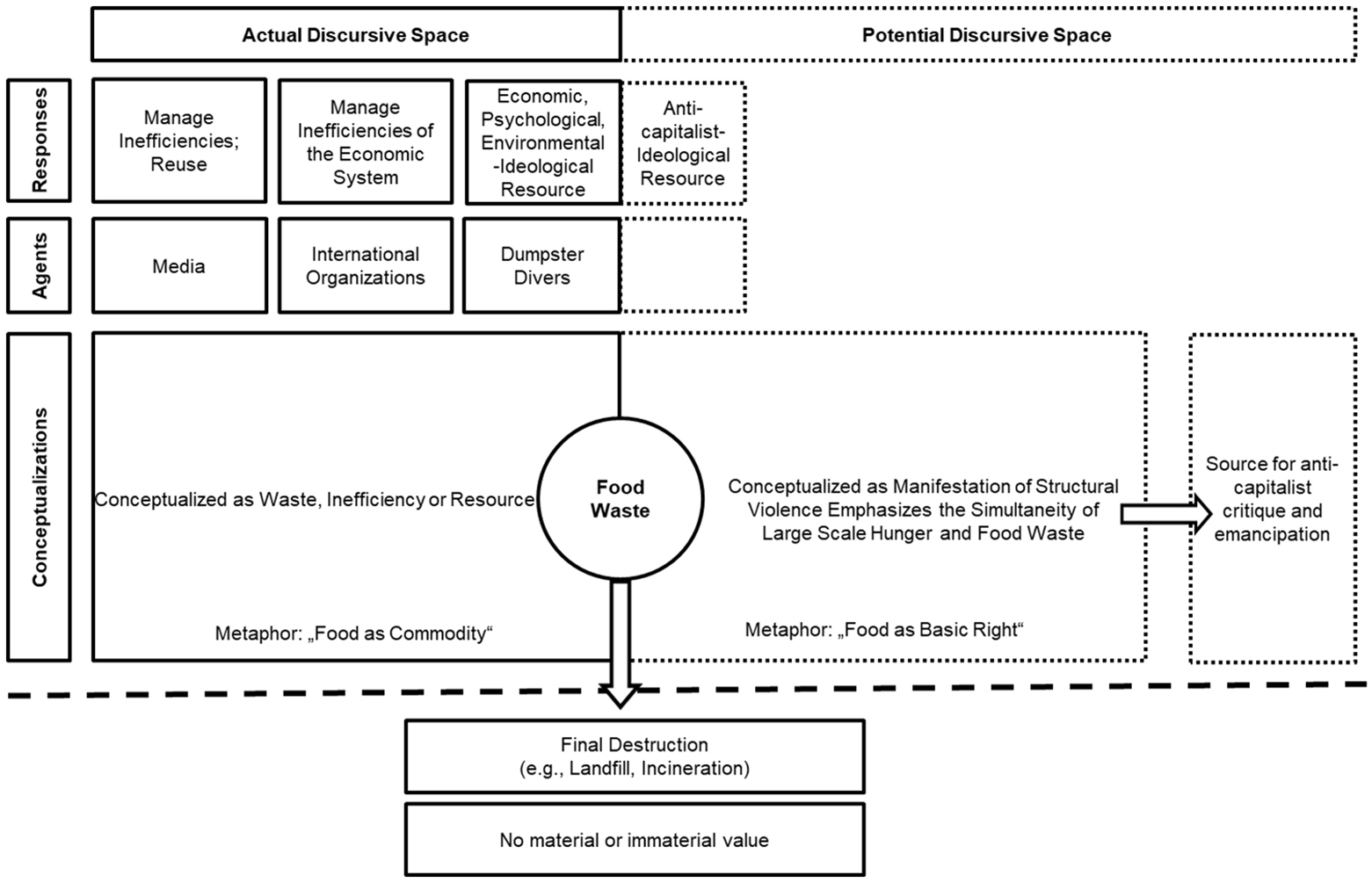
Conceptual model of hegemonic and counter-hegemonic discourses on food waste.
This study contributes to critical management and organization research (e.g. Fournier and Grey, 2000; Spicer et al., 2009; Willmott, 1992) as follows:
First, this study introduces structural violence into neo-Gramscian analysis (e.g. Bo et al., 2019; Böhm et al., 2008; Levy and Egan, 2003; Levy and Newell, 2002) and augments Gramsci’s concept hegemony by proposing structural violence as the mode of domination in the economic sphere. That is, besides consent in the sphere of civil society and coercion in the sphere of the state, this study proposes that the historical bloc “neoliberalism” builds on structural violence (Galtung, 1969) in the economic sphere. This proposition contributes to neo-Gramscian analyses as both, the economic sphere (besides Labour Process Theory’s analytical focus on the firm and the workplace; see Böhm et al., 2008) and the coercive side of hegemony are often under-theorized and receive less empirical attention than the consensual side of hegemony. More precisely, this study argues, contrary to prior literature (e.g. Anderson, 1976; Cox, 1983), that violence is not only applied in marginal, deviant cases but violence is constant and there is consent to neoliberal hegemony despite ongoing structural violence. Furthermore, this study exemplifies this proposition in the context of food and food waste and shows how the structural violence perspective on the economic sphere facilitates a social justice-based, fundamental, critique of the hegemonic neoliberal social order.
Second, this study adds to research on social movements (e.g. Böhm et al., 2008; Spicer and Böhm, 2007) by providing an empirical account of an infra-political social movement. This study addresses calls for empirical research studying different forms of resistance to understand better, how hegemonies and counter-hegemonies are constructed and maintained (see Böhm et al., 2008) by showing how the destabilization potential of a counter-hegemonic practice is contained by hegemonic conceptualizations and discourses. In this respect, this study also extends prior research on neoliberal governance (e.g. Fougère et al., 2017; Guthman, 2007; Parker, 2016) as it shows how potentially destabilizing phenomena such as food waste are naturalized and thereby stripped of their counter-hegemonic, emancipatory, potential by powerful institutional actors. That is, this study provides an example of “roll-with-it” neoliberalization, which is signified by “the normalization of neoliberal practices and mindsets” (Keil, 2009: 232).
Third, this study contributes to research on climate change (e.g. Böhm et al., 2012; Levy and Spicer, 2013; Swyngedouw, 2010; Wittneben et al., 2012). This study extends Levy and Spicer’s (2013) discussion of climate imaginaries (i.e. “shared socio-semiotic systems that structure a field around a set of shared understandings of the climate”, p. 659) within the climate change discourse by showing that at a higher level of competing discourses the environmental discourse contains a social inequality discourse. That is, the climate change discourse is on its way to become absorbed under the neoliberal hegemonic constellation, obfuscating that neoliberal capitalism exploits and destroys not only the environment but also people—through structural violence in the economic sphere. Violence is built into the structure of neoliberal capitalism and the greening of this capitalism (see Böhm et al., 2012) will not change this fundamental property of the hegemonic social order.
Finally, this study contributes to the (re-)politicization of waste (see Corvellec, 2019; Valenzuela and Böhm, 2017) by showing food waste’s relevance for both, antagonists’ contestations of the hegemonic neoliberal order (e.g. social movements) and critical scholarly research. In line with its alternative reading of the phenomenon, this study shows that food waste could be a prime source for anticapitalistic critique and counter-hegemonic emancipation and hence, addresses calls for counter frames on waste and sustainability that confront market-ideology casting the market as natural and moral (Lakoff, 2010; Valenzuela and Böhm, 2017). That is, understanding the simultaneity of food waste and hunger as structural violence facilitates a fundamental critique of neoliberal hegemony and alternative conceptualizations of food as, for example, basic human right or public good. In this respect, driven by critical management studies’ desire to transform existing power relations this study provides a critical reading of food waste to articulate an unacceptable present and envision radical alternatives (see Fleming and Banerjee, 2016).
Limitations and future research
This study comes with some limitations. While the study investigated international organizations, US media, and dumpster divers with a focus on their conceptualizations of food, food waste, and respective discourses, studying governments, NGOs, and common people could extend and probably challenge this study’s findings. Furthermore, as data for this study were collected in wealthy countries, future research could investigate if organizations’ and individuals’ conceptualizations and discourses of food and food waste in developing countries parallel hegemonic conceptualizations and discourses in wealthy countries. Another limitation originates from this study’s theoretical grounding in Gramsci’s political philosophy. As Anderson (1976) shows, in the prison notebooks Gramsci (1971) uses several concepts ambiguously. That is, while this study is to some extent based on Gramsci’s original writings, it also relies on the reception of his work. Gramsci’s work however, is notoriously open to different interpretations (Böhm et al., 2008) and hence this study provides but one reading of his ideas. Still, a theoretical contribution of this study is to augment Gramsci’s concept of hegemony with Galtung’s (1969) concept of structural violence. I believe that this augmented concept of hegemony could be fruitful for future critical management and organization studies. Future studies could seek to explore how other instances of structural violence remain hidden under neoliberal ideology, sedimented by hegemonic conceptualizations and discourses, or unchallenged as a given and natural.
Footnotes
Acknowledgements
The author thanks Marius K. Luedicke, Andrea Hemetsberger, Adam Arvidsson, and Robert V. Kozinets as well as Eileen Fischer and three anonymous reviewers for their valuable comments on earlier versions of this paper.

Author biography
Andreas Plank received his doctorate in International Economics from the University of Innsbruck in Austria. Currently, he is postdoctoral researcher at UMIT Tirol. His research focuses on sustainability, critical management studies, management, and consumer behavior. His research has been published, amongst others, in Journal of Cleaner Production, Entrepreneurship & Regional Development, and Tourism Management.
