



Abstract
Food waste is a problem that occurs throughout the supply chain, squandering natural resources, and contributing to greenhouse gas (GHG) emissions. While attention has been directed at systems designed to facilitate movement of food from manufacturer to consumers, little is known on alternative practices to recover food products no longer desired by the consumers. Responding to calls for greater attention to systems elements in macromarketing and for work that challenges the WEIRD hegemony, we investigate the issue of how collaborative networks can support more robust food systems. A qualitative case study draws on prolonged participant observation and depth interviews to address the question, “How do stakeholders in collaborative networks achieve shared system outcomes?” We apply institutional logic and the concept of coopetition to explore the dynamics within a food recovery network. Our findings suggest that notwithstanding shared commitments to sustainability, competition and conflicting interests can compromise systems performance. This study contributes a new perspective of collaborative network behaviour and highlights shortfalls in current theory and practices resulting from reliance on data collected from WEIRD contexts.
Introduction
The United Nations considers food waste an important target for the 2030 Sustainable Development Goals (United Nations 2021). Food waste squanders resources and contributes to greenhouse gas (GHG) emissions when disposed of to landfill, creating social, moral and environmental challenges (Yngfalk 2019; Papargyropoulou et al. 2014). Those challenges are reflected in a substantial body of work from multiple disciplines addressing the issue of waste in food production and consumption systems (Sutinen and Narvanen 2022). Building on that research, this study focuses on food waste recovery networks (FWRN), and specifically on the role of the key orchestrating actor, foodbanks. FWRNs capture and redistribute waste food, intervening in the take-make-waste production and consumption cycle by redirecting resources to the needy rather than to landfill. However, current research relating to this important social and environmental contribution has three limitations. First, most studies take a micro-marketing perspective, focusing on individual actors such as consumers (Aschemann-Witzel et al. 2018), businesses (Yngfalk 2019) and non-profit organisations (Baglioni et al. 2017). The complexity of actor interactions and relationships within FWRNs is relatively under-researched (Matzembacher, Vieira, and de Barcellos 2021). Second, research accentuates the positive aspects of collaborative relationships, ignoring tensions and conflicts in network relationships (Fontana 2018; Kujala et al. 2022). Finally, reflecting this special issue’s call for research (Wooliscroft 2021b) and related to the previous two points, current knowledge is dominated by western, educated, industrialised, rich, democracies’ (WEIRD) perspectives. With respect to FWRN research, while WEIRD studies report positive actor relationships and outcomes (Fontana 2018; Watson and Ekici 2017) our study supports previous non-WEIRD work (Matzembacher, Vieira, and de Barcellos 2021; Van Der Vorst, Tromp, and Van Der Zee 2009) in suggesting a different reality. Despite good intentions and shared commitments, stakeholders can compromise pro-social network performance through opportunistic behaviours. Responding both to calls for work that challenges the WEIRD hegemony and that pays greater attention to systems elements in macromarketing (Wooliscroft 2021a; Wooliscroft and Ganglmair-Wooliscroft 2018) this paper addresses the shortcomings in current FWRN research.
Successful resolution of social and environmental challenges requires collaborative effort (Clarke and Crane 2018; Enright et al. 2018). Insight into the operation of networks motivated by shared stakeholder commitment, collective action and common goals for long-term welfare (as opposed to self-interest and material gain), is therefore important (Watson and Ekici 2017). FWRN are prosocial networks. For example, the Food Bank Malaysia Programme coordinates networks of hypermarkets, restaurants, non-governmental organisations (NGOs) and individuals in order to capture and distribute excess food to needy households. Actors including donor businesses, government bodies and foodbanks cooperate to achieve the important social and environmental sustainability goals of reducing hunger and GHG emissions. Within FWRN, foodbanks are key intermediaries that orchestrate divergent or even backward movement in food supply chains, by capturing and redistributing surplus food (Baglioni et al. 2017; Bazerghi, McKay, and Dunn 2016; Cornforth 2014). The ability of foodbanks to source, process and redistribute waste food is contingent on building trusting relationships between diverse stakeholders including Government, packaged goods manufacturers, retailers, volunteers and beneficiaries within the FWRN. Stakeholder values and goals may be divergent, or even conflicting. However, research is limited in this regard. To address that limitation, we apply institutional logic and the concept of coopetition to explore the dynamics within a FWRN in a non-WEIRD context. Our research question was “How do stakeholders in collaborative networks achieve shared outcomes?” A qualitative case study of a FWRN drew on prolonged participant observation and in-depth interviews to address the following objectives:
To provide deeper insight about the nature and conduct of FWRNs; To theorise tension-inducing and tension-reducing mechanisms in stakeholder relationships within collaborative networks.
The paper makes three important contributions. First, we contribute new theoretical insights, challenging current understandings of the mechanisms of pro-social, collaborative networks. Second, we offer recommendations to stakeholders for improving the function of collaborative networks, which in the case of FWRN, is important in achieving the UNSDG goals. Finally, and supporting the goals of this special issue, we highlight shortfalls in current theory resulting from reliance on data collected from WEIRD contexts, challenging Western belief structures underpinning current sustainability efforts (Gollnhofer and Schouten 2017).
Literature Review
Both developed and developing countries grapple with food loss and food waste; contributing 44% and 56% respectively to global food waste totals (Lipinski et al. 2013). Food loss and food waste are two distinct problems. Food losses occur early in the supply chain, as a result of spoilage or spillage between harvest and distribution to consumers (FAO 2017). Low-income countries experience higher food loss, as a result of financial, managerial and technological limitations and institutional voids (Gustavsson et al. 2011; Matzembacher, Vieira, and de Barcellos 2021). On the other hand, food waste occurs at post-harvest and post-distribution stages in the supply chain, when otherwise edible food is not consumed owing to spoilage, and discarded by retailers or final consumers (FAO 2017). In industrialised countries consumers discard food for perceived quality and aesthetic reasons, as well as spoilage and safety (Lipinski et al. 2013). In the global North, nearly eight times more food is wasted per capita than in the global South including Asia (80kg vs. 11kg per annum) (FAO 2021; Gustavsson et al. 2011). However, Asia is catching up, as consumer tastes and food infrastructures are changing owing to rapidly increasing populations and per capita incomes. Throughout the food supply chain, marketing is implicated. Wastage and loss are inherently issues of supply and demand management failure, both at point of sale and in the home, indicating issues with distribution, logistics, product design, packaging and consumer behaviour.
Food is wasted by some, wanted by others. Wealth inequality, poverty and unemployment results in malnourishment among vulnerable populations, in both West and East (Lambie-Mumford and Dowler 2015). Covid-19 added over 400 million malnourishment sufferers in Asia (FAO 2021). In Malaysia, site of this study, nearly 200,000 households live below the poverty line, spending nearly one third of their income on food (Dermawan 2018). In general, demand for food aid in Asia is rising owing to income inequality, escalating food prices, urbanisation, and political instability (Asian Development Bank 2020), while food supplies are threatened owing to vulnerability to sea level rise, soil degradation, floods and droughts (Varkkey 2019). Regardless of who is deprived and why, addressing food deficits through waste reduction is the ‘low hanging fruit’ in this systemic problem. However, sensitivity to social factors is required. Food is deeply embedded in consumer culture; with diverse social, religious, economic and ethnic factors giving rise to unique food consumption and disposal preferences and practices (Gollnhofer 2017). With respect to FWRN, sharing economy approaches such as foodbanks and social supermarkets are well established in WEIRD contexts, (Zurek 2016), however, in Asia food waste recovery is a relatively new idea. As food is a complex socio-technical element in human provisioning systems, more efficient food systems need to be supported by structural changes to institutions and legislation, and by coordinated action among network actors (FAO 2021). In this regard, lessons learned from the global North are unlikely to apply to Asian contexts. National and regional conditions differ greatly in terms of socio-cultural, political and economic influences; and there is limited understanding of what more efficient food systems might look like (Cruz-Cardenas and Arevalo-Chavez 2018).
Actor Dynamics Within Food Waste Recovery Networks
Redistribution of surplus food to the needy is a social innovation, addressing social needs and improving quality of life for communities (Baglioni et al. 2017). The objectives of FWRNs are threefold: Adapting value chains to lower the cost of nutritious food, strengthening the resilience of vulnerable populations and reducing GHG emissions. Business sector organisations, government and civil society actors are key players, contributing to recovery, management and distribution of rescued food. In the normative sense, stakeholders in food recovery networks align social, environmental and financial goals to achieve mutually beneficial outcomes, and societal value. However, despite the common goal of eliminating food waste, the interests of actors within the FWRN may be divergent (Matzembacher, Vieira, and de Barcellos 2021). Erstwhile collaborators can become competitors, resulting in non-constructive interaction and conflict (Van Der Vorst, Tromp, and Van Der Zee 2009). Pragmatism and opportunism can result in sub-optimal outcomes, as each stakeholder acts to maximise their own self-interest. For example, a foodbank’s goal of minimising wastage may conflict with a donor firm’s aim to increase legitimacy through CSR efforts. In general, NGOs act as intermediaries, channelling resources from pro-social contributors to the underprivileged. Commensurate with the neoliberal turn to small government and austerity measures, NGOs have assumed greater social importance as governments relinquish social welfare responsibilities even as wealth inequality creates larger social need (Benmecheddal, Gorge, and Özçağlar-Toulouse 2017; Kilbourne 2004). However, despite the significant and growing importance of NGOs such as foodbanks in FWRNs, knowledge relating to the nature of partnerships between NGOs and other actors is limited (Baglioni et al. 2017). Moreover, scholars have focused primarily on firm-or industry-centric perspectives (Liu et al. 2020), or the positive impact of pro-social network partnerships (Harvey et al. 2020), neglecting challenges and conflicts that may hinder effectiveness networks with social rather than commercial goals (Baglioni et al. 2017).
In order to gain insight into the complex, hidden dynamics of FWRNs, stakeholder behaviour requires investigation. The notion of stakeholders, or “individuals and groups that can affect, or are affected by, the accomplishment of organisational purpose” (Freeman 1984 p. 25), and stakeholder theory, is well established. However, stakeholder theory is firm-centric and has a pragmatic rather than social orientation, focusing on a transactional approach to support long-term survival. Relational attributes of stakeholder engagement are less well understood (Kujala et al. 2022). In business networks, actors deploy individual and shared skills and resources, building interdependencies through relationships and interactions (Hakansson and Ford 2002). The uniqueness of each network is a result of the aggregate of actor resources and relationships, with each relationship providing connections to other relationships, and reliant on successful past experiences and reasonable expectations (Hakansson and Ford 2002). In the case of FWRNs, stakeholders include supermarkets, food service outlets, restaurants and hotels, NGOs and government bodies. Foodbanks serve as intermediaries, contact points and information conduits. However, this orchestration role has attracted only limited attention (Bazerghi, McKay, and Dunn 2016), which is of concern as insight into how foodbanks co-ordinate food waste and food sharing practices is crucial to reduce waste and improve social impact.
Characteristics of pro-social network partnerships include trust, professional rigor and a common interest that motivates cooperation among social actors (Fontana 2018). In contrast, business networks and relationships are defined by both competition and cooperation (Bengtsson and Raza-Ullah 2016). Simultaneous competition and cooperation are important drivers of strategic alliances and relationships among stakeholders in a network system (McCutchen, Swamidass, and Teng 2008). Competition motivates profit seeking at the expense of rival firms, while cooperation aims for a collaborative advantage, pursuing common goals for mutual benefits. While these two approaches are seemingly incompatible, the growing complexity of the global business environment, increased competition and shrinking customer markets requires firms to both compete and cooperate simultaneously, forming strategic alliances for value creation and mutual gains (Tidstrom and Rajala 2016). ‘Coopetition’ results from interactions between partners, defined by both conflicting and common interests and resulting in tensions (Lou 2004; Pattinson, Nicholson, and Lindgreen 2018), synergies and added value within the supply chain (Wilhelm 2011). Hence business relationships are characterised by both hostility and friendliness: “The dyadic and paradoxical relationship that emerges when two firms cooperate in some activities and at the same time compete with each other in another activity” (Bengtsson and Kock 2000 p.412). Coopetitive relationships have supported business success in the automobile and airline industries.
Coopetition has been studied from multiple perspectives including game theory (Cairo 2006), the resource-based view (Emden, Calantone, and Droge 2006) and the network approach (Gnyawali and Park 2011). At firm level, coopetition has been studied with respect to horizontal and vertical relationship ties (Le Roy, Robert, and Hamouti 2021), strategic alliances (Cairo 2006) and coopetition among competitors, for example, Gnyawali and Park’s (2011) study of the effects of Samsung and Sony’s joint work on technological advancement and innovation. Largely, studies of coopetitive strategies are limited to traditional, profit-based business networks operating in competitive business environments, with empirical work being conducted in the global North (Bouncken et al. 2015; Tidstrom 2014). A key question raised in this research is, how, then, might coopetition manifest in a non-profit business network in a non-WEIRD context? How do non-WEIRD cultural and religious aspects influence the conduct of network activities? The notion of coopetition acknowledges stakeholder tensions arising from cultural diversity, political and institutional constraints, knowledge sharing differences, and goal conflict (Raza-Ullah, Bengtsson, and Kock 2014; Wilhelm 2011). Tensions are to be expected in competitive, for-profit network relationships where actors do not necessarily share the same values and goals. However, tensions can also arise in not-for-profit and pro-social network relationships (Siegner, Pinkse, and Panwar 2018; Smith et al. 2013), nevertheless these tensions have received relatively little attention. The paper proceeds by describing the research context forming the backdrop for a study investigating coopetitive tensions in a FWRN.
Study Context – Malaysia
Malaysia offers an appropriate site for studying FWRN dynamics, as a developing, middle-income economy struggling with both food waste and social deprivation. Malaysians are the food waste equals of North Americans and Europeans, sending 0.5–0.8kg (1–1.8lbs) per household to landfill every day (Bong et al. 2017; Zainal 2021). Food waste is a particular problem in hospitality and in middle-class households (Papargyropoulou et al. 2019). Food waste is supported by food availability and affordability; and by consumption practices based on shared plates and buffets (Amirudin and Gim 2019). Cultural values of abundance and prosperity confer high symbolic value on waste, the ability to ‘throw’ connotes progress and modernity (Little, Lee, and Nair 2019). In-home waste management technologies and practices such as composting and in-sink waste disposers are a rarity. As there are no incentives or infrastructure for recycling, 95% of food waste goes to landfill (Moh and Manaf 2014). At landfills, waste management technologies fail to reduce methane emissions, the most damaging greenhouse gas (Agamuthu and Fauziah 2011). Waste is a major problem, and solutions are in short supply.
Waste is juxtaposed with want. Malaysian households are classified into three income groups: the top 20% (T20), middle 40% (M40) and bottom 40% (B40). B40 households survive on a monthly income of <RM2500 ($US600) (Shared Prosperity Vision 2030). 30% of B40 household income is spent on food. Most experience food insecurity, particularly in larger households, and in indigenous communities (the orang asli or first nations people) (Abas and Ooi 2016; Sulaiman et al. 2021). Diets are starch-and fat-heavy, rich in calories and low in nutrients; lacking green leafy vegetables, dairy products and meat. Both malnutrition and obesity are a problem. Half of the Malaysian population are obese, while a fifth of children under five are stunted, primarily in the B40 community (Lum 2018; The Edge 2019). Malnutrition results in increased disease loads, child mortality, and lower IQ scores; having repercussions for population health, health care costs and economic productivity (Bublitz et al. 2019; UNICEF 2019; Wong, Moy, and Nair 2014). Malnutrition and obesity are exacerbated by effective marketing of fast food and government subsidies for staples such as sugar, oil, flour and rice (Halim 2020; Yoshida 2014). While hunger is alleviated, the result is an increased health burden.
Political and cultural factors complicate efforts to improve social welfare. Policies have only recently been developed to address recovery and redistribution of surplus food, and are in general resolutely race-based. Building on the British colonial legacy of ‘divide and rule’, emphasis on differences in race, religion, and political ideology contributes to a prevailing culture of racial politics and ethnic discrimination (Aminnuddin and Wakefield 2020). Malay Muslims form the majority the 32 million population and most of the ruling elite, including Prime Ministers and Sultans of the 13 states. Chinese and Indian minorities comprise the balance of the population. Efforts to eradicate poverty through race-based education, healthcare and housing policies have achieved only limited results (Sulaiman et al. 2021). Consequently, income disparity between ethnic groups has widened. Inter-racial tensions are increasingly pronounced, threatening social cohesion (Pusat Komas Malaysia 2016). Cultural factors further complicate social support provision. Malay, Chinese and Indian culture equates success with self-sufficiency and wealth (Awanis, Schlegelmilch, and Cui 2017). Asking for assistance outside the kinship network is considered humiliating. Consequently, needy people seek help reluctantly, and do not register with social welfare departments.
Both politics and culture present challenges to the approximately 21,000 social enterprises that address the nutrition needs of beneficiary groups including orphans and the elderly (British Council 2018). Food recovery network actor organisations are mostly privately owned and operated, drawing funding from charities and CSR programs and adapting their operations to reflect the political, cultural, social and logistical realities of the Malaysian context.
Research Methods
This study uses a qualitative inductive case study, appropriate for complex, dynamic, situated phenomena with multiple actors, such as stakeholder interaction in complex networks (Tidstrom 2014; Halinen and Tornroos 2005). The case is a Malaysian FWRN, including focal actors (foodbanks), food suppliers and food consumers, and institutional actors such as the Malaysian Government. The research site is Kuala Lumpur, the largest conurbation in Malaysia, with a population of around seven million people.
Data Collection
Following case research best practice guidelines (Goffin et al. 2019), we drew on multiple data sources, multiple methods (secondary data analysis, in-depth interviews, participant observation), and engaged in two phases of data collection (see Table 1).
Methods and Phases of Data Collection.
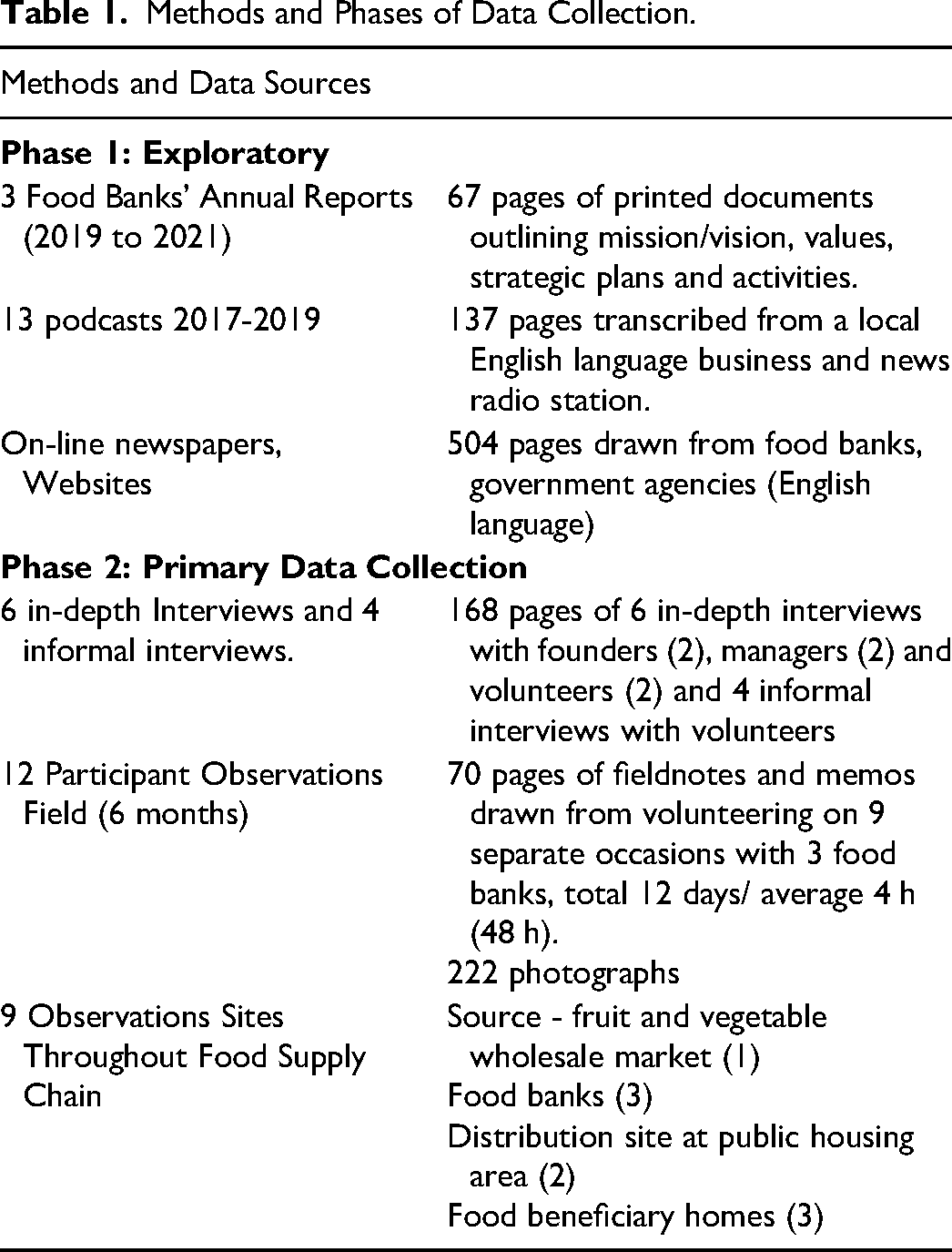
The pilot stage was aimed at developing pre-understanding, and refining the research design. We gathered secondary data from on-line newspapers, company websites, government agency websites and podcasts on food waste recovery, using the search term “food waste”. We used content analysis (Drisko and Tina 2015) to support our overall understanding of contextual issues, and issues for FWRN operation. We identified three well established foodbanks, and key informants for phase two. Subsequently, the lead author observed and, where possible, volunteered with three foodbanks as key network actors in phase two (see Table 2).
Detailed Data-Organisations and Participations.
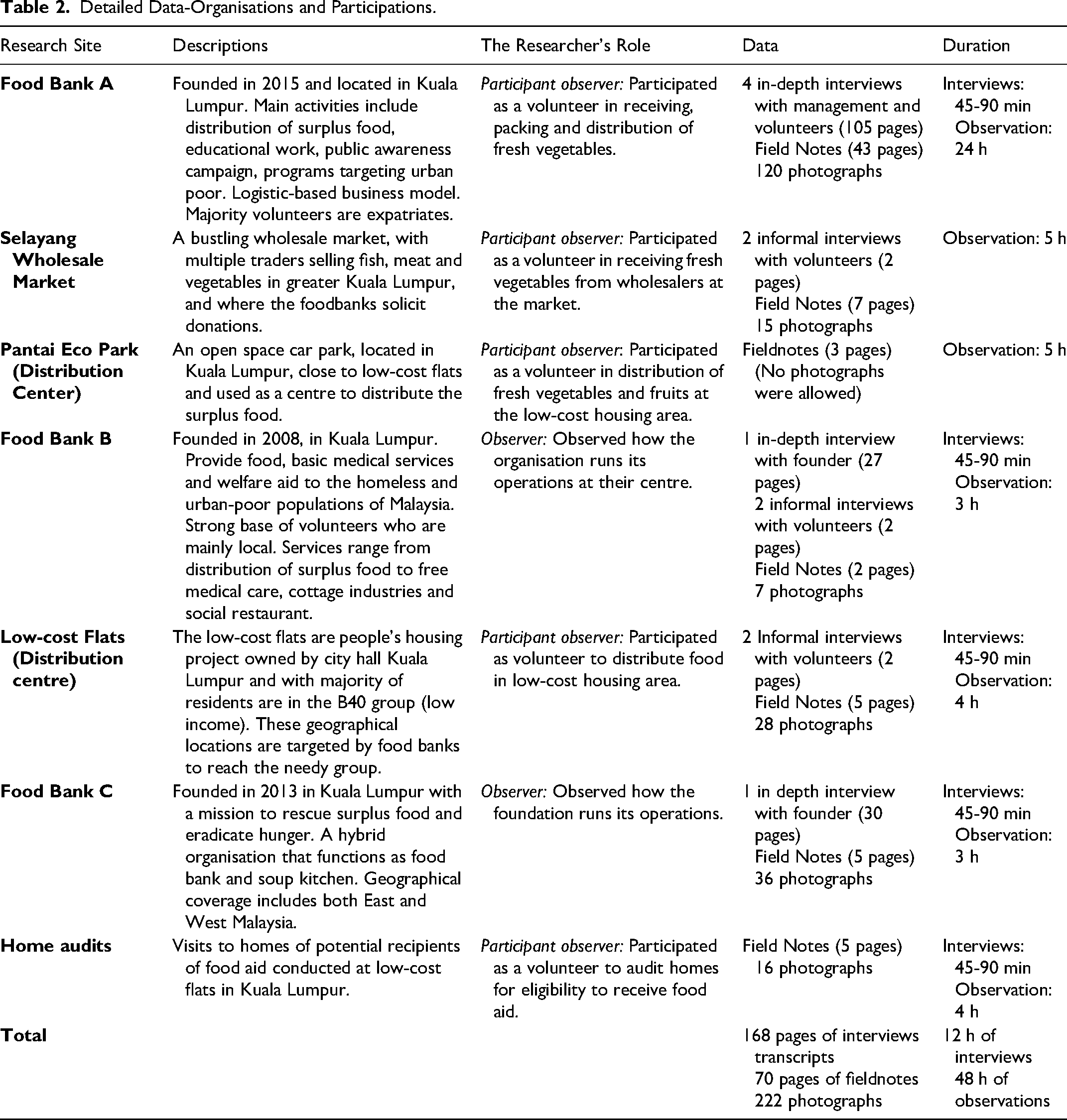
Observations were conducted throughout the food supply chain – from waste, food donor sources, food handling and distribution, to consumption. Six formal, in-depth interviews of 45−90 min were conducted with key informants. Additionally, multiple informal conversations took place with foodbank volunteers during volunteering duties. The interviews were conducted in English and transcribed verbatim. At Foodbank A (FBA) (pseudonym) the lead author formally volunteered, and joined the foodbank for the day, working out of a cramped warehouse and distribution centre. She unloaded and sorted donated food, repackaged it, and recorded weights, prior to distributing to beneficiaries. At Foodbank B (FBB) and C (FBC), she sorted and distributed rescued food to a housing project and beneficiary homes, providing insight into the world of food recipients. Further observations were conducted at a bustling wholesale market, where multiple traders sell locally sourced fish, meat and vegetables, and where the foodbanks solicit donations. That observation gave insight into how surplus food is generated, sourced and collected, and into the challenges of securing supplies.
Data Analysis
The findings derive from an iterative process of data collection and analysis, toggling between the literature and the data. The coding began with secondary data to develop familiarity with the context and actors (Phase 1). The secondary data was re-analysed as part of the case database (Table 1), using a phronetic iterative coding approach (Tracy 2018). This inductive approach highlighted relevant issues within the network and identified emerging areas of interest. An iterative grounded theory approach supported the next stage of coding (Charmaz 2006; Miles, Huberman, and Saldaña 2014). Toggling between the data and the literature, the coding alternated between etic and emic views, resulting in emergent themes and theories (Miles, Huberman, and Saldaña 2014). At the initial stage open coding (line by line coding) was applied followed by focused coding to identify significant categories. Next, codes within-case were compared to collate similar codes. Through between-case analysis sub-themes and themes were developed to establish relationships between themes. New data was coded and categorized progressively as it was collected, enabling us to identify data gaps, deepening the research findings (Charmaz 2006).
This research adheres to the principles of ethical and responsible research. The project was reviewed and approved by the university’s ethics committee. Written consent was sought and given by all organisations and interviewees, after explaining the nature and requirements of the research. Before volunteering activities commenced, a foodbank management team member informed the rest of the participants/volunteers of the lead researcher’s observer role. Pseudonyms are used to disguise identities of individuals and organisations.
Findings
We present the findings in two parts. First, we describe how foodbanks, as a key actor in FWRNs address the gap between social needs and public interventions. We introduce themes emphasising social value creation, network competencies, resource flow orchestration and institutional influences. Second, we identify the tensions between network stakeholders, three kinds of relationships characterising those tensions (collaborative, hybrid and competitive), and the tension resolution strategies adopted by FWRN actors.
1. Foodbanks - filling social needs
FWRNs fill the gap between social need and public policy interventions. Within FWRNs, foodbanks are focal actors, supporting social innovation and value creation. Foodbank missions focus on poverty elimination, food security and environmental protection, with slogans such as “ending hunger, nourishing hope” and “hunger knows no barriers”. Four themes emerged from the data, (1) Towards one Malaysia, (2) A well-oiled machine, (3) Conservation, conversion, and preservation and (4) Battling the marketplace.
Theme 1: Towards one Malaysia
We define this theme as strategies and practices designed to mitigate the effects of worsening social cohesion and ethnic differences on FWRN mission and operations.
Malaysia’s ethnic makeup is 69% Malays, 23% Chinese and 7% Indian (British Council 2018). During the colonial era, NGOs represented the separate interests of Malays, Chinese and Indians reflecting British ‘divide and rule’ policies (Abiddin, Ibrahim, and Abdul Aziz 2022). Post-independence, the 13th May 1969 Sino-Malay race riots severely impacted national unity (Malakolunthu and Rengasamy 2012). Today, social cohesion is under pressure from differences in race, religion, political ideology and socio-economic status (Aminnuddin and Wakefield 2020). Income disparities, a worsening economic situation and political expediency deepen racial tensions; therefore, eradicating poverty and minimising socio-economic imbalances is an important goal for social cohesion (Abiddin, Ibrahim, and Abdul Aziz 2022; MyGovernment, 2022). While ‘One Malaysia’ is espoused, open racism is enacted in education, economic and social policies, restricting government benefits to Malays (Malakolunthu and Rengasamy 2012; Pusat Komas Malaysia 2016). Needy Indian and Chinese communities must therefore turn to NGOs. The foodbanks addressed these differences by emphasising unity through service regardless of race, religion and nationality, and strong humanist values of equality, unity, and a caring society. It is so gratifying seeing a Malay feeding the Chinese, you know, the volunteerism unified, one nation. (Interview-Founder FBB)
While we were sorting the vegetables at the warehouse, there were other volunteers - a Malay man, a Chinese girl, a Malay couple with two kids and a Caucasian lady with her daughter. (Fieldnotes-Observation FBA)
The strategy was enacted by drawing volunteers and beneficiaries from all ethnic backgrounds and creating a sense of community through shared activities, fund-raising events, and coffee mornings. Social cohesion was supported through community capacity building, through supplying both food and life skills and employment opportunities. I started two years back to think on how to improve their life, give them new job, find them new opportunities. When I deliver food, I don't just deliver food, I look around the surroundings, how’s their children, does their children go to school? What is the condition of their home? (Podcast)
Food itself creates social ties, which the foodbanks emphasised through symbolic sharing: We bring our own tables and chairs and set up like pop up stalls and sit down for a three-course warm meal dinner with our street friends. At first, people were very reluctant to sit down to have a meal together, they just wanted to take the food and go. But now the street friends will volunteer themselves to carry the tables and chairs for us and sit down patiently, because all they care is to share a moment with their friends the volunteers, to share their stories. (Podcast)
A shared meal can bridge multiple social, ideological and economic divides.
Sharing food, however, is not straight forward in a multiracial culture. Ethnic and religious differences translate to specific requirements, e.g. Hindus do not eat beef, and for Muslims pork is haram (forbidden), requiring providers to adjust. We only cook vegetarian…We Chinese people want to serve to the Malays, they will say “wait, wait, this is a halal issue” …Cooking doesn’t take place here [it takes place]in Malay stalls. The Muslim stalls. (Interview-Founder FBB)
Taste preferences are also very different, drawing from national and regional cuisines. The foodbanks sorted and distributed vegetables according to the needs and tastes of specific ethnic groups: Cindy [volunteer] made sure every charity received a fair portion of appropriate vegetables. When a Malay lady arrived (Soup Kitchen-recipient) Cindy suggested she take the pucuk-pucuk (leafy vegetable commonly consumed by Malays as salad) (Fieldnotes-Observation FBA)
… for this home, they need more of [vegetable] because they are Indian … if we get water cress, we know, will give to Chinese. So more or less we kind of know what they want, what they eat, what they cannot cook and all that (Interview-Volunteer FBA)
Volunteers applied deep and detailed knowledge of dietary preferences in order to meet beneficiary needs, building trusting relationships between and within stakeholder groups.
Theme 2: A Well-Oiled Machine
We define this theme as the functioning of the foodbanks’ business models (served market, positioning, branding), standard operating procedures (donor sourcing, collecting, sorting and distribution), organisational structure (specialisation through departmentalisation) and marketing strategies (communication and networking).
The findings suggested that all three foodbanks have finely-tuned working models, modified over time in response to local challenges. Operations are systematic and knowledge-intensive. Food items are weighed and recorded prior to distribution to beneficiaries, or recycling as animal feed. FBA used performance metrics to instil a sense of shared goals and achievement: … the warehouse notice board offered information on volunteer roles and duties, food wastage statistics, logistics schedules and other charitable organisations …plus celebrated achievement “we have rescued over 300,500kg of edible food from the landfill”. (Fieldnotes-Observation FBA)
Daily announcements in social media and websites were reemphasised through podcast interviews e.g., “rescued 1,349,283 kg of edible food from going to the landfill” and “preventing 2,563,638 kg of greenhouse gases from entering the atmosphere”. Knowledge was a strategic resource supporting public-private alliances and relationships: We become their strategic partner to advise [the government] on how to … regulate the foodbank. Because there is no benchmark in Malaysia yet, the Ministry of Health don’t understand what food-banking is. (Interview-Founder FBC)
Each organisation’s business model is adapted to available resources and end-user needs. FBA is a dedicated food logistics organisation, sourcing, collecting, warehousing and distributing food items. FBB and FBC are also logistics organisations, however, services extend beyond food. FBB offers training, supporting single mothers to earn income through cottage industries such as weaving door mats and carpets, and runs a vegetarian restaurant contributing profit to other social support programs. FBC has invested in technologies that enable re-purposing and storage of cooked food, for later consumption.
Foodbanks identify and qualify legitimate beneficiaries through a systematic process carried out by volunteers: The families are requested to register. Applications are processed by the volunteers. The volunteers visit the homes of the applicants to check their living condition, number of occupants, living standard (do they own a TV, air-conditioning, Wi-Fi). The volunteer then makes a case and recommendation on registering the family as the recipient. 15 families registered … 6 Chinese, 4 Malay and 5 Indian (Fieldnote-Home Audit 1)
Customer databases are therefore extensive, and include demographic and geographic details. Many of those who require aid due to the lock-down are not registered under welfare government department. NGOs have the advantage in terms of logistical data. We know the area and their recipients well, have their medical records and access to kitchen facilities to cook. Not everyone we help is able to cook at home as some of them live in cubicles or are homeless (Podcast)
Frequent interactions build relationships, and insight into living conditions supports holistic understanding and hence trust. Soup kitchens and their volunteers often create a one-stop centre for a variety of things, from offering culinary programs, counselling, basic medical services and sometimes even shelter… They acknowledge that handing out food is insufficient to give these people a leg up, but more needs to be done to help them break the cycle of poverty… You get to know them better, know their personalities and capabilities. When they are ready to get out, we know their characters, their inclinations, and finding the right solution, knowing the person that you’re helping. (Podcast)
Deep insight into beneficiary needs supported business model strategy and execution, based on information-intensive, systematic processes.
Theme 3: Conversion, Conservation, and Preservation
We define this theme as operational practices directed at maintaining actual and perceived quality and least cost throughout the food supply chain, from initial sourcing to distribution to beneficiaries.
FWRNs challenge traditional notions of food (Gollnhofer 2017). Discarded food is seen as contaminated, associated with scavenging for survival, stigmatised and a social taboo (Edwards 2020). How would you feel if the day your luck runs out and you have to go join a food line like this, and someone’s busy taking photos of you? You wouldn’t want that, and neither do our beneficiaries. They get a job and then somebody may bring up a photo of them at the time when they were collecting food from a soup kitchen. Someone may make fun of them, that’s enough to make them quit. (Podcast)
Foodbanks address stigmatisation by engaging in conversion rituals that alter meanings associated with waste. The warehouse volunteers cleaned the food, shared recipes, re-purposed and re-packed: So now everything is cleaned up. We give it to them presentably. Fruits sometimes you have some rotten ones…Sometimes many you need to discard…. everything needs to be perfect. (Interview-Volunteer FBA).
Volunteers engaged in de-stigmatisation practices through resource inputs (knowledge, time and energy), conferring value to the rescued food by adding respectability, dignity, honour and respect. Both volunteers and beneficiaries are physically present at the point of exchange, i.e., the venue where the food is sorted and distributed. Belk, Wallendorf, and Sherry (1989, p. 7) argues that “through representation in an object, the sacred is concretised”. In this case, stigmatised objects are sanctified through the commitment and effort of respectful volunteers. Volunteer resources transform contaminated waste into a valuable resource: Blessed food conveying gratitude.
In addition to acceptability, reliability and quality of supply are key operational issues. Quality encompasses both nutritional requirements and condition. Beneficiary needs are taken into account, for example, FBA prioritises orphanages for eggs and noodles, while pumpkin, spinach and okra are distributed to elder care residences. Not all donated food was accepted. FBA refused confectionary, as volunteers felt it transgressed dietary guidelines. With respect to nutrition, proteins are particularly sought after: [The other foodbanks don’t] supply perishable goods, especially meat, fish and so on …which is what the poor need, rather than a couple of vegetables. Here we do it differently, we rescue a lot of meat items, besides raw fruits and so on, because the meat items are the protein. (Interview-Founder FBC)
Conserving and preserving meat and poultry in tropical climates require investment in cold chain transportation and storage technologies. For this reason, foodbanks lobby investors including the government and donor firms to sponsor refrigerated trucks and warehouses. For example, FBC invested in cook-freeze technology and cold storage facilities to store cooked food. People actually sell the salmon fish head to manufacturer of pet food, cats and dogs. Which is to me pure waste, because this thing contains a lot of protein, omega, why sell it to feed animals when it is still edible right? So, we repurpose the food, we turn it into fish head curry, and we can cook in volume, and bring down the temperature using, cook-freeze system. (Interview-Founder FBC)
FBC cooks, packs and stores into single serving sizes, chilled and frozen for future distribution.
Theme 4: Battling the Marketplace
We define this theme as foodbank strategies that address forces in the wider operating environment that support or constrain operations, and in particular, the risks associated with valuable waste food resources.
Private foodbanks create networks and establish commitment from donor firms. Surplus food is sourced from fruit and vegetable markets, food manufacturers, hospitality providers, bakeries, high-end grocers, butcheries and hypermarkets. Networking through both personal and official contacts gains consistent supply including fresh produce as retailers constantly update their assortments to maintain quality, freshness and consumer appeal: Because of my years of networking with the hoteliers and the chefs, they supported our mission. I know some of the manufacturers who are my clients, the hotels are my client services, so it is easier for me to convince them, and sign an agreement. (Interview-Founder FBC)
Donations, however, are not without risk: If anything happens it will affect everybody - food poisoning, contamination - this is my biggest fear. (Interview-Founder FBC)
Despite close personal relationships, the absence of regulations protecting donor organisations from liability from food-related risk is a major barrier to donations. A recent food donor protection bill was passed to encourage support for the government’s foodbank program (Food Donor Protection Bill 2019). However, protection is not absolute, and donors can be liable for negligence or misconduct (Kho 2020). Moreover, donations are not tax deductible. Thus, despite good intentions, donor organisations were unwilling to take risks: There is a lot of perception amongst let’s say restaurants, or hotel chains or, or different types of outlets that produce food, in terms of the kind of liability that’s attached to giving away food. (Podcast)
We indemnify them because of this so-called non-existence of a dedicated law. Technically for you to give food in food trade, no exchange of money, is not a contract … [if any health and safety issues arise] big brand they will see a down in terms of their sales … court case can take 6 months or a year, by the time they win, already damage done to their sales and profit, so a lot of brands, big boys don’t want to come in (Interview-Founder FBC)
Donors are instrumental to the foodbank as the main source of supply; hence liability is a key concern. Gifting expired or otherwise unsaleable food presents risks to large brands, in terms of consumer brand quality perceptions and liability for any health and safety issues. While the foodbanks do their best to address perceived risk through building trust and systematic operation, the current legal framework does not mitigate risk to the point where manufacturers are willing to donate surplus items. Consequently, edible items from processing over runs or excess retailer orders are sent to landfill. Relief from legal risk would result in increased contributions, particularly as donations can be parleyed into CSR communications, and reduce costs and risks of disposal to landfill.
Overall, the four themes characterise the nature of stakeholder relationships within the FWRN: One Malaysia (theme 1), Well-oiled machines (theme 2), conversion, conservation, and preservation (theme 3), and battling for resources (theme 4). A strong esprit de corps characterises within-foodbank operations, uniting staff, volunteers and beneficiaries, while supporting stakeholder goals. Foodbanks are established, knowledge-intensive enterprises, with effective operating and business models. The emphasis is on capturing and converting waste food into value for beneficiary stakeholders, using a variety of resources and technologies. Finally, despite shared values, common goals, clear mandates, smooth operations and contribution to aggregate social outcomes (health and quality of life for vulnerable populations), the foodbanks are required to compete for resources, and struggle for legal legitimacy.
Tensions in the Food Waste Recovery Network
Drawing on institutional and coopetition theory, we identify the forces creating tensions among stakeholders, and the strategies key actors adopt to manage these. To be characterized as ‘coopetitive’, relationships require cooperation and competition to (i) simultaneously exist, (ii) interact and influence each other, (iii) engender tension, and (iv) cause dynamic changes in such relationships over time” (Bengtsson and Raza-Ullah 2016, p. 33). All four characteristics were found in FWRN stakeholder relationships. The findings also reflected the coopetitive paradox (Raza-Ullah, Bengtsson, and Kock 2014), in that the foodbanks acknowledged both the need to cooperate and collaborate; and that they were competing for the same resources as they worked towards a common goal of minimising waste and eliminating hunger. The trade-offs and tensions arising through simultaneous cooperation and competition gave rise to three distinct coopetitive relationship types (Figure 1): Competitive-dominant, equal and cooperative-dominant.
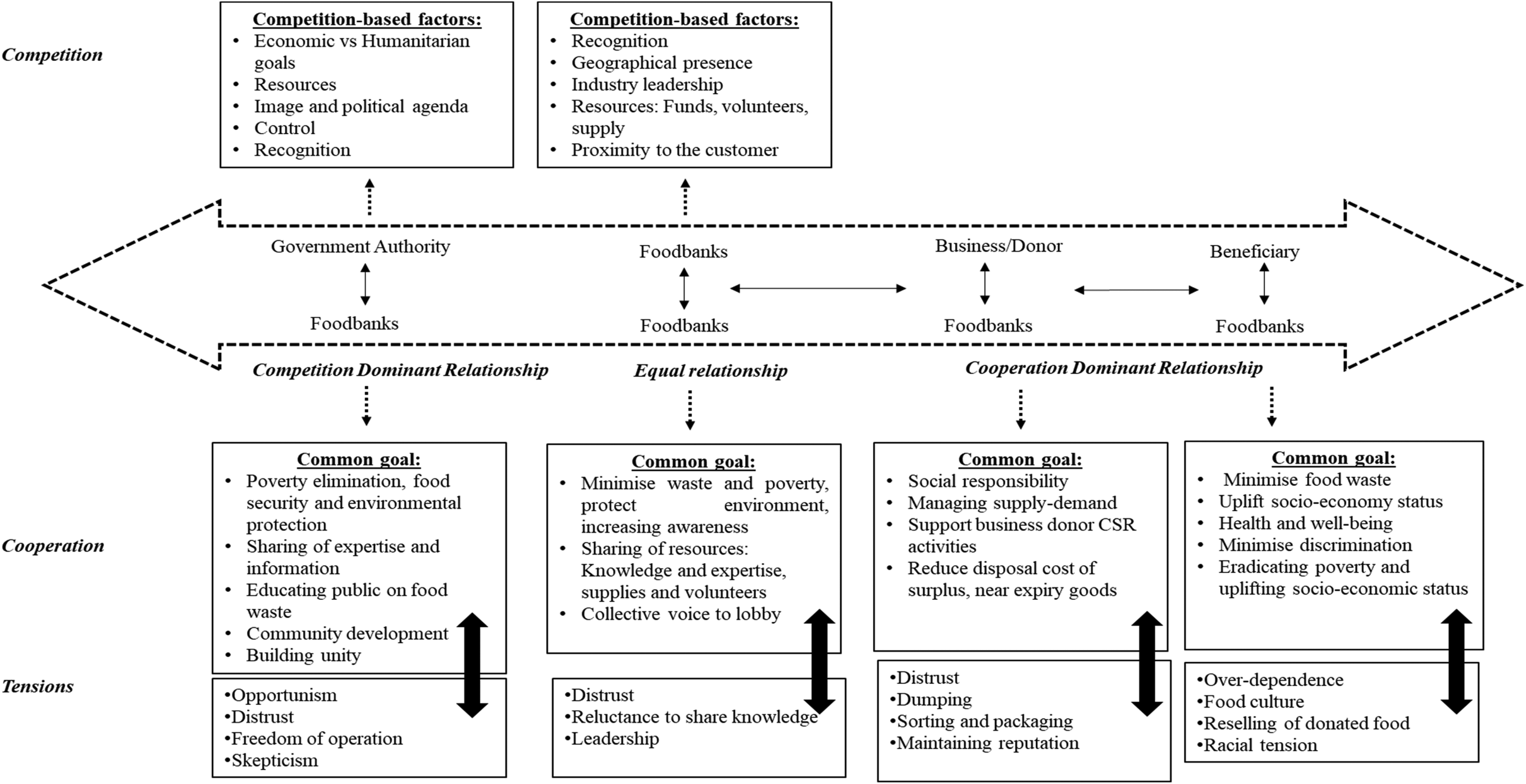
Types of Coopetitive Relationships in a Food Recovery Network and the Resulting Tensions.
Relationship Type 1: Competition Dominant - Foodbanks versus Government
Foodbanks support UN and government goals of poverty elimination, through values of impartiality, unity and universality (Shared Prosperity Vision 2030). Notionally, foodbanks and governments’ objectives are aligned. In Malaysia, the government motives for engaging with NGOs include stronger relationships with industry through indirect support of CSR programs; and long-term economic and political outcomes such as increased voter support and decreased social and landfill costs (FFTC-AP 2017). However, in a climate of rising social consciousness NGOs can be a powerful agent of change, which can place them at odds with ruling elites. We found considerable tensions in this relationship. Race and religion would be an issue, [authorities] may also control whom we should supply the vegetables…That’s why I enjoy, nothing, no connection… We need their help, but we don’t need their involvement. All the red tape and all. We don’t want all that. (Interview-Volunteer FBA)
Government acknowledges the need to reduce food waste, however, does not allocate necessary funding and legislative support to NGOs (British Council 2018). Supporting Baur and Schmitz’ (2012) argument that for NGOs “independence is the core credential and sign of legitimacy” (p. 11) the foodbanks are reluctant to engage, perceiving a risk to agency. For NGOs, “mission drift” through political and economic expediency may compromise humanitarian goals, again resulting in relationship tension (Cornforth 2014). In our data these tensions between government and foodbanks played out at local and national level: [Local authority officers said] stop all feeding because you guys are breeding homelessness … you’re encouraging people to sleep there … you put the sugar there, the ants will come… [Minister said] this activity doesn’t need money. [But] we are helping [the homeless]. We need money … (Interview-Founder FBB)
The quote reflects deflection of attention away from the problem (structural inequalities causing homelessness) to the symptom (individual suffering). Blame is placed on ‘others’ (homeless people) and the NGO, and the cause narrative is de-legitimised.
Further tensions arise from ethnic divisions: Every [low cost] flats have their own committee. The first week when we deliver the food, I saw a few [Indian] people. Then second week I didn’t see any. They complain to me … “one of my relatives is [in low cost flat], he says [government foodbanks] never give him the food, they give more priority to these people, their own friends [Malays]”. (Interview-Management FBA)
The undercurrents of race-based policies run deep in this multi-cultural society. The NGOs attempt to solve for these tensions through avoidance strategies i.e., remaining aloof from the political arena, and through modelling humanist values in organisational practices. However, the government’s new Food Bank Malaysia Program (FBMP) is seeking food donations (Ministry of Domestic Trade and Consumer Affairs, 2022). As FBMP-linked foodbanks offer business donors both legitimacy and government incentives, foodbanks cannot compete. [Government] wants to project the image, that Malays are seen giving the aid … [a] gimmick to make the people vote for the party… making sure the Malays they are with the government. But our motive is many people would need the food. (Interview-Management FBA)
Government-linked foodbanks are regarded as politically motivated, and as having an advantage. FBMP-linked foodbanks offer business donors both legitimacy and government incentives, increasing the likelihood of business donors to favour government-linked foodbanks. Moreover, the town council (Malay-dominant) are the gatekeepers granting permission to NGOs to gain access to the surplus food produce donated by the vendors at the wholesale market. The foodbanks lobby town councils (the gatekeepers) to grant permission to gain access to the surplus food. Perceived favouritism and prioritisation is causing tensions, disharmony and distrust between NGOs.
In competitive situations, knowledge sharing suffers. Most foodbanks have effective social business models, and considerable expertise in food recovery logistics. Knowledge relating to these capabilities is increasingly sought by government to support social welfare development. However, private foodbanks are reluctant to share, preferring to control resources and use knowledge advantage as bargaining power (Lou 2004): The government is [starting] all these foodbanks, they want to take the limelight, they want to show Malaysia has their own foodbank, not foreigners … [Foodbank colleague] called me up, “we can do it into a national initiative, using the government to run.” I said “no, if it is under the government, it will flop.”… if the previous government is still there, money go in, don’t know where it goes. (Interview-Founder FBC)
The previous government perpetrated the 1MdB corruption scandal, stealing public monies in support of lavish lifestyles and offshored private global investments. 1MdB remains unresolved at time of writing. Individuals implicated in theft of public funds remain influential in Malaysian politics (Rewcastle-Brown 2018), resulting in on-going distrust and rancour among better informed citizens. The foodbanks recognise that that the situation presents a major challenge to their mission.
Relationship Type 2: Equal - Between Foodbanks
Inter-foodbank relationships are characterised by both cooperation and competition, i.e., are coopetitive in nature. Pressure from wider FWRN stakeholders, particularly government forces result in collaborative effort, drawing on partner organisations with complementary resources and capabilities to achieve shared goals. Foodbanks collaborate in multiple ways, including sharing excess food resources, client referrals, and volunteers; as well as lobbying efforts. FBC is really good with us. We share resources… Like “oh I have a lot of buns, I have a lot of vegetables, you want?” Their concept is very different. Their model is very different. They cook, they don’t distribute to the families… So we kind of complement to each other (Interview-Founder FBB)
Common cause suggests foodbanks are more likely to collaborate rather than compete. However, despite collaborative efforts, the foodbanks also compete for resources such as donors, grants, space, human resources, volunteers and recognition for effort. We used to give the other food a lot, like they were one of our biggest beneficiaries every time we had surplus, but they started copying us, which is good right, there’s enough food for everybody but some people felt threatened when they started copying us and then said “Ok, give them less”. (Interview-Management FBA)
Emulation resulted in more similarity between organisations, hence a perceived threat, and therefore less collaboration.
Several strategies supported competitive (or coopetitive) coexistence, including geographic distribution and strategic partnerships. In the case of distribution, territory is important. In Kuala Lumpur, foodbanks compete for the same pool of resources and serve the same beneficiaries, therefore each foodbank serves an informally agreed geographical area. In addition to geographic segmentation, competitive strategies include differentiation through business model innovation and branding, supporting recognition and legitimacy among stakeholders (Bocken et al. 2014). For example, FBB and FBC use a hybrid business model to address intertwined societal challenges (Battilana et al. 2015) and have diversified into multiple food-related businesses including soup kitchens, social restaurants, cottage industries for the underprivileged, and a health and welfare clinic. FBA uses a logistic based business model and emphasises creative partnership strategies with business donors. For example, a Points-back Reward scheme in collaboration with a rideshare organisation, and a donation drive through an e-commerce platform. These partnerships provide cost reductions for the foodbanks, and tax exemption for donor organisations. In general, innovative business models help foodbanks to build competitive advantage through differentiated social value creation, which further establishes their presence and uniqueness (Brehmer, Ksenia, and Fred 2018).
Branding has also become important. As the non-profit environment becomes increasingly crowded, competition for financial and human support becomes more intense. The foodbanks have responded with commercial branding strategies featuring attractive messaging and graphics and integrated marketing communications approaches support identity and differentiation. Brand livery is prominently displayed at stakeholder touch points including websites, mobile apps, t-shirts, banners and vehicle signage, communicating the value proposition to stakeholders. In addition to attracting donors and volunteers, branding builds awareness, important to lobbying and reputation management, establishing confidence and commitment to the cause, and operational transparency (Stride and Lee 2007).
Relationship Type 3: Cooperation Dominant - Foodbank-Donor/ Foodbank-Beneficiary
Food donations are essential to FWRN operations. Surplus food is a problem to food suppliers and a valuable resource to distributors and the needy. With respect to donors, food surpluses create costs and risks for manufacturers and retailers. Manufacturers therefore employ in reuse strategies such as remanufacturing and repackaging; and demand management strategies such as discounting (Garrone et al. 2016). However, reuse strategies are risky, as food items have a limited shelf life and must be safe for human consumption. Risk can be mitigated by creating a secondary market, in this case by donating edible surplus food. Donors benefit through reputational CSR outcomes, and reduced costs of inventory and waste (Baglioni et al. 2017). The donor recruitment brand and internal esprit de corps also benefit. For example, FBA hosted donor employees as warehouse volunteers, supporting internal morale and team building, as well as external reputation (Fieldnotes, FBA). Further, the degree of resource dependency defines the extent of coopetition (Lou 2004). As foodbanks are highly dependent on donors for food resources, collaboration is strengthened by increasing relational ties.
For donors, trust and efficiency of the FWRN are on-going issues. Donor organisations suffer reputational risk if the donated food item is misused or resold, therefore foodbanks must control food flows carefully. We are collecting expiring goods, so … I need to keep track … I can’t give much to [low-cost housing residents] if they are going to sell the food to other shops because we signed a contract with all donors, we get into trouble. (Interview-Management FBA)
And we need to remind [beneficiaries], “make sure not to sell these things, we got spies to watch”. If people see us selling these things, we need to close down the warehouse, and you won’t get anything. So, we need to tell them, remind them “jangan jual”(don’t sell). (Interview-Volunteer FBA)
In the absence of legislation to protect donors, the foodbanks accept the responsibility of ensuring the donated food is consumed by the intended beneficiaries rather than on-sold for profit. Efficiency is also required. Business donors seek to reduce costs and risks of disposal, and are therefore motivated to seek out intermediaries who will efficiently collect and repurpose surplus food. Trust is built through performative ethical behaviour and legal compliance, expressed in detailed operation procedures and auditing. I think we are very transparent, we say “this is what it is, we’re not hiding anything, you can check all our books”, all our books get audited. But it’s also the governance. If they see you’re professionally run, they want to be with you. We have so many expats with us so the corporates like us because they think that we are more professional, but the government doesn’t really like us because they think we’re expats. (Interview-Management FBA)
The high regard for expatriates is a legacy of the British colonial past. However, it is a double-edged sword; beneficial when working with other expatriates in multi-national firms, however problematic when dealing with government.
Quality of food inputs from donors can be problematic. Foodbanks may be used as a means of disposal of unfit items, creating costs rather than benefits. For example, fruit and vegetable donations from the wholesale market: The stench from the rotting onions was overpowering…The onions sourced from the [wholesale] market were rotten, mostly sprouting. (Fieldnotes-Observation FBA)
The wholesale market is 24 h, so they have shift. The moment they switch the shift, they can’t sell, they push it to us. That is one thing. The other thing is that the price drop, they can’t sell also, they push it to us…Whichever its low price, they give it to us, because they can’t sell. (Interview-Management FBA)
In the case of the onions, very few were fit to consume, requiring disposal. The issue with the surplus from the previous selling session is that donations are a means of controlling price through manipulating supply. While this strategy may support consistency of supply for FWRNs and livelihoods for distributors and farmers, it highlights the issues for consumers in competitive market models. It is arguably ethical, and indirectly contributes to food waste, challenging the core mission of the FWRN and of foodbanks. The nature of the relationship is, however, reciprocal, reflecting give-and-take, negotiation, trust and commitment as far as possible within the wider social structures.
On the demand side, foodbanks supply to charitable organisations, all of which rely heavily on foodbanks to provide for their beneficiaries. Foodbanks take a systematic approach to qualify beneficiaries for aid, supporting transparency and efficiency. The charities collaborate by providing information on beneficiaries’ specific needs and locations; and by recommending others in need. The foodbanks develop and maintain a beneficiary database containing demographic and geographic data to ensure the food supplied meets recipient needs and preferences (Theme 1: Towards One Malaysia). However, specific cultural requirements can create challenges. For example, the need for halal food by Muslim recipients. Nevertheless, diversity presents the opportunity for collaboration, for example, providing halal food through Muslim-run soup kitchens.
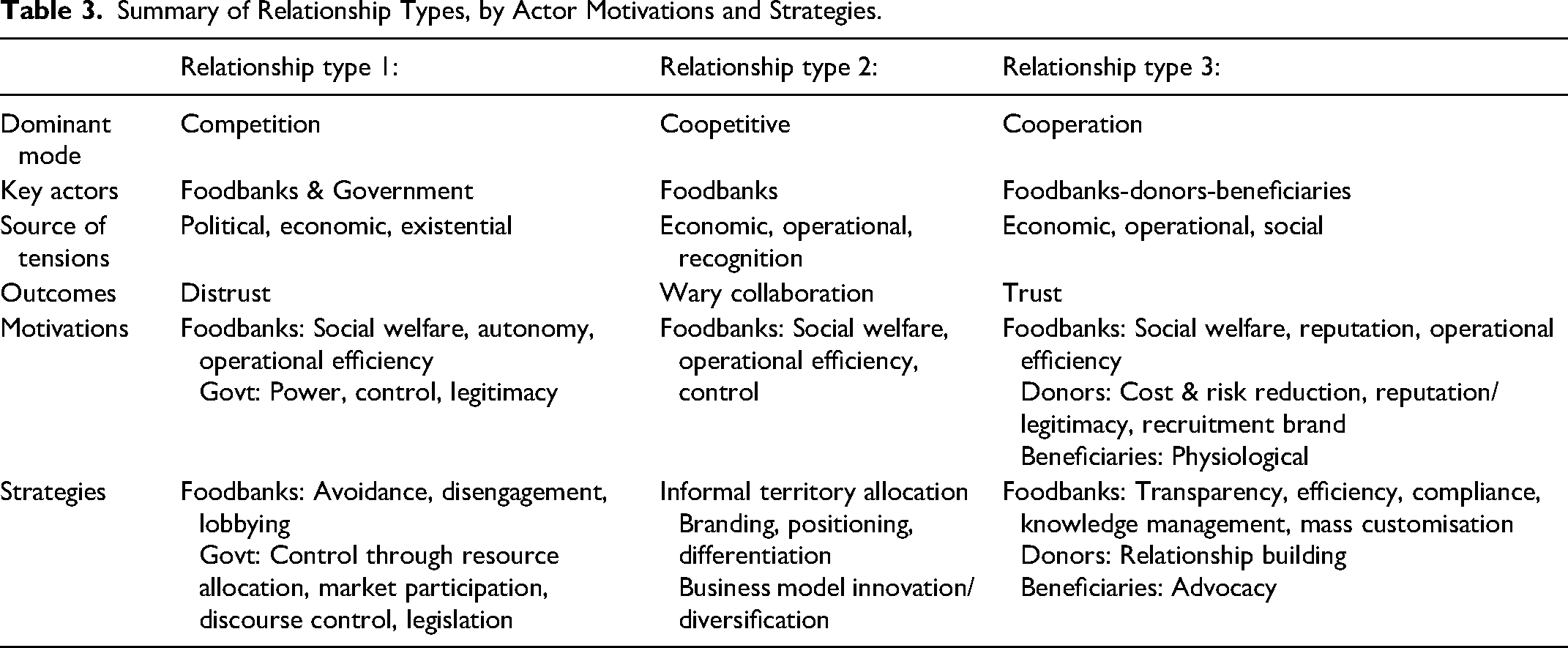
The three types of relationships are summarised in Table 3.
Summary of Relationship Types, by Actor Motivations and Strategies.
Overall, the findings highlighted the effects of unique demographic, cultural, political, historical and social aspects of context; further reinforcing calls for more qualitative research in Asian contexts (Eckhardt and Dholakia 2013). The three major factors influencing the FWRN operation were regulatory, social and cultural. Regulation was particularly important. In some developed countries, charitable donations are mandated, easing foodbanks’ resourcing needs (Chrisafis 2016). However, in Malaysia, laissez faire regulation hinders rather than helps operations, fostering competition and opportunistic behaviour, limiting knowledge sharing and enabling discrimination. Socially, overt racial discrimination contradicted an equitable ‘serve all’ ethos, creating resentment and tensions. Finally, cultural food meanings and conflicting religious strictures (no pork, no beef, preferences for particular vegetables) required high levels of tolerance and sensitivity from all stakeholders. Taken in sum, all contextual factors created challenges and tensions.
Discussion and Implications
This research investigated network ties and stakeholder relationships in food recovery networks. By exploring the ‘messy day-to-day practices’ of actors within the system (Lawrence, Leca, and Zilber 2013 p.1029), we answer the question “How do stakeholders in pro-social networks collaborate to achieve shared outcomes?” The findings advance previous understanding of actor relationships in business networks, integrating the concepts of coopetitive stakeholder relationships (Bengtsson and Kock 2000; Gnyawali, Jinyu, and Ravindranath 2006); building on recent macromarketing work investigating value creation through coopetition in the non-profit space (Chang 2020). The findings add to understanding about stakeholder behaviour in marketing systems, building on Layton (2015) and Domegan et al. (2019), and answering Wooliscroft’s (2021a) call for more work “to understand complex and chaotic systems, and to improve those systems via markets, marketing, policy and consumption for the sustainable well-being of society and the world” (p.121).
Evidence of ‘pure’ inter-stakeholder cooperation was conspicuous by its absence. While we found evidence of good intentions, respect, reciprocity and voluntary participation in value creation (Kujala et al.2022), these attributes of moral stakeholder engagement were within-entities, rather than between-entities. The NGO managers tended to be expatriates, often with prodigious and under-utilised skillsets, being spouses of relocated international executives. Their perceptions of peace and harmony were somewhat removed from front-line realities we observed, where beneficiaries resented perceived race-based inequities in resource distribution; and where foodbanks competed for prized donor food items. Each stakeholder group reflected a particular reality - NGO volunteers beneficent, beneficiaries a little grateful and a little resentful, donors pragmatic. In general, a transactional approach was taken within-group (e.g., “I donate my time in order to feel good and increase social ties” (volunteers), “I donate surplus food in order to meet my CSR objectives” (donors)). Between-group, tensions emerged in the liminal spaces travelled by the actual food. Competitive and opportunistic behaviours emerged due to resource scarcity and competing goals and expectations, regardless of pro-social motivations in the wider FWRN. Unpacking these realities would not be possible without a research approach that captured observed as well as expressed behaviours.
The findings advance understanding about pro-social stakeholders’ attempts to align financial, environmental and social goals (Hahn et al. 2015; Smith et al. 2013). Tensions were a particular focus of the findings. Stakeholders vied for leadership, recognition, control, power, and autonomy; which shaped the nature of tensions. In contrast to previous studies (Fontana 2018; Watson and Ekici 2017), we found evidence of resource competition, and attacks on autonomy as FWRN stakeholders leveraged resources including know-how, market knowledge, volunteers and customer bases to jockey for advantage through control and recognition. The tensions also eroded trust, further increasing competitiveness and conflict. While network stakeholders and in particular the foodbanks engaged in strategies to build trust, levels of trust were determined by a complex mix of factors and particularly historically complex cultural and legal institutions, levels of shared commitment, transparency of activities and communication. Tensions were evident between the government foodbanks and NGOs, and between beneficiary groups of different ethnicities. On the positive side, relationships between foodbanks and donors, and between private foodbanks were strong (see Table 3), perhaps reflecting common social ties.
The findings identified three sources of tension, role tension, opportunistic behaviours and agency. First, supporting previous work, role tensions arose through conflict between proprietary and partnership goals, and amplified as emphasis on private value increased (Fernandez, Le Roy, and Gnyawali 2014, Tidstrom 2014). These tensions exacerbated incongruence between goals, mindsets and strategic behaviours. Second, similarly to the for-profit sector, competition for shared resources and knowledge resulted in opportunistic and exploitative behaviours (Tidstrom 2014). Knowledge was not shared for fear of imitation and used as a source of competitive advantage. The foodbanks invested scarce resources to develop specialised skills and expertise, giving rise to boundary tensions as they sought to protect resources and position (Jarvenpaa and Wernick 2011). Finally, tensions arose from the need to maintain individual identity, and to gain recognition for their efforts. In this case, competition arose between foodbanks, and between foodbanks and government. In a pure collaborative relationship, common identity is pursued, but in a competitive relationship partner identities are “mixed without being merged” (Fernandez, Le Roy, and Gnyawali 2014, p. 224). Again, similarly to the for-profit sector, the non-profits were motivated to behave non-collaboratively, to differentiate and to individuate.
The macromarketing project is directed at achieving a post-materialist, participatory society; in turn requiring systems stakeholders to actively and inclusively engage (Kelleci 2021, Varey 2012). For example, Domegan et al. (2019), propose a dynamic stakeholder framework that moves beyond the limitations of firm-centric and transactional approaches, theorising stakeholder interactions from a systems perspective, and Kelleci (2021) argues that a new age of human centred sustainability “requires collaborative participation in a vibrant and ever-changing network of relationships working towards a shared purpose.” (p.8), “participation for a shared goal or purpose outside of market-mediated access” (p.9) and “self-consciousness through the collaboration of dynamic hybrid organizations with a blurring of hierarchies.” This study supports those calls, highlighting the mechanisms at work in complex pro-social networks. However, it goes further by offering an important corrective - we illuminate the ‘dark side’ of stakeholder interactions. Our findings indicate that despite good intentions and shared goals, stakeholders do not necessarily ‘play nicely’. Stakeholder relationships were characterised by varying degrees of cooperation and competition, reflecting the nature of the actors, the degree of commitment, network roles, value co-created, and synergy between business models (Figure 1).
Implications for Policy Makers and Managers
Supporting Little, Lee, and Nair (2019) and Peattie, Peattie, and Newcombe (2016), the findings indicated that strong institutions are critical to pro-social change, even when the change is initiated by collaborative organizations in pro-social networks. Government’s role is vital to the effective operation of FWRNs, and, we argue, to the circular economy. As NGOs with pro-social missions provide valuable social services, public investment in those organizations, both financial and legitimating, makes sense. As recovering rather than sending food to landfill saves taxpayer dollars and contributes to GHG emissions targets, policy makers should support foodbanks’ efforts through macrosocial marketing efforts (Kennedy 2016), for example ‘carrots’ (legislation encouraging donation of unused food), ‘sticks’ (penalties for sending food items to landfill) and ‘sermons’ (social marketing programmes raising public awareness of the issues and remedies around food waste) (Bemelmans-Videc, Rist, and Oskar Vedung 2011). In conditions of growing uncertainty, governments that manage public sentiment and ensure basic human needs are met are more likely to maintain power.
As intermediaries, foodbanks are well placed to address inter-organisational tensions hindering important social goals. Managing the tension requires strengthening of inter-stakeholder trust. Trust can be built through transparency and by supporting partners to achieve their goals. To gain trust from government, foodbanks should supply regular aggregate data to town councils and environment ministries, reinforcing shared commitment to achieving social targets. Transparency of operation and conduct also increases trust. Conducting and communicating yearly audits and publicising outcomes via social media, annual reports and media interviews enhances transparency. Sharing expertise and task specialisation would add value to partner operations where knowledge or expertise is lacking. Collective use of shared knowledge creates synergies around achieving common interests (Tidstrom 2014), enhancing foodbanks’ stature in the FWRN. However, foodbanks need to manage knowledge boundaries carefully, in order to maintain bargaining power and control.
Marketing strategies are important. Foodbanks are competing for scarce resources (volunteers, donors, food donations), and therefore differentiation strategies distinguish their efforts, supporting awareness and preference. Strong branding communicates confidence and creates legitimacy, widening the resource base for food, funding and volunteers. Drawing from the coopetition literature, foodbanks may apply management strategies including leadership, knowledge sharing, conflict management and cultivate trust and risk sharing (Chin, Chan, and Lam 2008). Donor firms should lobby government for incentives for food donations (vs. sending to landfill). All food producers should redouble efforts to apply closed loop supply chain principles, enlisting expertise and resources from other actors in the food network.
Implications for Future Research
This study adds to knowledge about the nature and conduct of social partnerships in pro-social networks. We have identified three types of relationships which would benefit from further research to deepen and broaden understanding. Furthermore, we have identified multiple stakeholder tensions and tension resolution strategies. Future studies are needed to explore different types of tensions arising with the use of varying business models. Cross-cultural studies comparing foodbanks’ strategies and operations in different cultural contexts, WEIRD and non-WEIRD, is an underexplored possibility. Additional research on the influence of coopetition on social innovation would add depth to the literature.
Conclusion
Solving the problem of food waste is central to food security, and critical to establishing a circular rather than linear ‘take-make-waste’ economy. This study challenges current micromarketing and WEIRD-dominant views of stakeholder behaviours in pro-social rather than industrial networks, adding a divergent voice to the current literature. We show how foodbanks intervene in complex food systems, capturing valuable but unvalued surplus food items that would normally go to landfill. In addition to feeding the hungry, foodbanks create value for food processers through cost savings and reputational enhancement. In an ideal world, the outcomes are social value, contributing to the UN’s goals of zero hunger and climate action. However, as our findings show, despite common social goals, collective benefit can be elusive. Institutional and network tensions resulted in behaviours ranging from classically competitive (win-lose) to fully cooperative (win-win), and in between, a hybrid type more closely conforming to conventional views of coopetition, i.e., collaborative behaviour having characteristics of both competition and collaboration, depending on the circumstances and the actors. Despite espoused commitments to pro-social outcomes, institutional actors can compromise food network performance through conflicting interests. We contribute a new theorisation of the mechanisms of collaborative networks (Figure 1) capturing these complexities and tensions. Second, we offer recommendations for improving the function of FWRNs. Finally, we consider opportunities for future research arising from this study.
In an ideal world, societies would be characterised by an equitable circular economy, obviating the need for foodbanks and landfills. In such a society, firms would likely need to consider other ways to burnish their social responsibility credentials, for example by supporting the arts or sports rather than fundamental human needs. However, in late capitalism, and without participatory marketing (Kelleci 2021), the effects of income inequality and climate change more or less guarantee that the best we can hope for is reduced rather than eliminated hunger and food waste (IPCC, 2022; Hart 2009; Klein 2015; Stiglitz 2012). Our data therefore highlighted the symptoms of the wicked problems of social inequality and overconsumption, an enduring theme in the macromarketing literature (Kennedy 2016; Varey 2012). Systems tweaks such as efficient redistribution, although helpful, address the symptoms rather than root causes. These problems can be addressed only by systems transformation.
Footnotes
Associate Editor
Ben Wooliscroft.
Declaration of Conflicting Interests
The author(s) declared no potential conflicts of interest with respect to the research, authorship, and/or publication of this article.
Funding
The author(s) disclosed receipt of the following financial support for the research, authorship, and/or publication of this article: Research is funded by Monash University Malaysia Seed Grant.
