




Abstract
This article contributes to the emergent field of corporate activism by exploring how corporate advertising voices, or is interpreted by the media as voicing, Trump resistance – that is, sympathy with anti-Trump protests and dismay at the politics of the White House incumbent. In so doing, we first situate corporate activism in relation to the more established fields of political corporate social responsibility and corporate social responsibility communication, focusing on discussions concerning the interplay between talk and action as well as the potential of talk to lead to action. On this basis, we propose a conceptual framework that posits talk and action as operating conjointly on the ontological plane of s(t)imulation, a conceptual conjunction of simulation and stimulation that is inspired by Baudrillard’s notion of the simulacrum. Empirically, we conduct a qualitative analysis of 20 examples of corporate advertising that has been reported as anti-Trump in the media. We find that the advertising in our sample is characterized by the following three main distinctions: (1) humorous references to Trump, (2) favourable and highly emotional appeals to social justice and (3) dystopian visions of society. We argue that a postmodern perspective on signs and representation may not only nuance our understanding of corporate activism, but also contribute to the conceptualization of the phenomenon by pushing the explanatory framework beyond the dialectic of talk and action.
Introduction
With headlines such as ‘The trump resistance will be commercialized’ (Hess, 2017) and ‘Corporate America tackles Trump’ (White and Romm, 2017), the news media have greeted a range of advertisements as expressions of resistance to Trump and the politics he represents. In large media organizations such as The New York Times (Hess, 2017) and The Washington Post (Blackistone, 2017) through wire-services like CNN Wire Service (Garcia, 2017) and UWIRE (Gelvzon, 2017) to various niche outlets, for example, Adweek (Coffee, 2017) and Washington Square News (Pineda, 2017), advertisements for established corporate brands and products have been covered as expressions of anti-Trump sentiment. For example, Politico reported that The resistance to President Donald Trump’s agenda is spreading fast across corporate America . . . traditional American brands like Budweiser, Coca-Cola and 84 Lumber used the Super Bowl . . . to brand themselves in sharp contrast to Trump’s nationalist agenda on immigration and trade. (White and Romm, 2017)
But how do the advertisements that led to this coverage articulate resistance to Trump and what is their potential for inspiring further anti-Trump activism?
In addressing these questions, we position our study as a contribution to the nascent field of corporate activism (Dauvergne and LeBaron, 2014; Skoglund and Böhm, forthcoming). We do so by, first, linking this emergent field to literature on political corporate social responsibility (PCSR) (Banerjee, 2018; Grigore and Molesworth, 2018; Scherer and Palazzo, 2007) and corporate social responsibility (CSR) communication (Christensen et al., 2013; Hoff-Clausen and Ihlen, 2015; Morsing, 2006), focusing on discussions concerning the interplay between talk and action as well as the potential of talk to lead to action (Christensen et al., 2019, 2020). Second, we argue that a postmodern perspective on signs and representation may not only nuance our understanding of empirical expressions of corporate activism, for example, in the form of advertisements, but also contribute to the conceptualization of the phenomenon by pushing it beyond the dialectic of talk and action.
More specifically, we propose that talk and action are inextricably linked as s(t)imulation, a conceptual conjunction of simulation and stimulation that is inspired by Baudrillard’s (1994) notion of the simulacrum. The simulacrum – the copy of a copy that has detached itself from its original – is, in Baudrillard’s conceptualization, the only social reality there is. From this perspective of the displacement of reality, depictions of or allusions to corporate resistance in advertisements are always and necessarily involved in an ongoing dynamic of simulation and stimulation. Each communicative instance of corporate activism holds the potential to both simulate an activist stance and stimulate further activism in and through its articulation. Hence, s(t)imulation is simultaneous and perpetual; rather than seeking explanations as to how talk and action are causally related, we posit that they are co-present as part of the simulacrum that is social reality (Baudrillard, 1994; Butler, 1999). In sum, we face the question of what it might mean for corporations to be politically active in the Trumpian post-truth era (Fouroughi et al., 2019) by re-viewing central claims concerning postmodernity and re-assessing key concepts of postmodernism.
In developing the framework for understanding corporate activism as s(t)imulation, we use the reported trend of anti-Trump advertising as an illustrative case. Thus, we apply the conceptual framework to a sample of corporate advertisements that have been covered by both traditional and niche media as communicative acts of resistance to the Trump presidency and, hence, gained attention and traction as such. Focusing exclusively on communicative activities in the form of corporate advertising, we have narrowed the analysis to only include ads that received media coverage during the first 100 days of the Trump presidency. On this basis, we have identified and analysed a total of 20 instances of anti-Trump corporate advertising. Taking the public circulation of and debate about these adverts as our methodological point of departure, the analysis focuses on their form and content as we seek to understand how they communicate Trump resistance.
Contrary to our expectations, the dominant analytical finding is the absence of explicit anti-Trump statements in the sample. Rather, the adverts are characterized by various implicit or indirect forms of critique, namely: (1) humorous references to Trump’s policies, political (mis)conduct and personal style; (2) favourable and highly emotional appeals to social justice in its various forms and (3) dystopian visions of society. In detailing these three forms, we show how the advertising s(t)imulates resistance to Trump and his policies by drawing on popular cultural imaginaries or phantasmagoria. The adverts – and the media coverage of them – are themselves stimulated by existing, wider discourses of protest against Trump, and appropriating – or being perceived as appropriating – these discourses for commercial gain not only simulate resistance but stimulate the further circulation and intensification of messages of resistance, regardless of the communicators’ intentions.
As such, the communication of corporate resistance becomes its own reality. Baudrillard pessimistically concluded from his travels in the United States that ‘America has no roots except in the future and is, therefore, nothing but what it imagines. It is perpetual simulation. America has no context other than what it, concretely, is’ (Baudrillard, 2010 [1986]: 96). Our study shares Baudrillard’s ontological post-foundationalism, but we open up his rejection of (media) representation to bring about social change and end on a less pessimistic note by discussing the potential of s(t)imulation to perpetually spur corporate activism onwards as a dynamic that gains momentum and direction independent of the intentions of participating corporations.
Corporate activism: identification of an emerging field
We perceive the phenomenon of anti-Trump advertising as a particular manifestation of the broader trend of corporate activism, understood as a move beyond classical CSR towards political advocacy of social, economic and environmental justice. Corporate activism can be seen as a subset of corporate political activity (CPA) (Den Hond et al., 2014) insofar as such activity not only involves lobbying governments and regulators, but also ‘campaigns aimed at mobilizing the civil society’ (Corvellec and Stål, 2019). Empirical examples of corporate activism include vague and general initiatives like Business Roundtable’s (2019) ‘Statement on the purpose of a corporation’ in which the 181 signatories, CEO’s of companies like Apple, JPMorgan Chase and Target, profess ‘. . . a fundamental commitment to
While corporate activism may already be a recognized field of practice, it remains nascent as a topic of scholarly concern. Existing contributions to the development of the field include studies of organizational members’ everyday environmental activism (Skoglund and Böhm, 2019), CEOs’ advocacy on environmental and social issues, both liberal and conservative (Chatterji and Toffel, 2019), recycling systems in fashion retailing (Corvellec and Stål, 2019) and brand activism (e.g. Böhm et al., 2018; Manfredi-Sánchez, 2019). As a subset of corporate activism, brand activism has been taken to include actions such as Patagonia’s ‘The President Stole Your Land’ campaign for the protection of national parks in the United States (Baldwin, 2018) and Nike’s advertisements featuring the National Football League (NFL) quarterback Colin Kaepernick who knelt during the national anthem to highlight racial injustice (Draper et al., 2018) as well as a wider range of practices that are traditionally associated with marketing management (Sarkar and Kotler, 2018).
However, in relation to corporate activism, generally, and the focus on advertisements in this article specifically, the term ‘brand activism’ is problematic, as it is also used to refer to social movements’ anti-corporate activism (e.g. Dauvergne, 2017). Therefore, we abandon this term and (re)integrate branding practices within the broader field of corporate activism. Using anti-Trump advertising as our empirical focal point, we seek to show how this reintegration may contribute to the conceptual development of the field. In the following, we prepare the ground for our contribution by, first, positioning ‘advertising-as-corporate-activism’ in relation to other forms of corporate politicization; second, unfolding and critiquing the distinction between talk and action, as currently maintained in the literature; and, third, establishing the alternative theoretical position on which we base our analysis and subsequent discussion.
The politicization of the commercial
As an emerging academic field, corporate activism is related to, but departs from, PCSR (Banerjee, 2018; Scherer and Palazzo, 2007), CPA (Anastasiadis et al., 2018; Den Hond et al., 2014), multi-stakeholder initiatives (MSI) (Cashore et al., 2019; Moog et al., 2015) and cause-related marketing (Brei and Böhm, 2014; Sarkar and Kotler, 2018). All these perspectives are premised on the role of corporations in influencing the political sphere. However, they differ in their focus on specific corporate practices of gaining such influence as well as their evaluation of these practices. From the perspectives of PCSR and MSI, corporations’ responses to environmental and social challenges through CSR programmes can be seen as both voluntary/informal and regulated/formal (Moog et al., 2015; Scherer et al., 2016). CPA and cause-related marketing, however, split these forms between them as the former mainly focuses on formal politics such as government affairs (Whelan, 2019) and the latter is primarily aimed at informal publics such as consumers (Brei and Böhm, 2014).
These are, of course, crude distinctions as various activities simultaneously target multiple publics and involve different tactics, including those ‘pioneered by labor and citizens groups’ (Barley, 2010: 796). Nonetheless, they are useful for positioning corporate activism in relation to more established literatures on the politicization of corporate practices. From this perspective, corporate activism, with its multifarious modes of action, can be seen as targeting both formal and informal publics. Furthermore, whereas cause-related marketing, PCSR, CPA and MSI are all corporate attempts to take back initiative in the face of growing political pressure, corporate activism goes one step further and seeks to turn the pressure back on to political actors.
In evaluating earlier corporate political initiatives, some scholars have seen these as opportunities for corporate responsibilization (Reinecke and Ansari, 2016), while others have highlighted the risks and limitations involved in corporate self-regulation, arguing that corporate agendas are counter-productive distractions from much-needed regulatory initiatives (e.g. Banerjee, 2018; Fooks et al., 2013). Corporate activism, however, sits uncomfortably with either of these evaluations as it exists alongside, indeed sometimes draws on, existing regulation, but can nevertheless be accused of being mere talk and no action; invocations of rules and principles (even legal ones) with no hard consequences.
In this sense, corporate activism reflects a shift towards a wider corporate repertoire of activist tactics alongside a marketization of NGO communication and the rise of NGO branding (Dauvergne and LeBaron, 2014; Ponte and Richey, 2014; Vestergaard, 2008). These may include astroturfing (Kraemer et al., 2013), legal actions in the name of social and environmental justice such as the above-mentioned lawsuits against Trump, and advertising campaigns. Corporate activism seeks to reposition corporations as not only reacting to political pressures but exerting such pressures of their own, meaning corporate responsibilization moves beyond the fulfilment of regulatory requirements and/or attempts to avoid further regulation and, instead, positions corporations as more responsible than their political counterparts. Claiming this position involves a re-assessment of CSR communication as more than a means of informing the public of corporate responsibility initiatives. Rather, communication is integrated in the corporate activist attempt at influencing politics, which more often than not must go through the public sphere so as to gain momentum.
CSR communication: how talk leads to action
In scholarship on CSR communication, the interrelations between talk and action are in focus. Exploring the role of communication in the construction of social and political reality, such scholarship uncovers the constitutive role of communication for corporate responsibility (Schoeneborn and Trittin, 2013). Communicative acts are argued to have performative power to condition social identities, be they personal, individual, collective and/or organizational (Alvesson and Kärreman, 2011; Gulbrandsen, 2019; Mumby, 2011; Schoeneborn and Trittin, 2013).
Research at the intersection of communication and CSR, however, has also emphasized the persuasive power of communication, understood as the planned communicative efforts of corporate actors (Schultz et al., 2013; see also Gulbrandsen and Just, 2016). At the same time, CSR professionals are concerned that activating responsibility communicatively may lead to the charge of hypocrisy: if you are so good, why do you need to brag about it? (Den Hond et al., 2014; Schultz et al., 2013). Practices of CSR communication arise from this tension; seeking to promote corporate responsibility while avoiding the risk of duplicity. As Schultz et al. (2013) propose, . . . contemporary organizations cannot expect that the careful orchestration of one consistent and coherent CSR message will result in the achievement of legitimacy across a variety of stakeholders. Rather we propose that CSR as enabler of corporate legitimacy is interactively constituted in communication through ongoing and changing descriptions. (p. 685)
Here, CSR communication is moved beyond the tension between talk and action by suggesting that the two are co-constitutive (for a generalized critique of the talk-action distinction, see Sturdy and Fleming, 2003). Following this suggestion, Schoeneborn and Trittin (2013) argue, . . . corporations that engage in practices of CSR communication should not generally be accused of ‘decoupling’ talk from action or of mere ‘green-washing’ (e.g. Laufer, 2003), because CSR communication can at least trigger a ‘creeping’ commitment to CSR practices over time. (p. 202)
In short, the progressive potential of this ‘creeping’ commitment suggests that CSR communication may hold a productive potential regardless of its instrumentality and the (in)sincerity of intentions behind it.
The co-constitutive perspective of ‘CSR as positive thinking’ and ‘CSR communication as aspirational talk’ (Christensen et al., 2013) is not uncontested. Critics of CSR communication argue that it is but a strategic move to ward off government regulation (Moog et al., 2015). In this vein, Fleming and Banerjee (2015) identify an exaggerated belief in the power of language as a main reason that critical management scholars fail in their engagements with management practices. Corporations, they argue, simply do not change just by talking differently; on the contrary, as Banerjee (2018) has shown in the context of PCSR, ‘. . . attempts to explicitly address the political role of corporations lead to a depoliticization of the public sphere . . .’ (p. 810). From this perspective, the more corporations latch on to and seem to be working for a political agenda of democratic participation and social inclusion, the more they defuse the potential of social movements to advance political reform and/or systemic change. By holding forth the promise that voluntary CSR and sustainability activities offer a win–win solution to contemporary social and environmental issues in a society organized and governed on the basis of market-driven logics, CSR communication can contribute to a post-political imaginary that obscures unequal power relations and contradictory interests (Uldam, 2016).
More optimistic perspectives on the interrelations between CSR practices and CSR communication argue that the circulation of CSR discourse opens up a space in which dialogue between multiple interests may pressure corporations to strive for more responsible behaviour in the future, even if currently they are a long leap from ‘walking their talk’ (Livesey, 2002). In this view, CSR communication propels a politicization of the corporation through public participation rather than leading to corporate depoliticization of the public.
Advancing the argument in favour of the potential of CSR communication as aspirational talk, Christensen et al. (2020) have identified four modalities of such talk: exploration, formulation, implementation and evaluation. They argue that the different modalities call for different conceptualizations and evaluations of the distance between (intentional) talk and action. This diagnosis rests upon the performativity of communication, but also assumes the existence of extralinguistic conditions that shape our collective expectations on the basis of which we evaluate discrepancies between talk and action. Drawing on speech act theory (Austin, 1962), Christensen et al. (2020) make a distinction between the act of uttering something (the locutionary level), the force or intent of the utterance (the illocutionary level) and the consequential effect of the utterance on the audience (the perlocutionary level). Thereby, they argue, overcoming simplifications of dichotomies of talk and action and assumptions that one is superior to the other.
In what follows, we seek to contribute further to this conceptual development by detailing the dynamics at play when the intention behind talk is ambiguous or even contradictory as well as the potential for (ambiguous) talk to s(t)imulate further activity (both talk and action), also among societal actors other than the talking corporation. To this end, we turn to a post-foundational ontology of talk and introduce Baudrillard’s (1994) concept of the simulacrum as a way to understand the dynamics at play when the intention behind talk is ambiguous or even contradictory.
Corporate activist communication: s(t)imulation beyond talk and action
While much existing work seeks to overcome the dichotomy of talk and action, it tends to end up reifying the split by either favouring talk as a means to action or expressing scepticism of this possibility. Rather than siding with one position against the other, we propose to understand the two as existing on the same ontological plane, as equal expressions of the Real that has no foundations (Cederström and Spicer, 2014). As such, the two are not dichotomous but dualities as we have no recourse to any reality outside of the enactment of that reality, whether in the form of discursive or other social practices, which are not different in nature, but only in the particular way they are enacted. This position, which Cederström and Spicer (2014) label post-foundational, is far from new; it is at the core of post-structuralist critical perspectives as, for example, developed on the basis of Gramsci’s initial troubling of the dialectics of base and superstructure (Gramsci, 1971; Laclau and Mouffe, 1985). Furthermore, it is at the centre of the diagnosis of postmodernity, which – though often reproached for its lack of critical edge (Hays, 1979; Parker, 1995) – seems to be back with a vengeance in the post-truth age (Houston, 2018).
Against this backdrop, we seek a critical position that does not have recourse to any standards of judgement or criteria of truth that are implied to exist outside of the social reality being studied (and of which the researcher is necessarily a part). It is our contention that talk has performative potential beyond locution and illocution just as physical action is not only perlocutionary, but can fail just as well as spoken words. This makes available criteria for judging the sincerity of the speaker, the truth of what is said or its cultural acceptability insufficient (Just, 2016). Nor can we rely on the pre-existence of certain felicity conditions for the successful realization of a speech act within the context of its articulation (Butler, 2010). Instead, we must understand talk and action as an immanent duality. Seeking to develop this understanding, we turn to Baudrillard’s (1994) concept of the simulacrum. Hence, we suggest that approaching the duality of talk and action in terms of simultaneous and perpetual simulation and stimulation – s(t)imulation – can help capture the potentialities and challenges of communicating corporate activism.
In Baudrillard’s (1994) conceptualization, simulation can be broken down into four stages of simulacra. In stage one, the sign represents a profound reality, possibly even truthfully. In stage two, the sign masks and distorts the reality it stands in for. In stage three, the sign no longer masks reality, but covers up the very absence of reality. In stage four, the sign is not a representation of anything other than itself. It has become a copy of a copy, entirely detached from any sense of originality. Furthermore, Baudrillard argues, the present social era is the age of the simulacrum. Now (social) reality only exists as referral to an original, which is forever deferred and, hence, (social) life unfolds as a constant process of replication (Baudrillard, 1994). While Baudrillard made this assessment at the height of postmodernity, it seems to have regained its relevance and urgency with the advent of the post-truth or post-factual society of which the Trump presidency is often cited as prime evidence (Fouroughi et al., 2019).
In an organizational context (and predating Trump’s presidential incumbency), Hatch and Schultz (2002) conceptualize identity as non-representational, without recourse to any deeper truth or meaning than what is contained within the dynamics of its expression. To this end, they adapt the concept of the simulacrum to the dynamics between corporate culture and brand image. Through a process of dissociation, they argue, organizational identity is transformed into simulacrum as the projected image is (mis)taken for culture. Building on this introduction of the simulacrum into the process of organizing, we approach corporate activist advertisements as simulacra, meaning such adverts invoke and influence the conditions of (re)presentation of corporate activism, regardless of the communicators’ intent.
Baudrillard has rightly been criticized for a pessimism that renders audiences as passive voyeurs seduced by the attraction of the media ‘where no space is left for strong emotions or meaningful relationships’ (Chouliaraki, 2008b: 834). Heeding this critique while insisting on the explanatory potential of the simulacrum, we introduce the concept of s(t)imulation to highlight the duality of the production and reception of signs, opening up the potential for interpretation and thus the potential of simulation to stimulate action regardless of intent. From this perspective, simulation and stimulation are not distinct communicative modes; rather, they are the simultaneous expression and formation of social reality, the analysis of which does not amount to a defeatist celebration of what is, but to an immanent critique of its modes of signification (Poster, 1979). It is worth quoting Baudrillard (1994) at length on this point: Capital doesn’t give a damn about the idea of the contract which is imputed to it: it is a monstrous unprincipled undertaking, nothing more. Rather, it is ‘enlightened’ thought which seeks to control capital by imposing rules on it. And all that recrimination which replaced revolutionary thought today comes down to reproaching capital for not following the rules of the game. ‘Power is unjust; its justice is a class justice; capital exploits us; etc’. – as if capital were linked by a contract to the society it rules. It is the left which holds out the mirror of equivalence, hoping that capital will fall for this phantasmagoria of the social contract and fulfill its obligation towards the whole of society (at the same time, no need for revolution: it is enough that capital accept the rational formula of exchange). (p. 173)
Baudrillard sees capital and the critique of it as equally implicated in the perpetuation of the capitalist simulacrum because there is no alternative to that which is criticized. Nor is there an alternative in the writing of Baudrillard, but there is the potential that the dynamics of ‘symbolic exchange’, the circulation and recirculation of signs without referents, may along the way turn those signs into something different from – perhaps even better than – their non-existent original (Kellner, 2019; Koch and Elmore, 2006). What is at stake here is, first, the movement from a ‘metallurgic’ to a ‘semiurgic’ society and, second, the question of how signs are produced and circulated within such a society (Surber, 1998: 222).
In what follows, we will discuss the potential for explaining corporate activism as the perpetual circulation of semiotic signs – or what we term s(t)imulation. To this end, we turn to an empirical illustration in the form of anti-Trump advertising, the methodological premises of which will now be established.
Studying anti-Trump advertising: methodological considerations
Corporate activism has been argued to encompass employee activism (Skoglund and Böhm, 2019), CEO activism (Chatterji and Toffel, 2019), systems innovation (Corvellec and Stål, 2019) and brand activism such as campaigns and advertising (e.g. Böhm et al., 2018; Manfredi-Sánchez, 2019; Sarkar and Kotler, 2018). In relation to CSR, advertising is construed as an ‘aggressive’ type of communication in contrast to, for example, CSR reports, which are seen as subtler communicative forms (Morsing and Schultz, 2006). That is, advertising and similar genres of direct communication to the public may spread the message of corporate responsibility more effectively, but are also more prone to the charge of hypocrisy; of being mere words that promote the corporate interest rather than its responsibility and, thus, have no link to action.
In studying anti-Trump advertising, we follow De Cock et al. (2011) who approach advertisements as expressions of the phantasmagoria of a particular context, in our case a time of political nationalism and protectionism. Thus, we do not propose a definitive interpretation of the advertisements in our sample but explore their potential meanings in relation to the socio-political context of their articulation (Chouliaraki, 2008b; De Cock et al., 2011).Furthermore, we are inspired by Frith’s (1997) suggestion of ‘reading culture in advertising’, which highlights how advertising may simultaneously exploit and advance the cultural trends and phenomena from which they draw their inspiration. Thus, the practice of seeing advertising as drawing on and, therefore, advancing a certain zeitgeist is far from novel, but has been most forcefully associated with the heyday of postmodernity (Bouchet, 1994).
As mentioned, part of what interests us is whether and how the postmodern slogan that ‘nothing is original’ may inform and further (studies of) corporate activism, in general, and of resistance to the Trump presidency, in particular. In the following sections, we will first present our strategy for data collection and then move on to detailing our analytical procedure for pursuing this interest.
How to know an anti-Trump ad when you see one? Methods of data collection
Beginning from the selection criterium of only studying corporate advertising that has been positioned by news media as expressions of anti-Trump sentiment, our collection strategy consisted in searching for mentions of such corporate advertising in news media databases. By news media, we refer to both traditional media platforms such as The New York Times, which was among the first mainstream media to cover the tendency (see Hess, 2017), as well as niche media, such as Adweek and Mashable.
We applied three main selection principles to the process of finding advertisements through mentions in the database ProQuest – a searchable archive of published news stories from both traditional and niche media. First, the advertisement had to be positioned as anti-Trump by US print media (physical and/or digital), meaning we excluded international and broadcast media. Second, the article in which the advertisement was positioned as anti-Trump had to be published during the first 100 days of the Trump presidency. Third, the organization promoting its goods/services through the advert had to be a private corporation operating in the United States, meaning we excluded public and interest organizations as well as corporations with no presence on the US market.
For the search in ProQuest, we used the term ‘ad*’ AND ‘anti-Trump’ OR ‘Trump resistance’. We used ‘Ad*’ in order to capture the different versions of advertisement (ad, advert and advertising), and we included ‘Trump resistance’ after noticing that this phrase was often used in conjunction with or as a substitute for ‘anti-Trump’. The search was, following our selection principles, limited to only include article types catalogued (in ProQuest) as ‘Newspapers’, ‘Blogs, Podcasts, & Websites’ and ‘Magazines’ (excluding article types such as ‘Scholarly Journals’, ‘Trade Journals’ and ‘Reports’) published by US news media between 20 January 2017 and 29 April 2017.
After all duplicates were removed, the total number of articles meeting the principles was 281. One of the authors, with the aid of a research assistant, systematically went through all articles to identify examples of corporate advertisements that were presented as anti-Trump (or part of the Trump resistance) by the news sources. In total, 20 ads were identified (see Table 1 for overview).
The sample.
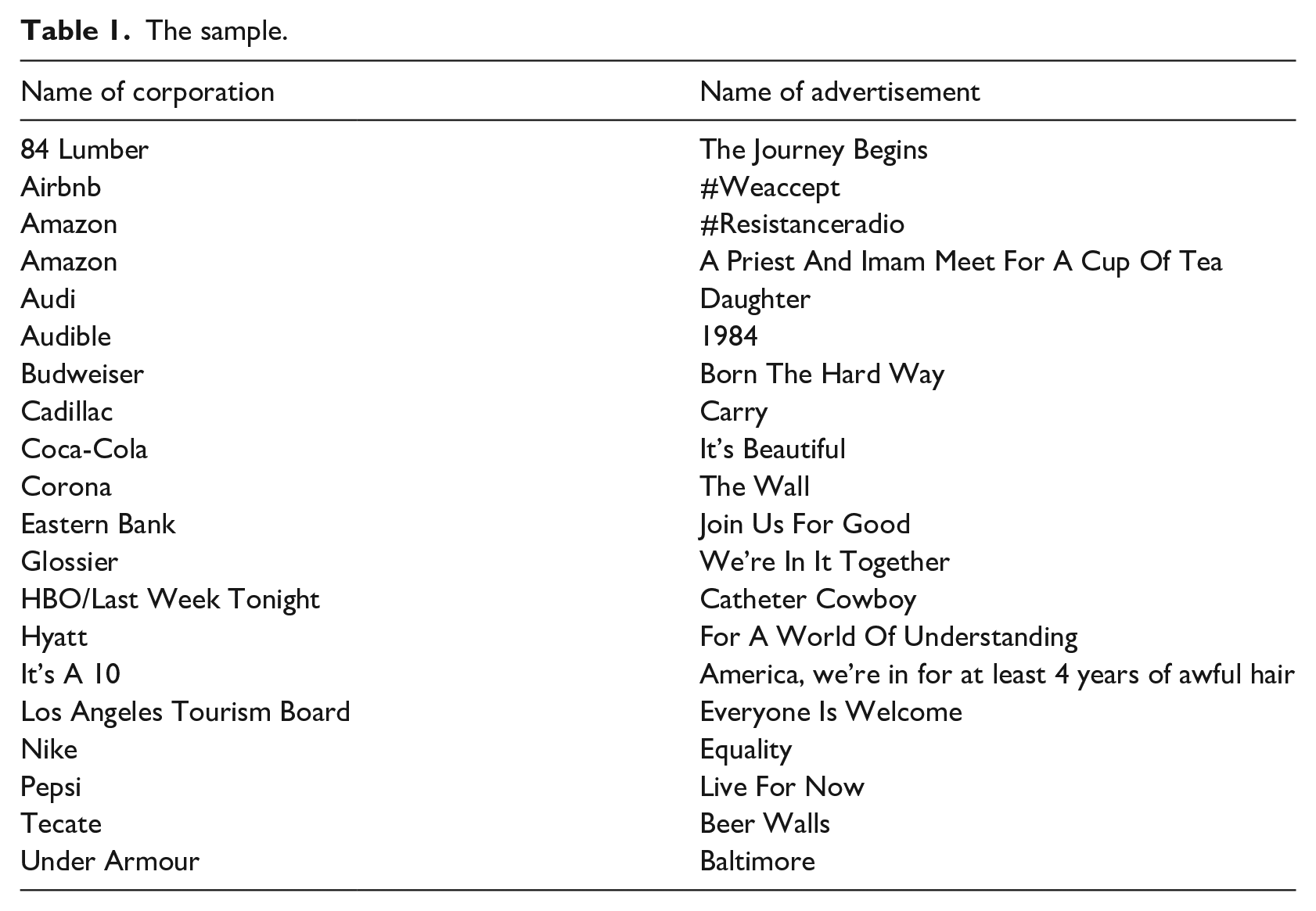
The sample, in its entirety, exhibits both hetero- and homogeneity. In relation to represented industries, there is a great variety: from building supplies (84 Lumber), through hotels (Hyatt) and beverages (Budweiser, Coca-Cola), to apparel (Under Armour). Similarly, there is variation in terms of the organizations’ prior social and political engagement: from having a reputation for corporate responsibility (e.g. Nike) to companies entering new territory such as Pepsi who had to pull its ad, featuring Kendall Jenner, following criticism from the social movement it attempted to portray and engage (Grigore and Molesworth, 2018). Despite these differences, the sample also exhibits similarities in that all corporations are well-known and well-established, and, in most instances, hold broad (international) customer bases. In addition, most of the identified advertisements were broadcast at the time of Trump’s inauguration, during the Super Bowl or in connection with the Academy Awards – the two latter being traditional platforms for corporate exposure (Raymond, 2017; White and Romm, 2017).
How to study anti-Trump advertising as s(t)imulation? Analytical procedure
Beginning from the mass mediated positioning of the sampled advertisements, our main analytical ambition was to textually explain how the adverts might be interpreted as expressing anti-Trump sentiments. What is it about their form and/or content that invites this reading of them?
For the analysis, we began by individually watching and/or reading each advertisement included in the sample. We then collectively discussed all the advertisements in order to identify central themes and categories, which would warrant further investigation. To facilitate this process, an Excel coding sheet was created, which we fed with information and observational notes such as name of corporation, short description of the advertisement as well as how it was framed by the media as anti-Trump, ending with our evaluation of the extent to which the advertisement contained any direct – and directly negative – reference to President Trump or his administration’s policies. This coding enabled us to examine similarities and differences between the advertisements, thereby gradually building a common perception of the sample as a whole – as well as of its individual parts.
Before moving to the findings, we would like to point out that even though we exclusively focus on communicative acts that are easily recognizable as belonging to the promotional genre (Morsing and Schultz, 2006), we do not deny the importance of non-promotional acts to the rise of corporate activism towards the Trump presidency. In methodological terms, these initiatives merely fall outside of the purview of the present investigation (see Garland et al., 2013 for a similar approach to corporate advertising). Furthermore, our exclusive focus on the first 100 days of the Trump presidency should not be seen as an indication that corporate resistance to Trump has desisted; to the contrary, we would argue that the tendency has established itself beyond the initial phase of his presidency, perhaps even intensifying during the 2018 and 2020 US elections, meaning that the patterns we find may have reach and relevance beyond the specific corporate responses we have studied.
Analysis: s(t)imulating corporate anti-Trump activism
Overall, the adverts are characterized by great variation in terms of form, but, strikingly, the content is similar in one significant respect: the majority of the ads do not explicitly refer to Trump, let alone criticize him. Despite the sample being constructed on the premise that the included adverts had been covered as expressions of anti-Trump sentiment, our initial readings of the material resulted in no hard and fast conclusions as to what caused this coverage.
In fact, only five adverts refer directly to often featured aspects of Trump’s personal, communicative or political style, in each case tempering the potentially critical point they make through the use of humour. By far the largest subset, consisting of 12 ads, celebrates values and ideas that have come to be perceived as being in opposition to Trump’s politics. Among these 12 ads, three are re-releases; first aired before Trump took office, these ads cannot have been intentionally encoded with Trump resistance, yet they are charged with anti-Trump advocacy as they appear again. This interpretation, therefore, must rely on a continuation of the companies’ promotion of corporate responsibility and inclusive multicultural values, which in media reporting is attributed new meaning in the context of the Trump presidency. A further set of two ads invoke fear rather than celebration, advancing dystopian visions of society without any explicit bearing on Trump. This leaves one advert, which draws on modes of articulation that do not map onto those identified above: an open letter from Under Armour CEO Kevin Plank, which was placed as an ad in The Baltimore Sun. We will not include the Under Armour advertisement in the analysis, but return to its implications for our study in the discussion.
Hence, in what follows, we will analyse the modes of articulation that in each their way potentially articulate indirect resistance to Trump: (1) humorous references to Trump’s policies, political (mis)conduct and personal style (5 advertisements); (2) favourable and highly emotional appeals to social justice in its various forms (12 advertisements); and (3) dystopian visions of society (2 advertisements). In analysing these three modes, we will also draw on the media coverage of the advertising so as to address the question of the relationship between text and context; what is it about the socio-political moment of their articulation that renders these adverts susceptible to the anti-Trump reading of them?
Poking fun at power
In our sample, five instances of advertising articulate anti-Trump sentiments through humorous albeit implicit references to Trump’s political (mis)conduct or personal style. Three of these adverts focus on policy, specifically the building of a wall on the Mexican–US border (the three beer producers Corona, Brew Dog and Tecate). One advert focuses on (mis)conduct (the entertainment company HBO’s run of the skit ‘Catheter Cowboy’ as an ad on Fox), and one takes on Trump’s personal style, specifically his hair (hair product producer It’s a 10). In doing so, Trump comes to work as a negative point of reference, which positions him on the outside of an ‘us and them’ frontier where ‘we’ gain some distance from and raise criticism of the powers that be by laughing at them (Momen, 2019).
Thereby, the adverts echo activist modes of resistance that serve to identify an opponent and forge a political identity (Uldam, 2013), drawing, for example, on the language employed by immigrant rights movements in the face of Trump’s anti-immigrant stance (Costanza-Chock, 2018). As such, the advertising draws on existing discourses of resistance to Trump, but the signifier of ‘resistance’ is emptied of its political motive. Instead, it is loaded with symbolic value, meaning it becomes circulated as a cultural commodity, an object of desire, without any specific political purpose (Koch and Elmore, 2006). From this perspective, the anti-Trump sentiments invoked in the adverts represent neoliberal consumer culture rather than an activist practice or agenda (Rothe and Collins, 2017).
As a case in point, Tecate’s ‘Beer Wall’ spot begins as the viewer is introduced to a scene of desert landscape divided by a wall that extends beyond the vision of the camera. Screen text anchors the image as ‘the US–Mexico border’. The scene is shown from the perspective of an eagle as a voiceover tells us that ‘the time has come for a wall, the best wall, a tremendous wall’. The voiceover continues ‘the Tecate beer wall’ as a Tecate beer can is placed on the wall, which when put in relation to the beer is revealed to be low and easily crossed. Eight men come into focus, identified by on-screen text as standing on the Californian and Mexican side of the wall, respectively, taking up positions that suggest antagonism and imminent face-off. The presence of the Tecate beer, however, transforms the scene into one of a friendly get-together as the eight men cheerfully start drinking and sharing the beer over the wall. The voiceover then suggests: ‘. . . a wall that brings us together’.
In this advert, the reference to Trump’s border wall is clear, and the move from a wall that divides to one ‘that brings us together’ suggests a playful – and potentially critical – recirculation of this well-known cultural and political meme. However, the scene of a carefree meeting of matey males is so far removed from the travails of migrants at the border that it blurs the distinction between image and reality ‘in a sort of nebulous hyperreality’ (Baudrillard, 1983: 101) in which what is represented disappears. As the reality of migrants is excluded, so is the cause to act upon this reality and the call to do so. Thus, the advert appeals to inclusion, sociality, perhaps even solidarity, while ignoring the struggles and suffering of immigrants, suggesting that a desirable (emotional) state can be obtained through consumption of Tecate beer. Such exclusion of the reality of the issue at stake is a main characteristic of all five adverts in this category, and it is further amplified by the common use of humour and irony (see Picture 1).

Beer Walls, Tecate.
The dominant strategy, here, is to ridicule Trump and/or his policies rather than appeal to a sense of social justice through emotions like anger or indignation. Various studies of the use of humour in resistance have found it to be a volatile strategy that both destabilizes one’s own political project and that of the adversary (Holm, 2017; Kalviknes Bore et al., 2017; Rodrigues and Collinson, 1995). Thus, humour is often used to defuse the critical point one is making (‘we were only joking’) so as to circumvent retaliation while maintaining the critical potential of the utterance.
The destabilizing potential of humour is evident in our material, for example in the spot from It’s a 10, which was first aired at the 2017 Superbowl. This advert begins with a voiceover warning the viewer that ‘We’re in for at least four years of awful hair, so it’s up to you to do your part by making up for it with great hair’ and goes on to show a montage of people (and one dog) with differently styled hair. The spot connects its message to Trump resistance through its reference to the presidential four-year term and to the ‘awful hair’ that has become iconographic of Trump. The people and hairstyles depicted in the spot represent different ethnicities, ages and sub-cultures, thereby invoking implicit criticism of Trump as a president who has built his political platform on anti-diversity. However, the absence of Trump’s more specific policies and their implications dampens the political impetus of the ad. Given that the appeal to viewers to do their ‘part by making up for it with great hair’ is loaded with irony, the absence of a call for action renders the advert potentially apolitical. The articulation of resistance remains ambiguous while the promotional purpose is ubiquitous.
Thus, a certain ‘textual playfulness’ (Chouliaraki, 2011: 365) is at large as the expressed resistance is ironic and less than directly oppositional to the president, just as the alternative it offers is not political but consumptive. Indeed, the CEO of the company, while assuring that reception of the ad had been ‘overwhelmingly positive’, insisted that It’s a 10 is ‘. . . not a political brand’, but went on to say that ‘the focus is on embracing the diversity of America’ (Garcia, 2017), which, as we shall see in the next round of analysis, has in itself become a controversial message in the era of Trump.
In sum, this ‘playful resistance’ (fight Trump’s awful hair with your own great hair; fight Trump’s divisive politics with your own cross-border beer consumption) holds critical potential as the use of humour and irony can be seen as inviting viewers to identify with a ‘cognizant elite’, capable of critically reflecting on the implications of the Trump administration’s politics (Glozer and Morsing, 2020). However, it is a particular form of critique, the common – and main – purpose of which is to create favourable conditions for the companies’ economic profit.
Favouring social justice
Whereas the above-mentioned advertisements use Trump and/or his politics as (more or less) explicit and (more or less) explicitly negative points of reference for a humorous critique of the powers that be, the majority of our sample of adverts never mentions Trump or any policy he has favoured, his political (mis)conduct or personal style. Yet, these ads are reported as being anti-Trump as in, for instance, this typical listing of Super Bowl ads: ‘more traditional American brands like Budweiser, Coca-Cola and 84 Lumber used the Super Bowl [. . .] to brand themselves in sharp contrast to Trump’s nationalist agenda on immigration and trade’ (White and Romm, 2017). In this category, the 84 Lumber ad stands out with its particular reference to a wall that, as shown earlier, has become a common way of invoking Trump. The Budweiser and Coca-Cola referents are more diffuse. The former presents a celebratory story of immigration with many obstacles, but none specifically pointing to Trump and, hence, only potentially alluding to Trump’s anti-immigration stance. The latter is even more diffuse as it is a re-run of an ad that celebrates diversity, initially launched in 2014. All the 12 advertisements in this category share this feature: they are reported by the media as being just as critical as the humorous adverts in our first category, but they do not offer any direct messages to support this interpretation.
Rather than leveraging critique against Trump, these adverts make favourable and highly emotional appeals to social justice in its various forms (diversity, human dignity, freedom of expression, enlightenment, prosperity, happiness, etc.). The interpretation of these emotional appeals as being anti-Trump, we believe, stems from the assumption that they validate issues or causes that Trump is against. Of the 12, eight celebrate general human values like freedom, equality and solidarity (Airbnb, Audi, Cadillac, Coca-Cola, Eastern Bank, Glossier, Hyatt and Pepsi) and four salute the more specific causes of pro-immigration and anti-discrimination (84 Lumber, Amazon, Budweiser and Los Angeles Tourism Board).
The spot by building supplies company 84 Lumber, first aired at the 2017 Superbowl, is, perhaps, the clearest example of how support for one cause can be criticism of another, in this case Trump. The connection is made through the door that is built (using 84 Lumber supplies) in a wall that clearly was meant to stop the progress of the Latina protagonists, a mother and her daughter, who have travelled far and endured much only to arrive at the barrier (see Picture 2). While Trump’s promise to build a wall at the US–Mexico border is not mentioned explicitly, the imagery of the wall obstructing the migrants’ journey through a desert landscape is arguably so particular in its reference to Trump’s project that the insertion of the door can be seen as a discursive act of resistance to Trump’s policies – and in this case, one that is not tempered by humour, making the critique potentially more damaging than that voiced in the case of Tecate. Indeed, Fox refused to show the spot, saying it was too political (Luttner, 2017). However, 84 Lumber’s CEO claimed that the intention was not political, that the advert contained no Trump critique but only a ‘patriotic’ celebration of those who struggle and find opportunity to reach their goals (Minutaglio, 2017; O’Reilly, 2017; Payne, 2017).

The Journey Begins, 84 Lumber.
Of the eight ads that focus even more broadly on human values, some emphasize individual freedom and patriotic pursuit of happiness (e.g. Eastern Bank), some s(t)imulate solidarity through staged protest (e.g. Pepsi) and others, such as Coca-Cola, focus on diversity. As mentioned, Coca-Cola’s ‘It’s beautiful’ campaign (see Picture 3) was produced and first aired in 2014, years before Trump’s presidency, wherefore this advert in itself could not be explicitly anti-Trump, but the decision to use it again was reported as an act of resistance. That is, Coca-Cola’s celebration of multiculturalism was, when re-aired in the pre-game commercial break at the 2017 Super Bowl, interpreted in the news media as having a critical edge vis-à-vis Trump.

It’s beautiful, Coca-Cola.
Such contextual attribution and perception of resistance showcases the radical relationality of agency and meaning (Just and Berg, 2016). There is no stable agency inscribed in any statement, no unquestionable and non-negotiable meaning. As such, the interpretation of this and similar adverts as instances of corporate anti-Trump activism is entirely due to the context of their circulation, to the discursive environment that encourages readings of otherwise innocuous messages as acts of Trump resistance. Meaning, the advertising does not articulate anti-Trump sentiment explicitly nor do the companies in question support such interpretation of the adverts, but remain silent on the matter if they do not, indeed, oppose the interpretation directly (as in the case of 84 Lumber). And yet, each instance is circulated as Trump resistance, intensifying their potential to be interpreted as such with each iteration.
Airbnb’s advertisement ‘#Weaccept’ (see Picture 4) differs slightly from the rest of this subset. The spot, which was first aired at the 2017 Superbowl, is a montage of human faces composed to represent different ethnicities, ages, genders and cultures accompanied by the text: ‘We believe no matter who you are, where you’re from, who you love or who you worship, we all belong. The world is more beautiful the more you accept’. This juxtaposition of the beauty of acceptance and diversity can be perceived to place Trump and his policies in contrast to human values. Indeed, the news media reported the advert to be an instance of Trump resistance as in the following example from The New York Times: ‘Airbnb, one of the most aggressive corporate critics of Mr. Trump’s policy, took its opposition to the Super Bowl’ (Benner, 2017). Instead of countering this interpretation, Airbnb (2017) lent further credence to it by publishing an email from the company’s chief executive Brian Chesky to all Airbnb staff in which Chesky stated that ‘This [the travel ban] is a policy I profoundly disagree with, and it is a direct obstacle to our mission at Airbnb’.

#Weaccept, Airbnb.
Airbnb’s spot can be seen as delivering a promise of refuge from the harshness of exclusion and discrimination created by Trump’s policies – a commercial promise to be fulfilled through consumer loyalty to Airbnb, not unlike the promises made by banks during the financial crisis that De Cock et al. (2011) identified. Moreover, the proposition that ‘the world is more beautiful the more you accept’ articulates acceptance and diversity in relation to human values rather than human rights. Without Airbnb’s explicit opposition to the travel ban, the ad would decouple values from formal structures of governance and, instead, construe their realization as an individualized consumer responsibility (Richey and Ponte, 2011). However, Airbnb’s more explicit articulations of resistance add momentum to the already circulating interpretation of it as voicing a much-needed positive alternative to Trump. The process is similar to the other 11 cases, only here the company joins in.
Invoking dystopian visions
Whereas the two most frequent strategies are either to humorously critique Trump or celebrate a socio-political reality that can be read as an alternative to Trump’s presidency, two adverts differ by implicitly targeting Trump’s political misconduct through fictional means that suggest (resistance to) dystopia. The two adverts are interpreted as stirring feelings of uncertainty and fear around Trump’s political conduct, but do so by analogy rather than as direct criticism. Amazon’s #resistanceradio promotes the fictional series The Man in the High Castle about an alternative future in which the Nazis won the Second World War. The series is advertised through a fictional radio stream that includes monologues condemning Nazis and fascism, which many listeners apparently took for a real radio station that criticized Trump (Morris, 2017).
The Audible advert includes actor Zachary Quinto reading a passage from Orwell’s 1984 on antagonistic attitudes towards immigration: ‘If he were allowed contact with foreigners, he would discover that they are creatures similar to himself and that most that had been told about them is lies’. This reading has been reported as ‘a subtle attack on the Trump administration’ (Haaretz, 2017), and another commentator noted that ‘against the backdrop of the current political climate, the “1984” spot can easily be interpreted as a direct nod to the Trump administration’s immigration ban’ (Diaz, 2017). Thus, even classics like 1984 and Les Misérables can be re-actualized and re-interpreted, and in the ‘current political climate’, as the commentator notes, such reinterpretation is like to revolve around Trump.
Discussion: s(t)imulating resistance
Despite the media’s representation of the adverts in our sample as anti-Trump, our analysis reveals that these commercial messages in no straightforward way articulate resistance to the Trump presidency Indeed, in some cases they were produced before Trump’s presidency (e.g. Coca-Cola’s America the beautiful), making critical intent impossible, or the companies behind them have denied any such intent (e.g. 84 Lumber’s The Journey). Others merely refer to values of inclusivity and respect, central to struggles for social justice long before/regardless of Trump’s presidency. Others again use humour to defuse the articulated criticism. As such, most of the advertisements in our sample are either devoid of or outright denying political intent at the illocutionary level in Austin’s (1962) terms. Yet, they could be explained from within the framework of aspirational talk as a fifth modality to supplement the four identified by Christensen et al. (2020).
This reading is particularly fitting of the instance we did not include in our analysis, which responds to a charge of being pro-Trump with a message of direct opposition to Trump’s travel ban. As the company in question (Under Armour) aspires to a brand position that may prove attractive to progressive consumers, it is also held accountable to act in accordance with its own value propositions. The rest of the sample, however, does not fit as easily into this explanation. Rather, all other advertisements are subject to a reverse dynamic in which the media coverage reflects anti-Trump sentiments back on the communicated messages, specifically, and the communicating corporations, more generally. No matter whether the corporations then accept, ignore or reject this interpretation, the point is that the adverts in themselves only become aspirational anti-Trump statements in and through their mediated re-circulation.
Therefore, we propose s(t)imulation as a conceptual framework in its own right; not just a supplement to the lens of performativity but an alternative perspective from which to explain corporate activism as such. In our specific case of corporate anti-Trump advertising the commercial intent of the communicating corporations – to sell cars, books, beer and so on – can be seen as rendering criticism of Trump, intentional or unintentional, as a self-referential simulacrum rather than a representation of political resistance. But as all political resistance is part of the same simulacrum, the advertising contributes as much as it takes: it s(t)imulates resistance.
Does this remove the potential for consequential effect of the utterance on the audience (the perlocutionary level)? It seems not. With the news media reporting the advertisements as expressions of anti-Trump sentiments, their potential to stimulate resistance remains. The point, then, is not that perlocution is no longer possible, but that it exists at the same level as illocution, which is, again, the same as locution. While Austin was well-aware of the latter point, our proposition that perlocution is not discreet from, but exists at the same level as illocution radicalizes his position to not only claim that people ‘can do things with words’, but that talk and action is the same, bound together in a perpetual dynamic that may, indeed, lead us beyond what is imaginable and, hence, possible in any given moment.
Beyond the focus on corporate advertising in our study, corporate resistance to Trump seems to have intensified, for example, around the time of the 2018 mid-term elections when several corporations moved very close to not only encouraging people to vote, but also suggesting who they should vote for (Tiffany, 2018). And several corporate statements have become more closely linked with specific political platforms and agendas. For instance, Nike’s ‘Dream Crazy’-campaign starring Colin Kaepernick, the first NFL player to kneel during the national anthem, took a clear stance and was rebuked directly by Trump. Similarly, Patagonia launched a full-frontal attack on Trump’s decision to revoke protection of national parks, integrating a communication campaign and a lawsuit under the heading of ‘the president stole your land’. And the founders of Ben & Jerry’s held ‘ice cream socials’ in support of Bernie Sanders’ bid to become the 2020 Democrat presidential candidate. We contend that neither of these instances is best explained as a case of talk (regardless of its ambiguity, sincerity or intent) leading to action. Rather, talk and action co-exist and perpetually produce each other on the same ontological plane of s(t)imulation.
Generalized to the field of corporate activism, the process of s(t)imulation both entails the potential for responsibilization of the corporate sphere and the risk of depolitization of the political sphere. They are not opposed evaluations of the implications of corporate activism, but co-existing potentialities within it. Insofar, as reality is displaced by self-referential simulation, this entails a risk that resistance is reduced to a matter of individualized, consumerist choice, albeit with the possibility that the choices consumers make will impact modes of corporate production. One cannot be true without the other, as the tendency towards commercialization of the political runs alongside the politicization of the commercial (Böhm et al., 2018; Dauvergne and LeBaron, 2014) – every act of consumption sends a political message and any political message can be consumed.
The result is to instate corporations as the responsible alternative to Trump while Trump’s claim to power is upheld. Corporate resistance, then, remains void of anything but the message to resist and, hence, s(t)imulates perpetual resistance as simultaneous potentiality and deferral – a call to action that remains unrealized and maintains its potential with each new articulation. This, we believe, is the particular, though by no means new, mode of communicating corporate activism as a commercialized revolution that offers consumption as the vehicle of change. In ‘the current political climate’, as the comment on Audible said, any and all statement has the potential to be sucked into the maelstrom that is the Trump presidency.
Conclusion
It is well-established that advertising has come to play a key role in the cultural terrain, rendering it a significant ground for moral action (Chouliaraki, 2008a). But what does that mean in the post-truth era of the Trump presidency? In this article, we have sought to answer this question through a re-introduction of Baudrillard’s concept of the simulacrum. Arguing that the recurrent discussion within PCSR and CSR communication as to whether or not words can lead to action misses the mark, we suggest that the dialectics of (critical) performativity be replaced by the dualism of s(t)imulation. This, we argue, provides a better starting point for conceptualizing the growing empirical phenomenon of corporate activism.
In making this suggestion, we concede that Baudrillard’s perspective of postmodern seduction risks simplifying the role of power by reducing it to a shift in structures of signification, backgrounding shifts in systemic structures between state and corporate interests. This obscures implications for and the concerns companies might have about backlashes from consumers and other stakeholders and, not least, Trump. Attending to such implications would require addressing the wider power structures in which signification is embedded and falls outside of the purview of this study.
However, a Baudrilliardian framework, generally, and our notion of s(t)imulation, specifically, can help uncover the ways in which advertisements as well as other forms of corporate activism have the potential to both perpetuate further corporate activism and mask the wider power relations in which such activism is embedded. Hence, the empirical findings and conceptual framework offered here, point towards further investigations of the dynamic duality of corporate activist s(t)imulation, of the ways in which its potentials and risks play out in and through the process of their articulation rather than as a derived effect of corporate aspirations.
Footnotes
Funding
The author(s) received no financial support for the research, authorship, and/or publication of this article.
