




Abstract
This article contributes to the understanding of actors and agency in the theorization of institutional work. We analyse institutional work as a specific kind of social action that involves exercising institutional agency (with an articulate awareness of institutions) as opposed to primary agency (taking institutions for granted). We propose a conceptual framework for combining a view of actors, who have agency and may engage in institutional work, with a view of actors as socially constructed, in line with critical-realist ontology. Applying this framework to the empirical case of the Spanish social movement 15M, we examine how actors moved from having primary agency to having institutional agency and how organization mattered for this process. We find that organizing by experienced organizers, the founding of new organizations and prefigurative organization were of crucial importance for the increase in institutional agency.
Keywords
Introduction
It has been argued repeatedly that there is need for a better understanding of agency and actors within institutional theory (Hwang et al., 2019). An influential branch of research to develop such an understanding is research on ‘institutional work’ (Lawrence et al., 2009, 2011; Lawrence and Suddaby, 2006). It seeks to understand how institutions are changed or maintained through the intentional efforts of actors. It has broadened our understanding, by examining not just institutional entrepreneurship to create new institutions but also work to maintain and disrupt institutions (Lawrence and Suddaby, 2006). It has also teased out variations of agency associated with institutional work, ranging from iterative agency to practical-evaluative agency and projective agency (Battilana and D’Aunno, 2009: 48). This increase in nuance has the benefit of revealing not only heroic institutional entrepreneurship but also small acts of institutional resistance and maintenance.
The downside of this differentiation has been a blurring of the distinction between social action in general and institutional work in particular. Institutional work is in danger of becoming an all-purpose concept, as Alvesson and Spicer (2019) have pointed out, calling for problematization and clarification.
Archer’s analysis of primary agency (Archer, 2000: 261–82) as opposed to what may be called institutional agency (Nilsson, 2015) is useful for sharpening the concept of institutional work: Primary agency means reacting to one’s social-cultural context while trying to survive in it and possibly pursuing upwards social mobility. But it involves no articulate awareness of one’s position within socio-cultural configurations, and no intent to maintain or change those configurations. Yet, if many pursuits of primary agency go in the same direction, this can generate effects on those configurations (Archer, 2000: 261–82). Institutional agency (Nilsson, 2015: 380), in contrast, involves an elevated level of reflexivity and projectivity. Institutional work means exercising institutional agency, and it requires actors to have articulate understanding of institutions, of their positions towards and within them, and of how they would like to change or maintain them.
We aim to refine the theorization of institutional work by examining how actors move from having primary agency to having institutional agency. We particularly focus on how organizing and organizations are related to people’s development of institutional agency. For this purpose, we build on critical-realist ontology (notably Archer, 2000, 2002). We thereby follow the lead of Leca and Naccache (2006) and Mutch (2007), who have studied institutional entrepreneurship from a critical-realist perspective. This approach is also compatible with previous critical-realist analyses of how actors inhabit existing institutions (Delbridge and Edwards, 2013).
We propose a conceptual framework of institutional work in line with critical-realist ontology. We apply this framework to empirically examine people’s development of institutional agency in the case of the Spanish 15M movement. 15M was a major protest movement against the ruling political parties, austerity politics and neoliberalism that peaked between 2011 and 2013. New and alternative forms of organization played a prominent role in this movement.
By doing so, we make three conceptual contributions: First, we offer a framework for combining a view of actors, who have agency and may engage in institutional work, with a view of actors as socially constructed, in line with critical-realist ontology. Second, we elaborate on the distinction between primary and institutional agency, thus helping to maintain institutional work as a meaningful concept. Third, we highlight the importance of organization – in the sense of organizing as well as of organizations – for people’s ability to develop institutional agency. In this way, we counteract overly individualistic notions of institutional work.
We develop our analysis in two main steps. First, we give an overview of how research on institutional work understands actors and their agency in relation to institutions. We point out some issues that have remained opaque in this strand of research, concerning the ontology of actors, and the distinction between institutional work and social action. Building on critical realism as a basis for clarifying these issues, we develop a conceptual framework of institutional work that includes the social construction of actors and their various modes of social action: exercising primary agency to make their way through existing institutions, or engaging in institutional work to preserve, destroy or build institutions deliberately. Second, after outlining our empirical method, we apply this framework to analyse developments in the Spanish 15M movement. We show how a combination of institutional crisis and embeddedness in alternative institutions provided the starting conditions for many new actors to develop institutional agency. Tracking this process, we show how the organizing by actors who already had institutional agency, the forming of new organizations and prefigurative organization as institutional work were vital to this increase in institutional agency. We also show how later on this led to counter dynamics. After discussing the theoretical relevance of these findings, we conclude with a reflection about our contributions, and about important remaining gaps in the understanding of agency and actors in institutional theory.
Conceptual framework
Research on institutional work is one of the major strands of institutional theory that have emerged in response to the criticism (e.g. by DiMaggio, 1988; Stinchcombe, 1997) that new institutional theory insufficiently investigates agency. Seminal works of new institutional theory (e.g. DiMaggio and Powell, 1983; Meyer and Rowan, 1977) clearly focus on how institutions constrain social action. A phenomenologically oriented strand of institutional theory further pursues this focus by applying it to analyse institutionalized models of modern actors (e.g. Meyer, 2010; Meyer and Jepperson, 2000). Another strand, focusing on institutional work (Lawrence et al., 2009, 2011; Lawrence and Suddaby, 2006), takes a different path and aims to forge a middle ground between the dominance of structure or agency.
A core concern of research on institutional work is to resolve ‘the paradox of embedded agency’, that is, the question how actors can change institutions when their interests and cognitive schemes have been moulded by institutions (Battilana and D’Aunno, 2009). Many insightful answers to this question have been put forward (Battilana and D’Aunno, 2009: 38). These answers point to such factors as the enabling effects of institutional crises (e.g. Castro and Ansari, 2017), positions of actors at the centre or periphery of institutional fields (see the literature review by Hardy and Maguire, 2008: 201), ambiguity within institutions (e.g. Van Dijk et al., 2011) and contradictions between institutional logics (e.g. Marquis and Lounsbury, 2007).
While research on institutional work has thus developed a sophisticated understanding of agency, the understanding of actors, that is, of the entities that have agency, has remained more opaque. The foregrounded concepts are institutions (as entities) and action (as a process) (see, for example, Barley and Tolbert, 1997: 101; Lawrence et al., 2009: 7). Especially, scholars of phenomenological institutionalism have therefore criticized that research on institutional work takes actors for granted, because it does not account for how actors are constructed (Hwang and Colyvas, 2011). The ontology of actors has remained opaque, like in most of institutional theory (Colyvas and Hwang, 2019). Research on institutional work defines the actor concept only indirectly, in the sense that actors are (tautologically) entities that have agency. The concept of agency is clearly explicated (Battilana and D’Aunno, 2009: 46): Agency is the process of an actor’s engagement with the social world that is informed by the past (in its habitual aspect), but also oriented toward the future (as a capacity to imagine alternative possibilities) and toward the present (as a capacity to contextualize past habits and future projects within the contingencies of the moment). (Emirbayer and Mische, 1998: 963)
The canonical definition of institutional work as ‘the purposive action of individuals and organizations aimed at creating, maintaining, and disrupting institutions’ (Lawrence and Suddaby, 2006: 215) implies that individuals and organizations are actors. However, scholars of institutional work have not explicated why agency is the domain of these two types of entities. If the key requirement for an actor is the ability to engage with the world in a way that is not only informed by the past but also oriented towards the future and the present, then we may wonder whether organizations should be considered as actors.
Critical-realist research, and notably Margaret Archer with her research programme to resolve the problem of structure and agency (for an overview, see Vandenberghe, 2005), has carefully crafted out concepts of actors and agency. This work is more an ontology than a theory in itself, and it has been found to be highly compatible with theorizations of institutional work (Leca and Naccache, 2006; also see Emirbayer and Mische’s, 1998, reception of Archer’s work). We hence build on critical realism to sharpen – and in some ways problematize – key concepts of research on institutional work. From a critical-realist perspective, the relationship between institutions and actors is not circular, but recursive in a dynamic forward-spiralling way (see Figure 1). 1 In contrast to similar frameworks put forward by scholars not only of institutional work (Lawrence et al., 2009: 7), but also of institutional theory more broadly (Barley and Tolbert, 1997: 101), it foregrounds not just institutions but also actors as emerging from processes of social construction. It is much in line with Padgett and Powell’s (2012: 2) aphorism that ‘[i]n the short run, actors create relations; in the long run, relations create actors’, but it must not be misunderstood as a sequential bracketing of either institutions or actors (Leca and Naccache, 2006: 628). Interrelations of both must be considered at all times. In the following, we will elaborate on the concepts included in this framework, in particular, on aspects that are important for our research question of how actors develop institutional agency and what relevance organizations have in this regard.
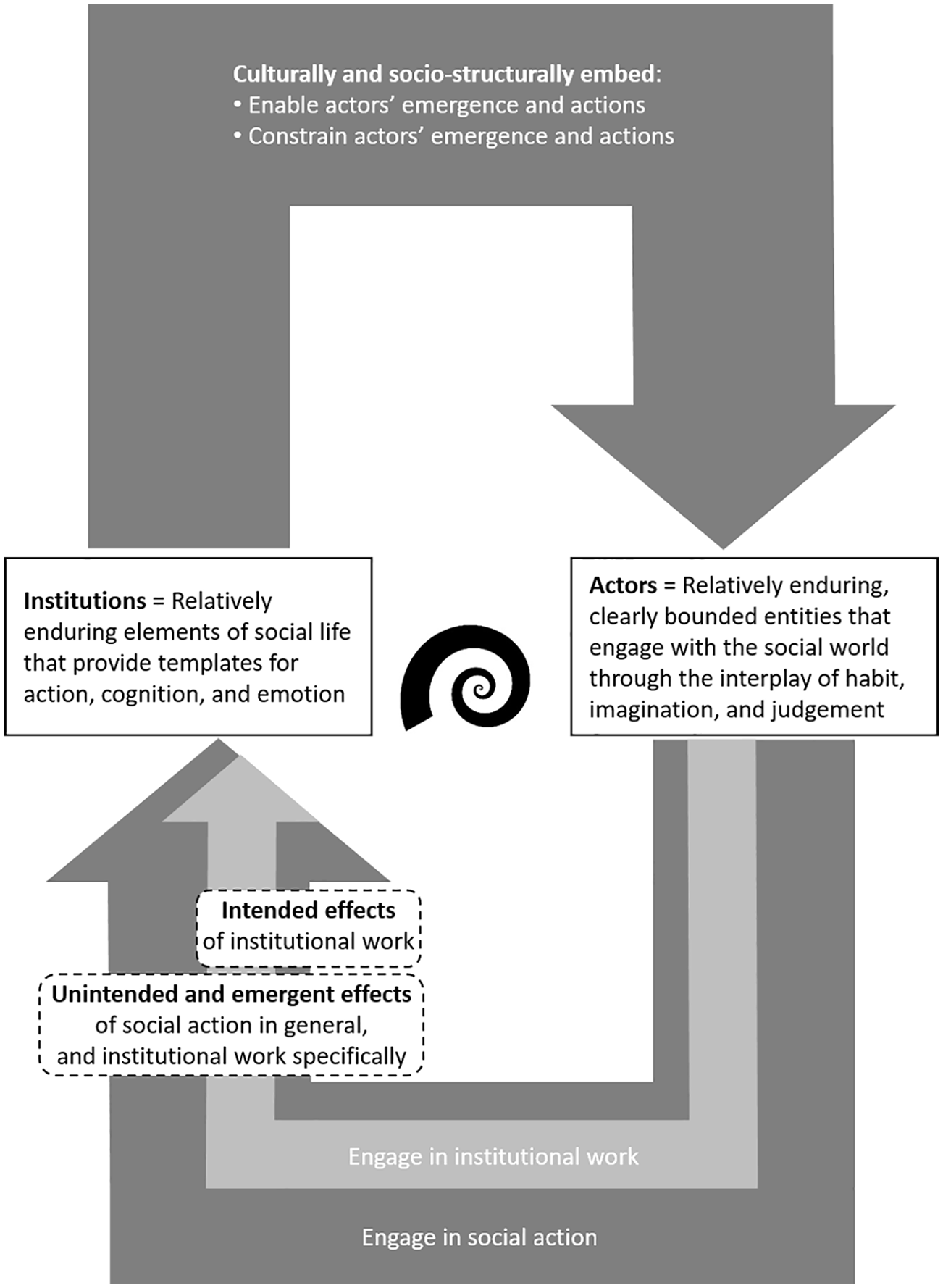
The relationships between actors, social action, institutions and institutional embeddedness.
Institutions
We could begin this explanation at any point of the recursive relationship, but for an institutionalist approach, it is fitting to begin with the institutions. Research on institutional work defines institutions as relatively enduring elements of social life that provide templates for action, cognition and emotion and thereby affect the behaviours and beliefs of actors. Nonconformity with institutions entails costs (Lawrence et al., 2011: 53). This is a useful definition.
To avoid taking actors for granted, it should be stressed that also roles are institutions. Yet, people must exercise agency in fulfilling socially prescribed roles, because [e]ven highly ritualized contexts, such as the chopping off [of] a head by an executioner, are full of choices on the part of those involved (the arrangement of bodies, subtle issues of timing, the display or not of emotion, the emitting or not of sounds), some of which might undermine the institution while others might bolster its legitimacy or its coercive foundations. (Lawrence et al., 2011: 54)
Creative performances of roles can transform the roles (Archer, 2000: 296).
Institutional embeddedness
Institutions shape actors, as all actors are embedded in an institutional environment that supported their emergence and provides templates for their actions. This has been called ‘embedded agency’ (Battilana and D’Aunno, 2009). Building on Archer, two interpenetrating aspects of institutional embeddedness can be discerned: embeddedness in cultural systems (relations between bodies of ideas) and embeddedness in social structures (causal relations of influence between groupings, such as social strata, etc.; Archer, 2000: 5 and 258).
Embeddedness in cultural systems is a key argument of institutional theory (DiMaggio and Powell, 1983; Meyer and Rowan, 1977). Cultural rules shape actors in important and often unconscious ways. Different templates for human action and human actors can be found in history and in different cultures (Morris, 1994), and there are also variants within Western culture (e.g. Clarke et al., 2009; Suddaby et al., 2015). Moreover, cultural context also provides templates for what kinds of organizations and organizing are legitimate. For example, Stevens (2002) shows how in the field of conservative Protestantism in the United States there are templates that facilitate the proliferation of a specific kind of organization, the ministry. Institutions thus provide cultural ‘building blocks for organizations’ (Meyer and Rowan, 1977: 345). Often those templates for organizations are emulated in uniform ways but sometimes with innovative modifications.
Embeddedness in social structures involves effects of inequality. Actors occupy particular positions within society that provide them with particular resources (Archer, 2000: 262). Every human enters this world situated in a particular social position, and this influences what kind of legitimacy they will enjoy, and how they will see their interests, process information and act.
Culture and social relations empirically interpenetrate and influence each other (cf. Emirbayer and Goodwin, 1994: 1438). Socio-cultural conditions can make it hard for some people to engage in institutional work, for example, if they are deprived of education. Recent research on institutional biographies helps to understand socio-cultural embeddedness. In the course of their life, actors are exposed to a specific range of institutions. In the interplay with the actors’ capabilities, these experiences shape actors’ actions, for example, heightening their ability to see opportunities for institutional change (Suddaby et al., 2016) and fuelling their willingness to engage in political action (Bertels and Lawrence, 2016).
Actors
An actor is a social entity that has agency. In research on institutional work, humans and organizations are seen as actors, as implied in the canonical definition of institutional work as ‘the purposive action of individuals and organizations’ aimed at changing or maintaining institutions (Lawrence and Suddaby, 2006: 215). However, scholars of institutional work have not explicated why agency is the domain of these two types of entities. Evidently, it is assumed that people and organizations are the two types of entities capable of purposive action.
In this regard, there is a discrepancy between research on institutional work and critical-realist ontology. Critical realists such as Archer have been careful to conceptualize only humans as actors. Especially critical-realist work on artificial intelligence (Morgan, 2019) is instructive in this regard: Is it enough to say that the properties and powers of one type of entity (e.g. robots or organizations) so much resemble those of another (e.g. human actors) that the former are ontologically of the same kind (i.e. actor) as the latter? According to a critical-realist understanding, actors must have mind states, to be able to have concerns of their own and engage in an internal conversation from a first-person perspective. Critical realists thus conceptualize organizations not as actors but as corporate agents (if they are unitarian associations to promote their members’ concerns, Archer, 2000: 266) or ‘communities’ (where human actors relate to each other in an organizing structure, Lawson, 2014: 6). Critical -realist work has stressed that organizations are by law attributed with powers that are similar to those of free and mature humans (Deakin, 2017), that they involve particular arrangements of social positions for humans, and that legal rights and responsibilities may be distributed in quite ‘bizarre’ (Lawson, 2015: 28) ways among the involved humans and the organization as a legal person. In any case, the primary concept for critical realists to understand collectively organized action is not the organization as an entity. This subtlety has been stepped over by some institutionalist work building on critical realism. Critical realists are debating about contemporary challenges how to deal with entities such as organizations and algorithms possibly ‘acting’ without (self-)consciousness (Lawson, 2015; Morgan, 2019; Morgan and Sun, 2017). For the purpose of the ensuing empirical analysis, we focus on human actors as they organize and engage with organizations. We bracket the issue how exactly to conceptualize organizations but return to it in the conclusion.
Another subtle point of difference between work in critical-realist and institutional work traditions deserves mention: Critical realists rarely use the term ‘individual’, and to them the terms ‘human’, ‘person’ and ‘actor’ are not synonymous. They work with a stratified concept of being human (Archer, 2000: 254). The four strata comprise the self, the person, the agent and the actor. Archer underlines the importance of engaging in bodily practices, developing a continuous sense of self, engaging in internal conversations and developing a personal identity as well as a social identity as preconditions for becoming an actor (Archer, 2000: 288). Her conceptualization of an actor thus remains close to the theatre metaphor that resonates in the term: Actors are humans who have a social identity in roles in which they have found it worthwhile to invest themselves. They also have a personal identity that enables them to personify those roles in a unique manner (Archer, 2000: 296). They not just passively animate roles but actively personify them. They may also transform roles or create new roles by acting creatively (Archer, 2000: 296).
Social action and institutional work
Action means exercising agency. Social action is action-oriented towards others (Weber, 1947: 88), and institutional work is a particular kind of social action: effortful, purposive and reflexive about the institutional context, as it aims to maintain or change institutions (Lawrence et al., 2011). A distinction is made between different forms of institutional work (Lawrence and Suddaby, 2006): maintaining, disrupting and creating institutions. In all of these forms of institutional work, various kinds of temporal orientations may predominate: iterative agency primarily informed by the past, practical-evaluative agency primarily oriented towards the present and projective agency primarily oriented towards the future (Battilana and D’Aunno, 2009: 48; Emirbayer and Mische, 1998). This differentiation has had the benefit of widening the focus beyond institutional entrepreneurship, that is, those instances of institutional work that result in institutional change as intended by the actor who engages in that work (Lawrence et al., 2011). It has rectified an overly heroic view of actors and has shifted attention towards everyday practices for gradually modifying institutions, and towards resistance against and maintenance of institutions.
However, these increasingly broad and nuanced understandings have hardly been helpful for maintaining the distinction between social action in general and institutional work in particular. It has hence been criticized that institutional work has become a concept void of meaning: It can be used to describe acts as different as mounting a protest, passing a law or copying a strategy from another organization (Lawrence and Suddaby, 2006). Simply turning up at work can be seen as form of maintaining the institution of paid labour/employment. A physician being nice to a patient may do the same for the institution of a profession. (Alvesson and Spicer, 2019: 206)
We propose that Archer’s conceptualization of primary agency (Archer, 2000: 261–82) as opposed to what may be called institutional agency (Nilsson, 2015) is useful for clarifying the significance of institutional work: If institutional work is defined as purposive action aimed at creating, maintaining or disrupting organizations, this purposefulness must mean an elevated level of reflexivity and projectivity. It requires actors to have an articulate understanding of what institutions are like at present, of their position towards and within them, and of how they would like them to be in the future. In other words, it requires actors to have institutional agency (Nilsson, 2015: 380). Primary agency, in contrast, means reacting to one’s context while trying to survive in it and possibly pursuing upwards social mobility. It involves no articulate awareness of one’s position within socio-cultural configurations, and no intention to maintain or change them.
Organizing and organizations are important for the development of institutional agency. Archer has touched on much of this importance in her analysis of corporate agents (Archer, 2000: 268ff.): At birth, humans are assigned to positions in society and begin to develop primary agency. They can only gain institutional agency when they develop a reflexive notion about their position in society. Organized action to develop shared articulations of positions within society and shared concerns has historically been of crucial importance in this process. For example, in the 19th century, organizations such as liberal student fraternities, workers’ unions, women’s suffrage associations and so on were crucial for the achievement of institutions such as freedom from corvée and slavery, liberal constitutions, more or less universal suffrage, and other human rights that form the basis for much institutional work today. Archer argues that actors can go beyond primary agency only through corporate agency. Only organizing enables people to articulate their interests and attain new subject positions. Otherwise, they ‘will not and cannot be strategically involved in the modelling or re-modelling of structure or culture’ (Archer, 2000: 265f.). We are hesitant to claim this so apodictically, but there is no doubt that organizing and organizations are important for developing institutional agency. In our empirical analysis, we will take a closer look at how exactly organizing and organizations are important.
Together with unintended effects of social action in general, institutional work forms the basis for the institutional order that sets the conditions for the persistence of old actors or the emergence of new ones, and that shapes their identities and interests. Therefore, the spiral that describes the recursive relationship between actors and institutions continues.
Methods
We will exemplify the analytical benefits of this conceptual framework by describing the social movement 15M in reference to key concepts of this framework. In line with Archer’s approach of analytical dualism (Archer, 2000: 306f), we will unpick how actors moved from primary to institutional agency. We focus on morphogenetic sequences and their recursive dynamics, that is, on temporal sequences of structures being changed or reproduced through social interaction.
The empirical data were collected in ethnographic field research between October 2014 and March 2016 in Madrid, Valencia and Seville by the second author and a research assistant. 2 They conducted 87 problem-centred interviews in Spanish with activists and representatives of social movement organizations, and wrote fieldnotes on 16 participant observations.
The sample was obtained using the snowball method. Sampling started in the first weeks of fieldwork with personal contacts of the research assistant, academic contacts of the second author, as well as contact persons found on the websites of organizations that were prominently involved in 15M (e.g. Yayoflautas, PAH, Juventud Sin Futuro). These initial contacts were asked to suggest further interview partners, aiming for maximum variance of actor characteristics with regard to age, gender and education.
All participant observations and 80 interviews were conducted by the second author; 7 interviews were conducted by the research assistant. All interviews and participant observations were numbered (with ‘I’ indicating interviews, ‘PO’ indicating participant observations, a consecutive number, and the year and month of recording). Forty-four interviews were then fully transcribed by a Spanish native speaker. 3 This resulted in a data set of about 850 pages of text. These data were read by the second author, and all passages that seemed to have an unclear or ambiguous meaning were discussed with the native speaker for clarification.
Data were analysed in Spanish using MAXQDA. Coding was done by the second author and the research assistant, with one checking the codes of the other and if necessary adapting them after discussion. The coding was theory-driven, that is, key concepts from the conceptual framework were applied to characterize on an abstract level the phenomena mentioned in the data. The following concepts were used as codes at the highest level of abstraction: institutions, actors, various forms of institutional embeddedness and various forms of institutional work. Within each main code, more concrete variants were distinguished. These subcategories were also informed by the literatures underlying the conceptual framework. To reconstruct the morphogenetic sequence of events, the temporal dimension (i.e. time of data collection and time to which statements refer) of each coded piece of data was considered. The data cited in this article were translated into English by the second author.
Empirical application: the 15M movement
In the following, we will apply the proposed framework to analyse how moves from primary to institutional agency occurred in the course of 15M, and what importance organizing and organizations had in this process.
Crisis of dominant institutions and embeddedness in alternative institutions
Uncountable institutions played a part in the development of 15M. Two of them shall be highlighted here, because they were eventually dismantled by the movement: the two-party system and sociological Franquismo.
The two-party system had been in effect since the end of the Franco dictatorship in 1978. The centre-left PSOE and the conservative PP dominated Spanish politics. In the years leading up to the emergence of 15M, information about massive cases of corruption involving both parties had become widely publicized, but this had had little effect on the political landscape.
This had to do with sociological Franquismo: the norm not to become involved in politics. Even people who were too young to have experienced the dictatorship acted as if they had been socialized by it. One 15M activist explained it this way: [. . .] I have seen this even in young people who have not lived under Franco. They cannot have this fear in their bodies due to living under the dictatorship, because they were born after Franco died. [. . .T]he older mothers, who knew Franco, have taught them: ‘Child, be careful’, ‘Child, don’t talk too much. Don’t let the powerful write down your name, don’t get into trouble’. That fear of the powerful, of attracting attention. (I51_2015_03)
But there were also alternative institutions, albeit in much smaller circles of society: There were subcultures from feminist, alter-globalization and free culture movements (Flesher Fominaya, 2014; Maeckelbergh, 2012; Morell, 2012). There were Spanish traditions of communism, anarchism and resistance against Franco (Payne, 1987). Despite sociological Franquismo, there was a strong tradition of leftist ideas and mobilizing. Strikes, demonstrations and smaller gestures of protest – such as apartment dwellers hanging banners from their windows to attract attention to a cause – constituted a common component of public life (Fishman, 2012).
For the start of 15M, experienced activists, who were culturally embedded in alternative institutions, played a crucial role. Some had long trajectories of activism and protest: I have been dedicated to the anti-globalization movement. I’ve been to Prague, Geneva, Porto Alegre and Florence; involved in various activities in the anti-globalization movement, and in the anti-war movement as well as advocating for the rights of those ‘without papers’, you know. Additionally, we had an internationalist outreach. [. . .] Later, back in Spain, I linked to the housing and anti-war movement and 15M. [. . .] We have been shaped politically by the anti-globalization movement, let’s say, we were some kind of ‘backpack-activists’ you know? (I6_2014_11)
These people were critical of capitalism and had wanted a different kind of politics even before the beginning of 15M.
Nevertheless, most people in Spain took politics and the economy for granted the way they were. However, this changed with the economic crisis in 2008. It caused many people in Spain to feel financial and social hardship. The ruling political parties had already been exposed as corrupt, and now trust in established politics declined even more (Hughes, 2011). Economic and social problems persisted in the following years, with high numbers of evictions, and increasing homelessness, poverty, youth unemployment (55.5% in 2013, Eurostat, 2016) and even malnutrition of children (González-Bueno and Bello, 2014). The dominant institutions were shaken by crisis.
In this situation, early activists had alternative frames of interpretation and recipes for action readily at hand. They began to organize protests. On 15 May 2011, protests across Spain reached massive levels, with 50,000 protesters gathering in Madrid alone (Alcaide, 2011). The 15M movement, named after this date, was thus formed. For early activists, alternative institutions provided guidance on how to explain the economic and social problems, and on what sort of solutions to seek. Those activists attributed responsibility for the problems to the corrupt two-party system, austerity politics and neoliberal capitalism. They suggested re-configuring the social and economic order in line with values of solidarity and horizontalism as solution. These were basically leftist standard templates for cognition and action. In 15M, these previously marginal templates quickly caught on with many more people, who developed new institutional agency.
Actors developing institutional agency and engaging in institutional work
Just as countless institutions shaped the movement, so did countless actors. We focus on how increasing numbers of people moved from having just primary agency to being capable of institutional work. Organizing and organization were of central importance in this regard.
Organizing to incite institutional agency
With the beginning of the movement, many people, who had previously been passive, became activists. This corresponds to the move from primary agency (Archer, 2000: 261–82) to institutional agency: Gaining an articulate awareness of one’s position within social structures and of prevailing culture, and developing a purposeful attitude towards this context.
For some people, this awakening of institutional agency happened seemingly coincidentally. For example, one woman, who had never been politically active, tells the story how she occasionally passed by an occupied space and felt attracted: People stood up, told their story one after another, and I realized that others were in the same position as me. [. . .] This was very moving. You felt that you are not alone and that it is not your fault. So, I stayed and became an activist myself. (I57_2015_03)
This practice of people standing up, telling about and listening to experiences of hardship was not coincidental. It was a pervasive ritual in the movement, performed in public encampments as well as in organizational settings, and fostered by movement activists. One activist from an organization that fights against evictions describes it as follows: [. . .T]he methodology is very easily to export [. . .] The methodology for example is to interview the person before the assembly. [. . .] In the first interview, people come shattered, everybody is crying. [. . .] And then, when they tell their problem in the group, and you hear the others say: ‘Yes, I experienced the same’, ‘Yes, it also happened to me’ [. . .] people say: ‘It is not only my problem, I am not the only one’. (I65_2015_03)
This ‘methodology’ had roots in previous social movements: In fact, [the methodology] has worked very well. And it is not a method that comes out of nowhere, because the people who organized [this organization as well as the gatherings] already came from other movements for the right for housing. (I65_2015_03)
Several interviewees told about having experienced this practice: By sharing their stories, people realized that they were in similar positions, embraced new views and embarked on activities to change institutions. An activist summarizes the result as, ‘For me, all paradigms fell’ (I69_2015_03).
With this dis-embedding from mainstream institutions, alternative templates began to make sense. Many actors began to emulate alternative templates for emotion, cognition and action in line with 15M: I had never before spoken in public or done anything politically when I was young. [. . .] As a woman you just stayed at home with the children. [. . .] Now it feels really natural for me to be active, to go to meetings, to fight for better conditions. I have learned how to act in an assembly. (I84_2015_02)
This development of institutional agency was facilitated in crucial ways by experienced activists who organized people. Much of this organizing took place outside formal organizations: at demonstrations, spontaneous assemblies, encampments or occupations. It was organizing in the sense in which Alinsky (1989: 72) coined the term: ‘What makes an organizer organize? [. . .] The function of an organizer is to raise questions that agitate, that break through the accepted pattern’.
Experienced organizers had a highly articulate understanding of institutions. They expressed sophisticated reflections about everybody’s institutional embeddedness, and about the meaning-making aims and effects of their activism. They frequently and competently used terminology from the social sciences to explicate this: Here, in this transition everything is affected, the places, the aesthetics, the ways of doing things, of filling the space, of visualizing it all; this was, [. . .], like a communicative container filled with a series of new narratives that have been developed [. . .]. (I69_2015_03)
They often referred to the change of institutions explicitly, even reverberating statements of institutional theory: ‘For changing institutions, we need to create a transversal, new discourse’ (I42_2015_02).
Forming new organizations to enhance institutional agency
Organizing mobilized increasing numbers of people, but without the founding of many new organizations, 15M would have remained a less impactful movement. Organizations amplified the powers of individual actors.
An activist described this with the following anecdote: A small group of friends was sitting together, discussing the political situation, when another friend, a lawyer, showed them a new web-based tool to facilitate participation. Using this tool, they connected with others and started to build an organization: [He] is a lawyer who [. . .] has had brilliant ideas before [. . .] but he had been alone, he had been feeling like he was crazy. When the movement started, he immediately was surrounded by people who wanted to do things. If many people want to do something, and somebody is constantly developing interesting ideas, then suddenly things go together, and this is magic. (I59_2015_03)
With this emerging organization, they got involved in preparing demonstrations. Members connected with others, established internal rules and, after having set up decision-making structures and procedures, this finally could be considered a proper organization: [. . .W]e had demonstrated that we were a political entity that had the capacity to make decisions. So, we wanted to be allowed to participate [in politics]. (I59_2015_03)
Another interviewee describes how forming an organization was crucial to whether squats would be successful: In fact, I was thinking of doing an occupation on my own. [. . .] Then I saw that there were more people who wanted to do it. I also saw that, because of our methodology of working in a participatory way, we have ways to make it easier for groups to work [. . .]. So we decided to do the occupation together. Of course, it was the strength of the group, the political legitimacy. (I61_2015_03)
Eventually, these squatters formed not just one but a whole network of organizations, which provided the squats with increased legitimacy and played a decisive role in making them long-lived and politically effective.
Prefigurative organization as institutional work
Organizing and organization-building were big issues in 15M. From the start, the movement drew strongly on alternative organizational templates: based on solidarity, horizontal, without leaders, self-governing. This was thought to serve the wider political purpose of ‘prefiguring the world you want to create’ (I77_2015_02). This kind of organizing was seen as institutional work in its own right. It was intended to effect social change by designing organizations in such a way that their means and organizational structures foreshadow the kind of society that members aspire to (Boggs, 1977).
The most widely applicable template for prefigurative organization was the asamblea (see Figure 2). It became an institution within the movement: a norm for any kind of event or organization that belonged to 15M. The word asamblea means ‘meeting’. Asambleas had been popular before in Latin America. The organizers of the initial 15M demonstrations taught others how to organize them. Today, instructions for asambleas can be found on many websites published by movement organizations and activists. In the context of 15M, an asamblea is a specific form of meeting with certain rules: It is public, egalitarian, consensus-based, formally unstructured and open to everybody. It has no leaders, only rotating speakers (Colectivo Madrilonia, 2012). It has rules for egalitarian communication and decision-making. Relationships among participants are not differentiated by formal roles (Haug, 2013). Asambleas were meant to put self-governance into practice: In that respect, we also showed that you did not always have to organize everything in a hierarchical, vertical way, in which there has to be a leader. [. . .] There was no leader. We were all the same and we were all spokespersons. (I59_2015_03)
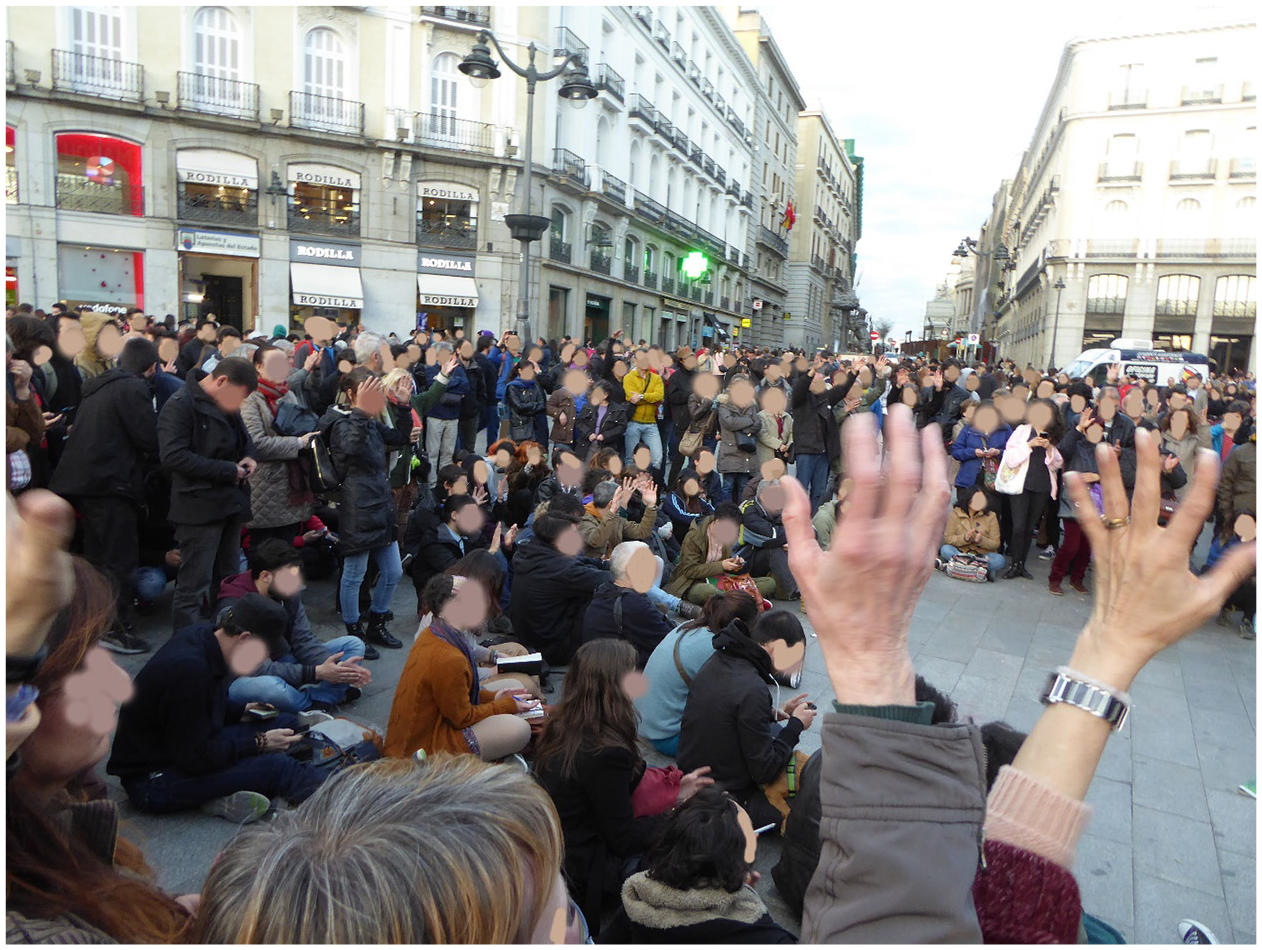
Spontaneous Asamblea, Madrid, March 2016; image rights: second author.
The people of the movement shared the idea that the asamblea should be the core of every organization of the movement, the forum where collective decisions are legitimately made: Our movement organizes in asambleas, [. . .] it is a horizontal movement, where decisions are taken in asambleas. We have speakers. They can only say what the asamblea has decided. [. . .] We trust in our rhythms, for the respect of an asamblea-based, democratic process. (I24_2014_11)
The asamblea was thought to be the forum where people organize into a corporate agent: It is left to each organization how it is established. But above all, much has been generalized. The asamblea has been generalized as the forum, let’s say, as an element of organization. Belonging to a collective in which I have to give my opinion, in which I participate, in which I take responsibility. (I55_2015_03)
Popularizing the asamblea was often difficult. People experienced constraints by the dominant institutional environment in the subtle ways they themselves had been shaped by it. They were aware that their style of non-hierarchical communication was unusual and required learning: You know, you learn to function in an asamblea, to self-govern. This is not something you learn from a manual, that you can read and that’s it. These are major learning processes. (I55_2015_03)
Besides the asamblea, with its wide applicability and its general purpose of prefiguring the movement’s political ideals, the movement also created specialized new forms of prefigurative organizations. Examples for such new forms include commissions (a new kind of organization that provides specialized services to activists, for example, legal advice or IT support), and a new kind of squats (where people from the mainstream of society, who have been evicted, occupy empty houses that are owned by banks).
A second morphogenetic sequence
As the movement gained momentum, it unfolded effects on human actors’ subjectivities and led to the founding of more movement organizations. These effects strengthened capacities to change institutions in line with the movement’s ideals and enabled more people to develop institutional agency. However, an opposing dynamic also developed, as the movement began to lose some momentum because of its success in the field of party politics and because of a violent backlash by defenders of dominant institutions.
Reinforcing dynamics: even more actors develop institutional agency
As the movement unfolded, more people joined the movement to change political and economic institutions. Those already engaged in institutional work were transformed by their engagement, and more organizations were founded.
For the mobilization of actors, reinforcing dynamics between the cultural system and social relations mattered (Archer, 2000: 173). With their prefigurative practices, organizations of 15M fostered dynamics that were conducive to the movement. Many people made use of what these organizations offered, got to know their practices, gained the impression that they were effective, and started to share the underlying ideas of solidarity and self-governance. One activist of an anti-eviction organization recounts, People came as clients, they wanted us to help them when they were threatened by eviction, and many of them stayed as activists, helping others. [. . .] There were many cases of people who never would have engaged in political activities before. And now they are coordinating work groups, join protests, and so on. (I065_2015_03)
The development of institutional agency was a collective process of learning from each other. In the organizations of the movement, much time was spent on mutual empowerment: I had very little knowledge [. . .]. Of course, when you go to asambleas, you meet people who have been studying for a long time, who have a very well-structured speech, who explain to you, give you proofs. [. . .] If you are a bit critical and a bit reflective, you see that there is no real democracy, that you want to change this. (I75_2015_03) I think that asambleas are really empowering [. . .]. Today, I think, people find it more difficult to accept when in a political organization someone else tells them how to do things. Thus, if organizations democratize, society becomes more democratic and perhaps we can hope that also the state will become more democratic [. . .]. Today, citizens are demanding the capacity to lead, while before they only blamed the state. [. . .T]hey are saying: ‘I want you to let us do things our own way’. (I55_2015_03).
Many new organizations were formed until around 2014. Social centres were an important resource in this regard, as they enabled the establishment of further organizations, which increased the movement’s capacity for institutional change. Another particularly important – but also contentious – step was the formation of a new national party (Podemos) and associated local parties to change the political system from within. These parties were quite successful in elections and brought the two-party system to an end.
For many people, engaging in the movement changed their self-perception and their ways of thinking. For example, a male activist recounts, Until some years ago, I thought feminism was just for women, I would never have thought that I would call myself a feminist one day. Now I have learned to see things differently. (I65_2015_03)
Many speak about how participating in the movement has increased their agency: We do not question ourselves so much anymore, we do not judge ourselves as insane, exaggerated or hysterical [. . .] this is very powerful. (I72_2015_04) So, these people have become politicized in the process, they have become empowered. (I85_2016_03)
The taboo not to become involved in political issues, the sociological Franquismo, was broken: Before, you couldn’t even imagine talking about corrupt politicians. Not even within the family. You just didn’t do it. And now, you turn on the television and you see a report of a trial or a new accusation. This is incredible. (I30_2014_11)
Also, the causal attribution of financial hardship changed. Before the movement, poverty was mostly seen as an individual’s failure. Now, people began to attribute these problems to systemic failure and highlighted the socio-cultural restrictions of actors. Instead of feeling ashamed or afraid, people now reacted with anger and solidarity. Many interviewees reported now feeling more responsible for others, and having built larger and more stable networks of social support: ‘Now I know whom to ask when I have problems’ (I75_2015_06).
It is therefore no exaggeration to say that the movement has been successful in effecting a ‘change of society’s mind-set’ (I21_2014_11). As another activist put it, In the long run, it might be that we won’t succeed. But what has really changed is the way we think about politics. We have started to talk about politics and we will not go back to being quiet again. (I57_2015_03)
These changes are striking examples of what Archer (2000, 2015) calls the double morphogenesis of agency: These actors have succeeded in effecting institutional change, and in the same process have themselves been transformed and have transformed others.
Counter dynamics: adaptation and backlash
While activism grew until 2013 (García, 2014), according to interviewees, participation in the movement has been on a decline since late 2014, due to internal and external challenges.
Success in conventional politics has had ambivalent results for the movement (much in line with classical findings by Piven and Cloward, 1979). The new political parties undoubtedly shifted the political balance, but they also adapted to ‘the system’ (I42_2015_02). In the interviews conducted in 2014, activists expressed mainly hope and satisfaction regarding the new parties. In interviews conducted in 2016, much of this had given way to disappointment and critique: [. . .] it was more of the same, painted new. [. . .] Sure, there have been changes [. . .] but many dynamics are like in the old way. (I80_2016_04)
It had proven difficult to realize ideals of self-governance within existing political structures. Ambitions regarding participation and gender-equality had not been fully met, and radical goals had been diluted. A further unintended effect was reported: ‘Podemos has emptied the streets’ (I76_2015_02). Activism receded because many people expected the new politicians to take matters into their hands.
Defenders of the dominant institutional order ramped up their efforts of policing and deterring (Lawrence and Suddaby, 2006: 230). Non-violent activists were faced with high fines, arrests and bodily harm by police (García, 2014). New laws on public security were passed to restrict the right to demonstrate and protest. Activists talked about police violence, showing their physical scars (I73_2015_04, I75_2015_04), and telling about the physical and mental strains: Well, there have been many incidents of torture [. . .]. It was not as severe as during the dictatorship [. . .] but for example, they let you stand for seven hours at the police office, they don’t allow you to rest against the wall. (I94_2016_04)
Activists also reported on the many incidents of fines and lawsuits, which severely reduced their capacity for institutional work.
[An acquaintance, who is an activist, and I] talked about the new laws and he said: ‘You know, in the times of Franco, we were used to being arrested, mostly for one night. In the morning, they gave you a kick in the butt and let you go. It was horrible, but we were somewhat used to it and had learned to cope. Now, in times of this high unemployment, a financial fine of several hundred euros often means hunger for the whole family’. (PO16_2016_03)
Activists have reacted to the backlash by building new institutions and new organizations. For example, when organizing a demonstration, it is now general practice to nominate a lawyer on duty to whom the demonstrators can turn. Demonstrators write this lawyer’s contact details on their body, because if they are arrested all personal items are taken away from them. New forms of protest have been developed, such as hologram demonstrations where not actual people but holographic projections take to the streets. Many groups have developed internal rules for sharing monetary fines. More than 100 organizations have joined together in a platform called ‘We are not delinquents’ to challenge the new laws. The changed institutional context also has influenced peoples’ subjectivities: activists have become more careful and many are afraid. Some describe the subtle effects of self-censorship ( ‘the police in your head’, I82_2016_04) and the shifting baselines regarding repression ( ‘what had been a scandal before, is sometimes now normalized to a certain degree’ I82_2016_04).
Discussion and conclusion
With our conceptual and empirical work, we have aimed to shed light on how actors move from having primary agency to having institutional agency, and how organizing and organizations contribute to this process. We have done so within a framework that refines the conceptualization of institutional work within the tenets of critical-realist ontology.
Regarding conceptual foundations, we have shown that critical-realist ontology provides a consistent basis for integrating an understanding of institutional embeddedness with an understanding of institutional work. A critical-realist approach de-paradoxifies the ‘paradox of embedded agency’ (Battilana and D’Aunno, 2009) by looking at it from an extended and detailed temporal perspective.
Applying such a perspective to the empirical analysis of the 15M movement, we find that this social movement entailed large numbers of people moving from having just primary agency to having institutional agency. When they had just primary agency, they took social structures and cultural ‘paradigms’ – as one interviewee put it – for granted and tried to succeed or at least get by within them. When they developed institutional agency, they realized that these things could be different and began to work towards changing them in ways more consistent with their ideas of a good life. As a mass phenomenon, this would have been impossible without a prior crisis of legitimacy of economic and political institutions (as external jolt), and without support by experienced organizers. These organizers were steeped in an alternative culture (with ideas about solidarity and egalitarianism) and knew well-tried techniques of political organizing (awareness-raising and empowering interventions such as explicated by Alinsky, 1989; Freire, 1972, etc.). They played a key role in the initial demonstrations that gave rise to the movement. Soon afterwards, the founding of new organizations was crucial for making the movement more impactful, for enabling initiatives to persist and for making more people develop institutional agency. People founded organizations that enabled them to conduct activities that otherwise would have been frowned upon or even regally risky (such as squats and demonstrations) in a more legitimate and legally safe manner. It also helped them to overcome the problem that as individuals, who question the status quo, they would have felt ‘crazy’ – as one interviewee put it – but within an organization, they could reassure each other that they were doing reasonable things. Activists also understood organizing and building organizations as a kind of institutional work in its own right. They explicitly referred to the concept of ‘prefigurative’ organization, that is, organizing in a way that realizes within the organization in the present the social relations they would like to see realized within society as a whole in the future (Boggs, 1977). In case of 15M, these were horizontal relations of solidarity. This prefigurative strategy worked reasonably well because people, who as passers-by or clients came into contact with prefigurative events or organizations, realized that co-operating within horizontal structures was a realistic option.
Furthermore, following Archer’s critical-realist approach to analyse structure and agency from an extended temporal perspective, we find that dynamics of institutional change generated counter dynamics: Unintended institutional inertia occurred (as the founding of a progressive political party led to a relapse into old political patterns); defenders of the old institutional order started a backlash (e.g. passing new repressive laws). There is a dialectical relationship between institutional work for change and institutional work for stasis.
With this analysis, we have made three theoretical contributions to debates about actors in institutional theory: First, we refine the conceptual lens for combining a view of actors as agentic with a view of actors as socially constructed. Second, we sharpen the distinction between primary and institutional agency, thus helping to maintain institutional work as a meaningful concept. Third, we emphasize the importance of organization (in the sense of organizing as well as organizations) for people’s ability to develop and exercise institutional agency, thereby counteracting tendencies to understand institutional work in overly individualistic terms.
Our first contribution has been to show how concepts of research on institutional work can be mapped onto critical-realist ontology, and how actors are hence agentic and at the same time socially constructed. We thereby extend on previous critical-realist work (Delbridge and Edwards, 2013; Leca and Naccache, 2006; Mutch, 2007) that has made similar transfer efforts for other aspects of interest to institutional theory. We hope to thereby provide further evidence that critical-realist ontology is a potential solution to problems of fragmentation and conceptual imprecision in institutional theory. We provide a framework for conceptualizing the relationship between actors and institutions as recursive in a dynamic (not circular) way. Actors may develop agency, and especially institutional agency, if socio-cultural conditions are conducive. For people, developing primary agency depends on legitimation by their institutional environment in a rather rough sense, for example, in the sense that they may not be hindered from developing it by the use of violence. Requirements for developing institutional agency are much higher. Affirmation by others is crucial in this regard. Our empirical example shows that without such affirmation, people tend to judge themselves as oversensitive or even insane. With such affirmation, they may develop institutional agency. With this analysis, we connect to Archer’s (2000, 2015) work on the double morphogenesis of agency: In today’s society, where institutions are no longer as stable as they used to be in Fordist times or earlier, institutions are not only changed through the exercise of agency, but also agency itself is changed when institutions are changed (Archer, 2000: 258). Changed socio-cultural relations lead to changed personal motivations, changed opportunities to connect with others and changed alliances (Archer, 2015). Institutional theory would benefit from further engaging with this work, because it complements the analysis how culture affects agency (e.g. Meyer and Jepperson, 2000) with an analysis of how social structures and the engagement with culture from different positions within social structures do so.
Our first contribution about refining concepts on the basis of critical-realist ontology also involves pointing out an inconsistency between critical-realist and institutional work literatures: While critical-realist scholars conceptualize only people as actors, scholars of institutional work regularly conceptualize also organizations as actors. It would go beyond the scope of this article to resolve this discrepancy or even to analyse its reasons in the detail that would be necessary to enable consistent solutions. To put it shortly, the crucial question in this regard is whether from a critical-realist perspective, it would be sensible to agree that organizations have some sort of inner conversation and first-person view, or that there can be actors who act but do not have this kind of consciousness. In view of the massive ecological changes taking place on this planet, in which organizations – especially corporations – are involved in active ways, we think that this is not a purely scholastic question. Clarifying the nature of organizations as actors (or finding another more appropriate analytical category) is an issue with serious political and legal implications. We hope that there will be more research efforts going into this direction.
Our second contribution has been to elaborate on the distinction between primary and institutional agency. We have made the point that institutional work is based on elevated reflexivity about institutions. Actors must be able to verbalize their views on what dominant institutions are, and why and how they would like to change or maintain them. Institutional work is based on a view of institutions that does not take them for granted. If any kind of social action that has an effect on institutions was called institutional work, then we would lose the unique difficulties of institutional work from sight. We would also overlook that much institutional change is driven by ‘purely demographic’ (Archer, 2000: 271) dynamics. If the numbers of particular kinds of people with just primary agency grow or decrease in a particular place, this may – without any intention from the side of those people – push others to become more creative to just maintain the status quo. To adequately grasp such complexities, we must distinguish between social action in general and institutional work in particular. Social action is any kind of action oriented towards others. Institutional work is social action that is based on articulated – or at least readily articulable – ideas of what institutions should look like and why they should look like that. These articulations can be simple or sophisticated. For sophisticated articulations, actors may even use concepts of institutional theory itself to reflect on their positions and concerns in society.
Third, we have demonstrated the importance of organization (in the sense of organizing as well as organizations) for people’s ability to develop institutional agency. In 15M, organizing by skilled organizers in settings outside traditional organizations has been of crucial importance for destabilizing and raising awareness of institutions in the minds of many people who had previously taken them for granted and for pointing out alternatives. Organizing prompted these people to take up various types of institutional work, such as volunteering in self-help initiatives and participating in demonstrations. In our case, this organizing was done by social movement activists, but the kind of work they do is similar to the one of union organizers or community organizers (as, for example, outlined by Alinsky, 1989). There has been institutionalist research pointing out the importance of ‘professionalized others’ (Meyer and Jepperson, 2000), as people who ‘function principally to make persons better actors, groups better organized actors, and nation-states more complete organized actors’ (Meyer, 2010: 7, also see Meyer, 2019). However, this research has focused on consultants, therapists, lawyers and the like (for a notable exception, see Giorgi et al., 2017). These are professionals, who specialize in fostering the agency of individual persons (or of individual organizations), not in fostering corporate agency in Archer’s sense. We believe that organizers deserve more research. We could learn about what enhances collective and individual capacity for institutional work by examining commonalities and differences between the roles and strategies of organizers as opposed to more conventional professionalized others.
As part of our third contribution, we have also demonstrated the importance of creating organizations to enhance people’s capacity for institutional work. Within organizations, people can do more far-reaching institutional work than as individuals. Regardless of the open question whether organizations actually are actors, they have important effects on the development of institutional agency of individual actors. Joined together in an organization, people can amplify their agency in ways that exceed the aggregated capacities of involved individuals. However, the effect of organizations on the capacity to effect institutional change is not unanimously positive. We have observed unintended consequences of founding organizations as well. The founding of new political parties contributed to a decrease in direct participation. This is a classic pattern in social movements (e.g. Piven and Cloward, 1979; Skocpol, 2003). We would welcome further research into this phenomenon, specifically into how organizations for corporate agency (e.g. social movement organizations, advocacy nongovernmental organizations, political parties) affect people’s institutional agency. So far, the role of organizations for social movements is mostly analysed on the macro-level of political influence (Benski et al., 2013). It would be important to know more about how they affect social change by changing the institutional agency of people.
Finally, also as part of our third contribution about the importance of organization, we have pointed out the importance of prefigurative organization as a strategy of institutional work. It has been of crucial importance in 15M, as in many other recent social movements (Flesher Fominaya, 2015; Graeber, 2012; Yates, 2015). Interest in forms of organization that prefigure more humane ways of collaborating is also increasing in the business world (evidenced, for example, by bestsellers such as Laloux, 2014). Further research on prefigurative institutional work, its intended and unintended consequences, and its conditions for bringing about institutional change at a larger scale would therefore be of interest.
Footnotes
Funding
The author(s) received no financial support for the research, authorship, and/or publication of this article.
