




Abstract
As agents of strategic institutional change, institutional entrepreneurs (IEs) draw resources from their structural environment to alter the structural context in which they are embedded. In this article, we explore which resources IEs mobilize in different structural settings. We distinguish between (positional or free) field resources and personal resources, all of which may be material, cultural, social, symbolic or political in kind. Our review of leading case studies of institutional entrepreneurship shows that centrally positioned IEs draw primarily on organizational positional resources. By contrast, peripherally positioned IEs rely mainly on the skilful mobilization of free resources as well as on the personal resources of individuals. Also the field’s degree of institutionalization has an impact on IEs’ resources: in emerging fields where field positions and field boundaries are not yet defined, resources must be imported from mature fields. Furthermore, although resource-poor peripheral IEs may set off institution-building processes in emerging fields, they are usually superseded by central organizational actors during later stages of institution-building.
Keywords
Institutional entrepreneurs (IEs) are individual or collective ‘actors who . . . leverage resources to create new institutions or to transform existing ones’ (Maguire et al., 2004, p. 657; see also DiMaggio, 1988, p. 14). Many transformation processes that are currently upheaving our social order such as the rise of social media, industry 4.0, the sharing economy, energy transitions or the emergence of populist parties in many Western democracies can be traced back to the institutional entrepreneurship of individuals or organizations. However, which resources enable IEs to build or change institutions and where do IEs draw these resources from?
In the literature on institutional entrepreneurship, different answers to this question can be found. One strand of literature ‘emphasizes institutional entrepreneurs’ unique abilities and features’ (Hardy & Maguire, 2017, p. 265) such as ‘demographic and psychological factors’ (Battilana et al., 2009, p. 78). Another literature strand focuses on the importance of IEs’ structural embeddedness, which refers not only to IEs’ field position but also to the structural configuration of the field of change, especially its degree of institutionalization (see Battilana, 2006, p. 656; Hardy & Maguire, 2017, pp. 264–268). From the latter perspective, ‘the “exceptional” ability of institutional entrepreneurs to see or create “a window of opportunity” needs to be considered in relation to the way in which the field produces their interests, skills and stocks of knowledge’ (Hardy & Maguire, 2017, p. 265).
Despite a rising interest in the structural embeddedness of IEs, the interrelation between the structural context and IEs’ ability to foster institutional innovation or change remains under-theorized. To date, there is no systematic account of ‘interaction effect[s] between field-level characteristics’ (such as a high or low degree of institutionalization, corresponding to mature or emerging fields) and ‘actors’ social position’ (in particular, a central or peripheral field position) as giving rise to ‘types of divergent changes’ (Battilana et al., 2009, p. 76). This theoretical blind spot hinders the emergence of a more general theory of strategic institutional change because studies that reach different conclusions about the process and enablers of institutional entrepreneurship remain theoretically unconnected rather than being recognized as addressing institutional entrepreneurship in different structural contexts.
To advance the theorization of institutional entrepreneurship and make institutional entrepreneurship theory more actionable, this article develops a framework of strategic institutional change in different structural settings by combining insights from sociological theory – in particular the work of Giddens, Bourdieu and Fligstein – with a review of the institutional entrepreneurship literature. Our framework rests on the key tenet that actors’ position in the social space (consisting of different types of fields and field positions) and social time (referring to individuals’ personal history of field memberships and field positions) endows them with differential access to resources of various kinds – especially free or positional field resources as well as personal resources, all of which can be material, cultural, social, symbolic or political in nature. Access to resources, in turn, preconditions actors’ ability to envision, pursue and implement change within fields.
We begin our account with a sociological explication of the concept of ‘structure’ and its relation to resources. After this, we comb through the institutional entrepreneurship literature to draw up a typology of IEs’ resources, also inquiring about the possible role of different resources in different types of structural settings (in terms of central or peripheral field positions in mature or emerging fields). In a following step, this typology is substantiated and refined based on a review of the 40 most-cited case studies of institutional entrepreneurship, resulting in a context-sensitive framework of strategic institutional change that is backed by both deductive and inductive reasoning.
A key insight from our theory-guided review of the institutional entrepreneurship literature is that centrally positioned IEs draw primarily on organizational positional resources, whereas peripherally positioned IEs rely mainly on the skilful mobilization of free resources as well as on the personal resources of individuals. In addition, institutional entrepreneurship in emerging fields requires the importation of resources from mature fields, for which central IEs are better equipped than peripheral IEs, who therefore tend to be superseded by central organizational actors when instigating change in emerging fields. Such a context-sensitive perspective represents a notable progression in the theorization of institutional entrepreneurship which previously lacked a coherent understanding of the interplay between IEs’ structural embeddedness and the resources used in strategic institutional change.
Structural Embeddedness and its Relation to Resources
The literature on institutional entrepreneurship often refers to the structural embeddedness of IEs as explaining why certain individuals or organizations become successful change-makers. Yet what exactly is ‘structure’ and what does it mean for individuals to be embedded in it? These questions lie at the heart of Giddens’ structuration theory. According to Giddens, the concept of ‘structure’ refers to pre-existing conditions that shape the perceptions and actions of social actors (such as IEs). These conditions come into being through the mental footprints or ‘memory traces’ left by previous actions in the minds of ‘reflexive’ individuals, who subsequently take the actual or potential actions of other persons into account when acting, thereby establishing commonly shared action patterns and reordering the infrastructure of social life (Giddens, 1984; see also Emirbayer & Mische, 1998). As an illustrative example, writing an article on institutional entrepreneurship implies engaging in a debate with previous contributions to the literature, foreseeing potential reviewer feedback, adding new arguments to the academic debate, and so on.
As Sewell (1992) specifies based on the work of Giddens, social structure has a ‘virtual’ component (‘cultural schemas’) and an ‘actual’ component (‘resources’). 1 Cultural schemas filter what we see in the world. Based on these cognitive frames, certain actions become conceivable or inconceivable to us. For example, writing an article on institutional entrepreneurship presupposes the authors to have a concept of science, journal, computer, and so on. In order to be able to act in a meaningful way, however, actors also need access to the resource side of the ‘human’ and ‘nonhuman’ structural elements of which they have awareness, such as other researchers, journal articles and computers (see Sewell, 1992, p. 10). 2 While Giddens (1981, p. 170) defines resources quite simply as ‘capabilities of making things happen’, 3 Sewell (1992, pp. 9–10) posits that resources ‘can be used to enhance or maintain power, including knowledge of the means of gaining, retaining, controlling, and propagating . . . resources’. Furthermore, Sewell (1992, p. 10) notes that resources are ‘unevenly distributed’.
The unequal distribution of resources and its impact on world views and life chances is central to the work of Pierre Bourdieu. According to Bourdieu, control over resources is preconditioned upon actors’ position in the social space (implying the largest structural context and the sub-fields thereof in which actors are embedded), with fields being defined as bounded ‘network[s] of objective relations (of domination or subordination . . ., etc.)’ (Bourdieu, 1996, p. 231). Apart from being embedded in the social space, however, Bourdieu also – implicitly – views actors as embedded in social time (see for example Bourdieu, 1986, p. 241). This is because individuals traverse multiple sub-fields of the social space in the course of their socialization, education, professional and private life. Even when fields are left behind over the life-course such as the field of education, some field resources (such as professional knowledge) may be carried along into the present in the form of personal ‘capital’.
Bourdieu (1986, 1989) identifies four basic capital forms: economic capital that has monetary value; cultural capital that relates to knowledge, ideas and meanings; social capital that refers to network connections; and symbolic capital that implies prestige and legitimacy in the eyes of others. A key notion in Bourdieu’s work is the convertibility of capital: not only can ‘the most material types of capital . . . which are economic in the restricted sense . . . present themselves in the immaterial form of cultural capital or social capital and vice versa’ (Bourdieu, 1986, p. 242), but economic, cultural and social capital can also be converted into symbolic capital (Bourdieu, 1989, p. 17) and back.
The institutional entrepreneurship literature has often insinuated, but not explained, the conceptual difference between field resources that actors can access through their current multi-dimensional (i.e. multi-field) position in the social space, and personal capital that is decoupled from current field memberships because it consists of internalized and thereby personalized field resources accumulated by individuals over the life-course, that is, over social time. As one of many examples, Maguire et al. (2004, p. 668) state that ‘change . . . requires resources or capital’ without substantiating this analytical distinction further (see also Hardy & Maguire, 2017, p. 264; Khan et al., 2007, p. 1071; Misangyi et al., 2008, p. 755; Peters et al., 2011, pp. 54–55; Wright & Zammuto, 2013, p. 53). Below, we argue that resources and capital should be distinguished conceptually because they play distinct roles in strategic institutional change, depending on the structural setting in which change unfolds. However, we prefer the term ‘personal resources’ to ‘capital’ in the context of institutional entrepreneurship, because both field resources that spring from IEs’ current position in the social space (defined by field memberships and field positions) and personal capital that accrues from the time spent by individual IEs in previous or current fields and field positions fall under Giddens’ (1981, p. 170) definition of resources as ‘capabilities of making things happen’. In the next section, we delve deeper into the different types of IEs’ resources.
Types of Resources available to IEs
According to Battilana et al. (2009, p. 83), ‘a full understanding of the process of divergent change implementation relies on an appreciation for the different types of resources institutional entrepreneurs mobilize’. In this section, we discuss different types of field resources and personal resources as they come to the fore in the institutional entrepreneurship literature.
Material, cultural, social, symbolic and political resources
The institutional entrepreneurship literature usually resorts to Bourdieu’s capital forms when categorizing the resources of IEs – sometimes with slight adaptations. For example, Misangyi et al. (2008, p. 757) speak of ‘the economic, cultural, social, and symbolic resources available’ to IEs, while Montiel and Husted (2009, p. 354) refer to IEs’ ‘economic, symbolic, social, intellectual, political’ resources (see also Brown et al., 2009, p. 194; Dorado, 2005, p. 389; Maguire et al., 2004; Peters et al., 2011). We follow the literature in this regard, but we use Battilana and Leca’s (2009, p. 263) ‘material’ category instead of Bourdieu’s ‘economic’ category because some material assets of IEs are not per se economic in nature, such as ambulances (see George et al., 2015). Furthermore, our review of the 40 most-cited case studies of institutional entrepreneurship yielded a fifth category – political resources that entail the ability to impose decisions on others (see also Beckert, 1999, p. 792; Fligstein & McAdam, 2011, p. 9; Montiel & Husted, 2009, p. 354; Ocasio et al., 2020; Sotarauta & Mustikkamäki, 2015, p. 345). 4 Finally, we move beyond Bourdieu in applying the terms ‘material’, ‘cultural’, ‘social’, ‘symbolic’ and ‘political’ not only to the personal resources of individuals, but also to field resources that exist independently of individual actors. In what follows, the field resources and personal resources of IEs are addressed in more detail.
Free or positional field resources
There is widespread consensus in the literature that many of IE’s resources are ‘embedded in the field rather than “owned” or “possessed” by individual actors’ (Hardy & Maguire, 2017, p. 264; see also Lawrence & Suddaby, 2006, p. 220). The term ‘field resources’ is well-suited for describing resources that are – and remain – engrained in the structure of a field or field position rather than passing into the ownership of individual actors. What constitutes valuable field resources in a given field depends on the field’s dominant institutional logic (Battilana, 2006, p. 660; Misangyi et al., 2008, pp. 756–757). For example, a high h-index constitutes a valuable resource in the field of science (where it can be converted into other valuable resources such as research funding), but not in the field of business. Two types of field resources can be distinguished, free and positional ones.
Eisenstadt (1980, p. 850) introduced the term ‘free resources’ to refer to field resources that are accessible to all field members (see also DiMaggio, 1988, p. 14; Montiel & Husted, 2009). The only structural condition for accessing free field resources is field membership. Most free resources cited in studies of institutional entrepreneurship are cultural ones, such as a favourable ‘zeitgeist’ (Czarniawska, 2009), commonly held ‘institutional understandings’ (DiMaggio, 1988, p. 14) and ‘existing cultural and linguistic materials’ that can be invoked to justify an institutional change project (Garud et al., 2007, p. 962; see also Tracey et al., 2011; Wright & Zammuto, 2013). However, also other types of free resources are thinkable, such as general (material) ‘levels of affluence’, communication technologies, or relatively free (social) ‘access to institutional centers’ in democratic societies (McCarthy & Zald, 1977, p. 1217).
Next to free resources, the institutional entrepreneurship literature addresses ‘positional’ resources that are tied to a certain actor position within a field (Dorado, 2013, p. 535; Hung & Whittington, 2011, p. 527; Misangyi et al., 2008; Wright & Zammuto, 2013). Because field positions are often mediated through organizational membership, positional resources tend to be organizational ones, i.e. resources associated with specific organizations or inner-organizational positions (see Battilana, 2006, pp. 664–666). Examples of positional resources cited in the literature include an organization’s funds, staff, knowledge, reputation or networks (Battilana & Leca, 2009, p. 263) and the status and legitimacy awarded to individual holders of recognized organizational positions (Ocasio et al., 2020, pp. 315–316).
Personal resources
When individuals ‘personalize’ and accumulate field resources in the course of their socialization, education and career history, these resources become part of an individual resource portfolio that can be used across field boundaries and that may partly substitute for a lack of positional resources. Illustrative examples from the literature include software entrepreneur and philanthropist Ramalinga Raju, who provided (personal material) seed funding for emergency medical services in India (George et al., 2015, p. 45); and Edwin Booz, management consulting pioneer in the United States, whose master’s degree in psychology (a personal cultural resource) enabled him to develop corporate counselling techniques that contributed to the rise of an entire new industry (David et al., 2013, p. 365). As these examples illustrate, higher-educated individuals and/or members of the upper classes generally have more personal resources to expend on institutional entrepreneurship than lower-educated individuals and/or members of the lower classes (see Bourdieu, 1984).
The same is true of the often-cited ‘skills’ of IEs (Fligstein, 1997). In our view, many skills that play a role in case studies of institutional entrepreneurship are in fact personal (cultural) resources: They are resources because they imply ‘knowledge of the means of’ mobilizing, i.e. of ‘gaining, retaining, controlling, and propagating . . . resources’ (Sewell, 1992, p. 10); and they are personal resources because they are acquired and maintained over the life-course of individuals (see also Bourdieu, 1996, p. 262) – particularly higher-educated and/or upper-class persons. Examples in the literature include the ability of the founders of the London School of Economics ‘to feel “what is in the air”’, which presupposes familiarity with relevant discourses in the field of education and society more generally (Czarniawska, 2009, p. 438); and the cognitive ‘independence and comfort with marginality’ of the American environmentalist Rachel Carson, which was ‘rooted in formative experiences’ (Kisfalvi & Maguire, 2011, p. 153; see also Dorado, 2013, p. 552; Mutch, 2007, pp. 1130, 1135).
To sum up: IEs dispose of personal resources and (positional or free) field resources that may be of a material, cultural, social, symbolic or political nature. Table 1 gives some illustrative examples of these resource types, before the next section discusses how IEs’ resource portfolio is likely to differ between different types of structural settings, i.e. between central or peripheral positions in mature or emerging fields.
Illustrative examples of IEs’ resources.

The Resources of IEs in Different Structural Settings
IEs can be individuals or organizations, but when organizations instigate institutional change, individual organizational members carry it through. This means that the personal resources of individuals always play a certain role in institutional entrepreneurship. However, depending on the structural setting in which change unfolds, field resources may be paramount. In exploring how different types of resources capacitate IEs to trigger and pursue institutional change in different structural settings (i.e. fields and relative actor positions within them), we draw on the field theory of Fligstein and McAdam (2011, 2012) that can be read as an institutionalist ‘clarification and extension’ of Bourdieu’s work on fields (Fligstein & Vandebroeck, 2014, p. 112; see also Fligstein & McAdam, 2012, p. 8).
Fligstein and McAdam (2011, p. 11) distinguish between fields that are ‘unorganized or emerging’ and fields that are ‘organized’ (whether ‘stable but changing’ or ‘unstable and open to transformation’). In the institutional entrepreneurship literature, the terms ‘mature’ and ‘emerging’ are generally used to refer to fields with high or low degrees of institutionalization. Emerging fields are ‘social space[s] where rules do not yet exist, but where actors, by virtue of emerging, dependent interests, are being forced increasingly to take one another into account in their actions’ (Fligstein & McAdam, 2011, p. 11). Because the structure and boundaries of emerging fields are still undefined and very much in flux, field actors wishing to build new institutions or change the design of emergent institutions can hardly draw resources from the field context. As David et al. (2013, p. 358) put it, ‘in new fields, institutional entrepreneurs cannot leverage [field resources such as] social positions, logics, or collectivities within their field, as these are not yet established’. Therefore, aspiring IEs in emerging fields must find other resources for entrepreneurial action. According to Fligstein and McAdam (2011, p. 11), these tend to be resources imported from adjacent fields: ‘for new fields to emerge’, actors ‘must find a way to translate existing rules and resources into the production of local orders’. In mature fields, by contrast, dense field structures are in place and resources are solidly distributed. By implication, (both free and positional) field resources are rampant and can be capitalized on for institutional entrepreneurship – at least by actors who have access to them.
Within fields and especially within mature ones, actor positions are associated with more or less power as being the ability to ‘wield disproportionate influence within’ the field and over the field’s ‘operation’ (Fligstein & McAdam, 2011, pp. 5–6). Fligstein and McAdam (2011) use the terms ‘incumbents’ and ‘challengers’ to refer to actors in powerful and less powerful field positions. In the institutional entrepreneurship literature, the terms ‘central’ and ‘peripheral’ are more common. Central field positions are places of resource accumulation within the social space. This endows their holders with large quantities of high-quality positional resources that can be used to instigate institutional change: ‘field dominants have superior material and network [i.e. social] resources to engage in entrepreneurship’ (Levy & Scully, 2007, p. 975; see also Maguire et al., 2004, p. 668; Weik, 2011, p. 475). 5 At the same time, central actors may be hesitant to change a status quo that awards them with power and influence (Battilana, 2006, p. 662; Battilana et al., 2009, pp. 76–77; Levy & Scully, 2007, p. 975). Therefore, actors in peripheral field positions may ‘find it easier to develop ideas for change because they are less embedded in the field’ (Hardy & Maguire, 2017, p. 265; see also Pacheco et al., 2010, p. 986). In our literature review below, we shall return to the open question of whether actors’ relative field position influences their likelihood to become IEs.
A Review of 40 Case Studies of Institutional Entrepreneurship
In order to develop a context-sensitive framework of strategic institutional change, we undertook a review of the 40 most-cited case studies of institutional entrepreneurship. To this end, we first conducted a topic search (of the title, abstract, author keywords and keywords plus 6 ) using the search term ‘institutional entrepreneur*’ in the Web of Science database, sorting all entries by the number of citations. This yielded 786 results with a range of nearly 1.000 to 0 citations over the period 1980 to 2020. After removing double counts such as early access publications, we were left with 545 sources. Next, we started browsing through the entries, keeping all records in the sample whose titles referred explicitly to institutional entrepreneurship but excluding records that clearly belonged to a neighbouring strand of literature such as the literature on entrepreneurship, social entrepreneurship, sustainable entrepreneurship, public entrepreneurship, entrepreneurial ecosystems or innovation. Also contributions that focused on social movement theory or legitimacy without making a reference to institutional entrepreneurship were dropped from the sample. In uncertain cases, we resorted to the abstract to determine whether a source dealt with institutional entrepreneurship. Finally, we singled out contributions discussing empirical cases of institutional entrepreneurship. Of these, the 40 most-cited articles – with 996 to 25 citations – were selected for a meta-analysis. 7
Table 2 gives an overview of the case studies in our sample, sorted by whether they describe institutional change projects in a mature or emerging field (no cases of mature fields in crisis were found in the sample) and by whether the described IEs were central or peripheral players. In emerging fields where clearly defined field positions are lacking, we counted IEs as central if they were influential players in adjacent or higher-level fields before embarking on institutional entrepreneurship, whereas we counted as peripheral any players who gained field status only through becoming IEs – if at all.
The 40 most-cited case studies of institutional entrepreneurship, sorted by structural settings.
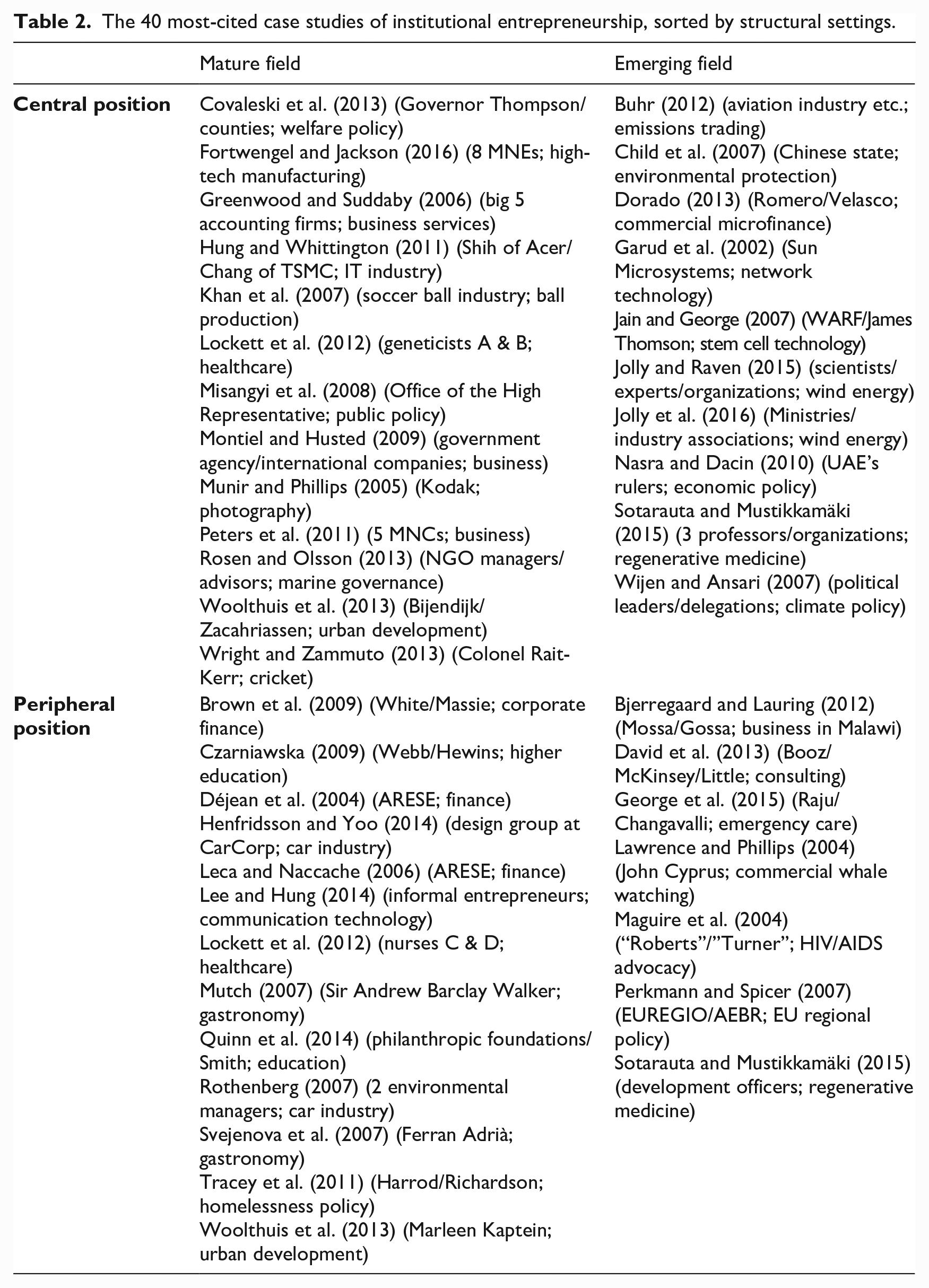
Each entry in Table 2 references the author’s name(s) and publication year, as well as the IE and the field of change described in the study (in brackets). Three case studies appear in two cells of the table because they describe both central and peripheral IEs (Lockett et al., 2012; Sotarauta & Mustikkamäki, 2015; Woolthuis et al., 2013). There are also some cases that raise the question of what does and what does not count as institutional entrepreneurship because they deal with ‘regular’ politics in the state arena (Child et al., 2007; Nasra & Dacin, 2010; Wijen & Ansari, 2007 and partly Covaleski et al., 2013; Jolly et al., 2016; Montiel & Husted, 2009) or with ‘regular’ strategic behaviour in a business environment (Rothenberg, 2007 and partly Bjerregaard & Lauring, 2012; Montiel & Husted, 2009). However, because these studies are nonetheless insightful regarding the role of resources in institutional entrepreneurship and because they are among the most-cited case studies of institutional entrepreneurship, we decided to keep them in the sample.
A brief look at Table 2 already yields some interesting observations. For example, slightly more case studies in the sample tackle institutional entrepreneurship in mature fields (24) than in emerging fields (16). This raises the question of whether changing existing institutions might be easier than building entirely new ones (see Jolly et al., 2016, p. 115). Another impression emerging from Table 2 is that the selected literature addresses central IEs and peripheral IEs in equal parts (23 and 20 case studies, respectively), resonating with Greenwood and Suddaby’s (2006) proposition that central actors are just as likely to pursue institutional change as peripheral field actors, although the entrepreneurial activities of peripheral IEs covered by our literature review unfold mainly in mature fields (13 case studies) rather than in emerging fields (7 case studies). It should be kept in mind, however, that our sample of case studies is not representative of institutional entrepreneurship ‘out there’ in the real world and may say as much about our selection criteria and the citation patterns of researchers as about the empirical phenomenon under study. In the following, we delve deeper into the 40 case studies of institutional entrepreneurship included in Table 2, exploring which resources IEs mobilize in different structural settings.
The resources of central IEs in mature fields
The first cell in Table 2 enumerates studies of 13 institutional entrepreneurship projects in mature fields pursued by central field actors. Interestingly, in 7 of those cases, the IEs in question were prominent companies or political bodies such as Canada’s Big Five accounting firms (Greenwood & Suddaby, 2006), which Fligstein and McAdam (2011, 2012) would call ‘incumbents’ and ‘governance units’, respectively. In the remaining cases, the IEs were individuals holding leading positions in dominant field organizations, such as British cricket reformer Colonel Rait-Kerr (Wright & Zammuto, 2013). In instigating institutional change, these powerful field organizations or high-level organizational representatives drew predominantly on organizational positional resources. 8
A closer look at the case studies shows how exactly central IEs use positional resources when pursuing change in mature fields. To begin with, IEs expend positional resources to which they have direct access, especially cultural and symbolic ones. In terms of cultural positional resources, the case studies mention financial records, ‘letters from the public’, a ‘scientific concept’ for marine governance, technical capabilities and in-house training programmes for staff (Greenwood & Suddaby, 2006, p. 40; Rosen & Olsson, 2013, p. 197; Wright & Zammuto, 2013, p. 58). As an illustrative example, the latter allowed Canada’s Big Five accounting firms to reduce staff’s ‘exposure to the profession’s normative influences’, making these professionals ‘more open to alternative logics’ such as a new organizational form – the multidisciplinary practice that combines ‘several professions, typically accounting and consulting, and, sometimes, law’ (Greenwood & Suddaby, 2006, pp. 27, 40). Relevant symbolic positional resources include reputation and ‘competence trust’ or ‘goodwill trust’, prestigious positions in not-for-profit organizations, and being perceived as a neutral broker (Hung & Whittington, 2011, p. 531; Peters et al., 2011, p. 66; Wright & Zammuto, 2013, p. 60).
More often than expending positional resources directly, however, central IEs in mature fields convert material positional resources into other resource types. For example, (cultural) expertise and (social) networks can be sourced in by hiring specialist staff or external consultants, just as (symbolic) legitimacy can be ‘bought’ through advertisement campaigns or a fear of expensive lawsuits (Fortwengel & Jackson, 2016, p. 903; Greenwood & Suddaby, 2006, p. 35; Hung & Whittington, 2011, p. 532; Munir & Phillips, 2005, p. 1673; Peters et al., 2011, pp. 75–76; Rosen & Olsson, 2013; Woolthuis et al., 2013, p. 97; Wright & Zammuto, 2013). Thus, when the Big Five set up multidisciplinary practices that included legal services, established Law Societies and Bar Associations did not challenge this because they ‘could not afford lengthy litigation with a [materially rich] Big Five firm’, winning the new multidisciplinary practices (symbolic) legitimacy (Greenwood & Suddaby, 2006, p. 39).
In the vast majority of cases, the conversion of social positional resources is used to gain access to the resources of other field members, such as (cultural) expert knowledge or insider information (Misangyi et al., 2008, p. 763; Woolthuis et al., 2013, p. 96; see also Ocasio et al., 2020, p. 311, who refer to this as ‘brokerage). As Greenwood and Suddaby (2006, p. 37) report: The ‘Big Five enjoyed unique access to the world’s most powerful corporate clients and through them learned of nascent consulting opportunities . . . not readily apparent to other firms’. Another way of cashing in on social positional resources is to collaborate with fellow incumbents, renowned civil society organizations or the media (‘bonding’ according to Ocasio et al., 2020, p. 312), thereby imbuing the envisioned change project with more structural legitimacy or social status, a symbolic positional resource (Fortwengel & Jackson, 2016; Greenwood & Suddaby, 2006, pp. 39–40; Khan et al., 2007, pp. 1063–1064; Misangyi et al., 2008, p. 761; Montiel & Husted, 2009, p. 354; Peters et al., 2011, p. 66). Finally, social networks with governance units such as politicians or high-level bureaucrats can be mobilized to remove reservations or resistance against institutional change (Fortwengel & Jackson, 2016, pp. 902–903; Woolthuis et al., 2013, p. 97).
In summary, our literature review shows that powerful, central IEs in mature fields tend to either directly expend cultural and symbolic positional resources or to convert material and especially social positional resources into other desired resource types. Next, we turn to central IEs entering emerging fields, discussing to what extent they are able to take their positional resources ‘with them’.
The resources of central IEs in emerging fields
As with central IEs in mature fields, virtually all central IEs in emerging fields portrayed by the reviewed case studies were large companies, powerful political bodies, or individuals holding leading positions in prominent field organizations. Their powerful position in a mature field capacitated those IEs to export at least some of their organizational positional resources to emerging fields. 9
As we delve deeper into the cited case studies, it emerges that when organizational actors pursue institutional change in emerging fields, these are often state organizations implementing regulations or incentives that give rise to new lower-level or adjacent fields (Child et al., 2007, pp. 1022–1023; Jolly et al., 2016; Jolly & Raven, 2015, p. 1003; Nasra & Dacin, 2010). Also when companies or individuals act as IEs in emerging fields, they often do so by harnessing the formal powers and influence – i.e. political resources – of state actors, thereby ‘bridging’ or importing resources from the political system as a higher-level mature field (Maguire et al., 2004, p. 668). An illustrative example is the Wisconsin Alumni Research Foundation (WARF): The technology transfer office of the University of Wisconsin-Madison supported the development and commercialization of a novel and ethically contested technology, human embryonic stem cell (hESC) technology, by collaborating with ‘political allies’, including Wisconsin’s Governor Thompson, who later became Secretary of the US Department of Health and Human Services (Jain & George, 2007, p. 551; see also Buhr, 2012; Jolly et al., 2016, p. 112). Yet in order to access Governor Thompson and win him over for hESC technology, WARF first had to expend social (network) resources.
In fact, apart from political resources, nearly all of the other resources applied by central IEs in emerging fields are social positional resources imported from IEs’ ‘home’ fields (Buhr, 2012, pp. 1576, 1578; Dorado, 2013, pp. 543–545; Garud et al., 2002, p. 202; Jain & George, 2007, pp. 543–545; Jolly et al., 2016, pp. 110–112; Jolly & Raven, 2015, pp. 1003, 1005–1007; Nasra & Dacin, 2010, p. 596; Sotarauta & Mustikkamäki, 2015, pp. 350–351, 353; Wijen & Ansari, 2007, p. 1090). By providing access to the material, cultural, symbolic or political resources of other actors from mature fields, social resources play a crucial role in catalysing institutional entrepreneurship in emerging fields. As an example pertaining to social resource access opening up pathways to material resources, WARF teamed up with the Californian biotechnology company Geron that provided ‘critical seed finance’ for stem cell research at the University of Wisconsin-Madison (Jain & George, 2007, p. 545). In this way, a central IE’s importation of social and material resources from an older and higher-level field (biotechnology) saved the emerging field of human embryonic stem cell research and technology from ‘an early demise’ (Jain & George, 2007, p. 538).
In essence, our literature review shows that central players seeking to build new institutions in emerging fields rely predominantly on imported positional resources, especially political ones – either their own political resources or those of other actors by way of converting social positional resources, although social resources are also exchanged for other resource types. Peripheral IEs, to which we turn next, must find other ways to build or change institutions, being poor in positional resources.
The resources of peripheral IEs in mature fields
When peripheral actors pursue institutional change projects in mature fields, these are often individuals without strong organizational backing (such as Ferran Adrià, who became an haute-cuisine legend in Spain; see Svejenova et al., 2007). Also visionary leaders of peripheral organizations spearhead institutional change in mature fields, such as Geneviève Férone of the French social rating agency ARESE (Déjean et al., 2004; Leca & Naccache, 2006).
Free field resources play a role in 11 of the 13 case studies at hand. Especially publicly discussed cultural concepts such as ‘sustainable development’, ‘corporate social responsibility’, ‘patient voice’ or ‘third way’ policies are mobilized by peripheral IEs in the process of generating new ideas and support in mature fields (Brown et al., 2009, pp. 183, 188; Lockett et al., 2012, p. 361; Tracey et al., 2011, p. 73; Woolthuis et al., 2013; see also Czarniawska, 2009, pp. 427, 431; Lee & Hung, 2014, pp. 21–22, 24; Quinn et al., 2014, p. 956; Rothenberg, 2007, p. 755). As an illustrative example, the French environmental and social rating agency ARESE drew on existing financial indexes as well as the cultural trope of ‘measurement’ in modelling an innovative measure of corporate social performance that was so appealing to the financial community that ‘by 2001 ARESE had managed to obtain 85% of French ethical funds as clients’ (Déjean et al., 2004, p. 755; Leca & Naccache, 2006, pp. 636, 639–640; see also Battilana & Leca, 2009, p. 266). In some cases, also free material resources are cited in the case studies as helping peripheral IEs in spearheading or diffusing change in mature fields, such as the internet and Google’s Android system – the latter as a basis for the world’s first Android-based platform, an open car communications platform (Brown et al., 2009, p. 192; Henfridsson & Yoo, 2014, pp. 937, 939; Lee & Hung, 2014, p. 25).
Personal cultural resources in the form of skills are often described as being key for the mobilization of free resources (see Tracey et al., 2011, p. 73). In particular, the case studies cite communicative skills such as framing and convincing, and social skills such as empathizing and liaising as mediating access to free resources (Brown et al., 2009, pp. 193–194; Czarniawska, 2009, pp. 429, 431; Déjean et al., 2004, p. 752; Leca & Naccache, 2006, p. 640; Lee & Hung, 2014, pp. 23–25; Lockett et al., 2012, p. 361; Quinn et al., 2014, p. 956; Rothenberg, 2007, p. 753; Tracey et al., 2011, p. 67). Personal skills are also emphasized as pivotal for mobilizing social network contacts and converting them into material resources (funds, profits, rooms, personnel), other cultural resources (expertise), or legitimacy as a symbolic resource (Brown et al., 2009, pp. 192–193; Czarniawska, 2009, pp. 429, 433; Lee & Hung, 2014, pp. 26–29; Lockett et al., 2012, p. 359; Rothenberg, 2007, p. 753).
As a further observation, in many cases, the resources gained through the skilful conversion of resources helped peripheral IEs to become more established in the field and thus to become owners of positional resources themselves, which in turn could be exchanged for further financial, social and political support from governance units or field incumbents (Brown et al., 2009, pp. 183, 194; Czarniawska, 2009, pp. 426–428, 433–434; Lee & Hung, 2014, pp. 27–29; Lockett et al., 2012, pp. 360–361; Quinn et al., 2014, p. 957; Tracey et al., 2011, pp. 67, 74; Woolthuis et al., 2013, pp. 96–97). This stands in some contrast to Fligstein (2001, p. 107), who assumes that skills as a particular form of personal cultural resource matter primarily in emerging fields, not in mature ones: ‘[W]here rules and resources are heavily weighted towards the most powerful groups, social skill might matter little. . . . Where there is more social turbulence or uncertainty, social skill can play a pivotal role . . . Moreover, in the founding of orders, social skill usually comes to the fore (see also Fligstein & McAdam, 2012, pp. 54, 183).’
Beside the aforementioned skills, also other forms of personal resources aid peripheral IEs in fostering institutional change in mature fields. For instance, the case studies cite education, expertise and professional experience – cultural resources (Czarniawska, 2009, p. 429; Lockett et al., 2012, p. 361; Mutch, 2007, p. 1133; Quinn et al., 2014, p. 956; Tracey et al., 2011, pp. 67, 70). As a case in point, ARESE’s founding CEO Geneviève Férone understood that only ‘individuals with both a knowledge of the financial markets or rating processes and a sensitivity to corporate social responsibility’ would be able to develop a successful new measure of corporate social performance (Battilana & Leca, 2009, p. 266). In addition to cultural resources, peripheral IEs in emerging fields also draw on a variety of other personal resources such as (material) money, (symbolic) public fame and especially (social) family ties, grassroots networks, professional networks and elite contacts (Brown et al., 2009, p. 191; Czarniawska, 2009, pp. 426, 433; Lee & Hung, 2014, p. 26; Mutch, 2007, pp. 1133–1134; Quinn et al., 2014, p. 963; Svejenova et al., 2007, pp. 544, 548–551; Tracey et al., 2011, p. 74; Woolthuis et al., 2013, p. 96). 10
Overall, our literature review thus shows that peripheral IEs in mature fields draw predominantly on free resources and personal resources. As an additional insight, skills as a particular form of personal cultural resource are often described as playing a key role in the mobilization of free resources in mature fields, not just in emerging fields as expected. Furthermore, the reviewed case studies suggest that skilful resource conversion may enable peripheral IEs in mature fields to generate and accumulate new positional resources that open up entirely new avenues for resource exchanges with field incumbents or governance units.
The resources of peripheral IEs in emerging fields
As in mature fields, peripheral IEs in emerging fields are usually individuals who make use of free resources and personal resources due to a lack of positional resources. Looking deeper into the case studies cited in the fourth cell of Table 2, it appears that the skilful mobilization of free resources stemming from other fields is cited in virtually all cases. For instance, David et al. (2013, p. 367) explain that ‘pioneers of the professional form of management consulting relied on categories of expertise that were external to their field because no internal categories of expertise had yet been established’.
Beside free resources, peripheral IEs embarking on institution-building projects in emerging fields sometimes rely on their personal resources, such as cultural resources in the form of education and professional experience, and especially discursive, framing and brokering skills (Bjerregaard & Lauring, 2012, pp. 37–39; David et al., 2013, pp. 364–365; George et al., 2015, pp. 45, 47; Maguire et al., 2004, p. 669; Perkmann & Spicer, 2007, p. 1114; Sotarauta & Mustikkamäki, 2015, p. 350). In addition, material personal resources such as money or land, symbolic personal resources such as being gay and HIV positive, and social personal resources such as personal networks play a role (Bjerregaard & Lauring, 2012, pp. 37, 39; George et al., 2015, p. 45; Maguire et al., 2004, p. 666). Once again, many instances of the conversion of one resource type into another are indicated in the case studies. As an illustrative example, the personal (social) ‘elite networks’ of the American management consulting pioneers Edwin Booz, James O. McKinsey and Arthur Little ‘ranged far beyond the boundaries of the cities where they lived, encompassing nationally recognized individuals and national organizations’. By affiliating with these elites, ‘Booz, McKinsey, and Little increased their own prestige [a symbolic personal resource] and so increased the likelihood that observers would view their ventures as culturally appropriate’ (a symbolic positional resource), eventually resulting in more and better (material positional) business opportunities (David et al., 2013, p. 368).
Interestingly, in all but one of the reviewed cases of peripheral institutional entrepreneurship in emerging fields, individual IEs without strong organizational backing were at the forefront of institution-building. Yet during later stages of institutional innovation, powerful field organizations emerged or took over, working towards diffusing the new institutional blueprints throughout the field, thereby consolidating the emergent field (a similar observation can be found in De Clercq & Voronov, 2009, p. 399). As a case in point, the early management consulting pioneers described by David et al. (2013, p. 369) instigated the creation of the Association of Consulting Management Engineers that ‘establish[ed] a code of ethics that formally defined norms for professional consulting firms’ (see also George et al., 2015; Lawrence & Phillips, 2004, p. 701; Perkmann & Spicer, 2007, pp. 1005, 1113; Sotarauta & Mustikkamäki, 2015, p. 350).
The case studies in our review sample indicate that organizational positional resources become paramount in these later stages of institutional entrepreneurship in new fields. On the one hand, this concerns resources that are tied to organizations founded by successful, albeit formerly peripheral, individual IEs. Examples include material resources such as ambulances produced at a very low cost, and social resources such as a pan-European network of municipalities (George et al., 2015, pp. 50, 54; Perkmann & Spicer, 2007, p. 1111; see also Lawrence & Phillips, 2004, p. 700). On the other hand, the organizations walking in the footsteps of pioneering individual IEs may access the positional resources of other field organizations by converting newly accrued social positional resources into, say, business opportunities or material resources (e.g. a large volunteer network), cultural resources (e.g. knowledge of HIV/AIDS treatment options) and (symbolic) legitimacy or (political) influence through collaboration with more influential actors (David et al., 2013, pp. 367, 370–371; George et al., 2015, pp. 47, 51–55; Maguire et al., 2004, p. 668; Perkmann & Spicer, 2007, pp. 1109–1115).
In conclusion, our literature review shows that peripheral IEs in mature fields, who are often individuals with few positional resources, rely first and foremost on the skilful mobilization of – often cultural – free resources from higher-level or adjacent fields. Also other forms of – directly expendable or convertible – personal resources play a role. Yet during later stages of institutional entrepreneurship, the positional resources of IE-founded or external organizations are portrayed as becoming much more important for stabilizing emergent institutional fields. Although this observation is based on a limited sample of case studies, it is in line with Maguire et al.’s (2004, p. 675) claim that ‘the development of a comprehensive theory of institutional entrepreneurship requires more attention to differences between organizational and individual actors’.
Discussion and Conclusion
This article investigated how IEs’ structural embeddedness influences their resource portfolio and hence their ability to pursue and implement institutional change. Heeding Battilana et al.’s (2009, p. 76) call for ‘[m]ore comparative studies’ on the ‘interaction effect between field-level characteristics and actors’ social position’, we drew on sociological theory (particularly the work of Giddens, Bourdieu and Fligstein) in combination with theoretical insights from the institutional entrepreneurship literature to carve out the building blocks of a theoretical framework distinguishing between different types of resources, field positions and fields’ degrees of institutionalization. In a second step, we revisited the 40 most-cited empirical case studies of institutional entrepreneurship to build a context-sensitive framework of strategic institutional change. Below, we summarize the main insights that emerged from this two-step theory-building process (see also Table 3).
Key resources of IEs in different types of structural setting.

Our literature review affirmed that IEs’ structural embeddedness in terms of their current and former field memberships and field positions ‘produces’ not only IEs’ personal ‘interests, skills and stocks of knowledge’ (Hardy & Maguire, 2017, p. 265), but also different types of field resources that IEs mobilize. Thus, central IEs (who are usually organizations or higher-level executives of powerful field organizations) rely mainly on organizational positional resources. More specifically, in mature fields, central IEs often directly ‘cash in’ cultural and symbolic positional resources, while material and social positional resources serve as exchange currencies in accessing other resource types. In emerging fields, by contrast, central IEs rely predominantly on imported political positional resources – either their own political resources or those of powerful third actors, which can be accessed by converting social positional resources.
Peripheral IEs, who are usually private individuals or members of powerless field organizations, draw primarily on their personal resources and above all their skills in mobilizing free field resources, especially cultural ones and to some degree material ones. This finding also has a bearing on Fligstein’s (2001, p. 107) tenet that social skill ‘usually comes to the fore’ in ‘the founding of orders’, because our literature review revealed that the usage of skills in institutional entrepreneurship is more a matter of (a peripheral) field position than of a field’s (low) degree of institutionalization. Another interesting finding of our meta-analysis of the 40 most-cited case studies of institutional entrepreneurship is that peripheral IEs in mature fields may use personal skills for creating entirely new positional resources, which can then serve as an exchange currency in resource trades with more central field actors. In emerging fields, by contrast, successful peripheral IEs are usually superseded by more resource-rich and thus central organizational actors.
As a final key insight, our literature review indicated that a central or peripheral field position makes no real difference for actors’ likelihood to become IEs. This stands in stark contrast to arguments in the literature that depict peripheral field actors as being more inclined, but less able, to challenge the status quo than field incumbents (see for example Levy & Scully, 2007, p. 975; Maguire et al., 2004, p. 668; Weik, 2011, p. 475). At the same time, our literature review suggests that central IEs have an easier time building new institutions in emerging fields than peripheral IEs because central IEs have better access to resources that can be imported from adjacent fields – which are needed for institution-building in emerging fields. Because our literature review covers only 40 case studies of institutional entrepreneurship, however, more systematic analyses would be needed to substantiate these suppositions.
While shedding more theoretical light on the impact of IEs’ structural embeddedness on institutional change processes, this article also raises some questions for further theory-building and research. For example, IEs’ resource portfolio might be influenced not only by IEs’ field position and fields’ degree of institutionalization, but also by other structural configurations such as dominant field logics that shape field actors’ perceptions, preferences and problem assessments (Battilana, 2006, p. 660; Misangyi et al., 2008, pp. 756–757). Furthermore, it remains an open question to what degree IEs’ structural embeddedness influences their ability to mobilize resources during different stages of institutional entrepreneurship (Battilana & Leca, 2009, p. 270), particularly during the stages of envisioning change, overcoming resistance and diffusing change (Battilana & Leca, 2009, pp. 265–267, 270; see also DiMaggio, 1988, pp. 14–16).
Another interesting arena for future theory-building endeavours is the importation of resources across field boundaries: are all resources importable, and are imported resources just as valuable as resources stemming from the field of institutional entrepreneurship? This also relates to the under-studied process (and preconditions) of resource conversion, which warrants more theoretical attention than it could receive in this article. In addition, in the context of the mobilization of resources, the role of skills deserves more nuanced attention (see the seven skill dimensions in institutional entrepreneurship identified by Fohim, 2019).
As a final point, the sufficiency of resources is still a theoretical black box: can it be known ex ante or only in retrospect which actors dispose of sufficient resources for institutional entrepreneurship? This question also has a bearing on the influence of social milieus as a specific type of structural setting on individuals’ likelihood to become IEs. Our reading of the institutional entrepreneurship literature has left us with the impression that individuals who engage in institutional entrepreneurship are usually academically trained members of the upper-middle and upper classes, which would mean that milieus play a critical role in shaping the personal resources and particularly skills of IEs. However, as the class aspect is seldom addressed in case studies of institutional entrepreneurship, more research would be needed to corroborate this assumption.
In concluding, our resource-focused account of institutional entrepreneurship puts theoretical flesh to the bone of the claim that IEs’ agency is structurally embedded. As we have argued and demonstrated, many of the resources that IEs draw on in pursuing institutional change are not personal, but rooted in field structures and power positions within fields. However, even the personal resources of individual IEs (including skills) bear a relation to field structures, being ‘souvenirs’ from IEs’ life-long travels through various sub-fields of the social space. Therefore, future case studies of institutional entrepreneurship should pay more systematic attention to the structural settings in which IEs navigate (e.g. mature or emerging fields and central or peripheral field positions) and the way in which those settings do or do not endow IEs with resources that make institutional innovation or change possible.
Footnotes
Acknowledgements
This article has a long history – we began working on it in 2017. We are deeply indebted to a number of reviewers who helped us develop our thoughts further over the years, most of all two anonymous reviewers at Organization Theory and Eva Boxenbaum, Associate Editor of Organization Theory. Without their invaluable feedback, this article would not be what it is today.
Declaration of Conflicting Interests
The author(s) declared no potential conflicts of interest with respect to the research, authorship, and/or publication of this article.
Funding
The author(s) received no financial support for the research, authorship, and/or publication of this article.