



Abstract
Informal entrepreneurship (IE) has received increased recognition because of its theoretical distinctiveness and practical relevance. However, the burgeoning literature on IE is difficult to navigate, due to its rapid growth across different disciplines. Through an integrative review, we introduce a novel typology of informal entrepreneurs that captures their heterogeneity across various contexts. We point out a dynamic perspective of IE, consisting of three pathways—the reactive formalizing, the proactive formalizing, and the informalizing pathways—along which informal entrepreneurs move, acquiring or foregoing regulative legitimacy. Our review extends the theory on IE, outlines promising research avenues, and suggests relevant practical implications.
Informal entrepreneurship (hereafter IE) is a globally widespread phenomenon (Autio & Fu, 2015; Dau & Cuervo-Cazurra, 2014; Omri, 2020; Thai & Turkina, 2014). It refers to those “entrepreneurial activities that are illegal yet remain legitimate to large groups in a society” (Webb et al., 2020, p. 511). Such entrepreneurial activities are undertaken by individual informal entrepreneurs who identify and exploit opportunities (Bygrave & Hofer, 1992; Ireland & Webb, 2007; Shane, 2003) in a socially accepted manner, while not complying with all of the legal requirements associated with the provision of goods and services in a given country (e.g., unregistered activities, off-the-book business transactions).
The latest Global Entrepreneurship Monitor (GEM) report indicates that IE is a highly prevalent and important phenomenon worldwide (Bosma et al., 2021). It represents about 60% of total entrepreneurial activities in developed and transition economies, and above 90% in developing economies (Autio & Fu, 2015). IE may lead to negative macro-level consequences, such as tax revenue loss and unfair competition toward formal firms (Webb et al., 2013). Nevertheless, it is regarded as a viable form of employment in developing and transition economies (Lee & Hung, 2014; Maloney, 2004), and as a source of innovation in more developed economies (Choi & Perez, 2007). Due to its global prevalence and high importance, IE has received increasing scholarly attention over the last two decades (Bruton et al., 2012; Darbi et al., 2018).
Management and entrepreneurship scholars’ growing interest in IE is attested by the increasing number of publications on IE in leading journals (e.g., Godfrey, 2011; Siqueira et al., 2016; Thai & Turkina, 2014; Thapa Karki et al., 2020; Webb et al., 2009). Three recent literature reviews have started highlighting various aspects of IE, from bibliometric analysis (Santos & Ferreira, 2017), to links to broader management research (Darbi et al., 2018), to the value of formalization for women entrepreneurs in developing economies (Xheneti et al., 2019b).
However, the heterogeneity and multidisciplinary nature of the literature on IE makes it difficult to navigate, and IE research opportunities and gaps remain unclear (Godfrey, 2011; McGahan, 2012; Webb et al., 2013). To connect disparate themes, such as the occurrence (e.g., Khavul et al., 2009; Kistruck et al., 2015; Siqueira et al., 2016), the antecedents (e.g., Blake et al., 2015; Bruhn, 2013; Thai & Turkina, 2014), and the outcomes of IE (e.g., Choi & Perez, 2007; Klein, 2017; Lee & Hung, 2014), we conduct an integrative review (Elsbach & van Knippenberg, 2020; Torraco, 2016). We aim to address the following research questions: What are the different types of informal entrepreneurs and how do they vary across contexts? What are the main entrepreneurial activities they undertake? Why do they do so and with what consequences?
To provide answers to these questions and to channel the progress of knowledge, we organize, synthesize, and critically analyze research on IE. Then, we cross-pollinate it with insights from various disciplines, such as management, economics, sociology, and political science, which represent the most widely adopted perspectives in this area (Bruton et al., 2012; Godfrey, 2011). Our theoretical contributions are threefold. First, we provide a novel typology highlighting the heterogeneity of informal entrepreneurs across economies. Second, we extend the theory on IE by introducing a new dynamic perspective that explains how informal entrepreneurs move along the continuum of informality to either increase or decrease regulative legitimacy for their entrepreneurial activities. In doing so, we bring synthetizing coherence to the IE literature by “reinterpreting existing work to show underlying consensus” (Locke & Golden-Biddle, 1997, p. 1034). Third, we draw on our novel typology and new dynamic perspective of IE to establish a forward-looking research agenda (Bacq et al., 2021; Breslin & Gatrell, 2020) for the field of IE. This research agenda leverages interesting insights, gaps, and anomalies from past work (Nadkarni et al., 2018; Shepherd & Wiklund, 2020) to outline promising avenues for research and practice.
Integrative Review
To conduct our integrative review (Elsbach & Knippenberg, 2020; Patriotta, 2020; Post et al., 2020; Torraco, 2005, 2016), we followed a transparent procedure, which consists of two main phases: data collection and data analysis. For the sake of rigor and replicability (Tranfield et al., 2003), we describe each phase in detail.
Data Collection
In the first phase, we searched for articles published on IE in five databases (Business Source Premier, Econlit, Scopus, SocIndex, and Thomson Reuters Web of Science). To capture the breadth and depth of IE research, we used the following search terms: (“informal” OR “underground” OR “shadow” OR “illegal” OR “off-the-books” OR “hidden” OR “unregistered” OR “undocumented” OR “unreported”) and at least one entrepreneurship search term: (“entrepreneur*” OR “enterpris*” OR “ventur*” OR “business*” OR “activit*” OR “firm*”). We focused on academic articles published in English up to the end of 2020, without including a start date. This search in the five databases yielded a total number of 6096 articles. After the database search, we ran a first screening to exclude all duplicates and non-academic sources. This reduced the number of articles to 5518.
To narrow down our selection further and to set the conceptual boundaries for our analysis, we drew on the definition of IE as those “entrepreneurial activities that are illegal yet remain legitimate to large groups in a society” (Webb et al., 2020, p. 511). Therefore, we ran a first title and abstract analysis to exclude all the academic articles that focused on activities that did not meet this definition, that is, non-entrepreneurial activities, legal entrepreneurial activities, and illegitimate entrepreneurial activities. This led to a total number of 1155 academic articles.
Then, we analyzed the bodies of text more in-depth and removed all articles that, despite referring to IE in the title or in the abstract, did not focus on IE in the core of the article but referred mainly to other activities, such as informal employment or illegal forms of behavior in large corporations. We also excluded all the articles referring to IE in the abstract but focusing mainly on the informal economy, which includes IE but is much broader, since it also embraces other activities. These include unpaid domestic work, unpaid community, voluntary work, and undeclared work (Williams & Nadin, 2012b). The content analysis yielded a final number of 352 peer-reviewed journal articles, which we included in our integrative review.
Data Analysis
In the second phase, we analyzed the 352 articles inductively, following a bottom-up approach to allow the data to speak for itself (Strauss & Corbin, 1990) and to let novelties, anomalies, and gaps emerge (Breslin & Gatrell, 2020; Shepherd & Wiklund, 2020). The inductive coding approach we used to analyze the journal articles on IE is analog to the grounded theory approach employed for the analysis of interview data in qualitative research (Gioia et al., 2013). Specifically, our inductive approach follows the guidelines by Tranfield et al. (2003) and is similar to the one adopted in other review articles. These tend to be “inductive or grounded in approach, with theoretical frameworks and research agendas emerging from the papers examined as part of the review” (Post et al., 2020, p. 362).
The three authors formed the coding team. The first and the second author coded 20% of the articles independently for the identification of first-order codes. In 90% of the cases, the independent coding process led to analogous results. In the remaining 10% of the cases, there were coding discrepancies, due to differing interpretations of the same text (Campbell et al., 2013). In these cases, both authors discussed and re-iterated the coding process until reaching 100% intercoder agreement (Campbell et al., 2013). This enabled the first author to identify the remaining first-order codes through a highly reliable and accurate coding procedure. In total, the coding process led to 150 first-order codes, which gradually developed into second-order themes (Gioia et al., 2013). Then, the entire coding team went through several rounds of iteration and discussion about the meaning of each second-order theme, how it emerged, and which first-order codes it entailed. This ensured that each article was assigned to the themes that better reflected its key contributions, aim, and scope (Breslin & Gatrell, 2020), while redundant themes were removed. This process led to a total of 13 second-order-themes, which we further clustered into four aggregated categories (Gioia et al., 2013) (Figure 1). Data structure.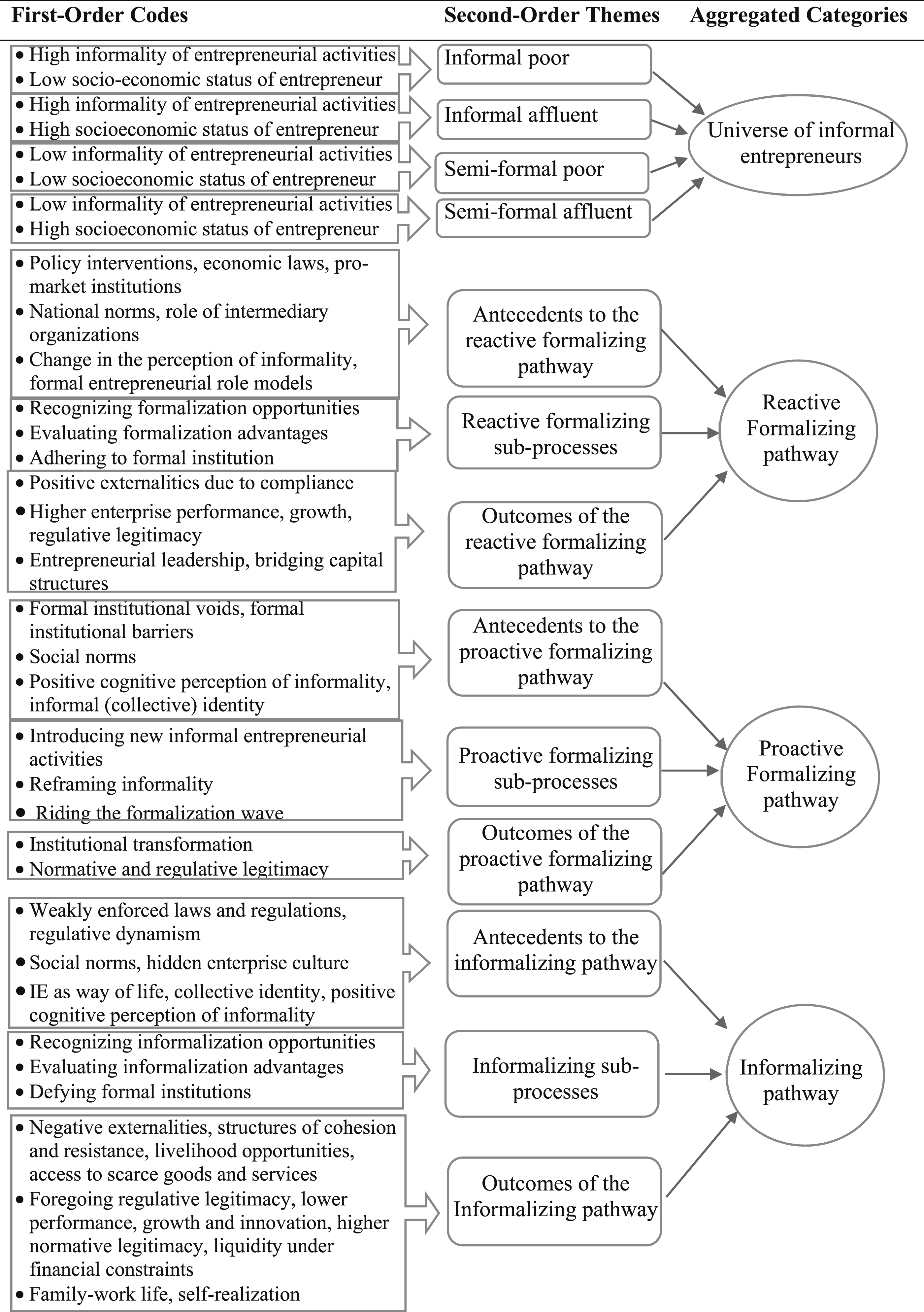
The first category relates to the empirical phenomenon of IE and refers to the universe of informal entrepreneurs at the individual level, whom we grouped into four types: the informal poor, the informal affluent, the semi-formal poor, and the semi-formal affluent. The second and third categories relate to the reactive and proactive formalizing pathway, along which informal and semi-formal entrepreneurs move to acquire regulative legitimacy. The fourth category relates to the informalizing pathway, along which informal and semi-formal entrepreneurs move, foregoing regulative legitimacy. Before explaining each category in-depth, we map the field of IE by providing a descriptive overview of the articles included in our review.
Mapping the Field
The first study relating IE was published in 1987 by Lesieur and Sheley in the journal “Social Problems” and considers IE as a form of deviant economic behavior. The study refers to informal entrepreneurs running illegal appended businesses of line gambling in New York. These types of businesses were illegal and yet legitimate, that is, they were socially accepted. Formally banned by the government, a widespread subculture fostered them and continues to do so to date.
In the 1990s, a number of scholars started to describe other phenomena, which could be ascribed to IE (e.g., Hartog & Zorlu, 1999; Hisrich & Grachev, 1993; House et al., 1993; Tsang, 1994). As such, IE in communist states took the shape of any private business being banned by the centrally planned economic system, and yet being socially accepted by the population subjected to a climate of resource scarcity (Hisrich & Grachev, 1993; Tsang, 1994). In developing economies, IE was seen as a solution to high poverty and unemployment rates (Espinal & Grasmuck, 1997; House et al., 1993; Kesteloot & Meert, 1999). IE in developed economies tended to the so-called “under-class” (Hartog & Zorlu, 1999; Leonard, 1998).
Overall, we identify two phases related to the trend of academic publications on IE (Figure 2). The first phase goes from 1987 to 2008 and includes 61 articles (17% of the total sample). The second phase starts in 2009 with the publication of two seminal articles by Webb et al. (2009) and Godfrey (2011), which created a spike of scholarly interest for IE; it includes 291 articles (83% of the total sample) from 2009 to 2020. Number of journal articles on IE, 1987–2020.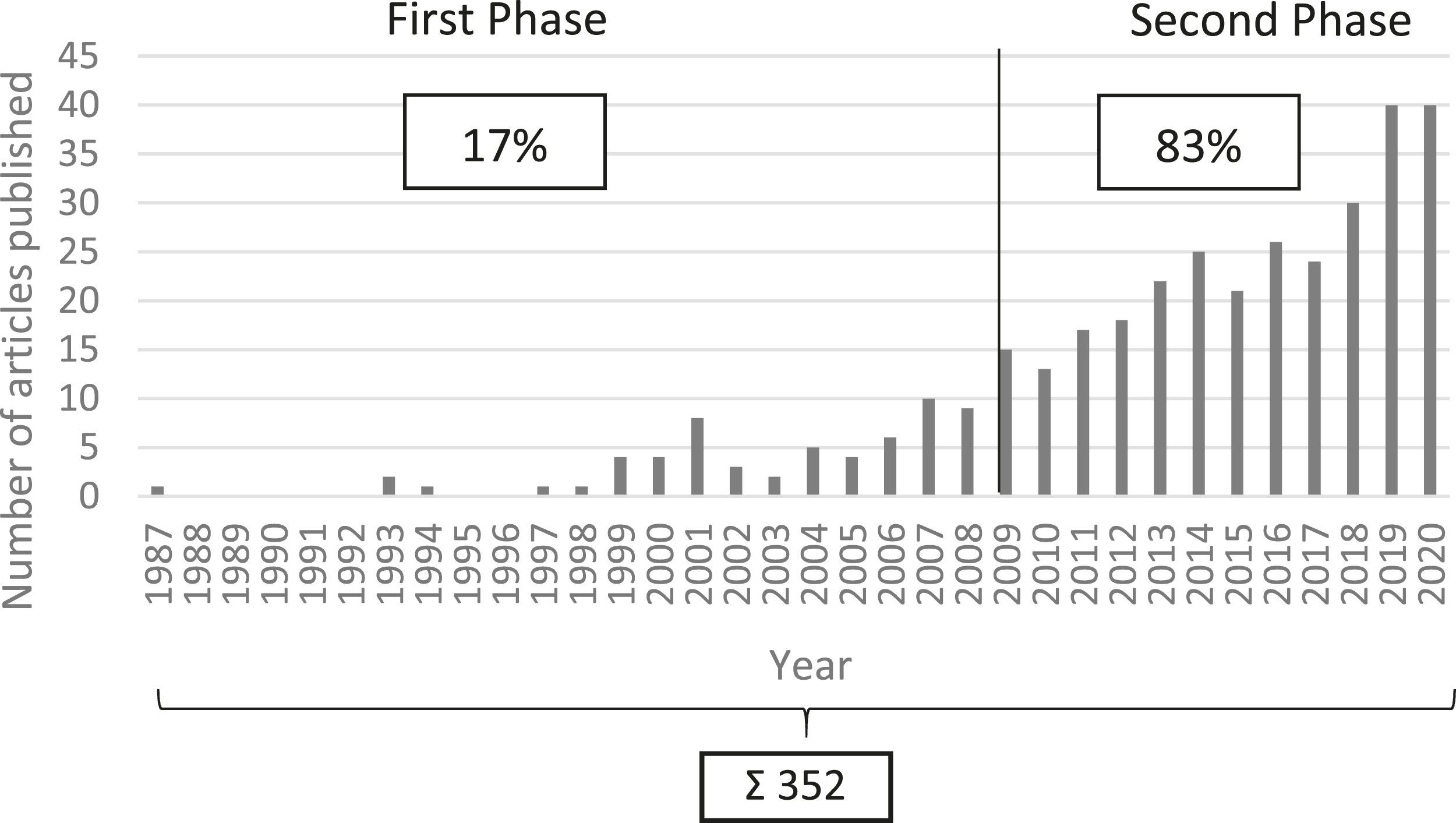
The first phase is characterized by more descriptive articles on IE. The second phase of publications on IE reflects the increasing dissemination of statistical data on informal entrepreneurial activities (Santos & Ferreira, 2017). Moreover, it witnesses the increasing recognition of IE as a relevant phenomenon that can be investigated from a multidisciplinary perspective (Darbi et al., 2018; Ketchen et al., 2014; McGahan, 2012). The 352 peer-reviewed academic articles on IE published until 2020 span the disciplines of entrepreneurship (44%), economics (18%), management (12%), development studies (9%), sociology (8%), geography (4%), political science (3%), and other disciplines (2%). Most articles on IE (36 out of 352, or 10%) are published in the Journal of Developmental Entrepreneurship. The other articles on IE are dispersed across a number of journals, including leading entrepreneurship journals like Entrepreneurship Theory and Practice (e.g., Siqueira et al., 2016; Webb et al., 2020; Welter et al., 2017; Williams et al., 2017) and the Journal of Business Venturing (e.g., Aidis & van Praag, 2007; Dau & Cuervo-Cazurra, 2014; Hisrich & Grachev, 1993; Kistruck et al., 2015; Sutter et al., 2017; Thai & Turkina, 2014).
Currently, the field of research on IE is at an intermediate stage and includes mainly empirical articles exploring relationships among constructs (Edmondson & McManus, 2007). Indeed, this review includes 304 empirical articles (86%) as compared to 48 conceptual articles (14%) (Figure 3). Conceptual and empirical articles on IE, 1987–2020.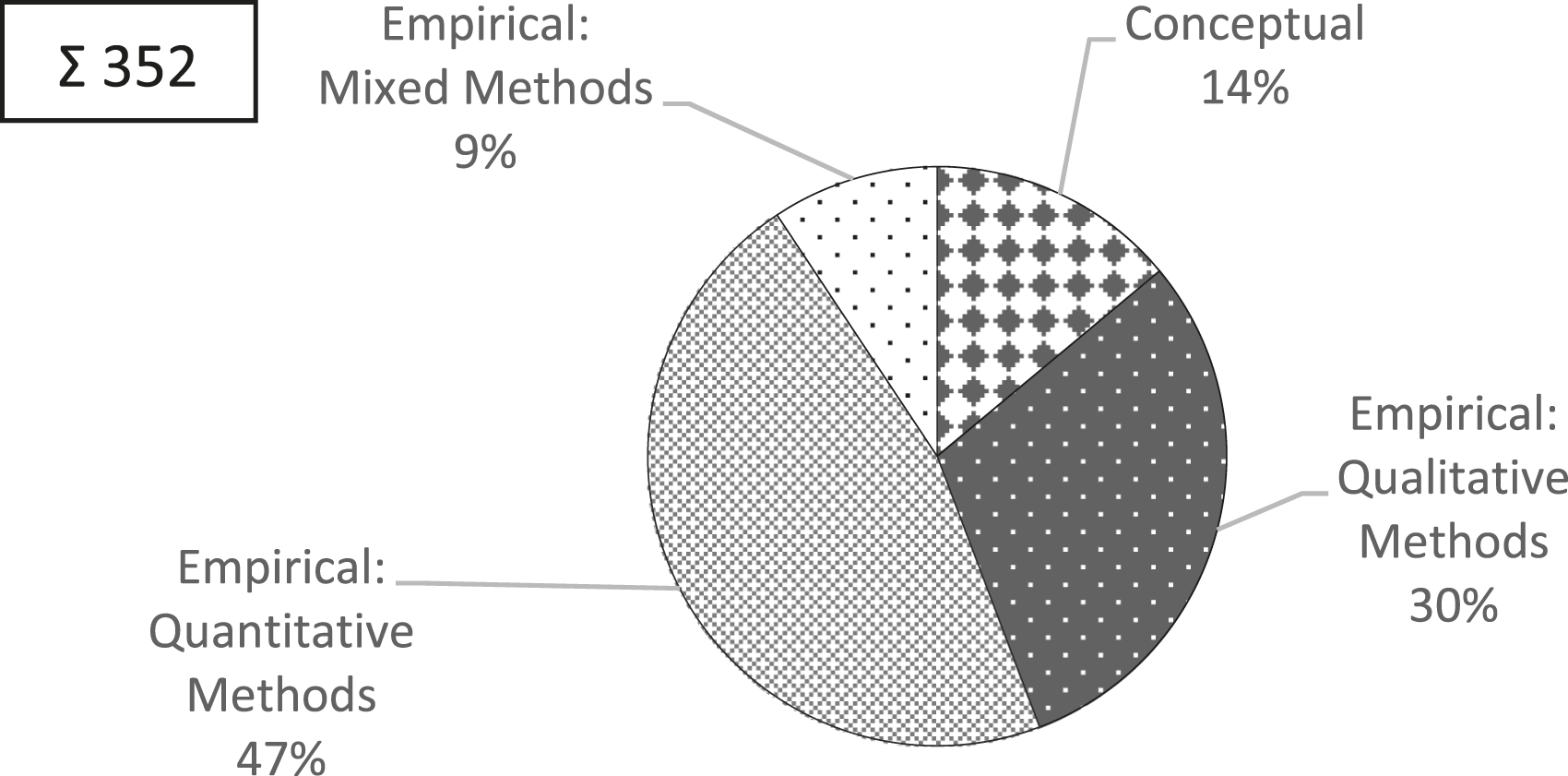
Most empirical articles employ quantitative methods and draw mostly on secondary data, which are made increasingly accessible by the World Bank, the Global Entrepreneurship Monitor, and the International Labor Organization. The majority of them (52%) focus on developing economies, which are characterized by the highest rates of IE (Acs et al., 2008; Autio & Fu, 2015; Dau & Cuervo-Cazurra, 2014). 20% focus on developed economies, where informality is common, especially at an early stage of the entrepreneurial process (Williams et al., 2017). Another 17% of the articles focus on transition economies, such as USSR, China, and East European economies (e.g., Aidis & van Praag, 2007; Lee & Hung, 2014). Finally, 11% of the articles draw cross-region comparisons to explain the antecedents and the outcomes of IE (e.g., Thai & Turkina, 2014; Williams & Kedir, 2018).
These insights indicate that IE has attracted increasing scholarly attention across the globe and different economies. Yet to reach a more mature stage, characterized by empirical articles testing relationships among established constructs (Edmondson & McManus, 2007), the field needs synthetizing coherence (Locke & Golden-Biddle, 1997). To fully comprehend the universe of informal entrepreneurs and how they vary across contexts, in the next section we shed light on those individuals who engage in “entrepreneurial activities that are illegal yet remain legitimate to large groups in a society” (Webb et al., 2020, p. 511).
The Universe of Informal Entrepreneurs: A Typology
When one thinks of informal entrepreneurs, it is common to visualize small producers or street vendors in developing economies, following the cliché that informal entrepreneurs are poor and engage in low performing, labor-intensive, entrepreneurial activities hidden from governmental authorities. However, the articles included in our integrative review reveal a much more nuanced picture. Taken together, they portray a largely heterogeneous body of informal entrepreneurs, which we summarize into a novel, comprehensive typology, transcending the usual cliché. The 2 × 2 matrix in Figure 4 provides an overview of this heterogeneity, characterized along two dimensions: the levels of informality of entrepreneurial activities undertaken by a given informal entrepreneur, and the socioeconomic status of a given informal entrepreneur, defined as their social standing in society in terms of income, education, and occupation (Bradley & Corwyn, 2002; Reynolds, 1991). Notwithstanding the number of dimensions used in previous studies to describe informal entrepreneurs (e.g., Carneiro-da-Cunha & Rossetto, 2015; Gibbs et al., 2014; Williams & Nadin, 2012a; Williams et al., 2012; Williams & Nadin, 2013a; Williams & Nadin, 2013b; Williams & Nadin, 2014), these two dimensions emerged from our inductive coding process as the two most important and comprehensive ones to characterize the heterogeneity of informal entrepreneurs across economies. We introduce them below, emphasizing their relevance. The universe of informal entrepreneurs: Typology and Examples.a,b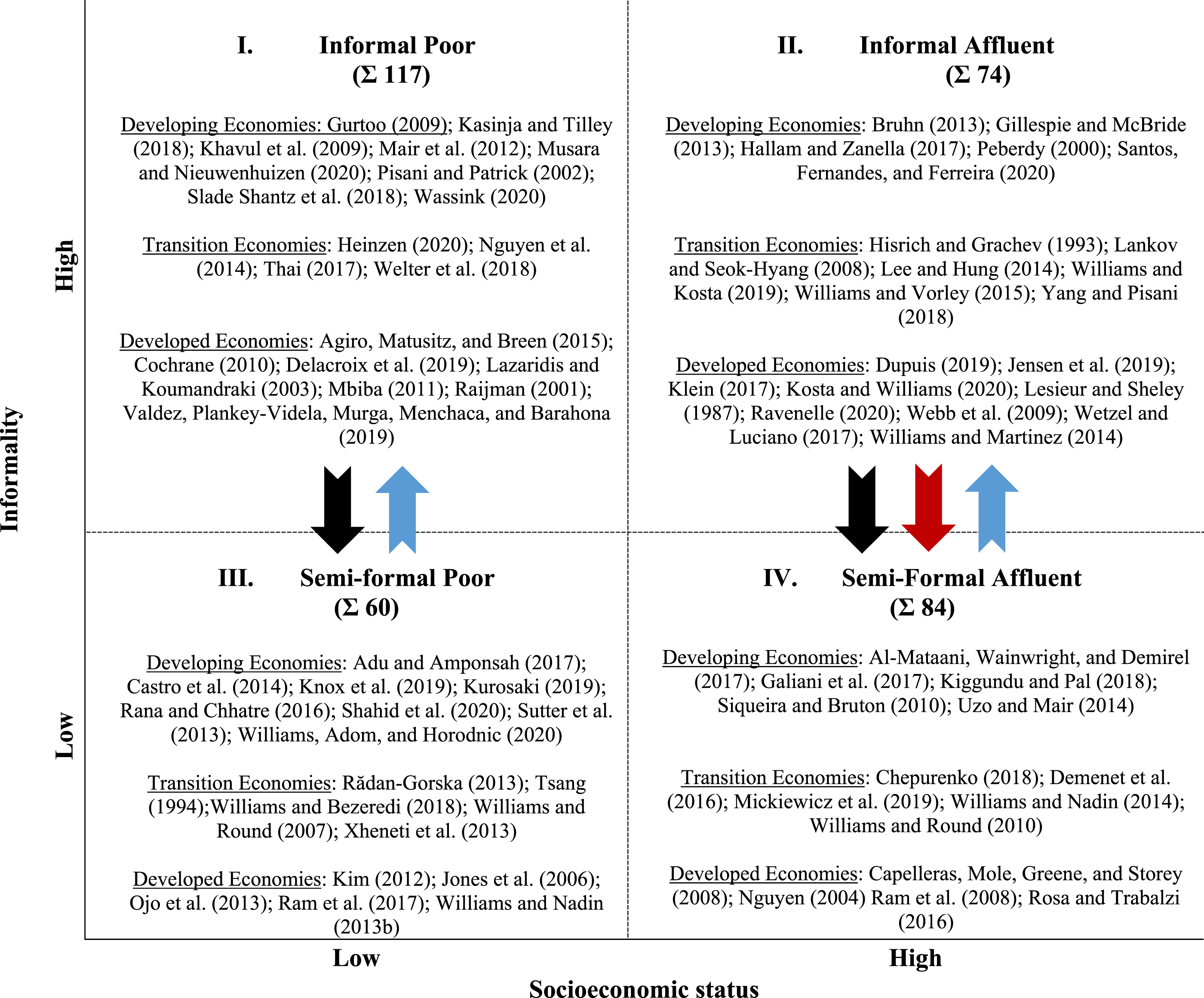
Informality
This dimension refers to the extent to which informal entrepreneurs engage in illegal and yet legitimate entrepreneurial activities (Webb et al., 2020), while not complying with formal rules and regulations. Most of the academic literature on IE, published during the first phase up to 2008 (Figure 2), refers to informality as a dichotomy between formal and informal entrepreneurial activities, based on firm registration (e.g., Arimah, 2001; Coate et al., 2006; House et al., 1993; Sepulveda & Syrett, 2007; Hillmann, 1999). Godfrey (2011) was one of the first scholars to explore the complex, multifaceted nature of informality. He suggested going beyond firm registration to consider all laws and regulations skirted by informal entrepreneurs when engaging in informal entrepreneurial activities (e.g., firm registration, tax payment, environmental regulations, employment, and health and safety regulations). By arguing that informality is a multidimensional phenomenon, Godfrey (2011) changed the way we think and talk about IE and, relatedly, formal entrepreneurship. Building on his work, we do not refer to formal entrepreneurial activities exclusively as those that are registered and to informal entrepreneurial activities as those that are not. Beyond firm registration, fully formal entrepreneurial activities are expected to comply with all national, regional, and local laws and regulations (Godfrey, 2011). Therefore, in a given country, the actual number of fully formal entrepreneurial activities undertaken is much smaller than the number of legally registered entrepreneurial activities. This is due to the fact that many legally registered units fail to comply with laws and regulations, even in developed economies (Godfrey, 2011). Based on this line of argument, a number of empirical studies has started to investigate the shades of gray that span fully formal and fully informal entrepreneurial activities (e.g., Bruton et al., 2012; Castro et al., 2014; Darbi et al., 2018; Williams et al., 2016).
Our integrative review indicates four key dimensions related to the informality of entrepreneurial activities, including: firm registration (e.g., Nichter & Goldmark, 2009, Siqueira et al., 2016), tax payment (e.g., Mickiewicz et al., 2019; Vallanti & Gianfreda, 2020), employee registration (e.g., Benjamin & Nisim, 2015; Ram et al., 2007), and compliance with health, safety, and environmental regulations (e.g., Rădan-Gorska, 2013; Rosa & Trabalzi, 2016). While firm registration is a binary variable, the others are all ordinal variables (full/partial/no tax payment, full/partial/no employee registration, full/partial/no compliance with health, safety, and environmental regulations). Following Shahid et al. (2020), we consider the level of informality of the entrepreneurial activities as “high” if they show full or partial informality in three or four dimensions (e.g., no firm registration, partial/no tax payments, partial/no employee registration). In turn, the level of informality is considered “low” if the activities show full or partial informality in only one or two dimensions (e.g., firm registration and full tax payment, but partial employee registration and no compliance with health, safety, and environmental regulations).
Socioeconomic Status
The second dimension refers to the social standing of a given informal entrepreneur in terms of income, education, and occupation (Bradley & Corwyn, 2002; Reynolds, 1991). The coding and the analysis of our articles suggest that the socioeconomic status is an important variable to consider when studying informal entrepreneurial activities (e.g., Castro et al., 2014; Williams & Round, 2007; Williams & Round, 2010; Williams & Nadin, 2010; Williams et al., 2016). Our evidence shows that informal entrepreneurs are often polarized at both ends of the income spectrum, i.e., poor and affluent (Gibbs et al., 2014). For instance, Williams and Round (2010) find that the informal nature of the entrepreneurial activities varies, depending on the socioeconomic status of the entrepreneur. While poor entrepreneurs do not register their firm and mostly operate off the books as a survival tactic, affluent entrepreneurs usually register their firm but participate in some off-the-book transactions to evade taxes. Following past research (Manstead, 2018), we operationalize the socioeconomic status of the entrepreneurs in terms of income: if the income level is below the average in the respective country, the socioeconomic status is “low”; if the income level is above the average income in the respective country, the socioeconomic status is “high.”
Four Types of Informal Entrepreneurs
Drawing on these two dimensions, we identify four different types of informal entrepreneurs, who are globally widespread. They include the informal poor, the informal affluent, the semi-formal poor, and the semi-formal affluent. Next, we characterize and illustrate each type by examples drawn from developing, transition, and developed economies.
Type I: “Informal Poor” is characterized by a high level of informality and low socioeconomic status (117 articles). Examples of this type include: rural poor entrepreneurs in Ghana who do not register their enterprises, do not pay taxes, and do not declare their employees (Slade Shantz et al., 2018); informal cross-border traders in Eastern Europe borderlands who engage in IE as a coping strategy to achieve economic “survival”, while also presenting full or partial informality across all informality dimensions (Welter et al., 2018); and French moms living below the poverty line and engaging in digital subsistence entrepreneurial activities on Facebook without complying with any formal rules or regulations (Delacroix et al., 2019).
Type II: “Informal Affluent” is characterized by a high level of informality and high socioeconomic status (74 articles). Examples of this type include: informal micro tea-stall entrepreneurs in Bangladesh having high income stability and yet engaging in fully informal entrepreneurial activities (Khan et al., 2013); above average income dealers from the largest electronics marketplace in the world producing “shan-zhai” 1 mobile phones in China, despite the governmental prohibition against private businesses (Lee & Hung, 2014); and the American computer programmer Shawn Fanning, who established Napster as a fully informal, successful, growth-oriented, and innovative software-based business while attending college (Webb et al., 2009).
Type III: “Semi-Formal Poor” is characterized by a low level of informality and low socioeconomic status (60 articles). Illustrative examples can be drawn from poor street sellers in Sub-Saharan Africa engaging in “semi-formal” entrepreneurial activities, that is, paying for local business permits (equivalent to firm registration in this context), paying taxes, and partially complying with environmental regulations but not registering employees (Knox et al., 2019); Romanian touristic pension owners who hardly make a living through IE and apply for only a portion of the mandatory authorizations to run a guesthouse, such as firm registration, partial tax payment, and partial compliance with health and environmental regulations, while engaging family members in the entrepreneurial activities without proper contracts (Rădan-Gorska, 2013); and minority entrepreneurs from abject spaces in the UK registering their businesses but remaining informal along a minority of informality dimensions, such as hiring ethnic workers off the books without any insurance cover or formal labor rights (Ram et al., 2017).
Type IV: “Semi-Formal Affluent” is characterized by a low level of informality and high socioeconomic status (84 articles). Some examples relate to entrepreneurs of above average income level in the Nigerian movie context of Nollywood, who follow all of the formal rules and regulations, despite selectively defying the rules of the Nigerian Copyright Act (Uzo & Mair, 2014); Latvian founders of enterprises with average positive turnover, evading taxes, due to their low level of trust in the newly formed government and institutions following the end of the communist regime (Mickiewicz et al., 2019); and Italian Buffalo Mozzarella producers running profitable legally registered enterprises, paying taxes, and having a formal bureaucratic structure, but deliberately not respecting animal welfare and labor law as a strategy to increase their profit and escape harassment from criminal organizations (Rosa & Trabalzi, 2016).
This typology reveals that IE goes far beyond the usual cliché of poor individuals engaging in completely hidden, low-performing entrepreneurial activities and enables us to move toward a more nuanced understanding of the phenomenon. The four types are widespread across developing, transition, and developed economies, and they provide a comprehensive overview of the heterogeneity of IE from a static perspective. But beyond this, our analysis also reveals that the informal poor and informal affluent entrepreneurs’ levels of informality may change over time. We thus adopt a dynamic perspective to understand how informal entrepreneurs move along the continuum of informality, why they do so, and with what consequences. This dynamic perspective proves crucial to unpacking the emergence, persistence, or disappearance of informality, as well as gradual movements along the continuum of informality. More specifically, informal entrepreneurs move along three distinctive pathways: the reactive formalizing, the proactive formalizing, and the informalizing pathways (respectively the black, red, and blue arrows in Figure 4). They do so while increasing or decreasing the regulative legitimacy—that is, the alignment with the law—of their entrepreneurial activities (Scott, 2014). We elaborate further on these three pathways in the next sections.
Formalizing and Informalizing Pathways: A Tale of Legitimacy
The most important actions undertaken by informal entrepreneurs revolve around legitimacy (Alvarez et al., 2021; Webb et al., 2009), which is defined as “a generalized perception or assumption that the actions of an entity are desirable, proper, or appropriate within some socially constructed systems of norms, values, beliefs, and definitions” (Suchman, 1995, p. 574). Legitimacy is a key resource (Zimmerman & Zeitz, 2002), and is gained through the consensus of the collective, who judges what is appropriate in a specific social context (Fisher et al., 2017; Kackovic & Wijnberg, 2020; Überbacher, 2014). Acknowledging the different kinds of legitimacy (Bitektine & Haack, 2015; Scott, 2014; Zimmerman & Zeitz, 2002), we draw on Scott (2014) and distinguish among regulative, normative, and cognitive legitimacy. Regulative legitimacy (or legality) is gained through the alignment of an activity with the law. This alignment is instrumental to avoid sanctions applied by legal authorities. Normative legitimacy is morally governed by binding social expectations, which determine what is appropriate and desirable in a certain context (e.g., industry, sector, market). This generates a sense of social obligation to conform to societal norms and codes of behaviors. Finally, cognitive legitimacy is culturally supported by constitutive schema and taken-for-granted cultural conceptions (Scott, 2014), which can be interpreted as “collective identities” (Polletta & Jasper, 2001; Webb et al., 2009). Collective identities are “one particular form of culture” (Polletta & Jasper, 2001, p. 298) and refer to “the common bond tying individuals to a group” (Webb et al., 2009, p. 497). They provide frames perceived as established and inherently correct ways of doing things, and leading to mimetic behaviors (DiMaggio & Powell, 1983) “because other types of behaviors are inconceivable” (Scott, 2014, p. 68) with what is learnt and taken for granted.
Moving along the continuum of informality implies making strategic or non-strategic decisions in terms of regulative legitimacy, while also balancing normative and cognitive legitimacy. In some cases, entrepreneurs make strategic decisions in terms of regulative legitimacy. For example, they may decide to comply with an increasing number of laws and regulations. This would be based on a strategic evaluation of the advantages that compliance might bring (Webb et al., 2009), for instance, in terms of access to formal forms of capital (Hommes et al., 2014). In other cases, informal entrepreneurs may make non-strategic decisions in terms of regulative legitimacy. These decisions are the unintended consequence of other choices. For instance, entrepreneurs may informalize their activities as a result of their choice to act against unfair governmental systems that prohibit free market activities (Lee & Hung, 2014), or else as a result of their willingness to attract less attention from criminals (Sutter et al., 2013). They may also formalize their activities in an effort to fulfill social expectations (normative legitimacy) (Thapa Karki et al., 2020) or to adopt taken-for-granted behaviors informed by their collective identity (cognitive legitimacy) (Klein, 2017). Non-strategic decisions in terms of regulative legitimacy may also result from contextual contingency, for example, an enterprise is required to formalize after being confiscated from criminal organizations (Cavotta & Dalpiaz, 2022).
Our inductive coding revealed that informal entrepreneurs make strategic or non-strategic decisions in terms of legitimacy along three distinctive pathways; namely, the reactive formalizing, the proactive formalizing, and the informalizing pathways (Figure 5). The formalizing pathway consists of the phases, or sequence of events, in which both poor and affluent entrepreneurs engage over time to decrease their level of informality, in an effort to acquire regulative legitimacy (black and red arrows in Figure 4 and 5). We highlight two types of formalizing pathways: the reactive formalizing pathway, and the proactive formalizing pathway, depending on what triggers informal entrepreneurs to (try to) change their level of informality. By contrast, we define the informalizing pathway as the phases, or sequence of events, in which informal poor and affluent entrepreneurs engage over time to increase their level of informality, foregoing regulative legitimacy (blue arrows in Figures 4 and 5). A dynamic perspective of IE.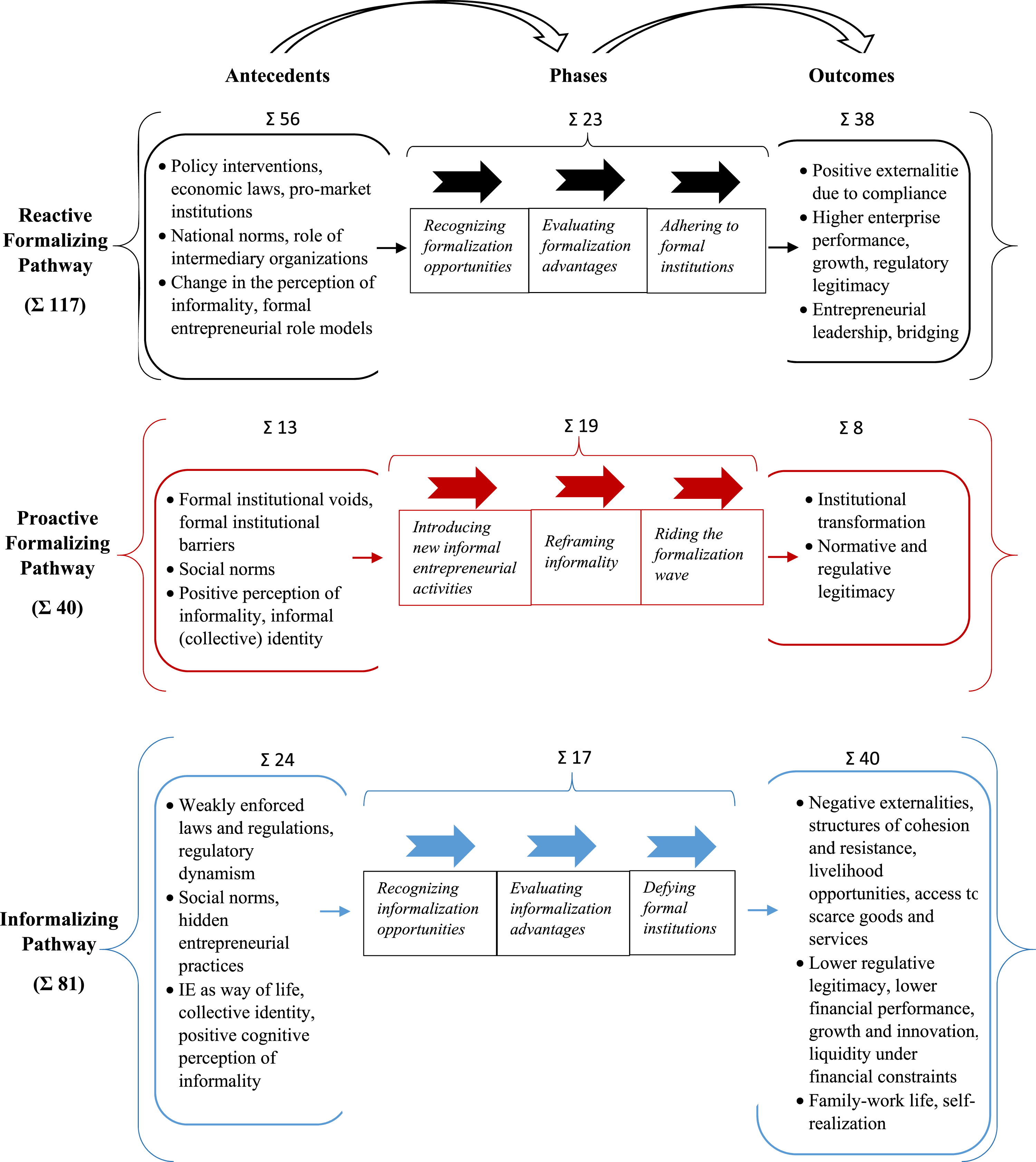
In sum, the reactive formalizing, the proactive formalizing, and the informalizing pathways consist of distinctive phases (as sequences of events). Each phase is driven by different combinations of regulative, normative, and cognitive institutional factors (Scott, 2014). 2 First, regulative institutional factors represent formal laws and regulations (Scott, 2014) that provide structure for formalization and informalization decisions, and create room for compliant and defiant entrepreneurial behaviors (Fredström et al., 2021). Second, normative institutional factors consist of social norms and codes of behavior, which generate social obligations (Scott, 2014). These social obligations may align or misalign with formal laws and regulations, thereby prompting entrepreneurs to align with or to resist them (e.g., Uzo & Mair, 2014). Third, cognitive institutional factors “stress the centrality … of the shared conceptions, which constitute the nature of social reality and create the frames through which meaning is made” (Scott, 2014, p. 67). In other words, cognitive institutional factors represent the taken-for-granted and culturally shared conceptions in a certain society, such as collective identities (Polletta & Jasper, 2001). For example, “a collective identity can create a cognitive awareness of why the venture in the informal economy exists” (Webb et al. 2009, p. 498).
As such, regulative, normative and cognitive institutional factors may drive entrepreneurs along the different pathways. In the next sections, we present the phases, antecedents, and outcomes of each pathway. In doing so, we highlight the main takeaways, research gaps, irregularities, and anomalies in the academic literature (Nadkarni et al., 2018), which we then discuss in the closing section.
Reactive Formalizing Pathway
The reactive formalizing pathway (black arrows in Figures 4 and 5; 117 articles) has been studied widely (Benhassine et al., 2018; Kasinja & Tilley, 2018; Mukorera, 2019) and fostered by policymakers in their efforts to increase tax compliance and to decrease negative externalities of informality (Galiani et al., 2017; Williams, 2015). Informal and semi-formal entrepreneurs undertake this pathway to acquire regulative legitimacy in reaction to existing institutional forces (Dau & Cuervo-Cazurra, 2014) and contextual contingencies (Cavotta & Dalpiaz, 2022).
Some scholars (23 articles) have started to examine the reactive formalizing pathway by highlighting the phases in which informal entrepreneurs engage when taking formalization decisions regarding registration of an enterprise with the government, partial or full tax compliance, and declaration of workers (Castro et al., 2014; Shahid et al., 2020; Thapa Karki et al., 2020). Below, we illustrate three reactive formalizing phases emerging from the literature: recognizing formalization opportunities, evaluating formalization advantages, and adhering to formal institutions.
Reactive Formalizing Phases
Recognizing Formalization Opportunities
Informal entrepreneurs may recognize different types of formalization opportunities, that is, sets of external circumstances or subjective ideas (Davidsson, 2017), which relate to registering entrepreneurial activities (Mukorera, 2019; Williams & Shahid, 2016), paying taxes (Adu & Amponsah, 2017; Berdiev & Saunoris, 2018), providing contracts for undocumented employees (Jones et al., 2006; Vallanti & Gianfreda, 2020), or complying with health, safety, and environmental standards (Rana & Chhatre, 2016; Schoneveld et al., 2019). Informal entrepreneurs recognize formalization opportunities once they have become more alert about formality requirements, e.g., when they are vigilant and watchful for information about sanctions affecting informal business operations (Babbitt et al., 2015; Floridi et al., 2020), or else about opportunities to access resources by formalizing their activities (Khan, 2018; Kurosaki, 2019). For example, informal entrepreneurs may recognize the opportunity to formalize once they become aware that the enforcement of business registration laws is more widespread than before (Nguyen et al., 2014), or once they realize that becoming legal may allow them to apply for different sources of capital, such as bank loans and government financing programs (Hommes et al., 2014).
Evaluating Formalization Advantages
Informal entrepreneurs evaluate formalization advantages by pondering economic formalization costs and benefits, and then considering the consequences in terms of social acceptability (Xheneti et al., 2019b). Castro et al. (2014) draw on rational choice theory to explain how informal entrepreneurs in the Dominican Republic evaluate formalization advantages and consider the economic and social costs of formalizing. In their study, Thapa Karki et al. (2020) adopt a sensemaking perspective (Weick, 1995; Weick et al., 2005) to explain how Nepalese informal women entrepreneurs evaluate formalization advantages, whereby the latter do this by pondering possible gains and losses in terms of cognitive legitimacy (congruence with their collective identity), normative legitimacy (incompatibility with socially prescribed norms, fit with family expectations), and regulative legitimacy (legal benefits from formalization).
Adhering to Formal Institutions
After evaluating the advantages of formalization, informal entrepreneurs adhere to formal institutions either selectively or consistently. On the one hand, informal entrepreneurs may take a number of strategic decisions regarding formalization, thereby selecting an acceptable level of regulative legitimacy (Castro et al., 2014). Thus, they may adhere to a carefully selected number of regulative frameworks. On the other hand, informal entrepreneurs may adhere to all of the relevant laws and regulations consistently, for example, in order to reach sector specific standards (Schoneveld et al., 2019) or to attract funding (Knox et al., 2019).
Antecedents to the Reactive Formalizing Pathway
The reactive formalizing pathway is driven by regulative, normative, and cognitive institutional factors (Scott, 2014) (Figure 5; 56 articles).
Regulative Institutional Factors
Informal entrepreneurs are more likely to formalize reactively whenever the law is seen to be enforced promptly and clearly. This could consist of tailored policy interventions simplifying formalization requirements, or increasing awareness about taxation, business registration, labor, and property rights (Williams & Nadin, 2014). A major body of literature has focused on the effects of government policies that aim to transform IE into formal entrepreneurship through formalization measures (e.g., Sepulveda & Syrett, 2007; Sheriff & Muffatto, 2014). Examples of this process relate to informal entrepreneurs who recognize formalization opportunities as a consequence of business registration reforms in Mexico (Bruhn, 2013), or as a consequence of the transition from centrally planned to market-based economic measures in post-Soviet countries (Aidis & van Praag, 2007; Hisrich & Grachev, 1993). A country’s level of economic development and GDP may also drive informal entrepreneurs to embark on the reactive formalizing pathway, since higher liquidity will lead to better implemented and more effective economic laws and pro-market institutions (Dau & Cuervo-Cazurra, 2014; Ketchen et al., 2014).
Normative Institutional Factors
The normative environment needs to evolve and adapt in order to align with the regulative environment. This allows reactive formalization decisions to be socially accepted (e.g., Castro et al., 2014). Nevertheless, the evolution of norms and codes of behaviors, and their alignment with regulative institutions, is generally slow, which gives rise to the role of intermediary organizations in speeding up the reactive formalizing pathway (Evans, 2007; Gurtoo, 2009; Sutter et al., 2017). In particular, formal for-profit platforms may act as orchestrators (Kistruck & Shulist, 2021) and convert informal entrepreneurs into formal service providers, assisted by institutional scaffolding (Sutter et al., 2017). Similarly, NGOs may redefine market structures and local arrangements, creating more inclusive market solutions and formalization opportunities for the informal poor (Mair et al., 2012).
Cognitive Institutional Factors
The cultural dis-identification from informality may lead to reactive formalization decisions (Berdiev & Saunoris, 2018; Mickiewicz et al., 2019). Whenever this happens (e.g., when tax morale increases), informal entrepreneurs become disentangled from their informal collective identities (Webb et al., 2009), and, as a result, they tend to pursue the reactive formalizing pathway. This may happen because of the actions of a formal entrepreneur acting as a role model (Musara & Nieuwenhuizen, 2020), or increased access to information regarding the benefits of paying taxes and complying with labor regulations (Williams & Nadin, 2012a).
Outcomes of the Reactive Formalizing Pathway
Below, we introduce the main conversations relating the outcomes of the reactive formalizing pathway (38 articles).
Societal-Level Outcomes
The reactive formalizing pathway is perceived as a strategic policymaking tool capable of producing positive externalities related to compliance (Webb et al., 2013; Williams, 2015). More specifically, this pathway may lead to neutralize the loss of tax revenues and thus increase the liquidity of governments, which is instrumental in developing infrastructure and providing social services (Galiani et al., 2017); to reduce the amount of informal labor engaged in by employees without proper employment contracts, social provision, or insurance cover (Maloney, 2004); to reduce the number of informal entrepreneurs flouting environmental regulations, using harmful fuels, or adopting environmentally dangerous trash disposal practices (Imamoglu, 2018); and finally, to reduce the level of unfair competition between formal and informal enterprises (Kosta & Williams, 2020).
Organizational-Level Outcomes
The reactive formalizing pathway is crucial to achieving advantages in business enterprise performance (Demenet et al., 2016; Giombini et al., 2018; Williams & Kedir, 2020) and growth (Kim & Kang, 2009; Sahai et al., 2020; Sasidharan & Rajesh, 2014). For example, Aidis and van Praag (2007) employ a signaling lens (Spence, 1973) to explain how informal entrepreneurial experience, gained prior to the transition to a market-based economy in post-communist Lithuania, translates into greater business knowledge and business skills. This contributes to the superior performance of business ventures after formalization. In general, reactive formalizing signals the achievement of a higher level of regulative legitimacy, allowing a greater mobilization of resources, especially in economies characterized by a strong governmental trust (Assenova & Sorenson, 2017). Nevertheless, it would be too hasty to generalize about the performance advantages related to reactive formalizing, as each reality needs careful investigation and understanding. For example, reactive formalizing leads to greater performance advantages in medium and large enterprises than in micro and small enterprises (Demenet et al., 2016). Moreover, reactive formalizing, after operating informally for a period of time, leads to greater performance advantages than registering the entrepreneurial activities from the outset (Williams et al., 2017; Williams & Kosta, 2020). Finally, according to the way performance is operationalized, performance results may differ. For instance, reactive formalizing leads to greater sales and productivity, but to lower employment growth than remaining informal (Williams & Kedir, 2020).
Individual-Level Outcomes
Reactive formalizing may drive entrepreneurial leadership (Musara & Nieuwenhuizen, 2020) and enhance the utility of bridging social capital (Dolan & Rajak, 2016). Nevertheless, the individual-level outcomes of this pathway remain underexplored, opening up research opportunities. We will elaborate on these in our future research agenda.
Proactive Formalizing Pathway
In the reactive formalizing pathway, informal and semi-formal entrepreneurs undertake actions aiming at acquiring regulative legitimacy in reaction to pre-existing institutions (e.g., enforcement of business registration laws, changes in social norms, changes in terms of cultural conception of informality). By contrast, informal and semi-formal entrepreneurs pursuing a proactive formalizing pathway (red arrows in Figures 4 and 5) play a more agentic role, as they aim to change pre-existing regulative institutions or develop new institutions. This pathway is represented in the literature comparatively less frequently (40 articles) and consists of the following phases (Figure 5; 19 articles): introducing new informal entrepreneurial activities, reframing informality, and riding the formalization wave. We describe each phase below.
Proactive Formalizing Phases
Introducing New Informal Entrepreneurial Activities
Individuals introduce illegal, yet (normatively and cognitively) legitimate entrepreneurial activities whenever the overarching legal framework prohibits them from doing so legally (Webb et al., 2009), or else whenever they become aware of “grey institutional areas” (Heinzen, 2020; Zidonis, 2014). For example, a group of informal entrepreneurs in California inaugurated commercial trading in medical cannabis, which at the time was unlawful (Klein, 2017). Similarly, a group of vendors started producing and selling more affordable “shan-zhai” mobile phone alternatives, despite a governmental prohibition in China where the economy is centrally planned and only national champions were authorized to produce and sell mobile phones (Lee & Hung, 2014). In these examples, informal entrepreneurs act as pioneers and introduce new informal entrepreneurial activities, which have the potential to turn into new, informal markets.
Reframing Informality
After introducing new, informal entrepreneurial activities, informal entrepreneurs may engage in the practice of reframing informality, as a way of building regulative legitimacy. This practice is a form of institutional work (Lawrence et al., 2011), and can manifest aggressively through the formulation and diffusion of discourses against unjust laws (Klein, 2017); although it can also manifest through peaceful actions, such as the promotion of relevant slogans or the setting up of discussion forums (Lee & Hung, 2014). For example, the “shan-zhai” mobile phones providers in China engaged in discourses that reframe informality and move away from the negative image relating to sales of illegal mobile phones toward the heroic image of “shan-zhai” mobile phones as iconic weapons to fight “the injustice of the government” (Lee & Hung, 2014). Similarly, Airbnb gained popularity in California and New York, despite the law prohibiting the short-term rental of private apartments, thanks to the articulation of discourses around the intrinsically good and convenient nature of the digital home-sharing platform as “a global travel community that offers magical end-to-end trips, including where you stay, what you do, and the people you meet.” (Ravenelle, 2020, p. 4).
Riding the Formalization Wave
Rather than adapting to restrictive laws and regulations, which prohibit the dissemination of their practices, informal entrepreneurs create momentum for their activities (Webb et al., 2009), e.g., by establishing increasing numbers of new marketplaces (Dupuis, 2019), creating associations to smooth government’s attitude toward the informal activities (Lee & Hung, 2014), or creating social movements designed to mobilize both resources and allies (Klein, 2017). In doing this, informal entrepreneurs exert pressure on regulative bodies, right up to the point of disruption. Thus, they achieve the objective of changing the nature of institutions, in order to favor their activities, which in time are no longer considered unlawful by the government. This is the case, for example, with the trade in medicinal cannabis in California, which became legal after continuous pressure from informal traders (Klein, 2017). Airbnb and Uber remain a gray area (Dupuis, 2019; Ravenelle, 2020), since legal frameworks for regulating these activities are difficult to build (e.g., insurance cover and standards for Airbnb hosts and Uber providers, who are not real employees).
Antecedents to the Proactive Formalizing Pathway
Just as the proactive formalizing pathway is discussed in the literature to a lesser extent, so are its antecedents (13 articles). We nevertheless summarize the extant knowledge below.
Regulative Institutional Factors
In contrast to the reactive formalizing pathway, in the proactive formalizing pathway, the regulative environment does not enable informal entrepreneurs to recognize formalization opportunities directly; instead, it prompts informal entrepreneurs to introduce new informal entrepreneurial activities as a way of overcoming formal institutional voids (Webb et al., 2020) or formal barriers (Xheneti et al., 2013). Subsequently, informal entrepreneurs leverage these formal institutional voids and barriers to reframe informality positively. For instance, when Airbnb and Uber were introduced, the regulative environment represented a formal barrier because it did not recognize, and imposed high constraints on, such activities in the sharing economy that took place outside labor and tax law. In this case, informal entrepreneurs, spurred on by a regulative environment that was excessively restrictive, engaged in the institutional work of reframing informality, thereby creating momentum for their entrepreneurial activities (Battilana et al., 2009).
Normative Institutional Factors
In the proactive formalizing pathway, background social norms provide fertile ground for informal entrepreneurs’ institutional efforts (e.g., Nguyen, 2004; Smallbone & Welter, 2001). Drawing on such norms, informal entrepreneurs engage in their institutional work of reframing informality positively, expanding their activities, and riding the formalization wave. Social norms are essential because they grant increasing levels of social acceptance to newly introduced informal entrepreneurial activities (Stanger, 2008). Whenever social acceptance is high, the power of regulative bodies to sanction and ban the activities concerned diminishes drastically, up to the point where legalization and subsequent formalization are achieved.
Cognitive Institutional Factors
Informal entrepreneurs introduce new informal entrepreneurial activities because they perceive informality positively (Amésquita Cubillas et al., 2018; Hallam & Zanella, 2017). This positive perception of informality can be either individual or collective, and causes both individuals and groups to build an informal (collective) identity (Klein, 2017; Webb et al., 2009). The informal (collective) identity represents the seedbed for the institutional work of reframing informality, in order to appeal to broader society and to regulative bodies in subsequent stages (Klein, 2017). For example, the informal collective identity of informal entrepreneurs in ethnic enclaves, who run unregistered entrepreneurial activities and employ undocumented workers (Hillmann, 1999; Ojo et al., 2013), may induce them to emphasize their positive scope or impact on society, in terms of job creation or poverty alleviation; leading to customer acquisition and even government support (Rothengatter, 2005). Another example is related to the informal collective identity of traders in medicinal cannabis, which is leveraged to increase their popularity until regulative institutions are disrupted (Klein, 2017).
Outcomes of the Proactive Formalizing Pathway
The outcomes of the proactive formalizing pathway are also investigated to a limited extent (8 articles).
Societal-Level Outcomes
The main outcome of the proactive formalizing pathway is institutional transformation. The conversation about the outcomes of IE along the formalizing pathway bridges the literature on institutional entrepreneurship (Battilana et al., 2009; Pacheco et al., 2010; Su et al., 2017). In fact, informal entrepreneurs along this pathway act as institutional agents, who manipulate institutions purposefully (Maguire et al., 2004) and engage in institutional work “eroding regulatory authority” (Zeller, 2009, p. 135). Informal entrepreneurs have the potential to change laws and regulations in favor of new entrepreneurial activities emerging from the informal economy (Zeller, 2009). Moreover, by reframing informality, they build increasing societal approval, as witnessed by the case of Napster founder, Shawn Fanning, who acted as a “catalyst for the normative reconceptualization of copyright in society” (Green, 2002, p. 799). Similarly, the institutional work emphasizing the infrastructural benefits provided by the (formerly illegal) Pavlenko construction enterprise in Russia led to a wider acceptance and even tolerance by the government, despite the centralized economic system (Khlevniuk, 2019).
Organizational-Level Outcomes
Proactive formalizing leads to higher normative and regulative legitimacy for IE over time. In particular, informal entrepreneurs expand the social acceptance of their organizations in the normative environment (Choi & Perez, 2007; Lankov & Seok-Hyang, 2008; Lesieur & Sheley, 1987; Roth, 2014). Similarly, they actively acquire regulative legitimacy, which allows them to eventually legalize their organizations, increase the number of customers, and mobilize allies (Wetzel & Luciano, 2017).
Individual-Level Outcomes
The individual-level outcomes of this pathway are under-investigated. Nevertheless, there are promising avenues for future research in this domain. We highlight them in the future research agenda below.
Informalizing Pathway
The informalizing pathway relates to the journey that individual entrepreneurs undertake once they increase the informality of their entrepreneurial activities, foregoing regulative legitimacy. Inherently hidden in nature, this pathway is more difficult to track and is, unsurprisingly, less acknowledged than the reactive formalizing pathway (81 articles). We identified three main phases in the informalizing pathway (Figure 5; 17 articles): recognizing informalization opportunities, evaluating informalization advantages, and defying formal institutions. These phases are similar to the phases of the reactive formalizing pathway. But, by contrast, entrepreneurs who pursue the informalizing pathway aim to achieve a higher (instead of lower) level of informality over time (Figure 5).
Informalizing Phases
Recognizing Informalization Opportunities
Informalization opportunities are sets of external circumstances or subjective ideas (Davidsson, 2017), which relate to deregistering entrepreneurial activities (Rosa & Trabalzi, 2016), evading taxes (Alm et al., 2019), hiring undocumented employees (Vallanti & Gianfreda, 2020), or skirting health, safety, and environmental standards (Rădan-Gorska, 2013). Entrepreneurs recognize informalization opportunities once they become alert to them (e.g., Cannatelli et al., 2019; Snyder, 2004). These entrepreneurs are vigilant and watchful for new opportunities, which could allow them to reduce their business costs (Vallanti & Gianfreda, 2020), avoid getting trapped in the complexity of the law (Rădan-Gorska, 2013), and avoid attracting attention from criminals (Rosa & Trabalzi, 2016). For instance, the presence of organized crime in Italy leads mozzarella producers to be vigilant and recognize informalization opportunities to escape criminal attention (Rosa & Trabalzi, 2016).
Evaluating Informalization Advantages
Informal entrepreneurs evaluate informalization advantages by pondering economic formalization costs and benefits, for example, from a rational economic choice perspective (Kus, 2014; Williams & Gurtoo, 2012). Nevertheless, they also consider the consequences of informalizing in terms of the social acceptability of their activities and compatibility with their collective identity. For example, Thapa Karki et al. (2020) describe how Nepalese women entrepreneurs, besides making an economic cost–benefit analysis of informalizing, consider informalization advantages in line with their gender identity, life courses, and family situations.
Defying Formal Institutions
After evaluating informalization advantages, informal entrepreneurs defy regulative institutions (Jensen et al., 2019; Kamath & Ramanathan, 2015; Uzo & Mair, 2014), that is, they actively resist formal institutions instead of adhering to their requirements (Oliver, 1991). For instance, Uzo and Mair (2014) describe how informal entrepreneurs in the Nigerian movie context of Nollywood selectively defy the rules of the Nigerian Copyright Act. While respecting the rules for movie distribution, they tend to skirt intellectual property rules, which they regard as too strict and counter-productive. Instead of following the rules regarding IP ownership, these informal entrepreneurs establish alternative practices, such as avoiding the use of written scripts in favor of verbal agreements regarding the movie plot.
Antecedents to the Informalizing Pathway
In this section, we introduce the main regulative, normative, and cognitive institutional factors (Figure 5; 24 articles) underlying informalization decisions.
Regulative Institutional Factors
Entrepreneurs may decide to informalize because of weakly enforced laws and regulations (Webb et al., 2020) that prevail in rural regions (Williams, 2011), ethnic communities (Austin et al., 2017), or other types of marginalized communities (Adriaenssens & Hendrickx, 2011). Informal entrepreneurs may also recognize informalization opportunities as a consequence of regulative dynamism (Berdiev & Saunoris, 2019; Meagher, 2009) caused by political, economic, and social evolution or crises. For instance, after the civil war in Nigeria (Meagher, 2009), the Biafran ethnic minority was persecuted by the Nigerian government and Biafran entrepreneurs informalized in order to stay in the market.
Normative Institutional Factors
Entrepreneurs informalize when they feel supported by the social norms in favor of hidden entrepreneurial practices (Bame-Aldred et al., 2013; Bukowski et al., 2014), which value tax evasion positively and support employment options outside labor laws (Williams, 2010). Such hidden entrepreneurial practices prompt individual entrepreneurs to defy laws and regulations (Oliver, 1991), especially when hidden norms are the rule rather than the exception (Rosa & Trabalzi, 2016). Thus, IE may be perceived as more advantageous than adherence to national laws and regulations (Williams & Round, 2007). In some cases, hidden entrepreneurial practices are reinforced and justified by the presence of bribes, corruption, and harassment (Kistruck et al., 2015; Rădan-Gorska, 2013; Rosa & Trabalzi, 2016; Sutter et al., 2013). These create a positive perception of hidden entrepreneurial activities as the best and most desirable alternatives to escape extortions and crime.
Cognitive Institutional Factors
Being an informal entrepreneur is often seen as a way of life (Welter et al., 2018), and a way of being recognized as a member of an informal entrepreneurial group with a specific collective identity (Webb et al., 2009). This collective identity can create a positive perception of informality (Webb et al., 2009), leading to the recognition of informalization opportunities to transform one’s own life (Gibbs et al., 2014). For instance, Snyder (2004) observes that informalizing can represent a strategy “to creatively avow a sense of self” (p. 236).
Outcomes of the Informalizing Pathway
Below, we describe the outcomes of the informalizing pathway (40 articles) at the societal, organizational, and individual levels.
Societal-Level Outcomes
By contrast with the formalizing pathways, most of the extant literature on IE emphasizes the negative outcomes of the informalizing pathway, such as negative externalities due to non-compliance, which are linked to economic underdevelopment (Massón-Guerra & Ortín-Ángel, 2019; Williams, 2013), unfair competition toward formal firms (Distinguin et al., 2016; Moreno-Monroy & Cruz, 2016), and the perpetuation of gender inequalities (Ćorić, 2018; Xheneti et al., 2019b). However, informalizing may also lead to certain positive outcomes. For instance, after the war in Nigeria, informalizing was the only alternative for persecuted Biafran entrepreneurs to earn a livelihood (Meagher, 2009). Moreover, informalizing enabled Biafran entrepreneurs to build cohesive, resistance structures from the bottom-up (Meagher, 2009). Informalizing has also led to positive economic outcomes in communist economies when private businesses were unlawful but represented the only way of accessing scarce goods and services (Tsang, 1994).
Organizational-Level Outcomes
Informalizing implies the foregoing of regulative legitimacy over time (Lent et al., 2019). This pathway may constrain financial performance (Brown et al., 2013; Engström & McKelvie, 2017), entrepreneurial growth (Krasniqi & Williams, 2020; Sonobe et al., 2011), and innovative capacity (Bu & Cuervo-Cazurra, 2020; Kabecha, 1999; Kurosaki, 2019; Ullah et al., 2019) in the long run. In fact, informal enterprises are generally smaller in size, less innovative, and characterized by lower productivity and higher capital intensity than formal enterprises (Amin & Islam, 2015; Nichter & Goldmark, 2009). Nevertheless, informalizing offers other benefits, such as higher normative legitimacy (Cannatelli et al., 2019), due to the adherence to socially supported hidden practices (Williams, 2010). Furthermore, evading taxes during the start-up phase may be a way of achieving higher liquidity under financial constraints, especially when governments are not regarded as trustworthy (Alm et al., 2019). Informalizing may also represent a strategic choice for overcoming limited access to credit, especially for women (Harriss-White, 2010; Xheneti et al., 2019b), immigrants (Ram et al., 2008; Tengeh & Nkem, 2017), and other marginalized societal groups (Atasü-Topcuoğlu, 2019; Leonard, 1998). For them, access to formal forms of credit may be very limited, while informalizing may give them access to alternative borrowing and repayment systems (Kamath & Ramanathan, 2015), as well as to informal credit associations (Tengeh & Nkem, 2017). Women in patriarchal societies tend to informalize their entrepreneurial activities, especially after marriage (Xheneti et al., 2019a). This happens because informalizing allows them to take better care of the household (Guma, 2015), as well as receive greater approval and financial support from their family members (Xheneti et al., 2019b).
Individual-Level Outcomes
Informalizing may have some positive outcomes at an individual level (Harriss-White, 2010; Swanson & Bruni-Bossio, 2019). It may enable informal entrepreneurs to create a better work–life balance and achieve some degree of financial autonomy (Espinal & Grasmuck, 1997). As such, informalizing may constitute an important self-realization opportunity for women (Delacroix et al., 2019; Mukherjee, 2016; Nmadu, 2011), despite gender-based roles and expectations (Xheneti et al., 2019b).
Future Research Agenda
Above, we have introduced a novel typology of informal entrepreneurs and have proposed a new dynamic perspective of IE. Building on this, we now draw a forward-looking research agenda for IE (Bacq et al., 2021). We provide guidance for scholars researching different types of informal entrepreneurs, the distinctive reactive formalizing, proactive formalizing, and informalizing pathways, as well as the antecedents and the outcomes of those pathways at societal, organizational, and individual levels.
Researching Different Types of Informal Entrepreneurs
Drawing on our novel, comprehensive typology of informal entrepreneurs (Figure 4), we call for future studies that amount to theoretical advances on IE and examine the personal traits, personal value orientations, and motivations of entrepreneurs belonging to each type posited. Such entrepreneurs might interact differently with their own in-groups (e.g., family and friends), as well as with societal groups (e.g., community members, authorities, and other stakeholders) when formalizing and informalizing in different contexts and cultures.
For example, it is widely known that informal entrepreneurs draw on their social networks to acquire resources and to make strategic formalization (e.g., Castro et al., 2014; Klein, 2017) and informalization-related decisions (e.g., Uzo & Mair, 2014). These social networks provide a range of human, social, physical, and financial resources (Jack & Anderson, 2002; Marti et al., 2013; Welter et al., 2018). Nevertheless, they may also constrain entrepreneurial action, since they are accompanied by far-reaching obligations and expectations (Light & Dana, 2013). Thus, we encourage future research to investigate how different informal entrepreneurial types leverage their social networks to both formalize and informalize.
Researching the Antecedents of Formalizing and Informalizing
While we know a lot about how regulative institutional factors influence formalizing and informalizing pathways, we know less about the role of normative and cognitive institutional factors (Nason & Bothello, 2022). Given that the nature of IE is intrinsically bounded to norms, shared cultural understandings and collective identities (Achim et al., 2019; Cavotta & Dalpiaz, 2022; Mickiewicz et al., 2019; Slade Shantz et al., 2018), it would be extremely important to shed light on how these dimensions influence the different pathways. For example, future research could build on founder identity research (Gruber & MacMillan, 2017; Powell & Baker, 2014, 2017) and endeavor to shed light on how individuals subjected to different normative and cognitive institutional factors build their informal identities and leverage them when engaging in the proactive formalizing pathway, to create institutional transformation. Moreover, it would be important to understand how the informal poor and the informal affluent draw on different cognitive and normative dimensions (Scott, 2014), and how they do this beyond laws and regulations (Fredström et al., 2021) when engaging in the reactive formalizing pathway. For example, social exchange theory (Cropanzano et al., 2017; Mitchell et al., 2012), which derives from anthropology and social psychology, could help produce useful insights in this domain. In particular, it might shed some light on how both informal, poor entrepreneurs, and affluent entrepreneurs engage in social exchange interactions, and are motivated by norms of reciprocity (Kerr & Coviello, 2020; Kong et al., 2014; Larson, 1992) and trust (Colquitt et al., 2012; Lioukas & Reuer, 2015; Pollack et al., 2017) when making reactive formalization decisions. Finally, exposure to criminal practices (Cavotta & Dalpiaz, 2022), which are both unlawful and socially unacceptable (Cannatelli et al., 2019), plays a decisive role in formalizing and informalizing pathways (Kistruck et al., 2015; Tonoyan et al., 2010). For instance, such practices may undermine the survival of formalizing firms (Cavotta & Dalpiaz, 2022). Therefore, future studies could look at the intersection between criminal and informal enterprise cultures in order to find out how informal entrepreneurs strategically assess the benefits of formalization and informalization and then either increase or decrease the level of informality they employ.
Researching the Outcomes of Formalizing and Informalizing at Societal Level
Most of the literature tends to portray the reactive formalizing pathway as good for society (Assenova & Sorenson, 2017; Svensson, 2019), in contrast to the informalizing pathway, which is viewed as negative for society (Meagher, 2014; Rosa & Trabalzi, 2016).
Nevertheless, in some cases the informalizing pathway may also lead to positive outcomes. For instance, defying unjust formal institutions through IE may be considered to be part of the solution to certain economic and societal inequalities (Bruton et al., 2021; Xheneti et al., 2019b)). Thus, we encourage future research to shed light on how reactive formalizing and informalizing pathways contribute to either exacerbating or remedying societies’ most critical inequalities. This research direction may lead to important theoretic advances in knowledge at the intersection of entrepreneurship and inequality (Amis et al., 2021; Bapuji et al., 2020).
Furthermore, we encourage future researchers to look at the dark side of the reactive formalizing pathway, as this could hinder the preservation of cultural heritage in traditional communities (Achim et al., 2019; Shinde, 2010). For instance, informal entrepreneurial activities may foster religious tourism, while preserving ancient cultural practices and rituals (Shinde, 2010). Thus, their formalization may lead to negative consequences in these terms. We encourage future researchers to explore how reactive formalizing may have adverse societal implications in some cases and hope that they might seek to foster more holistic formalizing policies and trends, especially in developing and transition economies where IE is deeply rooted in traditional cultural practices (Achim et al., 2019; George et al., 2016; Kozyreva & Ledyaeva, 2014).
Finally, the outcomes of the proactive formalizing pathway at societal level are the most overlooked of all. The informal affluents are the only type of informal entrepreneurs that move along this path, and who act as institutional agents (Battilana et al., 2009) endeavoring to create institutional transformations (Khlevniuk, 2019; Zeller, 2009). We know little about how they create such transformations, and it remains unclear if the informal poor are also able to do so. Future researchers should investigate how institutional transformations are brought about by informal entrepreneurs in different contexts, as well as whether the informal poor, through collective actions, are able to bring about similar transformations.
Researching the Outcomes of Formalizing and Informalizing at Organizational Level
Informal entrepreneurs who formalize proactively thereby acquire greater normative and regulative legitimacy for their entrepreneurial activities (Choi & Perez, 2007; Wetzel & Luciano, 2017). Similarly, the reactive formalizing pathway leads to organizational advantages in terms of regulative legitimacy, performance, innovation capacity, and growth (Bu & Cuervo-Cazurra, 2020; Siqueira et al., 2016). Nevertheless, pursuing these two formalizing pathways is far from an obvious decision in those contexts characterized by high corruption, crime, and low levels of confidence in the government (Cavotta & Dalpiaz, 2022; Sutter et al., 2013). Future studies could focus specifically on how different boundary conditions lead to different formalization decisions, as well as what outcomes they have in terms of regulative legitimacy, efficiency, and productivity.
Furthermore, the informalizing pathway leads to organizational advantages in the short run (e.g., shelter from criminals, flexibility of hiring, and firing decisions) but disadvantages in terms of performance, innovativeness, and growth in the long run (Ullah et al., 2019). Future research could explore how entrepreneurs evaluate the main organizational outcomes and stakeholder expectations when pondering formalization versus informalization decisions. This may lead to important theoretical advances and recommendations for policymakers, including formalization in their agendas.
Researching the Outcomes of Formalizing and Informalizing at Individual Level
Despite being less investigated than the outcomes at societal and organizational levels, outcomes at an individual level, for example, in terms of well-being, autonomy, and self-realization, are starting to attract attention in the literature. On the one hand, formalizing leads to acquisition of leadership skills (Musara & Nieuwenhuizen, 2020) and bridging capital (Dolan & Rajak, 2016). On the other hand, informalizing has relevant individual-level outcomes for women entrepreneurs, in terms of positive family work–life balance, autonomy, and independence (Delacroix et al., 2019; Espinal & Grasmuck, 1997; Xheneti et al., 2019b). Understanding how informalizing leads to self-realization and well-being (Shir & Ryff, 2021) may help shed light on the cognitive mechanisms underlying informalization decisions, especially for women, and to develop holistic formalization programs including important dimensions, such as women well-being, self-realization, and autonomy. Beyond this, future research could explore also the dark side of reactive formalization as well as informalization decisions at an individual level, such as in terms of human and social capital loss for the individual entrepreneur.
Moreover, future research could shed light on how individual entrepreneurs perceive themselves during and after engaging in the proactive formalizing pathway. For example, entrepreneurial identity and perception of self-realization may change over time for those informal entrepreneurs who bring about institutional transformations. Thus, future research could draw on identity theories (Radu-Lefebvre et al., 2021) to understand the cognitive consequences of the proactive shift from an informal to a formal entrepreneurial identity.
Implications for Theory and Practice
Theoretical Contributions
Our integrative review makes three main contributions to the literature on IE. First, we introduce a novel comprehensive typology that shows the prevalence of four different types of informal entrepreneurs, based on their levels of informality and socioeconomic status, namely, the informal poor, the informal affluent, the semi-formal poor, and the semi-formal affluent. As a result of our analysis, our typology shows that the four types are present in different economies around the globe. Therefore, the mainstream entrepreneurship literature, by tending to focus exclusively on formal entrepreneurship, risks neglecting a very important phenomenon. More specifically, the study of formal entrepreneurship implies a very high level of formality, although the different shades of informality characteristic of a large portion of entrepreneurial activities around the world should not be ignored. Thus, if we aim to conduct entrepreneurship research which truly embraces both diversity (Welter et al., 2017) and context (Baker & Welter, 2020), and which could also lead to greater advances in theory and practice (McGahan, 2012), we should pay more attention to the inherent heterogeneity of IE.
Second, moving from a static to a dynamic perspective of IE, we shed light on three unique pathways pursued by the various types of informal entrepreneurs in order to reach either higher or lower levels of informality, while at the same time acquiring or foregoing regulative legitimacy: the reactive formalizing, the proactive formalizing, and the informalizing pathways.
Third, we bring synthesizing coherence (Locke & Golden-Biddle, 1997) to the field of IE and devise a forward-looking research agenda for IE (Bacq et al., 2021), building on the insights gained from our novel typology and new dynamic perspective of IE. In our research agenda, we highlight interesting ways forward, which could add to current conversations around IE, and involve more general entrepreneurship and management perspectives.
We encourage future researchers to go further and extend the work carried out by Santos and Ferreira (2017) on the evolution of the field of IE and the associated intellectual community, using citation and co-citation techniques (van Eck & Waltman, 2017). We also encourage future researchers to follow the evolution of IE and to conduct further reviews, as this should help the field mature. Such reviews could problematize current constructs and perspectives (Alvesson & Sandberg, 2020), thereby opening up further research trajectories. Next, we highlight implications of our current work for practitioners and policymakers alike.
Implications for Practitioners and Policymakers
Our integrative review entails important implications for practitioners and policymakers. In particular, by highlighting the prevalence of IE across different economies and shedding light on the diverse universe of informal entrepreneurs, we provide a useful framework for informal and semi-formal entrepreneurs around the globe; with the aim being to understand better the nature of their activities and the potential of formalizing for achieving higher performance, growth, and innovativeness. Moreover, this diverse picture entails three core messages for policymakers. First, standardized policies aiming at eradicating IE or converting it into formal entrepreneurship may be barely effective if they do not consider the differing nature of IE in terms of informality and socioeconomic status of the individual entrepreneurs engaging in IE across different economies. Only by understanding the origins of IE, which go beyond skirting laws and regulations and are rooted in cognitive and normative environments, policymakers can design effective formalization policies that fit distinctive informal entrepreneurial types across different economies.
Second, we highlight that policymakers should address certain entrepreneurial types through specific formalization policies (e.g., informal and semi-formal affluent using harmful fuels as means of productions or the deliberate evasion of taxes to enhance business profits). Nevertheless, formalization policies may not always be inherently desirable. In the case of other entrepreneurial types, such as the informal and semi-formal poor who run micro enterprises enabled by a powerful, hidden enterprise culture, formalization policies may be inadequate or even destructive. Such policies may drastically inhibit entrepreneurial activities, instead of converting them into more productive forms of enterprise. Therefore, we highlight the importance of allowing the informal and semi-formal poor to engage in IE as a way of creating positive outcomes for their societies, e.g., employment opportunities (Arimah, 2001; Kabecha, 1999; Otoo et al., 2011) and cultural preservation (Shinde, 2010). In these cases, instead of providing formalization policies with a strong emphasis on sanctions for non-compliant behaviors, an alternate and more effective approach might be to incentivize these entrepreneurs to grow their informal activities, which could then be formalized at a later stage, i.e., beyond a given financial threshold.
Finally, our study provides important insights about the processes of reactive and proactive formalizing, as well as informalizing. These insights may be useful for policymakers, governments (Cavotta & Dalpiaz, 2022), philanthropic organizations (Mair et al., 2012), and social businesses (Weber et al., 2021), which are devoted to organizing informal entrepreneurs (e.g., the number of digital platforms working with waste pickers in developing countries). In fact, to achieve more effective results and social outcomes, they could first identify the pathways along which the targeted entrepreneurs evolve, as well as the main causes and strategic decisions they make to do so. This way, they could select the most effective time to intervene and start to organize them.
To conclude, we trust that, in addition to its theoretical contributions, our integrative review provides a valuable basis for practitioners and policymakers alike to orient themselves in the field of IE, in a concerted effort to generate positive outcomes for individuals, organizations, and the wider society.
Footnotes
Aknowledgements
We are very grateful to the editor, Tomasz Mickiewicz, for his exceptional guidance and to the three reviewers, who encouraged and helped us enhance the quality of our integrative review through their constructive comments. Our work has also greatly benefited from discussions at the 2021 AOM Annual Meeting and from the insightful feedback by the GRONEN Reading Group. Among all scholars who encouraged us to pursue this review and helped us refine our reasoning, we would like to express a special thanks to Desirée Pacheco and Siddharth Vedula for their critical insights and invaluable support.
Declaration of Conflicting Interests
The author(s) declared no potential conflicts of interest with respect to the research, authorship, and/or publication of this article.
Funding
The author(s) received no financial support for the research, authorship, and/or publication of this article.
