




Abstract
This article explores the complexities encountered in attempts to strengthen the ethos of bureaucracy in public organization. It does so by stressing the ethical and organizational conflicts generated in the aspiration to revive this ethos. Empirically, this exploration is done by examining a code introduced in the Danish state-bureaucracy in the aftermath of a number of political-administrative scandals. We show how the ethos of bureaucracy on the one hand has been repressed and displaced and, on the other hand, in light of the scandals, now reappears as something indispensable. At the same time, the article exposes how the revitalization attempt encounters considerable obstacles. By situating the code in relation to changing bureaucratic structures, semantic ideals, and civil servants’ reflections, we show how the revived ethos takes on monstrous proportions. Despite this transfiguration, we argue that the failed attempt at revitalization is no cause to dispense with the ethos of bureaucracy. The article is distinctive in how it bridges hitherto uncoupled streams of literature that are mobilized in the investigation of a critical case. In so doing, it adds to these literatures and seeks to revive critical organizational theorizing in light of current neo-liberal and populist sources of power.
There’s such a difference between the way we really live and the way we ought to live that the man who neglects the real to study the ideal will learn how to accomplish his ruin, not his salvation. [A]dministrative practitioners […] must continue to work day after day at solving problems they know are insoluble. And all this while resisting the overwhelming temptations to cynicism and despair […]. They are mediators or midwives or matchmakers – choose your metaphor – between principle and practice which meet in their persons.
Introduction
Since the 1980s, bureaucracy has constituted an ever more prevalent target of critique. In the wake of Reagan’s and Thatcher’s problematizations of the welfare state, the attacks on bureaucracy have intensified. These critiques have also proliferated in organization studies in which the 1980s and 1990s ‘coincided with an unforgiving assault on the bureaucracy’ (De Cock and Böhm, 2007: 816). Much of this critique predicted the imminent demise of bureaucracy and the concomitant rise of post-bureaucratic organizations (Heckscher and Donnellon, 1994). Although this simplistic post-bureaucratic discourse of endings (Courpasson and Reed, 2004) has since then been critiqued, toned down, and morphed into discussions about neo-bureaucracy (Clegg, 2012; Morris et al., 2016; Sturdy et al., 2016), there has nevertheless also in these more balanced accounts been a tendency ‘to mapping the changing “geometry” of’ organizations ‘instead of examining how the principles and ethos of bureaucracy are fostered, strengthened, or neglected’ (Willmott, 2011: 287, our italics). Somewhat surprisingly, this lacuna has coexisted with an increasing number of studies that have explored the multifaceted interrelationship between ethics and organizing (Rhodes and Wray-Bliss, 2013; Sørensen and Villadsen, 2015) and a number of studies that have criticized neo-liberalism and its associated organizational principles (Berglund et al., 2017; Bristow et al., 2017; Styhre, 2014). This criticism is particularly noteworthy in light of the fact that one of neoliberalism’s founding fathers, Ludwig von Mises (2007 (1944), identified the values and ethos of bureaucracy as being antithetical to his ideal market society. Although a few scholars have insisted on the importance of this ethos (Lopdrup-Hjorth and Roelsgaard Obling, 2018; Clegg, 2011; Du Gay, 1994, 2000; Willmott, 2011), the majority of critical organization scholars have either not looked in this direction, considered the ethicality of bureaucracy insufficient (De Cock and Böhm, 2007) or, alternatively, in the manner of Bauman (1989), viewed ethics as being at odds with – if not directly antithetical to – bureaucracy (Burrell et al., 1994: 10; McCabe, 2015).
This propensity to overlook the ethos of bureaucracy, dismiss it as an oxymoronic notion, or simply discharge it as not being sufficiently radical, however, appears exceedingly problematic. In addition to neoliberalism having survived the recent financial meltdown (Mirowski, 2013), the election of Donald J. Trump as president of the United States has cemented the influence of anti-bureaucratic sentiments in a hitherto unprecedented fashion – something that, in several spectacular instances, can be witnessed in Trump’s repeated public attacks on those civil servants who in aspiring to act in accordance with such an ethos necessarily fail to exhibit personal loyalty to Trump as a person – and, consequently, are removed from office or bullied on Twitter (Graham, 2017; Zegart, 2017). In this context, it is time to mobilize vocabularies that provide a source of resistance to the current neo-liberal and populist agendas, ideals, and sources of power (Robinson and Bristow, 2017) or, as was expressed in the very first editorial of Organization, ‘to construct […] ethical discourses that speak to the radically changed structural, theoretical and ideological realities we now face’ (Burrell et al., 1994: 6). However, whereas this in the early 1990s meant moving beyond conventional organizational idioms, including bureaucracy, the current structural, political and ideological configurations indicate that the time has come to not merely ‘remind ourselves of the continued […] relevance of bureaucracy’ (Courpasson and Reed, 2004: 11) but in particular to attend to how the ethos of bureaucracy might be cultivated and revitalized in an increasingly alien and hostile environment. Viewed from this perspective, insisting on the importance of the ethos of bureaucracy could be viewed as an attempt to nourish the ‘politics of transformation’ (Grey, 2009: xvi) at the heart of critical organizational theorizing.
Although the current White House excesses provide innumerable examples of a CEO figure who continually bypasses and frowns upon the ethical demands and foundational principles of office-holding, we will in this article attend to a case from the other side of the Atlantic and from the opposite side of the political-institutional spectrum, namely, a case exploring the attempt to revitalize the ethos of bureaucracy in the Danish central administration. The strategic relevance of this case lies in the fact that the Danish state-bureaucracy according to several measures and reports continually is assessed as among the least corrupt and most well-functioning in the world (Transparency International, 2016). Indeed, the Danish state-bureaucracy’s reputation for fair, ethical and competent administration has turned it into a ‘model state’ to be emulated by others as, for instance, can be witnessed in what recently has been formulated as the ‘problem of getting to Denmark’ (Fukuyama, 2014: 25–26; Pritchett and Woolcock, 2004: 192). However, this idealized and allegedly well-functioning Danish central administration has come under significant pressure. Throughout the last two decades, Denmark has witnessed a number of scandals in which civil servants and their political masters have leaked personal tax-papers to damage a Prime Ministerial candidate, lied to or withheld important information from the Parliament, wasted exorbitant amounts of tax funds and manipulated numbers, among other things (see Boye Koch and Knudsen, 2014; The Local, 2015; Tynell, 2014). This behaviour has resulted in an all-time low public trust in civil servants (Radius, 2017), an increasing insecurity among civil servants themselves (Bøgelund, 2014), and the permanent secretary to the Prime Minister’s Office publicly announcing that civil servants should re-familiarize themselves with classical administrative and bureaucratic duties (Bøgelund, 2014). Against this background, and in light of the contemporary scandals, the Danish state published a code called Seven Central Obligations (The Ministry of Finance, 2015), a publication that has been disseminated to 10,000 employees working in the central administration. In 63 pages, it summarizes and highlights the essential ethical-administrative duties that should guide civil servants in their work.
In light of the widespread anti-bureaucratic mentality stretching from contemporary organizational theorizing to the White House, and in light of how this anti-bureaucratic mentality currently is accentuated in conjunction with the rise of populism (Klein, 2017; Robinson and Bristow, 2017), we take the current attempt at revitalizing the ethos of bureaucracy in Denmark as our object of exploration – not only because this case is interesting in and of itself but also because its status as a ‘critical case’ (Flyvbjerg, 2006: 230) alerts us to a problem field that reaches significantly beyond its immediate context and brings us face-to-face with foundational problems of organizational theorizing.
The question that orients our exploration is how – in light of the recent scandals – is the ethos of bureaucracy currently being reborn in the Danish central administration, and what are the dynamics and implications of this process? Answering such a question requires enacting a mode of analysis capable of not only explicating what the ethos of bureaucracy is but also considering a changing organizational and semantic context that both constitutes the immediate receiving environment of the reborn ethos and might work counter to this revitalization attempt. To fulfil these requirements, this article builds on four different strands of theorizing: (a) the literature on ethics codes, (b) the literature on neo-bureaucracy and hybridity, (c) works on the ethos of office and bureaucracy, and (d) the literature on unintended consequences and dysfunctions within modern bureaucracies.
By integrating these elements, we contribute to a much needed reinvigoration of our understanding of bureaucracy and its ethos. We do so by combining studies that insist on the political-ethical indispensability of the ethos of bureaucracy with strands of literature that have empirically investigated transformations in bureaucracies, including their hybrid, neo-bureaucratic forms, and their seemingly recurring gaps between the ideal and reality. In so doing, we carve out a position that at one and the same time lets us insist on the importance of the ethos of bureaucracy but simultaneously allows a critical stance in relation to its empirical instantiations.
The structure of this article is as follows. First, we propose an approach to studying the ‘ethos of bureaucracy’. This proposal is followed by a methodological section, in which we describe our research study with its focus on how the ethos of bureaucracy is being reborn through a code. Based on our empirical material, we explore three dimensions of this phenomenon: (1) a description of changing organizational conditions and shifting semantics of the civil servant, (2) a close reading of the code and finally (3) an account of civil servants’ reflections on the ethos of office encountered in their organizational realities. We then discuss the implications of our study, including how it contributes to the literature. This final section also concludes the article.
Theoretical perspectives for studying the ethos of bureaucracy
(a) Codes of conduct and ethical codes have a long history dating back to the most famous and oldest of all, namely the Hippocratic Oath for doctors (Smith, 1996). Although codes of ethics specifically targeted at civil servants have been debated since 1924, when the International City Managers’ Association implemented its code, it was not until after the Watergate scandal in the 1970s that such codes began to proliferate on a huge scale (Denhardt, 1988: 127–128). Since then, we have witnessed a cyclical movement in which ethics codes periodically come to the fore in the wake of scandals in public and private organizations (Helin and Sandström, 2010: 583; Khurana and Nohria, 2008; Metcalf, 2014; Plant, 2000). Although codes in public bureaucracies – in contrast to private organizations – express political statements ‘that the public’s business is being conducted fairly, honestly, and competently’ (Plant, 2000: 311), there are significant divergences concerning assessments of whether codes have positive effects (Bruce, 1996; Khurana and Nohria, 2008; Lewis, 1991) or, in contrast, have less than benign effects (Garcia-Sanchez et al., 2011; Gortner, 1991; Helin et al., 2011; Munro, 1992). Although these divergences constitute a major discussion within the field, the literature on codes has, as Helin and Sandström (2010: 584) argue, failed to exhibit an adequate ‘sensitivity to context’, including, not least, how the bureaucracies, into which such codes are disseminated, have undergone significant changes.
(b) If the literature on codes, however, has given scarce attention to this issue, it has, conversely, been intensively discussed within organization theory (Courpasson and Clegg, 2006). Indeed, one can claim that organization theory has grown out of a number of studies of bureaucracy (Clegg, 2012: 62; Starbuck, 2003). From Weber (1978, 2007a) and Michels (1962) and on to Merton (1957) and Blau (1956), bureaucracy has constituted a main thread around which organization theory has been woven. From the 1960s and onwards, and in particular throughout the last four decades, discussions within organizational theorizing have moved from viewing bureaucracy as a prevalent organizational form with imperfections to becoming a largely problematic construct that, allegedly, was rapidly fading from our institutional environment. These discussions have on the one hand been framed around the notion of post-bureaucracy (Höpfl, 2006; Maravelias, 2003, 2007; Parker and Bradley, 2004) and, on the other hand and somewhat later, around the notion of neo-bureaucracy (Clegg, 2012; Morris et al., 2016; Sturdy et al., 2016). The term post-bureaucracy more easily suggests that we have moved beyond bureaucracy or are in the process of doing so. Conversely, neo-bureaucracy highlights how classical bureaucratic structures and values blend with entrepreneurial or market-oriented structures and values (Bolin and Härenstam, 2008). In conjunction with this discourse, a key theme, particularly within research into professionalism and New Public Management (NPM), has been the problems, potentials and implications of hybridity and what this does to public service institutions (Christensen and Lægreid, 2011; Denis et al., 2015; Waring, 2015), to organizational roles (Noordegraaf, 2007; Spyridonidis et al., 2015) and to institutionalized policy fields (Fossestøl et al., 2015).
In relation to hybrid organizational forms, a number of critical organization scholars have interrogated interconnections between changed organizational principles in bureaucracies, altered modes of speaking, and shifting role moralities. Alvesson and Thompson (2005), for instance, have described how decentralized, market-driven or individualized reward systems have increased managerial flexibility in bureaucracies but at the same time challenged the currencies that come with the roles of civil servants, thus creating an ‘occupational limbo’ (Bamber et al., 2017) in which there exists a conflict between different roles occupying the same office and in which different offices are in conflict with each other – leading to partial or shifting organizational commitments. In a similar vein, Sturdy et al. (2016) point to the introduction of ‘managers as consultants’, in which conflicting ‘dual identities’ develop, whereas Berglund et al. (2017) highlight how civil servants cultivate entrepreneurial selves that are enacted across different and potentially conflicting life orders.
(c) If the organizational literature on neo-bureaucracy and hybridity provides us crucial concepts for understanding the changing bureaucratic context into which codes are introduced, this literature has for its part gone lightly over the normative importance of the values and ethical principles inherent in public bureaucracies (Du Gay, 1994; Willmott, 2011). This omission is somewhat problematic because, as Weber (1978: 959) makes clear, public bureaucracies are founded on and supported by an ethos and a number of foundational cultural values (see also Clegg, 2012: 60; Du Gay, 2000, 2008). In light of this easily overlooked dimension, Willmott (2011: 258) highlights how the ethical discipline of bureaucrats ‘tends to be side-lined when discussions of bureaucracy and/or post-bureaucracy are directed primarily at their technical capabilities as organizational forms or socio-technical systems’. What is overlooked when such technical issues and system-considerations take centre-stage is that ‘equity and probity are assured only by office-holders who, being dedicated to the ethos of office, are committed to providing the very highest standards of administrative service’ (Willmott, 2011: 287–288, Lopdrup-Hjorth and Roelsgaard Obling, 2018).
Hence, to enquire into how codes and new forms of bureaucratic organization affect how the ethos of bureaucracy ‘might be fostered, strengthened, or neglected’ (Willmott, 2011: 287), we must attend to the literature in which this ethos is recognized as something of importance. Doing so, however, is no easy matter. From Whyte’s (1956) critique of the social ethic characterizing ‘A Generation of Bureaucrats’ (as chapter six of his book was called) via Argyris’ (1957) characterization of bureaucracy’s morale-undermining characteristics and Crozier’s (1964) exploration of bureaucracies’ numerous dysfunctions to more recent characterizations of the calamities accompanying ‘bureaucratic ethics’ (Jackall, 1984) and ‘administrative evil’ (Adams and Balfour, 1998), the ethos of bureaucracy has increasingly come to resemble an oxymoronic notion rather than designating something of vital importance. However, if one abstracts from this predominant negative characterization within organizational theorizing, it is possible to find a number of voices that have stressed how this ethos is essential for the exercise of administrative service in public bureaucracies (Chapman, 2000; Clegg, 2012; Dobel, 1999; Hunter, 1994; Minson, 1998; Willmott, 2011). Building on Weber’s (2007a, 2007b) work, Du Gay (1994, 2000, 2008) has highlighted how different offices come with diverse responsibilities and modes of conduct. The reason for this diversity is that such offices belong to different life-orders, that is, what Weber (2007a, 2007b) calls Lebensordnungen (see also Du Gay et al., 2018; Hennis, 2000). These orders of life are irreducible to one another and come with different ethical requirements. That is, they come with a distinct ethos. In its bureaucratic expression, this ethos can be characterized as ‘the capacity of civil servants to comport themselves according to the routines, norms and objectives of the bureaucracy itself’ (Hunter and Minson, 1992: 28). The development of this ethos is indispensable, Du Gay (2013: 290) argues, ‘to the long-range effectiveness of government’.
Despite the fact that contextual and situational awareness significantly influences how the ethos of bureaucracy is expressed (Rohr, 1998), and despite the fact that there are differences across national contexts, (Ziller, 2014), there are nevertheless a number of norms and values that together make up this ethos and that exhibit a remarkable similarity across different settings (Du Gay, 2000; Goodsell, 2004). Thus, in Denmark and in many other Western countries, behaviours such as acting within the confines of the law, abstaining from lying, exhibiting party political neutrality, setting private commitments aside, refraining from using the office for illegitimate purposes, and giving free and fearless advice all constitute norms of conduct that constitute the ethos of bureaucracy.
This ethos manifests itself in a certain ‘way of thinking’ (Rohr, 1998: 52) that can best be described as having a deep ‘sense of the state’ or, in the American context, a ‘deep sense of the constitution’ (Rohr, 1998: x-xi) – a ‘sense’ that finds its minute and daily expressions in the questions one asks, the complaints one makes, the encouragement one offers, the rebukes one imposes, the advice one offers, the initiative one assumes, the directives one chooses to enforce zealously or to quietly ignore, the decisions one postpones, the responsibilities one avoids. (p. 34) For that reason, its proper realization in concrete administrative conduct therefore requires a situational judgement in which the bureaucrats act as ‘midwives or matchmakers […] between principle and practice which meet in their persons’ (Rohr, 1998: 171). This act is by no means trivial but rather something that must be cultivated through training and real-life application.
(d) Although the ethicists of office have pointed to the necessity and normative importance of the ethos of bureaucracy in state service, they have, however, devoted less attention to the discrepancies between the ideals of bureaucracy and their realized organizational forms, something that in light of our research question is of crucial importance. Such discrepancies, however, have been debated rigorously in much of the bureaucracy-critical literature. Thus, from Merton (1940) and Zimmerman (1970) and on to Hodson et al. (2012) and McCabe (2015), bureaucracies (and the theories of bureaucracies) have been criticized for a number of issues pertaining to the discrepancies between the ideal and reality. In particular, recent critiques have suggested that Kafka rather than Weber might be a better guide to understanding the messy realities of bureaucratic organization (Clegg et al., 2016; Hodson et al., 2012; McCabe, 2015). Although this critique – in accordance with much of the hybridity literature in organization theory (Denis et al., 2015: 285) – has not taken its exclusive point of departure from public bureaucracies and has therefore not attended to the ethos of bureaucracy, it has nevertheless provided crucial insights into how bureaucracies, despite their ideal formulations and self-descriptions, are shot through with unintended consequences (McCabe, 2015), power (Clegg et al., 2016; Hodson et al., 2012), and rule-breaking (Zimmerman, 1970). 1 This bureaucracy-critical literature therefore adds a final crucial component relevant to the exploration of our case by alerting us to the differences between ideal formulations and intended purposes on the one hand and realized outcomes on the other hand – something that is crucial for our assessment of how the ethos of bureaucracy is reborn in our case.
We have now mapped out four different and, in some respects, quite oppositional strands of literature. By combining these elements, we construct a framework that makes it possible to insist on the political-ethical indispensability of the ethos of bureaucracy but also to allow for critical empirical scrutiny of how this ethos currently is being reborn via a code, including considering the organizational and linguistic context in which this code is disseminated. In so doing, it becomes possible to explore the combined normative-empirical problem of how the ethos of bureaucracy is being reborn in the Danish central administration. We will in the final part of the paper discuss the tensions arising from our analysis via the concept of the ‘monstrous’ – a concept which has already been utilized within social theory (Law, 1991; Munro, 2001; Star, 1991) and organizational theorizing (Bloomfield and Vurdubakis, 1999; Du Gay, 1994; Thanem, 2006, 2011; Toraldo and Mangia, 2015). This concept not only is suitable to address tensions in the Danish case but also will allow us to specify a number of contributions to the literature on which we draw.
Sources and methods
Our empirical material consists of two main sources. The first of these is the already mentioned handbook, Seven central obligations (The Ministry of Finance, 2015), which we refer to as the code. The code describes seven central obligations for civil servants. Its intended aim is to function as a pedagogical-educational tool that reminds civil servants – and teaches new employees – about how to meet the ethical and legal obligations of their roles. As we have already described in the introduction, the background for the publication of this paper is a number of political-administrative scandals and an explicit concern with re-familiarizing civil servants with the classical and foundational obligations on which their work rests. The making of the code was conducted by the Ministry of Finance and the Ministry of Justice, and the code is based on previous studies on the rule and norms of public service organizations (for an overview of the literature, see The Ministry of Finance, 2015: 62–63).
The second source is a number of commentaries collected in conjunction with a grand investigation into the Danish administrative system undertaken by The Bo Smith Committee (2015) in response to the aforementioned political-administrative scandals. The committee conducted a survey among civil servants in which they asked a number of questions aimed at disclosing possible political-administrative breaches. Altogether, 3.795 civil servants received the survey, which resulted in 2611 responses (68,8%). The respondents came from six ministries, and all employees were included in the population. This inclusion is not without problems because IT staff, local administration and financial management have no prior knowledge of a number of tasks crucial to the workings of the central administration such as, for instance, policy tasks, minister attendance, and case handling. Altogether, 70 employees did not participate because they found themselves ‘irrelevant’, and among the respondents, we see examples of this irrelevance in comments such as, ‘I am only an IT guy’. However, given our research interest and the focus in our data sources on people working in the central administration in general, we adopted a broad definition of ‘civil servants’.
In the first part of the survey, the respondents were tested on their knowledge of the fundamental norms by being asked to choose between two options (à la ‘which of the two statements do you mostly agree with?’). In the second part of the survey, a ‘vignette method’ (Finch, 1987) was used to convey “professional groups” normative beliefs’ (The Bo Smith Committee, 2015: 177), that is, civil servants’ responses to hypothetical situations in which the duties of lawfulness, truthfulness and professionalism can collide. Respondents were asked to consider a number of dilemmas in which (1) the right action is ambiguous and (2) the respondents therefore needed to weigh different concerns and duties against each other (The Bo Smith Committee, 2015: 177ff.). This part of the survey was supplemented with an ‘open answer box’ in which the respondents voluntarily could fill in commentaries on the situations described in the vignettes. It is these commentaries that we focus on in the following analysis. In relation to investigating knowledge of norms and ideas of appropriate official conduct, both methods have an inbuilt weakness – as a recent study by Boye Koch and Saxlund Bischoff (2018) has argued – a ‘social desirability bias’ in the respondents’ answers. Therefore, we can assume that there exists a gap between how the sketched dilemmas of the survey are responded to and how the dilemmas are experienced and handled in real-life situations. In the commentaries, which constitute the third part of the survey, it is possible to find what is missing from the two other survey sources, namely, how and when civil servants experience pressure – for instance, in situations in which they feel caught in a mixture of different concerns and duties.
We approach our empirical sources as follows. First, through applying a content analysis (Bryman, 2015), we describe and explain the seven obligations in the code, and we identify the ambiguity and potential conflict between obligations. Second, similarly and through giving careful attention to the meaning of the context in which the items being analysed appeared, we approached the comments from the survey. We began the analysis of this material by reading the comments in their entirety. Thereafter, we used the categories from the code to organize our focus of analysis. We listed what the respondents had written in relation to professionalism, collaboration with political masters and managers, responsibility, career and promotion. By doing so, we focussed on analysing how the respondents experience the duties and norms that characterize their roles in the Danish central administration. Furthermore, we were interested in gaining knowledge about whether the respondents experience the duties as conflicting – for instance, whether they feel pressure towards bending the norms or have trouble with saying no. Although the survey does not explicate the respondents’ place in the hierarchy of offices, which makes it impossible for us to match respondents’ commentaries with their place in the hierarchy, it provides valuable insight into some substantial problem areas in the Danish central administration.
Re-instating the ethos of bureaucracy in public organizations
Changing structures and new ideals in the Danish central administration
As explained in the theory section, the norms and duties of bureaucrats are centrally intertwined with organizational structures and institutionalized vocabularies. For that reason, we will in the following section provide a short sketch of how employment structures and conceptions of the ‘ideal’ civil servant have moved the Danish central administration in the direction of neo-bureaucratic organization. 2
Throughout the 19th and early 20th century, the classical Danish bureaucrat was expected to have a firm character, to be loyal to the state, to be oriented to the public good, and to be cautious of having too close relationships with the political masters (Frisk Jensen, 2013; Tamm, 1997). At the same time, the bureaucrat could expect to have a lifelong employment and a secure tenure for key positions. However, particularly towards the end of the 20th century, significant changes occurred that would progressively weaken the conditions on which the bureaucrat previously had been employed. As Knudsen (2011) highlights, from the middle of the 1970s, for instance, central changes in the terms of employment were introduced. In conjunction with modernization programmes, the public sector went through reforms stressing ‘performance management’, ‘quality’, ‘human resources’, ‘management training’, and ‘top executive management’ (Greve, 2006). With these reforms came less predictable and fluctuating career-paths.
In conjunction with the above, the hitherto prevailing organizational conditions were gradually changed. These changes also affected the previously prevailing role morality (Poulsen, 2007). As Knudsen (1995: 288) states, when ‘career-jumpers’ with general rather than specific skills increasingly were recruited to top positions, this generalization also entailed an increasing risk that ‘characterless’ civil servants could come to bend the rules and norms central to good administration. In addition, the changing career-patterns also brought with them new ‘nomad leaders’ and more-flexible civil servant who to a larger extent considered and reflected upon the prospects of their own individual careers (Boye Koch and Knudsen, 2014: 46).
Consistent with the structural reorganizations, a radical new way of speaking about the civil servant was also emerging. This new way of speaking started from a set of propositions antithetical to those with which the ideal of the classical bureaucrat had been articulated in early 20th century articulations of proper office holding in Denmark (Poulsen, 2007). The language that began to take over here was – consistent with the modernization initiatives – a descendant of a Human Resource Management vocabulary, in which the ideal employee was articulated as being a passionate, committed and whole human being (Andersen and Born, 2001). Particularly from the end of the 1980s, this vocabulary began to be consolidated as a highly influential one. The new semantics displayed in this mode of speaking not only appeared in official state-documents but also shined through in job advertisements (Beck Jørgensen and Vrangbæk, 2013). It was stressed in these advertisements that the ideal civil servant was proactive, sociable and flexible and was someone who succeeded in networks and informal settings and furthermore was creative, dynamic, innovative and, not least, capable of thinking politically (Knudsen, 1995; Poulsen, 2007). Of significant interest here is that with these rhetorical redescriptions, the earlier crucial distinction between the private individual and the professional personae was erased (Andersen and Born, 2001). Hence, with the entrance of this new semantics, a novel set of values that the civil servant was expected to incarnate had arrived. In addition, with this new semantics, as Andersen and Born (2001) highlight (p. 163), the values of lawful administration were ‘devalued without discussion about what simultaneously was lost’.
The changed organizational conditions and the new conceptualizations of the ideal civil servant in Denmark to some extent resemble experiences from other countries. However, according to the COCOPS survey (Executive Survey on Public Sector Reform in Europe, Hammerschmid et al., 2013), the use of performance-related pay is striking, compared with other countries. Furthermore, the utilization of management tools, such as staff appraisal talks, management by objectives/results and internal contracts is significantly higher in Denmark than is the COCOPS average (Greve and Ejersbo, 2016).
The code
Having highlighted key elements of the code’s organizational and linguistic context, we now turn to the code itself. As sketched in the introduction, a crucial intention behind the publication and dissemination of the code (Ministry of Finance, 2015, see Figure 1 on next page) was – in light of the scandals (Boye Koch and Knudsen, 2014; Loft and Rosted, 2016) – to restore, explicate, and revitalize the traditional duties on which proper office-holding rests. Therefore, how should we understand this attempt to revitalize the bureaucratic ethos in light of the changed organizational and semantic contexts? The first thing note here is that contrary to codes of appropriate business behaviour in the private sector, the code has a binding character (in a juridical sense) because its content essentially derives from the norms of the Danish constitution (The Ministry of Finance, 2015: 12). Note also that speaking in a vocabulary organized around duties and obligations implies in itself a return to a mode of discourse reminiscent of the one to which the classical bureaucrat gave content – a vocabulary that was gradually replaced by a human resource management vocabulary, as we showed above. In this sense, the very mode of communication is indicative of an attempt to restore a classical bureaucratic ethos. Supporting this ‘classical dimension’ is also the insistence in the opening pages of the code that the civil servant does not act as an individual. Rather, an official ‘always acts on behalf of the minister’ (The Ministry of Finance, 2015: 13). In this sense too, we see a strong emphasis on one of the key dimensions of the ethos of bureaucracy, namely the strict separation of the private individual and the office-holder, who must live up to the life-order and role morality of the office; something that, again, diverges sharply from the HRM-vocabulary’s emphasis on whole individuals. However, when we examine more closely the duties outlined in the code (see Figure 1), it becomes clear that it consists of a blend of traditional and new duties.
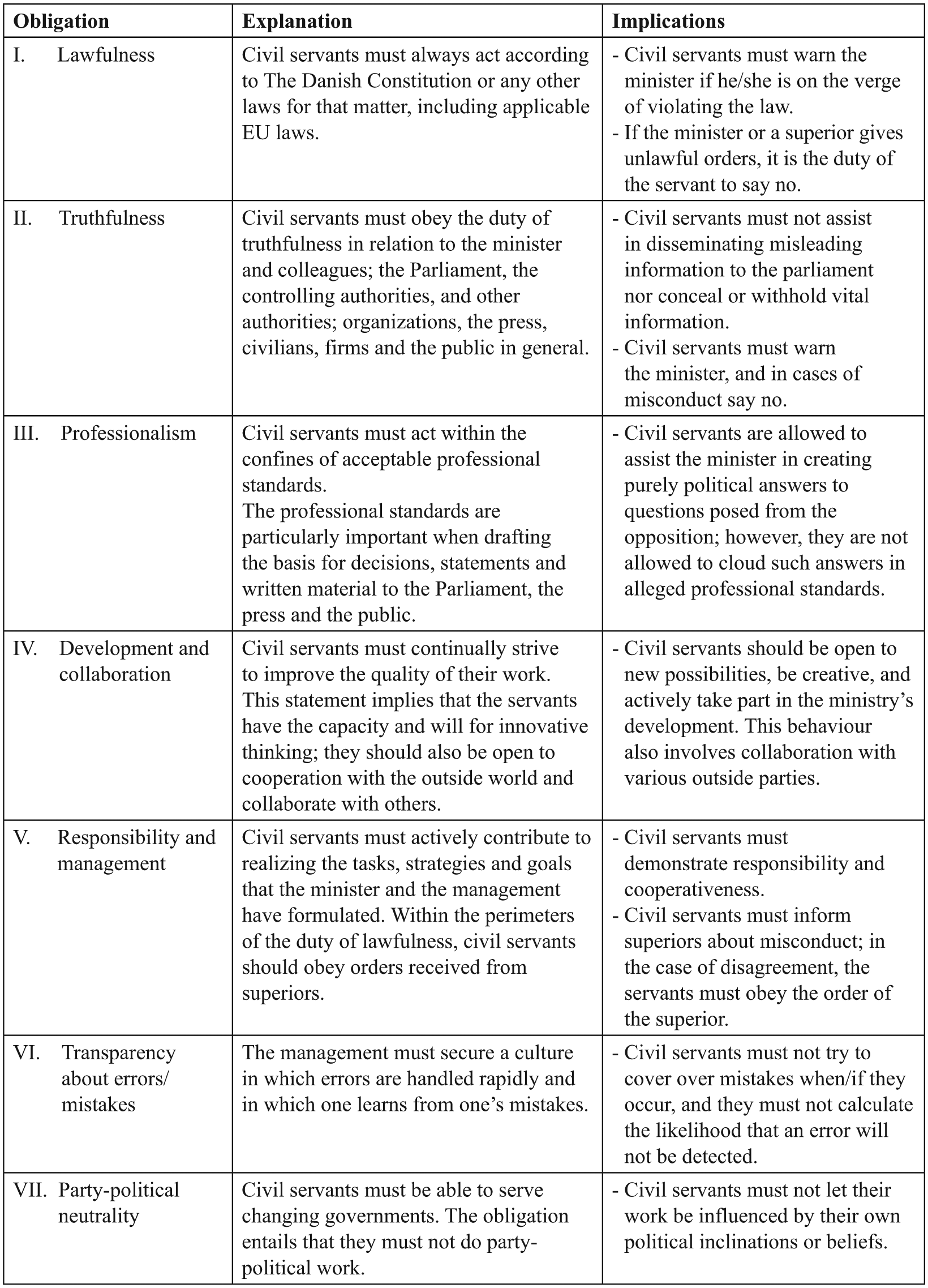
The code’s seven obligations.
More precisely, (I) lawfulness, (II) truthfulness, (III) professionalism and (VII) party-political neutrality are classical duties that are identical with Weber’s depiction of the bureaucrat and with the norms of office-holding that we highlighted in the section on the ethos of office/bureaucracy above. In contrast to these norms, (IV) development and collaboration, (V) responsibility and management and (VI) transparency are duties of a different type or, alternatively, duties that have been repackaged under new and more contemporary ringing names. For that reason, we will primarily consider the second group – in particular (IV) development and collaboration and (V) responsibility and management.
In conjunction with outlining and explaining the duty (IV) ‘Development and collaboration’, it is stated that a central competence for the ‘good’ civil servant is ‘the ability to think in new and creative’ ways (The Ministry of Finance, 2015: 12). This point is further elaborated when it is specified that the civil servant is expected to have ‘a will to think in new ways’ and to ‘collaborate with others’; similarly, he or she ‘should be ready to seek out new knowledge, and be prepared to be inspired by others’ so that ‘tasks and work-processes can develop in new ways’ (The Ministry of Finance, 2015: 36–37). The insistence on the creative, the new, and the innovative rhymes well with the new semantics associated with the flexible and innovative employee who is to exhibit entrepreneurial skills (Poulsen, 2007). The entrepreneurial servant must deal with a range of groups from civil society and the market sector, seeking synergy between different stakeholders and facilitating solutions. What should be clear here is how the insistence upon the new and innovative in significant respects does not equate well with the more ‘conservational’ duties central to the civil servants’ conduct (Lopdrup-Hjorth and Roelsgaard Obling, 2018). With such polyvalent descriptions, it does not come as a surprise if the public officials conceive of themselves as duty-bound to perform different types of transgression – not only in relation to how he or she currently thinks about administrative problems and tasks but also in relation to how such tasks are performed.
It is furthermore significant that failure to comply with the duty ‘development and collaboration’ is met with different consequences than is failure to comply with the duties of lawfulness, truthfulness and professionalism, for instance. Rather than juridical and disciplinary implications, failure to hone this obligation influences ‘the continuous evaluation of the employee in question’ (The Ministry of Finance, 2015: 60) and therefore rather influences his or her prospective career opportunities. The duty therefore builds another reflexive layer to official conduct, namely considerations about whether and to what extent certain types of activities and behaviour might influence one’s personal career-opportunities and individual destiny. Whereas Weber (1978) stressed the necessity of tenure and security to ensure ‘a strictly objective discharge of specific office duties free from all personal considerations’ (p. 962), the extent to which one has ‘a will to think in new ways’ now directly influences one’s career (The Ministry of Finance, 2015: 36–37, 60) and therefore also invites a career-conscious ‘I’ to surface in calculations about how to act appropriately.
This inbuilt tension in the code between the ethos of bureaucracy and ideals that conflict with it is augmented in a somewhat more subterranean manner in conjunction with the duty (V) ‘responsibility and management’. What is at stake here is a tension between what this duty implies and how it is named. The duty’s name in the code essentially covers over what used to be called the ‘duty to obey’ (The State Employer’s Authority et al., 2007). However, in renaming it ‘responsibility and management’, the duty to obey is rhetorically toned down and made to sound less harsh and authoritarian. This renaming is noteworthy in light of the fact that in several of the recent scandals, civil servants have used the duty to obey as a fig leaf behind which they have covered their disclosed misconduct (Boye Koch and Knudsen, 2014; Tynell, 2014). Thus, in several instances, in which civil servants have been accused of acting against the law, clouding numbers and statements in an aura of professionalism, and/or conspiring to disseminate untruthful information to the parliament, they have defended themselves by means of the duty to obey. It is therefore problematic to re-baptize this duty in an era when creeping doubt has been instilled about whether and to what extent the Danish central administration might be experiencing increased political pressure – a pressure that some observers have warned results in a decline in the force of the duties of ‘lawfulness’, ‘truthfulness’ and ‘professionalism’ and therefore also in a subservience to political pressures (Boye Koch and Knudsen, 2014; Tynell, 2014). Thus, whereas the intended aim of the code is to re-vitalize the ethos of bureaucracy, it is also clear that it supplements classical Weberian duties with duties that are introduced under new and potentially misleading names or, alternatively, highlights duties that are more consistent with human resources management semantics than with the ethos of bureaucracy.
Civil servants’ reflections on norms and ethos
Several of the tensions that we have analysed in the code reappear in the civil servants’ anonymous reflections on how they experience the duties and norms that characterize their roles in the Danish central administration. Specifically, when the duties ‘development and collaboration’ and ‘responsibility and management’ are reflected upon, a blend of different concerns and interests emerges. In relation to this emergence, the respondents are struggling with how they must live up to conflicting duties and norms, and they express anxiety over whether they might take a fall because they try to do their job properly. For some of the respondents, a decision to not follow a work culture of responsiveness and enthusiasm have had negative effects, such as not being promoted: If you have many cases where you will raise concerns/reservations, you are sure not to be promoted or get a pay raise. You may also come to appear as a non-flexible employee who just is cumbersome. Eventually you will not be put on the type of tasks that you find interesting and that you are academically good at. If I have been in situations of saying no many times, I might revert to a ‘yes’ without reservations. (Civil servant in The Bo Smith Committee investigation, 2015)
Colleagues who raise concerns about strategic and operational procedures and tasks are described by respondents as ‘naysayers’ who run the risk of being opted out if they say no to participation in, for example, creative execution of assignments. In the classical bureaucracy, the naysayer might be valued for his or her capacity to act as a gatekeeper of procedures and formal control mechanisms. However, this valuing is not the experience of the respondents in the survey: I think that there is today a trend towards more subservience … I also think that there is today a tendency to opt out employees who might say no. (Civil servant in The Bo Smith Committee investigation, 2015)
Consistent with the above statement, other respondents also couple the naysayer position with the risk of losing their jobs: It is often not a real option to say no to solve a task, because the task is then solved by others, or the tasks will in the future end up on other peoples’ desks … When you are at the end of your 40s, it is not easy to make yourself unpopular, as there is always a budget cut waiting ahead. (Civil servant in The Bo Smith Committee investigation, 2015) In many situations, it seems that you will be ‘damned if I do; damned if I don’t’, when you appear as ‘inopportune’ in the management’s eyes. Then there is no doubt at whom the bottleneck will point when the next ‘efficiency round’ arrives. (Civil servant in The Bo Smith Committee investigation, 2015)
As a respondent explains, the naysayer position also does not correspond to the urge of putting one’s self forward in the line of potentially interesting tasks and job promotion: If I say no to a task, I do not get ‘cooler’ tasks or more responsibility. Rather, I put myself at the back of the queue. (Civil servant in The Bo Smith Committee investigation, 2015)
The alternative form of action to ‘putting one’s self at the back of the queue’ is of course to be incredibly proactive and self-promoting. In conjunction with the move towards enterprising forms of neo-bureaucratic organization, the role of civil servants implies having to participate actively and entrepreneurially in problem-solving (Berglund et al., 2017). Success depends upon whether individual organizational members succeed as individuals as authors of their own success (Dempsey and Sanders, 2010). In some cases, this approach might entail instances in which employees simply ‘dress to perform’ without necessarily coming into conflict with the ethical and legal prescribed boundaries of their roles, whereas in other instances it might lead them into grey zones, if not directly illegal behaviour. When conducting background research for this project, one of the authors met with a civil servant who described some of the means used for bringing herself in close proximity to the minister: High-heel Louboutin pumps? We never wear those in the central administration. The problem with high-heel shoes is that you can’t run in them … I mean, it is of vital importance that you are able to keep pace with the department chief, when he is tapping down the corridors on his way to a meeting with the minister … You see, that is why I wear flat ballerina shoes, so I can make sure that the apron (another word for note or case folder) I’ve been working so hard on, and am proud of, also is the apron that is brought up to the minister’s table. (Civil servant in the Danish Ministry of Employment, 2015)
When civil servants show signs of entrepreneurial participation and present themselves as someone equipped for ‘the survival of the fittest game’ (Ogbor, 2000, see also Gill, 2014) by fitting choice of shoes with expected behaviour, it is partly an effect of the tensions in the bureaucratic structure itself, which, according to Jackall (1984: 198), make bureaucrats ‘take their world as they find it and pursue their careers as best they can’. However, it is also a symptom of the blend of duties and norms, which we find in neo-bureaucratic organization (Clegg, 2012; Sturdy et al., 2016), in which the relationships between politicians and servants are changing by adopting new standards of responsiveness and proximity to the minister. In graver instances, however, such responsiveness might cross through the grey zones and into actions that are clearly outside the sphere of the permissible, as several of the recent scandals indicate. One example of when civil servants moved from a grey zone into a red zone is how prominent individuals acted on the basis of private passions, proactivity and political instinct in the so-called ‘Jaeger-book scandal case’ in 2009. Due to his involvement in the controversy about a fake Arabic translation of a book written by a former member of the Special Forces, which the Danish Army Command tried to suppress, the Danish minister of Defence was removed from office, and the chief of defence staff resigned (see Boye Koch and Knudsen, 2014).
To summarize our analysis, the code on the one hand constitutes an attempt to revitalize the ethos of bureaucracy to counter the prevalent doubt and scepticism about the workings of the Danish central administration in the aftermath of a number of political-administrative scandals. This aspirational ‘return’ to a somewhat displaced foundation is at the same time emphasized by the very vocabulary utilized in the code (speaking about ‘duties and ‘obligations’) and by highlighting several classical Weberian bureaucratic duties. On the other hand, as we have shown, in conjunction with new employment structures and altered modes of speaking about civil servants, new duties, which are in tension with the ethos of bureaucracy, have surfaced. Instead of helping resolve the issue of how to act appropriately, the code rather appears to intensify already existing tensions by adding to the confusion and complexity of the expectations and responsibilities put on the civil servants.
Discussion and concluding remarks
This article considers the conditions under which a bureaucratic ethos is being re-born in an administrative setting and the difficulties pertaining to this. In our case, it is clear that the ethos of bureaucracy is being called for. However, it is also clear that the code ‘Seven central obligations’ is inadequate as the tool through which this ethos can be revitalized. Therefore, we agree with John Rohr (1989: 60–64) when he states that such a code represents ‘The Low Road’ to the training and education of ethics and responsibility. In this article, however, this point is substantiated via a concrete exploration of the intricacies of why and how this opinion is accurate by viewing the code in conjunction with its context, including the bureaucracy’s changing forms, the emergence of new ideals, and civil servants’ own reflections. In taking this approach, we add to the literature on codes by responding to Helin and Sandström (2010) call for more ‘sensitivity to context’ (p. 584). At the same time, however, although the code is unsuccessful in its stated endeavour, this does not mean that the code produces nothing, only that it might be producing something other than what was intended. However, what then does it produce? In this discussion, we will seek not only to explicate the answer to this question but also to highlight how our study contributes to the other strands of literature we have utilized and to critical organizational theorizing more generally. As briefly indicated towards the end of the theory section, the concept of the ‘monstrous’ provides us a point of departure for attending to these issues. Although already discussed within organization theory (Bloomfield and Vurdubakis, 1999; Du Gay, 1994; Thanem, 2006, 2011), we will open up the discussion by utilizing a quote from Deleuze (1995: 6) in which he explains how he coped with doing the history of philosophy by conceiving of it as a sort of buggery […]. I saw myself as taking an author from behind and giving him a child that would be his own offspring, yet monstrous. It was really important for it to be his own child, because the author had to actually say all I had him saying. However, the child was bound to be monstrous too, because it resulted from all sorts of shifting, slipping, dislocations. (Deleuze, 1995: 6)
Despite its completely different subject matter, Deleuze’s image contains three themes or insights that are relevant to the discussion we want to raise, namely that of (1) a monstrous offspring, (2) ‘buggery’, and (3) a subversive gesture. 3
Monstrous offspring
First, we will argue that whereas the intention behind the construction and dissemination of the code was to revitalize the ethos of bureaucracy, the result is a monstrous offspring containing ‘all sorts of shifting, slipping, dislocations’ (Deleuze, 1995: 6). As indicated in our analysis, the reborn ethos in certain respects resembles the ethos of bureaucracy. However, despite its mode of enunciation (e.g. speaking of duties and obligations and highlighting a number of classical duties), the result is monstrous. Not only in the sense that it involves ‘connections between heterogeneous elements’ (Thanem, 2006: 178) but also first and foremost in the sense that it brings a number of components into the life-order of the civil servant that are alien to the ethos of bureaucracy and that generate uncertainty with respect to how concrete administrative decisions should be made. The reborn ethos therefore comes across as a peculiar amalgamation that – so to speak – is neither purely bureaucratic, nor post- or neo-bureaucratic for that matter. Moreover, although the concept of hybridity, commonly understood as referring to a blend of principles of diverse origin (Noordegraaf, 2007), can take us some distance towards understanding the reborn ethos, even this concept, too, is less than satisfying because it presumes too much of a separation between the constituent components. As Ansell Pearson (1999: 197) explains, ‘Hybrids simply require a connection of points and do not facilitate a passing between them’ (see also Thanem, 2006: 183). Building on this insight, we argue that the problem confronted is not reducible to that of opposed co-existing principles that manifest themselves in, for instance, professional tensions (Denis et al., 2015; Hendrikx and van Gestel, 2017) and competing identities and roles (Noordegraaf, 2007; Spyridonidis et al., 2015; Sturdy et al., 2016). The problem is one of a civil servant who navigates in an environment shaped by a monstrous ethos in which fundamentally different dispositions and concerns are woven into a new, peculiar assemblage that appears similar to the ethos of bureaucracy but contains all types of mutations. Thus, viewed from the concept of the monstrous, it is important not to fall victim to what Whitehead (1997 [1925]: 52) and Barnard (1968 [1938]: 239) termed ‘misplaced concreteness’ by substituting the analytical components for the resulting monstrous offspring.
How should we then assess this reborn ethos? Faced with monsters, a number of potential strategies, including ‘monster barring’, ‘monster adjustment’, and ‘monster celebration’, present themselves (Bloomfield and Vurdubakis, 1999: 628). Seemingly leaning towards the last of these categories, Thanem (2006, 2011) argues for a reversal of the hitherto denial and/or repression of the monstrous in organizational theorizing. However, such a strategy, as Toraldo and Mangia (2015: 675) remark, is not without its own risks. Rather than deciding for or against ‘monster adjustment’, ‘-barring’ or ‘-celebration’ per se, we argue that such generalized assessments pose their own risks and should not be made be in abstraction above and beyond the investigation of any particular monster. Although Deleuze’s (1984) reading of Kant, for instance, produces a ‘monstrous offspring’ that can easily be ‘celebrated’, the monstrous offspring emanating in our case is clearly something to be viewed with considerably more reservations because it is more than questionable whether it minimizes future misconduct. Indeed, it might do precisely the opposite.
‘Buggery’
Although the code is presented as a tool designed to help civil servants live up to their obligations, its publication also, in a certain respect, intensifies the pressure put on them. Although ‘buggery’, as Deleuze has it, might be too strong a phrase, which perhaps also deceptively presumes too much intention on the part of those behind (pun intended) the publication of the code (i.e. the Danish Ministry of Finance), unintended results nevertheless emerge (Hodson et al., 2012; McCabe, 2015; Merton, 1940). More precisely, a problematic chain of causation is established by the fact that the political-administrative conduct leading to the recent years’ scandals is intended to be ‘corrected’ via the dissemination of a code that targets civil servants at all hierarchical levels, rather than the politicians, the terms of employment, or the dynamics between top civil servants (notably the permanent secretaries) and the ministers, for instance. Thus, whereas the code’s intended aim is to assist civil servants in living up to their obligations, it at the same time – implicitly – places the responsibility for the scandals on the civil servants because the correctional aspiration is largely targeted at them. Viewed in this light, the code might actually produce increasing stress and dissonance among particularly lower-ranked servants rather than help relieve the psychological experiences of ‘holding power’ (Dobel, 1999). This risk of course complicates the problem of how the ethos of bureaucracy currently is being reborn because we are addressing not only a code that – in light of changed ideals, altered terms of employment, and somewhat conflicting duties – provides less than fertile conditions for its stated endeavour but also a singling out of the civil servants as the implicit source of the problem. At this point, our exploration extends a number of the problems addressed in the literature. With respect to the literature on the ethos of office, our paper therefore not only provides an empirical case that explores the intricacies and dynamics of ‘how the principles and ethos of bureaucracy are fostered, strengthened, or neglected’ (Willmott, 2011: 287) but also highlights how an attempt at revitalization – despite its stated intention – might actually work counter to its stated purpose. Hence, to those ‘ethicists of office/bureaucracy’ who stress the importance of this ethos (Du Gay, 2013; Hunter and Minson, 1992; Rohr, 1998), our case shows the difficulty and complexity of revitalizing this ethos in what – comparatively speaking – is a well-functioning bureaucracy (Fukuyama, 2014: 25–26; Pritchett and Woolcock, 2004: 192). The problem is therefore not only that the values and organizational principles associated with NPM have infiltrated the state bureau and undermined its ability to perform its core task but also, as shown in our case, that the attempt to restore and revitalize the classical bureaucratic values and the ethos that goes with them might work counter to its stated intention.
This point is clearly aligned with several of the classical (Jackall, 1984; Merton, 1957; Zimmerman, 1970) and newer (Clegg et al., 2016; McCabe, 2015) investigations into bureaucracies’ dysfunctions, including their unintended consequences, systematic rule-breaking and inherent chaos. Consistent with this literature, our study shows that not only the normal workings of such bureaucracies are problematic but also attempts at correcting dysfunctions generate further problems that – most likely – can never be solved completely. However, whereas most of the bureaucracy-critical literature takes this limitation as a cause to dispense with the norms inherent in bureaucracies by, for instance, arguing that we should work to minimize the ‘tyranny of distance … to see the human and not simply the system’ (McCabe, 2015: 75), we believe such proposals risk throwing the baby out with the bathwater. For public bureaucracies, this risk is highly problematic because it would open up the moral life-order of the bureaucracy to a number of values and principles that potentially are no less undermining to the functioning of the state bureau than NPM, the ‘entrepreneurialization’ of the bureaucrat or the HRM vocabulary of the ‘whole human being’. Thus, we come back to the two epithets with which we opened this article. If we on the one hand should be careful not to deceive ourselves by only attending to lofty ideals, thereby neglecting reality as Machiavelli indicates, we should on the other hand be equally cautious of abandoning the values and ideals that are necessary for the workings of the state bureaucracy as stressed by Rohr. By combining the insistence on the normative importance of the ethos of bureaucracy with a critical view that interrogates specific attempts at revitalizing it, we argue that it is possible to have a more productive debate about bureaucracy and its ethos. Thus, our article provides a bridge between two strands of literature that usually are opposed, which moves us on to our third and final point of discussion.
A subversive gesture … within critical organizational theorizing
If we once again return to the quote by Deleuze (1994), it is clear that there is a subversive gesture at play, which attests to Deleuze’s ongoing attempt to subvert the dogmatic ‘image of thought’ (p. 131). In our context, however, we will suggest that this subversive gesture would serve us well with respect to how we conceive of bureaucracy and its ethos more generally within critical organizational theorizing. More precisely and to return to the points we made in the introduction, in light of the current political and ideological realities we face today, it would be recommendable for critical scholars of organizations to revisit their predominantly ‘dogmatic image of bureaucracy’ and in so doing to come to the realization that – although by no means perfect – the values and ethos associated with bureaucracy are indispensable to ‘the long-range effectiveness of government’ (Du Gay, 2013: 290) and furthermore most likely provide the most effective bulwark against gradually sliding into tyranny (Snyder, 2017a, 2017b; Zacka, 2017). This point, however, would imply that critical scholars should reassess the foundational and nonetheless prevailing anti-bureaucratic stance that characterizes critical organizational theorizing (Adler et al., 2007: 124, 131). However, perhaps such a gesture at self-subversion would at the same time enliven the inherent ability to criticize ‘on the move’ (Fournier and Grey, 2000: 19) and thereby also re-vitalize the ‘politics of transformation’ (Grey, 2009: xvi) that nourishes critical thinking about organizations. Indeed, such an approach might even be useful in combatting neo-liberal and populist sources of power.
Footnotes
Acknowledgements
We would like to thank Professor Paul du Gay and Professor Emeritus Ian Hunter for their intellectual support as part of the research program ‘Office as a Vocation’. We would also like to thank the VELUX FOUNDATION in Denmark for providing the funding that has made this research program possible. Additionally, we would like to thank our editor and four anonymous reviewers as well as Professor Christian De Cock for providing valuable criticisms of our paper as well as suggestions for improvement. Finally, we would like to thank Professor Emiritus Jørgen Grønnegaard Christensen and The Bo Smith Investigation Committee for giving us access to the Committee’s dataset.
Funding
The author(s) disclosed receipt of the following financial support for the research, authorship, and/or publication of this article: This research was funded by the Velux Foundation.
