



Abstract
Drawing from a qualitative, empirical study of the working lives of freelance television workers, we explore the experience of ‘meaningful’ work where aesthetic considerations are attractants to the industry. Such aesthetic considerations – and the glamorous nature of the work – attracted both older and younger freelancers. However, whereas the older cohort had entered the industry in a previous era governed by bureaucratic forms, the younger cohort had entered an already fragmented workplace marked by neo-bureaucratic forms. This shift for freelance workers generally entailed precarious working conditions, long hours, sometimes unpaid and often uncertain jobs: the dark side of meaningful employment. While older freelancers had acquired social networks through their work with large broadcasters, the younger freelancers lacked such networks, making career entry more difficult and uncertain, particularly as neo bureaucratic forms became looser. Widespread exploitation/self-exploitation characterized both groups as they completed work ‘for the love of their art’. Our findings suggest that, theoretically, discussions of meaningful work should be nuanced based on an understanding of organizational form, such as transitions from bureaucratic to neo-bureaucratic governance that impact freelance workers.
Introduction
Meaningful work has witnessed a resurgence in interest, both in academic literature and in the wider economy and society (Bailey et al., 2019; Bykov, 2023; Lysova et al., 2023). Meaningfulness refers to the experience of work as significant and positively valenced, even in situation where it is difficult or not pleasurable (Blustein et al., 2023). The resurgence of interest as at times been a reaction to mass production of goods and services (Browder et al., 2019), in others, meaningful work remained a hope despite the dominance of mass production. Nevertheless, meaningfulness remains a ‘contested concept’ (Bailey et al., 2019), and has drawn critique for its ideological uses in contemporary work (Toraldo et al., 2019). Emphasizing meaningfulness can mask the mundanity of salaried labour, revealing the possibility of ideological capture (Endrissat et al., 2015). Meaningfulness may play on sentimental desires amidst disenchantment, possibly by a middle class yearning for a less mass-produced and consumed form with ‘re-enchanted’ work (Endrissat et al., 2015; Fleming, 2009). The extent to which meaningful work can provide a meaningful alternative to mass production and even a form of resistance (Tweedie and Holley, 2016), or whether such meaningfulness provides a ruse for exploitation, is an open question (Bailey et al., 2019).
The case of television production, the focus of the current study, is an unusual one in a number of regards. Both technical and artistic, television production is a mainstream activity (Carter and McKinlay, 2013; Grugulis and Stoyanova, 2012), positioned between industrial and artistic worlds, not a marginal ‘high end’ form (Bozkurt and Cohen, 2019). It is infused with craft work, as many of the functions are inimitable and, certainly at the top end, not easily replicated, both in production and in more technical occupations such as editing and camera operations. However, it also involves high technology inputs, and digitalization in particular (McBreen, 2002). Further, organizing forms in television bear resemblance to ‘post -bureaucratic’ work (Hodgson, 2004); however, as we will argue, traditional bureaucratic forms have been replaced by what we term neo-bureaucratic ones, with negative consequences for employees in this sector, illustrative of tensions inherent in meaningful work.
By neo-bureaucracy, we refer to a hybridization of centralized and distributed control (Farrell and Morris, 2003, 2013) combining elements of market and hierarchical control. Different from a vertically organized market (cf., Rochet and Tirole, 2003), these are do not refer specifically to the upstream-downstream structure of markets, although such structures are consistent with a neo-bureaucracy mode of control. As Ahrne and Brunsson (2019) note, the traditional market-bureaucracy distinction is a limited way to understand organizing, as market and bureaucratic power reinforce each other. Neo-bureaucracy as a concept reflects the growing awareness that market-based organization can be consistent with centralized control.
Sturdy et al. (2016) note that neo-bureaucracies maintain control through informal mechanisms (e.g. information technology) and concertive control, while allowing the semi-fragmentation and insecurity of markets. Combining (Weber, 1968) notions of bureaucratic alienation with Marxian (Marx, 1977) notions of alienation as expropriation, neo-bureaucracies create a double challenge for workers searching for meaningful careers. How they experience meaningfulness against this background, however, remains largely unexplored.
The current paper examines meaningful work in the television sector to understand how the challenges of neo-bureaucracy shape meaningfulness in workers’ experience of their work. Based on an empirical examination of two UK-based television surveys, we theorize the ambivalence of meaningful work and explore how it dovetails with neo-bureaucratic forms of worker control. On this basis, we propose three contributions. First, bringing meaningful work debates into discussions of neo-bureaucratic organization, we show how neo-bureaucracy frames meaningfulness in unique ways and how the industry attracts people into visions of a ‘craft’-like environment. Second, we examine the internal tensions of meaningful work, contributing to past research by showing how these tensions result from capitalist labour processes within neo-bureaucratic organizing, with particular impacts for a younger generation of workers. Third, we show how these younger workers, less able to draw on social capital to operate in a more fluid environment, are rendered vulnerable to the dark sides of meaningful work, notably exploitation and precarity. This vulnerability is exacerbated by the tendency within neo-bureaucratic forms towards self-exploitation as cultural workers attempt to perfect their ‘art’, further exacerbated by moves towards a more freelance market. This factor helps explain how the experience of older freelancers is historically distinct from more recent entrants to the sector, partly as a consequence of this shift to looser neo-bureaucratic governance forms.
Restructuring television work
The television industry in the last 30 years, in the UK and elsewhere, has been characterized by dramatic transformations that exemplify in extremis the types of organizational restructurings found throughout OECD economies. Broadly, extensive vertical disintegration has replaced the traditional bureaucratic structure characterizing the industry until the 1990s (Carter and McKinlay, 2013). This prior structure had involved strict formal hierarchies, largely in-house activities, internal labour markets and clear career pathways (Burns, 1997; Currie et al., 2006). Multiple forces – globalization, technological change, digitalization, government-led deregulation – combined to virtually invert this structure, resulting in sector-level disintegration and fragmentation (Morris et al., 2016). State-led interventions included the creation of Channel 4 (state owned, but arms-length) with all content outsourced. Moreover, the 1990 Broadcasting Act created new markets for content and labour, with the BBC legally required to source a minimum of 25% from the independent sector. Subsequent reforms accelerated this process (Carter et al., 2020) and in-house production virtually ceased, with fixed costs favouring independent producers (D’Arma, 2018; Greer and Doellgast, 2017; Spicer and Presence, 2016). These trends were compounded by licence fee pressures (at the BBC) and reduced advertising revenue for the commercial sector, especially after 2008, along with an increase in competing media that led to reduced viewing figures. These changes all marked an industry shift from oligopolistic markets and bureaucracy to more fragmented product and labour markets.
These changes had far-reaching consequences for the television workforce; whereas in 1980 the freelance workforce was small and freelance work was largely done out of choice, 40 years later, freelancing was a dominant mode of employment. Freelancers comprised 50% of television production employment (Work Foundation, 2019) and 30% of the film and television workforce, typically employed on short-term rolling contracts (OFCOM, 2019), with little option other than freelance work once large parts of TV production were outsourced. Such work was characterized by insecurity and work intensification, as large producers faced cost-cutting (Lee, 2011) and the supply of freelancers increased dramatically with the rapid expansion of higher education provision (Ashton, 2015; Grugulis and Stoyanova, 2012; Hodgson and Briand, 2013). Younger, new entrant workers, in particular, were often subject to periods of unpaid and/or underpaid employment as part of establishing their commitment (Eikhof, 2017; Siebert and Wilson, 2013), particularly as the neo-bureaucratic structures further fragmented.
While appearing superficially as a shift from hierarchy to market, this transformation may be more fruitfully understood initially as the emergence of neo-bureaucracy, defined as a juxtaposition of centralized and distributed forms of control (Farrell and Morris, 2003, 2013). This is because the market for freelancers was not a spot market, but one where large producers retained close control over output (Morris et al., 2016). Commissioners at these organizations chose independents for productions and were very prescriptive over the choice of producer/directors who, in turn, chose their own ‘tried and trusted’ crews, including editors, camera crew, and other staff (Bechky, 2006; O’Mahony and Bechky, 2006). This meant that commissioners were key actors in programme making, with important relationships with independent owners, many who are ex-BBC or ITV staff. It also meant that social ties were crucially valuable in being able to navigate the changing industry terrain.
Specifically, these commissioner-owner relationships led projects to be organized around personal relationships between commissioners and senior creative teams, with pressure to meet quality considerations, time and financial budgets (Clegg and Burdon, 2021; Lourenço and Turner, 2019). In this way, markets are mediated through social networks (Cave, 2000; Manning, 2017) above and beyond individual service offerings. Teams use their social networks to recruit reliable crews, a process that minimizes risk and maximizes the degree of normative control over the production crew (Stjerne and Svejenova, 2016; Storey et al., 2005; Tunstall, 2015).
The social networking process circulates tacit knowledge among independent producers, thus advantaging them, but with considerable expenditure of money and time, also a barrier to entry (Zoellner, 2009, 2020). Freelancers who have strong social capital, as part of these networks, are at a distinct advantage and gain repeat work as part of loosely defined ‘crews’ based on familiarity and trust (Petriglieri et al., 2019; Randle et al., 2015). While technical aptitude is a pre-requisite for work, other, often class-based, criteria confer significant additional advantages (Antcliff et al., 2007; CAMEo, 2018; Friedman and Laurison, 2019; Hesmondhalgh and Baker, 2015). Nevertheless, the fact that such ties required an initial investment that is increasingly difficult to sustain in increasingly precarious conditions, over time this social capital effect may weaken, as older freelancers retire and younger freelancers have less access.
Given the above production scenario, with its dependence on social networks, reputational and group-based effects, large producers often centralize strategy, decision-making and resources. This centralization, characteristic of a neo-bureaucracy (Morris et al., 2016), involves a hybrid form. On one hand, it allows producers to minimize production risk, dictate policy and programming as well as financial control. On the other, it is simultaneously decentralizes, minimizing financial risks and obligations associated with large-scale employment, and contributing to a resultant precariat (Clegg and Courpasson, 2004; Farrell and Morris, 2003; Reed, 2011). This is, essentially, context (and time) specific.
The resulting work situation juxtaposes the flexibilization and precarity of the market interactions with the top-down control of centralized systems. How meaningfulness is articulated within this hybrid form is an open question. For instance, meaningful work has been discussed as a response to an increase in work-based precarity (Bailey et al., 2019); as such, one would expect the neo-bureaucratic milieu to modulate the search for a feeling of meaningfulness. For instance, one would imagine that affective, meaningful investments in a field would depend on sentiments of autonomy and future possibility in that field. As some have noted, the embrace of risk by creative workers is central to such ‘hope labour’ (Hoedemaekers, 2018; Lee, 2012a, 2012b; Mackenzie and McKinlay, 2021). Moreover, recent literature shows how meaningfulness is time-sensitive and changes over the course of careers (Fontana et al., 2023), although little is known about meaningfulness against the background of macro-changes in industry structure. Recent reviews of meaningful work (Blustein et al., 2023) have noted the need for more explicit examination of the link between precarious work circumstances and meaningfulness. Examining the literature on meaningful work in neo-bureaucratic transformations can help conceptualize employee experiences against this background.
Meaningful work, ‘callings’ and neo-bureaucracy
Within neo-bureaucratic organizing, the question of meaningfulness takes on contradictory dimensions. Neo-bureaucracies combine vertical control with market-based precarity in ways that may bring out the worst aspects of both market and hierarchy (Farrell and Morris, 2003, 2013; Sturdy et al., 2016). Combining the alienation and efficiency of bureaucracy with the fragmentation and precarity of markets, neo-bureaucracies emphasize control without formal structural supports (Sturdy et al., 2016). In this way, neo-bureaucracies are related to partial organization in that they demonstrate the highly controlled aspects of organization outside of a strictly formal sphere (Ahrne and Brunsson, 2019).
Freed from formal bureaucratic constraints yet submitted to intense market pressures and increased precarity, the dynamics of self-realization and constraint take a particular complexity in neo-bureaucratic organizing. Adding to this difficulty the politically fraught nature of exploitation and freedom within creative work (Endrissat et al., 2015; Kompatsiaris, 2015) in a mass-production setting, the question arises whether such an interpretation of meaningful work is viable when the social bases of work have shifted to a network-informal model.
Debates on meaningful work in sociology can be traced to Weber, who argued that work had wider social, political and religious meanings beyond economic gain and highlighted work’s importance for humans as a life activity conferring personal value (Anthony, 1997; Soffia et al., 2022; Weber, 1968). Meaningfulness involves a sense of both self-realization and the sense that one is doing something important (Bailey et al., 2017; Mortimer, 2023). However, associating meaningfulness with a new ‘spirit’ of capitalism that emphasizes expression, authenticity and creativity (Boltanski and Chiapello, 2005), perspectives on meaningful work also see it as a reaction to neo-liberal governance regimes, the rise in precarious work, the gig economy and zero hours contracts (Fleming, 2017), and how they shape people’s attempts to manage their work and careers (Hassard and Morris, 2018; Morris et al., 2023). Moreover, far from being limited to less-skilled work, in the UK nearly half of these precarious jobs involve managers, professionals and technical occupations (Brinkley, 2013). In short, the restructuring associated with neo-liberalization increases pressure on employees across developed economies (Hassard and Morris, 2022).
Against the background of these structural changes, the search for personally meaningful work can be read as an attempt to recuperate dignity in the face of material disadvantage and instability (Boltanski and Chiapello, 2005). In this ‘new spirit’ narrative, social critiques of economic injustice are replaced by artistic critiques focused on self-expression, a rear-guard action to salvage some form of critique in the face of an eroding world of work – or conversely, a way of appropriating critique that is made compatible with neo-liberal governance. Such a conception of meaningfulness cuts against the grain of views emphasizing positive meanings (Rosso et al., 2010). Ironically, meaningfulness is said to challenge traditional bureaucratic control in an era of post-bureaucracy (Bailey and Madden, 2017). However, most studies of meaningfulness do not take into account the external industry background that structures the experience and implications of meaningfulness (Robertson et al., 2020). Indeed, the contradictions within meaningful work involve contemporary work settings – such as television – which combine self-expression and precarity (Baumann, 2002; Petriglieri et al., 2019). Thus, while some scholars point to the emancipatory potential of meaningful work, empirical research points to its tensions, namely that workers may achieve satisfaction from work while simultaneously ‘suffering’ its negative consequences, such as eroding work conditions, job insecurity, sporadic work etc. thus emphasizing its ‘tensional’ nature (Mitra and Buzzanell, 2017; Symon and Whiting, 2019). Ironically, these factors are associated with precarity, one of the main rationales for the increased interest in meaningful work in the first place.
The ambivalence of meaningful work is particularly applicable to creative environments. In response to a literature emerging in the 1990s suggesting that work had lost its centrality and been replaced by consumption (Bauman, 1998; Beck, 2000; Sennett, 1998). Doherty (2009), for example, found a continued and surprising attachment to work in four, unskilled and prosaic settings in Ireland. However, the emphasis on meaningful work may be regarded as appropriation and as labour control by subtle means – or also by fairly unsubtle ones (Willmott, 1993). These include neonormative control (Jenkins and Delbridge, 2014) and ideologically hiding work’s economic instrumentality (O’Toole and Grey, 2016). Attempts to ‘colour’ and control unskilled work can take the form of promoting meaningfulness, such as Jenkins and Delbridge’s (2014) account of call centre workers. Brannan et al. (2015) explore how mundane work is infused with meaning through exciting brand images (see also, Fleming and Sturdy, 2011). Endrissat et al. (2015), similarly, describe what they term ‘enchanting work’ – work infused with meaning through artistic processes – in a ‘hipster’ environment at a North American organic supermarket. Across these settings, work characterized as ‘meaningful’ fails to provide material security, suggesting that the material conditions of work are equally important (Bailey et al., 2019; Lepisto and Pratt, 2017). In these situations, aesthetics are used to cover material insecurity, or else prosaic commercial expediencies remain in tension with – and often eclipse – aesthetic values, which are sacrificed when they runs up against economic considerations.
Similar dynamics can be seen in higher skilled work with a ‘calling’, for example, in artistic endeavours (such as the TV and film industry) or where work is ‘non-standard’. There is an expectation, therefore, that such environments might be fertile sites to find meaningful work (Pratt et al., 2013), in what are viewed as ‘enchanted’ spaces (Endrissat et al., 2015), with potential sources of self-expression, filled by the emancipatory possibilities of involvement, self-esteem and sociability (Bozkurt and Cohen, 2019; Hesmondhalgh and Baker, 2015). Bailey and Madden (2016), for example, surveyed a variety of occupations, including ones with a ‘calling’, and highlighted the importance of relationality and kind of work. Bunderson and Thompson (2009) explored the ‘double edged sword’ of meaningful work for zookeepers, whose deep attachment to work was characterized as a personal calling but led them into jobs with poor pay, long and erratic work hours and lack of career prospects, with impact on their personal lives (see also Berkelaar and Buzzanell, 2015; Pratt and Ashforth, 2003). Schabram and Maitlis (2017) similarly report both enjoyment and obligation in animal shelter work, as does Carton (2018) with mundane jobs at NASA, where the charm of being associated with space travel compensated for workers’ low-skill job content. Focusing specifically on creative work, Cinque et al. (2021) studied Italian actors in jobs which either pay poorly or not at all. They found that the actors rationalized their poor working conditions (‘living at the borders of poverty’) with deleterious effects on their non-work lives. The strategies they used were similar to those found with ‘callings’, including sacrifice (religious), responsibility (political) and self-care (therapeutic). Toraldo et al.’s (2019) study of non-standard (volunteer) creative work at UK music festivals similarly found that despite the brief duration of the work, many were disenchanted or cynical, particularly when comparing themselves to paid colleagues, but compensated by invoking a spirit of community.
Such contradictions and tensions may be particularly acute in creative industries (DeFillippi et al., 2007; Pratt et al., 2013), with highly adaptable workers who are constrained by the industry infrastructure (Stokes, 2021; Thompson et al., 2007). Creative professionals often face situations of precarity that are legitimized by their search for meaningfulness (Gill and Pratt, 2008). The idea that difficult work conditions are made acceptable by the significance of the work reinforces the idea that precarity is part of ‘the experience’ (Umney and Kretsos, 2015). The juxtaposition of precarity with symbolic recognition and meaningfulness, therefore, becomes an important lever by which workers are enrolled into organizational control mechanisms (Toraldo et al., 2019).
Creative industries, and TV and film specifically, therefore, offer an ideal arena to study such work, positioned as highly meaningful, with workers motivated by its potential for transcendence (Hesmondhalgh and Baker, 2010), self-fulfilment, self-actualization and self-expression. Despite such motivations, insecurity often accompanies creative work, with a tendency to result in self-exploitation (Eikhof and Warhurst, 2013; Hoedemaekers, 2018; Zoellner, 2009) and tight control sometimes limiting creative autonomy. Such tensions suggest the need to theorize these settings in relation to the broader context of the creative labour process (Hesmondhalgh and Baker, 2011; Thompson et al., 2016).
In sum, there is a growing consensus that the concept of meaningful work is subject to ambivalence and tensions, with the ‘elephant in the room’ being the background of work structures and the need to more openly discuss power and control in such settings. Despite being ‘interesting’ or ‘meaningful’, creative work operates within a capitalist milieu, and can become a lever for exploitation as the value produced by workers is skimmed off as surplus (the so-called valorization imperative, Adler, 2012).
In this way, critiques of meaningfulness in the context of precarity bridge Marxian conceptions of alienation (Marx, 1977) and Weberian notions of bureaucracy (Weber, 1968). Neo-bureaucracies combine the ‘iron cage’ of alienation and efficiency with the dispersal of labour solidarity within the ‘hidden abode’ of capitalism (Adler and Borys, 1996). Creative sectors such as TV and film, with their heavy reliance on freelance labour (Umney and Coderre-LaPalme, 2017), may wrestle with both bureaucratic and capitalistic sources of alienation. Understanding if and how these creative workers approach the meaningfulness of their work in such situations is the goal of our empirical study.
Empirical case
Data collection
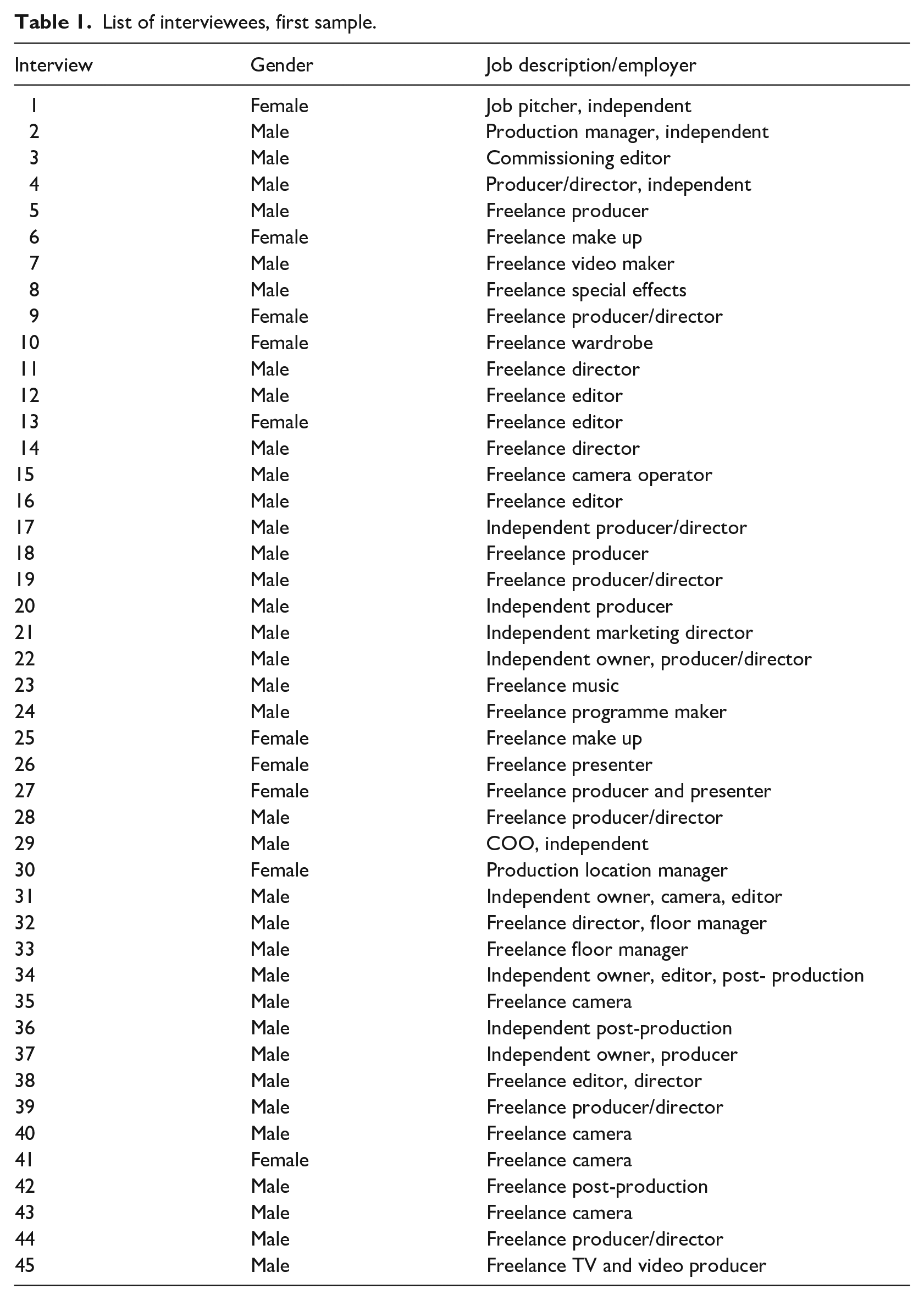
Beginning with an interest in the experience of work in neo-bureaucratic context, we were initially interested broadly in the ways that neo-bureaucracy shaped workplace experiences. Based on this interest, we focused on the television sector, which aligned with our theme given the recent changes that have been documented in this sector (cf., Carter and McKinlay, 2013; Grugulis and Stoyanova, 2012). Our data was drawn from two studies of UK television employees (See Tables 1 and 2). The first comprised 75 interviews with 45 staff, involving a small number of industry key informants/gatekeepers (including senior managers and commissioners from the main producers and independents) and a larger number of freelancers. The initial sample, interviewed in 2014, comprised established practitioners and was therefore skewed to older freelancers with only one aged under 40, but a number of younger freelancers (5) were later interviewed (in 2015) to remedy this shortcoming (four in their 20s and one in his 30s). The sample, a purposeful snowball one, was also skewed towards males (36 of 45), reflecting the gender split in many occupations (e.g. directing, production, camera and editing). Interviewees were drawn from a variety of creative professions, including producers, directors, presenters, location and floor managers, camera operators, editors and make up and wardrobe.
List of interviewees, first sample.
Interviewees Sample 2.
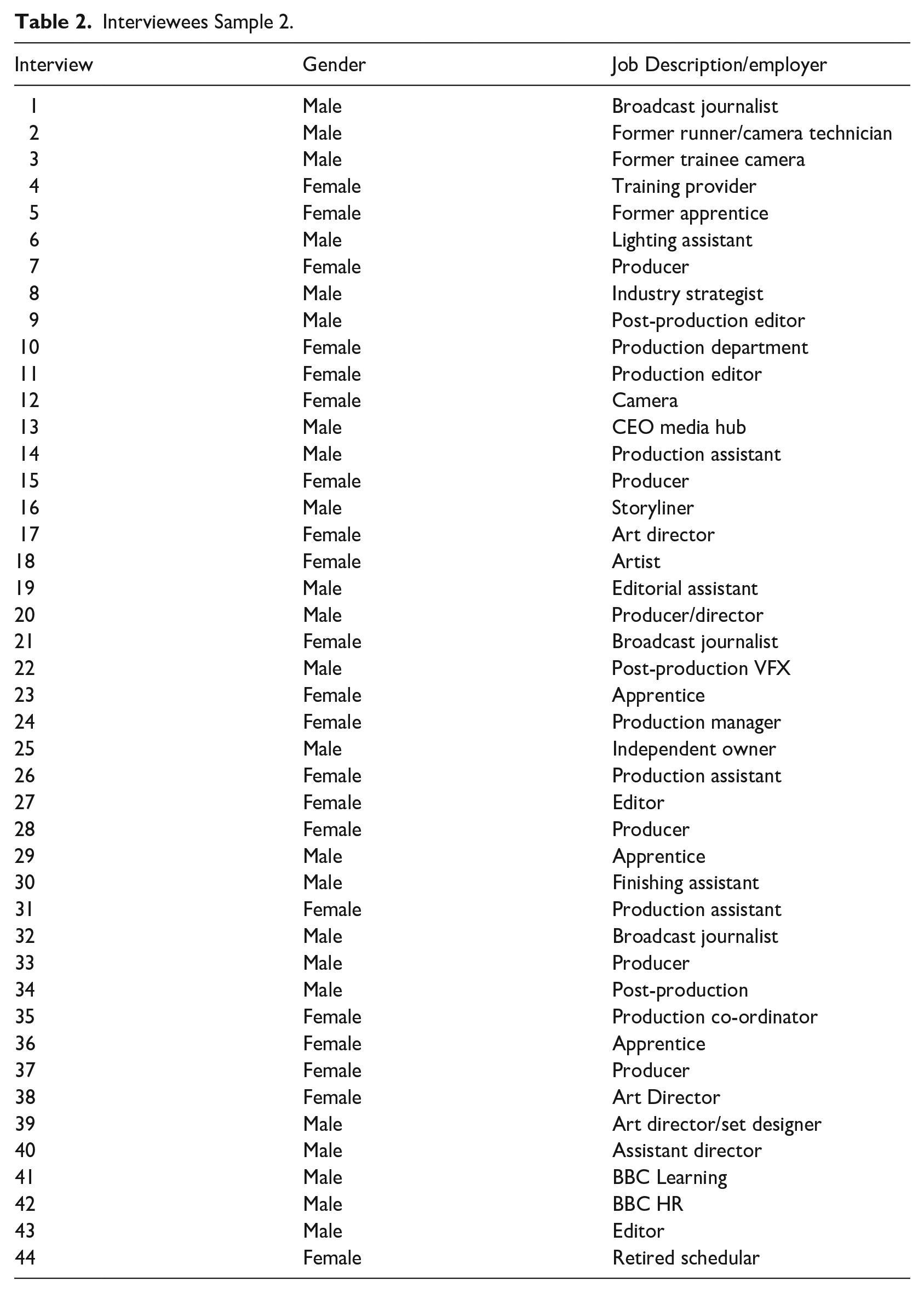
The second study (in 2019) was a follow-on from the first, but purposely focused on younger freelancers to evaluate very different organizational and labour market context with very different outcomes for younger freelance workers. For instance, very few of them had ever been employed in the industry’s major corporations, and many of them had experienced a more tortuous entry into networks and the accumulation of social capital necessary to find work. The sample, then, was deliberately skewed towards younger freelancers; only 7 of 43 interviewees were over 40 years, for example, an experienced apprentice/training provider. The majority (20) were in their 20s, 16 in their 30s and one under 20. The sample were evenly divided by gender (23 male, 20 female), broadly representative of the industry with ‘above and below’ the line occupations – including journalists, various production/directing activities, camera, editing, various art functions including set design, and costume, as well as apprentices. Further, three had left the industry but were included to gain insight into the reasons for this. The sector is covered primarily by a single workers’ union, BECTU, to which most of the older freelancers belonged, although a decline in the union by almost one-half had occurred after 2000 (Jones, 2019), leaving the younger workers particularly exposed to precarious conditions.
Data analysis
All interviews were recorded and transcribed and then coded, organizing the notes into groups thus taking the first step to conceptualization (Braun and Clarke, 2006). Data analysis involved generating interpretive schemes manually, identified from researchers’ analysis of transcripts, which was augmented by cross checking by colleagues. The analysis involved three stages of informal processing; empirical description, thematic identification and theoretical construction (Geertz, 2005).
The initial stage was developing empirical descriptions involving writing ‘thick’ accounts of issues and events (Glaser and Strauss, 2009; Jay, 2013). Interview and observation-based information was recorded, including facts but also subjective explanations provided by respondents. This led to qualitative data which provided an information repository for later analysis. The next stage involved the identification of thematic narratives. Here, intangible factors (such as autonomy and artistic attraction) were related to more tangible ones (strategic policies, technological innovations) to make sense of the changing nature of freelance creative work. The emerging interpretive themes from this analysis provide the central planks of explanation. The final stage concerned theory development. Interpretive themes were reviewed a number of times to establish reliability and validity and formed the basis for grounded theory. Major themes explained by higher order sociological concepts (such as habituated assumptions or against the grain trajectories) to provide a theory of meaningfulness in creative work, reflecting the ambivalence of work in such an environment
Organizing television: The emergence of neo-bureaucracy
The two samples, one predominantly of older freelancers and the second younger, enabled the analysis to track the shift from the bureaucratic form in television to a neo-bureaucratic one, with the oldest freelancers interviewed first employed in the 1970s and the youngest one starting in 2015. Given that the older freelancers offer reflections on their careers of sometimes over 40 years, the data has a historical aspect, spanning a period of significant changes to the sector. The oldest interviewees from the first sample had been employed at a time when the industry was dominated by a few oligopolistic providers (the BBC and ITV) operating strong hierarchies, internal labour markets and clear career paths with associated HR policies. In contrast, interviewees in the second sample worked in an industry characterized by fragmentation and a large number of independents and freelancers, with the associated labour market features.
This context shaped both the working conditions in the industry and the manner in which these freelancers joined it and, as a consequence, their industry ‘connections’. With one exception, all but one of the older freelancers in the first sample had been formerly employed at one of the large providers while none of the second sample had. Those freelancing from the first sample cited various reasons. First, some sought creative and financial opportunities from freelance work. Others had been made redundant as the large providers outsourced work in general and certain functions in particular (e.g. camera operators). Still others ‘jumped before they were pushed’ and left before this fragmentation occurred. In such cases, these more experienced freelancers held extensive social capital networks and a reliable route into regular work, established during their prior working experience (at, e.g. the BBC). None of the second sample, however, had ever been employed in the industry’s major corporations, unsurprising given the fragmentation of the industry. As Ed (60s), an ex-BBC and ITV Commissioner argued: ‘Staff jobs are something of the past, this is very tough for freelancers’.
Jac (50s), independent company-owner and ex-BBC further noted: ‘It all went pear-shaped in 2008, there were big cuts to save money, there was a new freelance model of ‘go-to’ freelancers who are almost full-time with us’.
The younger freelancers, therefore, potentially had very different labour market experiences, with more tortuous entry into networks, a more uncertain process of accumulating the social capital necessary to find work and far less structured access to training opportunities than was previously the case.
Sandra, owner of a training providing company and ex-ITV, described training in-house before the 1990s at the BBC and ITV as ‘fantastic and outstanding’.
Gareth (60s), an ex-BBC staffer who now runs a media hub, hinted at the changing nature of the industry which shaped employment patterns and the nature of television work. He argued that the production process had become much more entrepreneurial with the necessity of producers to make and sell material. This tended, in his view, to work against the craft ethos of production, particularly in areas where budgets are restricted, the majority of production.
These aspects, and the experiences thereof as described below, led us to characterize the site as one of neo-bureaucractic transition. Specifically, the loosening of direct organization and the entrepreneurialization of the sector gave an impression of decentralization. However, as we will see below, control was maintained through less formal, network oriented and subjective motivational factors, reproducing centralized control though more invisible means.
Changing industry structures were also noted by Lewis (ex-BBC and Independent company owner, 50s) on the now pivotal, and extremely powerful, role of programming commissioners:
‘One of the questions that throws up is, to what extent is any commissioner willing to take a risk on new talent, on new people coming into the industry?’
These observations point to a story of deep changes in the structure of work careers in television, changes that had led to a proliferation of freelancers. The effects of these changes were unevenly distributed so that the younger population, less robust in terms of social networks and experience, bore the brunt of the precarisation from this shifting terrain in the sector.
Accessing work
As noted above, access to work for freelance workers in this neo-bureaucratic organizational form depended largely on the social capital that they had accumulated, and which was asymmetrically distributed to the benefit of the older workers. By contrast, the five younger participants in the first study and all of the sample from study 2 struggled with access. Doreen (50s producer) when asked about ‘go-to’ people, explained: ‘Well, I was one, and it cascades. For example, a commissioner at the BBC will say at the BAFTA’s, I like that cameraman’s work, he won an award for that documentary on Africa, use him for your programmes. Then he would say, I want you to use so-and-so for sound. It’s all about personal connections’.
Such connections suggest an informal coordination mechanism that organizes neo-bureaucracy in the absence of a formal recruitment strategy. Similarly, Eric (40s) elaborated on the highly personalized nature of recruitment and the necessity of networks. A freelance director, he was extremely successful with a string of major (BBC and ITV) prime time drama shows and typically in the top 10 UK directors. As he explained: ‘For programme, N. was the executive producer, and she knew me, also K. was a producer from HomeCity, she showed me the script and I wanted to do it. She has a reputation as being very exacting and our working relationship was very good. But the BBC insisted that it was advertised, even though it was done by an independent. The BBC have a huge influence on the key creatives. . .the producer, director, the director of photography, the designer, the editor, this is all in their control’.
Going beyond simply ‘knowing someone’, Eric’s description implies an elaborate system by which personal connection populated each set. Despite an enviable reputation in UK television, he nevertheless expressed insecurity: ‘Reputation is everything, but it a very precarious profession. I am up at the moment but could be down and out next year. All you need is a couple of bum projects, I’ve seen it so many times. UK drama is dominated by 3 to 4 people, the drama commissioners from the BBC, ITV, Channel 4, they are gods in TV. I’ve heard them talking about people, for example designers who are very good, but they say, not him or her’.
These forms of networking for securing work can be based on patronage, as described by Nia (50, location manager). Despite what could be termed a stellar CV with lots of films and major UK dramas: ‘Last year I was promised 38 weeks with the BBC, with one other floor manager, but they took on another producer who took on another team and I ended up with 3 episodes, I had turned down work, and lost a load of money’.
Despite being anxiety-producing and frustrating for freelancers more generally, for younger freelancers this avenue to contacts had ceased. They faced an industry structured on social and sometimes familial capital. Christopher (30s, ex-industry) noted a contemporary who had gone onto work as a grip on all the major films for the past 5–10 years such as the Bond and Batman films, who had progressed his career in part as a result of certain family contacts. Further, he referred to a fellow graduate who had been given a £20,000 camera upon graduation. Similarly, Anthony gained his first ‘runner’ position from exercising with someone who worked at the independent company and that: ‘The people I was in the office with, one bloke works for BBC radio, one of the girls was – her mum was a production manager at the BBC, and the other girl was – I think her dad was one of the lecturers in X (a prestigious university media department).
With no experience of working for the major corporations to gain network access, work was sporadic, very insecure and poorly paid. Hayley (25), a camera operator, described carrying out 4 months of unpaid work, followed by six unemployed, then joining a short work experience scheme when she was twinned with a mentor (Richard) who finally got her regular work with major productions through his connections: ‘Word of mouth, Richard was great. I had been contacting the Focus Puller at BBC Science Fiction drama for years with no joy, but Richard rang him and he got in touch. That was a big break. He got me lots of work, he recommended me for lots of stuff, or acted as a referee or put me onto stuff. I did bits and bobs for Hospital drama, Science Fiction drama, daily cover stuff. Then I got a job with BBC Drama for 6 to 8 weeks as a camera trainee’.
Despite this degree of success, however, her work remained insecure and her career horizons limited to 1 year, even as she enjoyed the creativity of freelance work: ‘Generally, I work for a couple of days per week. The production team will ring but it can be very short notice, the day before or even that day in some cases’.
Furthermore, Hayley lived, for financial reasons, at her family home, as did her fiancé at his, and all of the other young freelancers with one exception, Rupert. Rupert was exceptional in a number of respects. He was slightly older (30), had retired prematurely from an English premiership football club, had familial contacts (his father was a well-known producer/director) and had other industry contacts who offered him his first job. He was also married to someone with a well-paid position in financial services. He loved the freelance creative industry for the ‘freedom and variety’ it provided. Despite these advantages, and taking a pragmatic view of labour market conditions, he bemoaned the insecurity, with long hours (10–12 hours a day), unpaid work, increased customer expectations and doubted whether he would be able to carry out the job without a well-paid partner or whether you could have two freelancers in a family, termed ‘stressful’.
Given the difficulties of industry entrance, both due to company risk aversion and over-supply of media graduates, social capital took on particular importance for the second sample. Contacts and familial ties were consistently cited, as in the case of Lyndsey (35), an editor, whose first work experience aged 16 involved an independent company owned by a family acquaintance. Lyndsey acknowledged that without these connections, she would probably not have succeeded and that even with them, her progress had been slow and often relied on family support for her life in London.
Jason (mid-30s, producer/director) started with the BBC and now ran two independent companies. From a working-class background, he had been born on a large public housing estate, had attended the local state school, and reported knowing more drug dealers than professionals. He described the BBC as ‘very middle class, full of family connections, but a lack of creativity and ideas’.
Overall, the presence of instability and precarity, particularly felt in the younger generation, was manifest in an opaque job market where applicants scrambled to find openings, often with the aid of personal connections as well as family support, which effectively subsidized the low job benefits. These elements of informal control allowed the circulation of worker-based information and control in the absence of formal policies, effectively delegating organization to the surrounding community. The precarity caused by this transformation was bearable by the older freelancers, who had benefitted from network ties. Their retirement led to a shift of work to middle-class composition, with an emphasis on prestige, as we elaborate below.
The allure of the industry
Most of the first sample began in the industry in the 1980s and 90s, a period characterized by in-house positions and stability, regular working hours, decent pay, considerable training and trade union protections. Many had been drawn into the industry for its creative allure. Our participants described a love of film or the arts in their teens, and it was this sense of meaningfulness that gave them a desire to develop that love into a career. Further, many had chosen to freelance to increase the creative side of their work, involving more diverse opportunities, variety of work employers and control over creative choices. They explained their attraction to the industry along three categories: the possibility of artistic creativity; the view of television as ‘glamorous’ and interesting; and the ‘steadiness’ of the occupation.
A recurring theme involved the love of craft and creativity, which imbued the work with a deep sense of meaningfulness. Richard (50s), a camera operator, had initially studied at Oxford University, with family teaching and studying at Cambridge; feeling he had something to prove, he had nevertheless become disillusioned with the abstract nature of his course and left, after a year, to study film at a small provincial college and ‘follow his heart and dreams’, recounted the moment he received a camera from his father at age 10. Similarly, Eric, a ‘go-to’ producer/director with a string of top drama credits, emphasized his fascination with storytelling and drama ‘from a young age’. In these cases, the meaningfulness of television production was linked to the realization of a lifelong self project.
Jac (50s), who produced music media, similarly reflected: ‘Inevitably this was glamorous, up to a point, as I was in the studio recording for Pop Star’s record label A Records, with musicians such as DT and producer PH, and the London Chamber Orchestra, a steep learning curve for me. My passions were for the music, less with the world of celebrity that surrounded it, though it was nice to be a part of this rarified world in my early twenties. I tended to be the one who was up all-night writing string arrangements whilst others partied. . .my passion for it goes back to my teens really, as player of the French horn in the County Youth Orchestra, then discovering the electric guitar, women and cigarettes – not necessarily in that order!’
That the meaningfulness of a creative and lifestyle-based work overshadowed economic and career considerations was a common trope. Arthur (40s), a designer, commented: ‘The industry and end employment were not on the forefront of my decision making really. My personal enjoyment, exploration and belief, as an artist with a message to share, were the main focus. Making a mark within the design community through published work maybe was an element of the recognition. . ..of course, at a certain point you have to realise that a living has to be made’.
Arthur’s final acknowledgement that working for ‘a living’ entered ‘at a certain point’ marked the ongoing negotiation of meaningfulness with the economic aspect of workers’ experience. The idea of a unique kind of ‘scene’ had a powerful draw that obscured the ‘job’ of television work, and in such cases meaningfulness provided an important substitute for security. Mike, a go-to producer with a string of major BBC and ITV dramas, described being an arty kid with a love of ‘indie’ films: ‘I was very attracted to this artisanal world and found the whole ‘indie film scene’, such as it was, fairly glamorous as an ‘alternative’ kind of way. It was almost the opposite of taking a ‘job in telly’ and felt more like joining a band’.
The meaningfulness of the work for Mike involved the glamour and alternative aspect of being an artist, which reinforced the idea of a dynamic, creative life, as noted by Doris (50s, producer): ‘I perceived television to be an exciting industry, offering interesting and constantly changing work- in other words, not “boring”. I felt people were impressed when they heard someone worked “in television”’.
At time, the meaningfulness of discovery was contrasted to the superficiality of ‘glamour’, as Doreen (50s), a producer, noted, reflecting her journalistic orientation: ‘What attracted me to the media was certainly not glamour! It was the creative side and being curious about the world, hence starting off in journalism. I liked the fact that no two days were the same, or so I thought at the beginning, the unpredictability, holding people in authority to account and having the means to communicate to an audience. I never felt as a child that I would go into anything that regular or “normal”, though looking back, perhaps I should have, given the pressure and insecurity of working in the media’.
The above quotes are taken from freelancers who were older and drawn from the first sample. The second, younger sample, also cited creativity as meaningful, linked to film and television or arts or design. Many had engaged in creative activities at school, such as acting, music or dance, or film. Graham (Storyliner, 20s) described being fixated by script writing from a young age (11), while Isobel’s (Art Assistant) parents were artists, a calling she followed after studying for an engineering degree. From her childhood, she reported fascination with art and Dr Who (a popular Sci-fi drama). Jenny (broadcast journalist, 30s) described being ‘obsessed with it (broadcasting)’ when, from age 11 ‘I wanted to be a BBC newsreader’. Neal (producer/director, 30s) described making videos with his friend from the age of 11, while Sian (producer, 30s described being attracted by her love of music (she played the harp, piano and composed). Despite the changing organizational conditions, then, freelancers were still attracted into the industry as an artistic ‘calling’.
While these illustrative examples were similar to the first sample in their emphasis on meaningfulness, none in the second mentioned being attracted by the notion of a ‘steady’, good job or by the ‘glamour’, supporting the notion of a changing background work scenario. Around half of the sample had done a film and media degree, which none of the first sample had, and so were making vocational choices at 17 or 18. However, despite industry entrance becoming much more competitive and working terms and conditions worsening significantly, the industry remained an attractive ‘calling’ for younger employees and freelancers.
Overall, this movement from an ‘artistic-glamourous’ career marked by the promise (although challenging) of a stable career was slowly replaced by personal dreams or callings that were largely decoupled from ideas of a glamourous lifestyle, linked to ongoing study and accompanied an awareness of the possibility of precarity, which we elaborate below.
The dark side of meaningful work
The changing industry governance towards neo-bureaucratic forms resulted in considerably worsening working conditions for freelancers. Job-insecurity, irregular pay and long working hours resulted in pressures on freelancers, which were sometimes self-imposed. Dic (50s) reflected upon the formative years of his career in his 20s. He described a freelance editing job with ITV from 9 until 6 but being in work until 12 the night before preparing, then after until 12 again, ‘sorting out the bits that I had fucked up and so I would do another 6 hours. I put in a lot of effort because there were a lot of other freelancers out there’.
Worsening conditions for freelancers were also noted by the older sample. Doreen (50s), a freelance producer, noted the change from earlier times: ‘When I went freelance in 1993, it went very, very well for me, I had as much job security as at ITV and loads of well-paid work. I did extremely well, it was good for me. . .there was lots of opportunity to branch out. You got more chance for advancement this way’.
By the mid-2010s, however, freelancers often worked to survive, over-and -above the creative rationale. Louise (40) a freelance presenter noted that ‘I got offered a contract with the BBC to do part time work for 5 days per month, it was crap work, but it paid the bills!’ Others were enticed into less insecure work. Derek (50s), producer, concurred: ‘Times have become more difficult, certain companies are taking advantage, extra hours, no extra pay, ignoring the European Working Directive’.
For Doreen, such conditions were sustained by the promise of a meaningful experience, however, ‘In 2008 I had enough, so I decided to go conventional and take a job in PR. . .the pay etc. was great but I was bored out of my brain so I went back to TV’.
As Doreen’s quote suggests, the desire to engage in meaningful tasks (‘bored..so I went back’) held out the potential for (self) exploitation, a reflection of the ‘dark side’ of meaningful work. Felix (50s), an editor, reflected on the link between long hours and self-exploitation, exacerbated by working in a creative industry, viewed as ‘labours of love’.
‘I sometimes do editing at home, I might start at 6, work until 5, take a few hours off, and go to the pub. But then I go home and do another 3 or 4 hours, I work every weekend, I did a 12-hour day yesterday, which was Sunday’.
Continuing on the idea of self-exploitation, he linked the internal sense of meaningfulness of the work to his willingness to continue, ‘Yes, the problem is that work is my passion. Also, the work we do for ourselves is often on the weekend, and this subsidizes the day job’.
Richard reflected a similar thought on the possibilities of exploitation, moving beyond individual motivation (‘passion’) to a concern with continuous employment: ‘Yes sometimes when you are younger you allow yourself to be exploited because you want the next job. Also you want your job to be perfect. It happens elsewhere, my son is a young teacher and he allows himself to be exploited’.
A recurrent theme with freelancers involved the ‘long (unpaid) hours ‘problem’, together with the impact that it had on work-life balance. Catarina, a successful make-up artist with top film and TV credits, complained about: ‘Really long hours, I’m working in Bristol Cathedral next week, making up 150 supporting artists. . ..I don’t get paid for travel because its only 60 miles. . .I was working down at location last week on major BBC drama. I got up at 4, picked someone up and then started work at 5, they start at 8, and it might be a 10-or-12 hour shooting day. We might finish at 7, then it’s back home, a glass of wine, bed and start again’.
Lydia similarly reflected on the mismatch of the hours ‘paid-for’ and those necessary to complete jobs: ‘Normally they are awful, they expect you to work long hours for no overtime they are extremely tight with expenses, they are very dictatorial, they tell you how much you earn and what hours, and if you don’t like it, they will find a youngster to do it for less and to work long hours’. So, for example a lot of work is 25-30 miles away, we don’t get anything for either our time or our petrol. So we recently worked in location on show, we had to be up at 5.30 so we got them to put us up, they put us up at a cheap hotel at £30 per night, no breakfast. B went to New York to film on science fiction programme, they gave them £10 a day, you couldn’t get a drink for that. She dug her heals in and they chucked her off the show.’
Part of the degraded work conditions was a consequence of split of programme-making into big budget (such as for Netflix) and low budget programmes (for regional off-peak TV). Garfield (40s), an independent producer, meanwhile, noted that ‘. . .the workload is ridiculous, the ‘caviar’ programmes are paid for by our ‘egg and chips’ ones. This bifurcation of production led to compromised artistic possibilities and rushed production, as he elaborated: ‘It’s a very small team, for example, years ago we would have had a researcher etc. We’re working much harder than we were before, driven by finance. We do our own editing if we can, simple camerawork, or interviews, we would have never done this 20-years ago. Freelancers are getting squeezed and are squeezing themselves, offering deals. In London, we have to set off at 5, work until 8 and then work the next day, it is cheaper to stay. I’m 47 but I can’t imagine doing this when I’m 60, not with the pressures and the hours worked’.
The idea of provisional acceptability but with serious life consequences (‘can’t imagine doing this when I’m 60’) was characteristic for the older freelancers, such as Medwyn (50s), a ‘go to’ director for large TV corporations. He viewed freelancing as offering creativity and produced avant garde films and high-profile TV dramas that had been highly successful. However, he lamented the work-life implications of the work demands: ‘But filming is hard work, because you are off filming for 9 months, that is great when you are young, but not when you have kids. . .I now prefer to do commercials as they’re easier. If I could live off commercials I would. . .I’ve never made any money out of films’:
While older freelancers faced insecurity, the younger ones faced sporadic employment and poor pay, as well as insecurity, given their lack of experience of working for the major corporations to gain network access. Hayley (25), a camera operator, described carrying out 4 months of unpaid work, followed by six unemployed then joining a short work experience scheme. Maria (31, producer), explaining a long-hours ‘culture’, noted that when she worked in London it was common to work ‘with people in offices sleeping on camp beds’.
Rick (20s) emphasized that even the attempt to get paid was an ongoing battle: ‘At the moment I spend 50% of my time doing unpaid work, I want to get this to 60-40 and eventually 80-20’. He emphasized the impossibility of planning a family as a result of this and the long hours, ‘That’s fine ‘cos I don’t have any kids or a wife at home. You get producers who take the piss, they want you to do something for nothing and they will get 4 people to do this. I’ve done this, on-line production for sports but you do get lots of calls out of it’. Sian (35, producer) struggled to combine the long hours with caring as a mother: ‘I think you make a choice as a woman, whether you want to be at 100% career or you want to be family and it’s very hard to, to marry both’.
Thus, while precarity was ubiquitous across participants, it had progressively worsened for the second sample of younger freelancers. Many of these respondents had chosen media-related university courses at 17 or 18 years old, with the promised vision of entering a glamorous, creative industry, and left as 21 years old graduates entering the labour market. Eve (20s), production runner, hinted at the way that a certain dream of meaningful work undergirded this dynamic: ‘I think it’s more the idea of working in telly that draws people in, rather than the thought of getting a job, because you never really think about the hours and all kind of stuff that comes along. It’s oh, I could work in telly! How cool would that be? If I don’t want to act, why not be part of something, entertainment-wise, it would be so cool to work in telly. I didn’t really ever think, how am I actually going to get a job?’
Christopher (30s) who had left the industry, provided a similar clue for motivation: ‘it’s glamorous and people want to be a part of this. . .the culture consumes you, no one is having an early night, I think at that point there is nothing else. The hours you work, you’re not going home and switching off. . .you are working on a job for three or four months, and there is nothing outside this, it’s all-encompassing and you go away and start again after two days on the next job, but no one was making money’.
Entryways for the younger freelancers included runner positions, work experience and placements, and apprenticeships. All were more precarious than the previous traineeships of the older freelancers. ‘Runner’ positions were entry level positions involving mundane tasks (getting drinks, driving etc.), across multiple projects of short duration. They were extremely precarious and generally poorly paid. Far from engaging creativity, they were mundane ‘go-for’ tasks. Work experience positions, similar to runners but generally unpaid, risked normalizing expectations of low pay, unpaid and exploitative work. Apprenticeships, on the other hand, were extremely variable, with mixed reports of positive experiences and exploitation.
Graham (story liner, 20s) reported working unpaid or low-paid freelance work after university, made possible by living in his parents’ house, doing occasional building labouring jobs and living off savings. Similarly, Lewis (50s, ex-BBC and independent company-owner) noted how long hours and poorer candidates ‘often-meant mother and father helping out, or you weren’t able to do it’. Frank (apprentice camera operator) reported earning 9000 pounds a year with six paid in rent, while Mark (20s) noted that salaries ranged from £6000 to £18,000 pa.
Irrespective of their mode of entry to the industry, the working lives of young TV workers were characterized by precarity, relatively low pay, long hours, uncertainty and exploitation/self-exploitation. Perhaps unsurprisingly, these aspects led to an industry characterized by high turnover, with long hours impacting on work life balance. Rebecca (30s) a production coordinator had a successful career but reported that she intended to leave the industry because of work intensity.
Those to who had left the industry produced interesting observations in retrospect. Such observations point to the decline of interest in the industry and an increasing impatience with the exploitation of passion for producing free labour. Andrew (30s), for example, acted as a runner after taking a Finance degree, but had left after 5 years, citing precarity, with jobs sometimes very short (as little as 3 days), taken at extremely short notice and pay low (£100 a day). Christopher joined the industry as a runner and a lighting assistant. However, he earned only ‘pin money’ or expenses and often he would have to wait for payment. As he explained the experience of a runner and his eventual exit: ‘I fell asleep behind the wheel of my car. . . I fell out of love with the industry. The hours, not knowing where the next pay-check was coming from and all that kind of stuff. I don’t think it will change, I absolutely loved it at the time, I was completely in the bubble. I don’t mind sleeping on someone’s sofa, I was just happy to do it. But I got more jaded the longer it went on’.
The ambivalence of loving and leaving reported here exemplifies the ambivalence of meaningful work experienced in the sector, the feeling of being ‘torn’, as John (26, post-production) reported: ‘You sort of get torn between the amount of hours you have to do, to stay. [. . .] You’re just doing the hours that are required to get the show on, or the product released. So I felt a conflict between not wanting spoil my chance, but at the same time feeling very exploited. So I felt like the rug was pulled out from under me, because then I had to argue against my own well-being in order to keep my job. . .and there’s always someone who would bite your arm off to be in that position’.
Overall, the ambivalence of meaningful work in television was constituted by a mixture of symbolic rewards in the form of creativity and, at times, glamour, mixed with increasing material penury in the form of eroding work conditions and pay. This ambivalence had moved from an older modality in which potentially exploitative work was demanded for a creative and glamourous lifestyle and a secure place in the field, to a newer modality in which the promise of self-realization dissipated in work that was unstable, all-consuming, and virtually unpaid. Such work was subsidized by family contributions and the willingness of young workers to sacrifice unflinchingly. As they began to conclude that such sacrifices would ultimately go unrecognized, or that, even if recognized, they would leave no space for any other aspects of life, they increasingly exited the field.
Discussion and conclusion
The television industry is an unusual one in that work can be characterized as both creative and largely craft-based and yet, in part, it is highly influenced by newer technologies, particularly digitalization, and has many aspects of mass-production. This combination of artistic and industrialized production creates tensions around how workers consider the meaningfulness of their work. The current study has examined how individuals experience meaningfulness in the face of neo-bureaucratic workplace transformations.
We argued that conceptions of meaningful work have positioned it in reaction to the alienation and disenchantment of modern modes of production (e.g. Endrissat et al., 2015). This positioning evokes either Marxian conceptions of worker alienation as extraction under an ‘enchanted’ ideology (Endrissat et al., 2015) or a more Weberian bureaucratic conception of alienation as formal, dehumanizing control (Adler, 2012). However, against the background of neo-bureaucratic trends (Farrell and Morris, 2003, 2013) and, indeed transformations to the neo-bureaucratic forms, this search for meaningfulness cannot be taken as only contrasting with modern production but may be symptomatic of new forms of workplace exploitation, where the love of the job (e.g. Bozkurt and Cohen, 2019) is leveraged to compensate for increasing precarity and the lack of stabilized organizational supports (Morris et al., 2023).
Empirically, it may be the loosening of the neo-bureaucratic form that is creating turbulence in field of television production. Large broadcasters attempt to keep control over the market by employing people they are familiar with on relatively long term (but freelance) contacts. Yet they lose control as they are less familiar with the freelancers than was previously the case. Meanwhile, for the freelancers, job markets are increasingly precarious as young freelancers struggle initially to join the neo bureaucratic network and find work more sporadic. While these markets are not spot markets, they increasingly resemble freelance markets. Importantly, we would argue that these forms of neo- bureaucracy are fluid and in transition.
Through our examination of the contours of meaningfulness in television production work, we explored how workers in precarious, intensified and uncertain work conditions held onto their artistic dreams, a persistence increasingly pitting their love of their work against the material conditions of their existence. In this sense, meaningful work – which applies to the job before and after fragmentation – is bounded by context with political and social logics being crucial (Hoedemaekers, 2018). For example far different employment outcomes applied to industry workers, particularly with moves to weaker neo-bureaucratic structures. Further, there are inherent tensions in this work between, for example, autonomy and creativity and the necessity to earn a living and features associated with this, such as collaboration and taking on undesired work (Hoedemaekers, 2018).
Our samples differ in a number of respects. The first and older sample offer reflections on the changing – and worsening – employment conditions in this craft/creative industry. The situation is one of government liberalization (in the UK at least); widespread industrial restructuring, including a shift from a bureaucratic organizing model to a neo-bureaucratic one (Morris et al., 2016); dramatic changes in underlying technology, and specifically the emergence of digital technologies which, in turn impacted upon the skills required in the industry and also the cost of production equipment; finally, and relatedly, the fragmentation of both outputs, in terms of channels, the emergence of streaming services (such as Netflix) and the ability to watch output on demand etc. The older sample also have in general advantages over the younger freelancers as they had worked for the major corporations, and thus have built-in networks of social capital required to gain work opportunities, which the younger sample did not (although they did have access to networks via social and familial contacts). In particular, it is an irony that this precarity is a direct consequence of the shift from bureaucratic forms of organizing to neo-bureaucratic ones, one of the supposed reasons for a renewed interest in meaningfulness.
Recent studies in meaningful work have noted how meaningfulness can change over the life of a worker, as tensions between economic and personal value change in shape over time, and over a lifetime of personal negotiations and compromises (Fontana et al., 2023). Our study differs, however, in that the change relates to sector-level shifts between organizational forms, and the specificities of neo-bureaucratic organizing that undermine younger workers’ ability to develop the relational ties needed to sustain their callings.
In our sample, we noted similarities and contrasts between more senior workers’ conceptions of difficult but meaningful production and a new generation’s navigation of precarious and uncertain work. Citing a lifelong passion for art, creation and sometimes celebrity, their search to develop these aspects of their trade led them to accept exploitative working hours and conditions, for little and sometimes no pay. While ‘running the gauntlet’ to make in creative industries was nothing new, and was described by the more senior workers, they had done so against the background of more ‘traditional’ bureaucratic organizations like the BBC, with whom they hoped to (and often did) achieve ongoing recognition or employment; by contrast, in a decentralized, neo-bureaucratic world of partial employment spread across a decentralized and privatized sector, promises of meaningfulness lacked an institutional basis for realization, and free-floated as personal dreams. As such, they allowed workers to continue stretching their personal and social resources to maintain productivity under intense demands.
Our theoretical contribution lies at the intersections of literatures on meaningfulness (cf., Bailey et al., 2019; Blustein et al., 2023) and neo-bureaucratic management forms (Morris and Farrell, 2017). Meaningfulness has often been addressed as a remedy for disenchanted workplaces, reproducing more socially and personally rich forms of work in contrast to modern rationalist norms (Toraldo et al., 2019). Nevertheless, recent reviews of this literature have stressed that meaningfulness should be studied in the light of structural issues around decent work and precarity (Blustein et al., 2023). The largely psychological bent of traditional meaningfulness literature (Lepisto and Pratt, 2017) can thus be supplemented by work-level analyses that examine how employment structures form the background of meaningful work.
Neo-bureaucracy, posits a contrasting view to enchantment, noting that contemporary workspaces have dissolved traditional hierarchical bureaucracies by replacing them with remote yet concentrated forms of control, including social networks and engineered incentives. These recreate some of the power effects of traditional bureaucracies but with an elusive source of control, often shifting responsibility for exploitation onto worker’s personal choices and calculations. Neo-bureaucracy provides a nuance to and caveat for meaningfulness within creative industries. In this sense, meaningful work is variable and depends on background context with political and social logics crucial (Hoedemaekers, 2018). The organizational context, for example, had far different employment outcomes for industry workers, particularly with moves to weaker neo-bureaucratic structures. Further there are inherent tensions in this work between, for example, autonomy and creativity and the necessity to earn a living and features associated with this, such as collaboration and taking on undesired work (Hoedemaekers, 2018).
Extant literature on neo-bureaucracy has focused largely on the nature of such organization at the macro-level. Specifically, studies have examined the organizational tensions produced by the tension between formal bureaucracy and networked forms of organizing (e.g. Sturdy et al., 2016). More recent literature has noted that this form of organizing involves a turn to normative forms of control, using worker creativity as a control mechanism (Morris et al., 2023). Some critical work notes that meaningfulness is related to new forms of normative control (Toraldo et al., 2019), a link that has not been linked however to neo-bureaucracy. The current study connects the literatures on neo-bureaucratic control and meaningfulness by examining how the experience of meaningfulness can play into and facilitate the continuation of work in conditions of increased precarity. Even as the network structures supporting neo-bureaucracy begin to erode, a new generation maintains its link to such work and experiences it as meaningful even as these supports disappear, leaving workers in an especially troublesome position.
The question arises, then, is what continues to attract staff to an industry which promises meaningfulness but is also marred by precarity. That the older generation of freelancers were seduced by working in creative occupations has been outlined in what are seen as – and were – glamorous, ‘want-to-work in’, occupations. The industry has, however, arguably become less glamorous with intense precarity pressures, and further, freelancers have been pushed into accepting more mundane work, in part to earn a living, but also on occasions to cross-subsidize more creative and craft elements of these occupations. Older freelancers made a more comfortable living which thy have maintained through social capital networks. Work in television could therefore be classed as ‘meaningful’, but hardly aspirational, in that it offers a sense of meaning or even calling but is also characterized by many negative forms associated with precarity.
Our contribution to this point is to show how meaningfulness functions to draw in new recruits despite transformations of the bases of production. The ‘meaning’ of meaningfulness shifts according to this modified context. Most studies treat meaningful work as a micro-level relational state between the worker and their conditions of labour, neglecting the structural and environmental background conditions of meaningfulness (e.g. Robertson et al., 2020). By contrast, our perspective zooms out to ask how meaningfulness takes its significance with relation to the macro-context within which it is place, complementing more phenomenological considerations (Bailey and Madden, 2017) with an insistence on maintaining a view to the historical and political economy of meaningfulness. In this sense, under neo-bureaucracy, meaningfulness takes on new meanings.
Still, questions remain as to the nature of the link between worker experience and the changing nature of organizational control. Specifically, while we cite literature describing meaningful experiences as reactions to workplace alienation and describe its operation as compensatory, future research is needed as to the temporal and processual link between these features. It may be that meaningfulness precedes structural changes and despite these changes, allowing workers to continue in the face of precarity. Alternatively, meaningfulness might be promoted as a post-hoc form of neonormative device in compensatory attempt by management. It is likely that some combination of these processes exists, and future research should examine when meaningfulness emerges and by whom it is championed. Doing so would allow a more complete picture of how the lived experience of work fits into the larger picture of workplace structuration and control. Establishing that link is a first step towards that larger research agenda.
Footnotes
Authors’ note
All names have been anonymized.
Funding
The author(s) disclosed receipt of the following financial support for the research, authorship, and/or publication of this article: the first study was an unfunded one conducted by one of the authors who subsequently sought and received funding for the second from the UKs ESRC. (ES/R501013/1).
