




Abstract
After the 1997 financial crisis, South Korea abruptly transformed into a neoliberal state. This sudden neoliberal turn necessitated an invention of new subjectivities, making it one of the nation’s most urgent projects. Various efforts were made by the state and market, and among them the notion of ‘creativity management’ stood out. First employed by Samsung Group, creativity management in a wide variety of forms was soon emulated by numerous organizations in South Korea, private or public. This article, drawing upon Foucault’s notion of governmentality, examines how self-governing, neoliberal subjectivities were constructed by the practices and discourses of creativity management. For this, we performed a multilevel analysis of governmentality at the macro (societal), meso (organizational), and micro (individual) levels by using data collected from various media sources and in-depth interviews conducted at two large Korean firms. The analysis reveals that the macro-meso-micro frame is a useful way of understanding the processes by which creativity discourse at a societal level is materialized in organizational programs and how both the discourse and programs influence subjectivities. The finding of this study also suggests an almost universal applicability of the governmentality notion in explaining the advent of neoliberal subjects even in a previously authoritarian state like South Korea. The article concludes by elaborating on these and other contributions in the discussion section.
Introduction
It is one Wednesday morning. People are hurriedly flocking to a stately conference room located at the headquarters of PionTech [a pseudonym], one of the 10 largest manufacturing companies in South Korea. At 7:00 AM sharp, the lecture begins and about 350 senior managers and executives of the company begin to concentrate on what the lecturer says. At the two other provincial locations of the company, another 500 senior managers listen to the same lecture through video-linked teleconference. This biweekly lecture series, which is to continue throughout the coming years, will cover various humanities and related topics such as ancient history and the thoughts of Socrates, Goethe, Zhuangzi, etc. In addition to this, PionTech’s employees are encouraged to participate in artistic activities like painting, reading or playing musical instruments and through these activities are expected to boost their creativity. (Gukje-News, 2014; Munhwa Ilbo, 2011)
Philosophy and ancient history in a manufacturing company? Employees painting and playing musical instruments during their working hours? As bizarre as they may seem, these developments are not unique to PionTech. In 2006, Samsung announced creativity management as the new management paradigm. Since then, numerous Korean companies have been fervently following this lead, and in a relatively brief space of time, the notion of creativity management has firmly settled down in Korean society as the dominant workplace discourse that dictates organizational practices and constitutes personal identities. However, other than introducing some stylish rhetoric or superficial practices of doubtful origin, creativity discourse had no significant effects on the fundamental nature of the wage labor/capital relationship (Chae, 2016; Ryu et al., 2016). Nevertheless, creativity discourse seems to have had a profound impact upon the everyday lives of the Korean people, forming new subjects obsessed with the notion of creativity who are anxious to avoid exclusion from social communities. In this way, creativity discourse faithfully serves to maintain capitalism. It has thus emerged as a successful governing discourse transforming individual Koreans into neoliberal subjects (Chae, 2016; Kim, 2014a; Ryu et al., 2016).
In face of this questionable phenomenon, this study explores the nature and trajectory of creativity discourse. Based on data from various media sources and in-depth interviews conducted at two large Korean firms, we examine how creativity has been established as a governing discourse and transformed the subjectivity of managers and employees. To investigate in detail the mechanisms through which grand discourses impact on subjects, we identify the practices that provoke this change in subjectivity. Theoretically, we address the issues of discourse and subjectivity by adopting a Foucauldian notion of governmentality (Foucault, 1991), examining how creativity discourse as a governing logic specifically affects power–knowledge relations and how technologies of self constitute the neoliberal subjectivities of South Korea’s modern-day employees.
This study contributes to the creativity and governmentality literature in three ways. First, it explores creativity discourse in terms of the three aspects of governmentality: governmental programs, technologies of government, and technologies of self. Each aspect embodies the societal, organizational, and individual levels that intricately work together to produce neoliberal subjects (Miller and Rose, 2008). Such diverse levels, in previous studies on governmentality, were usually addressed conceptually rather than empirically (e.g. Miller and Rose, 2008; Rose et al., 2006). In most previous creativity studies, discourse analyses were conducted at a single level and Foucauldian concepts of power, discourse, and governmentality were employed (e.g. Brown et al., 2010; Fougère and Solitander, 2010; Parush and Koivunen, 2014; Prichard, 2002; Tuori and Vilén, 2011). By contrast, this study contributes to the literature on creativity by examining how creativity discourse shapes neoliberal subjects at all three levels. On a macro (societal) level, creativity serves as a dominant discourse in Korean society. On a meso (organizational) level, it crystallizes into organizational practices, which further influence employees on a micro (individual) level. The cascading effects of creativity discourse is examined to overcome the limitations of a single-level approach.
Second, we investigate individuals’ various responses to creativity discourse. As a governing discourse, creativity influences the formation of neoliberal subjectivity (Fougère and Solitander, 2010; Jeanes, 2006), and it is safe to say that how each neoliberal subject reacts to the given discourse may vary (Alvesson and Kärreman, 2011). However, the issue of variability in responses among subjects has been overlooked in previous research (for a few exceptions, see Knights and McCabe, 2000, 2003). Fournier (1998) showed that individuals respond differently by choosing whether or not to embrace a governing discourse, thus forming various forms of self. A more thorough investigation into the diverse forms of self further extends our understanding of neoliberal governmentality.
Finally, this study explores the formation of neoliberal subjects in an Asian context. Although neoliberalism is a world-wide phenomenon, there is a lack of research on the effects of governmentality in a non-Western context (for a few exceptions, see Jeffrey, 2009; Sigley, 2006). Some argue that the concept of governmentality is appropriate for the analysis of Western and advanced liberal societies (Sigley, 2006). However, as some non-Western societies have undergone rapid neoliberal reform during the last few decades, governmentality studies in a non-Western context are required to elucidate the nature of governmentality (Song, 2009; Suh, 2007). By applying Foucault’s notion of governmentality, this study examines how neoliberal subjectivity emerges and identifies the types of discourse employed in South Korea, a non-Western, liberal society which underwent rapid development of capitalism.
In sum, we aim to reveal the role of creativity discourse in forming neoliberal subjectivity. The article begins with a review of governmentality and creativity studies, followed by a historical description of creativity emerging as a governing discourse in South Korea. We describe the practices mobilized in organizations and how individuals respond to creativity discourse. Finally, the implications and contributions of our findings are discussed.
Theoretical background
With the advent of the knowledge economy in the late 20th century, creativity has gained a great deal of attention from researchers and practitioners due to its alleged positive effects on the wealth of corporations, cities, and nations. Creativity is now accepted as a primary research topic in numerous organizational studies that have reported its high correlation with organizational performance (Anderson et al., 2014). Functionalism is the dominant perspective in organizational creativity studies (Driver, 2008; Taylor and Callahan, 2005). Functionalist researchers have tried to demonstrate the correlation between creativity and individual characteristics such as Big 5 personality, self-efficacy, and moods (e.g. Baas et al., 2008; Gong et al., 2009; Sung and Choi, 2009). Furthermore, situational variables (e.g. task structures, work environments, and leadership) have also been included in their studies with the goal of explaining the causal link between individual creativity and organizational performance (e.g. Amabile et al., 1996, 2004).
The functionalist approach assumes the realist ontology of creativity (Blomberg, 2014; Tuori and Vilén, 2011). This approach, however, may overlook the fact that creativity as a discourse is a powerful tool for the realization of political ends and the transformation of individuals into normalized subjects. The early humanist psychologists argued that creativity is a universal human attribute which awaits further development to be fully realized (Tuori and Vilén, 2011), and that it is each individual’s own responsibility, no one else’s, to discover and develop the potentialities for his or her own creativity. Creativity discourse can turn individuals into subjects who work on themselves to increase their creativity or to become enterprising selves (Prichard, 2002). Furthermore, Boltanski and Chiapello (2005) argued that in the era of esthetic capitalism, art and creativity become significant values to which individuals aspire. The creative person becomes a fascinating figure and for many people, the desire to be creative is difficult to resist (Jeanes, 2006). Creativity discourse, as an alternative to overt oppression, can regulate people’s thoughts and conduct (Fougère and Solitander, 2010).
In opposition to functionalist research, a few scholars have recently conducted a discourse analysis of creativity by employing Foucauldian concepts of power, discourse, and governmentality (e.g. Brown et al., 2010; Parush and Koivunen, 2014; Tuori and Vilén, 2011). Prichard (2002) argued that creativity discourse can reconstitute individuals as subjects who take part in a permanent project of self-development. In a similar vein, Fougère and Solitander (2010) critically investigated Florida’s (2002) creative class thesis, revealing that so-called ‘creative workers’ are under pressure to internalize neoliberal mentalities. Examining particular discursive practices in an architecture firm, Brown et al. (2010) also demonstrated that creativity discourse shapes employees’ shared beliefs about what constitutes the ideal employee. Similarly, Parush and Koivunen (2014) described creative managerial selves constructed by art and creativity discourse.
Despite their theoretical contributions, discourse analyses of creativity are not without limitations. First, they tend to conduct exclusively either micro- or macro-level analysis. While Prichard (2002) regarded the formation of creativity discourse as a macro phenomenon, Parush and Koivunen (2014) focused upon the managerial selves constructed through discursive practices on a micro level. However, a single-level analysis has its weaknesses (Grant and Marshak, 2011; O’Malley et al., 1997), and research on linkages among society, organizations, and individuals has been relatively neglected (Russell and McCabe, 2015; Salaman and Storey, 2008). The micro-discourse approach, focusing on language in local contexts, fails to reveal how the creative ethos becomes the dominant discourse across time and space. The macro-discourse approach, on the contrary, overlooks the fact that a discourse is embodied and materialized in concrete practices within particular organizations (Cooren et al., 2007; Fairclough, 2005). We believe that a combination of both micro- and macro-level approaches is necessary to provide a full picture of the discursive functions of creativity.
Second, the role of actors is overlooked in most discourse analyses of creativity, very few of which investigate employees’ diverse responses to creativity discourse. Bergström and Knights (2006) argued that actors in discourse analyses tend to be considered as mere conduits or channels of discourse. How actors think and behave, however, cannot be determined solely by the intentions of particular discourses. Although Brown et al. (2010) demonstrated, in their study, actors’ efforts to conform to the idealized selves, there was no deeper analysis of the extent to which individual responses to creativity discourse would vary. This is in sharp contrast to Gleadle et al.’s (2008) claim that actors’ roles should be emphasized in discourse analysis. Actors practice the care of the self and choose whether or not to accept a given discourse, which leads to the formation of a self that may or may not correspond with the intentions of the discourse (Fournier, 1998).
Drawing on the Foucauldian governmentality approach, this study attempts to identify the actor’s active role in the constitution of the self. Governmentality is defined succinctly as ‘the conduct of the conduct’ (Foucault, 1991), implying that governmental power is not exercised upon individuals directly but rather operates through the technologies of self (Clegg et al., 2002; Du Gay, 2000). Technologies of self, practiced in Ancient Greek societies, involve the active self-formation of subjects by their own means or with the help of others (Skinner, 2013). Modern governmental power is ‘exactly the interplay between … the guidance of others and the forms of self-guidance’ (Lemke, 2010: 37). Governmentality therefore refers to modern power mechanisms operating through the production of active selves who freely govern themselves while accomplishing the objectives of the authorities (Du Gay, 2000).
In governmentality studies, the relationship between self-governing activities of individuals and political objectives is explained by two interrelated mechanisms: governmental programs on a macro level and technologies of government on a meso level (Miller and Rose, 2008; Rose, 1999). Governmental programs can be considered as a kind of grand discourse which renders new domains problematic and amenable to intervention by experts. However, technologies of government are a complex mix of mundane techniques, procedures, and apparatuses which enable abstract programs to affect the activities of individuals (Rose, 1999). According to Miller and Rose (2008), technologies of government within specific contexts can establish links between discursive programs on a macro level and the concrete acts of individuals on a micro level.
Consequently, it could be argued that governmental power is exercised by the interactions among three interwoven but not mutually reducible concepts: governmental programs on a macro level, self-governing on an individual level, and technologies of government on a meso level. Unfortunately, there has been little attempt to explore how the creativity discourse shapes specific subjectivities through interactions on all three levels. In this study, we examine how creativity discourse on a macro level and creativity management practices within specific organizations combine to transform subjectivities. In the following section, creativity discourse in South Korea is discussed with an emphasis on its historical emergence as a governing discourse on a macro level.
Neoliberalism in Korea and the rise of creativity discourse
In November 1997, South Korea went through a crisis unprecedented in its modern history (Shin and Chang, 2003). As the nation’s foreign currency reserve was nearly drained, the Korean government was finally forced to ask the IMF to provide relief funding. The IMF responded promptly, but the loans it provided came with conditions attached: privatization of state enterprises, industry restructuring, reform of corporate governance, easier market access for foreign firms, and increasing labor market flexibility (Im, 2014; Lim and Jang, 2006b; Robison and Hewison, 2010). Gradually, the Korean economy recovered from the shock, but in the meantime the nation very rapidly transformed into a neoliberal state (Lim and Jang, 2006a).
Undeniably, in Korea, as in many other parts of the world, the process of neoliberalization had already been underway since the 1980s (Harvey, 2005). However, whereas the pace of change before 1997 was slow and erratic, the transformation triggered by the ‘IMF crisis’ was of a different kind and intensity. Within a few short years, the transition to a neoliberal state gained real momentum, with enormous ramifications reverberating throughout Korean society (Lim and Jang, 2006b). In particular, the adverse impact of the crisis on Korean laborers was unparalleled (Shin, 2003, 2013). According to one sociologist’s view (Suh, 2007), ‘When Korea was struck by the financial crisis in 1997, industrial workers and office employees faced hardships not experienced since the Korea War (1950–1953)’ (p. 519). Against this backdrop of aggravating socio-economic circumstances, neoliberal labor practices and their accompanying discourses were introduced into the nation’s economy and polity, penetrating swiftly (Im, 2014; Suh, 2007). Corporations rapidly abandoned the tradition of seniority-based wage structures and lifetime employment. Various forms of irregular employment were hurriedly introduced to numerous workplaces with no major resistance (Shin, 2003, 2013).
At this juncture, it must be noted that one of the most remarkable aspects of this neoliberal turn in the Korean economy is that most of the Korean populace perceived it as inevitable, or, to put in a different way, as a natural step in the progression of history, or even as a furtherance of democratization (Im, 2014). To Koreans, neoliberalization had become an overwhelming ‘natural law’, a fact of life, or a sort of irrefutable ‘truth’ (Song, 2003). Accordingly, their everyday lives and consciousness were, half voluntarily and half because they were forced to do so, molded in line with the logics of neoliberalism, which may be defined in this context as an advanced liberal mode of social governing that embraces the introduction of market-led reforms and the promotion of citizens as self-responsibilizing by encouraging people’s free will and self-sufficiency (Rose, 1999; Song, 2009).
The neoliberal turn was not just a transformation of the nation’s material conditions or an accumulation strategy, but it involved a fundamental alteration of the consciousness of the Korean people as well (Song, 2009; Suh, 2007). That is, perhaps for the first time in the country’s modern history, Koreans began to problematize their selves and personhood. They now had to consciously consider who they were and what new identities they had to transform into (Seo, 2005). During the previous ‘Developmental State’ regimes, which had lasted for more than three decades since the early 1960s, people were accustomed to formulating their identities based upon a certain combination of more or less macro social collectivities: extended family, employing organizations, labor unions, or the nation as a whole (Im, 2014). However, those secure ontological foundations had been swept away, and they now had to face new realities. Threatened by the vicissitudes of a liberated market, they suddenly found themselves in a new, precarious environment filled with numerous risks without any safety net (Seo, 2005). To govern these liberated, but ontologically insecure subjects, some rationality and technologies for stabilizing power and mobilizing consensus in the liberal governing of the population had to be invented (Seo, 2011; Song, 2009). As Rose et al. (2006) pointed out, in the neoliberal regime, ‘individuals should conduct their lives as an enterprise, should become entrepreneurs of themselves’ and are ‘required to conduct themselves responsibly and to account for their own lives and their vicissitudes in terms of their freedom’ (pp. 900–91).
At the end of the 20th century, inventing this kind of personhood was one of South Korea’s most central national projects. The project was set in motion through the dynamic interplay of the state and market. First of all, the government launched a massive campaign designed to mold model citizens, called the ‘New Intellectuals’ (‘sin jisik in’, in Korean) Movement (Chae, 2016; Song, 2002): National campaigns come and go in Korea, and many people no doubt yawned at the thought of another campaign … The ‘New Intellectuals’ movement is different because it is one of the few campaigns that is designed to produce permanent changes in cultural attitudes … [T]he movement aims to create an open cultural and intellectual climate that will allow creative and innovative people to rise to the top … By favoring creativity over ‘schooling’ and innovation over hierarchy, the movement seeks to ‘de-Confucianize’ Korean public life … The concept of ‘new intellectuals’ implies a new standard for entrance into the nation’s elite … To succeed, it will require more than words; it will require social structures that encourage openness, smallness, and ‘glocality’. Creativity and innovation will follow. (Fouser, 1998)
The campaign made it clear that its intention was to create new Koreans, drawing a sharp demarcation line between the old Confucian, authoritarian values and the new Western, liberal ideals (Song, 2002). Needless to say, the concept of New Intellectuals was an ambiguous and hollow one. However, all in all, it did not necessarily matter what the term actually meant. Or, more aptly, the very quality of ambiguity and hollowness was rather a virtue, because invoking within people’s psyche some senses of unknowing and disequilibrium, and planting a certain desire for new competences were all that was necessary. Now equipped with this new ‘intellectualized’ consciousness, desire, and fear, individuals could go forward and voluntarily undertake each one’s unique self-development project (Chae, 2016; Seo, 2011; Song, 2009). The New Intellectual campaign was more than a mere gesture. Many smaller prizes inaugurated by state ministries or local government offices were given to allegedly new intellectuals (Song, 2002). Soon the phrase ‘New Intellectuals’ slid into the everyday parlance of Koreans, and the associated rhetoric was reinforced by other managerially oriented discourses such as knowledge management and learning organization (e.g. Chae, 2016; Seo, 2011). More importantly, all these discourses were located within the irresistible narrative of ‘democratizing the country’ (Im, 2014; Song, 2009).
The first decade of the 21st century was a historical turning point for most Korean firms in terms of their mentalities, outlooks, and behavioral patterns (OECD, 2010). Having absorbed advanced technological capabilities, modern managerial techniques, and globalization capabilities, they now began to look out into the world with more confidence (Chang, 2003). Nevertheless, along with this enhanced self-consciousness, they came to apprehend that they needed to strengthen their innovation and entrepreneurial capabilities. Although the majority of Korean firms had aspired to be innovative, it would not be an overstatement to say that innovation in reality was just rhetoric, since in the past the distinctive competence of most Korean companies had invariably been the low cost and high efficiency (Lim, 2015). They could, however, no longer afford to settle for mere talk about innovation. Now, more than ever, they had to come up with real measures for enhancing their innovation capabilities.
It is well known that the conditions for facilitating innovation are fundamentally different from those for enhancing efficiency. As Skarzynski and Gibson (2008) stated, for innovation to become a core competence, there has to be a substantial degree of internal consistency among organizations’ processes, structures, rhetoric, and top management behavior. In these areas, Korean companies still lack the elements crucial for substantial innovation to a considerable extent, even today. In particular, outdated governance structures, company owners’ dictatorial management styles, centralized decision-making, and lack of cross-border collaboration remains intact within the corporate DNA of many Korean firms, hampering innovation capabilities (Im, 2014). In many cases, instead of reforming the fundamental structures and underlying power relations, the course of action taken up by the corporate elites was to place the responsibility to innovate on employees’ shoulders. Undoubtedly, individual employees play a significant role in the process of innovation, and it is safe to say that Korean companies have also tried to improve their systemic capabilities for innovation. However, such endeavors fall far short of being sufficient, and without the supporting structural conditions individual employees will not be able to exert innovative capabilities. During the last decade or so, Korean companies have continued to shift more and more of the responsibility to innovate to their employees. As a result of this process, the idea of creativity management was invented.
Since Samsung, a world-class company in Korea, announced ‘Creativity Management’ as the new management paradigm in 2006, the servile mass media has vigorously circulated the phrase. Figure 1 shows the number of newspaper articles (from the eight largest daily newspapers and the two largest business daily newspapers) that mentioned creativity management during the last 20 years. As can be seen, the number drastically increased after 2006, with creativity management being the topic of up to 10,000 articles in 2014. In 2013, the government ultimately declared the ‘Creative Economy’ as a national agenda. As a consequence, discourses on creativity rose exponentially once again, and many firms, large or small, picked up the slogan of creativity management as their own management philosophy, and in just a brink of time, creativity management had become one of Korea’s most dominant managerial discourses (Kim, 2014b; Ryu et al., 2016), as shown in Figure 1.
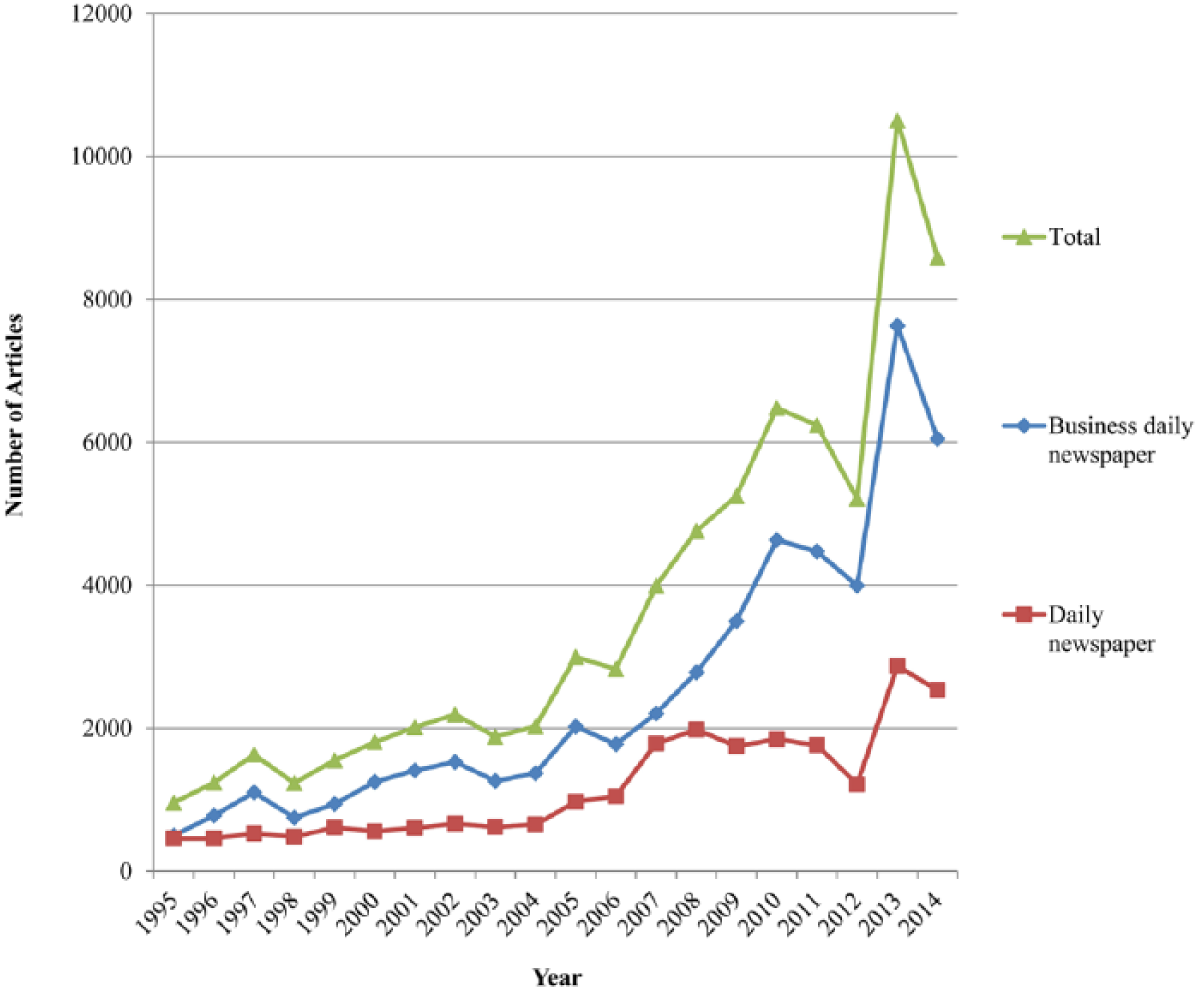
Number of articles that mentioned creativity management, 1995–2014.
With the introduction of creativity management, the ‘New Intellectuals’ rhetoric began to lose its currency. Although these two phrases share critical similarities in that both concern people’s personal traits and capabilities, creativity management as a discourse prevailed very soon. This may be because creativity as a personal virtue is more ambiguous and difficult to achieve than intellect, implying that the creativity management rhetoric is likely to make people aim higher, take on more challenges, and yet at the same time feel more confused, stressed, responsible, and anxious. In this respect, creativity management was more effective in transforming some Koreans into competitive and flexible workers, self-calculating consumers, efficient investors, self-managing entrepreneurs, or otherwise self-blaming ‘losers’ (Ryu et al., 2016; Seo, 2011).
During the last two decades, even after three changes in government, the neoliberal bent has never been abandoned, instead gaining an even stronger foothold in Korean society. Korean firms, especially large ones, sought to install a variety of creativity management programs in the workplace. In our view, the rhetoric of creativity and related practices have been quite successful in establishing neoliberal subjectivities. In the next sections, we examine in more detail how two Korean firms utilized creativity management programs and how workers responded to those programs. By doing this, we hope to show the birth of neoliberal, self-governing subjects in Korea.
Research sites and design
A qualitative study was conducted in two Korean companies, SayCom and PionTech (pseudonyms), due to their reputations in the business community for promoting creativity management proactively. SayCom is a firm in the consumer goods industry with about 95,000 full-time employees. Its annual sales exceed US$120 billion. As an advanced global company in diverse aspects of technology, marketing, and management, SayCom has a strong influence over numerous companies in Korea. SayCom has promoted creativity management by implementing a variety of practices, and it continues to play a critical role in the spreading of creativity discourse. On the contrary, PionTech is one of the largest steel companies in Korea with about 17,000 full-time employees. Its annual sales are approximately US$52 billion. Since 2000, PionTech changed ownership, moving from the public to the private sector, after which new management practices such as process innovation and 6-sigma for emphasizing innovation were initiated. As of now, PionTech is touted as one of the most aggressive companies promoting creativity management in Korea. For instance, it doubled its personnel in the department of human resource development in order to fast-track creativity management.
Data collection and analysis
We contacted five firms known for implementing creativity management in Korea by making a formal request to each firm’s HR team charged with creativity management. Two of them allowed us to implement this study. We visited the two firms a minimum of once a week for five months and collected data by means of observations, in-depth interviews, and documentary materials. The process of data collection was divided into two stages in order to gain a detailed understanding of the reality of creativity management. In the first stage, we explored changes in the environment and organizational atmosphere following the introduction of creativity management (e.g. Darso, 2004). Both firms had modified their workplaces, providing new spaces such as recreation rooms and redesigned offices or meeting rooms to enhance creativity among employees. Later on, our observations became more focused; for months, we attended the regular meetings of the HR team, participated in training courses, and took part in public events such as a symposium on creativity (e.g. Darso, 2004). In doing so, we developed an in-depth understanding of how these corporations encouraged employees to promote their own creativity.
In the second stage of data collection, we conducted interviews with 24 employees: 11 from SayCom (5 males, 6 females) and 13 from PionTech (7 males, 6 females). The interviewees came from a wide array of jobs (HR, PR, R&D, marketing, sales, finance, and manufacturing) and positions (director, manager, and staff). The ages of the interviewees ranged from 26 to 55 years, and organizational tenure from 1.5 to 25 years. All interviews took place in the interviewees’ offices during or after their working hours. The length of the interviews ranged from 1.5 to 2.5 hours. All participants were given assurance of anonymity and confidentiality. We created the interview protocol by drawing on the researchers’ previous knowledge of research contexts and gradually refined our protocol to reflect emerging research themes. Since we assumed an open approach, the interview protocol was used on a flexible basis, allowing for the emergence of new research topics. All interviews were tape-recorded and transcribed, and the transcripts were later used for closer analysis. In addition, we obtained documentary materials including internal documents such as meeting notes, company brochures, and booklets from training sessions, and external documents such as official promotional materials on creativity management. These provided information on history, policies, processes, and decisions related to creativity management.
Based on grounded theory (Glaser and Strauss, 1967), we analyzed the data using an iterative process, comparing our data and the results of existing literature. A theorized storyline (Golden-Biddle and Locke, 2007) was developed, which emphasized communication between the extant literature and the field phenomena, giving theoretically relevant insights into the data. Data analysis was conducted in two stages. In the first stage, we focused on identifying essential features of creativity management practices and systematically grouped them into distinctive categories (Wolcott, 1994: 12). Similar management practices were categorized into three first-order concepts and compared with those identified in the existing literature on governmentality. First, we found that companies tried to disrupt the existing identities of employees and reconstruct their self-images to be more compatible with the intentions of the company. We labeled this aspirational control (Alvesson and Kärreman, 2007). Second, companies also provided guidelines as to what must be done in order to become creative selves. Given the ambiguity of creativity, guidance is necessary for individuals to increase creativity and contribute creatively to organizational performance. This was referred to as guidance of conduct. Third, companies relied on different kinds of practices to encourage employees to engage in self-confession, a way to tap into their inner resources of creativity. This was named procedures of confession. The three concepts were then grouped into a second-order theme, technologies of government (Rose, 1999).
In the second stage of data analysis, we endeavored to identify how employees responded to creativity management. Two types of subjectivities were found: the enterprising self and the fatalistic self. The enterprising self refers to a person who takes on the responsibilities of finding and developing his or her creative potential. This subject establishes an identity aligned with the creativity discourse and succeeds in occupying a central position in the organization. On the contrary, the fatalistic self refuses to modify his or her behavior to comply with the creativity discourse (Fournier, 1998). These two types of subjectivities, the fatalistic self and enterprising self, were also grouped into a second-order theme, self-formation, referring to individual practices to reconstruct identities.
Technologies of government
Aspirational control
To transform and tie the self with creativity, the organizational ideal, both firms have stimulated employees’ aspirations with creativity management programs (e.g. Alvesson and Kärreman, 2007). Their efforts were conducted in two consecutive processes: sense-breaking and sense-giving (Kärreman and Alvesson, 2004; Pratt, 2000). In the process of sense-breaking, companies disrupt individuals’ sense of their own identities, inducing the fundamental question, ‘Who am I?’ After creating an identity void, companies then provide an image of the ideal self. The more severe the existential insecurity or crisis, the greater the desire to become the idealized self by constantly disciplining oneself (Collinson, 2003).
To create an identity void, both companies tried to raise crisis awareness in the employees. For example, the terms ‘crisis’ and ‘creativity’ were deliberately linked together in many cases (e.g. Prichard, 2002). One interviewee at SayCom explained how the words ‘crisis’, ‘threat’, and ‘danger’ frequently recurred in everyday talks, discussions, and meetings within the company. His boss would open official meetings with the statement that the company is under threat of increased competition from global markets, and therefore something has to change. Also, the CEO periodically sent emails to employees containing the following statement: ‘Without innovation or radical change, we are in danger of failure’. At PionTech, one employee told us that they were required to watch an in-house broadcast every morning, which showed a performance chart comparing PionTech with its competitors. This was followed by the CEO’s appearance on the screen, once again professing the urgency of the crisis and the need for innovation in order for the company to survive.
The frequent reference to crisis was intended to bring about strong anxiety about corporate failure to survive in turbulent economic times. The training managers of the two firms said that employees, idle and indolent in nature, tend to hate change and newness in favor of the status quo. The managers admitted that the fear of failure is what pushes employees to break away from complacency: Carelessness is our greatest enemy, and I believe some sensitivity is necessary. Creative management is the key to staying relevant. Unfortunately, you can’t really expect this kind of awareness from workers and it’s my job to constantly remind them and make sure we recognize and fight complacency. (Training manager, SayCom)
Both firms presented creativity as an ideal for which employees should strive, frequently using the word in various organizational practices. For example, in corporate mission statements, creativity management was claimed to be the key to success. In job interviews and entrance exams, questions about philosophy and literature were included in an attempt to measure applicants’ creative abilities. The terms ‘creativity’, ‘innovation’, and ‘uniqueness’ were also a regular part of both the workers’ everyday conversations as well as official meetings. Moreover, the external image of a company that pursues creativity was constantly promoted by corporate advertising, which again reinforced the employees’ awareness of the need for creativity: Whenever something new comes up, it’s hugely promoted. It’s introduced to the outside world through advertisement and the media and then gets back to the workers. Here’s what we accomplished so far. Now show us what you got. (Employee, SayCom)
The value of creativity was also emphasized by its close association with employees’ career trajectories (e.g. Alvesson and Kärreman, 2007), which was most evident in the training courses. Newcomers at SayCom were continually exposed to educational videos. For instance, a video would show examples of two extremes. In the first setting, workers are lazy and mentally switched off, mechanically carrying out mundane tasks. In the other, people are content with their work, actively searching for ways to invent and innovate, which inevitably leads to improved job performance and monetary incentives in the end. At PionTech, celebrities in creative industries, such as cartoonists, drama writers, comedy actors, and film directors, were periodically invited to give lectures. Their topics were self-motivating and their speeches inspirational, leaving the impression that it all boils down to a pioneering spirit: For survival in this age, isn’t it just natural to try and be creative whether it’s for mere survival or self-development? It’s no different for the companies. In order to survive, creativity needs to be a priority. (Employee, SayCom)
Most interviewees perceived that the responsibility for creativity rested solely on their own shoulders. They expressed anxiety, fearing that their failure to be creative would jeopardize the company’s competitive position, allowing it to fall prey to more innovative competitors. Creativity development would not only enhance the competitiveness of the firm but more importantly contribute to their own career survival.
Guidance of conduct
The pursuit of creativity continued in both firms, as employees were provided with not only an image of an ideal self but also guidance as to how to live up to this ideal. Suitable guidance for creativity, however, cannot be easily defined and executed because there is no specific, irrefutable body of knowledge available as to what produces and enhances one’s creativity. If there is an indisputable fact about creativity, it might be the notion that carrying out ordinary and mundane tasks is not conducive to boosting creativity. Thus, both firms encouraged employees to engage in seemingly non-work-related activities intended for creativity enhancement.
PionTech offered several creativity training programs for employees in managerial positions. For example, they were required to participate in the creativity shop, an annual workshop designed to enable employees to get creative inspiration from new and unfamiliar experiences. For example, the program included a guided tour of an art museum or gallery and attendance of a humanities and liberal arts lecture series on topics such as the life history and essential concepts of Western philosophers, from ancient Greek (e.g. Socrates and Plato) to French postmodern (e.g. Deleuze and Derrida) thinkers. Similar training programs were also conducted at SayCom annually for 2 days. Here, managers at headquarters and subsidiaries came together and listened to lectures on how to ‘work smart’. In addition, an annual in-house conference, the ‘emotion forum’, was also held for all employees, where cartoonists and TV show directors were invited to give a series of lectures on how to discover and foster their creative potential.
One important feature of the creativity management programs in both firms was the incorporation of leisure activities traditionally performed only in private areas into the workplace. Employees were expected to voluntarily make the time to enjoy leisure activities outside as well as within the workplace. Under the ‘work smart’ motto, employees at SayCom were encouraged to avoid working overtime and to save enough leisure time to develop their creative potential. It should be noted that the actual workload was not reduced; the responsibility to maintain balance between work and leisure remained with employees. Therefore, ‘work smart’ became nothing more than a hollow slogan that only added to the pressure to improve performance while simultaneously blurring the boundaries of work and life. Similarly, at PionTech, employees were encouraged to engage in leisure activities both in the workplace and at home. For example, when one employee became fascinated with the humanities after participating in lectures at the company, she began spending time in libraries to read up on related topics and continued her reading even on weekends and holiday trips: What used to be only for the few has now become a trend. Playing a musical instrument, painting, drawing, dancing … A friend of mine goes to museums. I also have a friend who’s learning how to play the guitar. I read books on Plato and Aristotle. I feel that I have to achieve the so-called work-life balance and get more experience, and of course, improve creativity. (Employee, PionTech)
Although creativity management programs were designed to help control how employees spend their time both in and out of the office, spatial issues were also of great concern. In both companies, managers tried to reshape the work environment into a supposedly creativity-friendly space. Refreshment, enjoyment, and playfulness were to be the key elements of the new interior design. A beautiful park was built at one of the manufacturing plants of SayCom, where animals ran around among exotic trees and flowers planted alongside the walking trails. All the manufacturing plants are called ‘campuses’ to remind the employees of the freedom, vitality, and newness one might feel on a college campus. Similarly, the main lobby of the PionTech headquarters was designed by a prestigious architect. Upon arrival, visitors are greeted with a huge aquarium full of various kinds of colorful fish, calling to mind the whimsical scene from the Disney film, The Little Mermaid. There are also another place called ‘Creatopia’, a neologism combining creativity and utopia, where employees are welcome to relax, play, and refresh themselves. This is where they are expected to unleash the creative self, lying on a bed or sitting on a sofa, chatting freely with each other, playing games, listening to music, or participating in all kinds of artistic work. In fact, many employees voluntarily choose to spend their lunch hour at Creatopia. The assumption is that the minds, attitudes, and behaviors of employees can be manipulated through changes in the physical environment (Lefebvre, 1991). This kind of subtle, yet powerful treatment of the self was intended to guide employees to internalize the creativity discourse: Simply telling employees to be creative is not enough to change their long, accustomed behavior patterns. So we paid attention to innovations concerning the workplace facilities. Environmental change will lead to changes in their behavior and way of thinking! They can’t help but come up with new ideas. (Manager, Saycom)
Self-confession
Confession has been generally considered as an important technology of government (Covaleski et al., 1998; Townley, 1995). It encourages the individual to discover his or her true inner self and gain self-knowledge. Creativity is a latent potentiality that can be discovered and developed through self-examination (Farmer et al., 2003), and through confession, employees are expected to reflect on their inadequacy, how they lack creativity. At both SayCom and PionTech, self-confession was facilitated through various programs.
At PionTech, leisure activity programs for employees, such as film-making and poetry- or novel-writing, were established. One manager said that the main purpose of these programs was to encourage employees to reflect on themselves and discover their unrealized potential (e.g. Taylor and Ladkin, 2009). For example, in the poetry-writing class, a noted poet was invited to give a lecture about what poetry is, how to appreciate poetry, and how to write it. While writing poetry, employees were expected to turn their attention to the inner mind, to their desires or dreams—all of which may be considered as resources or psychological capital to enhance creativity (Taylor and Ladkin, 2009). One employee participating in a poetry-writing class told us, ‘When I wrote poetry, for a while I felt like a child again’. During his childhood, he had been full of curiosity about the surrounding world, and his fantasies had often surprised his family and friends. He continued to say that ‘while working on my poetry, I found that I still had a lot of curiosity about everything. It was very joyful to discover new meanings behind ordinary things’. His poetry was about everyday life experiences and ordinary objects, but contained extraordinary insights, according to the lecturer. He admitted that, in the past, he had used to switch off mentally while at work, but nowadays tried to be more involved in the job and to find innovative ways of working and contributing. It is striking that in this example, a personal identity (in this case, a childlike mind) was summoned in the workplace (Fleming, 2014). While employees were required to conform to organizational identity and buy into the rhetoric of creativity management, they were also encouraged to express their authentic selves, which then became a source of innovation and firm performance.
Employees were encouraged not only to build self-knowledge but also to express their inner selves publicly. This would enable others to observe and evaluate the revealed selves, encouraging them to undergo their own self-transformation (Covaleski et al., 1998; Foucault, 1988; Townley, 1995). While attending the humanities lectures, employees at PionTech were required to report how they felt about the lectures in front of the other attendees and lecturers: Because of my major, engineering, I wasn’t interested in Western philosophy. Honestly, the philosophy lecture was so boring I could hardly focus. I thought philosophy is useless in reality, especially in the world of business. Naturally, when I was asked to share my thoughts about the lecture, it was really embarrassing. But when the lecturer commented on some of my misunderstandings, I was surprised to learn how philosophy helps us see things differently. It helps us to come up with fresh, new ideas that we couldn’t have come across on our own. (Employee, PionTech)
After presenting publicly, more than one employee shared feelings of shame about their prior selves because they believed they had been lazy or irresponsible for not exploring new ideas. Philosophy lectures provided them with an opportunity to widen their perspectives and discover previously unexplored insights.
At SayCom, employees were encouraged to participate in the company’s own TED conferences at the office building during the working hours as well as official TED programs. While preparing for speeches of their own, employees usually received coaching from co-workers who had previous experience participating. Employees also received feedback about the weaknesses and strengths of their own ideas as well as their presentation skills. On stage, employees received additional comments from the audience on how to improve and realize their ideas: Thanks to all the coaching and useful comments, I think I learned how to think creatively. Before the presentation, I had no idea what creative thinking was, but now I’m very enthusiastic about it. (Employee, SayCom)
Formation of subjectivities
Through the technologies described above, employees gradually redefined their self-concepts to align them with creativity discourse. Not only did employees come to regard creativity as socially worthy and personally desirable, but they also enthusiastically undertook projects of self-development to enhance their creativity. However, not all employees reacted to the creativity discourse in the same way. Foucault had serious reservations about all-embracing discourse (Gordon, 1987), implying that some individuals may not be entirely subjugated to the dominant discourse. In this study, following Fournier’s (1998) study, we categorize their responses into two types: the enterprising and the fatalistic self.
Enterprising self
As Du Gay (1996) noted, the enterprising self is the core concept of contemporary organizations. It encompasses characteristics such as initiative, risk-taking, self-reliance, self-responsibility, and independence (Du Gay, 1996; Gill, 2014; Salaman and Storey, 2008). Because enterprising selves believe that they are able to become masters of their lives and that their existence can be defined by pursuing novelty and innovation (Du Gay, 1996), they tend to consider creativity not as a duty to follow, but as a resource to express themselves fully and as a way to satisfy their needs: I read a lot, make sure to keep up with the news, and try to solve problems at work based on a mind map. I think mind mapping is a good way to organize my thoughts … Don’t you need them all to work efficiently? That’s what I thought at first, but now I just enjoy the process. (Employee, SayCom)
Enterprising selves we met tended to regard technologies of government as compasses or maps to enhance creativity and believed that the company had provided them with an ideal opportunity to become creative individuals. For example, at PionTech, employees received TRIZ training, a problem-solving methodology, to help them to perform their tasks more creatively. Most interviewees said that they attempted to apply TRIZ to their jobs. They also prepared for the TRIZ certification test, attended TRIZ conferences to learn new creative methods, and even trained themselves at home to become accustomed to using those methods.
The desire to be creative led to a blurred boundary between work and the private sphere (Prichard, 2002). During working hours, employees did not have enough time for creative endeavors because of the enormity of their assigned tasks, and thus they had to use whatever time they could spare to develop creativity. One interviewee at SayCom said that their choices of how to spend their spare time had changed after implementation of the creativity management programs, to the point that workers now tended to prefer attending online humanities or philosophy courses both at the workplace and at home rather than drinking with friends or watching TV shows. However, employees actually find it difficult to secure sufficient time for developing creativity because of the notoriously long work hours in Korean companies. Thus, most interviewees tried to secure as much free time as possible by carrying out their assigned tasks more efficiently: Life–work balance is really important to me. So I tried to work more efficiently to avoid overtime. By doing so, I was just barely able to make time for creative activities such as listening to music; reading books on philosophy or the liberal arts; taking trips and so on. I think those activities relate to life as well as work. (Employee, PionTech)
Enterprising selves believed that, in the process of balancing one’s work and life, making time for creativity is an act of the will. Because of the thought that the responsibility for developing creativity lies not in organizations but in individuals, they struggled to discover how they might become creative by themselves. One interviewee at PionTech mentioned that because of the difficulty of reading excessively long and difficult books, short online humanities courses or TED Talks provided more efficient ways to gain exposure to the thoughts of the world’s greatest thinkers. Another interviewee at SayCom said that although she wanted to learn to paint, she gave it up and attempted to listen to classical music. Compared to painting, she thought, listening to music seemed to be a more efficient way to develop creativity in less time and with less expense. What can be inferred from these comments is that the enterprising selves engage in social activities based on economic rationality or means-ends calculations.
When individuals experience existential insecurity, becoming the enterprise self who embraces creativity discourse would be one choice for them (Du Gay, 1996). Nevertheless, they face a feeling of insecurity and anxieties about failing to be creative. These feelings may be related to the fact that there are no reliable measures to assess creativity. Because there is no clearly established way to verify their efforts to enhance creativity, individuals were often seized with a fear that their self-developmental efforts were always insufficient. Perceptions of anxiety and crisis leads to becoming enterprise self, which makes individuals follow creativity discourse. However, this choice paradoxically seems to unleash a deeper anxiety, and enterprising selves more and more descended into endless project of self-developments: The company continually emphasizes the value of newness and being creative, but I don’t know what is creative, and how to be creative. I really want to be creative, and to get recognition as a creative person. I try to apply new ideas to my job as much as I possibly can. However, because I have no idea of creativity, I think that I feel more anxious. In particular, I wonder whether I can meet my boss’s expectations. There is no direct guide about what creativity is. Thus, faced with the word ‘creativity’, frankly speaking, I feel so anxious. (Employee, SayCom)
Fatalistic self
Fatalistic selves can be described as individuals who deny the ability to control their own destinies and doubt the possibility to become creative beings (Fournier, 1998). Despite this pessimistic belief, they do not entirely give up their desire for success, nor do they consider creativity worthless. Interviewees had ambitions to express their uniqueness and creativity. However, because of their anxiety that these ambitions might never be fulfilled, some individuals seemed to fall into despair, becoming fatalistic selves: I work in the innovations department. We’re supposed to be challenging the old ways, but I’m too busy dealing with all the work being tossed at me and pleasing my boss. Though I think about what I should be doing and how I should be doing more at the department … when I hear the term ‘creativity management’, I can’t help but think, ‘What a joke’. (Employee, SayCom)
This anxiety or fear may originate in employees’ lack of power, resources, and ability to create something new (Fournier, 1998; Rose, 1999). Within a hierarchical organizational structure, individuals were often frustrated by implementations of creativity management with a forceful, rigid, top-down approach. Many employees perceived that this approach denied them the opportunity to take initiative. They felt unable to come up with creative ideas and apply them to their jobs, having a sense of the futility of their efforts. Despite their desire to be creative, given the coercive nature of organizations, they thought there was little room to exercise their creativity: I understand that the company stresses creativity in order to adapt to a changing environment, but it just feels like a big squeeze. For example, A can’t always be the answer, you know, but we have no choice but to stick to it. It all comes down to coercion, not creativity. If you refuse to follow A, your boss will question your motives and force it on you sooner or later. It is what it is. Your original thoughts and creativity are ignored. (Employee, SayCom)
While enthusiastically emphasizing the importance of creativity, changing the workplace environment, and implementing multiple programs, organizations often ignored and/or disparaged employees’ creative ideas or behaviors (e.g. McCabe, 2008). Because of this contradictory situation, some interviewees thought that creativity management was nothing more than an attempt to extract the last drop of mental energy from workers. They tended to perceive that creativity management had no actual link with creativity. An organizational culture, no mistakes allowed, exacerbated the ambivalent experiences of employees. For instance, a sizable number of employees had complaints about their supervisors who would respond to their ideas with ‘Why would you do that?’ In this repressive climate, they hardly dared to suggest new ideas, and thus, would give up making efforts to be creative. In addition, the workload, which does not afford even a short rest, had profound impacts on employees. In an atmosphere where they often had to work overtime and weekends, employees inevitably had to devote all their energies to finishing their assigned tasks. They expressed feeling as if they were standing at a crossroads: either to sacrifice their every lives or to become fatalistic selves: A lot of creative people are workaholics. It seems nobody can really balance work and life and still be successful at work. Working late every day, even on weekends, and reading up on work-related books at home … This is how you earn the reputation of being creative and become successful at work. But I don’t wanna live like that. I used to be quite ambitious. I wanted respect and to be needed by the company, but there’s no family time, no leisure time, for such people. At most, leisure might mean drinking with coworkers? I don’t wanna live like that. (Employee, PionTech)
This discourse can have expected and unexpected effects on selves, because the power effects of macro-discourse might not be perfect (Barratt, 2015; Fournier and Grey, 1999). Although the discourse seems to be considerably valid, the probability of producing enterprising selves may differ depending on whether organizations, as channels of influence from macro-discourse to individuals, may fail to mobilize appropriate technologies or practices (Du Gay, 1996). In Korea, firms have actively implemented creativity management without constructing the appropriate organizational environment or structure, which led employees to experience the discrepancy between reality and the ideal. In coping with this discrepancy, individuals reacted in several different ways.
Reactions can be classified into three types, the first of which is ignoring. Individuals of this type acknowledged creativity as a valuable virtue but, due to lack of time, resources, and power, they essentially tried to ignore this dominant discourse. To hide their lack of ability, they adopted an attitude of playing it cool or trying not to think about it. This could be interpreted as a coping strategy to avoid a sense of shame or self-deprecation: I get frustrated when I hear the word creativity. It’s vague what you’re supposed to do. I think I’m not a creative person … miserable and even useless. So I try to ignore all the creativity stuff at work, because it’s tough. (Employee, PionTech)
Another type of reaction is self-hypnosis. Employees who manifested this reaction tended to console themselves with the idea that they could be creative someday, although they simultaneously doubted that they could become enterprising selves. In comparison with the ignoring type who gave up on being creative, the self-hypnosis type did not give up and still believed themselves to be creative, whether or not they were manifesting signs of doing so: You know, we don’t become creative by staying in the office day and night. But I think people find consolation at least by doing so because it helps us feel like we’re doing something creative. That’s the only way to endure … To endure, we cast spells. ‘Work is good’, ‘This is the best company that ever existed’, spells like that. Becoming a workaholic to be creative and casting spells to rationalize this situation … Funny, but bitter, isn’t it? (Employee, PionTech)
The final type of reaction is reconceptualization. This can be described as an active reaction in comparison with ignoring and self-hypnosis. Individuals manifesting this reaction tried to reinterpret the meaning of creativity that was unilaterally defined by the organization, developing their own concept of creativity. Although they were unable to reside in the core discourse, as opposed to enterprising selves, these individuals tried to justify their current states (Fournier, 1998), for example, by reinterpreting creativity as superior efficiency instead of newness. They often behaved as if they were enterprising selves and actively reacted to creativity discourse on their own terms: People say to be creative, you must constantly learn and practice something new even if it does not turn up right away. But I don’t think this is the one and only way for creativity management. I handle three portions of work by myself. Isn’t managing such an amount creativity management? No matter what others say, I believe I am doing my part of creativity management. People might say it’s merely an exploitation, but isn’t controlling vast amounts of work and learning to do it efficiently creative management? (Employee, SayCom)
Discussion
This study is an attempt to trace the historical rise of creativity as a dominant discourse in South Korea and to explore how creativity discourse influences individuals’ subjectivities in two Korean firms. Creativity can be an effective discourse for forming neoliberal subjects who hold themselves accountable for developing their own human capital (e.g. Du Gay, 1996; Miller and Rose, 2008). Creativity discourse easily aligns with the concept of neoliberal governmentality, or governing without government, because creativity is an inherent human quality that can only be developed by making efforts toward self-improvement, not by external coercion (Fougère and Solitander, 2010; Prichard, 2002). Furthermore, the ambiguity of what is considered creative makes it a powerful discourse to govern individuals. A fascinating value that individuals naturally aspire to, creativity becomes an irresistible force that cannot be denied, yet the often questionable intentions of the power authorities behind the discourse may remain obscure.
This study shows that the project of neoliberal reform has been closely related to the spread of creativity discourse in Korea. In 1997, the Korean economy experienced an external shock that undermined and changed pre-established institutions and practices (Corbo et al., 2016). A strong desire to break away from the past has rapidly diffused, leading to the emergence of creativity as a governing discourse. To establish the new discourse, power authorities implemented various practices; firms, in turn, readily accepted creativity as a necessity and eagerly sought ways to enhance creativity in their management practices. Creativity discourse embodied liberal virtues such as autonomy, empowerment, and entrepreneurship, as opposed to the once prevalent, repressive ethos of compliance and passivity. Creativity thus became a new, widely accepted work ethic among workers in Korea (Song, 2009).
To produce neoliberal subjects, Korean firms made various attempts to develop technologies of government, such as aspirational control, guidance of conduct, and self-confession. Aspirational control refers to the control of employees by generating the desire to be creative selves. With an emphasis on overcoming crises and enhancing career development, firms tried to manipulate the employees’ internal desires. Guidance of conduct involves the manner of creative behavior. Employees were strongly encouraged to follow specific behavioral guidelines for creativity enhancement as long as their efforts would not impede organizational performance or alter the established organizational structure. Finally, self-confession is the process of realizing one’s creative potential through self-reflection. Employees were encouraged to discover their own creative strengths and weaknesses and publicly express them.
Non-work-related activities to develop creativity were promoted on the premise that they do not interfere with work. Rather, they enhance it. In addition to the given workload, employees must make time to engage in creativity-enhancing activities. The burden of having to manage their time and resources fell solely on the employees without any managerial support. Such phenomenon reminds us of Walkers’ (2011) study on ‘20 Percent Time’ at Google, one of the company’s newest policies advocating the balanced integration of work and play. Google engineers can spend 20% of their workday on a creative project of their own choosing. However, Walker argued that in actual practice, this seemingly innovative policy only serves as yet another strategy to generate surplus revenue by stretching out an engineer’s workday in the name of effective management (Walker, 2011). Furthermore, creativity management practices blur the boundaries between work and life. On one hand, employees are urged, within the workplace, to engage in leisurely activities traditionally enjoyed outside the workplace. Even the most private aspects of life once suppressed in traditional bureaucratic settings are now deliberately drawn upon within the workplace as sources of creativity and innovation. On the other hand, the quest for creativity continues even after work, as employees are now under constant pressure not only to be dedicated, hardworking members of their organizations but also creative contributors. As Fleming (2014) noted in his study on neoliberal society, every aspect of life turns into an extension of work.
A dominant force in the daily lives of employees, creativity discourse has now encroached upon their most private lives, while the pre-existing organizational structure remains untouched in Korea. The birth of the enterprising self is often accompanied by administrative or structural revolution in organizations (e.g. Ainsworth and Hardy, 2008; Du Gay, 1996; Fournier and Grey, 1999; Prichard, 2002), such as the advent of network structures or quasi firms in place of more traditional, hierarchical firms. In Korea, however, the birth of the enterprising self helps maintain the traditional authoritative management structure even in the neoliberal era. This exceptional phenomenon may be explained by the fact that the widespread application of creativity management in Korea has been led by Chaebols, an owner-management system in which founding families enjoy group-wide and emperor-like power. Starting in 1997, creativity discourse enabled Chaebols to place the blame for the crisis and responsibility for recovery on employees, without implementing significant changes in the authoritative management structure. In Korea, creativity discourse served as a crucial instrument in overcoming a financial catastrophe while preserving the emperor-like power and authority of Chaebol.
Not surprisingly, not every worker becomes an enterprising self. Although receptive to the concept of creativity, some may fail to reinvent themselves according to the creativity discourse, becoming fatalistic selves instead. According to previous studies (e.g. Ainsworth and Hardy, 2008; Fenwick, 2002), whether one becomes an enterprising or fatalistic self is dependent on age, gender, and ethnicity. The extent to which one possesses sufficient power and resources to become an idealized self also affects how one responds to a dominant discourse (Rose, 1999). Our study showed that people who felt drained of the power and resources necessary to be creative were likely to position themselves as fatalistic selves. Despite the failure to become enterprising selves, however, they did not seem to give up on their hope for success entirely. Employing strategies such as self-hypnosis, reconceptualization, and ignoring, they reinterpreted the value of creativity, trying to close the gap between the ideal and reality.
This study makes several contributions to both creativity and governmentality studies. First, following the suggestions of Salaman and Story (2008), Fenwick (2008), and Russell and McCabe (2015), this study explores how macro-discourse at the societal level is materialized in organizational programs and how both the discourse and its related programs influence subjectivities. Previous works have mainly focused on investigating how creativity discourse shapes individual subjectivities (Brown et al., 2010; Fougère and Solitander, 2010; Parush and Koivunen, 2014; Tuori and Vilén, 2011) while overlooking the role of concrete programs and practices that enable employees to become creative selves in organizations. Drawing on the Foucauldian governmentality approach, we clarified the three technologies of government used to transform subjectivities in organizations: aspirational control, guidance of conduct, and self-confession. In changing employees’ subjectivities, such creativity management practices share common features with other management practices. However, creativity management differs from practices such as TQM and BPR in that it does not require large-scale changes in organizational structure (Gay and Salaman, 1992; Knights and Willmott, 2000; Willmott, 1993). In terms of the scope of their effects, other management practices tend to influence the working life within the workplace, while the effects of creativity management practices reach beyond the workplace, affecting life itself (Fleming, 2014).
Second, this study contributes to the literature by demonstrating employees’ diverse responses to creativity discourse. Bergström and Knights (2006) argued that discourse studies should conduct more detailed analysis of identity formation in local contexts. Although individual reactions to the dominant discourse can be classified into larger categories, the nuanced differences within these categories should not be passed over in the analysis. Following their suggestions, this study explores a variety of individual responses to creativity management within the category of fatalistic self. Individuals classified as fatalistic selves shared the common characteristic of maintaining a cynical distance from creativity management, but they differed from one another in their strategies to cope with the cognitive burden caused by the gap between the desired self-image and failure to achieve it. We found nuanced differences within the identity categories. Future research is needed to investigate diverse types of self-formation further.
Finally, we examined the birth of neoliberal subjects in a non-Western setting by using the concept of governmentality. Foucault coined the term ‘governmentality’ by analyzing archival records produced in Western societies from antiquity to the late 20th century. In line with Foucault’s original interest, most scholars have conducted research on the power–subjectivity relationship in Western society. Recently, there have been some attempts to address the effects of neoliberal governmental power in the non-Western setting, specifically China (e.g. Jeffrey, 2009; Leung et al., 2012). However, due to the socialist regime, the processes and effects of neoliberalization in China have more or less distinct characteristics (Sigley, 2006), and the results of the Chinese studies may not be easily generalizable or applicable to other non-Western liberal societies. Moreover, there seems to be little research on how neoliberal governments emerged and their effects on self-formation in non-Western capitalist societies. This study contributes to the literature by demonstrating that the concept of governmentality is a useful tool to analyze the neoliberalizing process in non-Western capitalist societies.
There are some limitations in this study. First, a more long-term approach is needed to fully investigate the process of self-formation. According to recent studies on identity, personal identities are in a state of constant flux and change (Alvesson et al., 2008), and there is no guarantee that people constitute their identities in a stable manner over a long period. This implies that people’s responses to a dominant discourse can also change over time. For example, although an employee may once have been regarded as an enterprising self, his or her cognitive and behavioral reactions to creativity management may soon fall into the other category, fatalistic self. This could easily happen when an individual’s self-development efforts fail to achieve career success or exhaustion occurs due to the pressure to perform as an enterprising self. More research, in the vein of Michel’s (2011) 9-year ethnography, is needed to analyze the long-term process of identity formation. We therefore call for longitudinal behavioral research in the near future.
Second, little attention has been paid to the dynamic relationships between macro-discourse and individual responses. Our primary focus lies in the various kinds of cognitive and behavioral responses to creativity management; however, further investigation is necessary to explore how creativity discourse itself may be changed or adjusted based on individuals’ responses. As shown in this study, some individual reactions to creativity management, such as ignoring and reconceptualization, were rather unexpected from the viewpoint of power authorities, and such unanticipated responses may lead to modifications in the governing discourse. It is beyond the scope of this study to identify the mutually influential relationships between creativity discourse and individual responses. Future research into these relationships will expand our understanding of the dynamic, unfolding nature of neoliberal governmentality.
To conclude, we reveal how power authorities and giant firms (Chaebols) have actively established and disseminated the rhetoric of creativity in Korea, producing self-governing subjects through various practices. In spite of the workers that remained against or outside the discourse, we found that creativity discourse was fairly effective in forming neoliberal subjects, helping institutions to survive the ups and downs of today’s global capitalism at the expense of their subjects. To minimize or at least attenuate any detrimental effects on workers, we believe the intricate process of neoliberal transformation of individuals needs to be more thoroughly researched. This study was an attempt to meet such needs. We hope that future research will further our understanding, identifying some protective measures for individuals in neoliberal times.