




Abstract
In this article, we conduct a critical reading of the European Union social innovation policy discourse. We argue that rather than being a transformative discourse within European Union policy, European Union social innovation policy discourse reinforces neoliberal hegemony by (re)legitimizing it. Inspired by post-foundational discourse theory and Glynos and Howarth’s logics of critical explanation, we analyse three central European Union social innovation policy documents. We characterize what kind of political project is articulated in and through European Union social innovation policy discourse, and uncover how it relates to neoliberal political rationality. Our contribution lies in showing (1) how the social logics of European Union social innovation policy can be understood as both ‘roll-out’ and ‘roll-with-it’ neoliberalization, thereby relegitimizing and naturalizing neoliberalism; (2) how the political logics of European Union social innovation policy pre-empt the critique of ‘roll-back’ neoliberalization and thus legitimize decreased public expenditure; and (3) how the fantasmatic logics make European Union social innovation policy ideologically useful in relegitimizing neoliberalism through the win-win-win fantasy and the ethical responsibilization of subjects. We argue that resisting the neoliberalizing power of European Union social innovation policy discourse implies resisting the fantasmatic grip of social innovation as carrying a sublime win-win-win. Instead of accepting social innovation as driven by a replication of best practices, we need to understand social innovations as conceived and suited for particular social issues in particular contexts: we call for a different win-win mindset that does not blind innovators to possible negative impacts of social innovations.
Keywords
Introduction
Social innovation (hereafter SI) can be seen as a contemporary buzzword (Pol and Ville, 2009) that is used in a great variety of policy practices (Moulaert et al., 2013) where it is often presented as a relatively new field of research and policy (e.g. European Commission (EC), 2010). Pol and Ville (2009) argue that while SI has rapidly become a popular term among social scientists, no shared understandings of the relevance or specific meaning of SI have yet emerged. This impression of novelty contrasts with Godin’s (2012) genealogy of SI, where uses of the concept for over 150 years are reviewed. Godin (2012) shows how the dominant meanings of SI have evolved over time: it was first associated with socialism and social reform, while today it is mainly seen as an alternative to established ways of addressing social needs, including through practices associated with New Public Management (see Lévesque, 2013). Moulaert et al. (2013) claim that the lack of conceptual clarity that characterizes discussions around SI can be in part explained by ‘the appropriation of the term by “caring liberalism”’ (p. 13). Thus, an ambiguous relationship between SI and neoliberalization has been noted (Moulaert et al., 2013; Peck, 2013). As SI is becoming an increasingly prevalent positive element of European policy discourses (Defourny and Nyssens, 2013), and as it tends to be framed in policy in ‘narrowly market economic terms (Jessop et al., 2013: 110), it is tempting to see SI policy discourse not so much as ‘an ideological reaction against an economistic and technologist view of socioeconomic and socio-political development’ (Moulaert et al., 2013: 14–15) but rather as a discourse that is largely in line with contemporary neoliberal hegemony (see, for example, Peck and Tickell, 2002).
The characteristics of European Union (EU) SI policy discourse (hereafter EUSIP discourse) that support the latter interpretation include the following. First, EUSIP shares the same premise as neoliberal austerity discourses, that is, that the only way to address state budget deficits is through downsizing public expenditure. It thus obfuscates the processes that have led to these budget deficits, notably the relentless, coordinated neoliberal strategies to ‘starve the beast’ (see, for example, Streeck, 2014: 68) and the massive tax avoidance and evasion of the rich and business corporations. Second, EUSIP discourse is fundamentally positive in nature, as SI is presented as a win-win-win solution to virtually all the European ills, which invites consent and prevents resistance. It can thus be seen as an alluring ‘sublime object’ discourse (Jones and Spicer, 2005; Žižek, 1989). Third, this discourse has an apolitical and pragmatic guise, as the social problems, much like the budget deficit problems, are framed as given, with little or no focus on their causes. SI allegedly consists of well-adapted pragmatic solutions to these problems, regardless of ideology or political positions – as Edward and Willmott (2013) remind us, such a use of ‘pragmatic’ or ‘realistic’ arguments warns us that powerful hegemonic practices are at play in stabilizing the discourse. Fourth, EUSIP discourse promotes the combination of this apolitical guise with the articulation of a political project envisioning how the state, market and civil society should be reorganized (Torfing, 1999), driving a new type of society in which the provision of social welfare is less the responsibility of the state and more a matter of enterprising individuals and organizations.
To us, these characteristics warrant a problematization of EUSIP discourse in terms of how it relates to neoliberal political rationality. We hence set out to critically study this discourse as it has been adopted by the EC as well as various governmental bodies and other agencies (see Ilie and During, 2012). More specifically, our aim is to (1) characterize what kind of political project is articulated in and through EUSIP discourse and (2) uncover how it relates to neoliberal political rationality.
One framework for delivering this type of critical characterization of a policy by drawing on post-foundational discourse theory (Cederström and Spicer, 2014; Willmott, 2005) has been developed by Glynos and Howarth (2007; Howarth, 2010), with the primary aim of ‘critically explain[ing] how and why a particular policy has been formulated and implemented, rather than others’ (Howarth, 2010: 324). It focuses on the ‘logics of critical explanation’, that is, social, political and fantasmatic logics (Glynos and Howarth, 2007). Applying this logics framework allows us to illuminate how EUSIP discourse relates to neoliberal political rationality. We characterize neoliberal political rationality by drawing on the works of Foucault (2007 [1977–78], 2008 [1978–79]), Lemke (2001), Mirowski (2013), Brown (2003, 2006), Peck (2010), Peck and Tickell (2002) and Keil (2009), among others. Some of the key aspects this allows us to foreground include the centrality of the market, the key characteristics of neoliberal subjects, the notion of ‘equal inequality for all’ (Brown, 2003; Foucault, 2008 [1978–1979]; Lemke, 2001) and the three moments of neoliberalization, as articulated by Keil (2009) drawing on Peck and Tickell (2002). This leads us to conclude that even though some characteristics of EUSIP discourse are in contradiction with some key aspects of neoliberalism, EUSIP discourse overall contributes to further neoliberalism, as it can be associated with all three moments of neoliberalization: ‘roll-back’ – as a key premise of EUSIP discourse is a decrease of public expenditure and state intervention; ‘roll-out’ – which, flanked by the ideological gloss of SI, relegitimizes neoliberalism in face of crisis; and ‘roll-with-it’ – which naturalizes neoliberal governmentality as commonsensically the only game in town.
We next review literature on neoliberalism as a political rationality. We then discuss our methodology; we first introduce Glynos and Howarth’s (2007) framework relying on three logics of critical explanation, and then describe the retroductive process of study and the documents studied. Thereafter, we present our analysis of EUSIP discourse, first through a specification of our problematization, then in terms of the three logics one by one, and then in terms of how the logics are articulated together in discourse. We end with a discussion of our contribution and how that relates to (critical) management and organization studies.
Characterizing neoliberal political rationality
Neoliberalism is used in many different meanings, sometimes confused with laissez-faire libertarianism and sometimes equated with neoclassical economics. However, it fundamentally differs from both, from the former because despite its anti-state rhetorics neoliberalism gives a very important role to the state in contributing to construct markets in certain ways (Brown, 2003; Lemke, 2001; Peck, 2010), and from the latter because it is a political project (Brown, 2006; Harvey, 2005) which draws more on Austrian economics (Gane, 2014b; Mirowski, 2013). Critics of neoliberalism have focused on different aspects, from the activation and responsibilization of enterprising neoliberal subjects (notably Foucault, 2007 [1977–1978], 2008 [1978–1979]; and following his lead, Dean, 1999; Lemke, 2001; Munro, 2012; Rose, 1999) to the shaping of the neoliberal political project by and for the super-rich at the expense of the majority of the population (e.g. Harvey, 2005; Klein, 2007), through a number of studies of the historical intellectual development of neoliberalism (e.g. Gane, 2014a, 2014b; Mirowski, 2013) and contributions emphasizing its impacts on politics and society (e.g. Davies, 2014; Peck, 2010). This rich, varied literature provides an excellent basis for characterizing neoliberalism as a political rationality (Brown, 2003, 2006; Mirowski, 2013; Peck, 2010).
What foremost characterizes neoliberalism is the Hayekian notion that the market knows best, that is, that it is ‘an information processor more powerful than any human brain’ (Mirowski, 2013: 54) and that it is a marvel (Hayek, 1948) that works through competition as a process of veridiction (Gane, 2014b). This notion is the basis for the claimed desirability of extending and disseminating market rationality to all spheres of human action (see Brown, 2003). Even when there are cases of market failure, the solutions are to be delivered by … the market (Mirowski, 2013). Markets are thus not considered ‘natural’, instead they are to be constructed for certain purposes. The neoliberal extension of market rationality was identified by Foucault (2007 [1977–1978], 2008 [1978–1979]), who noted how cost-benefit calculations and market criteria can inform decision-making within different spheres of life (Lemke, 2001). While Foucault’s (2007 [1977–1978], 2008 [1978–1979]) understanding of neoliberalism – notably as expressed in his and later authors’ works on governmentality – has been criticized for being inaccurate (Gane, 2014a; Mirowski, 2013), too abstracted from empirical realities (Mirowski, 2013) and somewhat ideologically dubious (Mirowski, 2013; Zamora, 2014), his critics have also acknowledged the merit of his analysis when it comes to a number of key insights. Inspired by and going beyond Foucault, Brown (2003, 2006) and Mirowski (2013) identify five main characteristics of neoliberal political rationality.
First, a key role is given to the state in constructing market and rational economic behaviour in various ways (Mirowski, 2013), as well as in establishing the health and growth of the economy as the basis for its own legitimacy (Brown, 2003). Among other consequences, this leads to the transformation of the state from the primacy of democratic accountability to norms of good management (Brown, 2006).
Second, calculus becomes extended to every social activity (Mirowski, 2013), in such a way that the political sphere, and all dimensions of human life, are cast in terms of a market rationality, with all human and institutional action reframed as rational entrepreneurial action driven by a cost–benefit calculus (Brown, 2003). As Brown (2006) argues, one political consequence of this is a threat to political autonomy through the transformation of the citizen into only a rational decider.
Third, the neoliberal subject is chiefly characterized by entrepreneurialism, which frames projects of self-development in terms of individualized human capital and at the same time leads to a fragmentation of identity, enhanced by many technologies of the self (Mirowski, 2013). The extreme emphasis on individualism can be seen to lead to the depoliticization of social problems through transforming them into individual problems with market solutions (Brown, 2006).
Fourth, entrepreneurial selves accept the omnipresence of risk and the verdict of the market, which may reward or punish them (Foucault, 2008 [1978–1979]): they are ‘responsibilized’ for their possible failure because an assessment of risk should inform their utility-maximizing calculation (Brown, 2003). They need to fully subject themselves to the market and embrace risk, unlike those who ‘expect the state to shield them from risk’ (Mirowski, 2013: 119). The rejection of the welfare state also leads to a rejection of the notion of class: everyone, if they so wish, can now be a member of the middle class. Following, if people have not taken the opportunity of remaking themselves and have remained or become poor, they have only themselves to blame for this. Mirowski (2013) shows how neoliberalism legitimizes ‘everyday sadism’ towards the poor and the indebted.
Fifth, neoliberal freedom is tied with a notion of moral economy and an ethics of choice: as Thatcher herself once put it (quoted by Mirowski, 2013), ‘faith-based charities … were crowded out by the rise of the welfare state and would grow again … if government were to reduce its profile or remove itself entirely’ (p. 95). Thus, neoliberal social policy involves the multiplication and expansion of (social) entrepreneurial forms in society, thereby obeying the principle of ‘equal inequality for all’ (Brown, 2003; Foucault, 2008 [1978–1979]; Lemke, 2001). This type of social entrepreneurialism is partly driven by people’s feelings of empowerment when expressing their own anti-conformist values through ‘murketing’ – for example, projecting their personality onto others while working as unpaid volunteers – and ‘buycotting’ – paying an ethical premium for certain commodities to make the world a better place, while this in fact ‘preempt[s] state regulation on working conditions, product standards, [etc.]’ (Mirowski, 2013: 147). Brown (2006) notes that this ideology of choice and need-satisfaction leads to a stronger grip of governance and discipline on the consumer-entrepreneur-citizen.
One further characterization that may be particularly useful to understand the political logics behind reforms or transformations of neoliberalism is the distinction introduced by Peck and Tickell (2002) (Peck, 2010) between ‘roll-back’ and ‘roll-out’ neoliberalism, and later elaborated by Keil (2009) in terms of neoliberalization and with the addition of ‘roll-with-it’ neoliberalization. Peck and Tickell (2002) introduce the distinction as
a shift from the pattern of deregulation and dismantlement so dominant during the 1980s, which might be characterized as ‘roll-back neoliberalism’, to an emergent phase of active state-building and regulatory reform – an ascendant moment of ‘roll-out neoliberalism’. (p. 384)
This shift marks a gradual change in the political agenda from a preoccupation with destroying and discrediting the Welfare State and its institutions to the consolidation of neoliberalized governance modes involving the state, the market and the third sector (Peck and Tickell, 2002). Understood as a response to the failings of Thatcherism and Reaganomics, roll-out neoliberalism involves ‘more socially interventionist and ameliorative forms, epitomized by the Third-Way contortions of the Clinton and Blair administrations’ (Peck and Tickell, 2002: 388–389), and is thus argued to represent both a reaction to and a deepening of the neoliberal project. The market fundamentalism usually associated with neoliberalism gets somewhat qualified in roll-out neoliberalism, as some policy emphasis is put on community, partnership-based projects for urban regeneration and social welfare, and the mobilization of the third sector for the attainment of neoliberal goals (Peck and Tickell, 2002).
Keil (2009) supplements the distinction between roll-back and roll-out processes of neoliberalization by adding the notion of ‘roll-with-it’ neoliberalization, by which he refers to ‘the normalization of neoliberal practices and mindsets’ (Keil, 2009: 232). Through roll-with-it neoliberalization, Keil argues, political and economic actors lose a sense of alternatives to a broadly accepted neoliberal governmentality and take the latter for granted as the basis for their action: governing then chiefly means steering the subjects’ conducts through the ethos of enterprise and established norms of competition. Roll-with-it neoliberalization can be seen to sequentially succeed roll-back and roll-out forms of neoliberalization. However, it should perhaps foremost be understood as ‘a moment of neoliberalization which exists alongside and intertwined with its historical predecessors’ (Keil, 2009: 232, emphasis in original). This triadic typology of moments of neoliberalization can prove useful in characterizing EUSIP discourse in terms of how it relates to EU neoliberalization.
Methodology and data: discourse analysis of policy documents
We are inspired by Glynos and Howarth (2007) and Howarth (2010) in investigating how different logics are at play in EUSIP discourse. Applying Glynos and Howarth’s (2007) conceptualization of social logics to the context of policy discourse means that we pay attention to the norms and rules that structure the social practices envisioned by that policy discourse (Howarth, 2010). Social logics refer to ‘the overall pattern or coherence of a discursive practice’ (Glynos and Howarth, 2007: 139), helping us characterize its dominant, sedimented norms (Glynos et al., 2015). When we examine EUSIP documents, we only access what Glynos et al. (2015) call ‘projected social logics’, that is, contingent rules and norms that come to govern social practices and relations if we assume the policy to be successful.
A look at political logics, in turn, invites more focus on ‘the diachronic aspects of a practice or regime’ (Glynos and Howarth, 2007: 141), in terms of how this practice or regime has emerged and evolved over time. It is meant to enable us to reach a critical understanding of the emergence and development of this practice or regime (Howarth, 2010), which entails a genealogical approach. In addition, while political logics are often mainly about challenging and disrupting established social logics, they may also ‘pre-empt contestation or indeed … restore social logics and norms that are being challenged’ (Glynos et al., 2012: 299). Thus, unpacking the political logics in the EUSIP documents entails examining not only what they contest or disrupt but also what contestation of a norm they pre-empt (see also Glynos et al., 2015).
The third type of logics introduced by Glynos and Howarth (2007), fantasmatic logics, is about how subjects get to be gripped by a particular discourse. These logics are mainly about ‘concealing – suturing or closing off – the contingency of social relations’ and ‘an enjoyment of closure’ from the perspective of the subject who is gripped by fantasmatic narratives (Glynos and Howarth, 2007: 151). This corresponds neatly with what Glynos and Howarth (2007: 113) elsewhere refer to as the ideological dimension of socio-political reality, which functions through closure around what Laclau and Mouffe (1985) call a nodal point and what Žižek (1989) calls a Master-Signifier, that is, an empty signifier that holds symbolic authority and at the same time serves to conceal antagonism and lack through an associated fantasmatic narrative (see also De Cock and Böhm, 2007; Jones and Spicer, 2005; Müller, 2012). In this article, we make a distinction between this type of ideological enjoyment and what we call an ethical enjoyment. The latter type of enjoyment can be argued to grip subjects too when it provides to the subject ‘a foundational guarantee’ (Glynos, 2008: 14) which offers the subject some protection from the anxiety caused by an awareness of the radical contingency of social relations. In our analysis of EUSIP documents, we examine both ways of gripping subjects (through ideological and ethical enjoyment) as part of fantasmatic logics.
In our discourse analysis, we begin by problematizing EUSIP. The problematization leads us to some initial assumptions that are then continuously challenged and adjusted through a retroductive process (Glynos and Howarth, 2007). This involves movements between the policy documents and critical discussions between the authors in order to construct an understanding of the problematized phenomenon – we may add that a first round of reviews has been one additional stage in this retroductive process, now leading us to formulate the second part of our aim in terms of how EUSIP relates to neoliberal political rationality. We then move on to the logics – (1) projected social logics, (2) political logics and (3) fantasmatic logics. Thereafter, we analyse how the different logics are articulated together, which leads us to an evaluation of EUSIP discourse as a whole.
The empirical process began with a search for the term ‘social innovation’ on the official EU website in order to find key documents on SI. 1 The search resulted in a great number of hits, and we selected three documents for systematic analysis: (1) the brochure This is European Social Innovation (EC, 2010; hereafter TESI); (2) the report Empowering People, Driving Change. Social Innovation in the European Union by the Bureau of European Policy Advisers (2010; hereafter BEPA1); and (3) the report Social Innovation – A Decade of Changes, also by BEPA (2014; hereafter BEPA2) as these documents seem to be the most central EUSIP documents (see EC, 2015).
A few more words are in order about these three documents, especially on (1) the circumstances under which they were initiated and written, (2) what their intended use is and (3) what their purchase has been. TESI was initiated and led by the Social Innovation eXchange (SIX) at the UK organization Young Foundation, Euclid Network (Denmark) and the Social Innovation Park in Bilbao (Spain). The document reports on 10 stories of SI selected by a jury of eight persons 2 representing the EU and the EC, UK organizations SIX and the Young Foundation, networks for social entrepreneurs, foundations and third sector bodies and the private finance industry. The stories were collected through a public call for ‘inspiring stories’, which resulted in over 100 stories submitted from 23 countries. The report summarizes SIs that the jury found promising. The ultimate objective of the authors and the organizations they represent seems to be to use the report in order to raise the profile of SI and improve its impact at a time of public budgetary cuts in Europe. The report concludes with three recommendations in order to support SI and to create enabling conditions and best practices. Following the report, a workshop was organized at the Social Innovation Park in Bilbao to show and share lessons learnt from the 10 chosen SI projects.
BEPA1 was steered by BEPA, which provides advice to the EU President and Commission Services for future EU policies. The report builds on results from a SI workshop organized by BEPA in 2009 for 40 European stakeholders. 3 The aim of the workshop was to discuss how the EU supports and integrates SI in policies in line with the EU’s Renewed Social Agenda (EC, 2008). The President of the EC, José Manuel Barroso, participated in the workshop and asked BEPA to produce a report on SI in order to analyse the suggestions made by the workshop participants and Commission Services. BEPA1 is the response to this call. BEPA1 also draws on a study on SI conducted by the UK organizations SIX and the Young Foundation. The BEPA1 report (2010: 17) concludes with recommendations ‘to better develop the social innovation dimension in EU policies and programmes implemented at national, regional and local level’ and makes suggestions on how these policies may ‘act as a driver for social change’. BEPA1 can hence be read as an effort to identify key SI issues for the EU to address ‘at a high political level’ (BEPA, 2010: 13).
The objective of BEPA2 is to update BEPA1, to report achievements and to produce further recommendations. The report claims that many improvements have been done since BEPA1 to foster and fund SI in more effective and relevant ways. The writers of the report believe that SI ‘has moved towards the centre of the political agenda’ and that ‘a “social innovation” culture has spread in support of the Europe 2020 Strategy and its implementation’ (BEPA, 2014: 9). The report argues that legal and institutional mechanisms that support SI have been strengthened, giving rise to particular initiatives, instruments, actions, projects and achievements. These arguments suggest that the purchase of SI in the EC and the EU has increased significantly from the writing of TESI to the production of BEPA2.
In addition, we gradually included other relevant documents as we went on a genealogical trek and tracked the sources for the definitions of SI in the policy documents. We did this in order to understand the political logics at play, and more information about the process of inclusion of other documents can be found in our analysis of the political logics. The documents selected for analysis are listed in Table 1.
Documents included in the analysis.
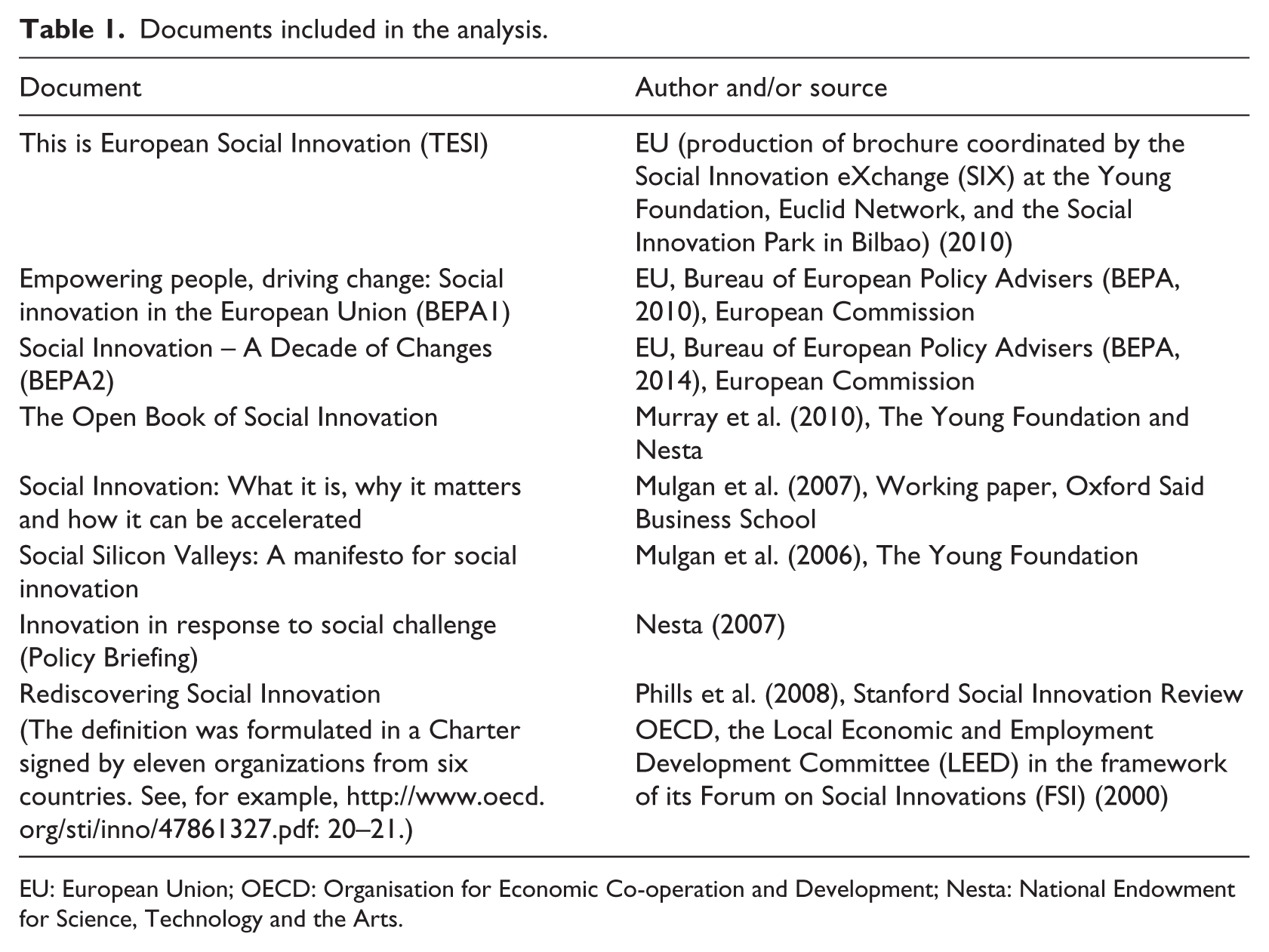
EU: European Union; OECD: Organisation for Economic Co-operation and Development; Nesta: National Endowment for Science, Technology and the Arts.
Critical analysis of EU SI policy discourse
In this section, we critically analyse EU SI policy (EUSIP) discourse. We begin by introducing our problematization of that discourse, and then move on to discuss each of the logics separately. We then show how the different logics are articulated together in discourse.
Problematization
Since the late 1990s, the concepts of social enterprise, social entrepreneurship and social innovation have gradually become more prevalent in policy (Moulaert et al., 2013; Teasdale, 2012), first in the United States and the United Kingdom and later in many other countries as well as at EU level. The issue of SI has recently been promoted to central strategic significance for the EU, in explicit relation to its ‘new growth strategy for a smart, sustainable and inclusive Europe by 2020’ (BEPA1, 2010: 7; see also BEPA2, 2014). The role of SI is thus articulated in terms of not just the EU’s Renewed Social Agenda from 2008 but also its renewed growth strategy, as clearly contrasted from the Lisbon Strategy for Growth and Jobs.
As a starting point, and after a first reading of EUSIP documents (before we framed the research problem in terms of how EUSIP discourse resonates with neoliberal political rationality), we argue that EUSIP discourse warrants a problematization due to four main interrelated discursive features. First, it is a discourse that wants to have the cake and eat it too, in the sense that SI is framed at the same time as a growth engine just like business innovation and as a way to address social issues. There is a tension here, as articulation is partly in a logic of equivalence (all types of innovations are assumed to have economic benefits) and partly in a logic of difference (SI always delivers social benefits, unlike business innovation).
Second, it is a fundamentally ‘positive’ discourse, in that SI is defined per se as ‘new ideas that … meet social needs (more effectively than alternatives)’ (TESI, 2010: 9). An important implication follows from how this definition is used to articulate SI as a coherent policy discourse. The logic arguing for SI as a basis for policy is circular/tautological, as it posits that (1) there are problems in society that need new solutions, (2) SI is defined as a successful (or more successful than alternatives) new solution to problems, (3) thus, we need SI (more than alternatives). As it were, SI is by definition always a better solution – or put differently, whatever the cure (the solution to a given social problem), we can always call that ‘social innovation’. In this sense, ‘social innovation’ is an empty signifier which grips subjects through fantasy. Thus, the discourse has the potential to be very powerful by working through consent, as it is easy to embrace and almost impossible to resist something that is presented as the best available solution to social problems that are framed as given (this invites a problematization of the power effects of the discourse, what it naturalizes, what it conceals, etc.).
Third, this discourse takes an apolitical, pragmatic guise, in that the social problems are framed as given (typically their causes seem not to be in focus) and SI is presented as consisting of well-adapted pragmatic solutions to these problems, regardless of ideology or political positions. As suggested by Edward and Willmott (2013), this can be seen as a way to conceal antagonism and thus suggests hegemonic practices. Again, if SI is framed as the pragmatic way to address the (naturalized) social challenges we are facing, then everyone has to be in favour of SI. This consensus may hide and work to exclude (1) possible alternative ways of addressing the challenges, as well as (2) a debate over the causes of the challenges.
Fourth, this new discourse has recently become much more visible in the EU and it has been seemingly imported from societies that are significantly different from many EU countries. This invites a problematization in terms of the following questions: How can such a quick rise be explained? Where does it come from? What political agenda has been driving it? Through studying EUSIP discourse in terms of its social, political and fantasmatic logics, we attempt to explore these questions in more depth.
Projected social logics: partnerships and activation, employability and inclusion
Social Innovation relates to the development of new forms of organisation and interactions to respond to social issues … (BEPA1: 43)
Thinking in terms of projected social logics draws attention to new social relationships that the EU documents envision in a society where SI would be a core element, as illustrated in the quote above. In addition, the documents analysed emphasize activation:
They [SIs] are innovations that are not only good for society but also enhance society’s capacity to act. (BEPA1, 2010: 9) … the time has now come to try new ways of bringing people out of poverty and promoting growth and well-being not only for, but also with citizens. (BEPA1, 2010: 7, emphasis in original)
These extracts illustrate how the documents envision changes in social relationships through the activation of members of civil society, whether individual citizens or organizations. (Table 2 lists additional citations showing how TESI, BEPA1 and BEPA2 construct social logics around social relations and collaborations as well as activation.)
Extracts revealing the social logics.
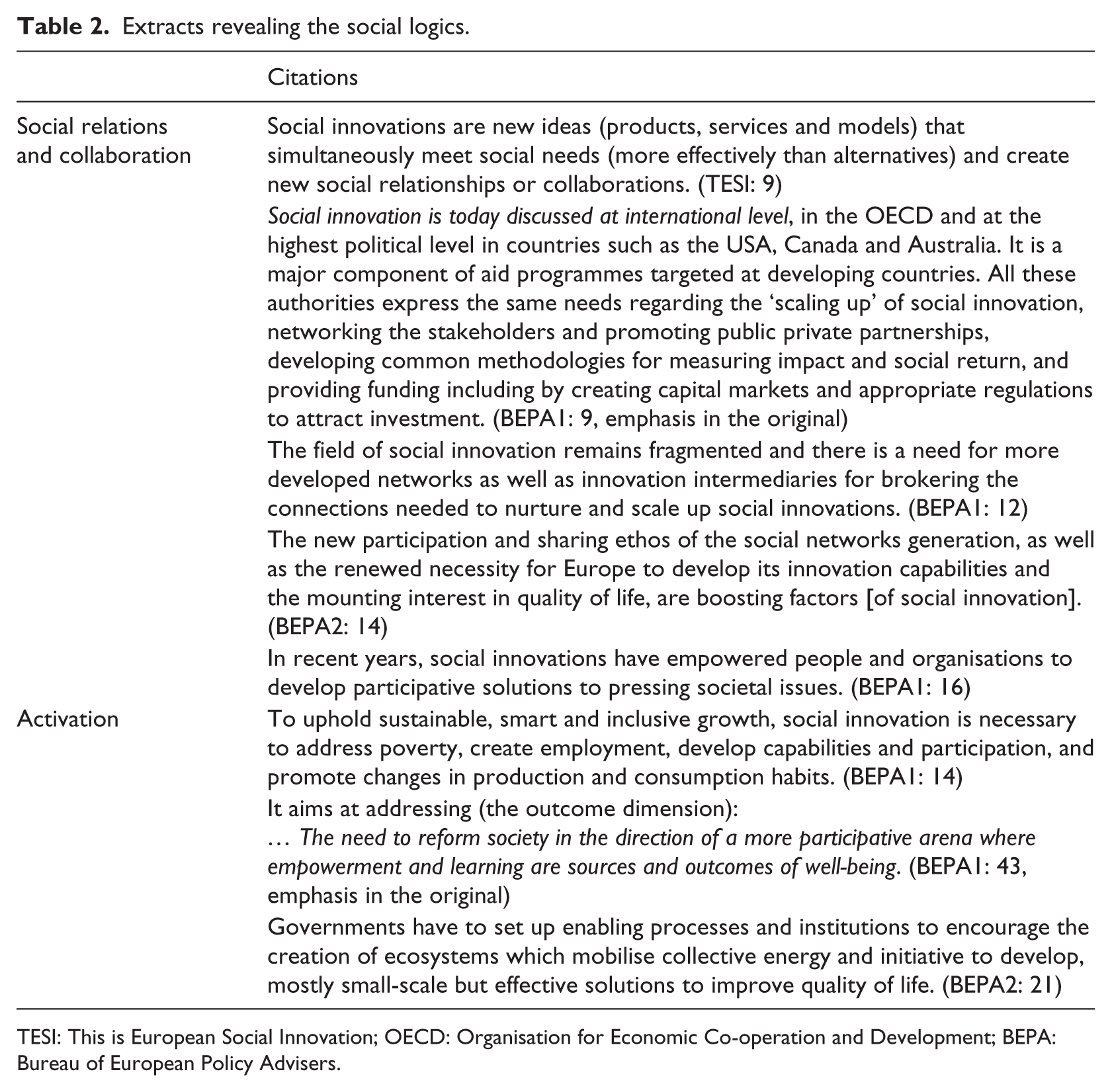
TESI: This is European Social Innovation; OECD: Organisation for Economic Co-operation and Development; BEPA: Bureau of European Policy Advisers.
Acknowledging the challenges of changing relationships and of activation, BEPA1 and BEPA2 discuss various barriers and weaknesses from different perspectives. Among other issues, it is argued that fragmented networks within the EU are problematic for the scaling up and acceleration of SI. BEPA1 also questions ‘the way in which the traditional welfare state has been designed and incrementally adapted up to now’ and calls for ‘social learning and citizens’ involvement, empowerment and participation’ (BEPA1, 2010: 12).
These social logics of activation can be traced in a number of example cases of SI presented in the EU documents. Some of the examples address pressing social needs (work insertion for vulnerable groups, health issues, care arrangements, education and community help) or societal and environmental challenges while others focus on systemic change. For instance, BEPA1 describes the Community of San Patrignano, a large drug rehabilitation community for young people free of charge. The report highlights that the drug rehabilitation community does not accept funding from guests, families or the government. Instead, the funding comes from the profits earned from the production of goods and services by the patients, as well as from private donors and companies. The community runs cooperatives that provide the people undergoing rehabilitation skills and jobs leading to an estimated 72% of the patients getting fully integrated into society and remaining drug-free. Thus, the drug rehabilitation community is described as a driver of SI that rejects old social policy relying on public funding. As an SI project, it relies on the activation of an entrepreneurial drive for the funding part; and as the outcome of SI, it is claimed to integrate vulnerable youth into society by rehabilitating and in turn activating them as productive free subjects who have become ‘employable’ (see Chertkovskaya et al., 2013; Cremin, 2010) – reminiscent of neoliberal governmentality (e.g. Munro, 2012; Rose, 1999). In addition, the programme is celebrated for diffusing its ideas, as it is noted that it has been replicated in Sweden. Thus, SI is argued to transform society through the replication of best practices, that is, successful cases of activation of both potential entrepreneurs and previously marginalized subjects.
As in the example above, the EU documents typically position social innovators or entrepreneurs as drivers of SI who have to overcome resistance, barriers and risks, and change others’ attitudes in order to use restricted or hitherto untapped resources efficiently. Social innovators are, on the one hand, activated by policies and, on the other hand, engaged in enhancing further activation by forming partnerships and networks. The role of the public sector is more ambiguous, as both those who deliver innovative public services and those who reduce public funding are celebrated.
This gives an indication of the type of changing relationships that the EU documents attempt to enhance as emergent norms. The documents promote a shift towards a web of relationships in which entrepreneurs, enterprises, civil society organizations, grassroots organizations and non-governmental organizations (NGOs) are increasingly positioned as providers of SI (which implicitly assumes an inevitable reduction in public spending), while vulnerable groups in society – the elderly, children, early school-leavers, unemployed migrants, minorities, disabled people, the poor and local communities – tend to be positioned first as beneficiaries, then as activated free subjects thanks to SI. Some subject positions seem to overlap or be contradictory, as when citizens are constructed as both providers and beneficiaries of SI. Constructing society in such broad terms could be argued to be problematic when the different groups are differentiated so vaguely, thus raising the question whether the objective is truly the positive social outcomes – or if the main objective lies in the legitimation of a reduced role for the state and public spending.
This depiction of activated employable and enterprising subjects combined with an apolitical guise resonates with Keil’s (2009) roll-with-it neoliberalization: the documents seem to aim at normalizing neoliberal governmentality. In particular, it is clear that what is suggested is a multiplication of entrepreneurial forms, in line with the principle of equal inequality for all (Brown, 2003; Foucault, 2008 [1978–1979]; Lemke, 2001). On the other hand, the emphasis on a web of relationships involving entrepreneurs, enterprises, civil society organizations, grassroots organizations and NGOs is clearly characteristic of roll-out neoliberalization, in which community and helping the poor are foregrounded – whereas they are typically rejected in roll-back neoliberalization.
In line with roll-with-it neoliberalization, social and economic considerations are permanently mixed in EUSIP discourse, as in the overall goal to ‘stimulate a more dynamic, inclusive and sustainable social market economy’ (TESI: 8). The formulation ‘social market economy’ (used even more extensively in BEPA2) reveals a hybridization of the social and the economic. Citizens are asked to be dynamic and as a result the economy, as an organic whole, will be dynamic. The notion of ‘inclusion’ is framed at the same time in social and economic terms; it seems that social inclusion can only happen through economic inclusion, through being activated as an employable and/or entrepreneurial subject. The variety of different impacts of public budget cuts on the role of public services in facilitating social inclusion is one of many problematic issues that are not sufficiently discussed in EUSIP discourse. Again, this is characteristic of Keil’s (2009) conceptualization of how roll-with-it neoliberalization, by normalizing the entrepreneurialism of neoliberal governmentality as the way to address societal challenges, enables a concealment of the destructive effects of roll-back neoliberalization.
Political logics: inspired by neoliberal and third-way governmentality
We explore political logics in order to develop an understanding of (1) the formation and origins of the dominant perspectives on SI in the EU, (2) changes over time especially in terms of the connection between SI and economic growth, and (3) what social logics EUSIP is aiming to disrupt, and what contestation it is aiming to pre-empt (Glynos et al., 2012, 2015). In addition to the three EU documents, the genealogical trek we engage in leads us to some documents not produced by the EU, but which the EU draws on in the articulation of SI.
Origins of EUSIP perspectives
Let us begin by tracing where the EU’s conceptualization of SI comes from. The definition of SI in the BEPA1 report does not include any references (BEPA 2 builds on the same definition). Thus, it appears to be the EU’s ‘own’ construction. However, in TESI, the earlier EU document, the definition of SI is nearly identical, and there, a reference is made to The Open Book of Social Innovation (Murray et al., 2010). The definition of SI in this Open Book is also more or less identical with the definitions in the EU documents and seems to be constructed by Murray et al. who in turn reference Phills et al. (2003), the UK’s National Endowment for Science, Technology and the Arts (Nesta) and Organisation for Economic Co-operation and Development (OECD).
The Open Book of Social Innovation is the result of collaboration between two UK-based organizations, Nesta and The Young Foundation. Since these two and their core members (such as Geoff Mulgan, one of the most influential thinkers of third-way politics and the co-author of several seminal documents on SI) have had a clear influence on the EU definitions of SI, it seems important to examine how the definitions of and justifications for SI have evolved in these organizations. Seminal documents published on SI by The Young Foundation include Social Silicon Valleys: A Manifesto for Social Innovation (Mulgan et al., 2006) and an updated and more cited document called Social Innovation: What It Is, Why It Matters and How It Can Be Accelerated (Mulgan et al., 2007). One of the first documents published on Nesta’s (2007) website regarding SI is Innovation in Response to Social Challenges. Table 3 summarizes the definitions of SI in the documents produced by the EU, the Young Foundation and Nesta, as well as the definitions in the sources they draw on, that is, Phills et al. (2003) and the OECD’s LEED programme in order to illustrate the commonalities and differences between the documents.
Documents contributing to the definition of social innovation in the EU.
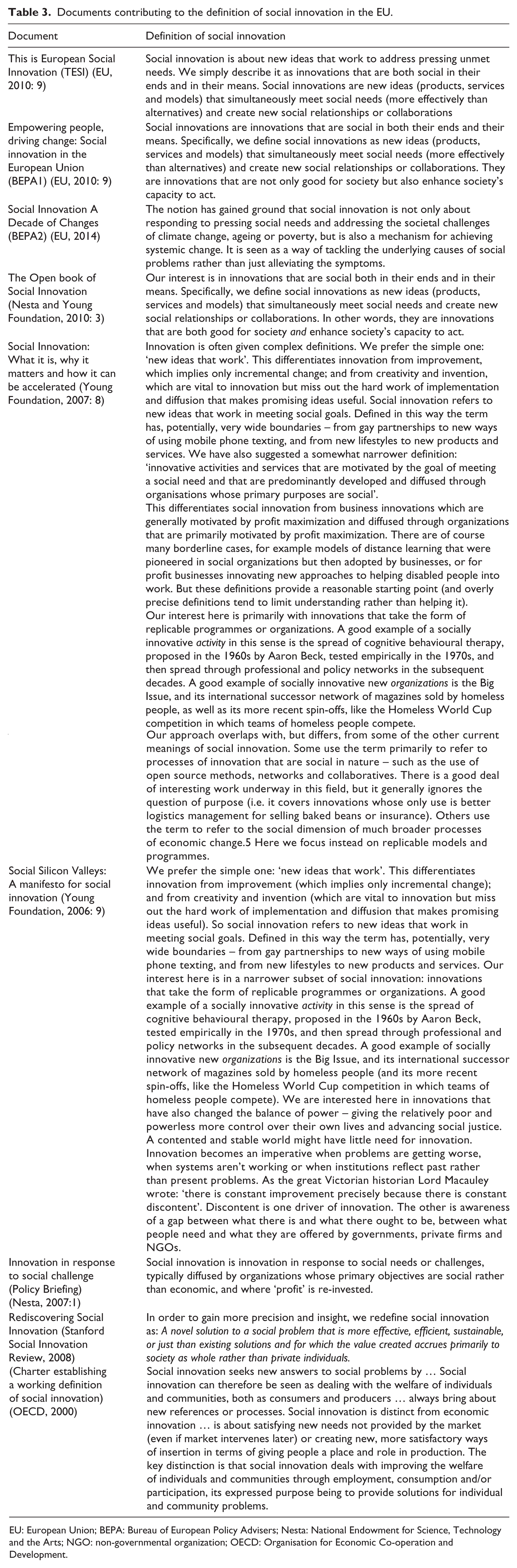
EU: European Union; BEPA: Bureau of European Policy Advisers; Nesta: National Endowment for Science, Technology and the Arts; NGO: non-governmental organization; OECD: Organisation for Economic Co-operation and Development.
If we look at the specific EU definitions, it becomes clear that the EU views SI as (1) the most effective new ideas that (2) solve pressing unmet social needs, (3) create new social relationships, and (4) enhance society’s capacity to act. These definitions are partly in line and partly in opposition with the definitions in the other documents. More specifically, although the EU definitions of SI are more or less copied from The Open Book of Social Innovation, the EU adds that SIs meet social needs ‘more effectively than alternatives’ – this adds to the fundamental tautological goodness of SI, which we lifted up in the problematization. In the other documents, this specification can only be found in Phills et al.’s (2003) definition. That said, the tautological justification for SI can be found in all the documents listed in Table 3, as they all (1) argue that there are social needs, goals, challenges and/or problems that need addressing and (2) define SI as something that addresses these needs, goals, challenges and/or problems successfully.
The notion that SI creates new social relationships or collaborations, which is prominent in the EU definitions, can be traced to The Open Book of Social Innovation (Murray et al., 2010). While the other documents touch upon different stakeholders of SI, they do not emphasize the importance of creating new relationships to the extent that the EU does in the definition. Regarding the EU goal of enhancing society’s capacity to act, we can see that this idea again can be traced to The Open Book of Social Innovation (Murray et al., 2010). In a similar vein, the OECD document emphasizes that in and through SI, individuals and communities become both consumers and producers of welfare: this is a project of activation of a variety of subjects for the co-production of social benefits, as noted about the social logics. Thus, we can see when tracking the EU’s definitions of SI that they have strong but loosely acknowledged connections to foremost UK-based organizations (the Young Foundation and Nesta) and the OECD.
It is also important to examine what the EU excludes in its definitions. One striking difference between the EU definitions and the definitions made by The Young Foundation and Nesta relates to how SI is related to profit and business. The Young Foundation and Nesta both differentiate SI from business innovation by claiming that the goal of SI is not profit maximization as in business innovation. The OECD’s LEED programme also argues that SI is distinct from economic innovation, but sees SI as a potential arena for the market to enter into later. The EU documents, on the other hand, do not discuss the relationship between SI and profit maximization in their definition. However, BEPA1 includes revealing connections to the EU growth strategy. It argues that while the Lisbon Strategy focused on ‘stimulating innovation, entrepreneurship and the knowledge-based society’ (BEPA1: 7), the new growth strategy purports to give a central role to SI ‘in coping with the societal challenges and the crisis that the EU is facing’ (BEPA1: 7). Thus, there is both continuity and change between the two growth strategies, as SI is framed both in a logic of equivalence – as another form of innovation that is meant to drive growth – and in a logic of difference – as a form of innovation that, unlike traditional innovation thinking, can ‘[help] people out of poverty’ (BEPA1:7). Here, we can see how BEPA1 both criticizes traditional approaches to business innovation – since it is acknowledged that the Lisbon strategy has not been so successful and therefore a new type of innovation is needed – while still subscribing to the central notion that innovation is foremost meant to drive economic growth.
Links between SI and growth
Three main hints on how SI contributes to stronger and more inclusive growth are provided in the documents. The first hint, which is about SI creating greater value for money in public services, seems to be mainly a reaffirmation of the need for a significant reduction in public expenditure: ‘There is an urgent need to power innovation within the public sector itself in order to unlock radical productivity improvements and efficiency gains, foster the creation of more public value and a better response to societal challenges’ (BEPA2: 31). Now, if we assume public expenditure to be significantly reduced, we may imagine at best that as much value creation as before will come from public services. Here, the political logics seem to be in line with roll-back neoliberalization.
The second hint, which emphasizes the activation of hitherto unproductive and ‘unemployable’ people, suggests more possibilities for employers to tap in an extended human resource pool. This begs the question: are the current social and economic challenges in most EU countries (including the issue of slow economic growth) more linked to a lack of active employable people or to a lack of good business and employment opportunities? While benefits of a bigger employment pool may be seen from the business perspective – one of the least disputable Marxist observations may well be that capitalism always benefits from having a substantial ‘reserve army of labour’ (Marx, 1954 [1867]) which makes workers and employees on low-skill jobs easily replaceable – they may not necessarily be conducive to overall economic growth in the EU, and even less so to an overall improvement in social welfare. Admittedly, an important argument that is more explicit in BEPA2 than in previous documents is that employability enhancement efforts need to aim for ‘matching migrant skills to the labour market, as well as those of the young unemployed’ (BEPA2: 54). This technocentric understanding in terms of matching skills to the market tends to overlook the fact that many of the unemployed young may be highly educated, while many of the (present and future) available jobs may be ‘low-skill’ and/or low status, for example, in elderly care. Here again, the underlying rationality is aligned with roll-back neoliberalization.
Finally, the third hint, which promotes an activation of the entrepreneurial drive and creativity of citizens, may be a more convincing promise for new value-creating solutions to the social challenges. Even so, while social entrepreneurship initiatives may well bring a number of win-win solutions in terms of both economic value creation and social welfare, it remains difficult to imagine this phenomenon to be scalable enough for being a robust driver of both the economy (growth and competitiveness) and welfare. This begs the question, can we expect all forms of social entrepreneurship to be directly conducive to value creation in the economic sense? This is where BEPA2 is again more explicit than the previous documents, with its emphasis on a ‘new growth paradigm, centred on society, not growth’ (BEPA2: 53) and relying on measurements of not only economic impacts in the current narrow sense, but also social and environmental impacts.
The promotion of ‘a new growth paradigm’, founded on the idea of a ‘social market economy’, has certainly been the most striking development in EUSIP discourse over time. It aims for ‘improving the innovative capacity of SMEs; bridging the digital divide between Member States; matching migrant skills to the labour market, as well as those of the young unemployed’ (BEPA2: 54), all of which are meant to become new priorities of policy. At the same time as this emphasis on social objectives marks a shift in EUSIP discourse, it also marks the attempt to integrate the more social aspects together with the traditional economic understanding, and at the core of this project is the need for new measurements of social and environmental impacts. The new measurements, once established as a better alternative than the current narrow economic measurements, are meant to work as incentives for entrepreneurial projects that provide good social and environmental impacts – in governmentality jargon, these measurements, if successful, can become techniques that will steer the conduct of entrepreneurial conducts. This proposed solution is characteristic of roll-with-it and roll-out neoliberalization to the extent that it both (1) contributes to the further systematization of calculus as basis for action (see, for example, Brown, 2003; Foucault, 2007 [1977–1978]; Mirowski, 2013) and (2) is meant to go beyond traditional cost-benefit calculations by thinking in terms of social and environmental impacts.
Political logics of disruption and pre-emption of contestation
Thus, all three moments of neoliberalization are mobilized in EUSIP discourse. In comparison with the United Kingdom and the United States of the early 1980s, roll-back neoliberalization in continental Western Europe has neither been as abrupt nor as explicitly endorsed by political leadership. Instead, roll-back neoliberalization has been largely gradual in most EU countries, tied to the normalization of German ordoliberalism, which is related to, but a quite different political rationality from, the Chicago school neoliberalism that has informed Reaganomics and Thatcherism: it does prioritize the economy but does not attempt to universalize competition (see Lemke, 2001) to the same extent as UK and US neoliberalisms. The more abrupt recent turns to neoliberalism in continental Europe can admittedly be attributed to ordoliberalism and its influence on the EU integration process through the Stability and Growth Pact, leading to austerity responses to economic crises (see Müller, 2015; Streeck, 2014). But it remains that the UK-specific neoliberal and third-way influences on EUSIP discourse, and their associated forms of governmentality (see Munro, 2012; Rose, 2000), still sound rather alien in many continental European social democracies.
Bearing in mind these differences between the United Kingdom and continental Europe, it is somewhat surprising that EUSIP discourse assumes roll-back neoliberalization as inevitable – one key objective seems to be to prepare people for, and ultimately legitimize, a reduction in public expenditure on social policy. This legitimization is made possible by the claim that SI co-produced by everyone will be ‘more effective’ than the provision of social welfare through traditional state social policy. Through this claim, EUSIP discourse is enacting elements of both roll-back and roll-out neoliberalization, simultaneously as it were: it is both contesting the desirability of the traditional welfare state and pre-empting the contestation of that roll-back neoliberalization, by advancing a third-way-like project that emphasizes social benefits, community and so on (see Peck and Tickell, 2002; Rose, 2000). This project of course entails a move to self-governing citizens who are responsibilized for different social risks they may face, related to for example health or unemployment (it is up to citizens to make sure they remain employable so there is no need for a too demanding law on job security). These suggestions resonate with developments that have already been taking place in many countries in the EU (e.g. ‘flexicurity’ policies, healthcare reforms), but taken as a whole, EUSIP discourse sounds like a more comprehensive move towards the taken-for-granted, roll-with-it neoliberalization of a UK-like society. The clear UK origins of this policy discourse, which we have exposed here, are only alluded to in the EU documents, which reinforces the suspicion that the aim is to normalize neoliberalism and neoliberal governmentality through elements of all three moments of neoliberalization.
Fantasmatic logics: ideological win-win-win, ethical responsibilization
Innovation is important insofar as it is our capacity to shape the future we desire. (TESI: 7)
We now turn to the fantasmatic logics in the three EU documents and ask, what are the fantasized futures in terms of success and/or threats? How are the subjects to be gripped by these fantasies? As Howarth (2010: 326) puts it, these logics work through fantasy to conceal the contingency of social relations and naturalize power relations.
Ideological win-win-win
The three EU documents include both positive and negative fantasmatic narratives (see Table 4). The documents discursively construct SI as producing new social interactions that improve wellbeing and use available resources in the most efficient way. Moreover, social challenges are systematically transformed into social and economic opportunities. Such fantasies around opportunities involve, for example, the idealization of ‘innovation’ as what will ‘shape the future we desire’ (TESI: 7) and the use of information and communications technology (ICT) in eHealth and virtual schools. By framing these challenges as potential opportunities thanks to innovative thinking and technology, BEPA1 prophesies a ‘triple triumph’:
By encouraging social innovation, policy-makers strive to pursue a triple triumph: a triumph for society and individuals by providing services that are of high quality, beneficial and affordable to users and add value to their daily lives; a triumph for governments by making the provision of those services more sustainable in the long term; and a triumph for industry by creating new business opportunities and new entrepreneurship. (BEPA1: 9)
Extracts revealing the fantasmatic logics drawing on ideological enjoyment.
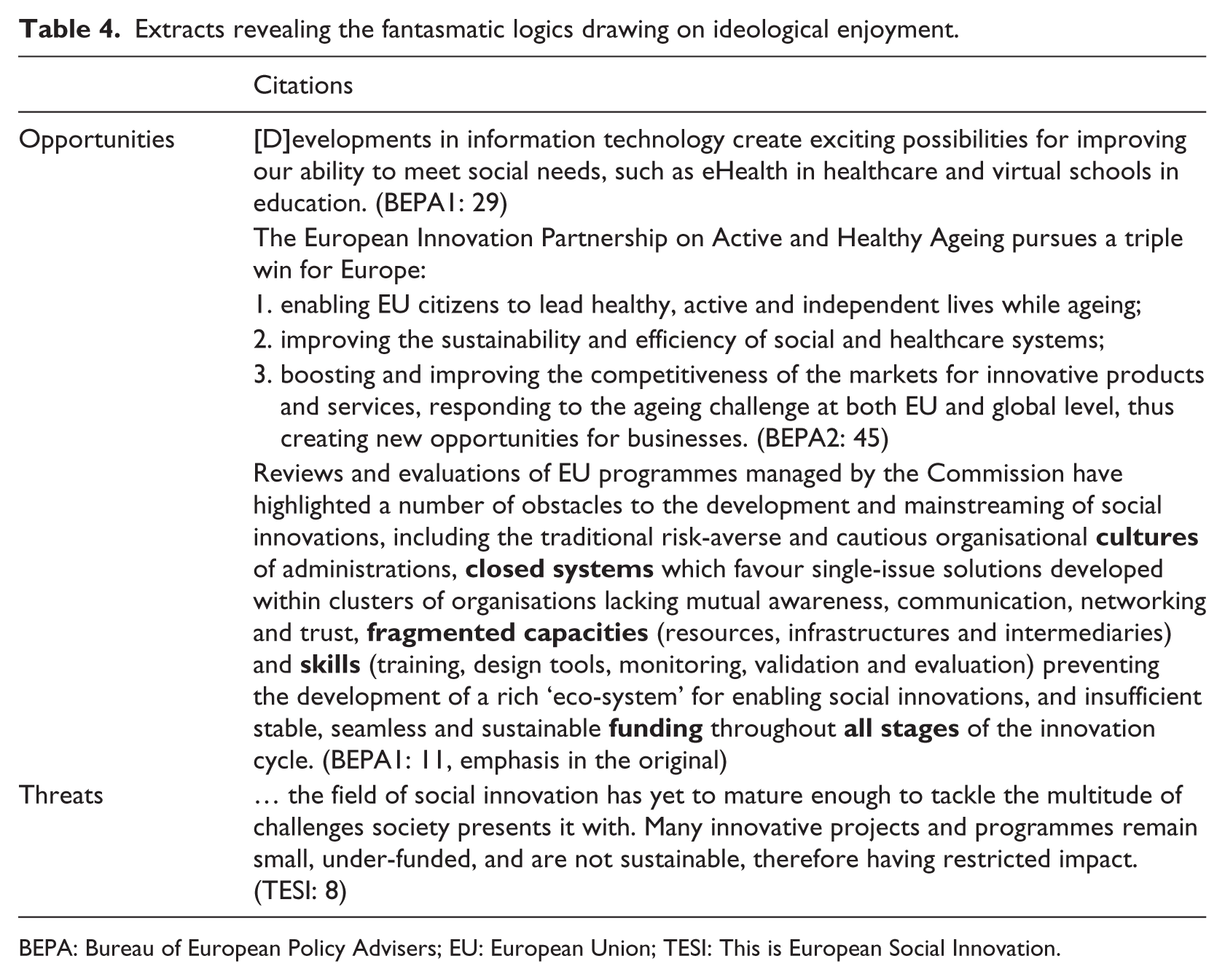
BEPA: Bureau of European Policy Advisers; EU: European Union; TESI: This is European Social Innovation.
Here, society and individuals, governments and industry all seemingly benefit simultaneously from SI (see also BEPA2: 45). Thus, EUSIP discourse is characterized by a win-win-win logic, in which every sphere of society is claimed to be an eventual winner. Again, what makes this possible is the tautological definition of SI; if SI is by definition about successful solutions to problems, then everyone can be claimed to benefit from this success. Interestingly, the individuals are claimed to benefit as recipients of services, not as active members of a successful third sector, as the benefit of ‘new entrepreneurship’ is only attached to ‘industry’. This would suggest – against the more concrete, less fantasmatic parts of the documents – that the provision of these services is to move largely from governments to industry. This is a clear expression of the fantasmatic logics that are at play, positing privatization of services as fundamentally positive – thereby gripping subjects through an enjoyment of this positive conviction – and concealing the role of the third sector as a provider of services. This positivity of the win-win-win discourse is ideological at its core as it conceals the flip sides (loss of public services) and blurs the concrete mechanisms by which the private provision of social welfare would benefit both citizens and industry, at a time when both are suffering from the economic crisis.
While the notion of partnership is present in all the documents, BEPA2 is the most explicit in calling for collaborative action between all spheres of society. In articulating the need for collaboration, it is inspired by a recent ‘think piece’ by the British Council (Richardson and Catherall, 2014), which depicts the future social market economy as one where ‘public, private and social economy organisations will be
In parallel with positive win-win-win fantasies, the documents also discuss barriers in relation to SI, which tend to be related to the lack of flexibility of the public sector, as can be seen in Table 4.
Thus, SI is discursively constructed as a phenomenon that is difficult to resist since subjects are meant to be convinced that SI is always a positive force: they can only win when engaging in SI. Even when threats are discussed, little is said about consequences and alternatives if SI fails; only some possible reasons for a potential failure – lying in an inefficient public sector or an under-funded third sector – are alluded to.
Ethical responsibilization
The ethical enjoyment that is meant to grip subjects in EUSIP discourse is clearly one of responsibilization: By integrating older people into group sessions of physical activity, Siel Bleu empowers them to become active participants in society, offering social links, physical autonomy, self confidence and an incentive for active behaviour. (TESI: 26)
More specifically, the subject is meant to get to see various social problems as his or her responsibility, which provides him or her a foundational guarantee (Glynos, 2008): the subject is protected from the anxiety of uncertainty since responsibility is clearly ascribed to him or her. The ethic of responsibilization is constructed in the EU reports in a number of ways (see examples in Table 5).
Extracts revealing the fantasmatic logics drawing on ethical enjoyment.
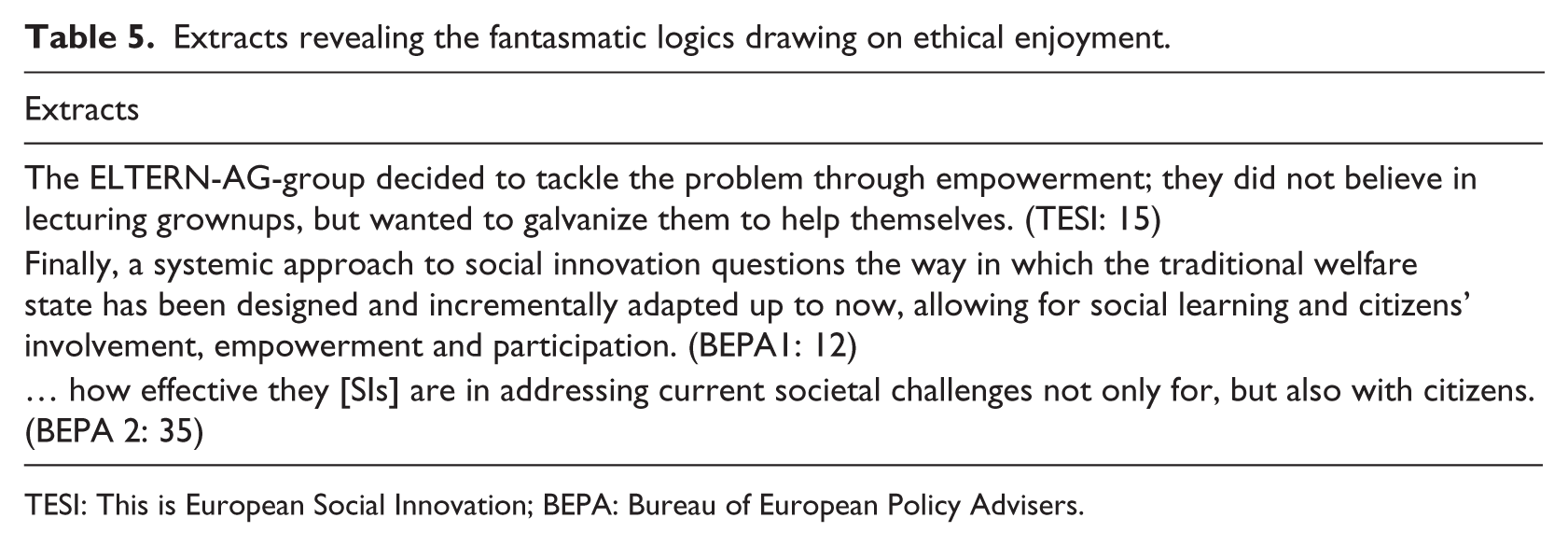
TESI: This is European Social Innovation; BEPA: Bureau of European Policy Advisers.
The first order signifier that tends to be used is ‘empowerment’. We interpret this signifier as a matter of responsibilization because the claimed empowerment includes two dimensions: (1) a (partial) shift in responsibility from traditional welfare providers (public services) to individuals or civil society groups (here, in line with the understanding of responsibilization advanced in governmentality studies, that is, as a shift in responsibilities and costs from the state to citizens 4 ) and (2) a prescribed behavioural change towards more responsible individual practices in relation to different societal challenges (climate change, public health issues, etc.). The former dimension suggests that roll-back neoliberalization, as part of EUSIP discourse, is foremost expressed in terms of an ethical enjoyment of empowerment.
As the extracts on responsibilization show, SI is seen as a process that should be addressed with, not just for, citizens (BEPA1; BEPA2) – in contrast with the triple triumph fantasy, which frames citizens as recipients of the better services to be provided by SI. BEPA1 digs deeper into this issue and argues that SI is a participative process creating strong partnerships and it questions the traditional welfare state by calling for ‘social learning and citizens’ involvement, empowerment and participation’ (BEPA1, 2010: 12). At the level of systemic change, the EU calls for, among other things, changes in attitudes and values as well as in strategies and policies in order to reshape society into a more participative arena. In addition, end users and local communities are constructed as subjects who must challenge existing organizations in order to contribute to more inventive uses of innovation. Likewise, various cases related to elderly care, education, climate change, employability or healthcare are used as example cases in which self-managed action could be employed more broadly. This responsibilization through empowerment is explicitly framed as urgent and necessary mainly due to the current budgetary cuts in the EU (see, for example, BEPA1: 23; BEPA2: 14). This confirms the link between roll-back neoliberalization in times of austerity and the particular type of responsibilization promoted in EUSIP discourse through the rhetoric of empowerment.
Articulation of the logics
Despite its tautological constructions, apparent contradictions and fuzzy zones, EUSIP discourse can still be presented as forming a fairly coherent whole as part of a political project, since it is clearly devoted to a new vision of how the state, the market and civil society should be reorganized (Torfing, 1999). This vision is articulated through the fantasmatic ‘triple triumph’, which is the ideological core of EUSIP discourse: if the argument for SI driving both economic growth and social welfare does not seem to add up under closer scrutiny, it is largely because it is only a positive fantasmatic narrative that conceals the flip sides of benefits. EUSIP discourse argues, in line with EU austerity politics and UK-inspired neoliberal and third-way politics (political logics), that the reduction in and increased efficiency of public expenditure, combined with the activation (social logics) and responsibilization (fantasmatic logics drawing on ethical enjoyment) of citizens, will lead to employability, flexibility and entrepreneurship, which ultimately will deliver both (1) economic growth and (2) social welfare to the EU countries, while (3) also benefiting government (fantasmatic logics drawing on the ideological enjoyment of a win-win-win fantasy). There seems to be a belief that all actors will somehow agree that their interests are aligned with SI policy; the problem here is that this belief ignores or conceals the possible different interests of different institutional actors: it is difficult to imagine that state institutions would be easily converted to competitive logics of efficiency when that would most certainly mean that they would need to shrink considerably as a result. Thus, EUSIP discourse is chiefly characterized by the fantasy of the triple triumph, whose gloss serves to (re)legitimize an ongoing neoliberalization – much like the Third Way can be seen to have reinforced neoliberalism by providing it with a new ideological gloss (Petras, 2000). The integration of the logics is quite seamless – their neat separation here is only for analytical purposes – as activation and responsibilization, for example, are both a matter of projected social norm and ethical gripping.
Discussion and concluding remarks
We find that EUSIP discourse is largely in line with the neoliberal austerity politics that is predominant in the EU at this juncture, as all three moments of neoliberalization (roll-back, roll-out and roll-with-it) are prevalent in the projected social logics, political logics and fantasmatic logics of the EUSIP documents. The projected social logics of EUSIP, infused with a sense of community and an emphasis on social benefits characteristic of roll-out neoliberalization, at the same time contribute to naturalizing an increasingly neoliberal order through internalized roll-with-it neoliberalization, putting the emphasis on enhancing individual human capital through activation, employability and entrepreneurship. The political logics of EUSIP involve both (1) further disrupting continental social democracies by affirming the inevitability of budgetary restraint (roll-back neoliberalization), and (2) pre-empting the contestation against roll-back neoliberalization through a ‘social’ wrapping that implies roll-out neoliberalization. The fantasmatic logics provide both (1) the ideological gloss of the promised win-win-win, which helps to (re)legitimize neoliberalism; and (2) an ethical responsibilization of the subject, which, if successful, makes roll-back neoliberalization acceptable.
Several important specifications need to be made before concluding. First, neoliberalism has many faces (Mirowski, 2013; Peck, 2010) as the process of neoliberalization is both driven by crisis and exploiting crisis, with different regulatory implications at different stages (Peck, 2013). For example, the UK Third Way, a key inspiration for EUSIP discourse, can be understood as meant to support and flank neoliberal projects (Jessop, 2002), as a variant of neoliberalism (Hall, 2003) more in line with a so-called caring liberalism (Moulaert et al., 2013). Thus, it is important to note that there are significant differences between EUSIP discourse and general characterizations of ‘hardcore’ (e.g. Chicago School) neoliberalism. Notably, EUSIP discourse is clearly not aligned with neoliberal characteristics such as (1) the rejection of altruism (see Gane, 2014a), (2) the notion that economic agents should not and cannot pursue the collective good (Foucault, 2008 [1978–1979]: 179–183), or (3) an explicit war on the poor (Mirowski, 2013: 129–138).
Second, if EUSIP discourse contributes to the seemingly unstoppable process of (crisis-driven and crisis-exploiting) neoliberalization, it is more because it is produced by an increasingly neoliberal EU than because it is about SI. Our critique is not targeting SIs – which should each be understood in terms of their ‘potential for social change in particular contexts’ (Moulaert et al., 2013: 18) – but the ideological use in EU policy of the promised win-win-win of SI, which gives SI the character of a sublime object (cf. Jones and Spicer, 2005). Resisting the neoliberalizing power of EUSIP discourse implies resisting the fantasmatic grip of SI as carrying this sublime win-win-win, variously called ‘triple triumph’ (BEPA1: 9) or ‘triple win for Europe’ (BEPA2: 45).
Third, and relatedly, it is SI as a basis for policy that we criticize here. A number of problems that we see in EUSIP discourse are related to problems that are specific to the field of contemporary policy. These include characteristics of what Peck (2013) calls ‘fast policy’, notably the promotion of spreading best practices and portable policy paradigms transnationally associated with an emphasis on so-called ‘pragmatic’ solutions and ‘ideas that work’. The problem with fast policy is that imported policy models get to prevent more local reflections on what should be done, which further depoliticizes the policymaking processes (Peck, 2013). As Jessop et al. (2013) note, it would be important to resist the importation of prefabricated solutions and instead promote bottom-up local initiatives. In addition, what is needed rather than the economistic understanding of social challenges found in SI policy documents would be an understanding that does not neglect ‘the economic aspects of social innovations that are not immediately economic in their objectives’ (Jessop et al., 2013: 111), relating for example to education, gender equality or health issues.
Thus, we conclude that in order for the transformative promise of SI (see, for example, Moulaert et al., 2013; Srinivas, 2013) to have a chance to be delivered in the EU, we will need to resist (1) the win-win-win fantasy, (2) the fast-policy emphasis on ‘ideas that work’, and (3) the economistic centrality of SI as needing to directly contribute to growth. Critical management and organization studies certainly have a role to play in pursuing more progressive and transformative understandings of SI in context. Our point is not to reject the win-win mindset that needs to inspire SIs, on the contrary. But for SIs to be as progressive as possible, it is crucial that this win-win mindset be (1) always deployed in context, in terms of very specific concrete conditions, (2) not prioritizing the economic win over social wins, and (3) not blinding the innovators to possible negative impacts of their SIs, whether directly or through causing the displacement of previous social benefits (by contributing to further neoliberalization). Given the social issues at stake, we cannot do without an assessment of not only who stands to win from SIs but also who might stand to lose from them and the neoliberalization EUSIP discourse accompanies.
Limitations and further research
As the study is a discourse analysis of policy documents and some of the documents they have drawn inspirations from, it has a number of significant limitations. First, it does not examine the social logics of a society where SI gets to be prevalent empirically, since it looks only into projected social logics as they are discursively articulated in the documents. Second, our study of the political logics is not informed by first-hand access to the political processes and struggles that have initiated, developed or contested certain understandings of SI as part of policy. Third, any study of the fantasmatic logics of a policy discourse has to be somewhat speculative based on identification and interpretation of what a discourse does to people’s affects, as we cannot find out per se how ‘empirical subjects’ are gripped by a discourse.
The documents have been written under circumstances where the EC and the EU have responded to SI initiatives in relatively positive ways. Future research could consider how people, organizations, the public and private sectors, and EU member states have been responding to this ongoing shift in policies. Another avenue for further research relates to investigating more specifically the win-win(-win) and possible win-lose aspects of various SIs: for example, it would be interesting to identify cases where the win-win and the pragmatic rhetorics that characterize SI are successfully decoupled from the ideological effects of policy discourse, that is, cases where a pragmatic win-win mindset does not blind innovators to the possible negative impacts of their SIs.
Footnotes
Acknowledgements
We would like to thank the editors of Organization for their guidance and the three anonymous reviewers for their constructive and insightful comments.
Funding
The author(s) disclosed receipt of the following financial support for the research, authorship, and/or publication of this article: Beata Segercrantz would like to acknowledge that her work was supported by the Academy of Finland (grant number 259252).