




Abstract
Much literature on the cultural industries celebrates ethnicity as a source of creativity. Despite its positive connotation, this discourse reduces ethnic minority creatives to manifestations of a collective ethnic identity automatically leading to creativity, creating a paradox of creativity without a creative subject. Approaching creatives with an ethnic minority background as agents, this article investigates how they self-reflectively and purposely discursively construct ethnicity as a source of creativity in their identity work. Empirically, we analyze interviews with well-established creatives with an ethnic minority background active in Belgium. Most respondents construct their ethnic background as ‘hybrid’, ‘exotic’, or ‘liminal’ to craft an identity as creatives and claim creativity for their work. Only few refuse to discursively deploy ethnicity as a source of creativity, crafting more individualized identities as creatives. Our study contributes to the literature on power and ethnicity in the creative industries by documenting ethnic minority creatives’ discursive micro-struggle over what is creative work and who qualifies as a creative. Specifically, we show their counterpolitics of representation of ethnicity in the creative industries through the re-signification of the relation between the ‘west’ and the ‘other’ in less disadvantageous terms. Despite such re-signification, the continued relevance of the discourse of ethnicity as a key marker of difference suggests that ethnicity remains a principle of unequal organization of the creative industries.
Introduction
We live in a remarkably diverse society, and how we evolve and face the challenges of the future will depend on how we can use the creative resources that diversity gifts us. (Arts Council of England, http://www.artscouncil.org.uk/how-we-make-impact/diversity-and-equality) ‘You cannot believe it today: we organized our show in a small room in the back of the ccBe [Culturcentrum Berchem]. I sat at a table selling self-made tickets, while the “good people” passed by to go to the big room with real ccBe tickets’. Mohamed Ikoubaân has a vivid memory of the early years of Moussem. ‘It was not right, I thought. How could we claim a real place in the cultural field?’ Today Moussem is ten years old and is a ‘nomadic arts center’. In big cultural institutions like M HKA, Bozar or de Hallen van Schaarbeek, it produces and invites theater makers, choreographers, visual artists and writers balancing between Belgium, the Maghreb or the Arabic world. And, are we there Mohamed? ‘As long as we are seen as mere suppliers of diversity, of black heads in the room, we have not reached anything’, says Ikoubaân. (Hillaert, 2010).
Since the turn of the century, scholarly texts and policy documents on the creative industries—that is, advertising, architecture, arts and antiques markets, crafts, design, fashion, film, music, performing arts, publishing, software and computer services, computer games, and radio and TV (Department of Culture, Media and Sport (DCMS), 2001)—have been indelibly marked by the idea that diversity, more or less broadly defined, is a repository of creativity. Echoing the business case (Cox, 1991; Robinson and Dechant, 1997), diversity is cast as a unique source of inspiration (e.g. Brandellero, 2010, 2011; Mavrommatis, 2006), a resource for diversifying products and crafting creative niches (e.g. Basu and Werbner, 2001; Pang, 2003, 2007), and a potential source of competitive advantage for the creative industries (e.g. Smallbone et al., 2005, 2010), and cities and regions (e.g. Florida, 2002, 2005a, 2005b; Lee et al., 2004; Leslie et al., 2013) to the benefit of society (e.g. Arts Council of England, 2016; Australian Government, 2011; Cleemput and Boucharafat, 2010; De Preter, 2007; Jans, 2004; Kets, 2010; Kibbelaar, 2007).
At first sight, this celebratory association of diversity to creativity, innovation, and symbolic and economic value represents a welcome alternative for creatives with an ethnic minority background. 1 In many European countries, public discourses commonly portray ethnic minorities in subordinated and pejorative terms, for instance, as unwilling to ‘integrate’ in the majority culture and society, to learn the local language, lagging behind the ethnic majority both in education and on the labor market, profiting from the welfare state and, more recently, as dangerous carriers of violence (e.g. Blommaert, 2001; Moufahim et al., 2015; Siebers, 2010; Timmerman et al., 2003; Van Laer and Janssens, 2011; Wodak, 1997).
Upon closer scrutiny, however, the discourse of diversity as a source of creativity might reveal itself as less emancipatory than it appears at first sight, as, we argue, it rests on and reproduces subject positions for ethnic minorities which are at their core remarkably similar to contemptuous ones. Following the business case for diversity, such discourse constructs ethnic alterity as a social group’s essential trait (Phillips, 2010)—in national, religious, linguistic, cultural terms or a combination thereof—and by naturalizing ‘difference’ as something fixed and unchangeable (Zanoni and Janssens, 2004). Echoing the scientific language of biodiversity in biology (Litvin, 1997) and Ashby’s principle of requisite variety in cybernetics (Ashby, 1956; Harrisson and Klein, 2007), this discourse represents diversity as variety of ‘species’ or ‘types’. Through these metaphors, creativity arises automatically as the ‘natural’ outcome of the mere juxtaposition of distinct essences. In other words, diversity stands for the distinctive characteristic of a system, disconnecting creativity from individuals’ purposeful and effortful meaning making and action. This representation of diversity de facto erases the subject, subsuming the individual into a reified collective of which he or she is a mere manifestation (Litvin, 1997; Phillips, 2010; Zanoni et al., 2010; Zanoni and Janssens, 2004). Positing that creativity stems from a collective trait—an ethnic essence—leads to a paradoxical understanding of creativity without creatives.
The paradox lies in that creativity is precisely conceptualized in the creative industries as an individual capacity (Amabile et al., 1996; Herrmann-Pillath, 2010; Muhr, 2010; Runco, 2004). Creativity commonly refers to an individual’s unique ability to express and create novel meaning from unique sources of inspiration, such as one’s memories, biography, and experience of the world, ranging from societal issues to everyday life and nature (Eckert and Stacey 2000; Reading, 2008). Memories, biography, and experience are not randomly distributed, as they, to some degree, reflect one’s position in the social world, including one’s belonging to specific social groups. Yet creative products never automatically express collectively shared experience, in which case they rather come to be seen as folklore (Bauman, 1977; Bock and Borland, 2011). Creativity crucially needs a subject who processes those experiences, emotions, and ideas in a unique way to craft unique esthetic or semiotic content (Becker, 1982; Caves, 2000; Handke, 2004; Howkins, 2001; Scott, 2000). Paraphrasing Kirshenblatt-Gimblett (1998), to become ‘art’, objects need to become ‘singular’, to hold up once they are stripped of contingency or, in our case, the contingency of their relation to the specific heritage of a social group.
The goal of this article is to interrogate the widely shared assumption in the creative industries that creatives’ ‘different’ identity is immediately constitutive of their creativity (Caves, 2000; Hagoort, 2005). To build an alternative account of the relation between ethnicity and creativity than the one offered by the celebratory discourse of diversity delineated above, we posit that neither ethnicity nor creativity is ‘automatically’ filled, and that their intimate relation is in no way self-evident (Dwyer and Crang, 2002). In our view, this relation rather rests, for its existence, on subjects’ own and active deployment of available texts in their practice of meaning making that is at the core of the creative process. More specifically, we examine how available discourses of ethnicity are strategically used by speakers as a discursive resource to construct their own work as creative and themselves as creatives.
Our analysis rests on an understanding of the subject as simultaneously constituted through the social world of which he or she is part and as an agent continuously reflecting and acting upon it (Foucault, 1980, 1988). From this perspective, it is collectively shared discourses—structured collections of texts—that infuse objects and subjects with particular kinds of meaning, socially constituting the horizon of the imaginable and thus the possible (Parker, 1992; Phillips and Hardy, 1997). At the same time, discourses never completely fix subjects. In their own discursive practice, individuals always retain some capacity to proactively choose, omit, and combine available discourses, to deploy them strategically as discursive resources to construct desired meanings of themselves, their actions (Brown, 2006; Brown and Coupland, 2005; Clarke et al., 2009; Kornberger and Brown, 2007), and their creative work (Thoelen and Zanoni, 2016). Empirically, we deconstruct texts gathered through in-depth interviews with well-established ethnic minority creatives in which they extensively elaborate on who they are, narrating their creative trajectory and their creative philosophy and products.
This study addresses Hesmondhalgh and Saha’s (2013) recent call for theorizing cultural production in ways that take questions of power, race, and ethnicity seriously by unveiling the subject behind diversity in the creative industries. Our analysis shows how creatives with an ethnic minority background proactively and self-reflectively construct ethnicity to deploy it as a discursive resource to reclaim a creative identity for themselves and the uniqueness of their creative work. By doing so, our respondents perform a counterpolitics of representation. They reclaim subjectivity for themselves by defining creativity and the creative subject in ways that allow them to qualify as one. In this sense, individuals’ discursive practices destabilize hegemonic discourses of ethnicity at the micro-level of the individual, opening up possibilities of re-signification. At the same time, by doing so these discursive practices necessarily engage with and reproduce such discourses, re-affirming ethnicity as a marker of difference, and thus possibly at once perpetuating its relevance as a principle of unequal organization of the creative industries. Our analysis further rejoins broader debates on the politics of representation of diversity in contemporary work settings and society at large (e.g. Bhabha, 1994; Giroux, 1994; Hall, 1997; Swan, 2010).
Ethnic diversity in the creative industries
As Mohamed Ikoubaân’s epigraph vividly illustrates, despite the currency of the idea that diversity fosters creativity, ethnic minorities have historically been largely excluded from the creative industries or relegated to its margins. Still today, they remain heavily underrepresented among the producers of cultural artifacts (Creative Skillset, 2012; Oakley, 2006) as well as in audiences (e.g. Hill and Alshaer, 2010; Van Wel et al., 2006). A first explanation of this marginalization points to the domination of ethnic majority ‘significant others’—for example, peers, critics, patrons, journalists, curators, clients, teachers, and experts—in the creative industries (Muhr, 2010; Werbner, 1999). As significant others are placed to ascribe value to some creative work while denying it to other (Anand and Jones, 2008; Becker, 1982; Brandellero and Kloosterman, 2010; Khaire and Wadhwani, 2010), creative work is largely assessed against ethnic majority norms and standards concerning quality and esthetics. These standards become institutionalized and constitute what is held to be creative, disqualifying from the outset expressions of creativity that do not meet them (Brandellero, 2011). Even when these standards are met, ethnic minority creatives and their work run a higher risk of being perceived and represented as ‘other’ and ‘lesser’, stressing their difference from the superior vantage point of a western subject and for his or her consumption (Bauman, 1977; Bock and Borland, 2011; Hutnyk, 2000; Kirshenblatt-Gimblett, 1998; Thoelen and Zanoni, 2016). A second mechanism of exclusion is rather related to the structurally disadvantaged position of minorities in social networks (Leslie et al., 2013). As cultural norms are largely non-codified, they are mainly transmitted through socialization into the habitus of the ethnic (upper-class) majority to which ethnic minority individuals have little or no access (Bourdieu, 1986, 1993). Moreover, social networks play a paramount role in the creative industries (Aage and Belussi, 2008), which are largely organized through temporary projects and collaborations characterized by short-term or freelance contracts and flexible employment system (e.g. Blair, 2001; Haunschild, 2004), and where an oversupply of labor leads to high competition (Becker, 1982; Bielby and Bielby, 1994; Caves, 2000; Henry, 2007). As individuals tend to be connected more to individuals with similar socio-demographic profiles, minority individuals are likely to have less access to established networks, which are instrumental to build their careers (Oakley, 2006), and therefore compete in an unequally structured social space (Leslie et al., 2013).
Although these mechanisms still fundamentally structure the creative industries, since the turn of the century, they co-exist along a celebratory discourse of diversity which rather casts distinct socio-demographic identities, including one’s ethnic background, as a source of creativity and value. Some scholars have argued that the ‘difference’ or distinctiveness of specific social groups from the rest of the actors in a certain field offers them specific possibilities for new combinations of cultural elements, leading to novel forms of creativity and even domination in specific market niches (e.g. Brandellero, 2011; Florida, 2002; Mavrommatis, 2006; Pang, 2003; Smallbone et al., 2005). For instance, in their study on Asian entrepreneurs in the creative industries in London, Smallbone and colleagues highlight how ethnic minority communities’ specific knowledge provide them with a specific resource: ‘Asian music has potential appeal outside the co-ethnic market because of the fusion of musical influences, which reflect the experience of young British Asians within a multicultural society’ (Smallbone et al., 2005: 49). Clearly, in this type of research, the subject is not the individual creative but rather an ethnic community ‘structurally’ and ‘naturally’ possessing specific cultural resources, which automatically lead to new combinations of cultural elements giving a competitive advantage to that community. This understanding of the relationship between ethnic/cultural diversity and creativity indeed informs policy documents, highlighting the contribution of the Asian community to the London creative industries and economy more broadly (Greater London Authority (GLA), 2001, 2003).
A similar approach is found in Basu and Werbner’s (2001) study of ‘blackness’ in African Americans’ hip-hop and Pang’s (2003, 2007) work on Chinese cultural entrepreneurship in Belgian cities. Contesting predominantly negative representations of these ethnic communities, both studies conceptualize creativity as originating in a group’s specific socio-cultural position and its ability to monopolize certain cultural goods in urban spaces. Basu and Werbner (2001) argue that ‘African Americans in the enclave economy guard their intellectual property from “external” encroachment by drawing on their unique experiences as impoverished, inner-city residents’ (Basu and Werbner, 2001: 242). Pang (2007) similarly stresses the new possibilities the experience economy opens up for ethnic minority creative entrepreneurship. She argues that, if adequately supported through policy, creative entrepreneurship can foster ethnic minorities’ social mobility and the economic regeneration of disadvantaged neighborhoods. Both articles conceptualize creativity as reflecting a community’s specific cultural experience. Accordingly, the community, as a collective subject, can commercialize it and make it appealing to both mainstream and ethnic minority audiences.
This approach is in line with the idea that diversity increases knowledge levels in a city or region, championed by Richard Florida (2002) around the turn of the century: Places with diverse mixes of creative people are more likely to generate new combinations. Furthermore, diversity and concentration work together to speed the flow of knowledge. Greater and more diverse concentrations of creative capital in turn lead to higher rates of innovation […] and economic growth. (p. 249)
Although this work addresses diversity more broadly, it conceives immigrants as risk-prone individuals or ‘innovative outsiders’ whose entrepreneurial skills will stimulate economic growth. Despite the subsequent critique to Florida’s thesis, the idea of diversity as a source of creativity has long informed the policy discourse on the creative industries (e.g. Arts Council of England, 2016; Australian Government, 2011; City of Toronto, 2003; EU, 2009; GLA, 2001, 2002, 2003). This discourse is especially appealing to European policy-makers, as it is congruent with the protection and promotion of cultural diversity, one of the foundational principles of the European Union (EU; Article 151 of the Treaty on European Union, Article 22 of the Charter of Fundamental Rights of the European Union, and Article 2 and Article 188c of the Treaty of Lisbon). Moreover, the creative industries are often portrayed as strategic to fostering social cohesion, leading to a virtuous circle of diversity, economic activity, and democracy (cf. European Council, 2008; FlandersDC, 2011; Lieten, 2011).
When applied to the creative industries, the value-in-diversity thesis at the heart of the business case for diversity (Robinson and Dechant, 1997; Zanoni et al., 2010) has, however, a dark side. Subsumed into an ascribed collective ethnic identity, individual creative subjects vanish as do their unique meaning and their deliberate artistic choices. Arguably, this leads to the paradoxical situation of creativity without a creative subject expressing a unique idea (Howkins, 2001), perhaps the most fundamental assumption at the heart of creative products and their value (Mauws, 2000; Throsby, 2000). The erasure of the creative subject is highly problematic as it inevitably undermines the qualification of their work as creative, diminishing its value and reproducing the subordination of individuals with an ethnic minority background in the creative industries.
Ethnicity and creativity: looking for the subject
To the aim of recuperating the subject at the heart of creativity, this study focuses on how creatives reflexively deploy ethnicity when authoring accounts of their selves. From our perspective, ethnicity is not an innate or true ‘essence’ of a social group but rather a discursive resource in individual creatives’ identity work, that is, their presentation of who they are, wish to be, used to be, fear to be, are thought to be, and so on. Such an approach shifts the focus from the distinctive characteristics of a given social identity to people’s ongoing efforts to discursively ‘create, confirm, and disrupt a sense of self’ (Beech et al., 2016: 520; Ybema et al., 2009), triggered, for instance, by interactions with others or changes in the social environment (Beech, 2008). In this sense, identities are conceived as inherently temporary and tentative (Alvesson and Willmott, 2002; Ybema et al., 2009) and as socially constituted through situated practices of talking and writing in ‘identity discourse’ (Ainsworth and Hardy, 2004), ‘identity narratives’ (Brown, 2006), and ‘identity talk’ (Snow and Anderson, 1987) constituting ‘identity work’ (Watson, 2008).
This is not to say that identities occur in a social vacuum. They always necessarily also reflect the particular social context in which an individual articulates her identity (Ybema et al., 2009). Answering questions, such as ‘who am I?’, ‘what do I stand for?’, and ‘how should I act?’, requires subjects to engage with available grand discourses, which shape a collective understanding of social reality. Because of their recognizability, such discourses can be used by speakers as resources to construct the self in ways that are intelligible and thus meaningful in social relations. Discourses offering a socially recognizable identity bring specific subjectivities into being (Parker, 1992), endorsing actors to speak with different degrees of power and authority (du Gay, 1996). The pervasiveness of ethnicity, as a marker of ‘subordinate difference’ in western societies, calls creatives whose name, appearance, and/or other visible signs can be associated with foreign origins to mobilize—incorporate, adapt, address, or resist—ethnicity in their construction of their identity, particularly their identity as creatives (e.g. Clarke et al., 2009). Such discourse thus unequally constrains and enables individuals’ identity work as well as their ability, through their identity, to challenge hegemonic discourses reproducing unequal power relations to their disadvantage (Alvesson et al., 2008).
Despite their entanglement in and subjection to discursively constituted ‘regimes of truth’ (Foucault, 1977), subjects are never deterministically defined by them. Individuals remain agents to the extent that they self-reflexively work on their identity and strategically deploy it in social life (Collinson, 2003; Knights and Willmott, 1989). Agency is made possible by the simultaneous availability of competing discourses reflecting their unique social embeddedness and life story (Alvesson and Willmott, 2002; Zanoni and Janssens, 2007), opening up discursive space to resist imposed identities. An identity perspective therefore offers a productive theoretical lens to recuperate the subject behind creativity, a subject that, however, does not precede the social but rather is inherently constituted through it (Foucault, 1977).
Specifically, we direct our attention to the creatives’ crafting of recognizable and plausible self-narratives which draw on—and themselves (re)produce—available grand discourses of ethnicity. We study how creatives proactively deploy them to construct themselves and their creativite work (Brown, 2006; Fachin, 2009) as esthetically or semiotically valuable (Mauws, 2000; Thoelen and Zanoni, 2016; Throsby, 2000). Our approach stresses the strategic nature of identity work, whereby individuals ‘act directly on our sensitivity’ (Perelman and Olbrechts-Tyteca, 1969: 116) to build narratives and argumentations to their own advantage (Kornberger and Brown, 2007; Mauws, 2000). In this sense, our analysis highlights the micro-political dimension of individuals’ narrative representations of themselves as subjects (Alvesson et al., 2008): These narratives are places where the struggle over the definition of the creative and her creative work can be observed, a struggle about both the power to represent and the ensuing politics of representation (Bhabha, 1994; Giroux, 1994; Swan, 2010). Our analysis is guided by the following research questions: How do ethnic minority creatives discursively deploy ethnicity as a source of creativity? and With what effects on their own subject position?
The Belgian context
The creative industries make up an important part of the Belgian economy, accounting for 4.8% of the GDP (15.6 billion euro) and 4.8% of the turnover (48 billion euro), 12.6% of the entrepreneurs (56,000), 8% of the employers (22,000), and 5% of the workers (185,000; Lazzaro and Lowies, 2014; see also De Voldere and Maenhout, 2007; Guiette et al., 2011; Maenhout et al., 2006; Van Andel and Schramme, 2015). At the time of the study, no exact figures on the ethnic background of creatives were available. 2 Although the creative industries policy has paid increasing attention to diversity and interculturality—for instance, through an explicit focus on participation and cultural diversity as engines for innovation in culture (Compendium, 2014)—we observe that ethnic minority creatives are underrepresented in Belgium as in other European countries (e.g. Creative Skillset, 2012). Also in this context, significant others largely belong to the ethnic majority and social networks play a key role. Moreover, as free labor is endemic among entrants in these industries (Hesmondhalgh, 2010; Oakley, 2006), the entry of individuals with a lower socio-economic background, among whom ethnic minorities are overrepresented (Organisation for Economic Co-operation and Development (OECD), 2008), is discouraged.
In the Belgian public arena, ethnic minorities are today discursively constructed in particularly negative ways. Although Belgium never witnessed multiculturalism as found in the United Kingdom, Canada, and The Netherlands, especially in Flanders, the northern Dutch-speaking region of Belgium, a rising share of the population has become increasingly critical of the multicultural society, as shown by the success of right-wing parties over the last two decades (Moufahim et al., 2015). Ethnic minority individuals, both migrants and their descendants, in particular those with origins outside the EU15, are commonly clustered under the negatively connoted category ‘allochtons’ or, literally, ‘those from another country’. The terms ‘allochton’ and ‘autochton’ constitute a relationally defined and hierarchically ordered binary, which highlights difference between the ethnic majority and ethnic minorities (Blommaert and Verschueren, 1998; Ceuppens, 2006; Ceuppens and Geschiere, 2005; Van Laer and Janssens, 2011, 2014). Through the diffuse use of these terms, an ‘us/them’, ‘west/non-west’ division is discursively constituted and sustained, which effectively others and excludes ethnic minorities (Essed, 1991) and casts their culture as ‘polluting’ the majority culture (Blommaert and Verschueren, 1998). At the same time, the term ‘allochton’ discursively connects individuals with heterogeneous profiles (migrants, their descendants, Belgian-born individuals with a foreign-sounding name, etc.) rendering them an undifferentiated collective in public discourse (Timmerman et al., 2003).
Although the specific meaning of the us/them and of the west/non-west is historically bound, 3 public discourses do consistently reproduce unequal power relations between the ethnic majority and minorities by constructing these latter as culturally different and ‘inferior’ (Blommaert and Verschueren, 1998; Phalet et al., 2007). Such inferiority is articulated today by casting ethnic minorities’ disadvantaged position in education and employment as a consequence of their own culture, their (other) native language and, for some groups, their religion, rather than discriminatory and exclusionary dynamics of Belgian institutions (e.g. OECD, 2008; Timmerman et al., 2003; Van Laer and Janssens, 2011). In this sense, current public discourses of minority ethnicities in Belgium as a whole tend to stigmatize ethnic minorities and to reproduce ethnic inequality.
Method
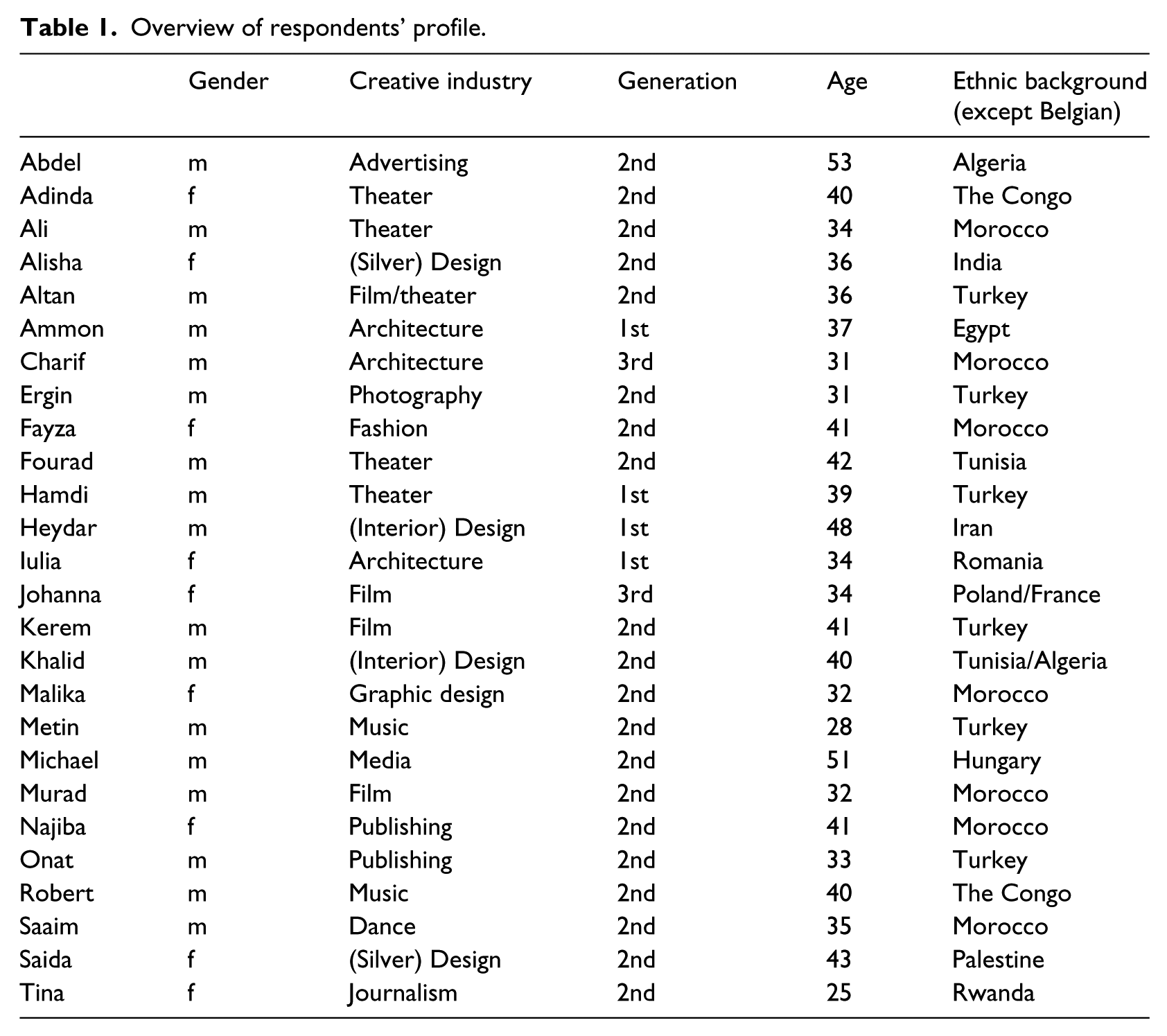
Our empirical study is based on extensive interview material collected through in-depth face-to-face interviews with 26 ethnic minority creatives active in Belgium. The interviews were conducted in the frame of a larger research project drawing on both interviews and mass-media texts produced for a general, non-specialized audience aiming to investigate self-employed individuals with an ethnic minority background with specific attention for their identity construction and the underlying power relations. Attempting to gain insights across a variety of creative sectors (Cunningham and Higgs, 2009), we were able to recruit respondents from design and fashion (6), theater and dance (5), film and photography (5), architecture (3), journalism and publishing (3), music (2), and media and advertising (2; see Table 1).
Overview of respondents’ profile.
Respondents’ selection
Our sample includes respondents (self-)identifying with the largest ethnic minority groups with origins outside the EU15 today present in Belgium: they are of North African, Turkish, Eastern European and central African descent (OECD, 2008; Timmerman et al., 2003). We initially identified respondents through various channels, including public organizations providing funding to creatives in various sub-sectors, media appearances, suggestions of key informants and intermediaries such as agents and managers. We further used snowball sampling, asking participants to provide contact information of other potential respondents. In all our communication, we referred to creatives with an ethnic minority background, self-employed and ‘established’, in terms of having been active for a few years and having reached some visibility and recognition in their creative sector. We indicated that respondents qualified for the study if they either had a nationality outside the EU15 and/or had at least one parent or two grandparents with a nationality outside the EU15 (Commissie Diversiteit SERV, 2014). We used this definition because it is used by the public administration and is broadly in line with the public discourse on ethnic minorities described above.
Nonetheless, we are aware that this selection procedure remains somewhat at odds with our discursive conceptualization of ethnicity. Ethnicity is, in our view, not a trait but socially constructed through ascription and (self-)identification (Barth, 1969; Jenkins, 1997). By including both migrants and individuals with an ethnic minority background, our procedure ascribed ethnicity in a way that resembles what commonly occurs in wider Belgian society, that is, disavowing ethnic minorities’ heterogeneous backgrounds and specific migration trajectories. At the same time, we would like to stress that our empirical analysis remains in line with our theoretical approach conceptualizing ethnicity as a discursive resource in respondents’ identity work or their self-reflective and purposive mobilization of ethnicity in constructions of creative identities (Alvesson, 2010; Alvesson et al., 2008; Cerulo, 1997; Ybema et al., 2009). We further restricted the sample to established creatives, as indicated, for instance, by prizes awarded by the sector, positive acclaim in the media, substantial financial revenue, and collaborations with other established peers. Such criterion aimed at increasing the possibility of capturing discursive practices conveying meaning about oneself and one’s creative products, which is accepted in the creative industry within which each individual operates.
Interviews
The first part of the interviews was open. Respondents were asked to talk about themselves and their work, narrating their personal and professional trajectory. In this way, they had the opportunity to reflect on particularly salient moments in their professional lives, and to introduce and contextualize their experiences. In the second part, a semi-structured, open-ended questionnaire was used to explore a broad variety of themes, including respondents’ creative work, clients, management, financial matters, networks, encountered barriers in their career, as well as their personal background, including their family and education. To avoid probing, all the questions concerning the ethnic background(s) were asked later in the interview. Following respondents’ preferences, 24 interviews were conducted in Dutch, one in English, and one in French. These interviews took place either at the respondents’ home, in a bar, or at their workplace, and lasted 1 and 3 hours each. Each interview was fully recorded and transcribed verbatim in the original language.
In conducting this research, we were sensitive to the need to be self-reflexive on the fact that interviews represent a specific dialogical modality of the production of narratives, one that necessarily reflects, among other, scholars’ communicative preferences as well as his or her and interviewees’ position within the social field relative to each other (Essers and Benschop, 2007). The interviews were carried out by the second author, who has an ethnic majority background, and who was at the time a junior researcher with no specialized knowledge on the creative industries yet a background and a strong interest in art. Although it is impossible to evaluate how the interviewer’s social profile affected the produced narratives, her profile does not substantially differ from the broader non-specialized public which ethnic minority creatives commonly address in their profession. In this sense, the interview mirrored a common situation for the respondents, yet triggered a more in-depth reflection on themselves and their work than what might usually be the case.
Data analysis
All data analysis was conducted on the texts in their original language to remain close to their specific textual features as long as possible. The excerpts included in this article were translated to English by the authors only after the analysis was complete. We initially read and re-read the transcripts in order to become fully acquainted with the narratives. We then jointly identified all excerpts explicitly connecting the respondent’s (self-ascribed) ethnic background to his or her creative products. Through open coding, we could distinguish 19 first-order descriptive labels used by respondents to construct their ethnicity (e.g. ‘being the only one’, ‘being different’, or ‘mixed origins’) and 39 first-level codes referring to creativity (e.g. ‘rare situation’, ‘tied to one individual’, ‘opportunity’, ‘capabilities’, ‘possibilities’, ‘exception’, and ‘special talent’). This resulted in a total of 28 excerpts from 22 of our 26 interviews, most of which were quite extensive. In four interviews, respondents did not connect their creative work or creativity more generally to ethnicity. One of them explicitly denied this connection. Already in this initial phase, we observed that interviewees related their ethnic background to their creative work in distinct ways.
In a second step, we examined the 28 selected excerpts focusing on the constructions of one’s identity, in which they address the question ‘who am I?’ drawing on discourses of ethnicity or (non)belonging to a group defined in ethnic terms. We systematically went through the excerpts to identify distinct ways in which respondents positioned themselves vis-à-vis the ethnic majority and ethnic minority(ies). This resulted in three distinct constructions of one’s identity: (1) as carrying both the ethnic majority and minority cultures in oneself (19 fragments), (2) as an alien to the ethnic majority culture because of one’s ethnic minority background (6 fragments), and (3) as an alien to both the ethnic majority and minority cultures (7 fragments).
In a third step, to answer our main research question, we focused on the ways in which respondents discursively mobilized these three representations of ethnicity as sources of creativity in their work. This analysis led to the identification of four discursive strategies: Constructions of oneself as carrying both the ethnic majority and minority cultures were used to represent creative work as reflecting either one’s active crafting of a unique ethnic hybridity (16 fragments) or one’s ‘automatic’ and natural ethnic hybridity due to one’s multiple ethnic cultures (6 fragments). Constructions of oneself as an outsider vis-à-vis the ethnic majority culture were used to represent one’s creative work as ‘exotic’ (7 fragments). Finally, constructions of oneself as an outsider vis-à-vis both the ethnic majority and minority cultures were used to represent creative work as expressing one’s ‘liminal’ position fostering creativity (9 fragments). Although some respondents constructed identity consistently in one way, many combined two or more discursive constructions in their narratives. After analyzing interview excerpts illustrating these four discursive strategies, we conclude the results with a fifth one, in which the respondent explicitly denies the relevance of her ethnic background for her creative work.
Building creative identities from ‘intentional’ ethnic hybridity
In their narratives, respondents’ most frequently constructed a ‘hybrid’ ethnicity for themselves, that is, one resulting from the encounter of two distinct cultural worlds in their lives: the (minority) culture of the country of origins and the (majority) culture. This construction of ethnicity enabled respondents to subsequently describe themselves as creatives who proactively and selectively fuse elements originating in these two distinct cultural worlds. This discursive strategy is well illustrated by Metin, a musician and DJ with a Turkish background: My mother is Belgian, my father is Turkish. […] I am a half-breed, and I want everyone to know it. I will never do something to hide it, on the contrary, it’s who I am. […] When I was 15, I was fascinated by DJ’s, and I started spinning some tunes myself. […] So first I was more into electronic music, but I left that and later got a bit into Balkan music. Now I’m actually looking for a way to create my own music, my own Metin Öztürk music, distilled from these two broad influences I carry in me. […] Many things about me are double. I have a very double character, I can switch quite quickly from one thing to another, and also in music I have these different genres I want to be part of. I have these electronic influences, but I also have Turkish elements in me. […] I have touched upon those sounds regularly, and now I’m looking for ways to blend both […] Which means I make an amalgam of electronic music, with a lot of eastern sounds at the same time. […] musically I’m convinced I need to bring this story, because it’s my story.
Here, Metin clearly portrays himself as influenced by both the Turkish and the Belgian cultural contexts. He explicitly and with pride labels himself ‘half-breed’, purposely rejecting the negative connotation of the term. Precisely, this representation of ethnicity enables him to construct his music as innovative due to the combination of (western) electronic sounds and Turkish/Balkan/eastern sounds. Yet such combination does not occur automatically: Metin claims that his creative product is the result of his active and self-reflective crafting, the distilling of music out of carefully selected elements from these two cultures.
Fourad, a theater maker with a Tunisian background, talks about himself and his creative work in a similar manner, yet alluding more to the power underlying societal discourses of ethnic minorities and highlighting the disruptive potential of creative work expressing hybridity: I grew up with four languages, Dutch in school, West-Flemish on the street, French on TV and my parents’ Arab language. This allowed me to play with and choose my identity, as if it was a little game […] I am child of many influences […] I auditioned [… But] I thought I had to play the ‘exotic’ too much. […] That’s the moment I started my own dancing company […] That’s where I made my family trilogy, ‘The Lion of Flanders’, ‘Our Dear Lady of Flanders’, and ‘Brothers of Love’. […] It was a conscious mix of the Flemish tradition [based on famous literature, symbols and themes such as Catholicism] and my personal Arab and family context […] We really wanted to mix and show the conflict between them […] Through the combination of elements it was new for that time. […] And of course, you know this is tainted, and soon people started to get upset and started calling me: ‘What is that Arab doing with our Hendrik Conscience, and with our Lion [symbol of Flanders]?!’ […] But it’s exactly those symbols that fascinate me, and that I wanted to combine them in my story, despite the clash and resistance. […] It was quite heavy, all that controversy.
Fourad constructs himself as in-between multiple cultures, making heterogeneous cultural elements available to him and enabling him to choose and mix them both in his own identity—a child of many influences—and in his creative work. He constructs a ‘glocal superdiversity’ by foregrounding the heterogeneity within Flemish culture. To do so, he points to local cultures within Flanders by mentioning the West-Flemish dialect (notoriously known for its incomprehensibility for Flemish native-speakers who are not from West Flanders), as well as in the Arab culture, referring to French mass-media consumption. Fourad further explicitly refers to the ethnic majority’s attempts to delegitimize his appropriation of Flemish symbols as ‘an Arab’, and how he resists this amidst the controversy. In his narrative, he portrays himself in a privileged creative position offering him the possibility to consciously juxtapose multiple cultural elements in new ways, break common boundaries, and question cultural canons in ways that shock the audience and cause controversy. In this sense, Fourad’s work explicitly challenges dominant discourses of the ethnic majority and minority cultures as well as their hierarchical ordering.
Both accounts echo the grand discourse of diversity as a source of creativity, yet do so in a way that reclaims the subject at the center of the creative endeavor. The speakers’ creative products are portrayed as the direct expression of their individual creative trajectory combining various ethnic influences. The creative and his work are hybrid, that is, they consist of ‘forms [which] become separated from existing practices and recombine with new forms in new practices’ (Nederveen-Pieterse, 1994: 165; Van Laer and Janssens, 2014). In these texts, there is nothing collective or automatic about one’s experience. These fragments represent instances of what Bakhtin (1981) calls ‘intentional hybridity’, a hybridity which is consciously authored—by agents—dialogically, with the deliberate purpose of creating something new (see also Basu and Werbner, 2001). The stress on uniqueness and intentionality re-inscribes the speakers in the dominant understanding of the creative as an individual, rejecting pigeonholing and exoticization by ethnic majority significant others and to advance creativity as a ‘third space’. Here, meaning becomes ambiguous through re-contextualization, and the hierarchical relation between western traditions—the ‘Belgian tradition’, ‘French mass media’—and their other—‘Arab culture’, ‘Balkan music’—is called into question (Bhabha, 1994).
Building creative identities from ‘organic’ ethnic hybridity
In a second type of texts, the speaker rather constructs ethnicity as hybridity resulting from an effortless mix of two worlds, due to his or her double ethnic background. Here, creativity is portrayed more as the ‘natural’ expression of one’s hybrid ethnicity than one’s conscious creative choices—creative products as the bearers of original references, unexpected elements from the perspective of the ethnic majority. Alisha, a jewelry designer with an Indian background, told us: My mother is Belgian […] my father comes from Bombay, India. […] The culture at home was a very nice balance between East and West […] Concerning faith, although I am a Catholic, we went every year on holiday to India, so I saw many Indian temples there […] with Indian furniture and other Indian things. And I think that my love for decoration, and the adoration for jewelry—which is very present over there—later was the motivation to study jewelry design. […] And when I hear the reactions of clients coming into the store, it often something like: ‘Well, this refers to something oriental’. And I do not consciously include that, yet apparently it gets naturally intertwined somehow. There must be an Eastern flavor, which in the end apparently hits a spot […] Indian jewelry is also all made by hand, and I must say I’m not afraid to say that I really work a whole week to complete a ring. […] It’s my cultural background which brings out that part of me.
Alisha constructs herself as a natural mix of Indian and Belgian elements to which she was exposed since her childhood. Different from the previous interviewees, she makes no reference to her own effort in creating work that links elements out of each culture but rather refers to it as simply reflecting her upbringing. Alisha mentions becoming aware of the influence of her hybrid ethnic culture through the observations of ethnic majority clients associating aspects of her creative work with ‘oriental’ culture and clearly embraces this association as reflecting who she is. She stresses the seamless continuity between herself and her work, which she presents as spontaneously and naturally flowing from her hybrid ethnicity.
This construction of a natural and effortless hybrid ethnicity shaping one’s creative work is even more explicit in the interview with Johanna, a film director with a Polish/French background: My mother is Polish […] but was born in Congo and then […] she came to live in Belgium. My father is half French, [half] Flemish. […] So at home, we spoke mostly French […] and I went to the international school in Brussels […]. I always was surrounded by a broad variety of languages and cultures, […] with many different sounds […] Which means, while making movies, it appears to me as if I cannot tell a Belgian story. Because I was raised between so many different cultures, it feels as if I can only develop my personal film language in between of them all […] For example I made a short film on the Trans-Siberian Express […] about a Flemish woman and a Russian man, and they don’t have a common language, so […] they need to communicate without words. And now my new project […] It seems as if I need to talk [in my movies] about communication between different cultures. And the idea in the end is that communication is also possible without words and without a common language.
In this fragment, the speaker’s creative work is again constructed as directly and naturally resulting from her upbringing at the cross-road between multiple cultures. Johanna constructs herself as an expression of a multifaceted ethnic context, which is in turn reflected in her creative work representing the encounter of multiple elements in her own life.
At first sight, the discursive strategy used to link one’s hybrid ethnic background to creativity illustrated by these two fragments faithfully reproduces the grand discourse of diversity as a source of creativity. These creatives construct a ‘natural’ hybrid ethnic background, de-emphasizing their own choice in the creative process leading to hybrid creative products. The reference to majority of audience’s interpretation of their work as reflecting their ethnic minority background also discursively locates agency outside the subject. These fragments echo what Bakhtin (1981) calls ‘organic hybridity’, that is, an hybridity that occurs spontaneously in language and culture by virtue of natural evolution, and which, he argues, reveals the illusory nature of ‘pure’ linguistic and cultural essence (see also Bhabha, 1994; Young, 1995).
At the same time, these texts also fundamentally differ from the hegemonic grand discourse of diversity. While portraying hybridity as organic, they do not construct the creatives as expressing a collective experience of an ethnic minority group. On the contrary, they construct diversity as occurring within the (hybrid) subject, shaping his or her experience, distinct interests, sensitivity, and esthetic orientation, which are then expressed in his or her creative work. Whereas this hybrid ethnicity is located in third space (Bhabha, 1994), compared to the previous fragments, there seems to be less overt conflict over the meaning of the other. In her identity work, Alisha embraces the identity as ‘other’ attributed to her, stressing how it contributes to her creativity. Doing so, she ignores the subordinate connotation that might come with it. Johanna rather eludes the majority–minority binary by pointing to the multiplicity of cultures in Brussels. Doing so she re-casts the Belgian capital as superdiverse and hints at the possibility that organic hybridity be(come) the norm rather than the characteristic of the other. This is a subtle, non-confrontational yet clear act of re-signification of the other in a discursive context still largely structured along the binary us/them, west/other (Blommaert and Verschueren, 1998).
Building creative identities from ‘exotic’ ethnicity
In a third type of texts, speakers construct an explicitly ‘exotic’ ethnicity by re-appropriating the ethnic majority’s stigmatizing images of a specific ethnic minority through self-exoticization. This construction of ethnicity reproduces the dominant discourse of diversity as creativity by stressing the unique social, cultural, and economic position ethnic minorities occupy in society. It allows speakers to claim unique creative possibilities, for instance, the ability to legitimately express certain opinions through their work or access specific creative networks by virtue of their ethnic minority background. The following fragment from the interview with Ali, a stand-up comedian with a Moroccan background, is illustrative: I work as a comedian […] What strikes me is that I’m still the only one with Moroccan origins, and even the only one with an ethnic minority background. […] I perform stand-up and […] my show is actually about me, about the things I experience as a Moroccan in Flanders. Although I was born here, people still see me as a Moroccan, so I keep on using that in my shows. [Because] as long as you still are the only one, people will come and see your shows, right? […] Recently, I also started organizing a comedy event. I know some Moroccan performers living in Morocco, and have invited them to […] come and do a show in Flanders […] I mainly do this for my parents. They cannot come to my shows [as they do not speak Dutch], and they have never been in a theater before. When you can present someone from Morocco, then also they can see Moroccan stand-up once […] and of course they also talk about the differences between here and there.
In this text, Ali constructs himself through the eyes of the ethnic majority, as a Moroccan in Flemish society (despite the fact that he was born in Belgium). To do so, he draws on the identity the ethnic majority audience ascribes to him, yet presents this ascription as an opportunity to distinguish himself from ethnic majority creatives in his sector, rather than an imposition and/or a stigmatization. This discursive strategy also aligns with the grand discourse of diversity as a source of creativity, as it conveys the idea that, from his specific position, Ali has privileged access to specific creative content for his shows and allows him to act as a cultural broker in his sector (Smallbone et al., 2005, 2010). At the same time, the text also clearly goes beyond such discourse. For instance, Ali points to his strategic, instrumental re-appropriation of the social identity imposed on him to attract the majority of public and further clearly reclaims the experience of ‘a Moroccan in Flanders’ as his own. By so doing he subtly hints at the possibility that, in his comedy, the subordinate other might speak back from his or her own point of view rather than staying within the boundaries of the (subordinated) exotic (Bhabha, 1994). The affirmation of the other on its own terms is discursively further suggested by the reference to the organization of a cultural offer in Belgium for older, lower-class first-generation ‘Moroccans’ like his parents, who are excluded from ethnic majority cultural circuits, through re-connection with performers in Morocco, the other.
Despite the apparent alignment of Ali’s construction of ethnicity with the grand discourse of diversity as a source of creativity, his re-appropriation might thus be less compliant with this discourse than it appears at first sight. The clear stress on otherness and subordination by the ethnic majority, combined with the emancipatory re-connection to comedians in Morocco, inscribes the creative and his work in the space of the Moroccan diaspora (Butler, 2001). Paradoxically, it is the ethnic majority’s expectation that he speak for and represent the Moroccan ethnic minority community that opens up the possibility for legitimately re-connecting with the homeland (Clifford, 1994). Although fixed in his or her subordinated ethnic minority identity, the other escapes it and is neither exotic nor docile, as he or she politically re-inscribes herself in alternative ways, which disavow the centrality and superiority of the ethnic majority.
Building creative identities from ethnic liminality
A fourth type of texts is characterized by the speaker’s construction of the creative as belonging to neither the ethnic majority nor the ethnic minority. By defining oneself as ‘liminal’ (Turner, 1969) or relationally (rather than temporally) in-between two cultures (Ybema et al., 2011), belonging to neither, speakers are able to claim a uniquely different perspective from other creative professionals. An example of this strategy is found in the words of Najiba, a writer with Moroccan roots: My parents came here from North-Morocco […] I was two […] I am a Moroccan-Belgian with Muslim roots. I got an Islamic upbringing when I was younger, but I’ve also been immersed in western culture, the fairy tales of Hans Christian Andersen, and Sesame Street and Mickey Mouse. […] At home we spoke Amazigh, so the Berber language, yet I’ve always attended school in Dutch […] and now I also write in Dutch. […] I often doubt between these two [cultures] […] You know you’re in between both. But if I’m not the one, and not the other, what am I? […] I started writing because […] my outside world mainly consisted of a school where I was confronted with teachers who didn’t understand my faith and principles, and who sometimes were very racist. I constantly felt that this wasn’t a place where I could be myself. […] I felt like an outsider, who wasn’t fitting quite well in her environment, and I needed to write that down, to create a parallel inner world […] So I developed this outsider stance for myself, which is the perfect position for a writer. Because then I could observe everything from the sideline, and try to capture these [insights] in my writings.
Despite her reference to both the ethnic majority and the minority cultures, Najiba highlights her non-belonging completely to either. This double outsider position is constructed as the consequence of her traumatic experience of the imposition of an outsider position by ethnic majority teachers, whom she defines racist. Najiba builds an identity as a creative around the creative re-appropriation of this experience. She portrays herself as an outsider, a position that allows her to observe and write from a distance.
Also Ammon, an architect with Egyptian roots, reflexively constructs himself as non-belonging: I’m doing modern architecture. […] I was born in Alexandria in Egypt. I lived there, I grew up [there] until I was 16. But I’ve always travelled with my parents, so I lived in Morocco and in Egypt and for a short time in Germany, too. After high-school I went to Paris to study architecture. I also lived and worked there and since three years I have an office in Brussels. […] I once took a plane, and I wasn’t looking at the movie but at the Mediterranean Sea […] and you saw nothing else. I realized that this is my land; this is my real identity, this non-identity […] I guess in my work you feel that my architecture is neither from the south nor from the north. It’s too much north to be from the south and there is too much south in it to be really architecture from here, from the north. This is what I like. […] You have to admit that your life has to be a just solitary travel with your boat, and you cross these other cultures. In the end, [your work] is only going to say something about you. You[’re] going to see nothing Belgian in my architecture, nothing French, nothing Egyptian—there is no pyramid—it talks about me, and the people I met.
Ammon’s lyrical construction of his creative identity through the metaphor of a solitary travel by boat on a sea dividing and connecting the European continent (the north) and the African one (the south) similarly positions him as an outsider. Despite the reference to the trope of the north and the south, in this case, there is no trace of imposition or trauma. The power relation between the north and the south is de-emphasized through reference to multiple wests and many ‘others’, while the incipit referring to ‘modern architecture’ ends potential associations with ethnic ‘tradition’ before they might arise. In a counterpoint, life is represented through an existentialist vocabulary, as an individualized, unique creative trajectory leading to creative products which ultimately solely reflect it.
These texts most radically challenge the representation of diversity as an essential collective trait automatically generating creativity in the grand discourse of diversity as a source of creativity. They do so in a double way by foregrounding the individual creative and negating the relevance of ethnic belonging. As liminar, creative subjects are ‘neither here nor there; they are betwixt and between the positions assigned and arrayed by law, custom, convention, and ceremonial’ (Turner, 1969: 95; Ybema et al., 2011). Rather, he or she is at the center stage, authoring a creative product that emerges from the—more or less traumatic—encounters with the west and others, and the processing of these encounters through creative work. Creativity becomes here a therapeutic or existential strategy of the self to deal with an ethnically inscribed social world from which he or she is estranged. From this highly individual perspective, ethnicity is used as a discursive resource to represent an abstract encounter between the self and the other, rather than as a category of belonging to define the self.
Building creative identities by denying ethnicity
Finally, few speakers did not use ethnicity as a discursive resource to construct creativity. This omission indicates that, despite hegemonic discourses pressuring them to do so, creatives with an ethnic minority background retain a certain degree of freedom in the construction of creativity and their identity as creatives. One respondent mentioned using his ethnic background in the beginning of his career yet abandoning references to it later on. Another, a designer with Palestinian roots running her own design company, explicitly denies the relevance of her ethnic minority background in her professional work: My father is Palestinian, my mother was Belgian, and yes, that influences you […] because in the end you’ve got the two cultures. And I completely don’t see that as an obstruction, but rather as an enrichment […] I don’t think that what I’m doing now is caused by my upbringing in two cultures […] Identity […] is really the theme I think, that 90 percent of the [ethnic minority] people use in their work […] but I don’t have that, far from it! […] And still people really expect you to […] I get a lot of comments like: ‘Well your work is very feminine, and very oriental’ […] yet I don’t think anyone can see that in my work […] [My] objects […] are in the end daily objects with a […] I don’t know really. Some say it’s a twist […] sometimes it’s a wink […] But for me this was not like: ‘Well and here I’m going to use my roots, and now I finally can show who I am and how important that is’.
In this fragment, Saida makes reference to being brought up in two different cultures at once, yet to then explicitly deny the relevance of her double upbringing to her creative work. She overtly refuses to discursively reduce herself to one or more ethnic minority backgrounds (or, as a matter of fact, her gender), despite other creatives’ widespread use of their ethnic minority background in accounts of their work and attempts of clients to interpret her creative work in ethnic (and gendered) terms.
The last discursive strategy radically rejects the grand discourse of diversity as a source of creativity. It does so by resolutely separating the subject’s background from the creative endeavor, passing for the opportunity to claim creativity in the name of one’s minority identity. Through the nuances in the text—the double background is qualified as ‘enriching’ and a ‘twist’ is acknowledged—the speaker counters ethnic majority individuals’ reduction of her creative work as the mere expression of a (subordinate) ethnic minority, feminine identity, and the ensuing risk of exoticization and devaluation (Thoelen and Zanoni, 2016). On the contrary, Saida reclaims full subjectivity as a creative, arguing that her objects are not an expression of her ethnically defined self but rather objects of universal, everyday use, to which she adds her own creative touch. De-emphasizing her ‘different’ biography, she purposely inscribes herself in a broader, disembodied, ‘universal’ representation of the creative and creativity (cf. Amabile et al., 1996; Herrmann-Pillath, 2010; Muhr, 2010).
Discussion and conclusion
It’s not just that diversity and inclusion are moral imperatives, which of course they are. They are economic necessities. Creativity requires diversity: it is the great leveler, annihilating the social categories we have imposed on ourselves, from gender to race and sexual orientation. (R. Florida, preface to The rise of the creative class, revisited and expanded for the 2012 edition, Basic Books, stress in original) Montesquieu’s Turkish Despot, Barthes’s Japan, Kristeva’s China, Derrida’s Nambikwara Indians, Lyotard’s Cashinahua pagans are part of this strategy of containment where the Other text is forever the exegetical horizon of difference, never the active agent of articulation. The Other is cited, quoted, framed, illuminated, encased in the shot/reverse-shot strategy of a serial enlightenment. Narrative and the cultural politics of difference become the closed circle of interpretation. The Other loses its power to signify, to negate, to initiate its historic desire, to establish its own institutional and oppositional discourse. (Bhabha, 1994: 31, stress added)
At the outset, this article departed from a critique of the discourse of diversity as a source of creativity in the creative industries which, while celebratory of difference, discursively reduces ethnic minority creatives and their work to the natural and automatic manifestation of a collective ethnic essence (Basu and Werbner, 2001; Brandellero, 2010, 2011; Florida, 2002; Lee et al., 2004; Mavrommatis, 2006; Smallbone et al., 2005, 2010). We pointed to the erasure of the creative subject behind an essentialistic and ‘systemic’ understanding of diversity from the vantage point of ethnic majority significant others. We argued that once domesticated, essentialized, and inscribed in an economic logic (cf. Swan, 2010; Zanoni and Janssens, 2004), ethnic ‘difference’ can no longer hold its promise of emancipation of ethnic minority creatives through association with esthetic or semiotic worth.
Aiming at recovering the subject behind this discourse, this study analyzed ethnic minority creatives’ own discursive practice and, in particular, how they, as agents, navigate grand discourses of ethnicity by selectively and strategically deploying them as a discursive resource in the construction of a creative identity. Our argument is that despite their problematic nature, discourses of ethnicity do offer a highly recognizable vocabulary to represent experiences, emotions, and ideas to craft unique esthetic or semiotic content (Becker, 1982; Caves, 2000; Handke, 2004; Howkins, 2001; Scott, 2000). Due to the pervasiveness of these discourses in contemporary Belgian society, ethnic minority creatives can strategically use them as a discursive resource to construct distinctive creative identities (Caves, 2000; Hagoort, 2005). This resource can be particularly appealing as it helps perform distinction without direct comparison with (more powerful) others, which might elicit embarrassment or hostility (Down and Reveley, 2004). It is further not accessible to ethnic majority creatives due to their historical position of privilege in the creative industries and society at large. Such privilege entails that the majority ethnicity represents the norm that is taken for granted and thus invisible (Grimes, 2001; Nkomo, 1992).
Overall, our analysis suggests that the discourse of ethnicity as a source of creativity can seldom be ignored, avoided, or wished away by creatives with a foreign background. Yet at the same time, such discourse fails to deterministically fix these subjects, as its normativity does not operate automatically. In constructing identities as creatives, speakers mobilize heterogeneous discursive strategies or ‘varied ways of thinking about cultural difference—varied “multicultural imaginaries” […] fashioning those imaginaries of cultural difference and ethnicity’ (Dwyer and Crang, 2002: 412). Specifically, we could identify five uses of ethnicity as a discursive resource to construct a creative identity—‘intentional hybrid’, ‘organic hybrid’, ‘exotic’, ‘liminal’, and explicitly ‘non-ethnic’. Despite differences in the degree to which speakers (dis)associate themselves from/with multiple ethnic groups and cultures, they all clearly perform an alternative representation of themselves than the one advanced in the grand discourse of diversity as a source of creativity. Namely, they craft representations of themselves as creative subjects. Moreover, all refrain from pinning ethnicities and cultures down in terms of specific contents: They defer closure of meaning to avoid (self-)essentialization. Left denotatively indeterminate (Silverstein, 2003), ethnicity—be it the hegemonic one or its others—operates in the narratives as a ‘floating signifier’, one whose appearance is recognizable but whose signification remains ambiguous and malleable, open for future use.
Ethnic minority creatives selectively appropriate hegemonic representations of ethnicity and cultures as fixed essences reflecting historical unequal power relations between the ethnic majority and minorities, introducing slippage in meaning (Bhabha, 1994). Such slippage is often achieved by relying on the signifier of ‘hybridity’ to portray either the purposeful joining of ‘pure’ essences in one’s creative work enabled by the simultaneous location in two cultures or, less often, the natural, ‘organically’ mixed experiences of individuals (Bakhtin, 1981; Bhabha, 1994; Nederveen-Pieterse, 1994; Van Laer and Janssens, 2014). At the same time, to avoid that hybridity implicitly re-affirms the existence of ‘pure’ identities and the subordination of the ethnic other with which they associate themselves, speakers also normalize it. They do so by deliberately ignoring the ethnic other’s subordinate relation to the ethnic majority, however defined, or by highlighting superdiversity as a defining trait of contemporary society, to challenge the hegemony of the ethnic majority (Blommaert and Verschueren, 1998) in the creative industries. In this sense, these strategies represent political acts of re-signification, as they do not simply reproduce Belgium/the west and their culturally hegemonic understanding of the other. Rather, they leverage the ambiguity inherent to hybridity to destabilize the meanings of both the west and the other and subvert the power relations between them.
In other texts, speakers re-appropriate ethnicity by voicing the collective experience of othering by the ethnic majority, yet refracting the stigmatized representation of the other to construct themselves as ‘exotic’ creatives. This deployment of ethnicity casts the creative subject as having privileged access to specific creative (collective) content by virtue of his or her ethnic background, as posited by the discourse of diversity as a source of creativity. Although at first sight this use of ethnicity places the creative self within the confines of this hegemonic representation, a closer look reveals the transgression of these confines. Once legitimated to speak as the manifestation of the collective other, the subject might legitimately speak from his or her own vantage point, one that re-constitutes him or her as part of a diasporic community (Butler, 2001) through connection with the homeland (Clifford, 1994), rather than through her subordinate relation to the ethnic majority. Also here, an ‘exotic’ ethnicity is not so docile, as it is deployed to re-signify both the creative and the other.
Yet another strategy casts the creative self as being in a ‘liminal’ position (Turner, 1969) or in-between two cultures yet belonging to neither. Most distant from the discourse of diversity as a source of creativity, this strategy relies on a highly individualized vocabulary to carve out a space for creatives in their own right. Speakers construct themselves as outsiders vis-à-vis both Belgium/the west and its others. They highlight either the rejection by the ethnic majority because of their ethnic minority background or an individual trajectory leading to the re-appropriation of Belgian/western cultural elements and the other for creative purposes. Here, speakers break most radically with the subject position of the ethnic minority creative subject, re-signifying themselves as individual creative subjects, rather than as members of an ethnic minority community. Even the reference to overt racism—one of the few ones in our material—is discursively used to construct creativity in individual terms. In this sense, this strategy comes close to the ‘non-ethnic’ strategy, through which speakers explicitly reject their association with ethnicity in order to re-inscribe themselves in a broader discourse of the individualized creative subject (cf. Amabile et al., 1996; Herrmann-Pillath, 2010; Muhr, 2010; Runco, 2004).
Our analysis contributes to current debates on power and ethnicity in the creative industries by providing insights into contemporary struggles over the control of cultural production (cf. call for papers’ Special Issue; Hesmondhalgh and Saha, 2013). Specifically, we address the struggle over the representation of the creative subject and creative work, through which who qualifies as a creative and whose work should accordingly be considered as creative are defined and re-defined. From critically oriented diversity studies, we know that definitions of prototypical subjects—the ideal employee, leader, entrepreneur, scientist, professional, and so on—are normative, constituting powerful mechanisms of exclusion and marginalization of historically underrepresented groups from those positions (e.g. Ashcraft, 2013; Slay and Smith, 2011). Our respondents’ discursive practices attempt to shape the meaning of social reality in ways that affirm their belonging to the creative industries. These practices unveil how even grand discourses performing a politics of representation that ostensibly erases the subject can be re-appropriated to re-affirm the subject as an agent. As acts of re-signification of both the majority and the minority ethnicities and their unequal relation, these practices provide an entry point into the micro-dynamics of power in which subjects are entangled.
While our analysis shows how creatives’ discursive practices shape their identity, it is less suitable to assess the extent to which they undermine the operation of ethnicity as an institutionalized organizing principle of the creative industries more broadly, beyond their immediate micro-context. Hesmondhalgh and Saha’s (2013) statement that ‘[c]ultural production in the modern world cannot be adequately understood without taking account of race and ethnicity, and their relation to oppression’ (p. 180) alerts us that, as long as ethnicity remains a shared vocabulary to assert distinctiveness, we should remain cautious about the possibility that this discourse, however signified, may actually reproduce unequal power relations between the ethnic majority and minorities, rather than undermine them. Nonetheless, taking the vantage point of ethnic minority themselves enables us to highlight that the modalities of incorporation of ‘vital forms of culture from the margins of societies’ should at the very least not be understood solely as commodification (p. 180). These modalities also evidently represent opportunities for individuals to re-negotiate novel forms of subjectivity that re-signify the discourses constituting them in non-subordinate terms.
Footnotes
Funding
The author(s) received no financial support for the research, authorship, and/or publication of this article.