




Abstract
Organizational ethics has attracted increasing attention, but how individuals make sense of themselves as ethical subjects is a yet to be explored domain. The few empirical articles on ethical subjectivity have focused on how people within organizations seek to find a balance between a sense of ethical selfhood and dominant organizational discourse. We are interested in the role of the body and embodied experiences in constructing the entrepreneurial self and how this process unfolds over time. Viewing entrepreneuring as an ethical practice, we rely on a larger study of 58 entrepreneurs and a smaller multi-modal ethnography of three entrepreneurs in the ethical fashion industry. Drawing on the Deleuzian four folds of subjectivity that we employ as an analytical device, the data analysis reveals how our protagonists use the body as sensor, source, and processor in constructing themselves as ethical subjects. Our study complements rational perspectives on ethical decision making in entrepreneurship and establishes the body as a primary mechanism for one’s formation as an ethical subject. Through connecting the body with ethics, we aim to disclose the continuous subtle interaction between morality and materiality in the process of entrepreneuring. Our abductive framework discloses how one’s body prompts and informs the development of moral actions and material artifacts.
Styling […] the self goes much further than simply selecting an appropriate outfit from one’s wardrobe. […] Dress is a performative space related to storytelling.
1
Introduction
Ethics in organizations has been dominantly discussed from a rational, cognitive perspective of morality: ‘Morality was founded as an enterprise of domination of the passions by consciousness’ (Deleuze, 1988a: 18). Instead, we build on the affirmative possibilities of ethics (Pullen and Rhodes, 2015) derived from embodied, lived experience as it is conceived before the actual organization of ethics (Diprose, 2002). In this study, we are interested in the role of the body in how entrepreneurs, who shape their own organizations, organizational discourse, and themselves, fashion an ethical subjectivity (Rhodes and Wray-Bliss, 2013).
We ground our study in the field of ethical fashion enterprise—a phenomenon that does not allow ignoring the embodied nature of organizational ethics ( Pullen and Rhodes,2015). Entrepreneurial practices in this field interweave human beings, non-human bodies, and objects in an ‘ethics of entangled embodiment’ (Dale and Latham, 2015). These practices are explicitly feminine evolving around an interrelated, fluid subjectivity (Kenny and Fotaki, 2015; Knights, 2015). Taking a social-relational ‘affirmative’ approach to entrepreneurship (Weiskopf and Steyaert, 2009), we conceive it as creative world-making, an ongoing movement of inventing and relating between humanity and materiality. A multi-modal study of 58 entrepreneurs in ethical fashion employed video interviews and observations to complement discursive practices with material interactions. By focusing on practices ‘as the objects to be followed’, we are able to disclose connections to other activities, products, and humans (Nicolini, 2009: 121). From this data focus, our analysis centered on how a ‘subjective sense of self’ emerged as it was enacted by the body in interaction to ‘others’ such as fabrics, inspiration, artifacts, customers, comparables, equipment, and the final fashion designs. The fashion entrepreneurs we studied construct themselves as ethical subjects through contesting the existing logics of the fashion industry in the name of ethics. The process of entrepreneuring and designing has an embodied character that connects the creator with the end consumer and offers them a vision of ethical subjectivity.
The desire to undress/unpack this ‘subjective sense of self’ is guided by an understanding of how subjectivities are ‘fashioned’. Deleuze offers a constructive, materialist view of reconfiguring our subjectivities. For this study, we use Deleuze’s (1988b) four folds—where the self is a product of a continued folding–unfolding—as an analytical tool to maintain the primacy and distinctiveness of embodied ethics without cutting it off completely from discursive accounts that it often informs. The protagonists we studied converge around three complementary categories of embodied ethics, respectively, using their bodies as sensor, source, and processor of ethical concerns. Our abductive framework brings out these connections of how one’s body prompts and informs the development of moral actions and material artifacts. Through connecting the body with ethics, we aim to disclose the continuous subtle interaction between morality and materiality in the process of entrepreneuring (Steyaert, 2007a). Our intended contribution focuses on the role of the body and embodied ethics in the formation of ethical subjects in and through entrepreneurial organizations. In particular, we argue that an embodied ethics helps to understand how in entrepreneurial ethics, subjects ‘begin’ with their bodies and use their bodies as they create their organizations. Our secondary contribution is to show that embodied ethics is not disconnected from the discursive practices we now begin to take into account. We structure the article by first reviewing the literature on entrepreneurial self-formation and how an embodied ethics is an entanglement of morality and materiality. Then, we introduce our research setting and the process of data creation and analysis supported by the four folds. In the findings, we consolidate our embodied understanding of ethical subjectivity in an abductive model. We end the article with a discussion and conclusion.
Theoretical framework
We aim to answer the question how entrepreneurs fashion an ethical subjectivity and the role of the body in this process. The literature review will help us in the ‘Findings’ section to unravel the role of the body and embodied experiences in constructing the entrepreneurial self and how this process unfolds over time.
Entrepreneurial self-formation
The context of our study is entrepreneurship, which, as Johannisson (2007) suggested, ‘is as much about identity and sense making as it is about market and money-making’ (p. 13). Unfortunately, most entrepreneurship literature eschews the social formation of the entrepreneurial self (Down and Reveley, 2004) and focuses on the individual and psychological (Gray, 1998). Instead, we take a perspective to constructing entrepreneurial identity highlighting its interactionist nature.
With the aim to move away from studying entrepreneurs as ‘substances’, we turn to entrepreneurship as a verb (Steyaert, 2007a)—to address processes in the making. An affirmative approach views entrepreneuring as a practice of (un)folding, rather than a rational exercise of accumulating information, values, and resources (Weiskopf and Steyaert, 2009: 196). Grounded in an ontology of becoming, an affirmative approach allows us to study entrepreneurship as an ethical practice (Weiskopf and Steyaert, 2009). Entrepreneurs are thrown into the world and connect with its different elements in an ongoing process of creating and becoming. This relational–material approach to entrepreneurship is not about entrepreneurs, it is about relations with other ‘bodies’, whether human (Jones, 2003) or non-human (Law, 2008). The self can only be affirmed by the other’s difference (Hancock and Tyler, 2001) while generosity toward others constitutes the affective experience of constructing ethical subjectivity (Diprose, 2002; Hancock, 2008; Pullen and Rhodes, 2013). It is not limited to ‘what we find when we unmask the entrepreneur is the face of the other’ (Jones and Spicer, 2009: 115—italics not in original). It is expanded to all the materials (the non-human bodies, artifacts) that engage in the process of unclothing the entire body.
This view of entrepreneurship radically contrasts dominant perspectives that put the entrepreneur at center stage (Steyaert, 2007b). Instead, an affirmative approach focuses on practices of (self-)formation (Weiskopf and Steyaert, 2009: 199). Self-formation can be seen as a process of continuous aesthetic self-styling. Styling is interpreted as the way practices fit together: style acts as the basis on which practices are newly developed (Spinosa et al., 1997: 20). We build on literature that demonstrates how entrepreneurs craft self-identity ‘by connecting the discursively available world “out there” with “inner selves”’ (Phillips, 2012). We argue that in order to more profoundly comprehend the entrepreneurial process and its ethical impacts, we need to develop a better understanding of self and how it is constituted because ‘when human beings produce change, they change themselves as well’ (Spinosa et al., 1997: 38). Especially the kind of entrepreneurship that aims to transform society has made us aware of the emancipatory potential of what entrepreneurship is and can bring about (Phillips, 2012; Rindova et al., 2009). Therefore, we need to expand the notion of entrepreneuring as an ethical practice (Weiskopf and Steyaert, 2009) and ask how to perceive entrepreneurial self-formation as practices of ethical subjectivity in the making. In this study, we are particularly interested in the role of the body in that process.
Embodied ethics
Alternative perspectives to ethical and moral selfhood bring out the role of embeddedness (Skinner, 2012), suggesting that one becomes an ethical subject by experiencing ethical dilemmas rather than merely reacting to them. There are two distinct perspectives on experience: a relational one, building on the duty of care argument to explore how ethical responsibilities arise as one engages in specific relationships; and an embodied one, that underscores the role of one’s body and bodily resources in sensing and sensemaking (Michel, 2011). These two perspectives overlap to some extent in that one’s body is essential in how one relates to oneself and others (Liu and Maitlis, 2014; Michel, 2011) and serves as a key vehicle for communicating (Quinn and Dutton, 2005). This embodied nature of ethical encounters and interactions (Hancock, 2008; McMurray et al., 2011) is germane for the sub-domain of social entrepreneurship because bodily resources help entrepreneurs notice, feel, and respond to others’ needs (Atkins and Parker, 2012).
Embodied theories need to articulate the specific ways in which the body feeds forward into the discursive approaches that are becoming common at the intersection of ethics and entrepreneurship (Harris et al., 2009). A handful of studies offer embodied perspectives on traditional topics in related disciplines. For example, Heracleous and Jacobs (2008) explained how embodied metaphors help craft strategy, while Küpers et al. (2013) recast strategy as lived, embodied experience. Jarzabkowski et al. (2015) show that strategic work requires and relies on specific combinations of bodily, material, and discursive resources. Poldner et al. (2015) offer an embodied perspective to entrepreneurial discourse. The body plays a variety of roles in organizing (Heaphy and Dutton, 2008), but advances in embodiment remain largely theoretical. We complement these studies by abducing a process model of how one’s body prompts and informs the development of moral actions and material artifacts.
Morality and materiality
Our premise that morality is informed by one’s bodily experience has several important precedents in the literature on moral selves, that is, individuals as moral entities. Stets and Carter (2011: 192) find, for example, that moral identity guides how individuals approach moral dilemmas. Entrepreneurial subjectivities are multifaceted, complex, and in-flux, and they co-evolve with the ethical dilemmas entrepreneurs face (Skinner, 2012). When opportunities are new or ambiguous, entrepreneurs need to first become aware of (Bryant, 2009) and/or imagine (McVea, 2009) the moral underpinnings of their actions. Furthermore, the way entrepreneurs act on the opportunities they perceive may change the situation, for example, when monetary rewards motivate some to do harm (Shepherd et al., 2013) or when doing good motivates others to pursue other-interested outcomes (Atkins and Parker, 2012). Experiencing ethical dilemmas triggers not only rational sensemaking but also an ongoing self-formation process.
Because the body is material and interacts with a wide range of materials (Streeck et al., 2011; Vaara and Whittington, 2012), it is important to differentiate between the body and other physical artifacts (Jarzabkowski et al., 2015). For example, Jarzabkowski et al. (2015) show how the body can be used to reconfigure material and discursive resources and how the resultant combinations perform different types of strategy work. It is also important to separate the material consequences of one’s body and bodily interactions from the broader set of interrelating one does (Jarzabkowski et al., 2007). Because there is limited work specifying the interfaces between the body and material artifacts, we approach our data with few preconceived notions of what we might find.
Methodology
Methodologically, we collected and analyzed visual, physical, and textual evidence of how entrepreneurs use their bodies to develop themselves as ethical subjects. We followed recent advances that specify how we can use multi-modal data to observe and analyze the role of the body in organizing (Gylfe et al., 2016; Jarzabkowski et al., 2015). We are just beginning to learn how one’s physical body shapes organizing—for example, through emotional displays such as facial, physical, and verbal cues (Liu and Maitlis, 2014)—which is what we drew on in this study.
Research setting and data creation
Our research context is the sustainable fashion industry, which emerged as hundreds of entrepreneurs were disenchanted with the shortcomings of traditional fashions and explored alternative business models. The opportunities, organizations, and eventual artifacts they created were foregrounded by entrepreneurs’ subjective sense of selves. In the exploratory stage of this study, we relied on a data set of 58 entrepreneurs whom we followed for 4 years, between 2008 and 2012. They were all ethical fashion ventures that we could get access to through the network of the first author (K.P.) of this article. We included archival accounts, photos of fashion collections, web sources, and artifacts. This data-collection approach enabled us to triangulate accounts from multiple sources for each collection as well as observe the evolution of their collections over time.
Departing from an understanding that we can only study ethical subjectivities in the making when we move beyond text or ‘talk’ (Rhodes and Wray-Bliss, 2013: 45), we captured the performances through videotaping all interviews. Aside from analyzing their narrative descriptions (textual data), we looked at their performance in the video interviews (visual data) as well. Here, we asked questions such as: what do we see happening in this video in terms of facial expressions and interactions between the artifact and the entrepreneur, who not only shows her designs but touches them, strokes them, smells them, or even puts them on her body as to ‘perform’ them? What is captured in this photo or image and how does it relate to other images? Table 1 provides an overview of the analytical steps we applied following this exploratory phase.
Methodological overview of the analytical steps.
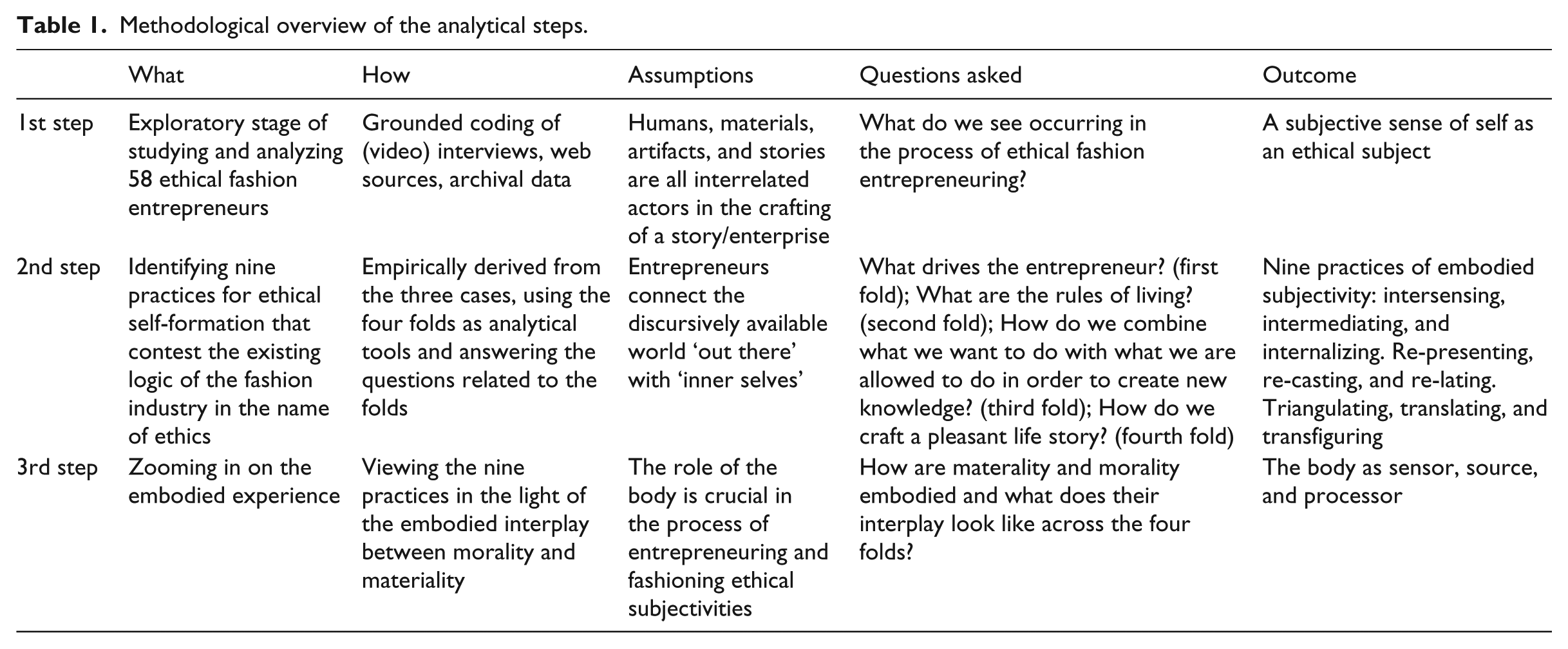
Our analysis was guided by the question what the role of the body is in constructing the entrepreneurial self. After several rounds of coding of the transcribed video interviews, the notion of a ‘sense of self as an ethical subject’ emerged as a core theme. At first, we did not know how to deal with this ethical subjectivity, but we went back to the literature and discovered the four folds of subjectivity proposed by Deleuze. The folds served as a data-framing device that supported the development of a subjective sense of self—as such they merit a short explanation.
Folding–unfolding
The first fold is the substance éthique (Deleuze, 1988b)—the material part of ourselves, the corporeal. Within the first fold, we ask questions such as: ‘What drives the entrepreneur? What are the core resources? How are these to be spent and restrained?’ The second fold is the mode d’assujetissement (Deleuze, 1988b)—the way ‘through which the subject is constituted through knowledge-power relations’ (Milchman and Rosenberg, 2007: 55). In this fold, we ask a critical question such as ‘to what rules of living do we wish to relate?’ The third fold is the pratique de soi (Deleuze, 1988b) or the fold of (self-)knowledge, which implies a critically reflexive attitude to the question ‘how do I know myself?’ Our relational view implies that we know ourselves through others, in the case of ethical fashion entrepreneuring, for example, through feedback from customers and through trying new ways to approach the art of fashion design. Here we ask the critical question: ‘how do we combine what we want to do with what we are allowed to do in order to create new knowledge?’ The fourth and final fold is the fold of the telos (Deleuze, 1988b) in which the individual recognizes herself as different from others. Here we ask the critical question: ‘How can we craft our affects, rules of living, and self-knowledge into an aesthetically and ethically pleasing life story?’ In Deleuze’s reformulation of Foucault’s subjectivity map, it becomes the fold of freedom and aesthetic self-formation (Bogue, 2004: 52). This fold is critical as it is not only the end goal but also the beginning of a new phase of folding–unfolding (see Figure 1—source: Cummings and Wilson, 2003: 62).
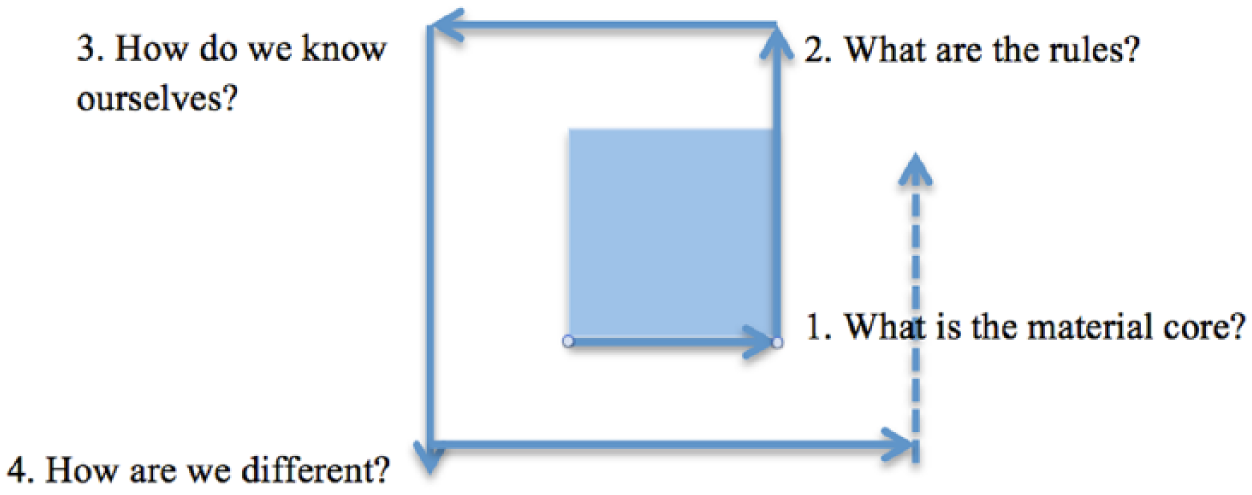
Four folds of subjectification.
The four folds ‘operate beneath the rules of knowledge and power and are apt to unfold and merge with them, but not without new foldings being created in the process’ (Deleuze, 1988a: 105). Foldings are infinitive and stress the process of becoming of the self: entrepreneurship can then be seen as a creative process of folding and refolding material. Understanding the four folds aided us in recognizing the role of the body in the entrepreneurial self-formation of ethical subjectivity in our data—they served as a narrowing device to grasp what we were looking at and to deal with the amount of material we were trying to make sense of.
Analysis
Equipped with the four folds as analytical tools, we could do a second round of coding to distinguish nine practices. Three rich cases were selected from the total amount of 58 entrepreneurs that were most illustrative of the four ethical aspects extracted from one’s own experience. We decided to refer to these cases by capturing their ‘sense of self’ in three names: Life Drapist, Fashion Architect, and Urban Nomad. We developed rich narrative and visual accounts and sorted them by answering the various questions for each fold and found that the folds truly aided the ability of zooming in and unraveling the practices. Several rounds of coding and continuous triangulation and discussion between the authors led to distinguishing nine practices.
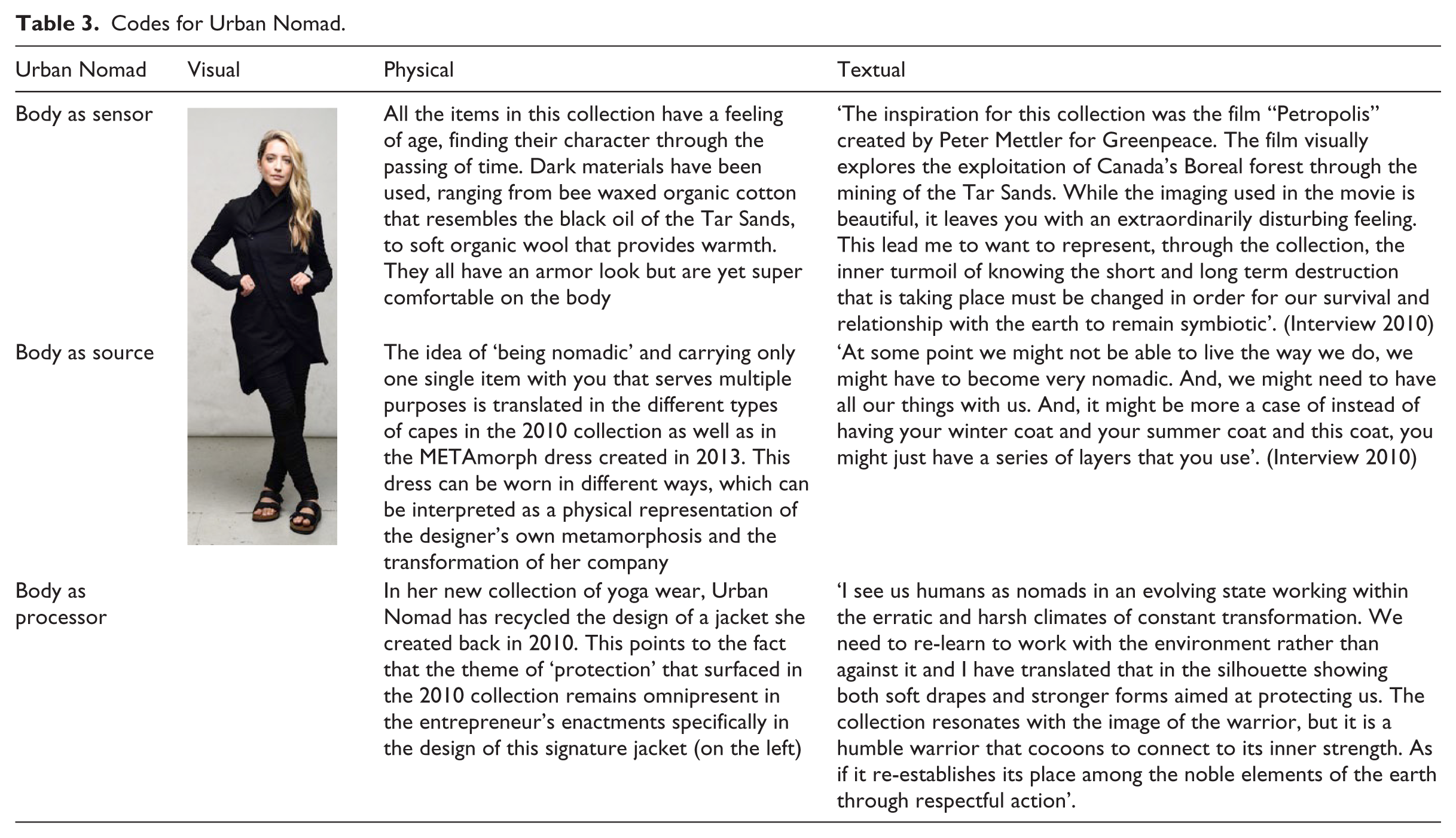
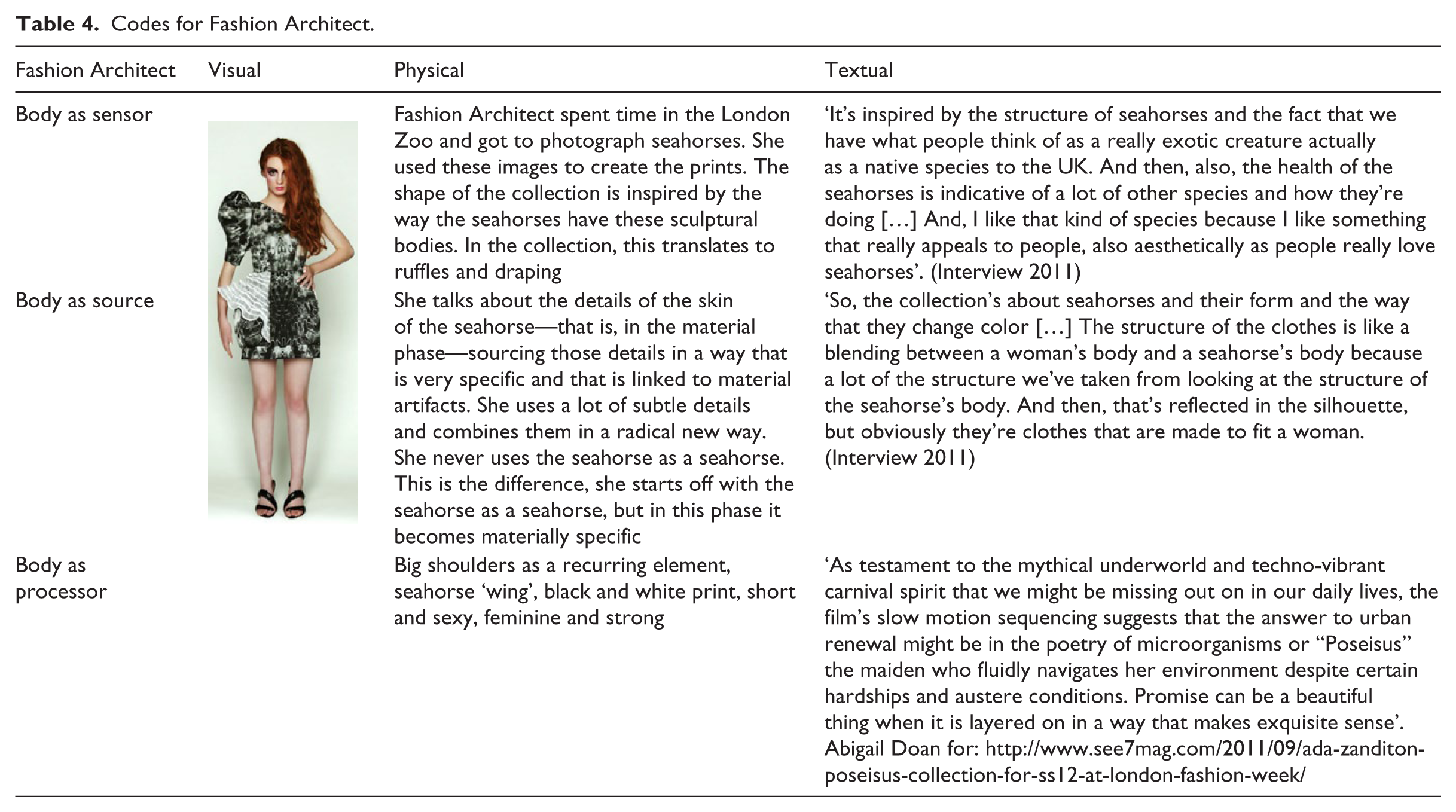
As a third analytical step, we brought in the nuances of the body, which pinned us down to the embodied side of ethics. Going back and forth between the different materials, we could identify key actants, resources, and artifacts, and understand how these came together as the subjects fashioned their ventures, their designs, and themselves. We developed visual, physical, and textual codes with physical codes being a descriptive interpretation of the physicality we observed in the data. We independently coded the narratives for the three protagonists, clustering codes into patterns and making sense of the patterns. In this third analytical phase, we did not look at all the experiences but only at the use of bodies and the embodied experience. We asked the questions: ‘what do materality and morality look like and how does their interplay appear across the four folds?’ The embodied view of materiality and morality throughout the codes supported teasing out the appearance of the body in the process of entrepreneuring, namely, the role as sensor, source, and processor. Tables 2 to 4 provide an overview of the visual, physical, and textual codes for the three protagonists.
Codes for Life Drapist.
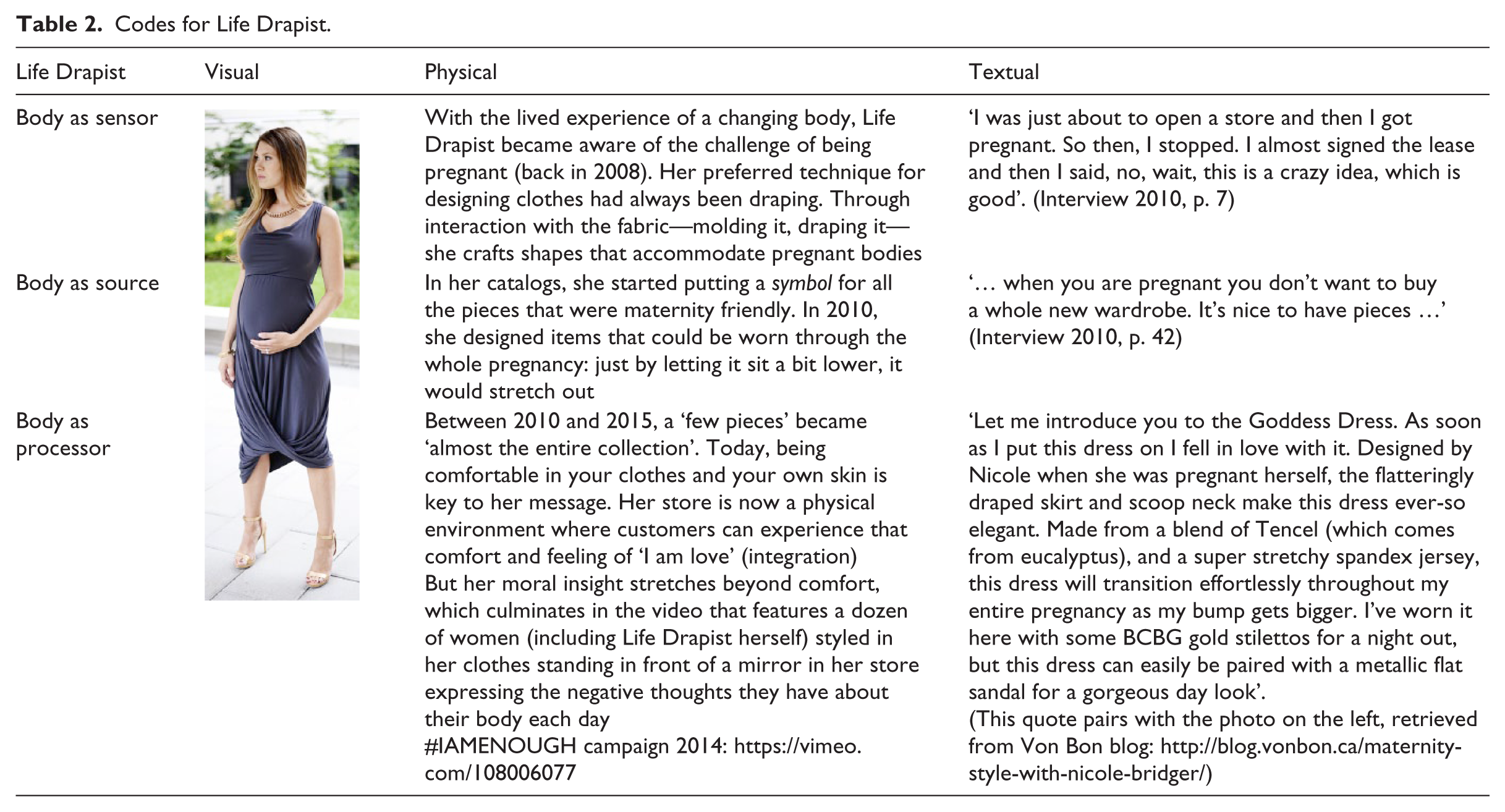
Codes for Urban Nomad.
Codes for Fashion Architect.
Findings
This section is divided into three parts. In part I, we introduce our abductive framework that unravels how entrepreneurs can be viewed as embodied ethical subjects. Figure 2 serves as the visual ‘map’ that provides structure to our findings. Departing from our research question how the role of the body evolves in entrepreneurial self-formation, we deciphered three functions of the body and three practices for each function that together construe how entrepreneurs fashion ethical subjectivities. We will move through the figure vertically focusing on the three columns with the ‘body as’ functions and their related practices. Second, in part II, we explain the three functions of the ‘body as’: we zoom in on the role of the body as sensor, source, and processor. In part III, we elaborate the nine practices in sets of three practices for each ‘body as’ function: interfacing, intermediating, and internalizing for body as sensor; re-presenting, re-casting, and re-lating for body as source; and triangulating, translating, and transfiguring for body as processor.
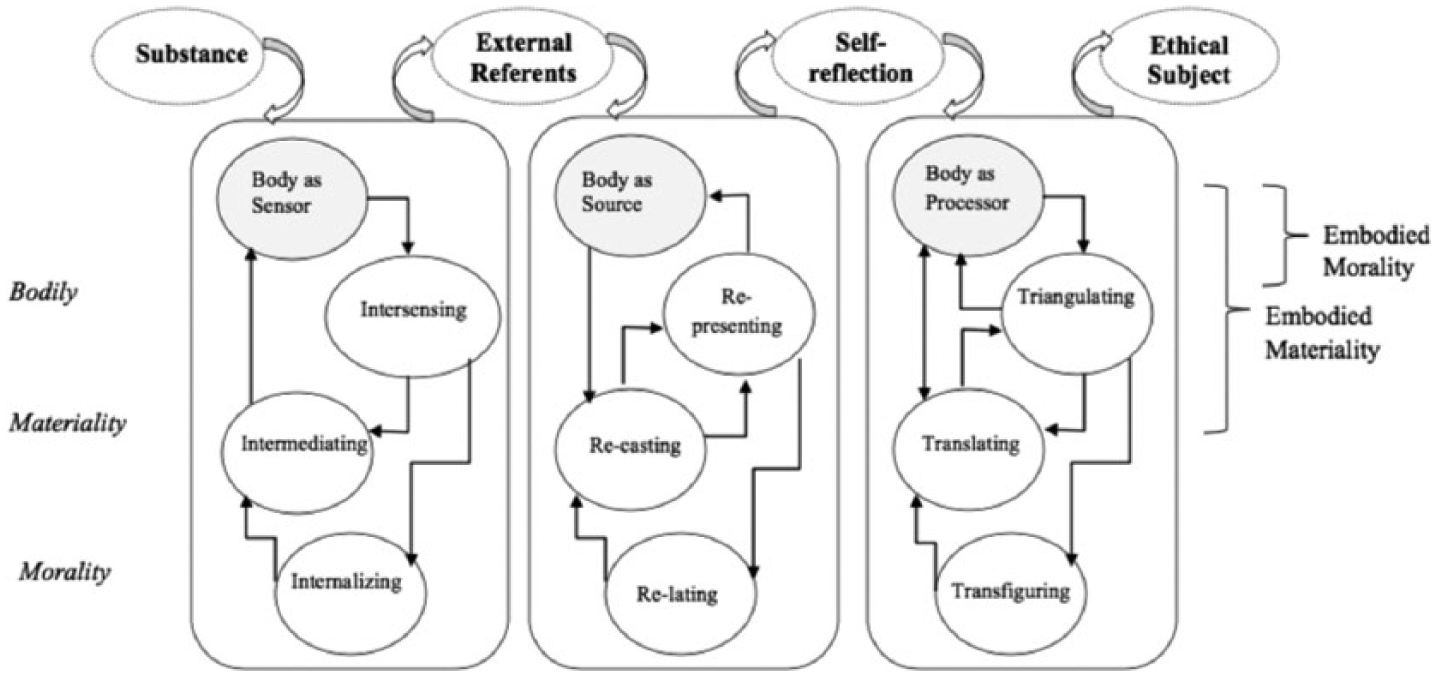
Entrepreneurs as embodied ethical subjects.
Part I: entrepreneurs as embodied ethical subjects
All three protagonists reflected on their own becoming, they spoke about and enacted their ethical motivations. They critically question the rules of the fashion industry and aim to change them through bringing in sustainability as a guiding force in their entrepreneurial becoming. The cycles of folding and unfolding an embodied ethics support entrepreneurs in fashioning an ethical subjectivity. In the literature, the body is treated as a material and physical artifact, but in this study we distinguish between ‘bodily’ and ‘materiality’ (in rows 1 and 2, respectively). Our protagonists use bodily approaches in the interaction with material artifacts such as jewelry and fabrics. They use material artifacts with their bodies, on their bodies, and for other people’s bodies. In other words, for many people the body is material, but in this study we talk about material artifacts and not the body as materiality.
Part II: three ‘body as’ functions
Departing from the four folds, the data revealed that the body takes on three different functions that balance at the crossroads of fold 1 and 2 (body as sensor), fold 2 and 3 (body as source), and fold 3 and 4 (body as processor).
Body as sensor
At the interface of substance and external referents, we find that our protagonists employ their body as a sensor: they put themselves out there—they are receptive and open. Through their lived experience, they connect themselves to specific ethical issues. For example, Life Drapist got pregnant in her 20s—during the early beginnings of building her fashion brand—and this lived experience made her naturally connect to the ethical issues around pregnancy. With her body as a sensor, she became aware of the challenges and opportunities of being pregnant as she explained: ‘I think now pregnancy is so different from our parents’ era where there was a sense of shame in being pregnant. You had to hide yourself and you had these huge tents. Now it’s really sexy to be pregnant’. As such we define the body as sensor as ‘using the body and bodily approaches to identify and make sense of ethical issues that are directly relevant to one’s life and life-style’.
Body as source
Whereas our protagonists ‘earnt’ the ethical issues as a result of using their body as sensor, they select and refine the issues when they use the body as source. It is not a trivial difference between these two roles of the body: the body as sensor is an unconscious receptivity, while body as source defines the different fragments of the ethical issues that our protagonists address. We consider the body as source similar to assemblage—the practices within the body as source take snippets of issues that are relevant to others and make them relevant to the entrepreneurs themselves. For example, Fashion Architect had always been passionate about environment and animals. From a very young age she had wanted to be a designer, then in fashion school an African farmer shared his story of organic cotton farming, and later ‘all came together for me quite naturally and in a strange way’. The findings show that this ‘strange way’ has everything to do with how entrepreneurs’ bodies act as bricoleurs in making sense of different ethical issues. As such, we define body as source as ‘using the body and bodily approaches to select and refine ethical issues in a material assemblage’.
Body as processor
Whereas body as source creates an assemblage of ethical fragments, the body as processor is very much about putting those pieces of the puzzle together in a radical new way that ends up transforming who our protagonists are. The processing—the way they combine the pieces—creates a new Gestalt, a new sense of self. We define body as processor as using the body and bodily approaches to discover oneself (one’s priorities, recurrent drivers, and one’s ‘authentic style’). Urban Nomad was stuck in the body as source stage for a long time, which we captured in our 2010 video interview in which she burst into tears. The body was used to source critically, personally relevant ideas, but she was not achieving that radical re-integration and self-transformation that come from using her own body as a processor. The feeling of being stuck led her to choose new directions in her life. As she explains in an interview: I took some time off from the fashion world a few years ago to develop my interests in wellbeing, yoga and shiatsu, not only to regain a life balance and health, but to be able to connect others with wellbeing. Through that time, the designer in me was wanting yoga and apres yoga lifestyle clothes that I was not able to find anywhere, so I began designing (name of her new brand).
This transition not only resulted in a wonderful collection of yoga inspired wear but also in a peaceful state of mind for the designer, ‘because it ties in so completely into my other wellness offerings, it allows me to create a business that helps me feel more balanced in my life and work experience’. Now with Urban Nomad’s new identity and integration across professions, we see her body as processing those issues, creating a new configuration of ethical elements, which becomes self-defining to who she is. This bodily transformation is visible in snapshots of her physical appearance—from skinny blonde (ecstatic, but stressed right after showing at New York Fashion Week) to troubled brunet around the time she had to close down her physical store as not enough revenue was coming in up to a more integrated version of herself that shows more fullness, confidence, and radiance (see Figure 3).
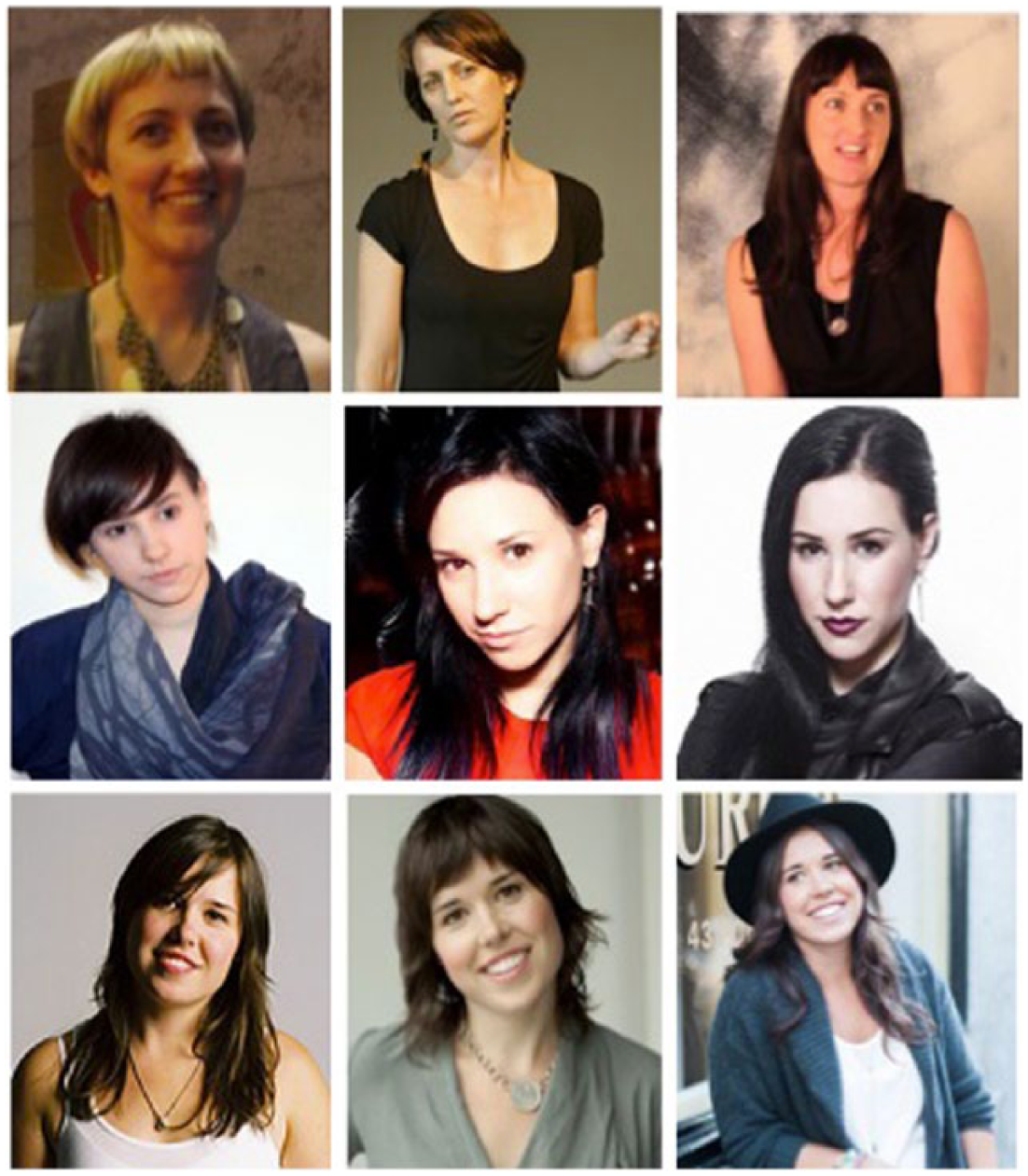
Snapshots 2008–2015, top to bottom: Urban Nomad, Fashion Architect, and Life Drapist
In these snapshots, we see that the bodies of our protagonists carry pieces of the ethical issues they are concerned about, but they are also fully integrated and have morphed into this state of being with their products on them and in front of them (they all wear their own designs). As we see the bodies of our protagonists change over time, we start to understand why their physicality changes so much between collections. Bloggers and journalists have argued that it has to do with marketing and of course this is also true, but the nine practices explain why they change their physical presentations.
Part III: nine practices of entrepreneurial self-formation
After introducing the three ‘body as’ functions, we now turn to the nine practices of entrepreneurial self-formation. We introduce each set of three practices by explaining how it is informed by the four folds of subjectification.
Belonging to ‘body as’ sensor
In the space of body as sensor, the corporeal substance starts interacting with external referents enabling receptivity to what could be integrated in an embodied becoming.
Intersensing
We found that our protagonists use all their senses to dive into lived experiences such as eating healthy (Life Drapist and Urban Nomad) and spending hours in the aquarium to study a rare species of seahorses (Fashion Architect) as an inspiration for a collection. Being fully immersed, their body functions as a sensor for inspiration, creativity, and sensemaking. This receptivity enables all senses to play a part: from taste to touch to smell to auditory and visual impressions. For example, Fashion Architect derives inspiration from species threatened by global warming such as the bee (Spring Summer Collection 2010), the English bat (Autumn Winter Collection 2010/2011), or the seahorse (SS2012) and from fragile ecosystems like coral reefs (SS2011) or Antarctica (AW2011/2012). Her temporary obsession with these muses drives her in the entire collection design as she explained in one of the interviews: ‘My best time the past half year was spent in the London aquarium where I observed and photographed these sea horses for hours. I absolutely loved it’. As such, we define intersensing as direct sensing through immersion and multi-sensorial experience.
Intermediating
To differentiate between what is their own immersion from things that they rely on others for, we could distinguish a second practice for body as sensor. Whereas intersensing requires a natural receptivity to phenomena, the practice of intermediating uses materials to hone that receptivity and changes materials in the process. The interaction with materials makes protagonists’ ability to perceive with their bodies better, stronger, and more refined. This notion of intermediated sensemaking comes to full expression in how they transform materials into artifacts such as fashion items and jewelry. For example, Life Drapist has made draping her specialty: her designs start with the fabric that she—depending on the smoothness and the consistency—fluidly swathes around the body. After she has decided on the final silhouette, she draws the patterns, oftentimes makes a sample out of plain cotton, and after adjustments cuts the chosen fabric and then sews the pieces together. All her garments are characterized through drapes that hide or accentuate different parts of the physique. As she explains, … when you’re manipulating the fabric on the dress form, it really takes its own shape. And, that unfolds as you’re doing it […]. Maybe for others as they design it’s more deliberate, but another thing about my designing is that it really has to work for life.
When we look at Figure 2, this indicates that the arrows go in both directions: protagonists perceive issues and then their bodies help them to engage with materials in a new way (arrows from body as sensor to intersensing to intermediating and then back from intermediating to body as sensor). In this iterative process, they often first open up to issues and then select materials to let their body ‘work with’ these issues. As they communicate through the means of artifacts or objects, their intermediate sensemaking of material choice is crucial: whether it is shredded money in recycled plastics for jewelry collections (Fashion Architect) or bamboo jersey that supports the draping of dresses (Life Drapist). As such, we understand intermediating as using artifacts to sense with, by, and for third parties.
Internalizing
The notion of embodied morality is based on the idea that our moral insights of what is right and wrong are based on our lived experience. The practice of internalizing entails that the protagonists recognize what is right for them: this is not the result of a rational process of deciding what is right or wrong but is rather experiential. Internalizing can be explained as realizing ‘this is part of me’—taking sides within one’s own body and moral system. For example, Life Drapist’s substance consists of the yearning to do something positive for people and the planet. She grew up in a family that valued healthy nutrition, recycling and treating others in a respectful manner. ‘When I am creating something, I still have those values inside of me and they come out’. As such, we define internalizing as adopting specific ethical issues as one’s own. Just like water carves out ever-deeper traces in rock, so does the bodily immersion strengthen what these entrepreneurs already deem important in life.
Belonging to ‘body as’ source
In the fold where the body becomes a source, our protagonists go beyond receptivity and start using their bodies as a device to construct morality. The difference with the first set of practices is that what is acknowledged as ‘this is part of my substance’ in relation to external referents now becomes reflected upon and connected to the larger ecosystem.
Re-presenting
In the representation phase, our protagonists use their bodies to perceive what the suffering is related to their selected ethical issue. Whether it is the cruel beauty of the Alberta tar sands or the critical self-image many women hold high, it is their bodily response ranging from disgust to fascination that makes them work these issues. With the body as a source, they are not dealing with ethical issues as big issues, but they are dealing with very specific things that they pin down and use in their collections. A concrete outcome of the practice of representation is the fundraising efforts Fashion Architect undertakes in factor of the species she chooses as the main inspiration for her collection. For the seahorses, she swam a distance of 12 kmr 2 and for the bats she designed a drawing that was printed on a bamboo jersey shirt with 10% of revenues of the shirt being donated to the Bat Conservation Trust. 3 These are two ways to represent what some of the ethical issues are, which our protagonists are concerned about: they take on such a cause as part of who they are, of their own bodies. And they use their own bodies in the process, for example, by swimming. As such, we delineate re-presenting as using artifacts to focus on key ethical issues as they are, may, or ought to be experienced.
Re-casting
The practice of re-casting discloses the much more subtle, material connection that is unraveled as a result of protagonists’ bodily engagement with an ethical issue. In contrast to the ‘body as sensor’ practice of intermediating where the choice of materials is not necessarily connected with the specific issue (yet), with the practice of re-casting protagonists zoom in on one element of the ethical issue and source the relevant materials to convey its message. In the case of Urban Nomad, she carefully selected beeswaxed organic cotton to embody the oily, yet tarry substance of the tar sands. She configures this fabric into layers that serve the body in a range of environments, as she says: A fall/winter must have is the unisex blanket cape which is a very simple form with two armholes in it that you can literally use as a blanket, but also as an extra layer in any kind of situation. When travelling, I often long for a layer like this and even now, living as an urban nomad going from one place to the other in this city, I like the feeling of carrying my own blanket with me that serves very well as a dress-up cape. (see Image 1)
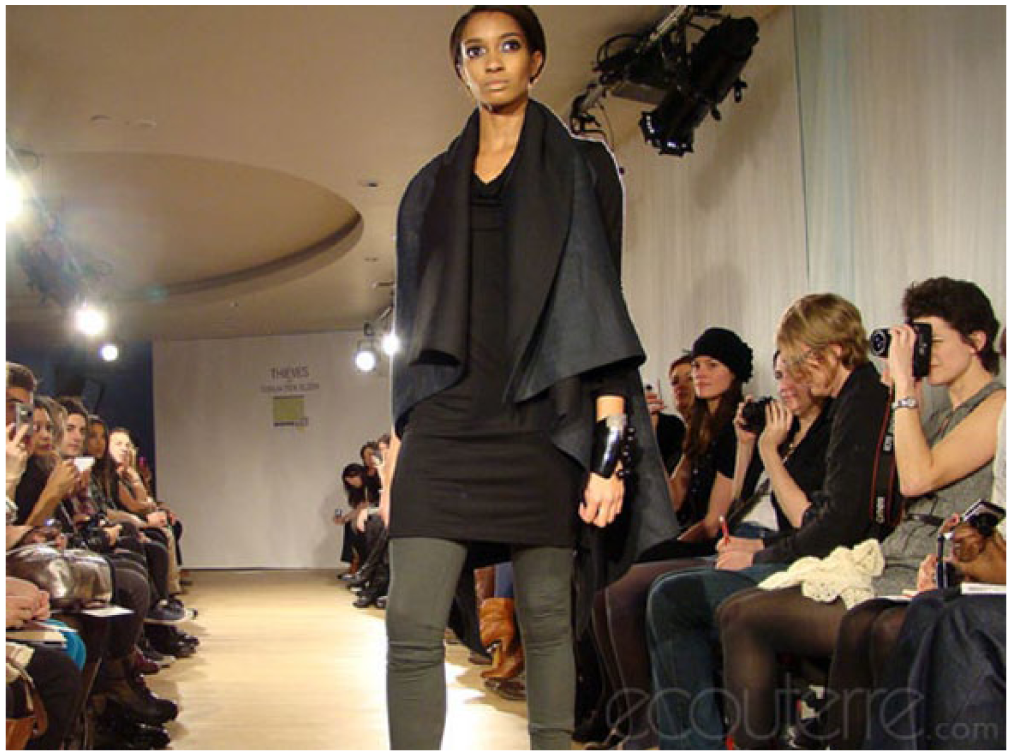
Re-casting the tar sands in a unisex blanket made from beeswaxed organic cotton.
Similarly, Fashion Architect never uses the seahorse as a seahorse or literally translates the bee to a black and yellow striped dress, but instead subtly dissects her source of inspiration and its context. The interaction between body and material is crucial in this process as she explains for the bees collection: The hexagon is a fantastic shape because they all just slot together. Any of the scraps that are cut off are very small and you can use them in the shoulder pads: you waste very little. That shoulder pad is made out of two hexagons of organza; inside you can see all the scraps of fabric. And, if you touch it, it’s like … a little cloud.
Her combined desire for sustainability (wanting to waste as little as possible) and aesthetics lead her to develop new practices of design. In this case, she develops a certain type of shoulder pads that look and feel unique on the body of the wearer (the embodied experience of the self through fashion design) and save fabric as they are crafted from leftover pieces. As such, we define re-casting as using artifacts to reframe ethical issues in ways relevant to ‘different’ others.
Re-lating
The last practice for ‘body as source’ is the concept of the present versus the future. The morality here is different from the morality in the prior column in Figure 2, because there is much more refined insight. And the refinement is not just about ‘it is wrong to exploit the tar sands or to have the bees suffer’. This is an elaboration of that moral insight—through making new connections that are relevant to themselves as embodied beings. All protagonists speak a lot of these intricacies, and the practice of relating is not to describe the complexity but about understanding how that moral insight really becomes part of who they are and inscribed in their own style. In the prior column, they would not know explicitly ‘what is right or wrong’ except from their lived experience. In this column, they actively participate in construing the right or wrong and we see this clearly in the visual materials. When they engage with the morality of the issue, their bodies tell a very powerful story that is never captured in words but rather in their bodily expressions: their defensive gesture, their face blocking, their bodies relaxing or cramping. We can see how these moral issues are right or wrong in their bodies. This is a form of moral elaboration that is very bodily—they do this across the different videos we studied (including those interviews that other people undertook with these entrepreneurs). As such, we define this practice as re-lating time (both past and future), ecosystems, species, and social communities.
Belonging to ‘body as’ processor
When the body functions as a processor, it transitions into an organism that rediscovers and redefines the ethical self. The three practices related to the processing role confirm a new way of self-transforming the body, beyond receptivity (sensor) and tool (source). It is not embodied sensemaking: the body continuously transforms itself through these practices.
Triangulating
The practice of triangulating refers to working across ethical issues to identify common ways of being and feeling in one’s body. For example, Fashion Architect composes a palette of themes for every collection like a painter works with various colors. She starts being inspired by a certain species and she puts herself out there in their environment (i.e. with the seahorses in the aquarium). She then associates the seahorse with Greek goddesses: ‘There’s something kind of mythical and otherworldly about seahorses because there’s so many things about them that’s completely different, like the fact that the men have the babies’ (Interview 2011). The third element is the Haiti Carnival: And then, also, I was really inspired by images that I found of the Haiti Carnival. And, what really interested me is the idea that even though the ocean is huge, you have all these different islands within it. And, the UK is an island and also Haiti is an island. I think the idea of how the ocean and islands that globally are more linked now than ever before because it’s the health of our oceans and the health that indicates how healthy an island will be. It’s quite complex, but I’m always thinking about the idea of life and how life is really quite tough and endures. What I found really interesting about these images from Haiti Carnival is that most of the images were taken just before the huge earthquake in Haiti. They’re really poignant images because many of the people or many of the buildings that you see in the images probably were destroyed by the earthquake, but then if you go online, there’s tons of footage from the carnival, the latest Haiti Carnival that’s happened after the earthquake. So, it’s about how that tradition of carnival was kind of like a point of hope for people. And, it’s about how you can use communities to rebuild and answer questions around how you recover from very devastating things that can happen to the environment that are either natural or man-made. (Interview 2011)
The various colors then become a beautiful painting in the narrative that Fashion Architect weaves and conveys to her audience: I think you need to tell people really creative stories which may make them feel more engaged in a positive way. So, the way I’m telling the story of Poseisus is that there’s a spiny seahorse living on the south coast of England. And, this spiny seahorse, which is one of the breeds that’s native to the UK, decides that it’s not safe to live on the south coast of England anymore. So, it’s going to make an epic journey all the way to Haiti. And, as it’s swimming to Haiti the seahorse transforms from a seahorse into a woman. And then, when the woman swims ashore in Haiti she kind of dances out of the water and joins the carnival. (Interview 2011—see Table 4 for the dress that was the key piece in this collection)
The triangulation is captured in the way Fashion Architect feels about these various issues, how she connects them, and creates an appealing narrative. While she explains her inspiration behind several collections, the body really underscores the friction between the different themes that serve as an inspiration. From a cramp and visible frown when speaking about the fragility of ecosystems and adversity to nose and ear rubs, eye rolls and hand gestures that indicate there is something internalized that matters, but is unresolved. When she uses the words ‘future’ or ‘ideal’, her body relaxes visibly into a state of complete peace. This is where we see the double interact in Figure 2, again pointing to how the body transforms itself through these practices. In that sense, triangulating is really about what carries on from one issue to the other that is common and becomes self-defining for the entrepreneurs and their bodies.
Translating
The practice of translating puts the material center stage in that it captures the continuity in who our protagonists are becoming. Here, they use material artifacts to move themselves to that place where they have a new sense of authenticity. With the body as source they focus on capturing one ethical issue really well, but with the body as processor we observe the recurrent practices in the material. While viewing beyond the materials themselves and recognizing the patterns in the protagonists’ bodily–materiality relationships, we start to understand what those materials actually accomplish across collections and life phases. For example, Fashion Architect is a big fan of American Football and her big shoulders are a recurrent shape in each collection. This shape takes on different meanings (see Image 2): from the Football inspiration in Emergence (SS2009), to the genius of the hexagon shape (SS2010), to the gradually crafting of a powerful image of a woman in later collections (outspoken in SS2013 Tigress Reign). 4
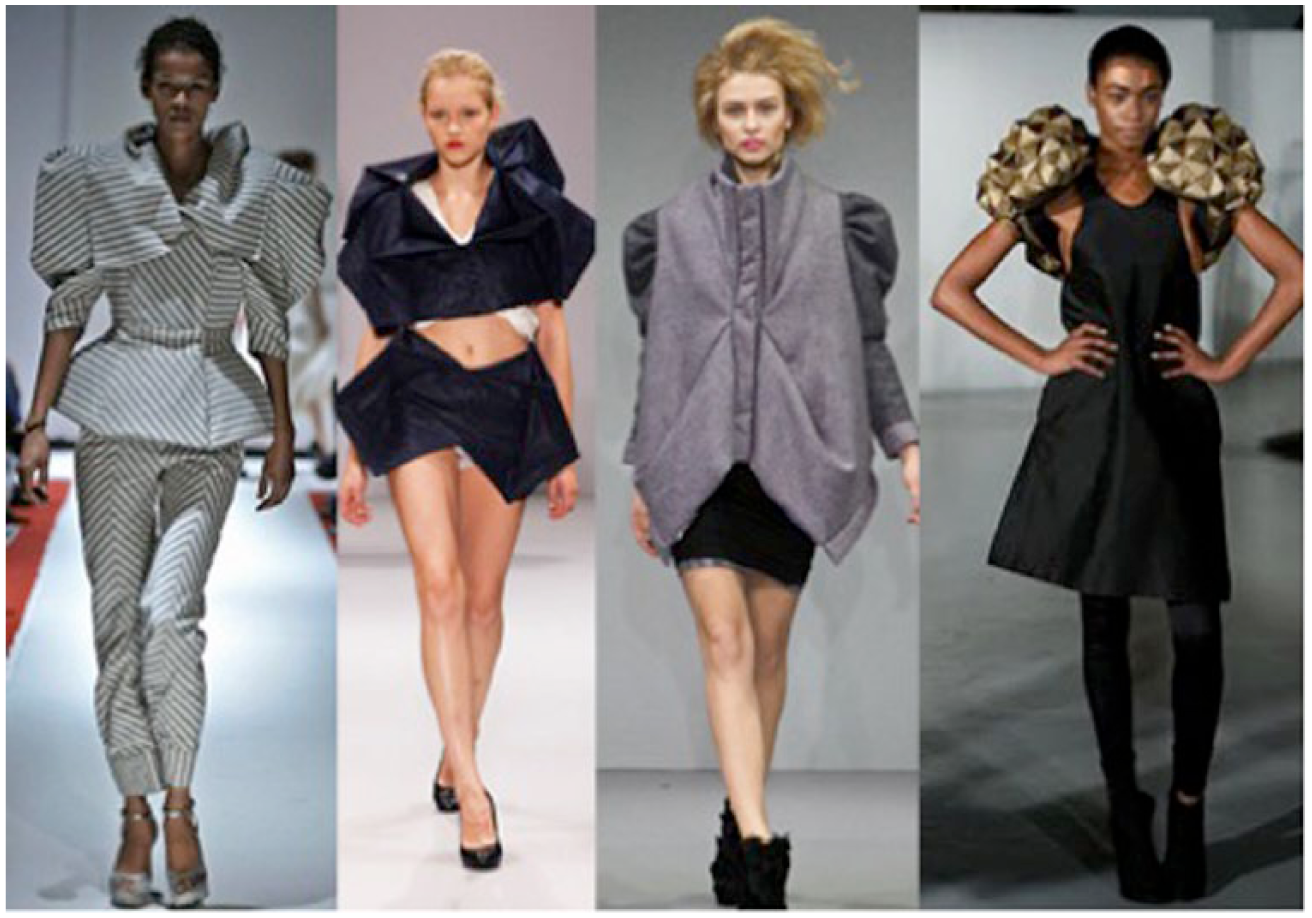
Fashion Architect’s big shoulders across collections, from left to right: SS2009 ‘Emergence’, SS2010 ‘The Colony’, AW2010 ‘Echolocation’, and SS2011 ‘Pyramora’. Table 4 shows a dress with one big shoulder from the SS2012 Poseisus collection.
It is not the big shoulders alone that spur that imagery as Fashion Architect uses different ‘hooks’ to develop it such as the color red. But it is in the interaction between the big shoulder shape and the body of the wearer that we see the translation happen. The consistent conversation between the bodily and the materiality brings about a novel ethical subjectivity. In recent (men’s) collections, we see how Fashion Architect makes the concept of power even more evident with the use of solely black, exuberant leather, and fierce lines and shapes. Urban Nomad’s theme is protection: the repeated shape of a cape or something you can fold yourself in to hide from the rest of the world survived the phase of ‘taking a break from fashion’ to come back in the form of a jacket in her most recent collection (see Table 3). With Life Drapist, the material—the recurrent draping—accomplishes a sense of comfort that enables her to grow that comfort on her own body. All three protagonists use their bodies in interaction with recurrent elements of materiality to come to a new ethical sense of self that becomes recognizable to others. Especially Fashion Architect receives a lot of media attention and we see how journalists and bloggers look across collections and construct this persona of someone who connects these ethical issues in a very personal, bodily way. Body as processor is no longer about elements but about a way of being in their own body that allows them to be open to these ethical issues; they use the body and what the body needs and what they can give to everyone else’s bodies. As such, we define translating as using artifacts to create and convey similar experiences with, by, and for third parties.
Transfiguring
With the practice of transfiguring, we can see the morality transform the physical appearance of our protagonists. It gives them a new stepping stone for their authenticity as they re-integrate things from a new found sense of what is to be authentic in their own bodies. No longer is it about connecting just one issue, but it is really owning the issues and integrating them into their lives like Urban Nomad does with her yoga practice. It is really connecting across things—what brings them together is their bodily response to them. Our protagonists feel the same struggle around sustainability, but the reactions are different. For Urban Nomad, it is one of stress and suffering that awakens a sense of wanting to feel protected; for Life Drapist, it is one of comfort; and for Fashion Architect, it is one of power. The practice of transfiguring itself is a bodily thread that makes those issues coherent for them. Figure 3 (snapshots) shows how Fashion Architect’s own sense of authenticity changes: from a tomboy appearance in 2008 up to a vamp including manicured pointy nails, gothic makeup, and straightened black hair in 2015. It is in this newly found (re)presentation as ethical subjects—when all the nine practices ‘work’—that we see the biggest transformation in their physicality. As such, we define transfiguring as updating one’s own image to sustain one’s attention and commitment to these ‘core’ issues.
Discussion
In this article, we were curious to disclose the role of the body in how entrepreneurs fashion an ethical subjectivity (Rhodes and Wray-Bliss, 2013). We attempt to extend the literature on embodied ethics in two fundamental ways: (1) by reclaiming the role of the body as a critical source, sensor, and processor of ethicality and (2) by explaining how entrepreneurs leverage their bodies as they (re)construct moral enterprises. The role of the body is not a one-time thing but an unfolding process whereby embodied ethicality is acknowledged and used as a critical reference point as entrepreneurs (re)construct their enterprises.
According to Pullen and Rhodes (2013), corporeal ethics manifest in practical and political acts that are founded in openness and generosity toward oneself and the other (Hancock, 2008). In our research context, this means that the entrepreneurs contest the dominant organizational arrangements of the fashion industry in the name of ethics and seek to construct themselves as ethical subjects who challenge, re-interpret, and re-make the expectations governed by the industry (Rhodes and Wray-Bliss, 2013). This is a different reading compared to conventional understandings of business ethics as ‘corporate self-presentation’ (Roberts, 2003) or management of ethical behavior of individuals in organizations (Trevino and Weaver, 1994). According to Rhodes and Wray-Bliss (2013: 40), the key difference of these approaches lies in understanding organizations not as locuses of ethicality but as the context in which ethics are negotiated.
Our abductive framework speaks to the primacy of the body in the formation of the ethical subject—and the way in which embodied ethicality shapes narratives. As such, it complements existing accounts of ethics in entrepreneurial subjects and their organizations by showing that rational or discursive accounts, while often present, are not necessarily primary sensors, sources, or processors of ethical practices. While for Michel (2011) the body is very physical in its (ab)use, for us the body is mainly moral zooming in on what the body can do. Our Deleuzian understanding of the body as primarily affective speaks to the construction of ethical selves, rather than the presentation of themselves as ethical subjects to third parties or potentially instrumental audiences.
Our secondary contribution is to show that embodied ethics is neither exclusive nor disconnected from the discursive practices or the rationalizations we now begin to take into account as, for example, Reinecke and Ansari (2015) accomplish in their paper on ethical sensemaking and ethical truces. One’s body and embodied ethics feeds forward to inform how one sees, sense-makes, and eventually shapes the ethicality of one’s worlds in and through organizations. We argue that through the body, ethicality is a work in progress as ethical selves are produced in practice. In other words, ethical selves are not the alpha but the omega of social change processes.
Limitations
We acknowledge that emotional and affective aspects matter—but we decided to stay focused on the bodily aspects in this study. While of course the body is experienced in more affective or integrated ways by different entrepreneurs, these are too fine nuances at the current stage of our theorizing. Our multi-modal data are better equipped to reveal the visual, material, and textual aspects rather than the emotional underpinnings. We offer this as a direction for future studies, not in small part because the rapidly growing literature on emotions in entrepreneurship has not yet been systematically connected to their ethical considerations and/or consequences.
We are not sure whether the construction of oneself as an ethical subject would be different depending on one’s ex-ante ethical bend. If it is, the process may be tautological, in the sense that more ethical subjects become more ethical over time, while unethical subjects become even less concerned with ethicality over time. We concede this may well be the case, and view this as a possible limitation of our work. However, we believe that the in-depth longitudinal analysis we undertook shows that ex-ante beliefs are a lot less deterministic. In fact, once one engages the body, a whole range of previously uncaptured experiences can be accessed and fed forward into other kinds of practices, including narrative ones. And vice versa: these embodied ways to experience the world may lead one to reduce or change course, backing away from specific ethical practices, or disconnecting some ethical practices followed in the past from what may come next.
Conclusion
This article studies ethical subjectivity, which Rhodes and Wray-Bliss (2013) define as ‘the nature and possibility of ethical understandings and self-formation in organizational contexts’ (p. 42). We aim to answer the call of extending the analysis of organizational ethics beyond the managerial perspective and studying ethical subjectivity empirically—a challenge which only a few studies have taken up thus far (Pullen and Rhodes, 2013; Rhodes and Wray-Bliss, 2013). We have attempted to illustrate how ethical fashion entrepreneurs who shape their own organizations and practices make sense of themselves as embodied, ethical subjects. The embodied, lived, and ‘real’ descriptions (Dentchev, 2009) enable us to encompass a relational sensibility (Roberts, 2001) that is usually left out in the study of ethics.
Implications
Moving forward, we suggest greater attention is warranted to understanding when the body gets ‘lost’—or factored out, or perhaps prematurely replaced by discursive and rational practices. From our data, we can offer that entrepreneurs who return to their body as an ethical device may remain more creative in their products and organizational practices. Perhaps because their own idiosyncratic bodily experiences afford sources of insights that keep differentiating who they are and what they do. Our study points out that the role of the body is not just understudied: it has much potential to study strategy, organization, and entrepreneurship.
Practices of embodied ethical self-formation can lead to a more comprehensive understanding of the emancipatory potential of entrepreneuring (Calás et al., 2009; Rindova et al., 2009), societal change (Spinosa et al., 1997), and the effects on subjectivities in the making. We have shown that our protagonists employ a certain playfulness in how they approach the crafting of their enterprise, their (fashion) designs, themselves, and their environment. This ‘homo ludens’ adds to the multifaceted personality of ‘the entrepreneur’ as someone who experiments with how to synergize economic needs with caring for self and the environment (Johannisson, 2011: 139). As such, we can see the entrepreneur as ‘someone’ (or some-body) who is in-between (Steyaert, 2005): through ‘in-between’ practices such as intersensing, re-lating, and transfiguring, we approach a corporeal ethics of entrepreneuring. Rooted in their everyday lives, our protagonists construct ethical subjectivities by searching for a sense of authenticity and engaging others through aesthetics, stories, and embodied experiences. They do not see things as settled, nor act as if the way things are done in the fashion industry should be the way of doing things (Spinosa et al., 1997: 54). Through their ethical practices of self-fashioning, they hold a promise for transforming the fashion industry in the name of ethics.
The strength of our approach lies particularly in its ability to address processes in the making or becoming. Our protagonists do not practice ‘business ethics’ in order to manage ethicality of their companies. Instead, they engage in relational processes of creating authenticity with oneself and significant others in order to inspire social change. The fourth fold, in particular, embodies these transformational practices of ethical self-formation. We do not suggest, however, that this is an end in itself. Rather it is the beginning of a new phase of folding and unfolding that transforms existing boundaries and creates new visions for social change (Ferguson, 1996). Accordingly, subjectivities are always in the making; they are incomplete and fragmented and therefore always remain ‘a question’ (Jones and Spicer, 2005: 233). Further research could shed light on these processes of corporeal ethics in the making of different organizational contexts and with different visions for the future.