




Abstract
The French textile engineer, Christèle Merter, founded La Gentle Factory in 2014 as a label for capsule collections from the Happychic Group, a large, international men's ready-to-wear fashion retailer. Her objective is to promote simple, yet elegant ‘Made in France’ menswear made from organic materials and recycled products. The case discusses the challenges faced by the entrepreneur as she develops a sustainable clothing brand, first within a large group and then as an independent entrepreneur. The case also describes different forms of sustainable-oriented innovation in fashion and how narrative can aid the building of a new sustainable venture.
Introduction
La Gentle Factory (LGF) case study deals with the challenges faced by sustainable entrepreneurs in the fashion industry (Henninger et al., 2016). According to the World Commission on Environment and Development (WCED, 1987), at the heart of ‘sustainable development’ is the belief that economic prosperity, human development and environmental protection are interrelated. Given the significant role of businesses in society and the impacts of their practices, entrepreneurship is central in transitioning towards a more sustainable future. One way to overcome the potential dichotomy between present and future generations is provided by sustainable entrepreneurship, an approach in which businesses engage to achieve efficiency and competitiveness by balancing the impacts of their environmental and social activities (Schaltegger and Wagner, 2011). By reducing waste, creating more circular business processes or using renewable energy, sustainable entrepreneurship helps to innovate business.
As illustrated in the case, the personal values of the entrepreneur (primarily a sense of moral responsibility, as well as personal gains, contribution to society, employment choices, prestige, power and status) are vital drivers behind sustainable entrepreneurship (Vuorio et al., 2018). Sustainable entrepreneurs often exploit opportunities arising from neglected ecological and social concerns, which are more complex to address than conventional entrepreneurship (Rosário et al., 2022). They apply a moral lens to their ventures, ethical and moral values often being of more importance to founders of sustainable ventures compared with their traditional counterparts (Muñoz and Dimov, 2017). Sustainable development and the future depend on such entrepreneurs and their influence on other stakeholders and the public to adopt sustainable practices.
LGF case study helps students to better understand the challenges and determinants of sustainable entrepreneurship in the fashion industry, the types of sustainable-orientated innovation required to make a difference and how the founder's narrative is key to making sense of a new sustainable venture. The case tells the story of Christèle and her sustainable journey which began as an intrapreneur within Happychic, a large, international men's ready-to-wear fashion retailer, where the LGF brand was developed, to her becoming an independent, sustainable entrepreneur.
Key learning outcomes
By tracing the narrative of the start-up, this case aims at exposing students of entrepreneurship and fashion to the challenges faced by sustainable entrepreneurs within the industry. It highlights key topics related to understanding (1) the challenges facing sustainable fashion and innovation within the fashion industry; (2) the determinants of sustainable entrepreneurship within SMEs; (3) the different types of sustainable-oriented innovation (SOI) as well as the importance of alliances and networks within SOIs; and (4) the use of narrative to build a new sustainable venture by focusing on the founder's vision, mission and values.
La Gentle Factory story
Christèle, who had been campaigning for the protection of the planet since her childhood, and was touched by the poverty of Bangladeshi children during a visit to textile suppliers, was contemplating the idea of LGF running summer sales, considering how it conflicted somewhat with her idea of sustainable fashion. LGF's turnover, since the brand had become independent in 2019, had increased every year and doubled from €800,000 in 2019 to €1,600,000 in 2021, finally plateauing to the same figure in 2022. As a visionary textile engineer with a passion for her work, Christèle wanted to play her part in revitalising French fashion manufacturing from a circular perspective. She was proud of her venture's success so far. In May 2023, her short-term challenge was to decide how to continue to be a sustainable brand true to her values while remaining economically viable.
Beginnings at Happychic
For 10 years (2004–2014) Christèle ran the quality service of Happychic Group
1
, an international, multi-channel French fashion company in men's ready-to-wear, selling Jules, Brice and Bizzbee brands. As of 2009, Happychic highlighted corporate and social responsibility (CSR) issues and reduced their carbon footprint by half. Christèle was called upon to measure the Group's carbon footprint in utilities and the life cycles of the clothing marketed. She discovered that 60% of greenhouse gas emissions were the result of products placed on the market, the balance resulting from the use and end-of-life of these products. She organised a recycling channel, which collected and upgraded used textiles, enabling the recycling of four tonnes of products bought by customers. Other initiatives followed such as the sale of pullovers from recycled materials in 2012. While this initiative was a technical success, it was an economic flop with only 10 out of 500 pullovers sold. Christèle put this flop down to the aesthetic nature of the product: ‘This pullover was virtuous but not beautiful. In fashion, the aesthetics of the product is unavoidable: we must not forget that the customer buys a product because it pleases them and makes them look good.’
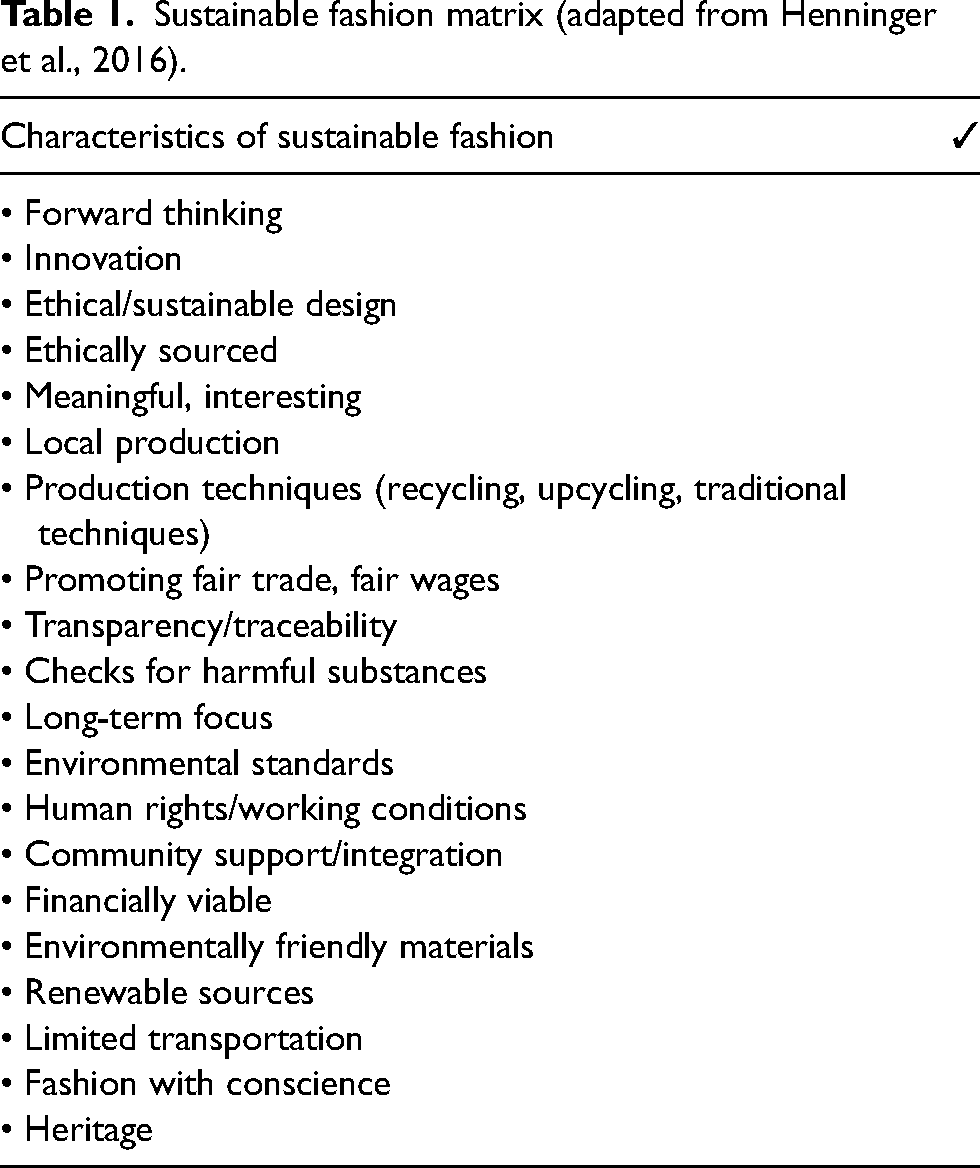
Sustainable fashion matrix (adapted from Henninger et al., 2016).
‘Consumers don't want to see recycled yarn on their backs. That should not be the first message. Sustainable development is just the icing on the cake.’
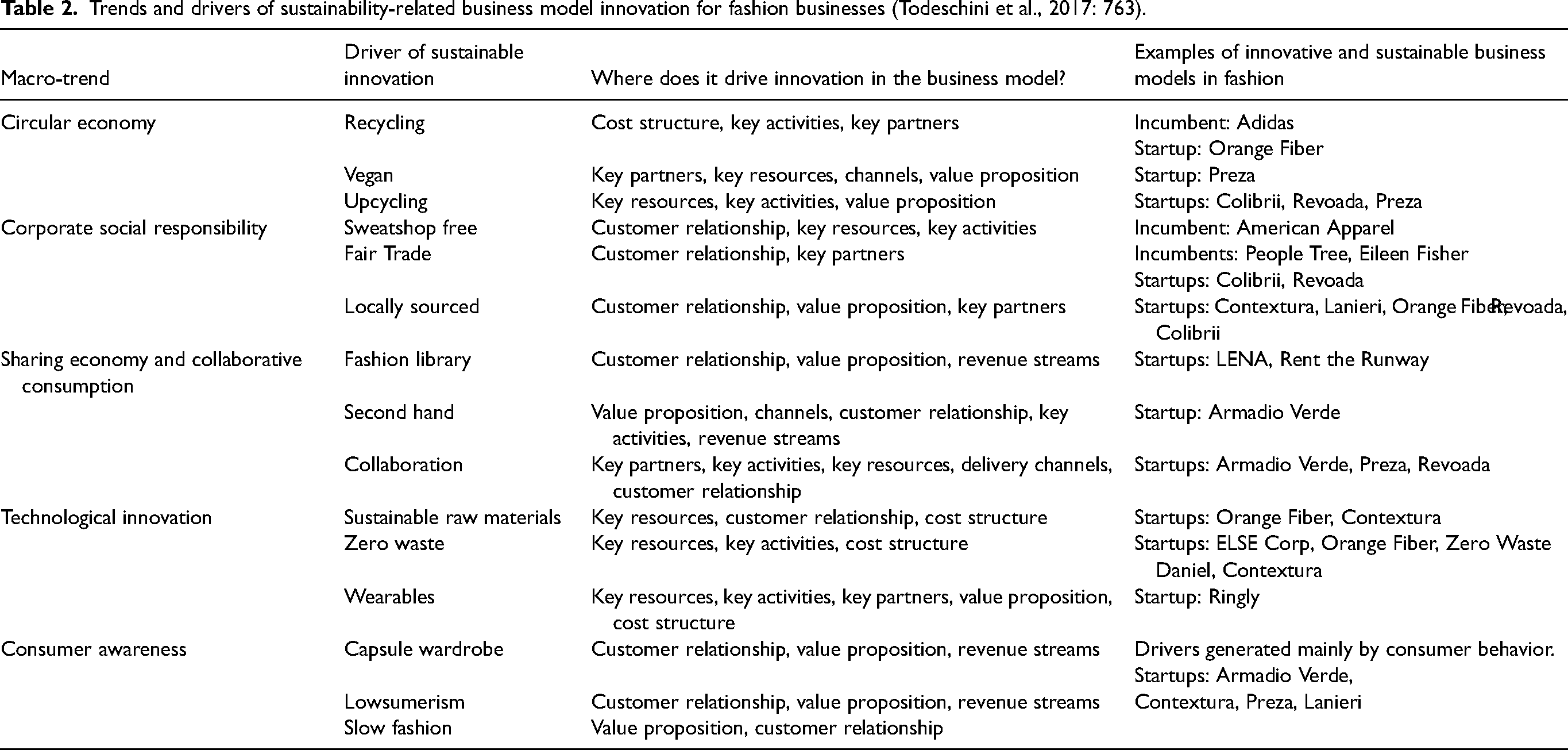
Given this success, Happychic gave Christèle a chance to reflect, like many other fashion brands, on how to reconcile economic success, ecological friendly products and ethical practices with eco-manufacturing, eco-design and eco-distribution in a unique business model (see Table 2). In 2013, the first Happychic collection was produced according to an eco-friendly charter.
Birth of La Gentle Factory brand
In April 2014 (see Figure 1), a fashion offer was created to fulfil three main objectives: (1) offer modern and desirable clothing in a capsule collection
2
format within branded shops; (2) develop eco-responsible products (i.e., collections from recycling, biological materials, local production and/or solidarity work); (3) innovate with a free collaborative platform of services, offering a second life to old clothes via online services such as bartering, reselling or lending clothes. To underline the novelty of the offer, and distinguish it clearly from Happychic brands’ main collections, it was sold under LGF new brand name. As new brand director of LGF, Christèle became an intrapreneur within Happychic: ‘The comfort of a salary suited me just fine. I spent five years telling myself that I was an intrapreneur rather than an entrepreneur.’
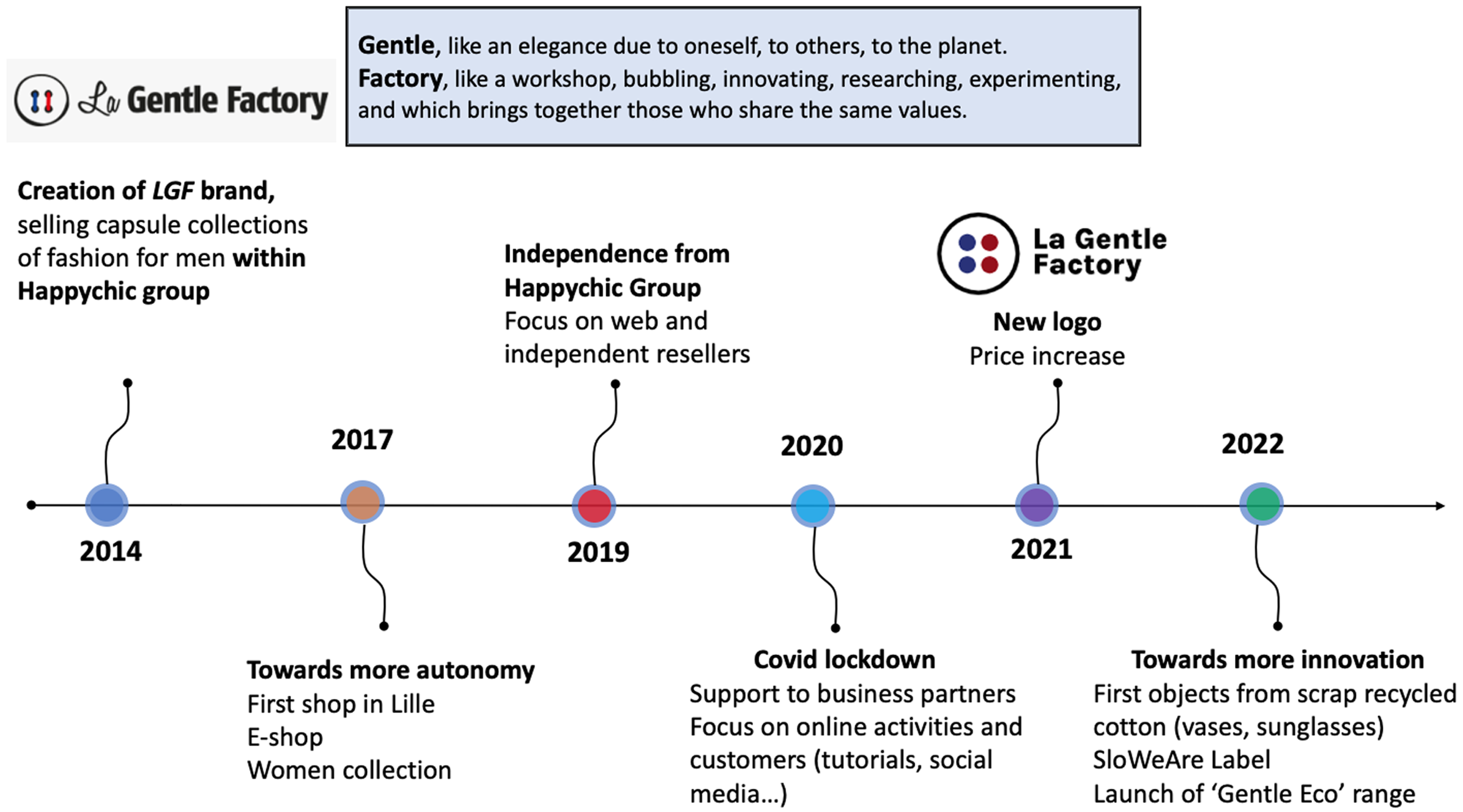
La Gentle Factory timeline.
Trends and drivers of sustainability-related business model innovation for fashion businesses (Todeschini et al., 2017: 763).
‘Our slogan: “to be beautiful is good, and to do good, is beautiful!” Our unique approach is to enable the active man to act responsibly via his wardrobe, either by purchasing eco-friendly products or by offering a second life to his old clothes. A ‘Gentle Man’ is a man who considers how he looks, and thinks about the planet!’
Initially developed as a label and presented in corners via co-branded, capsule collections, the project was being tested by Jules: ‘I had no marketing experience, but I had the opportunity to learn the business by benefiting from a lot of in-house expertise in IT and logistics.’
LGF produced jackets, pullovers, shirts, T-shirts, trousers, Bermuda shorts and accessories (tote bags, cheches, etc.). Christèle adopted innovative sourcing using an eco-responsible approach at each stage of the product life cycle, from the creation of thread to the finished product. These practices were set out in a Manifesto for the Creation of the Collection to ensure the products used biomaterial, were Made in France, from recycled materials and incorporated social initiatives such as professional insertion. The brand gradually recreated a French production chain to build a complete eco-system that is Made in France and eco-responsible. LGF renewed its collections four times a season with timeless cuts and a mix of timeless and trendy colours. The brand targeted upper middle-class, adult males aged 25–45, for whom fashion was a means of expression. The brand values were responsibility, action, optimism, modernity, simplicity and discretion.
The brand was distributed mainly internally via the Happychic network of shops and on the Internet. In summer 2015, after four years of ‘Test & Learn’, the collection became a permanent fixture in all Jules shops, and then at Bizzbee. It was also distributed externally via co-development and co-branding of clothing pieces with young eco-friendly, ready-to-wear brands such as Leax
3
or 1083
4
, who had the same responsible fashion mission as LGF and their own distribution network. Christèle explained: ‘This collaboration enabled us to test another type of clientele and slightly increase our reputation. It also allowed us to enter the closed world of start-ups and open ourselves up to other opportunities.’
In November 2015, for the first time, LGF participated in the Made-in-France Expo
5
. Growth was strong, and in 2016, a market study confirmed the opportunity to create a fully fledged brand with its own points of sale, as Christèle underlined: ‘We knew that some of our target customers wouldn't shop at Jules, but they were sensitive to the issue and had the purchasing power.’
The first exclusive collection as an own-brand was presented in collaboration with DreamAct
6
, an eco-responsible e-shop. LGF opened its bricks and mortar shop in Lille in March 2017 and another pop-up store in Rennes from April to June 2017. However, they did not meet their objectives, and the chosen shop location, amongst top luxury brands, affected their margins badly. The project was no longer viable, and the other planned openings did not materialise: ‘The shop in Lille closed two years after it opened, because we didn't know how to do luxury in the city centre as we'd only been present in shopping centres. I didn't have the maturity to say no to the location chosen by the board of directors. The rent was indecent for 32 sq. m, so sales were not achievable. Yet the shop was performing well, with sales of €250,000. For us, the boutique was a fantastic laboratory for getting feedback on our clothing, our positioning and materials, as well as the sense of our message.’
Christèle approached independent retailers interested in responsible fashion with fifteen of them agreeing to distribute LGF. In 2017, the brand launched their first collection for women as well as their own e-shop website (www.lagentlefactory.com), marking a strategic turn.
In the spring of 2018, following a common agreement, Christèle announced that LGF would become independent from Happychic and called for a buyer. This followed the decision by Happychic to restructure their business, and to prioritise economic rationalisation in a competitive, slightly declining, French clothing retailing market (see Figure 2). Their decision was due to the interlinking nature of inherent economic, environmental and social aspects in a sustainable venture and the need to compromise between financial and sustainable intentions (Daub and Gerhard, 2022). Happychic decided to concentrate investments in their core brands, and hence, separated from LGF, whose sustainable business model differed from their historic brands that were following a more traditional fashion industry business model: ‘LGF wanted to capture a very specific, cutting-edge market niche that required a start-up approach. It was complicated to stay with Happychic, which sold its brands in its own shops and did not have a B-to-B approach’
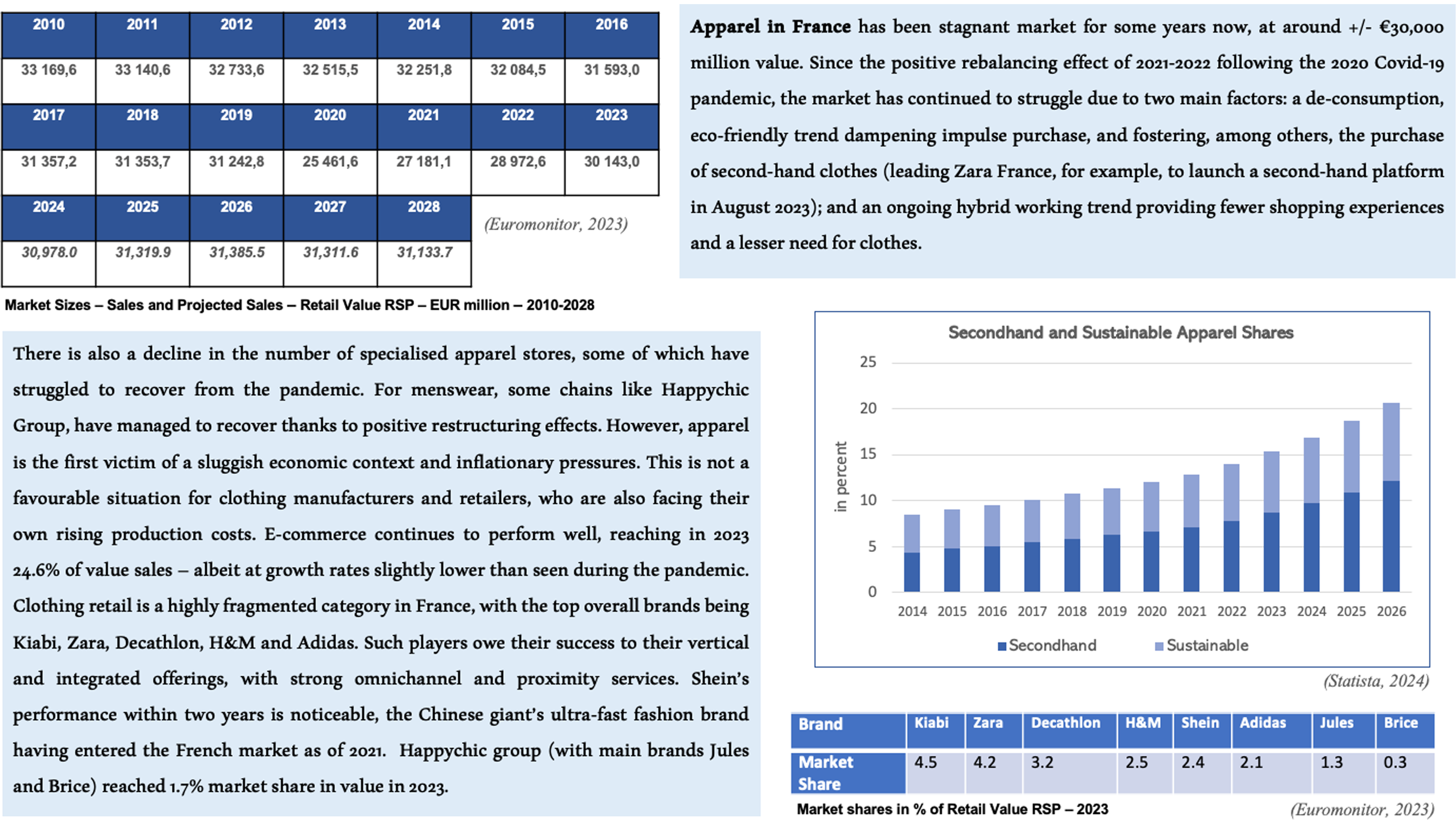
Clothing retail market in France: key trends and figures.
Christèle became an independent sustainable entrepreneur
In February 2019, Christèle started to write the next chapter of the brand as a business owner. She managed to raise €1 million with four business angels (including one of the manufacturers; two digital experts; and the investment fund Finorpa), and to keep her whole team of six employees, who chose to follow her in this new challenging venture: ‘Our first challenge was to continue our B-to-B development, with the extension of our network of independent concept stores selling our products. The second challenge was to enhance the omni-channel nature of our e-commerce site, which promotes the brand by presenting all the capsule collections, but also provides a service to independent networks by indicating the availability of a particular product.’
LGF set up its offices in a former spinning mill in Roubaix, a city that is emblematic of the textile industry in France. The French brand is committed to building a virtuous garment model from head to toe. ‘Responsibility’ and ‘quality’ are the watchwords of LGF, who control materials and the supply chain, by using natural fibres processed in France in 29 workshops committed to social integration, and ensuring the shortest possible supply chains combined with ruthless quality control: ‘No garment is delivered to the customer before our specialist has carried out a series of tests, concerning washing, fading, pilling, etc.’
LGF collections (of which 70% were timeless and 30% ephemeral capsule collections) were available from independent retailers and online. With around 100 references, the brand was counting on selling 50,000 items in 2019 and achieved €800,000 sales in the first year (45% B-to-C via their e-commerce site and 55% B-to-B).
As of September 2019, LGF put on sale a new capsule designed to raise consumer awareness of the importance of recycling and fighting against waste. Recycled fibres were at the heart of this collection of T-shirts (e.g., the ‘Pablo’ T-shirt with a micro-striped blend of two separate yarns from leftover recycled dyed yarns) and sweatshirts priced between €35 and €65, including cotton from used clothing and recycled polyester from plastic bottles. The five pieces in this collection featured awareness-raising messages such as ‘Repair, Reduce, Reuse, Recycle’ or ‘Act without harming’. LGF tripled their annual sales in volume in three years and reinforced their commitment as a sustainable entrepreneurship (see Figure 3).
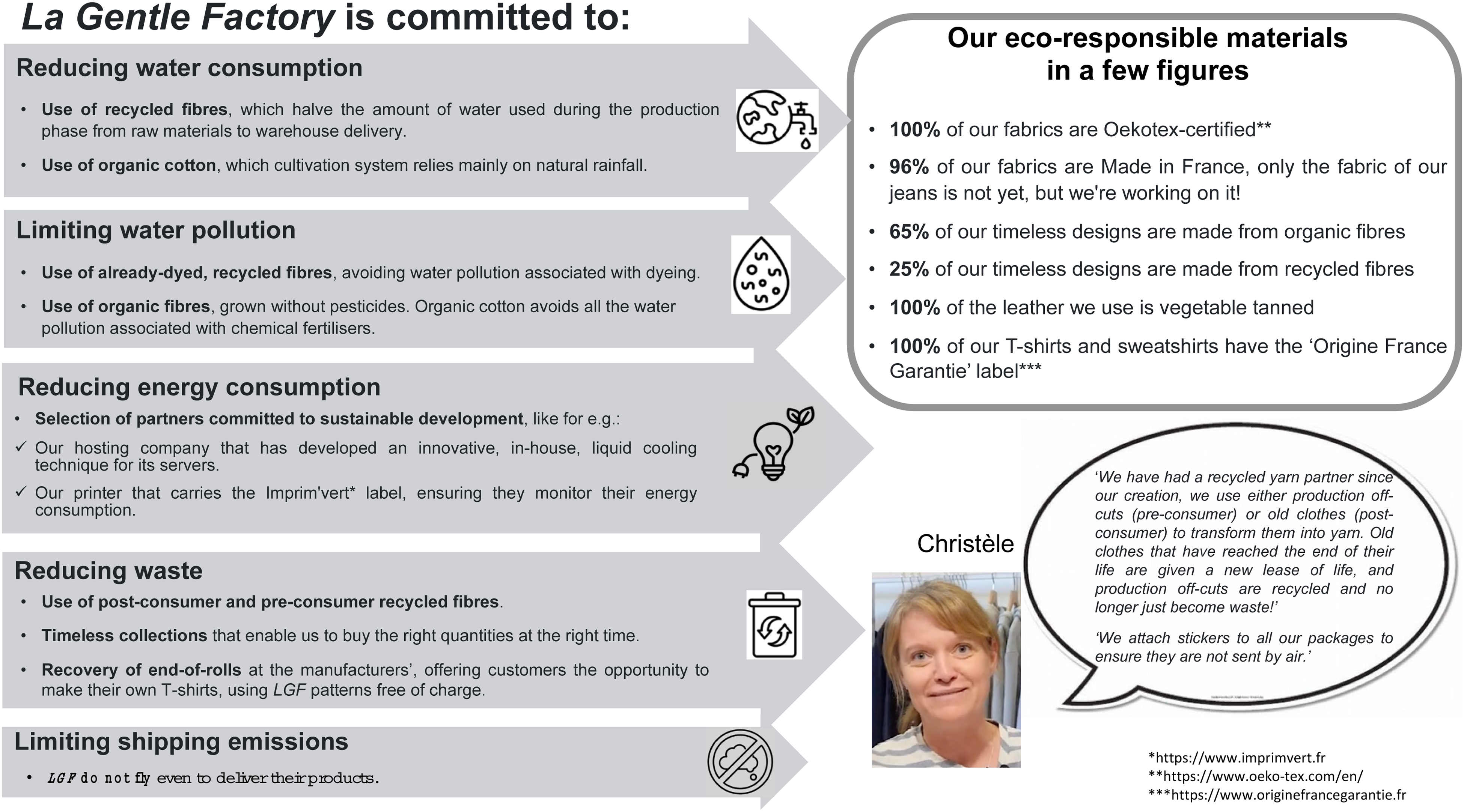
LGF commitments to environmental sustainability.
COVID-19 hit in 2020. Even if the pandemic raised awareness of local re-industrialisation and protection of the planet in the textile industry, it nevertheless represented a major economic challenge for many companies in the sector, including LGF. During lockdown, LGF chose to significantly support their manufacturing business partners (giving them 15% of their sales), while focusing more on deliveries and online activities. In April 2020, LGF also offered a series of video tutorials posted on YouTube to teach the basics of sewing (sewing buttons, hemming, etc.). These educational tutorials encouraged consumers to reduce waste by adopting upcycling practices.
In 2021, LGF raised their prices due to the increase in the price of raw material (especially organic cotton), marking the end of their moderate price policy. They returned to the Made in France Expo (after two years absence). In spring 2021, ‘the living world’ was printed as a beautiful lobster on the men's capsule T-shirts and an aerial dragonfly for the women's, while a new logo affirmed the brand's values of local tailoring and love of detail (see Figure 1). LGF, which now had 15 employees, sold around 100,000 items in 135 shops in France and online. The online store accounted for 30% of the €1.6 million turnover (up 50% on 2019). All well and good, but nothing like the clothing giants. They too were aiming for ‘Made in France’ and could compete with LGF for niches in the 30 or so industrial supplier partners with which the brand works. However, a lasting relationship had been established: ‘Since our departure from Happychic, we have divided our volumes by ten. But our partners have all stayed. Our main aim is to forge bonds. We're not competing on price, and we're not changing suppliers, even though we were approached by around ten potential partners at the last Made in France trade fair.’
In February 2022, LGF made their first advertising campaign (see Figure 4). On 28 March 2022, they were granted the SloWeAre Label 7 for eco-responsible fashion, based on how eco-responsibility was developed throughout the supply chain, which attested to a balanced approach to the triple bottom line; the implementation of a continuous improvement process; an ethical value chain; reasoned production; positive social and environmental impact; and declared actions that were not green/social washing.
With the war in Ukraine, Christèle reinforced the brand's political commitment, creating a T-shirt to support Ukrainians. LGF had involved its partners in the manufacturing chain in this project: the knitters, the dyers, the garment makers and the printers. The proceeds from the sale, minus the manufacturing costs, were donated in full to a humanitarian association. The T-shirt was sold for €30– €40, and the higher the price, the greater the donation to the charity: ‘Beyond the local and responsible manufacturing of the T-shirt, we demonstrated pacifism and solidarity with the Ukrainian people with our ‘МИР and Love’ T-shirt, which symbolised hope and union.’
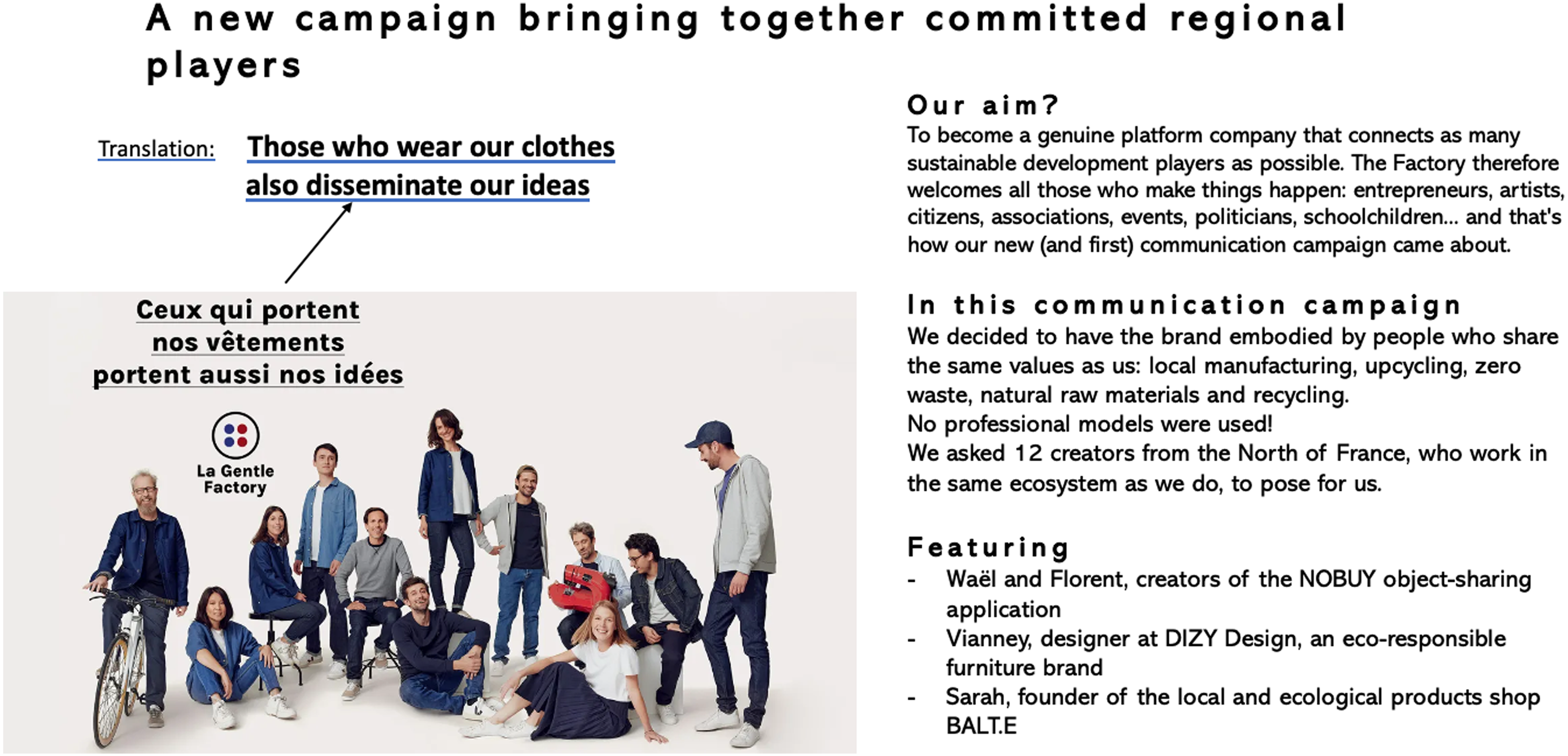
LGF's first advertising campaign.
In September 2022, to react to inflation, the slowing down of consumption due to cost-of-living crisis, and rising costs of raw materials and energy, LGF launched a more accessible range of clothes named ‘Gentle Eco’, to dress even more customers with 100% Made-in-France clothes for less than €100. Christèle explained how to offer T-shirts, sweatshirts and jeans at a lower price without betraying the brand's commitments: ‘The cost factor is first and foremost a human factor. So, we had to work on reducing production time. We kept the brand's markers but adapted them. Sewing a label costs 10 to 15 cents per product. Fewer labels is already a saving. We've also simplified assembly operations with our garment-making partners. That half-moon on the back of the sweatshirt or T-shirt? It's gone, so we keep only the essentials. Thicker yarn is cheaper. And to save even more money, we've limited the range of colours - white, grey and black - to increase the quantity on each reference. As for the jeans, made from a stock of 3000 metres of fabric that the supplier didn't know what to do with, they are not washed out, which means one less step. And while the cost of a zip fastener or buttons is the same, sewing a zip is much simpler and therefore less expensive.’
Conclusion
Christèle wanted to play her part in revitalising French fashion manufacturing from a circular perspective. Her career, initially within a large textile group, where her environmental voice was silenced at the expense of many concessions, reached a turning point in 2019. LGF was an adventure in her image, frank and full of values, with the strong ambition of becoming Europe's first regenerative fashion brand. Today, Christèle felt fully in control of her own business: ‘The intrapreneur has more time to have her head in the clouds and follow her vision. The entrepreneur's feet are firmly on the ground, and she has to keep things running. But this wind of freedom and autonomy is totally energising. Since taking over, I've had the feeling that I'm in the right place.’
Questions
What are the challenges facing the sustainable fashion industry? How did LGF address these challenges? (Use the sustainable fashion matrix provided in Table 1 to address this question).
Is LGF sustainable entrepreneurship? Can Christèle be considered a sustainable entrepreneur?
What types of sustainability-oriented innovations were evident in Christèle's approach to business and the business model in place? What role did networking play in innovation for LGF?
How did Christèle exploit narrative in building her new sustainable venture? What compromises occurred for Christèle when balancing different social and environmental challenges? What was the importance of defining vision, mission and values within this process?
Footnotes
Authors' note
Throughout the case study, we refer to the entrepreneur by her first name, Christèle, and to the business venture as LGF for ‘La Gentle Factory’ ( ). The case was written in collaboration with the entrepreneur and based on in-depth interviews. All the quotes in the case study are from those interviews and all other information in the case study was provided by the entrepreneur.
Declaration of conflicting interests
The author(s) declared no potential conflicts of interest with respect to the research, authorship, and/or publication of this article.
Funding
The author(s) received no financial support for the research, authorship, and/or publication of this article.