




Abstract
The present case is based on an Indian fashion brand, ‘Grassroot by Anita Dongre’, focusing on sustainable luxury. Fashion designer, Anita Dongre, who is behind the brand, is helping to revive the old Indian art and crafts through its environment-friendly luxury offerings. The present study examine the issues that have aroused in sustainable luxury worldwide. It explores the various sustainable practices and challenges being face by Anita Dongre at her ‘Grassroot by Anita Dongre’ brand for inculcating sustainability. It also traverses the rise of Anita Dongre as one of the most premier fashion designer of India. The current case is an example of how and why Luxury brands should focus on sustainability as a key differentiating factor in an emerging economy like India. In future, we might come across laws and policies for the promotion and development of sustainable practices in the fashion industry, as India being the world’s largest producer of organic cotton has immense potential for future growth.
Introduction
‘Professionally, I see my company being carbon-neutral in next five years’ said Anita Dongre (Sarkar, 2020). Anita Dongre is an Indian Fashion designer of international repute having her stores in India, New York and Mauritius. She is a pioneer of sustainable luxury fashion in India and steered her brand towards her goal of reducing her carbon footprints. She is also the first Indian designer to be included in Sustainable Apparel Coalition (SAC) (Mehra, 2019), which is a global association for the promotion of sustainable practices in the Apparel and Footwear industries. All this was not as smooth as it seemed and was a roller coaster ride for her. She talked of sustainability back in the 2010s when none in the Indian fashion industry could even conceive that idea. This case describes how she built and established herself as a designer with a INR 1,000 crore turnover; from a girl born in a traditional Sindhi family; and her ideas, vision and difficulties for implementing sustainability in her brand and in India as a whole.
Luxury and sustainability come together as oxymoron which symbolizes different meanings. Luxury one hand symbolizes ‘affluence, opulence, quality, prestige, selfishness, expensiveness, conspicuous consumption, hedonic desires’ while sustainability on the other hand symbolizes ‘care, less, efficient, altruistic behaviour, regard for the environment’. Traditionally, luxury, fashion and sustainability were seen as completely different concepts, however, because of the development of sustainable practices and consumers’ concerns, the distance between the concepts started to reduce (Kapferer & Michaut, 2015).
Recently, a lot of luxury companies came under fire of various NGOs for their unsustainable practices. Victoria’s Secret was attacked by organization ForestEthics for the destruction of endangered forests through the massive printing of catalogues (Cervellon, 2012). In 2014, Greenpeace published a report in which it targeted luxury brands like Dolce & Gabbana, Giorgio Armani, Versace, Hermes, Christian Dior, Louis Vuitton and Marc Jacobs for having chemicals that cause water pollution, in their children’s line of luxury clothing. They use the hashtag #TheKingIsNaked to attack the luxury brands on their social media webpages (Greenpeace International, 2014).
PETA through its campaigns like ‘Bloody Burberry’ (Chisholm, 2006), ‘Behind the Leather’ (Burns, 2016) and the iconic ‘I’d Rather Go Naked Than Wear Fur’, featuring celebs like Pamela Anderson, Charlize Theron, P!nk, Anna Nicole Smith and Sadie Frost, has been a constant voice of concern for animal cruelty, for their exotic skins, fur and other parts, in the production of luxury fashion products. Fashion brand like Louis Vuitton was condemned by PETA (2017) for their use of crocodile skins in making of luxury bags, shoes, clutches and belts.
In 2017, Burberry accepted to deliberately burning its unsold goods and products from the last season worth of 28million € or ₹ 250 crore (total worth 90 million € for the last five seasons) in order to maintain its brand equity and exclusivity, to ensure that its products are not sold cheap or in grey market areas. Recently in 2021, Tapestry Inc.’s Coach was accused of intentionally slashing and dumping its unsold handbags of the last season (Felsted & Leondis, 2021; Jha, 2018).
Gucci was accused of labour abuses and unsympathetic working conditions (Wang & Snell, 2013). Chanel was also accused of not taking any steps to reduce its environmental footprints and waste generated or to improve its labour’s working conditions (Rauturier, 2022). Aljazeera reported that in KnowTheChain’s (2021) pparel and Footwear Benchmark Report, 2021 (Table 1), the world’s biggest luxury fashion brands are among the worst culprits of labour and other ill-treatments throughout their supply chains, scoring an average of 31 out of 100 (Suleymanova, 2021).
Luxury Company Rankings.
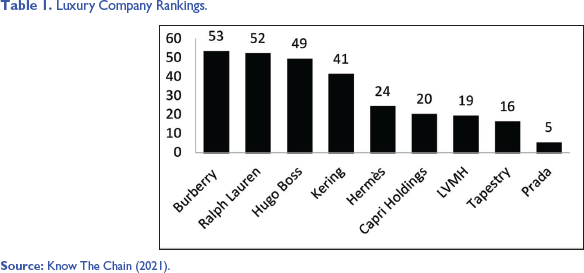
Thus, we see that even the big global luxury players are not spared for their indifference towards the environmental and social sustainability. This calls for a dedicated strategy for sustainability implementation and various challenges associated with it.
Global Luxury Fashion Industry
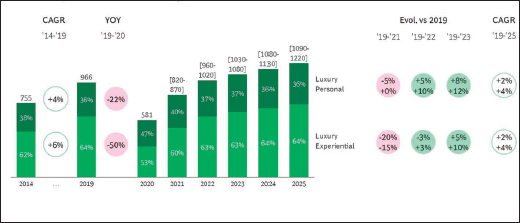
The revenue for the luxury market worldwide amounts to US$312.60 billion presently in 2022 which is expected to grow annually @ 5.40% (CAGR 2022–2027). The Luxury Fashion is the largest segment within the luxury market with the market volume of US$ 97.23 billion in 2022. Most revenue is generated within the United States (US), for the luxury goods (amounting to US$ 69,520 million in 2022), followed by Asian markets like China and Japan (Source: Statista) (Figure 1). The French Luxury Fashion Conglomerate Louis Vuitton-Moet Hennessy (LVMH) owner, Bernard Arnault became the world’s richest man in May and August 2021 according to the Forbes Real-Time Billionaires list, with a net worth of about $198 billion, indicating that despite being among a global pandemic people are still buying luxury goods and demand is there in form of revenge buying. LVMH’s luxury fashion and leather goods showed strong performance with most of the demand coming from Asian and USA markets (Mellor, 2021).
Indian Luxury Fashion Industry
The luxury goods market in India is US$7.52 billion (R 612.70 billion) strong in 2022. It is expected to grow at the rate of 4.67% CAGR during 2022–2027 (Source: Statista).
Both Christian Dior Trading India Private Limited and Louis Vuitton India Retail Pvt India showed upward growth patterns in India despite being in the middle of a global pandemic (Roy, 2021). This shows there is a strong appetite for luxury brands in India and Indian consumers are not shy of spending money on them.
India’s luxury market is an aspirational one and it is in its nascent stage as compared to other markets in the world like the US and China (Gupta & Banerjee, 2019). Many of the Indian consumers are still unaware of the rich culture, heritage and pedigree of different luxury brands and what differentiates them from the mass brands. They usually go for better-known, popular luxury brands because of the ‘brand name’ that they provide and ignore the lesser-known luxury brands ex—Mercedes-Benz vs Volvo (Jain, 2021).
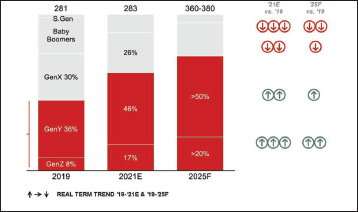
People are becoming more conscious of their buying habits and patterns in the ongoing pandemic, and looking forward to more sustainable options in the luxury category. Revenge shopping after the upliftment of lockdowns is leading the growth in the luxury goods sector (Tripathi, 2021). While older generations (Baby Boomers) still prefer traditional shopping methods, millennials represented 36% of consumption in 2019 and would increase to up to >50% by 2025. Even, the Gen-Z would increase their foothold from 8% in 2019 to >20% by 2025. These young generations are tech-savvy and spend a considerable amount of time in the virtual world of the internet (Bain & Company, 2021; Kapferer & Michaut-Denizeau, 2019) (Figure 2).
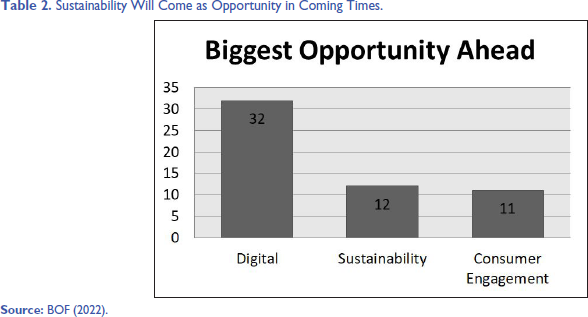
Millennials and Gen-Z are spearheading the social and environmental revolution in the luxury fashion landscape (Table 2). The companies are also responding to them like in 2021, Lakme Fashion Week Designer Rajesh Pratap Singh from Satya Paul showcased collection which was made completely of Carbon Zero Tencel, a biodegradable sustainable fibre. In the same fashion show, another designer Satyajit Vetoskar, showcased his collection named ‘Shourai’ which means ‘the future’ in Japanese. He made this collection with the help of recycling of discarded items like tarpaulin, billboard flex and car seat belts to make accessories like duffle bags, backpacks and cross-body bags (Tripathi, n.d.).
Sustainability Will Come as Opportunity in Coming Times.
The demand for the luxury products in India is not only increasing in Metros but also in Tier-1 and Tier-2 cities like Ahmedabad, Chandigarh, Ludhiana etc. Amit Pande, brand head for The Collective, one of India’s largest luxury retailers, says that the internet and e-commerce have helped the luxury retailers to get demand from the non-metro cities, which do not have their stores but are keen to owing and experiencing luxury, mining barons from Raipur, agriculturists from coastal Andhra Pradesh and small towns in Kerela. The increase in High Net-worth Individuals (HNIs) has created a segment of luxury buyers called First Time Luxury Buyers (Gupta, 2019; Tripathi, 2021).
There were around 13,637 ultra-high net worth individuals (uHNI’s) in India in 2021, which is expected to grow to 19,006 by 2026; a projected growth rate of 39% and in 2020. There were 145 numbers of billionaires in India in 2021, the third highest in the world only after China and the USA, which also confirms the fact that the demand for luxury goods will grow substantially in future (Knight Frank Wealth Report, 2022).
About Anita Dongre
Anita Dongre is a pioneer in the Indian textile and fashion space with her brands like ‘AND’ and ‘GlobalDesi’, which cater to the needs of modern Indian women. She is often called ‘Queen of Prêt’ within the fashion industry. Her other brand, ‘Grassroot by Anita Dongre’, a luxury Prêt brand, is more focused on the preservation of traditional crafts, dying, printing and embroidery techniques of India and providing a sustainable future for all. It provides both ethnic wear and western wear in its collection.
Background
Back in 1983, Anita Dongre started her business with the help of her sister, Meena Sehra, in Khar, Mumbai initially having only two sewing machines supplying ethnic embroidered clothes to local stores and boutiques. After the beginning of the liberalization of the Indian Economy in 1991, she sensed an opportunity in women western wear. She saw that due to coming of new companies in India; young, Indian girls and women wanted formal western wear having cuts, curves and colours in line with Indian heritage. Eventually, in 1995, she launched ‘And Designs India Ltd’ (Warsia, 2020) with her brand ‘AND’ (women’s western wear). This was an instant hit among young women of Mumbai. In 2007, she launched the ‘GlobalDesi’ brand (boho-chic girl/Indian fusion wear).
Investments at the ‘AND Designs India Ltd’
In 2008, Kishore Biyani led Future Group invested in And Designs India Ltd for a significant minority stake. This helped Anita Dongre to further launch brands like ‘Anita Dongre Bridal Couture’ in 2012, ‘Pinkcity Fine Jewellery’ in 2013. By 2013, Future Lifestyle Fashion Ltd sold its 22.9% minority stake in And Designs India Ltd to General Atlantic, a US private equity firm, for about US$ 20 million.
Corporate Restructuring of the ‘House of Anita Donge (HOAD)’
After the selling of their minority stake to General Atlantic, by Future Group, the name of the company was changed from ‘And Designs India Ltd’ to flagship corporate brand ‘House of Anita Dongre (HOAD) Pvt Ltd’ in 2015. It consisted of all other five sub-brands, namely
AND (Formal woman western wear) GlobalDesi (Indian fusion wear) Anita Dongre Bridal Couture (Indian Bridal/Wedding and Ethnic wear) Grassroot by Anita Dongre (sustainable luxury fashion) Anita Dongre Pinkcity (a Fine Jewellery line)
This move was in line with her plan of expansion. It helped in the consolidation of corporate operations, vertical integration and all sub-brands, under the one roof. It provided seamless integration from designing, sourcing, cutting & stitching to finally marketing and retailing across the different brands, resulting in better efficiencies and control (Malhotra, 2015).
But, just after four years, again in 2019, a new fully owned subsidiary was formed namely ‘Ochre and Black Private Ltd’ Under this, brands like ‘AND’, ‘AND Girl’, ‘GlobalDesi’ and ‘GlobalDesi Girl’ were included while other brands like ‘Anita Dongre Bridal Couture’, ‘Grassroot by Anita Dongre’ and ‘Pink City Jewellery’ remained with the flagship ‘HOAD’. This was done since both ‘AND’ and ‘GlobalDesi’ are mass-premium brands (Masstige) targeting middle and upper-middle-income groups and contributed to 80–82% of group sales. While other 18% revenue came from other luxury brands which target upper income group.
Brand Architecture: Brand architecture as defined by Aaker and Joachimsthaler (2000) is the arrangement of brands in a specific hierarchy which defines the nature and parts played by different brands and the connections between them.
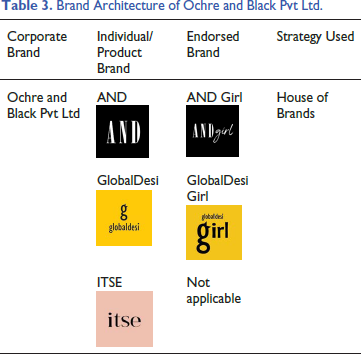
Ochre and Black Pvt Ltd uses a House of Brands strategy to communicate its various value propositions. Two main brands under the corporate brand are ‘AND’ and ‘GlobalDesi’. Both the brands cater to different segment of buyers and have separate endorsed brands for young girls. Both ANDgirl and GlobalDesiGirl use Linked Name strategy of Endorsed Brands to create a connection with the parent brand. On the other side, the corporate brand, Ochre and Black Pvt Ltd uses Shadow Endorser technique to link itself with the HOAD. Since, AND was the first brand to be conceived by Anita Dongre, people still associate AND with Anita Dongre.
In 2021, they introduced a new brand namely ITSE, which basically focuses on young women taking a fresh, modern approach on traditional Indian silhouettes and offering them at an affordable, budget-friendly deal (Table 3).
Brand Architecture of Ochre and Black Pvt Ltd.
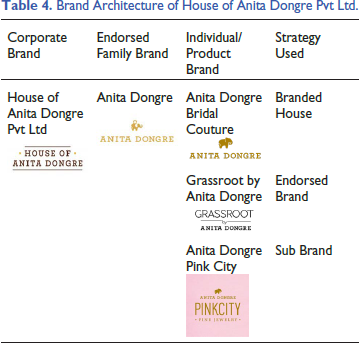
Corporate brand ‘HOAD Pvt Ltd’ uses an Endorsed Brand strategy for their premium luxury brand ‘Anita Dongre’. The family brand ‘Anita Dongre’ builds on the capabilities of Anita Dongre as a designer and her expertise as the fore-runner of the contemporary Prêt and Haute Couture. Product Brand ‘Anita Dongre Bridal Couture’ works on luxury Indian wedding wear, Bridal wear, Menswear and couture prêt. It uses the Branded House strategy having same identity all over the globe whether it is the US or any other store in India. Customer will get the same experience, products, store atmospherics, appeals etc across the various stores owned by the brand. Luxury Organic brand ‘Grassroot by Anita Dongre’, on the other hand, utilizes Endorsed Brand strategy having a strong endorsement from the ‘Anita Dongre’ brand. The Luxury Jewellery line ‘Anita Dongre Pinkcity’ is the sub-brand of the ‘Anita Dongre’ brand having the master brand ‘Anita Dongre’ as the driving force behind the brand (Table 4).
Brand Architecture of House of Anita Dongre Pvt Ltd.
Operations: A Family Affair
HOAD’s top management comprises close family members of Anita Dongre which help her in the functioning of the company. Anita Dongre, herself is the Chief Creative Officer, looking after the designing of the products. Her brother, Mukesh Sawlani, is managing Operations, Human Resources (HR) and Finance as the Managing Director of the firm. Her younger sister, Meena Sehra, with whom she started her business now heads the Product department (Sourcing and Merchandising) while her other elder sister, Priyanka Hira, manages the Customer Relationship operations. All the siblings are equal shareholders in the firm and contribute equally to the functioning of the firm.
With the coming of age, the younger generation of the family has started to contribute to the working of the firm. Her son, Yash Dongre, sees the Global Operations of the company with the stores in Mauritius and New York while her nephew, Deepikesh Hira is looking after the brand’s Digital Strategy. Yash Dongre’s wife Benaisha Kharas Dongre provides her services for the training of company’s sales force. Thus, the entrepreneurial spirit of Anita Dongre has culminated into a successful family-run business which has scaled a turnover of over INR 1,000 crores in 2020–2021 (Assomull, 2020).
About ‘Grassroot by Anita Dongre’
‘Grassroot is an exploration of traditional crafts, and an expression of contemporary lifestyle. Stylish, functional, yet rooted in authenticity’.—Anita Dongre.
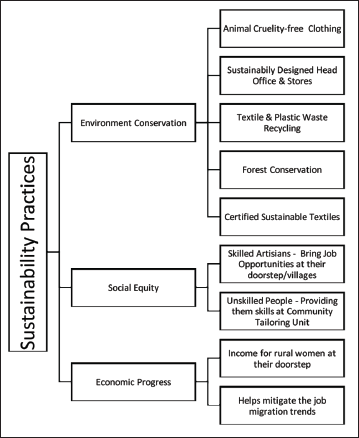
‘Grassroot by Anita Dongre’ brand aims to preserve both environmental and social faucets of sustainability (Figure 3). They do so by promoting fair trade and heritage Indian crafts and by sharing a percent of profits with the local artisans who produce those crafts (Hemantha, 2019). With this, the brand focuses on United Nation’s Sustainable Development Goal (SDG) No. 8. It states to perceive for a sustainable economic growth, providing decent work levels and job opportunities for all men and women.
‘Grassroot by Anita Dongre’ Sustainability Precis.
Brand Profile: ‘Grassroot by Anita Dongre’ is a contemporary Luxury Prêt created to revive and sustain the traditional arts and crafts of India. The objective of the brand is assimilating the Indian artisans into the Fashion mainstream with a modern touch.
Since, the outdated machinery and equipment, high maintenance costs, long production time and low production levels the capability of the handloom and heirloom sector remains under-utilized and the lack or indifference of consumers aggravates the issue; the brand pays homage to India’s handcrafted customs by fashioning them into modern stories. ‘Grassroot by Anita Dongre’ speaks to today’s evolved, a sophisticated global woman who understands the value of slow fashion and has the fine taste to appreciate the heritage of handcrafted craftsmanship.
Business Model: The brand does not believe in the seasonality of the fashion industry. Instead, they focus on the longevity and timeless appeal of their products. Collections are created based on the availability of the talents of artisans at that time and patterns and pieces of clothing are modified accordingly (Shilpika, 2021). This leads to a kind of Slow Fashion where each item is crafted individually; giving priority to longevity, love, patience and environment-friendly production process. The brand also believes in closing the loop, since they do not go for excess production and produce only that much which they can sell comfortably, without building any pressure on artisans, production team and customers to buy, by constantly checking their inventory levels. They also recycle and reuse waste from production processes to make small items of daily use in an Indian household like quilts, carry bags, reusable masks, etc.
The 4 Ps of the Brand
Products Produced: Women’s ready to wear; both western and ethnic (dresses, tops, tunics, co-ord sets, kurtis, gowns and jackets)
Pricing: The brand targets the upper and upper-middle-income groups with the pricing starting from INR 10,000 and going up to INR 35,000.
Place: The brand has five dedicated stores in India in big Metros like New Delhi, Mumbai, Kolkata and new emerging fashion and luxury hotspots like Hyderabad and Chandigarh. It also has one store overseas at Soho, New York, US. The brand also has a considerable online presence at Anita Dongre’s official website and other online luxury stores like Pernia’s Pop-Up Store, Ogaan.com and Aza Fashions.
Promotion: The promotion of the brand is done in a very subtle manner considering the essence of Luxury incorporated in it. The brand showcases its collection at various Fashion shows like Lakme Fashion Week, India Fashion Week, etc. At these Fashion shows, the brands’ targeted clientele is present and they also follow it on social media. The brand releases its collection every six months as Spring-Summer and Autumn-Winter and promotes it on its website and various social media handles. This refreshes the brand in the minds of consumers with their new offerings. Brand publishes print advertisements in the English Fashion magazines like Vogue, Elle, Harper’s Bazaar, etc. Brand also utilizes the prowess of star designer Anita Dongre via her interviews or being worn by various celebrities time to time. This helps the brand to have positive publicity and get into the consideration set of its target customers.
Positioning of the Brand: ‘My muse is the modern Indian woman who is still rooted in tradition and my partners are Indian artisans who bring my vision alive with their rich artistry’ said Anita Dongre (Sarkar, 2020). ‘Grassroot by Anita Dongre’ positions itself as the Luxury Prêt brand catering to Modern women having the traditional roots appreciating the local crafts. They provide both western wear and ethnic wear and differentiate themselves on the basis of sustainability endeavours and slow, cruelty-free fashion, which they are striving hard to follow.
Grassroot by Anita Dongre: Sustainability Practices being followed
Social Sustainability (Women Empowerment): She is working towards the women empowerment of rural artisans in Maharashtra, India by setting up Community Tailoring Units, with NGOs like Goonj, NEPRA Foundation and SEWA (Self-Employed Women Association), to train them professionally in Garment manufacturing. This helps in bringing job opportunities back to villages where people used to migrate for better employment prospects, because migration divides the family, where women are left behind to take care of children and elderly and men go to cities for work (Source:
Presently, there are eight centres dedicated to the Community Tailoring Unit. The brand is planning to increase them to 30 in the coming years by 2025. The brand’s long-term goal for these centres is to expand them into various remote villages in India and address the issue of poverty, migration to cities and improving the overall quality of life of an average rural woman (Robert, 2019).
By this way, they are being able to provide job opportunities to the rural, artisan women at their doorsteps, close to their family and save them from sometimes the harsh working conditions of the factory (Gage & Pasricha, 2020).
Animal Welfare: As a vegan and animal-lover herself, she feels that animals also have an equal right to live a free life, without any pain or fear. Her brand supports the sterilization and rehabilitation of approximately 100 dogs per month and helped in the setup of a veterinary clinic at Andheri, Mumbai by animal welfare NGO, World for All Animal Care and Adoptions. They have also adopted the stray dogs inhabiting the area near their headquarters.
They also work with NGOs like Plants and Animal Welfare (PAWS), Thane and Bhumi Jeevadaya Samvardhan Trust, Navi Mumbai for the betterment of the Plant and Animal population (Source:
The brand is also staunch against the use of leather and fur in its products and is recognized by People for Ethical Treatment (PETA) at the Vegan Fashion Awards in 2013 for its stand for being fur-free and leather-free (Source:
Company’s Headquarters: Anita Dongre’s philosophy also reflected in the company’s new headquarters, which was inaugurated in 2015. The building is 100,000 sq. ft. structure located in the pristine hills of the Rabale, Navi Mumbai. Its main focus is being sustainable and to reduce energy consumption and carbon footprints by using as much as natural sunlight, rainwater harvesting and air for lightening and ventilation purposes (Driver, 2021).
67% of wastewater produced is recycled and reused for flushing the toilets and watering the garden. They also have an organic terrace garden and Anita Dongre is known to grow the vegetables which she consumes, locally in the garden.
Brand Stores: 90% of the ‘Grassroot by Anita Dongre’s Exclusive Brand Outlets (EBO’s) are equipped with energy-saving LED bulbs. They recycle and discard their E-Waste (Electronic Waste) in a sustainable and eco-conscious manner.
Textile Waste Recycling: These rural women also helped in the recycling of textile waste generated during the production process and transformed the waste into socially useful products like face masks, carry bags and godharis. Every month, these women, saved up to 2,000 kg of textile waste which would have otherwise gone to landfills and made 400 godharis from them. (Source:
Plastic Waste Recycling: The brand through collaboration with Lucro Plastecycle Private Limited, has developed and implemented a plastic waste recycling and management program throughout its supply chain. The recycled plastic is then used for making the packing material. Monthly 500 kg of plastic waste is recycled throughout the supply chain and 125,000 plastic bags are reused. (Source:
Plants and Forest Conservation: The brand helped in the plantation drive of 25,000 trees with the collaboration of grow-trees.com. The trees were planted as part of a forest and wildlife initiative on Earth Day in April 2018 at Bassi Wildlife Sanctuary, Chittorgarh, Rajasthan. They have also partnered with Canopy NGO to ensure that the packaging and fabrics they use are not detrimental to the forest and wildlife resources.
Use of Certified Sustainable Fabrics: The brand strictly ensures that the fabrics they are procuring for the production are from sustainable sources and are biodegradable like Bemberg Fabric, Better Cotton Initiative (BCI) Fabric and Tencel Fabric.
Anita Dongre used the Tencel Fabric sourced from the Lenzing group of Austria, for her Spring-Summer collection 2021, Sounds of Forest. Tencel is natural regenerated cellulosic fibre which is produced from Eucalyptus trees and is biodegradable in nature. These trees require very less water; no pesticides, have a fast growth rate and can be grown on land not suitable for farming (Banerjee, 2021).
The brand Grassroot by Anita Dongre has generated jobs for women at the village level and provided the employment opportunities at their doorsteps. It has also helped in the recognition and mass revival of heritage Indian arts and crafts like Ari, Antha, Ajrak, Chikankari, Dabbu, Bandhani, Kamdani, Ikkat, Chanderi, Maheshwari Phulia, Murshidabad, Bhagalpuri handloom, etc. (Rangnekar, 2018).
The brand has also opened its stores in uptown Manhattan, New York and Mauritius, bringing the traditional arts and crafts sustainability of rural artisan women of India at the global level (Gage & Pasricha, 2020).
Grassroot by Anita Dongre: Challenges in Sustainable Practices Implementation
Putting the brand and company at the forefront of sustainability and making them carbon neutral is a time taking process and requires dedication and focus from a management point of view and readjust their strategy on various levels. Anita Dongre is a pioneer in this field but she also faces various challenges to cope up and maintain her stand. Some of the major challenges faced by her are as follows:
Since most of the cluster villages and tribal are located in the hinterlands of the country, there is always a logistical and supply chain challenge. On the other hand, most of the production happens in the one lakh square feet headquarters located in Navi Mumbai and, from there, it is transported to various retail stores in India and the US. This calls for extending the present and developing new supply and retail chains. Artisans and craftsmen need to be trained for modern contemporary designs, cuts and patterns to help them to adapt to market trends and this requires a lot of resources in terms of manpower, machinery or raw materials. People also need to be trained for dyeing cloths using natural dyes and processes and raw materials that go with that. For scaling up these clusters, the brand requires credible, reputable skilling organizations that can efficiently provide high-quality, individualized training on-site in a timely, cost-effective way. The brand is doing a commendable job in slowing the fashion by using innovative raw materials which are both renewable and environmentally friendly but is unable to fully close the loop to enable the Circular Fashion, through recycling and upcycling. The concepts of the 4 R, that is reuse, reduce, repair and resale are not being fully implemented in the brand. The brand focuses more on reducing the waste generation during the production process and reusing the fabrics to make other small useful items. But on the front of repairability and reselling, they are still lagging behind and improving. The transparency and accountability of the production processes is still lacking. The brand actively engages in Waste water treatment, Plastic PET bottles and packing material recycling but it also put-up questions like ‘What percentage of Water is being treated?’ with a credible third party validating it. The transparency and accountability go a long way in gaining the confidence and trust of consumers. Traceability of fashion products from conceiving to disposal is very important inclosing the loop of circular fashion. Brand can use newer technologies like blockchain and artificial intelligence for increasing the traceability of their products. The transparency, accountability, traceability and sharing the stories of artisans behind the products (Mehra, 2019) help in increasing the knowledge levels of consumers (Bajaj, 2020; Khare et al., 2020; Saha et al., 2019; Sandhya & Mahapatra, 2018) regarding the sustainable fashion and is instrumental in gaining validity and acceptance from the consumers. There is also the lack of India-specific laws, policies and incentives for the promotion and development of sustainable practices inside the organizations, besides CSR funding. The organizations can utilize them to get guidance for the implementation of sustainable practices.
Conclusion
India has a rich heritage in textile and fabric production since ancient times, which can be traced back to the Indus Valley Civilization. The local ‘Karkahanas’ or cottage industries were producing fabrics with locally sourced raw materials and providing employment at the village level. These were sustainable in their very sense.
Indian cotton, muslin and silk were in great demand by females in the Roman and later European courts. Romans even used to pay in gold for these fabrics. They were renowned for their quality, rich feel and texture and designs. During the colonial period, the textile weavers of India suffered. British used the Indian raw materials and produced fabric on machines which were far cheaper and had good quality than handmade fabrics (Aggarwal & Vohra, 2021; Uzramma, 2006).
So, Indians are not new to the concept of sustainability, with most of the Indians knowing about recycling of resources. Therefore, it would be easier for them to connect with sustainable fashion (Aggarwal & Vohra, 2021). With 51.15%, India is the largest producer of organic cotton and has a lot of potential, but most of this is exported to the US and Europe (Textile Exchange’s, 2020). This can be used to cater to the niche of environmentally conscious customers in India which the increasing due to an increase in awareness among people.
Luxury designer like Anita Dongre is doing a commendable work in promoting indigenous weaving & printing arts at a global level, so that they are saved from extinction, passed on to the next generations and help in the sustainable development of the textile and fashion field. There are a lot of challenges for implementing sustainability, especially in an emerging economy like India, and all the stakeholders like Designers, Employees, Artisans, NGOs, the Government and most importantly the Customers must come together for its implementation and creating a better future for our coming generations.
Since Luxury Fashion companies represent the best in segment, they cannot afford to be associated with Environmental pollution, degradation and forced labour practices. They have both the responsibility and opportunity to promote the sustainable fashion products. Since, they are closely followed by people, mass marketers; their inclusion of sustainable luxury fashion might help others to follow the same route and the development of the overall fashion industry on the tenets of sustainability.
Discussion Questions
Q1. Discuss the growth potential of sustainable luxury brands in an emerging economy like India?
Q2. Social, environmental or mixed? Which dimension of sustainability to be focused by the brand?
Q3. Discuss corporate restructuring? What advantages or disadvantages might occur in the long run due to it?
Q4. Illustrate the branding strategies which can be adopted by ‘Grassroot by Anita Dongre’ for increasing their brand awareness?
Q5. On the basis of Hofstede cultural dimensions, what changes are required in 4Ps, positioning and marketing of the brand in the USA from India?
Q6. Transparency and traceability go a long way in making an empowered customer. In what way do they help in consumer decision-making, especially in sustainable products?
Footnotes
Declaration of Conflicting Interests
The authors declared no potential conflicts of interest with respect to the research, authorship and/or publication of this article.
Funding
The authors received no financial support for the research, authorship and/or publication of this article.
