




Abstract
In this article, we explore the affective dimension of human temporality. Drawing on the work of Michael Theunissen in his Negative Theologie der Zeit (Negative Theology of Time), we suggest that understanding time as affect may help shed light on how people in organizational settings are influenced by and react toward time, once it comes to appear as an obstacle, rather than a resource to the unfolding of life. To capture such situations, we introduce the notion of ‘chronopathic experience’ and proceed to explore such experiences empirically among men incarcerated in Helsinki Prison. Here, we identify chronotelic behavior as a modality of activities directed toward dealing with the affective pressure exerted by time, as it comes to appear given, external, and meaningless. We argue that the affective dimension of human temporality can be drawn upon in other organizational contexts to clarify the notion of time pressure and to better understand temporality-related institutional pathologies like stress, boredom, and depression.
I’ve experienced times so difficult and felt boredom and loneliness to such a degree that it seemed to be a physical thing inside so thick it felt like it was choking me, trying to squeeze the sanity from my mind, the spirit from my soul, and the life from my body.
Introduction
Over the past decades, a number of organizational scholars have explored the temporal aspects of organizational change and process, calling for an expansion of our understanding of the notion of time (Ancona et al., 2001; Bluedorn and Jaussi, 2008; Orlikowski and Yates, 2002; Reinecke and Ansari, 2017; Shipp and Fried, 2014). With variations in the Augustinian question (‘What is time?’), this stream of research has challenged the traditional distinction between two opposing understandings of time, either as objective and existing independently of any perceiver, or as subjective and socially constructed through human action. Instead, it has bridged the two by arguing that time, rather than being either objective (and shaping human action) or subjective (and shaped by human action), is tightly woven into the practices that simultaneously shape and are shaped by day-to-day actions (Hernes et al., 2013; Orlikowski and Yates, 2002; Reinecke and Ansari, 2017). According to this view, the impression that time exists externally as an objective reality is, in fact, the result of human reifications, and while people’s actions may sometimes be shaped by structural conditions beyond their control, they have an active role in shaping the temporal contours of their lives, for example, by enacting different social practices.
While this perspective has done a lot toward affirming time, in a fundamental ontological sense, as a productive and creative source of events (Osborne, 2008), it has also muffled perspectives on time as a problem with which organizational members struggle. The dominance that time exerts over human beings has been a theme at least since the precision and linearity of clock time began with the industrial revolution (Hassard, 2001). In The Poverty of Philosophy, for example, Marx (1976) explicitly asserts time against human life, proclaiming that ‘time is everything, man is nothing’ (p. 127). More recently, studies of social acceleration connect the loss of temporal agency in modernity’s maelstrom of efficiency and improvement to a drastic rise in serious maladies like stress, anxiety, and depression (Rosa, 2003; Roxburgh, 2004; Wajcman, 2016). The agonizing experience of time as ‘empty’ or ‘meaningless’ is also visible in newer studies of boredom that show how this experience not only impacts individuals but also creates negative corollaries in contemporary organizational life (Costas and Kärreman, 2016; Johnsen, 2016; Loukidou et al., 2009). Indeed, as suggested by the quote at the beginning of this article, the subjugating effects of being confronted with time as a given and perpetual force existing on the outside can be associated with severe suffering and devastation.
In this article, we explore this affective dimension of time as it becomes an obstacle to the immediate unfolding of human life. What happens, we ask, when the individual cannot simply amend her experience of time as foreign and external by changing her relationship with it? In order to capture this shift toward the affective dimension of time experientially, we will refer to it in the following as chronopathic experience (from the Greek chronos for ‘time’ and pathos for ‘suffering’or ‘feeling’). The notion of chronopathic experience might be understood as what Dashtipour and Vidaillet (2017) have recently termed ‘affective suffering’. Suffering here has two related meanings, referring to pathos; the passive capacity of the subject to be affected by its surroundings, but also implying pain—for example, the agonizing boredom described by the inmate William Blake at the beginning of this article. In our explorations of the chronopathic experience, we discern how it develops, feels, and impacts human behavior in (and outside) organizations. The acute effort to ‘pass’ time, we argue, points to a class of behavior, which can best be described as chronotelic (from the Greek chronos for ‘time’, and telos for ‘end’, ‘purpose’, or ‘goal’): activities that are not primarily autotelic (with a purpose in themselves) or heterotelic (with a purpose apart from themselves), but are designated to afford ways of passing the intensity of time as affect. Rather than asking what time is in an emphatic sense, then, we seek to know how time is and to which extent the success or failure of human life is dependent on our relationship with it.
We engage in this exploration conceptually and empirically. Conceptually, we first sketch the emergence of affect as a theme in organization studies and discuss how time is related to it. We then probe further into when and how temporal agency arises and when it breaks down or becomes chronotelic. For this purpose, we introduce Michael Theunissen’s (1991) unsettling work on time as a force that subjugates human existence by dominating it, as presented in his work Negative Theologie der Zeit (Negative Theology of Time). Empirically, we investigate a number of interviews from a previous study with inmates in a high security prison in Finland, who in multiple ways struggle with time. In prison, time is said to be an ineffaceable presence that inmates come to fear, struggle to master, and are ceaselessly forced to reckon with (Medlicott, 1999; Wahidin, 2006). As a coercive and relatively closed community, the prison offers a potent organizational representation of the way in which time depends ‘not only on [its] absolute length but also on the nature and intensity of [its] qualities’ (Sorokin and Merton, 1990: 61; see also Brown, 1998). The ways in which prisoners experience and deal with time are, as we shall see, manifestations of the distressing, affective dimension of time.
In our discussion of these conceptual and empirical explorations, we reflect on what happens when human beings experience time as fundamentally external and given. The article seeks to make two main contributions. First, it adds to the growing literature on affect in organization studies—what has recently been called ‘organization theory’s minor affective turn’ (Beyes and De Cock, 2017). In this turn, interest has so far been predominantly turned to aesthetic and spatial understandings of affect. By focusing on the affective dimension of time, we introduce a more critical perspective on affect, in which affect not only liberates and opens up new creative space but also pacifies, petrifies, and subjugates the individual in her struggles to maintain temporal agency—a ’dark side’ of affect, as it were. By introducing chronopathic experience as a modus for understanding how human beings relate to time, our second contribution is to extend existing research on temporality in organization studies, all the while challenging its tendency to view time as fundamentally affirmative and available to the unfolding of human existence (see, for example, Hernes et al., 2013; Langley and Tsoukas, 2010; Reinecke and Ansari, 2017; Schultz and Hernes, 2013). Instead, we suggest, human beings objectify time to form coherent subjective experience, creating a ‘life-support mechanism’ that upholds a sense of agency toward time. When this mechanism breaks down, a pathological dimension of human temporality emerges, in which individual and organizational behavior becomes driven by an overriding compulsion to escape the pain of time’s ‘domination character’ (Theunissen, 1991: 42). Such chronotelic behavior has serious implications in daily organizational life and has the potential to shed new light on the causes and effects of phenomena such as depression, stress, boredom, and anxiety in organizations.
Affect, time, and organization studies
The study of affect in organizations is rapidly gaining prominence (Beyes and De Cock, 2017), not least with organization scholars looking to extend insights on affect in philosophy and social studies, as well as in the fields of architecture, design, and neuroscience (Fotaki et al., 2017). Affect is produced as intensities that are located outside the discourse of emotions or representation of feelings (Massumi, 2002). As a research program, affect holds potential for elucidating more critical and elusive aspects of organization theory, as Fotaki et al. (2017) argue (see also Kenny et al., 2011). Although this potential has yet to be realized, the ‘affective turn’ has been promoted in fields like philosophy, cultural and social theory, and human geography (Berlant, 2011; Clough, 2008; Sedgwick, 2003; Thrift, 2012), where it shares an imperative to contest established disciplinary boundaries between humanities, social sciences, and natural sciences (Clough, 2010). A predominant feature of this literature is an interest in how pre-cognitive experiences of intensity and states of becoming add themselves to forces of organizing and organization. Whether the term designates a specific work environment, an urban site of interaction, a total institution, or bureaucratic functions, ‘organization’ can be viewed fundamentally as an affective arrangement—that is, a material-discursive formation exceeding or transgressing individual experience in various ways. Affect theory emphasizes how a ‘social grammar’ exists prior to the individual (Massumi, 2002; Pile, 2010) and has foregrounded aesthetic and spatial understandings of, for example, atmosphere (Anderson, 2009; Borch, 2010); the material, affective, and aesthetic connection between space and the law (Philippopoulos-Mihalopoulos, 2013); public space and affective cartography (Beyes, 2010; Lohmann and Steyaert, 2006); and organizational design (Michels and Steyaert, 2017). Explorations of affect venture to organizational constellations, otherwise overlooked, in a sense apprehending ‘white spaces’ in the field (Beyes and Steyaert, 2013; O’Doherty, 2008).
Temporality is a natural companion to affect in these studies, as any affective arrangement is also a process of becoming. But time itself and its inherent affective potency are all but disregarded. Reflective of the time-as-container metaphor (Adam, 1990), time is predominantly treated as enclosing affective arrangements, thus sustaining rather than disrupting them (e.g. Hansen, 2004), or as an orienting backdrop against which affect is made intelligible rather than obscured. Take as an example De Cock and O’Doherty’s (2016) enthralling exploration of the ‘affective charge’ of ruins. Here, affect is envisioned to travel in and across time, rendering subjects receptive to pre-individual and constitutive experiences. The authors lay bare the cross-temporality of affect (Bertelsen and Murphy, 2010)—but what they do not address is the affective dimension of time itself. In effect, they focus primarily on the time of affect, more than the affect of time. The latter, however, is so present in modern organizations that it is almost mundane: Everyday, organizational life is permeated by the micro-vocabulary with which people address time as affective pressure—as when we say that time is ‘creeping’, ‘flying’, or ‘running’, something we are ‘stuck’ or ‘lost’ in, ‘fighting’ or ‘up against’. The affective content of this vocabulary constitutes an evaluative awareness that is closely associated with the subject’s registering of its existential situation, powerfully influencing, challenging, interrupting, and simultaneously constraining and enabling its sense of agency and identity. Exploring time as affect in chronopathic experience and developing a better understanding of the effects of chronotelic behavior, thus, add a new layer to the study of affect as a co-constitutive dimension of organization.
Time as affect: Michael Theunissen’s Negative Theology of Time
Like much of the current literature on time in social studies, Theunissen’s (1991) Negative Theology of Time confronts the scientistic view of time as a discrete, objective entity. But rather than asserting a plurality of times (Adam, 1990), investigating their ideological bearings (Berg Johansen and De Cock, 2018), or arguing for temporality as a realm of pure becoming (Hernes et al., 2013), Theunissen understands time as a force that fundamentally negates life. Rather than affirming human life, it ‘is the distinguished way in which the whole of the world dominates us’ (Theunissen, 1991: 41). Time in this way, more than anything—and unless it is modified—is a source of suffering to human beings.
In order to understand time’s dominion, we must first revisit the distinction between subjective and objective time. According to Theunissen (1991: 42f.), the meaningfulness of human existence is rooted in the constructive dialogue between what he calls the dimensional and linear order of time. The dimensional order represented by the horizon of past, present, and future corresponds to subjective time, in that it captures time as it is consciously lived and experienced. Here, time relates to existential-practical, biographically describable life, and in this respect constitutes the ‘inner foundation of possibility’ for a meaningful existence (p. 307). The linear order, on the other hand, is a posterior product of human practices (p. 290). Here, human beings spatialize time to form a line of uniform moments serving to distinguish objectively between ‘earlier’ and ‘later’ and ‘now’ and ‘then’, thus relieving the individual subject of this responsibility. This further entails that the dimensional and the linear order are constructively inscribed into each other, yielding the objectively dated present. Rather than constituting a discrete reality, this objectified time is thus instantiated and produced by human beings to orient their ongoing activities. This leads Theunissen to argue that the relationship between the two temporal orders itself presupposes subjectivity: dimensional time may correspond to the subject, just like linear time corresponds to objective reality. But as conceptualizations of time, both modalities presuppose the synthetizing activities of human beings, which relate them to each other. In this manner, they are not opposed, but intimately related.
For Theunissen, this argument does not serve to show that time is ultimately a social construction. Rather, it is meant to justify the reality and ultimate unity of time beyond such constructions. In fact, he claims, even the distinction between a physical Newtonian time and a socially constituted time is a misunderstanding of what in reality are merely ‘different perceptions of one and the same time’ (p. 42). To illustrate his point, Theunissen introduces the difference between what he calls lived (‘gelebte’) and experienced (‘erlebte’) time (p. 306). Experienced time includes not only the dimensional order of time as past, present, and future but also the linear order as it is enacted recurrently in human practices. Lived time, in contrast, has no content other than as the medium through which one experience is exchanged for another. In this manner, lived time refers to the movement of life itself (Fuchs, 2013). While experienced time is always a modality of lived time, lived time is not necessarily experienced consciously. In fact, as Theunissen puts it, any experience of time from the outside is conditioned by the time that such experience takes. Lived time passes ceaselessly; it is dominating us, as it were, behind our backs (Theunissen, 1991: 43). It is this affective remainder, constituted by the hegemony of time, which reminds us of both time’s reality and unity. Lived or chronic time, as he also calls it, can never be completely objectified, brought before us. In this sense, lived time is primordial and fundamentally affective. For Theunissen this does not mean that it is a physical entity. Rather, he tentatively designates time as a pre-subjective reality (p. 303). While being may be time, in that ‘the living of time and the fulfillment of the self are two aspects of the same process’ as Theunissen puts it (p. 305), time is not reducible to being. Instead, the recognition of the reality and unity of time lies in the experience of its dominion—in chronopathic experience—wherever human life is confronted with the negativity of such facticity.
This kind of experience emerges in situations where the temporal orders collapse and instead come to appear as disparate realities (p. 303). When the subject is no longer able to meaningfully sustain the relationship between the temporal orders, the dimensionality of time is shattered, and time emerges as ‘naked’(p. 45), imposing itself on the subject. The affect that Theunissen associates with such chronopathic experience is boredom. Boredom, according to Theunissen, correlates with the ‘emptying out of time that makes it a time of dying, not of living’ (p. 305). In doing so, it reveals ‘the blind and mute fact of human existence’ (p. 304) that designates the experience of time, not as a social process but as pure passage. As affect, boredom records the reproduction of time’s eternally repetitive pattern. It is this form of repetition which comes to the fore in chronopathic experience as a sign that we suffer incessantly from and because of time. To Theunissen, it is only through the resistance to the rule of time that we can begin to envision a successful human life. To raise the possibility of resistance to time is, for Theunissen, to deal with time in its most authentic dimension.
The affective remainder: implications for the study of time in organizations
So far, we have broadly introduced Theunissen’s contradistinction between time and human existence. In Theunissen’s view, time is not produced by the subject, as much as it is modified when human beings ‘make time their own’. At first glance, this view does not appear far removed from what has become known as the practice-based or processual view of time in organization, where the construction of time and temporality is seen as the product of an ongoing, intersubjective process (Reinecke and Ansari, 2017). Orlikowski and Yates (2002) argue that time is experienced in organizational life through a process of temporal structuring that is ‘both shaping and being shaped by human action’ (p. 684). A similar perspective is adopted by Hernes et al. (2013) who, inspired by Heidegger, claim that ‘temporality and being are two words for the same experience, namely living’ (p. 3). In both examples, time is viewed not only as an inherently social phenomenon, but also as available to and affirmative of human existence. As Orlikowski and Yates (2002) argue, the apparent objectivity of time ‘is in fact objectification, constituted by the actors who reify the temporal structures they enact in their recurrent social practices’ (p. 686). From such a perspective, there can be no time outside social existence.
In contrast, Theunissen illustrates how human existence applies a mediating role toward time, moderating it and essentially turning meaningful existence against time as a pre-subjective force. Unlike the social constructive view that currently dominates organizational research, time in this perspective is a source of affective obstruction, rather than a resource, a force which, if not tended, becomes a source of suffering and an obstacle to the immediate unfolding of human life. Turning again to boredom as an example, there is a long-standing awareness in organizational research of an association between boredom and the experience of meaninglessness (e.g. Fisher, 1993; Game, 2007; Gemmill and Oakley, 1992; Loukidou et al., 2009). However—and surprisingly so given the immediate experiential connection—there is little work connecting boredom directly with temporal experience (for one of a few exceptions, see Johnsen, 2016). Following Theunissen’s lead will allow us not only to better understand the specific experience of meaninglessness that is associated with the loss of temporal agency but also to follow the affective imperative toward meaning, which is produced in boredom (Barbalet, 1999). As we shall see in the following section, this imperative in its pathological form is the cause of chronotelic behavior as the effort to avoid the suffering caused by time at any price.
Serving time: chronopathic experiences in Helsinki Prison
In this section, we turn to an empirical exploration of the affective dimension of time that we have so far laid down, by drawing on the experiences of a number of inmates in a high security prison in Helsinki, Finland (see Table 1). We base our illustration on data from a previous project, which produced in-depth accounts on inmates’ identity work (Brown and Toyoki, 2013; Toyoki and Brown, 2013). Reflecting on these data with the principal investigator, we found that time played an overshadowing role in inmates’ lives, as they struggled to come to terms with life within the walls. We also found that much of the activity that this struggle produced was directed against time itself and was meant to alleviate its pains (rather than serving other extrinsic purposes, like, for example, productivity). In the process of writing this article, we engaged conceptually with the data, extracting ‘thematic strands’ (Crouch and McKenzie, 2006) in several iterations with theory, working our way toward an illustration of the phenomenology of the inmates’ temporal existence. In the following, we use the data to develop a narrative that specifically focuses on the affective dimension of prison time.
Prisoner overview.
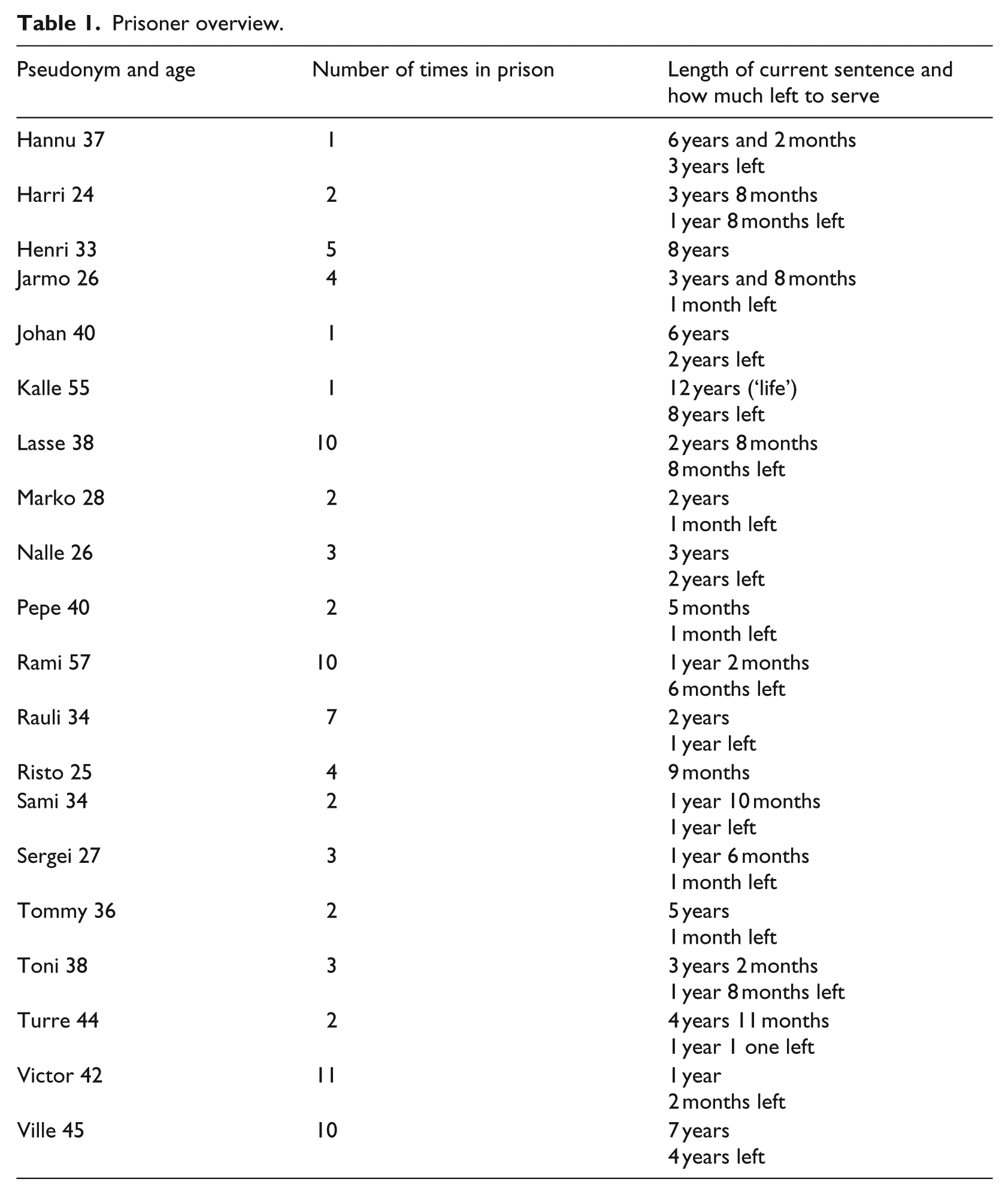
First, we look at the synthesizing activities in which inmates adjust to and develop prison’s temporal structures. We investigate how time is experienced by the inmates as they become subject to—and subject themselves to—the specific linear order of the prison frame, and we identify a range of activities that inmates develop to create meaning against the force of time in this suspension. Second, we turn to what happens when lived time can no longer be mediated and the relation between the dimensional and the linear order collapses. We explore the struggles and strategies that the inmates throw themselves into when naked time presents itself, both in feelings and in behaviors. We then turn to a discussion of how the insights from our prison data can be useful in understanding the affective dimension of time also in other organizational spheres.
Doing time: synthesizing experience with prison’s temporal structure
As total institutions, prisons function through a clear and tightly coordinated temporal structure that seems to be generic across prisons and time. Inmates follow exact temporal schemes for getting up, brushing teeth, breakfast, showers, meals, training, yard time, doors closing, and sleep (Meisenhelder, 1985: 50) and activities such as work, leisure, and education.
1
In Helsinki Prison, inmates’ days are scripted from an early start at 6 a.m. until late afternoon: My normal day means waking up at six, making some coffee, cell doors open at seven, I go for breakfast, socialize with others for a bit, then I go to work at eight. Our cleaning team takes care of the canteens in the complex. This takes a few hours so our workday usually ends after ten. Then we eat at 10.45. Yard-time starts at 11.20. If you want to train that day [weight-lifting], you walk. After that you go back to your block, hang around until evening yard-time that starts at 16.20. You get 30 minutes outside. Either you train or you walk. Doors close at 16.50 and the day is pretty much done then. I try to stay up until nine or so, watching TV or something and then get some sleep. (Victor)
Such temporal scripts constitute marked events that give the days and weeks routine and a structure, which makes time sequential and initially ‘help you adjust’, as one inmate (Jukka) related, potentially offering ‘a sense of progress through time’ (Meisenhelder, 1985: 49f.) Routines help inmates pass time and as another inmate puts it, ‘you lose your sense of time in here really easily […], weeks just fly by sometimes’ (Sami). This can be a desirable state to be in, in which the personal, experienced life that inmates come from is willingly contextualized in the keen linearity of their new prison time. For the majority of inmates, however, the stark contrast between temporal dynamics in the outside world and the regimented dominance of prison time structures creates a sense of shock and anxiety (Medlicott, 1999; Meisenhelder, 1985) that is not easily relieved. To reclaim a sense of control over their lives, inmates are forced to actively master prison time:
‘Do you control time or does it control you?’
‘In reality, it probably controls me, but I’m also trying to fight it back […] trying to make time go faster, making it more unnoticeable or kind of easy’.
The use of clocks underlines the point: Daily schedules are broadcast over speakers; beginnings and ends of activities are marked by sounds, wards, and speakers; and most days have the exact same structure and rhythm. In a manner of speaking, the total institution is the clock and inmates not only follow the clock but also struggle and aspire to become it. Enacting the temporal rhythms of the total institution, they become like the hands of a clock themselves (Calkins, 1970), a clock that renders prison time readable. This apparent surrender to the linear order of prison’s temporal regime is constructed through careful and diligent efforts by the inmates: they choose to synchronize with prison time rather than letting it rule over them, and thereby uphold a sense of agency and control of their lives. As Jarmo puts it, when asked about the meaning of ‘doing time’, It’s about doing things everyday like you have an internal clock … that you do everything at a certain time, punctually, and that you don’t deviate from that … every day is really the same and that’s probably why time passes quickly, you don’t even notice it. It’s about everything being as simplified as possible and you get everything you need out of it, in mind and spirit …
The intention that goes into synchronization activity is no small achievement. Synchronization is hard work. The times in the day when the prison clock does not dictate activity exactly, inmates synthesize their experienced time and the prison rhythm by making use of available activities, as expressed by Marko: ‘The institution sets the basic rhythm and then you have to build on it’. Apart from their practical value, work tasks and hobbies are important measures in the struggle to fill out the temporal voids that exist in between set activities. The inmates in the interviews mentioned an array of different activities that prove helpful when it comes to the individual entrainment with the pace of the prison environment, allowing them to ‘zone in’ and ‘forget all that other shit that’s constantly on your mind’ (Victor). The simple and routinized tasks involved in cleaning, for example, are mentioned by several inmates, and the way such tasks convey a sense of temporal agency is neatly summarized here: Sometimes it’s just so quiet that all you can do is to mop the floors. You kill some time with that. It’s like you decide to do something and then you do it. Time goes by and you work up a little sweat. There’s nothing else to do, you see. You get water into two buckets and then you mop the corridor. It takes about an hour. It’s like this sometimes. (Henri)
The most prominent method of synthesizing is weight lifting, a scheduled opportunity for inmates once (1 hour) or twice (2 × 30 minutes) a day. Inside that time slot, prisoners experience a measure of freedom: ‘The only thing you can plan is your training; that you can plan yourself’ (Ville). Several of the inmates explained how muscle training helps them, not only to take their mind of things and control latent aggression but also how the bodybuilding training regimen itself functions as a way of creating routines and individual synchronization with the daily pace in prison. Training schedules, with their shift between different muscle groups on different days, provide an embodied internalization of the institutional rhythm that makes prison time both visible and tangible on the body:
‘I don’t use calendars. My training schedule tells me which month of the year it is’.
‘You have this schedule on paper?’
‘No, it’s all in my head. I only write down what muscle groups I do in each session. I used to keep track of everything, the different reps and all but … I’ve been here for 12 years now … it’s all in the back of my head’.
What is at stake in these routinized activities is arguably something more than—or at least different from—the goal of the activities themselves. Cleaning and training help inmates feel the passing of time as something they own, and it builds flow. ‘It’s good that there’s a lot to do and there ain’t many breaks in between’, says Risto. Anything that takes the mind of the mediation of time is upsetting. If, for example, ‘your training session gets cancelled or something; that can really fuck you up, you start throwing things around and …’ (Marko). If a meal is late and it ‘messes with your training schedule […] it just messes up your rhythm … it really pisses you off’ (Nalle). As one inmate puts it, ‘If our weights are taken away, then we have a problem on our hands’ (Johan). In prison, any extra time you are awarded is not a gift, but an additional burden. Nobody wants to have time on their hands.
Chronopathic experience: waiting and the emergence of time as a source of suffering
If there is one experience that inmates’ everyday lives are fundamentally conditioned by it is waiting, not only do they wait for the day of their release but also for things to happen every day—endless amounts of waiting. Most inmates painfully described their frustrations and struggles with having to wait: You wait for your meals, phone calls, mail, at weekends you wait for visitors, it’s just waiting all the time … and then when you can go on leaves, you wait for them to come along. […] It’s really frustrating, waiting for everything. It’s a real tradition in here. (Harri)
Waiting is the first thing you must learn in prison. In waiting, inmates experience a chronopathic interruption, a rift in the artifactual flow of time. This generates an appetitive tension, or a pursuit of ‘something indefinite’, which inmates have little or no personal agency in satisfying: The days are so empty here that you wait for something to happen, like this interview for example. I knew that this interview would be at 12:00 and you kind of automatically keeping looking at the clock and thinking ‘why isn’t it 12:00 already’. You kind of wait for breaks in routine. When its morning, you wait for your eleven o’clock meal. Then in the afternoon, you wait for your four o’clock meal … so it’s all about waiting, waiting for something. At the weekends you wait for visits. Taking care of your personal matters also involves a lot of waiting, ‘why don’t they answer my requests already’ … You are constantly waiting for something. Nothing happens just like that. (Kalle)
The successful mediation of time becomes difficult to uphold. Efforts to integrate personal experience with the imposed linear scripts of prison time begin to show unintended effects of blurring: It becomes hard to tell days apart and to distinguish between events. Time is slowly stripped of the markers that were supposed to make it inconspicuous; it begins to appear external and hegemonic as boredom sets in: ‘… your routines, they start getting to you too; you get bored of them as with anything else in here …’ (Rauli). Ultimately, the hard-won sense of control begins to skid. Time once again comes to the fore, but now as a contentless passing without meaning: I remember during my last sentence, I spent a lot of time in my cell, in the same cell, and I used to look out of the cell window and the trees were green, and then the ground was covered with snow, and there were colors again, some green and some orange … I could, in a sense, have taken a photography of each moment … but everything in between is totally meaningless and … let’s say that your life stops when you end up in here. When you get out, you can carry on with your life from where you left it. […] They might as well invent some pill that would just make you older, it’s the same thing basically. (Marko)
In Marko’s haunting memory, time and its passing emerge as a mere fact and prison itself as its own warped and paradoxical universe, where nothing ever happens and nothing ever can happen. His words create the paradoxical impression of a time that is both passing and completely halted, of simultaneously being captured in prison time and lost in a sea of timelessness. Several inmates described similar feelings of being left behind, of losing the ability to act, and of being excluded from the life of others. In the words of Pepe, prison is ‘a vacuum of time. The clock ticks out there, but in here it means nothing’. There is simply no way of making ‘in-here’ correspond with ‘out-there’: It’s about really knowing that you’re in here; that your life is going to waste. That there’s nothing sensible to do, that you can’t accomplish anything … you kind of live this meaningless existence in here, it’s wasted time. (Toni)
Every bit of time in prison is measured against what it could have been used for on the outside—work, family, or just having fun. When inmates allow themselves to think about this, their time becomes wasteful and so do their lives, causing remorse and often longing. Time emerges as a source of suffering, half-registered with the powerlessness and muffled anger of someone living in a daze: You don’t have any feelings in here except for being pissed off and tired … and tiredness isn’t even real […] your emotions are all half-way … you feel nothing. (Tommy)
As the mediation of time collapses, the inmates are left with frustration and exhaustion. If they were ever used to perceiving themselves as causes for action on the outside, the emergence of chronopathic experience appears, to paraphrase Meisenhelder (1985), to reduce them to effects.
Chronotelic behavior: tricking, shunning, escaping time
Living in this uncanny if not nightmarish world, where time is perceived to be standing still, yet is passing away, creates antagonism. Time is the enemy, feared by inmates, as they lose their hold on it mentally and physically. However, such situations, we found, also create an imperative toward meaning. In order to survive, inmates draw on specific activities to exercise autonomy by creating ‘spaces’ in which the pressure exerted by chronopathic experience is suspended. Other prison studies have shown how inmates mentally ‘slip away’ to the world outside (see, for example, Wahidin, 2006); ‘turn[ing] to their imaginations in order to erect a personalized fantasy future’ (Meisenhelder, 1985: 52). Entertainment such as movies and games are the most typical examples of such chronotelic behavior, where the only goal is to make time pass more easily. Watching a movie, for example, is like you are away from prison for a while … away in your head … I can’t explain it any better. … There’s that short period of time when nothing can touch you. … It’s like … there is no time, you’re not in time, or in prison. You don’t think about prison things, prison routines, or anything. You’re free for a moment. That’s what it’s about. (Johan)
The freedom described by Johan, before anything else, is the freedom not to feel time, to momentarily give it a different meaning than the one penetrating, contaminating, and regulating body and mind. As the link with a meaningful flow of time becomes more tenuous, such behavior intensifies, for example, by creating focus: … we just do everything in more detail, slightly differently than you would outside, more attention to the specifics … I mean, it’s about making them days go by, getting them cycles up and running, right … Outside it’s different. Everything is a lot more random. (Lasse)
Every moment must be used and filled out so that time does not take over or rather that the artifactual flow of meaning created to pass time does not again give in to time in its indifferent facticity: ‘It’s about the small details; you have time to really focus on it, utterly’ (Victor), and if you have a game to play, you play from start to finish. You learn the game as well as possible; you go through all its features and then some extra … You have time to do it properly; you’re dedicated to learning the game in and out. You do it because you can and because that’s how you get the most out of it. (Marko)
What is arguably at stake here is not just synthetization; the integration of subjective time with the objective time of the institution. Rather, everything is invested in denying time its hegemony over life to the extent that activities lose any other teleological purpose. In chronotelic behavior, inmates shield their identity from time. ‘It’s like a trip to the sauna’, explains Rami, you go in naked, put the outside on hold and sweat it out, effectively nullifying your own identity until you can reengage with life: In here, you’re like in this time capsule; this is like being in a time-machine. […] There is no such thing as development in here, and if there were such a thing, it would have very little to do with what really matters. You can try to stay in shape and study but interaction with the outside world is shut down, time has stopped for you […]. You just jump out of the time-machine in a few months or years’ time and try to find your place again. (Rami)
This bracketing of worldly experience and needs until the sauna, the nightmare, the time capsule is over even prompts some prisoners to assume a ghost-like identity: Even my cell is quite spartan. I have a portable TV there, can grab it with me anytime, I don’t have a coffee maker, I drink my coffee cold, instant coffee with tap water. I eat my porridge cold, noodles cold, everything. […] I’m just visiting here. I want to remind myself that I don’t live here. […] You see, I know when I’m getting out and it makes me feel good and I don’t want to … I can just grab my TV in this hand and then I have this huge garbage bag and I have to be able to fit all my stuff in it, and I have to be able to move easily. (Hannu)
The inmate thus removes himself from the world, accepting the ‘degradation of reality and self’ (Meisenhelder, 1985: 53) that the nakedness of time obliges. Following the rules and rhythms with his surface self, he hides his sense of self deep inside, shields it even from contact with his own daily experience of existence, in the hope that he can unearth it and reclaim himself as a human being once he exists again in the real world. Reality splits in two—the factious passage of time and the precious innermost realm—which must, in harrowing paradox, be shielded from the experience of life in order to survive.
Discussion
In this section, we build on our analysis to explore the affective dimension of time. First, by tracing the negative dimension of time that emerges in the chronopathic experiences of the Helsinki prison inmates, we argue for a reconsideration of the affirmative practice- and process-based understanding of time in organization. Second, we turn to chronotelic behavior to show how an analytic focus on such activities may extend organizational research on the ‘dark side’ of affect.
Synthetization and chronopathic experience
Inmates in Helsinki Prison worked to produce an increased temporal flow and a sense of progress by adjusting to the temporal structures of the prison world. Such temporal work served a mediating function, integrating the inmates’ subjective continuity and dimensionality of past/present/future with the linearity of institutional time. This illustrates the intimate relation of the subjective and objective dimensions of time co-existing to support meaningful human existence. The ‘internal clock’, which one of the inmates (Jarmo) strove to follow, is not so much ‘objective’ time as it is a cipher of the constructive integration of institutional time with his own time, which allows him to survive prison. While the inmates were not able to dictate events, they fought time by ‘doing it’, by making it ‘their own’. Chronopathic experience ensued when this process of integration failed and the dimensionality of subjectively experienced time was shattered. Inmates described the temporality of the prison world as atomized, without a definite sense of an attainable future other than that which is imposed on them, the artificial and ultimately meaningless sense of prison as a ‘vacuum of time’ (Pepe) and time itself as simply meaningless and ‘wasted’ (Toni). Time in this dimension appeared foreign and monolithic, endowed with a life of its own, and yet as something to which every inmate had an intimate relation and was forced to reckon. In prison, as Victor Serge (1970) has put it, ‘the problem of time is everything’ (p. 30). The subjugating effects of being constrained by a time that must be made to pass, rather than flowing effortlessly, are magnified in prison, making time an obsession and arguably giving the inmates an exaggerated awareness of it.
The existential importance of the mediation of time highlighted by our study provokes a reconsideration of the practice- and process-based understanding of time in organization, which has emerged in recent decades. A core ontological assumption of such understandings is that time is not merely experienced subjectively and introspectively but is conceived as an inherently social phenomenon (Reinecke and Ansari, 2017; see also, for example, Hernes et al., 2013; Orlikowski and Yates, 2002). Time, from this perspective, is socially constructed, and ultimately affirmative of human existence. While reified clock time may appear objective, it is nonetheless socially produced and reproduced by actors as they weave together past, present, and future (Schultz and Hernes, 2013). However, such a perspective does little toward explaining what happens when such temporal mediations collapse. Our study extends this view by suggesting that chronopathic experience points to a more fundamental and negative dimension of time, where the processual construction of meaningful time is substituted for a radical experience of finitude. The general theme running through the accounts of the inmates in Helsinki Prison is ultimately about how to live through this situation, which corresponds to Theunissen’s (1991) conceptualization of the negative experience of time as pathological or simply as ‘fatal boredom’ (p. 305). Although we rely on the extreme context of prison to get to such experiences of the negativity of time, they are in no way exclusive to total institutions like prisons, but instead open up to a pathological dimension of human temporality in general, which as of yet has received only little attention in organization studies. Against this backdrop, we suggest that sensitivity toward the affective dimension of time may be helpful in understanding psychopathological decomposition in organizational life. Chronic time pressure, for example, is viewed as one of the greatest contemporary challenges (Kleiner, 2014; Rosa, 2003; Szollos, 2009) because of the effects that it has on behavior and decision-making in work organizations (Maule and Svenson, 2013), and because of its potentially detrimental health effects (Roxburgh, 2004). But while the notion of time pressure and related labels like time crunch (Zuzanek, 2004), time deficit (Bianchi et al., 2005), or time famine (Robinson and Godbey, 1999) suggest various ways of describing the experiential effects of time shortage, these terms do little toward an integrated understanding of how such shortages are affectively mediated. Furthermore, the notion of chronopathic experience, we suggest, may be helpful in establishing a broader understanding of time pressure that is not only restricted to time shortage proper but also encompasses the ‘time pressure’ experienced, for example, in unfilled aspirations, boredom and the sense of stagnation (Costas and Kärreman, 2016), stress (Roxburgh, 2004), or depression (Rosa, 2003; Wajcman, 2016).
Time as affect and chronotelic behavior
In the final part of our analysis, we traced the strange form of agency that chronopathic experience translated into, namely, chronotelic behavior. The role of time as affect in motivating or directing actors here emerged as an imperative toward meaning, which inmates struggled with in attempting to pass time. The activities enlisted in this struggle were very different, ranging from cognitive work (like gaming, studying, and writing) to embodied practices (like physical labor or bodybuilding), but had in common their function as survival strategies. Thus, the latent function of such activities was not the intrinsic value in becoming more skilled at something, as in playing a game (Marko), but to make the present tolerable. Structurally, this ambivalence can be explained, as Cohen and Taylor (1972: 89) do, by the fact that prisoners have been abstracted of their own time and have been given the time of someone else (i.e. the court’s) to serve instead. But as our analysis illustrated, it was also deeply related to the manner in which time emerged as affect in chronopathic experience. Interestingly, what emerged here was a subtle shift toward a class of goal-oriented behavior, which, we found, might appear like a regular activity, but ultimately designated ways of dealing with the affective pressure of finitude, of time passing away. The activities involved in this shift, like incessant attention to detail (Victor), were characterized by not primarily being concerned with a teleological purpose but rather with bracketing worldly existence, sometimes to the extent of denying such existence altogether and assuming a ghost-like identity (Hannu).
The importance of chronotelic behavior highlighted by our study adds itself to the discussion of affect as a co-constituting force of organizational life. First, while most studies of affect have a temporal dimension, given their intention to address the process through which affective forces emerge and unfold as a constituting factor in organization, they tend to treat time primarily as an always-already-available source of events. This is the case, for example, in studies of atmosphere (Borch, 2010; Michels and Steyaert, 2017), artistic intervention (Beyes, 2010), or cartographies (Steyaert, 2015). Our study suggests that approaching time as affect allows us to address how time emerges as an obstacle and threat to the unfolding of human existence. While prison represents an organizational context in which such obstruction is naturally accentuated by circumstance, chronotelic behavior arguably plays a role in any organizational context where people experience time pressure, whether this is understood as time shortage proper, stress, or more subtly as in boredom or depression.
Second, adding an analytical interest in chronotelic behavior to the study of affect in organization studies challenges the tendency in such literature to highlight the liberating qualities of affect (Pullen et al., 2017; Pullen and Rhodes, 2015). Our study adds to a strand of literature more critical of affect’s subjugating qualities (Philippopoulos-Mihalopoulos, 2013; for further examples, see also Fotaki et al., 2017), in effect contributing to the study of affect’s ‘dark sides’. Such a contribution has important implications for the study of boredom and meaning at work. Although it appears to be spreading, boredom has arguably been largely neglected in studies of workplace affect (Fisher, 1993; Loukidou et al., 2009). Making the link between boredom as a vocabulary for the subjective confrontation with ‘naked’ time and the chronotelic activities that people undertake to avoid this situation provides a new perspective on boredom’s many negative corollaries (Johnsen, 2016). Studies of boredom in organizational life illustrate how the bored vehemently and often at great costs turn against the organizational prescription and has been associated, for example, with alcohol abuse (Ames and Cunradi, 2004), work strain (Matthews et al., 2000), counterproductive behavior (Bruursema et al., 2011; Spector et al., 2006); accidents and injuries (Frone, 1998), lower job performance (O’Hanlon, 1981), stress (Broadbent and Gath, 1979), and depression (Wiesner et al., 2005)—just to name some of the documented effects. In this literature, boredom is associated with irrationalism and destruction. Focusing on chronotelic behavior provides another perspective, associating it with the loss of temporal agency and—more importantly perhaps—with the affective imperative toward meaning that such a loss entails. Such a perspective may help us better understand the temporal implications of some of the questions of depersonalization, which emerge as work in our societies assumes a total presence, demanding exterior signs of life and the feigned enthusiasm of the ‘dead man working’ (Cederström and Fleming, 2012). While ours is a first, explorative attempt at addressing time as affect in this manner, we hope that it will inspire future studies of how time simultaneously thwarts and co-constitutes the processes of organization.
