




Abstract
This article focuses on representations of the nexus of work, meaning and consumption as experienced by university students. We develop an empirically based argument that the meaning of work is being constructed as an object of consumption on a British university campus. We suggest that this indicates two key changes in representations of the meaning of work. First, there is a significant shift in the social construction of orientations to work towards what we term ‘consumption of work’. Second, we argue that this new social construction is made up of three dimensions: (1) consumption of an idealised image of work, (2) consumption through specific work processes and (3) consumption of self-development opportunities at work. We conclude by suggesting ways in which this argument could be researched further.
Introduction
This article begins from the position that analysis of the intersection of capitalism, consumption and higher education provides a key means of understanding contemporary social and economic life. The gradual withdrawal of many states from higher education funding in recent decades, especially in countries following a neoliberal political agenda, appears to have promoted more consumerist identity practices in students (Williams, 2013). Alongside this, the corporatisation of universities around the world has provoked commentators to question the nature of learning (Aronowitz, 2000) and the organisational forms that academic institutions develop (Prichard and Willmott, 1997). Questions about the future of the ‘house of knowledge’ (Calás and Smircich, 2001) are therefore both broad and intense. However, we rarely think about or hear directly from students in this debate in organisation studies (Tymon, 2013), or take their subjective experience of university life as a starting point for interpretive analysis of these dynamics.
This article presents analysis of student experiences on a British university campus based on a 17-month period of qualitative fieldwork. We focus on one key aspect of contemporary university life, the representation of employment opportunities. Such opportunities are usually presented under the discourse of employability (Williams, 2013). The practices associated with developing employability provide an ideal set of events within which to observe how students are encouraged to think of work and employment. Higher education ‘experiences’ in the United Kingdom promote labour market preparation as a key goal, and university campuses are increasingly characterised by the year-round presence of employers, going far beyond the long-established one-off recruitment ‘milkround’. Large organisations in particular maintain a continuous prominently branded presence that may be crucial in shaping what students aspire to and the worldviews they internalise (Ho, 2009; Monbiot, 2015). The university campus is therefore a key empirical context for analysis of how work is framed to this group of new entrants into the labour market. Previous research emphasises how analysis of employability is essential to understanding the aspirations being encouraged (Cremin, 2010), the identities offered (Holmes, 2013) and the social effects of graduate employment (Okay-Somerville and Scholarios, 2017). Here, we add to literature by offering an additional conceptual lens that draws on theories of consumption.
Consumption and work are entangled and increasingly blurred realms (Chertkovskaya et al., 2016; Gabriel et al., 2015). Classical modernist perspectives on work represented it primarily as a means to achieve consumption opportunities during leisure time (Gorz, 1985). It is now more common for work to be conceptualised as an accompaniment to the process of consumption (Rieder and Voß, 2010), or for consumption to be understood as entwined with work, the employment relationship and the process of production (Dale, 2012; Du Gay, 1996; Korczynski, 2007; Land and Taylor, 2010). Some go so far as to suggest the possibility of the consumption of work, implying that work itself may be an object of consumer choice (Bauman, 2005; Besen-Cassino, 2014; Jenner, 2004; Salomonsson, 2005). Our analysis is located within these latter perspectives, which challenge the binary separation of production and consumption or consumption and work, to understand how work is represented as a consumer object to a key audience, university students, and through that, to extend understanding of the work–consumption nexus.
In making this argument, we show how greater attention to framing work as a consumer object is visible in uncritical accounts of employer branding in the so-called ‘war for talent’. This hortatory promotional literature aimed at employers explicitly positions the university as a key space for employer branding practices that encourage the reframing of work as a consumer object. Following this, we outline our conceptualisation of consumption of work. After presenting our methodology, we continue with the analysis of empirical material collected on a UK university campus, with specific reference to the presentation and reception of the meaning of work. The article concludes with a restatement of our argument, and an outline of how it might be further developed empirically and conceptually.
Employer branding: fighting the ‘war for talent’
In managerialist literature, both academic and practitioner produced, employer branding refers to ‘a firm’s efforts to promote, both within and outside the firm, a clear view of what makes it different and desirable as an employer’ (Backhaus and Tikoo, 2004: 501). It is a practice that has been popularised by consultancy firms since the early 2000s, positioned as a necessary corporate response to the idea that corporate success relies on a limited number of talented individuals who need to be fought over in a ‘war for talent’ (Chambers et al., 1998).
This literature repeatedly emphasises the need for an ‘employee value proposition’ to sell the employer to potential and current employees (Chambers et al., 1998; Michaels et al., 2001). This proposition is divided into functional (e.g. salary, benefits) and symbolic (e.g. prestige, training, exciting experiences, social approval) aspects (Backhaus and Tikoo, 2004), and may also be referred to as ‘brand experience’ (Mosley, 2007) or ‘brand excitement’ (Sartain, 2005). Hieronimus et al. (2005) stress that attention to the symbolic is a new feature which distinguishes employer branding from longer established promotional recruitment practices.
The employee-oriented value proposition, according to commentators, must be actively promoted. To attract potential employees, managers are encouraged to apply branding techniques to recruitment (Hieronimus et al., 2005: 12). Employer branding is expected to stimulate associations that would make an employer attractive to potential recruits. The associations can be verbalised, but might also function at a more sensory level, with potential employees-consumers feeling something about the brand, experiencing emotional responses or sensory memories such as smell or taste (Backhaus and Tikoo, 2004: 505).
This suggests there are many ways in which organisations can encourage engagement in employer branding in the ‘war’. Temporary posts such as internships, on-campus presentations, formal and informal mentorship, workshops, dinners, career fairs, online games, prize sponsorship, media campaigns and advertising are all utilised (Hieronimus et al., 2005). Notably, these activities are directed primarily at higher education students as the next cohort of potential employees (Edwards, 2010); universities are key spaces for this branding to happen. The intensity of these branding processes suggests that work is positioned as a consumer object, at least rhetorically. Next, we outline our use of the concept of consumption.
Conceptualising consumption: commodities, signs and pleasures 1
Consumption may be understood in two interconnected ways: first, as a set of interlinked processes through which resources are objectified and given value, and second, as the processes through which commodities serve as means to satisfy human wants (Campbell, 1987). We focus here on the latter more social understanding of consumption, in which wants and aspirations are capitalised on as people are ‘encouraged to behave in ways that promote the logic of capital accumulation’ (Moran, 2015: 160). As Moran further argues, contemporary patterns of consumption promoted by large corporations are founded on notions of individualism, lifestyle aspirations and the possibility of achieving socio-cultural distinction. This chimes with Cremin’s (2010) psychoanalytic argument that employability, as manifest in the kinds of literature reviewed above, tends to bind the commodified subject to capital’s drive for profit.
All critical discussions of consumption and subjectivity begin with the notion of the commodity form. According to Marx’s (2007 [1867]) classical formation, the commodity form is specific to the capitalist mode of production, within which a commodity carries use value and exchange value. Use value refers to properties of the commodity that have the capability to satisfy human wants. However, at the same time, all commodities are a product of human labour. The commodity therefore also carries a value on the market – the exchange value – through which it acquires a degree of abstraction from use value: ‘when commodities are exchanged, their exchange value manifests itself as something totally independent of their use value’ (Marx, 2007 [1867]: 45). As a result, the products of human labour ‘appear as independent beings endowed with life … entering into relation both with one another and with the human race’ (Marx, 2007 [1867]: 83). For Marx (2007 [1867]), commodities above all satisfy human wants, whether these wants come, as he puts it, from stomach or from fancy (pp. 41–42). The mode of production, rather than the reason for or the purpose of consumption, is central to this part of his discussion of commodities. However, the constant creation of seemingly never-ending sources of human gratification has arguably made consumption one of the key driving forces in maintaining capitalism (Bauman, 2005; Ewen, 1976; Harvey, 2011; Moran, 2015). For this reason, contemporary theorists tend to speak of identities, aspirations and meanings when discussing commodities (Gabriel and Lang, 1996; Moran, 2015; Radin, 1996).
Gabriel and Lang’s (1996) classic analysis outlines a range of images of the consumer, which corresponds to different sources of gratification from consumption. ‘Communicators’ consume ‘to express social differences as well as personal meanings and feelings’ (Gabriel and Lang, 1996: 47). Within this category, to become an object of consumption the commodity ‘must first become a sign’ (Baudrillard, 1996 [1968]: 200) to enable a relationship, rather than the object itself, to be consumed. For the category of ‘hedonists’, gratification comes through pleasure derived in the process of consumption, which Campbell (1987) had divided into two types: ‘traditional’ and ‘modern’. Traditional hedonism relates to pleasure that comes from sensations attached to the senses (hearing, sight, smell, taste, touch); while modern hedonism is founded on a rise in comfort, which might dull pleasure from senses, but gives rise to it being stimulated in a different way – ‘less predictable, less comfortable, more dangerous’ (Gabriel and Lang, 1996: 104).
The consumption of work
From this understanding of consumption, our argument also builds on Radin’s (1996) radical extension of the notions of consumption and commodity to a wide range of aspects of social life. She wanted to understand the relationship of things to market, especially ‘things’ we think of as fundamental to meaningful human life, such as sex, bodies and other humans. Radin’s analysis is founded on the extension of markets into ever more areas of social life, and the political-economic assumptions as to our willingness to think in a monetised way about the social life we achieve through consumption. The commodified and uncommodified social meanings attached to the examples mentioned above were key to the possibility of framing them as (contested) commodities. In this section, we work with her notion of incomplete commodification (Radin, 1996) to explore the commodification and consumption of work as a ‘thing’, to argue that the consumption of work is not the oxymoron that it might appear to be. We then outline what consumption of work means by positioning it as an umbrella term that describes three ways in which work itself has become a consumer object. To do this, we read Baudrillard’s (1998 [1970]) Marxian account of commodification and work through Radin’s argument as to the probability of incomplete commodification even under the most enveloping market conditions.
Following Marx, Baudrillard began to unpick the commodified nature of work and non-work, through the idea that leisure activities might become competitive and more disciplinary in late capitalism, to the degree that work might become the place to recover from leisure. Baudrillard (1998 [1970]) allows for the possibility of work being consumed as in the consumer society ‘anything can become a consumer object’ (p. 157). However, in relation to work, he states, [N]on-economic demand for work is an expression of all the aggressivity that has not been satisfied in leisure and satisfaction. But it can find no resolution by that route since, arising from the depths of the ambivalence of desire, it here reformulates itself as a demand or a need for work and thus re-enters the cycle of needs, from which we know there is no way out for desire. (Baudrillard, 1998 [1970]: 185)
Baudrillard therefore sees a contradiction between needs and aspirations in the idea and activity of work as consumer object, with needs potentially being a means for satisfying a desire, but not being the desire itself. Work, according to him, lying within the realm of needs – that is, being something that one has to do – cannot be an object of desire and hence cannot be an object of consumption.
The concept of incomplete commodification (Radin, 1996), which allows for an understanding of the contested nature of commodities and their thing-ness, can help loosen the knots in which Baudrillard ties himself. For Radin, something can take the form of either commodity or non-commodity, depending on the meanings that people attach to them. This is based on Radin’s version of the distinction between work and labour (drawing on Arendt, 1958), where labour suggests the complete commodification of work when the activity is done purely for money and hence is experienced as something that one has to do. This is where Baudrillard’s (1998 [1970]) interpretation of the nature of work stands – in other words, for Baudrillard, work is always labour. For Radin, however, work, unlike labour, may have intrinsic or subjective meaning, and hence as an activity has the potential to be experienced as more than simply selling one’s labour power. This is manifest when we observe people willing to undertake some form of work even when financial motivation is lacking or when labour is given as a gift.
This suggests that looking at work as operating purely in the realm of needs provides only a limited account of why people work, in that meaning does not just belong to the transactional relationship of buying and selling labour. This is evident in the long tradition of social analysis of the meaning of work. A key insight from that debate is that meanings attached to work are socially constructed within certain cultural and ideological contexts (Anthony, 1977; Heelas, 2002). Concepts such as self-work (Heelas, 2002) and reimagined forms of the Protestant ethic (Bell and Taylor, 2003) draw on this insight. The analysis we present here speaks directly to that debate but from the analytical perspective of consumption.
Consideration of work as a source of meaning, however bounded, is therefore key to explaining how consumption of work is a generative way of understanding the contemporary representation of work. Our reading above of the managerialist literature on employer branding suggests that the meaning of work is being included as one of the targets of marketing practices. Consumption of work becomes a possibility when the meaning of work – rather than work itself – becomes an object of consumption, a commodity. The meaning of work becomes a commodity when it is produced under capitalist relations of production by material and immaterial labour of corporate employees engaged in building employer branding practices, and acquires an exchange value. This branded meaning of work becomes part of the exchange between an employer and a newly recruited employee. The meaning of work may be framed as a consumer object through its representation in an idealised image, through work processes, and via self-development opportunities at work. We deal with each of these in turn before setting out the research methodology our empirical work rested on.
First, the image of work refers to its representation as an object of consumption. The image of work carries sign values that may be transferred to people doing the work, which they in turn communicate to others. The image of work centres on a range of features such as corporate or employer brand, job, industry or profession. Images of so-called ‘knowledge work’ in particular may be used to represent a ‘glamourised’ life, even if the work itself does not live up to these images (Costas and Kärreman, 2016). Jobs in the banking industry may be associated with the sign values of luxury, status and prestige, which may give rise to elite individual identities (Alvesson and Robertson, 2006); other organisations may seek to create an image of themselves as cool, creative and fun (Besen-Cassino, 2014; Fleming, 2005; Land and Taylor, 2010; Reddy, 2016).
Second, work processes can refer to opportunities for consumption, accessed via the work process and experienced as pleasurable in themselves. This dimension of the consumption of work is closely connected to consumption of the image of work, with one feeding into the other. A significant amount of consumption is found in the world of investment banking, for example, during everyday working life (Ho, 2009). Similarly, organisations that promote ‘cultures of fun’ (Fleming, 2005) integrate the consumption of play into the work process. Consumption through work processes can also stem from the nature of work undertaken. For example, a certain way of dressing at work associated with the profession or the employer can demand consumption of specific clothing (Land and Taylor, 2010). The mobility offered by some organisations may open a myriad of opportunities for consumption. Although this mobility might come with senses of ambiguity, disorientation and loss (Costas, 2013), the consumption opportunities associated with it are designed to make work highly attractive for potential employees.
Finally, self-development opportunities at work provide another commoditised form which derives from the work process. Contemporary discourses of employability, learning and self-development position employees as agents who should continuously seek to increase their labour market value through self-development (Contu et al., 2003; Cremin, 2010; Heelas, 2002). Employees may feel a consumer pleasure from exercising some degree of choice in deciding how to do this, even if this is a limited choice from a specific ‘menu’ (Dale, 2012; Korczynski, 2007) designed to enable fulfilment of organisational goals. Self-development opportunities at work materialise in training, professional courses or diplomas, and in the experience of work itself (e.g. engagement in different projects or volunteering).
Notably, these three dimensions of work are interrelated and overlapping. This becomes clear in the empirical section below, in which we present our analysis of empirical material collected on a British university campus. The next section of the article describes the methodologies used to collect and analyse the empirical material to address this.
Researching consumption and work: methodology and method
The methodology of this study is informed by a critical qualitative epistemology, in the sense that both ‘reality and science are socially constructed’ and that power relations in society produce ‘hegemonic versions of reality’ (Johnson et al., 2006: 147). This perspective guided how consumption of work was conceptualised during data collection and analysis. In terms of method, we treat data as best interpreted through Denzin’s (1994) notion of critical interpretation. Throughout the processes reported here, we also sought to reflect critically on the methods, methodologies and research process. Part of that involves systematic reflexivity (Fournier and Grey, 2000), with the intention of examining the purpose of the research and our positionalities within it. The data presented here were generated during the first author’s doctoral degree. Pre-graduation we worked together, as research degree student and supervisors, to develop the analytical frame. The first author then developed the analysis through a series of critical conversations and readings of drafts. This jointly written article is one of the outcomes of that work.
The empirical material was collected during a 17-month period at a British public research university we call Aimfield. Aimfield is usually categorised as a ‘Top 20’ institution in British rankings; it gained university status in the 1960s during the first significant state-led expansion of higher education in the United Kingdom. There are currently around 16,000 under- and post-graduate students on campus, which positions Aimfield as medium-sized in the United Kingdom. The university is often represented by marketers, staff and students as oriented towards practical skills and industry as well as knowledge production and higher education. As Aimfield often appears at or near the top of rankings related to employability, we approach it as a ‘paradigmatic case’ (Flyvbjerg, 2011) for studying the representation of work at UK universities.
Our analysis focuses on data from three empirical sources:
Documentary material gathered during careers fairs. Recruitment brochures demonstrate how employers wish to present their organisations and their employment practices. They are tangible objects which students collect at employers fairs and therefore are worthy of analysis.
Interviews with staff of the Careers and Employability Centre (CEC) and analysis of the CEC’s career-related materials for students. The CEC is the main source of information, the contact point on career-related issues and the main organiser of employability and recruitment activities at Aimfield. Analysis of their activities gave us an opportunity to understand employer presence on campus and individual interpretations of career-related processes from within their construction.
Repeat interviews with students. We conducted three stages of interviews with 15 students during their key period of job search and engagement, in the last year of their studies and into the start of their working lives. In addition, one-off interviews were conducted with three students. This material is key to showing how the students received and acted upon the representations of work and employment on campus.
The repeat interviews in particular provide a nuanced picture of students’ interpretations of the meaning of work. They also helped reveal contradictions and inconsistencies in students’ accounts, which both challenged and enriched our interpretation. Table 1 provides a summary of the empirical material used in this article.
Empirical sources.
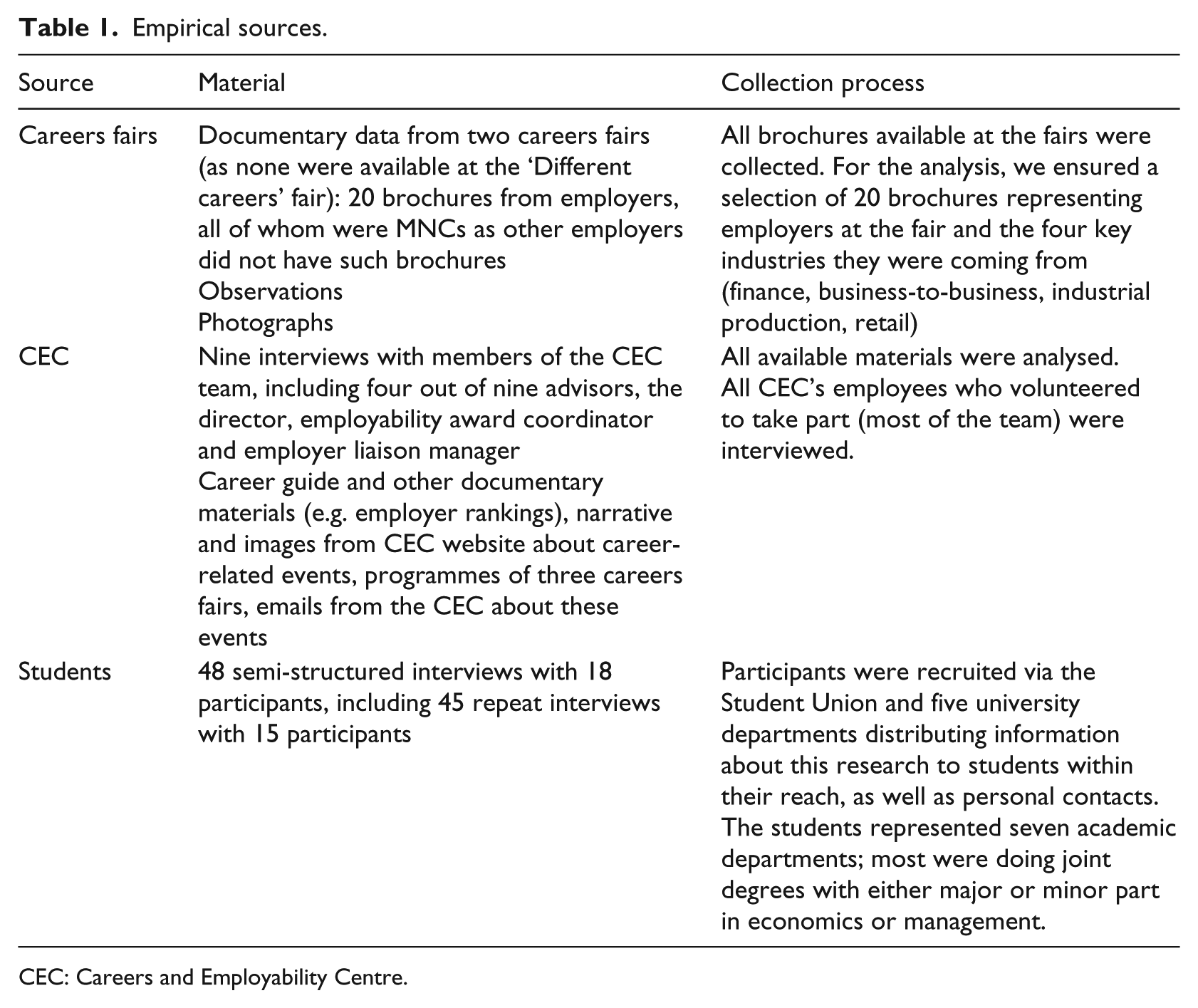
CEC: Careers and Employability Centre.
The empirical material was coded via an online programme Dedoose. Before coding, socio-demographic characteristics (gender, nationality, ethnicity, class, programme, interview stage) were added to allow checks for any potential differences or similarities. Codes were assigned through a close reading of interview transcripts and recruitment brochures. Codes pointed to themes present in empirical material, serving as descriptive categories that help understand the text itself. Each theme was then analysed in detail, during which a dialogue developed between the descriptive categories from the empirical material and emerging categories in the conceptual framework. All personal names used are pseudonyms.
Representing work on campus: presence and print
Reaching for the ‘top’: large organisation presence on campus
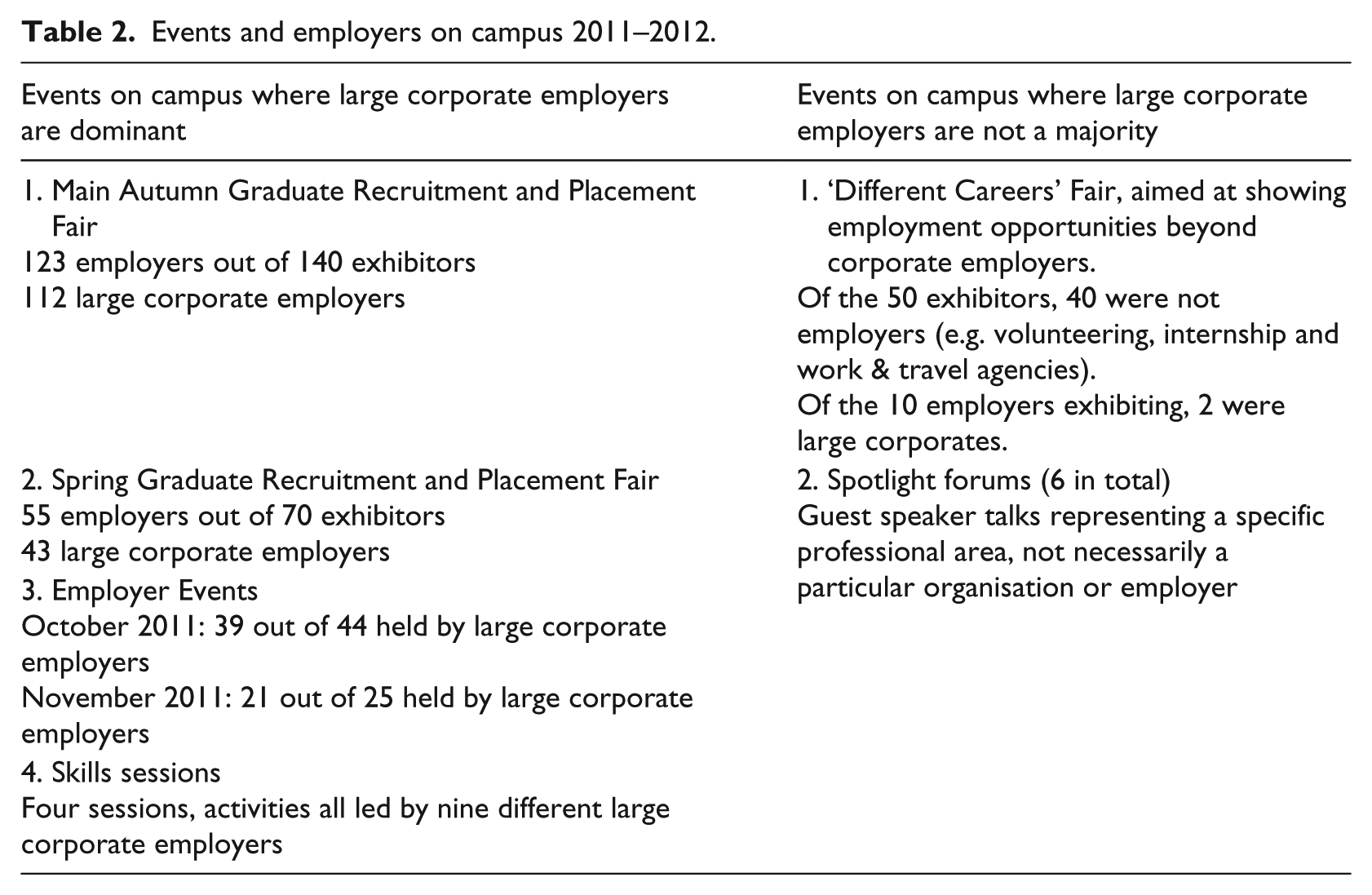
Large corporate employers and a very narrow range of prestige professions maintain the greatest presence in the wide range of career-related events that take place on Aimfield campus. Other employers, such as smaller organisations, the public sector and less prestigious professions, have only a marginal visibility. Around 80% of organisations taking part in recruitment events and 90% of organisations with a presence as potential employers were large corporations (see the summary in Table 2).
Events and employers on campus 2011–2012.
Despite this overwhelming dominance, the CEC director noted that large corporate employers will not provide jobs to most graduates: I think one always has to go back to the fact that 80% of all graduates are employed in companies outside the big companies. The medium-sized companies are where most graduates will end up.
This is puzzling, given how visible large corporate employers are and how they are presented as ‘top’, as in this email reminder: 140 TOP employers will be visiting Aimfield for one day only to attend the BIGGEST careers fair in the [region]. This fantastic line up of companies are coming to the careers fair in the hope to recruit a[n] Aimfield student or graduate which could be YOU!! (email to students, 18 October 2011)
The semantic emphasis contributes to the creation of a specific sign value. Being ‘top’, and ‘TOP’, implies quality, prestige and special status. In contrast, the Different Careers Fair is presented as ‘very different and exciting’, but definitely not ‘top’: This is a very different and exciting careers fair and we have invited a range of organisations here to give you access to information, advice and opportunities in sectors ranging from Art & Design to Charities and from Sport to Summer Work and many more … (email to students, 5 May 2011)
A potentially positive sign value of difference is constructed around this alternative careers fair, but its visibility on campus is very limited. Furthermore, this sign value is not reinforced in other career-related materials and events.
Brochures also contribute to the differential sign value of large corporate employers. Employer rankings like The Times 100 Graduate Employers, The Job Crowd Top 50, or the Top 50 Placement & Internship Employers from Ratemyplacement.co.uk, as well as the Aimfield Careers Guide 2012, consistently present large corporates as ‘top’. Indeed, there is no information about any other type of employer in Aimfield Careers Guide 2012. Even though CEC literature emphasises that staff can help students with a range of employment routes, the ideal workplace that is explicitly portrayed in their materials is very specific.
Literal and symbolic marking of large corporate employers as superior to all others was also present in the way the CEC staff spoke about the spring graduate fair: In terms of employers [at the fair], the list was fantastic, and therefore that attracted others, and therefore that attracted students. The best, the good names that you can get there, the more of them you can get, the more successful the event will be … (Linda, CEC Employer Liaison team)
However, even within the elite group, some employers are described as more ‘top’ than others: There are the tough, very top end employers … we may have an entrée with some of the banks, where students may go into, say, operations, rather than front desk investments. But that’s fine because we’re playing to the strengths of the students. So, we wouldn’t necessarily say we have investment bankers, but we have students who go into, say, the operations or back desk functions with the investment banks. (CEC director)
Observations suggested that banks got most attention from students; there were often long queues of people waiting to talk to them at graduate recruitment fairs and they ran out of brochures very quickly.
To sum up, large corporate employers are more visible on campus and are presented to students as ‘top’ employers. Our findings here echo existing analyses of the construction of elite organisational and individual identity (e.g. Alvesson and Robertson, 2006). Through this process, large corporate employers gain an exclusive sign value as ‘top’ not associated with any other employers. Therefore, if someone wants to work for a large corporate employer, primarily because of it being represented as ‘top’, we would suggest that the person is consuming this image of work and its associated sign value of ‘top’. We will now look at representations of work in recruitment brochures, as a means of understanding the visual promotion of an image of work.
Representations of work in recruitment brochures
Representations of work in recruitment brochures were constructed around three dimensions. ‘Top’ organisations constructed sign values around their brands, such that the organisational brand becomes an image of work to be consumed. Some make products central to communicating sign values. Aston Martin’s brochure cover features only the corporate logo on a white background, while all images inside feature cars. Their sign value might be associated with style, status and conspicuous consumption. The brochure is implicitly stating that employees of the organisation can share this sign value, even if they do not own an Aston Martin (as, presumably, most of them do not).
The sign values often apply to corporation, sector and profession. Banks and management consultancies – organisations such as Nomura, RBS, Morgan Stanley, Citi, Accenture, HSBC, Ernst & Young – use logos and images of ‘typical’ workspaces in their brochures – predominantly office spaces in skyscrapers and a small area of the City of London (see Plates 1, 3 and 4). These visual clichés highlight the sign value of status, success and prestige associated with the corporation and the sector, and imply that this sign value can be acquired through work.

Nomura’s Europe careers webpage.
Some corporations also promote a sign value associated with the organisational brand through slogans. For example, the front cover of Amazon’s brochure states, ‘Work hard. Have fun. Make history’, the company’s motto. This constructs employer brand as having a sign value of being fun and important at the same time, hinting at a specific culture that is supposed to encourage creativity and authenticity.
Commodification in work processes
Access to consumption through work processes was highlighted in all the brochures examined. It is associated with a certain lifestyle accessed at work. All employers emphasise opportunities to engage in an ethical lifestyle, through at least one but no more than two brochure pages devoted to corporate social responsibility practices. CapGemini (2012), for example, claims, Our Community programme provides graduates with lots of opportunities for involvement; past activities have included transforming a network of run-down footpaths through our support of Raleigh, mentoring young offenders as part of our work with the Prince’s Trust and trekking from coast to coast in Costa Rica to help change the lives of the UK’s most disadvantaged young people. (Graduate programme brochure, 2012: 13)
This appears designed to appeal to students who wish to engage in socially important activities at work, as well as offers a sign value that can be communicated to others. It highlights another consumer lifestyle feature to which employers provide access: opportunities for travel and adventure, intrinsic to the work of extremely mobile elites (Costas, 2013). Nomura’s graduate brochure front cover depicts a globe as well as the usual office buildings. Within the brochure, key landmarks such as the Eiffel Tower, ‘Leaning Tower’ of Pisa and Taj Mahal are prominent (see Plate 1). This demonstrates the scope of operations and opportunities for working and travelling globally. PwC’s front cover (see Plate 2) depicts people surfing, with the slogan ‘It’s the experience that stays with you’. Throughout, all pictures show a dynamic lifestyle of travelling and adventure. In contrast, photos depicting the mundane realities of work or organisational space are completely absent. Students are repeatedly framed as modern hedonists, experiencing pleasure from the variety of activities (including challenging ones) available through work.

Front cover of PwC’s 2012 graduate brochure.
Self-development opportunities at work
PwC’s slogan ‘It’s the experience that stays with you’ implies not only the opportunity to consume through work processes by having access to adventures and travelling but also the possibility to consume self-development opportunities at work. HSBC’s slogan ‘Discover HSBC. Discover Yourself’ (Plate 3) and Accenture’s ‘Be > You Imagined’ (Plate 4) are good examples of presenting self-development opportunities as part of what is offered for consumption through employment.

Front cover of HSBC’s 2012 graduate brochure.

Front cover of Accenture’s 2012 graduate brochure.
At PwC, for example, ‘you’ll learn most from an outstanding variety of work, picking up business, personal and technical skills you can use across PwC and throughout your career’ (PwC Graduate Brochure, 2012: 21). It is remarkable that in these brochures, discovering oneself or becoming more than one imagined is always framed in terms of self-development tied to work and potential for career progression. The opportunities for self-development are positioned as key to achieving the never-satisfiable employability ideal (Cremin, 2010), and as a space for exercising choice.
Although the organisation provides all these opportunities, ‘enabling’ employees to develop, it is their own responsibility to achieve, as can be seen in the quote from the HSBC’s Graduate Brochure (2012: 16): Your own progression and growth is solely down to you, you have to drive your own development. There are, however, plenty of people to help you with this. Programmes are designed to push and test individuals to get them to draw on skills and strengths they never knew they had.
In short, on the basis of the analysis of employer presence on campus, as well as recruitment brochures, we would conclude that consumption of work was a dominant representation of work on campus. We now consider how these presentations of the image of work were received by students.
Representing work on campus: student interpretations
The interview data suggest that on-campus events played an important role in developing students’ interpretations of work. This empirical material also shows that there were other factors shaping students’ orientations to work. There was a dominant pattern that corresponded closely to the commodified framing of work as an object of consumption, but it could be rejected by students too, as Archer’s case demonstrates. Archer summarises various dimensions of the corporate ideal of the work–consumption nexus when referring to what he used to think was a good job: A: … when I was young I was picturing myself, you know, working in a big company, wearing a suit and stuff like that [laughs] IR: When was that? A: I was like fifteen-fourteen, I’d say. I wanted to be a consultant. I didn’t even know what a consultant was, but I wanted to be a consultant in a big company … and I wanted to travel the world and work in many countries and stuff like that – and learn languages and experience different things. But [laughs] it changed a bit.
First, Archer refers to two aspects of work that carry sign values – the consultant identity and employment with a large organisation. Second, he speaks of work being attractive in part because of consumption opportunities provided in the work process. Third, he talks about an opportunity to develop. Such an opportunity – whether provided by formal training or through travelling the world for work – may be understood as an opportunity for development of the commoditised self through work. It is also something that makes work attractive.
Archer’s description of work corresponds closely to the dominant representation of work on campus and is also based on an image Archer brought to the university. This suggests that work may be represented in this way in a range of contexts. When asked of the provenance of this image of work, Archer nominated movies as a key influence – unsurprisingly, given the prevalence of representations of work in this way in popular culture (Bell, 2008; Rhodes and Parker, 2008). However, despite the dominant representation of work on campus, Archer’s ideas changed while a student. At the time of the interview, he wanted to work as a renewable energy engineer and ‘do something nice, something good for the environment, for the society’. The change came with him ‘learning about what the guys in the suits were doing’, especially environmentally and socially destructive corporate practices. He also explained the change by not attaching a big importance to career and money, claiming that as long as he had a base to be able to live comfortably, he would prefer to make a social contribution in work. Throughout the interviews, Archer was primarily focussed on talking about the job itself – the purpose of the profession, the craft aspect of it and environmental challenges. Moreover, he was not particularly attached to certain organisations, their brands or a specific size of employer. What Archer came to be critical of, however, was embraced by the majority of students – as we see below.
Consumption in the image of work
The vast majority of our student participants were interested in working for large corporate ‘top’ employers, perceiving them as the best places to work at. The employer’s status as large or international was often a sufficient reason in itself for students to apply to work there. Andy demonstrates this well: So for ideal job, at the moment I’m interested in HRM, so I’m trying to apply for obviously HR positions, and basically the bigger the company the better.
He showed flexibility with regard to the type of work he would prefer, but none with regard to the size of the employer: Well, I’m trying to keep the plank quite high. Cause I don’t know, I feel like yeah, keep applying for big companies or internationals, and then after I’m really pressured, like after this year, if I don’t get a job, I’ll go for masters. If I don’t get a job then, that’s when I’m gonna lower my plank. Well, I think for now, you should go for as high as possible.
In contrast, Melanie did not want to work for a big organisation, as these elements were associated with a corporate and impersonal environment, of which a suit was a symbol. Like Archer, she stressed a lack of interest in money, wanting only enough to live on while doing something that she enjoyed. With a lot of work experience by the time of graduation, she already knew work had to be connected to her passion for professional sports and the ability to work autonomously or on her own, which, as she thought, was not something the big companies could offer – despite the representations described in the previous section.
Organisational brand was often present in student accounts. For example, Beatrice noted, You know I like – [laughs] – I like to think that my parents would be proud, you know. Saying oh my daughter works somewhere, they’d go oh, where? … the chances are the kind of people they talk about it – would know what organisation – so yeah, there’s that side of it.
Peter spoke in a similar tone, of wanting to work for an organisation with a sign value that can be communicated to others. After graduation, he found a job in sales in a small company near home. However, when interviewed a couple of months later, he was already actively applying to other places, saying that he wanted to work for a global company. One of the main explanations of his desire to move was that the company he worked for was not well known – it had no brand sign value: … if I told you I work for [name of the company], that doesn’t mean anything to you. You know what I mean, it doesn’t resonate. There’s no prestige about it at all. I mean I don’t feel any ownership of it. I just feel as if it’s a young person’s job sort of passing through. Um, possibly paying off debts. Possibly in between travelling or saving up to do something. I don’t think it’s a long-term job, you know.
The sign values of the brand, or the size of the organisation, were often complemented by additional value-laden objects. For example, Beatrice talked about the suit and tall buildings as adding to the sign values of status and prestige associated with large corporate employers: I don’t think I had a particular job in mind when I was younger. However, the business – business has always been a theme ever since college. I just imagined myself in a suit. You know like working in a very, very big – you know even now that I go to London I still admire the big tall buildings that people go in and out. And, you know, I’m like, one day I want to work for you [laughs].
Beatrice also refers to the financial sector as the most attractive. This was a clear pattern in student accounts; for many, the financial sector more than any other had a desirable aura constructed around it. As emphasised above, though, not all students embraced these sign values uncritically. For example, Auriel describes her work preferences in opposition to the popular choice of finance or banking: … cause I’m doing Economics, and it involves maths, people usually pre-think oh, you’re doing Economics, you wanna be a banker. I don’t want to be a banker, you know, I’m interested in research, and how research could be applied to affect everyday life.
Consumption in work processes
The opportunities to access consumer lifestyles through work were something to which students were consistently attracted. Peter explains how it is exactly the consumption through work processes that makes the image of being an investment banker attractive to him: … I love the sort of image that it will put up, you know, ‘yeah I’m a banker, and drink at this sort of coffee house and got a leather briefcase’.
The experience and object underpin the image of an investment banker, providing a motivation to choose the profession. Consumption through work processes also included consumption not connected to the image of work. Lyle, as a new employee in a major computer technology corporation by the time of the third interview, had already experienced access to consumption in work processes: All the new recruits, all the new teams that were recruited for those offices, everyone was there put into the Malaga office where we had our training and we were put up in a hotel, all expenses paid – taxis, food, clubbing, everything was paid for by the company.
What the employer paid for during the trip is associated with a certain lifestyle of consumerist abundance, where all is notionally free, which can give both hedonist experience for consumer-workers and signify a certain status.
Our interpretation is that there is more to Peter’s and Lyle’s aspirations than just a desire to earn a lot of money to gain access to consumption. In both cases, the object of consumption is tied up with work itself. Peter had access to money through his current job but this was not sufficient for him.
Apart from the desire to have access to both status and consumerist lifestyle in work processes, many students wanted their work to provide travel opportunities, to work globally and visit the world through work. This was a key reason behind Derek’s choice of job application: I also applied for John Lewis, as a buying and merchandising graduate, and the reason I applied for that is because that was what my dad used to do. He had a successful career as a buying-merchandising manager for a number of companies. When I was younger I always thought that was a brilliant job cause he got to travel around the world, met lots of people, you know had a really good time as well as working, paid well, it just seems like an attractive job so I applied for that. But there’s no one area or one specific kind of thing that I’m looking to be employed in. As long as it’s … fun job, I’ll be happy to give it a try.
Derek talks about work as more than just labour, as a place where he would be having ‘a really good time’. Travelling and meeting new people would contribute to a job being fun, a source of hedonist experience.
Students often referred to travelling when talking about ideal life situations, in response to a question regarding what they would do if they did not need to work. Work that involves travel would bring them closer to this ideal. Manifestations of this dimension of consumption of work were challenged by only one student. Archer, as we saw earlier, was ironic about travelling and seeing the world as something that makes a job desirable. Other students did not question the desirability of opportunities to get access to consumption through work processes. The same pattern in the empirical material applied to students consuming self-development opportunities, as we see immediately below.
Consumption in self-development opportunities at work
Students argued that it was important that work should provide opportunities for self-development, as one of the key criteria for choice of work. Jolene explained her choice of working in corporations rather than going into teaching, another option she was considering: I think I want to be in education for longer. So with the job that I’ve chosen … it also means I have to carry on learning so I’ve got another like fifteen qualifications I need to get and stuff. And I think that’s my main thing. Like obviously with teaching you have another year … and you’re in it forever. But I wanted to carry on studying. But I didn’t really want to do a Masters. Not yet.
Jolene likes the idea that she would gain various professional qualifications and hence appreciates the opportunity of learning offered by large corporate employers. They can be a source of modern hedonism, where pleasure comes from the potentially challenging but exciting experience that the consumption of such self-development opportunities provides. They can also provide the signs of her employability to be communicated to the future employers. The value of work therefore lies in the learning opportunities it provides as commodities, with the pleasure and potential for communication they provide. At the same time, Jolene compares learning within employment with the educational experience she could have doing a teaching qualification or a masters degree. The main difference is in the number of years she would be spending in each, with longer exposure to learning as a preference. However, she does not touch upon the content of the experience that these various learning opportunities will provide. It is continuous self-development work that students like Jolene are oriented to. Their idea of learning is framed via training and experiences provided by large employers, but content was a secondary issue – students hardly specified what they wanted to learn from them.
If a job lacked formal training opportunities, students expressed lack of satisfaction. Kelly initially resisted the idea of working for a large corporate employer and found a job in a small marketing company. During the third interview, despite being satisfied with what she was doing and being given responsibility, she was already looking into graduate positions with large employers. Lack of training was the primary explanation for her desire to change: I think I see myself here, maybe, for not much longer than a year. Uh, just because of what I mentioned earlier. We don’t get much formal training, because it’s a very small agency [and] there’s not much structure. And whilst there’s a higher chance that you’d be promoted quicker, I think I would benefit a lot from being in a larger company and, kind of, learning from a more corporate structure, perhaps. So I’m actually looking into maybe a grad scheme.
When asked what training she wanted in a larger company, Kelly referred to areas that had no direct relevance to her current work focus. She had a position in marketing and stated that she thought she lacked training in management, economics and accounting. Again, the presence of formal training at work rather than its content is important. Kelly ascribes meaning to work in relation to the consumption of self-development opportunities that it provides.
Concluding comments: commodifying work, consuming work
Our theoretical purpose in this article is to develop the idea of ‘consumption of work’, through analysis of the empirical material gathered on a British university campus. We have worked throughout with the definition of consumption as commodity-based, to argue that it is possible for work itself, especially its meaning, to become an object of consumption. The notion of incomplete commodification (Radin, 1996) was key to this as it helped resolve the theoretical puzzle of the (im)possibility of work being a consumer object articulated by Baudrillard (1998 [1970]). Consumption of work is visible, we have argued, in three key ways: (1) consumption of an image of work, (2) consumption through work processes and (3) consumption of self-development opportunities at work. We have noted the central significance of practices such as employer branding, and showed in detail how the consumption of work was promoted as a key way of approaching employment on campus.
Whether we can also use consumption of work as a way of understanding the meaning of work in other forms of employment (e.g. self-employment, freelancing, volunteering) is an important question. To address this issue, the specific practices, such as employer branding, would need to be examined, especially whether, and how, they construct the meaning of work as an object of consumption within these forms of work. In addition, the contemporary university, which has been the physical focus of our study, is a complex organisational space. There are other processes – such as the education process, student societies or enterprise centres – which may contribute to representations of work on campus, but which have not formed part of our empirical material. Understanding these better may add to representation of the meaning of work as a commodity, or indicate how work is framed differently.
Our analysis here has also raised questions regarding the extent to which the consumption of work may be presented to students prior to their time in higher education. Some of our empirical material indicated that students have embraced consumption of work prior to being exposed to employer branding practices on campus. This theme clearly deserves more attention. Hence, addressing how ideas about work are constructed in other spheres than employer branding (e.g. in the media and popular culture, in pre-university education or within families) and how they relate to the consumption of work would be fruitful avenues for further investigation.
These further research possibilities relate to our central conceptual discussion on the ways we might bring together the idea of work, consumption and representations of work. The possibility that work can become an object of consumption has been frequently alluded to (Baudrillard, 1998 [1970]; Bauman, 2005; Besen-Cassino, 2014), but not adequately conceptualised. In doing this, we have also suggested that consumption of work may constitute a new way of framing work. Our analysis suggests that students are encouraged to approach work itself, especially work in large multinational corporations, as a consumerist opportunity, thereby transforming work into an individualistic, lifestyle-oriented social practice of distinction that supports and reproduces the social logic of capitalism.
Footnotes
Funding
The author(s) received no financial support for the research, authorship, and/or publication of this article.